Random Variable and
Probability Distribution
by:
Kathleen Joyce G. Villaroza, LPT
Topic 1
Understanding Random Variables
•Sample Space: This refers to the complete
collection of all possible results that can occur
from an experiment. For example, when flipping
two coins, the sample space includes the
outcomes: HH, HT, TH, and TT.
•Variable: A variable represents a feature or
property that can take on various values.
Typically, we use uppercase letters to symbolize
these variables.
EXPLORING RANDOM VARIABLES
•Random Variable: A function assigning a
real number to each outcome in the sample
space.
Its values are determined by chance,
reflecting randomness.
Normal Distribution
by:
Kathleen Joyce G. Villaroza, LPT
Project analysis slide 2
Normal Distribution
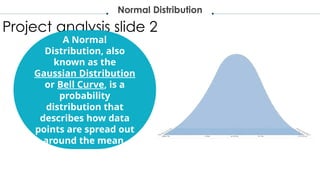
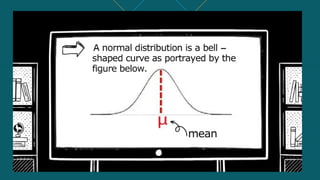
A Normal
Distribution, also
known as the
Gaussian Distribution
or Bell Curve, is a
probability
distribution that
describes how data
points are spread out
around the mean.
Mean = median = mode
The normal curve is a bell-shaped and symmetric about the
mean
The area to left of the y-axis is 50%
and the area to right of the y-axis is 50%.
The total area under the curve is equal to 1 or 100%
The two end tail of the curve never touches the x-axis as it
extends from the mean.
Properties of
Normal Distribution
Area under the
Normal Curve
Project analysis slide 2
Case #1:
Finding the Area from
0 to z-scores
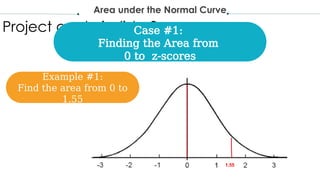
Example #1:
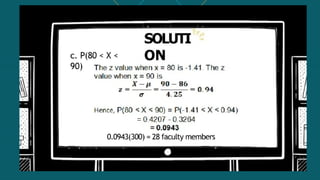
Find the area from 0 to
1.55
1.55
Area under the Normal Curve
Project analysis slide 2
Case #1:
Finding the Area from
0 to z-scores
Example #1:
Find the area from 0 to
1.55
1.55
Area under the Normal Curve
Project analysis slide 2
Example #1:
Find the area from 0
to 1.55
1.55
O
Z = 0 ; Z = 1.55
A = 0 + 0.4394
A = 0.4394
A = 43.94%
Area under the Normal Curve
Project analysis slide 2
Normal Distribution
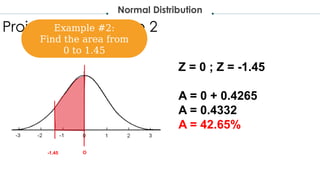
Example #2:
Find the area from
0 to 1.45
-1.45 O
Z = 0 ; Z = -1.45
A = 0 + 0.4265
A = 0.4332
A = 42.65%
Project analysis slide 2
Normal Distribution
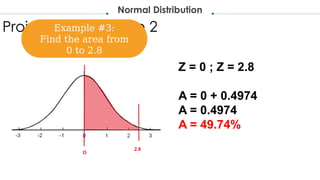
Example #3:
Find the area from
0 to 2.8
2.8
O
Z = 0 ; Z = 2.8
A = 0 + 0.4974
A = 0.4974
A = 49.74%
Project analysis slide 2
Normal Distribution
Example #4:
Find the area from
0 to -0.25
-0.25
O
Z = 0 ; Z = -0.25
A = 0 + 0.0987
A = 0.0987
A = 9.87%
Project analysis slide 2
Case #2:
Finding the areato the
left/right of z-scores
Area under the Normal Curve
Note:
Area to the left of (+)z-score
Area to the right of ( - ) z-score
Area to the left of (-) z-score
Area to the right of ( + ) z-score
subtract 0.50
add 0.50
Project analysis slide 2
Case #2:
Finding the areato the
left/right of z-scores
Example #1:
Find the area
to the left of 1.55
1.55
Area under the Normal Curve
Project analysis slide 2
Normal Distribution
to the left of Z=1.55
A = .50 + 0.4394
A = 0.9394
A = 93.94%
Example #1:
Find the area
to the left of 1.55
1.55
Project analysis slide 2
Normal Distribution
to the left of Z= -1.37
A = .50 - 0.4147
A = 0.0853
A = 8.53%
Example #2:
Find the area
to the left of -1.37
-1.37
Project analysis slide 2
Normal Distribution
to the right of Z= 2.75
A = .50 - 0.4970
A = 0.003
A = 0.3%
Example #3:
Find the area
to the right of 2.75
2.75
Project analysis slide 2
Normal Distribution
to the right of Z = - 0.82
A = .50 + 0.2939
A = 0.7939
A = 79.39%
Example #4:
Find the area
to the right of -0.82
-0.82
Project analysis slide 2
Case #3:
Finding the area between two z-
scores
Area under the Normal Curve
Note:
Area bet. + and +
Area bet. – and -
Area bet. + and -
Area bet. – and +
subtract the two
areas
add the two areas
Project analysis slide 2
Case #3:
Finding the area between two z-
scores
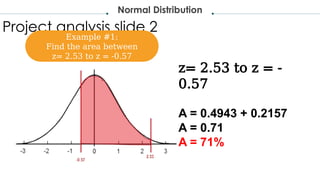
Example #1:
Find the area between
z= 2.53 to z = -0.57
2.53
Area under the Normal Curve
-0.57
Project analysis slide 2
Normal Distribution
z= 2.53 to z = -
0.57
A = 0.4943 + 0.2157
A = 0.71
A = 71%
Example #1:
Find the area between
z= 2.53 to z = -0.57
Project analysis slide 2
Normal Distribution
z= -1.75 to z=
0.10
A = 0.4599 + 0.0398
A = 0.4997
A = 49.97%
Example #2:
Find the area between
z= -1.75 to z= 0.10
-0.82
Project analysis slide 2
Normal Distribution
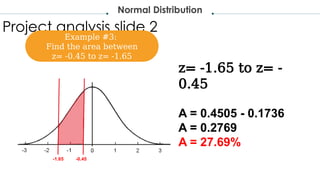
z= -1.65 to z= -
0.45
A = 0.4505 - 0.1736
A = 0.2769
A = 27.69%
Example #3:
Find the area between
z= -0.45 to z= -1.65
-1.65 -0.45
Project analysis slide 2
Normal Distribution
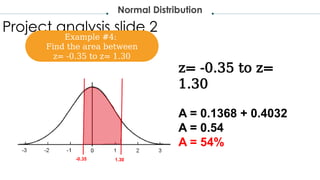
z= -0.35 to z=
1.30
A = 0.1368 + 0.4032
A = 0.54
A = 54%
Example #4:
Find the area between
z= -0.35 to z= 1.30
1.30
-0.35
z-scores/
Standard Scores
Z-Scores
Z-scores
Formula: or
Where :
z – standard score
x – score
µ/ - mean
σ/s- standard deviation
Z-Scores
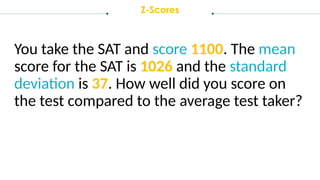
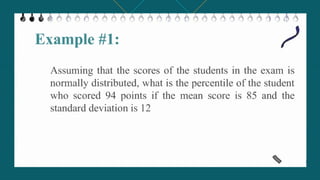
You take the SAT and score 1100. The mean
score for the SAT is 1026 and the standard
deviation is 37. How well did you score on
the test compared to the average test taker?
Z-Scores
You take the SAT and score 1100. The mean score for the SAT is
1026 and the standard deviation is 37. How well did you score on
the test compared to the average test taker?
z = 2
𝒛 =
𝒙 −𝝁
𝝈
Z-Scores
What is the standard score of the student
who took the exam in mathematics with the
score of 42 and the mean of the class was 45
with a standard deviation of 10.
Z-Scores
What is the standard score of the student who took the
exam in mathematics with the score of 42 and the mean
of the class was 45 with a standard deviation of 10.
𝒛 =
𝒙 −𝝁
𝝈
z = -.3
Z-Scores
Z-Scores
Z-Scores
3. Find σ.
z = 2
X = 90
μ = 80
Answer: σ = 5
4. Find X.
z = 0.9
μ = 70
σ = 8
Answer: X = 77.2
5. Find z.
X = 92
μ = 85
σ = 10
Answer: z = 0.7
1. Find μ.
z = -1
X = 60
σ = 12
Answer: μ = 72
2. Find σ.
z = -1.5
X = 40
μ = 50
Answer: σ = 6.67
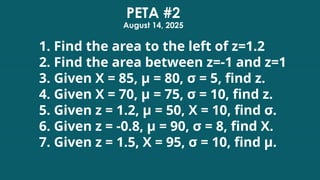
1. Find the area to the left of z=1.2
2. Find the area between z=-1 and z=1
3. Given X = 85, μ = 80, σ = 5, find z.
4. Given X = 70, μ = 75, σ = 10, find z.
5. Given z = 1.2, μ = 50, X = 10, find σ.
6. Given z = -0.8, μ = 90, σ = 8, find X.
7. Given z = 1.5, X = 95, σ = 10, find μ.
PETA #2
August 14, 2025
8. A normal distribution has a mean
of 80 and a standard deviation of 10.
Find the z-score for a score of 135.
9. A company’s employee salaries
have a mean of 50,000 pesos and a z-
score of 2.3, Find the standard
deviation for a janitor’s salary of
20,000 pesos
10. Find the z score for the value of
25, given a mean of 20 and a standard
deviation of 5.
1.Given X = 85, μ = 80, σ = 5, find z. Answer: z = 1
2.Given X = 70, μ = 75, σ = 10, find z. Answer: z = -0.5
3.Given z = 1.2, μ = 50, σ = 10, find X. Answer: X = -33.3
4.Given z = -0.8, μ = 90, σ = 8, find X. Answer: X = 83.6
5.Given z = 1.5, X = 95, σ = 10, find μ. Answer: μ = 80
Sampling and
Sampling Distribution
POPULATION
 the entire group you want
to study or draw
conclusions about.
SAMPLE
 a smaller, specific group you
collect data from. It is a subset of
the population, and it should be
representative of the larger
group.
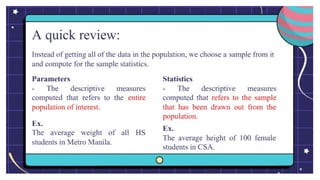
Population
The population is the complete set of all
individuals, objects, events, or measurements that
have a common characteristic. It's the total group
you are interested in.
Example:
If you want to know the average height of all
adults in the United States, then the population is
every single adult in the United States.
Sample
A sample is a portion or a subset of the population. Since
it's often impossible or impractical to collect data from
an entire population (due to size, time, or cost),
researchers use a sample to represent the whole.
Example:
Instead of measuring the height of every adult in the
U.S., you might measure the height of 1,000 randomly
selected adults across different states. This smaller
group is your sample.
Sampling Frame
 the actual list or source from which a sample is
drawn. It's a complete, specific list of all the
individuals, households, or other units that
make up the population you intend to study.
Sample size
 The number of individuals you should include in
your sample depends on various factors,
including the size and variability of the
population and your research design. There are
different sample size calculators and formulas
depending on what you want to achieve with
statistical analysis.
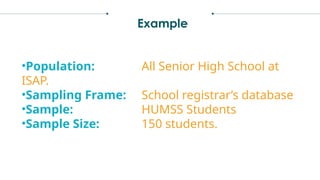
Example
•Population: All Senior High School at
ISAP.
•Sampling Frame: School registrar’s database
•Sample: HUMSS Students
•Sample Size: 150 students.
Sampling
techniques
Probability
Sampling Methods
 Random sampling is a technique where
every individual in the population has an
equal chance of being selected for the
sample. This method ensures that the
sample is representative of the entire
population, reducing bias and increasing
the generalizability of the findings.
Random Sampling
Random Sampling
EXAMPLE
Imagine a researcher studying the heights of students
in a school. To use random sampling, the researcher
could assign each student in the school a number and
then use a random number generator to select a
certain number of students. This ensures that every
student has an equal chance of being included in the
study.
 involves dividing the population into subgroups or strata
based on certain characteristics that are relevant to the
research. Random samples are then taken from each
stratum, ensuring representation from all segments of the
population. This method is useful when there are distinct
subgroups with different characteristics.
Stratified Sampling
Stratified Sampling
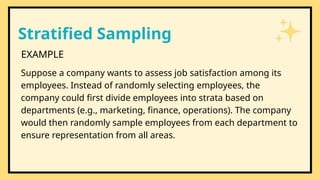
EXAMPLE
Suppose a company wants to assess job satisfaction among its
employees. Instead of randomly selecting employees, the
company could first divide employees into strata based on
departments (e.g., marketing, finance, operations). The company
would then randomly sample employees from each department to
ensure representation from all areas.
 Systematic sampling involves selecting every kth
individual from a list after a random starting point.
The interval (k) is determined by dividing the
population size by the desired sample size. This
method is systematic and ensures that each
individual has an equal chance of being selected.
Systematic Sampling
Systematic Sampling
EXAMPLE
Consider a population of 1000 individuals, and a researcher
wants a sample of 100. Using systematic sampling, the
researcher could select every 10th individual from a list
after randomly choosing a starting point. If the random
starting point is the 5th individual, the sample would
include the 5th, 15th, 25th, and so on until reaching the
100th individual.
Cluster Sampling
 Cluster sampling also involves dividing the
population into subgroups, but each subgroup
should have similar characteristics to the whole
sample. You randomly select entire groups
(clusters) and survey everyone within them. The
goal is to make the clusters as diverse as possible.
Cluster Sampling
The company has offices in 10 cities across the country
(all with roughly the same number of employees in
similar roles). You don’t have the capacity to travel to
every office to collect your data, so you use random
sampling to select 3 offices – these are your clusters.
EXAMPLE
Non-Probability
Sampling Methods
Non-Probability Sampling
 Non-random sampling, also known as non-
probability sampling, refers to any sampling
method where not every individual in the
population has an equal chance of being
included in the sample.
Non-Probability Sampling
 This type of sample is easier and cheaper to
access, but it has a higher risk of sampling bias.
That means the inferences you can make about
the population are weaker than with probability
samples, and your conclusions may be more
limited.
Convenience Sampling
 A convenience sample simply includes the
individuals who happen to be most accessible to
the researcher.
Convenience Sampling
EXAMPLE
In a study examining smartphone usage patterns, a
researcher might use convenience sampling by surveying
people in a shopping mall. While this method is convenient, it
doesn't ensure a representative sample of the entire
population, as it only includes those who happen to be in the
mall at that time.
 This type of sampling, also known as judgement
sampling, involves the researcher using their
expertise to select a sample that is most useful
to the purposes of the research.
Purposive Sampling
You want to know more about the opinions and
experiences of disabled students at your university, so
you purposefully select a number of students with
different support needs in order to gather a varied
range of data on their experiences with student
services.
Purposive Sampling
EXAMPLE
Capture sampling is a technique commonly used in ecology
and biology. It involves capturing and marking a portion of
the population, releasing them back into the environment,
and then recapturing a new sample later. By comparing the
marked and unmarked individuals, researchers can estimate
population size and dynamics.
Capture Sampling
Snowball Sampling
 If the population is hard to access, snowball
sampling can be used to recruit participants via
other participants. The number of people you
have access to “snowballs” as you get in contact
with more people.
Snowball Sampling
You are researching experiences of homelessness in
your city. Since there is no list of all homeless people in
the city, probability sampling isn’t possible. You meet
one person who agrees to participate in the research,
and she puts you in contact with other homeless
people that she knows in the area.
EXAMPLE
Quota Sampling
 Quota sampling relies on the non-random selection of a
predetermined number or proportion of units. This is called a
quota.
• You first divide the population into mutually exclusive
subgroups (called strata) and then recruit sample units until
you reach your quota. These units share specific
characteristics, determined by you prior to forming your
strata. The aim of quota sampling is to control what or who
makes up your sample.
Quota Sampling
You want to gauge consumer interest in a new produce delivery
service in Boston, focused on dietary preferences. You divide the
population into meat eaters, vegetarians, and vegans, drawing a
sample of 1000 people. Since the company wants to cater to all
consumers, you set a quota of 200 people for each dietary
group. In this way, all dietary preferences are equally
represented in your research, and you can easily compare these
groups.You continue recruiting until you reach the quota of 200
participants for each subgroup.
EXAMPLE
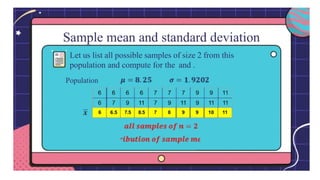
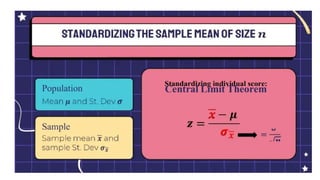
Sampling Distribution
Thank You

Statistics and Probability Presentation Grade 11.pptx

  • 1.
    Random Variable and ProbabilityDistribution by: Kathleen Joyce G. Villaroza, LPT Topic 1
  • 2.
    Understanding Random Variables •SampleSpace: This refers to the complete collection of all possible results that can occur from an experiment. For example, when flipping two coins, the sample space includes the outcomes: HH, HT, TH, and TT. •Variable: A variable represents a feature or property that can take on various values. Typically, we use uppercase letters to symbolize these variables.
  • 3.
    EXPLORING RANDOM VARIABLES •RandomVariable: A function assigning a real number to each outcome in the sample space. Its values are determined by chance, reflecting randomness.
  • 7.
  • 8.
    Project analysis slide2 Normal Distribution A Normal Distribution, also known as the Gaussian Distribution or Bell Curve, is a probability distribution that describes how data points are spread out around the mean.
  • 9.
    Mean = median= mode The normal curve is a bell-shaped and symmetric about the mean The area to left of the y-axis is 50% and the area to right of the y-axis is 50%. The total area under the curve is equal to 1 or 100% The two end tail of the curve never touches the x-axis as it extends from the mean. Properties of Normal Distribution
  • 10.
  • 11.
    Project analysis slide2 Case #1: Finding the Area from 0 to z-scores Example #1: Find the area from 0 to 1.55 1.55 Area under the Normal Curve
  • 12.
    Project analysis slide2 Case #1: Finding the Area from 0 to z-scores Example #1: Find the area from 0 to 1.55 1.55 Area under the Normal Curve
  • 13.
    Project analysis slide2 Example #1: Find the area from 0 to 1.55 1.55 O Z = 0 ; Z = 1.55 A = 0 + 0.4394 A = 0.4394 A = 43.94% Area under the Normal Curve
  • 14.
    Project analysis slide2 Normal Distribution Example #2: Find the area from 0 to 1.45 -1.45 O Z = 0 ; Z = -1.45 A = 0 + 0.4265 A = 0.4332 A = 42.65%
  • 15.
    Project analysis slide2 Normal Distribution Example #3: Find the area from 0 to 2.8 2.8 O Z = 0 ; Z = 2.8 A = 0 + 0.4974 A = 0.4974 A = 49.74%
  • 16.
    Project analysis slide2 Normal Distribution Example #4: Find the area from 0 to -0.25 -0.25 O Z = 0 ; Z = -0.25 A = 0 + 0.0987 A = 0.0987 A = 9.87%
  • 17.
    Project analysis slide2 Case #2: Finding the areato the left/right of z-scores Area under the Normal Curve Note: Area to the left of (+)z-score Area to the right of ( - ) z-score Area to the left of (-) z-score Area to the right of ( + ) z-score subtract 0.50 add 0.50
  • 18.
    Project analysis slide2 Case #2: Finding the areato the left/right of z-scores Example #1: Find the area to the left of 1.55 1.55 Area under the Normal Curve
  • 19.
    Project analysis slide2 Normal Distribution to the left of Z=1.55 A = .50 + 0.4394 A = 0.9394 A = 93.94% Example #1: Find the area to the left of 1.55 1.55
  • 20.
    Project analysis slide2 Normal Distribution to the left of Z= -1.37 A = .50 - 0.4147 A = 0.0853 A = 8.53% Example #2: Find the area to the left of -1.37 -1.37
  • 21.
    Project analysis slide2 Normal Distribution to the right of Z= 2.75 A = .50 - 0.4970 A = 0.003 A = 0.3% Example #3: Find the area to the right of 2.75 2.75
  • 22.
    Project analysis slide2 Normal Distribution to the right of Z = - 0.82 A = .50 + 0.2939 A = 0.7939 A = 79.39% Example #4: Find the area to the right of -0.82 -0.82
  • 23.
    Project analysis slide2 Case #3: Finding the area between two z- scores Area under the Normal Curve Note: Area bet. + and + Area bet. – and - Area bet. + and - Area bet. – and + subtract the two areas add the two areas
  • 24.
    Project analysis slide2 Case #3: Finding the area between two z- scores Example #1: Find the area between z= 2.53 to z = -0.57 2.53 Area under the Normal Curve -0.57
  • 25.
    Project analysis slide2 Normal Distribution z= 2.53 to z = - 0.57 A = 0.4943 + 0.2157 A = 0.71 A = 71% Example #1: Find the area between z= 2.53 to z = -0.57
  • 26.
    Project analysis slide2 Normal Distribution z= -1.75 to z= 0.10 A = 0.4599 + 0.0398 A = 0.4997 A = 49.97% Example #2: Find the area between z= -1.75 to z= 0.10 -0.82
  • 27.
    Project analysis slide2 Normal Distribution z= -1.65 to z= - 0.45 A = 0.4505 - 0.1736 A = 0.2769 A = 27.69% Example #3: Find the area between z= -0.45 to z= -1.65 -1.65 -0.45
  • 28.
    Project analysis slide2 Normal Distribution z= -0.35 to z= 1.30 A = 0.1368 + 0.4032 A = 0.54 A = 54% Example #4: Find the area between z= -0.35 to z= 1.30 1.30 -0.35
  • 29.
  • 30.
    Z-Scores Z-scores Formula: or Where : z– standard score x – score µ/ - mean σ/s- standard deviation
  • 31.
    Z-Scores You take theSAT and score 1100. The mean score for the SAT is 1026 and the standard deviation is 37. How well did you score on the test compared to the average test taker?
  • 32.
    Z-Scores You take theSAT and score 1100. The mean score for the SAT is 1026 and the standard deviation is 37. How well did you score on the test compared to the average test taker? z = 2 𝒛 = 𝒙 −𝝁 𝝈
  • 33.
    Z-Scores What is thestandard score of the student who took the exam in mathematics with the score of 42 and the mean of the class was 45 with a standard deviation of 10.
  • 34.
    Z-Scores What is thestandard score of the student who took the exam in mathematics with the score of 42 and the mean of the class was 45 with a standard deviation of 10. 𝒛 = 𝒙 −𝝁 𝝈 z = -.3
  • 35.
  • 36.
  • 37.
  • 39.
    3. Find σ. z= 2 X = 90 μ = 80 Answer: σ = 5 4. Find X. z = 0.9 μ = 70 σ = 8 Answer: X = 77.2 5. Find z. X = 92 μ = 85 σ = 10 Answer: z = 0.7 1. Find μ. z = -1 X = 60 σ = 12 Answer: μ = 72 2. Find σ. z = -1.5 X = 40 μ = 50 Answer: σ = 6.67
  • 40.
    1. Find thearea to the left of z=1.2 2. Find the area between z=-1 and z=1 3. Given X = 85, μ = 80, σ = 5, find z. 4. Given X = 70, μ = 75, σ = 10, find z. 5. Given z = 1.2, μ = 50, X = 10, find σ. 6. Given z = -0.8, μ = 90, σ = 8, find X. 7. Given z = 1.5, X = 95, σ = 10, find μ. PETA #2 August 14, 2025
  • 41.
    8. A normaldistribution has a mean of 80 and a standard deviation of 10. Find the z-score for a score of 135. 9. A company’s employee salaries have a mean of 50,000 pesos and a z- score of 2.3, Find the standard deviation for a janitor’s salary of 20,000 pesos
  • 42.
    10. Find thez score for the value of 25, given a mean of 20 and a standard deviation of 5.
  • 43.
    1.Given X =85, μ = 80, σ = 5, find z. Answer: z = 1 2.Given X = 70, μ = 75, σ = 10, find z. Answer: z = -0.5 3.Given z = 1.2, μ = 50, σ = 10, find X. Answer: X = -33.3 4.Given z = -0.8, μ = 90, σ = 8, find X. Answer: X = 83.6 5.Given z = 1.5, X = 95, σ = 10, find μ. Answer: μ = 80
  • 44.
  • 45.
    POPULATION  the entiregroup you want to study or draw conclusions about. SAMPLE  a smaller, specific group you collect data from. It is a subset of the population, and it should be representative of the larger group.
  • 46.
    Population The population isthe complete set of all individuals, objects, events, or measurements that have a common characteristic. It's the total group you are interested in. Example: If you want to know the average height of all adults in the United States, then the population is every single adult in the United States.
  • 47.
    Sample A sample isa portion or a subset of the population. Since it's often impossible or impractical to collect data from an entire population (due to size, time, or cost), researchers use a sample to represent the whole. Example: Instead of measuring the height of every adult in the U.S., you might measure the height of 1,000 randomly selected adults across different states. This smaller group is your sample.
  • 48.
    Sampling Frame  theactual list or source from which a sample is drawn. It's a complete, specific list of all the individuals, households, or other units that make up the population you intend to study.
  • 49.
    Sample size  Thenumber of individuals you should include in your sample depends on various factors, including the size and variability of the population and your research design. There are different sample size calculators and formulas depending on what you want to achieve with statistical analysis.
  • 50.
    Example •Population: All SeniorHigh School at ISAP. •Sampling Frame: School registrar’s database •Sample: HUMSS Students •Sample Size: 150 students.
  • 51.
  • 53.
  • 54.
     Random samplingis a technique where every individual in the population has an equal chance of being selected for the sample. This method ensures that the sample is representative of the entire population, reducing bias and increasing the generalizability of the findings. Random Sampling
  • 55.
    Random Sampling EXAMPLE Imagine aresearcher studying the heights of students in a school. To use random sampling, the researcher could assign each student in the school a number and then use a random number generator to select a certain number of students. This ensures that every student has an equal chance of being included in the study.
  • 56.
     involves dividingthe population into subgroups or strata based on certain characteristics that are relevant to the research. Random samples are then taken from each stratum, ensuring representation from all segments of the population. This method is useful when there are distinct subgroups with different characteristics. Stratified Sampling
  • 57.
    Stratified Sampling EXAMPLE Suppose acompany wants to assess job satisfaction among its employees. Instead of randomly selecting employees, the company could first divide employees into strata based on departments (e.g., marketing, finance, operations). The company would then randomly sample employees from each department to ensure representation from all areas.
  • 58.
     Systematic samplinginvolves selecting every kth individual from a list after a random starting point. The interval (k) is determined by dividing the population size by the desired sample size. This method is systematic and ensures that each individual has an equal chance of being selected. Systematic Sampling
  • 59.
    Systematic Sampling EXAMPLE Consider apopulation of 1000 individuals, and a researcher wants a sample of 100. Using systematic sampling, the researcher could select every 10th individual from a list after randomly choosing a starting point. If the random starting point is the 5th individual, the sample would include the 5th, 15th, 25th, and so on until reaching the 100th individual.
  • 60.
    Cluster Sampling  Clustersampling also involves dividing the population into subgroups, but each subgroup should have similar characteristics to the whole sample. You randomly select entire groups (clusters) and survey everyone within them. The goal is to make the clusters as diverse as possible.
  • 61.
    Cluster Sampling The companyhas offices in 10 cities across the country (all with roughly the same number of employees in similar roles). You don’t have the capacity to travel to every office to collect your data, so you use random sampling to select 3 offices – these are your clusters. EXAMPLE
  • 62.
  • 63.
    Non-Probability Sampling  Non-randomsampling, also known as non- probability sampling, refers to any sampling method where not every individual in the population has an equal chance of being included in the sample.
  • 64.
    Non-Probability Sampling  Thistype of sample is easier and cheaper to access, but it has a higher risk of sampling bias. That means the inferences you can make about the population are weaker than with probability samples, and your conclusions may be more limited.
  • 65.
    Convenience Sampling  Aconvenience sample simply includes the individuals who happen to be most accessible to the researcher.
  • 66.
    Convenience Sampling EXAMPLE In astudy examining smartphone usage patterns, a researcher might use convenience sampling by surveying people in a shopping mall. While this method is convenient, it doesn't ensure a representative sample of the entire population, as it only includes those who happen to be in the mall at that time.
  • 67.
     This typeof sampling, also known as judgement sampling, involves the researcher using their expertise to select a sample that is most useful to the purposes of the research. Purposive Sampling
  • 68.
    You want toknow more about the opinions and experiences of disabled students at your university, so you purposefully select a number of students with different support needs in order to gather a varied range of data on their experiences with student services. Purposive Sampling EXAMPLE
  • 69.
    Capture sampling isa technique commonly used in ecology and biology. It involves capturing and marking a portion of the population, releasing them back into the environment, and then recapturing a new sample later. By comparing the marked and unmarked individuals, researchers can estimate population size and dynamics. Capture Sampling
  • 70.
    Snowball Sampling  Ifthe population is hard to access, snowball sampling can be used to recruit participants via other participants. The number of people you have access to “snowballs” as you get in contact with more people.
  • 71.
    Snowball Sampling You areresearching experiences of homelessness in your city. Since there is no list of all homeless people in the city, probability sampling isn’t possible. You meet one person who agrees to participate in the research, and she puts you in contact with other homeless people that she knows in the area. EXAMPLE
  • 72.
    Quota Sampling  Quotasampling relies on the non-random selection of a predetermined number or proportion of units. This is called a quota. • You first divide the population into mutually exclusive subgroups (called strata) and then recruit sample units until you reach your quota. These units share specific characteristics, determined by you prior to forming your strata. The aim of quota sampling is to control what or who makes up your sample.
  • 73.
    Quota Sampling You wantto gauge consumer interest in a new produce delivery service in Boston, focused on dietary preferences. You divide the population into meat eaters, vegetarians, and vegans, drawing a sample of 1000 people. Since the company wants to cater to all consumers, you set a quota of 200 people for each dietary group. In this way, all dietary preferences are equally represented in your research, and you can easily compare these groups.You continue recruiting until you reach the quota of 200 participants for each subgroup. EXAMPLE
  • 83.
  • 119.