An introduction to QR codes

A QR Code is a matrix code (or two-dimensional bar code) created by Japanese
corporation Denso-Wave in 1994. The "QR" is derived from "Quick Response," as
the creator intended the code to allow its contents to be decoded at high speed.

QR Codes are common in Japan, where they are currently the most popular type of two
dimensional codes. In addition, most Japanese mobile phones can read this code with their
camera.

Initially used for tracking parts in vehicle manufacturing, QR Codes are now used in a much
broader context, including both commercial tracking applications and convenience-oriented
applications aimed at mobile phone users - mobile tagging.

QR Codes storing addresses and URLs appear in magazines, on signs, buses,
buildings, business cards, or just about any object that users might need information
about. Users with a camera phone equipped with the correct reader software can
scan the image of the QR Code causing the phone's browser to launch and redirect
to the programmed URL. This act of linking from physical world objects is known as
a hardlink or physical world hyperlinks.

                              A range of QR code readers can be downloaded from:
                              http://www.mobile-barcodes.com/qr-code-software/


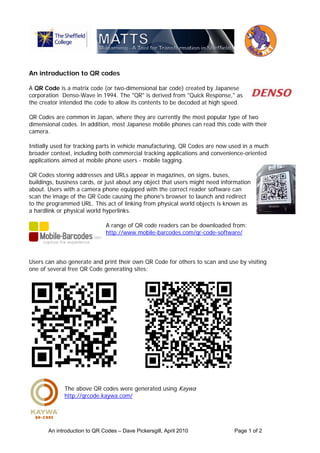
Users can also generate and print their own QR Code for others to scan and use by visiting
one of several free QR Code generating sites:


             The above QR codes were generated using Kaywa
             http://qrcode.kaywa.com/


       An introduction to QR Codes – Dave Pickersgill, April 2010             Page 1 of 2
For example, it is possible to read QR codes by using the mobiletag application on a
Blackberry:

                                  1. Open mobiletag and click ‘scan’ - the camera on the
                                     phone then opens
                                  2. Try to make the entire code appear on the screen as
                                     sharp as possible, then take a photo of the QR code
                                  3. mobiletag then tries to detect the code in the image
                                  4. If this is successful, the QR code is decoded. For
                                     example, if it is a url, the website opens.


QR codes could be included on printed worksheets or display material
to allow students to link to further reading online or further information


      ZXing Decoder Online -            if you don't have a mobile that can read a QR
code and assuming you can capture one as an image, then this website will read the code:
http://zxing.org/w/decode.jspx


This document from the University of Bath includes many useful ideas regarding the use of
QR codes in teaching and learning:
http://opus.bath.ac.uk/11408/1/getting_started_with_QR_Codes.pdf


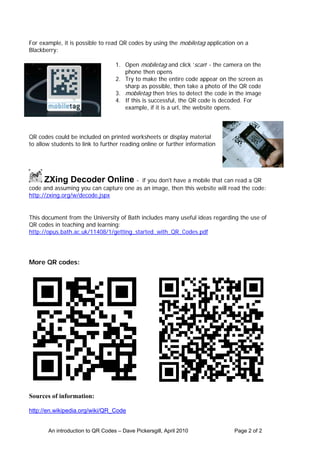
More QR codes:


Sources of information:

http://en.wikipedia.org/wiki/QR_Code


       An introduction to QR Codes – Dave Pickersgill, April 2010             Page 2 of 2

An Introduction To Qr Codes[1]

  • 1.
    An introduction toQR codes A QR Code is a matrix code (or two-dimensional bar code) created by Japanese corporation Denso-Wave in 1994. The "QR" is derived from "Quick Response," as the creator intended the code to allow its contents to be decoded at high speed. QR Codes are common in Japan, where they are currently the most popular type of two dimensional codes. In addition, most Japanese mobile phones can read this code with their camera. Initially used for tracking parts in vehicle manufacturing, QR Codes are now used in a much broader context, including both commercial tracking applications and convenience-oriented applications aimed at mobile phone users - mobile tagging. QR Codes storing addresses and URLs appear in magazines, on signs, buses, buildings, business cards, or just about any object that users might need information about. Users with a camera phone equipped with the correct reader software can scan the image of the QR Code causing the phone's browser to launch and redirect to the programmed URL. This act of linking from physical world objects is known as a hardlink or physical world hyperlinks. A range of QR code readers can be downloaded from: http://www.mobile-barcodes.com/qr-code-software/ Users can also generate and print their own QR Code for others to scan and use by visiting one of several free QR Code generating sites: The above QR codes were generated using Kaywa http://qrcode.kaywa.com/ An introduction to QR Codes – Dave Pickersgill, April 2010 Page 1 of 2
  • 2.
    For example, itis possible to read QR codes by using the mobiletag application on a Blackberry: 1. Open mobiletag and click ‘scan’ - the camera on the phone then opens 2. Try to make the entire code appear on the screen as sharp as possible, then take a photo of the QR code 3. mobiletag then tries to detect the code in the image 4. If this is successful, the QR code is decoded. For example, if it is a url, the website opens. QR codes could be included on printed worksheets or display material to allow students to link to further reading online or further information ZXing Decoder Online - if you don't have a mobile that can read a QR code and assuming you can capture one as an image, then this website will read the code: http://zxing.org/w/decode.jspx This document from the University of Bath includes many useful ideas regarding the use of QR codes in teaching and learning: http://opus.bath.ac.uk/11408/1/getting_started_with_QR_Codes.pdf More QR codes: Sources of information: http://en.wikipedia.org/wiki/QR_Code An introduction to QR Codes – Dave Pickersgill, April 2010 Page 2 of 2