An Introduction to
Microcontrollers
Microcontrollers
• Small, self-contained computers that
are used to control a wide range of
devices, from washing machines to
drones.
• The general microcontroller consists of the
processor, the memory (RAM, ROM,
EPROM), Serial ports, peripherals (timers,
counters), etc.
• They can be programmed to perform a
wide range of tasks, making them ideal
for use in everything from robotics to
home automation systems.
Components of Microcontrollers
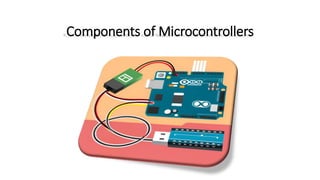
• Central processing unit (CPU) – Executes instructions & performs
Calculations.
• Memory – Used to store and retrieve data.
• Random Access Memory (RAM) – Volatile, stores the data
required to be processed
• Read Only Memory (ROM) – Non-volatile, permanently stores
the data
• Input/Output (I/O) pins – Used to interact with external devices such
as sensors or actuators.
• Digital pins – Have two signals (High and Low)
• Analog pins – Continuous values
• Others
• Other components of a microcontroller may include timers, counters,
UART, PWM, and analog-to-digital converters (ADCs) – Used to
measure and respond to changes in its environment.
Serial and Parallel Communication
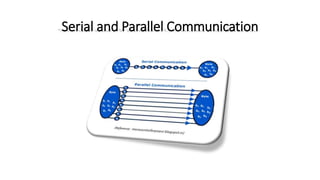
• Serial and parallel communication are two methods used for transmitting data
between devices.
• Serial communication is a method of transmitting data one bit at a time over a
single wire or channel.
• In serial communication, the sender sends a stream of bits, one after the
other, while the receiver decodes them into meaningful data.
• Example: I2C, SPI, and USART are some serial communication protocol
• Parallel communication is a method of transmitting multiple bits of data
simultaneously using separate channels.
• In this method, each bit of the data is transmitted through its own dedicated
wire or channel.
• This allows for faster data transfer rates as compared to serial communication.
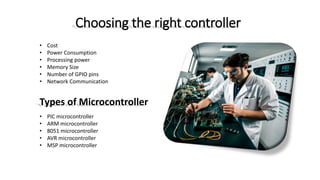
Choosing the right controller
• Cost
• Power Consumption
• Processing power
• Memory Size
• Number of GPIO pins
• Network Communication
Types of Microcontroller
• PIC microcontroller
• ARM microcontroller
• 8051 microcontroller
• AVR microcontroller
• MSP microcontroller
Programming a Controller
• Development Environment – like Arduino IDE, Cube
• Programming Knowledge – C and C++
• Compilers
• Microcontroller board – Arduino Uno, NodeMCU
• Peripherals – Sensors, Actuators
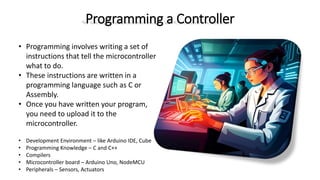
• Programming involves writing a set of
instructions that tell the microcontroller
what to do.
• These instructions are written in a
programming language such as C or
Assembly.
• Once you have written your program,
you need to upload it to the
microcontroller.
Application of Microcontroller
• Controlling machines, sensing and
monitoring devices, and automated
systems.
• Many home automation systems rely on
microcontrollers to control lighting,
temperature, and security features.
• In the automotive industry, microcontrollers
are used in engine management systems,
anti-lock brakes, and airbag deployment.
• Even medical devices such as insulin pumps
and pacemakers use microcontrollers to
regulate the dosage and monitor vital
signs.

An Introduction to Microcontrollers.pptx

  • 1.
  • 2.
    Microcontrollers • Small, self-containedcomputers that are used to control a wide range of devices, from washing machines to drones. • The general microcontroller consists of the processor, the memory (RAM, ROM, EPROM), Serial ports, peripherals (timers, counters), etc. • They can be programmed to perform a wide range of tasks, making them ideal for use in everything from robotics to home automation systems.
  • 3.
  • 4.
    • Central processingunit (CPU) – Executes instructions & performs Calculations. • Memory – Used to store and retrieve data. • Random Access Memory (RAM) – Volatile, stores the data required to be processed • Read Only Memory (ROM) – Non-volatile, permanently stores the data • Input/Output (I/O) pins – Used to interact with external devices such as sensors or actuators. • Digital pins – Have two signals (High and Low) • Analog pins – Continuous values • Others • Other components of a microcontroller may include timers, counters, UART, PWM, and analog-to-digital converters (ADCs) – Used to measure and respond to changes in its environment.
  • 5.
    Serial and ParallelCommunication
  • 6.
    • Serial andparallel communication are two methods used for transmitting data between devices. • Serial communication is a method of transmitting data one bit at a time over a single wire or channel. • In serial communication, the sender sends a stream of bits, one after the other, while the receiver decodes them into meaningful data. • Example: I2C, SPI, and USART are some serial communication protocol • Parallel communication is a method of transmitting multiple bits of data simultaneously using separate channels. • In this method, each bit of the data is transmitted through its own dedicated wire or channel. • This allows for faster data transfer rates as compared to serial communication.
  • 7.
    Choosing the rightcontroller • Cost • Power Consumption • Processing power • Memory Size • Number of GPIO pins • Network Communication Types of Microcontroller • PIC microcontroller • ARM microcontroller • 8051 microcontroller • AVR microcontroller • MSP microcontroller
  • 8.
    Programming a Controller •Development Environment – like Arduino IDE, Cube • Programming Knowledge – C and C++ • Compilers • Microcontroller board – Arduino Uno, NodeMCU • Peripherals – Sensors, Actuators • Programming involves writing a set of instructions that tell the microcontroller what to do. • These instructions are written in a programming language such as C or Assembly. • Once you have written your program, you need to upload it to the microcontroller.
  • 9.
    Application of Microcontroller •Controlling machines, sensing and monitoring devices, and automated systems. • Many home automation systems rely on microcontrollers to control lighting, temperature, and security features. • In the automotive industry, microcontrollers are used in engine management systems, anti-lock brakes, and airbag deployment. • Even medical devices such as insulin pumps and pacemakers use microcontrollers to regulate the dosage and monitor vital signs.