
An Introduction to an
Effective Earned
Value Management
System
By Scot Butcher & Martin Eveleigh
1
Webinar 3 of 3
The Assurance
Review Model:
2
Objective.
How to assure attainment of a credible
Earned Value Management System
and
How to Maintain its credibility through
time
Introductions
• Scot Butcher
• 30 years working in defence
acquisition and support
• Started out life as a mechanical
engineer but quickly moved to
management of projects
• Last 18 years have been spent in
project controls
• First experience of EVM was in
2003
• Experienced IBR participant and
chair
• Martin Eveleigh
• 40+ years working in the Defence
Sector both in the UK and USA
• Mechanical/Electrical Engineer,
but moved to
Programme Management in 1993
• Author of a US
DoD Validated Earned
Value Management System
Description (EVMSD)
• Holds an MSc in Programme &
Project Management
• Experienced in enabling and leading
IBRs
3
Why these webinars?
• There is clear confusion between Project Controls, Earned Value Management
and Earned Value Analysis.
• There is an acknowledged and widespread obsession with Earned Value metrics
and its analysis without a firm understanding of the system required to underpin
it.
• There is a false belief that if you are planning discrete activities, that you can/are
performing EVM
• Therefore, these webinars are aimed at dispelling myths and advising what it
takes to establish an appropriate, pragmatic Earned Value Management System
4SB
Content of the 3 webinars
1. Basics and myth busting:
• Incessant ‘false focus’ - the Earned Value Management ‘Iceberg’.
• The relationship between Project Controls (PC), Earned Value Management System (EVMS) and Earned Value
Analysis (EVA).
• The understanding and importance of the Performance Measurement Baseline (PMB).
2. What’s needed……..and importantly what’s not!:
• Explain the attributes of an effective EVMS with/without compliance to EIA748.
• Discuss were Earned Value Analysis is beneficial and where not!
3. Assurance reviews:
• System Demonstration Review (SDR)
• Integrated Baseline Review (IBR)
• Surveillance Review (SR)
• Annual Estimate at Completion Review (AEAC)
5SB
Assurance Reviews and
how they fit together
6SB
• System Demonstration Review (SDR)
• Integrated Baseline Review (IBR)
• Surveillance Review (SR)
• Annual Estimate at Completion Review (AEAC)
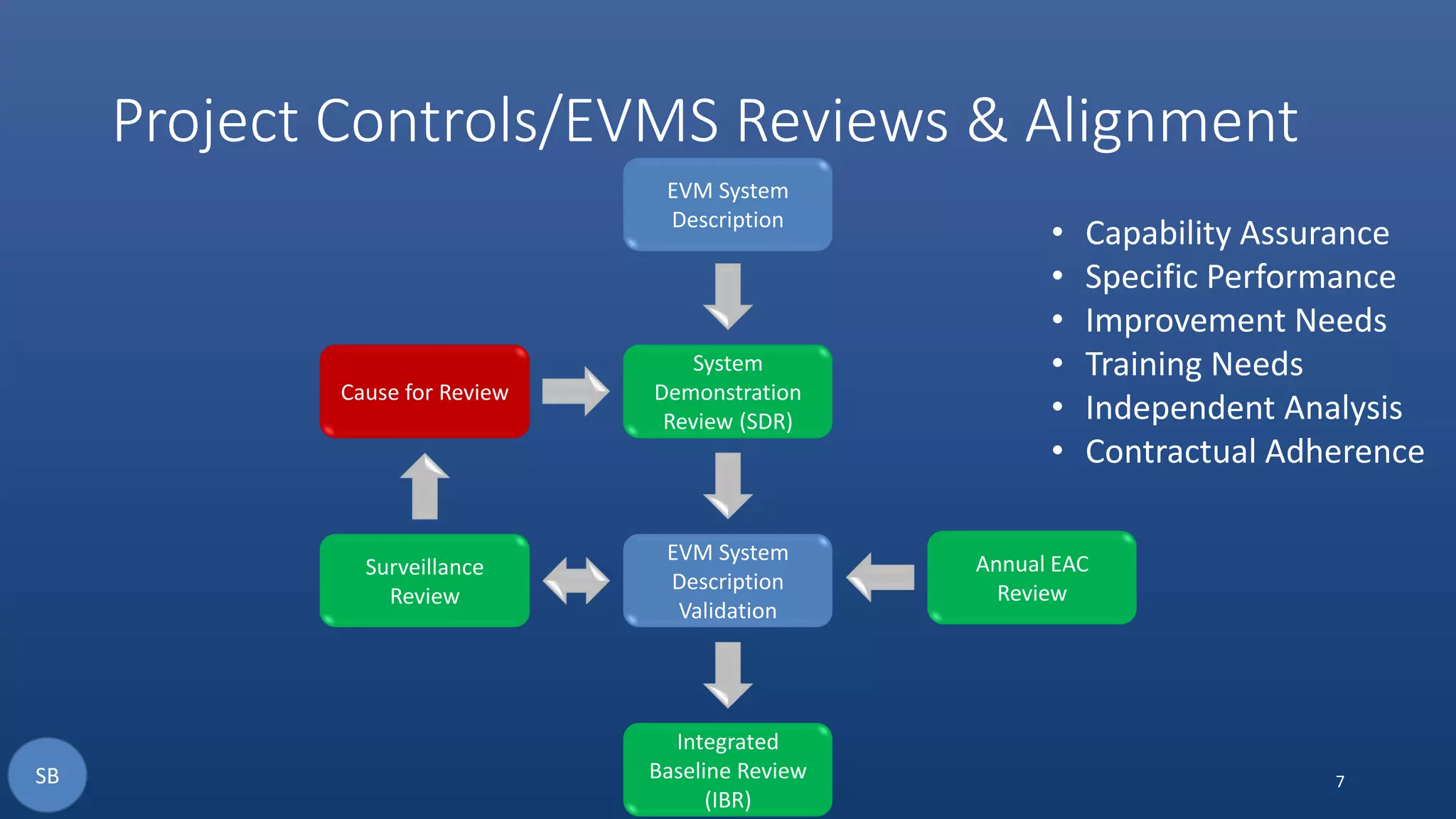
Project Controls/EVMS Reviews & Alignment
7
EVM System
Description
System
Demonstration
Review (SDR)
EVM System
Description
Validation
Integrated
Baseline Review
(IBR)
Surveillance
Review
Cause for Review
Annual EAC
Review
• Capability Assurance
• Specific Performance
• Improvement Needs
• Training Needs
• Independent Analysis
• Contractual Adherence
SB
System Demonstration
Review (SDR)
8ME
• System Demonstration Review (SDR)
• Integrated Baseline Review (IBR)
• Surveillance Review (SR)
• Annual Estimate at Completion Review (AEAC)
Purpose of an SDR
• Initial Assurance Review, focussed on Capability
• Intended as being a one-off review, be site based, and uses a Pilot
Project
• Assures the creditability of Earned Value Management System (EVMS)
• Examines – People, Processes, Data and to an extent Tools
• Will require highly experienced personnel to lead and participate
• Leads to contractual compliance and associated Project & Programme
Integrated Baseline Reviews (IBR)
9ME
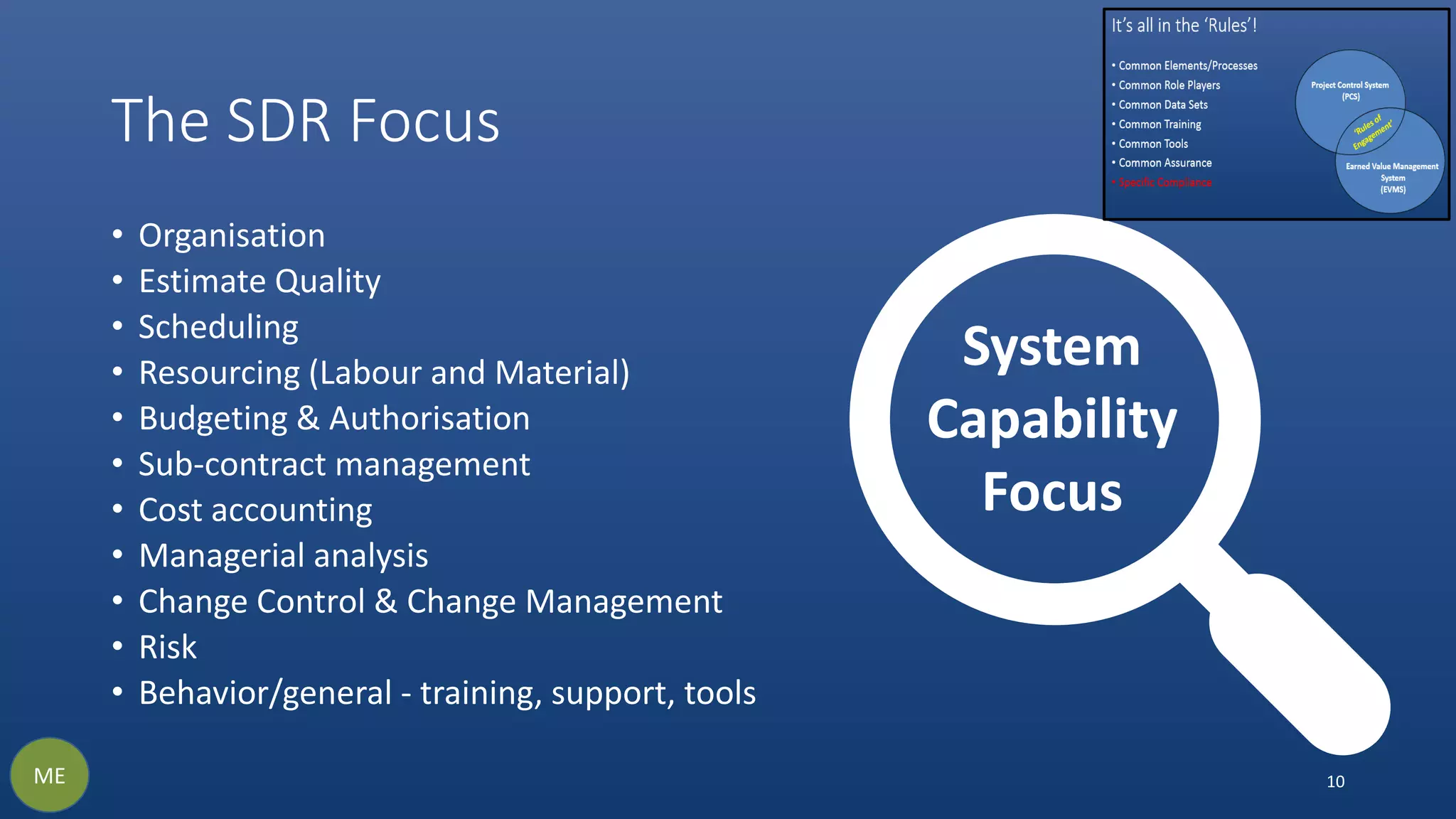
The SDR Focus
• Organisation
• Estimate Quality
• Scheduling
• Resourcing (Labour and Material)
• Budgeting & Authorisation
• Sub-contract management
• Cost accounting
• Managerial analysis
• Change Control & Change Management
• Risk
• Behavior/general - training, support, tools
10
System
Capability
Focus
ME
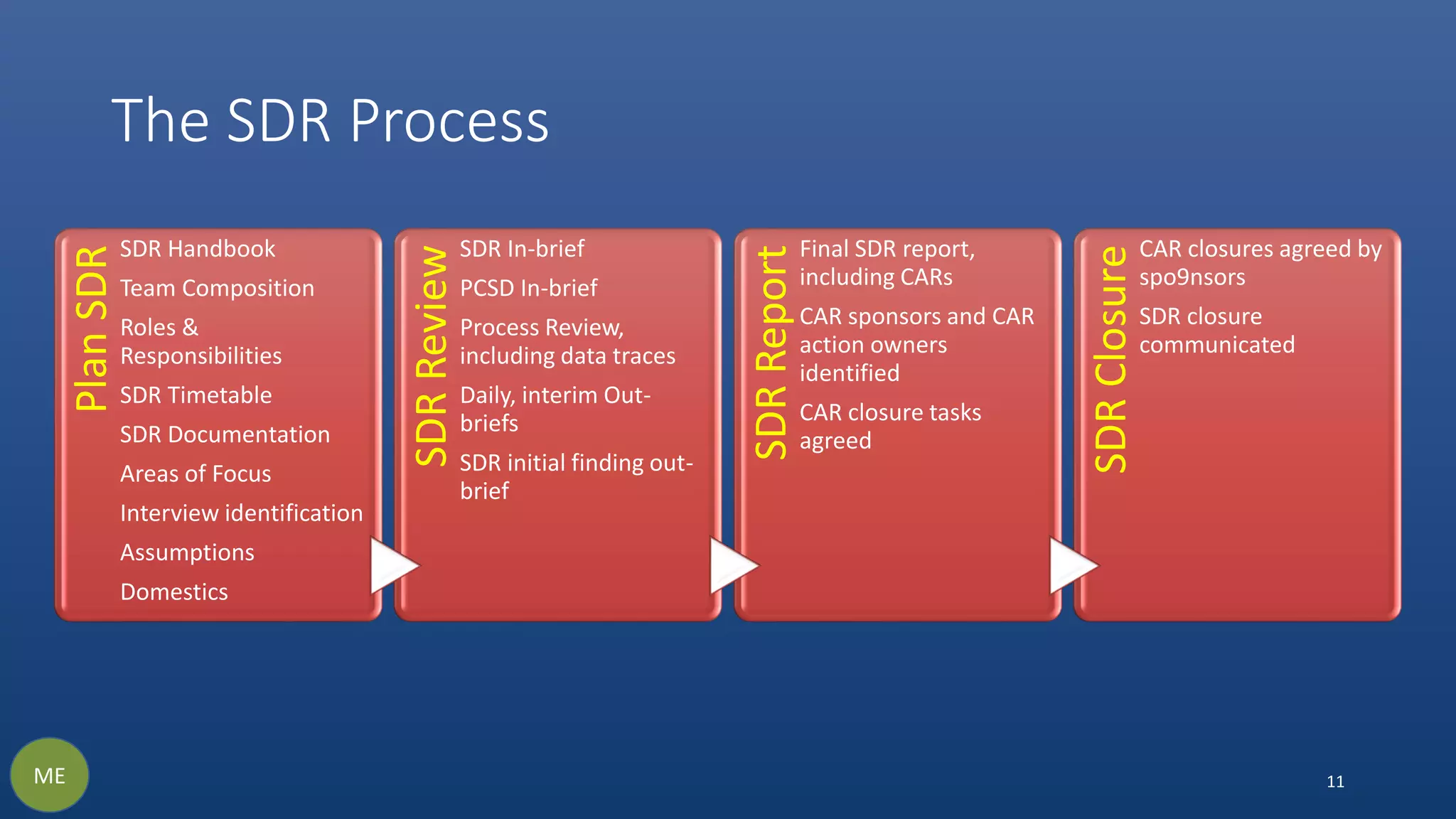
The SDR Process
PlanSDR
SDR Handbook
Team Composition
Roles &
Responsibilities
SDR Timetable
SDR Documentation
Areas of Focus
Interview identification
Assumptions
Domestics
SDRReview
SDR In-brief
PCSD In-brief
Process Review,
including data traces
Daily, interim Out-
briefs
SDR initial finding out-
brief
SDRReport
Final SDR report,
including CARs
CAR sponsors and CAR
action owners
identified
CAR closure tasks
agreed
SDRClosure
CAR closures agreed by
spo9nsors
SDR closure
communicated
11ME
Integrated Baseline
Review (IBR)
12SB
• System Demonstration Review (SDR)
• Integrated Baseline Review (IBR)
• Surveillance Review (SR)
• Annual Estimate at Completion Review (AEAC)
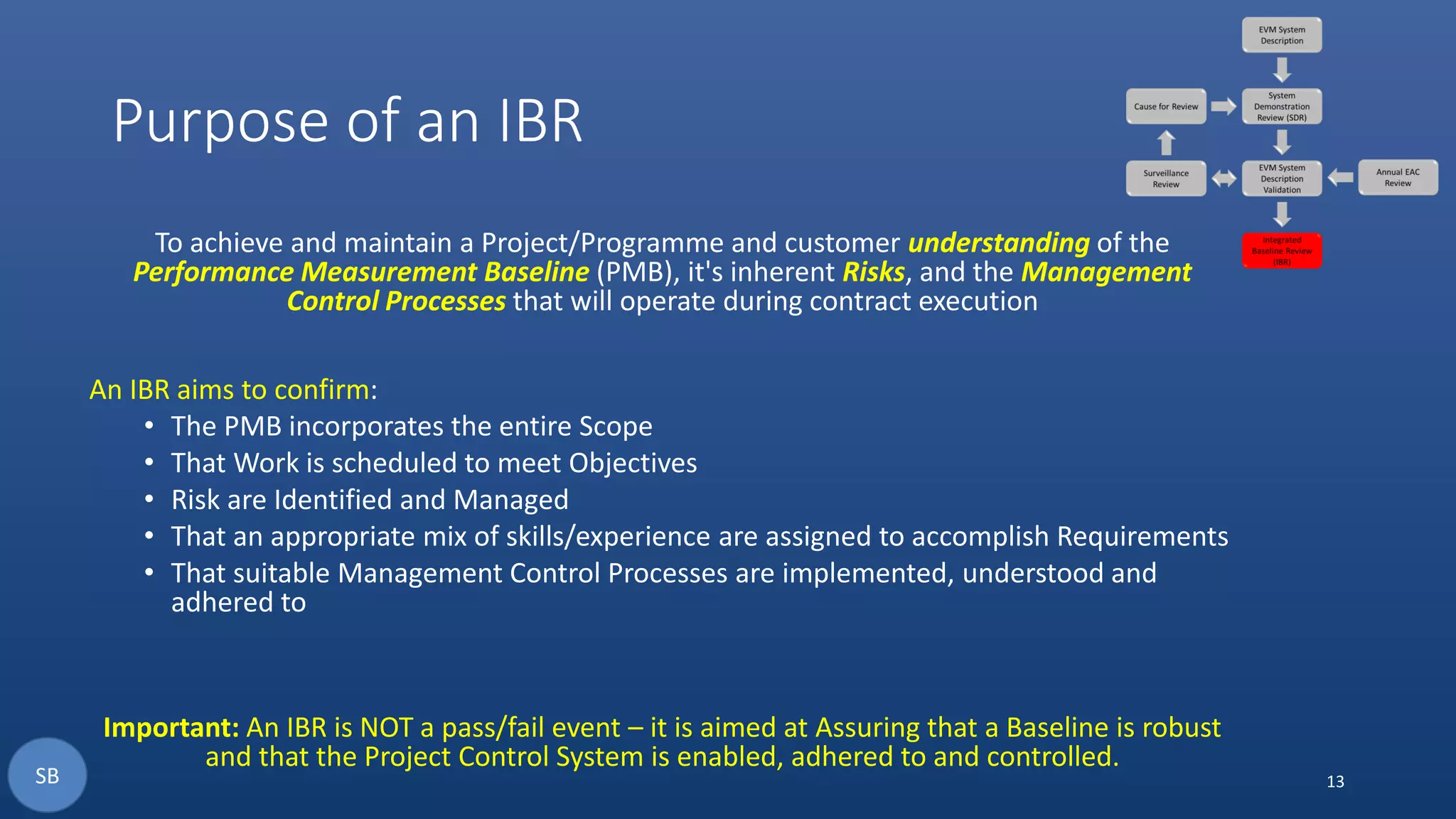
Purpose of an IBR
To achieve and maintain a Project/Programme and customer understanding of the
Performance Measurement Baseline (PMB), it's inherent Risks, and the Management
Control Processes that will operate during contract execution
An IBR aims to confirm:
• The PMB incorporates the entire Scope
• That Work is scheduled to meet Objectives
• Risk are Identified and Managed
• That an appropriate mix of skills/experience are assigned to accomplish Requirements
• That suitable Management Control Processes are implemented, understood and
adhered to
Important: An IBR is NOT a pass/fail event – it is aimed at Assuring that a Baseline is robust
and that the Project Control System is enabled, adhered to and controlled.
13SB
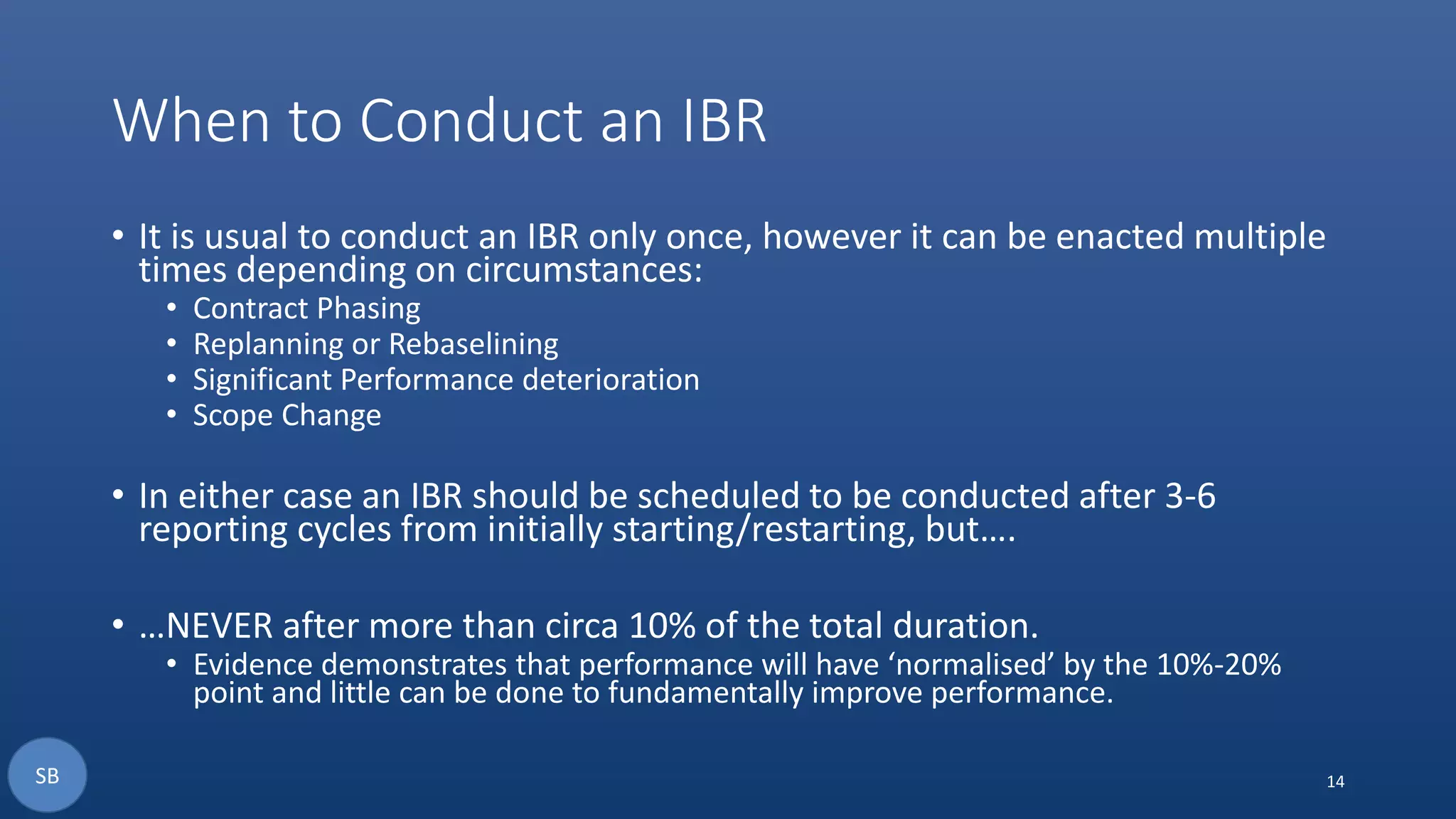
When to Conduct an IBR
• It is usual to conduct an IBR only once, however it can be enacted multiple
times depending on circumstances:
• Contract Phasing
• Replanning or Rebaselining
• Significant Performance deterioration
• Scope Change
• In either case an IBR should be scheduled to be conducted after 3-6
reporting cycles from initially starting/restarting, but….
• …NEVER after more than circa 10% of the total duration.
• Evidence demonstrates that performance will have ‘normalised’ by the 10%-20%
point and little can be done to fundamentally improve performance.
14SB
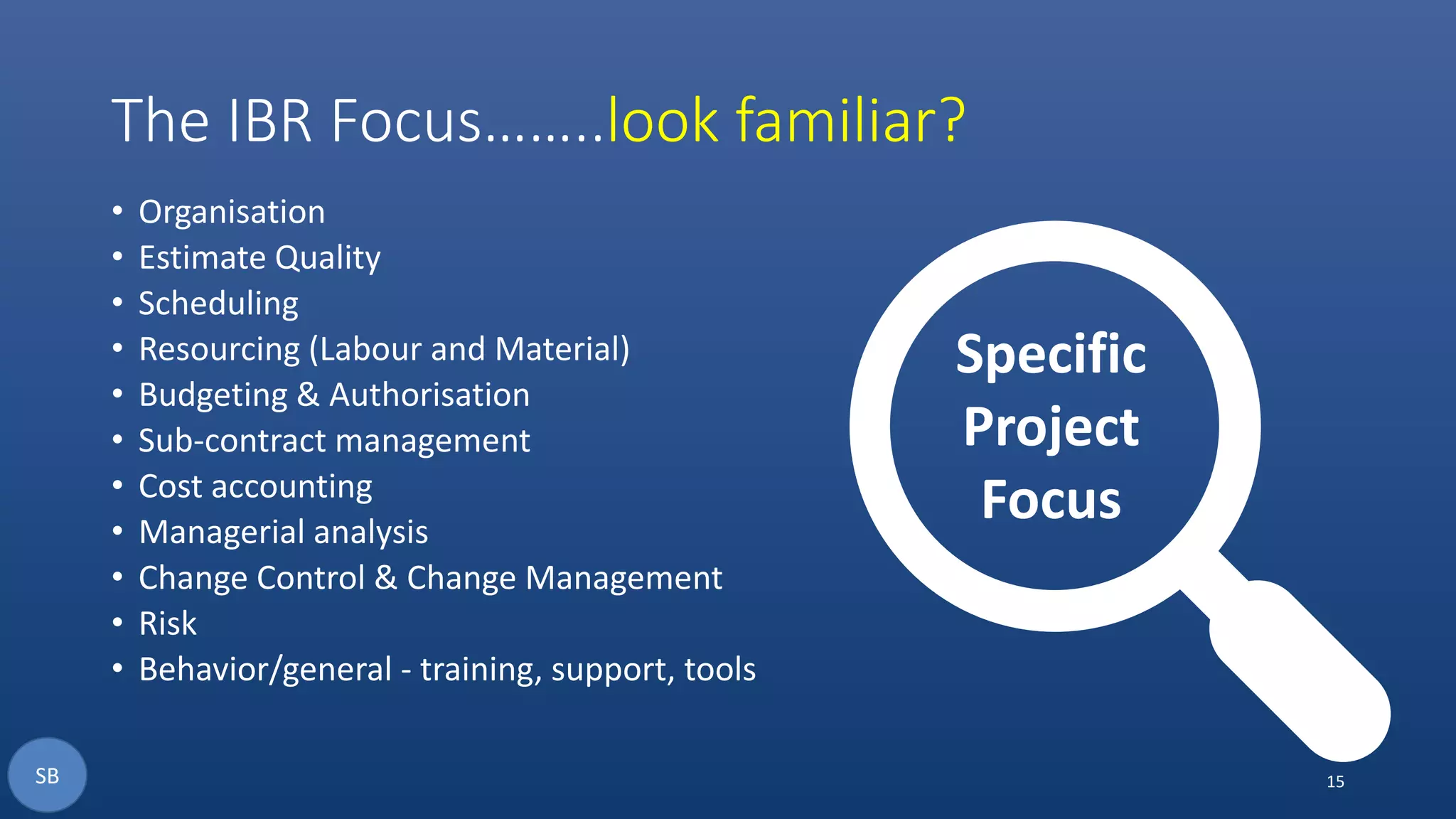
The IBR Focus……..look familiar?
15
• Organisation
• Estimate Quality
• Scheduling
• Resourcing (Labour and Material)
• Budgeting & Authorisation
• Sub-contract management
• Cost accounting
• Managerial analysis
• Change Control & Change Management
• Risk
• Behavior/general - training, support, tools
SB
Specific
Project
Focus
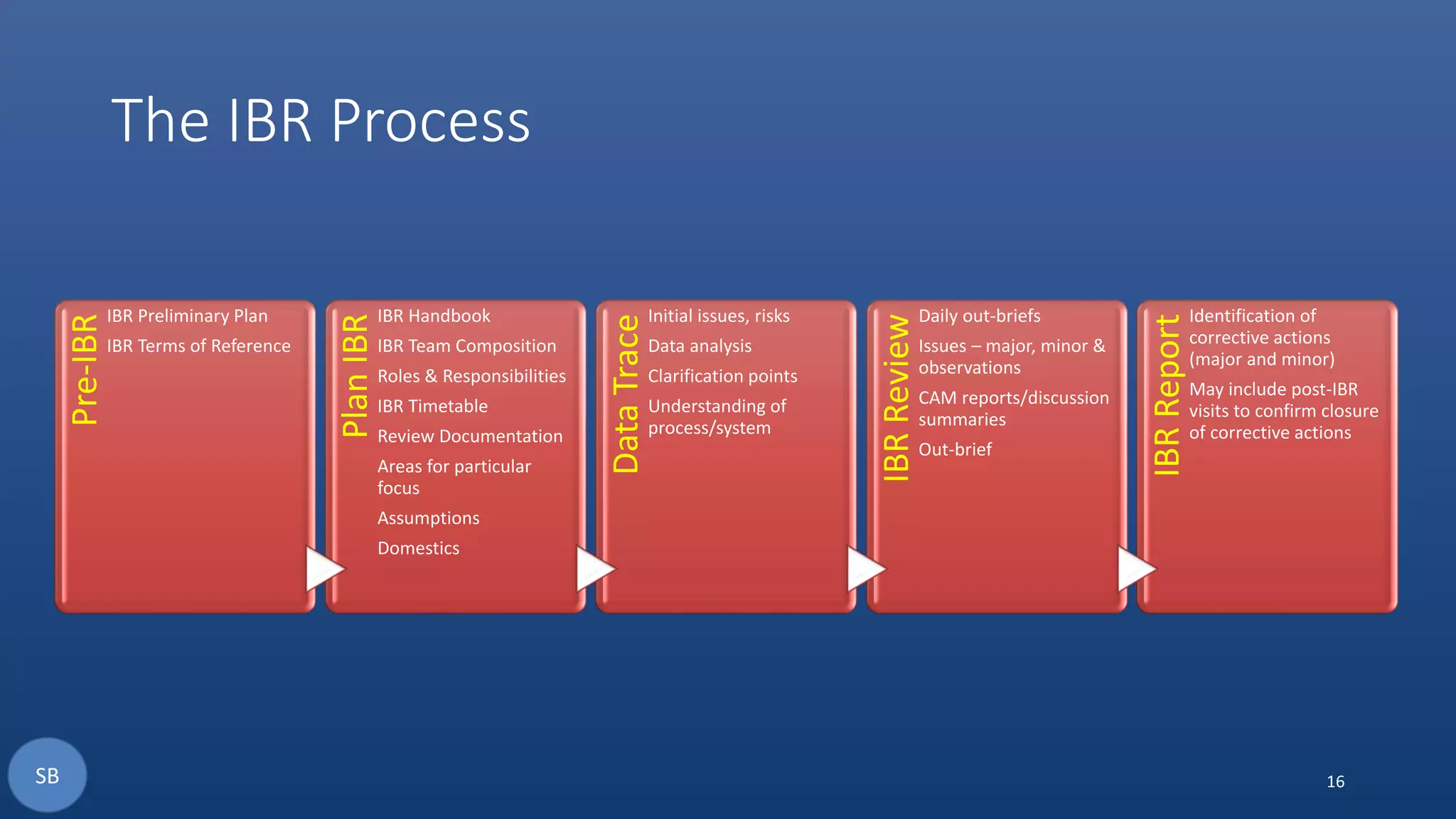
The IBR Process
Pre-IBR
IBR Preliminary Plan
IBR Terms of Reference
PlanIBR
IBR Handbook
IBR Team Composition
Roles & Responsibilities
IBR Timetable
Review Documentation
Areas for particular
focus
Assumptions
Domestics
DataTrace
Initial issues, risks
Data analysis
Clarification points
Understanding of
process/system
IBRReview
Daily out-briefs
Issues – major, minor &
observations
CAM reports/discussion
summaries
Out-brief
IBRReport
Identification of
corrective actions
(major and minor)
May include post-IBR
visits to confirm closure
of corrective actions
16SB
Surveillance Reviews
17SB
• System Demonstration Review (SDR)
• Integrated Baseline Review (IBR)
• Surveillance Review (SR)
• Annual Estimate at Completion Review (AEAC)
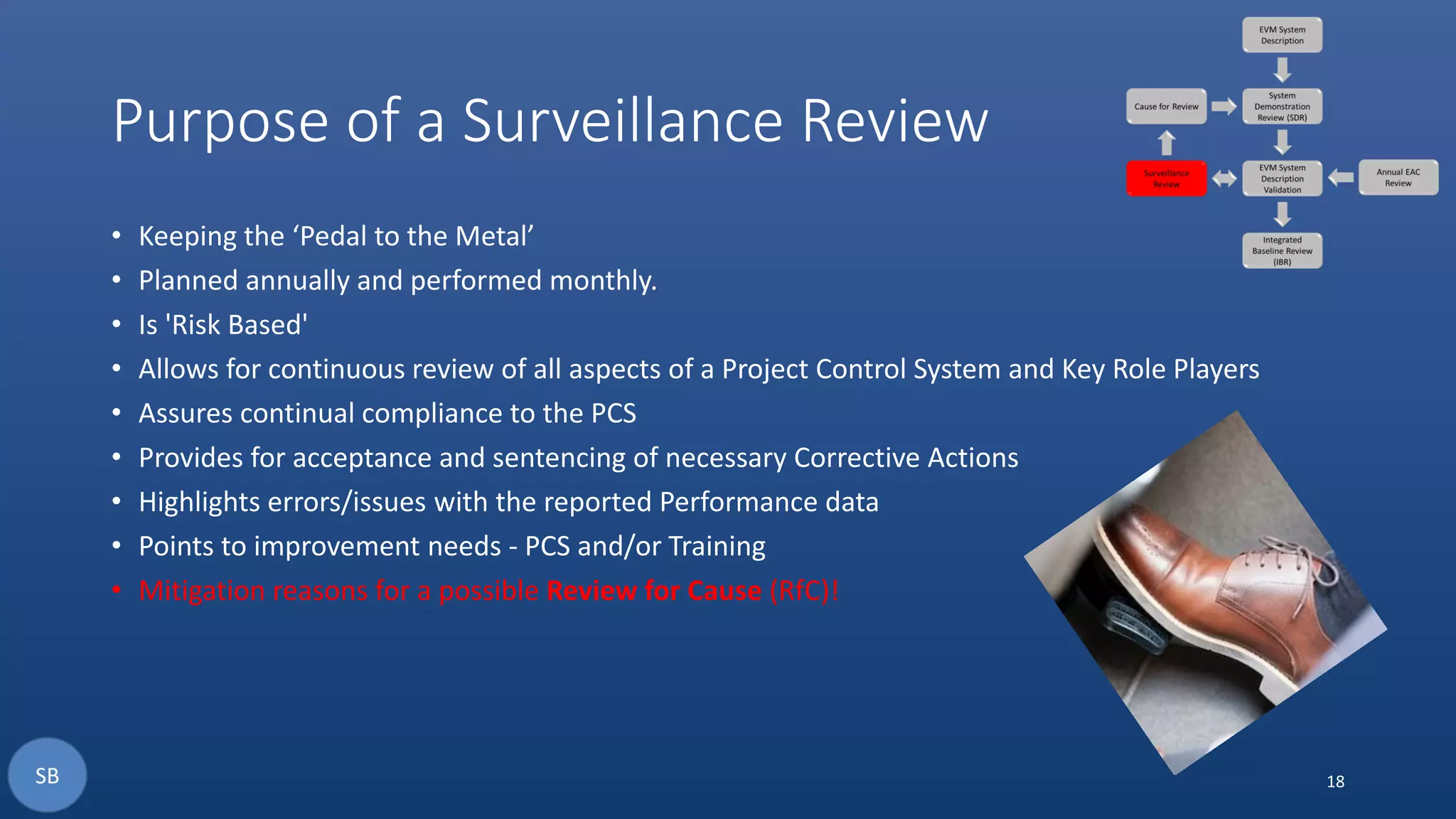
Purpose of a Surveillance Review
• Keeping the ‘Pedal to the Metal’
• Planned annually and performed monthly.
• Is 'Risk Based'
• Allows for continuous review of all aspects of a Project Control System and Key Role Players
• Assures continual compliance to the PCS
• Provides for acceptance and sentencing of necessary Corrective Actions
• Highlights errors/issues with the reported Performance data
• Points to improvement needs - PCS and/or Training
• Mitigation reasons for a possible Review for Cause (RfC)!
18SB
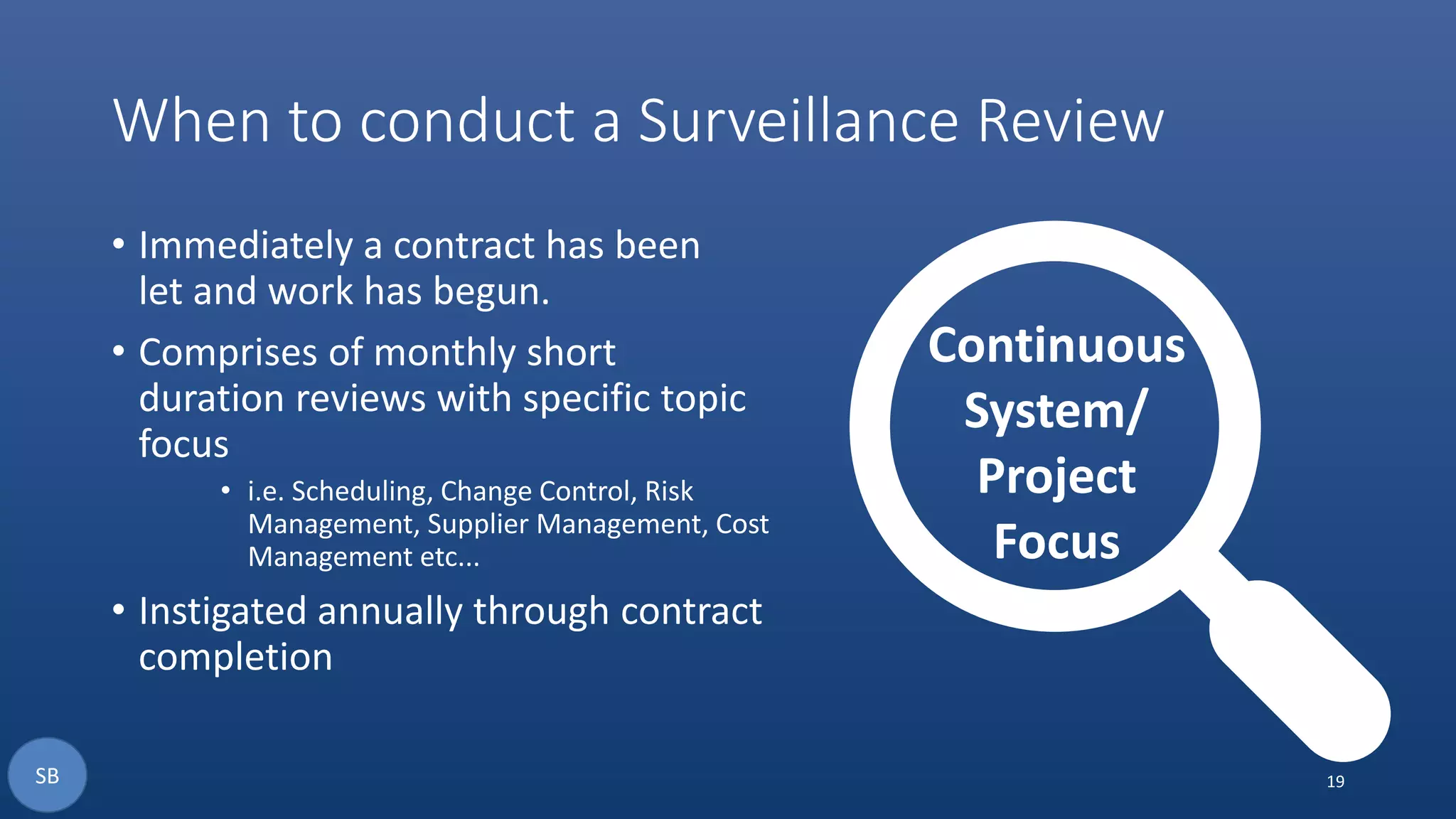
When to conduct a Surveillance Review
• Immediately a contract has been
let and work has begun.
• Comprises of monthly short
duration reviews with specific topic
focus
• i.e. Scheduling, Change Control, Risk
Management, Supplier Management, Cost
Management etc...
• Instigated annually through contract
completion
19
Continuous
System/
Project
Focus
SB
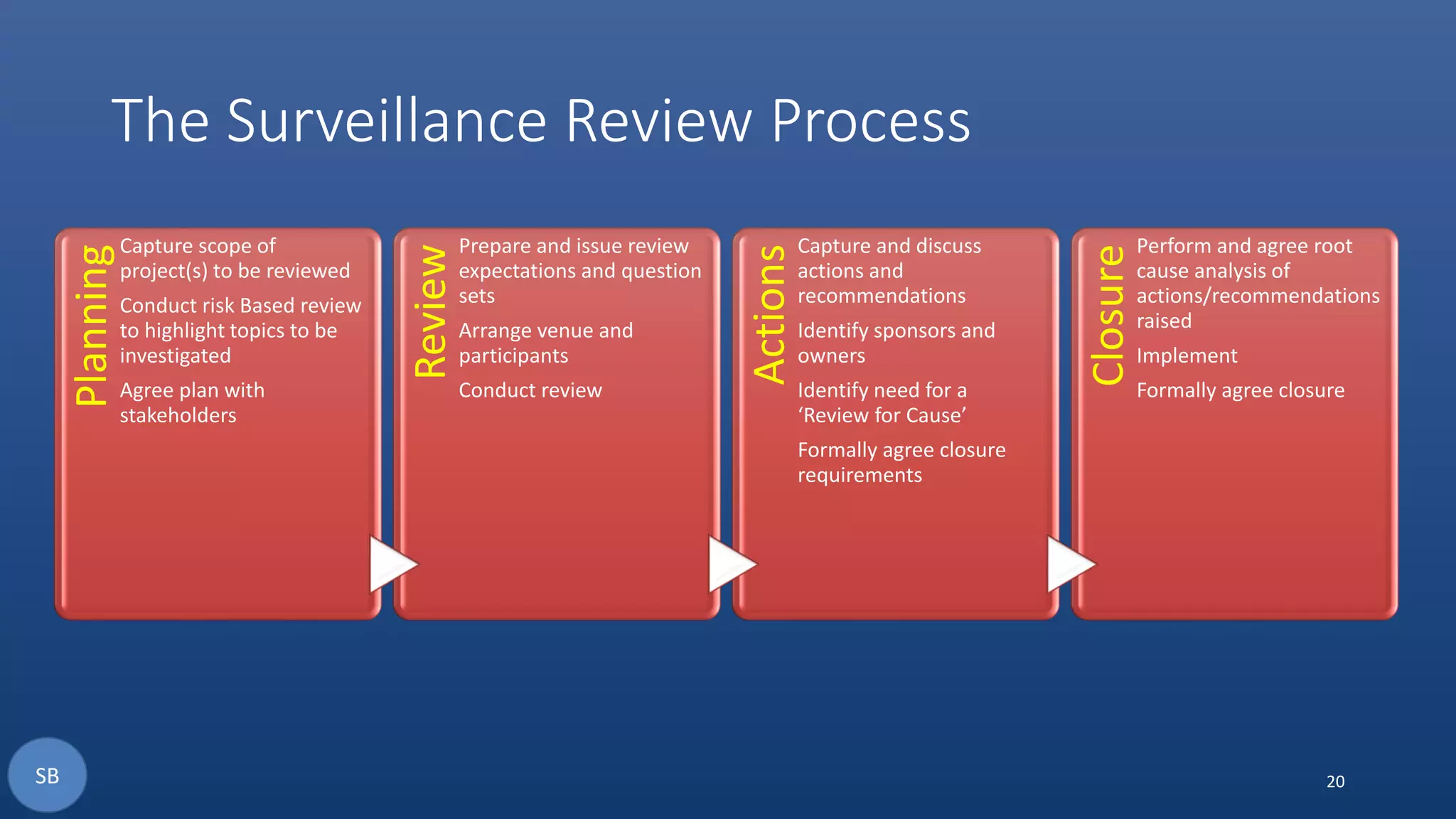
The Surveillance Review Process
Planning
Capture scope of
project(s) to be reviewed
Conduct risk Based review
to highlight topics to be
investigated
Agree plan with
stakeholders
Review
Prepare and issue review
expectations and question
sets
Arrange venue and
participants
Conduct review
Actions
Capture and discuss
actions and
recommendations
Identify sponsors and
owners
Identify need for a
‘Review for Cause’
Formally agree closure
requirements
Closure
Perform and agree root
cause analysis of
actions/recommendations
raised
Implement
Formally agree closure
20SB
Annual Estimate at
Completion Review
21ME
• System Demonstration Review (SDR)
• Integrated Baseline Review (IBR)
• Surveillance Review (SR)
• Annual Estimate at Completion Review (AEAC)
Purpose of an Annual EAC Review
• To independently and objectively review a Project/Programme
in terms of……to see the wood for the trees:
• Performance to-date
• Risks
• Lessons Learned
• Programmatic & Technical Content
• Concur or reset the Estimate to and at Completion
• Management Reserve 'burn-down' and regeneration
• Provide Corrective Action advice, and if needed on Replanning or Rebaselining
22ME
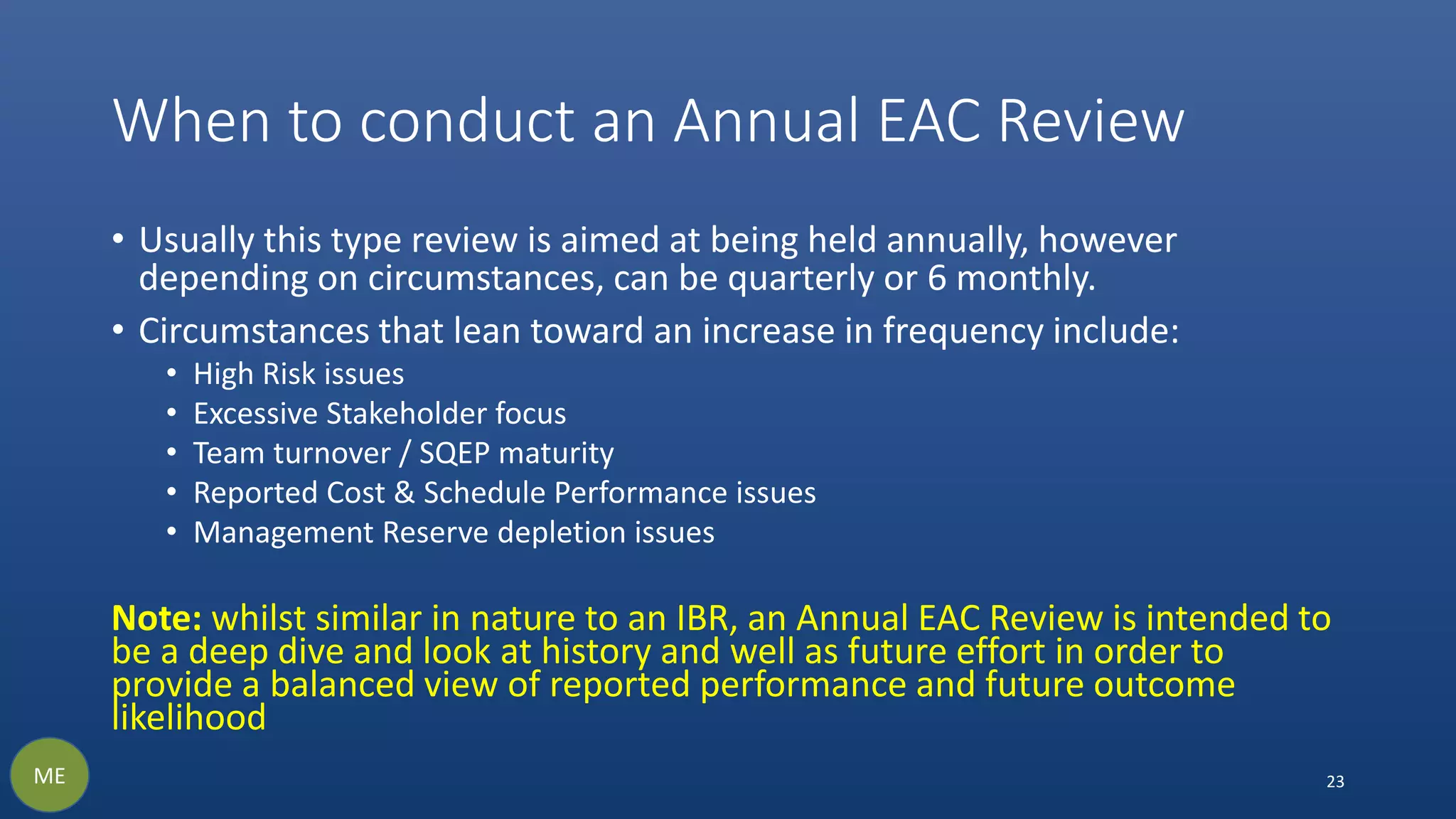
When to conduct an Annual EAC Review
• Usually this type review is aimed at being held annually, however
depending on circumstances, can be quarterly or 6 monthly.
• Circumstances that lean toward an increase in frequency include:
• High Risk issues
• Excessive Stakeholder focus
• Team turnover / SQEP maturity
• Reported Cost & Schedule Performance issues
• Management Reserve depletion issues
Note: whilst similar in nature to an IBR, an Annual EAC Review is intended to
be a deep dive and look at history and well as future effort in order to
provide a balanced view of reported performance and future outcome
likelihood
23ME
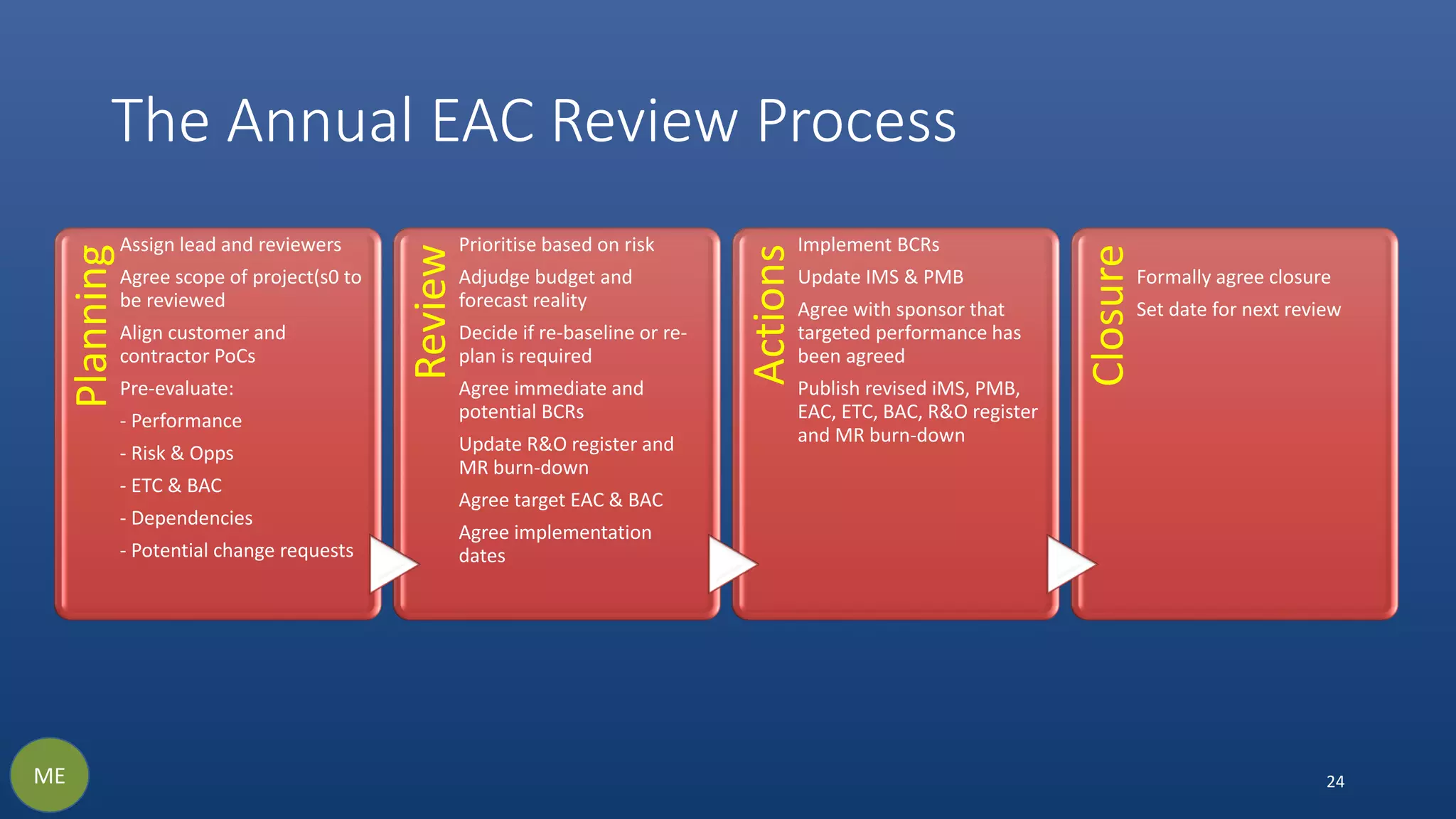
The Annual EAC Review Process
Planning
Assign lead and reviewers
Agree scope of project(s0 to
be reviewed
Align customer and
contractor PoCs
Pre-evaluate:
- Performance
- Risk & Opps
- ETC & BAC
- Dependencies
- Potential change requests
Review
Prioritise based on risk
Adjudge budget and
forecast reality
Decide if re-baseline or re-
plan is required
Agree immediate and
potential BCRs
Update R&O register and
MR burn-down
Agree target EAC & BAC
Agree implementation
dates
Actions
Implement BCRs
Update IMS & PMB
Agree with sponsor that
targeted performance has
been agreed
Publish revised iMS, PMB,
EAC, ETC, BAC, R&O register
and MR burn-down
Closure
Formally agree closure
Set date for next review
24ME
Thank you for
joining us for
the webinars.
Questions?
25

An introduction to an effective earned value management system (EVMS) webinar series part 3, 24 November 2020

  • 1.
    An Introduction toan Effective Earned Value Management System By Scot Butcher & Martin Eveleigh 1
  • 2.
    Webinar 3 of3 The Assurance Review Model: 2 Objective. How to assure attainment of a credible Earned Value Management System and How to Maintain its credibility through time
  • 3.
    Introductions • Scot Butcher •30 years working in defence acquisition and support • Started out life as a mechanical engineer but quickly moved to management of projects • Last 18 years have been spent in project controls • First experience of EVM was in 2003 • Experienced IBR participant and chair • Martin Eveleigh • 40+ years working in the Defence Sector both in the UK and USA • Mechanical/Electrical Engineer, but moved to Programme Management in 1993 • Author of a US DoD Validated Earned Value Management System Description (EVMSD) • Holds an MSc in Programme & Project Management • Experienced in enabling and leading IBRs 3
  • 4.
    Why these webinars? •There is clear confusion between Project Controls, Earned Value Management and Earned Value Analysis. • There is an acknowledged and widespread obsession with Earned Value metrics and its analysis without a firm understanding of the system required to underpin it. • There is a false belief that if you are planning discrete activities, that you can/are performing EVM • Therefore, these webinars are aimed at dispelling myths and advising what it takes to establish an appropriate, pragmatic Earned Value Management System 4SB
  • 5.
    Content of the3 webinars 1. Basics and myth busting: • Incessant ‘false focus’ - the Earned Value Management ‘Iceberg’. • The relationship between Project Controls (PC), Earned Value Management System (EVMS) and Earned Value Analysis (EVA). • The understanding and importance of the Performance Measurement Baseline (PMB). 2. What’s needed……..and importantly what’s not!: • Explain the attributes of an effective EVMS with/without compliance to EIA748. • Discuss were Earned Value Analysis is beneficial and where not! 3. Assurance reviews: • System Demonstration Review (SDR) • Integrated Baseline Review (IBR) • Surveillance Review (SR) • Annual Estimate at Completion Review (AEAC) 5SB
  • 6.
    Assurance Reviews and howthey fit together 6SB • System Demonstration Review (SDR) • Integrated Baseline Review (IBR) • Surveillance Review (SR) • Annual Estimate at Completion Review (AEAC)
  • 7.
    Project Controls/EVMS Reviews& Alignment 7 EVM System Description System Demonstration Review (SDR) EVM System Description Validation Integrated Baseline Review (IBR) Surveillance Review Cause for Review Annual EAC Review • Capability Assurance • Specific Performance • Improvement Needs • Training Needs • Independent Analysis • Contractual Adherence SB
  • 8.
    System Demonstration Review (SDR) 8ME •System Demonstration Review (SDR) • Integrated Baseline Review (IBR) • Surveillance Review (SR) • Annual Estimate at Completion Review (AEAC)
  • 9.
    Purpose of anSDR • Initial Assurance Review, focussed on Capability • Intended as being a one-off review, be site based, and uses a Pilot Project • Assures the creditability of Earned Value Management System (EVMS) • Examines – People, Processes, Data and to an extent Tools • Will require highly experienced personnel to lead and participate • Leads to contractual compliance and associated Project & Programme Integrated Baseline Reviews (IBR) 9ME
  • 10.
    The SDR Focus •Organisation • Estimate Quality • Scheduling • Resourcing (Labour and Material) • Budgeting & Authorisation • Sub-contract management • Cost accounting • Managerial analysis • Change Control & Change Management • Risk • Behavior/general - training, support, tools 10 System Capability Focus ME
  • 11.
    The SDR Process PlanSDR SDRHandbook Team Composition Roles & Responsibilities SDR Timetable SDR Documentation Areas of Focus Interview identification Assumptions Domestics SDRReview SDR In-brief PCSD In-brief Process Review, including data traces Daily, interim Out- briefs SDR initial finding out- brief SDRReport Final SDR report, including CARs CAR sponsors and CAR action owners identified CAR closure tasks agreed SDRClosure CAR closures agreed by spo9nsors SDR closure communicated 11ME
  • 12.
    Integrated Baseline Review (IBR) 12SB •System Demonstration Review (SDR) • Integrated Baseline Review (IBR) • Surveillance Review (SR) • Annual Estimate at Completion Review (AEAC)
  • 13.
    Purpose of anIBR To achieve and maintain a Project/Programme and customer understanding of the Performance Measurement Baseline (PMB), it's inherent Risks, and the Management Control Processes that will operate during contract execution An IBR aims to confirm: • The PMB incorporates the entire Scope • That Work is scheduled to meet Objectives • Risk are Identified and Managed • That an appropriate mix of skills/experience are assigned to accomplish Requirements • That suitable Management Control Processes are implemented, understood and adhered to Important: An IBR is NOT a pass/fail event – it is aimed at Assuring that a Baseline is robust and that the Project Control System is enabled, adhered to and controlled. 13SB
  • 14.
    When to Conductan IBR • It is usual to conduct an IBR only once, however it can be enacted multiple times depending on circumstances: • Contract Phasing • Replanning or Rebaselining • Significant Performance deterioration • Scope Change • In either case an IBR should be scheduled to be conducted after 3-6 reporting cycles from initially starting/restarting, but…. • …NEVER after more than circa 10% of the total duration. • Evidence demonstrates that performance will have ‘normalised’ by the 10%-20% point and little can be done to fundamentally improve performance. 14SB
  • 15.
    The IBR Focus……..lookfamiliar? 15 • Organisation • Estimate Quality • Scheduling • Resourcing (Labour and Material) • Budgeting & Authorisation • Sub-contract management • Cost accounting • Managerial analysis • Change Control & Change Management • Risk • Behavior/general - training, support, tools SB Specific Project Focus
  • 16.
    The IBR Process Pre-IBR IBRPreliminary Plan IBR Terms of Reference PlanIBR IBR Handbook IBR Team Composition Roles & Responsibilities IBR Timetable Review Documentation Areas for particular focus Assumptions Domestics DataTrace Initial issues, risks Data analysis Clarification points Understanding of process/system IBRReview Daily out-briefs Issues – major, minor & observations CAM reports/discussion summaries Out-brief IBRReport Identification of corrective actions (major and minor) May include post-IBR visits to confirm closure of corrective actions 16SB
  • 17.
    Surveillance Reviews 17SB • SystemDemonstration Review (SDR) • Integrated Baseline Review (IBR) • Surveillance Review (SR) • Annual Estimate at Completion Review (AEAC)
  • 18.
    Purpose of aSurveillance Review • Keeping the ‘Pedal to the Metal’ • Planned annually and performed monthly. • Is 'Risk Based' • Allows for continuous review of all aspects of a Project Control System and Key Role Players • Assures continual compliance to the PCS • Provides for acceptance and sentencing of necessary Corrective Actions • Highlights errors/issues with the reported Performance data • Points to improvement needs - PCS and/or Training • Mitigation reasons for a possible Review for Cause (RfC)! 18SB
  • 19.
    When to conducta Surveillance Review • Immediately a contract has been let and work has begun. • Comprises of monthly short duration reviews with specific topic focus • i.e. Scheduling, Change Control, Risk Management, Supplier Management, Cost Management etc... • Instigated annually through contract completion 19 Continuous System/ Project Focus SB
  • 20.
    The Surveillance ReviewProcess Planning Capture scope of project(s) to be reviewed Conduct risk Based review to highlight topics to be investigated Agree plan with stakeholders Review Prepare and issue review expectations and question sets Arrange venue and participants Conduct review Actions Capture and discuss actions and recommendations Identify sponsors and owners Identify need for a ‘Review for Cause’ Formally agree closure requirements Closure Perform and agree root cause analysis of actions/recommendations raised Implement Formally agree closure 20SB
  • 21.
    Annual Estimate at CompletionReview 21ME • System Demonstration Review (SDR) • Integrated Baseline Review (IBR) • Surveillance Review (SR) • Annual Estimate at Completion Review (AEAC)
  • 22.
    Purpose of anAnnual EAC Review • To independently and objectively review a Project/Programme in terms of……to see the wood for the trees: • Performance to-date • Risks • Lessons Learned • Programmatic & Technical Content • Concur or reset the Estimate to and at Completion • Management Reserve 'burn-down' and regeneration • Provide Corrective Action advice, and if needed on Replanning or Rebaselining 22ME
  • 23.
    When to conductan Annual EAC Review • Usually this type review is aimed at being held annually, however depending on circumstances, can be quarterly or 6 monthly. • Circumstances that lean toward an increase in frequency include: • High Risk issues • Excessive Stakeholder focus • Team turnover / SQEP maturity • Reported Cost & Schedule Performance issues • Management Reserve depletion issues Note: whilst similar in nature to an IBR, an Annual EAC Review is intended to be a deep dive and look at history and well as future effort in order to provide a balanced view of reported performance and future outcome likelihood 23ME
  • 24.
    The Annual EACReview Process Planning Assign lead and reviewers Agree scope of project(s0 to be reviewed Align customer and contractor PoCs Pre-evaluate: - Performance - Risk & Opps - ETC & BAC - Dependencies - Potential change requests Review Prioritise based on risk Adjudge budget and forecast reality Decide if re-baseline or re- plan is required Agree immediate and potential BCRs Update R&O register and MR burn-down Agree target EAC & BAC Agree implementation dates Actions Implement BCRs Update IMS & PMB Agree with sponsor that targeted performance has been agreed Publish revised iMS, PMB, EAC, ETC, BAC, R&O register and MR burn-down Closure Formally agree closure Set date for next review 24ME
  • 25.
    Thank you for joiningus for the webinars. Questions? 25