Support Reliability Strategies
with Key Performance Indicators
Using IBM Maximo®
Julie Rampello
Director Business Development Solutions,
Projetech
www.Projetech.com
Speaker Bio
• Julie Rampello
• Director, Business Development Solutions
• Projetech, Inc. www.Projetech.com
• Maximo Project Manager and Trainer for Projetech for
12 years
• Maximo Certified Deployment Professional
• Hobbies & Interests include: technology, data analytics,
fitness, social media
Workshop Topics
• Reliability programs should support strategic
corporate objectives
• Relevant Key Performance Indicators
– Measure program effectiveness
– Provide believable data
• KPI management and other Reporting options
in Maximo
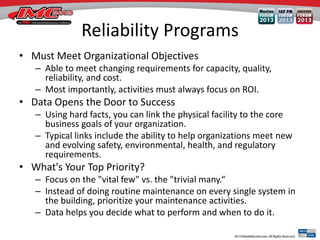
Reliability Programs
• Must Meet Organizational Objectives
– Able to meet changing requirements for capacity, quality,
reliability, and cost.
– Most importantly, activities must always focus on ROI.
• Data Opens the Door to Success
– Using hard facts, you can link the physical facility to the core
business goals of your organization.
– Typical links include the ability to help organizations meet new
and evolving safety, environmental, health, and regulatory
requirements.
• What's Your Top Priority?
– Focus on the "vital few" vs. the "trivial many.“
– Instead of doing routine maintenance on every single system in
the building, prioritize your maintenance activities.
– Data helps you decide what to perform and when to do it.
KPI’s
• Performance Indicator (PI’s)
– Any indicator measuring the performance of a
business process, work team, individual, piece of
equipment or plan in terms of its ability to meet its
desired levels of performance. 1
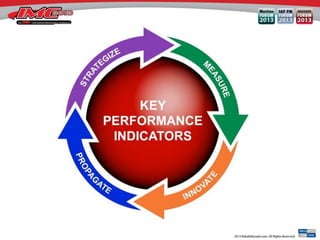
• Key Performance Indicators (KPI’s)
– Real-Time Measure
– Measures the overall performance of a particular
strategy or improvement initiative
• Use them to monitor effectiveness of reliability
programs.
1 The Maintenance Scorecard: Creating Strategic Advantage
Indicators
• Lagging indicators (KRI) use historic data to build a
performance trend line. The trend shows progress and
can be projected forward to forecast likely progress.
• Leading indicators (KPI) use historic data to monitor
whether or not activities are producing good results.
• Use a mix of lagging indicators and leading indicators
to provide a clear understanding of what is happening
to the risk and performance of your operational assets
through maintenance efforts
What are You Measuring?
Maintenance Effectiveness
• Maintenance performance indicators reflect
achievement and progress in meeting an agreed
maintenance benchmark.
• Measure whether maintenance work successfully
removes risk of failure from your plant and equipment.
• Define Useful and Relevant KPI’s & PI’s 1
– Identify causes of equipment failures
– Effectiveness of PM / Predictive Maintenance (PdM)
activities
– Measure effectiveness and efficiency of the Maintenance
Group
– Measure the reliability improvement and operating risk
reduction results of the maintenance effort
Maintenance Effectiveness/Efficiency
Maintenance Effectiveness KPI’s
 Mean time between failure
(MTBF)
 Mean time between repair
(MTBR)
 Overall Equipment Effectiveness
(OEE)
 Time to complete EM work
 Budget compliance
Maintenance Efficiency and other
KPI’s
 PM compliance
 % Corrective maintenance
 Maintenance overtime
 Inventory stock outs (Service
level)
 Safety, i.e., Lost time
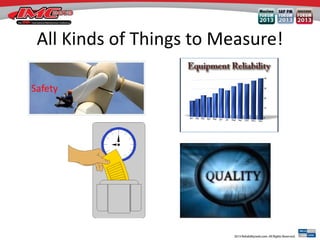
All Kinds of Things to Measure!
Safety
What’s Needed?
• The information you need to manage your
reliability programs should be right at your
fingertips.
• If done correctly, your CMMS/EAM applications
will be able to provide you with the information
you need to analyze the success of your reliability
initiatives.
• It is important to know where data sources
reside, whether in Maximo or 3rd Party systems.
• Integrate when it makes sense.
Bad Data = Bad KPI
• Meaningful KPI’s need relevant, timely, accurate
and consistent data.
• Whenever possible, eliminate human error factor.
• Leverage automated data collection sources such
as PLCs, Building Automation Systems, and
computers.
• Collect data “at the source” via handheld or
mobile devices.
• Use barcodes wherever it makes sense.
KPI’s by Job Function
Maintenance Supervisor KPI Examples
• Maintenance cost per unit produced
• MTBFF (Mean Time Between Functional Failure)
• Maintenance labor cost (measured against target)
• Maintenance material cost (measured against target)
• Maintenance contractor cost (measured against target)
• Overtime - %
• Absenteeism - %
• # of discipline violations
• # of safety incidents
• # of days without loss time accidents
• # of environmental incidents
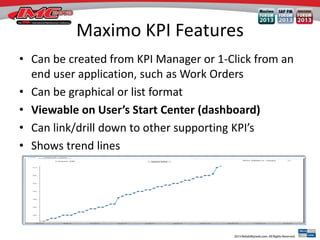
Maximo KPI Features
• Can be created from KPI Manager or 1-Click from an
end user application, such as Work Orders
• Can be graphical or list format
• Viewable on User’s Start Center (dashboard)
• Can link/drill down to other supporting KPI’s
• Shows trend lines
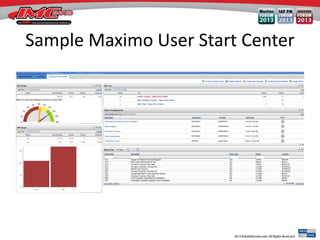
Sample Maximo User Start Center
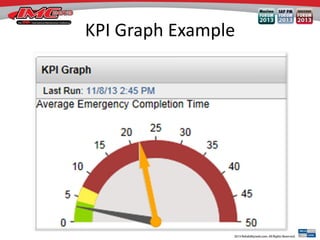
KPI Graph Example
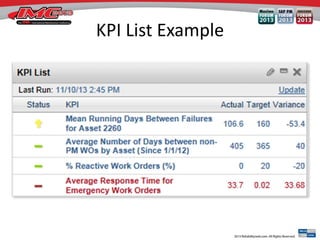
KPI List Example
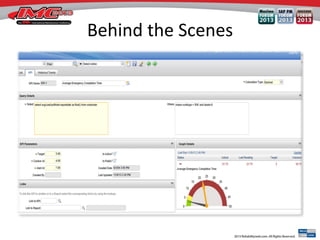
Behind the Scenes
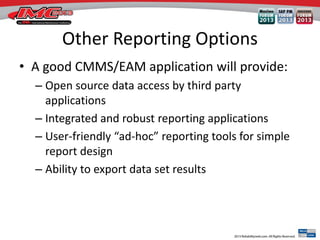
Other Reporting Options
• A good CMMS/EAM application will provide:
– Open source data access by third party
applications
– Integrated and robust reporting applications
– User-friendly “ad-hoc” reporting tools for simple
report design
– Ability to export data set results
Integrated Reporting
• Open Source Platform report applications
• Support robust reporting requirements
(complex formulas/crosstabs, etc.)
• Maximo
– BIRT
– Cognos
– Optional integration with Crystal XI
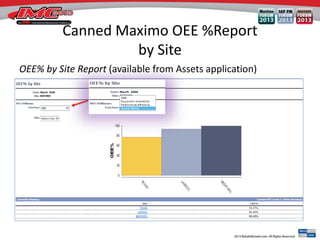
Canned Maximo OEE %Report
by Site
OEE% by Site Report (available from Assets application)
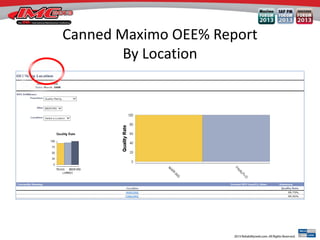
Canned Maximo OEE% Report
By Location
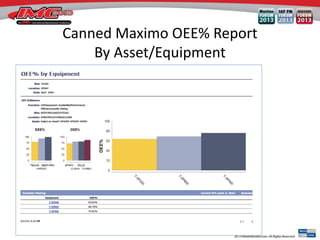
Canned Maximo OEE% Report
By Asset/Equipment
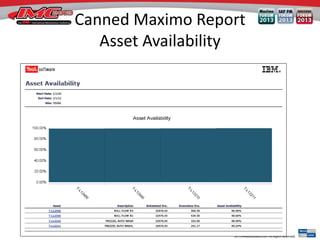
Canned Maximo Report
Asset Availability
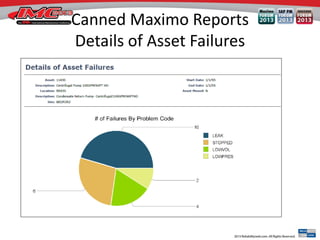
Canned Maximo Reports
Details of Asset Failures
Open Source Reporting
• Connect to “back end” via 3rd party applications:
– MS Excel
– MS Access
– SQL Query apps
– Crystal Reports
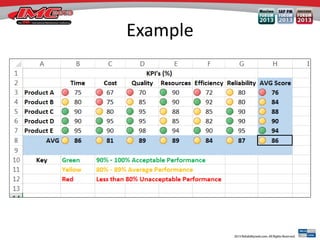
Example
Export Data Utilities
• On screen query results
• Canned and ad-hoc reports
Conclusion
• Reliability programs should support strategic
corporate objectives
• KPI and other metrics should provide relevant,
accurate and timely information to support
reliability program success.
• Many KPI best practices resources available.
• Prioritize metrics.
• Maximo provides many reporting options to
support Key Performance Indicator reporting.
Resources
• The Maximo Manager’s guide to Business Performance
Management
– Richard Taggs, Philip Sage, Monica Osana, Dante Tepora, John Mark de Asis, TEAM
Global
• The Seven Deadly Sins in Measuring Asset Reliability
– Ricky Smith, CMRP
• The Maintenance Scorecard: Creating Strategic Advantage
– Darryl Mather
– http://www.reliabilityweb.com/rr/MSCRD.pdf
• KPI Dashboards (White Paper)
– Mileo Group www.mileogroup.com
• Projetech YouTube channel
– http://www.youtube.com/results?search_query=projetech+kpi&sm=3

Maximo KPI Maintenance & Asset Reliability Support Workshop IMC 2013 presentation

  • 1.
    Support Reliability Strategies withKey Performance Indicators Using IBM Maximo® Julie Rampello Director Business Development Solutions, Projetech www.Projetech.com
  • 2.
    Speaker Bio • JulieRampello • Director, Business Development Solutions • Projetech, Inc. www.Projetech.com • Maximo Project Manager and Trainer for Projetech for 12 years • Maximo Certified Deployment Professional • Hobbies & Interests include: technology, data analytics, fitness, social media
  • 3.
    Workshop Topics • Reliabilityprograms should support strategic corporate objectives • Relevant Key Performance Indicators – Measure program effectiveness – Provide believable data • KPI management and other Reporting options in Maximo
  • 4.
    Reliability Programs • MustMeet Organizational Objectives – Able to meet changing requirements for capacity, quality, reliability, and cost. – Most importantly, activities must always focus on ROI. • Data Opens the Door to Success – Using hard facts, you can link the physical facility to the core business goals of your organization. – Typical links include the ability to help organizations meet new and evolving safety, environmental, health, and regulatory requirements. • What's Your Top Priority? – Focus on the "vital few" vs. the "trivial many.“ – Instead of doing routine maintenance on every single system in the building, prioritize your maintenance activities. – Data helps you decide what to perform and when to do it.
  • 5.
    KPI’s • Performance Indicator(PI’s) – Any indicator measuring the performance of a business process, work team, individual, piece of equipment or plan in terms of its ability to meet its desired levels of performance. 1 • Key Performance Indicators (KPI’s) – Real-Time Measure – Measures the overall performance of a particular strategy or improvement initiative • Use them to monitor effectiveness of reliability programs. 1 The Maintenance Scorecard: Creating Strategic Advantage
  • 6.
    Indicators • Lagging indicators(KRI) use historic data to build a performance trend line. The trend shows progress and can be projected forward to forecast likely progress. • Leading indicators (KPI) use historic data to monitor whether or not activities are producing good results. • Use a mix of lagging indicators and leading indicators to provide a clear understanding of what is happening to the risk and performance of your operational assets through maintenance efforts
  • 8.
    What are YouMeasuring? Maintenance Effectiveness • Maintenance performance indicators reflect achievement and progress in meeting an agreed maintenance benchmark. • Measure whether maintenance work successfully removes risk of failure from your plant and equipment. • Define Useful and Relevant KPI’s & PI’s 1 – Identify causes of equipment failures – Effectiveness of PM / Predictive Maintenance (PdM) activities – Measure effectiveness and efficiency of the Maintenance Group – Measure the reliability improvement and operating risk reduction results of the maintenance effort
  • 9.
    Maintenance Effectiveness/Efficiency Maintenance EffectivenessKPI’s  Mean time between failure (MTBF)  Mean time between repair (MTBR)  Overall Equipment Effectiveness (OEE)  Time to complete EM work  Budget compliance Maintenance Efficiency and other KPI’s  PM compliance  % Corrective maintenance  Maintenance overtime  Inventory stock outs (Service level)  Safety, i.e., Lost time
  • 10.
    All Kinds ofThings to Measure! Safety
  • 11.
    What’s Needed? • Theinformation you need to manage your reliability programs should be right at your fingertips. • If done correctly, your CMMS/EAM applications will be able to provide you with the information you need to analyze the success of your reliability initiatives. • It is important to know where data sources reside, whether in Maximo or 3rd Party systems. • Integrate when it makes sense.
  • 12.
    Bad Data =Bad KPI • Meaningful KPI’s need relevant, timely, accurate and consistent data. • Whenever possible, eliminate human error factor. • Leverage automated data collection sources such as PLCs, Building Automation Systems, and computers. • Collect data “at the source” via handheld or mobile devices. • Use barcodes wherever it makes sense.
  • 13.
    KPI’s by JobFunction Maintenance Supervisor KPI Examples • Maintenance cost per unit produced • MTBFF (Mean Time Between Functional Failure) • Maintenance labor cost (measured against target) • Maintenance material cost (measured against target) • Maintenance contractor cost (measured against target) • Overtime - % • Absenteeism - % • # of discipline violations • # of safety incidents • # of days without loss time accidents • # of environmental incidents
  • 14.
    Maximo KPI Features •Can be created from KPI Manager or 1-Click from an end user application, such as Work Orders • Can be graphical or list format • Viewable on User’s Start Center (dashboard) • Can link/drill down to other supporting KPI’s • Shows trend lines
  • 15.
    Sample Maximo UserStart Center
  • 16.
  • 17.
  • 18.
  • 19.
    Other Reporting Options •A good CMMS/EAM application will provide: – Open source data access by third party applications – Integrated and robust reporting applications – User-friendly “ad-hoc” reporting tools for simple report design – Ability to export data set results
  • 20.
    Integrated Reporting • OpenSource Platform report applications • Support robust reporting requirements (complex formulas/crosstabs, etc.) • Maximo – BIRT – Cognos – Optional integration with Crystal XI
  • 21.
    Canned Maximo OEE%Report by Site OEE% by Site Report (available from Assets application)
  • 22.
    Canned Maximo OEE%Report By Location
  • 23.
    Canned Maximo OEE%Report By Asset/Equipment
  • 24.
  • 25.
  • 26.
    Open Source Reporting •Connect to “back end” via 3rd party applications: – MS Excel – MS Access – SQL Query apps – Crystal Reports
  • 27.
  • 28.
    Export Data Utilities •On screen query results • Canned and ad-hoc reports
  • 29.
    Conclusion • Reliability programsshould support strategic corporate objectives • KPI and other metrics should provide relevant, accurate and timely information to support reliability program success. • Many KPI best practices resources available. • Prioritize metrics. • Maximo provides many reporting options to support Key Performance Indicator reporting.
  • 30.
    Resources • The MaximoManager’s guide to Business Performance Management – Richard Taggs, Philip Sage, Monica Osana, Dante Tepora, John Mark de Asis, TEAM Global • The Seven Deadly Sins in Measuring Asset Reliability – Ricky Smith, CMRP • The Maintenance Scorecard: Creating Strategic Advantage – Darryl Mather – http://www.reliabilityweb.com/rr/MSCRD.pdf • KPI Dashboards (White Paper) – Mileo Group www.mileogroup.com • Projetech YouTube channel – http://www.youtube.com/results?search_query=projetech+kpi&sm=3