
1
Using Earned Value Management Concepts to
Improve Commercial Project Performance
R. Scott Brunton, PMP, PMI-RMP/SP, EVP
Principal Solutions Consultant
Lewis Fowler, LLC – www.lewisfowler.com
Welcome to the PMI Houston Conference & Expo and Annual Job Fair 2015
• Please put your phone on silent mode
• Q&A will be taken at the close of this presentation
• There will be time at the end of this presentation for you to take a few
moments to complete the session survey. We value your feedback which
allows us to improve this annual event.
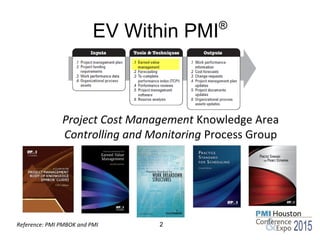
EV Within PMI®
2
Project Cost Management Knowledge Area
Controlling and Monitoring Process Group
Reference: PMI PMBOK and PMI
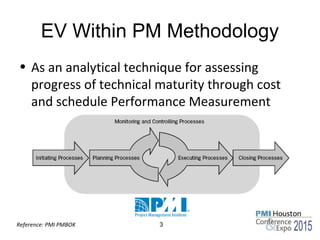
EV Within PM Methodology
• As an analytical technique for assessing
progress of technical maturity through cost
and schedule Performance Measurement
3Reference: PMI PMBOK
Capabilities of EV Management
• Objective, measurable metrics
• Informs the organization decision
making process
• Supports project controls to enable
successful project execution through
Performance Measurement
• Relevant to internally driven business
efficiency requirements for commercial
programs 4
Why EV Was Developed
• Late 1800s
– Optimize performance of factories
• 1950s and 1960s
– Navy developed into PERT/Cost techniques
– Cost/Schedule Control Systems Criteria (C/SCSC)
• 1998
– 32 guidelines in ANSI/EIA-748 by NDIA
• Performance Measurement as a means to
make better business decisions5
What’s In A Name
• Historically driven and mandated
within the defense industry
• Perception of being operationally
burdensome
• “Uncomfortable”
– Involves “a priori” planning and periodic reporting
– Requires root cause analysis and mitigation
– Drives accountability and active management
6
Earned Value
M
anagement
Reference: Earning Value from Earned Value
Glen Alleman, Aug 2013
What EV Isn’t or Won’t Do
• Performance Measurement
– Will not ensure project success by itself
– Is not a one size fits all strategy
– Does not make up for a bad plan, incomplete
requirements, or poor project management
– Is not just a government reporting requirement
• Performance Measurement is not a solution
as much as it is an efficiency enabling
methodology
7
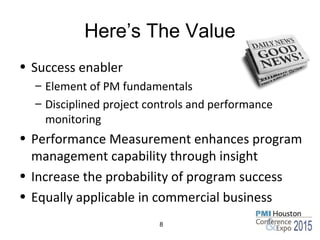
Here’s The Value
• Success enabler
– Element of PM fundamentals
– Disciplined project controls and performance
monitoring
• Performance Measurement enhances program
management capability through insight
• Increase the probability of program success
• Equally applicable in commercial business
8
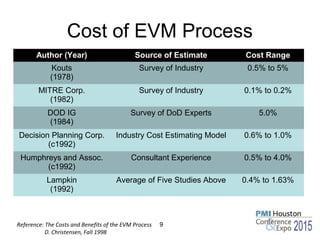
Cost of EVM Process
9Reference: The Costs and Benefits of the EVM Process
D. Christensen, Fall 1998
Author (Year) Source of Estimate Cost Range
Kouts
(1978)
Survey of Industry 0.5% to 5%
MITRE Corp.
(1982)
Survey of Industry 0.1% to 0.2%
DOD IG
(1984)
Survey of DoD Experts 5.0%
Decision Planning Corp.
(c1992)
Industry Cost Estimating Model 0.6% to 1.0%
Humphreys and Assoc.
(c1992)
Consultant Experience 0.5% to 4.0%
Lampkin
(1992)
Average of Five Studies Above 0.4% to 1.63%
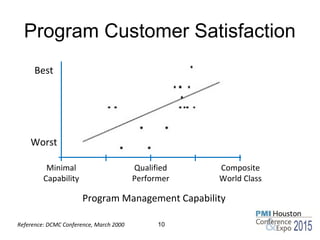
Program Customer Satisfaction
10
Best
Worst
Minimal
Capability
Composite
World Class
Qualified
Performer
Program Management Capability
Reference: DCMC Conference, March 2000
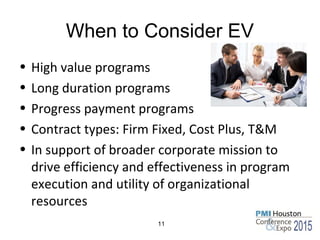
When to Consider EV
• High value programs
• Long duration programs
• Progress payment programs
• Contract types: Firm Fixed, Cost Plus, T&M
• In support of broader corporate mission to
drive efficiency and effectiveness in program
execution and utility of organizational
resources
11
Performance Measurement
• In support of objective technical maturity
• Objectively validated and measured time-
phased cost and schedule performance
• Alerts program to potential execution problems
– Absolute or trend measures
• Enables problem diagnosis by variance analysis
that leads to active program risk management
12
Why Measure Performance?
• To further increase the probability of program
success through:
– Risk and opportunity management
– Program governance and controls
• Answer the questions
– Is the program performing according to plan?
– Are there performance trends emerging?
– How does this program relate to corporate success?
13
Concepts
• Validate the technical scope
• Establish ‘The Plan’
– What scope, by when, for how much
• Measure performance and assess variance
• Analyze to reveal root cause
• Implement corrective actions
• Inform the organization
– Project and Portfolio levels
14
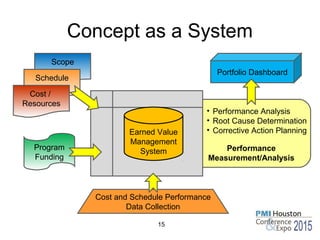
Portfolio Dashboard
Performance
Measurement/Analysis
Scope
Schedule
Cost /
Resources
Concept as a System
15
Earned Value
Management
System
• Performance Analysis
• Root Cause Determination
• Corrective Action Planning
Cost and Schedule Performance
Data Collection
Program
Funding
Performance Measures
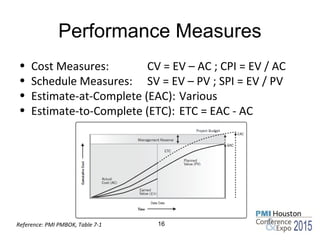
• Cost Measures: CV = EV – AC ; CPI = EV / AC
• Schedule Measures: SV = EV – PV ; SPI = EV / PV
• Estimate-at-Complete (EAC): Various
• Estimate-to-Complete (ETC): ETC = EAC - AC
16Reference: PMI PMBOK, Table 7-1
Establish the Plan
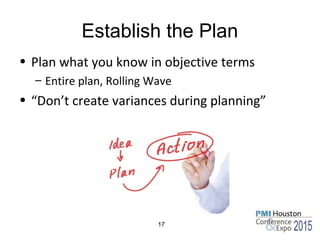
• Plan what you know in objective terms
– Entire plan, Rolling Wave
• “Don’t create variances during planning”
17
Measure Performance
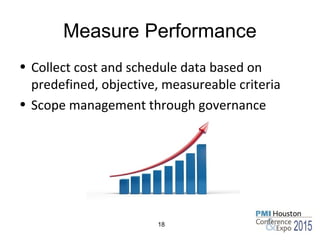
• Collect cost and schedule data based on
predefined, objective, measureable criteria
• Scope management through governance
18
Assess Variance
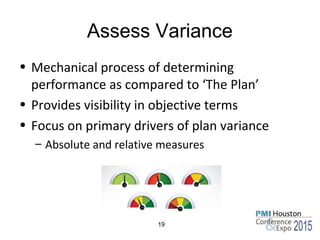
• Mechanical process of determining
performance as compared to ‘The Plan’
• Provides visibility in objective terms
• Focus on primary drivers of plan variance
– Absolute and relative measures
19
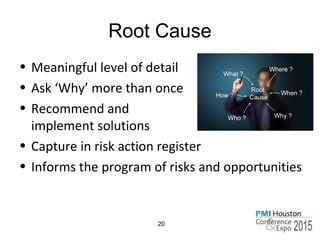
Root Cause
• Meaningful level of detail
• Ask ‘Why’ more than once
• Recommend and
implement solutions
• Capture in risk action register
• Informs the program of risks and opportunities
20
Implement Corrective Action
• Supports the program controls function
• Assess cost and schedule impacts
• Baseline program governance
• Log, track, and report
• Archive
21
Broader Context
• Risk and opportunity management
• Dashboard reporting
• Project portfolio management
– Projects | Programs | Portfolios
• Supportive of enterprise strategic objectives
and “Value Chain” of the organization
22
Deploy Incrementally
• Reconcile objective sources of performance
information for cost and/or schedule
• Measure performance period-over-period
• Allow the variance analysis to inform next
steps in evolving measurement maturity
– Rigorous management of baseline plan
– Reveal need for scope management
through governance
23
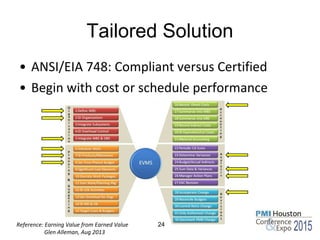
• ANSI/EIA 748: Compliant versus Certified
• Begin with cost or schedule performance
Tailored Solution
24Reference: Earning Value from Earned Value
Glen Alleman, Aug 2013
Overhead Burdens
• Training and education
– Stakeholders, PMO Team,
Project Managers
• Supporting IT infrastructure
– Cost and schedule information collection
– Excel spreadsheets to enterprise solutions
• Reporting and analysis time
• In comparison to value of improved
performance and project delivery25
Frame the Conversation
• Speak in terms of
Performance Measures
• Recognize the value of
performance insight
• Recognize performance data as a corporate asset
• Value of improved probability of program
success outweighs organizational cost factors
• Improved internal/external customer satisfaction
• Align to corporate objectives26
Prepare for Implementation
• Shared vision of what
success looks like
• Stakeholder alignment
and visible support
• Project identity and organizational brand
• Motivated, capable, and visionary team
• Integrated governance, change management
• Build open cross functional relationships
27
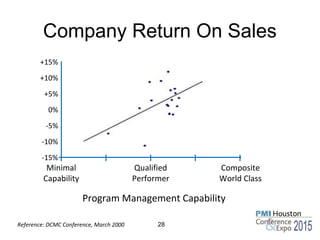
Company Return On Sales
28
+15%
Minimal
Capability
Composite
World Class
Qualified
Performer
Program Management Capability
Reference: DCMC Conference, March 2000
+10%
+5%
-15%
-10%
-5%
0%
29
Using Earned Value Management Concepts to
Improve Commercial Project Performance
R. Scott Brunton, PMP, PMI-RMP/SP, EVP
Principal Solutions Consultant
Lewis Fowler
383 Inverness Parkway, Suite 475
Englewood, CO 80112
www.lewisfowler.com
Phone: 719.339.0748
E-mail: sbrunton@lewisfowler.com
LinkedIn: www.linkedin.com/in/sbrunton
30
31
32

Using Earned Value Management Concepts to Improve Commercial Project Performance

  • 1.
    1 Using Earned ValueManagement Concepts to Improve Commercial Project Performance R. Scott Brunton, PMP, PMI-RMP/SP, EVP Principal Solutions Consultant Lewis Fowler, LLC – www.lewisfowler.com Welcome to the PMI Houston Conference & Expo and Annual Job Fair 2015 • Please put your phone on silent mode • Q&A will be taken at the close of this presentation • There will be time at the end of this presentation for you to take a few moments to complete the session survey. We value your feedback which allows us to improve this annual event.
  • 2.
    EV Within PMI® 2 ProjectCost Management Knowledge Area Controlling and Monitoring Process Group Reference: PMI PMBOK and PMI
  • 3.
    EV Within PMMethodology • As an analytical technique for assessing progress of technical maturity through cost and schedule Performance Measurement 3Reference: PMI PMBOK
  • 4.
    Capabilities of EVManagement • Objective, measurable metrics • Informs the organization decision making process • Supports project controls to enable successful project execution through Performance Measurement • Relevant to internally driven business efficiency requirements for commercial programs 4
  • 5.
    Why EV WasDeveloped • Late 1800s – Optimize performance of factories • 1950s and 1960s – Navy developed into PERT/Cost techniques – Cost/Schedule Control Systems Criteria (C/SCSC) • 1998 – 32 guidelines in ANSI/EIA-748 by NDIA • Performance Measurement as a means to make better business decisions5
  • 6.
    What’s In AName • Historically driven and mandated within the defense industry • Perception of being operationally burdensome • “Uncomfortable” – Involves “a priori” planning and periodic reporting – Requires root cause analysis and mitigation – Drives accountability and active management 6 Earned Value M anagement Reference: Earning Value from Earned Value Glen Alleman, Aug 2013
  • 7.
    What EV Isn’tor Won’t Do • Performance Measurement – Will not ensure project success by itself – Is not a one size fits all strategy – Does not make up for a bad plan, incomplete requirements, or poor project management – Is not just a government reporting requirement • Performance Measurement is not a solution as much as it is an efficiency enabling methodology 7
  • 8.
    Here’s The Value •Success enabler – Element of PM fundamentals – Disciplined project controls and performance monitoring • Performance Measurement enhances program management capability through insight • Increase the probability of program success • Equally applicable in commercial business 8
  • 9.
    Cost of EVMProcess 9Reference: The Costs and Benefits of the EVM Process D. Christensen, Fall 1998 Author (Year) Source of Estimate Cost Range Kouts (1978) Survey of Industry 0.5% to 5% MITRE Corp. (1982) Survey of Industry 0.1% to 0.2% DOD IG (1984) Survey of DoD Experts 5.0% Decision Planning Corp. (c1992) Industry Cost Estimating Model 0.6% to 1.0% Humphreys and Assoc. (c1992) Consultant Experience 0.5% to 4.0% Lampkin (1992) Average of Five Studies Above 0.4% to 1.63%
  • 10.
    Program Customer Satisfaction 10 Best Worst Minimal Capability Composite WorldClass Qualified Performer Program Management Capability Reference: DCMC Conference, March 2000
  • 11.
    When to ConsiderEV • High value programs • Long duration programs • Progress payment programs • Contract types: Firm Fixed, Cost Plus, T&M • In support of broader corporate mission to drive efficiency and effectiveness in program execution and utility of organizational resources 11
  • 12.
    Performance Measurement • Insupport of objective technical maturity • Objectively validated and measured time- phased cost and schedule performance • Alerts program to potential execution problems – Absolute or trend measures • Enables problem diagnosis by variance analysis that leads to active program risk management 12
  • 13.
    Why Measure Performance? •To further increase the probability of program success through: – Risk and opportunity management – Program governance and controls • Answer the questions – Is the program performing according to plan? – Are there performance trends emerging? – How does this program relate to corporate success? 13
  • 14.
    Concepts • Validate thetechnical scope • Establish ‘The Plan’ – What scope, by when, for how much • Measure performance and assess variance • Analyze to reveal root cause • Implement corrective actions • Inform the organization – Project and Portfolio levels 14
  • 15.
    Portfolio Dashboard Performance Measurement/Analysis Scope Schedule Cost / Resources Conceptas a System 15 Earned Value Management System • Performance Analysis • Root Cause Determination • Corrective Action Planning Cost and Schedule Performance Data Collection Program Funding
  • 16.
    Performance Measures • CostMeasures: CV = EV – AC ; CPI = EV / AC • Schedule Measures: SV = EV – PV ; SPI = EV / PV • Estimate-at-Complete (EAC): Various • Estimate-to-Complete (ETC): ETC = EAC - AC 16Reference: PMI PMBOK, Table 7-1
  • 17.
    Establish the Plan •Plan what you know in objective terms – Entire plan, Rolling Wave • “Don’t create variances during planning” 17
  • 18.
    Measure Performance • Collectcost and schedule data based on predefined, objective, measureable criteria • Scope management through governance 18
  • 19.
    Assess Variance • Mechanicalprocess of determining performance as compared to ‘The Plan’ • Provides visibility in objective terms • Focus on primary drivers of plan variance – Absolute and relative measures 19
  • 20.
    Root Cause • Meaningfullevel of detail • Ask ‘Why’ more than once • Recommend and implement solutions • Capture in risk action register • Informs the program of risks and opportunities 20
  • 21.
    Implement Corrective Action •Supports the program controls function • Assess cost and schedule impacts • Baseline program governance • Log, track, and report • Archive 21
  • 22.
    Broader Context • Riskand opportunity management • Dashboard reporting • Project portfolio management – Projects | Programs | Portfolios • Supportive of enterprise strategic objectives and “Value Chain” of the organization 22
  • 23.
    Deploy Incrementally • Reconcileobjective sources of performance information for cost and/or schedule • Measure performance period-over-period • Allow the variance analysis to inform next steps in evolving measurement maturity – Rigorous management of baseline plan – Reveal need for scope management through governance 23
  • 24.
    • ANSI/EIA 748:Compliant versus Certified • Begin with cost or schedule performance Tailored Solution 24Reference: Earning Value from Earned Value Glen Alleman, Aug 2013
  • 25.
    Overhead Burdens • Trainingand education – Stakeholders, PMO Team, Project Managers • Supporting IT infrastructure – Cost and schedule information collection – Excel spreadsheets to enterprise solutions • Reporting and analysis time • In comparison to value of improved performance and project delivery25
  • 26.
    Frame the Conversation •Speak in terms of Performance Measures • Recognize the value of performance insight • Recognize performance data as a corporate asset • Value of improved probability of program success outweighs organizational cost factors • Improved internal/external customer satisfaction • Align to corporate objectives26
  • 27.
    Prepare for Implementation •Shared vision of what success looks like • Stakeholder alignment and visible support • Project identity and organizational brand • Motivated, capable, and visionary team • Integrated governance, change management • Build open cross functional relationships 27
  • 28.
    Company Return OnSales 28 +15% Minimal Capability Composite World Class Qualified Performer Program Management Capability Reference: DCMC Conference, March 2000 +10% +5% -15% -10% -5% 0%
  • 29.
    29 Using Earned ValueManagement Concepts to Improve Commercial Project Performance R. Scott Brunton, PMP, PMI-RMP/SP, EVP Principal Solutions Consultant Lewis Fowler 383 Inverness Parkway, Suite 475 Englewood, CO 80112 www.lewisfowler.com Phone: 719.339.0748 E-mail: sbrunton@lewisfowler.com LinkedIn: www.linkedin.com/in/sbrunton
  • 30.
  • 31.
  • 32.

Editor's Notes

  • #6 Performance Evaluation and Review Technique
  • #7 Objections from Reference * Too bureaucratic, Too expensive to implement, Too many people required to administer, Special tools are needed, Baseline cannot be established early, Program too small for such an intrusive tool, Can’t affort this, Program is too big
  • #16 Responsibility Assignment Matrix (OBS, WBS), WBS Dictionary, Organizational Breakdown Structure, Work Breakdown Structure