
I
INTERNSHIP REPORT ON MAIMAAR
CONSTRUCTION COMPANY
Osama Yousaf
BBA (Hons)
INSTITUTE OF MANAGEMENT STUDIES
UNIVERSITY OF PESHAWAR
Session: 2011-2015
II
INTERNSHIP REPORT ON MAIMAAR
CONSTRUCTION COMPANY
Internship Report submitted To the Institute of Management Studies,
University of Peshawar, in partial Fulfillment of the Requirements
For the Degree of Bachelor of Business Administration (Hons)
February, 2016
III
INSTITUTE OF MANAGEMENT STUDIES
UNIVERSITY OF PESHAWAR
INTERNSHIP REPORT ON MAIMAAR
CONSTRUCTION COMPANY, PESHAWAR
Internal Supervisor:
Signature: _________________________
Name: ___________________________
Designation: ___________________________
External Supervisor:
Signature: _____________________________
Name: _____________________________
Designation: _____________________________
Dated: ___/___/2016
IV
Dedicated to:
My beloved Mother
&
Honorable teachers
V
Contents
Chapter 1.................................................................................................1
1.1 Background:.............................................................................. 1
1.2 Purpose of Study:.......................................................................2
1.3 Scope of Work:..........................................................................2
1.4 Methodology of the Study:......................................................... 3
1.5 Scheme of report:.......................................................................4
Chapter 2.................................................................................................5
2.1 Construction Sector in Pakistan.................................................. 5
2.2 Introduction to the Organization................................................. 5
2.3 Pre-Construction Services........................................................... 6
2.4 General Construction Services.................................................... 7
2.5 Construction Management Services............................................ 7
2.6 Design/Build Services.................................................................7
2.7 Main Office ............................................................................... 8
2.8 Competitors .............................................................................. 8
Chapter 3.................................................................................................9
3.1 Organizational Structure ............................................................ 9
3.2 Human Resource Department: ................................................. 10
3.3 Compensation and Benefits:..................................................... 10
3.3.1 Compliance...................................................................... 10
3.4 Recruitment & SelectionProcess, Methodologies, & Sources: .... 11
3.4.1 Methods of collectingjob analysisinformation:.................. 11
3.4.2 Interviews:....................................................................... 11
3.4.3 Interview questions:......................................................... 12
3.4.4 Recruitment:.................................................................... 12
3.4.5 Recruitment Process:........................................................ 13
3.5 TYPES OF RECRUITMENT: ......................................................... 14
3.6 PERFORMANCE APPRAISAL SYSTEM:......................................... 16
VI
3.6.1 APPRAISAL METHODS ....................................................... 17
3.6.2 BEHAVIOR APPRAISAL....................................................... 17
3.6.3 PERFORMANCE STANDARDS: ............................................ 17
3.6.4 MANAGING CAREER & FAIR TREATEMENT ......................... 18
3.6.5 PAY PLANS & INCENTIVES.................................................. 18
3.7 Employee Compensation & Benefits ......................................... 18
3.7.1 Type of compensation & benefits...................................... 18
3.7.2 CompensationPlans for Employees:.................................. 19
3.7.3 EMPLOYEE BENEFIT & SERVICES: ....................................... 19
3.7.4 Other Benefits:................................................................. 20
3.7.5 Financial, Career, Job-placement, Grievances..................... 20
3.7.6 Employee safety & health contribution.............................. 20
3.7.7 Health problems & remedies............................................. 21
3.7.8 Other Precautionary Measures.......................................... 21
3.8 Employee Job Changes Policies:................................................ 22
3.9 Accounts Department:............................................................. 23
3.10 Quantity Survey Department:................................................... 24
Chapter 4............................................................................................... 25
4.1 HR Analysis:............................................................................. 25
4.1.1 Training and Development.................................................... 25
4.1.2 TWO SCENARIOS OF TRAINING.............................................. 25
4.1.3 TWO TYPES OF TRAINING...................................................... 26
4.2 Training program..................................................................... 27
4.3 Activities of the Human Resource Department .......................... 28
4.4 Critical analysis ........................................................................... 31
4.5 SWOT Analysis: ......................................................................... 32
Chapter 5............................................................................................... 37
5.1 Findings & Recommendations .................................................. 37
References:.............................................................................. 40
VII
EXECUTIVE SUMMARY
The construction industry plays a vital role in the economic
development and prosperity of the country. Also seen as an economic
growth driver especially in the third world countries which is unluckily
often overlooked in a country such as ours . This industry plays an
important role by reducing unemployment and developing the
aggregate economy by providing employment opportunities. Economic
efficiency is improved when the industry material resources and
human resources effectively in the development of housing,
infrastructure and their maintenance. Construction industry also
provides growth to other sectors through forward and backward
linkages which makes it very important to be nurtured for a healthy
economic growth.
Internee’s purpose of study was to be indulged and work in the
practical environment of the organization. How the activities take place
and are managed specifically relating to the human resource practices.
The aim was to increase in the internee’s practical knowledge make
analysis and then give recommendation in benefit of the organization.
Methods used for the collection of data during the internship period
were both primary and secondary sources. The main and biggest
source of information was from the personal observation and
discussion with different members of the organization.
Findings made by the internee through personal observation and
analysis about the organization includes increasing the reach to the
customers, how to motivate the employee’s, how to help the
employee’s in enhancing their abilities, how the communication can be
VIII
further improved, to which level authority delegation should be
implemented, how to retain employees, how can the proper placement
of departments effect the overall performance and why should the
market be kept under constant surveillance in order to keep up with the
competition in the market.
The internee recommends different options to the organization which
will help it in different aspects. The recommendations are based on
based on personal experience, observation and analysis of internee
relating to irregularities and general mistakes that occasionally take
place in the organization. Recommendations are related to maximum
reach, motivation, abilities enhancement, communication
improvement, delegation or authority, retention, proper placement of
the departments and monitoring.
1
Chapter 1
1.1 Background:
The construction industry plays an essential role in the socio economic
development of a country. The activities of the industry have great
significance to the achievement of national socio-economic
development goals of providing infrastructure, sanctuary and
employment. It includes hospitals, schools, townships, offices, houses
and other buildings; urban infrastructure (including water supply,
sewerage, drainage); highways, roads, ports, railways, airports; power
systems; irrigation and agriculture systems; telecommunications etc. It
deals with all economic activities directed to the creation, renovation,
repair or extension of fixed assets in the form of buildings, land
improvements of an engineering nature. Besides, the construction
industry generates substantial employment and provides a growth
impetus to other sectors through backward and forward linkages. It is,
essential therefore, that, this vital activity is nurtured for the healthy
growth of the economy.
The housing and construction sector in Pakistan plays an important
role in developing aggregate economy and reducing unemployment. It
provides substantial employment opportunities as it contributes
through a higher multiplier effect with a host of beneficial forward and
backward linkage in the economy. The sector through linkages affects
about 40 building material industries, support investment and growth
climate and helps reduce poverty by generating income opportunities
for poor household. It provides jobs to about 5.5 per cent of the total
employed labor force or to 2.43 million persons during 2003- 04.
2
Though Construction activities and its output is an integral part of a
country’s national economy and industrial development. The
construction industry is often seen as a driver of economic growth
especially in developing countries. The industry can mobilize and
effectively utilize local human and material resources in the
development and maintenance of housing and infrastructure to promote
local employment and improve economic efficiency. Unfortunately the
construction sector is one of the most neglected sectors in Pakistan. It
is at low ebb, which can be judged from the fact that per capita
consumption of cement in Pakistan is one of the lowest among the
developing countries.
1.2 Purpose of Study:
The purpose of the study is to work in a real life situation and the
human resource practices, workings and the issues regarding it taking
place within the organization. It is aimed at the application of the
internee’s knowledge at the practical field analysis of the concerned
organization as well making recommendation so as to be beneficial for
internee and the organization as well. For this purpose the internee
chose Maimaar Construction Company, Peshawar.
1.3 Scope of Work:
The scope of work is confined to the organizations human resource
practices, along with all the limitations to collect relevant data,
practices and issues. Keeping in view the purpose of study covered
areas which include are employees strength, training and development,
their recruitment processes, appraisal methods and the amount of
compensation and benefits given to the employee.
3
1.4 Methodologyof the Study:
The report is based on my two months internship program in MCC,
Peshawar. The methodology reported for collection of data was
primary as well as secondary data sources. The biggest source of
information was my personal observation while working with staff and
discussing with them about different tasks performed at hand. I was
keenly observing different employees while they were dealing with
others and then when they would report back to their respective
managers and team leaders.
Primary Data:
This data was collected through
 Personal Observation
 Unstructured Interviews
Secondary' Data:
Secondary data was collected through
 Sales Journals, employee manuals, and documents regarding
different departments
 Organization’s website
 Other reports
4
1.5 Scheme of report:
Chapter 1: It includes introduction of the report that consists of
background of the study, purpose of study, scope of work,
methodology of research and scheme of report.
Chapter 2: It includes the background and history of Maimaar
Construction Company (MCC).
Chapter 3: It includes the introduction of the MCC, different HR
practices by the organization recruitment & selection, HR functions,
org structure, training and development and their details, and
everything related to the human resource department of MCC.
Chapter 4: It includes the HR analysis, Critical Analysis and SWOT
analysis of the overall functions of Maimaar Construction Company.
Chapter 5: It includes the findings of the report and some
recommendations for the organization.
5
Chapter 2
2.1 ConstructionSectorin Pakistan
The construction industry is an important sector of the economy and
has multiple backward and forward linkages with other sectors. The
industry contributes significantly to socio-economic development and
employment and there is a consensus on certain common issues that
plague the construction industry in developing countries.
Pakistan is a developing country that is currently enjoying relatively
strong growth in construction activities. Today, construction is the
second largest sector in Pakistan’s economy after agriculture. Roughly
30-35% of employment is directly or indirectly affiliated with the
construction sector. As such, the construction sectorin Pakistan has
played an important role in providing jobs and facilitating revival of
the economy.
2.2 Introduction to the Organization
Maimaar Construction Co. offers a full range of pre-construction and
construction services. The project teams maintain a strong foundation
of trust and mutual respect generated through positive relationships
with clients, architects, engineers, subcontractors and suppliers. A
company-wide policy encouraging shared performance responsibility
ensures the highest degree of professional service and results on all
projects undertake. Maimaar Construction co. was established in 2003
with its office in Peshawar. Maimaar Construction co. was a brainchild
6
of 2 engineers. Engineer Ibad Ali as Managing director and Engineer
Suleman Ahmad as Projects Director. Maimaar Construction co. is
registered AOP and holds license of C-3 category with Pakistan
Engineering Council, and has A class registration with Army Housing
Directorate GHQ Rawalpindi. We keep an expert eye on time, cost and
quality of projects.
2.3 Pre-ConstructionServices
Through clarification of and commitment to project team goals,
Maimaar Construction provides the project owner and architect with
control of the project's schedule, budget and quality. This is
accomplished with studies, Expert advice in construction means and
methods and confirmation of the Maimaar project team's
understanding of these goals with mock-ups, samples and
investigations of existing product installations.
Maimaar Construction Co. believes the identification of team goals to
be one of pre-construction's primary objectives. A draft schedule
incorporating these goals with the anticipated construction activities
and entitlement process displays logic relationships and anticipates
potential team goal conflicts. The pre-construction schedule serves as
the road map for design development decisions pertaining to project
scope, budget and procurement.
7
2.4 GeneralConstructionServices
Maimaar Construction Co. provides in-depth management and
supervision of all of its projects with hands-on involvement by the
companies’ principals and project supervisors from start to finish.
Maimaar Construction Co. process encompasses an information system
for the project to coordinate the owner's and architect's goals. This
comprehensive system includes numerous components ranging from
scheduling, cost control, and billing to job meetings, procurement, job
close-out and warranty management.
2.5 ConstructionManagementServices
At Maimaar Construction Co., construction management services
provide assurance to the owner of a well-run, problem-free job site.
The team of experienced construction professionals provides cost
control, scheduling coordination, quality control and timely execution
of plans throughout the project. The owner's interest is represented
throughout the project, from start to finish, ensuring schedule
compliance, coordinating proper document control and optimizing the
owner's investment in the project.
2.6 Design/BuildServices
Design/build project success is accomplished by applying a
comprehensive project team management delivery system. Maimaar
Construction Co. team's experience covers a broad range of
8
professional services, from consulting and feasibility studies, to the
complete design, engineering and construction expertise to fully
implement a project. The planners, designers, engineers and builders
work in concert throughout the entire project towards the common goal
of providing a quality product at a competitive price.
2.7 Main Office
Tel: 92-91-5844315
Email: info@maimaarconstruction.com
Address: Opposite Honda North Jamrud Road, Peshawar
2.8 Competitors
 Rockwell Group
 Ahansaz Contractor (Pvt) Limited
 Habib Construction Services
 Izhar Construction
 Taloo Builders & Developers
 Paragon Construction (Pvt) Limited
 Habib Rafiq (Pvt) Limited
 AMCE (Pvt) Limited
 Waquat Builders & Developers
 MIDJAC Construction (Pvt) Limited
 Siemens Pakistan Engineering Company
9
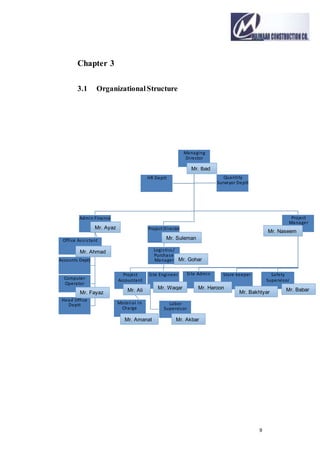
Chapter 3
3.1 OrganizationalStructure
Managing
Director
Admin Finance
Accounts Deptt
Computer
Operator
Head Office
Deptt
Office Assistant
Project Director
Logistics/
Purchase
Manager
Project
Accountant
Material in
Charge
Project
Manager
Site Engineer
Labor
Supervisor
Site Admin Store keeper Safety
Supervisor
HR Deptt Quantity
Surveyor Deptt
Mr. Ibad
Mr. Ayaz
Mr. Ahmad
Mr. Suleman
Mr. Gohar
Mr. Fayaz
Mr. Naseem
Mr. AkbarMr. Amanat
Mr. BabarMr. Bakhtyar
Mr. HaroonMr. WaqarMr. Ali
10
3.2 Human ResourceDepartment:
The human resources department of at Maimaar Construction
Company is responsible for hiring employees, maintaining employee
well-being and dismissing employees when necessary. The human
resources department handles many tasks related directly to
employment issues, such as payroll, insurance, benefits and taxes, and
it is responsible for staying up-to-date on legal issues affecting
employment. The primary responsibility of the human resources
department is to keep the company staffed appropriately at all times.
This includes employee recruitment, selection and retention. Human
resources managers strive to recruit quality employees select the best
for the available positions and then develop policies that retain great
workers. Retention policies include providing adequate compensation,
training programs and competitive benefits packages. When an
employee leaves, the human resources department conducts exit
interviews to assess the employee's reasons for leaving in order to
create better retention policies.
3.3 Compensationand Benefits:
3.3.1 Compliance
Compliance with labor and employment laws is a critical HR function.
Noncompliance can result in workplace complaints based on unfair
employment practices, unsafe working conditions and general
dissatisfaction with working conditions that can affect productivity and
ultimately, profitability. HR staff must be aware of federal and state
employment laws such as Title VII of the Civil Rights Act, the Fair
11
Labor Standards Act, the National Labor Relations Act and many other
rules and regulations.
3.4 Recruitment & Selection Process, Methodologies,
& Sources:
3.4.1 Methods of collecting job analysis information:
There are two methods of collecting Job Analysis Information:-
 Interviews
 Observation
3.4.2 Interviews:
“A procedure designed to obtain information from a person through
oral responses to oral inquiries”
Who Conducts Interview?
“Interviews are taken by the branch HR head responsible for
recruitment and selection”
Types of Interviews Taken:
• Structured interview only
• Structured Sequential Interviews
• Panel Interview
12
Criteria for Selecting Candidates:
Following is the criteria for selecting candidates are based on:
 Communication Skills
 Present Personality
 Educational Background (etc.)
 Skills And Competency
3.4.3 Interview questions:
 Why Should I Hire You?
 Why Do You Want To Work For Us?
 What’s Your Great Strength?
 What’s Your Great Weakness?
 How Much Salary Do You Expected From Us?
3.4.4 Recruitment:
“The development of a pool of applicants for jobs in the organization”
Sources of Job Recruitment's:
Following are the some sources of Job Recruitment:
 By Universities
 By Website
 By Newspapers
13
3.4.5 Recruitment Process:
Following are the recruitment processes:
1.) Assess need (strategic planning and tactical planning)
2.) Create a pool of candidates:
3.) Screen out candidates:
4.) Make selection
5.) Evaluate recruitment process:
1.) Assess need(strategic planning and tactical planning)
There is no fixed quota of number of employees to be recruited, it
depends on need and the strategic (organizational) and tactical
requirements or by the number of incoming projects.
2.) Create a pool of candidates:
The prospect candidates are attracted through advertisement in the
newspapers; walk in or through PR contacts.
3.) Screen out candidates:
Through interviews and tests they screen out the less attractive
candidates.
14
4.) Make selection:
After further interviews and other processes the final candidate is
selected. Questions in an interview are made by doing proper job
analysis of the job. That includes identifying the job duties and
requirements.
5.) Evaluate recruitment process:
Evaluate effectiveness of recruitment by comparing the results to
expected results.
3.5 TYPES OF RECRUITMENT:
Internal sources
Transfers
The employees are transferred from one department to another
according to their efficiency and experience.
Promotions
The employees are promoted from one department to another with
more benefits and greater responsibility based on efficiency and
experience.
15
Upgrading and Demotion of present employees are done according
to their performance.
Retired and Retrenched employees may also be recruited once again
in case of shortage of qualified personnel or increase in load of
work.
Deceased employees and Disabled employees are also done by many
companies so that the members of the family do not become
dependent on the mercy of others.
External sources
Press Advertisement
Advertisements of the vacancy in newspapers and journals are a widely
used source of recruitment. The main advantage of this method is that
it has a wide reach.
Placement Agencies
Several private consultancy firms perform recruitment functions on
behalf of client companies by charging a fee.
These agencies are particularly suitable for recruitment of executives
and specialists. It is also known as RPO (Recruitment Process
Outsourcing)
16
Educational-Institutes
Various management institutes are a good source of recruiting well
qualified executives. They provide facilities for campus interviews and
placements. This source is known as Campus Recruitment.
Employment-Exchanges
Government establishes public employment exchanges throughout the
country. These exchanges provide job information to job seekers and
help employers in identifying suitable candidates.
Unskilled workers
May be recruited at the factory gate these may be employed whenever
a permanent worker is absent. More efficient among these may be
recruited to fill permanent vacancies
3.6 PERFORMANCEAPPRAISAL SYSTEM:
“Evaluating an employee’s current and/or past performance relative to
his or her performance standards”
“Performance appraisal helps us in estimating employee’s current
performance, setting work standards and then providing feedback to
employees with the aim of eliminating performance deficiencies”.
17
3.6.1 APPRAISAL METHODS
The Appraisal Methods are
1. Self Appraisal Method
 Rating
 Evaluation
1. Problems During Appraisal
· Unfair Assessment (Bias)
3.6.2 BEHAVIOR APPRAISAL
In this service oriented industry behavior is as important as
performance on job. To manage behaviors and appraise company has
devised a managing behavior system to evaluate their core values.
Each employee in such a system is rated against the behavior
performance achieved, against the required benchmark applicable,
depending on the Job Grade.
3.6.3 PERFORMANCE STANDARDS:
Following Performance Standards that are laid down are:
1-Demonstrates Commitment
2-Aligns Activities
3-Promotes Long Term Objectives
18
3.6.4 MANAGING CAREER & FAIR TREATEMENT
At MCC Managing Career & Fair Treatment is based on:
 Promotion Decision
 How To Handle Transfer
 Communication At MCC
 Manage Dismissals
3.6.5 PAY PLANS & INCENTIVES
Pay Plans:
Pay plans are establish on the basis of job ratings. All jobs are ranked
from top to bottom, on the bases of compensable factor. Employee
with higher rank gets highest pay and incentives.
3.7 Employee Compensation& Benefits
3.7.1 Type of compensation & benefits
Companies regularly provide benefits, facilities, and incentives to their
employees and workers to motivate them. The management is well
aware of the impact of the incentives to workers and other staff
members. Keeping the importance of incentive system, management
offers following benefits to its workers.
19
3.7.2 Compensation Plans for Employees:
Compensation plan for employees includes:
 Basic Salary
 Bonuses
 Medical Facilities
 Allowances
Incentive Plans:
Incentive are provided to
 Managers and Executives
 Middle and Lower Level Employees
3.7.3 EMPLOYEE BENEFIT & SERVICES:
The employee benefits & services provided are
 Health & Life Insurance
 Paid Annual Vacations, Leaves, Holidays
 Health Insurance Of Parents
 Pension & Provident Fund
 Discount On Company Products
 Annual Bonuses
 Educational Plans
20
 Social Events
 Customized Services
 Creative, Learning & Healthy Environment
 Highly Qualified, Experienced & Committed Staff
 Profit & Gain Sharing Plans
3.7.4 Other Benefits:
Other benefits provided to its employees are
 Introduction Of MENTORS
 Job Rotation Facility
 Refreshment Packages
 Traveling & Stay Allowances
3.7.5 Financial, Career, Job-placement, Grievances
 Lunch & Learn Program
 Employee Transportation
 Educational & Training Subsidies
 No-subsidized Child & Elder Care
3.7.6 Employee safety & health contribution
 Strict About Occupational Safety Laws
 Routine Safety Audits
 Inspection & Citations By Head Branch
21
 Managing Proper Responsibilities & Rights Of Both Employer
& Employee
3.7.7 Health problems & remedies
Following are the steps that taken to solve the health problems in the
organization and make possible remedial changes
 Smoke Free Environment
 Role Of Mentors
 Job-stress , Burn-out , Health Conditions
 Vaccinations & Health Treatments
3.7.8 Other Precautionary Measures
Other precautionary measures taken for the safety of employees are
1. Personalized Attention To Employees
2. Angry Employees Management
3. Temporary Stop The Working
4. Counseling
5. Real Root Problem
6. Use Of Personal Skills
7. Professional Attitude Adopted
8. Future Avoidance
22
3.8 Employee Job Changes Policies:
1. Promotion
It is a good tool to reward and motivate employees. Employees who
perform well within organization they are rewarded with promoting.
2. Transfer
Organization has the right to transfer its employees.
3. Demotion
If employee is not performing well company can demote him.
Separation:
1. Layoff
Layoff is the temporary suspension or permanent termination of an
employee if he is not working well in case of over staffing.
2. Termination
Termination of employee is the end of an employee's duration with an
employer. Depending on the case, the decision may be made by the
employee, the employer, or mutually agreed upon by both.
23
3. Resignation
A resignation is the formal act of giving up or quitting one's office or
position. The employee as per requirement has to hand over a letter 30
days before he wants to resign so that his place can be replaced by the
management.
4. Retirement
Retirement is the point where a person stops employment completely.
At the age of 60 employees have the benefits of provident fund and
gratuity after retirement but no such retirement plan policy has yet
been devised at the Maimaar Constructions.
3.9 Accounts Department:
An accounting department at Maimmar Construction provides
accounting services and financial support to the organization. The
department records accounts payable and receivable, inventory,
payroll, fixed assets and all other financial elements. The department's
accountants review the records of each department to determine the
company's financial position and any changes required to run the
organization cost effectively.
24
3.10 Quantity Survey Department:
The quantity surveyor department at Maimmar Constructions manages
all costs relating to building and civil engineering projects, from the
initial calculations to the final figures. Surveyors seek to minimize the
costs of a project and enhance value for money, while still achieving
the required standards and quality. Many of these are specified by
statutory building regulations, which the surveyor needs to understand
and adhere to.
The department can be working in an office or on site at any given
time. They are involved in a project from the start, preparing estimates
and costs of the work.
When the project is in progress, quantity surveyors keep track of any
variations to the contract that may affect costs and create reports to
show profitability. Their Main roles also include:
• managing the finances for any kind of construction project
• working to keep the project on time
• working to keep the project within the budget
•making sure that construction costs and production are managed as
efficiently as possible
• resolving disputes between contracting parties
• allocating work to subcontractors
• On-going cost analysis of maintenance and repair work
25
Chapter 4
4.1 HR Analysis:
4.1.1 Training and Development
Training
“The process of teaching new employee the basic skills they need to
perform their jobs.”
Basic Steps in Training:
Following are the basic steps in training employees:
• Need Analysis
• Instructional Design
• Validation
• Implementation
• Evaluation and follow up
4.1.2 TWO SCENARIOS OF TRAINING
Training Calendar:
Head office devises a calendar according to which they train their
employees.
26
NeedBasis:
When the Branch Manager realizes that a specific department lacks in
some skill or need further improvements.
4.1.3 TWO TYPES OF TRAINING
On The Job Training:
“Training a person to learn a job while working on it”
Off The Job Training:
“Training an employee to learn a job while providing him a class room
environment”
ON THE JOB TRAINING
“On The Job Training” is done by
 Making teams of new employees with a few old specialized
Employees.
 Contribution to overall productivity.
 Lower cost
 Lower Time
OFF THE JOB TRAINING
Off the Job Training is done by
27
 In-house training ,done at least once a year
 Employees are tested after the completion of the course
 Specialist trainers are hired
 Provide a proper learning environment to the employees
 Professional faculty is hired
 Increases employee loyalty
 Labor productivity is zero
 Cost is high
 Time is consumed
4.2 Training program
Detailed description of the operations/activities of the department
worked at:
The Human Resource Department deals with management of people
within the organization. There are a number of responsibilities that
come with this title. First of all, the Department is responsible for
hiring members of staff; this will involve attracting employees,
keeping them in their positions and ensuring that they perform to
expectation. Besides, the Human Resource Department also clarifies
and sets day to day goals for the organization. It is responsible for
28
organization of people in the entire Company and plans for future
ventures and objectives involving people in the Company.
4.3 Activities of the Human Resource Department
Recruitment of employees
This is one of the most fundamental roles of the HR department. This
is because this function ensures that the Company under consideration
selects the most skillful and competent person from a sea of applicants
at that time. This function involves evaluation of ability and
competency of potential employees in relation to what the Company
needs. This role falls under the Staffing role of management. If this
function is performed well, then the organization will increase value
consequently being on the right pathway to achieve its organizational
and departmental goals and objectives.
Improvement of compensation packages
One of the major functions of the HR department is to motivate
employees. This can be done through rewards especially for those who
have done well. The HR department needs to evaluate performance of
employees and those who have exceeded expectations should be
compensated for their actions. Research has shown that rewarding
employees for good performance is the number one incentive for
keeping up this trend. These compensation packages can come in the
following ways;
 Holiday offers
 End of year bonuses
29
 Awards
 Salary increments
 Provision of flexible working hours
 Straight forward promotion schemes and career developments
If the HR department includes these incentives, then it will ensure that
employees are satisfied with the Company. It will also contribute
towards good staff retention rates. This is especially crucial in
increasing stability within the organization. It also makes employees
identify with the firm and instills a sense of loyalty.
Planning in the organization
The Human Resource Department is placed with the responsibility of
ensuring that it plans adequately for all the organization’s future
engagements that will involve people. One important aspect of this is
planning for employees in the organization. It is important that the
organization ensures that all the employees under its wing are just
enough to increase value to the organization. The HR department is
also bestowed with the responsibility of planning future organizational
goal in relation to people or clarifying these same goals to staff
members.
Training and internships
It is not necessarily a guarantee that a candidate who did well in the
recruitment exercise is the best in performing an organization’s
functions. New employees need orientation into the Company’s
functions and can also improve some inefficiency that these new
employees may have in relation to their skills. This is the purpose of
30
placing them on internships. Training is also essential for members of
staff who have been working for the organization for a long time. This
is especially so in the wake of technological advancements, legal
changes and changes in service delivery. It is important for an
Organization to keep up with industry trends otherwise it faces the
danger of becoming obsolete; especially in the background of
increasing competition.
Making better use of time
The Human Resource is conferred with the responsibility of ensuring
that all members of staff perform to their best ability. It could improve
this area by facilitating better use of time in all departments within the
organization. Time is one of the most crucial yet intangible assets of
the Company. The proper use of this resource could maximize
production and achievement of organizational goals.
Improving organizational culture
The Human Resource Department can try to improve organizational
culture by finding out what makes ups or what the company’s culture
is like. HR should also be very intense on the organizational needs.
Here, HR should realize that personal fulfillment works better and
therefore should try to ensure that the change is relevant to every staff
member. In this stage, HR should try to explain to all staff members or
stakeholder the advantage of transforming the culture in the
organization. This should be made clear so that all can see the
advantages at the individual level and not simply at the organizational
level. Then HR should try to eliminate all inhibitions in staff member’s
minds. It is possible that some may claim that they tried one or two
31
strategies before and it did not succeed. This are what are called ‘cries
of despair’ and HR should try its best to explain to staff members the
need of changing the culture of the organization.
4.4 Critical analysis
Critical analysis of HR department
Placement:
HR department is not given proper place within the organization i.e. it
is only existent on the papers and not physically allotted space within
the organisation.
Negligence:
Training & development programmes are not appropriate because of
any proper attention given to it by the management or the lack of
funds.
Favoritism:
There is favoritism practiced in the department by the senior
individuals.
Internal Politics:
Politics are involved in management team which is an effect also
because of the favouritism involved.
Insufficient Staff:
Staff is not sufficient to carry out the proper functions and deploy the
strategies that would benefit the organisation.
32
Non-serious Management:
HR department is not properly developed because of overlooking of its
importance and role in the senior management.
Work load:
Working hours are mostly longer due to lack of employees and
overburden of work.
Inefficient Reward System:
Reward system is not appropriate or followed thoroughly as mentioned
by the organisation which causes frustration among the employees.
4.5 SWOT Analysis:
SWOT Analysis is a popular technique used to analyze some
company’s present business situation. It provides us with an overview
of company’s major strengths and its critical weaknesses. The external
opportunities and threats that the company faces in the external
environment are also highlighted in this approach. The SWOT
Analysis has two basic components. These components are due to:
Strengths
 Location
33
Location is right in the middle of university road which makes
them very approachable and in sight for the potential
customers.
 Human resources
The base to the success of the organizations service which are
their best asset and can be found in abundance.
 Quality
No compromise on the quality since the organizations existence
that is why it achieved category 3 in such a short period.
 Employees
A family like bond and trust present among all the employees
resulting in little to no turnover.
 Price
Best price is offered to all customers in the market that is why
the organization is constantly contracted by the military
regularly due to their budget restrictions.
Weaknesses
 Written Communication
34
Managing director is updated mostly by the word of mouth or
through text messages by the employees present at the working
site.
 Centralization Of Power
Decision making power and authority only exists with the
managing director.
 Unsatisfaction In Management
Unsatisfaction in the management exists due to incentives not
properly given or on time, working overtime and favoritism in
the organization.
 Wastage Of Resources
If the daily records and paper material are converted into digital
it would save the organization immense amount of resources.
 HR Department
HR department is not properly given time, managed or allotted
space due to negligence of management.
 IT System
Almost all work is not computerized and on papers resulting in
loss of time, effort and resources.
35
Opportunities
 PR Influence
Personal and Public relations both can be used to the advantage
of the organization.
 More Marketing
More marketing can be done weather free though the internet or
paid such as news ads or billboards to grab the attention of
potential customers or while hiring new employees.
 Apply Newspaper Ads
The better and feasible approach to getting the word out of any
sort that the organization wants to grab people’s interest since a
lot of people still read the newspaper in the local area
 Walk-In Customer
Potential future clients when the customer himself walks into
the organization.
 Connected With Architects
Relations are good with the architects and consistent which in
turn is a possible future customer and can be a possible word of
mouth for the organization.
36
Threats
 Terrorism
Under developed areas or remote areas have little to no security
and are always under the possibility of an attack where progress
of development takes place.
 Severe Market Changes
Changes within the market can pose a threat to the
organization, such as a new market entrant who significantly
alters the product/service offering. There may also be
unexpected changes in consumer behavior that can significantly
impact revenue.
 Globalization
Any setback or crash in the international stock market can also
directly affect the financial flow.
 Growing Prices Of Raw Material
Quality work and on budget is what all customers want but due
to instability in the national currency and inflation, prices can
go up while the deal has already been made or in progress at a
cheaper rate & may cause potential setbacks.
 Material Supplier
37
The organization should try to avoid being dependent on one
supplier and keep in touch with multiple suppliers to avoid the
negative influence that they may try to cause.
Chapter 5
5.1 Findings & Recommendations
Findings
1. Maximum Reach:
How can they expand business and reach more customers?
2. Motivation:
Way to increase employee motivation?
3. Enhancing Abilities:
How will the employee improve their skill and knowledge?
4. Improving Communication:
In order to keep track of information being exchanged what steps
should be taken?
5. Delegating Authority:
How will executives make sure processes are carried out properly at
every level?
6. Retention:
38
How to retain experienced employees?
7. Proper Placement:
How to increase performance and effectiveness of HR department?
8. Monitoring:
How should the organisation keep up with their competition?
Recommendations
1. Maximum Reach:
They need to establish their offices in other cities to expand their
operations and maximize their reach also to monitor on-going
operations from the office that would be nearest to the city and to reach
more potential customers.
2. Motivation:
There is not much motivation or enthusiasm therefore eemployee’s
incentives should be increased in order to maximize their satisfaction
and retention which will also in turn increase their performance.
3. Enhancing Abilities:
Need to improve the Training of employees so they can develop and
enhance their knowledge and abilities in turn it would profit the
organisation also.
39
.
4. Improving Communication:
Need to improve communication within the organization from top
level to bottom level and vice versa, making it more formal through the
e-mail in order to keep track of the information being exchanged.
5. Delegating Authority:
Decision making should not be centralized; lower level management
should also be involved in the activity which will save the organization
time, avoiding miscommunication and executing jobs effectively.
6. Retention:
If they need to retain trained and experienced people that can be
done by offering attractive salary and bonus packages.
7. Proper Placement:
HR department should be fully established and placed properly within
the organization since almost all the activities are performed by the
human resource and the organizations existence relies on it.
8. Monitoring:
They should continuously monitor severe market changes and try to
cope with them such as market rate fluctuation locally and globally,
customer behavior change, globalization etc.
40
References:
http://www.maimaarconstruction.com/
www.Wikipedia.com
Others
Finance Manager: Mr Ayaz
Head Engineer: Mr Ibad
Supply Chain Manager: Mr. Gohar
Technical Staff: Mr. Amanat

An internship report on a Construction Company

  • 1.
    I INTERNSHIP REPORT ONMAIMAAR CONSTRUCTION COMPANY Osama Yousaf BBA (Hons) INSTITUTE OF MANAGEMENT STUDIES UNIVERSITY OF PESHAWAR Session: 2011-2015
  • 2.
    II INTERNSHIP REPORT ONMAIMAAR CONSTRUCTION COMPANY Internship Report submitted To the Institute of Management Studies, University of Peshawar, in partial Fulfillment of the Requirements For the Degree of Bachelor of Business Administration (Hons) February, 2016
  • 3.
    III INSTITUTE OF MANAGEMENTSTUDIES UNIVERSITY OF PESHAWAR INTERNSHIP REPORT ON MAIMAAR CONSTRUCTION COMPANY, PESHAWAR Internal Supervisor: Signature: _________________________ Name: ___________________________ Designation: ___________________________ External Supervisor: Signature: _____________________________ Name: _____________________________ Designation: _____________________________ Dated: ___/___/2016
  • 4.
    IV Dedicated to: My belovedMother & Honorable teachers
  • 5.
    V Contents Chapter 1.................................................................................................1 1.1 Background:..............................................................................1 1.2 Purpose of Study:.......................................................................2 1.3 Scope of Work:..........................................................................2 1.4 Methodology of the Study:......................................................... 3 1.5 Scheme of report:.......................................................................4 Chapter 2.................................................................................................5 2.1 Construction Sector in Pakistan.................................................. 5 2.2 Introduction to the Organization................................................. 5 2.3 Pre-Construction Services........................................................... 6 2.4 General Construction Services.................................................... 7 2.5 Construction Management Services............................................ 7 2.6 Design/Build Services.................................................................7 2.7 Main Office ............................................................................... 8 2.8 Competitors .............................................................................. 8 Chapter 3.................................................................................................9 3.1 Organizational Structure ............................................................ 9 3.2 Human Resource Department: ................................................. 10 3.3 Compensation and Benefits:..................................................... 10 3.3.1 Compliance...................................................................... 10 3.4 Recruitment & SelectionProcess, Methodologies, & Sources: .... 11 3.4.1 Methods of collectingjob analysisinformation:.................. 11 3.4.2 Interviews:....................................................................... 11 3.4.3 Interview questions:......................................................... 12 3.4.4 Recruitment:.................................................................... 12 3.4.5 Recruitment Process:........................................................ 13 3.5 TYPES OF RECRUITMENT: ......................................................... 14 3.6 PERFORMANCE APPRAISAL SYSTEM:......................................... 16
  • 6.
    VI 3.6.1 APPRAISAL METHODS....................................................... 17 3.6.2 BEHAVIOR APPRAISAL....................................................... 17 3.6.3 PERFORMANCE STANDARDS: ............................................ 17 3.6.4 MANAGING CAREER & FAIR TREATEMENT ......................... 18 3.6.5 PAY PLANS & INCENTIVES.................................................. 18 3.7 Employee Compensation & Benefits ......................................... 18 3.7.1 Type of compensation & benefits...................................... 18 3.7.2 CompensationPlans for Employees:.................................. 19 3.7.3 EMPLOYEE BENEFIT & SERVICES: ....................................... 19 3.7.4 Other Benefits:................................................................. 20 3.7.5 Financial, Career, Job-placement, Grievances..................... 20 3.7.6 Employee safety & health contribution.............................. 20 3.7.7 Health problems & remedies............................................. 21 3.7.8 Other Precautionary Measures.......................................... 21 3.8 Employee Job Changes Policies:................................................ 22 3.9 Accounts Department:............................................................. 23 3.10 Quantity Survey Department:................................................... 24 Chapter 4............................................................................................... 25 4.1 HR Analysis:............................................................................. 25 4.1.1 Training and Development.................................................... 25 4.1.2 TWO SCENARIOS OF TRAINING.............................................. 25 4.1.3 TWO TYPES OF TRAINING...................................................... 26 4.2 Training program..................................................................... 27 4.3 Activities of the Human Resource Department .......................... 28 4.4 Critical analysis ........................................................................... 31 4.5 SWOT Analysis: ......................................................................... 32 Chapter 5............................................................................................... 37 5.1 Findings & Recommendations .................................................. 37 References:.............................................................................. 40
  • 7.
    VII EXECUTIVE SUMMARY The constructionindustry plays a vital role in the economic development and prosperity of the country. Also seen as an economic growth driver especially in the third world countries which is unluckily often overlooked in a country such as ours . This industry plays an important role by reducing unemployment and developing the aggregate economy by providing employment opportunities. Economic efficiency is improved when the industry material resources and human resources effectively in the development of housing, infrastructure and their maintenance. Construction industry also provides growth to other sectors through forward and backward linkages which makes it very important to be nurtured for a healthy economic growth. Internee’s purpose of study was to be indulged and work in the practical environment of the organization. How the activities take place and are managed specifically relating to the human resource practices. The aim was to increase in the internee’s practical knowledge make analysis and then give recommendation in benefit of the organization. Methods used for the collection of data during the internship period were both primary and secondary sources. The main and biggest source of information was from the personal observation and discussion with different members of the organization. Findings made by the internee through personal observation and analysis about the organization includes increasing the reach to the customers, how to motivate the employee’s, how to help the employee’s in enhancing their abilities, how the communication can be
  • 8.
    VIII further improved, towhich level authority delegation should be implemented, how to retain employees, how can the proper placement of departments effect the overall performance and why should the market be kept under constant surveillance in order to keep up with the competition in the market. The internee recommends different options to the organization which will help it in different aspects. The recommendations are based on based on personal experience, observation and analysis of internee relating to irregularities and general mistakes that occasionally take place in the organization. Recommendations are related to maximum reach, motivation, abilities enhancement, communication improvement, delegation or authority, retention, proper placement of the departments and monitoring.
  • 9.
    1 Chapter 1 1.1 Background: Theconstruction industry plays an essential role in the socio economic development of a country. The activities of the industry have great significance to the achievement of national socio-economic development goals of providing infrastructure, sanctuary and employment. It includes hospitals, schools, townships, offices, houses and other buildings; urban infrastructure (including water supply, sewerage, drainage); highways, roads, ports, railways, airports; power systems; irrigation and agriculture systems; telecommunications etc. It deals with all economic activities directed to the creation, renovation, repair or extension of fixed assets in the form of buildings, land improvements of an engineering nature. Besides, the construction industry generates substantial employment and provides a growth impetus to other sectors through backward and forward linkages. It is, essential therefore, that, this vital activity is nurtured for the healthy growth of the economy. The housing and construction sector in Pakistan plays an important role in developing aggregate economy and reducing unemployment. It provides substantial employment opportunities as it contributes through a higher multiplier effect with a host of beneficial forward and backward linkage in the economy. The sector through linkages affects about 40 building material industries, support investment and growth climate and helps reduce poverty by generating income opportunities for poor household. It provides jobs to about 5.5 per cent of the total employed labor force or to 2.43 million persons during 2003- 04.
  • 10.
    2 Though Construction activitiesand its output is an integral part of a country’s national economy and industrial development. The construction industry is often seen as a driver of economic growth especially in developing countries. The industry can mobilize and effectively utilize local human and material resources in the development and maintenance of housing and infrastructure to promote local employment and improve economic efficiency. Unfortunately the construction sector is one of the most neglected sectors in Pakistan. It is at low ebb, which can be judged from the fact that per capita consumption of cement in Pakistan is one of the lowest among the developing countries. 1.2 Purpose of Study: The purpose of the study is to work in a real life situation and the human resource practices, workings and the issues regarding it taking place within the organization. It is aimed at the application of the internee’s knowledge at the practical field analysis of the concerned organization as well making recommendation so as to be beneficial for internee and the organization as well. For this purpose the internee chose Maimaar Construction Company, Peshawar. 1.3 Scope of Work: The scope of work is confined to the organizations human resource practices, along with all the limitations to collect relevant data, practices and issues. Keeping in view the purpose of study covered areas which include are employees strength, training and development, their recruitment processes, appraisal methods and the amount of compensation and benefits given to the employee.
  • 11.
    3 1.4 Methodologyof theStudy: The report is based on my two months internship program in MCC, Peshawar. The methodology reported for collection of data was primary as well as secondary data sources. The biggest source of information was my personal observation while working with staff and discussing with them about different tasks performed at hand. I was keenly observing different employees while they were dealing with others and then when they would report back to their respective managers and team leaders. Primary Data: This data was collected through  Personal Observation  Unstructured Interviews Secondary' Data: Secondary data was collected through  Sales Journals, employee manuals, and documents regarding different departments  Organization’s website  Other reports
  • 12.
    4 1.5 Scheme ofreport: Chapter 1: It includes introduction of the report that consists of background of the study, purpose of study, scope of work, methodology of research and scheme of report. Chapter 2: It includes the background and history of Maimaar Construction Company (MCC). Chapter 3: It includes the introduction of the MCC, different HR practices by the organization recruitment & selection, HR functions, org structure, training and development and their details, and everything related to the human resource department of MCC. Chapter 4: It includes the HR analysis, Critical Analysis and SWOT analysis of the overall functions of Maimaar Construction Company. Chapter 5: It includes the findings of the report and some recommendations for the organization.
  • 13.
    5 Chapter 2 2.1 ConstructionSectorinPakistan The construction industry is an important sector of the economy and has multiple backward and forward linkages with other sectors. The industry contributes significantly to socio-economic development and employment and there is a consensus on certain common issues that plague the construction industry in developing countries. Pakistan is a developing country that is currently enjoying relatively strong growth in construction activities. Today, construction is the second largest sector in Pakistan’s economy after agriculture. Roughly 30-35% of employment is directly or indirectly affiliated with the construction sector. As such, the construction sectorin Pakistan has played an important role in providing jobs and facilitating revival of the economy. 2.2 Introduction to the Organization Maimaar Construction Co. offers a full range of pre-construction and construction services. The project teams maintain a strong foundation of trust and mutual respect generated through positive relationships with clients, architects, engineers, subcontractors and suppliers. A company-wide policy encouraging shared performance responsibility ensures the highest degree of professional service and results on all projects undertake. Maimaar Construction co. was established in 2003 with its office in Peshawar. Maimaar Construction co. was a brainchild
  • 14.
    6 of 2 engineers.Engineer Ibad Ali as Managing director and Engineer Suleman Ahmad as Projects Director. Maimaar Construction co. is registered AOP and holds license of C-3 category with Pakistan Engineering Council, and has A class registration with Army Housing Directorate GHQ Rawalpindi. We keep an expert eye on time, cost and quality of projects. 2.3 Pre-ConstructionServices Through clarification of and commitment to project team goals, Maimaar Construction provides the project owner and architect with control of the project's schedule, budget and quality. This is accomplished with studies, Expert advice in construction means and methods and confirmation of the Maimaar project team's understanding of these goals with mock-ups, samples and investigations of existing product installations. Maimaar Construction Co. believes the identification of team goals to be one of pre-construction's primary objectives. A draft schedule incorporating these goals with the anticipated construction activities and entitlement process displays logic relationships and anticipates potential team goal conflicts. The pre-construction schedule serves as the road map for design development decisions pertaining to project scope, budget and procurement.
  • 15.
    7 2.4 GeneralConstructionServices Maimaar ConstructionCo. provides in-depth management and supervision of all of its projects with hands-on involvement by the companies’ principals and project supervisors from start to finish. Maimaar Construction Co. process encompasses an information system for the project to coordinate the owner's and architect's goals. This comprehensive system includes numerous components ranging from scheduling, cost control, and billing to job meetings, procurement, job close-out and warranty management. 2.5 ConstructionManagementServices At Maimaar Construction Co., construction management services provide assurance to the owner of a well-run, problem-free job site. The team of experienced construction professionals provides cost control, scheduling coordination, quality control and timely execution of plans throughout the project. The owner's interest is represented throughout the project, from start to finish, ensuring schedule compliance, coordinating proper document control and optimizing the owner's investment in the project. 2.6 Design/BuildServices Design/build project success is accomplished by applying a comprehensive project team management delivery system. Maimaar Construction Co. team's experience covers a broad range of
  • 16.
    8 professional services, fromconsulting and feasibility studies, to the complete design, engineering and construction expertise to fully implement a project. The planners, designers, engineers and builders work in concert throughout the entire project towards the common goal of providing a quality product at a competitive price. 2.7 Main Office Tel: 92-91-5844315 Email: info@maimaarconstruction.com Address: Opposite Honda North Jamrud Road, Peshawar 2.8 Competitors  Rockwell Group  Ahansaz Contractor (Pvt) Limited  Habib Construction Services  Izhar Construction  Taloo Builders & Developers  Paragon Construction (Pvt) Limited  Habib Rafiq (Pvt) Limited  AMCE (Pvt) Limited  Waquat Builders & Developers  MIDJAC Construction (Pvt) Limited  Siemens Pakistan Engineering Company
  • 17.
    9 Chapter 3 3.1 OrganizationalStructure Managing Director AdminFinance Accounts Deptt Computer Operator Head Office Deptt Office Assistant Project Director Logistics/ Purchase Manager Project Accountant Material in Charge Project Manager Site Engineer Labor Supervisor Site Admin Store keeper Safety Supervisor HR Deptt Quantity Surveyor Deptt Mr. Ibad Mr. Ayaz Mr. Ahmad Mr. Suleman Mr. Gohar Mr. Fayaz Mr. Naseem Mr. AkbarMr. Amanat Mr. BabarMr. Bakhtyar Mr. HaroonMr. WaqarMr. Ali
  • 18.
    10 3.2 Human ResourceDepartment: Thehuman resources department of at Maimaar Construction Company is responsible for hiring employees, maintaining employee well-being and dismissing employees when necessary. The human resources department handles many tasks related directly to employment issues, such as payroll, insurance, benefits and taxes, and it is responsible for staying up-to-date on legal issues affecting employment. The primary responsibility of the human resources department is to keep the company staffed appropriately at all times. This includes employee recruitment, selection and retention. Human resources managers strive to recruit quality employees select the best for the available positions and then develop policies that retain great workers. Retention policies include providing adequate compensation, training programs and competitive benefits packages. When an employee leaves, the human resources department conducts exit interviews to assess the employee's reasons for leaving in order to create better retention policies. 3.3 Compensationand Benefits: 3.3.1 Compliance Compliance with labor and employment laws is a critical HR function. Noncompliance can result in workplace complaints based on unfair employment practices, unsafe working conditions and general dissatisfaction with working conditions that can affect productivity and ultimately, profitability. HR staff must be aware of federal and state employment laws such as Title VII of the Civil Rights Act, the Fair
  • 19.
    11 Labor Standards Act,the National Labor Relations Act and many other rules and regulations. 3.4 Recruitment & Selection Process, Methodologies, & Sources: 3.4.1 Methods of collecting job analysis information: There are two methods of collecting Job Analysis Information:-  Interviews  Observation 3.4.2 Interviews: “A procedure designed to obtain information from a person through oral responses to oral inquiries” Who Conducts Interview? “Interviews are taken by the branch HR head responsible for recruitment and selection” Types of Interviews Taken: • Structured interview only • Structured Sequential Interviews • Panel Interview
  • 20.
    12 Criteria for SelectingCandidates: Following is the criteria for selecting candidates are based on:  Communication Skills  Present Personality  Educational Background (etc.)  Skills And Competency 3.4.3 Interview questions:  Why Should I Hire You?  Why Do You Want To Work For Us?  What’s Your Great Strength?  What’s Your Great Weakness?  How Much Salary Do You Expected From Us? 3.4.4 Recruitment: “The development of a pool of applicants for jobs in the organization” Sources of Job Recruitment's: Following are the some sources of Job Recruitment:  By Universities  By Website  By Newspapers
  • 21.
    13 3.4.5 Recruitment Process: Followingare the recruitment processes: 1.) Assess need (strategic planning and tactical planning) 2.) Create a pool of candidates: 3.) Screen out candidates: 4.) Make selection 5.) Evaluate recruitment process: 1.) Assess need(strategic planning and tactical planning) There is no fixed quota of number of employees to be recruited, it depends on need and the strategic (organizational) and tactical requirements or by the number of incoming projects. 2.) Create a pool of candidates: The prospect candidates are attracted through advertisement in the newspapers; walk in or through PR contacts. 3.) Screen out candidates: Through interviews and tests they screen out the less attractive candidates.
  • 22.
    14 4.) Make selection: Afterfurther interviews and other processes the final candidate is selected. Questions in an interview are made by doing proper job analysis of the job. That includes identifying the job duties and requirements. 5.) Evaluate recruitment process: Evaluate effectiveness of recruitment by comparing the results to expected results. 3.5 TYPES OF RECRUITMENT: Internal sources Transfers The employees are transferred from one department to another according to their efficiency and experience. Promotions The employees are promoted from one department to another with more benefits and greater responsibility based on efficiency and experience.
  • 23.
    15 Upgrading and Demotionof present employees are done according to their performance. Retired and Retrenched employees may also be recruited once again in case of shortage of qualified personnel or increase in load of work. Deceased employees and Disabled employees are also done by many companies so that the members of the family do not become dependent on the mercy of others. External sources Press Advertisement Advertisements of the vacancy in newspapers and journals are a widely used source of recruitment. The main advantage of this method is that it has a wide reach. Placement Agencies Several private consultancy firms perform recruitment functions on behalf of client companies by charging a fee. These agencies are particularly suitable for recruitment of executives and specialists. It is also known as RPO (Recruitment Process Outsourcing)
  • 24.
    16 Educational-Institutes Various management institutesare a good source of recruiting well qualified executives. They provide facilities for campus interviews and placements. This source is known as Campus Recruitment. Employment-Exchanges Government establishes public employment exchanges throughout the country. These exchanges provide job information to job seekers and help employers in identifying suitable candidates. Unskilled workers May be recruited at the factory gate these may be employed whenever a permanent worker is absent. More efficient among these may be recruited to fill permanent vacancies 3.6 PERFORMANCEAPPRAISAL SYSTEM: “Evaluating an employee’s current and/or past performance relative to his or her performance standards” “Performance appraisal helps us in estimating employee’s current performance, setting work standards and then providing feedback to employees with the aim of eliminating performance deficiencies”.
  • 25.
    17 3.6.1 APPRAISAL METHODS TheAppraisal Methods are 1. Self Appraisal Method  Rating  Evaluation 1. Problems During Appraisal · Unfair Assessment (Bias) 3.6.2 BEHAVIOR APPRAISAL In this service oriented industry behavior is as important as performance on job. To manage behaviors and appraise company has devised a managing behavior system to evaluate their core values. Each employee in such a system is rated against the behavior performance achieved, against the required benchmark applicable, depending on the Job Grade. 3.6.3 PERFORMANCE STANDARDS: Following Performance Standards that are laid down are: 1-Demonstrates Commitment 2-Aligns Activities 3-Promotes Long Term Objectives
  • 26.
    18 3.6.4 MANAGING CAREER& FAIR TREATEMENT At MCC Managing Career & Fair Treatment is based on:  Promotion Decision  How To Handle Transfer  Communication At MCC  Manage Dismissals 3.6.5 PAY PLANS & INCENTIVES Pay Plans: Pay plans are establish on the basis of job ratings. All jobs are ranked from top to bottom, on the bases of compensable factor. Employee with higher rank gets highest pay and incentives. 3.7 Employee Compensation& Benefits 3.7.1 Type of compensation & benefits Companies regularly provide benefits, facilities, and incentives to their employees and workers to motivate them. The management is well aware of the impact of the incentives to workers and other staff members. Keeping the importance of incentive system, management offers following benefits to its workers.
  • 27.
    19 3.7.2 Compensation Plansfor Employees: Compensation plan for employees includes:  Basic Salary  Bonuses  Medical Facilities  Allowances Incentive Plans: Incentive are provided to  Managers and Executives  Middle and Lower Level Employees 3.7.3 EMPLOYEE BENEFIT & SERVICES: The employee benefits & services provided are  Health & Life Insurance  Paid Annual Vacations, Leaves, Holidays  Health Insurance Of Parents  Pension & Provident Fund  Discount On Company Products  Annual Bonuses  Educational Plans
  • 28.
    20  Social Events Customized Services  Creative, Learning & Healthy Environment  Highly Qualified, Experienced & Committed Staff  Profit & Gain Sharing Plans 3.7.4 Other Benefits: Other benefits provided to its employees are  Introduction Of MENTORS  Job Rotation Facility  Refreshment Packages  Traveling & Stay Allowances 3.7.5 Financial, Career, Job-placement, Grievances  Lunch & Learn Program  Employee Transportation  Educational & Training Subsidies  No-subsidized Child & Elder Care 3.7.6 Employee safety & health contribution  Strict About Occupational Safety Laws  Routine Safety Audits  Inspection & Citations By Head Branch
  • 29.
    21  Managing ProperResponsibilities & Rights Of Both Employer & Employee 3.7.7 Health problems & remedies Following are the steps that taken to solve the health problems in the organization and make possible remedial changes  Smoke Free Environment  Role Of Mentors  Job-stress , Burn-out , Health Conditions  Vaccinations & Health Treatments 3.7.8 Other Precautionary Measures Other precautionary measures taken for the safety of employees are 1. Personalized Attention To Employees 2. Angry Employees Management 3. Temporary Stop The Working 4. Counseling 5. Real Root Problem 6. Use Of Personal Skills 7. Professional Attitude Adopted 8. Future Avoidance
  • 30.
    22 3.8 Employee JobChanges Policies: 1. Promotion It is a good tool to reward and motivate employees. Employees who perform well within organization they are rewarded with promoting. 2. Transfer Organization has the right to transfer its employees. 3. Demotion If employee is not performing well company can demote him. Separation: 1. Layoff Layoff is the temporary suspension or permanent termination of an employee if he is not working well in case of over staffing. 2. Termination Termination of employee is the end of an employee's duration with an employer. Depending on the case, the decision may be made by the employee, the employer, or mutually agreed upon by both.
  • 31.
    23 3. Resignation A resignationis the formal act of giving up or quitting one's office or position. The employee as per requirement has to hand over a letter 30 days before he wants to resign so that his place can be replaced by the management. 4. Retirement Retirement is the point where a person stops employment completely. At the age of 60 employees have the benefits of provident fund and gratuity after retirement but no such retirement plan policy has yet been devised at the Maimaar Constructions. 3.9 Accounts Department: An accounting department at Maimmar Construction provides accounting services and financial support to the organization. The department records accounts payable and receivable, inventory, payroll, fixed assets and all other financial elements. The department's accountants review the records of each department to determine the company's financial position and any changes required to run the organization cost effectively.
  • 32.
    24 3.10 Quantity SurveyDepartment: The quantity surveyor department at Maimmar Constructions manages all costs relating to building and civil engineering projects, from the initial calculations to the final figures. Surveyors seek to minimize the costs of a project and enhance value for money, while still achieving the required standards and quality. Many of these are specified by statutory building regulations, which the surveyor needs to understand and adhere to. The department can be working in an office or on site at any given time. They are involved in a project from the start, preparing estimates and costs of the work. When the project is in progress, quantity surveyors keep track of any variations to the contract that may affect costs and create reports to show profitability. Their Main roles also include: • managing the finances for any kind of construction project • working to keep the project on time • working to keep the project within the budget •making sure that construction costs and production are managed as efficiently as possible • resolving disputes between contracting parties • allocating work to subcontractors • On-going cost analysis of maintenance and repair work
  • 33.
    25 Chapter 4 4.1 HRAnalysis: 4.1.1 Training and Development Training “The process of teaching new employee the basic skills they need to perform their jobs.” Basic Steps in Training: Following are the basic steps in training employees: • Need Analysis • Instructional Design • Validation • Implementation • Evaluation and follow up 4.1.2 TWO SCENARIOS OF TRAINING Training Calendar: Head office devises a calendar according to which they train their employees.
  • 34.
    26 NeedBasis: When the BranchManager realizes that a specific department lacks in some skill or need further improvements. 4.1.3 TWO TYPES OF TRAINING On The Job Training: “Training a person to learn a job while working on it” Off The Job Training: “Training an employee to learn a job while providing him a class room environment” ON THE JOB TRAINING “On The Job Training” is done by  Making teams of new employees with a few old specialized Employees.  Contribution to overall productivity.  Lower cost  Lower Time OFF THE JOB TRAINING Off the Job Training is done by
  • 35.
    27  In-house training,done at least once a year  Employees are tested after the completion of the course  Specialist trainers are hired  Provide a proper learning environment to the employees  Professional faculty is hired  Increases employee loyalty  Labor productivity is zero  Cost is high  Time is consumed 4.2 Training program Detailed description of the operations/activities of the department worked at: The Human Resource Department deals with management of people within the organization. There are a number of responsibilities that come with this title. First of all, the Department is responsible for hiring members of staff; this will involve attracting employees, keeping them in their positions and ensuring that they perform to expectation. Besides, the Human Resource Department also clarifies and sets day to day goals for the organization. It is responsible for
  • 36.
    28 organization of peoplein the entire Company and plans for future ventures and objectives involving people in the Company. 4.3 Activities of the Human Resource Department Recruitment of employees This is one of the most fundamental roles of the HR department. This is because this function ensures that the Company under consideration selects the most skillful and competent person from a sea of applicants at that time. This function involves evaluation of ability and competency of potential employees in relation to what the Company needs. This role falls under the Staffing role of management. If this function is performed well, then the organization will increase value consequently being on the right pathway to achieve its organizational and departmental goals and objectives. Improvement of compensation packages One of the major functions of the HR department is to motivate employees. This can be done through rewards especially for those who have done well. The HR department needs to evaluate performance of employees and those who have exceeded expectations should be compensated for their actions. Research has shown that rewarding employees for good performance is the number one incentive for keeping up this trend. These compensation packages can come in the following ways;  Holiday offers  End of year bonuses
  • 37.
    29  Awards  Salaryincrements  Provision of flexible working hours  Straight forward promotion schemes and career developments If the HR department includes these incentives, then it will ensure that employees are satisfied with the Company. It will also contribute towards good staff retention rates. This is especially crucial in increasing stability within the organization. It also makes employees identify with the firm and instills a sense of loyalty. Planning in the organization The Human Resource Department is placed with the responsibility of ensuring that it plans adequately for all the organization’s future engagements that will involve people. One important aspect of this is planning for employees in the organization. It is important that the organization ensures that all the employees under its wing are just enough to increase value to the organization. The HR department is also bestowed with the responsibility of planning future organizational goal in relation to people or clarifying these same goals to staff members. Training and internships It is not necessarily a guarantee that a candidate who did well in the recruitment exercise is the best in performing an organization’s functions. New employees need orientation into the Company’s functions and can also improve some inefficiency that these new employees may have in relation to their skills. This is the purpose of
  • 38.
    30 placing them oninternships. Training is also essential for members of staff who have been working for the organization for a long time. This is especially so in the wake of technological advancements, legal changes and changes in service delivery. It is important for an Organization to keep up with industry trends otherwise it faces the danger of becoming obsolete; especially in the background of increasing competition. Making better use of time The Human Resource is conferred with the responsibility of ensuring that all members of staff perform to their best ability. It could improve this area by facilitating better use of time in all departments within the organization. Time is one of the most crucial yet intangible assets of the Company. The proper use of this resource could maximize production and achievement of organizational goals. Improving organizational culture The Human Resource Department can try to improve organizational culture by finding out what makes ups or what the company’s culture is like. HR should also be very intense on the organizational needs. Here, HR should realize that personal fulfillment works better and therefore should try to ensure that the change is relevant to every staff member. In this stage, HR should try to explain to all staff members or stakeholder the advantage of transforming the culture in the organization. This should be made clear so that all can see the advantages at the individual level and not simply at the organizational level. Then HR should try to eliminate all inhibitions in staff member’s minds. It is possible that some may claim that they tried one or two
  • 39.
    31 strategies before andit did not succeed. This are what are called ‘cries of despair’ and HR should try its best to explain to staff members the need of changing the culture of the organization. 4.4 Critical analysis Critical analysis of HR department Placement: HR department is not given proper place within the organization i.e. it is only existent on the papers and not physically allotted space within the organisation. Negligence: Training & development programmes are not appropriate because of any proper attention given to it by the management or the lack of funds. Favoritism: There is favoritism practiced in the department by the senior individuals. Internal Politics: Politics are involved in management team which is an effect also because of the favouritism involved. Insufficient Staff: Staff is not sufficient to carry out the proper functions and deploy the strategies that would benefit the organisation.
  • 40.
    32 Non-serious Management: HR departmentis not properly developed because of overlooking of its importance and role in the senior management. Work load: Working hours are mostly longer due to lack of employees and overburden of work. Inefficient Reward System: Reward system is not appropriate or followed thoroughly as mentioned by the organisation which causes frustration among the employees. 4.5 SWOT Analysis: SWOT Analysis is a popular technique used to analyze some company’s present business situation. It provides us with an overview of company’s major strengths and its critical weaknesses. The external opportunities and threats that the company faces in the external environment are also highlighted in this approach. The SWOT Analysis has two basic components. These components are due to: Strengths  Location
  • 41.
    33 Location is rightin the middle of university road which makes them very approachable and in sight for the potential customers.  Human resources The base to the success of the organizations service which are their best asset and can be found in abundance.  Quality No compromise on the quality since the organizations existence that is why it achieved category 3 in such a short period.  Employees A family like bond and trust present among all the employees resulting in little to no turnover.  Price Best price is offered to all customers in the market that is why the organization is constantly contracted by the military regularly due to their budget restrictions. Weaknesses  Written Communication
  • 42.
    34 Managing director isupdated mostly by the word of mouth or through text messages by the employees present at the working site.  Centralization Of Power Decision making power and authority only exists with the managing director.  Unsatisfaction In Management Unsatisfaction in the management exists due to incentives not properly given or on time, working overtime and favoritism in the organization.  Wastage Of Resources If the daily records and paper material are converted into digital it would save the organization immense amount of resources.  HR Department HR department is not properly given time, managed or allotted space due to negligence of management.  IT System Almost all work is not computerized and on papers resulting in loss of time, effort and resources.
  • 43.
    35 Opportunities  PR Influence Personaland Public relations both can be used to the advantage of the organization.  More Marketing More marketing can be done weather free though the internet or paid such as news ads or billboards to grab the attention of potential customers or while hiring new employees.  Apply Newspaper Ads The better and feasible approach to getting the word out of any sort that the organization wants to grab people’s interest since a lot of people still read the newspaper in the local area  Walk-In Customer Potential future clients when the customer himself walks into the organization.  Connected With Architects Relations are good with the architects and consistent which in turn is a possible future customer and can be a possible word of mouth for the organization.
  • 44.
    36 Threats  Terrorism Under developedareas or remote areas have little to no security and are always under the possibility of an attack where progress of development takes place.  Severe Market Changes Changes within the market can pose a threat to the organization, such as a new market entrant who significantly alters the product/service offering. There may also be unexpected changes in consumer behavior that can significantly impact revenue.  Globalization Any setback or crash in the international stock market can also directly affect the financial flow.  Growing Prices Of Raw Material Quality work and on budget is what all customers want but due to instability in the national currency and inflation, prices can go up while the deal has already been made or in progress at a cheaper rate & may cause potential setbacks.  Material Supplier
  • 45.
    37 The organization shouldtry to avoid being dependent on one supplier and keep in touch with multiple suppliers to avoid the negative influence that they may try to cause. Chapter 5 5.1 Findings & Recommendations Findings 1. Maximum Reach: How can they expand business and reach more customers? 2. Motivation: Way to increase employee motivation? 3. Enhancing Abilities: How will the employee improve their skill and knowledge? 4. Improving Communication: In order to keep track of information being exchanged what steps should be taken? 5. Delegating Authority: How will executives make sure processes are carried out properly at every level? 6. Retention:
  • 46.
    38 How to retainexperienced employees? 7. Proper Placement: How to increase performance and effectiveness of HR department? 8. Monitoring: How should the organisation keep up with their competition? Recommendations 1. Maximum Reach: They need to establish their offices in other cities to expand their operations and maximize their reach also to monitor on-going operations from the office that would be nearest to the city and to reach more potential customers. 2. Motivation: There is not much motivation or enthusiasm therefore eemployee’s incentives should be increased in order to maximize their satisfaction and retention which will also in turn increase their performance. 3. Enhancing Abilities: Need to improve the Training of employees so they can develop and enhance their knowledge and abilities in turn it would profit the organisation also.
  • 47.
    39 . 4. Improving Communication: Needto improve communication within the organization from top level to bottom level and vice versa, making it more formal through the e-mail in order to keep track of the information being exchanged. 5. Delegating Authority: Decision making should not be centralized; lower level management should also be involved in the activity which will save the organization time, avoiding miscommunication and executing jobs effectively. 6. Retention: If they need to retain trained and experienced people that can be done by offering attractive salary and bonus packages. 7. Proper Placement: HR department should be fully established and placed properly within the organization since almost all the activities are performed by the human resource and the organizations existence relies on it. 8. Monitoring: They should continuously monitor severe market changes and try to cope with them such as market rate fluctuation locally and globally, customer behavior change, globalization etc.
  • 48.
    40 References: http://www.maimaarconstruction.com/ www.Wikipedia.com Others Finance Manager: MrAyaz Head Engineer: Mr Ibad Supply Chain Manager: Mr. Gohar Technical Staff: Mr. Amanat