Application of…
…to the real
Introduction
&
History
of
Calculus
-Divyarajsinh
C a l c u l u s
What does it mean ?
Who invented it?
What we study in Calculus?
What was the need to invent it?
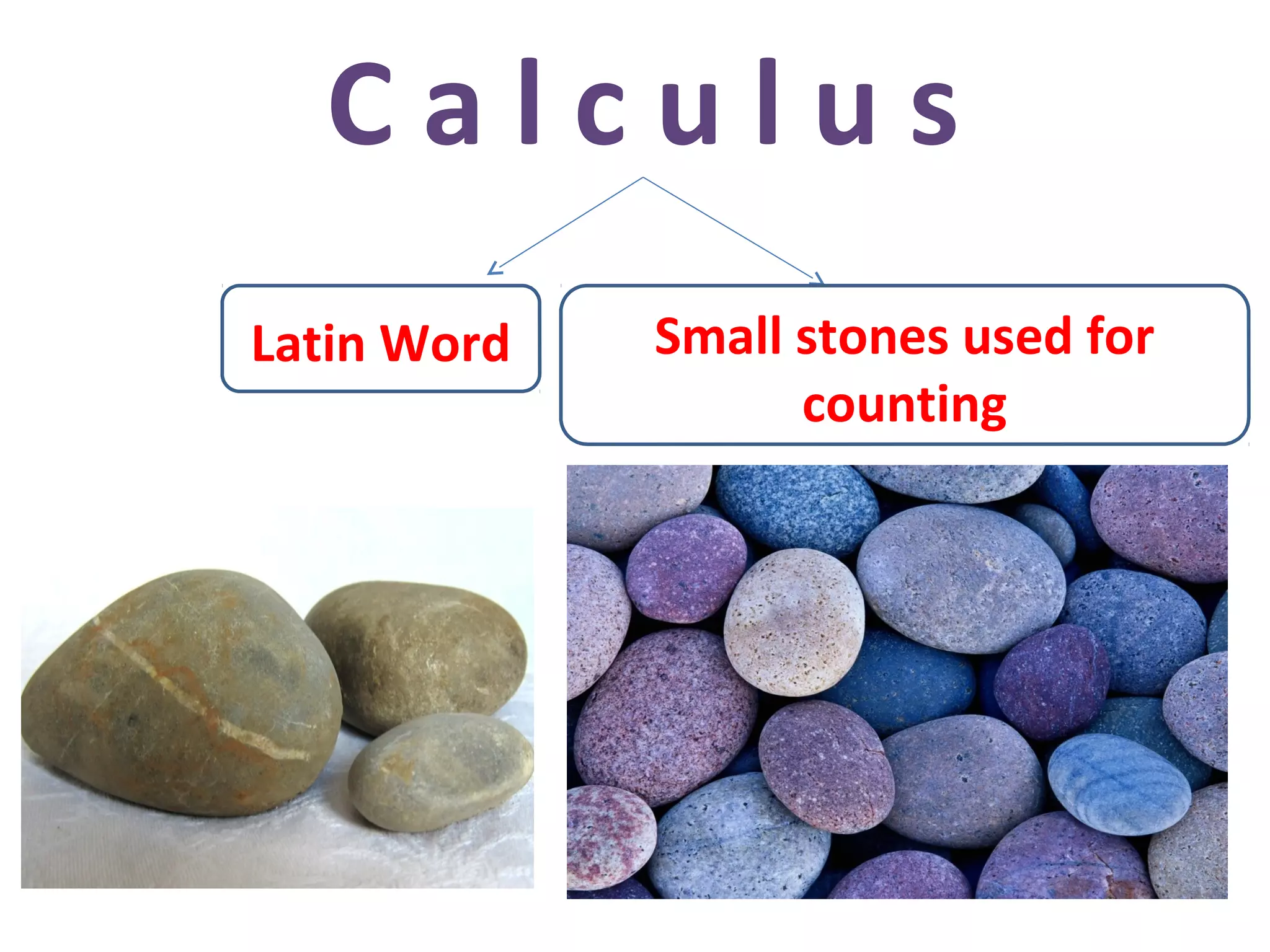
C a l c u l u s
Latin Word Small stones used for
counting
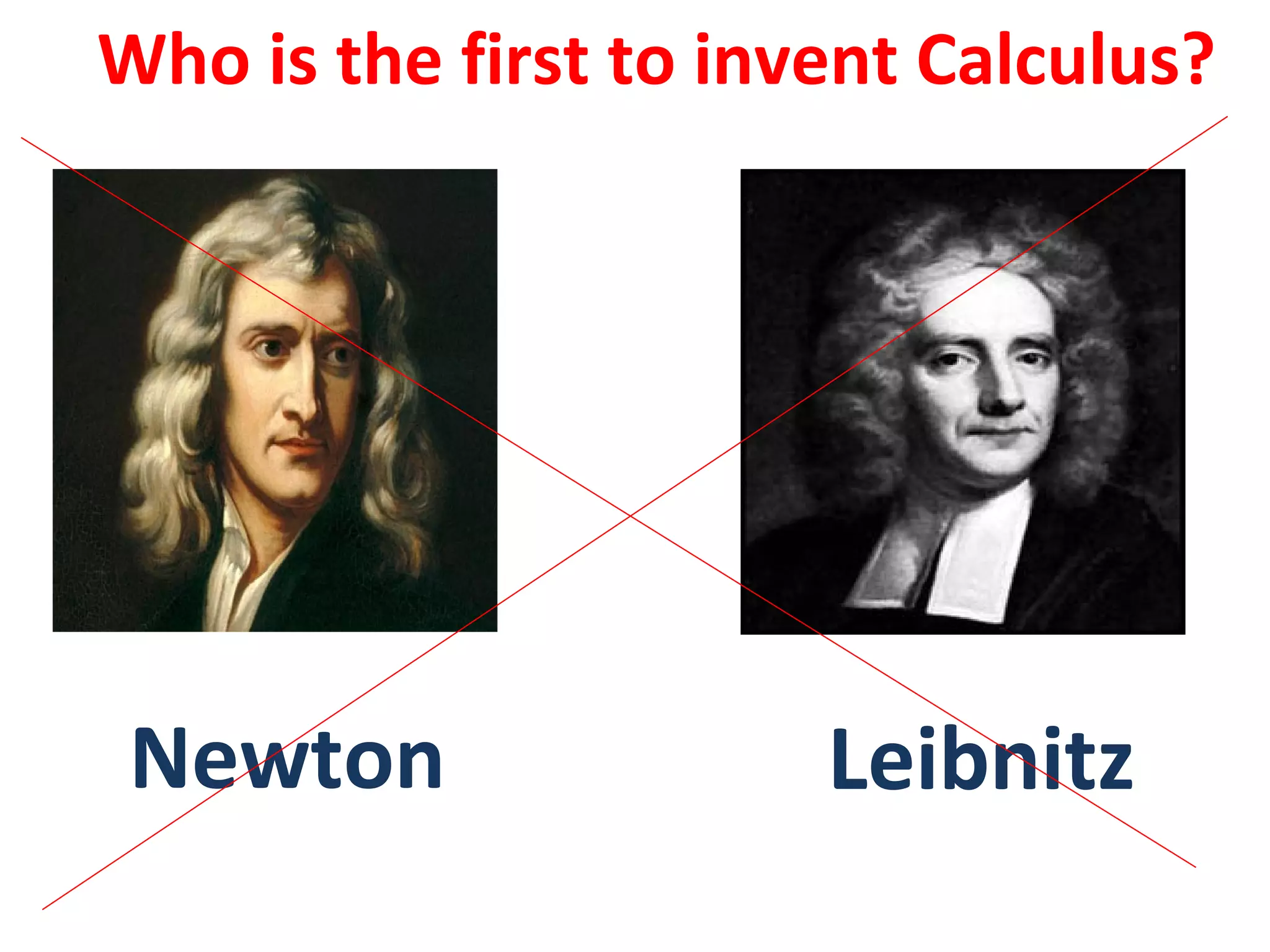
Who is the first to invent Calculus?
Newton Leibnitz
Who is the first to invent Calculus?
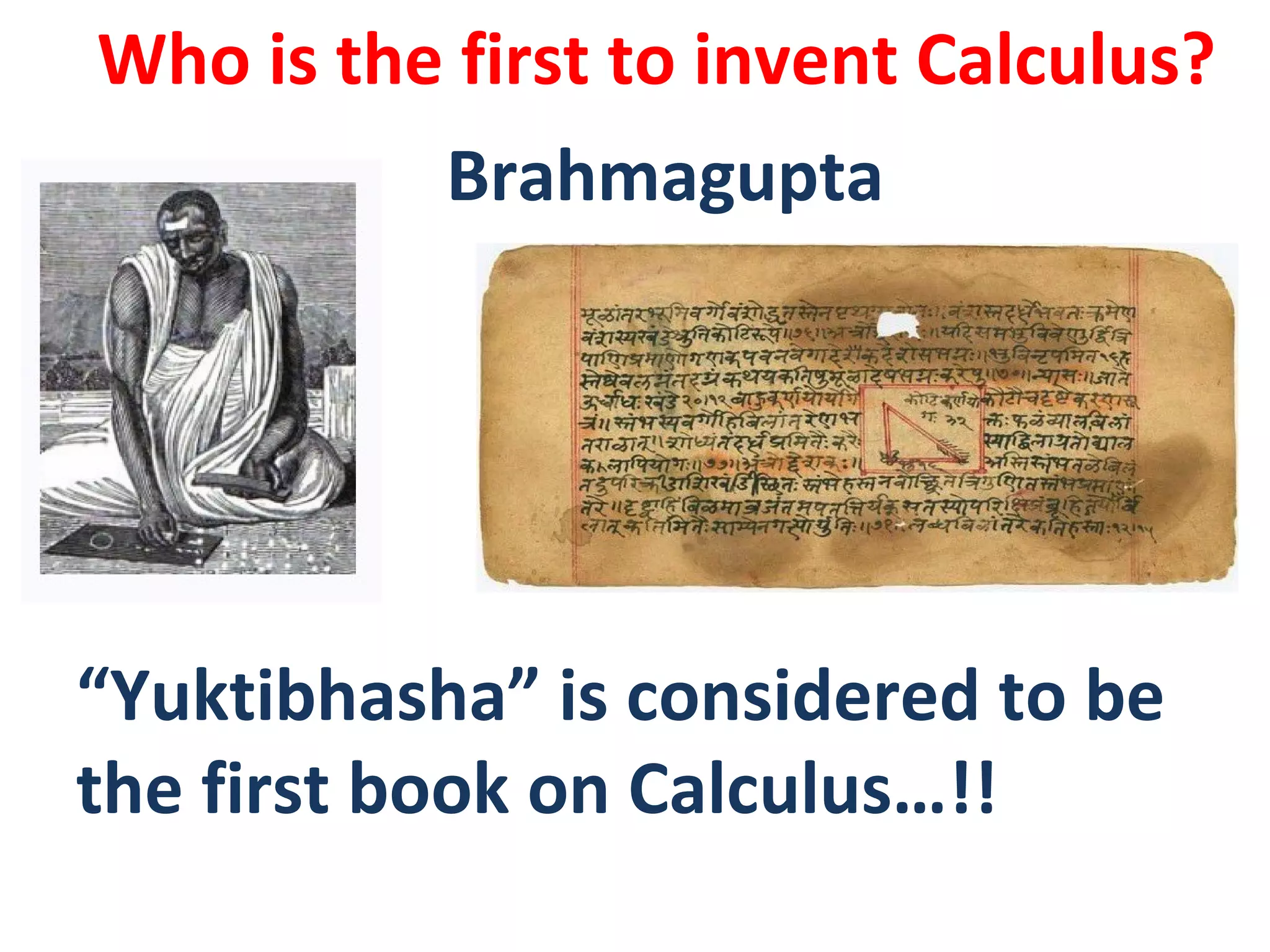
Brahmagupta
“Yuktibhasha” is considered to be
the first book on Calculus…!!
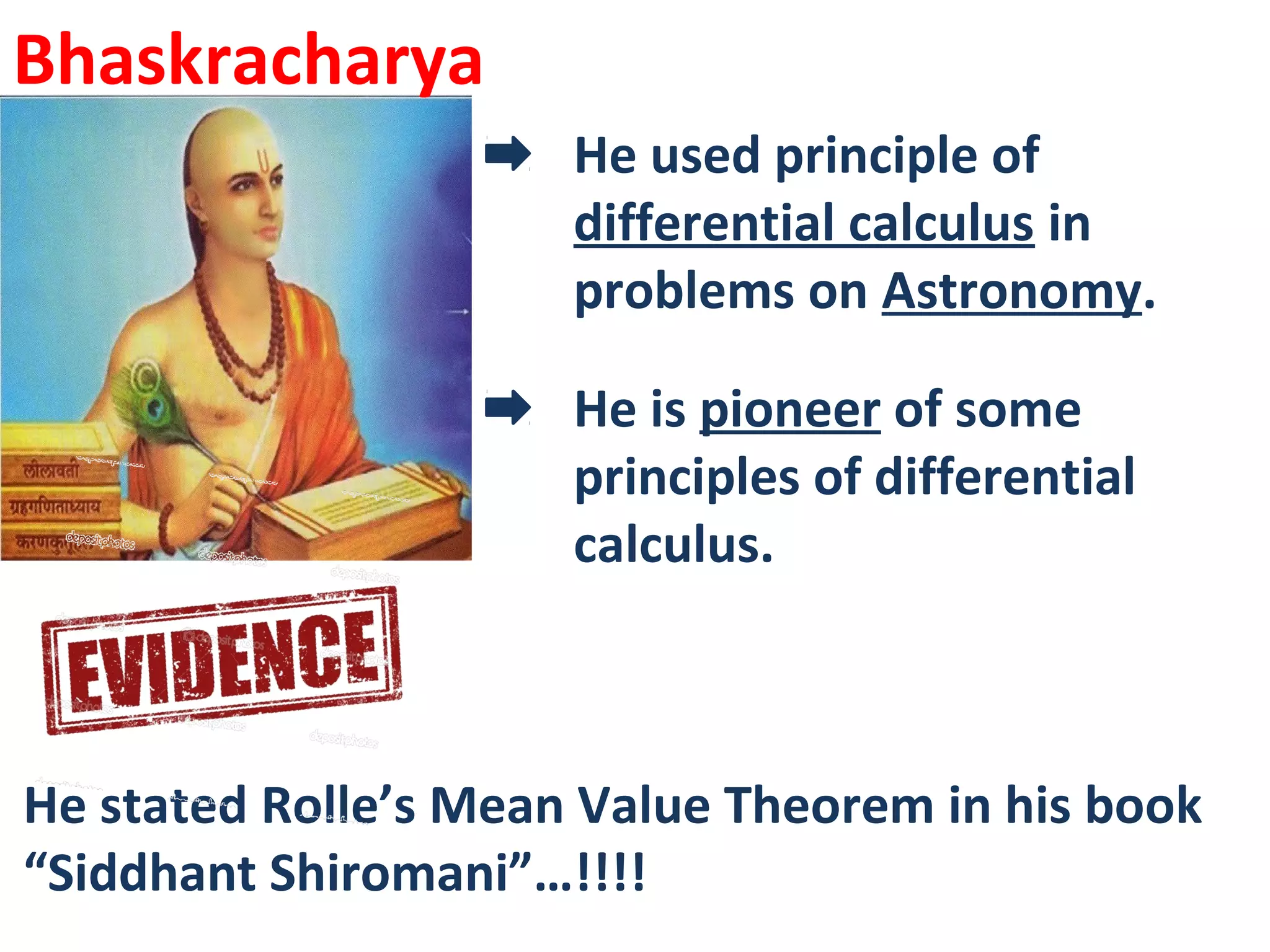
Bhaskracharya
He used principle of
differential calculus in
problems on Astronomy.
He is pioneer of some
principles of differential
calculus.
He stated Rolle’s Mean Value Theorem in his book
“Siddhant Shiromani”…!!!!
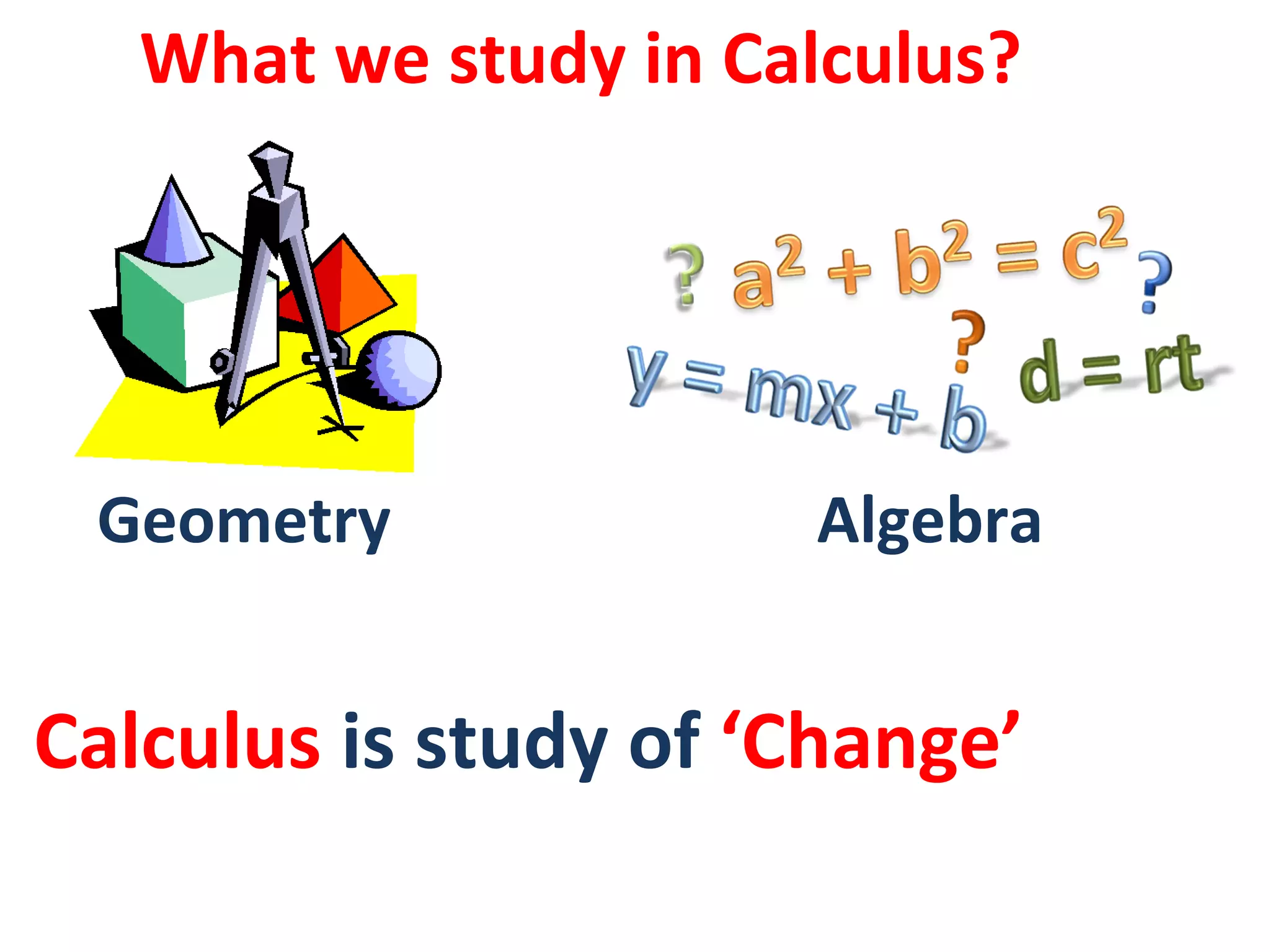
What we study in Calculus?
Geometry Algebra
Calculus is study of ‘Change’
What was the need to invent it?
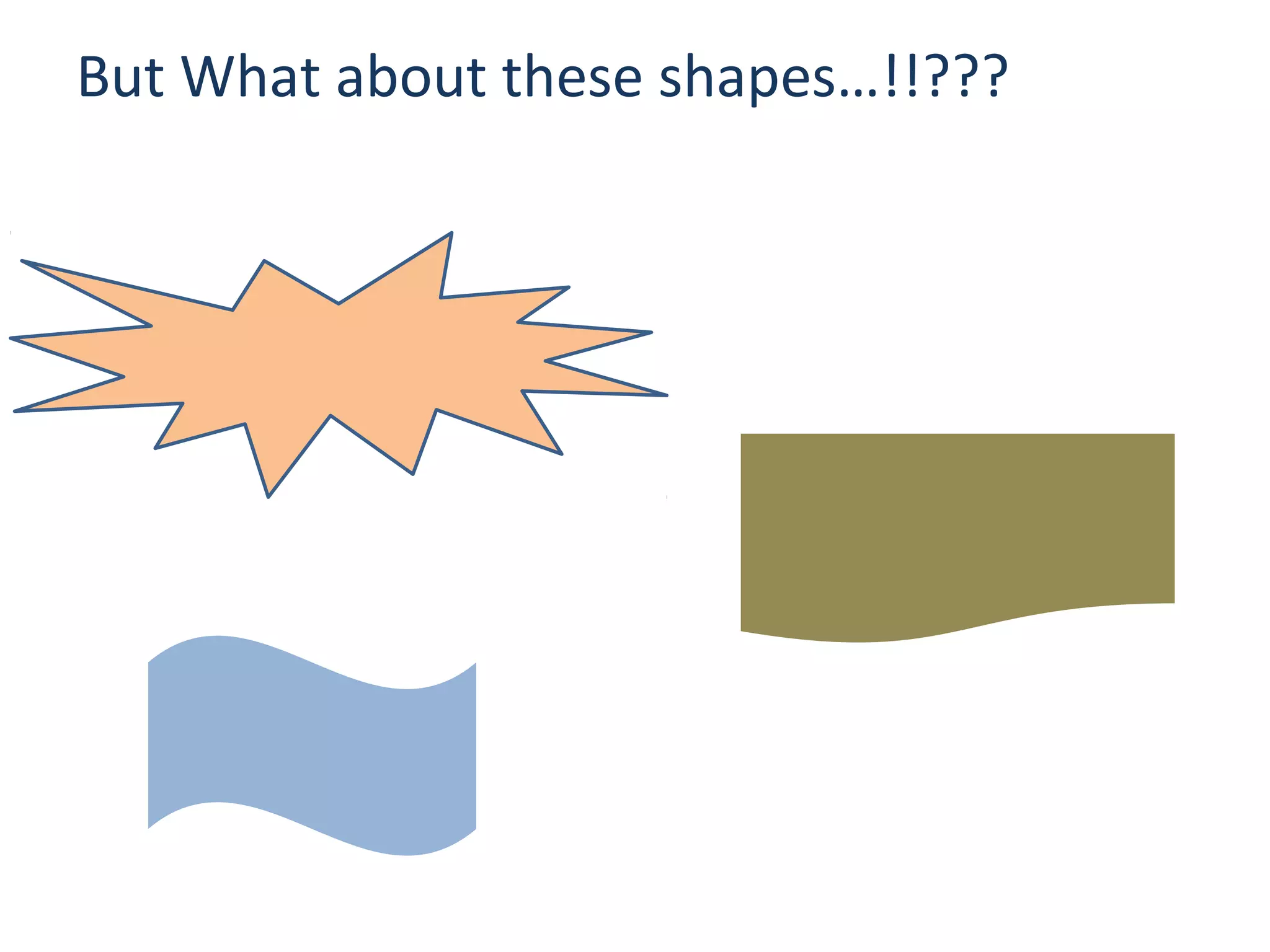
We can find the area of above shapes
with the help of Geometrical tools.
But What about these shapes…!!???
ContinuousDiscrete
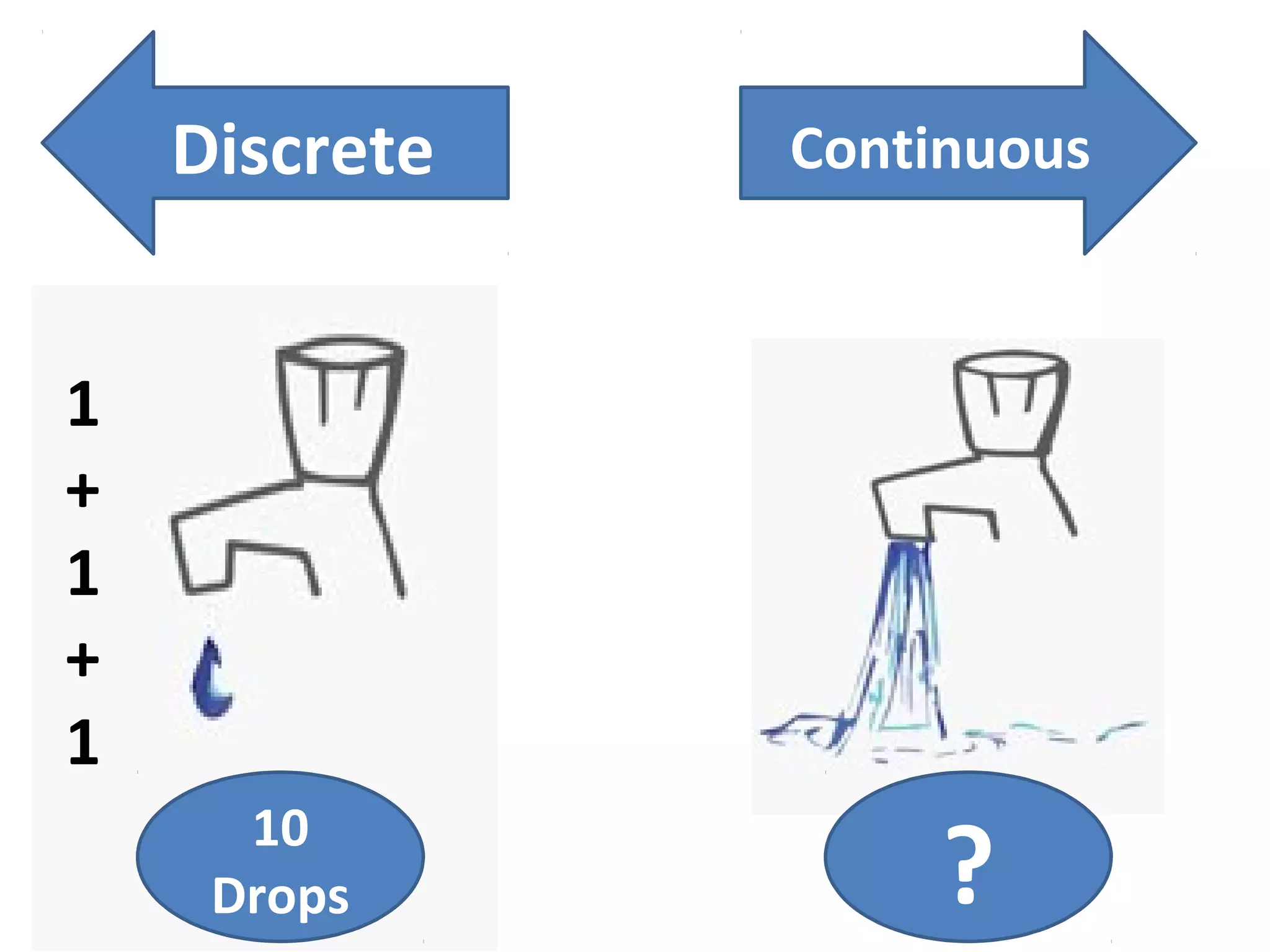
ContinuousDiscrete
1
+
1
+
1
10
Drops ?
“We need a continuous
summation tool.”
This idea leads to the
invention of Calculus.
Calculus
● Integration● Differentiation
Integration
 Origin from the word ‘to integrate’ or ‘to merge’.
 In 18th century the calculation of area and volume
are done using integration.
Differentiation
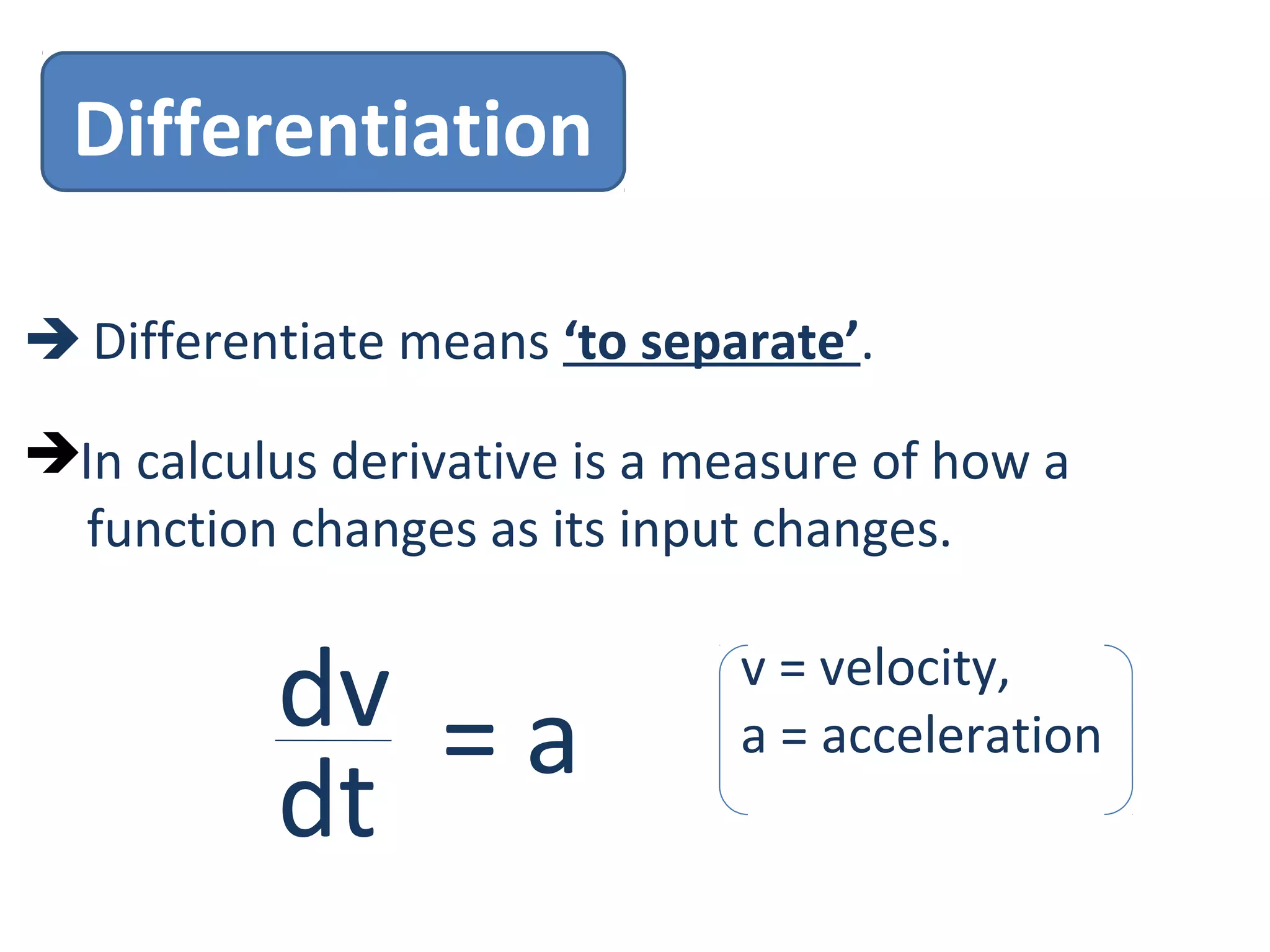
 Differentiate means ‘to separate’.
In calculus derivative is a measure of how a
function changes as its input changes.
dv
dt
= a
v = velocity,
a = acceleration
Uses of
Calculus
&
Mathematical Modeling
-Milan Patel
1) Save money on experiments.
2) Perform impossible experiments.
3) Predict the future…!!
Assume that you are a General
Manager of a company which
produces open top boxes for fruit
market…
To make open top boxes for
fruit market, using square
sheet of card board.
To maximize the volume of
box in order to increase the
profit of the company.
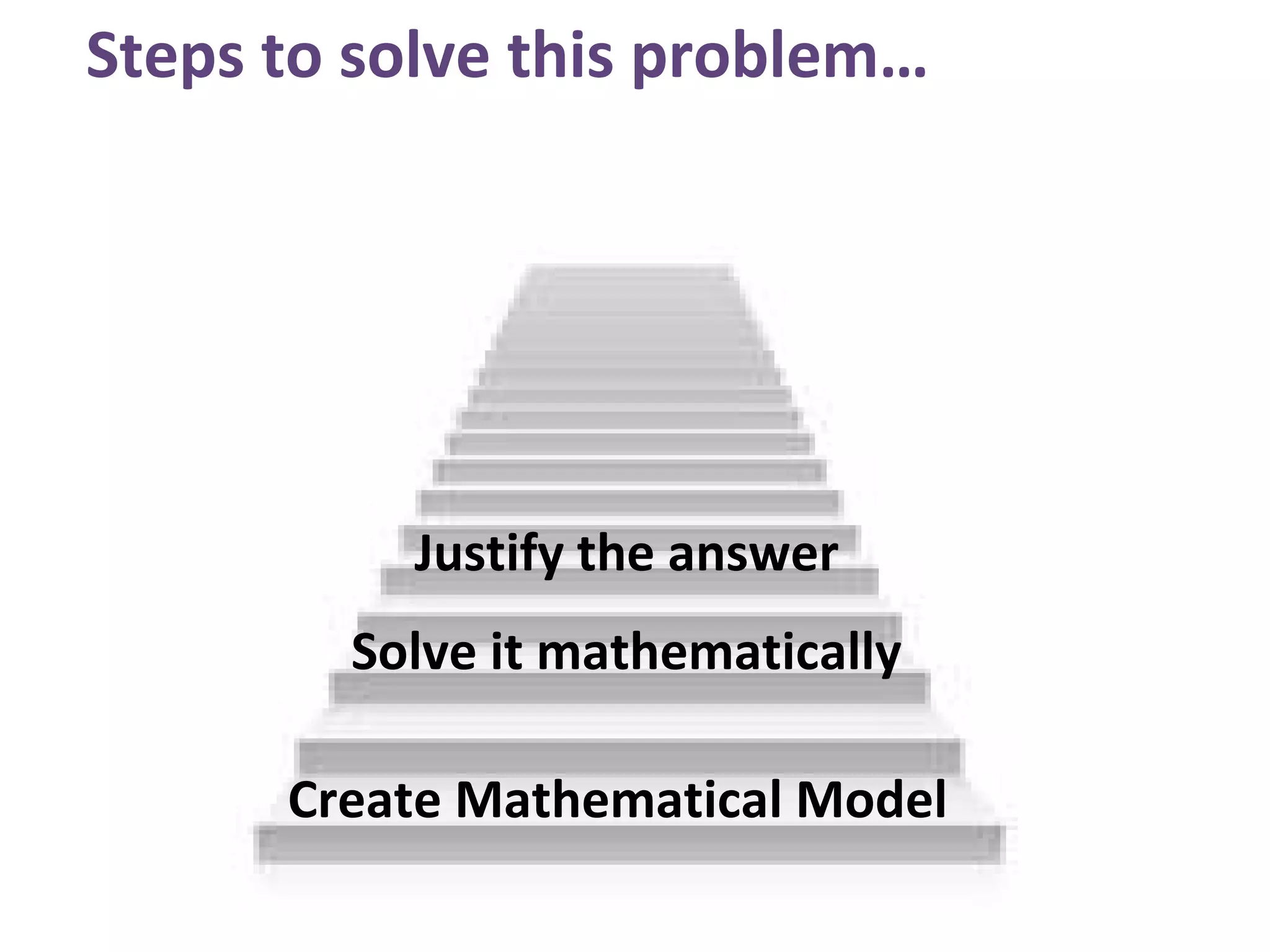
Steps to solve this problem…
Create Mathematical Model
Solve it mathematically
Justify the answer
How to create a mathematical model?
Understand
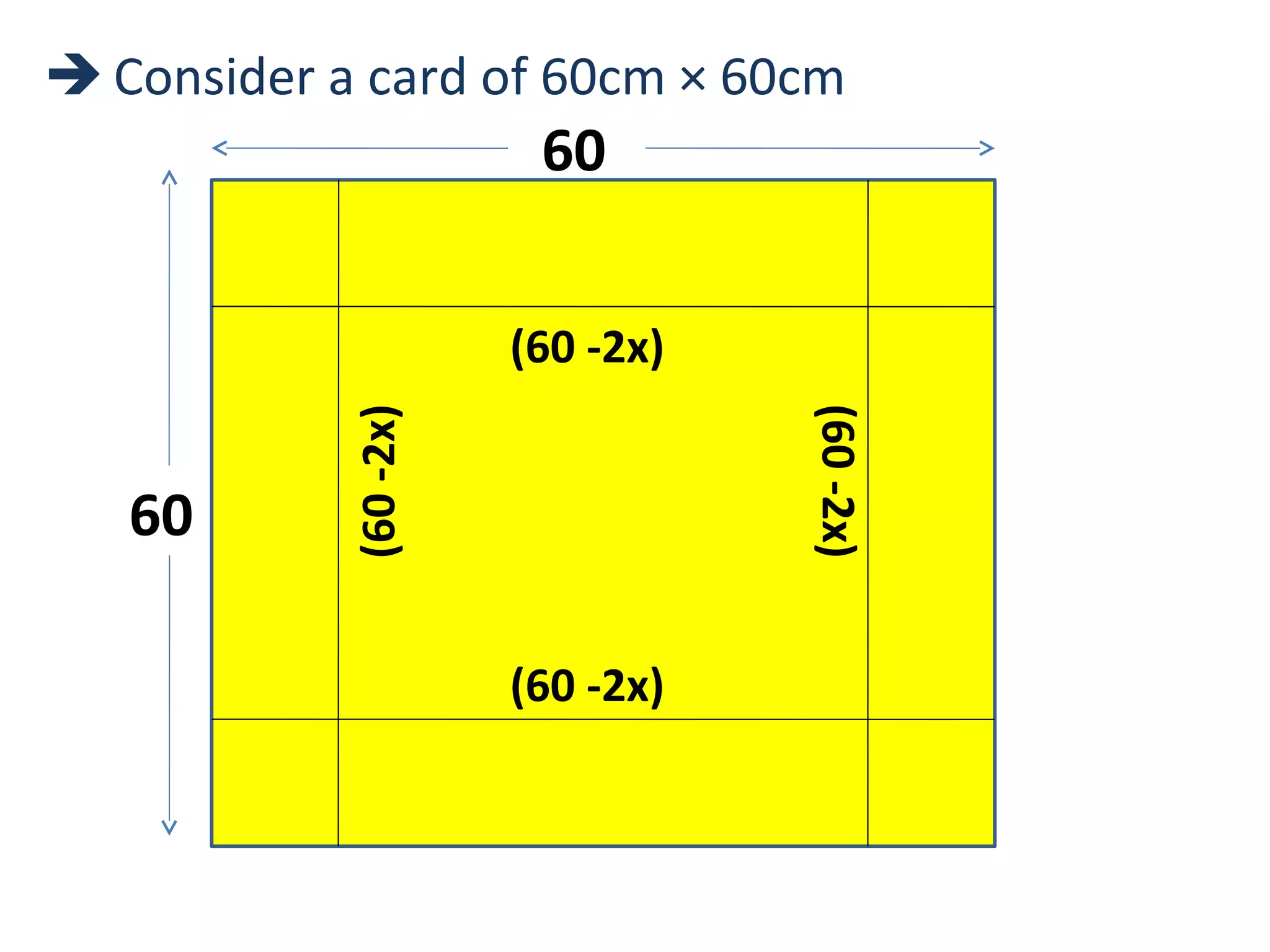
 Consider a card of 60cm × 60cm
60
60
(60 -2x)
(60 -2x)
(60-2x)
(60-2x)
Volume of the box,
V = L × B × H
= (60-2x) × (60-2x) × (x)
= 4x – 240x + 3600x
3 2
Now, We will use…
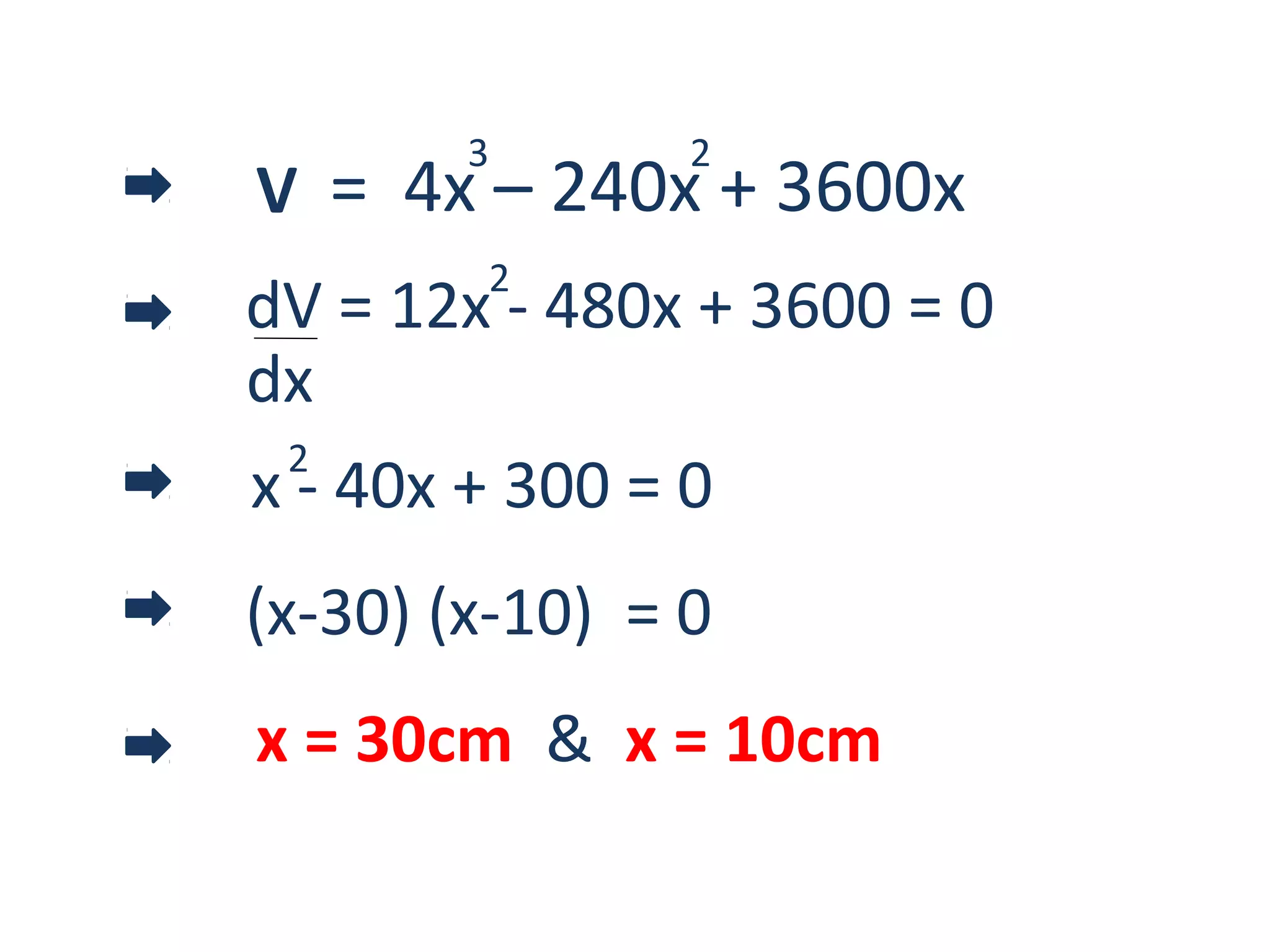
= 4x – 240x + 3600x
3 2
V
dV = 12x - 480x + 3600 = 0
2
dx
x - 40x + 300 = 0
2
(x-30) (x-10) = 0
x = 30cm & x = 10cm
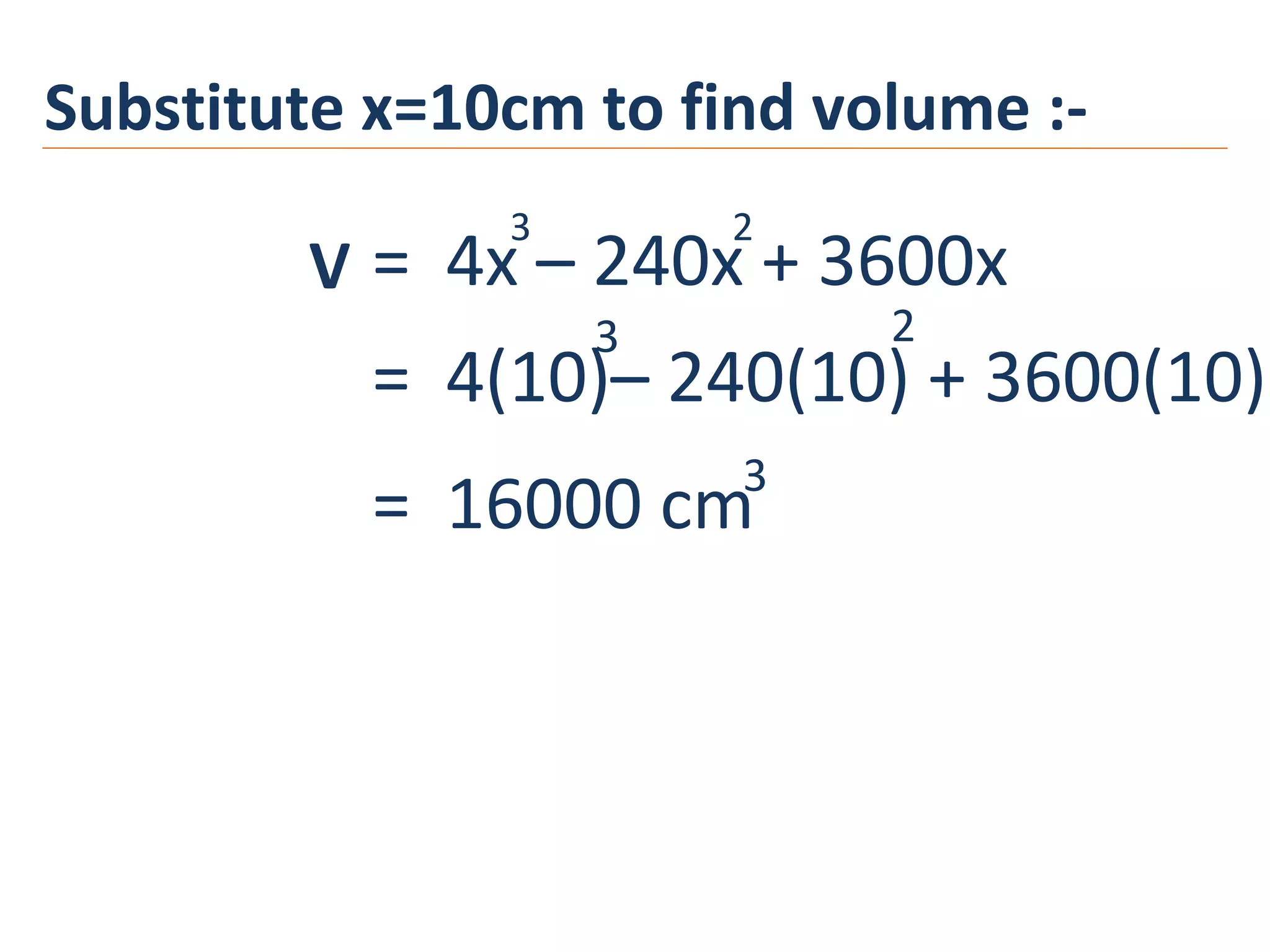
Substitute x=10cm to find volume :-
= 4x – 240x + 3600x
3 2
V
= 4(10)– 240(10) + 3600(10)
3 2
= 16000 cm3
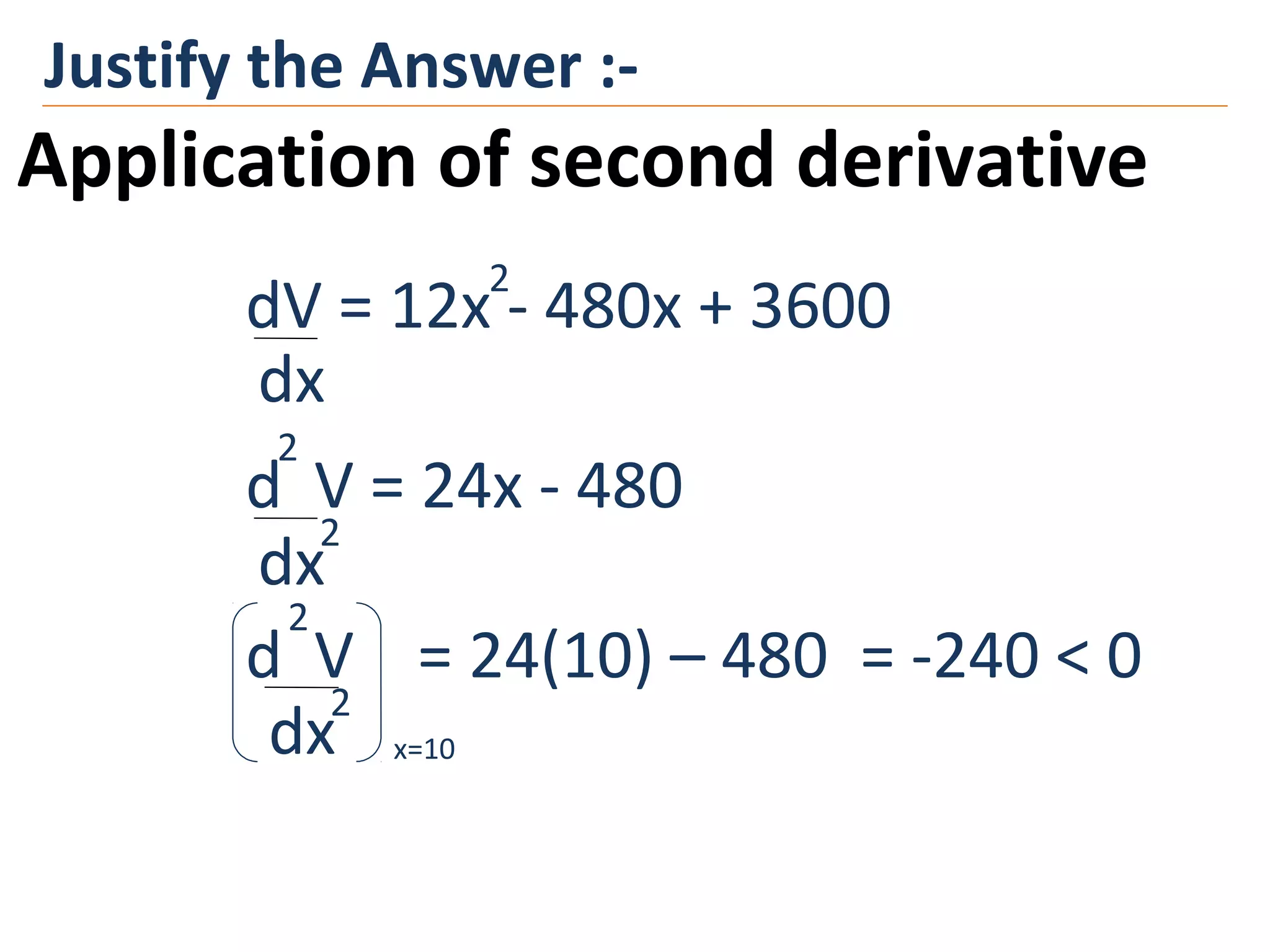
Justify the Answer :-
Application of second derivative
dV = 12x - 480x + 3600
dx
d V = 24x - 480
dx
2
2
2
d V = 24(10) – 480 = -240 < 0
dx
2
2
x=10
Cut the square of 10 cm X 10 cm
from the corner in order to
maximize the volume of the box.
Useful
Applications
of
Calculus
-Saumil Patel
Average Value
Area b/w Curves
Length of Arc
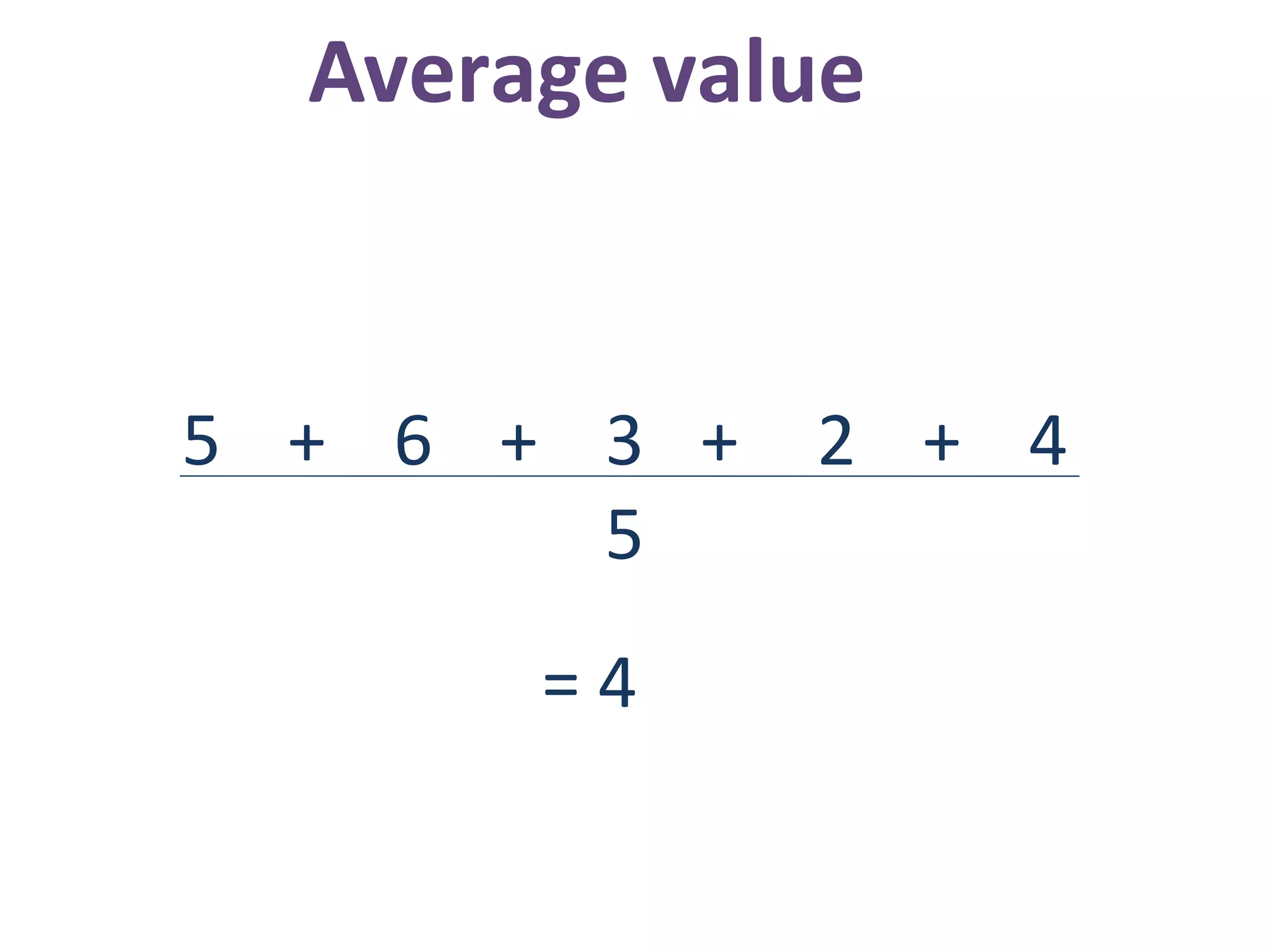
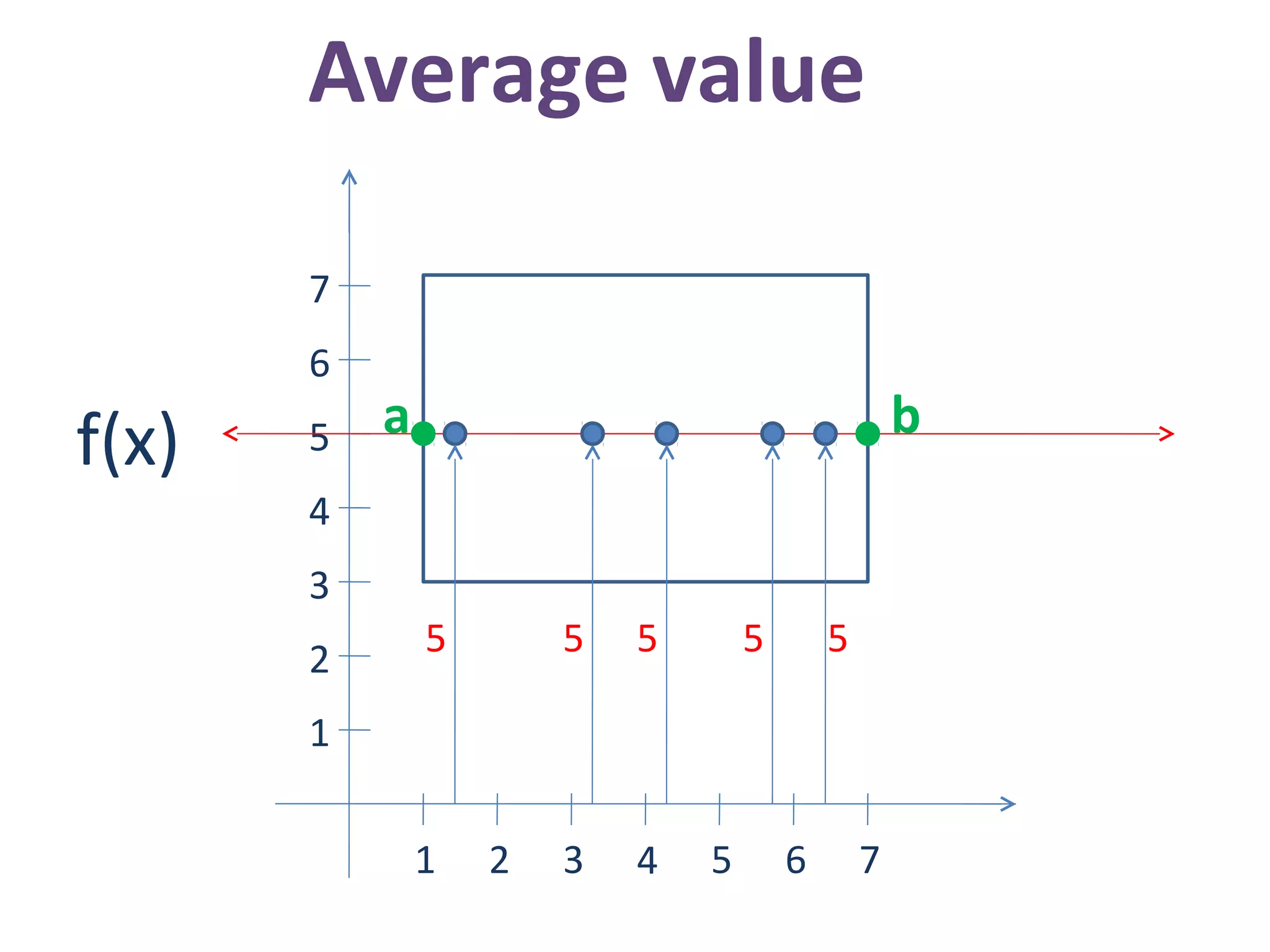
Average value
5 6 3 2 4+ + + +
5
= 4
Average value
1
2
3
4
5
6
7
1 2 3 5 64 7
f(x)
5 5 5 5 5
a b
Average value
Average value of f(x) in given interval
5 5 5 5 5+ + + +
5
= 5
=
-1
0
1
Average value
f(x)
a b
Average value
favg = 1
b-a
f(x) dx
a
b
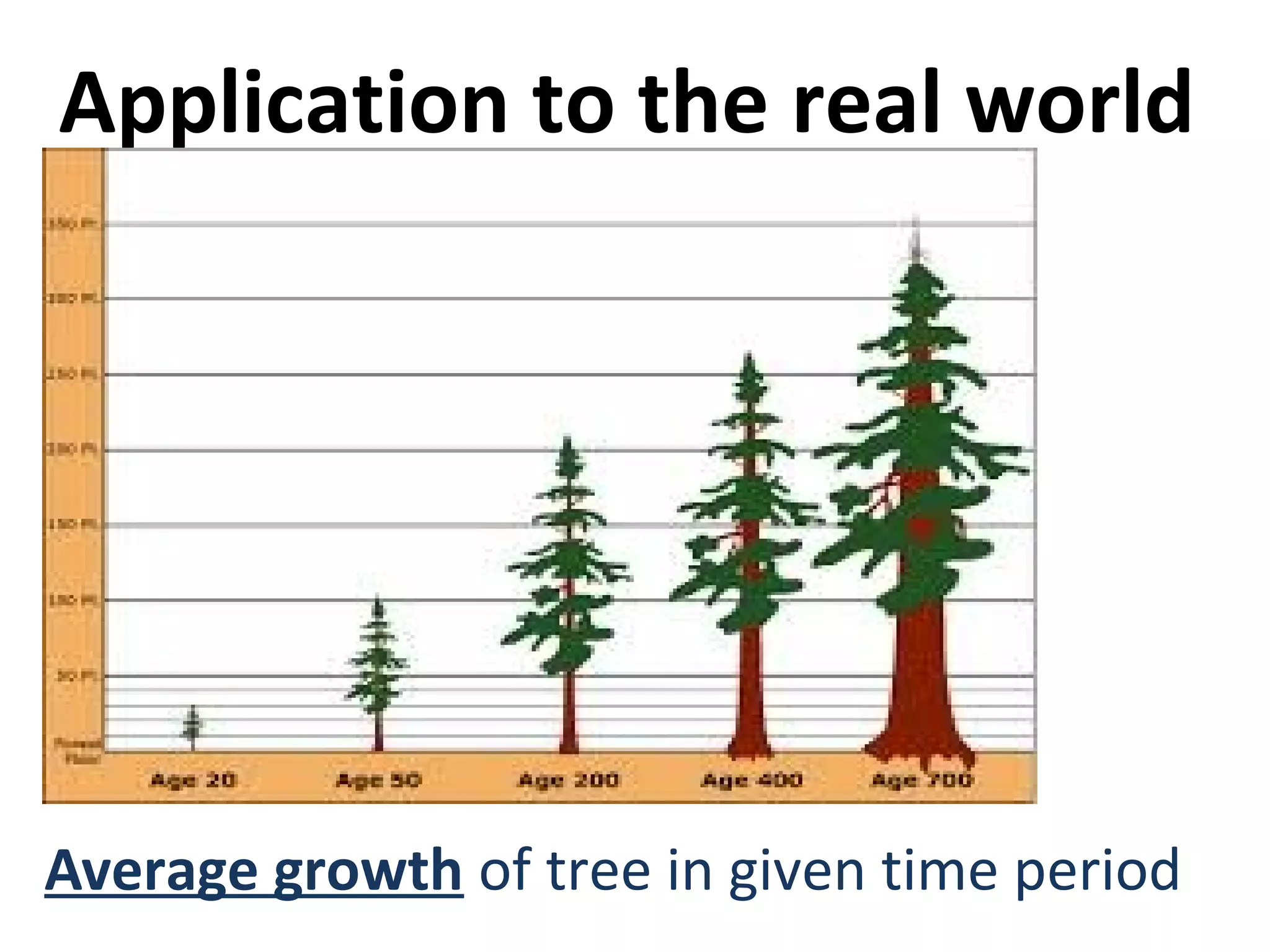
Application to the real world
Average growth of tree in given time period
Application to the real world
Average growth of bacteria
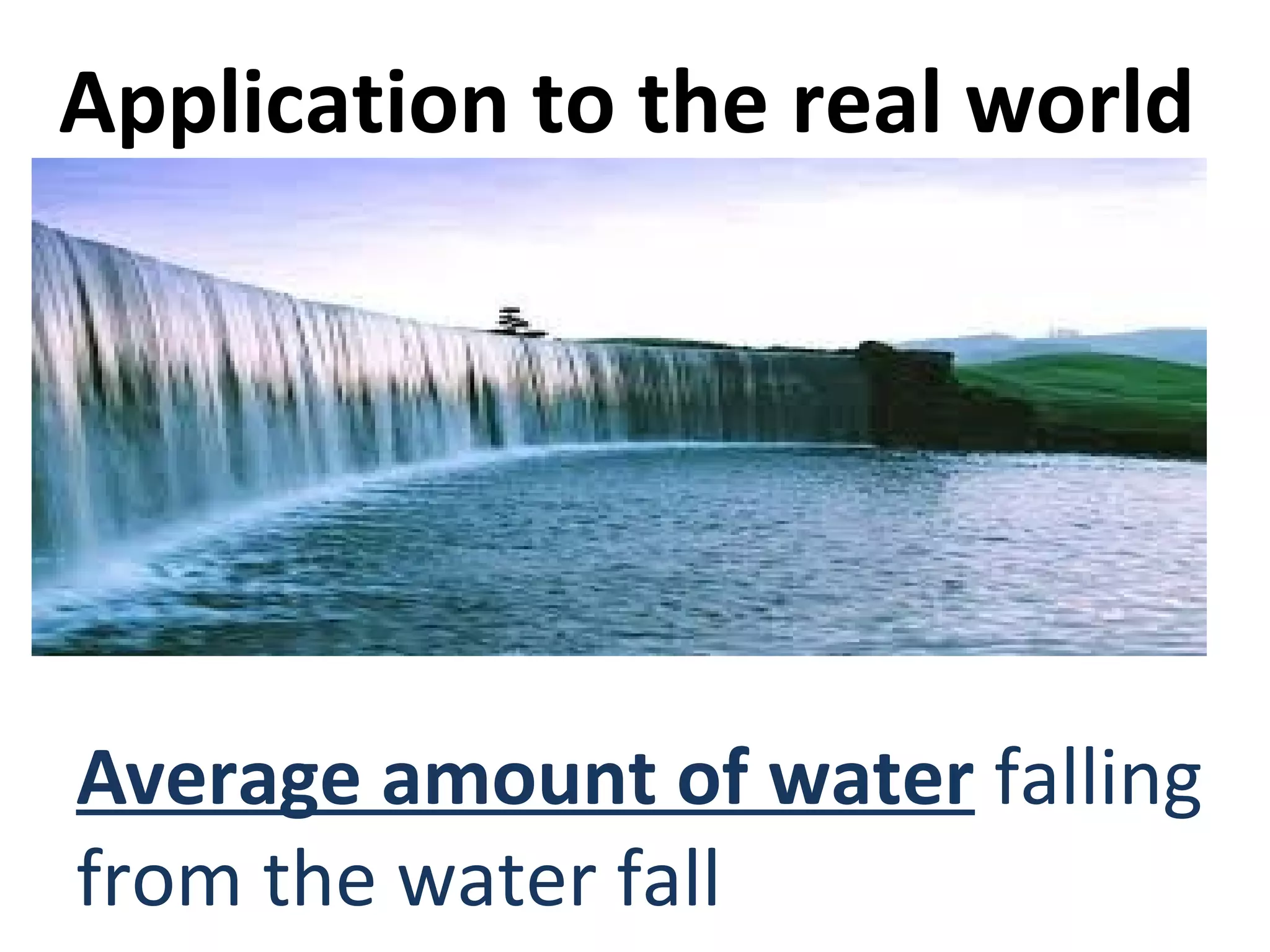
Application to the real world
Average amount of water falling
from the water fall
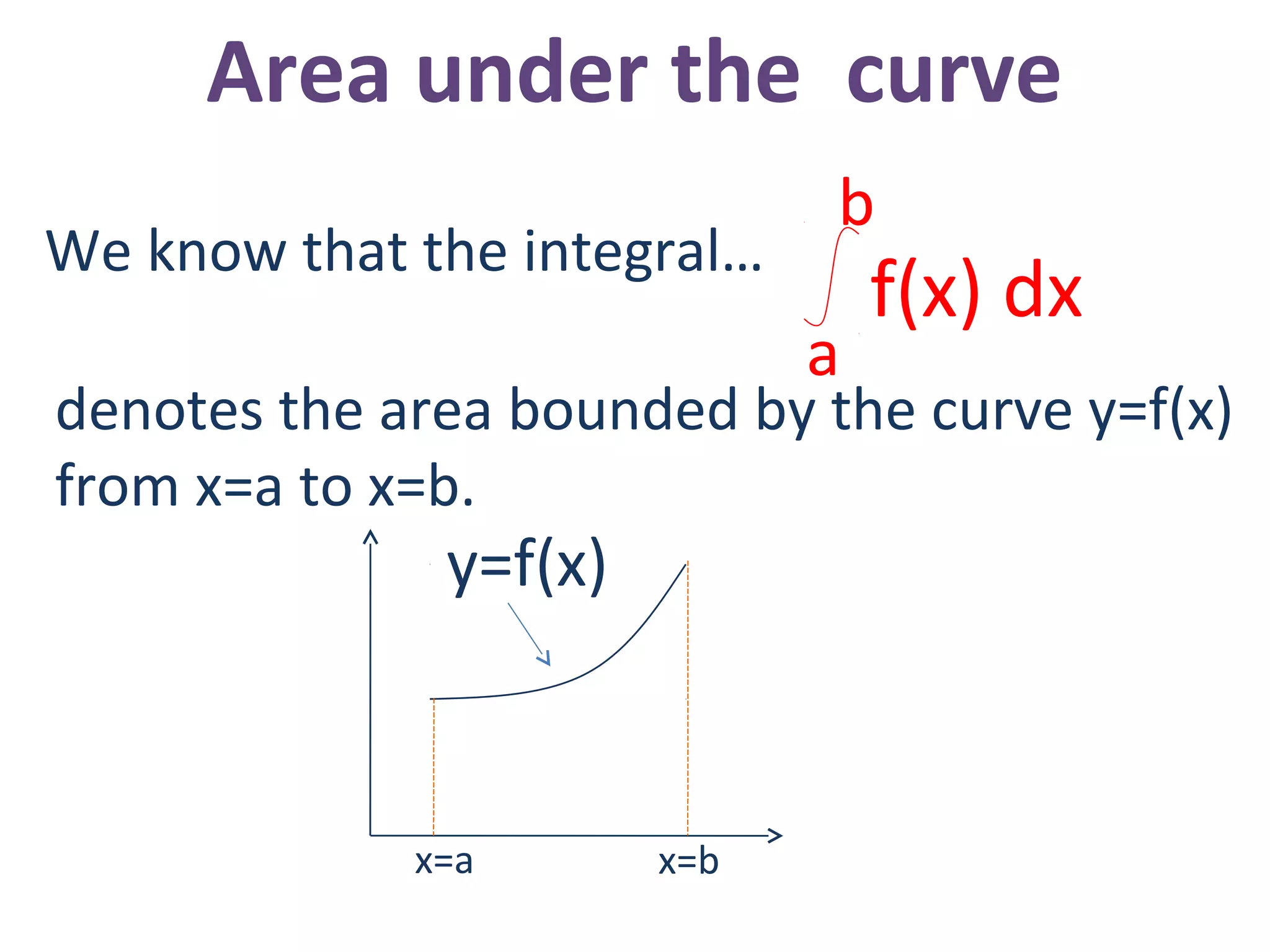
Area under the curve
We know that the integral…
f(x) dx
a
b
denotes the area bounded by the curve y=f(x)
from x=a to x=b.
x=a x=b
y=f(x)
Area between curves
x=a x=b
f(x)
g(x)
Area b/w curves = [Area under f(x)]
-[(Area under g(x)]
Area between curves
= -f(x) dx
a
b
g(x) dx
a
b
= [f(x) - g(x)]dx
a
b
Application to the real world
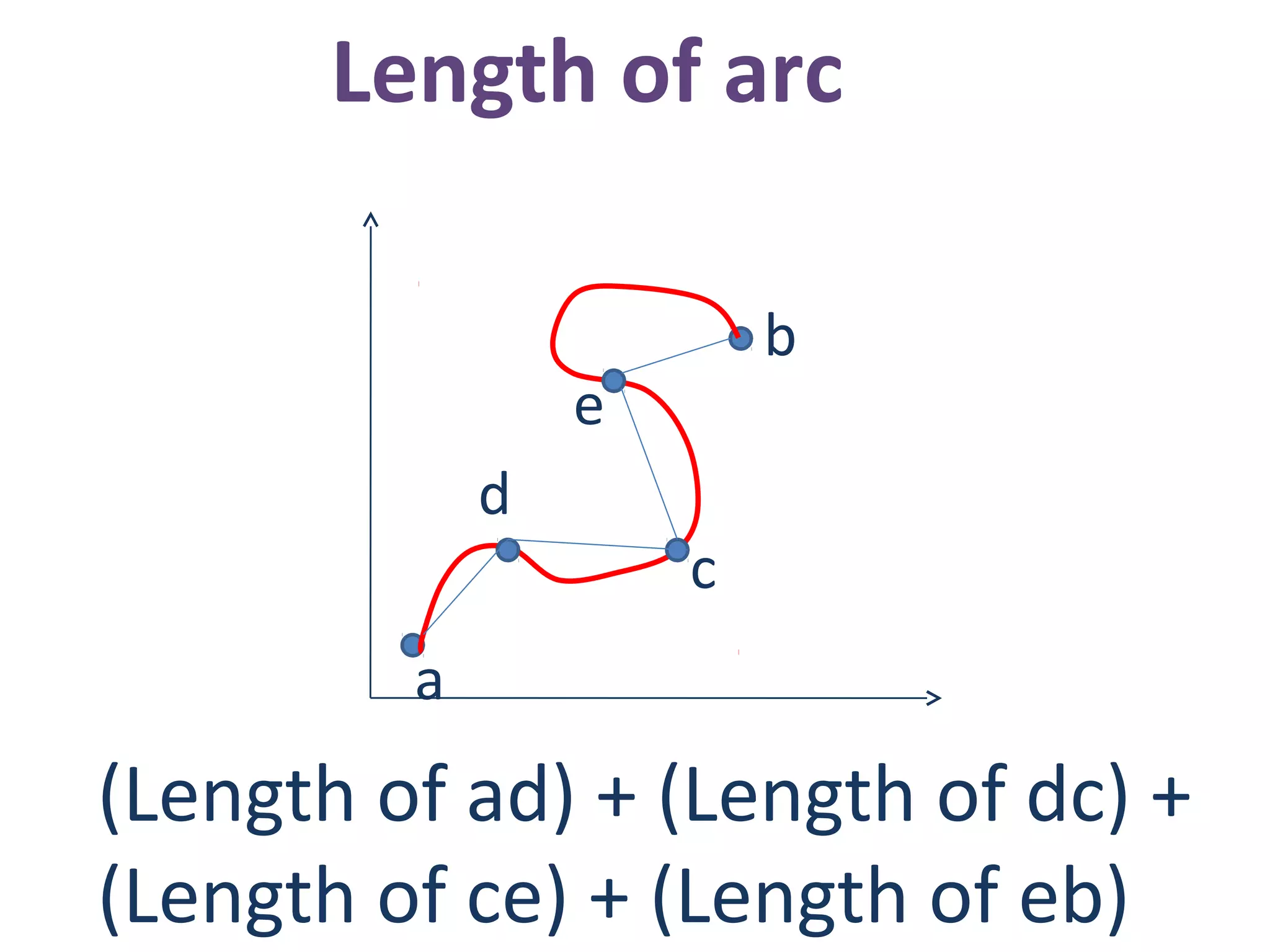
Length of arc
a b
Length of arc = b-a
f(x)
Length of arc
a
b
Length of ab = b-a
Length of arc
a
b
c
(Length of ac) + (Length of cb)
Length of arc
a
b
d
c
e
(Length of ad) + (Length of dc) +
(Length of ce) + (Length of eb)
Length of arc
a
b
Length of arc =
1+[f’(x)] dx
2
Application to the real world
Newton’s Law of
cooling
&
It’s Applications
-Richa Raval
“Rate of change of the temperature of an
object is proportional to the difference
between its own temperature and the
temperature of its surroundings.”
“Newton’s law of cooling”
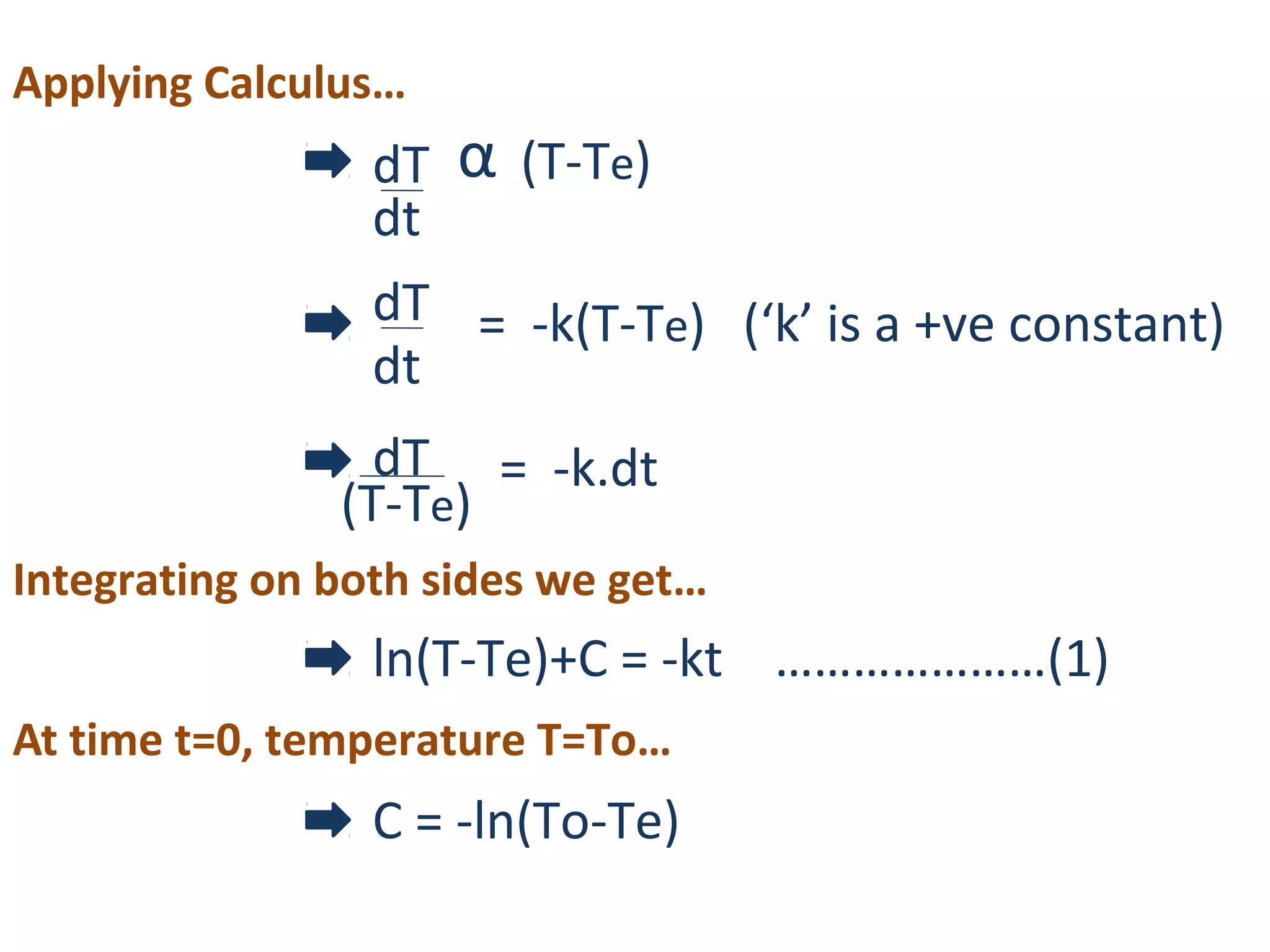
Applying Calculus…
dT (T-Te)α
dt
dT
dt
= -k(T-Te) (‘k’ is a +ve constant)
dT
(T-Te)
= -k.dt
Integrating on both sides we get…
ln(T-Te)+C = -kt
At time t=0, temperature T=To…
C = -ln(To-Te)
…………………(1)
Substitute the value of ‘C’ in (1)…
ln = -kt
T-Te
To-
Te
= e
T-Te
To-
Te
-kt
T-Te = (To-Te) e
-kt
T = Te + (To-Te) e
-kt
…………………(2)
Application of
“NEWTON’S
LAW OF
COOLING”In
Crime Investigation
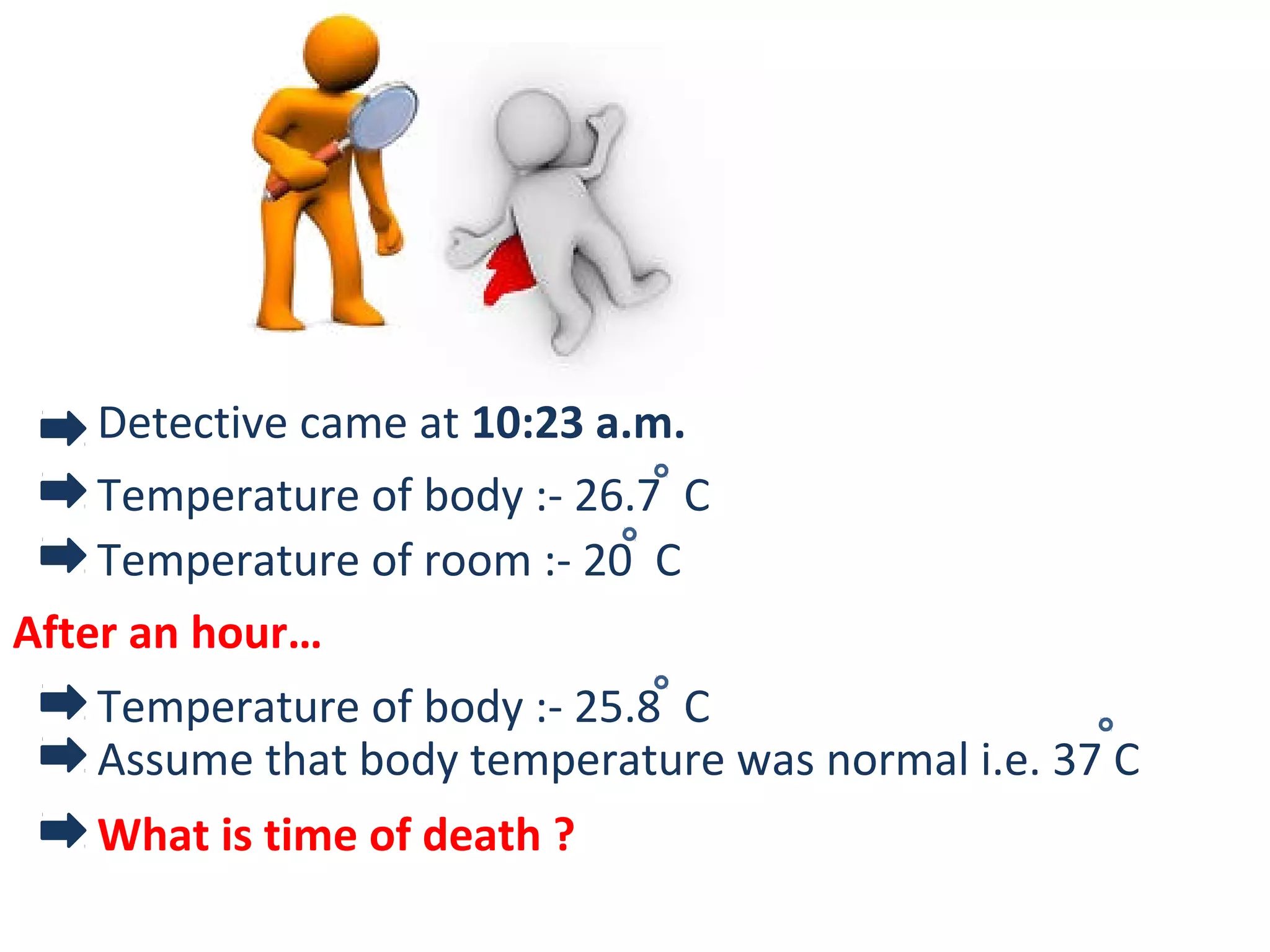
Detective came at 10:23 a.m.
Temperature of body :- 26.7 C
Temperature of room :- 20 C
After an hour…
Temperature of body :- 25.8 C
Assume that body temperature was normal i.e. 37 C
What is time of death ?
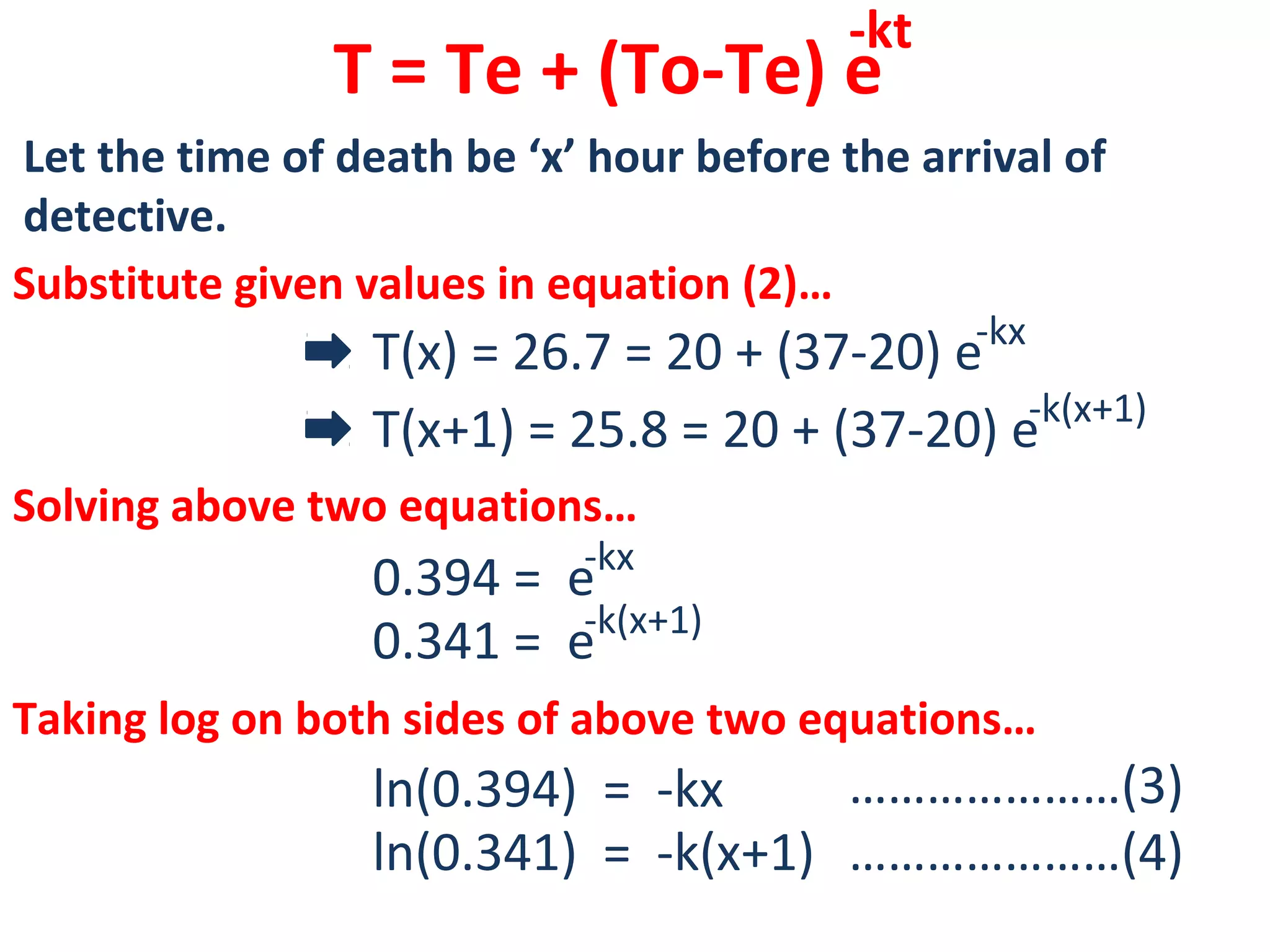
T = Te + (To-Te) e
-kt
Let the time of death be ‘x’ hour before the arrival of
detective.
Substitute given values in equation (2)…
T(x) = 26.7 = 20 + (37-20) e-kx
T(x+1) = 25.8 = 20 + (37-20) e-k(x+1)
Solving above two equations…
0.394 = e-kx
0.341 = e-k(x+1)
Taking log on both sides of above two equations…
ln(0.394) = -kx
ln(0.341) = -k(x+1)
…………………(3)
…………………(4)
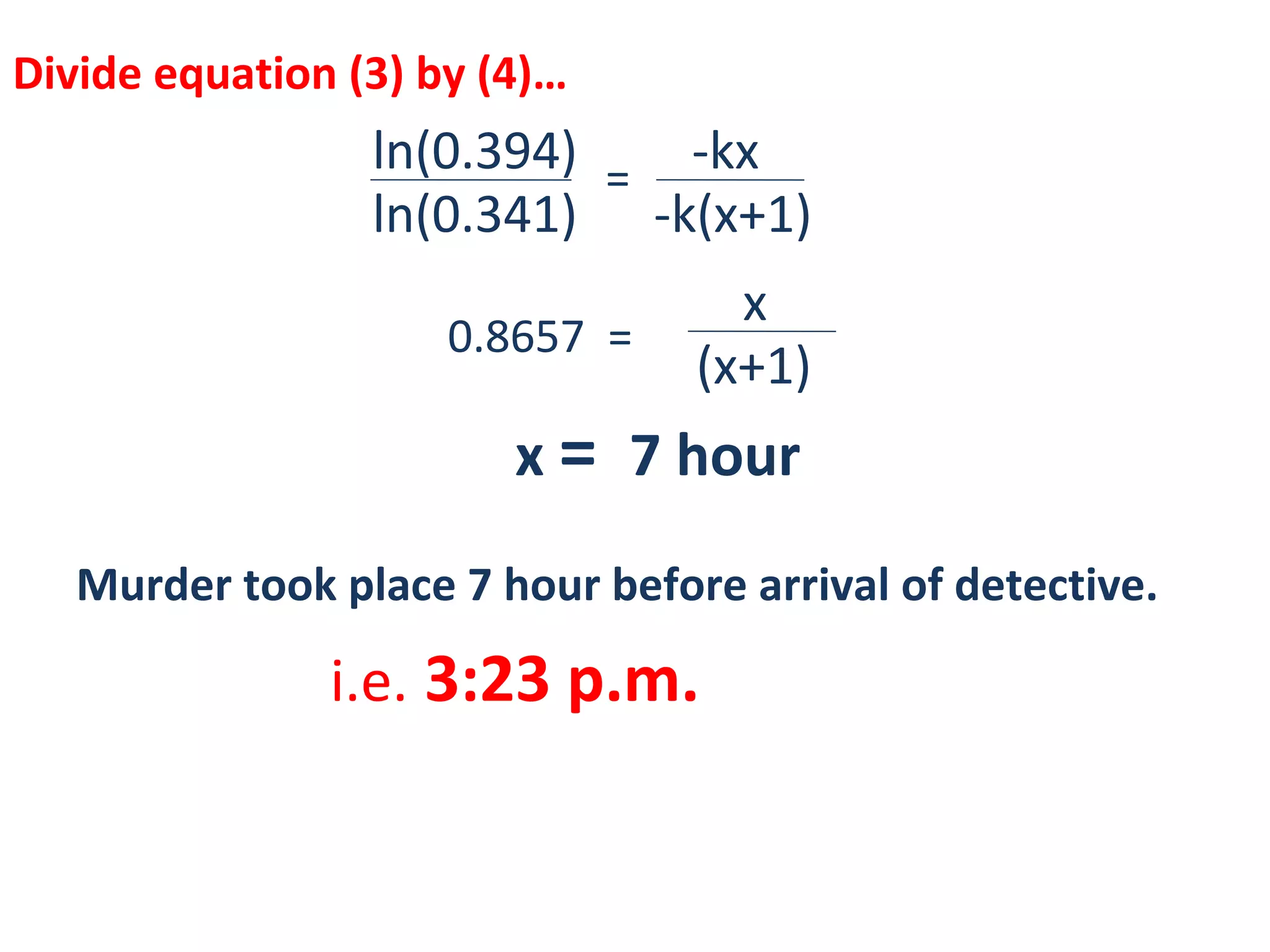
Divide equation (3) by (4)…
ln(0.394) -kx
ln(0.341) -k(x+1)
=
=0.8657
x
(x+1)
x = 7 hour
Murder took place 7 hour before arrival of detective.
i.e. 3:23 p.m.
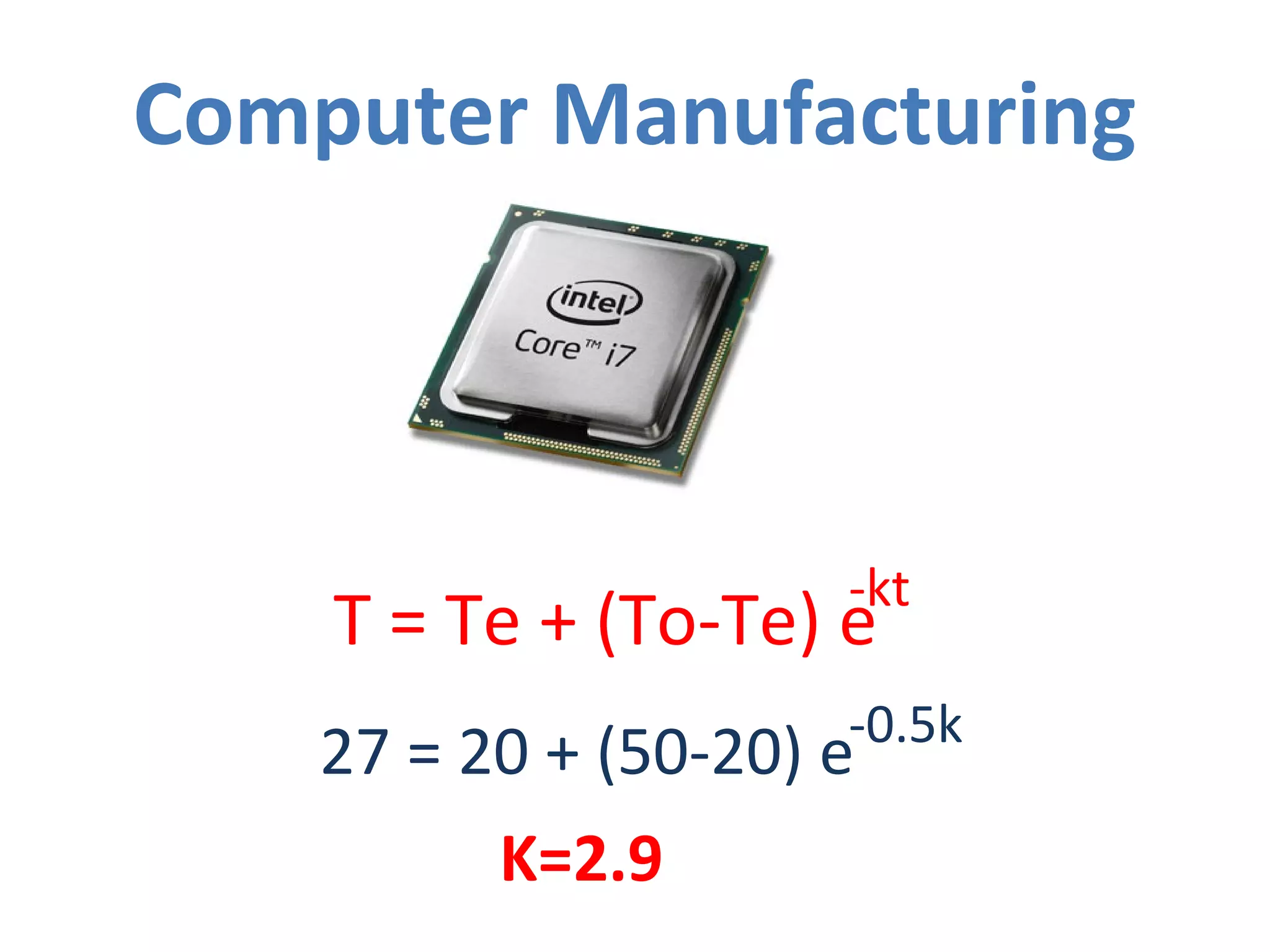
Computer Manufacturing
T = Te + (To-Te) e
-kt
27 = 20 + (50-20) e-0.5k
K=2.9
SomeImportant
Applicationsof
Calculus…
Growth of bacteria
Construction Technology
Thank you…

Application of Calculus in Real World

Editor's Notes

  • #27 &amp;lt;number&amp;gt;
  • #40 &amp;lt;number&amp;gt;
  • #42 &amp;lt;number&amp;gt;