Introduction To Tensor Calculus And Continuum Mechanics J H Heinbockel
Introduction To Tensor Calculus And Continuum Mechanics J H Heinbockel
Introduction To Tensor Calculus And Continuum Mechanics J H Heinbockel
Introduction To Tensor Calculus And Continuum Mechanics J H Heinbockel
Introduction To Tensor Calculus And Continuum Mechanics J H Heinbockel
1.
Introduction To TensorCalculus And Continuum
Mechanics J H Heinbockel download
https://ebookbell.com/product/introduction-to-tensor-calculus-
and-continuum-mechanics-j-h-heinbockel-2111596
Explore and download more ebooks at ebookbell.com
2.
Here are somerecommended products that we believe you will be
interested in. You can click the link to download.
Introduction To Tensor Calculus Relativity And Cosmology Dover Books
On Physics 3rd Ed D F Lawden
https://ebookbell.com/product/introduction-to-tensor-calculus-
relativity-and-cosmology-dover-books-on-physics-3rd-ed-d-f-
lawden-58581598
Introduction To Tensor Analysis And The Calculus Of Moving Surfaces
1st Edition Pavel Grinfeld
https://ebookbell.com/product/introduction-to-tensor-analysis-and-the-
calculus-of-moving-surfaces-1st-edition-pavel-grinfeld-4345188
Introduction To Tensor Network Methods Numerical Simulations Of
Lowdimensional Manybody Quantum Systems 1st Ed Simone Montangero
https://ebookbell.com/product/introduction-to-tensor-network-methods-
numerical-simulations-of-lowdimensional-manybody-quantum-systems-1st-
ed-simone-montangero-7320498
Introduction To Tensor Products Of Banach Spaces 2002th Edition
Raymond A Ryan
https://ebookbell.com/product/introduction-to-tensor-products-of-
banach-spaces-2002th-edition-raymond-a-ryan-4079254
3.
An Introduction ToTensor Analysis Bipin Singh Koranga
https://ebookbell.com/product/an-introduction-to-tensor-analysis-
bipin-singh-koranga-22694688
Introduction To Diffusion Tensor Imaging 1st Edition S Mori
https://ebookbell.com/product/introduction-to-diffusion-tensor-
imaging-1st-edition-s-mori-1870582
Introduction To Differential Geometry With Tensor Applications
Dipankar De
https://ebookbell.com/product/introduction-to-differential-geometry-
with-tensor-applications-dipankar-de-43071816
An Introduction To Elementbased Galerkin Methods On Tensorproduct
Bases Analysis Algorithms And Applications 1st Ed Francis X Giraldo
https://ebookbell.com/product/an-introduction-to-elementbased-
galerkin-methods-on-tensorproduct-bases-analysis-algorithms-and-
applications-1st-ed-francis-x-giraldo-22500536
An Introduction To Tensors And Group Theory For Physicists 1st Edition
Nadir Jeevanjee Auth
https://ebookbell.com/product/an-introduction-to-tensors-and-group-
theory-for-physicists-1st-edition-nadir-jeevanjee-auth-2375388
PREFACE
This is anintroductory text which presents fundamental concepts from the subject
areas of tensor calculus, differential geometry and continuum mechanics. The material
presented is suitable for a two semester course in applied mathematics and is flexible
enough to be presented to either upper level undergraduate or beginning graduate students
majoring in applied mathematics, engineering or physics. The presentation assumes the
students have some knowledge from the areas of matrix theory, linear algebra and advanced
calculus. Each section includes many illustrative worked examples. At the end of each
section there is a large collection of exercises which range in difficulty. Many new ideas
are presented in the exercises and so the students should be encouraged to read all the
exercises.
The purpose of preparing these notes is to condense into an introductory text the basic
definitions and techniques arising in tensor calculus, differential geometry and continuum
mechanics. In particular, the material is presented to (i) develop a physical understanding
of the mathematical concepts associated with tensor calculus and (ii) develop the basic
equations of tensor calculus, differential geometry and continuum mechanics which arise
in engineering applications. From these basic equations one can go on to develop more
sophisticated models of applied mathematics. The material is presented in an informal
manner and uses mathematics which minimizes excessive formalism.
The material has been divided into two parts. The first part deals with an introduc-
tion to tensor calculus and differential geometry which covers such things as the indicial
notation, tensor algebra, covariant differentiation, dual tensors, bilinear and multilinear
forms, special tensors, the Riemann Christoffel tensor, space curves, surface curves, cur-
vature and fundamental quadratic forms. The second part emphasizes the application of
tensor algebra and calculus to a wide variety of applied areas from engineering and physics.
The selected applications are from the areas of dynamics, elasticity, fluids and electromag-
netic theory. The continuum mechanics portion focuses on an introduction of the basic
concepts from linear elasticity and fluids. The Appendix A contains units of measurements
from the Système International d’Unitès along with some selected physical constants. The
Appendix B contains a listing of Christoffel symbols of the second kind associated with
various coordinate systems. The Appendix C is a summary of useful vector identities.
J.H. Heinbockel, 1996
7.
Copyright c 1996by J.H. Heinbockel. All rights reserved.
Reproduction and distribution of these notes is allowable provided it is for non-profit
purposes only.
1
PART 1: INTRODUCTIONTO TENSOR CALCULUS
A scalar field describes a one-to-one correspondence between a single scalar number and a point. An n-
dimensional vector field is described by a one-to-one correspondence between n-numbers and a point. Let us
generalize these concepts by assigning n-squared numbers to a single point or n-cubed numbers to a single
point. When these numbers obey certain transformation laws they become examples of tensor fields. In
general, scalar fields are referred to as tensor fields of rank or order zero whereas vector fields are called
tensor fields of rank or order one.
Closely associated with tensor calculus is the indicial or index notation. In section 1 the indicial
notation is defined and illustrated. We also define and investigate scalar, vector and tensor fields when they
are subjected to various coordinate transformations. It turns out that tensors have certain properties which
are independent of the coordinate system used to describe the tensor. Because of these useful properties,
we can use tensors to represent various fundamental laws occurring in physics, engineering, science and
mathematics. These representations are extremely useful as they are independent of the coordinate systems
considered.
§1.1 INDEX NOTATION
Two vectors ~
A and ~
B can be expressed in the component form
~
A = A1 b
e1 + A2 b
e2 + A3 b
e3 and ~
B = B1 b
e1 + B2 b
e2 + B3 b
e3,
where b
e1, b
e2 and b
e3 are orthogonal unit basis vectors. Often when no confusion arises, the vectors ~
A and
~
B are expressed for brevity sake as number triples. For example, we can write
~
A = (A1, A2, A3) and ~
B = (B1, B2, B3)
where it is understood that only the components of the vectors ~
A and ~
B are given. The unit vectors would
be represented
b
e1 = (1, 0, 0), b
e2 = (0, 1, 0), b
e3 = (0, 0, 1).
A still shorter notation, depicting the vectors ~
A and ~
B is the index or indicial notation. In the index notation,
the quantities
Ai, i = 1, 2, 3 and Bp, p = 1, 2, 3
represent the components of the vectors ~
A and ~
B. This notation focuses attention only on the components of
the vectors and employs a dummy subscript whose range over the integers is specified. The symbol Ai refers
to all of the components of the vector ~
A simultaneously. The dummy subscript i can have any of the integer
values 1, 2 or 3. For i = 1 we focus attention on the A1 component of the vector ~
A. Setting i = 2 focuses
attention on the second component A2 of the vector ~
A and similarly when i = 3 we can focus attention on
the third component of ~
A. The subscript i is a dummy subscript and may be replaced by another letter, say
p, so long as one specifies the integer values that this dummy subscript can have.
10.
2
It is alsoconvenient at this time to mention that higher dimensional vectors may be defined as ordered
n−tuples. For example, the vector
~
X = (X1, X2, . . . , XN )
with components Xi, i = 1, 2, . . . , N is called a N−dimensional vector. Another notation used to represent
this vector is
~
X = X1 b
e1 + X2 b
e2 + · · · + XN b
eN
where
b
e1, b
e2, . . . , b
eN
are linearly independent unit base vectors. Note that many of the operations that occur in the use of the
index notation apply not only for three dimensional vectors, but also for N−dimensional vectors.
In future sections it is necessary to define quantities which can be represented by a letter with subscripts
or superscripts attached. Such quantities are referred to as systems. When these quantities obey certain
transformation laws they are referred to as tensor systems. For example, quantities like
Ak
ij eijk
δij δj
i Ai
Bj aij.
The subscripts or superscripts are referred to as indices or suffixes. When such quantities arise, the indices
must conform to the following rules:
1. They are lower case Latin or Greek letters.
2. The letters at the end of the alphabet (u, v, w, x, y, z) are never employed as indices.
The number of subscripts and superscripts determines the order of the system. A system with one index
is a first order system. A system with two indices is called a second order system. In general, a system with
N indices is called a Nth order system. A system with no indices is called a scalar or zeroth order system.
The type of system depends upon the number of subscripts or superscripts occurring in an expression.
For example, Ai
jk and Bm
st , (all indices range 1 to N), are of the same type because they have the same
number of subscripts and superscripts. In contrast, the systems Ai
jk and Cmn
p are not of the same type
because one system has two superscripts and the other system has only one superscript. For certain systems
the number of subscripts and superscripts is important. In other systems it is not of importance. The
meaning and importance attached to sub- and superscripts will be addressed later in this section.
In the use of superscripts one must not confuse “powers ”of a quantity with the superscripts. For
example, if we replace the independent variables (x, y, z) by the symbols (x1
, x2
, x3
), then we are letting
y = x2
where x2
is a variable and not x raised to a power. Similarly, the substitution z = x3
is the
replacement of z by the variable x3
and this should not be confused with x raised to a power. In order to
write a superscript quantity to a power, use parentheses. For example, (x2
)3
is the variable x2
cubed. One
of the reasons for introducing the superscript variables is that many equations of mathematics and physics
can be made to take on a concise and compact form.
There is a range convention associated with the indices. This convention states that whenever there
is an expression where the indices occur unrepeated it is to be understood that each of the subscripts or
superscripts can take on any of the integer values 1, 2, . . ., N where N is a specified integer. For example,
11.
3
the Kronecker deltasymbol δij, defined by δij = 1 if i = j and δij = 0 for i 6= j, with i, j ranging over the
values 1,2,3, represents the 9 quantities
δ11 = 1
δ21 = 0
δ31 = 0
δ12 = 0
δ22 = 1
δ32 = 0
δ13 = 0
δ23 = 0
δ33 = 1.
The symbol δij refers to all of the components of the system simultaneously. As another example, consider
the equation
b
em · b
en = δmn m, n = 1, 2, 3 (1.1.1)
the subscripts m, n occur unrepeated on the left side of the equation and hence must also occur on the right
hand side of the equation. These indices are called “free ”indices and can take on any of the values 1, 2 or 3
as specified by the range. Since there are three choices for the value for m and three choices for a value of
n we find that equation (1.1.1) represents nine equations simultaneously. These nine equations are
b
e1 · b
e1 = 1
b
e2 · b
e1 = 0
b
e3 · b
e1 = 0
b
e1 · b
e2 = 0
b
e2 · b
e2 = 1
b
e3 · b
e2 = 0
b
e1 · b
e3 = 0
b
e2 · b
e3 = 0
b
e3 · b
e3 = 1.
Symmetric and Skew-Symmetric Systems
A system defined by subscripts and superscripts ranging over a set of values is said to be symmetric
in two of its indices if the components are unchanged when the indices are interchanged. For example, the
third order system Tijk is symmetric in the indices i and k if
Tijk = Tkji for all values of i, j and k.
A system defined by subscripts and superscripts is said to be skew-symmetric in two of its indices if the
components change sign when the indices are interchanged. For example, the fourth order system Tijkl is
skew-symmetric in the indices i and l if
Tijkl = −Tljki for all values of ijk and l.
As another example, consider the third order system aprs, p, r, s = 1, 2, 3 which is completely skew-
symmetric in all of its indices. We would then have
aprs = −apsr = aspr = −asrp = arsp = −arps.
It is left as an exercise to show this completely skew- symmetric systems has 27 elements, 21 of which are
zero. The 6 nonzero elements are all related to one another thru the above equations when (p, r, s) = (1, 2, 3).
This is expressed as saying that the above system has only one independent component.
12.
4
Summation Convention
The summationconvention states that whenever there arises an expression where there is an index which
occurs twice on the same side of any equation, or term within an equation, it is understood to represent a
summation on these repeated indices. The summation being over the integer values specified by the range. A
repeated index is called a summation index, while an unrepeated index is called a free index. The summation
convention requires that one must never allow a summation index to appear more than twice in any given
expression. Because of this rule it is sometimes necessary to replace one dummy summation symbol by
some other dummy symbol in order to avoid having three or more indices occurring on the same side of
the equation. The index notation is a very powerful notation and can be used to concisely represent many
complex equations. For the remainder of this section there is presented additional definitions and examples
to illustrated the power of the indicial notation. This notation is then employed to define tensor components
and associated operations with tensors.
EXAMPLE 1.1-1 The two equations
y1 = a11x1 + a12x2
y2 = a21x1 + a22x2
can be represented as one equation by introducing a dummy index, say k, and expressing the above equations
as
yk = ak1x1 + ak2x2, k = 1, 2.
The range convention states that k is free to have any one of the values 1 or 2, (k is a free index). This
equation can now be written in the form
yk =
2
X
i=1
akixi = ak1x1 + ak2x2
where i is the dummy summation index. When the summation sign is removed and the summation convention
is adopted we have
yk = akixi i, k = 1, 2.
Since the subscript i repeats itself, the summation convention requires that a summation be performed by
letting the summation subscript take on the values specified by the range and then summing the results.
The index k which appears only once on the left and only once on the right hand side of the equation is
called a free index. It should be noted that both k and i are dummy subscripts and can be replaced by other
letters. For example, we can write
yn = anmxm n, m = 1, 2
where m is the summation index and n is the free index. Summing on m produces
yn = an1x1 + an2x2
and letting the free index n take on the values of 1 and 2 we produce the original two equations.
13.
5
EXAMPLE 1.1-2. Foryi = aijxj, i, j = 1, 2, 3 and xi = bijzj, i, j = 1, 2, 3 solve for the y variables in
terms of the z variables.
Solution: In matrix form the given equations can be expressed:
y1
y2
y3
=
a11 a12 a13
a21 a22 a23
a31 a32 a33
x1
x2
x3
and
x1
x2
x3
=
b11 b12 b13
b21 b22 b23
b31 b32 b33
z1
z2
z3
.
Now solve for the y variables in terms of the z variables and obtain
y1
y2
y3
=
a11 a12 a13
a21 a22 a23
a31 a32 a33
b11 b12 b13
b21 b22 b23
b31 b32 b33
z1
z2
z3
.
The index notation employs indices that are dummy indices and so we can write
yn = anmxm, n, m = 1, 2, 3 and xm = bmjzj, m, j = 1, 2, 3.
Here we have purposely changed the indices so that when we substitute for xm, from one equation into the
other, a summation index does not repeat itself more than twice. Substituting we find the indicial form of
the above matrix equation as
yn = anmbmjzj, m, n, j = 1, 2, 3
where n is the free index and m, j are the dummy summation indices. It is left as an exercise to expand
both the matrix equation and the indicial equation and verify that they are different ways of representing
the same thing.
EXAMPLE 1.1-3. The dot product of two vectors Aq, q = 1, 2, 3 and Bj, j = 1, 2, 3 can be represented
with the index notation by the product AiBi = AB cos θ i = 1, 2, 3, A = | ~
A|, B = | ~
B|. Since the
subscript i is repeated it is understood to represent a summation index. Summing on i over the range
specified, there results
A1B1 + A2B2 + A3B3 = AB cos θ.
Observe that the index notation employs dummy indices. At times these indices are altered in order to
conform to the above summation rules, without attention being brought to the change. As in this example,
the indices q and j are dummy indices and can be changed to other letters if one desires. Also, in the future,
if the range of the indices is not stated it is assumed that the range is over the integer values 1, 2 and 3.
To systems containing subscripts and superscripts one can apply certain algebraic operations. We
present in an informal way the operations of addition, multiplication and contraction.
14.
6
Addition, Multiplication andContraction
The algebraic operation of addition or subtraction applies to systems of the same type and order. That
is we can add or subtract like components in systems. For example, the sum of Ai
jk and Bi
jk is again a
system of the same type and is denoted by Ci
jk = Ai
jk + Bi
jk, where like components are added.
The product of two systems is obtained by multiplying each component of the first system with each
component of the second system. Such a product is called an outer product. The order of the resulting
product system is the sum of the orders of the two systems involved in forming the product. For example,
if Ai
j is a second order system and Bmnl
is a third order system, with all indices having the range 1 to N,
then the product system is fifth order and is denoted Cimnl
j = Ai
jBmnl
. The product system represents N5
terms constructed from all possible products of the components from Ai
j with the components from Bmnl
.
The operation of contraction occurs when a lower index is set equal to an upper index and the summation
convention is invoked. For example, if we have a fifth order system Cimnl
j and we set i = j and sum, then
we form the system
Cmnl
= Cjmnl
j = C1mnl
1 + C2mnl
2 + · · · + CNmnl
N .
Here the symbol Cmnl
is used to represent the third order system that results when the contraction is
performed. Whenever a contraction is performed, the resulting system is always of order 2 less than the
original system. Under certain special conditions it is permissible to perform a contraction on two lower case
indices. These special conditions will be considered later in the section.
The above operations will be more formally defined after we have explained what tensors are.
The e-permutation symbol and Kronecker delta
Two symbols that are used quite frequently with the indicial notation are the e-permutation symbol
and the Kronecker delta. The e-permutation symbol is sometimes referred to as the alternating tensor. The
e-permutation symbol, as the name suggests, deals with permutations. A permutation is an arrangement of
things. When the order of the arrangement is changed, a new permutation results. A transposition is an
interchange of two consecutive terms in an arrangement. As an example, let us change the digits 1 2 3 to
3 2 1 by making a sequence of transpositions. Starting with the digits in the order 1 2 3 we interchange 2 and
3 (first transposition) to obtain 1 3 2. Next, interchange the digits 1 and 3 ( second transposition) to obtain
3 1 2. Finally, interchange the digits 1 and 2 (third transposition) to achieve 3 2 1. Here the total number
of transpositions of 1 2 3 to 3 2 1 is three, an odd number. Other transpositions of 1 2 3 to 3 2 1 can also be
written. However, these are also an odd number of transpositions.
15.
7
EXAMPLE 1.1-4. Thetotal number of possible ways of arranging the digits 1 2 3 is six. We have
three choices for the first digit. Having chosen the first digit, there are only two choices left for the second
digit. Hence the remaining number is for the last digit. The product (3)(2)(1) = 3! = 6 is the number of
permutations of the digits 1, 2 and 3. These six permutations are
1 2 3 even permutation
1 3 2 odd permutation
3 1 2 even permutation
3 2 1 odd permutation
2 3 1 even permutation
2 1 3 odd permutation.
Here a permutation of 1 2 3 is called even or odd depending upon whether there is an even or odd number
of transpositions of the digits. A mnemonic device to remember the even and odd permutations of 123
is illustrated in the figure 1.1-1. Note that even permutations of 123 are obtained by selecting any three
consecutive numbers from the sequence 123123 and the odd permutations result by selecting any three
consecutive numbers from the sequence 321321.
Figure 1.1-1. Permutations of 123.
In general, the number of permutations of n things taken m at a time is given by the relation
P(n, m) = n(n − 1)(n − 2) · · · (n − m + 1).
By selecting a subset of m objects from a collection of n objects, m ≤ n, without regard to the ordering is
called a combination of n objects taken m at a time. For example, combinations of 3 numbers taken from
the set {1, 2, 3, 4} are (123), (124), (134), (234). Note that ordering of a combination is not considered. That
is, the permutations (123), (132), (231), (213), (312), (321) are considered equal. In general, the number of
combinations of n objects taken m at a time is given by C(n, m) =
n
m
=
n!
m!(n − m)!
where n
m
are the
binomial coefficients which occur in the expansion
(a + b)n
=
n
X
m=0
n
m
an−m
bm
.
16.
8
The definition ofpermutations can be used to define the e-permutation symbol.
Definition: (e-Permutation symbol or alternating tensor)
The e-permutation symbol is defined
eijk...l
= eijk...l =
1 if ijk . . . l is an even permutation of the integers 123 . . .n
−1 if ijk . . . l is an odd permutation of the integers 123 . . .n
0 in all other cases
EXAMPLE 1.1-5. Find e612453.
Solution: To determine whether 612453 is an even or odd permutation of 123456 we write down the given
numbers and below them we write the integers 1 through 6. Like numbers are then connected by a line and
we obtain figure 1.1-2.
Figure 1.1-2. Permutations of 123456.
In figure 1.1-2, there are seven intersections of the lines connecting like numbers. The number of
intersections is an odd number and shows that an odd number of transpositions must be performed. These
results imply e612453 = −1.
Another definition used quite frequently in the representation of mathematical and engineering quantities
is the Kronecker delta which we now define in terms of both subscripts and superscripts.
Definition: (Kronecker delta) The Kronecker delta is defined:
δij = δj
i =
1 if i equals j
0 if i is different from j
17.
9
EXAMPLE 1.1-6. Someexamples of the e−permutation symbol and Kronecker delta are:
e123 = e123
= +1
e213 = e213
= −1
e112 = e112
= 0
δ1
1 = 1
δ1
2 = 0
δ1
3 = 0
δ12 = 0
δ22 = 1
δ32 = 0.
EXAMPLE 1.1-7. When an index of the Kronecker delta δij is involved in the summation convention,
the effect is that of replacing one index with a different index. For example, let aij denote the elements of an
N × N matrix. Here i and j are allowed to range over the integer values 1, 2, . . ., N. Consider the product
aijδik
where the range of i, j, k is 1, 2, . . ., N. The index i is repeated and therefore it is understood to represent
a summation over the range. The index i is called a summation index. The other indices j and k are free
indices. They are free to be assigned any values from the range of the indices. They are not involved in any
summations and their values, whatever you choose to assign them, are fixed. Let us assign a value of j and
k to the values of j and k. The underscore is to remind you that these values for j and k are fixed and not
to be summed. When we perform the summation over the summation index i we assign values to i from the
range and then sum over these values. Performing the indicated summation we obtain
aijδik = a1jδ1k + a2jδ2k + · · · + akjδkk + · · · + aNjδNk.
In this summation the Kronecker delta is zero everywhere the subscripts are different and equals one where
the subscripts are the same. There is only one term in this summation which is nonzero. It is that term
where the summation index i was equal to the fixed value k This gives the result
akjδkk = akj
where the underscore is to remind you that the quantities have fixed values and are not to be summed.
Dropping the underscores we write
aijδik = akj
Here we have substituted the index i by k and so when the Kronecker delta is used in a summation process
it is known as a substitution operator. This substitution property of the Kronecker delta can be used to
simplify a variety of expressions involving the index notation. Some examples are:
Bijδjs = Bis
δjkδkm = δjm
eijkδimδjnδkp = emnp.
Some texts adopt the notation that if indices are capital letters, then no summation is to be performed.
For example,
aKJ δKK = aKJ
18.
10
as δKK representsa single term because of the capital letters. Another notation which is used to denote no
summation of the indices is to put parenthesis about the indices which are not to be summed. For example,
a(k)jδ(k)(k) = akj,
since δ(k)(k) represents a single term and the parentheses indicate that no summation is to be performed.
At any time we may employ either the underscore notation, the capital letter notation or the parenthesis
notation to denote that no summation of the indices is to be performed. To avoid confusion altogether, one
can write out parenthetical expressions such as “(no summation on k)”.
EXAMPLE 1.1-8. In the Kronecker delta symbol δi
j we set j equal to i and perform a summation. This
operation is called a contraction. There results δi
i, which is to be summed over the range of the index i.
Utilizing the range 1, 2, . . . , N we have
δi
i = δ1
1 + δ2
2 + · · · + δN
N
δi
i = 1 + 1 + · · · + 1
δi
i = N.
In three dimension we have δi
j, i, j = 1, 2, 3 and
δk
k = δ1
1 + δ2
2 + δ3
3 = 3.
In certain circumstances the Kronecker delta can be written with only subscripts. For example,
δij, i, j = 1, 2, 3. We shall find that these circumstances allow us to perform a contraction on the lower
indices so that δii = 3.
EXAMPLE 1.1-9. The determinant of a matrix A = (aij) can be represented in the indicial notation.
Employing the e-permutation symbol the determinant of an N × N matrix is expressed
|A| = eij...ka1ia2j · · · aNk
where eij...k is an Nth order system. In the special case of a 2 × 2 matrix we write
|A| = eija1ia2j
where the summation is over the range 1,2 and the e-permutation symbol is of order 2. In the special case
of a 3 × 3 matrix we have
|A| =
a11 a12 a13
a21 a22 a23
a31 a32 a33
= eijkai1aj2ak3 = eijka1ia2ja3k
where i, j, k are the summation indices and the summation is over the range 1,2,3. Here eijk denotes the
e-permutation symbol of order 3. Note that by interchanging the rows of the 3 × 3 matrix we can obtain
19.
11
more general results.Consider (p, q, r) as some permutation of the integers (1, 2, 3), and observe that the
determinant can be expressed
∆ =
ap1 ap2 ap3
aq1 aq2 aq3
ar1 ar2 ar3
= eijkapiaqjark.
If (p, q, r) is an even permutation of (1, 2, 3) then ∆ = |A|
If (p, q, r) is an odd permutation of (1, 2, 3) then ∆ = −|A|
If (p, q, r) is not a permutation of (1, 2, 3) then ∆ = 0.
We can then write
eijkapiaqjark = epqr|A|.
Each of the above results can be verified by performing the indicated summations. A more formal proof of
the above result is given in EXAMPLE 1.1-25, later in this section.
EXAMPLE 1.1-10. The expression eijkBijCi is meaningless since the index i repeats itself more than
twice and the summation convention does not allow this. If you really did want to sum over an index which
occurs more than twice, then one must use a summation sign. For example the above expression would be
written
n
X
i=1
eijkBijCi.
EXAMPLE 1.1-11.
The cross product of the unit vectors b
e1, b
e2, b
e3 can be represented in the index notation by
b
ei × b
ej =
b
ek if (i, j, k) is an even permutation of (1, 2, 3)
− b
ek if (i, j, k) is an odd permutation of (1, 2, 3)
0 in all other cases
This result can be written in the form b
ei × b
ej = ekij b
ek. This later result can be verified by summing on the
index k and writing out all 9 possible combinations for i and j.
EXAMPLE 1.1-12. Given the vectors Ap, p = 1, 2, 3 and Bp, p = 1, 2, 3 the cross product of these two
vectors is a vector Cp, p = 1, 2, 3 with components
Ci = eijkAjBk, i, j, k = 1, 2, 3. (1.1.2)
The quantities Ci represent the components of the cross product vector
~
C = ~
A × ~
B = C1 b
e1 + C2 b
e2 + C3 b
e3.
The equation (1.1.2), which defines the components of ~
C, is to be summed over each of the indices which
repeats itself. We have summing on the index k
Ci = eij1AjB1 + eij2AjB2 + eij3AjB3. (1.1.3)
20.
12
We next sumon the index j which repeats itself in each term of equation (1.1.3). This gives
Ci = ei11A1B1 + ei21A2B1 + ei31A3B1
+ ei12A1B2 + ei22A2B2 + ei32A3B2
+ ei13A1B3 + ei23A2B3 + ei33A3B3.
(1.1.4)
Now we are left with i being a free index which can have any of the values of 1, 2 or 3. Letting i = 1, then
letting i = 2, and finally letting i = 3 produces the cross product components
C1 = A2B3 − A3B2
C2 = A3B1 − A1B3
C3 = A1B2 − A2B1.
The cross product can also be expressed in the form ~
A × ~
B = eijkAjBk b
ei. This result can be verified by
summing over the indices i,j and k.
EXAMPLE 1.1-13. Show
eijk = −eikj = ejki for i, j, k = 1, 2, 3
Solution: The array i k j represents an odd number of transpositions of the indices i j k and to each
transposition there is a sign change of the e-permutation symbol. Similarly, j k i is an even transposition
of i j k and so there is no sign change of the e-permutation symbol. The above holds regardless of the
numerical values assigned to the indices i, j, k.
The e-δ Identity
An identity relating the e-permutation symbol and the Kronecker delta, which is useful in the simpli-
fication of tensor expressions, is the e-δ identity. This identity can be expressed in different forms. The
subscript form for this identity is
eijkeimn = δjmδkn − δjnδkm, i, j, k, m, n = 1, 2, 3
where i is the summation index and j, k, m, n are free indices. A device used to remember the positions of
the subscripts is given in the figure 1.1-3.
The subscripts on the four Kronecker delta’s on the right-hand side of the e-δ identity then are read
(first)(second)-(outer)(inner).
This refers to the positions following the summation index. Thus, j, m are the first indices after the sum-
mation index and k, n are the second indices after the summation index. The indices j, n are outer indices
when compared to the inner indices k, m as the indices are viewed as written on the left-hand side of the
identity.
21.
13
Figure 1.1-3. Mnemonicdevice for position of subscripts.
Another form of this identity employs both subscripts and superscripts and has the form
eijk
eimn = δj
mδk
n − δj
nδk
m. (1.1.5)
One way of proving this identity is to observe the equation (1.1.5) has the free indices j, k, m, n. Each
of these indices can have any of the values of 1, 2 or 3. There are 3 choices we can assign to each of j, k, m
or n and this gives a total of 34
= 81 possible equations represented by the identity from equation (1.1.5).
By writing out all 81 of these equations we can verify that the identity is true for all possible combinations
that can be assigned to the free indices.
An alternate proof of the e − δ identity is to consider the determinant
δ1
1 δ1
2 δ1
3
δ2
1 δ2
2 δ2
3
δ3
1 δ3
2 δ3
3
=
1 0 0
0 1 0
0 0 1
= 1.
By performing a permutation of the rows of this matrix we can use the permutation symbol and write
δi
1 δi
2 δi
3
δj
1 δj
2 δj
3
δk
1 δk
2 δk
3
= eijk
.
By performing a permutation of the columns, we can write
δi
r δi
s δi
t
δj
r δj
s δj
t
δk
r δk
s δk
t
= eijk
erst.
Now perform a contraction on the indices i and r to obtain
δi
i δi
s δi
t
δj
i δj
s δj
t
δk
i δk
s δk
t
= eijk
eist.
Summing on i we have δi
i = δ1
1 + δ2
2 + δ3
3 = 3 and expand the determinant to obtain the desired result
δj
sδk
t − δj
t δk
s = eijk
eist.
22.
14
Generalized Kronecker delta
Thegeneralized Kronecker delta is defined by the (n × n) determinant
δij...k
mn...p =
δi
m δi
n · · · δi
p
δj
m δj
n · · · δj
p
.
.
.
.
.
.
...
.
.
.
δk
m δk
n · · · δk
p
.
For example, in three dimensions we can write
δijk
mnp =
δi
m δi
n δi
p
δj
m δj
n δj
p
δk
m δk
n δk
p
= eijk
emnp.
Performing a contraction on the indices k and p we obtain the fourth order system
δrs
mn = δrsp
mnp = ersp
emnp = eprs
epmn = δr
mδs
n − δr
nδs
m.
As an exercise one can verify that the definition of the e-permutation symbol can also be defined in terms
of the generalized Kronecker delta as
ej1j2j3···jN = δ1 2 3 ··· N
j1j2j3···jN
.
Additional definitions and results employing the generalized Kronecker delta are found in the exercises.
In section 1.3 we shall show that the Kronecker delta and epsilon permutation symbol are numerical tensors
which have fixed components in every coordinate system.
Additional Applications of the Indicial Notation
The indicial notation, together with the e − δ identity, can be used to prove various vector identities.
EXAMPLE 1.1-14. Show, using the index notation, that ~
A × ~
B = − ~
B × ~
A
Solution: Let
~
C = ~
A × ~
B = C1 b
e1 + C2 b
e2 + C3 b
e3 = Ci b
ei and let
~
D = ~
B × ~
A = D1 b
e1 + D2 b
e2 + D3 b
e3 = Di b
ei.
We have shown that the components of the cross products can be represented in the index notation by
Ci = eijkAjBk and Di = eijkBjAk.
We desire to show that Di = −Ci for all values of i. Consider the following manipulations: Let Bj = Bsδsj
and Ak = Amδmk and write
Di = eijkBjAk = eijkBsδsjAmδmk (1.1.6)
where all indices have the range 1, 2, 3. In the expression (1.1.6) note that no summation index appears
more than twice because if an index appeared more than twice the summation convention would become
meaningless. By rearranging terms in equation (1.1.6) we have
Di = eijkδsjδmkBsAm = eismBsAm.
23.
15
In this expressionthe indices s and m are dummy summation indices and can be replaced by any other
letters. We replace s by k and m by j to obtain
Di = eikjAjBk = −eijkAjBk = −Ci.
Consequently, we find that ~
D = −~
C or ~
B × ~
A = − ~
A × ~
B. That is, ~
D = Di b
ei = −Ci b
ei = −~
C.
Note 1. The expressions
Ci = eijkAjBk and Cm = emnpAnBp
with all indices having the range 1, 2, 3, appear to be different because different letters are used as sub-
scripts. It must be remembered that certain indices are summed according to the summation convention
and the other indices are free indices and can take on any values from the assigned range. Thus, after
summation, when numerical values are substituted for the indices involved, none of the dummy letters
used to represent the components appear in the answer.
Note 2. A second important point is that when one is working with expressions involving the index notation,
the indices can be changed directly. For example, in the above expression for Di we could have replaced
j by k and k by j simultaneously (so that no index repeats itself more than twice) to obtain
Di = eijkBjAk = eikjBkAj = −eijkAjBk = −Ci.
Note 3. Be careful in switching back and forth between the vector notation and index notation. Observe that a
vector ~
A can be represented
~
A = Ai b
ei
or its components can be represented
~
A · b
ei = Ai, i = 1, 2, 3.
Do not set a vector equal to a scalar. That is, do not make the mistake of writing ~
A = Ai as this is a
misuse of the equal sign. It is not possible for a vector to equal a scalar because they are two entirely
different quantities. A vector has both magnitude and direction while a scalar has only magnitude.
EXAMPLE 1.1-15. Verify the vector identity
~
A · ( ~
B × ~
C) = ~
B · (~
C × ~
A)
Solution: Let
~
B × ~
C = ~
D = Di b
ei where Di = eijkBjCk and let
~
C × ~
A = ~
F = Fi b
ei where Fi = eijkCjAk
where all indices have the range 1, 2, 3. To prove the above identity, we have
~
A · ( ~
B × ~
C) = ~
A · ~
D = AiDi = AieijkBjCk
= Bj(eijkAiCk)
= Bj(ejkiCkAi)
24.
16
since eijk =ejki. We also observe from the expression
Fi = eijkCjAk
that we may obtain, by permuting the symbols, the equivalent expression
Fj = ejkiCkAi.
This allows us to write
~
A · ( ~
B × ~
C) = BjFj = ~
B · ~
F = ~
B · (~
C × ~
A)
which was to be shown.
The quantity ~
A · ( ~
B × ~
C) is called a triple scalar product. The above index representation of the triple
scalar product implies that it can be represented as a determinant (See example 1.1-9). We can write
~
A · ( ~
B × ~
C) =
A1 A2 A3
B1 B2 B3
C1 C2 C3
= eijkAiBjCk
A physical interpretation that can be assigned to this triple scalar product is that its absolute value represents
the volume of the parallelepiped formed by the three noncoplaner vectors ~
A, ~
B, ~
C. The absolute value is
needed because sometimes the triple scalar product is negative. This physical interpretation can be obtained
from an analysis of the figure 1.1-4.
Figure 1.1-4. Triple scalar product and volume
25.
17
In figure 1.1-4observe that: (i) | ~
B × ~
C| is the area of the parallelogram PQRS. (ii) the unit vector
b
en =
~
B × ~
C
| ~
B × ~
C|
is normal to the plane containing the vectors ~
B and ~
C. (iii) The dot product
~
A · b
en = ~
A ·
~
B × ~
C
| ~
B × ~
C|
= h
equals the projection of ~
A on b
en which represents the height of the parallelepiped. These results demonstrate
that
~
A · ( ~
B × ~
C) = | ~
B × ~
C| h = (area of base)(height) = volume.
EXAMPLE 1.1-16. Verify the vector identity
( ~
A × ~
B) × (~
C × ~
D) = ~
C( ~
D · ~
A × ~
B) − ~
D(~
C · ~
A × ~
B)
Solution: Let ~
F = ~
A × ~
B = Fi b
ei and ~
E = ~
C × ~
D = Ei b
ei. These vectors have the components
Fi = eijkAjBk and Em = emnpCnDp
where all indices have the range 1, 2, 3. The vector ~
G = ~
F × ~
E = Gi b
ei has the components
Gq = eqimFiEm = eqimeijkemnpAjBkCnDp.
From the identity eqim = emqi this can be expressed
Gq = (emqiemnp)eijkAjBkCnDp
which is now in a form where we can use the e − δ identity applied to the term in parentheses to produce
Gq = (δqnδip − δqpδin)eijkAjBkCnDp.
Simplifying this expression we have:
Gq = eijk [(Dpδip)(Cnδqn)AjBk − (Dpδqp)(Cnδin)AjBk]
= eijk [DiCqAjBk − DqCiAjBk]
= Cq [DieijkAjBk] − Dq [CieijkAjBk]
which are the vector components of the vector
~
C( ~
D · ~
A × ~
B) − ~
D(~
C · ~
A × ~
B).
26.
18
Transformation Equations
Consider twosets of N independent variables which are denoted by the barred and unbarred symbols
xi
and xi
with i = 1, . . . , N. The independent variables xi
, i = 1, . . . , N can be thought of as defining
the coordinates of a point in a N−dimensional space. Similarly, the independent barred variables define a
point in some other N−dimensional space. These coordinates are assumed to be real quantities and are not
complex quantities. Further, we assume that these variables are related by a set of transformation equations.
xi
= xi
(x1
, x2
, . . . , xN
) i = 1, . . . , N. (1.1.7)
It is assumed that these transformation equations are independent. A necessary and sufficient condition that
these transformation equations be independent is that the Jacobian determinant be different from zero, that
is
J(
x
x
) =
∂xi
∂x̄j
=
∂x1
∂x1
∂x1
∂x2 · · · ∂x1
∂xN
∂x2
∂x1
∂x2
∂x2 · · · ∂x2
∂xN
.
.
.
.
.
.
...
.
.
.
∂xN
∂x1
∂xN
∂x2 · · · ∂xN
∂xN
6= 0.
This assumption allows us to obtain a set of inverse relations
xi
= xi
(x1
, x2
, . . . , xN
) i = 1, . . . , N, (1.1.8)
where the x0
s are determined in terms of the x0
s. Throughout our discussions it is to be understood that the
given transformation equations are real and continuous. Further all derivatives that appear in our discussions
are assumed to exist and be continuous in the domain of the variables considered.
EXAMPLE 1.1-17. The following is an example of a set of transformation equations of the form
defined by equations (1.1.7) and (1.1.8) in the case N = 3. Consider the transformation from cylindrical
coordinates (r, α, z) to spherical coordinates (ρ, β, α). From the geometry of the figure 1.1-5 we can find the
transformation equations
r = ρ sin β
α = α 0 α 2π
z = ρ cos β 0 β π
with inverse transformation
ρ =
p
r2 + z2
α = α
β = arctan(
r
z
)
Now make the substitutions
(x1
, x2
, x3
) = (r, α, z) and (x1
, x2
, x3
) = (ρ, β, α).
27.
19
Figure 1.1-5. Cylindricaland Spherical Coordinates
The resulting transformations then have the forms of the equations (1.1.7) and (1.1.8).
Calculation of Derivatives
We now consider the chain rule applied to the differentiation of a function of the bar variables. We
represent this differentiation in the indicial notation. Let Φ = Φ(x1
, x2
, . . . , xn
) be a scalar function of the
variables xi
, i = 1, . . . , N and let these variables be related to the set of variables xi
, with i = 1, . . . , N by
the transformation equations (1.1.7) and (1.1.8). The partial derivatives of Φ with respect to the variables
xi
can be expressed in the indicial notation as
∂Φ
∂xi
=
∂Φ
∂xj
∂xj
∂xi
=
∂Φ
∂x1
∂x1
∂xi
+
∂Φ
∂x2
∂x2
∂xi
+ · · · +
∂Φ
∂xN
∂xN
∂xi
(1.1.9)
for any fixed value of i satisfying 1 ≤ i ≤ N.
The second partial derivatives of Φ can also be expressed in the index notation. Differentiation of
equation (1.1.9) partially with respect to xm
produces
∂2
Φ
∂xi∂xm
=
∂Φ
∂xj
∂2
xj
∂xi∂xm
+
∂
∂xm
∂Φ
∂xj
∂xj
∂xi
. (1.1.10)
This result is nothing more than an application of the general rule for differentiating a product of two
quantities. To evaluate the derivative of the bracketed term in equation (1.1.10) it must be remembered that
the quantity inside the brackets is a function of the bar variables. Let
G =
∂Φ
∂xj = G(x1
, x2
, . . . , xN
)
to emphasize this dependence upon the bar variables, then the derivative of G is
∂G
∂xm
=
∂G
∂xk
∂xk
∂xm
=
∂2
Φ
∂xj
∂xk
∂xk
∂xm
. (1.1.11)
This is just an application of the basic rule from equation (1.1.9) with Φ replaced by G. Hence the derivative
from equation (1.1.10) can be expressed
∂2
Φ
∂xi∂xm
=
∂Φ
∂xj
∂2
xj
∂xi∂xm
+
∂2
Φ
∂xj
∂xk
∂xj
∂xi
∂xk
∂xm
(1.1.12)
where i, m are free indices and j, k are dummy summation indices.
28.
20
EXAMPLE 1.1-18. LetΦ = Φ(r, θ) where r, θ are polar coordinates related to the Cartesian coordinates
(x, y) by the transformation equations x = r cos θ y = r sin θ. Find the partial derivatives
∂Φ
∂x
and
∂2
Φ
∂x2
Solution: The partial derivative of Φ with respect to x is found from the relation (1.1.9) and can be written
∂Φ
∂x
=
∂Φ
∂r
∂r
∂x
+
∂Φ
∂θ
∂θ
∂x
. (1.1.13)
The second partial derivative is obtained by differentiating the first partial derivative. From the product
rule for differentiation we can write
∂2
Φ
∂x2
=
∂Φ
∂r
∂2
r
∂x2
+
∂r
∂x
∂
∂x
∂Φ
∂r
+
∂Φ
∂θ
∂2
θ
∂x2
+
∂θ
∂x
∂
∂x
∂Φ
∂θ
. (1.1.14)
To further simplify (1.1.14) it must be remembered that the terms inside the brackets are to be treated as
functions of the variables r and θ and that the derivative of these terms can be evaluated by reapplying the
basic rule from equation (1.1.13) with Φ replaced by ∂Φ
∂r and then Φ replaced by ∂Φ
∂θ . This gives
∂2
Φ
∂x2
=
∂Φ
∂r
∂2
r
∂x2
+
∂r
∂x
∂2
Φ
∂r2
∂r
∂x
+
∂2
Φ
∂r∂θ
∂θ
∂x
+
∂Φ
∂θ
∂2
θ
∂x2
+
∂θ
∂x
∂2
Φ
∂θ∂r
∂r
∂x
+
∂2
Φ
∂θ2
∂θ
∂x
.
(1.1.15)
From the transformation equations we obtain the relations r2
= x2
+y2
and tan θ =
y
x
and from
these relations we can calculate all the necessary derivatives needed for the simplification of the equations
(1.1.13) and (1.1.15). These derivatives are:
2r
∂r
∂x
= 2x or
∂r
∂x
=
x
r
= cos θ
sec2
θ
∂θ
∂x
= −
y
x2
or
∂θ
∂x
= −
y
r2
= −
sin θ
r
∂2
r
∂x2
= − sin θ
∂θ
∂x
=
sin2
θ
r
∂2
θ
∂x2
=
−r cos θ ∂θ
∂x + sin θ ∂r
∂x
r2
=
2 sin θ cos θ
r2
.
Therefore, the derivatives from equations (1.1.13) and (1.1.15) can be expressed in the form
∂Φ
∂x
=
∂Φ
∂r
cos θ −
∂Φ
∂θ
sin θ
r
∂2
Φ
∂x2
=
∂Φ
∂r
sin2
θ
r
+ 2
∂Φ
∂θ
sin θ cos θ
r2
+
∂2
Φ
∂r2
cos2
θ − 2
∂2
Φ
∂r∂θ
cos θ sin θ
r
+
∂2
Φ
∂θ2
sin2
θ
r2
.
By letting x1
= r, x2
= θ, x1
= x, x2
= y and performing the indicated summations in the equations (1.1.9)
and (1.1.12) there is produced the same results as above.
Vector Identities in Cartesian Coordinates
Employing the substitutions x1
= x, x2
= y, x3
= z, where superscript variables are employed and
denoting the unit vectors in Cartesian coordinates by b
e1, b
e2, b
e3, we illustrated how various vector operations
are written by using the index notation.
29.
21
Gradient. In Cartesiancoordinates the gradient of a scalar field is
gradφ =
∂φ
∂x
b
e1 +
∂φ
∂y
b
e2 +
∂φ
∂z
b
e3.
The index notation focuses attention only on the components of the gradient. In Cartesian coordinates these
components are represented using a comma subscript to denote the derivative
b
ej · grad φ = φ,j =
∂φ
∂xj
, j = 1, 2, 3.
The comma notation will be discussed in section 4. For now we use it to denote derivatives. For example
φ,j =
∂φ
∂xj
, φ,jk =
∂2
φ
∂xj∂xk
, etc.
Divergence. In Cartesian coordinates the divergence of a vector field ~
A is a scalar field and can be
represented
∇ · ~
A = div ~
A =
∂A1
∂x
+
∂A2
∂y
+
∂A3
∂z
.
Employing the summation convention and index notation, the divergence in Cartesian coordinates can be
represented
∇ · ~
A = div ~
A = Ai,i =
∂Ai
∂xi
=
∂A1
∂x1
+
∂A2
∂x2
+
∂A3
∂x3
where i is the dummy summation index.
Curl. To represent the vector ~
B = curl ~
A = ∇ × ~
A in Cartesian coordinates, we note that the index
notation focuses attention only on the components of this vector. The components Bi, i = 1, 2, 3 of ~
B can
be represented
Bi = b
ei · curl ~
A = eijkAk,j, for i, j, k = 1, 2, 3
where eijk is the permutation symbol introduced earlier and Ak,j = ∂Ak
∂xj . To verify this representation of the
curl ~
A we need only perform the summations indicated by the repeated indices. We have summing on j that
Bi = ei1kAk,1 + ei2kAk,2 + ei3kAk,3.
Now summing each term on the repeated index k gives us
Bi = ei12A2,1 + ei13A3,1 + ei21A1,2 + ei23A3,2 + ei31A1,3 + ei32A2,3
Here i is a free index which can take on any of the values 1, 2 or 3. Consequently, we have
For i = 1, B1 = A3,2 − A2,3 =
∂A3
∂x2
−
∂A2
∂x3
For i = 2, B2 = A1,3 − A3,1 =
∂A1
∂x3
−
∂A3
∂x1
For i = 3, B3 = A2,1 − A1,2 =
∂A2
∂x1
−
∂A1
∂x2
which verifies the index notation representation of curl ~
A in Cartesian coordinates.
30.
22
Other Operations. Thefollowing examples illustrate how the index notation can be used to represent
additional vector operators in Cartesian coordinates.
1. In index notation the components of the vector ( ~
B · ∇) ~
A are
{( ~
B · ∇) ~
A} · b
ep = Ap,qBq p, q = 1, 2, 3
This can be verified by performing the indicated summations. We have by summing on the repeated
index q
Ap,qBq = Ap,1B1 + Ap,2B2 + Ap,3B3.
The index p is now a free index which can have any of the values 1, 2 or 3. We have:
for p = 1, A1,qBq = A1,1B1 + A1,2B2 + A1,3B3
=
∂A1
∂x1
B1 +
∂A1
∂x2
B2 +
∂A1
∂x3
B3
for p = 2, A2,qBq = A2,1B1 + A2,2B2 + A2,3B3
=
∂A2
∂x1
B1 +
∂A2
∂x2
B2 +
∂A2
∂x3
B3
for p = 3, A3,qBq = A3,1B1 + A3,2B2 + A3,3B3
=
∂A3
∂x1
B1 +
∂A3
∂x2
B2 +
∂A3
∂x3
B3
2. The scalar ( ~
B · ∇)φ has the following form when expressed in the index notation:
( ~
B · ∇)φ = Biφ,i = B1φ,1 + B2φ,2 + B3φ,3
= B1
∂φ
∂x1
+ B2
∂φ
∂x2
+ B3
∂φ
∂x3
.
3. The components of the vector ( ~
B × ∇)φ is expressed in the index notation by
b
ei ·
h
( ~
B × ∇)φ
i
= eijkBjφ,k.
This can be verified by performing the indicated summations and is left as an exercise.
4. The scalar ( ~
B × ∇) · ~
A may be expressed in the index notation. It has the form
( ~
B × ∇) · ~
A = eijkBjAi,k.
This can also be verified by performing the indicated summations and is left as an exercise.
5. The vector components of ∇2 ~
A in the index notation are represented
b
ep · ∇2 ~
A = Ap,qq.
The proof of this is left as an exercise.
31.
23
EXAMPLE 1.1-19. InCartesian coordinates prove the vector identity
curl (f ~
A) = ∇ × (f ~
A) = (∇f) × ~
A + f(∇ × ~
A).
Solution: Let ~
B = curl (f ~
A) and write the components as
Bi = eijk(fAk),j
= eijk [fAk,j + f,jAk]
= feijkAk,j + eijkf,jAk.
This index form can now be expressed in the vector form
~
B = curl (f ~
A) = f(∇ × ~
A) + (∇f) × ~
A
EXAMPLE 1.1-20. Prove the vector identity ∇ · ( ~
A + ~
B) = ∇ · ~
A + ∇ · ~
B
Solution: Let ~
A + ~
B = ~
C and write this vector equation in the index notation as Ai + Bi = Ci. We then
have
∇ · ~
C = Ci,i = (Ai + Bi),i = Ai,i + Bi,i = ∇ · ~
A + ∇ · ~
B.
EXAMPLE 1.1-21. In Cartesian coordinates prove the vector identity ( ~
A · ∇)f = ~
A · ∇f
Solution: In the index notation we write
( ~
A · ∇)f = Aif,i = A1f,1 + A2f,2 + A3f,3
= A1
∂f
∂x1
+ A2
∂f
∂x2
+ A3
∂f
∂x3
= ~
A · ∇f.
EXAMPLE 1.1-22. In Cartesian coordinates prove the vector identity
∇ × ( ~
A × ~
B) = ~
A(∇ · ~
B) − ~
B(∇ · ~
A) + ( ~
B · ∇) ~
A − ( ~
A · ∇) ~
B
Solution: The pth component of the vector ∇ × ( ~
A × ~
B) is
b
ep · [∇ × ( ~
A × ~
B)] = epqk[ekjiAjBi],q
= epqkekjiAjBi,q + epqkekjiAj,qBi
By applying the e − δ identity, the above expression simplifies to the desired result. That is,
b
ep · [∇ × ( ~
A × ~
B)] = (δpjδqi − δpiδqj)AjBi,q + (δpjδqi − δpiδqj)Aj,qBi
= ApBi,i − AqBp,q + Ap,qBq − Aq,qBp
In vector form this is expressed
∇ × ( ~
A × ~
B) = ~
A(∇ · ~
B) − ( ~
A · ∇) ~
B + ( ~
B · ∇) ~
A − ~
B(∇ · ~
A)
32.
24
EXAMPLE 1.1-23. InCartesian coordinates prove the vector identity ∇ × (∇ × ~
A) = ∇(∇ · ~
A) − ∇2 ~
A
Solution: We have for the ith component of ∇ × ~
A is given by b
ei · [∇ × ~
A] = eijkAk,j and consequently the
pth component of ∇ × (∇ × ~
A) is
b
ep · [∇ × (∇ × ~
A)] = epqr[erjkAk,j],q
= epqrerjkAk,jq.
The e − δ identity produces
b
ep · [∇ × (∇ × ~
A)] = (δpjδqk − δpkδqj)Ak,jq
= Ak,pk − Ap,qq.
Expressing this result in vector form we have ∇ × (∇ × ~
A) = ∇(∇ · ~
A) − ∇2 ~
A.
Indicial Form of Integral Theorems
The divergence theorem, in both vector and indicial notation, can be written
ZZZ
V
div · ~
F dτ =
ZZ
S
~
F · b
n dσ
Z
V
Fi,i dτ =
Z
S
Fini dσ i = 1, 2, 3 (1.1.16)
where ni are the direction cosines of the unit exterior normal to the surface, dτ is a volume element and dσ
is an element of surface area. Note that in using the indicial notation the volume and surface integrals are
to be extended over the range specified by the indices. This suggests that the divergence theorem can be
applied to vectors in n−dimensional spaces.
The vector form and indicial notation for the Stokes theorem are
ZZ
S
(∇ × ~
F) · b
n dσ =
Z
C
~
F · d~
r
Z
S
eijkFk,jni dσ =
Z
C
Fi dxi
i, j, k = 1, 2, 3 (1.1.17)
and the Green’s theorem in the plane, which is a special case of the Stoke’s theorem, can be expressed
ZZ
∂F2
∂x
−
∂F1
∂y
dxdy =
Z
C
F1 dx + F2 dy
Z
S
e3jkFk,j dS =
Z
C
Fi dxi
i, j, k = 1, 2 (1.1.18)
Other forms of the above integral theorems are
ZZZ
V
∇φ dτ =
ZZ
S
φ b
n dσ
obtained from the divergence theorem by letting ~
F = φ~
C where ~
C is a constant vector. By replacing ~
F by
~
F × ~
C in the divergence theorem one can derive
ZZZ
V
∇ × ~
F
dτ = −
ZZ
S
~
F × ~
n dσ.
In the divergence theorem make the substitution ~
F = φ∇ψ to obtain
ZZZ
V
(φ∇2
ψ + (∇φ) · (∇ψ)
dτ =
ZZ
S
(φ∇ψ) · b
n dσ.
33.
25
The Green’s identityZZZ
V
φ∇2
ψ − ψ∇2
φ
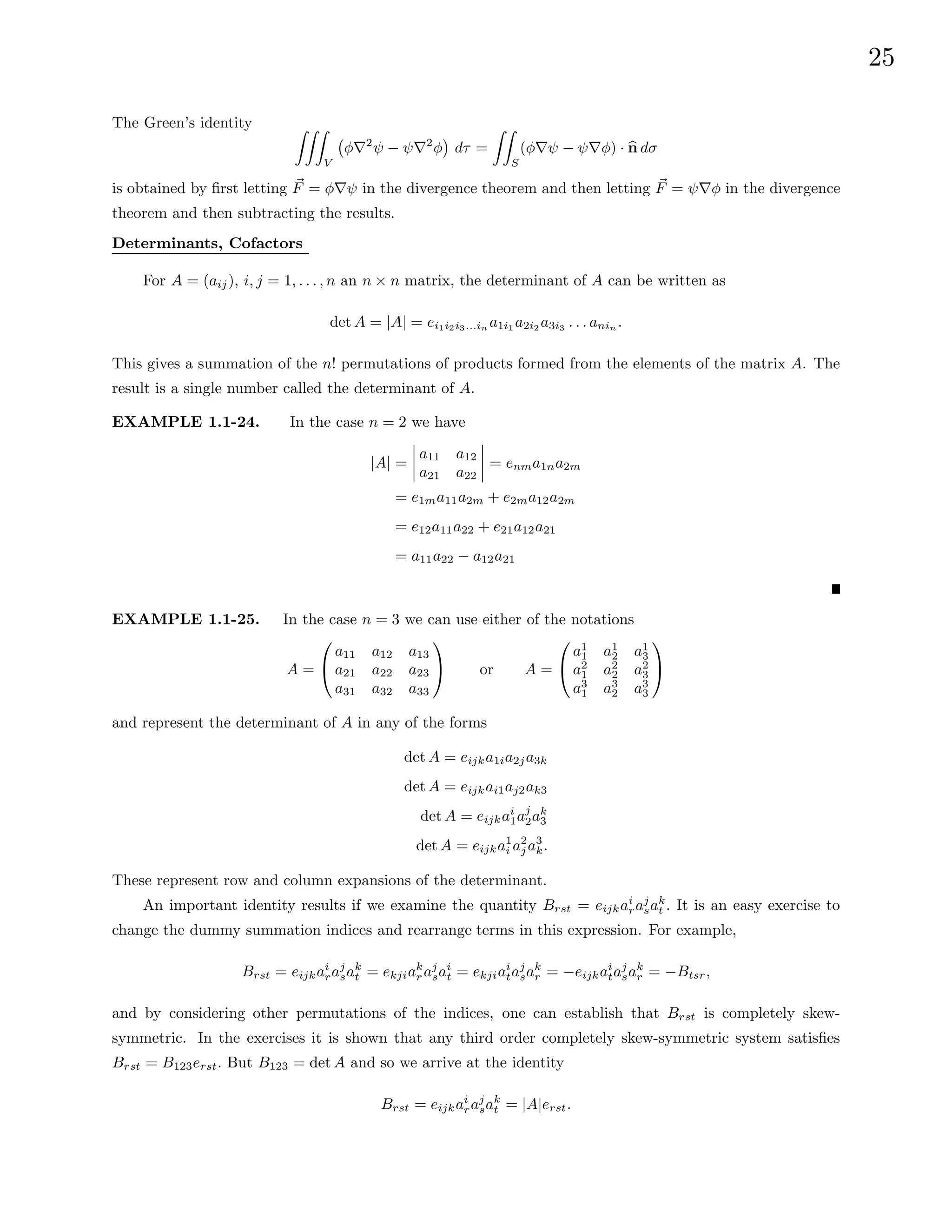
dτ =
ZZ
S
(φ∇ψ − ψ∇φ) · b
n dσ
is obtained by first letting ~
F = φ∇ψ in the divergence theorem and then letting ~
F = ψ∇φ in the divergence
theorem and then subtracting the results.
Determinants, Cofactors
For A = (aij), i, j = 1, . . . , n an n × n matrix, the determinant of A can be written as
det A = |A| = ei1i2i3...in a1i1 a2i2 a3i3 . . . anin .
This gives a summation of the n! permutations of products formed from the elements of the matrix A. The
result is a single number called the determinant of A.
EXAMPLE 1.1-24. In the case n = 2 we have
|A| =
a11 a12
a21 a22
= enma1na2m
= e1ma11a2m + e2ma12a2m
= e12a11a22 + e21a12a21
= a11a22 − a12a21
EXAMPLE 1.1-25. In the case n = 3 we can use either of the notations
A =
a11 a12 a13
a21 a22 a23
a31 a32 a33
or A =
a1
1 a1
2 a1
3
a2
1 a2
2 a2
3
a3
1 a3
2 a3
3
and represent the determinant of A in any of the forms
det A = eijka1ia2ja3k
det A = eijkai1aj2ak3
det A = eijkai
1aj
2ak
3
det A = eijka1
i a2
j a3
k.
These represent row and column expansions of the determinant.
An important identity results if we examine the quantity Brst = eijkai
raj
sak
t . It is an easy exercise to
change the dummy summation indices and rearrange terms in this expression. For example,
Brst = eijkai
raj
sak
t = ekjiak
r aj
sai
t = ekjiai
taj
sak
r = −eijkai
taj
sak
r = −Btsr,
and by considering other permutations of the indices, one can establish that Brst is completely skew-
symmetric. In the exercises it is shown that any third order completely skew-symmetric system satisfies
Brst = B123erst. But B123 = det A and so we arrive at the identity
Brst = eijkai
raj
sak
t = |A|erst.
34.
26
Other forms ofthis identity are
eijk
ar
i as
jat
k = |A|erst
and eijkairajsakt = |A|erst. (1.1.19)
Consider the representation of the determinant
|A| =
a1
1 a1
2 a1
3
a2
1 a2
2 a2
3
a3
1 a3
2 a3
3
by use of the indicial notation. By column expansions, this determinant can be represented
|A| = erstar
1as
2at
3 (1.1.20)
and if one uses row expansions the determinant can be expressed as
|A| = eijk
a1
i a2
j a3
k. (1.1.21)
Define Ai
m as the cofactor of the element am
i in the determinant |A|. From the equation (1.1.20) the cofactor
of ar
1 is obtained by deleting this element and we find
A1
r = erstas
2at
3. (1.1.22)
The result (1.1.20) can then be expressed in the form
|A| = ar
1A1
r = a1
1A1
1 + a2
1A1
2 + a3
1A1
3. (1.1.23)
That is, the determinant |A| is obtained by multiplying each element in the first column by its corresponding
cofactor and summing the result. Observe also that from the equation (1.1.20) we find the additional
cofactors
A2
s = erstar
1at
3 and A3
t = erstar
1as
2. (1.1.24)
Hence, the equation (1.1.20) can also be expressed in one of the forms
|A| = as
2A2
s = a1
2A2
1 + a2
2A2
2 + a3
2A2
3
|A| = at
3A3
t = a1
3A3
1 + a2
3A3
2 + a3
3A3
3
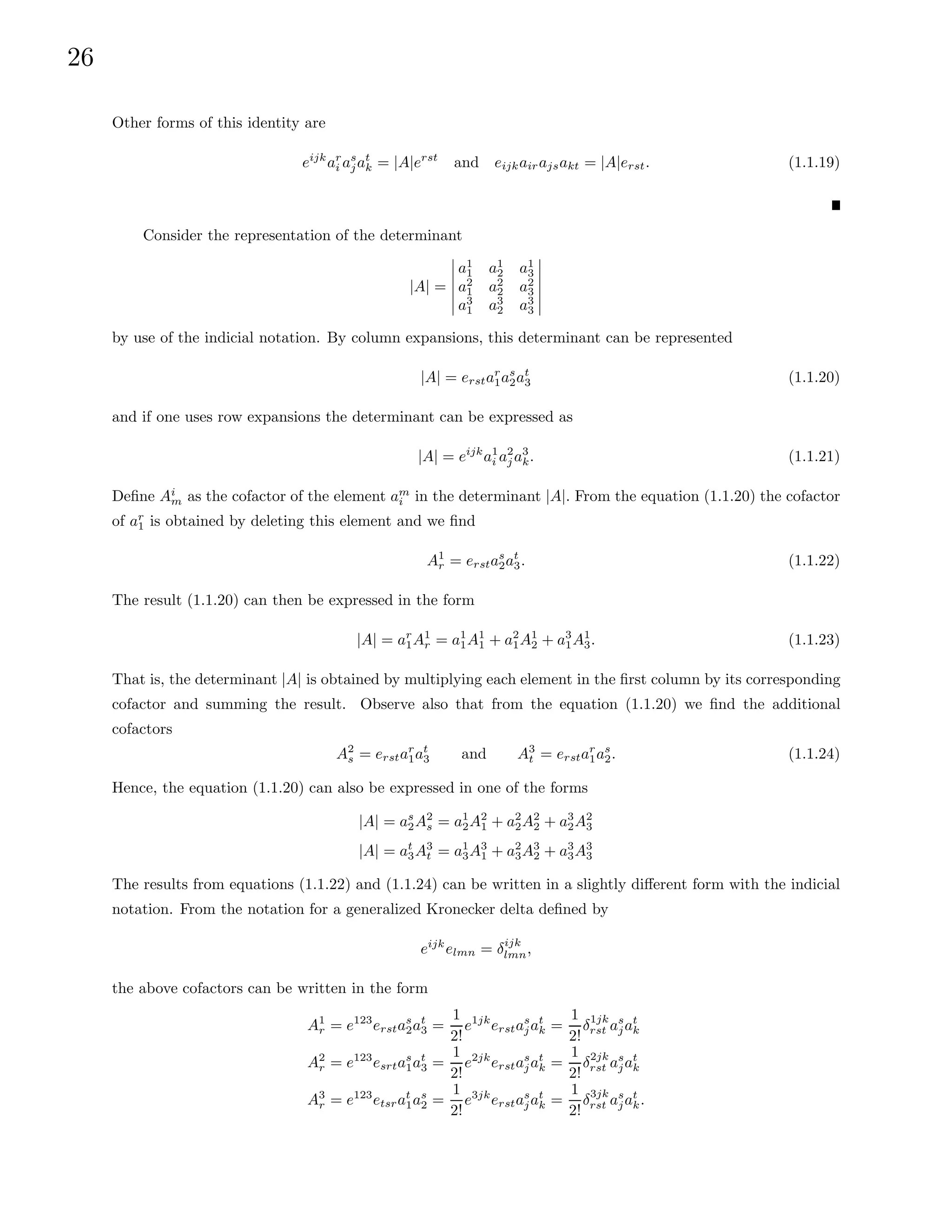
The results from equations (1.1.22) and (1.1.24) can be written in a slightly different form with the indicial
notation. From the notation for a generalized Kronecker delta defined by
eijk
elmn = δijk
lmn,
the above cofactors can be written in the form
A1
r = e123
erstas
2at
3 =
1
2!
e1jk
erstas
jat
k =
1
2!
δ1jk
rst as
jat
k
A2
r = e123
esrtas
1at
3 =
1
2!
e2jk
erstas
jat
k =
1
2!
δ2jk
rst as
jat
k
A3
r = e123
etsrat
1as
2 =
1
2!
e3jk
erstas
jat
k =
1
2!
δ3jk
rst as
jat
k.
35.
27
These cofactors arethen combined into the single equation
Ai
r =
1
2!
δijk
rst as
jat
k (1.1.25)
which represents the cofactor of ar
i . When the elements from any row (or column) are multiplied by their
corresponding cofactors, and the results summed, we obtain the value of the determinant. Whenever the
elements from any row (or column) are multiplied by the cofactor elements from a different row (or column),
and the results summed, we get zero. This can be illustrated by considering the summation
am
r Ai
m =
1
2!
δijk
mstas
jat
kam
r =
1
2!
eijk
emstam
r as
jat
k
=
1
2!
eijk
erjk|A| =
1
2!
δijk
rjk|A| = δi
r|A|
Here we have used the e − δ identity to obtain
δijk
rjk = eijk
erjk = ejik
ejrk = δi
rδk
k − δi
kδk
r = 3δi
r − δi
r = 2δi
r
which was used to simplify the above result.
As an exercise one can show that an alternate form of the above summation of elements by its cofactors
is
ar
mAm
i = |A|δr
i .
EXAMPLE 1.1-26. In N-dimensions the quantity δj1j2...jN
k1k2...kN
is called a generalized Kronecker delta. It
can be defined in terms of permutation symbols as
ej1j2...jN
ek1k2...kN = δj1j2...jN
k1k2...kN
(1.1.26)
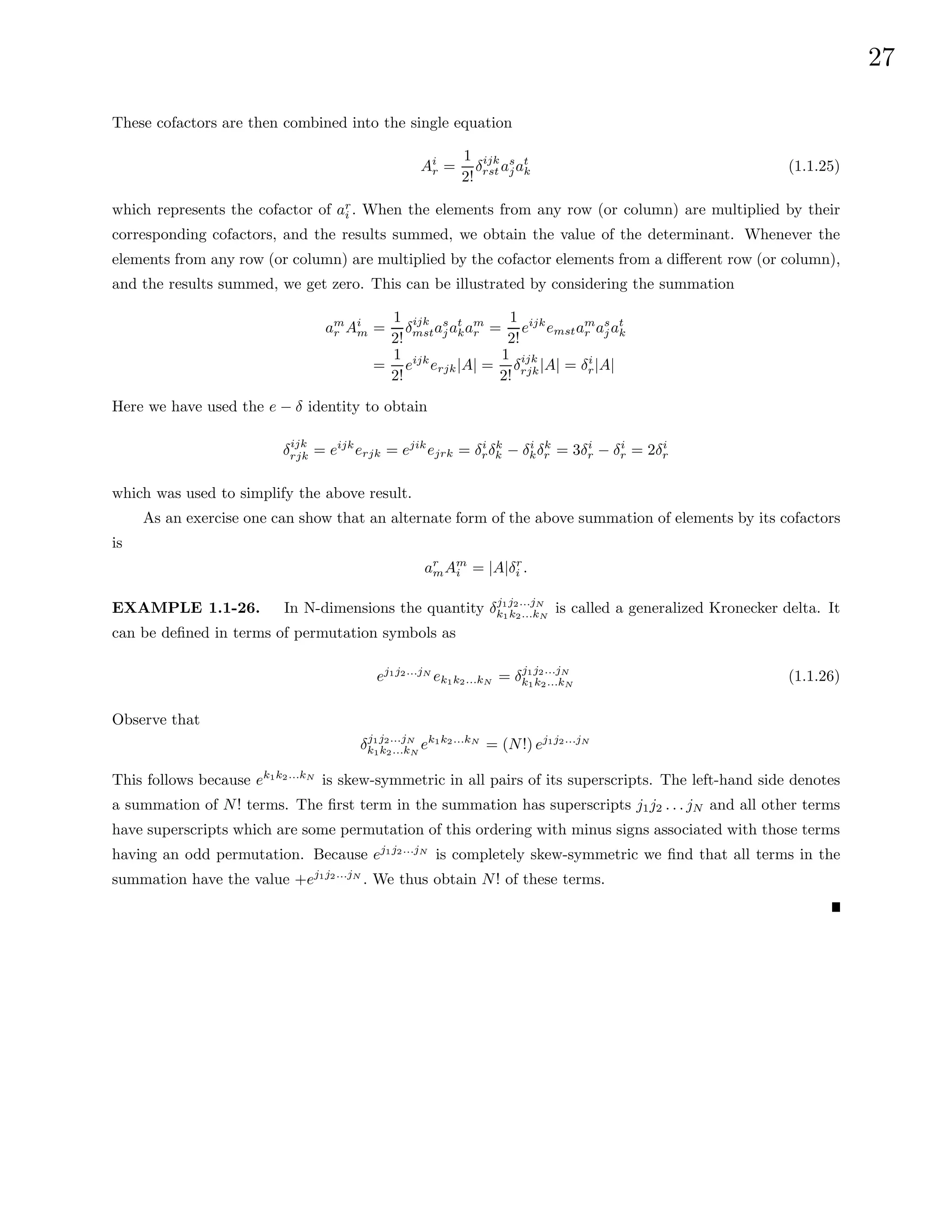
Observe that
δj1j2...jN
k1k2...kN
ek1k2...kN
= (N!) ej1j2...jN
This follows because ek1k2...kN
is skew-symmetric in all pairs of its superscripts. The left-hand side denotes
a summation of N! terms. The first term in the summation has superscripts j1j2 . . . jN and all other terms
have superscripts which are some permutation of this ordering with minus signs associated with those terms
having an odd permutation. Because ej1j2...jN
is completely skew-symmetric we find that all terms in the
summation have the value +ej1j2...jN
. We thus obtain N! of these terms.
36.
28
EXERCISE 1.1
I 1.Simplify each of the following by employing the summation property of the Kronecker delta. Perform
sums on the summation indices only if your are unsure of the result.
(a) eijkδkn
(b) eijkδisδjm
(c) eijkδisδjmδkn
(d) aijδin
(e) δijδjn
(f) δijδjnδni
I 2. Simplify and perform the indicated summations over the range 1, 2, 3
(a) δii
(b) δijδij
(c) eijkAiAjAk
(d) eijkeijk
(e) eijkδjk
(f) AiBjδji − BmAnδmn
I 3. Express each of the following in index notation. Be careful of the notation you use. Note that ~
A = Ai
is an incorrect notation because a vector can not equal a scalar. The notation ~
A · b
ei = Ai should be used to
express the ith component of a vector.
(a) ~
A · ( ~
B × ~
C)
(b) ~
A × ( ~
B × ~
C)
(c) ~
B( ~
A · ~
C)
(d) ~
B( ~
A · ~
C) − ~
C( ~
A · ~
B)
I 4. Show the e permutation symbol satisfies: (a) eijk = ejki = ekij (b) eijk = −ejik = −eikj = −ekji
I 5. Use index notation to verify the vector identity ~
A × ( ~
B × ~
C) = ~
B( ~
A · ~
C) − ~
C( ~
A · ~
B)
I 6. Let yi = aijxj and xm = aimzi where the range of the indices is 1, 2
(a) Solve for yi in terms of zi using the indicial notation and check your result
to be sure that no index repeats itself more than twice.
(b) Perform the indicated summations and write out expressions
for y1, y2 in terms of z1, z2
(c) Express the above equations in matrix form. Expand the matrix
equations and check the solution obtained in part (b).
I 7. Use the e − δ identity to simplify (a) eijkejik (b) eijkejki
I 8. Prove the following vector identities:
(a) ~
A · ( ~
B × ~
C) = ~
B · (~
C × ~
A) = ~
C · ( ~
A × ~
B) triple scalar product
(b) ( ~
A × ~
B) × ~
C = ~
B( ~
A · ~
C) − ~
A( ~
B · ~
C)
I 9. Prove the following vector identities:
(a) ( ~
A × ~
B) · (~
C × ~
D) = ( ~
A · ~
C)( ~
B · ~
D) − ( ~
A · ~
D)( ~
B · ~
C)
(b) ~
A × ( ~
B × ~
C) + ~
B × (~
C × ~
A) + ~
C × ( ~
A × ~
B) = ~
0
(c) ( ~
A × ~
B) × (~
C × ~
D) = ~
B( ~
A · ~
C × ~
D) − ~
A( ~
B · ~
C × ~
D)
37.
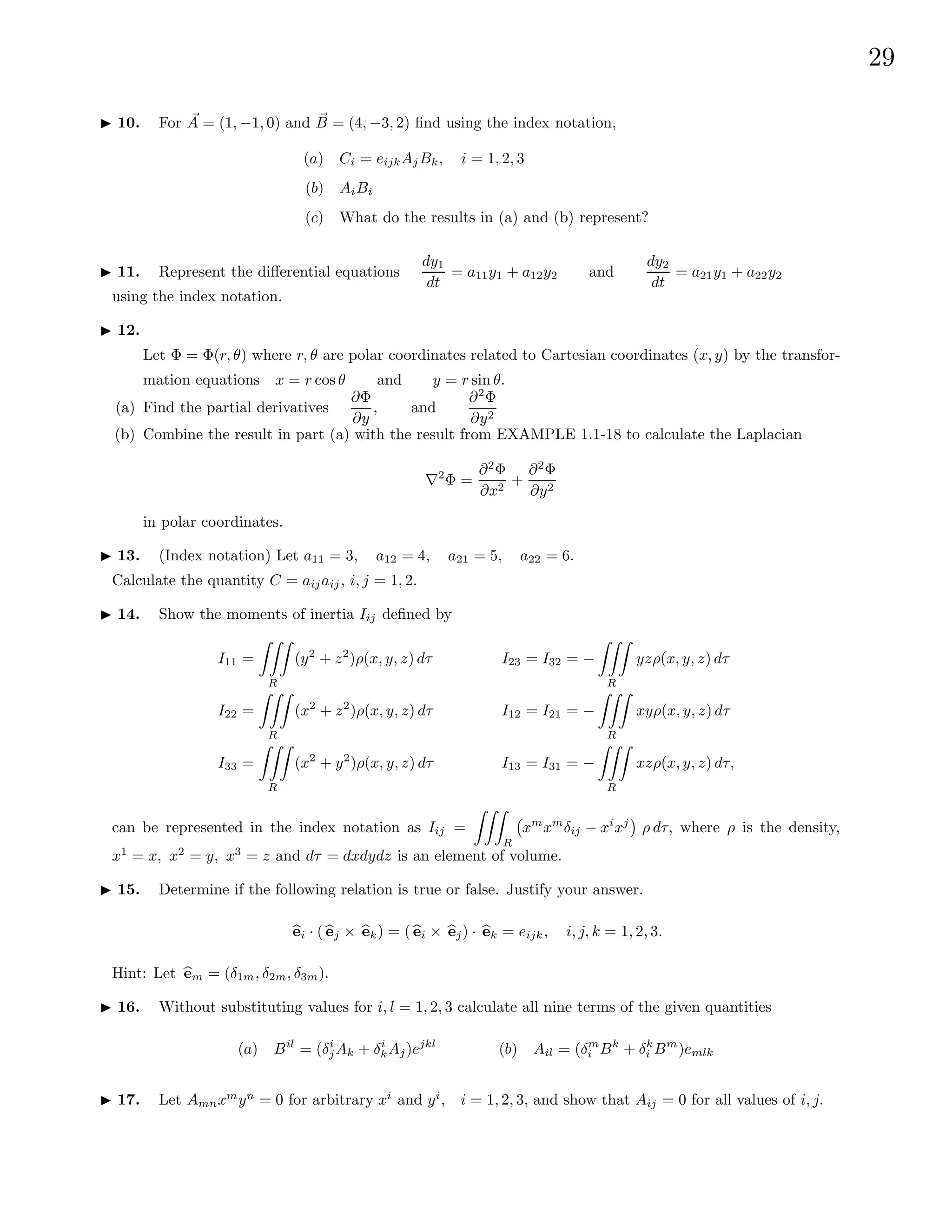
29
I 10. For~
A = (1, −1, 0) and ~
B = (4, −3, 2) find using the index notation,
(a) Ci = eijkAjBk, i = 1, 2, 3
(b) AiBi
(c) What do the results in (a) and (b) represent?
I 11. Represent the differential equations
dy1
dt
= a11y1 + a12y2 and
dy2
dt
= a21y1 + a22y2
using the index notation.
I 12.
Let Φ = Φ(r, θ) where r, θ are polar coordinates related to Cartesian coordinates (x, y) by the transfor-
mation equations x = r cos θ and y = r sin θ.
(a) Find the partial derivatives
∂Φ
∂y
, and
∂2
Φ
∂y2
(b) Combine the result in part (a) with the result from EXAMPLE 1.1-18 to calculate the Laplacian
∇2
Φ =
∂2
Φ
∂x2
+
∂2
Φ
∂y2
in polar coordinates.
I 13. (Index notation) Let a11 = 3, a12 = 4, a21 = 5, a22 = 6.
Calculate the quantity C = aijaij, i, j = 1, 2.
I 14. Show the moments of inertia Iij defined by
I11 =
ZZZ
R
(y2
+ z2
)ρ(x, y, z) dτ
I22 =
ZZZ
R
(x2
+ z2
)ρ(x, y, z) dτ
I33 =
ZZZ
R
(x2
+ y2
)ρ(x, y, z) dτ
I23 = I32 = −
ZZZ
R
yzρ(x, y, z) dτ
I12 = I21 = −
ZZZ
R
xyρ(x, y, z) dτ
I13 = I31 = −
ZZZ
R
xzρ(x, y, z) dτ,
can be represented in the index notation as Iij =
ZZZ
R
xm
xm
δij − xi
xj
ρ dτ, where ρ is the density,
x1
= x, x2
= y, x3
= z and dτ = dxdydz is an element of volume.
I 15. Determine if the following relation is true or false. Justify your answer.
b
ei · ( b
ej × b
ek) = ( b
ei × b
ej) · b
ek = eijk, i, j, k = 1, 2, 3.
Hint: Let b
em = (δ1m, δ2m, δ3m).
I 16. Without substituting values for i, l = 1, 2, 3 calculate all nine terms of the given quantities
(a) Bil
= (δi
jAk + δi
kAj)ejkl
(b) Ail = (δm
i Bk
+ δk
i Bm
)emlk
I 17. Let Amnxm
yn
= 0 for arbitrary xi
and yi
, i = 1, 2, 3, and show that Aij = 0 for all values of i, j.
38.
30
I 18.
(a) Foramn, m, n = 1, 2, 3 skew-symmetric, show that amnxm
xn
= 0.
(b) Let amnxm
xn
= 0, m, n = 1, 2, 3 for all values of xi
, i = 1, 2, 3 and show that amn must be skew-
symmetric.
I 19. Let A and B denote 3 × 3 matrices with elements aij and bij respectively. Show that if C = AB is a
matrix product, then det(C) = det(A) · det(B).
Hint: Use the result from example 1.1-9.
I 20.
(a) Let u1
, u2
, u3
be functions of the variables s1
, s2
, s3
. Further, assume that s1
, s2
, s3
are in turn each
functions of the variables x1
, x2
, x3
. Let
∂um
∂xn
=
∂(u1
, u2
, u3
)
∂(x1, x2, x3)
denote the Jacobian of the u0
s with
respect to the x0
s. Show that
∂ui
∂xm
=
∂ui
∂sj
∂sj
∂xm
=
∂ui
∂sj
·
∂sj
∂xm
.
(b) Note that
∂xi
∂x̄j
∂x̄j
∂xm
=
∂xi
∂xm
= δi
m and show that J(x
x̄ )·J(x̄
x ) = 1, where J(x
x̄ ) is the Jacobian determinant
of the transformation (1.1.7).
I 21. A third order system a`mn with `, m, n = 1, 2, 3 is said to be symmetric in two of its subscripts if the
components are unaltered when these subscripts are interchanged. When a`mn is completely symmetric then
a`mn = am`n = a`nm = amn` = anm` = an`m. Whenever this third order system is completely symmetric,
then: (i) How many components are there? (ii) How many of these components are distinct?
Hint: Consider the three cases (i) ` = m = n (ii) ` = m 6= n (iii) ` 6= m 6= n.
I 22. A third order system b`mn with `, m, n = 1, 2, 3 is said to be skew-symmetric in two of its subscripts
if the components change sign when the subscripts are interchanged. A completely skew-symmetric third
order system satisfies b`mn = −bm`n = bmn` = −bnm` = bn`m = −b`nm. (i) How many components does
a completely skew-symmetric system have? (ii) How many of these components are zero? (iii) How many
components can be different from zero? (iv) Show that there is one distinct component b123 and that
b`mn = e`mnb123.
Hint: Consider the three cases (i) ` = m = n (ii) ` = m 6= n (iii) ` 6= m 6= n.
I 23. Let i, j, k = 1, 2, 3 and assume that eijkσjk = 0 for all values of i. What does this equation tell you
about the values σij, i, j = 1, 2, 3?
I 24. Assume that Amn and Bmn are symmetric for m, n = 1, 2, 3. Let Amnxm
xn
= Bmnxm
xn
for arbitrary
values of xi
, i = 1, 2, 3, and show that Aij = Bij for all values of i and j.
I 25. Assume Bmn is symmetric and Bmnxm
xn
= 0 for arbitrary values of xi
, i = 1, 2, 3, show that Bij = 0.
39.
31
I 26. (GeneralizedKronecker delta) Define the generalized Kronecker delta as the n×n determinant
δij...k
mn...p =
δi
m δi
n · · · δi
p
δj
m δj
n · · · δj
p
.
.
.
.
.
.
...
.
.
.
δk
m δk
n · · · δk
p
where δr
s is the Kronecker delta.
(a) Show eijk = δ123
ijk
(b) Show eijk
= δijk
123
(c) Show δij
mn = eij
emn
(d) Define δrs
mn = δrsp
mnp (summation on p)
and show δrs
mn = δr
mδs
n − δr
nδs
m
Note that by combining the above result with the result from part (c)
we obtain the two dimensional form of the e − δ identity ers
emn = δr
mδs
n − δr
nδs
m.
(e) Define δr
m = 1
2 δrn
mn (summation on n) and show δrst
pst = 2δr
p
(f) Show δrst
rst = 3!
I 27. Let Ai
r denote the cofactor of ar
i in the determinant
a1
1 a1
2 a1
3
a2
1 a2
2 a2
3
a3
1 a3
2 a3
3
as given by equation (1.1.25).
(a) Show erst
Ai
r = eijk
as
jat
k (b) Show erstAr
i = eijkaj
sak
t
I 28. (a) Show that if Aijk = Ajik, i, j, k = 1, 2, 3 there is a total of 27 elements, but only 18 are distinct.
(b) Show that for i, j, k = 1, 2, . . ., N there are N3
elements, but only N2
(N + 1)/2 are distinct.
I 29. Let aij = BiBj for i, j = 1, 2, 3 where B1, B2, B3 are arbitrary constants. Calculate det(aij) = |A|.
I 30.
(a) For A = (aij), i, j = 1, 2, 3, show |A| = eijkai1aj2ak3.
(b) For A = (ai
j), i, j = 1, 2, 3, show |A| = eijkai
1aj
2ak
3.
(c) For A = (ai
j), i, j = 1, 2, 3, show |A| = eijk
a1
i a2
j a3
k.
(d) For I = (δi
j), i, j = 1, 2, 3, show |I| = 1.
I 31. Let |A| = eijkai1aj2ak3 and define Aim as the cofactor of aim. Show the determinant can be
expressed in any of the forms:
(a) |A| = Ai1ai1 where Ai1 = eijkaj2ak3
(b) |A| = Aj2aj2 where Ai2 = ejikaj1ak3
(c) |A| = Ak3ak3 where Ai3 = ejkiaj1ak2
40.
32
I 32. Showthe results in problem 31 can be written in the forms:
Ai1 =
1
2!
e1steijkajsakt, Ai2 =
1
2!
e2steijkajsakt, Ai3 =
1
2!
e3steijkajsakt, or Aim =
1
2!
emsteijkajsakt
I 33. Use the results in problems 31 and 32 to prove that apmAim = |A|δip.
I 34. Let (aij) =
1 2 1
1 0 3
2 3 2
and calculate C = aijaij, i, j = 1, 2, 3.
I 35. Let
a111 = −1, a112 = 3, a121 = 4, a122 = 2
a211 = 1, a212 = 5, a221 = 2, a222 = −2
and calculate the quantity C = aijkaijk, i, j, k = 1, 2.
I 36. Let
a1111 = 2, a1112 = 1, a1121 = 3, a1122 = 1
a1211 = 5, a1212 = −2, a1221 = 4, a1222 = −2
a2111 = 1, a2112 = 0, a2121 = −2, a2122 = −1
a2211 = −2, a2212 = 1, a2221 = 2, a2222 = 2
and calculate the quantity C = aijklaijkl, i, j, k, l = 1, 2.
I 37. Simplify the expressions:
(a) (Aijkl + Ajkli + Aklij + Alijk)xixjxkxl
(b) (Pijk + Pjki + Pkij )xi
xj
xk
(c)
∂xi
∂xj
(d) aij
∂2
xi
∂xt
∂xs
∂xj
∂xr − ami
∂2
xm
∂xs
∂xt
∂xi
∂xr
I 38. Let g denote the determinant of the matrix having the components gij, i, j = 1, 2, 3. Show that
(a) g erst =
g1r g1s g1t
g2r g2s g2t
g3r g3s g3t
(b) g ersteijk =
gir gis git
gjr gjs gjt
gkr gks gkt
I 39. Show that eijk
emnp = δijk
mnp =
δi
m δi
n δi
p
δj
m δj
n δj
p
δk
m δk
n δk
p
I 40. Show that eijk
emnpAmnp
= Aijk
− Aikj
+ Akij
− Ajik
+ Ajki
− Akji
Hint: Use the results from problem 39.
I 41. Show that
(a) eij
eij = 2!
(b) eijk
eijk = 3!
(c) eijkl
eijkl = 4!
(d) Guess at the result ei1i2...in
ei1i2...in
41.
33
I 42. Determineif the following statement is true or false. Justify your answer. eijkAiBjCk = eijkAjBkCi.
I 43. Let aij, i, j = 1, 2 denote the components of a 2 × 2 matrix A, which are functions of time t.
(a) Expand both |A| = eijai1aj2 and |A| =
a11 a12
a21 a22
to verify that these representations are the same.
(b) Verify the equivalence of the derivative relations
d|A|
dt
= eij
dai1
dt
aj2 + eijai1
daj2
dt
and
d|A|
dt
=
da11
dt
da12
dt
a21 a22
+
a11 a12
da21
dt
da22
dt
(c) Let aij, i, j = 1, 2, 3 denote the components of a 3 × 3 matrix A, which are functions of time t. Develop
appropriate relations, expand them and verify, similar to parts (a) and (b) above, the representation of
a determinant and its derivative.
I 44. For f = f(x1
, x2
, x3
) and φ = φ(f) differentiable scalar functions, use the indicial notation to find a
formula to calculate grad φ .
I 45. Use the indicial notation to prove (a) ∇ × ∇φ = ~
0 (b) ∇ · ∇ × ~
A = 0
I 46. If Aij is symmetric and Bij is skew-symmetric, i, j = 1, 2, 3, then calculate C = AijBij.
I 47. Assume Aij = Aij(x1
, x2
, x3
) and Aij = Aij(x1
, x2
, x3
) for i, j = 1, 2, 3 are related by the expression
Amn = Aij
∂xi
∂xm
∂xj
∂xn . Calculate the derivative
∂Amn
∂xk
.
I 48. Prove that if any two rows (or two columns) of a matrix are interchanged, then the value of the
determinant of the matrix is multiplied by minus one. Construct your proof using 3 × 3 matrices.
I 49. Prove that if two rows (or columns) of a matrix are proportional, then the value of the determinant
of the matrix is zero. Construct your proof using 3 × 3 matrices.
I 50. Prove that if a row (or column) of a matrix is altered by adding some constant multiple of some other
row (or column), then the value of the determinant of the matrix remains unchanged. Construct your proof
using 3 × 3 matrices.
I 51. Simplify the expression φ = eijke`mnAi`AjmAkn.
I 52. Let Aijk denote a third order system where i, j, k = 1, 2. (a) How many components does this system
have? (b) Let Aijk be skew-symmetric in the last pair of indices, how many independent components does
the system have?
I 53. Let Aijk denote a third order system where i, j, k = 1, 2, 3. (a) How many components does this
system have? (b) In addition let Aijk = Ajik and Aikj = −Aijk and determine the number of distinct
nonzero components for Aijk.
42.
34
I 54. Showthat every second order system Tij can be expressed as the sum of a symmetric system Aij and
skew-symmetric system Bij. Find Aij and Bij in terms of the components of Tij.
I 55. Consider the system Aijk, i, j, k = 1, 2, 3, 4.
(a) How many components does this system have?
(b) Assume Aijk is skew-symmetric in the last pair of indices, how many independent components does this
system have?
(c) Assume that in addition to being skew-symmetric in the last pair of indices, Aijk + Ajki + Akij = 0 is
satisfied for all values of i, j, and k, then how many independent components does the system have?
I 56. (a) Write the equation of a line ~
r = ~
r0 + t ~
A in indicial form. (b) Write the equation of the plane
~
n · (~
r − ~
r0) = 0 in indicial form. (c) Write the equation of a general line in scalar form. (d) Write the
equation of a plane in scalar form. (e) Find the equation of the line defined by the intersection of the
planes 2x + 3y + 6z = 12 and 6x + 3y + z = 6. (f) Find the equation of the plane through the points
(5, 3, 2), (3, 1, 5), (1, 3, 3). Find also the normal to this plane.
I 57. The angle 0 ≤ θ ≤ π between two skew lines in space is defined as the angle between their direction
vectors when these vectors are placed at the origin. Show that for two lines with direction numbers ai and
bi i = 1, 2, 3, the cosine of the angle between these lines satisfies
cos θ =
aibi
√
aiai
√
bibi
I 58. Let aij = −aji for i, j = 1, 2, . . ., N and prove that for N odd det(aij) = 0.
I 59. Let λ = Aijxixj where Aij = Aji and calculate (a)
∂λ
∂xm
(b)
∂2
λ
∂xm∂xk
I 60. Given an arbitrary nonzero vector Uk, k = 1, 2, 3, define the matrix elements aij = eijkUk, where eijk
is the e-permutation symbol. Determine if aij is symmetric or skew-symmetric. Suppose Uk is defined by
the above equation for arbitrary nonzero aij, then solve for Uk in terms of the aij.
I 61. If Aij = AiBj 6= 0 for all i, j values and Aij = Aji for i, j = 1, 2, . . ., N, show that Aij = λBiBj
where λ is a constant. State what λ is.
I 62. Assume that Aijkm, with i, j, k, m = 1, 2, 3, is completely skew-symmetric. How many independent
components does this quantity have?
I 63. Consider Rijkm, i, j, k, m = 1, 2, 3, 4. (a) How many components does this quantity have? (b) If
Rijkm = −Rijmk = −Rjikm then how many independent components does Rijkm have? (c) If in addition
Rijkm = Rkmij determine the number of independent components.
I 64. Let xi = aijx̄j, i, j = 1, 2, 3 denote a change of variables from a barred system of coordinates to an
unbarred system of coordinates and assume that Āi = aijAj where aij are constants, Āi is a function of the
x̄j variables and Aj is a function of the xj variables. Calculate
∂Āi
∂x̄m
.
43.
35
§1.2 TENSOR CONCEPTSAND TRANSFORMATIONS
For b
e1, b
e2, b
e3 independent orthogonal unit vectors (base vectors), we may write any vector ~
A as
~
A = A1 b
e1 + A2 b
e2 + A3 b
e3
where (A1, A2, A3) are the coordinates of ~
A relative to the base vectors chosen. These components are the
projection of ~
A onto the base vectors and
~
A = ( ~
A · b
e1) b
e1 + ( ~
A · b
e2) b
e2 + ( ~
A · b
e3) b
e3.
Select any three independent orthogonal vectors, (~
E1, ~
E2, ~
E3), not necessarily of unit length, we can then
write
b
e1 =
~
E1
| ~
E1|
, b
e2 =
~
E2
| ~
E2|
, b
e3 =
~
E3
| ~
E3|
,
and consequently, the vector ~
A can be expressed as
~
A =
~
A · ~
E1
~
E1 · ~
E1
!
~
E1 +
~
A · ~
E2
~
E2 · ~
E2
!
~
E2 +
~
A · ~
E3
~
E3 · ~
E3
!
~
E3.
Here we say that
~
A · ~
E(i)
~
E(i) · ~
E(i)
, i = 1, 2, 3
are the components of ~
A relative to the chosen base vectors ~
E1, ~
E2, ~
E3. Recall that the parenthesis about
the subscript i denotes that there is no summation on this subscript. It is then treated as a free subscript
which can have any of the values 1, 2 or 3.
Reciprocal Basis
Consider a set of any three independent vectors (~
E1, ~
E2, ~
E3) which are not necessarily orthogonal, nor of
unit length. In order to represent the vector ~
A in terms of these vectors we must find components (A1
, A2
, A3
)
such that
~
A = A1 ~
E1 + A2 ~
E2 + A3 ~
E3.
This can be done by taking appropriate projections and obtaining three equations and three unknowns from
which the components are determined. A much easier way to find the components (A1
, A2
, A3
) is to construct
a reciprocal basis ( ~
E1
, ~
E2
, ~
E3
). Recall that two bases (~
E1, ~
E2, ~
E3) and ( ~
E1
, ~
E2
, ~
E3
) are said to be reciprocal
if they satisfy the condition
~
Ei · ~
Ej
= δj
i =
1 if i = j
0 if i 6= j
.
Note that ~
E2 · ~
E1
= δ1
2 = 0 and ~
E3 · ~
E1
= δ1
3 = 0 so that the vector ~
E1
is perpendicular to both the
vectors ~
E2 and ~
E3. (i.e. A vector from one basis is orthogonal to two of the vectors from the other basis.)
We can therefore write ~
E1
= V −1 ~
E2 × ~
E3 where V is a constant to be determined. By taking the dot
product of both sides of this equation with the vector ~
E1 we find that V = ~
E1 · ( ~
E2 × ~
E3) is the volume
of the parallelepiped formed by the three vectors ~
E1, ~
E2, ~
E3 when their origins are made to coincide. In a
44.
36
similar manner itcan be demonstrated that for ( ~
E1, ~
E2, ~
E3) a given set of basis vectors, then the reciprocal
basis vectors are determined from the relations
~
E1
=
1
V
~
E2 × ~
E3, ~
E2
=
1
V
~
E3 × ~
E1, ~
E3
=
1
V
~
E1 × ~
E2,
where V = ~
E1 · ( ~
E2 × ~
E3) 6= 0 is a triple scalar product and represents the volume of the parallelepiped
having the basis vectors for its sides.
Let ( ~
E1, ~
E2, ~
E3) and ( ~
E1
, ~
E2
, ~
E3
) denote a system of reciprocal bases. We can represent any vector ~
A
with respect to either of these bases. If we select the basis ( ~
E1, ~
E2, ~
E3) and represent ~
A in the form
~
A = A1 ~
E1 + A2 ~
E2 + A3 ~
E3, (1.2.1)
then the components (A1
, A2
, A3
) of ~
A relative to the basis vectors ( ~
E1, ~
E2, ~
E3) are called the contravariant
components of ~
A. These components can be determined from the equations
~
A · ~
E1
= A1
, ~
A · ~
E2
= A2
, ~
A · ~
E3
= A3
.
Similarly, if we choose the reciprocal basis (~
E1
, ~
E2
, ~
E3
) and represent ~
A in the form
~
A = A1
~
E1
+ A2
~
E2
+ A3
~
E3
, (1.2.2)
then the components (A1, A2, A3) relative to the basis ( ~
E1
, ~
E2
, ~
E3
) are called the covariant components of
~
A. These components can be determined from the relations
~
A · ~
E1 = A1, ~
A · ~
E2 = A2, ~
A · ~
E3 = A3.
The contravariant and covariant components are different ways of representing the same vector with respect
to a set of reciprocal basis vectors. There is a simple relationship between these components which we now
develop. We introduce the notation
~
Ei · ~
Ej = gij = gji, and ~
Ei
· ~
Ej
= gij
= gji
(1.2.3)
where gij are called the metric components of the space and gij
are called the conjugate metric components
of the space. We can then write
~
A · ~
E1 = A1( ~
E1
· ~
E1) + A2( ~
E2
· ~
E1) + A3( ~
E3
· ~
E1) = A1
~
A · ~
E1 = A1
( ~
E1 · ~
E1) + A2
( ~
E2 · ~
E1) + A3
( ~
E3 · ~
E1) = A1
or
A1 = A1
g11 + A2
g12 + A3
g13. (1.2.4)
In a similar manner, by considering the dot products ~
A · ~
E2 and ~
A · ~
E3 one can establish the results
A2 = A1
g21 + A2
g22 + A3
g23 A3 = A1
g31 + A2
g32 + A3
g33.
These results can be expressed with the index notation as
Ai = gikAk
. (1.2.6)
Forming the dot products ~
A · ~
E1
, ~
A · ~
E2
, ~
A · ~
E3
it can be verified that
Ai
= gik
Ak. (1.2.7)
The equations (1.2.6) and (1.2.7) are relations which exist between the contravariant and covariant compo-
nents of the vector ~
A. Similarly, if for some value j we have ~
Ej
= α ~
E1 + β ~
E2 + γ ~
E3, then one can show
that ~
Ej
= gij ~
Ei. This is left as an exercise.
45.
37
Coordinate Transformations
Consider acoordinate transformation from a set of coordinates (x, y, z) to (u, v, w) defined by a set of
transformation equations
x = x(u, v, w)
y = y(u, v, w)
z = z(u, v, w)
(1.2.8)
It is assumed that these transformations are single valued, continuous and possess the inverse transformation
u = u(x, y, z)
v = v(x, y, z)
w = w(x, y, z).
(1.2.9)
These transformation equations define a set of coordinate surfaces and coordinate curves. The coordinate
surfaces are defined by the equations
u(x, y, z) = c1
v(x, y, z) = c2
w(x, y, z) = c3
(1.2.10)
where c1, c2, c3 are constants. These surfaces intersect in the coordinate curves
~
r(u, c2, c3), ~
r(c1, v, c3), ~
r(c1, c2, w), (1.2.11)
where
~
r(u, v, w) = x(u, v, w) b
e1 + y(u, v, w) b
e2 + z(u, v, w) b
e3.
The general situation is illustrated in the figure 1.2-1.
Consider the vectors
~
E1
= gradu = ∇u, ~
E2
= gradv = ∇v, ~
E3
= gradw = ∇w (1.2.12)
evaluated at the common point of intersection (c1, c2, c3) of the coordinate surfaces. The system of vectors
( ~
E1
, ~
E2
, ~
E3
) can be selected as a system of basis vectors which are normal to the coordinate surfaces.
Similarly, the vectors
~
E1 =
∂~
r
∂u
, ~
E2 =
∂~
r
∂v
, ~
E3 =
∂~
r
∂w
(1.2.13)
when evaluated at the common point of intersection (c1, c2, c3) forms a system of vectors (~
E1, ~
E2, ~
E3) which
we can select as a basis. This basis is a set of tangent vectors to the coordinate curves. It is now demonstrated
that the normal basis ( ~
E1
, ~
E2
, ~
E3
) and the tangential basis (~
E1, ~
E2, ~
E3) are a set of reciprocal bases.
Recall that ~
r = x b
e1 + y b
e2 + z b
e3 denotes the position vector of a variable point. By substitution for
x, y, z from (1.2.8) there results
~
r = ~
r(u, v, w) = x(u, v, w) b
e1 + y(u, v, w) b
e2 + z(u, v, w) b
e3. (1.2.14)
46.
38
Figure 1.2-1. Coordinatecurves and coordinate surfaces.
A small change in ~
r is denoted
d~
r = dx b
e1 + dy b
e2 + dz b
e3 =
∂~
r
∂u
du +
∂~
r
∂v
dv +
∂~
r
∂w
dw (1.2.15)
where
∂~
r
∂u
=
∂x
∂u
b
e1 +
∂y
∂u
b
e2 +
∂z
∂u
b
e3
∂~
r
∂v
=
∂x
∂v
b
e1 +
∂y
∂v
b
e2 +
∂z
∂v
b
e3
∂~
r
∂w
=
∂x
∂w
b
e1 +
∂y
∂w
b
e2 +
∂z
∂w
b
e3.
(1.2.16)
In terms of the u, v, w coordinates, this change can be thought of as moving along the diagonal of a paral-
lelepiped having the vector sides
∂~
r
∂u
du,
∂~
r
∂v
dv, and
∂~
r
∂w
dw.
Assume u = u(x, y, z) is defined by equation (1.2.9) and differentiate this relation to obtain
du =
∂u
∂x
dx +
∂u
∂y
dy +
∂u
∂z
dz. (1.2.17)
The equation (1.2.15) enables us to represent this differential in the form:
du = grad u · d~
r
du = grad u ·
∂~
r
∂u
du +
∂~
r
∂v
dv +
∂~
r
∂w
dw
du =
grad u ·
∂~
r
∂u
du +
gradu ·
∂~
r
∂v
dv +
grad u ·
∂~
r
∂w
dw.
(1.2.18)
By comparing like terms in this last equation we find that
~
E1
· ~
E1 = 1, ~
E1
· ~
E2 = 0, ~
E1
· ~
E3 = 0. (1.2.19)
Similarly, from the other equations in equation (1.2.9) which define v = v(x, y, z), and w = w(x, y, z) it
can be demonstrated that
dv =
grad v ·
∂~
r
∂u
du +
grad v ·
∂~
r
∂v
dv +
grad v ·
∂~
r
∂w
dw (1.2.20)
47.
39
and
dw =
grad w·
∂~
r
∂u
du +
gradw ·
∂~
r
∂v
dv +
grad w ·
∂~
r
∂w
dw. (1.2.21)
By comparing like terms in equations (1.2.20) and (1.2.21) we find
~
E2
· ~
E1 = 0, ~
E2
· ~
E2 = 1, ~
E2
· ~
E3 = 0
~
E3
· ~
E1 = 0, ~
E3
· ~
E2 = 0, ~
E3
· ~
E3 = 1.
(1.2.22)
The equations (1.2.22) and (1.2.19) show us that the basis vectors defined by equations (1.2.12) and (1.2.13)
are reciprocal.
Introducing the notation
(x1
, x2
, x3
) = (u, v, w) (y1
, y2
, y3
) = (x, y, z) (1.2.23)
where the x0
s denote the generalized coordinates and the y0
s denote the rectangular Cartesian coordinates,
the above equations can be expressed in a more concise form with the index notation. For example, if
xi
= xi
(x, y, z) = xi
(y1
, y2
, y3
), and yi
= yi
(u, v, w) = yi
(x1
, x2
, x3
), i = 1, 2, 3 (1.2.24)
then the reciprocal basis vectors can be represented
~
Ei
= gradxi
, i = 1, 2, 3 (1.2.25)
and
~
Ei =
∂~
r
∂xi
, i = 1, 2, 3. (1.2.26)
We now show that these basis vectors are reciprocal. Observe that ~
r = ~
r(x1
, x2
, x3
) with
d~
r =
∂~
r
∂xm
dxm
(1.2.27)
and consequently
dxi
= grad xi
· d~
r = gradxi
·
∂~
r
∂xm
dxm
=
~
Ei
· ~
Em
dxm
= δi
m dxm
, i = 1, 2, 3 (1.2.28)
Comparing like terms in this last equation establishes the result that
~
Ei
· ~
Em = δi
m, i, m = 1, 2, 3 (1.2.29)
which demonstrates that the basis vectors are reciprocal.
48.
40
Scalars, Vectors andTensors
Tensors are quantities which obey certain transformation laws. That is, scalars, vectors, matrices
and higher order arrays can be thought of as components of a tensor quantity. We shall be interested in
finding how these components are represented in various coordinate systems. We desire knowledge of these
transformation laws in order that we can represent various physical laws in a form which is independent of
the coordinate system chosen. Before defining different types of tensors let us examine what we mean by a
coordinate transformation.
Coordinate transformations of the type found in equations (1.2.8) and (1.2.9) can be generalized to
higher dimensions. Let xi
, i = 1, 2, . . ., N denote N variables. These quantities can be thought of as
representing a variable point (x1
, x2
, . . . , xN
) in an N dimensional space VN . Another set of N quantities,
call them barred quantities, xi
, i = 1, 2, . . . , N, can be used to represent a variable point (x1
, x2
, . . . , xN
) in
an N dimensional space V N . When the x0
s are related to the x0
s by equations of the form
xi
= xi
(x1
, x2
, . . . , xN
), i = 1, 2, . . ., N (1.2.30)
then a transformation is said to exist between the coordinates xi
and xi
, i = 1, 2, . . . , N. Whenever the
relations (1.2.30) are functionally independent, single valued and possess partial derivatives such that the
Jacobian of the transformation
J
x
x
= J
x1
, x2
, . . . , xN
x1
, x2
, . . . , xN
=
∂x1
∂x1
∂x1
∂x2 . . . ∂x1
∂xN
.
.
.
.
.
. . . .
.
.
.
∂xN
∂x1
∂xN
∂x2 . . . ∂xN
∂xN
(1.2.31)
is different from zero, then there exists an inverse transformation
xi
= xi
(x1
, x2
, . . . , xN
), i = 1, 2, . . ., N. (1.2.32)
For brevity the transformation equations (1.2.30) and (1.2.32) are sometimes expressed by the notation
xi
= xi
(x), i = 1, . . . , N and xi
= xi
(x), i = 1, . . . , N. (1.2.33)
Consider a sequence of transformations from x to x̄ and then from x̄ to ¯
x̄ coordinates. For simplicity
let x̄ = y and ¯
x̄ = z. If we denote by T1, T2 and T3 the transformations
T1 : yi
= yi
(x1
, . . . , xN
) i = 1, . . . , N or T1x = y
T2 : zi
= zi
(y1
, . . . , yN
) i = 1, . . . , N or T2y = z
Then the transformation T3 obtained by substituting T1 into T2 is called the product of two successive
transformations and is written
T3 : zi
= zi
(y1
(x1
, . . . , xN
), . . . , yN
(x1
, . . . , xN
)) i = 1, . . . , N or T3x = T2T1x = z.
This product transformation is denoted symbolically by T3 = T2T1.
The Jacobian of the product transformation is equal to the product of Jacobians associated with the
product transformation and J3 = J2J1.
49.
41
Transformations Form aGroup
A group G is a nonempty set of elements together with a law, for combining the elements. The combined
elements are denoted by a product. Thus, if a and b are elements in G then no matter how you define the
law for combining elements, the product combination is denoted ab. The set G and combining law forms a
group if the following properties are satisfied:
(i) For all a, b ∈ G, then ab ∈ G. This is called the closure property.
(ii) There exists an identity element I such that for all a ∈ G we have Ia = aI = a.
(iii) There exists an inverse element. That is, for all a ∈ G there exists an inverse element a−1
such that
a a−1
= a−1
a = I.
(iv) The associative law holds under the combining law and a(bc) = (ab)c for all a, b, c ∈ G.
For example, the set of elements G = {1, −1, i, −i}, where i2
= −1 together with the combining law of
ordinary multiplication, forms a group. This can be seen from the multiplication table.
× 1 -1 i -i
1 1 -1 i -i
-1 -1 1 -i i
-i -i i 1 -1
i i -i -1 1
The set of all coordinate transformations of the form found in equation (1.2.30), with Jacobian different
from zero, forms a group because:
(i) The product transformation, which consists of two successive transformations, belongs to the set of
transformations. (closure)
(ii) The identity transformation exists in the special case that x and x are the same coordinates.
(iii) The inverse transformation exists because the Jacobian of each individual transformation is different
from zero.
(iv) The associative law is satisfied in that the transformations satisfy the property T3(T2T1) = (T3T2)T1.
When the given transformation equations contain a parameter the combining law is often times repre-
sented as a product of symbolic operators. For example, we denote by Tα a transformation of coordinates
having a parameter α. The inverse transformation can be denoted by T −1
α and one can write Tαx = x or
x = T −1
α x. We let Tβ denote the same transformation, but with a parameter β, then the transitive property
is expressed symbolically by TαTβ = Tγ where the product TαTβ represents the result of performing two
successive transformations. The first coordinate transformation uses the given transformation equations and
uses the parameter α in these equations. This transformation is then followed by another coordinate trans-
formation using the same set of transformation equations, but this time the parameter value is β. The above
symbolic product is used to demonstrate that the result of applying two successive transformations produces
a result which is equivalent to performing a single transformation of coordinates having the parameter value
γ. Usually some relationship can then be established between the parameter values α, β and γ.
50.
42
Figure 1.2-2. Cylindricalcoordinates.
In this symbolic notation, we let Tθ denote the identity transformation. That is, using the parameter
value of θ in the given set of transformation equations produces the identity transformation. The inverse
transformation can then be expressed in the form of finding the parameter value β such that TαTβ = Tθ.
Cartesian Coordinates
At times it is convenient to introduce an orthogonal Cartesian coordinate system having coordinates
yi
, i = 1, 2, . . ., N. This space is denoted EN and represents an N-dimensional Euclidean space. Whenever
the generalized independent coordinates xi
, i = 1, . . . , N are functions of the y0
s, and these equations are
functionally independent, then there exists independent transformation equations
yi
= yi
(x1
, x2
, . . . , xN
), i = 1, 2, . . ., N, (1.2.34)
with Jacobian different from zero. Similarly, if there is some other set of generalized coordinates, say a barred
system xi
, i = 1, . . . , N where the x0
s are independent functions of the y0
s, then there will exist another set
of independent transformation equations
yi
= yi
(x1
, x2
, . . . , xN
), i = 1, 2, . . ., N, (1.2.35)
with Jacobian different from zero. The transformations found in the equations (1.2.34) and (1.2.35) imply
that there exists relations between the x0
s and x0
s of the form (1.2.30) with inverse transformations of the
form (1.2.32). It should be remembered that the concepts and ideas developed in this section can be applied
to a space VN of any finite dimension. Two dimensional surfaces (N = 2) and three dimensional spaces
(N = 3) will occupy most of our applications. In relativity, one must consider spaces where N = 4.
EXAMPLE 1.2-1. (cylindrical coordinates (r, θ, z)) Consider the transformation
x = x(r, θ, z) = r cos θ y = y(r, θ, z) = r sin θ z = z(r, θ, z) = z
from rectangular coordinates (x, y, z) to cylindrical coordinates (r, θ, z), illustrated in the figure 1.2-2. By
letting
y1
= x, y2
= y, y3
= z x1
= r, x2
= θ, x3
= z
the above set of equations are examples of the transformation equations (1.2.8) with u = r, v = θ, w = z as
the generalized coordinates.
51.
43
EXAMPLE 1.2.2. (SphericalCoordinates) (ρ, θ, φ)
Consider the transformation
x = x(ρ, θ, φ) = ρ sin θ cos φ y = y(ρ, θ, φ) = ρ sin θ sin φ z = z(ρ, θ, φ) = ρ cosθ
from rectangular coordinates (x, y, z) to spherical coordinates (ρ, θ, φ). By letting
y1
= x, y2
= y, y3
= z x1
= ρ, x2
= θ , x3
= φ
the above set of equations has the form found in equation (1.2.8) with u = ρ, v = θ, w = φ the generalized
coordinates. One could place bars over the x0
s in this example in order to distinguish these coordinates from
the x0
s of the previous example. The spherical coordinates (ρ, θ, φ) are illustrated in the figure 1.2-3.
Figure 1.2-3. Spherical coordinates.
Scalar Functions and Invariance
We are now at a point where we can begin to define what tensor quantities are. The first definition is
for a scalar invariant or tensor of order zero.
52.
44
Definition: ( Absolutescalar field) Assume there exists a coordinate
transformation of the type (1.2.30) with Jacobian J different from zero. Let
the scalar function
f = f(x1
, x2
, . . . , xN
) (1.2.36)
be a function of the coordinates xi
, i = 1, . . . , N in a space VN . Whenever
there exists a function
f = f(x1
, x2
, . . . , xN
) (1.2.37)
which is a function of the coordinates xi
, i = 1, . . . , N such that f = JW
f,
then f is called a tensor of rank or order zero of weight W in the space VN .
Whenever W = 0, the scalar f is called the component of an absolute scalar
field and is referred to as an absolute tensor of rank or order zero.
That is, an absolute scalar field is an invariant object in the space VN with respect to the group of
coordinate transformations. It has a single component in each coordinate system. For any scalar function
of the type defined by equation (1.2.36), we can substitute the transformation equations (1.2.30) and obtain
f = f(x1
, . . . , xN
) = f(x1
(x), . . . , xN
(x)) = f(x1
, . . . , xN
). (1.2.38)
Vector Transformation, Contravariant Components
In VN consider a curve C defined by the set of parametric equations
C : xi
= xi
(t), i = 1, . . . , N
where t is a parameter. The tangent vector to the curve C is the vector
~
T =
dx1
dt
,
dx2
dt
, . . . ,
dxN
dt
.
In index notation, which focuses attention on the components, this tangent vector is denoted
T i
=
dxi
dt
, i = 1, . . . , N.
For a coordinate transformation of the type defined by equation (1.2.30) with its inverse transformation
defined by equation (1.2.32), the curve C is represented in the barred space by
xi
= xi
(x1
(t), x2
(t), . . . , xN
(t)) = xi
(t), i = 1, . . . , N,
with t unchanged. The tangent to the curve in the barred system of coordinates is represented by
dxi
dt
=
∂xi
∂xj
dxj
dt
, i = 1, . . . , N. (1.2.39)
53.
45
Letting T
i
, i= 1, . . . , N denote the components of this tangent vector in the barred system of coordinates,
the equation (1.2.39) can then be expressed in the form
T
i
=
∂xi
∂xj
T j
, i, j = 1, . . . , N. (1.2.40)
This equation is said to define the transformation law associated with an absolute contravariant tensor of
rank or order one. In the case N = 3 the matrix form of this transformation is represented
T
1
T
2
T
3
=
∂x1
∂x1
∂x1
∂x2
∂x1
∂x3
∂x2
∂x1
∂x2
∂x2
∂x2
∂x3
∂x3
∂x1
∂x3
∂x2
∂x3
∂x3
T 1
T 2
T 3
(1.2.41)
A more general definition is
Definition: (Contravariant tensor) Whenever N quantities Ai
in
a coordinate system (x1
, . . . , xN
) are related to N quantities A
i
in a
coordinate system (x1
, . . . , xN
) such that the Jacobian J is different
from zero, then if the transformation law
A
i
= JW ∂xi
∂xj
Aj
is satisfied, these quantities are called the components of a relative tensor
of rank or order one with weight W. Whenever W = 0 these quantities
are called the components of an absolute tensor of rank or order one.
We see that the above transformation law satisfies the group properties.
EXAMPLE 1.2-3. (Transitive Property of Contravariant Transformation)
Show that successive contravariant transformations is also a contravariant transformation.
Solution: Consider the transformation of a vector from an unbarred to a barred system of coordinates. A
vector or absolute tensor of rank one Ai
= Ai
(x), i = 1, . . . , N will transform like the equation (1.2.40) and
A
i
(x) =
∂xi
∂xj
Aj
(x). (1.2.42)
Another transformation from x → x coordinates will produce the components
A
i
(x) =
∂x
i
∂xj A
j
(x) (1.2.43)
Here we have used the notation Aj
(x) to emphasize the dependence of the components Aj
upon the x
coordinates. Changing indices and substituting equation (1.2.42) into (1.2.43) we find
A
i
(x) =
∂x
i
∂xj
∂xj
∂xm
Am
(x). (1.2.44)
54.
46
From the factthat
∂x
i
∂xj
∂xj
∂xm
=
∂x
i
∂xm
,
the equation (1.2.44) simplifies to
A
i
(x) =
∂x
i
∂xm
Am
(x) (1.2.45)
and hence this transformation is also contravariant. We express this by saying that the above are transitive
with respect to the group of coordinate transformations.
Note that from the chain rule one can write
∂xm
∂xj
∂xj
∂xn
=
∂xm
∂x1
∂x1
∂xn
+
∂xm
∂x2
∂x2
∂xn
+
∂xm
∂x3
∂x3
∂xn
=
∂xm
∂xn
= δm
n .
Do not make the mistake of writing
∂xm
∂x2
∂x2
∂xn
=
∂xm
∂xn
or
∂xm
∂x3
∂x3
∂xn
=
∂xm
∂xn
as these expressions are incorrect. Note that there are no summations in these terms, whereas there is a
summation index in the representation of the chain rule.
Vector Transformation, Covariant Components
Consider a scalar invariant A(x) = A(x) which is a shorthand notation for the equation
A(x1
, x2
, . . . , xn
) = A(x1
, x2
, . . . , xn
)
involving the coordinate transformation of equation (1.2.30). By the chain rule we differentiate this invariant
and find that the components of the gradient must satisfy
∂A
∂xi =
∂A
∂xj
∂xj
∂xi . (1.2.46)
Let
Aj =
∂A
∂xj
and Ai =
∂A
∂xi
,
then equation (1.2.46) can be expressed as the transformation law
Ai = Aj
∂xj
∂xi . (1.2.47)
This is the transformation law for an absolute covariant tensor of rank or order one. A more general definition
is
own workshop, andout of any parts he happened to have by him;
for it ran on four iron wheels with flat tyres, and bore at the back
the conventional boiler and smokestack. In front it carried a post,
erected to some height, and stayed with two stout metal rods from
the rear. The remainder of the machine consisted of the engine and
driving gear which operated the drills.
It'll get through solid rock at a pace that will make you stare,
declared Phineas, though our friend at Gorgona believes that this
new model that you're to run will do even better. But you can see
what happens; these drills get to work where the diggers will follow.
They drill right down, 30 feet perhaps, and then get along to
another site. The powder men then come along, put their shot in
position, place their fuse, wire it so that a current can be sent along
to the fuse, and then get along to another drill hole. At sunset, when
all the men have cleared, the shots are fired, and next morning
there's loose dirt enough to keep the diggers busy. Guess you'll be
put to work with one of these drillers, so as to learn a bit. You can't
expect to handle a machine unless you know what's required of
you.
The following morning, in fact, found our hero dressed in his
working clothes, assisting a man in the management of one of the
rock drills. He had risen at the first streak of dawn, and after
breakfasting, had clambered aboard an empty dirt train making for
Culebra.
Yer know how to fire a furnace? asked the man who was to
instruct him. Ay, that's good; I heard tell as I wasn't to have no
greenhorn. Ain't you a pal o' Harry's?
There might have been only one Harry amidst the huge army of
white employees; but Jim knew who was meant, and nodded
promptly.
And you're the chap as went off into the swamps, across a lagoon,
along with the Police Major, ain't you?
57.
Yes, responded ourhero shortly.
Huh! You and I is going to be pals. Harry's been blabbing. You don't
happen to have brought that 'ere banjo along with you?
Jim had not, but promised to do so if this new friend liked.
Why, in course we like, cried Hundley, for that was the man's
name. Seems that you're to live 'way down there at Gatun, so the
boys along over there will get you of an evening; but you'll feed with
us midday. I tell you, Jim, there's times when a man feels dull out
here, particularly if he's had a go of fever, same as I have. It takes
the life out of a fellow, and ef he ain't brightened he gets to moping.
That's why I'm precious keen on music; a song soothes a man.
There's heaps like me up at the club; jest steady, quiet workers,
sticking like wax to the job, 'cos the most of us can't settle to pack
and leave till we've seen the canal completed.
There it was again! Right along the fifty miles of works Jim had
come across the same expressions. It mattered not whether a man
drove a steam digger or a dirt train, whether he were official or
labouring employee, if he were American, as all were, the canal
seemed to have driven itself into his brain; the undertaking had
become a pet child, a work to be accomplished whatever happened,
an exacting friend not to be cast aside or deserted till all was ended
and a triumph accomplished. But Jim had heard the request, and
promptly acceded.
I'll bring the banjo along one of these days right enough, he
smiled. Perhaps you'll make a trip down to Gatun and hear one of
our concerts. They tell me there's to be one within a few days.
Hundley eagerly accepted the invitation, and then proceeded to
instruct our hero. As to the latter, he found no great difficulty in
understanding the work, and, indeed, in taking charge of the
machine. For here it was not quite as it was with a hundred-ton
digger, when the lip of the huge shovel might in some unexpected
moment cut its way beneath a mass of rock, and be brought up
58.
short with ajerk capable of doing great damage. The rock drill, on
the other hand, pounded away, the engine revolving the drill, while
the crew of the machine saw that the gears were thrown out when
necessary, and an extra length added to the drill. If the hardened-
steel point of the instrument happened to catch—as was sometimes
the case—and held up the engine, then steam had to be cut off
quickly, the drill reversed and lifted, so as to allow it to begin afresh.
You never know what's goin' to happen, explained Hundley; but
most times things is clear and straightforward. You lengthen the drill
till you've run down about 30 feet: that means eight hours' solid
work—a day's full work, Jim. You don't see the real result till the
next morning; but my, how those dynamite shots do rip the place
about! For instance, jest here where we're sinkin' the drill we're
yards from the edge of the step we're working on. Well now, that
shot'll be rammed home, and the hole plugged over it. Something's
got to go when dynamite is exploded, and sense there's all this
weight of stuff to the outside of the terrace, and the shot is 30 feet
deep, the outer lip gives way, and jest this boring results in tons of
rock and dirt being broken adrift. It's when you see the huge mass
of loose stuff next morning that you realize that you ain't been doin'
nothin'.
At the end of a week Jim was placed in entire charge of a rock drill,
while a negro was allocated to the machine to help him. Then,
somewhat later than the official had intimated, the motor driller was
completed, and our hero was drafted to the Gorgona works for some
days, to practise with the implement and get thoroughly accustomed
to it. It was a proud day when he occupied the driving seat, threw
out his clutch, and set the gears in mesh. Then, the engine buzzing
swiftly, and a light cloud of steam coming from the nozzle of the
radiator—for, like all rapidly moving motor engines designed for
stationary work, the water quickly heated—he set the whole affair in
motion, and trundled along the highroad towards the cut.
If you don't make a tale of this machine I shall be surprised, said
the official, as he bade him farewell. This motor should get through
59.
the rock veryquickly, quicker a great deal than the steam-driven
ones. But go steady along the road; steering ain't so easy.
Easy or not, Jim managed his steed with skill, and soon had the
affair on one of the terraces. He had already had a certain part
allotted to him, and within an hour of his departure from the works
had set his first drill in position. Nor was it long before he realized
that the desire of the staff at Gorgona was to be more than realized;
for the drill bit its path into the rock swiftly, more so than in the case
of the slower revolving steam drills, while there were fewer sudden
stops. That first day he accomplished two bore holes, giving four
hours to each operation. His cheeks were flushed with pleasure
when he reported progress to the official.
And the engine? asked the latter. She ran well?
Couldn't have gone better, declared Jim. She gives off ample
power, and there is plenty of water for cooling. That machine easily
saves the extra dollar wages you offered.
And will pay us handsomely to repeat it, for then there will be more
dirt for the diggers to deal with, and the more there is the sooner
the cut will be finished. We can always manage to get extra
diggers.
That the innovation was a success was soon apparent to all, and
many a time did officials come from the far end of the canal works
to watch Jim at work, and to marvel at the swiftness with which his
machine opened a way through the rock. It was three months later
before anything happened to disturb our hero, and during all that
time he continued at his work, coming from Gatun in the early
hours, usually aboard an empty spoil train, but sometimes by means
of one of the many motor trolley cars which were placed at the
disposal of inspectors. At the dinner hour he went off to one of the
Commission hotels, and there had a meal, and often enough sang
for the men to the banjo which he had since purchased. When the
whistles blew at sundown he pulled on his jacket, placed a
60.
mackintosh over hisshoulders if it happened to be raining, which
was frequently the case, and sought for a conveyance back to
Gatun. And often enough these return journeys were made on the
engine hauling a loaded spoil trail.
As for Tom and Sam, the two negroes had received posts at the very
beginning, the little negro working with the sanitary corps and the
huge Tom being made into a black policeman.
He's got a way with the darkies, explained Phineas, when
announcing the appointment, and I've noticed that they're mighty
civil to him. You see, the majority of our coloured gentry come from
the West Indies, and, though they are likely enough boys, they are
not quite so bright, I think, as are the negroes from the States.
Anyway, Tom has a way with them, and don't stand any sauce;
while, when things are all right, he's ready to pass the time of day
with all, and throw 'em a smile. Gee, how he does laugh! I never
saw a negro with a bigger smile, nor a merrier.
It may be wondered what had happened to the worthy and patient
Ching. The Chinaman was far too good a cook to have his talents
wasted in the canal zone, and from the very beginning was installed
in that capacity at Phineas Barton's quarters, thus relieving the lady
who had formerly done the work. The change, indeed, was all for
the best, for now Sadie received more attention.
Three months almost to a day from the date when Jim had begun to
run the motor drill the machinery got out of order.
One of the big ends of a piston flew off, he reported to the official,
when the latter arrived. Before I could stop her running the piston
rod had banged a hole through the crank case, and I rather expect it
has damaged the crank shaft.
It was an unavoidable accident, and meant that the machine must
undergo repair.
61.
You'll have tobe posted to another job meanwhile, Jim, said the
official. Of course I know that this is none of your doing. We shall
be able to see exactly what was the cause of the accident to that
piston rod when we've taken the engine down. Perhaps one of the
big end bolts sheered. Or there may have been a little carelessness
when erecting, and a cotter pin omitted. But I don't think that: my
staff is too careful to make errors of that sort. How'd you like to run
one of the inspection motor trolleys? They were asking me for a man
this morning; for one of the drivers is down with fever. You'd be able
to take on the work at once, since you understand motors. Of course
there isn't any timetable to follow. You just run up and down as
you're wanted, and all you've got to learn really is where the
switches and points are; so as to be able to sidetrack the car out of
the way of the dirt trains.
So long as it was work in connection with machinery Jim was bound
to be pleased, and accepted the work willingly. The next day he
boarded the inspection car at Gatun, and within half an hour had
made himself familiar with the levers and other parts. Then he was
telephoned for to a spot near Gorgona, and ran the car along the
rails at a smart pace. Twice on the way there he had to stop, reverse
his car, and run back to a siding, there to wait on an idle track till a
dirt train had passed.
You'll get to know most every switch in a couple of days, said the
negro who was in charge of this particular point, and sometimes
yo'll be mighty glad that you did come to know 'em. Them spoil
trains don't always give too much time, particularly when there's a
big load and they're coming down the incline from way up by
Culebra.
The truth of the statement was brought to our hero's mind very
swiftly; for on the following morning, having run out on the tracks
ahead of an empty spoil train, and passed a passenger train at one
of the stations, he was slowly running up the incline into the Culebra
cut when he heard a commotion in front of him. At once he brought
his car to a standstill beside one of the points.
62.
Specks there's beena breakdown, or something of that sort, said
the man in charge, coming to the side of the car. The track's clear
enough, but I guess there'll be a dirt train along most any minute.
Are you for runnin' in over the points out of the way?
At that moment Jim caught sight of something coming towards him.
Suddenly there appeared over the brow of the incline the rear end of
a dirt train, and a glance told him that it was loaded. A man was
racing along beside one of the cars, somewhere about the centre of
the train, and was endeavouring to brake the wheels with a stout
piece of timber. Jim saw the timber suddenly flicked to one side, the
man was thrown heavily, then, to his horror, there appeared a whole
length of loaded cars racing down towards him, with nothing to stop
the mad rush, not even an engine.
Gee, she's broken away from the loco! shouted the man at the
points. She's runnin' fast now, but in a while she'll be fair racing.
Time she gets here, which'll be within the minute, she'll be doing
sixty miles an hour. She'll run clear way down to Gatun. Come right
in over the points.
He ran to open the switch, so that Jim could reach safety, while our
hero accelerated his engine in preparation for the movement. Then a
sudden thought came to his mind. He recollected the passenger
train which was coming on behind him.
Man, he shouted, there's a passenger coming 'way behind us! The
cars were filled with people when I passed. She's ahead of the dirt
trains, and of course does not expect to have a full spoil train
running down on this line. She'll be smashed into a jelly.
So'll you if you don't come right in, cried the man, waving to Jim
frantically.
But he had a lad of pluck to deal with. Jim realized that between
himself and the oncoming passenger train, now some six miles away
perhaps, there lay a margin of safety for himself, if only he could run
fast enough before the derelict spoil train racing towards him. But
63.
that margin mightallow him to warn the driver of the passenger
train. He took the risk instantly, shouted to the pointsman, and
began to back his car. Fortunately it was one of those in which the
reverse gear applied to all speeds, and, since there was no steering
to be done, he was able to proceed at a furious pace.
Get to the telephone, he bellowed to the man as he went away.
Warn them down the line.
Then began an exciting race between his car and the spoil train; for
the latter was composed of many long, heavy trucks, all laden to the
brim with rock debris, consequently the smallest incline was
sufficient to set them in motion if not properly braked. Now, when
the whole line had broken adrift from its engine, and had run on to
the Culebra incline, the weight told every instant. The pace soon
became appalling, the trucks bounding and scrunching along the
tracks, shaking violently, throwing their contents on either side,
threatening to upset at every curve, gained upon Jim's car at every
second.
I'll have to jump if I can't get clear ahead, he told himself. But if I
can only keep my distance for a while the incline soon lessens, when
the pace of the runaway will get slower. But that man was right;
she's coasting so fast, and has so much weight aboard, that the
impetus will take her best part of the way to Gatun.
Once more it was necessary for Jim to do as he had done aboard the
motor launch. His ignition and throttle levers were pushed to the
farthest notch. He was getting every ounce of power out of his car,
desperately striving to keep ahead. But still the train gained. They
came to a curve, our hero leading the runaway by some fifty yards,
and both running on the tracks at terrific speed. Suddenly the inside
wheels of the inspection car lifted. Jim felt she was about to turn
turtle and promptly threw himself on to the edge of the car,
endeavouring to weigh her down. Over canted the car till it seemed
that she must capsize. Jim gave a jerk with all his strength, and
slowly she settled down on to her inside wheels again, clattering and
64.
jangling on theiron track as she did so. Then he glanced back at the
dirt train racing so madly after him.
She'll be over, he thought. She'll never manage to get round that
bend at such a pace.
But weight steadies a freight car, and on this occasion the leading
trucks at least managed to negotiate the curve without sustaining
damage. The long train, looking like a black, vindictive snake, swung
round the bend, with terrific velocity, and came on after him
relentlessly. Then, as the last truck but one reached the bend, there
was a sudden commotion. The dirt it contained heaved
spasmodically and splashed up over the side; it seemed to rise up at
the after end in a huge heap, and was followed by the tail of the
truck. The whole thing canted up on its head, then swayed
outwards, and, turning on its side, crashed on to the track running
along beside it. There was a roar, a medley of sounds, while the
actual site of the upset was obscured by a huge cloud of dust.
That'll do it, thought our hero. If we have any luck, that upsetting
truck will pull the rest of the cars off the road, and bring the whole
train to a standstill.
But he was counting his chickens before they were hatched. The
cloud of dust blew aside swiftly, and, when he was able to see again,
there was the line of cars, nearer by now, leaping madly along,
trailing behind them the broken end of the one which had
overturned. Right behind, the other portion, together with the
greater portion of the last truck of all, was heaped in a confused
mass on the second track of rails, disclosing its underframe and its
two sets of bogie wheels to the sky.
That passenger train must be only a couple of miles from us now,
said Jim, as he desperately jerked at his levers, in the endeavour to
force his car more swiftly along the track. If I can keep ahead for
half that distance I shall manage something, for then the incline
65.
lessens. Just hereshe's going faster if anything. If only I could send
this car along quicker!
He gazed anxiously over his shoulder, in the direction in which he
was flying, and was relieved to discover that the rails were clear.
Then he took a careful look at the line of cars bounding after him.
There was no doubt that the train was nearer. The leading car was
within two hundred yards of him, and a minute's inspection told him
clearly that the distance between them was lessening very rapidly;
for the runaway now seemed to have taken the bit between her
teeth with a vengeance. Despite the weight of earth and rock in the
cars they were swaying and leaping horribly, causing their springs to
oscillate as they had, perhaps, never done before. The wheels on
the leading bogie seemed to be as much off the iron tracks as on
them, and at every little curve the expanse of daylight on the inner
side beneath the trucks increased in proportions, showing how
centrifugal force was pulling the heavy mass and endeavouring to
upset it. It was an uncanny sight, but yet, for all that, a fascinating
one. Jim watched it helplessly, almost spellbound, conscious that the
few moments now before him were critical ones. He unconsciously
set to work to calculate how long it would take, at the present rate
of comparative progression of his own car and the runaway train, for
the inevitable collision to occur. Then, seeing the heaving bogies of
the trucks, he leaned over the side of his own car and watched the
metal wheels. They clattered and thundered on the rails, the spokes
were indistinguishable, having the appearance of disks. But at the
bends this was altered. The car tipped bodily, the inner wheels left
the tracks, and at once their momentum lessened. Then, though he
could not see the individual spokes, the disk-like appearance was
broken, telling him plainly, even if his eyes had not been sufficiently
keen to actually see the fact, that the wheels and the track had
parted company.
Ah! It was almost a groan that escaped him. In the few minutes in
which he had been engaged in examining his own wheels the
runaway train had gained on him by leaps and bounds. He could
66.
now hear theroar of its wheels above the rumble and clatter of his
own, that and the buzz of the motor so busy beneath the bonnet. He
cast his eye on either side, as if to seek safety there, and watched
the fleeting banks of the Chagres River, bushes and trees, and
abandoned French trucks speeding past. A gang of workmen came
into view, and he caught just a glimpse of them waving their
shovels. Their shouts came to his ears as the merest echoes. Then
something else forced itself upon his attention. It was the figure of a
white man, standing prominent upon a little knoll beside the rails,
and armed with a megaphone. He had the instrument to his mouth,
and thundered his warning in Jim's ears.
Jump! he shouted. Jump! She'll be up within a jiffy!
Within a jiffy! In almost less time than that; there were but two
yards now between the small inspection car and the line of loaded
trucks. Jim could see the individual pieces of broken rock amongst
the dirt, could watch the fantastic manner in which they were
dancing. He looked about him, standing up and gripping the side of
the car. Then away in front, along the clear tracks. He thought of the
passenger train, and remembered that he alone stood between it
and destruction.
I'll stick to this ship whatever happens, he told himself stubbornly.
If the train strikes me and breaks up the car, the wreck may throw
it off the rails. Better that than allow it to run clear on into the
passenger train. Ah! Here it is.
Crash! The buffers of the leading truck struck the motor inspection
car on her leading spring dumb irons, and the buffet sent her
hurtling along the track, while the shock of the blow caused Jim to
double up over the splashboard. But the wheels did not leave the
tracks. Nothing seemed to have been broken. The dumb irons were
bent out of shape, that was all.
Jump, yer fool! came floating across the air to Jim's ear, while the
figure of the man with the megaphone danced fantastically, arms
67.
waving violently inall directions.
But Jim would not jump; he had long since made up his mind to
stick to his gun, to remain in this car whatever happened; for the
safety of the passenger train depended on him. True, a telephone
message might have reached the driver; but then it might not have
done so. He recollected that at the switch where this mad chase had
first begun there was no telephone station closely adjacent. It would
be necessary for the man there to run to the nearest one. That
would take time, while his own flight down the tracks had endured
for only a few minutes, though, to speak the truth, those minutes
felt like hours to our hero.
Bang! The cars struck him again, causing the one on which he rode
to wobble and swerve horribly; the wheels roared and flashed sparks
as the flanges bit at the rails. The bonnet that covered the engine,
crinkled up like a concertina; but the car held the track. Jim was still
secure, while the second buffet had sent him well ahead. Better than
all, he realized that he was now beyond the steeper part of the
incline, while his engine was still pulling, urging the car backward. If
only he could increase the pace, if only he could add to the distance
which separated him from that long line of trucks bounding after him
so ruthlessly. Then a groan escaped him; for along the Chagres
valley, where, perhaps, in the year 1915 a huge lake will have
blotted out the site of the railway along which he flew, and where
fleets of huge ships may well be lying, there came the distinct, shrill
screech of a whistle. Jim swung round in an agony of terror. He
looked along the winding track and his eyes lit upon an object. It
was the passenger train, loaded with human freight, standing in the
way of destruction.
68.
CHAPTER XIV
The RunawaySpoil Train
Barely a mile of the double track of the Panama railway stretched
between the inspection car, on which Jim was racing for his life, and
the oncoming passenger train. Glancing over his shoulder he could
see the smoke billowing from the locomotive and the escape steam
blowing out between her leading wheels. Behind him there was the
scrunch, the grinding roar, of the long line of steel wheels carrying
the runaway spoil train. He kneeled on his driving seat and looked
first one way and then the other, hesitating what to do. The rush of
air, as he tore along, sent his broad-brimmed hat flying, and set his
hair streaking out behind him. His eyes were prominent, there was
desperation written on his face; but never once did he think of
taking the advice which the megaphone man flung at him.
Jump for it! No! I won't! he declared stubbornly to himself. I'll
stick here till there's no chance left; then I'll bring this machine up
sharp, and leave her as a buffer between the spoil train and the one
bearing passengers. Not that she'll be of much use. That heavy line
of cars will punch her out of the way as if she were as light as a
bag; but something might happen. The frame of this car might lift
the leading wheels of the spoil train from the tracks and wreck her.
There was an exhaust whistle attached to his car, and he set it
sounding at once, though all the time his eyes drifted from
passenger train to spoil train, from one side of the track to the other.
Suddenly there came into view round a gentle bend a mass of
discarded machinery. He remembered calling Phineas's attention to it
some weeks before. Broken trucks, which had once conveyed dirt
from the cut at Culebra for the French workers, had been run from
the main track on to a siding and abandoned there to the weather,
69.
and to theadvance of tropical vegetation, that, in a sinister, creeping
manner all its own, stole upon all neglected things and places in this
canal zone, and wrapped them in its clinging embrace, covering and
hiding them from sight, as if ashamed of the work which man had
once accomplished. Jim remembered the spot, and that it was one
of the unattended switching stations rarely used—for here the tracks
of the railway were less encumbered with spoil trains—yet a post for
all that where the driver of an inspection car might halt, might
descend and pull over the lever, and so direct his car into the siding.
I'll do it, he told himself. If only I can get there soon enough to
allow me to reach the lever.
He measured the distance between himself and the pursuing spoil
train, and noted that it had increased. His lusty little engine, rattling
away beneath its crumpled bonnet, was pulling the car along at a
fine pace. True, the velocity was not so great as it had been when
descending the first part of the incline, that leading out of the
Culebra cut; but then the swift rush of the spoil train was also
lessened. The want of fall in the rails was telling on her progress,
though, to be sure, she was hurtling along at a speed approximating
to fifty miles an hour; but the bump she had given to Jim's car had
had a wonderful effect. It had shot the light framework forward,
and, with luck, Jim determined to increase the start thus obtained.
But it'll be touch and go, he told himself, his eye now directed to
the switching station, just beyond which the mass of derelict French
cars lay. There's one thing in my favour: the points open from this
direction. If it had been otherwise I could have done nothing, for,
even if I had attempted to throw the point against the spoil train,
the pace she is making would carry her across the gap. Why don't
that fellow on the passenger engine shut off steam and reverse?
Ain't he seen what's happening?
He scowled in the direction of the approaching passenger train, and
knelt still higher, shaking his fists in that direction. It seemed that
the man must be blind, that his attention must be in another
70.
direction; for alreadythe line of coaches was within five hundred
yards of the points which had attracted Jim's attention, and he
realized that she would reach the spot almost as soon as the spoil
train would.
'Cos she's closer, he growled. If he don't shut off steam, anything
I may be able to do will be useless. He'll cross the switch and come
head on to the collision.
A minute later he saw a man's figure swing out from the cab of the
locomotive on which his eyes were glued, while a hand was waved
in his direction. Then a jet of steam and smoke burst from the
funnel, while white clouds billowed from the neighbourhood of the
cylinders. Even though it was broad daylight, Jim saw sparks and
flashes as the wheels of the locomotive were locked and skated
along the rails.
He's seen it; he knows! he shouted. But he ain't got time to stop
her and reverse away from this spoil train. If that switch don't work
there's bound to be a bad collision.
There was no doubt as to that point. The driver and fireman aboard
the locomotive recognized their danger promptly, and, like the bold
fellows they were, stuck to their posts.
Brakes hard! shouted the former, jerking his steam lever over, and
bringing the other hand down on that which commanded the
reverse. Hard, man! As hard as you can fix 'em! Be ready to put
'em off the moment she's come to a standstill. This is going to be a
case with us, I reckon. That spoil train's doing fifty miles an hour if
she's doing one. We can't get clear away from her, onless——
He blew his whistle frantically, and once more leaned out far from
his cab, waving to the solitary figure aboard the flying inspection car.
Onless what? demanded the fireman brusquely, his eyes showing
prominently in his blackened face, his breath coming fast after his
efforts; for both hand and vacuum brakes had been applied.
71.
Onless that 'erefellow aboard the inspection car manages to reach
the points in time and switch 'em over. Guess he's tryin' for it; but
there ain't much space between him and the spoil train. There's
goin' ter be an almighty smash.
Thus it appeared to all; for by now men, invisible before, had
appeared at different points, and were surveying the scene, holding
their breath at the thought of what was about to happen.
Best get along to the telephone and send 'way up to Gorgona for
the ambulance staff, said one of these onlookers. That 'ere
passenger train ain't got a chance of gettin' clear away. She ain't got
the room nor the time. Fust the spoil train'll run clear over the
inspection car, and grind it and the chap aboard to powder. Then
she'll barge into the passenger, and, shucks! there'll be an unholy
upset. Get to the telephone, do yer hear!
He shouted angrily at his comrade, overwrought by excitement, and
then set off to run towards the points for which Jim was making. As
for the latter, by strenuous efforts, by jagging at his levers, he had
contrived to get his engine to run a little faster, and had undoubtedly
increased his lead over the spoil train. He was now, perhaps, a long
hundred yards in advance.
Not enough, he told himself. Going at this pace it'll take time to
stop, though the brakes aboard this car are splendid. I know what
I'll do. Keep her running till I'm within fifty yards, then throw her out
of gear, jam on the brakes, and jump for it just opposite the switch.
I'll perhaps be able to roll up to it in time to pull that train over.
It was the only method to employ, without doubt, though the risk
would not be light. For, while a motor car on good hard ground can
be brought to a standstill within fifty yards when going at a great
pace, when shod with steel wheels and running on a metal track the
results are different. Jim's steed lacked weight for the work. Though
he might lock his wheels, they would skate along the tracks, and
72.
reduce his paceslowly. The leap he contemplated must be made
from a rapidly moving car. That might result in disaster.
Better a smash like that than have people aboard the train killed by
the dozen, he told himself. Those points are two hundred yards
off; in a hundred I set to at it.
He cast a swift glance towards the passenger train, which was now
retreating, and then one at the spoil train. He measured the distance
between himself and the latter nicely. Then he dropped his toe on
the clutch pedal, and his hand on the speed lever. Click! Out shot the
gears, while the engine raced and roared away as if it were
possessed. But Jim paid no attention to it. He let it continue racing,
and at once jammed on his brakes. It made his heart rise into his
mouth when he noticed with what suddenness the spoil train had
recovered the interval between them. She was advancing upon him
with leaps and bounds. It seemed as if he were not moving. With an
effort he took his eyes from the rushing trucks, and fixed them upon
the points he hoped to be able to operate. They were close at hand.
His glance was caught by the operating lever. The moment for action
had arrived, while still his car progressed at a pace which would
have made the boldest hesitate to leap from it. But Jim made no
pause, more honour to him. He left his seat, placed one hand on the
side of the car, and vaulted into space. The ground at the side of the
track struck the soles of his feet as if with a hammer, doubling his
knees up and jerking his frame forward. The impetus which the
moving car had imparted to his body sent him rolling forward. He
curled up like a rabbit struck by the sportsman at full pace, and
rolled over and over. Then with a violent effort he arrested his
forward movement. With hands torn, and every portion of his body
jarred and shaken, he brought his mad onward rush to a standstill,
and, recovering from the giddiness which had assailed him, found
that he was close to the all-important lever governing the points.
With a shout Jim threw himself upon it, tugged with all his might,
and jerked the points over.
73.
JIM TUGGED WITHALL HIS MIGHT
Meanwhile the thunder of the spoil train had grown louder. The
scrunch of steel tyres on the rails, and the grinding of the flanges of
the wheels against the edges of the track drowned every other
sound, even the singing which Jim's tumble had brought to his ears.
The runaway, with all its impetus and weight rushing forward to
destroy all that happened to be in its path, was within a yard of the
points when our hero threw his weight on the lever. The leading
74.
wheels struck thepoints with violence, and Jim, watching eagerly,
saw the rims mount up over the crossway. Then the bogie frame
jerked and swung to the right, while the four wheels obeyed the
direction of the points and ran towards the side track. But it was
when the first half of the leading car had passed the points that the
commotion came. The dead weight of the contents—projected a
moment earlier directly forward—were of a sudden wrenched to one
side. The strain was tremendous. Something was bound to give way
under it, or the car would capsize.
As it happened, the wreck was brought about by a combination of
movements. The front bogie of the truck collapsed, the wheels being
torn from their axles. At the same moment the huge mass capsized,
flinging its load of rock and dirt broadcast across the track. The
noise was simply deafening, while a huge dust cloud obscured the
actual scene of the upset from those who were looking on. But Jim
could see. As he clung to the lever he watched the first truck come
to grief in an instant. After that he himself was overwhelmed in the
catastrophe; for the remaining trucks piled themselves up on the
stricken leader. The second broke its coupling and mounted on the
first; while the third, deflected to one side, shot past Jim as if it were
some gigantic dart, and swept him and the lever away into space.
The remainder smashed themselves into matchwood, all save five in
rear, which, with retarded impetus, found only a bank of fallen dirt
and rock that broke the collision and left them shaking on the track.
When the onlookers raced to the spot, and the people aboard the
passenger train joined them, there was not a sight of the young
fellow who had controlled the inspection car and had saved a
disastrous collision.
Guess he's buried ten feet deep beneath all that dirt and stuff, said
one of the men, gazing at the ruin. I seed him run to the lever. Run,
did I say? He jest rolled, that's what he did. He war just in time,
though, and then, gee! there war a ruction. I've seen a bust-up on a
railway afore, but bless me if this wasn't the wildest I ever seed. Did
yer get to the telephone?
75.
His comrade reassuredhim promptly.
I rung 'em up at Gorgona, he answered. There's a dirt train
coming along with the ambulance and Commission doctor aboard,
besides a wrecking derrick. That young chap saved a heap of lives
you'd reckon?
It was in the nature of a question, and the answer came from the
first speaker speedily.
Lives! a full trainload, man. I seed his game from the beginning,
and guess it war the only manœuvre that was worth trying. It was a
race for the points, and the man aboard the inspection car won by a
short head. He hadn't more'n a second or two to spare once he got
a grip of the lever; but I reckon he's paid his own life for the work.
He war a plucked 'un—a right down real plucked 'un!
He stared fiercely into the eyes of the other man, as if he challenged
him to deny the statement; but there were none who had seen this
fine display of courage who had aught but enthusiasm for it. There
was no dissentient voice; the thing was too plain and palpable.
Some of you men get searching round to see if you can find a trace
of that young fellow, cried one of the Commission officials who
happened to come running up at this moment. If he's under this
dirt he'll be smothered while we're talking.
Every second brought more helpers for the task, and very soon there
were a hundred men round the wreck of the spoil train; for the
driver of the passenger train had stopped his reverse movement as
soon as he saw that all danger for his own charge had gone. Then
he had steamed forward till within a foot of the inspection car which
Jim had driven. The latter, thanks to the fact that the brake was
jammed hard on, came to a halt some thirty yards beyond the
points, and stood there with its engine roaring. But the fireman
quickly shut off the ignition. Passengers poured from the coaches—
for it happened that a number of officials were making a trip to the
far end of the Culebra cut to inspect progress—and at once hastened
76.
to the sideof the wreck. But search as they might there was no
trace of the lad who had saved so many lives by his gallantry and
resourcefulness.
Come here and tell me what you think of this, suddenly said one of
the officials, drawing his comrades after him to the tail end of the
train, to the shattered remains of the two trucks which had
overturned at a bend, and which had been trailing and clattering
along the track in wake of the spoil train. He invited their inspection
of the couplings which had bound the last of the cars to the
locomotive. There came a whistle of surprise from one of his friends,
while something like a shout of indignation escaped another.
Well? demanded the first of the officials. What's your opinion?
That this was no accident. This train broke away from her loco.
when she was on the incline because some rascal had cut through
the couplings. That, sir, 's my opinion, answered the one he
addressed, with severity.
There was agreement from all, so that, at the first examination, and
before having had an opportunity of questioning those who had
been in charge of the spoil train, it became evident that there had
been foul play, that some piece of rascality had been practised.
But who could think of such a thing? There's never been any sort of
mean game played on us before this. Whose work is it? demanded
one of the officials hotly.
That's a question neither you nor I can answer, instantly
responded another. But my advice is that we say not a word. There
are but six of us who know about the matter. Let us report to the
chief, and leave him to deal with it. For if there is some rascal about,
the fact that his work is discovered will warn him. If he thinks he has
hoodwinked everyone there will be a better opportunity of
discovering him.
77.
The advice wassound, without question, so that, beyond arranging
to get possession of the coupling, which showed that it had
fractured opposite a fine saw cut, the party of officials preserved
silence for the moment. Meanwhile American hustle had brought
crowds of helpers to the spot. A locomotive had steamed down from
Gorgona, pushing a wrecking derrick before it, and within thirty
minutes this was at work, with a crew of willing helpers. A gang of
Italian spademen was brought up from the other direction, and
these began to remove the rock and dirt. As to Jim, not a trace of
him was found till three of the overturned and wrecked trucks had
been dragged clear by the wrecking derrick. It was then that the
actual site of the lever which operated the points was come upon,
the most likely spot at which to discover his body.
We'll go specially easy here, said the official who was directing
operations. Though one expects that the man is killed, and
smothered by all this dirt, yet you never can say in an accident of
this sort. I've known a life saved most miraculously.
The hook at the end of the huge chain run over the top of the
derrick was attached to the forward bogie of the overturned car,
then the whole thing was lifted. Underneath was found a mass of
dirt and rock which the impetus of the car had tossed forward. At
the back, just beneath the edge of the truck, where it had thrust its
way a foot into the ground, one of the workers caught sight of an
arm with the fingers of the hand protruding from the debris. Hold
hard! he shouted. He's here. Best wait till we've tried to pull him
out. The car might swing on that chain and crush him.
They kept the end of the wrecked truck suspended while willing
hands sought for our hero. A man crept in under the truck, swept
the earth away, and passed the listless figure of the young car driver
out into the open. Jim was at once placed on a stretcher, while the
Commission surgeon bent over him, dropping a finger on his pulse.
He found it beating, very slowly to be sure, but beating without
doubt, while a deep bruise across the forehead suggested what had
78.
happened. A rapidinspection of his patient, in fact, convinced the
surgeon that there was no serious damage.
Badly stunned, I guess, he said. I can't find that any bones are
broken, and though I thought at first that his skull must be injured,
everything points to my fears being groundless. Put him in the
ambulance, boys, and let's get him back to hospital.
An hour later our hero was safely between the sheets, with a nurse
superintending his comfort. By the time that Phineas arrived on the
scene he was conscious, though hardly fit for an interview; but on
the following morning he was almost himself, and chafed under the
nurse's restraint till the surgeon gave him permission to get up.
As if I was a baby, he growled. I suppose I fell on my head, and
that knocked me silly. But it's nothing; I haven't more than the
smallest headache now.
Just because you're lucky, young fellow, quizzed the surgeon. Let
me say this: the tumble you had was enough to knock you silly, and
I dare say that if you hadn't had something particular to do you
would have gone off at once. But your grit made you hold on to your
senses. That car, when it overturned, as near as possible smashed
your head into the earth beneath it. You'll never be nearer a call
while you're working here on the canal. Low diet, sister, and see that
he keeps quiet.
Jim glowered on the surgeon and made a grimace. Low diet indeed!
Why, he felt awful hungry.
But no amount of entreaty could influence the nurse, and, indeed, it
became apparent to even our hero himself that the course of
procedure was correct. For that evening he was not so well, though
a long, refreshing sleep put him to rights.
And now you can hear something about the commotion the whole
thing's caused, said Phineas, as he put Jim into a chair in his
parlour, and ordered him with severity to retain his seat. Orders are
79.
that you keepquiet, else back you go right off to the hospital. Young
man, there were forty-two souls aboard that passenger train, and I
reckon you saved 'em. Of course, there are plenty of wise heads that
tell us that the driver, when he'd stopped his train, should have
turned all the passengers out. Quite so, sir; but then it takes time to
do that. You might not have opened the points, and the spoil train
would have been into them before the people could climb down out
of the cars. So the general feeling is that everyone did his best,
except the villain who cut that coupling half through. They've told
you about it?
Jim nodded slowly. Who could have done such a miserable and
wicked thing? he asked. Not one of the white employees.
It don't bear thinking about, said Phineas sharply. No one can
even guess who was the rascal. Leave the matter to the police;
they're making quiet enquiries. But there's to be a testimonial, Jim, a
presentation one evening at the club, and a sing-song afterwards.
What? More! Jim groaned. Let them take this testimonial as
presented. I'll come along to the sing-song.
And there's to be promotion for a certain young fellow we know,
proceeded Phineas, ignoring his remarks utterly. One of the bosses
of a section down by Milaflores locks got his thumb jammed in a
gear wheel a week back, and the chief has been looking round to
replace him. You've been selected.
Jim's eyes enlarged and brightened at once. He was such a
newcomer to the canal zone that promotion had seemed out of the
question for a long time to come. He told himself many a time that
he was content to work on as he was and wait like the rest for
advancement.
The wages are really good, he had said to Sadie, and after I've
paid everything there is quite a nice little sum over at the end of the
week. I'm putting it by against a rainy day.
80.
And here waspromotion! By now he had learned the scale of wages
and salaries that were paid all along the canal. Such matters were
laid down definitely, and were decidedly on the liberal side. With a
flush of joy he realized that, as chief of a section, he would be in
receipt of just double the amount he had had when working the rock
drill.
And of course there'll be compensation for the accident, just the
same as in the case of any other employee, added Phineas, trying
to appear as if he had not noticed the tears of joy which had risen to
Jim's eyes. For who is there of his age, imbued with the same
keenness, with greater responsibilities on his young shoulders than
falls to the lot of the average lad, who would not have gulped a little
and felt unmanned by such glorious news? Consider the
circumstances of our hero's life for some little time past. It had been
a struggle against what had at times seemed like persistent bad
fortune. First his father ruined, then the whole family compelled to
leave their home and drift on the Caribbean. The loss of his father
and then of his brother had come like final blows which, as it were,
drove the lessons of his misfortunes home to Jim. And there was
Sadie, at once a comfort and an anxiety. Jim alone stood between
her and charity.
There'll be compensation for the accident, continued Phineas, and
reward from the Commissioners for saving that train of passenger
cars. You've got to remember that it is cheaper any day to smash up
a spoil train than it is to wreck one carrying people. One costs a
heap more to erect than the other. So there you saved America a
nice little sum. I needn't say that if the people aboard had been
killed, compensation would have amounted to a big figure. So the
Commission has received powers from Washington to pay over 500
dollars. I rather think that'll make a nice little nest egg against the
day you get married.
Phineas roared with laughter as he caught a glimpse of Jim's face
after those last words. Indignation and contempt were written on
the flushed features. Then our hero joined in the merriment. Gee! If
81.
there ever wasa lucky dog, it's me! he cried. Just fancy getting a
reward for such a job! As for the nest egg and marrying, I've better
things to do with that money. I'll invest it, so that Sadie shall have
something if I'm unlucky enough next time not to escape under
similar circumstances. Bein' married can wait till this canal's finished.
Guess I've enough to do here. I'm going to stay right here till the
works are opened and I've sailed in a ship from Pacific to Atlantic.
Phineas smiled, and, leaning across, gripped his young friend's hand
and shook it hard. Open admiration for the pluck which our hero had
displayed, now on more than one occasion, was transparent in the
eyes of this American official. But there was more. Jim had caught
that strange infection which seemed to have taken the place of the
deadly yellow fever. It was like that pestilence, too, in this, that it
was wonderfully catching, wonderfully quick to spread, and inflicted
itself upon all and sundry, once they had settled down in the zone.
But there the simile between this infection and that of the loathsome
yellow fever ended. That keenness for the work, that determination
to relax no energy, but to see what many thought a hopeless
undertaking safely and surely accomplished, had, in the few months
since he came to the canal zone, fastened itself upon Jim, till there
was none more eager all along the line between the Pacific and the
Atlantic.
Yes, he repeated, I'll stay right here till the canal's opened. By
then that nest egg ought to be of respectable proportions.
A week later there was a vast gathering at the clubhouse, when one
of the chief officials of the canal works presented Jim with a fine
gold watch and chain to the accompaniment of thunderous applause
from the assembled employees. At the same time the reward sent or
sanctioned by the Government at Washington was handed over to
him. A merry concert followed, and then the meeting broke up. It
was to be Jim's last evening in the neighbourhood of Gatun.
Of course you'll have to live in one of the hotels at Ancon, said
Phineas, when discussing the matter, for it is too long a journey
82.
from there tothis part to make every day. It would interfere with
your work. You can come along weekends, and welcome. Sadie'll
stop right here; I won't hear of her leaving.
The arrangement fell in with our hero's wishes, for there was no
doubt but that his sister was in excellent hands. She had taken a
liking to Phineas's housekeeper, and was happy amongst her
playmates at the Commission school close at hand. Jim left her,
therefore, in the care of his friend, and was soon established in his
quarters in a vast Commission hotel at Ancon, within easy distance
of Milaflores, the part where he was to be chief of a section of
workers. He found that the latter were composed for the most part
of Italians, though there were a few other European nationalities, as
well as some negroes.
You'll have plans given you and so get to know what the work is,
said his immediate superior. Of course what we're doing here is
getting out foundations for the two tiers of double locks. You'll have
a couple of steam diggers to operate, besides a concrete mill; for
we're putting tons of concrete into our foundations. A young chap
like you don't want to drive. Though it's as well to remember that
foreigners same as these ain't got the same spirit that our men
have. They don't care so much for the building of the canal as for
the dollars they earn, but if you take them the right way you can get
a power of work out of them.
The advice given was, as Jim found, excellent, and with his sunny
nature and his own obvious preference for hard work, in place of
idleness, he soon became popular with his section, and conducted it
for some weeks to the satisfaction of those above him. Nor did he
find the work less interesting. The huge concrete mill was, in itself,
enough to rivet attention, though there was a sameness about its
movements which was apt to become monotonous when compared
with the varied, lifelike motions of the steam diggers. Rubble and
cement were loaded into its enormous hopper by the gangs of
workmen, and ever there was a mass of semi-fluid concrete issuing
from the far side, ready mixed for the foundations of the locks
83.
Welcome to ourwebsite – the perfect destination for book lovers and
knowledge seekers. We believe that every book holds a new world,
offering opportunities for learning, discovery, and personal growth.
That’s why we are dedicated to bringing you a diverse collection of
books, ranging from classic literature and specialized publications to
self-development guides and children's books.
More than just a book-buying platform, we strive to be a bridge
connecting you with timeless cultural and intellectual values. With an
elegant, user-friendly interface and a smart search system, you can
quickly find the books that best suit your interests. Additionally,
our special promotions and home delivery services help you save time
and fully enjoy the joy of reading.
Join us on a journey of knowledge exploration, passion nurturing, and
personal growth every day!
ebookbell.com




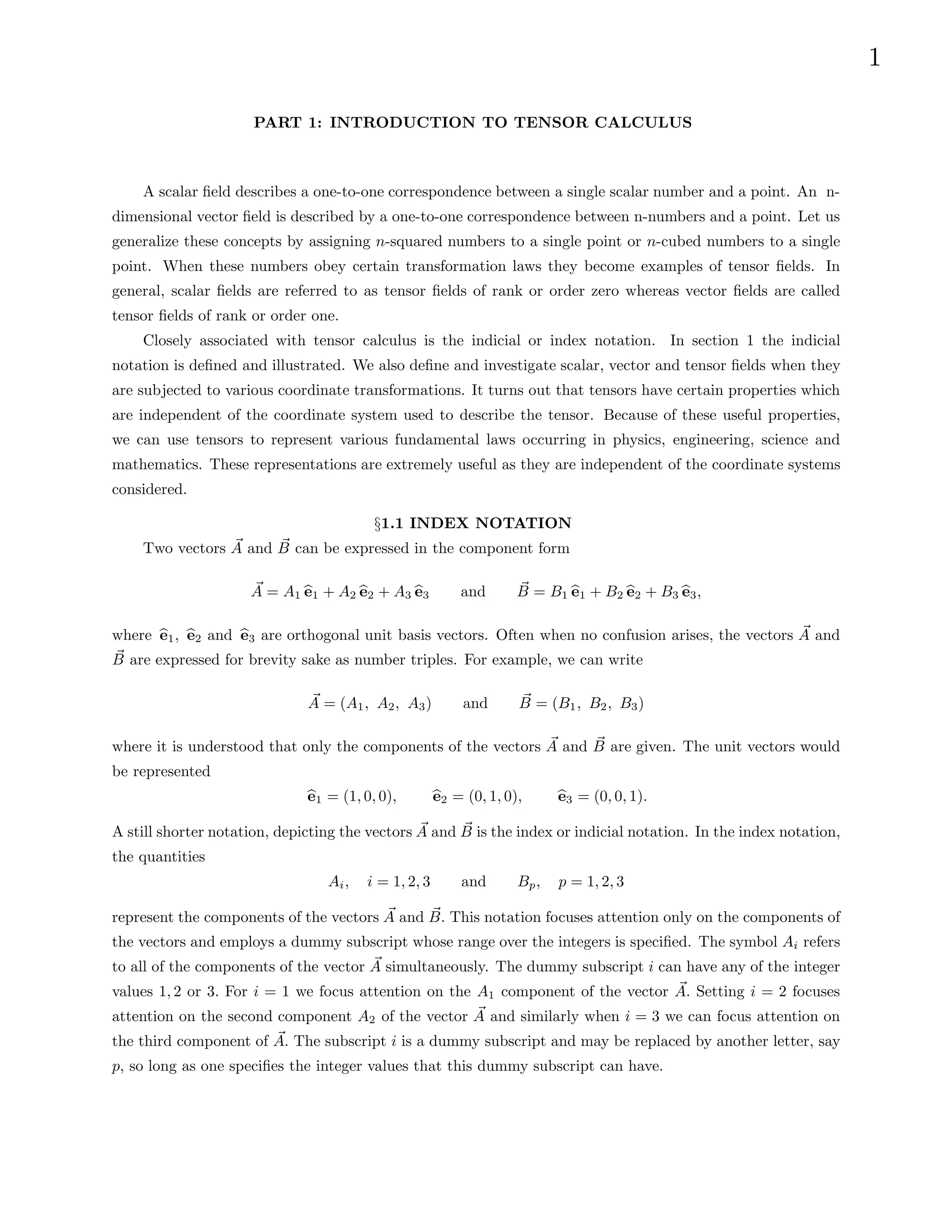
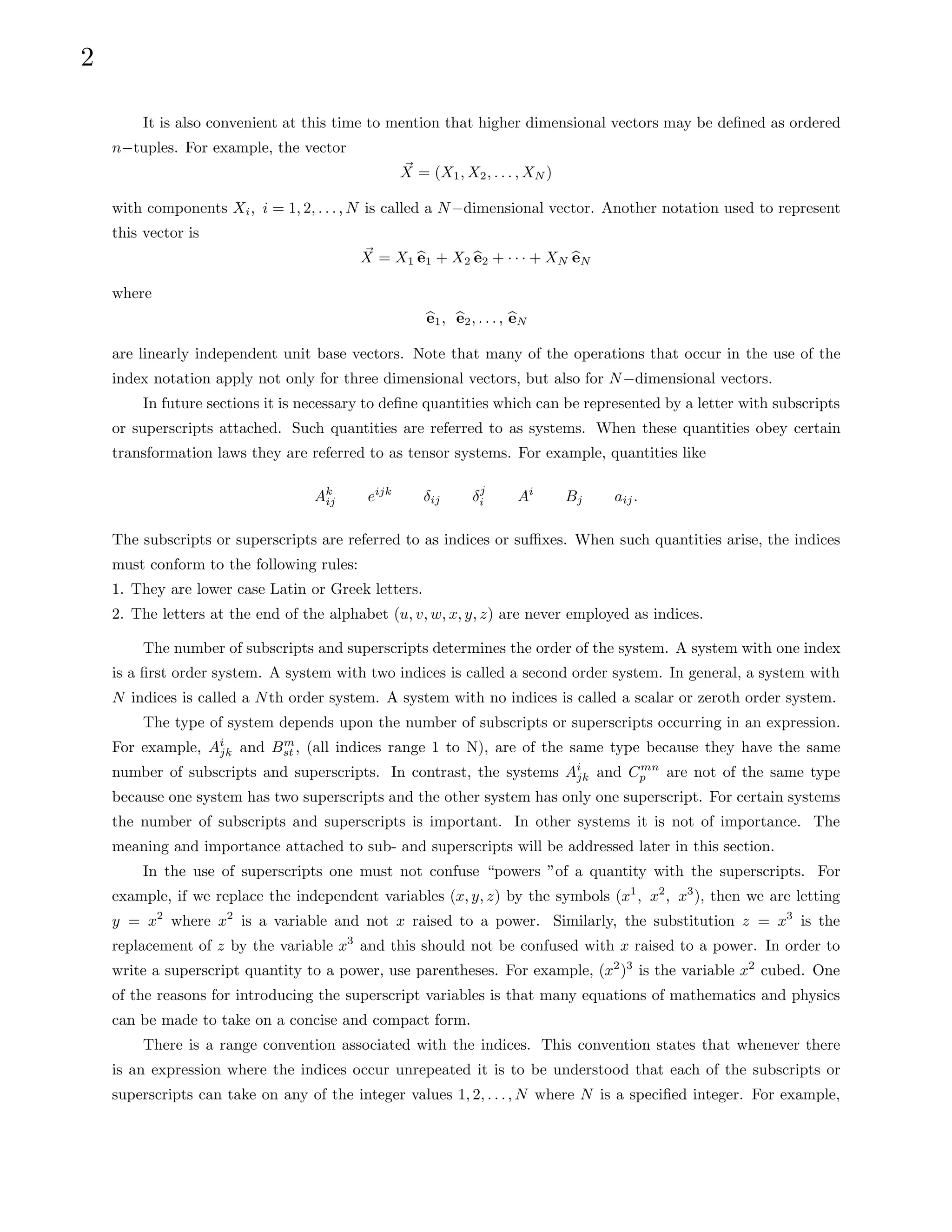
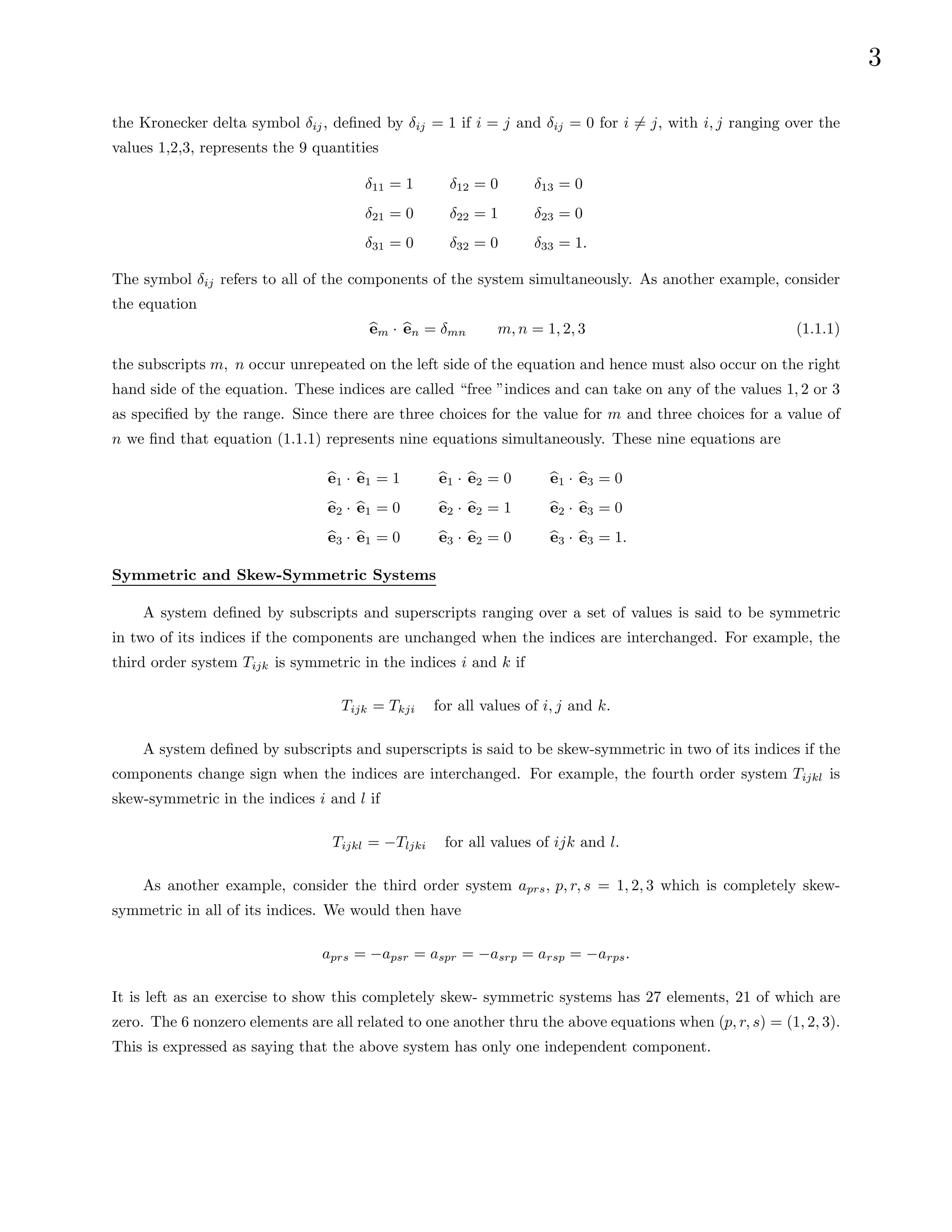
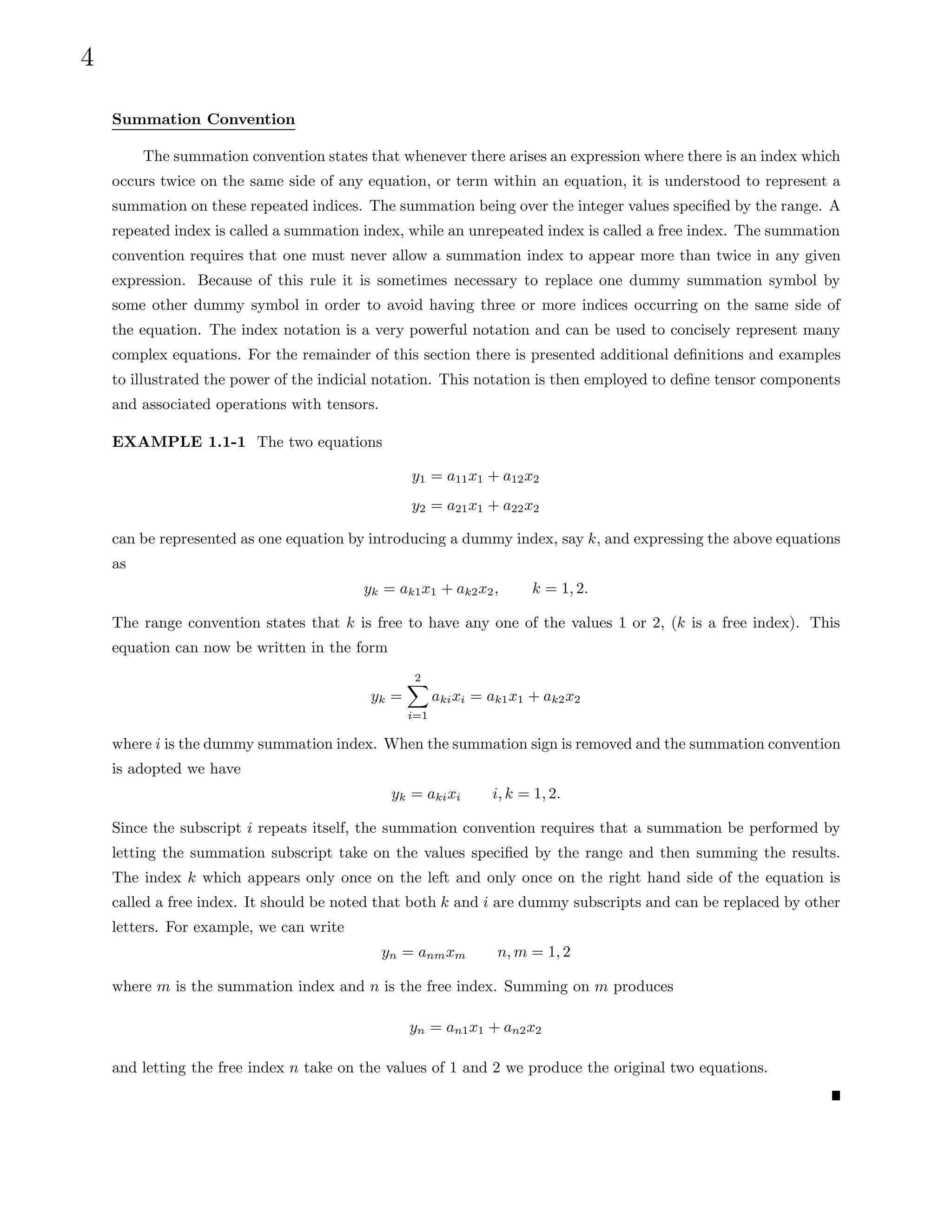
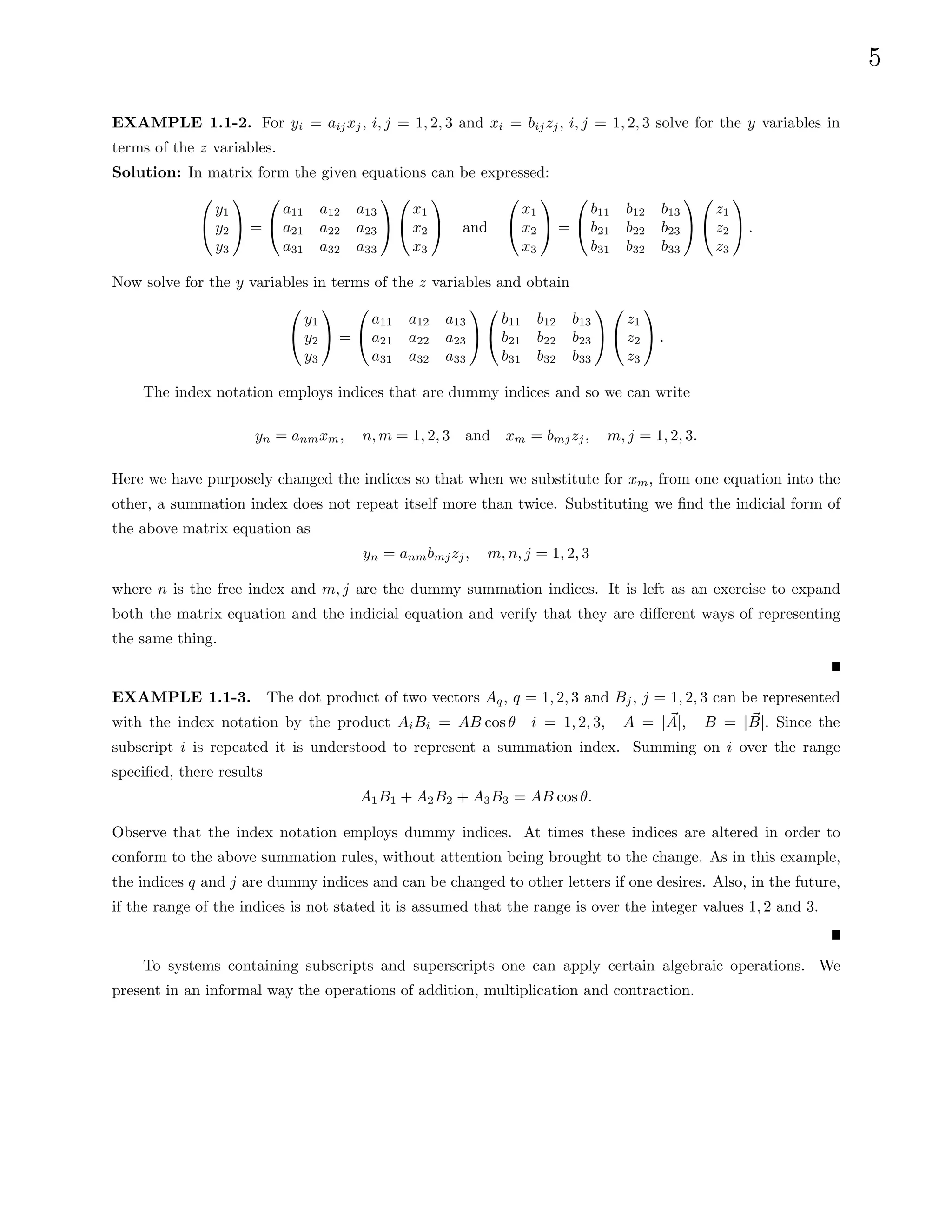
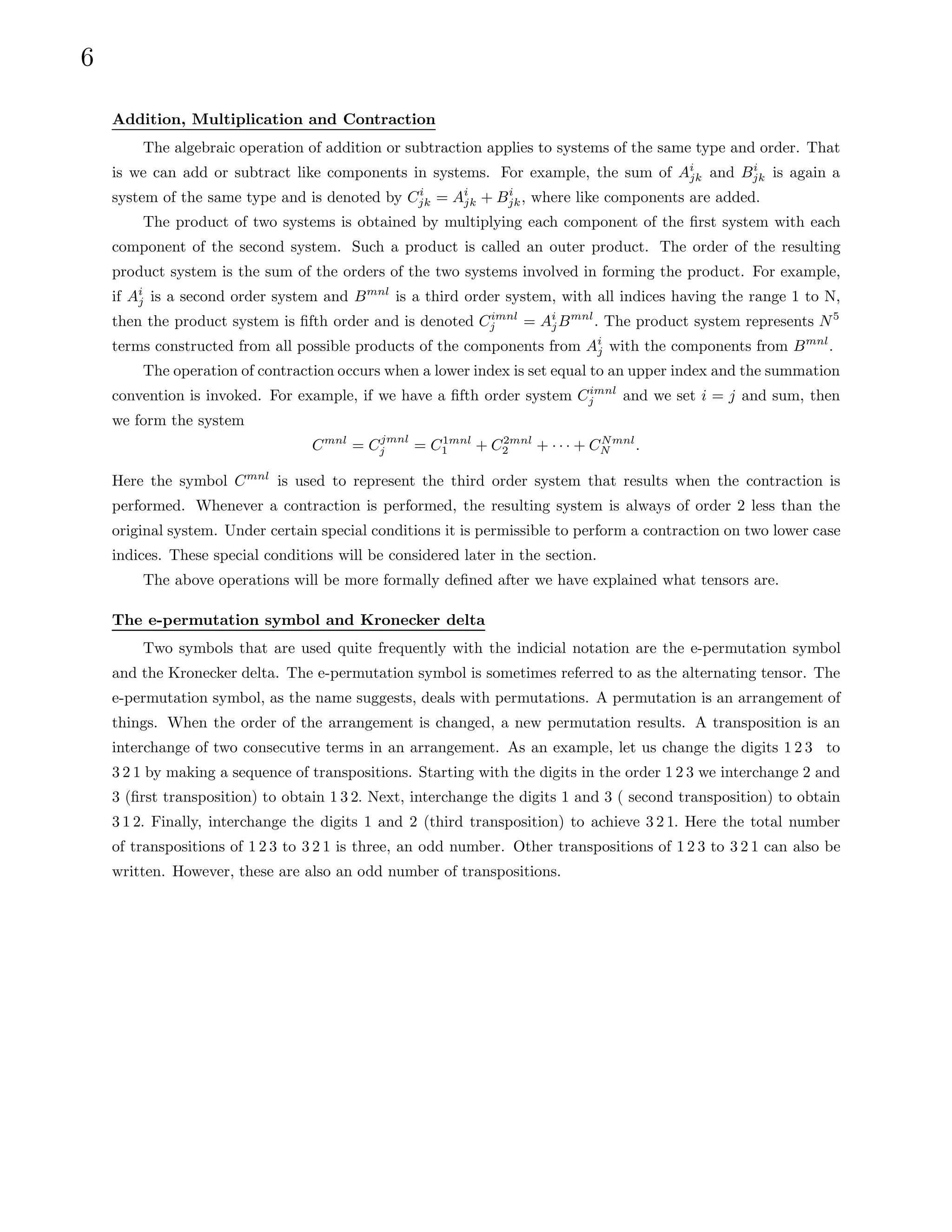
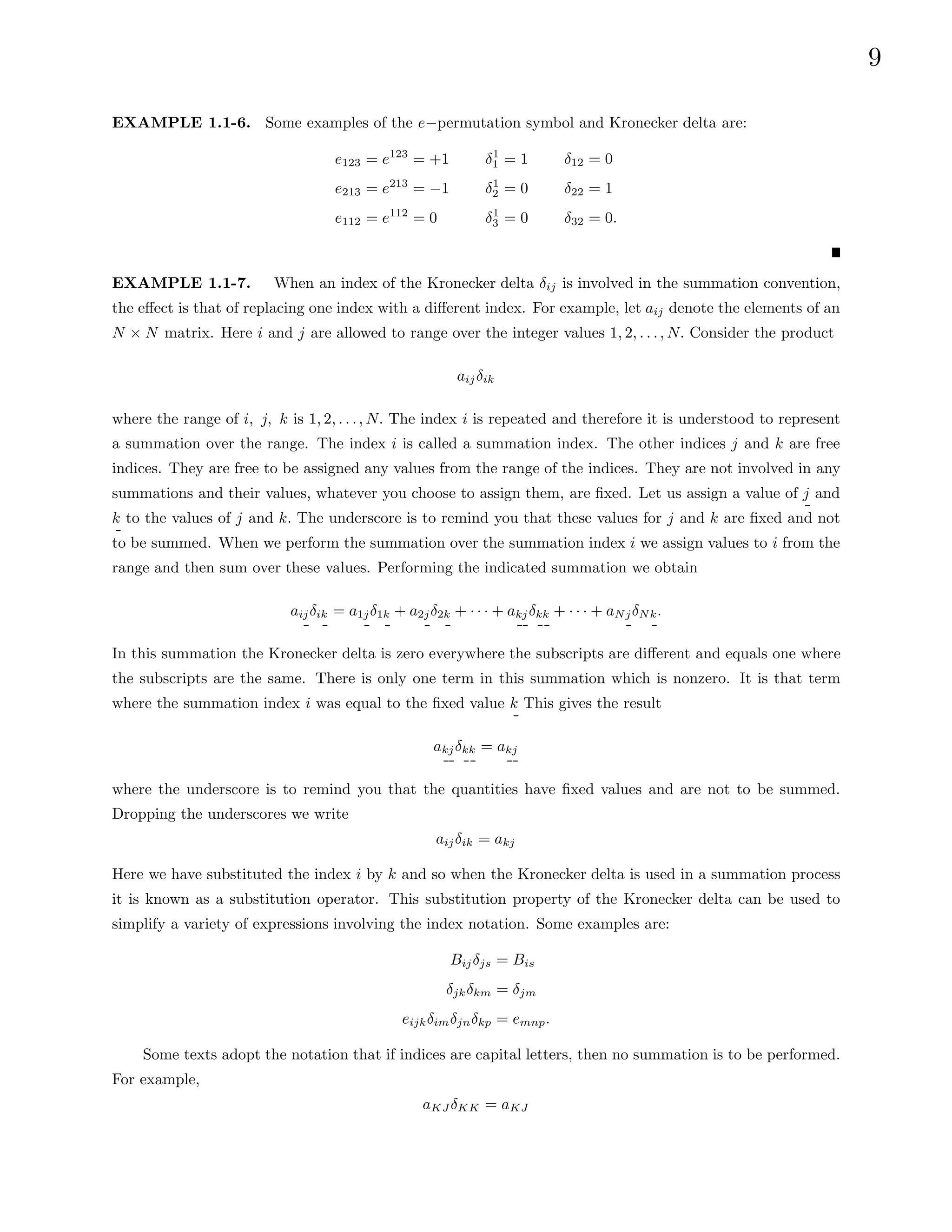
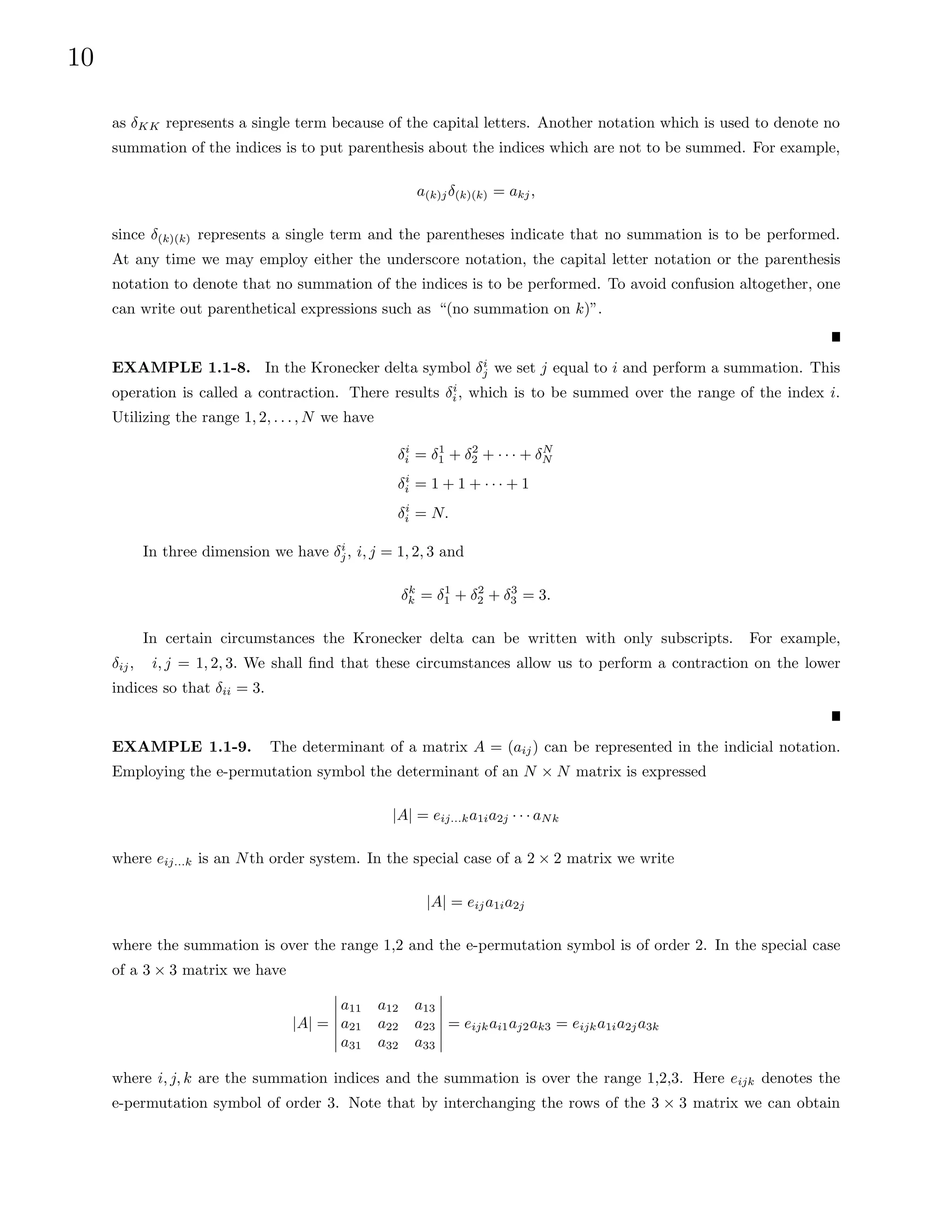
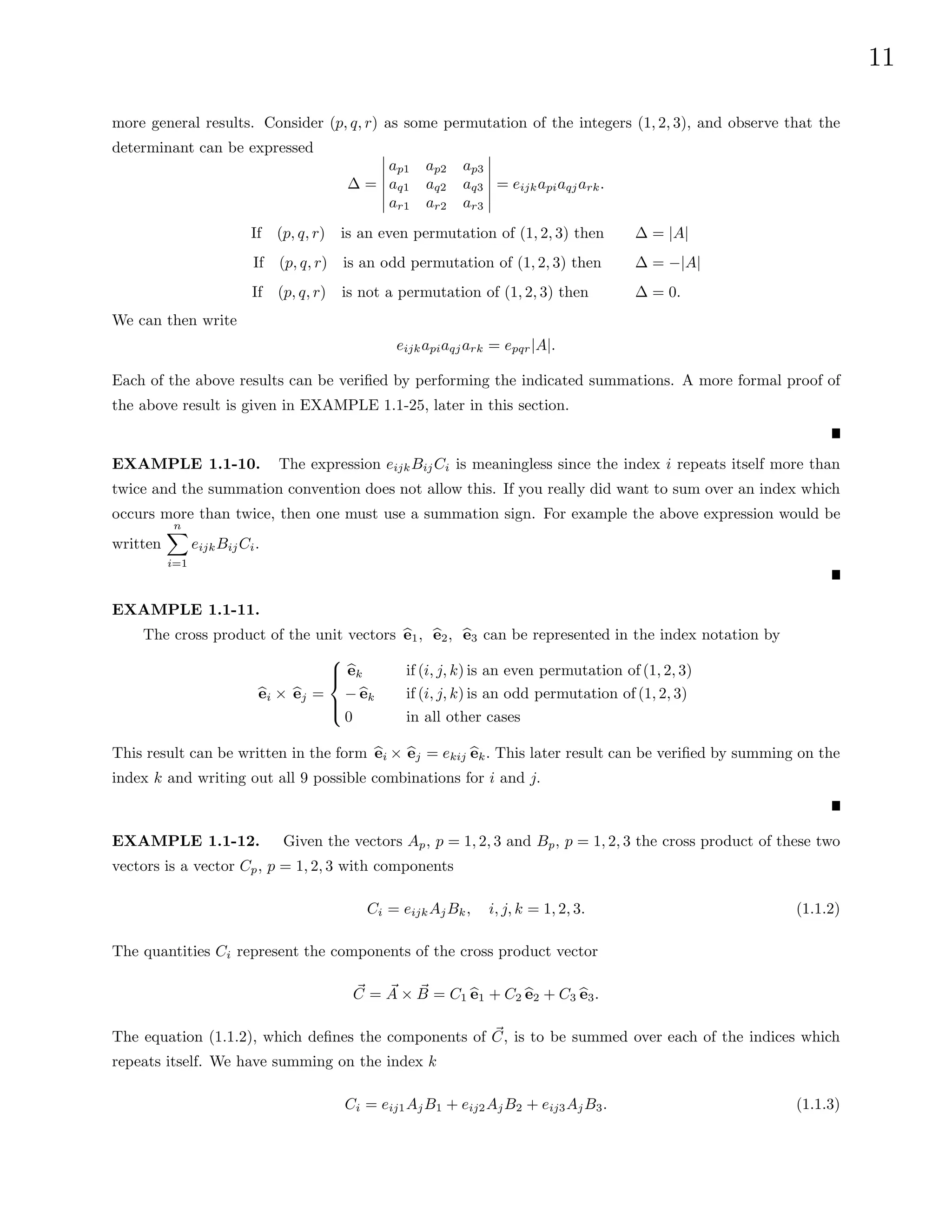
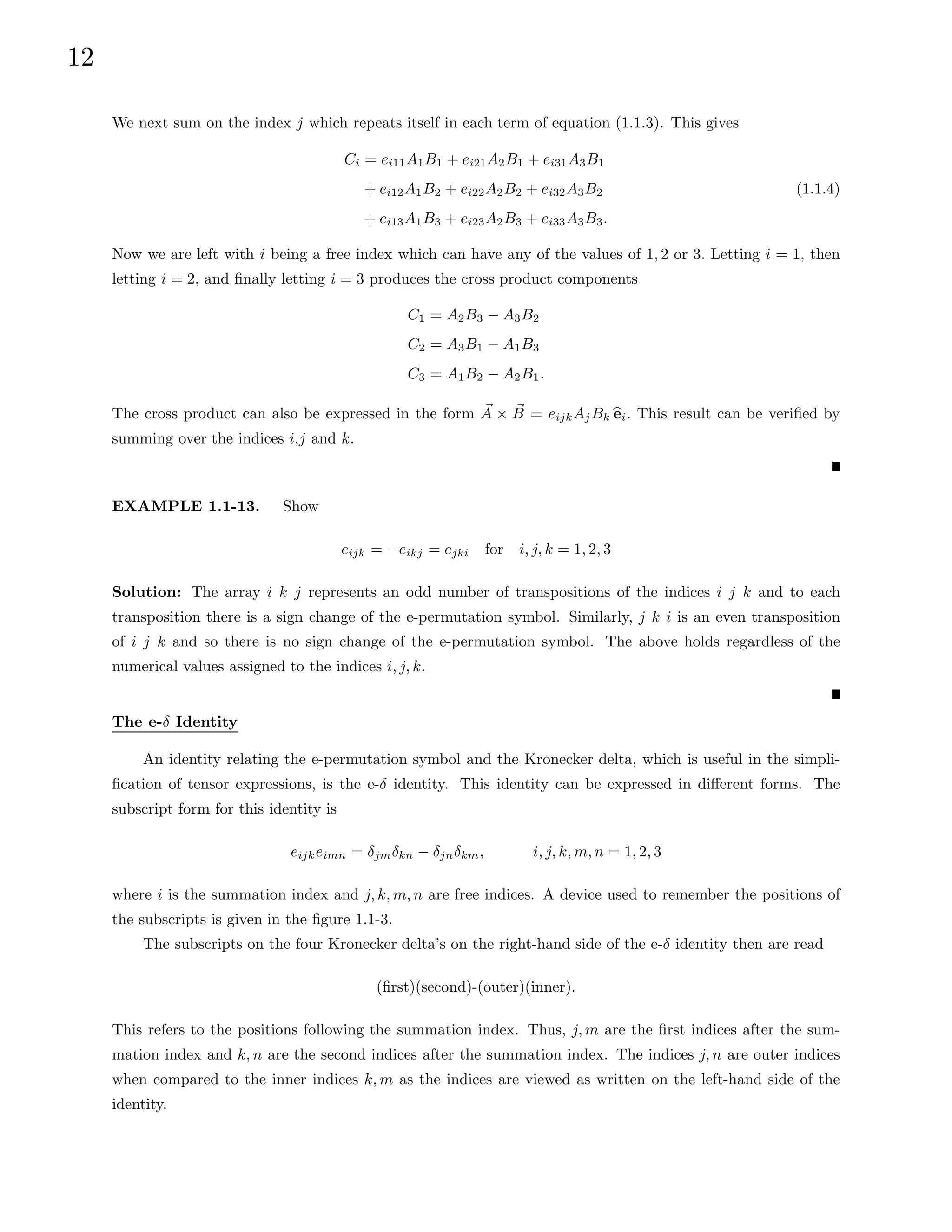
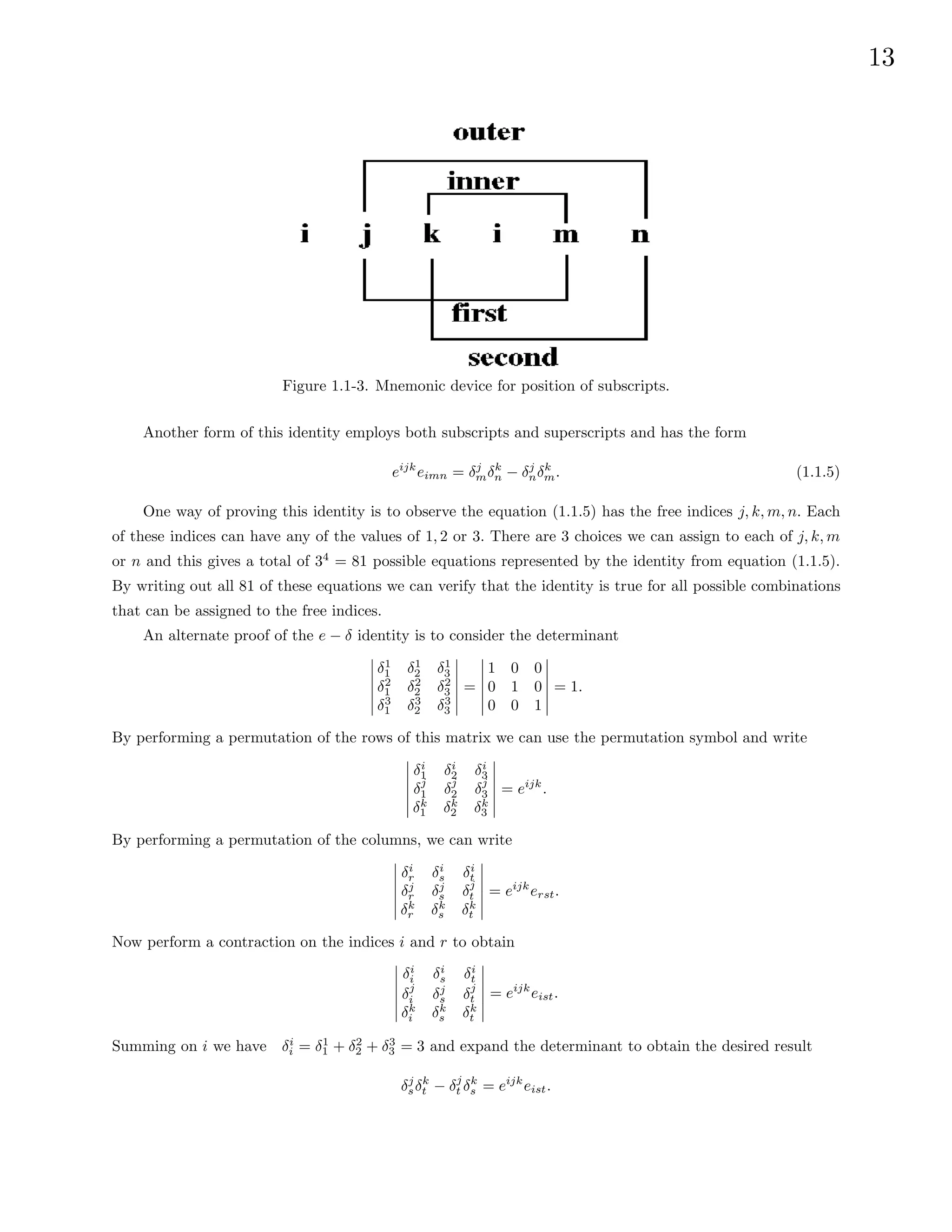
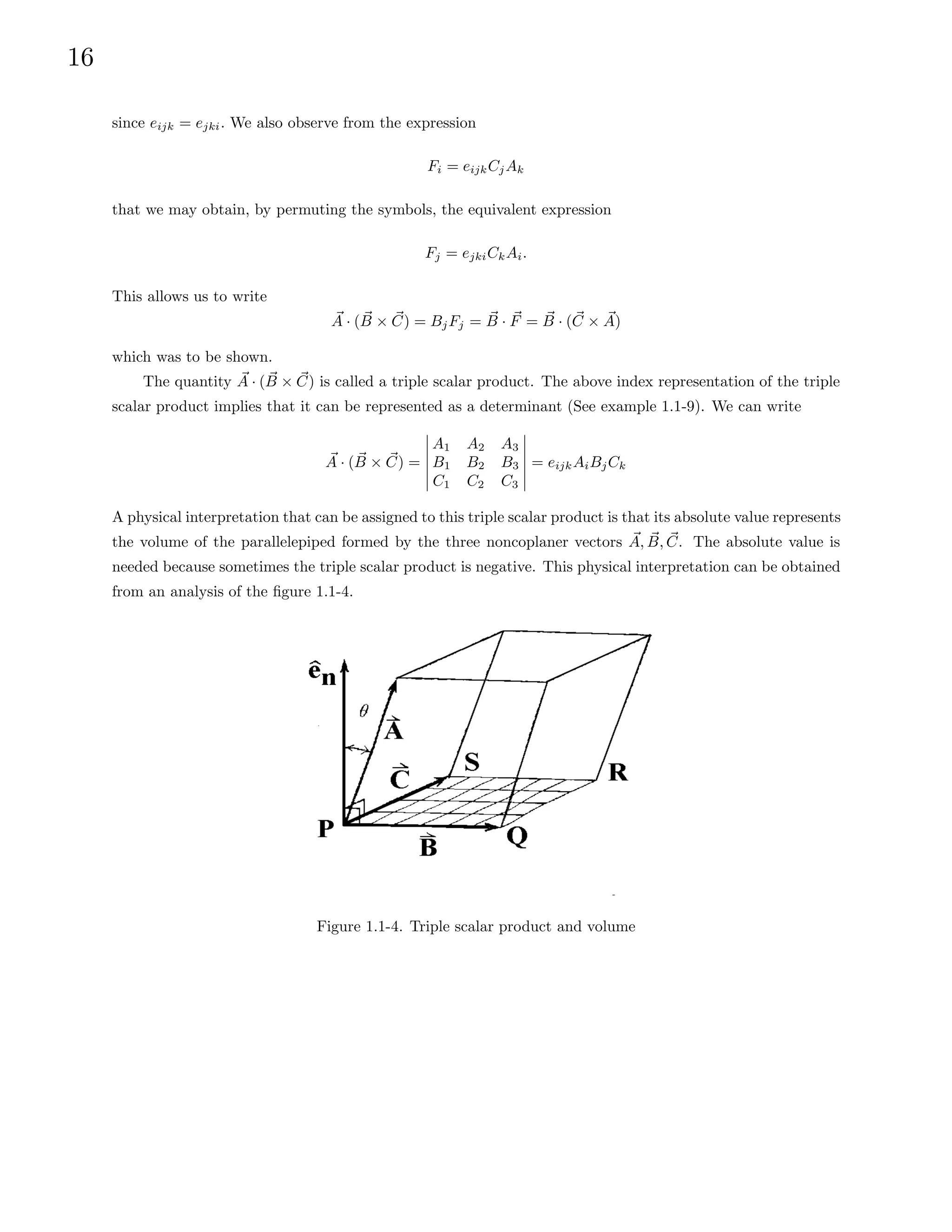
![17
In figure 1.1-4 observe that: (i) | ~
B × ~
C| is the area of the parallelogram PQRS. (ii) the unit vector
b
en =
~
B × ~
C
| ~
B × ~
C|
is normal to the plane containing the vectors ~
B and ~
C. (iii) The dot product
~
A · b
en = ~
A ·
~
B × ~
C
| ~
B × ~
C|
= h
equals the projection of ~
A on b
en which represents the height of the parallelepiped. These results demonstrate
that
~
A · ( ~
B × ~
C) = | ~
B × ~
C| h = (area of base)(height) = volume.
EXAMPLE 1.1-16. Verify the vector identity
( ~
A × ~
B) × (~
C × ~
D) = ~
C( ~
D · ~
A × ~
B) − ~
D(~
C · ~
A × ~
B)
Solution: Let ~
F = ~
A × ~
B = Fi b
ei and ~
E = ~
C × ~
D = Ei b
ei. These vectors have the components
Fi = eijkAjBk and Em = emnpCnDp
where all indices have the range 1, 2, 3. The vector ~
G = ~
F × ~
E = Gi b
ei has the components
Gq = eqimFiEm = eqimeijkemnpAjBkCnDp.
From the identity eqim = emqi this can be expressed
Gq = (emqiemnp)eijkAjBkCnDp
which is now in a form where we can use the e − δ identity applied to the term in parentheses to produce
Gq = (δqnδip − δqpδin)eijkAjBkCnDp.
Simplifying this expression we have:
Gq = eijk [(Dpδip)(Cnδqn)AjBk − (Dpδqp)(Cnδin)AjBk]
= eijk [DiCqAjBk − DqCiAjBk]
= Cq [DieijkAjBk] − Dq [CieijkAjBk]
which are the vector components of the vector
~
C( ~
D · ~
A × ~
B) − ~
D(~
C · ~
A × ~
B).](https://image.slidesharecdn.com/1055798-250527013708-a6600002/75/Introduction-To-Tensor-Calculus-And-Continuum-Mechanics-J-H-Heinbockel-25-2048.jpg)
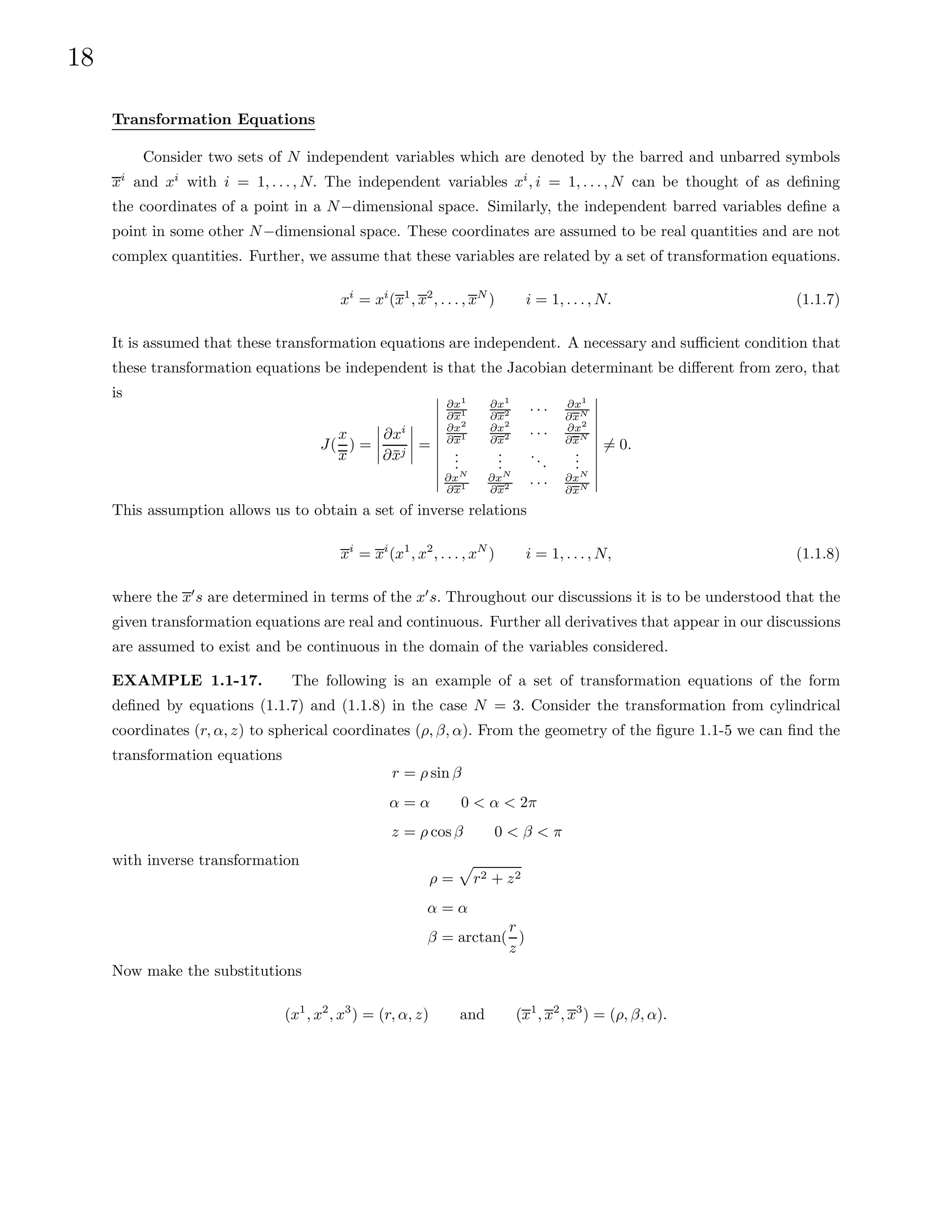
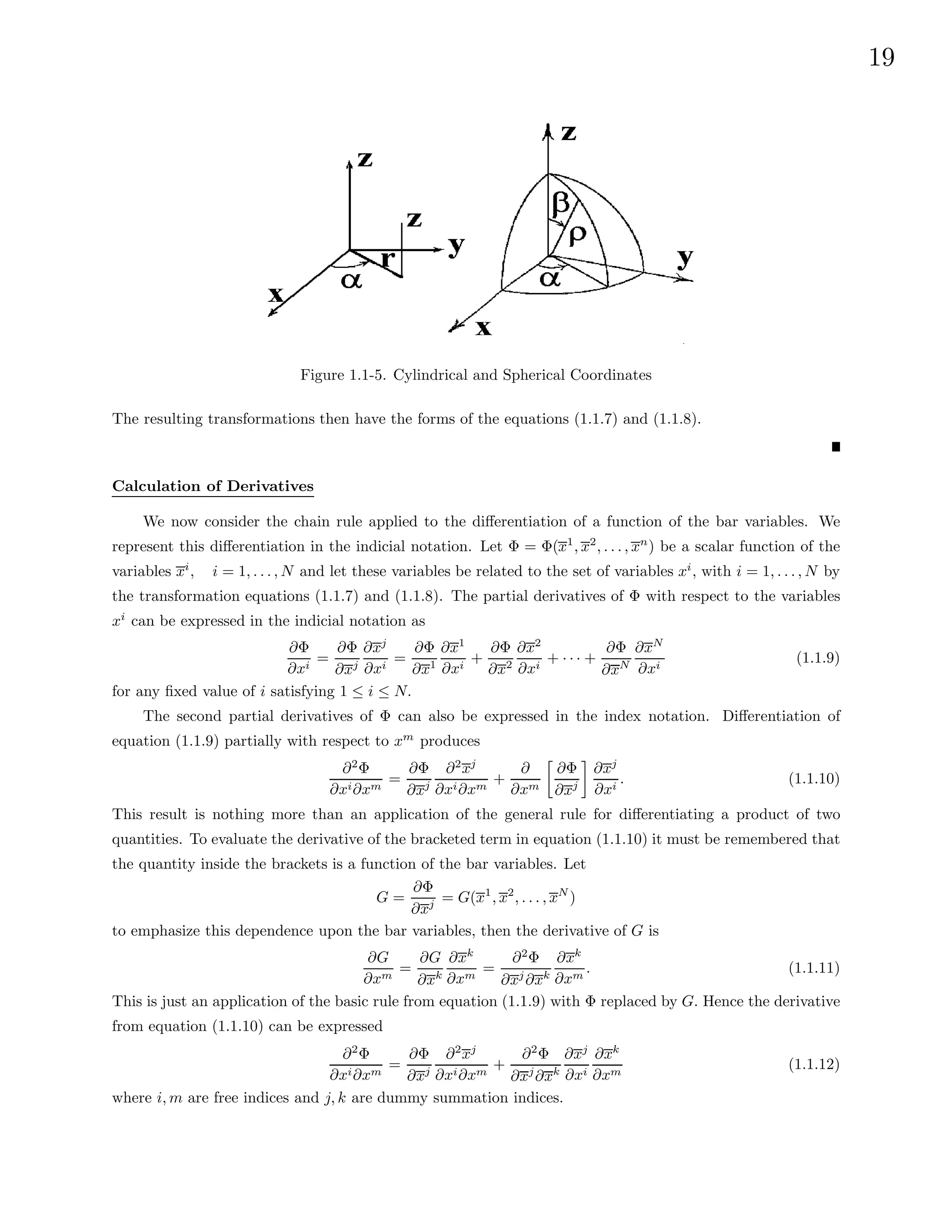
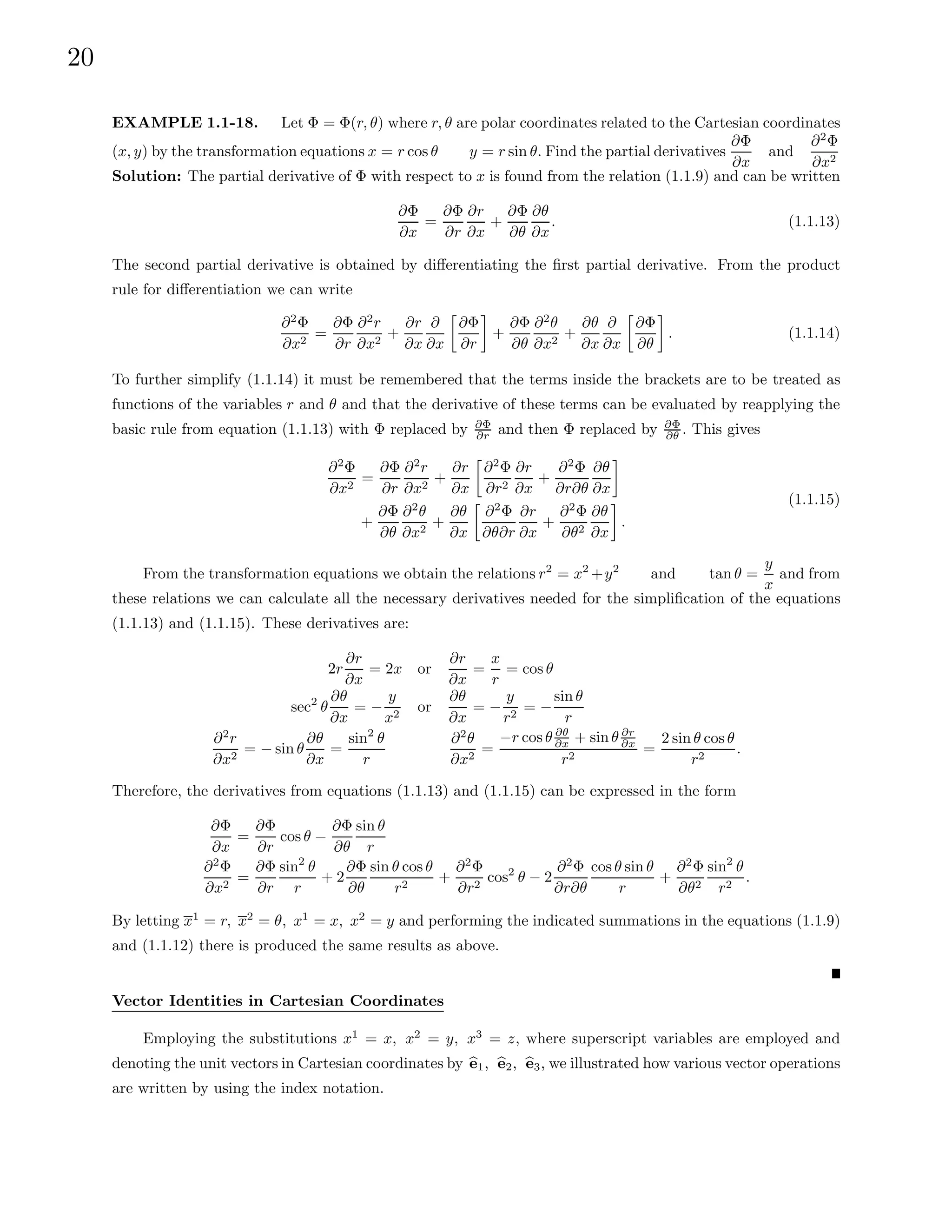
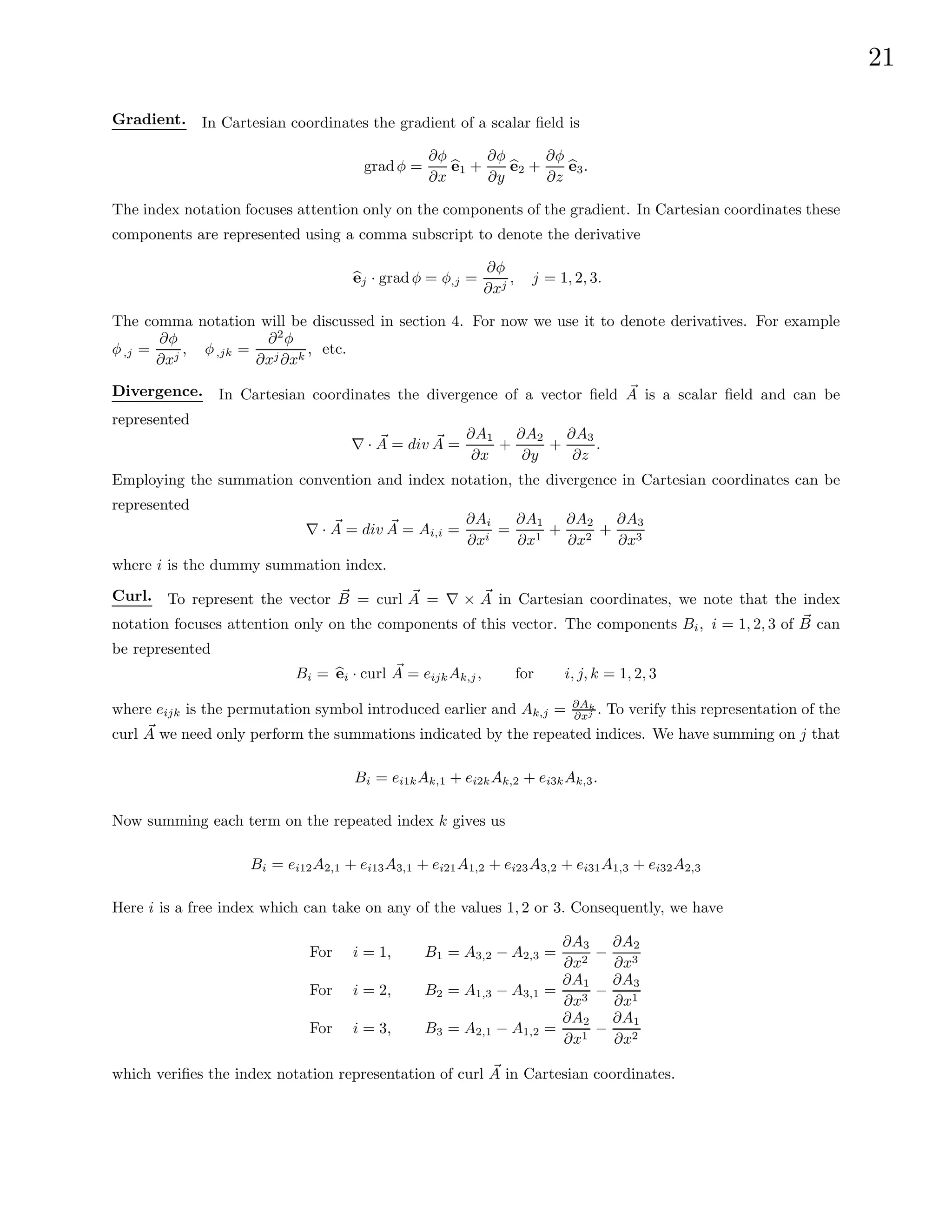
![23
EXAMPLE 1.1-19. In Cartesian coordinates prove the vector identity
curl (f ~
A) = ∇ × (f ~
A) = (∇f) × ~
A + f(∇ × ~
A).
Solution: Let ~
B = curl (f ~
A) and write the components as
Bi = eijk(fAk),j
= eijk [fAk,j + f,jAk]
= feijkAk,j + eijkf,jAk.
This index form can now be expressed in the vector form
~
B = curl (f ~
A) = f(∇ × ~
A) + (∇f) × ~
A
EXAMPLE 1.1-20. Prove the vector identity ∇ · ( ~
A + ~
B) = ∇ · ~
A + ∇ · ~
B
Solution: Let ~
A + ~
B = ~
C and write this vector equation in the index notation as Ai + Bi = Ci. We then
have
∇ · ~
C = Ci,i = (Ai + Bi),i = Ai,i + Bi,i = ∇ · ~
A + ∇ · ~
B.
EXAMPLE 1.1-21. In Cartesian coordinates prove the vector identity ( ~
A · ∇)f = ~
A · ∇f
Solution: In the index notation we write
( ~
A · ∇)f = Aif,i = A1f,1 + A2f,2 + A3f,3
= A1
∂f
∂x1
+ A2
∂f
∂x2
+ A3
∂f
∂x3
= ~
A · ∇f.
EXAMPLE 1.1-22. In Cartesian coordinates prove the vector identity
∇ × ( ~
A × ~
B) = ~
A(∇ · ~
B) − ~
B(∇ · ~
A) + ( ~
B · ∇) ~
A − ( ~
A · ∇) ~
B
Solution: The pth component of the vector ∇ × ( ~
A × ~
B) is
b
ep · [∇ × ( ~
A × ~
B)] = epqk[ekjiAjBi],q
= epqkekjiAjBi,q + epqkekjiAj,qBi
By applying the e − δ identity, the above expression simplifies to the desired result. That is,
b
ep · [∇ × ( ~
A × ~
B)] = (δpjδqi − δpiδqj)AjBi,q + (δpjδqi − δpiδqj)Aj,qBi
= ApBi,i − AqBp,q + Ap,qBq − Aq,qBp
In vector form this is expressed
∇ × ( ~
A × ~
B) = ~
A(∇ · ~
B) − ( ~
A · ∇) ~
B + ( ~
B · ∇) ~
A − ~
B(∇ · ~
A)](https://image.slidesharecdn.com/1055798-250527013708-a6600002/75/Introduction-To-Tensor-Calculus-And-Continuum-Mechanics-J-H-Heinbockel-31-2048.jpg)
![24
EXAMPLE 1.1-23. In Cartesian coordinates prove the vector identity ∇ × (∇ × ~
A) = ∇(∇ · ~
A) − ∇2 ~
A
Solution: We have for the ith component of ∇ × ~
A is given by b
ei · [∇ × ~
A] = eijkAk,j and consequently the
pth component of ∇ × (∇ × ~
A) is
b
ep · [∇ × (∇ × ~
A)] = epqr[erjkAk,j],q
= epqrerjkAk,jq.
The e − δ identity produces
b
ep · [∇ × (∇ × ~
A)] = (δpjδqk − δpkδqj)Ak,jq
= Ak,pk − Ap,qq.
Expressing this result in vector form we have ∇ × (∇ × ~
A) = ∇(∇ · ~
A) − ∇2 ~
A.
Indicial Form of Integral Theorems
The divergence theorem, in both vector and indicial notation, can be written
ZZZ
V
div · ~
F dτ =
ZZ
S
~
F · b
n dσ
Z
V
Fi,i dτ =
Z
S
Fini dσ i = 1, 2, 3 (1.1.16)
where ni are the direction cosines of the unit exterior normal to the surface, dτ is a volume element and dσ
is an element of surface area. Note that in using the indicial notation the volume and surface integrals are
to be extended over the range specified by the indices. This suggests that the divergence theorem can be
applied to vectors in n−dimensional spaces.
The vector form and indicial notation for the Stokes theorem are
ZZ
S
(∇ × ~
F) · b
n dσ =
Z
C
~
F · d~
r
Z
S
eijkFk,jni dσ =
Z
C
Fi dxi
i, j, k = 1, 2, 3 (1.1.17)
and the Green’s theorem in the plane, which is a special case of the Stoke’s theorem, can be expressed
ZZ
∂F2
∂x
−
∂F1
∂y
dxdy =
Z
C
F1 dx + F2 dy
Z
S
e3jkFk,j dS =
Z
C
Fi dxi
i, j, k = 1, 2 (1.1.18)
Other forms of the above integral theorems are
ZZZ
V
∇φ dτ =
ZZ
S
φ b
n dσ
obtained from the divergence theorem by letting ~
F = φ~
C where ~
C is a constant vector. By replacing ~
F by
~
F × ~
C in the divergence theorem one can derive
ZZZ
V
∇ × ~
F
dτ = −
ZZ
S
~
F × ~
n dσ.
In the divergence theorem make the substitution ~
F = φ∇ψ to obtain
ZZZ
V
(φ∇2
ψ + (∇φ) · (∇ψ)
dτ =
ZZ
S
(φ∇ψ) · b
n dσ.](https://image.slidesharecdn.com/1055798-250527013708-a6600002/75/Introduction-To-Tensor-Calculus-And-Continuum-Mechanics-J-H-Heinbockel-32-2048.jpg)