• A PRESENTATION SUBMITTED BY 
• Sneha Manamohan 
• Smruthy N. Pradeep
ADVERTISING 
STRATEGIES – A 
COMPARISON
History 
• The journey of Amul ice creams began on 10th March, 1996 in 
Gujarat and with its superior quality it was able to capture the 
highest market share in a short period of time 
• In 1997, Amul Ice creams entered Mumbai followed by Chennai 
in 1998 and Kolkata and Delhi in 2002. Nationally it was rolled 
out in 1999. 
• Since then not only has it grown at a phenomenal rate but also 
it has added a vast variety of flavors to its ever growing range. 
Currently it offers a selection of over 200 variants.
Products 
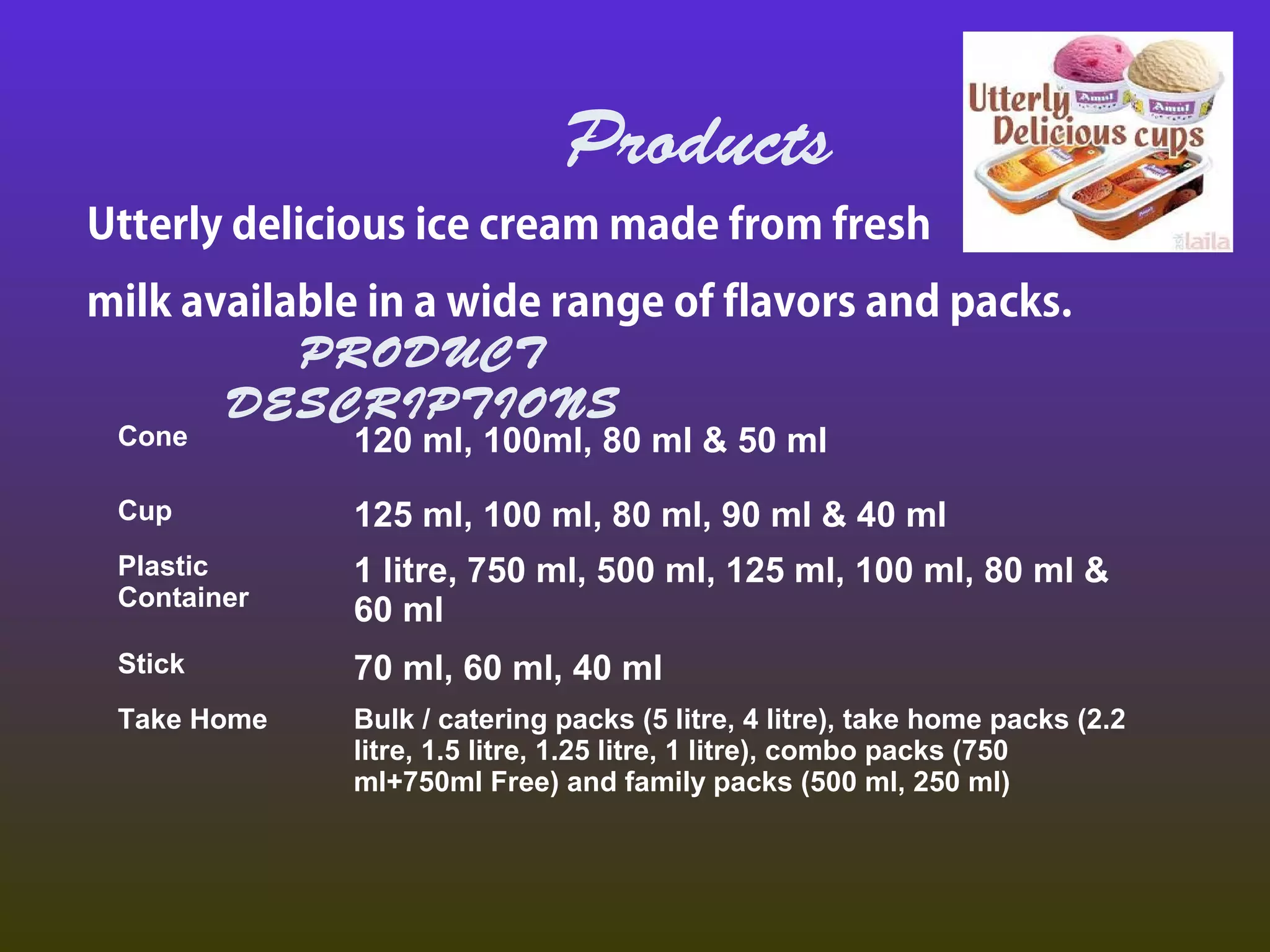
Utterly delicious ice cream made from fresh 
milk available in a wide range of flavors and packs. 
PRODUCT 
DESCRIPTIONS 
Cone 120 ml, 100ml, 80 ml & 50 ml 
Cup 125 ml, 100 ml, 80 ml, 90 ml & 40 ml 
Plastic 
Container 
1 litre, 750 ml, 500 ml, 125 ml, 100 ml, 80 ml & 
60 ml 
Stick 70 ml, 60 ml, 40 ml 
Take Home Bulk / catering packs (5 litre, 4 litre), take home packs (2.2 
litre, 1.5 litre, 1.25 litre, 1 litre), combo packs (750 
ml+750ml Free) and family packs (500 ml, 250 ml)
PRODUCT FEATURES 
• Made from Fresh Milk (Real Milk, Real Ice cream): No added 
vegetable oil, hence no Frozen Dessert. 
• No Differentiation in Quality Standards of Consumer & Catering/ 
Institutional Packs: Stringent Standards than Specified by PFA & 
BIS for more fat and less overrun (less air) to give creamier feeling. 
• Best Ingredients: Fresh milk, superior fruits & nuts. 
• Manufacturing Facility: Made in ISO & HACCP certified state of the 
art plants with stringent hygienic standards to ensure food safety. 
• Pro-life & SUGAR FREE Probiotic: The first company in India to 
introduce probiotics in ice cream (IDF Award for Best 
Nutrimarketing Category, Oct '07) & SUGAR FREE Probiotic 
products.
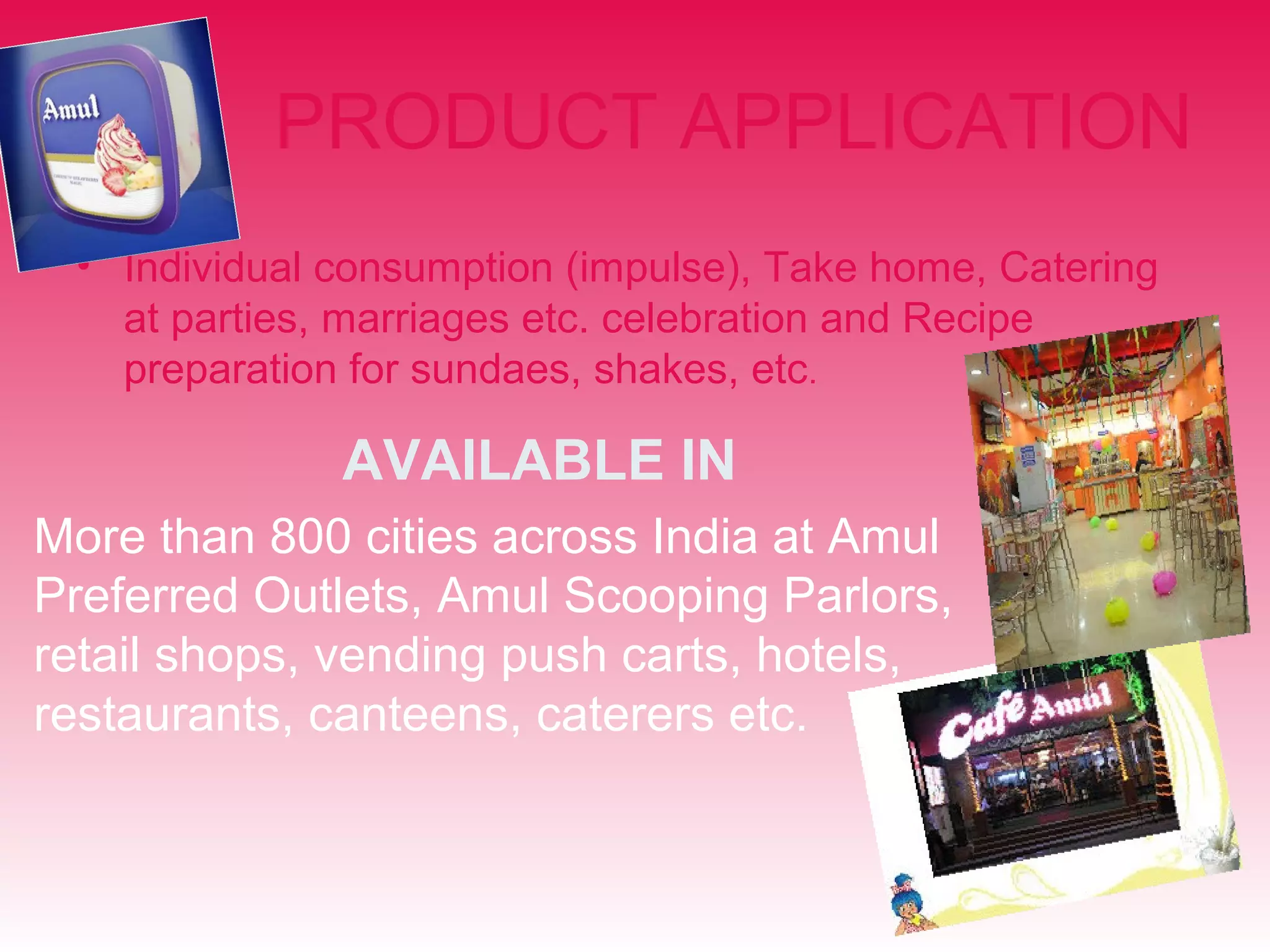
PRODUCT APPLICATION 
• Individual consumption (impulse), Take home, Catering 
at parties, marriages etc. celebration and Recipe 
preparation for sundaes, shakes, etc. 
AVAILABLE IN 
More than 800 cities across India at Amul 
Preferred Outlets, Amul Scooping Parlors, 
retail shops, vending push carts, hotels, 
restaurants, canteens, caterers etc.
ADVERTISING 
STRATEGIES
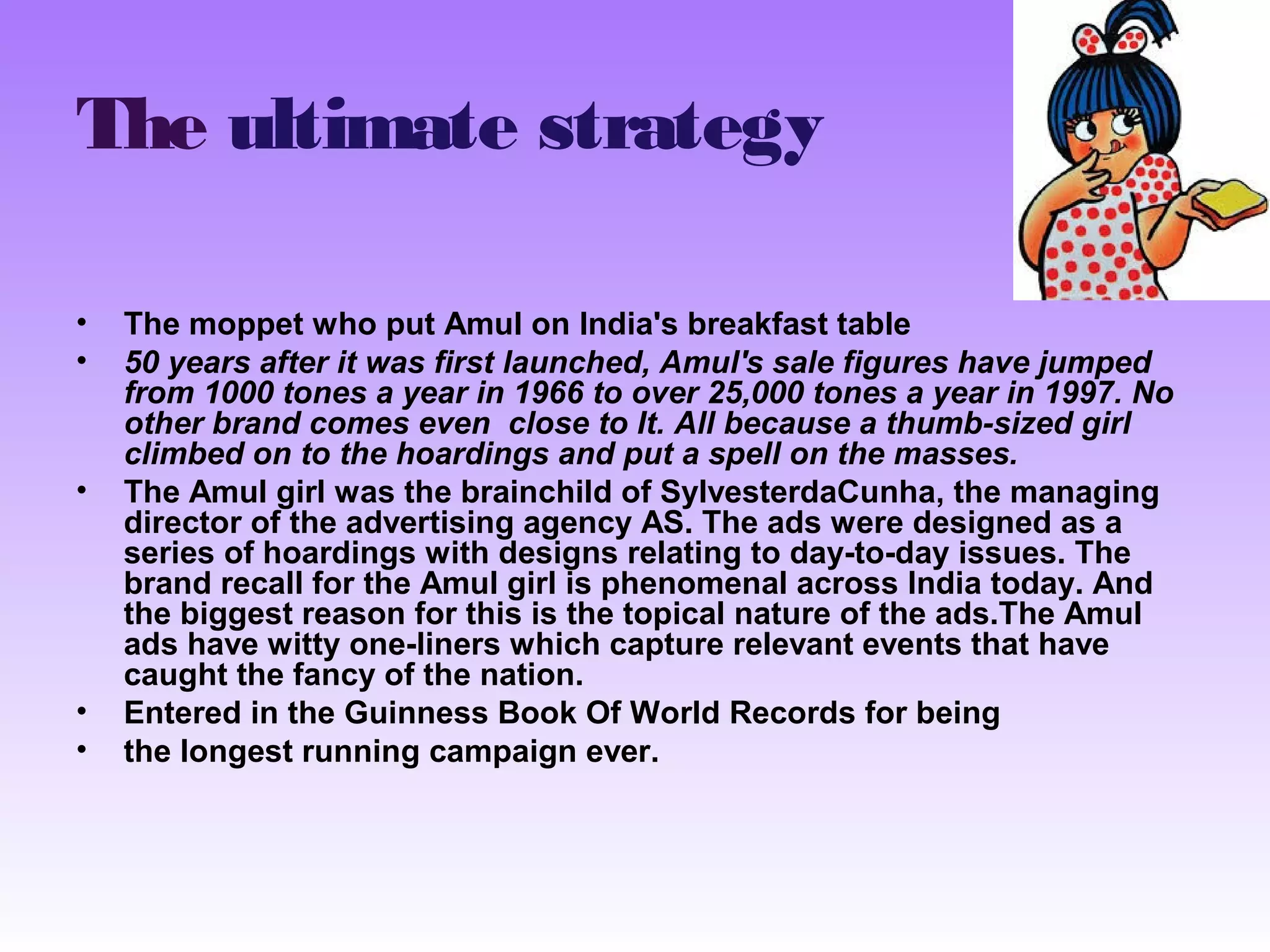
The ultimate strategy 
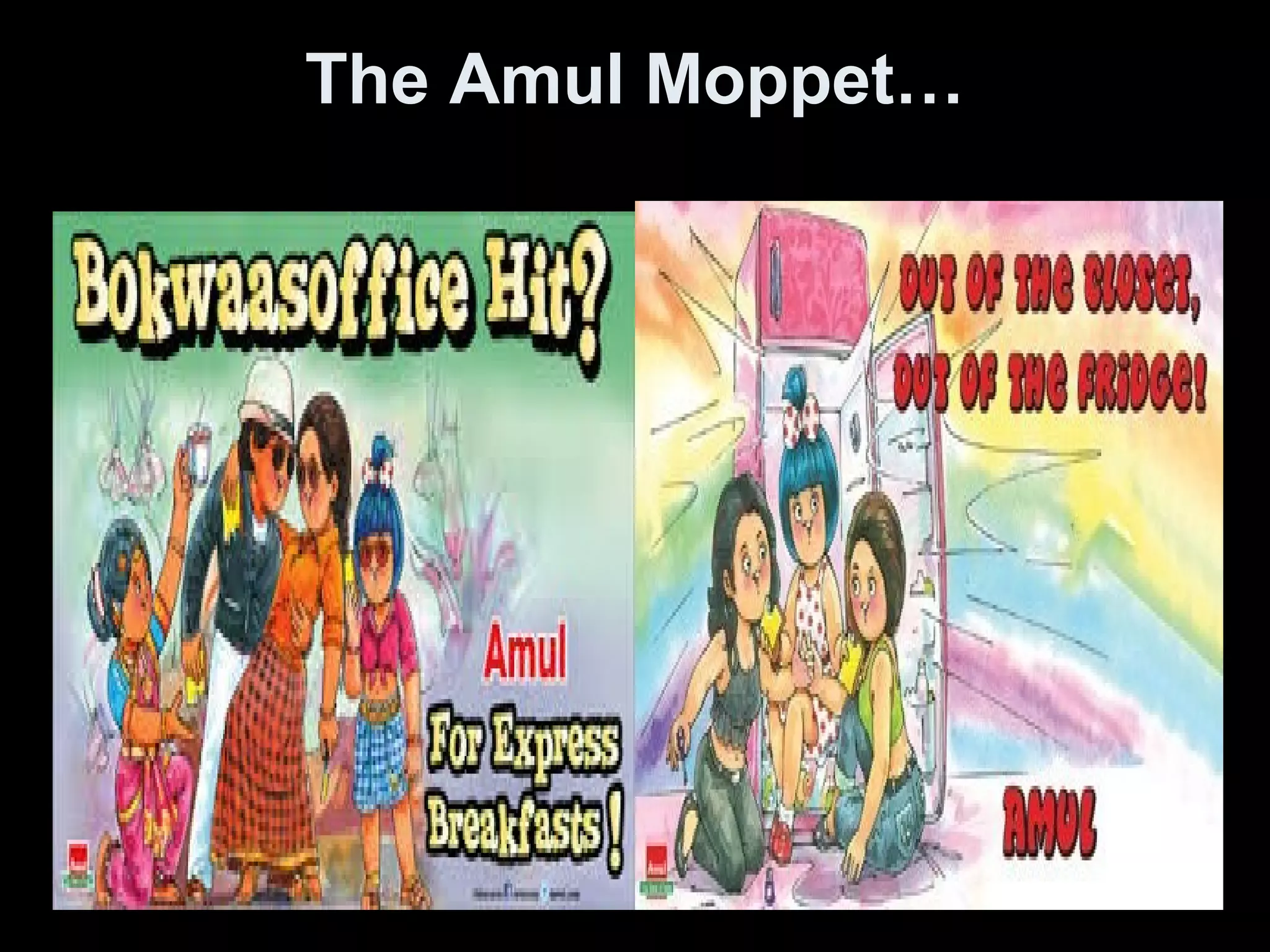
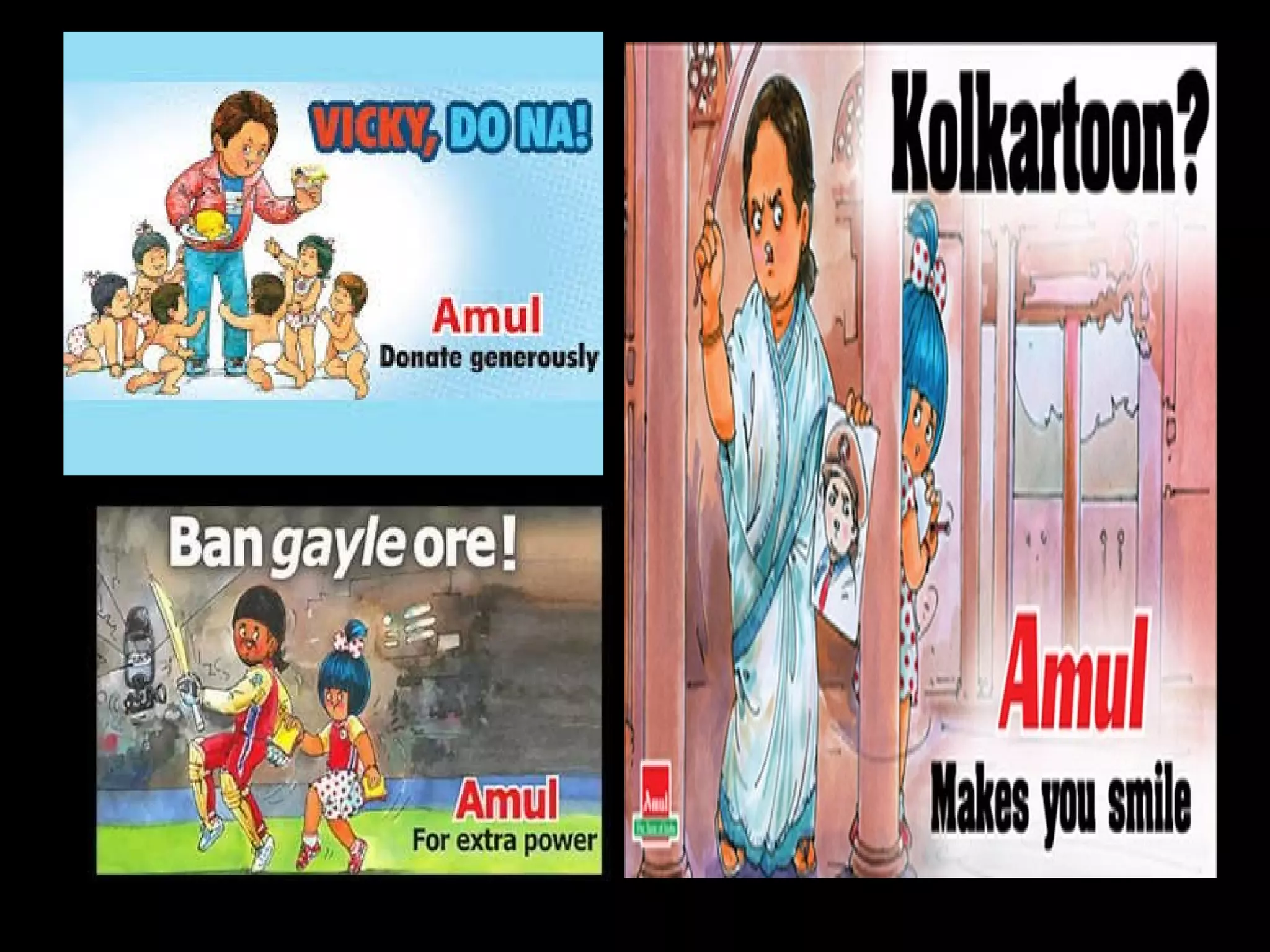
• The moppet who put Amul on India's breakfast table 
• 50 years after it was first launched, Amul's sale figures have jumped 
from 1000 tones a year in 1966 to over 25,000 tones a year in 1997. No 
other brand comes even close to It. All because a thumb-sized girl 
climbed on to the hoardings and put a spell on the masses. 
• The Amul girl was the brainchild of SylvesterdaCunha, the managing 
director of the advertising agency AS. The ads were designed as a 
series of hoardings with designs relating to day-to-day issues. The 
brand recall for the Amul girl is phenomenal across India today. And 
the biggest reason for this is the topical nature of the ads.The Amul 
ads have witty one-liners which capture relevant events that have 
caught the fancy of the nation. 
• Entered in the Guinness Book Of World Records for being 
• the longest running campaign ever.
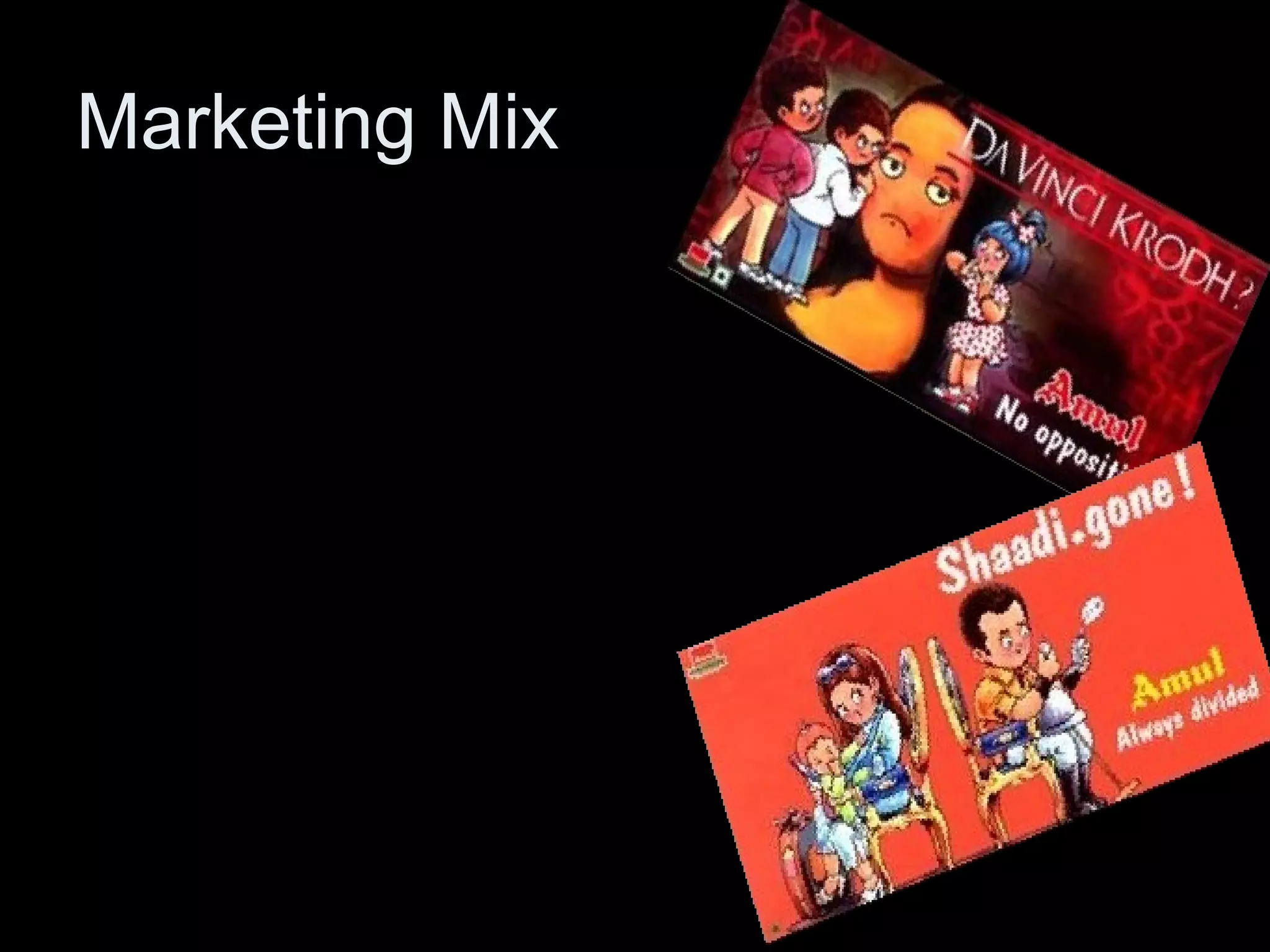
Marketing Mix 
Product 
• Dairy Products 
• Cooking Products 
Price 
• Low Pricing 
Strategy 
Place 
• Rural & Urban Market 
• International Market 
Promotion 
• Advertisements
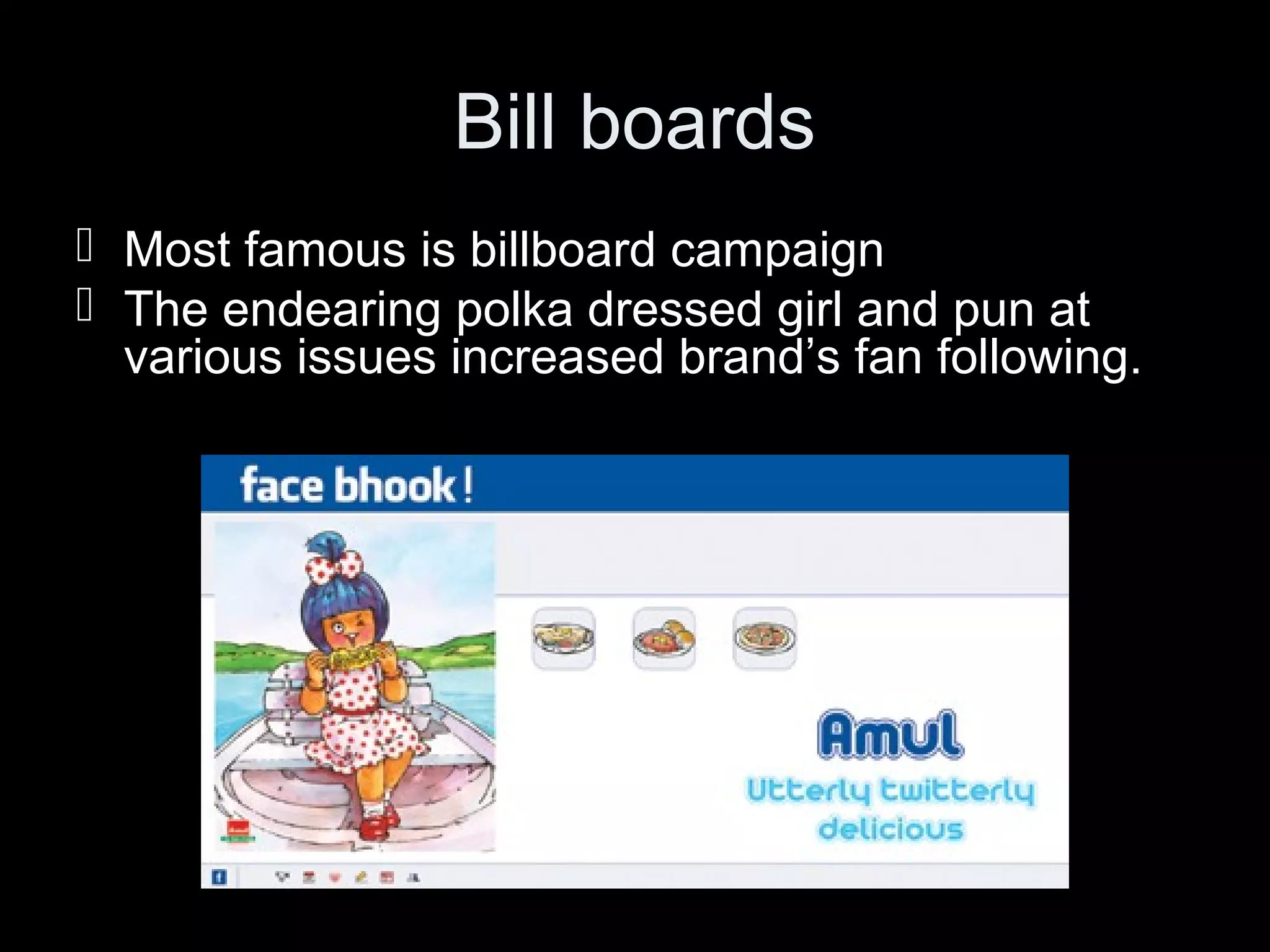
Bill boards 
 Most famous is billboard campaign 
 The endearing polka dressed girl and pun at 
various issues increased brand’s fan following.
Promot ion 
• Given this wide product portfolio, Amul’s 
approach is to promote its brands in a rotational 
cycle of two to three years. 
• After ice-creams were launched in 1996, the 
category was re-visited in 1999, in order to 
improve availability of the product and make it 
affordable. 
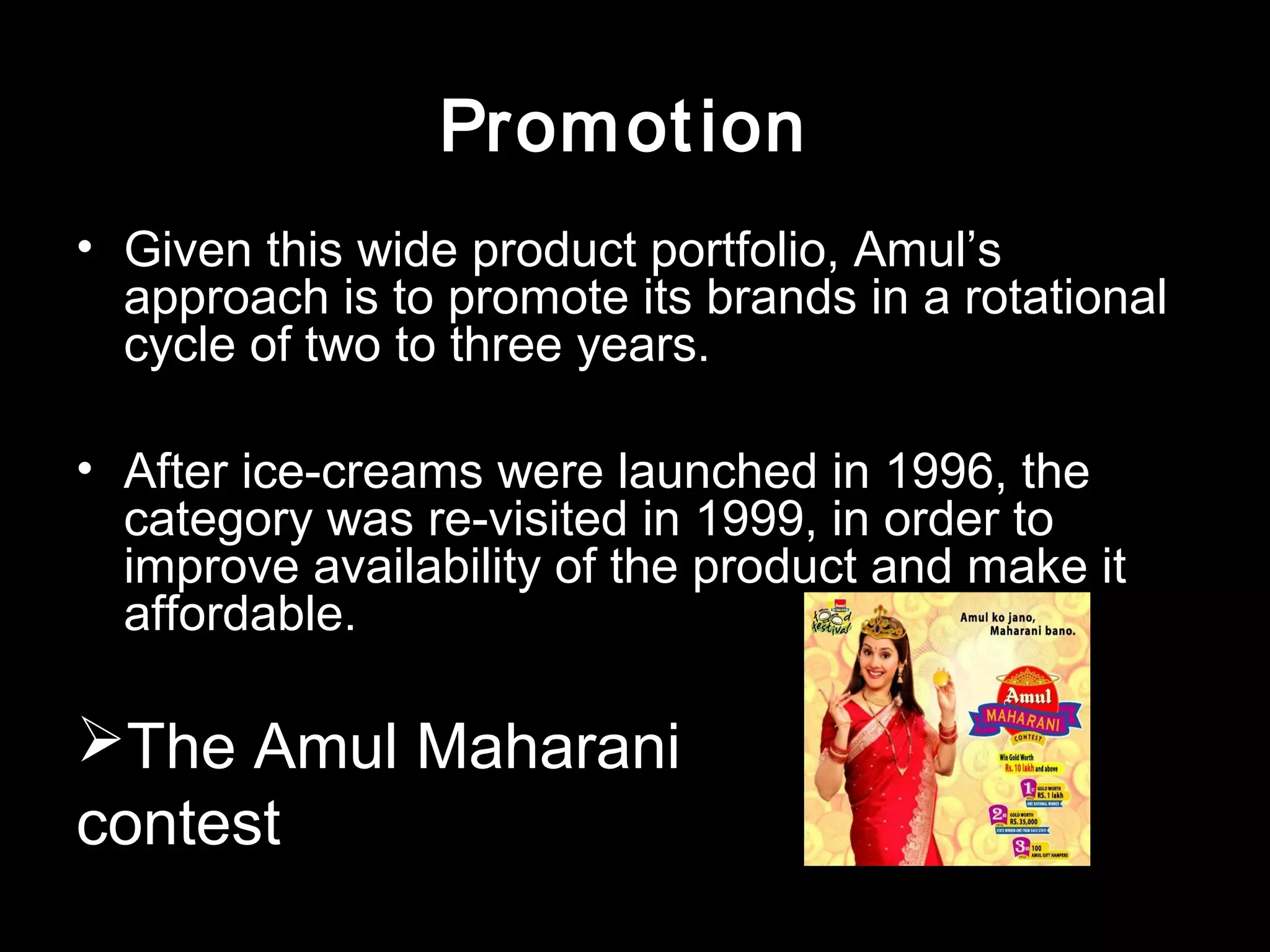
The Amul Maharani 
contest
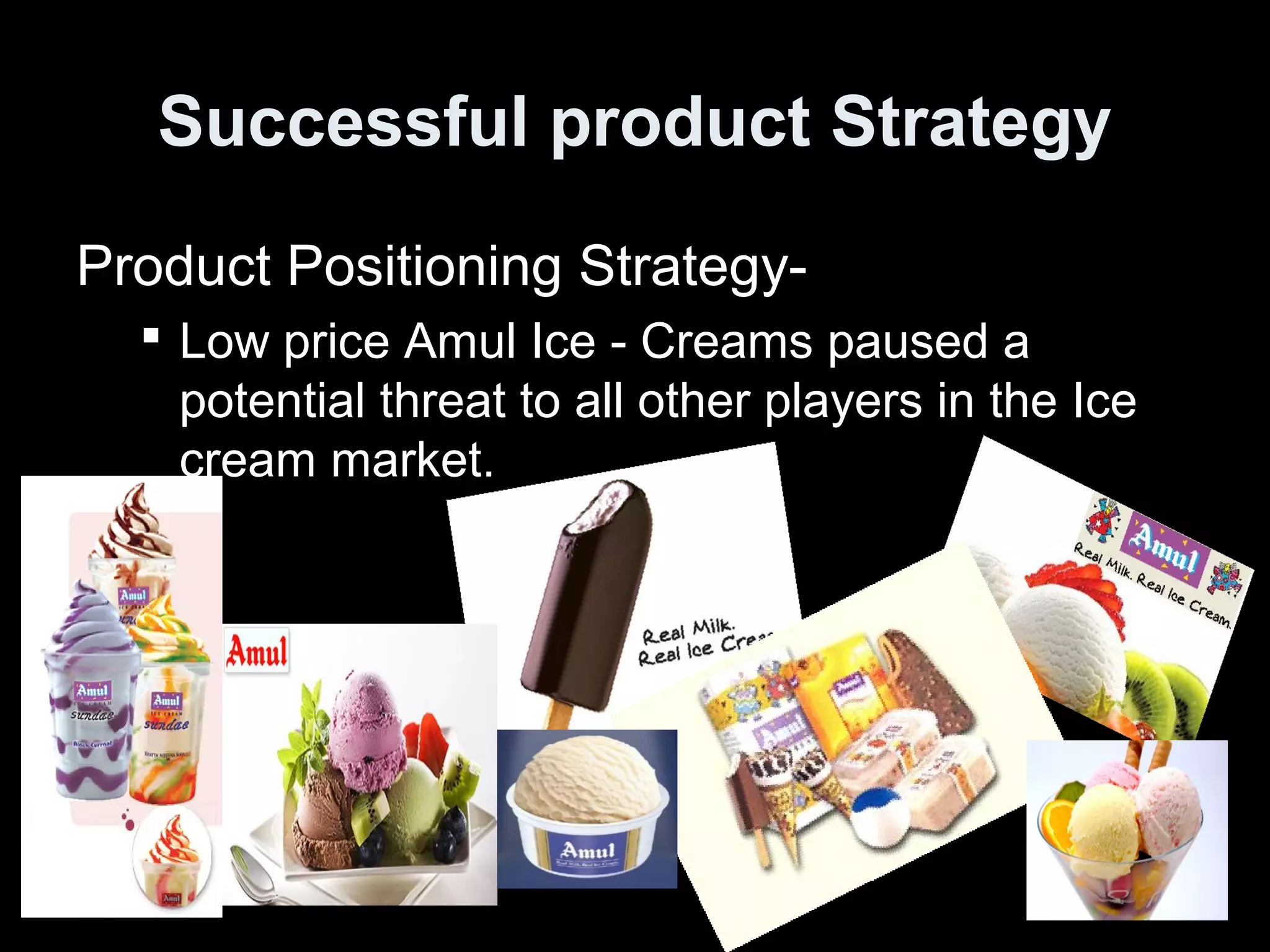
Successful product Strategy 
Product Positioning Strategy- 
 Low price Amul Ice - Creams paused a 
potential threat to all other players in the Ice 
cream market.
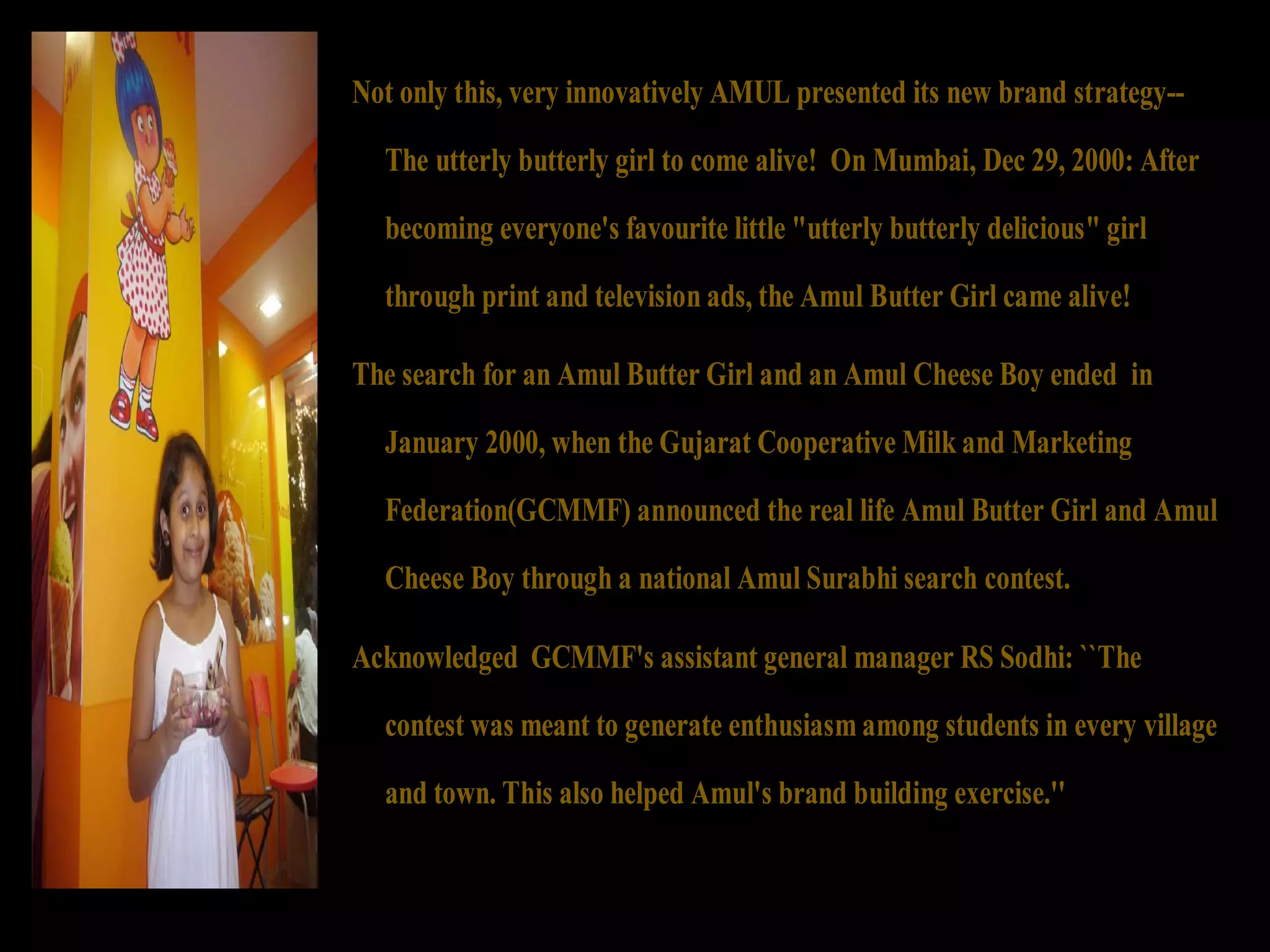
The Amul Moppet…
Not only this, very innovatively AMUL presented its new brand strategy-- 
The utterly butterly girl to come alive! On Mumbai, Dec 29, 2000: After 
becoming everyone's favourite little "utterly butterly delicious" girl 
through print and television ads, the Amul Butter Girl came alive! 
The search for an Amul Butter Girl and an Amul Cheese Boy ended in 
January 2000, when the Gujarat Cooperative Milk and Marketing 
Federation(GCMMF) announced the real life Amul Butter Girl and Amul 
Cheese Boy through a national Amul Surabhi search contest. 
Acknowledged GCMMF's assistant general manager RS Sodhi: ``The 
contest was meant to generate enthusiasm among students in every village 
and town. This also helped Amul's brand building exercise.''
At the time when AMUL was formed , consumers had limited purchasing power & modest 
consumption levels of milk & other dairy products . thus AMUL adopted:- 
Low-Cost Price strategy 
Low Cost Price Strategy was adopted to make the product affordable & alluring to 
consumers by guaranteeing them value for money. The main aim of Amul is to provide 
quality products to the consumers at minimum cost. The goal of Amul is to provide 
maximum profit in terms of money to the farmers. Low cost of production of 
AMUL: Milk production is scale insensitive and labour intensive. Due to low labour cost, 
cost of production of milk is significantly lower in AMUL. Amul’s icecreams are 
relatively low priced.
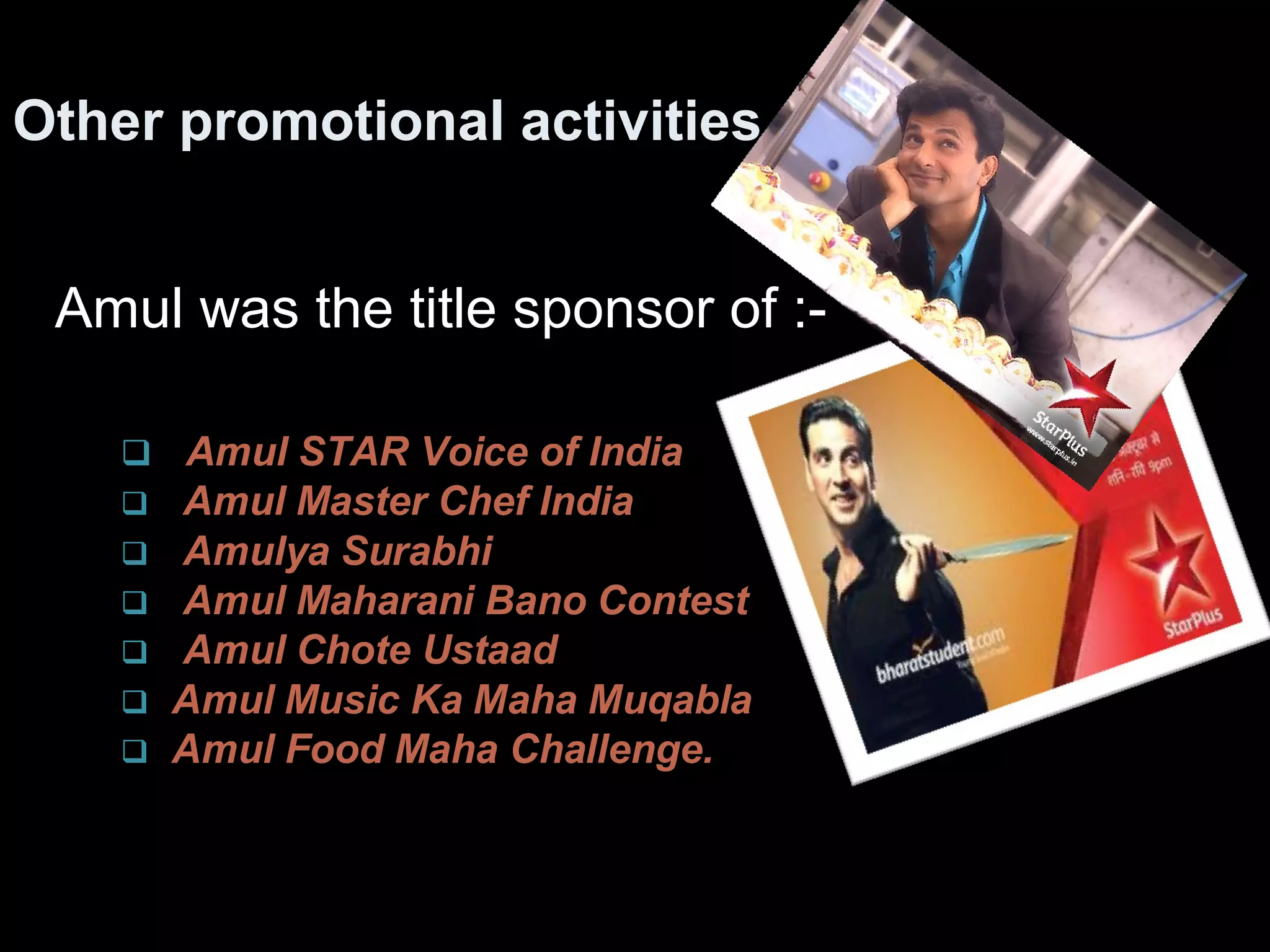
Other promotional activities 
Amul was the title sponsor of :- 
 Amul STAR Voice of India 
 Amul Master Chef India 
 Amulya Surabhi 
 Amul Maharani Bano Contest 
 Amul Chote Ustaad 
 Amul Music Ka Maha Muqabla 
 Amul Food Maha Challenge.
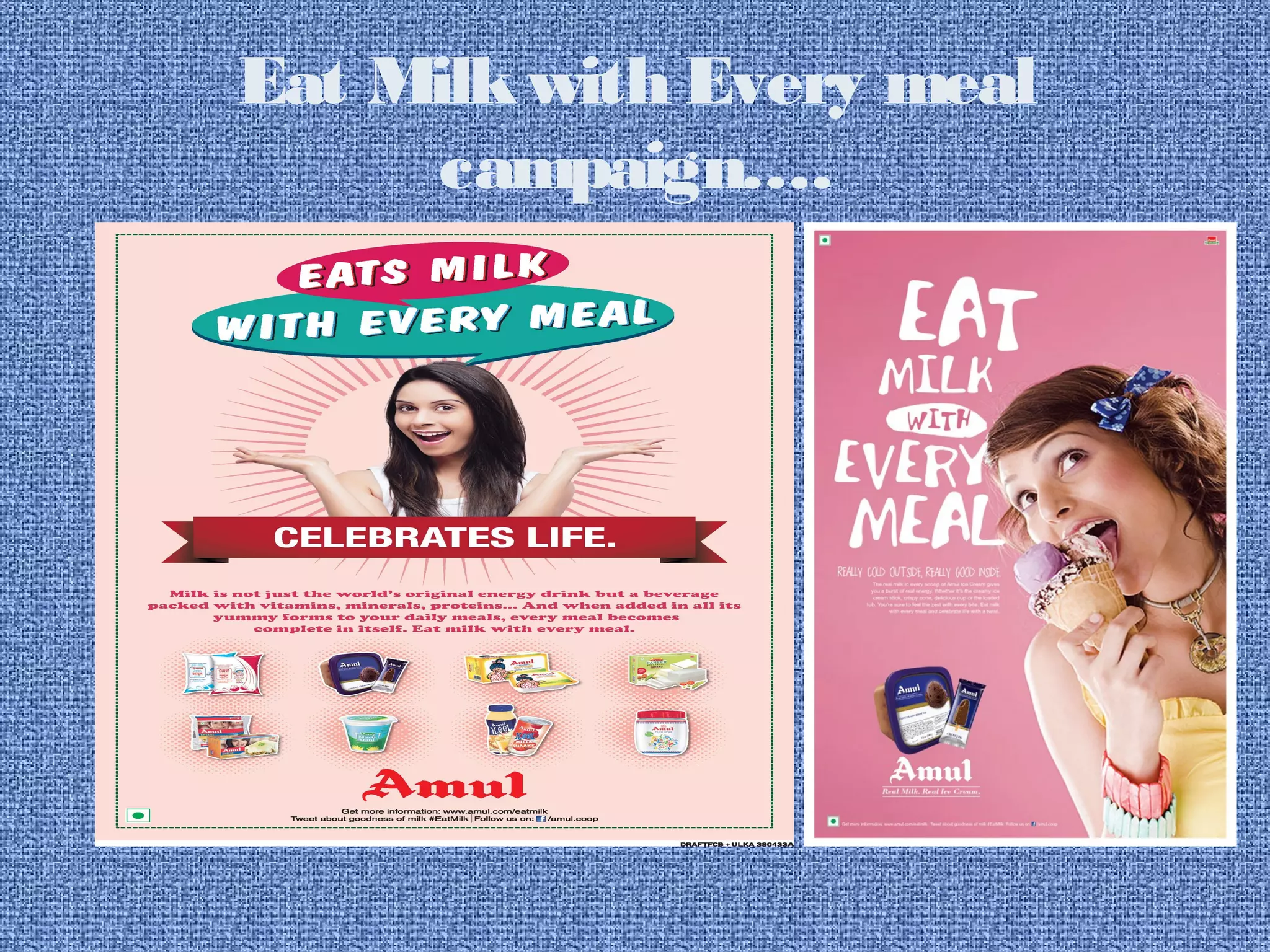
Eat Milk with Every meal 
campaign….
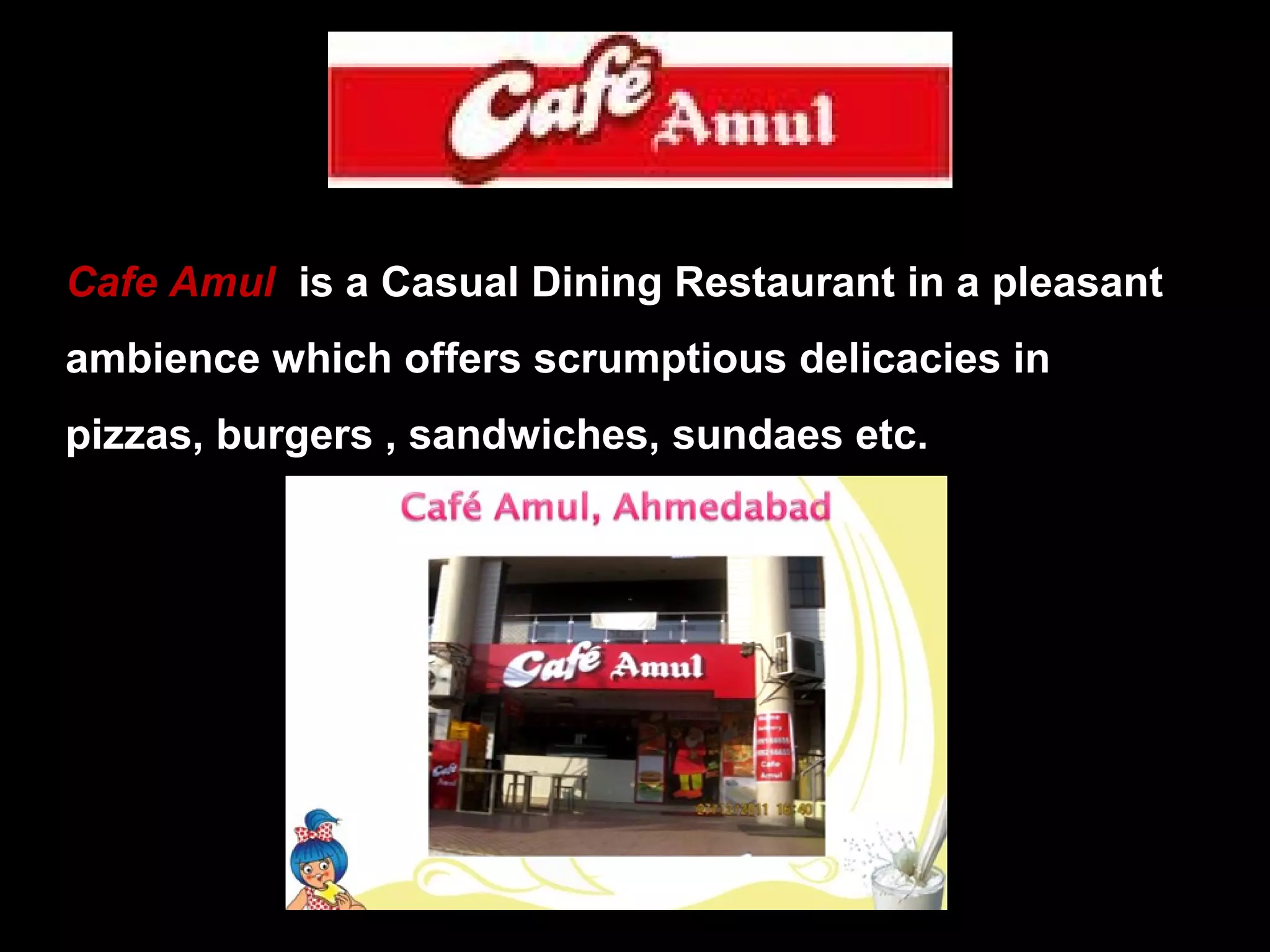
Cafe Amul is a Casual Dining Restaurant in a pleasant 
ambience which offers scrumptious delicacies in 
pizzas, burgers , sandwiches, sundaes etc.
• Baskin Robbins entered India in 1993 through a joint 
venture with The Graviss Group. Its first manufacturing 
plant outside North America opened in Pune. Offering 
delicious and fun treats across 150 cities / towns with 
550+ stores, Baskin Robbins is the largest Ice Cream 
chain in India. The Graviss Group has dedicated teams 
with expertise in the multiple verticals; that has turned 
Baskin Robbins into India’s most loved Ice Cream Brand.
•ADVERTISING 
STRATEGIES
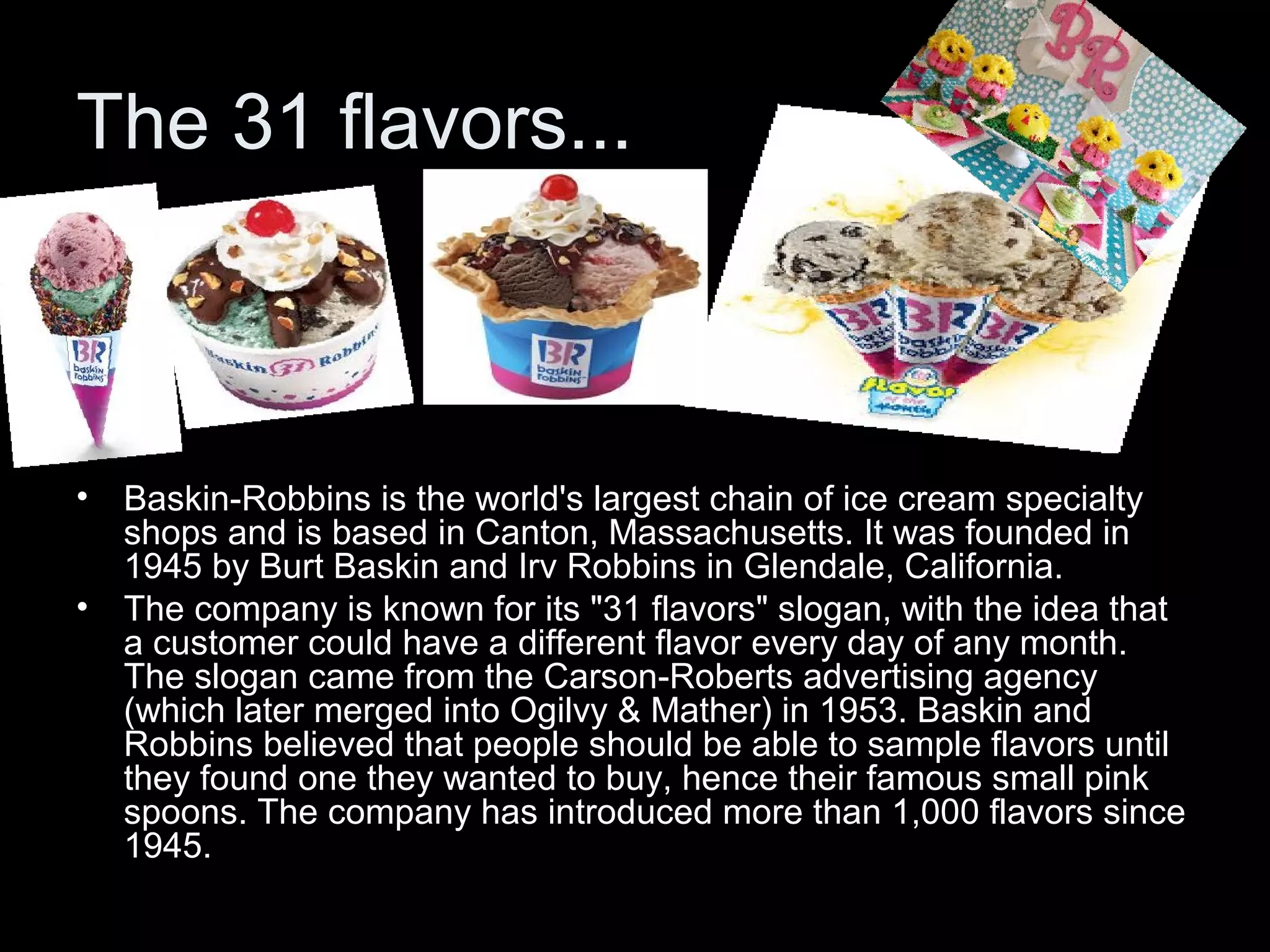
The 31 flavors... 
• Baskin-Robbins is the world's largest chain of ice cream specialty 
shops and is based in Canton, Massachusetts. It was founded in 
1945 by Burt Baskin and Irv Robbins in Glendale, California. 
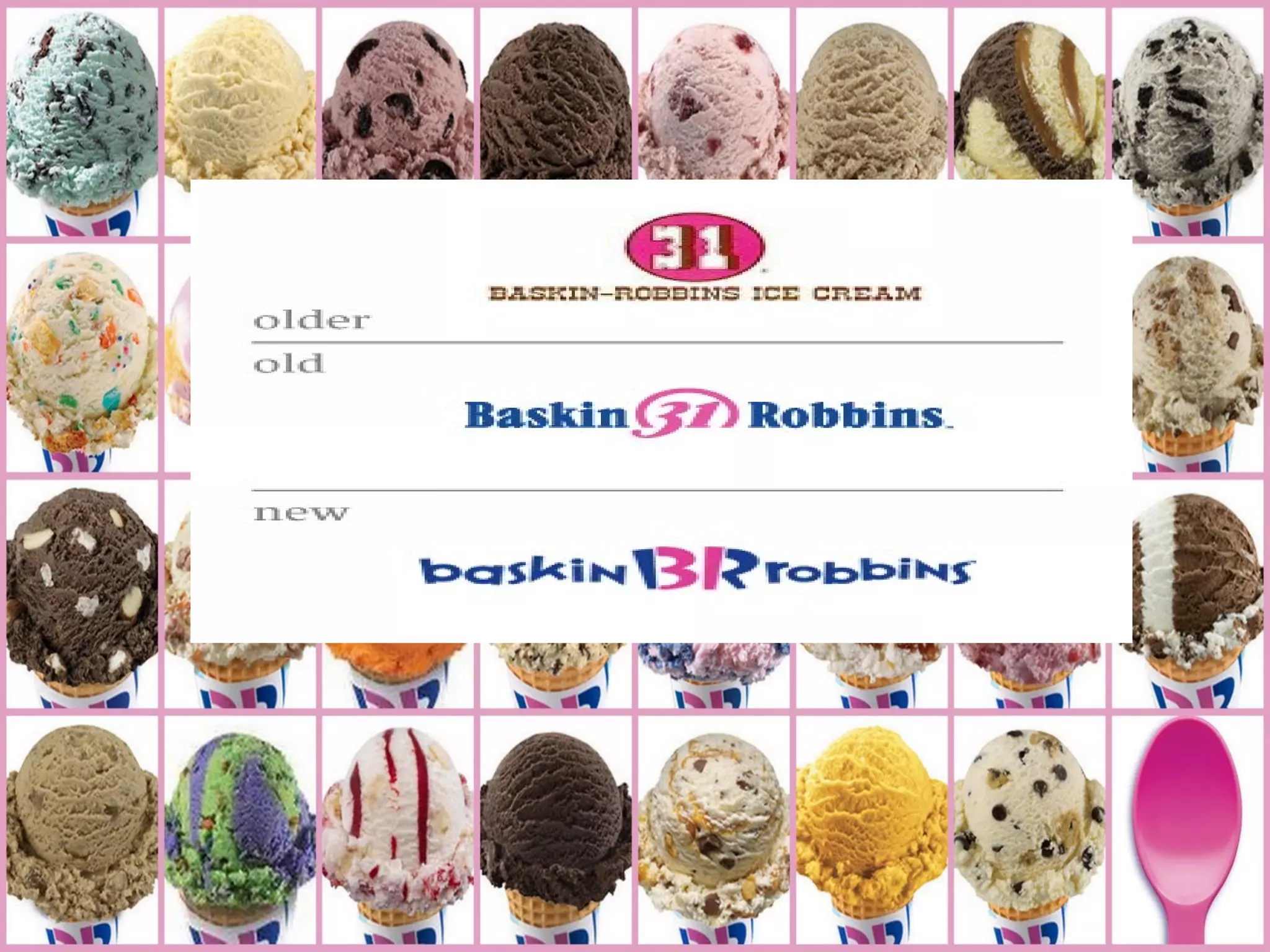
• The company is known for its "31 flavors" slogan, with the idea that 
a customer could have a different flavor every day of any month. 
The slogan came from the Carson-Roberts advertising agency 
(which later merged into Ogilvy & Mather) in 1953. Baskin and 
Robbins believed that people should be able to sample flavors until 
they found one they wanted to buy, hence their famous small pink 
spoons. The company has introduced more than 1,000 flavors since 
1945.
MARKETING STRATEGIES 
COMMUNICATION STRATEGY 
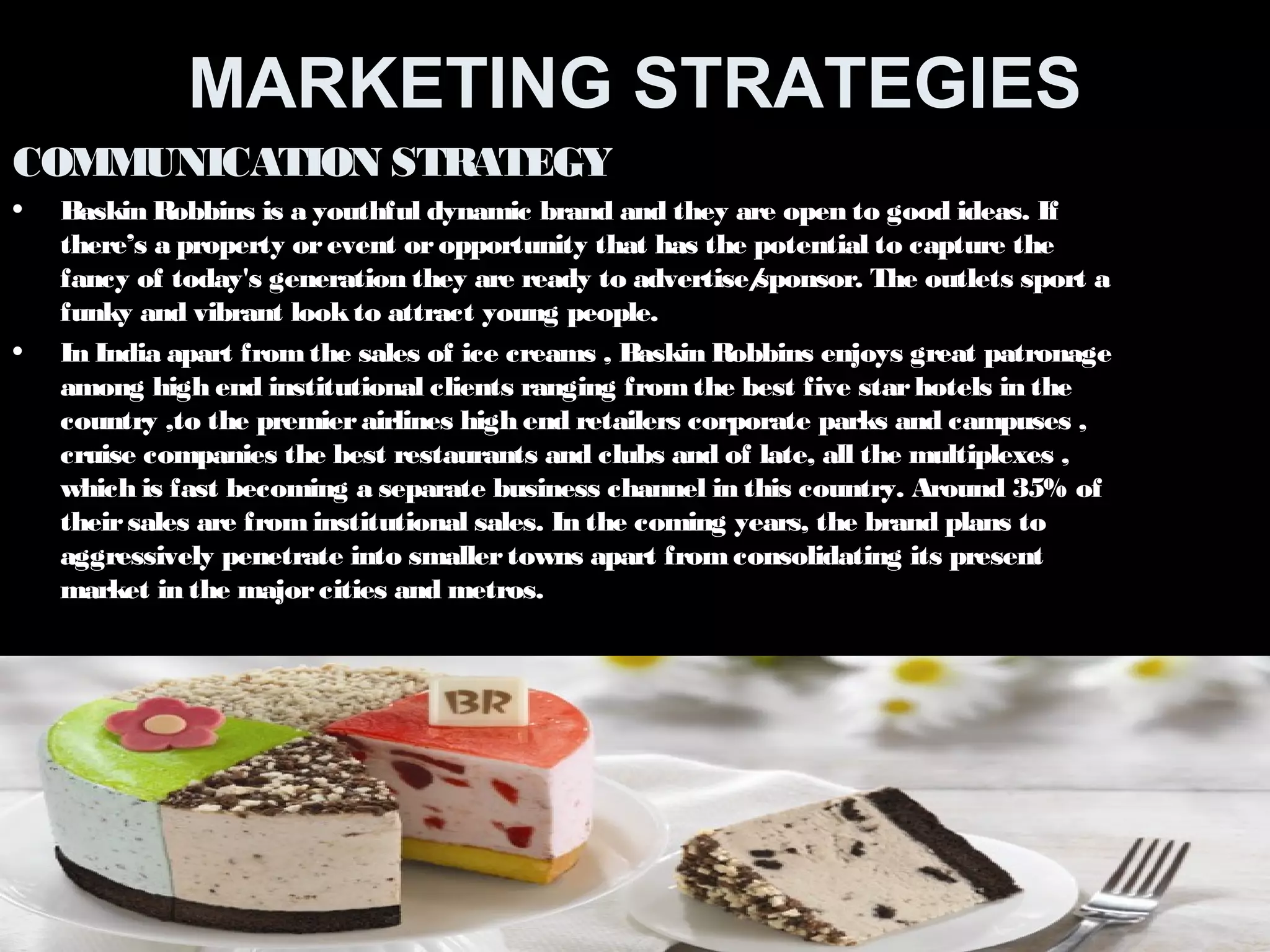
• Baskin Robbins is a youthful dynamic brand and they are open to good ideas. If 
there’s a property or event or opportunity that has the potential to capture the 
fancy of today's generation they are ready to advertise/sponsor. The outlets sport a 
funky and vibrant look to attract young people. 
• In India apart from the sales of ice creams , Baskin Robbins enjoys great patronage 
among high end institutional clients ranging from the best five star hotels in the 
country ,to the premier airlines high end retailers corporate parks and campuses , 
cruise companies the best restaurants and clubs and of late, all the multiplexes , 
which is fast becoming a separate business channel in this country. Around 35% of 
their sales are from institutional sales. In the coming years, the brand plans to 
aggressively penetrate into smaller towns apart from consolidating its present 
market in the major cities and metros.
Marketing plan- Baskin Robbins 
Target market 
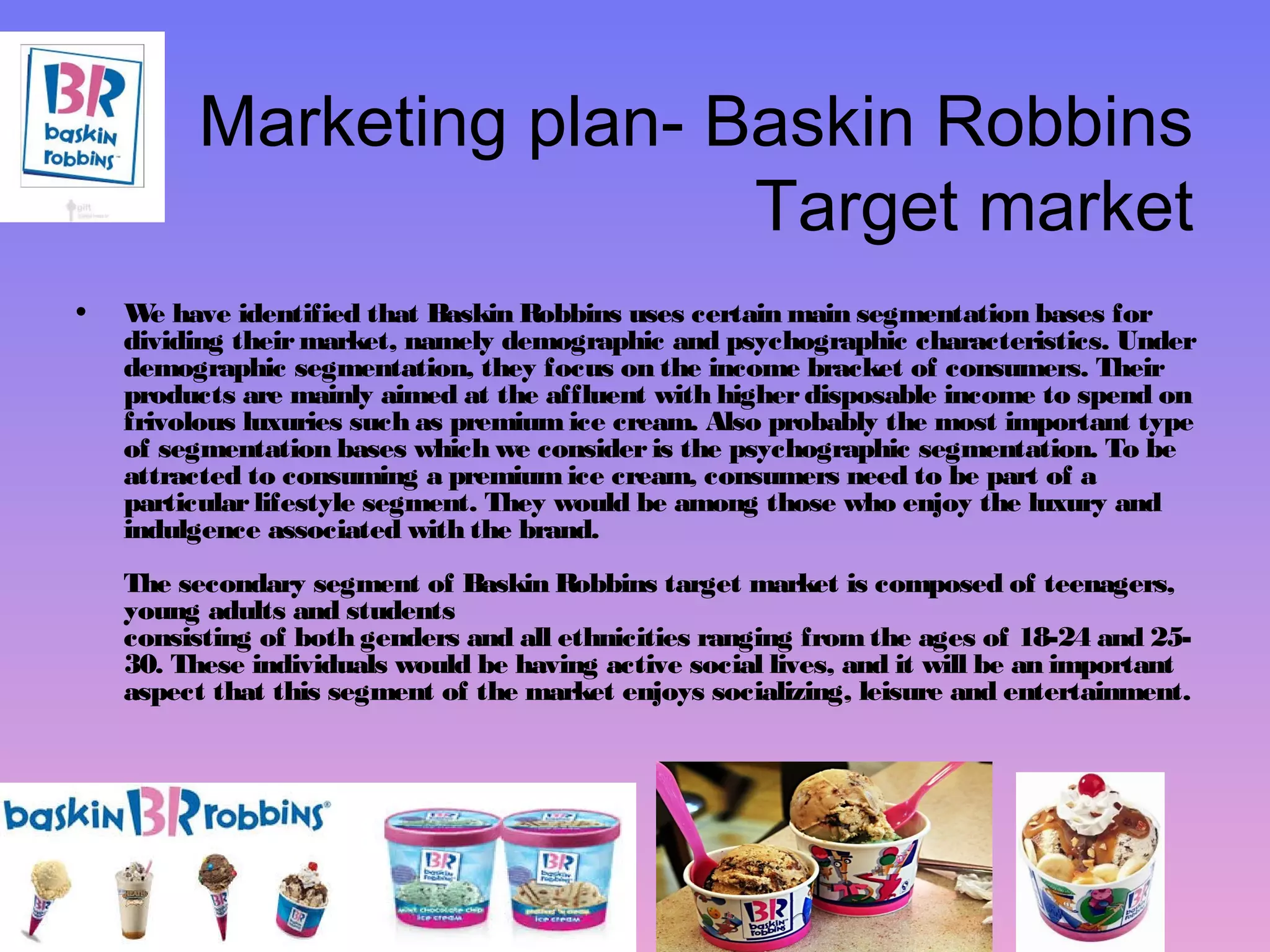
• We have identified that Baskin Robbins uses certain main segmentation bases for 
dividing their market, namely demographic and psychographic characteristics. Under 
demographic segmentation, they focus on the income bracket of consumers. Their 
products are mainly aimed at the affluent with higher disposable income to spend on 
frivolous luxuries such as premium ice cream. Also probably the most important type 
of segmentation bases which we consider is the psychographic segmentation. To be 
attracted to consuming a premium ice cream, consumers need to be part of a 
particular lifestyle segment. They would be among those who enjoy the luxury and 
indulgence associated with the brand. 
The secondary segment of Baskin Robbins target market is composed of teenagers, 
young adults and students 
consisting of both genders and all ethnicities ranging from the ages of 18-24 and 25- 
30. These individuals would be having active social lives, and it will be an important 
aspect that this segment of the market enjoys socializing, leisure and entertainment.
Ambiance 
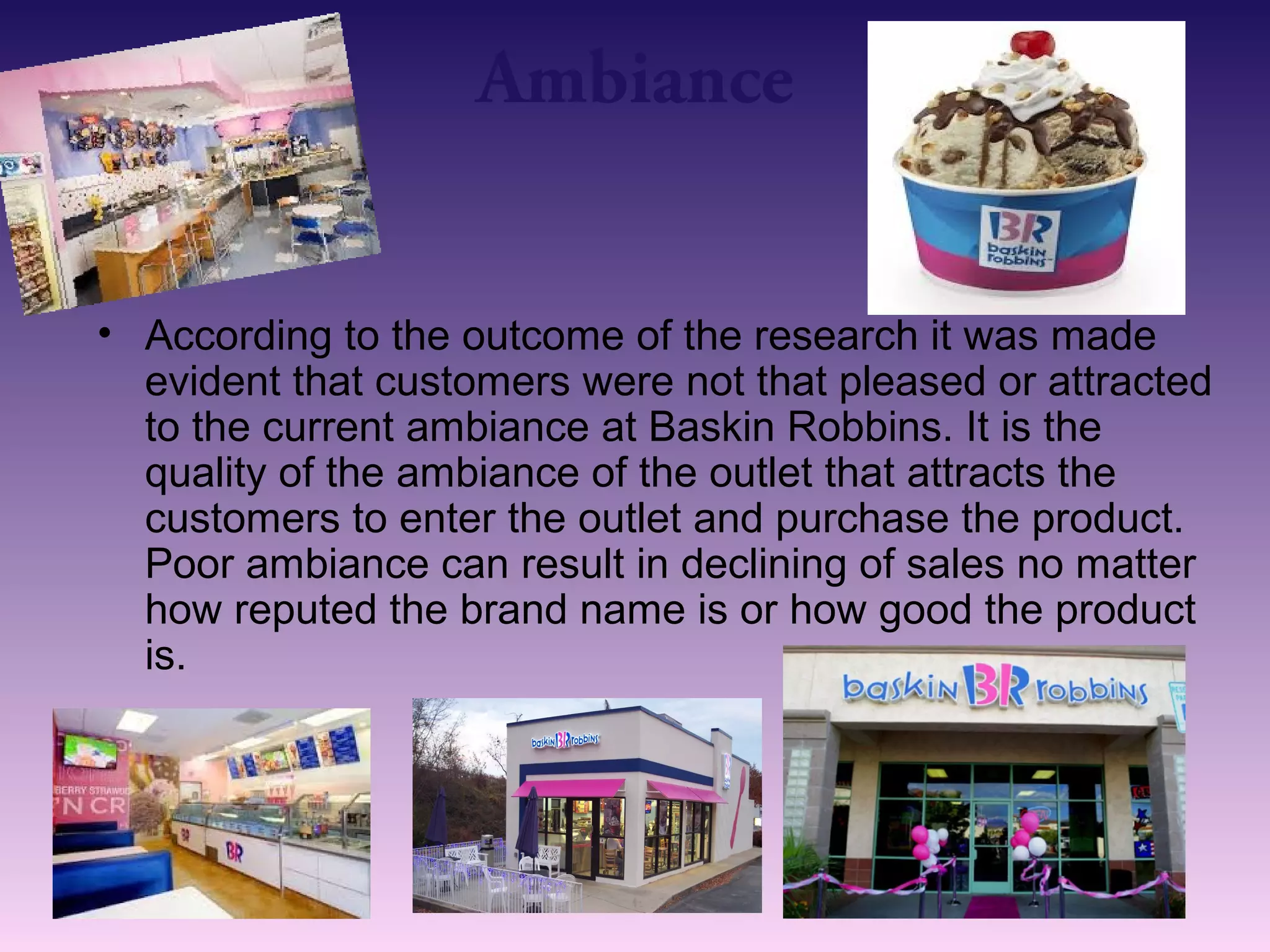
• According to the outcome of the research it was made 
evident that customers were not that pleased or attracted 
to the current ambiance at Baskin Robbins. It is the 
quality of the ambiance of the outlet that attracts the 
customers to enter the outlet and purchase the product. 
Poor ambiance can result in declining of sales no matter 
how reputed the brand name is or how good the product 
is.
Spiderman 3 Campaign 
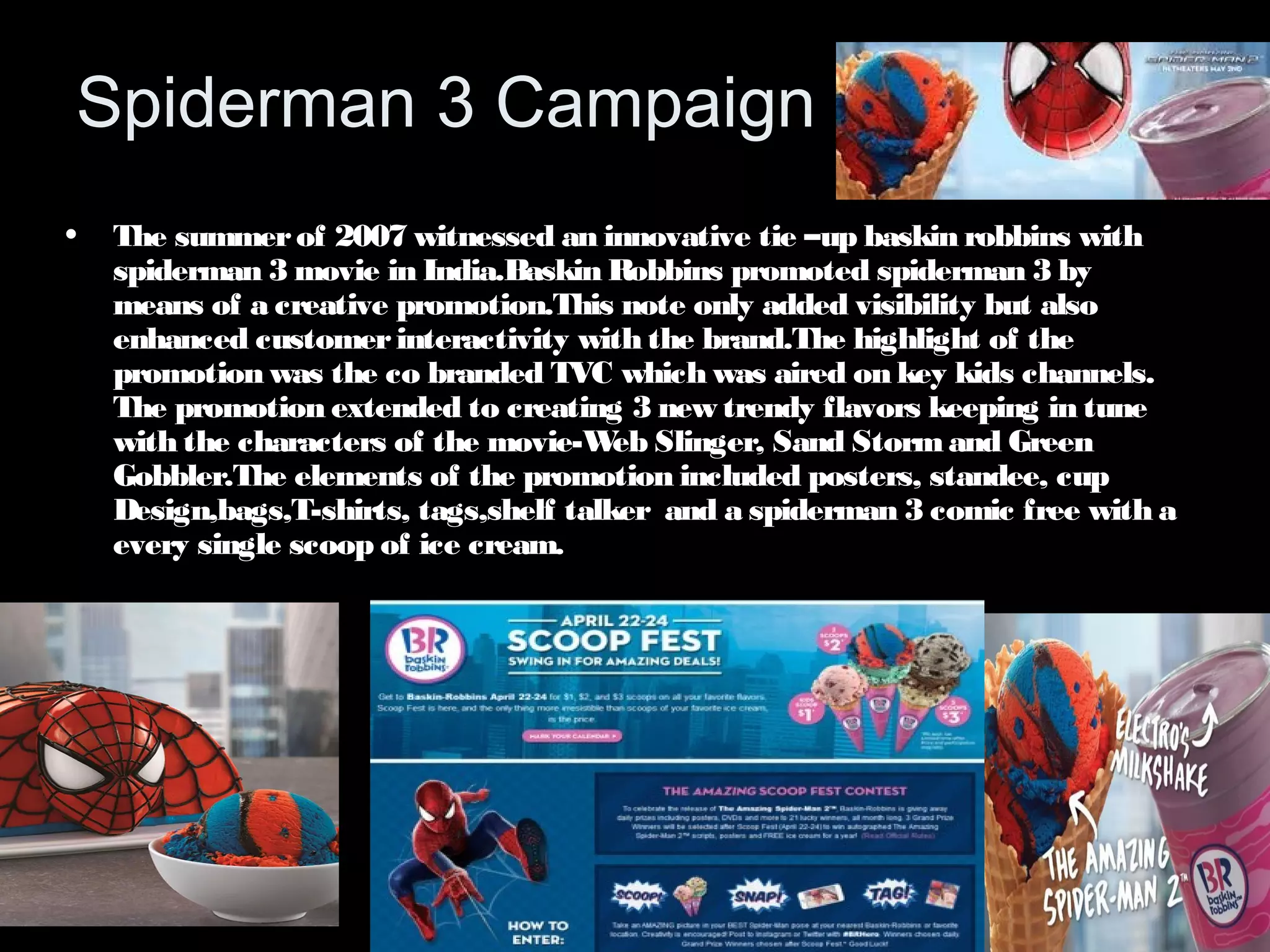
• The summer of 2007 witnessed an innovative tie –up baskin robbins with 
spiderman 3 movie in India.Baskin Robbins promoted spiderman 3 by 
means of a creative promotion.This note only added visibility but also 
enhanced customer interactivity with the brand.The highlight of the 
promotion was the co branded TVC which was aired on key kids channels. 
The promotion extended to creating 3 new trendy flavors keeping in tune 
with the characters of the movie-Web Slinger, Sand Storm and Green 
Gobbler.The elements of the promotion included posters, standee, cup 
Design,bags,T-shirts, tags,shelf talker and a spiderman 3 comic free with a 
every single scoop of ice cream.
PAANCHVI CAMPAIGN 
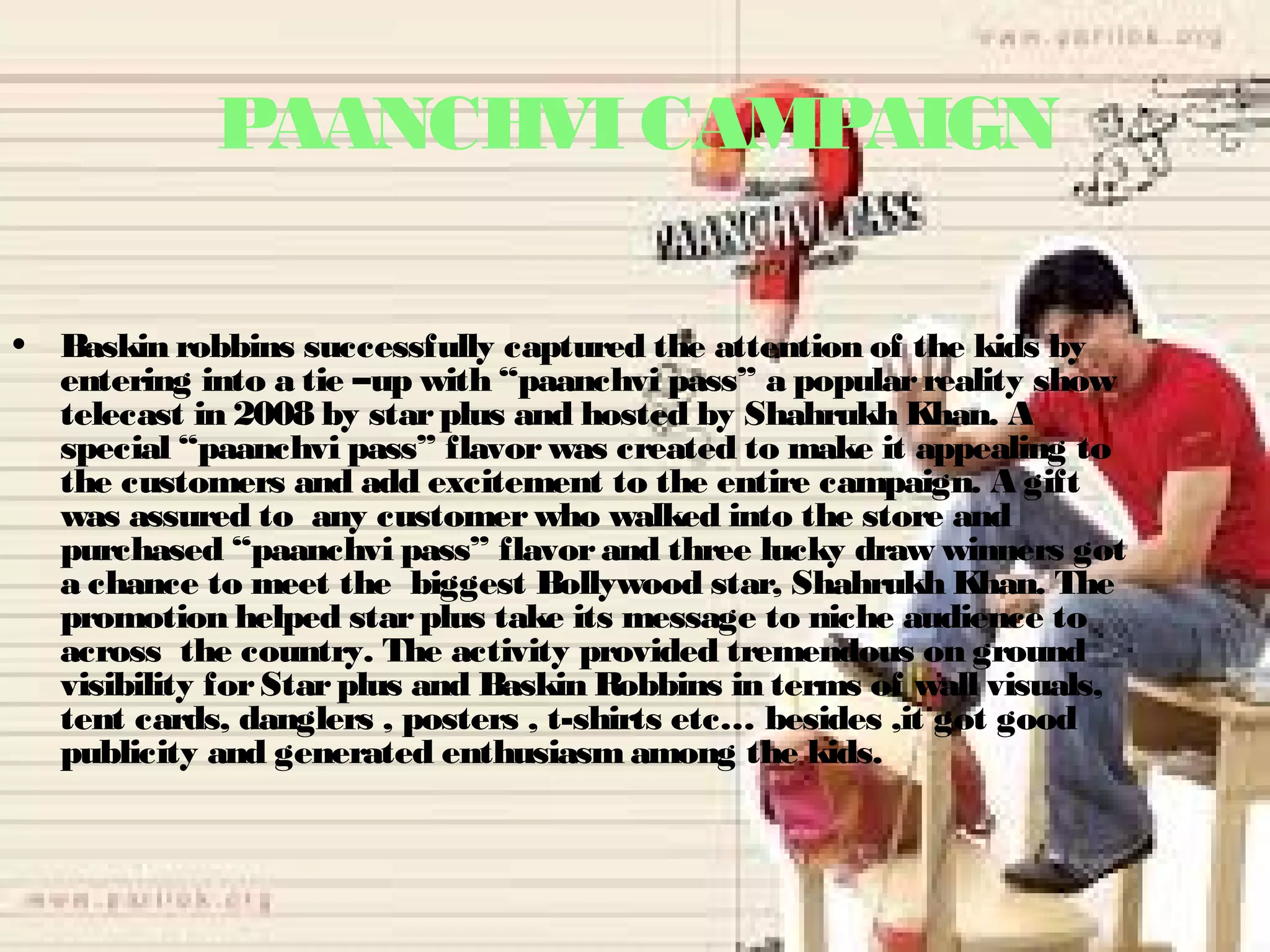
• Baskin robbins successfully captured the attention of the kids by 
entering into a tie –up with “paanchvi pass” a popular reality show 
telecast in 2008 by star plus and hosted by Shahrukh Khan. A 
special “paanchvi pass” flavor was created to make it appealing to 
the customers and add excitement to the entire campaign. A gift 
was assured to any customer who walked into the store and 
purchased “paanchvi pass” flavor and three lucky draw winners got 
a chance to meet the biggest Bollywood star, Shahrukh Khan. The 
promotion helped star plus take its message to niche audience to 
across the country. The activity provided tremendous on ground 
visibility for Star plus and Baskin Robbins in terms of wall visuals, 
tent cards, danglers , posters , t-shirts etc… besides ,it got good 
publicity and generated enthusiasm among the kids.
THE DRONA CAMPAIGN 
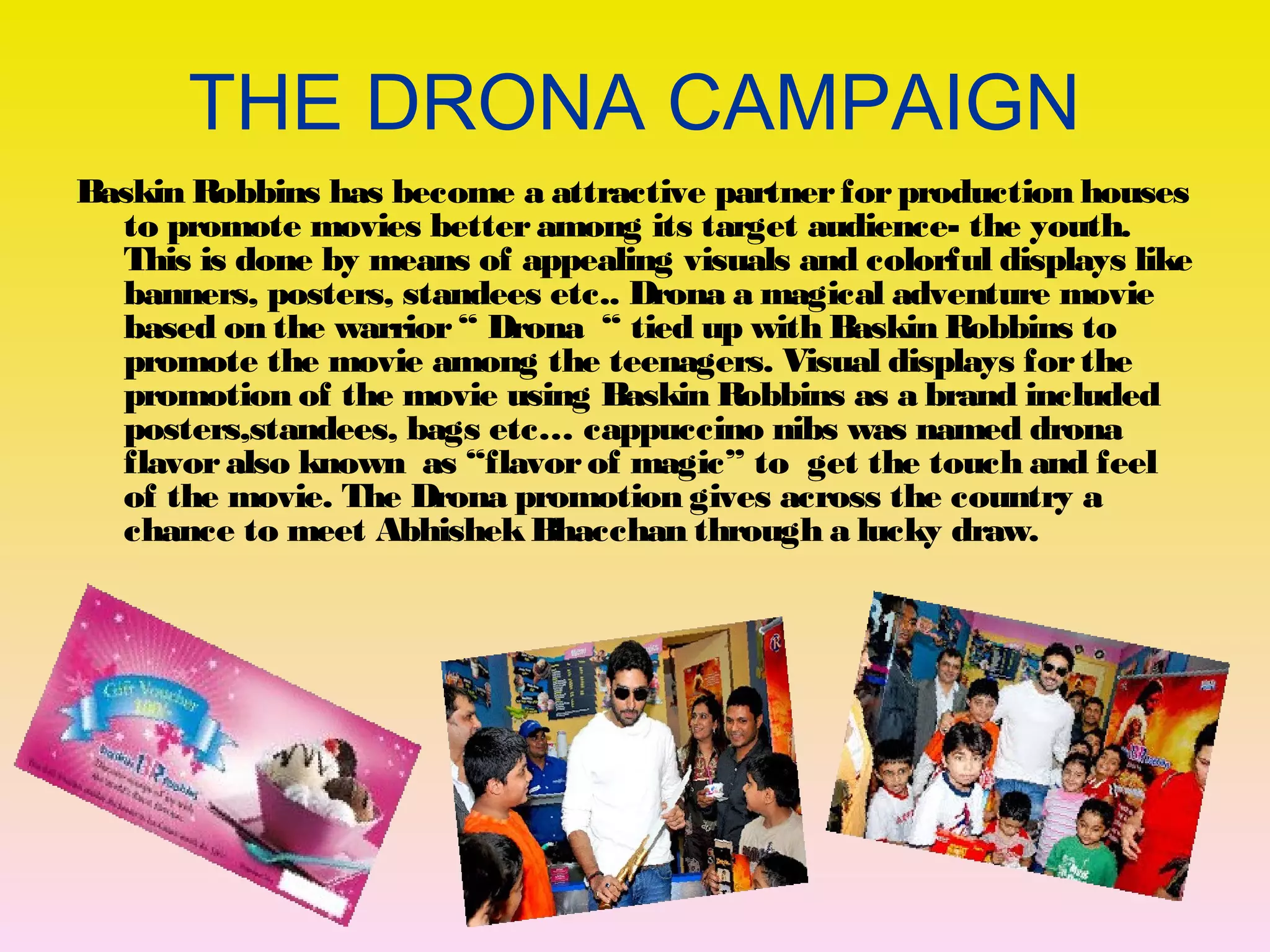
Baskin Robbins has become a attractive partner for production houses 
to promote movies better among its target audience- the youth. 
This is done by means of appealing visuals and colorful displays like 
banners, posters, standees etc.. Drona a magical adventure movie 
based on the warrior “ Drona “ tied up with Baskin Robbins to 
promote the movie among the teenagers. Visual displays for the 
promotion of the movie using Baskin Robbins as a brand included 
posters,standees, bags etc… cappuccino nibs was named drona 
flavor also known as “flavor of magic” to get the touch and feel 
of the movie. The Drona promotion gives across the country a 
chance to meet Abhishek Bhacchan through a lucky draw.
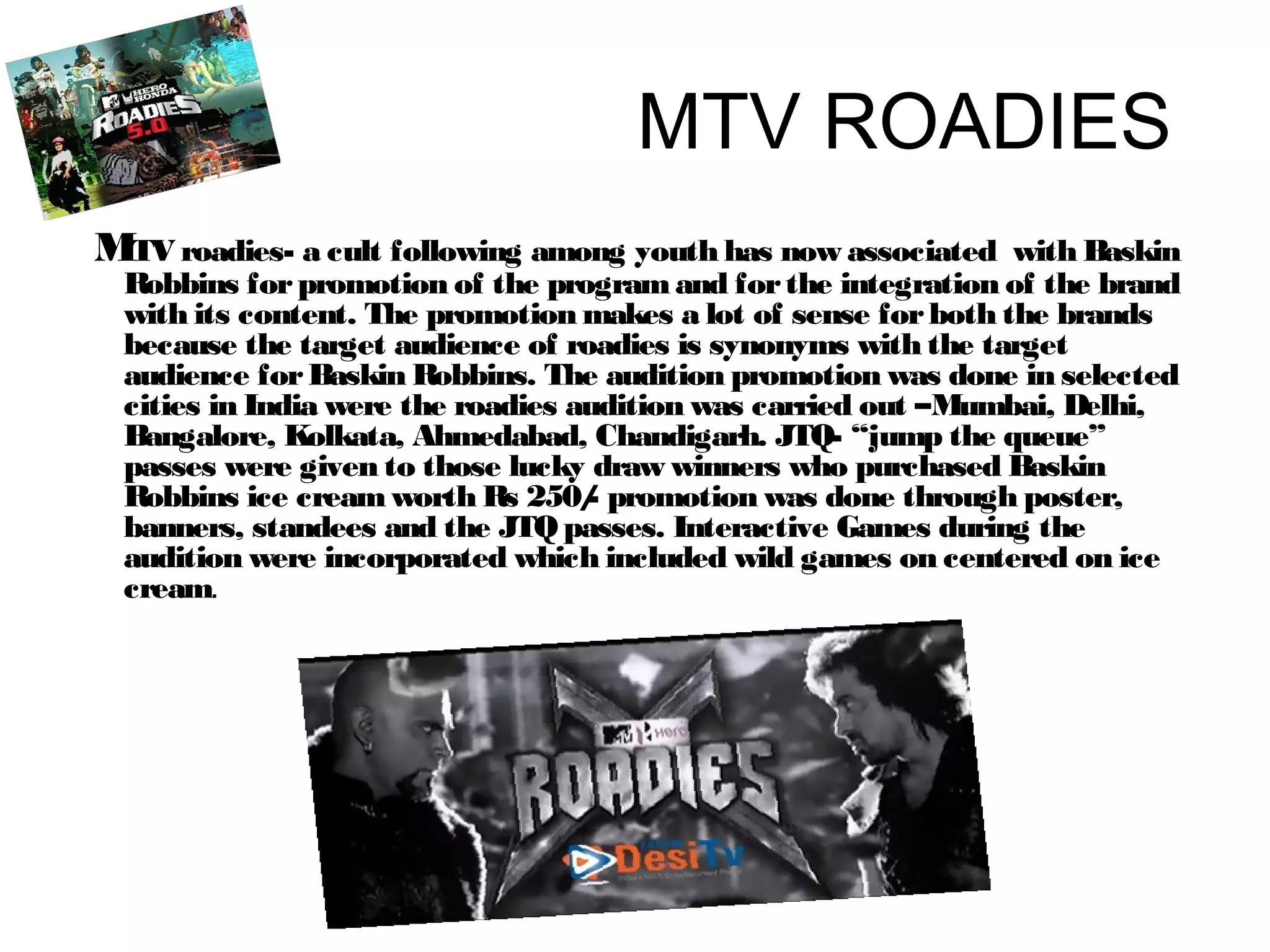
MTV ROADIES 
MTV roadies- a cult following among youth has now associated with Baskin 
Robbins for promotion of the program and for the integration of the brand 
with its content. The promotion makes a lot of sense for both the brands 
because the target audience of roadies is synonyms with the target 
audience for Baskin Robbins. The audition promotion was done in selected 
cities in India were the roadies audition was carried out –Mumbai, Delhi, 
Bangalore, Kolkata, Ahmedabad, Chandigarh. JTQ- “jump the queue” 
passes were given to those lucky draw winners who purchased Baskin 
Robbins ice cream worth Rs 250/- promotion was done through poster, 
banners, standees and the JTQ passes. Interactive Games during the 
audition were incorporated which included wild games on centered on ice 
cream.
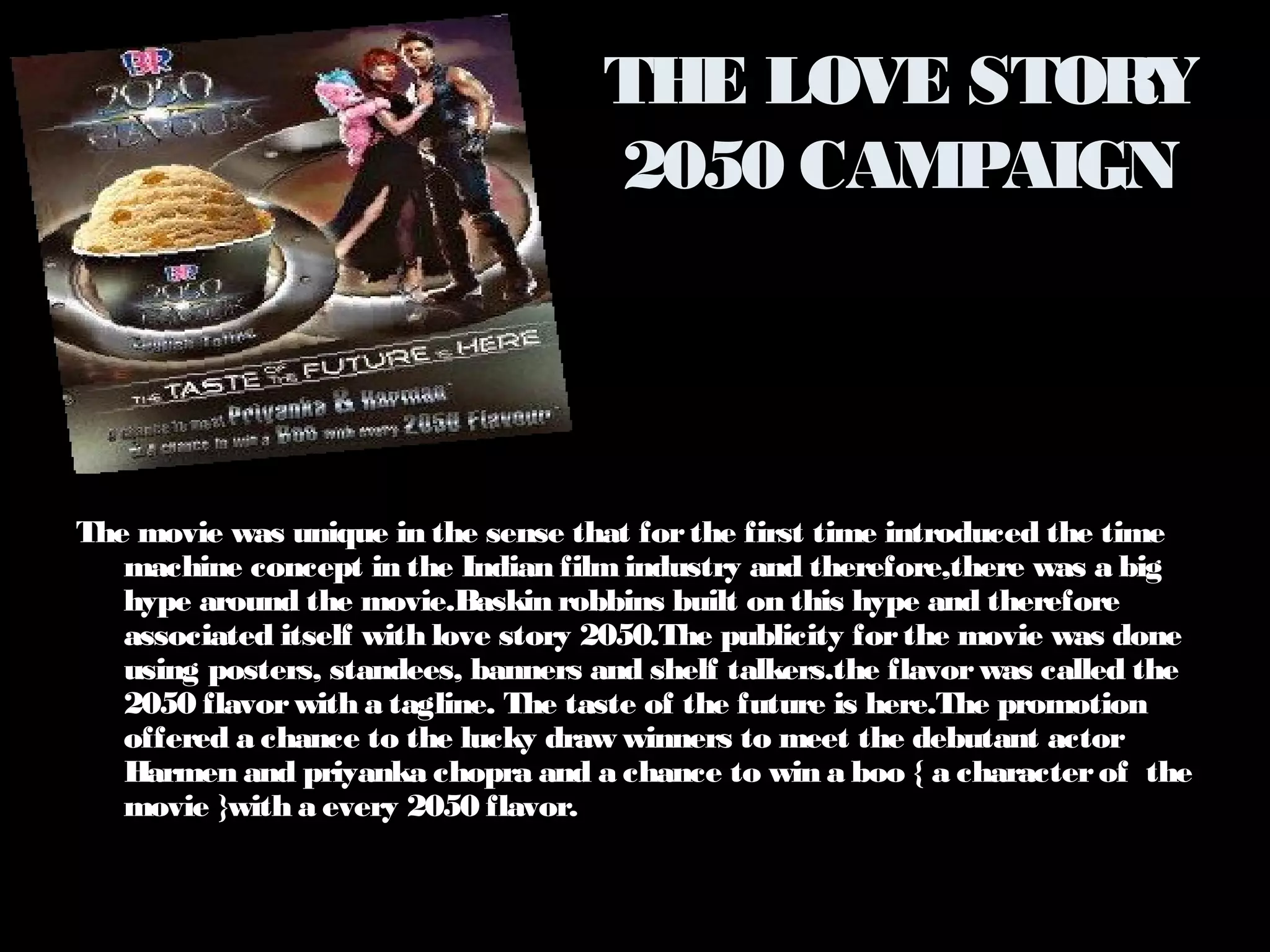
THE LOVE STORY 
2050 CAMPAIGN 
The movie was unique in the sense that for the first time introduced the time 
machine concept in the Indian film industry and therefore,there was a big 
hype around the movie.Baskin robbins built on this hype and therefore 
associated itself with love story 2050.The publicity for the movie was done 
using posters, standees, banners and shelf talkers.the flavor was called the 
2050 flavor with a tagline. The taste of the future is here.The promotion 
offered a chance to the lucky draw winners to meet the debutant actor 
Harmen and priyanka chopra and a chance to win a boo { a character of the 
movie }with a every 2050 flavor.
• 1. Baskin Robbins is a dynamic brand that appeals 
mostly to the younger generation. The secondary 

segment of BR's target market is composed of 
teenagers, young adults and students belonging to the 
age group of 18-24 and 25-30 years. Hence, the 
advertising campaigns of BR - such as the MTV Roadies' 
campaign, Spiderman 3 campaign, etc - are designed in 
such a manner so as to attract the youth. 
On the other hand, Amul has a slightly wider target 
market. Besides targeting the youth, Amul also seeks to 
cater to the older generation. This is evident from its 
advertising strategies which include title sponsorship of 
various programmes (Amul Star Voice of India, Amul 
Master Chef India, etc) which have a vast and varied 
audience base.
• 2. Amul adopts a low-cost price strategy to sell its 
products. The aim of the company is to deliver value for 
money to its customers by providing quality products at 
minimum cost. Amul prices its products in such a 
manner so as to make them affordable to the lower 
income groups of the society as well. 
BR's products are aimed mainly at the well-off members 
of the society with a higher disposable income which 
can be spent on luxurious items such as premium quality 
ice creams. Only those consumers who are part ofan 
affluent llifestyle will be able to enjoy, and most 
importantly, afford the products of such high end 
brands.BR, unlike Amul, therefore focuses not on 
minimising the price of the products but on providing 
high end, quality 
products. They are not concerned with lowering the 
price of the product as they cater primarily to the 
affluent groups.
• 3. Over the last few years, Amul's advertising 
philosophy has been "to be simple, fresh and 
innovative". The advertisements are of 
immediate relevance, interest or importance, 
and are in relation to major current events. 
In contrast, the advertising strategies of BR are 
more creative, and are aimed at increasing 
customer interactivity with the brand. All the 
major campaigns of the brand sought to 
promote the brand among its target market by 
means of various promotional activities such as 
provision of free goodies, lucky draws, meet-and- 
greet events with stars, etc.
4.Amul researches in developing products that are 
sugar free and hence can be appealing to elder 
people too. 
Whereas Baskin Robbins is not rather keen in 
developing such products as it aims at teenagers 
and kids mainly and hence is coming up with 
different flavours that would attract them. 
5. Baskin Robbins is still working on brand building 
whereas Amul is already the biggest food brand in 
the country. Hence, BR is trying to attract 
customers to their stores whereas Amul is trying to 
make its customers use more and more of its 
products.
Amul v. baskin robbins

Amul v. baskin robbins

  • 1.
    • A PRESENTATIONSUBMITTED BY • Sneha Manamohan • Smruthy N. Pradeep
  • 2.
  • 3.
    History • Thejourney of Amul ice creams began on 10th March, 1996 in Gujarat and with its superior quality it was able to capture the highest market share in a short period of time • In 1997, Amul Ice creams entered Mumbai followed by Chennai in 1998 and Kolkata and Delhi in 2002. Nationally it was rolled out in 1999. • Since then not only has it grown at a phenomenal rate but also it has added a vast variety of flavors to its ever growing range. Currently it offers a selection of over 200 variants.
  • 4.
    Products Utterly deliciousice cream made from fresh milk available in a wide range of flavors and packs. PRODUCT DESCRIPTIONS Cone 120 ml, 100ml, 80 ml & 50 ml Cup 125 ml, 100 ml, 80 ml, 90 ml & 40 ml Plastic Container 1 litre, 750 ml, 500 ml, 125 ml, 100 ml, 80 ml & 60 ml Stick 70 ml, 60 ml, 40 ml Take Home Bulk / catering packs (5 litre, 4 litre), take home packs (2.2 litre, 1.5 litre, 1.25 litre, 1 litre), combo packs (750 ml+750ml Free) and family packs (500 ml, 250 ml)
  • 5.
    PRODUCT FEATURES •Made from Fresh Milk (Real Milk, Real Ice cream): No added vegetable oil, hence no Frozen Dessert. • No Differentiation in Quality Standards of Consumer & Catering/ Institutional Packs: Stringent Standards than Specified by PFA & BIS for more fat and less overrun (less air) to give creamier feeling. • Best Ingredients: Fresh milk, superior fruits & nuts. • Manufacturing Facility: Made in ISO & HACCP certified state of the art plants with stringent hygienic standards to ensure food safety. • Pro-life & SUGAR FREE Probiotic: The first company in India to introduce probiotics in ice cream (IDF Award for Best Nutrimarketing Category, Oct '07) & SUGAR FREE Probiotic products.
  • 6.
    PRODUCT APPLICATION •Individual consumption (impulse), Take home, Catering at parties, marriages etc. celebration and Recipe preparation for sundaes, shakes, etc. AVAILABLE IN More than 800 cities across India at Amul Preferred Outlets, Amul Scooping Parlors, retail shops, vending push carts, hotels, restaurants, canteens, caterers etc.
  • 7.
  • 8.
    The ultimate strategy • The moppet who put Amul on India's breakfast table • 50 years after it was first launched, Amul's sale figures have jumped from 1000 tones a year in 1966 to over 25,000 tones a year in 1997. No other brand comes even close to It. All because a thumb-sized girl climbed on to the hoardings and put a spell on the masses. • The Amul girl was the brainchild of SylvesterdaCunha, the managing director of the advertising agency AS. The ads were designed as a series of hoardings with designs relating to day-to-day issues. The brand recall for the Amul girl is phenomenal across India today. And the biggest reason for this is the topical nature of the ads.The Amul ads have witty one-liners which capture relevant events that have caught the fancy of the nation. • Entered in the Guinness Book Of World Records for being • the longest running campaign ever.
  • 9.
    Marketing Mix Product • Dairy Products • Cooking Products Price • Low Pricing Strategy Place • Rural & Urban Market • International Market Promotion • Advertisements
  • 10.
    Bill boards Most famous is billboard campaign  The endearing polka dressed girl and pun at various issues increased brand’s fan following.
  • 11.
    Promot ion •Given this wide product portfolio, Amul’s approach is to promote its brands in a rotational cycle of two to three years. • After ice-creams were launched in 1996, the category was re-visited in 1999, in order to improve availability of the product and make it affordable. The Amul Maharani contest
  • 12.
    Successful product Strategy Product Positioning Strategy-  Low price Amul Ice - Creams paused a potential threat to all other players in the Ice cream market.
  • 13.
  • 15.
    Not only this,very innovatively AMUL presented its new brand strategy-- The utterly butterly girl to come alive! On Mumbai, Dec 29, 2000: After becoming everyone's favourite little "utterly butterly delicious" girl through print and television ads, the Amul Butter Girl came alive! The search for an Amul Butter Girl and an Amul Cheese Boy ended in January 2000, when the Gujarat Cooperative Milk and Marketing Federation(GCMMF) announced the real life Amul Butter Girl and Amul Cheese Boy through a national Amul Surabhi search contest. Acknowledged GCMMF's assistant general manager RS Sodhi: ``The contest was meant to generate enthusiasm among students in every village and town. This also helped Amul's brand building exercise.''
  • 16.
    At the timewhen AMUL was formed , consumers had limited purchasing power & modest consumption levels of milk & other dairy products . thus AMUL adopted:- Low-Cost Price strategy Low Cost Price Strategy was adopted to make the product affordable & alluring to consumers by guaranteeing them value for money. The main aim of Amul is to provide quality products to the consumers at minimum cost. The goal of Amul is to provide maximum profit in terms of money to the farmers. Low cost of production of AMUL: Milk production is scale insensitive and labour intensive. Due to low labour cost, cost of production of milk is significantly lower in AMUL. Amul’s icecreams are relatively low priced.
  • 17.
    Other promotional activities Amul was the title sponsor of :-  Amul STAR Voice of India  Amul Master Chef India  Amulya Surabhi  Amul Maharani Bano Contest  Amul Chote Ustaad  Amul Music Ka Maha Muqabla  Amul Food Maha Challenge.
  • 18.
    Eat Milk withEvery meal campaign….
  • 19.
    Cafe Amul isa Casual Dining Restaurant in a pleasant ambience which offers scrumptious delicacies in pizzas, burgers , sandwiches, sundaes etc.
  • 20.
    • Baskin Robbinsentered India in 1993 through a joint venture with The Graviss Group. Its first manufacturing plant outside North America opened in Pune. Offering delicious and fun treats across 150 cities / towns with 550+ stores, Baskin Robbins is the largest Ice Cream chain in India. The Graviss Group has dedicated teams with expertise in the multiple verticals; that has turned Baskin Robbins into India’s most loved Ice Cream Brand.
  • 21.
  • 22.
    The 31 flavors... • Baskin-Robbins is the world's largest chain of ice cream specialty shops and is based in Canton, Massachusetts. It was founded in 1945 by Burt Baskin and Irv Robbins in Glendale, California. • The company is known for its "31 flavors" slogan, with the idea that a customer could have a different flavor every day of any month. The slogan came from the Carson-Roberts advertising agency (which later merged into Ogilvy & Mather) in 1953. Baskin and Robbins believed that people should be able to sample flavors until they found one they wanted to buy, hence their famous small pink spoons. The company has introduced more than 1,000 flavors since 1945.
  • 24.
    MARKETING STRATEGIES COMMUNICATIONSTRATEGY • Baskin Robbins is a youthful dynamic brand and they are open to good ideas. If there’s a property or event or opportunity that has the potential to capture the fancy of today's generation they are ready to advertise/sponsor. The outlets sport a funky and vibrant look to attract young people. • In India apart from the sales of ice creams , Baskin Robbins enjoys great patronage among high end institutional clients ranging from the best five star hotels in the country ,to the premier airlines high end retailers corporate parks and campuses , cruise companies the best restaurants and clubs and of late, all the multiplexes , which is fast becoming a separate business channel in this country. Around 35% of their sales are from institutional sales. In the coming years, the brand plans to aggressively penetrate into smaller towns apart from consolidating its present market in the major cities and metros.
  • 25.
    Marketing plan- BaskinRobbins Target market • We have identified that Baskin Robbins uses certain main segmentation bases for dividing their market, namely demographic and psychographic characteristics. Under demographic segmentation, they focus on the income bracket of consumers. Their products are mainly aimed at the affluent with higher disposable income to spend on frivolous luxuries such as premium ice cream. Also probably the most important type of segmentation bases which we consider is the psychographic segmentation. To be attracted to consuming a premium ice cream, consumers need to be part of a particular lifestyle segment. They would be among those who enjoy the luxury and indulgence associated with the brand. The secondary segment of Baskin Robbins target market is composed of teenagers, young adults and students consisting of both genders and all ethnicities ranging from the ages of 18-24 and 25- 30. These individuals would be having active social lives, and it will be an important aspect that this segment of the market enjoys socializing, leisure and entertainment.
  • 26.
    Ambiance • Accordingto the outcome of the research it was made evident that customers were not that pleased or attracted to the current ambiance at Baskin Robbins. It is the quality of the ambiance of the outlet that attracts the customers to enter the outlet and purchase the product. Poor ambiance can result in declining of sales no matter how reputed the brand name is or how good the product is.
  • 27.
    Spiderman 3 Campaign • The summer of 2007 witnessed an innovative tie –up baskin robbins with spiderman 3 movie in India.Baskin Robbins promoted spiderman 3 by means of a creative promotion.This note only added visibility but also enhanced customer interactivity with the brand.The highlight of the promotion was the co branded TVC which was aired on key kids channels. The promotion extended to creating 3 new trendy flavors keeping in tune with the characters of the movie-Web Slinger, Sand Storm and Green Gobbler.The elements of the promotion included posters, standee, cup Design,bags,T-shirts, tags,shelf talker and a spiderman 3 comic free with a every single scoop of ice cream.
  • 28.
    PAANCHVI CAMPAIGN •Baskin robbins successfully captured the attention of the kids by entering into a tie –up with “paanchvi pass” a popular reality show telecast in 2008 by star plus and hosted by Shahrukh Khan. A special “paanchvi pass” flavor was created to make it appealing to the customers and add excitement to the entire campaign. A gift was assured to any customer who walked into the store and purchased “paanchvi pass” flavor and three lucky draw winners got a chance to meet the biggest Bollywood star, Shahrukh Khan. The promotion helped star plus take its message to niche audience to across the country. The activity provided tremendous on ground visibility for Star plus and Baskin Robbins in terms of wall visuals, tent cards, danglers , posters , t-shirts etc… besides ,it got good publicity and generated enthusiasm among the kids.
  • 29.
    THE DRONA CAMPAIGN Baskin Robbins has become a attractive partner for production houses to promote movies better among its target audience- the youth. This is done by means of appealing visuals and colorful displays like banners, posters, standees etc.. Drona a magical adventure movie based on the warrior “ Drona “ tied up with Baskin Robbins to promote the movie among the teenagers. Visual displays for the promotion of the movie using Baskin Robbins as a brand included posters,standees, bags etc… cappuccino nibs was named drona flavor also known as “flavor of magic” to get the touch and feel of the movie. The Drona promotion gives across the country a chance to meet Abhishek Bhacchan through a lucky draw.
  • 30.
    MTV ROADIES MTVroadies- a cult following among youth has now associated with Baskin Robbins for promotion of the program and for the integration of the brand with its content. The promotion makes a lot of sense for both the brands because the target audience of roadies is synonyms with the target audience for Baskin Robbins. The audition promotion was done in selected cities in India were the roadies audition was carried out –Mumbai, Delhi, Bangalore, Kolkata, Ahmedabad, Chandigarh. JTQ- “jump the queue” passes were given to those lucky draw winners who purchased Baskin Robbins ice cream worth Rs 250/- promotion was done through poster, banners, standees and the JTQ passes. Interactive Games during the audition were incorporated which included wild games on centered on ice cream.
  • 31.
    THE LOVE STORY 2050 CAMPAIGN The movie was unique in the sense that for the first time introduced the time machine concept in the Indian film industry and therefore,there was a big hype around the movie.Baskin robbins built on this hype and therefore associated itself with love story 2050.The publicity for the movie was done using posters, standees, banners and shelf talkers.the flavor was called the 2050 flavor with a tagline. The taste of the future is here.The promotion offered a chance to the lucky draw winners to meet the debutant actor Harmen and priyanka chopra and a chance to win a boo { a character of the movie }with a every 2050 flavor.
  • 33.
    • 1. BaskinRobbins is a dynamic brand that appeals mostly to the younger generation. The secondary segment of BR's target market is composed of teenagers, young adults and students belonging to the age group of 18-24 and 25-30 years. Hence, the advertising campaigns of BR - such as the MTV Roadies' campaign, Spiderman 3 campaign, etc - are designed in such a manner so as to attract the youth. On the other hand, Amul has a slightly wider target market. Besides targeting the youth, Amul also seeks to cater to the older generation. This is evident from its advertising strategies which include title sponsorship of various programmes (Amul Star Voice of India, Amul Master Chef India, etc) which have a vast and varied audience base.
  • 34.
    • 2. Amuladopts a low-cost price strategy to sell its products. The aim of the company is to deliver value for money to its customers by providing quality products at minimum cost. Amul prices its products in such a manner so as to make them affordable to the lower income groups of the society as well. BR's products are aimed mainly at the well-off members of the society with a higher disposable income which can be spent on luxurious items such as premium quality ice creams. Only those consumers who are part ofan affluent llifestyle will be able to enjoy, and most importantly, afford the products of such high end brands.BR, unlike Amul, therefore focuses not on minimising the price of the products but on providing high end, quality products. They are not concerned with lowering the price of the product as they cater primarily to the affluent groups.
  • 35.
    • 3. Overthe last few years, Amul's advertising philosophy has been "to be simple, fresh and innovative". The advertisements are of immediate relevance, interest or importance, and are in relation to major current events. In contrast, the advertising strategies of BR are more creative, and are aimed at increasing customer interactivity with the brand. All the major campaigns of the brand sought to promote the brand among its target market by means of various promotional activities such as provision of free goodies, lucky draws, meet-and- greet events with stars, etc.
  • 36.
    4.Amul researches indeveloping products that are sugar free and hence can be appealing to elder people too. Whereas Baskin Robbins is not rather keen in developing such products as it aims at teenagers and kids mainly and hence is coming up with different flavours that would attract them. 5. Baskin Robbins is still working on brand building whereas Amul is already the biggest food brand in the country. Hence, BR is trying to attract customers to their stores whereas Amul is trying to make its customers use more and more of its products.