A presentation on Ice cream
GROUP MEMBERS 
NAME:
INDEX 
 Introduction 
 Marketing Mix 
 Business Model 
 Marketing Strategy 
 Competitors & Conclusion
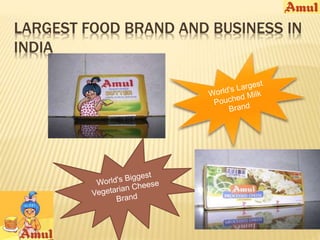
LARGEST FOOD BRAND AND BUSINESS IN 
INDIA
INTRODUCTION 
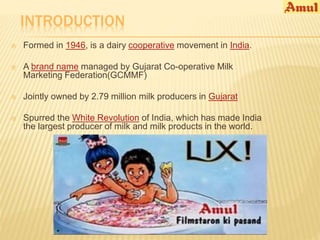
 Formed in 1946, is a dairy cooperative movement in India. 
 A brand name managed by Gujarat Co-operative Milk 
Marketing Federation(GCMMF) 
 Jointly owned by 2.79 million milk producers in Gujarat 
 Spurred the White Revolution of India, which has made India 
the largest producer of milk and milk products in the world.
INTRODUCTION 
 Overseas markets - Mauritius, UAE, USA, Bangladesh, Australia, China, 
Singapore, Hong Kong and a few South African countries 
 Fresh plans of flooding the markets of Japan & Sri Lanka. 
 Dr Verghese Kurien, former chairman of the GCMMF -the man behind the 
success of Amul. 
 Has a 15% market share in the Rs 15,000 crore milk category, and a 37% 
share in the Rs 900 crore organized ice-cream segment.
BUSINESS MODEL 
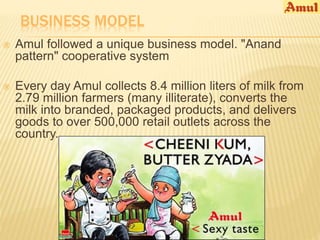
 Amul followed a unique business model. "Anand 
pattern" cooperative system 
 Every day Amul collects 8.4 million liters of milk from 
2.79 million farmers (many illiterate), converts the 
milk into branded, packaged products, and delivers 
goods to over 500,000 retail outlets across the 
country.
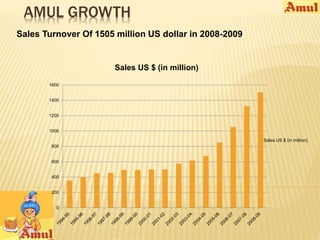
AMUL GROWTH 
Sales Turnover Of 1505 million US dollar in 2008-2009 
1600 
1400 
1200 
1000 
800 
600 
400 
200 
0 
Sales US $ (in million) 
Sales US $ (in million)
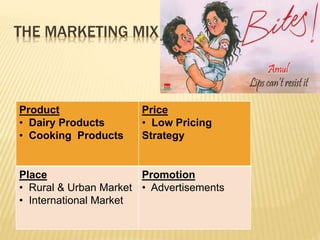
THE MARKETING MIX 
Product 
• Dairy Products 
• Cooking Products 
Price 
• Low Pricing 
Strategy 
Place 
• Rural & Urban Market 
• International Market 
Promotion 
• Advertisements
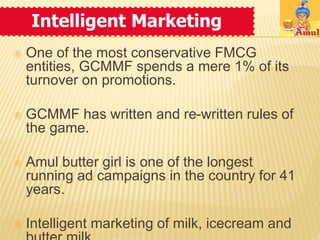
Intelligent Marketing 
 One of the most conservative FMCG 
entities, GCMMF spends a mere 1% of its 
turnover on promotions. 
 GCMMF has written and re-written rules of 
the game. 
 Amul butter girl is one of the longest 
running ad campaigns in the country for 41 
years. 
 Intelligent marketing of milk, icecream and 
butter milk.
EXPANSION TO FOREIGN 
SHORES 
 GCMMF had signed an agreement with Wal-Mart to stock its 
shelves with products under its Amul brand name. Amul 
processed cheese, pure ghee, Shrikhand, Nutramul, Amul's 
Mithaee Gulab Jamuns are few of the products marketed in the 
US markets. 
 50 per cent of Americans being medically obese, and if Amul is 
really looking to capture the hearts of the second- and third-generation 
Indians, offering low-fat versions of its brands, would 
make a lot of commercial sense. 
 Hence targeting the large Indian community in the US markets 
with its niche products like mithai, packaged ready to eat foods 
market it can definitely expand its market to a large extent.
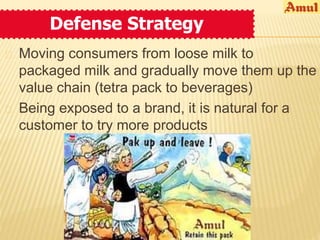
Defense Strategy 
 Moving consumers from loose milk to 
packaged milk and gradually move them up the 
value chain (tetra pack to beverages) 
 Being exposed to a brand, it is natural for a 
customer to try more products
Segmentation 
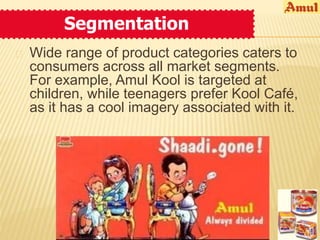
 Wide range of product categories caters to 
consumers across all market segments. 
For example, Amul Kool is targeted at 
children, while teenagers prefer Kool Café, 
as it has a cool imagery associated with it.
Targeting 
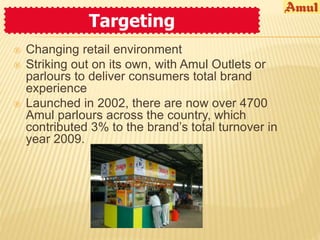
 Changing retail environment 
 Striking out on its own, with Amul Outlets or 
parlours to deliver consumers total brand 
experience 
 Launched in 2002, there are now over 4700 
Amul parlours across the country, which 
contributed 3% to the brand’s total turnover in 
year 2009.
Promotion 
 Given this wide product portfolio, Amul’s 
approach is to promote its brands in a rotational 
cycle of two to three years. 
 After ice-creams were launched in 1996, the 
category was re-visited in 1999, in order to 
improve availability of the product and make it 
affordable. 
 The focus shifted to cheese in 2001, Amul Masti 
Chaas in 2004-05 (sales of Masti dahi grew by 
25%), Nutramul and Kool Kafe in 2006 and this 
year the focus is on Amul Koko — cold 
chocolate drink
Promotion 
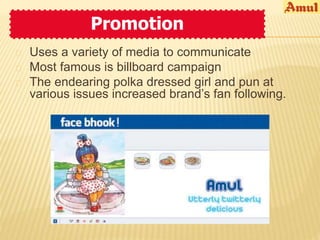
 Uses a variety of media to communicate 
 Most famous is billboard campaign 
 The endearing polka dressed girl and pun at 
various issues increased brand’s fan following.
Promotion 
 Amul food festival, which has been held for 
the last four year between October and 
December in about 50,000 retail outlets. 
 The Chef Of India contest invites people to 
come up with recipes using as many Amul 
products as possible. The recipe can be 
submitted on Amul’s website. 
 Slogan Likho Disneyland Dekho Contest
Promotion 
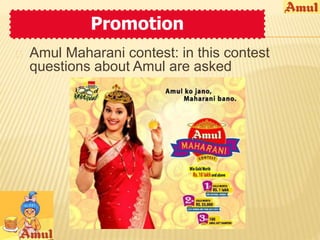
 Amul Maharani contest: in this contest 
questions about Amul are asked
Promotion 
 AMUL sponsored the Singing Competition 
AMUL Star Voice of India, Amul music ka 
maha mukabla
SUCCESSFUL PRODUCT STRATEGY: 
1. Product Positioning Strategy- 
 Low price Amul Ice - Creams made Kwality 
walls life hell. 
 Chocolate milk was launched ‘Amul Kool koko’ 
2. Product Re-Positioning Strategy- 
 Jaldhara – Narmada Neer
SUCCESSFUL PRODUCT STRATEGY: 
3. Product Overlap Strategy – 
 Amul Processed Cheese Vs Cheese Spread 
 Nutramul Energy Drink Vs Amul Kool 
4. Product Design Strategy – 
 Use of Utterly – Butterly Girl since 1967 
5. Product Elimination – 
 Eliminated Jaldhara – bottled water
SUCCESSFUL PRODUCT STRATEGY: 
6. Diversification Strategy – 
 Dairy Products 
Eg: Fresh Milk, Milk Drinks & Desserts, 
Bread Spreads, Cheese Products 
 Non Dairy Products 
Egg: Veg Oils , Snacks, Instant Food
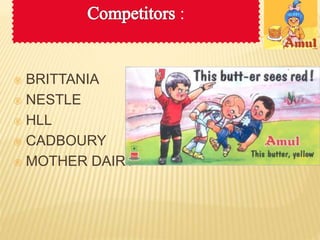
 BRITTANIA 
 NESTLE 
 HLL 
 CADBOURY 
 MOTHER DAIRY 
:
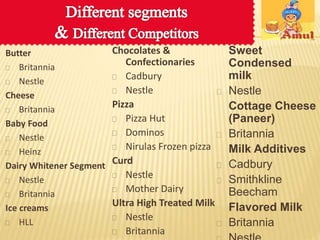
Butter 
 Britannia 
 Nestle 
Cheese 
 Britannia 
Baby Food 
 Nestle 
 Heinz 
Dairy Whitener Segment 
 Nestle 
 Britannia 
Ice creams 
 HLL 
Chocolates & 
Confectionaries 
 Cadbury 
 Nestle 
Pizza 
 Pizza Hut 
 Dominos 
 Nirulas Frozen pizza 
Curd 
 Nestle 
 Mother Dairy 
Ultra High Treated Milk 
 Nestle 
 Britannia 
Sweet 
Condensed 
milk 
 Nestle 
Cottage Cheese 
(Paneer) 
 Britannia 
Milk Additives 
 Cadbury 
 Smithkline 
Beecham 
Flavored Milk 
 Britannia 
 Nestle
CONCLUSION 
 Amul has risen from Indian soil and it remains 
Indian in every sense. 
 There is ample scope in the low priced 
segment as also in other categories. 
 There are a significant number of retailers who 
are currently stocking more than two brands. 
 Amul has the opportunity to capture the more 
evolved young adults and children who are 
open to new products provided they meet their 
expectations.
THANKYOU…

Amulppt 121101232750-phpapp02

  • 1.
  • 2.
  • 3.
    INDEX  Introduction  Marketing Mix  Business Model  Marketing Strategy  Competitors & Conclusion
  • 4.
    LARGEST FOOD BRANDAND BUSINESS IN INDIA
  • 5.
    INTRODUCTION  Formedin 1946, is a dairy cooperative movement in India.  A brand name managed by Gujarat Co-operative Milk Marketing Federation(GCMMF)  Jointly owned by 2.79 million milk producers in Gujarat  Spurred the White Revolution of India, which has made India the largest producer of milk and milk products in the world.
  • 6.
    INTRODUCTION  Overseasmarkets - Mauritius, UAE, USA, Bangladesh, Australia, China, Singapore, Hong Kong and a few South African countries  Fresh plans of flooding the markets of Japan & Sri Lanka.  Dr Verghese Kurien, former chairman of the GCMMF -the man behind the success of Amul.  Has a 15% market share in the Rs 15,000 crore milk category, and a 37% share in the Rs 900 crore organized ice-cream segment.
  • 7.
    BUSINESS MODEL Amul followed a unique business model. "Anand pattern" cooperative system  Every day Amul collects 8.4 million liters of milk from 2.79 million farmers (many illiterate), converts the milk into branded, packaged products, and delivers goods to over 500,000 retail outlets across the country.
  • 8.
    AMUL GROWTH SalesTurnover Of 1505 million US dollar in 2008-2009 1600 1400 1200 1000 800 600 400 200 0 Sales US $ (in million) Sales US $ (in million)
  • 9.
    THE MARKETING MIX Product • Dairy Products • Cooking Products Price • Low Pricing Strategy Place • Rural & Urban Market • International Market Promotion • Advertisements
  • 10.
    Intelligent Marketing One of the most conservative FMCG entities, GCMMF spends a mere 1% of its turnover on promotions.  GCMMF has written and re-written rules of the game.  Amul butter girl is one of the longest running ad campaigns in the country for 41 years.  Intelligent marketing of milk, icecream and butter milk.
  • 11.
    EXPANSION TO FOREIGN SHORES  GCMMF had signed an agreement with Wal-Mart to stock its shelves with products under its Amul brand name. Amul processed cheese, pure ghee, Shrikhand, Nutramul, Amul's Mithaee Gulab Jamuns are few of the products marketed in the US markets.  50 per cent of Americans being medically obese, and if Amul is really looking to capture the hearts of the second- and third-generation Indians, offering low-fat versions of its brands, would make a lot of commercial sense.  Hence targeting the large Indian community in the US markets with its niche products like mithai, packaged ready to eat foods market it can definitely expand its market to a large extent.
  • 12.
    Defense Strategy Moving consumers from loose milk to packaged milk and gradually move them up the value chain (tetra pack to beverages)  Being exposed to a brand, it is natural for a customer to try more products
  • 13.
    Segmentation  Widerange of product categories caters to consumers across all market segments. For example, Amul Kool is targeted at children, while teenagers prefer Kool Café, as it has a cool imagery associated with it.
  • 14.
    Targeting  Changingretail environment  Striking out on its own, with Amul Outlets or parlours to deliver consumers total brand experience  Launched in 2002, there are now over 4700 Amul parlours across the country, which contributed 3% to the brand’s total turnover in year 2009.
  • 15.
    Promotion  Giventhis wide product portfolio, Amul’s approach is to promote its brands in a rotational cycle of two to three years.  After ice-creams were launched in 1996, the category was re-visited in 1999, in order to improve availability of the product and make it affordable.  The focus shifted to cheese in 2001, Amul Masti Chaas in 2004-05 (sales of Masti dahi grew by 25%), Nutramul and Kool Kafe in 2006 and this year the focus is on Amul Koko — cold chocolate drink
  • 16.
    Promotion  Usesa variety of media to communicate  Most famous is billboard campaign  The endearing polka dressed girl and pun at various issues increased brand’s fan following.
  • 17.
    Promotion  Amulfood festival, which has been held for the last four year between October and December in about 50,000 retail outlets.  The Chef Of India contest invites people to come up with recipes using as many Amul products as possible. The recipe can be submitted on Amul’s website.  Slogan Likho Disneyland Dekho Contest
  • 18.
    Promotion  AmulMaharani contest: in this contest questions about Amul are asked
  • 19.
    Promotion  AMULsponsored the Singing Competition AMUL Star Voice of India, Amul music ka maha mukabla
  • 20.
    SUCCESSFUL PRODUCT STRATEGY: 1. Product Positioning Strategy-  Low price Amul Ice - Creams made Kwality walls life hell.  Chocolate milk was launched ‘Amul Kool koko’ 2. Product Re-Positioning Strategy-  Jaldhara – Narmada Neer
  • 21.
    SUCCESSFUL PRODUCT STRATEGY: 3. Product Overlap Strategy –  Amul Processed Cheese Vs Cheese Spread  Nutramul Energy Drink Vs Amul Kool 4. Product Design Strategy –  Use of Utterly – Butterly Girl since 1967 5. Product Elimination –  Eliminated Jaldhara – bottled water
  • 22.
    SUCCESSFUL PRODUCT STRATEGY: 6. Diversification Strategy –  Dairy Products Eg: Fresh Milk, Milk Drinks & Desserts, Bread Spreads, Cheese Products  Non Dairy Products Egg: Veg Oils , Snacks, Instant Food
  • 23.
     BRITTANIA NESTLE  HLL  CADBOURY  MOTHER DAIRY :
  • 24.
    Butter  Britannia  Nestle Cheese  Britannia Baby Food  Nestle  Heinz Dairy Whitener Segment  Nestle  Britannia Ice creams  HLL Chocolates & Confectionaries  Cadbury  Nestle Pizza  Pizza Hut  Dominos  Nirulas Frozen pizza Curd  Nestle  Mother Dairy Ultra High Treated Milk  Nestle  Britannia Sweet Condensed milk  Nestle Cottage Cheese (Paneer)  Britannia Milk Additives  Cadbury  Smithkline Beecham Flavored Milk  Britannia  Nestle
  • 25.
    CONCLUSION  Amulhas risen from Indian soil and it remains Indian in every sense.  There is ample scope in the low priced segment as also in other categories.  There are a significant number of retailers who are currently stocking more than two brands.  Amul has the opportunity to capture the more evolved young adults and children who are open to new products provided they meet their expectations.
  • 26.