Marketsegmentation,Targetingandpositioning
It is the process in marketing of grouping a market (i.e. Customers) into smaller
subgroups. These markets are often termed niche markets
or specialty markets.These segments are fairly homogeneous in their attitudes about
certain variables.
Because of this intra-group similarity, they are likely to
respond somewhat similarly to a given marketing strategy. T h a t i s , t h e y
a r e l i k e l y t o h a v e similar feeling and ideas about a marketing
mix comprised of a given product or service, sold at a given
price,distributes in a certain way, and promoted in a certain way.
Amul's robust strategies regarding STP for the product Butter has helped it to be no.1
throughout India.
SEGMENTATION FOR AMUL
T h e p u r p o s e o f s e g m e n t a t i o n f o r A M U L b u t t e r
i s t o i d e n t i f y a n d t a r g e t p r i m e c u s t o m e r groups (e.g. the 20% that
account for 80% of your sales) so that they get the maximum return from a limited
marketing budget.
Homogeneity within the segment
Heterogeneity between the segments
Segments are measurable and identifiable
Segments are accessible and actionable
It is large enough to be profitable
TARGETING FOR AMUL
After the most attractive segments are selected, a company should
not d i r e c t l y s t a r t t a r g e t i n g a l l t h e s e s e g m e n t s . T h e a t t r a c t i v e n e s s
o f t h e segments is also depending on other important factors. In the main activity of
defining a target market, four sub activities are given which are the bases
for deciding which segments will actually be targeted on.
POSITIONING FOR AMUL
AMUL has carefully cultivated its family based image.
Brand Positioning Statement : "The taste of India"- It has created a value for evryone in the
value chain, be it a customer or the supply chain.
Positioning Components :
Emotional Components : through the campaigns like ______ and "Taste of india"
Functinal Attributes : Unique functional attributes of Amul are :-
1. Value for money : The best Quality Butter (dairy product) at the reasonable price
2. Product Availability : It has huge supply chain and distribution netwroks across India and has
strong link back to the sourcing farmers.
Descriptive factor :
The butter is now a family product and relates to its homely image.
Brand Consistency :
Amul butter comes under the biggest brand that has been a part of the Topical campaign for 4
decades now,one of the longest running advertisements in the world.
Target market and segment :
It has positioned variety of products for different market segment
Marketing strategy of Amul
The Marketing strategy of Amul covers various aspects of the business right from
segmentation and targeting to the overall mission and vision of the company and the
various parameters which the company executes to become the top brand that it has in
the market. So what is the marketing strategy of Amul? Let us discuss
Segmentation, targeting, positioning in the Marketing strategy of Amul – The
segmentation of Amul is the mass population and in general, you will find people of all
different age groups and demography enjoying Amul products. This is because Amul is
not only present in Ice cream, but also in Milk, Butter, Cheese and other such products.
As it has a very deep product portfolio, it does not differentiate in its customers but uses
a mass marketing principle. And till date, this principle has worked very well for the
marketing strategy of Amul. Similarly, the target audience are the regular middle class
people. This is because higher end customers do have a lot of high end products as an
alternative in ice cream. However, for other products like Butter and cheese, both high
end and low end customers are the target. In terms of positioning, Amul has top of the
mind positioning because it is the first brand which comes in mind when talking of Ice
cream, milk, cheese, butter or any other milk based products.
Mission – “We the motivated and dedicated workforce at amul are committed to
produce wholesome and safe foods of excellent quality to remain market leader through
development of quality management system, state of art technology, innovation and
eco-friendly operations to achieve delightment of customers and milk producers”.
Vision – Amul has a vision to provide more and more satisfaction to the farmers,
employees and distributors.
Tagline – The taste of India.
Competitive advantage in the Marketing strategy of Amul – There are two major
competitive advantages of Amul over other brands. First and foremost is the supply chain.
Because of the large numbers of dairy suppliers, Amul has a tremendous strength and
reliability in its supply chain. Hence it is able to produce such high volumes. The second
competitive advantage is the wide product portfolio due to which it can run Amul shoppe’s
and also have its products present in retail. The product portfolio is such that products
like Butter and Ice cream are cash cows for the company.
BCG Matrix in the Marketing strategy of Amul – When we plot the BCG matrix,
Amul has certain products which are stars whereas others are cash cows. And in fact,
Amul chocolates are question marks because they have very low market share in a growing
market. Amul ice cream and Amul butter can clearly be said to be a cash cow because they
have very high market share and the market in itself is growing with the increase in
population. On the other hand, Dairy products like Milk, buttermilk, cheese, lassi, amul
kool etc have a lot of direct and indirect competition in their niche. However, when
compared with the same type of product, then Amul has a high market share. Thus, these
products are stars for Amul.
Distribution strategy in the Marketing strategy of Amul – Like any FMCG
company, Amul concentrates on breaking the bulk. It supplies in huge amounts to its C&F,
who is required to have the right arrangements to store Amul products in bulk. This C&F
then transfers the products to distributors who in turn give it to retailers. Furthermore,
Amul has a direct sale team too which sells to modern retail. Besides this, the company
has exclusive Amul stores which sell all products of Amul brand. Thus, in the marketing
strategy of Amul, distribution is another strength of the brand.
Brand equity in the Marketing strategy of Amul – Because of the excellent
products, the top of the mind positioning, the fantastic distribution and supply chain
channels and finally the point of purchase branding and advertising of the Amul girl,
Amul finds itself in a very strong position where its brand equity is concerned. Amul brand
is worth $3.2 billion as per the 2013 brand equity report. Furthermore, most analysts say
that Amul would have touched the $4 billion mark, but the dropping value of the rupee is
what caused the difference.
Competitive analysis in the Marketing strategy of Amul – Amul has some good
competitors who have entered the market in the last decade and growing strong steadily.
Most of these ice creams entered regionally but then held on to the regional market share.
Thus, even though individually these brands might not be a worthy adversary, combined
and with their total net aggregate, all of them together are giving a very tough competition
to Amul. Some of these competitors are Kwality walls, Vadilal, Havmore, Dinshaws, Arun
Ice cream, Baskin Robbins, London dairy and others. Many of these ice cream products
have their own niche or geographic targets. Arun ice cream is strong in the south whereas
havmor and Vadilal are strong in the west. Besides these organized players, there are
many unorganised local players who also give competition to Amul by having their own
outlets and their own variants of ice cream. However, the competition in Butter and
Cheese and other dairy products is far lesser.
Market analysis in the Marketing strategy of Amul – The FMCG market is highly
competitive in nature and is known to have a combination of organized players as well as
unorganized players. Similarly, in FMCG, direct competition is equally important as
indirect competition. For example – During winters, ice cream and cold milk products
will not sell, whereas butter and cheese will sell equally well. But on the other hand, during
summers the demand of ice cream shoots up so much so that companies are not able to
meet demands. Thus, when we analyse the market of Amul, in some cases Amul is the
clear market leader, whereas in other products it is a competitor in the market.
Customer analysis in the Marketing strategy of Amul – The typical customers of
Amul belong to the Sec B and Sec C segment wherein they are either middle class or lower
class. Amul in general uses mass marketing and therefore it targets these 2 classes
majorly. The high end customers are more likely to prefer a Naturals, a Baskin robbins,
or any other such brand which meets their taste and status.
This completes the analysis of the marketing strategy of Amul. What do you think of the
Amul brand and why do you think it is the market leader?
SWOT analysis of Amul
Amul is one of the largest milk and milk based products manufacturer in India. Known
to be the founder of the white revolution in India, Amul has some strong products and
brands up its sleeves, strongest of them being Amul ice cream. Similarly, the Milk &
Dairy products company has a very in depth product portfolio including cheese, butter,
curd, chocolates, ice cream, and others. You can visit the following link to refer to
the marketing mix of Amul. However, following are the points in the SWOT analysis of
Amul.
Strengths in the SWOT analysis of Amul
Very high market share in ice cream – Amul has the top market share in ice cream
segment which further helps it push other products into the market.
Excellent brand equity – amul is a beloved brand over the years and the
contribution of amul girl and her outdoor ads should specifically be mentioned here.
Excellent quality management – even though amul has such a wide and large
distribution network, hardly any quality complaints come for amul.
Strong distribution network – This is one company which is strong in urban as well
as rural distribution. You will find amul present even in small towns and villages.
Good product portfolio – Amul had a deep product portfolio when compared to any
fmcg company. It has many different variety of milk milk based food items like cheese,
butter, milk, buttermilk, lassi and many others. In ice creams too, amul has a large
variety of flavours
Strong Supply chain – Vendors love Amul and amul is known for the white
revolution in India.
Rural presence – Strong rural presence of Amul is its plus point. It is mentioned here
separately because this rural presence gives amul a strong competitive advantage.
Weaknesses in the SWOT analysis of Amul
Cost of Operations – Amul’s operation is huge. And so is the cost. Plus the sector is
such that maintaining margins becomes difficult day by day. Thus, to face international
players, Amul needs to maintain the operations in the same manner it is carrying out
today. It is not a weakness but rather a constant challenge for Amul. In fact, during
summers, the brand faces severe shortage of supply.
Chocolates – Amuls expansion to chocolate has failed and hardly any product of Amul
chocolates is selling in the market. Amul needs further products to expand its product
line and increase bottomline.
Opportunities in the SWOT analysis of Amul
Export – Amul can export its product to other countries thereby increasing its turnover
and margins exponentially.
Concentrate more on chocolate market – Amul has a no advertisement policy
which creates a problem for its foray into additional products. Amul should in fact have
separate SBU’s and concentrate more on increasing its product line through chocolates
or other such products.
Threats in the SWOT analysis of Amul
Increasing competition in Ice cream segment – Many players, local and
international, are entering the ice cream market thereby taking away share of wallet
from Amul. Kwality walls, Naturals, London dairy, Havmor, Arun ice cream, Vadilal,
Ramani, are some of the few brands who are directly in competition with Amul.
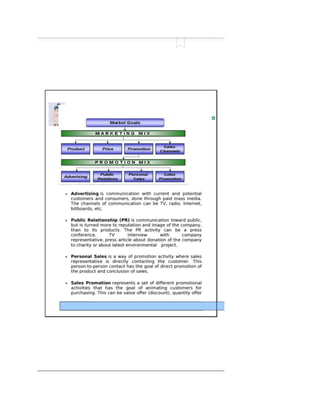
Marketing mix of Amul
Amul is definitely an “Amoolya” brand. Amoolya in Sanskrit means something which is
invaluable or priceless. With a presence in almost every product which can be made by
milk, Amul has won over hearts along with market share to become a highly valued brand
with an Indian origin. Amul was formed because of a revolt of dairy farmers. And today,
Amul is a brand against which companies want to compete and come on top but the same
is not being allowed by the smart minds in Amul. The reason Amul is such a strong brand
is because of the marketing mix of Amul. Here is an in depth analysis of the Marketing
mix of Amul.
Product in the marketing mix of Amul –
Amul has a very very strong product portfolio. Amul product portfolio is comprised
mainly of Dairy products. Amul butter, Amul cheese and Amul ice cream are cash cows
for Amul as they have the major market share in their product category. Amul ice cream
is amongst the top 10 ice cream brands of India.
Amul milk, Amul Paneer and Amul Dahi consumption is on the rise. In fact Amul milk
has 26% of market share in the packaged milk segment. The only disappointing
performance is seen in Amul Chocolates which are a burden for Amul and lot of push is
required for the sales of the same. This is because the chocolate market has established
players like Parle, Dairy milk and others.
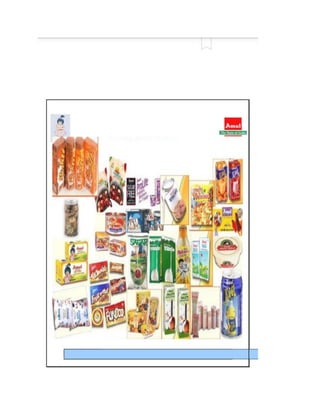
The Amul family tree has the following brands – Amul Milk, Amul bread spreads, Amul
Cheese, Amul Milk, Amul kool and its variants, Amul pro, Amul ice cream, Amul Paneer,
Amul Dahi, Amul Ghee, Amul Milk powders, Amul Nutramul, Amul mithai range,
Amul mithai mate, Amul chocolates, Amul butter milk. Thus the product portfolio of
Amul considering its dairy origins is astounding. Amul has various competitors based on
different products. In ice cream it is Vadilal, Dinshaws and Havmor. In butter and milk
there is mother dairy, Britannia and others. However, no competitor has such a vast dairy
based product portfolio as Amul. This is the major reason that Amul has a
sustainable competitive advantage over its competitors.
Price in the marketing mix of Amul –
Amul has a strategy of low cost pricing. Some may call it penetrative pricing. But
penetrative pricing strategy is used when the market has a high level of competition and
a player wants to establish itself in the market by giving low prices. However, in the case
of Amul, when Amul started, there were no national players and the dairy market was
unorganized. During the introduction stage itself, Amul had a vision to provide their
products to end customers at the best affordable rates. And the same vision is in place
even today.
Today also, you will find that Amul butter, milk and cheese are available at affordable
prices keeping in mind the end customers. You may call these products costly, but the cost
has nothing to do with Amul’s strategy. Remember that transportation costs as well as
storage and distribution costs are very high in FMCG. Thus, as the cost of transportation,
storage and distribution has increased over the years, so has the cost of Amul products
gone up. But considering their value for the average India consumer, these products are
still priced at an affordable rate.
Place in the marketing mix of Amul –
Amul has a massive distribution network because its ice creams, milk, butter and cheese
is found practically everywhere. As it is a FMCG product, Amul follows the methodology
of breaking the bulk. The initial factory output is in bulk. Later on this bulk becomes
smaller and smaller and finally one individual slab of butter or scoop of ice cream is sold
at the retail place.
There are two different channels through which Distribution happens in Amul. One is
the procurement channel which is responsible for collection of Milk through dairy co
operatives. The other is the distribution channel which is responsible for distributing
the finalized product to the end customers.
In the procurement channel, the milk is individually delivered from farmers to the co
operatives. The co operatives then collect all this milk and send the bulk to the
manufacturing facility. At the manufacturing facility, the milk is used to manufacture the
finalised products.
In the distribution channel, there are carrying and forwarding agents,
distributors, dealers and retailers involved. There are also Amul shoppe’s which sell all
products in the Amul product portfolio. The distribution is as follows.
Amul >> Carrying and forwarding agent >> Distributor >> Dealer / Retailer / Amul
Shoppe >> Customer
Amul >> Modern retail
Thus there is a lot of transportation involved for all of Amul’s products. However, the
distribution channel of Amul ensures that the products reach every nook and corner of
India.
Promotions in the marketing mix of Amul –
Amul is responsible for one of the most unique and longest running outdoor campaign as
well as one of the most known outdoor advertising characters – The Amul girl. We would
like to take this opportunity to specially thank Mr Eustace fernandes, the creative brain
behind the sweet girl. But we should know by now that the Amul girl is hardly sweet or
cute. She is known to be the most naughty advertising girl ever. Amul hoardings mainly
feature the current news and are used to take a tongue in cheek viewpoint at current
happenings. However, each advertisement hits the nail on the head.
The promotions of Amul are mainly for butter but for all the other products there is hardly
any promotions. During the launch of products, Amul is known to go ATL and advertise
milk, butter etc. The Smita Patil ad wherein Smita patil is shown as a village
milk collector is one of the most famous ads for Amul. But overall, the main
advertisement is BTL through outdoor, trade promotions, discount schemes and sales
promotions.
The major reason for Amul’s absence in hardcore advertising is that Amul does not want
to give away margins in advertising its products. As per Amul, their maximum budget for
advertising is 1% of the turnover. Above and beyond that will directly affect the cost of the
product. And the major reason for Amuls strong presence in the market is its excellent
quality combined with the affordable price. Thus, overall promotions will always be low
for Amul except for the outdoor advertising of Amul butter.
This concludes the marketing mix of Amul. The bottom line is that we love that an Indian
brand like Amul has reached such staggering heights and that we are a part of the time
when such a white revolution took place.

Amul_Final_Project.pdf

  • 57.
    Marketsegmentation,Targetingandpositioning It is theprocess in marketing of grouping a market (i.e. Customers) into smaller subgroups. These markets are often termed niche markets or specialty markets.These segments are fairly homogeneous in their attitudes about certain variables. Because of this intra-group similarity, they are likely to respond somewhat similarly to a given marketing strategy. T h a t i s , t h e y a r e l i k e l y t o h a v e similar feeling and ideas about a marketing mix comprised of a given product or service, sold at a given price,distributes in a certain way, and promoted in a certain way. Amul's robust strategies regarding STP for the product Butter has helped it to be no.1 throughout India. SEGMENTATION FOR AMUL T h e p u r p o s e o f s e g m e n t a t i o n f o r A M U L b u t t e r i s t o i d e n t i f y a n d t a r g e t p r i m e c u s t o m e r groups (e.g. the 20% that account for 80% of your sales) so that they get the maximum return from a limited marketing budget. Homogeneity within the segment Heterogeneity between the segments Segments are measurable and identifiable Segments are accessible and actionable It is large enough to be profitable TARGETING FOR AMUL After the most attractive segments are selected, a company should not d i r e c t l y s t a r t t a r g e t i n g a l l t h e s e s e g m e n t s . T h e a t t r a c t i v e n e s s o f t h e segments is also depending on other important factors. In the main activity of defining a target market, four sub activities are given which are the bases for deciding which segments will actually be targeted on.
  • 58.
    POSITIONING FOR AMUL AMULhas carefully cultivated its family based image. Brand Positioning Statement : "The taste of India"- It has created a value for evryone in the value chain, be it a customer or the supply chain. Positioning Components : Emotional Components : through the campaigns like ______ and "Taste of india" Functinal Attributes : Unique functional attributes of Amul are :- 1. Value for money : The best Quality Butter (dairy product) at the reasonable price 2. Product Availability : It has huge supply chain and distribution netwroks across India and has strong link back to the sourcing farmers. Descriptive factor : The butter is now a family product and relates to its homely image. Brand Consistency : Amul butter comes under the biggest brand that has been a part of the Topical campaign for 4 decades now,one of the longest running advertisements in the world. Target market and segment : It has positioned variety of products for different market segment
  • 59.
    Marketing strategy ofAmul The Marketing strategy of Amul covers various aspects of the business right from segmentation and targeting to the overall mission and vision of the company and the various parameters which the company executes to become the top brand that it has in the market. So what is the marketing strategy of Amul? Let us discuss Segmentation, targeting, positioning in the Marketing strategy of Amul – The segmentation of Amul is the mass population and in general, you will find people of all different age groups and demography enjoying Amul products. This is because Amul is not only present in Ice cream, but also in Milk, Butter, Cheese and other such products. As it has a very deep product portfolio, it does not differentiate in its customers but uses a mass marketing principle. And till date, this principle has worked very well for the marketing strategy of Amul. Similarly, the target audience are the regular middle class people. This is because higher end customers do have a lot of high end products as an alternative in ice cream. However, for other products like Butter and cheese, both high end and low end customers are the target. In terms of positioning, Amul has top of the mind positioning because it is the first brand which comes in mind when talking of Ice cream, milk, cheese, butter or any other milk based products. Mission – “We the motivated and dedicated workforce at amul are committed to produce wholesome and safe foods of excellent quality to remain market leader through development of quality management system, state of art technology, innovation and eco-friendly operations to achieve delightment of customers and milk producers”. Vision – Amul has a vision to provide more and more satisfaction to the farmers, employees and distributors. Tagline – The taste of India. Competitive advantage in the Marketing strategy of Amul – There are two major competitive advantages of Amul over other brands. First and foremost is the supply chain. Because of the large numbers of dairy suppliers, Amul has a tremendous strength and reliability in its supply chain. Hence it is able to produce such high volumes. The second competitive advantage is the wide product portfolio due to which it can run Amul shoppe’s and also have its products present in retail. The product portfolio is such that products like Butter and Ice cream are cash cows for the company.
  • 60.
    BCG Matrix inthe Marketing strategy of Amul – When we plot the BCG matrix, Amul has certain products which are stars whereas others are cash cows. And in fact, Amul chocolates are question marks because they have very low market share in a growing market. Amul ice cream and Amul butter can clearly be said to be a cash cow because they have very high market share and the market in itself is growing with the increase in population. On the other hand, Dairy products like Milk, buttermilk, cheese, lassi, amul kool etc have a lot of direct and indirect competition in their niche. However, when compared with the same type of product, then Amul has a high market share. Thus, these products are stars for Amul. Distribution strategy in the Marketing strategy of Amul – Like any FMCG company, Amul concentrates on breaking the bulk. It supplies in huge amounts to its C&F, who is required to have the right arrangements to store Amul products in bulk. This C&F then transfers the products to distributors who in turn give it to retailers. Furthermore, Amul has a direct sale team too which sells to modern retail. Besides this, the company has exclusive Amul stores which sell all products of Amul brand. Thus, in the marketing strategy of Amul, distribution is another strength of the brand. Brand equity in the Marketing strategy of Amul – Because of the excellent products, the top of the mind positioning, the fantastic distribution and supply chain channels and finally the point of purchase branding and advertising of the Amul girl, Amul finds itself in a very strong position where its brand equity is concerned. Amul brand is worth $3.2 billion as per the 2013 brand equity report. Furthermore, most analysts say that Amul would have touched the $4 billion mark, but the dropping value of the rupee is what caused the difference. Competitive analysis in the Marketing strategy of Amul – Amul has some good competitors who have entered the market in the last decade and growing strong steadily. Most of these ice creams entered regionally but then held on to the regional market share. Thus, even though individually these brands might not be a worthy adversary, combined and with their total net aggregate, all of them together are giving a very tough competition to Amul. Some of these competitors are Kwality walls, Vadilal, Havmore, Dinshaws, Arun Ice cream, Baskin Robbins, London dairy and others. Many of these ice cream products have their own niche or geographic targets. Arun ice cream is strong in the south whereas havmor and Vadilal are strong in the west. Besides these organized players, there are many unorganised local players who also give competition to Amul by having their own
  • 61.
    outlets and theirown variants of ice cream. However, the competition in Butter and Cheese and other dairy products is far lesser. Market analysis in the Marketing strategy of Amul – The FMCG market is highly competitive in nature and is known to have a combination of organized players as well as unorganized players. Similarly, in FMCG, direct competition is equally important as indirect competition. For example – During winters, ice cream and cold milk products will not sell, whereas butter and cheese will sell equally well. But on the other hand, during summers the demand of ice cream shoots up so much so that companies are not able to meet demands. Thus, when we analyse the market of Amul, in some cases Amul is the clear market leader, whereas in other products it is a competitor in the market. Customer analysis in the Marketing strategy of Amul – The typical customers of Amul belong to the Sec B and Sec C segment wherein they are either middle class or lower class. Amul in general uses mass marketing and therefore it targets these 2 classes majorly. The high end customers are more likely to prefer a Naturals, a Baskin robbins, or any other such brand which meets their taste and status. This completes the analysis of the marketing strategy of Amul. What do you think of the Amul brand and why do you think it is the market leader? SWOT analysis of Amul Amul is one of the largest milk and milk based products manufacturer in India. Known to be the founder of the white revolution in India, Amul has some strong products and brands up its sleeves, strongest of them being Amul ice cream. Similarly, the Milk & Dairy products company has a very in depth product portfolio including cheese, butter, curd, chocolates, ice cream, and others. You can visit the following link to refer to the marketing mix of Amul. However, following are the points in the SWOT analysis of Amul.
  • 62.
    Strengths in theSWOT analysis of Amul Very high market share in ice cream – Amul has the top market share in ice cream segment which further helps it push other products into the market. Excellent brand equity – amul is a beloved brand over the years and the contribution of amul girl and her outdoor ads should specifically be mentioned here. Excellent quality management – even though amul has such a wide and large distribution network, hardly any quality complaints come for amul. Strong distribution network – This is one company which is strong in urban as well as rural distribution. You will find amul present even in small towns and villages. Good product portfolio – Amul had a deep product portfolio when compared to any fmcg company. It has many different variety of milk milk based food items like cheese, butter, milk, buttermilk, lassi and many others. In ice creams too, amul has a large variety of flavours Strong Supply chain – Vendors love Amul and amul is known for the white revolution in India. Rural presence – Strong rural presence of Amul is its plus point. It is mentioned here separately because this rural presence gives amul a strong competitive advantage. Weaknesses in the SWOT analysis of Amul Cost of Operations – Amul’s operation is huge. And so is the cost. Plus the sector is such that maintaining margins becomes difficult day by day. Thus, to face international players, Amul needs to maintain the operations in the same manner it is carrying out today. It is not a weakness but rather a constant challenge for Amul. In fact, during summers, the brand faces severe shortage of supply. Chocolates – Amuls expansion to chocolate has failed and hardly any product of Amul chocolates is selling in the market. Amul needs further products to expand its product line and increase bottomline.
  • 63.
    Opportunities in theSWOT analysis of Amul Export – Amul can export its product to other countries thereby increasing its turnover and margins exponentially. Concentrate more on chocolate market – Amul has a no advertisement policy which creates a problem for its foray into additional products. Amul should in fact have separate SBU’s and concentrate more on increasing its product line through chocolates or other such products. Threats in the SWOT analysis of Amul Increasing competition in Ice cream segment – Many players, local and international, are entering the ice cream market thereby taking away share of wallet from Amul. Kwality walls, Naturals, London dairy, Havmor, Arun ice cream, Vadilal, Ramani, are some of the few brands who are directly in competition with Amul. Marketing mix of Amul Amul is definitely an “Amoolya” brand. Amoolya in Sanskrit means something which is invaluable or priceless. With a presence in almost every product which can be made by milk, Amul has won over hearts along with market share to become a highly valued brand with an Indian origin. Amul was formed because of a revolt of dairy farmers. And today, Amul is a brand against which companies want to compete and come on top but the same is not being allowed by the smart minds in Amul. The reason Amul is such a strong brand is because of the marketing mix of Amul. Here is an in depth analysis of the Marketing mix of Amul. Product in the marketing mix of Amul –
  • 64.
    Amul has avery very strong product portfolio. Amul product portfolio is comprised mainly of Dairy products. Amul butter, Amul cheese and Amul ice cream are cash cows for Amul as they have the major market share in their product category. Amul ice cream is amongst the top 10 ice cream brands of India. Amul milk, Amul Paneer and Amul Dahi consumption is on the rise. In fact Amul milk has 26% of market share in the packaged milk segment. The only disappointing performance is seen in Amul Chocolates which are a burden for Amul and lot of push is required for the sales of the same. This is because the chocolate market has established players like Parle, Dairy milk and others. The Amul family tree has the following brands – Amul Milk, Amul bread spreads, Amul Cheese, Amul Milk, Amul kool and its variants, Amul pro, Amul ice cream, Amul Paneer, Amul Dahi, Amul Ghee, Amul Milk powders, Amul Nutramul, Amul mithai range, Amul mithai mate, Amul chocolates, Amul butter milk. Thus the product portfolio of Amul considering its dairy origins is astounding. Amul has various competitors based on different products. In ice cream it is Vadilal, Dinshaws and Havmor. In butter and milk there is mother dairy, Britannia and others. However, no competitor has such a vast dairy based product portfolio as Amul. This is the major reason that Amul has a sustainable competitive advantage over its competitors. Price in the marketing mix of Amul – Amul has a strategy of low cost pricing. Some may call it penetrative pricing. But penetrative pricing strategy is used when the market has a high level of competition and a player wants to establish itself in the market by giving low prices. However, in the case of Amul, when Amul started, there were no national players and the dairy market was unorganized. During the introduction stage itself, Amul had a vision to provide their products to end customers at the best affordable rates. And the same vision is in place even today. Today also, you will find that Amul butter, milk and cheese are available at affordable prices keeping in mind the end customers. You may call these products costly, but the cost
  • 65.
    has nothing todo with Amul’s strategy. Remember that transportation costs as well as storage and distribution costs are very high in FMCG. Thus, as the cost of transportation, storage and distribution has increased over the years, so has the cost of Amul products gone up. But considering their value for the average India consumer, these products are still priced at an affordable rate. Place in the marketing mix of Amul – Amul has a massive distribution network because its ice creams, milk, butter and cheese is found practically everywhere. As it is a FMCG product, Amul follows the methodology of breaking the bulk. The initial factory output is in bulk. Later on this bulk becomes smaller and smaller and finally one individual slab of butter or scoop of ice cream is sold at the retail place. There are two different channels through which Distribution happens in Amul. One is the procurement channel which is responsible for collection of Milk through dairy co operatives. The other is the distribution channel which is responsible for distributing the finalized product to the end customers. In the procurement channel, the milk is individually delivered from farmers to the co operatives. The co operatives then collect all this milk and send the bulk to the manufacturing facility. At the manufacturing facility, the milk is used to manufacture the finalised products. In the distribution channel, there are carrying and forwarding agents, distributors, dealers and retailers involved. There are also Amul shoppe’s which sell all products in the Amul product portfolio. The distribution is as follows. Amul >> Carrying and forwarding agent >> Distributor >> Dealer / Retailer / Amul Shoppe >> Customer Amul >> Modern retail Thus there is a lot of transportation involved for all of Amul’s products. However, the distribution channel of Amul ensures that the products reach every nook and corner of India. Promotions in the marketing mix of Amul –
  • 66.
    Amul is responsiblefor one of the most unique and longest running outdoor campaign as well as one of the most known outdoor advertising characters – The Amul girl. We would like to take this opportunity to specially thank Mr Eustace fernandes, the creative brain behind the sweet girl. But we should know by now that the Amul girl is hardly sweet or cute. She is known to be the most naughty advertising girl ever. Amul hoardings mainly feature the current news and are used to take a tongue in cheek viewpoint at current happenings. However, each advertisement hits the nail on the head. The promotions of Amul are mainly for butter but for all the other products there is hardly any promotions. During the launch of products, Amul is known to go ATL and advertise milk, butter etc. The Smita Patil ad wherein Smita patil is shown as a village milk collector is one of the most famous ads for Amul. But overall, the main advertisement is BTL through outdoor, trade promotions, discount schemes and sales promotions. The major reason for Amul’s absence in hardcore advertising is that Amul does not want to give away margins in advertising its products. As per Amul, their maximum budget for advertising is 1% of the turnover. Above and beyond that will directly affect the cost of the product. And the major reason for Amuls strong presence in the market is its excellent quality combined with the affordable price. Thus, overall promotions will always be low for Amul except for the outdoor advertising of Amul butter. This concludes the marketing mix of Amul. The bottom line is that we love that an Indian brand like Amul has reached such staggering heights and that we are a part of the time when such a white revolution took place.