GAMETE FUSION AND EARLY
DEVELOPMENT IN MAMMALS
Dr.J.JOONU
Asst.Prof,
Department Of Zoology,
Bishop Heber College,
Trichy-17.
MAMMALIAN EGG
• Mammalian eggs are
among the smallest in the
animal kingdom, making
them hard to manipulate
experimentally.
• The human zygote, for
instance, is only 100 μm
in diameter—barely
visible to the eye and less
than one-thousandth the
volume of a Xenopus
egg.
Gamete fusion
• In mammals the entry of sperm is tangential to the
eggs surface. Once inside the egg, the sperm
nucleus becomes male pronucleus.
• The sperm centrosome produces asters and
contacts the female pronucleus. Male & female
pronuclei migrate towards each other.
• They remain adjacent to each other;
• their nuclear envelopes break down but instead of
forming a zygote nucleus the chromatin
condenses into chromosomes orienting them on a
common mitotic spindle.
The unique nature of mammalian
cleavage
• The mammalian oocyte is released from the ovary
and swept by the fimbriae into the oviduct .
• Fertilization occurs in the ampulla of the oviduct,
a region close to the ovary.
• Meiosis is completed at this time, and first
cleavage begins about a day later .
• Cleavages in mammalian eggs are among the
slowest in the animal kingdom—about 12–24
hours apart.
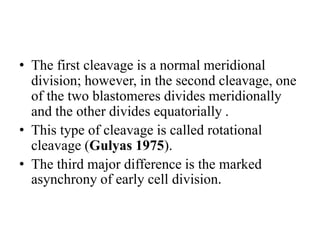
• The first cleavage is a normal meridional
division; however, in the second cleavage, one
of the two blastomeres divides meridionally
and the other divides equatorially .
• This type of cleavage is called rotational
cleavage (Gulyas 1975).
• The third major difference is the marked
asynchrony of early cell division.
Compaction
• Following the third cleavage, however, the
blastomeres undergo a spectacular change in
their behavior.
• They suddenly huddle together, maximizing
their contact with one another and forming a
compact ball of cells
Compaction process
• The cells of the compacted 8-cell embryo divide to
produce a 16-cell morula (Figure 11.22E).
• The morula - small group of internal cells surrounded
by a larger group of external cells (Barlow et al. 1972).
• The descendants of the external cells become the
trophoblast (trophectoderm) cells -it forms the tissue of
the chorion, the embryonic portion of the placenta.
The chorion –
• fetus to get oxygen and nourishment from the mother.
• It also secretes hormones that cause the mother's uterus
to retain the fetus,
• It produces regulators of the immune response so that
the mother will not reject the embryo.
• These cells generate the inner cell mass (ICM),
gives rise to the embryo and its associated yolk
sac, allantois, and amnion.
• By the 64-cell stage, the inner cell mass
(approximately 13 cells) and the trophoblast cells
-separate cell layers.
• Thus, the distinction between trophoblast and
inner cell mass blastomeres - the first
differentiation event in mammalian development.
• This differentiation is required for the early
mammalian embryo to adhere to the uterus
MAMMALIAN BLATOCYST
Implantation of the mammalian blastocyst into the
uterus. (A) Mouse blastocysts entering the uterus.
(B) Initial implantation of the blastocyst in a rhesus
monkey.
CAVITATION PROCESS
• a process called cavitation, the
trophoblast cells secrete fluid
into the morula to create a
blastocoel.
• The inner cell mass is positioned
on one side of the ring of
trophoblast cells.
• the blastocyst, is another
hallmark of mammalian
cleavage.
• This fetal organ—the chorion—is derived
primarily from embryonic trophoblast
cells, supplemented with mesodermal
cells derived from the inner cell mass.
• The chorion forms the fetal portion of the
placenta. It will induce the uterine cells to
form the maternal portion of the placenta,
the decidua. The decidua becomes rich in
the blood vessels that will provide
oxygen and nutrients to the embryo.
The origins of early mammalian tissues are summarized in .
• The first segregation of cells within the inner cell mass results
in the formation of the hypoblast (sometimes called the
primitive endoderm) layer .
• The hypoblast cells delaminate from the inner cell mass to line
the blastocoel cavity, where they give rise to the
extraembryonic endoderm, which forms the yolk sac.
• The remaining inner cell mass tissue above the hypoblast is
now referred to as the epiblast. separate the embryonic epiblast
from the other epiblast cells, which form the amnionic cavity .
• Once the lining of the amnion is completed, it fills with a
secretion called amnionic (amniotic) fluid, which serves as a
shock absorber for the developing embryo while preventing its
desiccation.
• The embryonic epiblast is believed to contain all the cells that
will generate the actual embryo, and it is similar in many ways
to the avian epiblast.
• Gastrulation begins at the posterior end of the embryo,
and this is where the node forms
• the mammalian mesoderm and endoderm migrate
through a primitive streak, the migrating cells of the
mammalian epiblast lose E-cadherin, detach from their
neighbors, -migrate through the streak as individual
cells (Burdsall et al. 1993).
• Those cells migrating through the node give rise to the
notochord - integrated into the endoderm of the
primitive gut (Jurand 1974; Sulik et al. 1994).
• These cells can be seen as a band of small, ciliated cells
extending rostrally from the node .
• They form the notochord by converging medially and
folding off in a dorsal direction from the roof of the gut.
• The original type of trophoblast cells constitute
a layer called the cytotrophoblast, whereas the
multinucleated type of cell forms the
syncytiotrophoblast.
• The cytotrophoblast initially adheres to the
endometrium -adhesion molecules.
• These cells also contain proteolytic enzymes
that enable them to enter the uterine wall and
remodel the uterine blood vessels so that the
maternal blood bathes fetal blood vessels
The ventral surface a the 7.5-day
mouse embryo, seen by scanning
electron microscopy.
The presumptive notochord cells are
the small, ciliated cells in the
midline that are flanked by the larger
endodermal cells of the primitive
gut.
The node (with its ciliated cells) is
seen at the bottom. (B) The
formation of the notochord by the
dorsal infolding of the small, ciliated
cells
Human embryo after 50 days of
gestation
Chorionic villi to maternal blood
supply
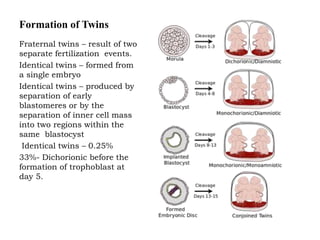
Formation of Twins
Fraternal twins – result of two
separate fertilization events.
Identical twins – formed from
a single embryo
Identical twins – produced by
separation of early
blastomeres or by the
separation of inner cell mass
into two regions within the
same blastocyst
Identical twins – 0.25%
33%- Dichorionic before the
formation of trophoblast at
day 5.
TWINS

Amnion & early development

  • 1.
    GAMETE FUSION ANDEARLY DEVELOPMENT IN MAMMALS Dr.J.JOONU Asst.Prof, Department Of Zoology, Bishop Heber College, Trichy-17.
  • 2.
    MAMMALIAN EGG • Mammalianeggs are among the smallest in the animal kingdom, making them hard to manipulate experimentally. • The human zygote, for instance, is only 100 μm in diameter—barely visible to the eye and less than one-thousandth the volume of a Xenopus egg.
  • 3.
    Gamete fusion • Inmammals the entry of sperm is tangential to the eggs surface. Once inside the egg, the sperm nucleus becomes male pronucleus. • The sperm centrosome produces asters and contacts the female pronucleus. Male & female pronuclei migrate towards each other. • They remain adjacent to each other; • their nuclear envelopes break down but instead of forming a zygote nucleus the chromatin condenses into chromosomes orienting them on a common mitotic spindle.
  • 5.
    The unique natureof mammalian cleavage • The mammalian oocyte is released from the ovary and swept by the fimbriae into the oviduct . • Fertilization occurs in the ampulla of the oviduct, a region close to the ovary. • Meiosis is completed at this time, and first cleavage begins about a day later . • Cleavages in mammalian eggs are among the slowest in the animal kingdom—about 12–24 hours apart.
  • 7.
    • The firstcleavage is a normal meridional division; however, in the second cleavage, one of the two blastomeres divides meridionally and the other divides equatorially . • This type of cleavage is called rotational cleavage (Gulyas 1975). • The third major difference is the marked asynchrony of early cell division.
  • 8.
    Compaction • Following thethird cleavage, however, the blastomeres undergo a spectacular change in their behavior. • They suddenly huddle together, maximizing their contact with one another and forming a compact ball of cells
  • 9.
  • 10.
    • The cellsof the compacted 8-cell embryo divide to produce a 16-cell morula (Figure 11.22E). • The morula - small group of internal cells surrounded by a larger group of external cells (Barlow et al. 1972). • The descendants of the external cells become the trophoblast (trophectoderm) cells -it forms the tissue of the chorion, the embryonic portion of the placenta. The chorion – • fetus to get oxygen and nourishment from the mother. • It also secretes hormones that cause the mother's uterus to retain the fetus, • It produces regulators of the immune response so that the mother will not reject the embryo.
  • 11.
    • These cellsgenerate the inner cell mass (ICM), gives rise to the embryo and its associated yolk sac, allantois, and amnion. • By the 64-cell stage, the inner cell mass (approximately 13 cells) and the trophoblast cells -separate cell layers. • Thus, the distinction between trophoblast and inner cell mass blastomeres - the first differentiation event in mammalian development. • This differentiation is required for the early mammalian embryo to adhere to the uterus
  • 12.
    MAMMALIAN BLATOCYST Implantation ofthe mammalian blastocyst into the uterus. (A) Mouse blastocysts entering the uterus. (B) Initial implantation of the blastocyst in a rhesus monkey.
  • 13.
    CAVITATION PROCESS • aprocess called cavitation, the trophoblast cells secrete fluid into the morula to create a blastocoel. • The inner cell mass is positioned on one side of the ring of trophoblast cells. • the blastocyst, is another hallmark of mammalian cleavage.
  • 15.
    • This fetalorgan—the chorion—is derived primarily from embryonic trophoblast cells, supplemented with mesodermal cells derived from the inner cell mass. • The chorion forms the fetal portion of the placenta. It will induce the uterine cells to form the maternal portion of the placenta, the decidua. The decidua becomes rich in the blood vessels that will provide oxygen and nutrients to the embryo.
  • 16.
    The origins ofearly mammalian tissues are summarized in . • The first segregation of cells within the inner cell mass results in the formation of the hypoblast (sometimes called the primitive endoderm) layer . • The hypoblast cells delaminate from the inner cell mass to line the blastocoel cavity, where they give rise to the extraembryonic endoderm, which forms the yolk sac. • The remaining inner cell mass tissue above the hypoblast is now referred to as the epiblast. separate the embryonic epiblast from the other epiblast cells, which form the amnionic cavity . • Once the lining of the amnion is completed, it fills with a secretion called amnionic (amniotic) fluid, which serves as a shock absorber for the developing embryo while preventing its desiccation. • The embryonic epiblast is believed to contain all the cells that will generate the actual embryo, and it is similar in many ways to the avian epiblast.
  • 18.
    • Gastrulation beginsat the posterior end of the embryo, and this is where the node forms • the mammalian mesoderm and endoderm migrate through a primitive streak, the migrating cells of the mammalian epiblast lose E-cadherin, detach from their neighbors, -migrate through the streak as individual cells (Burdsall et al. 1993). • Those cells migrating through the node give rise to the notochord - integrated into the endoderm of the primitive gut (Jurand 1974; Sulik et al. 1994). • These cells can be seen as a band of small, ciliated cells extending rostrally from the node . • They form the notochord by converging medially and folding off in a dorsal direction from the roof of the gut.
  • 19.
    • The originaltype of trophoblast cells constitute a layer called the cytotrophoblast, whereas the multinucleated type of cell forms the syncytiotrophoblast. • The cytotrophoblast initially adheres to the endometrium -adhesion molecules. • These cells also contain proteolytic enzymes that enable them to enter the uterine wall and remodel the uterine blood vessels so that the maternal blood bathes fetal blood vessels
  • 21.
    The ventral surfacea the 7.5-day mouse embryo, seen by scanning electron microscopy. The presumptive notochord cells are the small, ciliated cells in the midline that are flanked by the larger endodermal cells of the primitive gut. The node (with its ciliated cells) is seen at the bottom. (B) The formation of the notochord by the dorsal infolding of the small, ciliated cells
  • 22.
    Human embryo after50 days of gestation
  • 23.
    Chorionic villi tomaternal blood supply
  • 24.
    Formation of Twins Fraternaltwins – result of two separate fertilization events. Identical twins – formed from a single embryo Identical twins – produced by separation of early blastomeres or by the separation of inner cell mass into two regions within the same blastocyst Identical twins – 0.25% 33%- Dichorionic before the formation of trophoblast at day 5.
  • 25.