ABC
2+2=4
ABC
2+2=4
X-Y=?ABC
2+2=4
X-Y=?
2+2=4
X-Y=?
FREE READY RECKONER
All India Engineering & Medical Entrance
FORMULA HAND BOOK
tH§F«
PHYSICS
FORMULA HAND BOOK
1
PHYSICS
1. Unit and Measurement.............................................................................................................................2
2. Motion in a Straight line ...........................................................................................................................3
3. Motion in a Plane......................................................................................................................................3
4. Laws of Motion .........................................................................................................................................4
5. Work Energy and Power ...........................................................................................................................4
6. System of Particles and Rotational Motion ..............................................................................................6
7. Gravitation ..............................................................................................................................................11
8. Mechanical Properties of Solids..............................................................................................................12
9. Mechanical Properties of Fluids..............................................................................................................13
10. Thermal properties of Matter...............................................................................................................14
11. Thermodynamics...................................................................................................................................15
12. Kinetic Theory of gases .........................................................................................................................16
13. Oscillations............................................................................................................................................18
14. Waves....................................................................................................................................................20
15. Electric Charges and Fields....................................................................................................................22
16. Electrostatic Potential and Capacitance ...............................................................................................24
17. Current Electricity .................................................................................................................................27
18. Moving Charges and Magnetic Field.....................................................................................................28
19. Magnetism and Matter.........................................................................................................................30
20. Electromagnetic Induction....................................................................................................................32
21. Electromagnetic Waves ........................................................................................................................33
22. Ray Optics and Optical Instruments......................................................................................................34
23. Wave Optics..........................................................................................................................................36
24. Dual Nature of Radiation and Matter...................................................................................................37
25. Atoms....................................................................................................................................................38
26. Nuclei ....................................................................................................................................................38
27. Semiconductor Electronics ...................................................................................................................39
28. Communication System ........................................................................................................................39
2
1. UNIT AND MEASUREMENT
 Fundamental Units :
Sr. No. Physical Quantity SI Unit Symbol
1 Length Metre m
2 Mass Kilogram Kg
3 Time Second S
4 Electric Current Ampere A
5 Temperature Kelvin K
6 Luminous Intensity Candela Cd
7 Amount of Substance Mole mol
 Supplementary Units :
Sr. No. Physical Quantity SI Unit Symbol
1. Plane Angle Radian r
2 Solid Angle Steradian Sr
(1). Distance of an object by parallax method,
Basis
D
Parallax angle

(2). Absolute error = True value – Measured value n[ a ] 
(3). True value = Arithmetic mean of the measured values
1 2 n
mean
a a .... a
a
n
  

(4). Relative error in the measurement of a quantity mean
mean
a
a


(5). Percentage error mean
mean
a
100
a

 
(6). Maximum permissible error in addition or subtraction of two quantities (A A)  and (B B)  :
A B   
(7). When
qp
r
a b
z
c

 , then maximum relative in z is
z a b C
p q r
z a b C
   
  
3
2. MOTION IN A STRAIGHT LINE
(1). For objects in uniformly accelerated rectilinear motion, the five quantities, displacement x, time
taken t, initial velocity 0v , final velocity v and acceleration a are related by a set of kinematic equations
of motions. These are
0v v at 
2
0
1
x v t at
2
 
2 2
0v v 2ax 
The above equations are the equations of motion for particle. If the position of the particle at t = 0 is 0.
If the particle starts at 0x x i.e. if it is at 0x at t = 0, then in the above equation x is replaced by
0(x x ) .
(2). The relative velocity of an object moving with velocity Av w.r.t. an object B moving with velocity Bv
is given by
AB A Bv v v 
3. MOTION IN A PLANE
(1). Law of cosines, if R P Q  then 2 2
R P Q 2PQ cos   
Here,   angle between P and Q
(2). Direction of R
Q cos
tan : angle between R and P
P Q sin

    
 
(3). Position of an object at time t, if it is initially at 0r , having initial velocity v0 and moving with constant
acceleration a, is
4
2
0 0
1
r r v t a
2
  
4. LAWS OF MOTION
(1). Force:
dp dv dm
F m v
dt dt dt
   , when m is constant
dv
F m ma
dt
 
(2). Conservation of linear momentum: i jp p  
(3). For motion of a car on level road maximum safest velocity is max sv Rg 
(4). For motion of a car on banked road maximum safest velocity is s
max
s
( tan )
v Rg
1 tan
   
  
   
Angle of banking:
2
1 v
tan
rg

 
5. WORK ENERGY AND POWER
(1). The work-energy theorem states that for conservative forces acting on the body, the change in
kinetic energy of a body equal to the net work done by the net force on the body.
f i netK K W 
Where Ki and Kf are initial and final kinetic energies and Wnet is the net work done.
5
(2). For a conservative force in one dimension, Potential energy function V(x) is defined such that
dV(x)
F(x)
dx
 
(3). Average power of a force is defined as the ratio of the work, W, to the total time t taken.
av
W
P
t
 
(4). The instantaneous power is defined as the limiting value of the average power as time interval
approaches zero.
dW
P
dt

Power can also be expressed as
dr
P F F v
dt
    here, dr is displacement vector.
(5). Work done by Constant Force :
W F S 
(6). Work done by multiple forces
1 2 3F F F F .....    
W [ F] S   … i
1 2 3W F S F S F S ........      
Or 1 2 3W W W W .....   
(7). Work done by A variable force
dW F ds 
(8). Relation between momentum and kinetic energy
2
P
K and P 2 m K ; P
2m
   Linear momentum
(9). Potential energy
U r2 2
U r1 1
dU F dr    i.e.,
r2
2 1
r1
U U F dr W    
r
U F dr W

    
6
(10). Conservative Forces
U
F
r

(11). Work-Energy theorem
C NC PSW W W K   
(12). Modified Form of work-Energy Theorem
CW U 
NC PSW W K U    
NC PSW W E  
(12). Power
The average power av(P or P ) delivered by an agent is given by av
W
P or p
t

F dS dS
P F F v
dt dt

   
6. SYSTEM OF PARTICLES AND ROTATIONAL MOTION
(1). According to the theorem of perpendicular axes moment of inertia of a body about perpendicular
axis is z x y'I I I 
Where x y zI ,I ,I , are the moment of inertia of the rigid body about x, y and z axes respectively x and y
axes lie in the plane of the body and z-axis lies perpendicular to the plane of the body and passes
through the point of intersection of x and y.
(2). According to the theorem of parallel axes c
CI I Md 
Where CI is the moment of inertia of the body about an axis passing through its centre of mass and d is
the perpendicular distance between the two axes.
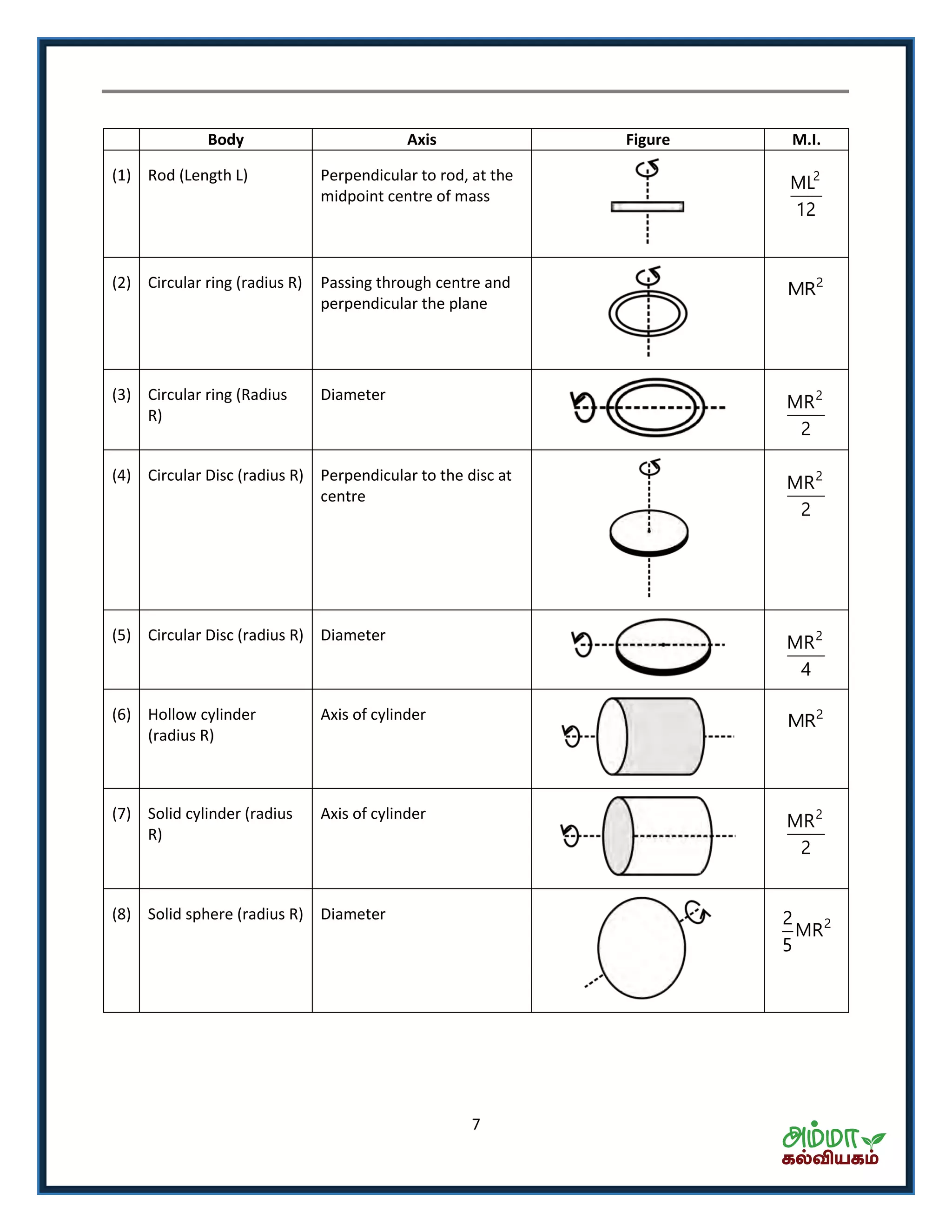
Table 1: Moment of inertia of some symmetrical bodies
7
Body Axis Figure M.I.
(1) Rod (Length L) Perpendicular to rod, at the
midpoint centre of mass
2
ML
12
(2) Circular ring (radius R) Passing through centre and
perpendicular the plane
2
MR
(3) Circular ring (Radius
R)
Diameter 2
MR
2
(4) Circular Disc (radius R) Perpendicular to the disc at
centre
2
MR
2
(5) Circular Disc (radius R) Diameter 2
MR
4
(6) Hollow cylinder
(radius R)
Axis of cylinder 2
MR
(7) Solid cylinder (radius
R)
Axis of cylinder 2
MR
2
(8) Solid sphere (radius R) Diameter 22
MR
5
8
(9) Hollow sphere (radius
R)
Diameter
22
MR
3
(3). Relation between moment of inertia (I) and angular momentum L is given by L l 
(4). Relation between moment of inertia (I) and kinetic energy of rotation is given by
2
rotation
1
K.E. l
2
 
(5). Relation between of inertia (l) and torque ( ) l   
(6). If no external torque acts on the system, the total angular momentum of the system remains
unchanged 1 1 2 2l l  
(7). Position vector of centre of mass of a discrete particle system
n
i i
1 1 2 2 n n i 1
CM n
1 2 n
i
i 1
m rm r m r ...... m r
r
m m ...... m
m


  
 
  

Where im is the mass of the th
i particle and 1r is the position of the th
i particle corresponding
CM CMx y and CMz co-ordinates are
n n n
i i i i i i
l 1 i 1 i 1
CM CM CMn n n
i i i
i 1 i 1 i 1
mn m y mz
x , y , z
m m m
  
  
  
  
  
(8). Velocity of centre of mass,
n
i i
i 1
CM
i
mv
v
m




(9). Acceleration of CM,
n
i i
i 1
CM n
i
i 1
ma
a
m





9
(10). Momentum of system,
n
1 2 n i CM
i 1
P P P ..... P m v

 
       
 
(11). Centre of mass of continuous mass distribution
e
CM CM CM CM
dmr xdm y dm zdm
r , x , y , z
dm dm dm dm
   
   
  
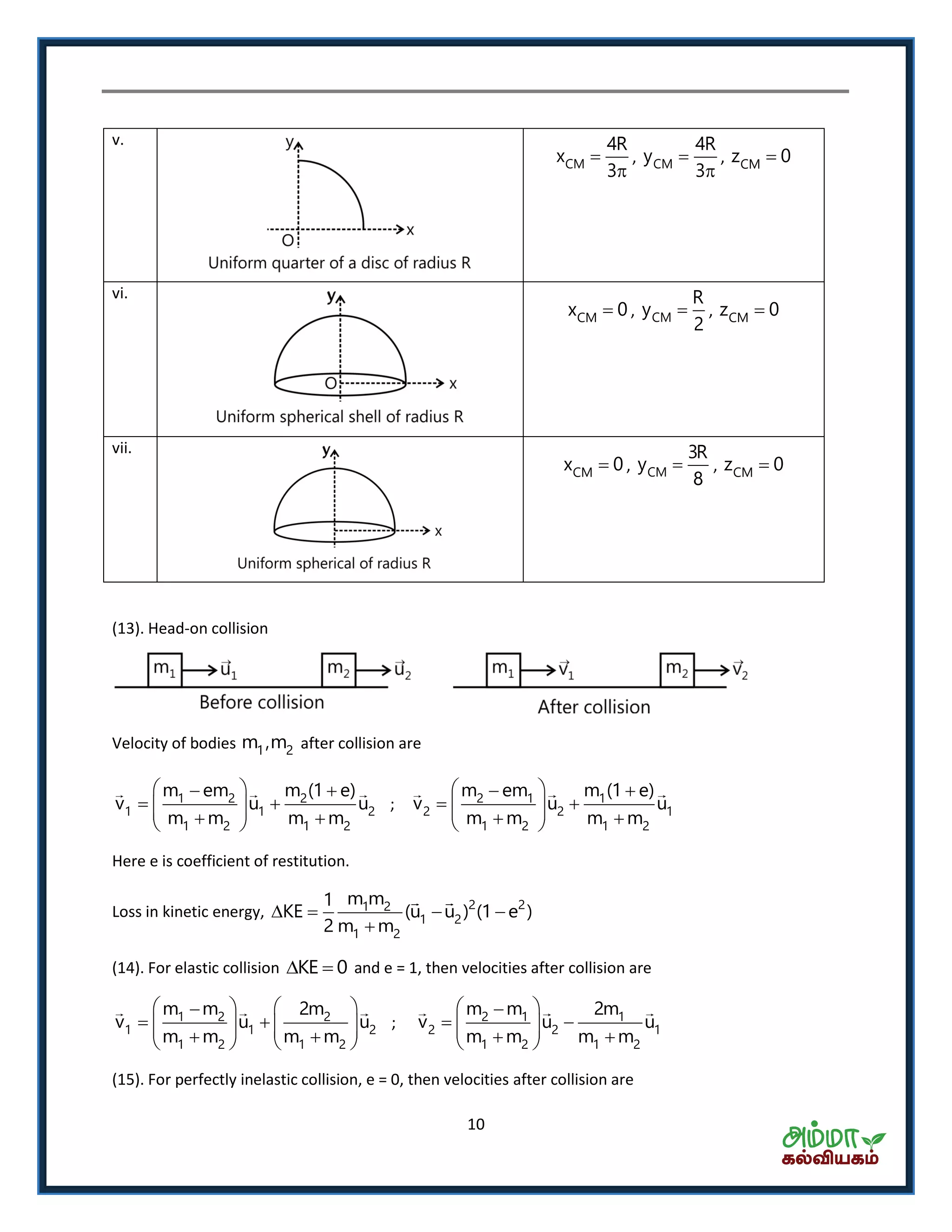
(12). Given below are the positions of centre of mass of some commonly used objects.
S.No. Object Location of centre of mass
i.
CM
L
x
2
 , CMy 0 , CMz 0
ii.
CMx 0 , CM
2R
y 

, CMz 0
iii.
CMx 0 , CM
4R
y
3


, CMz 0
iv.
CM
2R
x 

, CM
2R
y 

, CMz 0
10
v.
CM
4R
x
3


, CM
4R
y
3


, CMz 0
vi.
CMx 0 , CM
R
y
2
 , CMz 0
vii.
CMx 0 , CM
3R
y
8
 , CMz 0
(13). Head-on collision
Velocity of bodies 1 2m ,m after collision are
1 2 2
1 1 2
1 2 1 2
m em m (1 e)
v u u
m m m m
  
     
; 2 1 1
2 2 1
1 2 1 2
m em m (1 e)
v u u
m m m m
  
     
Here e is coefficient of restitution.
Loss in kinetic energy, 2 21 2
1 2
1 2
m m1
KE (u u ) (1 e )
2 m m
   

(14). For elastic collision KE 0  and e = 1, then velocities after collision are
1 2 2
1 1 2
1 2 1 2
m m 2m
v u u
m m m m
   
           
; 2 1 1
2 2 1
1 2 1 2
m m 2m
v u u
m m m m
 
     
(15). For perfectly inelastic collision, e = 0, then velocities after collision are
11
1 1 2 2
1 2
1 2
m u m u
v v
m m

 

and loss in kinetic energy is 21 2
1 2
1 2
m m1
KE (u u )
2 m m
  

7. GRAVITATION
(1). Ne to s u i e sal la of g a itatio 1 2
2
Gm m
F
r

In vector form, 1 2
2
Gm m
F (r)
r
 
(2). According to Keple s IInd
law
dA L
dt 2m

(3). A o di g to Keple s IIIrd
law
2
2 34
T R
GM

 2 3
T R 
Where, T = Time period of revolution, and R = Semi-major axis of the elliptical orbit.
Ne to s u i e sal la of gravitation 1 2
2
Gm m
F
r

. A ele atio due to g a it g is e
2
e
GM
g
R

(5). Variation of g at altitude h is
2
e
h
e
R
g g
R h
 
  
 
If h < < R then, h
e
2h
g g 1
R
 
  
 
(6). Variation of g at depth d is d
e
d
g g 1
R
 
  
 
12
(7). Gravitational potential energy AB
2 1
1 1
U W GMm
r r
 
    
 
If, 1 2r , r r  
GMm
U
r
  
8. MECHANICAL PROPERTIES OF SOLIDS
(1). Elongation produced in rod of length ‘L’ due to its own weight is
2
gL MgL
L
2Y 2AY

  
(2). Thermal Stress Y  
(3). Elastic potential energy density
1
U (stress) (strain)
2
 
(4). Bulk modulus,
P
B V
V

 

(5). Compressibility
1
B

(6). Restoring couple per unit twist
4
r
2

 (7).
r / r
L / L

  

(8). Relation between Y,B,S
9BS
Y
3B S
 

(9). Relation between Y,B,, Y 3B(1 2 )  
(10). Relation between Y,S Y 2S(1 )   (11). Poisso s ‘atio
3B 2S
6B 2S

 

(12). Depression at the middle of a beam
3
3
Wt
y
4Ybd

(13) Sheer Modulus
Fh
S
Ax
 (14) Relation between B,S, ,
2S(1 )
B
3(1 2 )
 

 
13
9. MECHANICAL PROPERTIES OF FLUIDS
(1). Relative density of a substance substance
rel o
water at 4 C

 

(2). Gauge pressure gP gh 
(3). Apparent weight of a body of density  in a fluid of density 
W' W 1
 
  
 
, W = weight of the body in air
(4). Equation of continuity Av = constant
Here, A = cross-sectional area of pipe and v = fluid velocity
. Be oulli s e uatio : At any point in a streamline flow
21
P gh v constant
2
    
Here, P= pressure, v = fluid velocity and  is density.
(6). Coefficient Of viscosity
F
vA
 
Here, F = Viscous force, = Separation between two lamina, A = Area of each lamina and v = Relative
velocity of two lamina
(7). According to Stokes la F 6 av  
Here, a = radius a ball or drop and v = velocity of ball or drop
(8). Formula for Terminal velocity is
2
T
2a
v ( )g
9
   

Where,  = density of falling body,  = density of fluid and  = coefficient of viscosity
(9). Reynolds number. e
vd
R



where, d = diameter of the pipe
(10). Excess pressure inside a liquid drop or a cavity of radius R is i 0
2S
P P
R
   where S is surface
tension
14
(11). Excess pressure inside an air bubble is i 0
4S
P P
R
 
(12). Height of a liquid in a capillary tube is
2Scos
h
r g



Where,  = angle of contact,  = density of the liquid and g = acceleration due to gravity
10. THERMAL PROPERTIES OF MATTER
(1). Conversion of temperature from one scale to other.
(a) From C F  C F F C
5 9
t (t 32), & t t 32
9 5
   
(b) From C K  C CT t 273.15, & t T 273.15   
(c) ) From F K  F F
9 5
t T 459.67, & T t 255.37
5 9
   
Where C FT, t , t , stand for temperature reading on Kelvin scale, Celsius scale, Fahrenheit scale
respectively.
(2). 2 , 3      (Relation between , ,   )
(3). (a) 1 2kA(T T )t
Q
x


Where Q is the amount of heat that flows in time t across the opposite faces of a rod of length x and
cross-section A. T1 and T2 are the temperatures of the faces in the steady state and k is the coefficient of
thermal conductivity of the material of the rod.
(b)
dT
Q kA t
dx
 
   
 
Where
dT
dx
represents the temperature gradient.
15
(c)
dQ dT
H kA
dt dx
 
    
 
H is called the heat current.
(4). (a) Coefficient of reflectivity is 1Q
r
Q

(b) Coefficient of absorptivity 2Q
a
Q

(c)Coefficient of transitivity 3Q
t
Q

Where Q1 is the radiant energy reflected, Q2 is the radiant energy absorbed and Q3 is the radiant energy
transmitted through a surface on which Q is the incident radiant energy
(5). (a) 1 0
2 0
(T T )
ln Kt
(T T )



(b) 1 2 1 2
0
(T T ) T T
K T
t 2
  
  
 
The a o e t o e uatio s ep ese ts Ne to s la of ooli g. He e, t is the ti e take a ody to cool
from T1 to T2 in a surrounding at temperature T0.
11. THERMODYNAMICS
(1). First law of thermodynamics Q U W    
(2). Work done, W P V  
Q U P V     
(3). Relation between specific heats for a gas p rC C R 
. Fo isothe al p o ess, i a o di g to Bo le s la PV = constant
According to Charles law (For volume) V T constant and Charles law (for pressure) P T
16
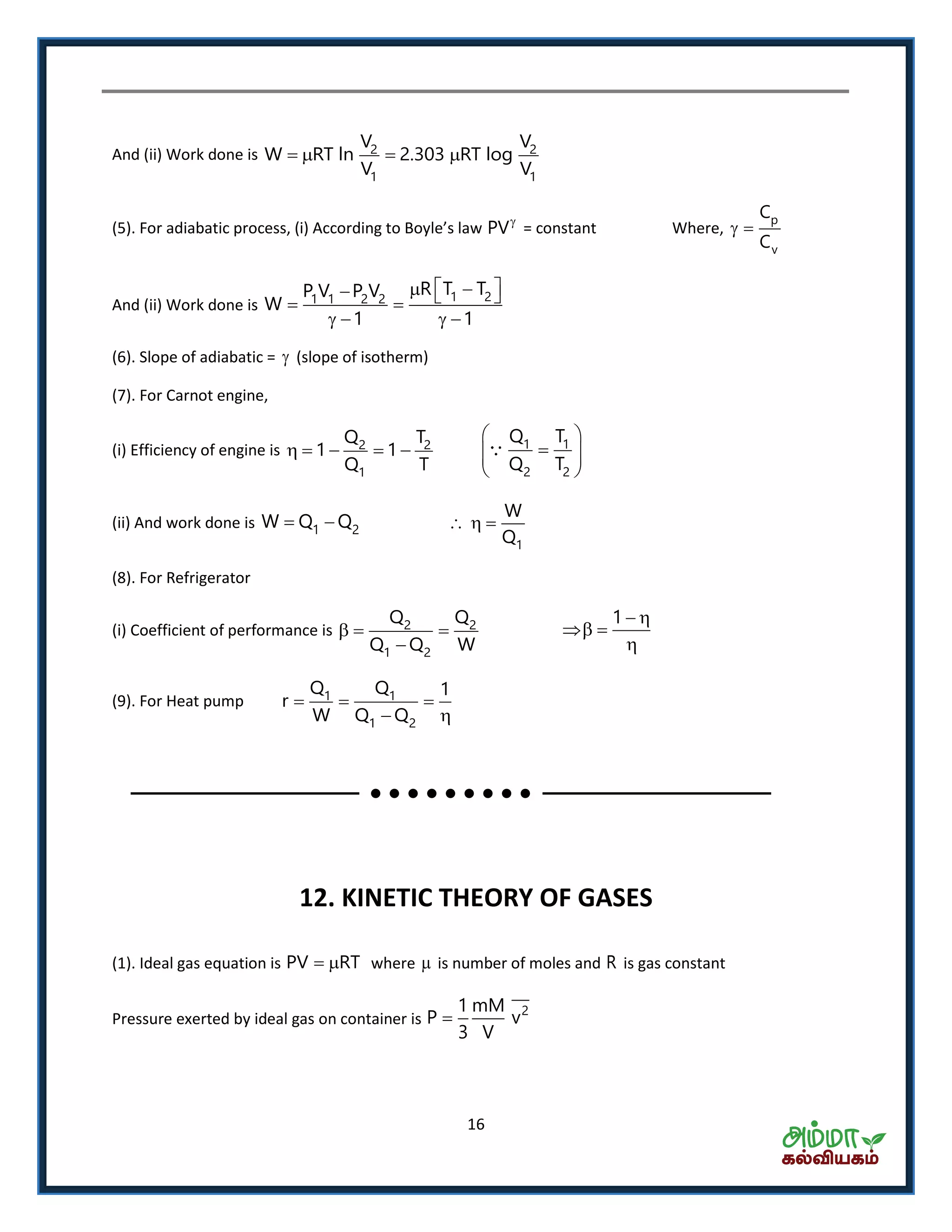
And (ii) Work done is 2 2
1 1
V V
W RT ln 2.303 RT log
V V
   
. Fo adia ati p o ess, i A o di g to Bo le s la PV
= constant Where,
p
v
C
C
 
And (ii) Work done is
1 21 1 2 2
R T TP V P V
W
1 1
     
   
(6). Slope of adiabatic =  (slope of isotherm)
(7). For Carnot engine,
(i) Efficiency of engine is 2 2
1
Q T
1 1
Q T
     1 1
2 2
Q T
Q T
 
  
 
(ii) And work done is 1 2W Q Q 
1
W
Q
  
(8). For Refrigerator
(i) Coefficient of performance is 2 2
1 2
Q Q
Q Q W
  

1  
 

(9). For Heat pump 1 1
1 2
Q Q 1
r
W Q Q
  
 
12. KINETIC THEORY OF GASES
(1). Ideal gas equation is PV RT  where  is number of moles and R is gas constant
Pressure exerted by ideal gas on container is
21 mM
P v
3 V

17
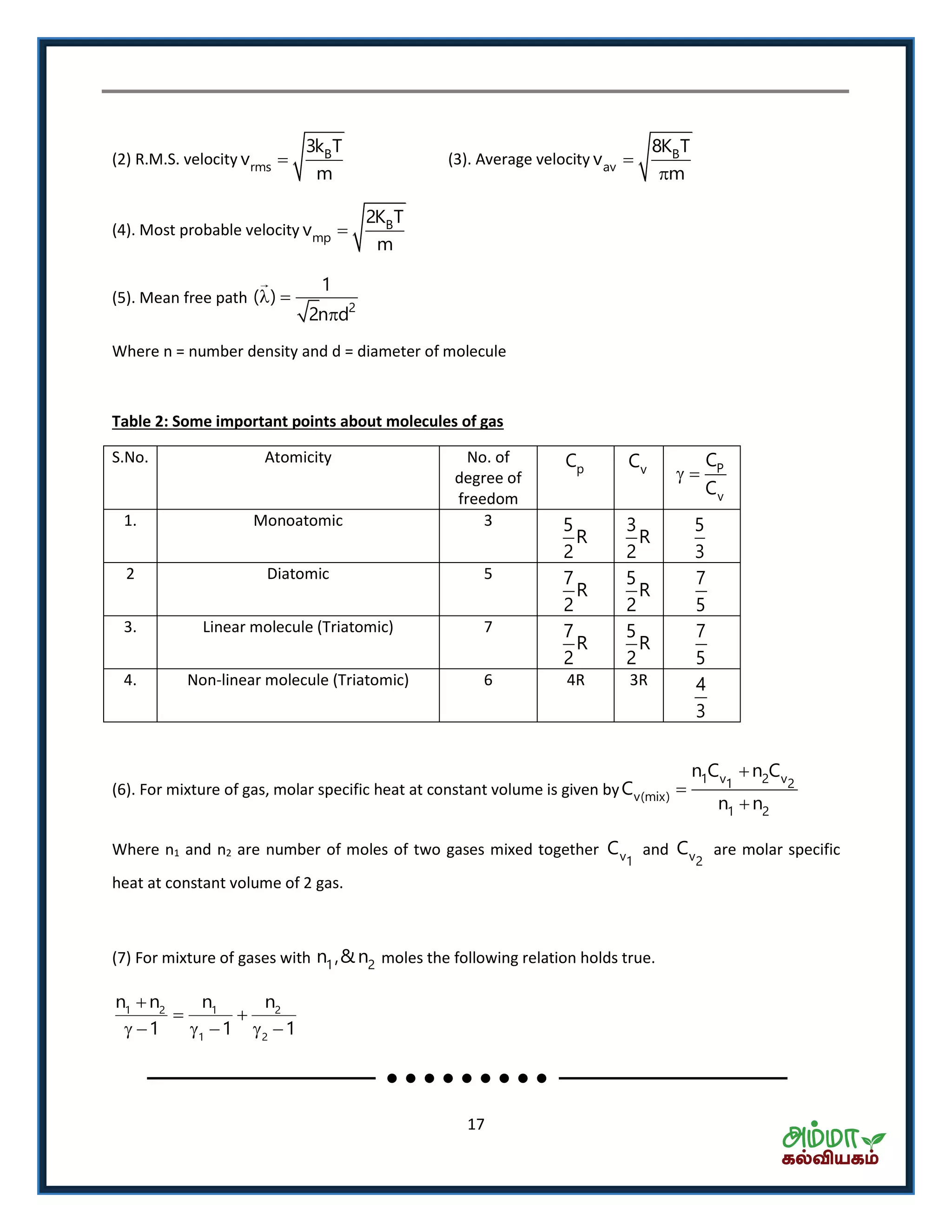
(2) R.M.S. velocity B
rms
3k T
v
m
 (3). Average velocity B
av
8K T
v
m


(4). Most probable velocity B
mp
2K T
v
m

(5). Mean free path
2
1
( )
2n d
 

Where n = number density and d = diameter of molecule
Table 2: Some important points about molecules of gas
S.No. Atomicity No. of
degree of
freedom
pC vC P
v
C
C
 
1. Monoatomic 3 5
R
2
3
R
2
5
3
2 Diatomic 5 7
R
2
5
R
2
7
5
3. Linear molecule (Triatomic) 7 7
R
2
5
R
2
7
5
4. Non-linear molecule (Triatomic) 6 4R 3R 4
3
(6). For mixture of gas, molar specific heat at constant volume is given by
1 v 2 v1 2
v(mix)
1 2
n C n C
C
n n



Where n1 and n2 are number of moles of two gases mixed together v1
C and v2
C are molar specific
heat at constant volume of 2 gas.
(7) For mixture of gases with 1 2n ,&n moles the following relation holds true.
1 2 1 2
1 2
n n n n
1 1 1

 
     
18
13. OSCILLATIONS
(1) Displacement equation for SHM x A sin ( t )    Or
x A cos[ t ]    where A is amplitude and  t   is phase of the wave
(2). Velocity in SHM v A cos t   and
2 2
v A x  
(3). Acceleration in SHM is
2
a A sin t   and
2
a x 
(4). Energy in SHM is
(i) Potential energy
2 21
U m x
2
  (ii) Kinetic energy
2 2 21
K m (A x )
2
  
(iii) Total energy
2 21
E m A
2
 
(5). For Simple pendulum
(i) Time period of pendulum is
L
T 2
g
  (ii) If L is large
1
T 2
1 1
g
L R
 
 
 
 
(iii)
T 1 L
T 2 L
 
 (iv) Accelerated pendulum
L
T 2
g a
 

(6). For torsional pendulum, time period of oscillation is
l
T 2
k
  ; where I is moment of inertia
(7). For physical pendulum, time period of oscillation is
l
T 2
mgd
  ; where l is moment of inertia of
body about axis passing through hinge and, d : Distance of centre of mass from hinge
(8). Damped simple harmonic motion
19
(i) Force action on oscillation body is
2
2
d x dx
m kx b
dtdt
   
(ii) Equation of motion is
u/2m
x Ae cos( 't )
    Where
2
2
k b
'
m 4m
  
(9). Forced oscillator
(i) Force acting on body is
2
02
md x
kx bv F sin t
dt
    
(ii) Equation of motion is x A sin [wt ]   Where
2
2 2 2
0
F
A
b
m ( )
m


 
     
 
. Supe positio of T o SHM s
(i) In same direction
1 1x A sin t  and 2 2x A sin ( t )   
Resultant amplitude is 2 2
r 1 2 1 2A A A 2A A cos   
(ii) In perpendicular direction
1 1x A sin t  and 1 2y A sin( t )   
(a) Resultant motion is SHM along straight line, if 0  or   
(b) Resultant motion is circular, if 1 2and A A
2

  
(c) Resultant motion is an (light) elliptical path, if 1 2and A A
2

  
20
14. WAVES
(1). Equation of a plane progressive harmonic wave travelling along positive direction of X-axis is
y(x, t) a sin (kx t )    
And along negative direction of X-axis is y(x, t) a sin(kx t )    
Where, y(x,t)  Displacement as a function of position x and time t,
a  Amplitude of the wave,   Angular frequency of the wave,
k  Angular wave number, (kx t )     Phase,
And   Phase constant or initial phase angle
(2). Angular wave number or propagation constant (k)
2
k



(3). Speed of a progressive wave v f
k T
 
   
(4) Speed of a transverse wave on a stretched string
T
v 

where, T  Tension in the string, and   Mass per unit length
(5). Speed of sound wave in a fluid
B
v 

where, B  Bulk modulus, and   density of medium
(6). Speed of sound wave in metallic bar
Y
v 

he e, Y = ou g s odulus of elasti it of etalli a
. Speed of sou d i ai o gases Ne to s fo mula (connected)]
v
v 

where, P  Pressure,   Density of air (or gas) and   Atomicity of air (or gas)
21
(8). The effect of density on velocity of sound 2 1
1 2
v
v



(9). The effect of temperature on velocity of sound 1
0 0
v T 273 t
v T 273

 
(10). If two waves having the same amplitude and frequency, but differing by a constant phase  , travel
in the same direction, the wave resulting from their superposition is given by
y(x,t) 2a cos sin kx t
2 2
    
     
   
(11). If we have a wave
1y (x,t) a sin(kx t)   then,
(i) Equation of wave reflected at a rigid boundary
ry (x,t) a sin(kx t )     Or ry (x, t) a sin (kx t)   
i.e. the reflected wave is 180o
out of phase.
(ii) Equation of wave reflected at an open boundary ry (x, t) a sin(kx t)  
i.e. the reflected wave is a phase with the incident wave.
(12). Equation of a standing wave on a string with fixed ends y(x,t) [2a sin kx]cos t 
Frequency of normal modes of oscillation
nv
f n 1,2,3.....
2L
 
(13). Standing waves in a closed organ pipe (closed at one end) of length L.
Frequency of normal modes of oscillation.
1 v
f n n 1,2....
2 2L
 
   
 
n 1f (2n 1)f  
Where fn is the frequency of nth
normal mode of oscillation. Only odd harmonics are present in a closed
pipe.
(14). Standing waves in an open organ pipe (open at both ends)
Frequency of normal modes of oscillation
nv
f n 1,2,3....
2L
 
n 1f nf 
22
Where fn is frequency of nth
normal mode of oscillation.
(15). Beat frequency (m)
m  Difference in frequencies of two sources
1 2 2 1m (v v ) or (v v )  
. Dopple s effe t 0
0
s
v v
f f
v v
 
  
  
Where, f  Observed frequency, 0f  Source frequency,
v  Speed of sound through the medium, 0v  Velocity of observer relative to the medium
and sv  Source velocity relative to the medium
 In using this formula, velocities in the directions (i.e. from observer to the source) should be treated
as positive and those opposite to it should be taken as negative.
15. ELECTRIC CHARGES AND FIELDS
(1). Electric force between two charges is given by 1 2
2
0
q q
F
4 R


And 1F q E where 2
2
0
q
E
4 R


is the electric field due to charge 2q
(2) Electric potential energy for system of two charges is 1 2
0 1 2
q q 1 1
U W
4 r r
 
       
For 1 2
2
0 1
q q
r , U
4 r
  

23
(3) Electrostatic potential is
U
V
q

 
(4). Electric field on the axis of a dipole of moment p 2aQ at a distance R from the centre is
2 2 2
0
2Rp
E
4 (R a )

 
. If R > > a then
3
0
2p
E
4 R


(5). Electric field on the equatorial line of the dipole at a distance R from the centre is
3
2 2 2
0
p
E
4 (R a )


 
. If R > > a then
2
0
p
E
4 R



(6). Torque  experienced by a short dipole kept in uniform external electric field E is
ˆp E pE sin 0 n   
(7). Perpendicular deflection of a charge q in a uniform electric field E after travelling a straight distance
x is
2
2
0
qEx
y
2mv
, where m is mass of the charge and v0 is initial speed of perpendicular entry in the electric
field.
(8). Electric flux E E S ES cos    . Area vector S is perpendicular to the surface area.
(9). Gauss law :
0
Q
E dS 
 . Here E is the electric field due to all the charges inside as well as outside
the Gaussian surface, while Q is the net charge enclosed inside Gaussian surface.
(10). Electric field due to infinitely long charged wire of linear charge density  at a perpendicular
distance R is
0
E
2 R



(11). Electric field due to singal layer of surface charge density  is
02


. Field due to oppositely
charged conducting plates is
0


in between the gap but zero outside.
(12). Field due to a uniformly charged thin spherical shell of radius R is
2
0
Q
E
4 r


for outside points
and zero inside (r is distance from the centre of shell)
24
(13). Field due to a charge uniformly distributed in a spherical volume is 2
3
00
d Q r
E r
dr 34 R
  
  
   
for inside points and
2
0
Q
E
4 r


for outside point.
Here
3
3Q
4 R
 

is volume charge density and Q is total charge inside the sphere.
16. ELECTROSTATIC POTENTIAL AND CAPACITANCE
(1). Electric potential :
(a) Potential due to a conducting sphere of radius r with charge q (solid or hollow) at a distance r from
the centre
0
q1
V
4 r
 
    
if (r > R) or
0
q1
V
4 R
 
    
if (r = R)
or
0
q1
V
4 R


if (r < R)
(b) Relation between electric field potential
| v |v
| E |

   
 
(2). Electric dipole potential:
(a)
2
0
p cos1
V
4 r
 
  
  
(b) Potential energy of a dipole in an external electric field
U( ) P E   
25
(3). Capacitors :
Capacitance of a potential plate capacitor 0
A
C
d
 
(4). Electric field energy : (a)
2
21 Q 1
U QV CV
2 2C 2
  
(b) Energy density of energy stored in electric field
2
0
1
u E
2
 
(5) Combination of capacitors :
(a) When capacitors are combined in series,
eq 1 2 3
1 1 1 1
.....
C C C C
   
(b) When capacitors are connected in parallel. eq 1 2 3C C C C ......   
(c) Capacitance of spherical capacitor,
0
ab
C 4
b a
 

. (When outer shell is earthed). or
2
0
b
C 4
b a
 

. (When inner shell is earthed) or
0C 4 R  (For a sphere of radius R)
(d) Cylindrical capacitor, 02
C
b
ln
a


 
 
 
(6). Dielectrics :
(a) Induced charge,
1
q' q 1
k
 
  
 
(b) Polarization
Dipole moment
p
Volume

Electric dipole moment is ep E 
e
0
K 1

 

where e is electrical susceptibility, and K is dielectric constant.
26
27
17. CURRENT ELECTRICITY
(1). Resistance of a uniform conductor of length L, area of cross-section A and resistivity  along its
length, R
A
 
(2). Current density
di
j
ds
 (3). Conductance
1
G
R
 .
i4) Drift velocity d
eE i
v t.
m neA
  (5). Current di neAv
(6) Resistivity is
2
m 1
ne t
  

where  is resistivity.
(7) A o di g to Oh s la j E  and V iR (8) Mobility of free electrons dv
E
 
(9) ne   (10). Thermal resistivity of material is T 0 0[1 (T T )]     
(11). Potential difference across a cell during discharging
R
V ir
R r

   

(12). Potential difference across a cell during charging V ir  
(13) For n cells in series across load R, current through load
n
i
R nt



(14). For n identical cells in parallel across load R, current through load
n
i
nR r



(15). Wheatstone bridge network
For balanced Wheatstone bridge 31
2 4
RR
R R

(16). If unknown resistance X is in the left gap, known resistance R is in the right gap of meter bridge and
balancing length from left end is l then
R
X
100


(17) Potentiometer
28
(i) Comparison of emf 1 1
2 2



(ii) Internal resistance of cell 1
2
r 1 R
 
   
 
18. MOVING CHARGES AND MAGNETIC FIELD
S.No. Situation Formula
1.
Lorentz force q[E v B] 
2.
Condition for a charged particle to go undeflected in a cross
electric and magnetic field
E
B

3.
A charge particle thrown perpendicular to uniform magnetic
field
(i) Path
(ii) Radius
(iii) Time period
(i) Circular
(ii)
mv
r
qB

(iii)
2 m
t
qB


4.
A charge particle thrown at some angle to a uniform magnetic
field
(i) Path
(ii) Radius
(iii) Time period
(iv) Pitch
(i) Helix
(ii)
mvsin
r
qB


(iii)
2 m
t
qB


(iv) T vcos 
5.
Cyclotron frequency qB
f
2 m


6.
Maximum kinetic energy of a charged particle in a cyclotron
(With R as radius of dee)
2 2 2
q B R
K
2m

29
7.
Force on a straight current carrying conductor in a uniform
magnetic field
F i(l B) 
8.
Force on a arbitrary shaped current carrying conductor in a
uniform magnetic field
F i d B  i B 
9.
Magnetic moment of a current carrying loop M i A
10.
Torque on a current carrying loop placed in a uniform magnetic
field
M B  
11.
Biot-Savart Law
0
3
i d r
dB
4 r
 


12.
Magnetic field at a point distance x from the centre of a current
carrying circular loop
2
0
2 2 3/2
iR
2(R x )


13.
Magnetic field at the centre of a current carrying circular loop
0i
2R

14.
Magnetic field on the axis of a current carrying circular loop far
away from the centre of the loop
(Moment behaves as magnetic dipole)
0
3
2M
4 x


15.
Magnetic field on the centre of current carrying circular arc
0 i
4 t



16.
A pe e s i ula la
0B d i  
17.
Magnetic field due to a long thin current carrying wire
0i
B
2 r



18.
Magnetic field inside a long straight current carrying cylindrical
conductor at a distance r from the axis.
0
2
i
B r
2 R

  

19.
Magnetic field outside a long straight current carrying conductor
at a distance r from the axis
0 2i
B
4 r

 

20.
Magnetic field inside a long solenoid
0B ni 
30
21.
Magnetic field inside a toroid
0Ni
B
2 r



22.
Force per unit length between two current carrying wire
0 1 2i i
F
2 r



23.
Current sensitivity of moving coil galvanometer NBA
i k


24.
Voltage sensitivity of moving galvanometer NBA
V kR


25.
Shunt resistance required to convert galvanometer into
ammeter of range i ( gi is the full scale deflected current of
galvanometer)
g
g
G
r
i
1
i

 
 
 
 
26.
Resistance required to convert galvanometer into voltmeter of
range V
g
V
R G
i
 
19. MAGNETISM AND MATTER
(1). Bar magnet : The electrostatic Analog
Electrostatics Magnetism
Permittivity =
0
1

Permittivity = 0
Charge q Magnetic pole strength (qn)
Dipole Moment
p q l 
Magnetic Dipole Moment
mM q l
31
1 2
2
0
q q
F
4 r


m(1) m(2)0
2
q q
F
4 t



F qE mF q B
Axial Field
2
0
2p
E
4 r


0
3
2M
B
4 r



Equatorial Field
2
0
p
E
4 r



0
2
M
B
4 r

 

Torque p E   M B  
Potential Energy U p E   U M B  
Work 1 2W pE(cos cos )    1 2W MB(cos cos )   
(2). Field due to a magnetic monopole 0 m
2
q
ˆB r
4 r

 

(3). B on the axial line or end on position of a bar magnet
0 0
2 2 2 2
2Mr 2M
B for r l, B
4 4(r l ) r
  
    
   
(4). B on the equatorial line or broad side on position of a bar magnet
0 0
2 2 3/2 3
M M
B for r l, B
4 4(r l ) r
  
    
   
(5). Time period angular SHM T 2
MB

  here  is moment of inertia.
. Gauss s la i ag etis B ds 0 
(7). Fo ho izo tal a d e ti al o po e t of ea th s ag eti field, v
H
B
tan
B
 
32
(8).
'
1
tan
tan
cos

 

(9). 2 2 2
1 2cot cot cot    
(10). Magnetic intensity is
0
B B
H  
 
(11). Relative magnetic permittivity is r
0

 

(12). Magnetic Susceptibility m
M
H
  (13). r m1    (14).
c
1
(T T )
 

20. ELECTROMAGNETIC INDUCTION
(1). Average induced emf 2 1
2 1
e
t t t
   
   
  
(2). Instantaneous induced emf
(t)
(t)
d
e
dt

 
(3). Motional emf B v  (4). Motional emf e de (v B)dl (v B) j     
(5). B
d
E dl
dt

   [E  electric (induced) field, B  Magnetic flux]
(6). B Li L    self inductance of the coil
(7). Induced emf
di
e L
dt
  (8). 2
0 rL n A i     Where L coefficient of self-inductance
(9). 1
2 1 2
di
Mi and M
dt
     Where M is co efficient of mutual inductance
(10). The emf induced (in dynamo)  (t)e BA sin t  
(11). Mutual inductance 0 1 1 2M n n Ai  
33
21. ELECTROMAGNETIC WAVES
(1). Displacement current E
D 0 0
d E dsd CdV
l
dt dt dt

    

. Ma ell s E uatio :
(a)
0
q
E ds 
 (b) B ds 0 
(c) B
d d
E dl B ds
dt dt

       (d) E
0 c 0
d
B dl l
dt
 
     
 

(3). y 0E E sin( t kx)   and 2 0B B sin ( t kx)  
vacuum medium
0 0 r 0 r 0
1 1
c ; c 
     
(4). RMS
0 RMS
E E E
c
B B B

  
(5). Average of wave lav = Average energy density  (speed of light)
Of
2 2
0 0 0 0
av av
0 0 0
E B E cB
l U
2 2c 2
    
  
(6). Instantaneous energy density
2 2
2 2
av 0 0
0 0
1 B B
u E E
2
 
         
Average energy density
2 2 2
2 0 0 0 0
av 0 0
0 0
B E B1
u E
4 4 2 2

    
 
(7). Energy = (momentum), c or U Pc
(8). Radiation pressure 0I
R.P.
c
 where 0I is intensity of source (when the wave is totally absorbed)
And 02I
R.P.
c
 (when the wave is totally reflected)
34
(9).
2
1
I
t
 (for a point source) and
1
I
r
 (for a line source)
For a plane source intensity is independent of r.
22. RAY OPTICS AND OPTICAL INSTRUMENTS
(1). The distance between the pole and centre of curvature of the mirror called radius of curvature
R
f
2

(2). Mirror equation
1 1 1
v u f
  (u is Object distance, v is Image distance and f Focal length)
(3). Linear magnification
size of image image distance v
m
size of object Object distance u
   
(4). In case of lens 2 1 2 1
v u R
    
 
(R= Radius of curvature , 1 and 2 are refractive indices of medium)
(5). Relationship between u, v and focal length f is
1 1 1
v u f
  in case lens.
(6). Longitudinal magnification = (Lateral magnification)2
(7) Equivalent lens
(i) Lens in contact
1 2
1 1 1
F f f
  (ii) Lens at a distance
1 2 1 2
1 1 1 d
d,
F f f f f
  
(8). Reciprocal of focal length is called as power of lens.
1 100
P
f(in metres) f(in cm)
 
35
(9). For achromatic combination of two lens 1 2
1 2
0
f f
 
 
(10). Refractive index of material of prism
mA
sin
2
A
sin
2
  
 
  
 
 
 
m( ) Minimum deviation angle
(11). For small-angled prism d ( 1)A  
(where A= Angle of prism and B= Deviation angle)
(12). Dispersive power of prism for two colors (blue and red)
v R v R
d 1
        
     
    
(13). For simple microscope,
(a) Magnification
D
m 1
f
  (Where D= Least distance of distinct vision. and f= Focal length)
(b)
D
M
f
 for image to form at infinity
(14). For compound microscope.
Magnification of objective O
O
O
v
M
u
 and Magnification of eye piece e
e
e
v
M 1
f
 
   
 
(a) o
o e
e e
v D
m m m 1
u f
 
   
 
for least distance of distinct vision.
(b)
o e
L D
m
f f
  for image to form at infinite.
(15). Magnifying power of telescope o
e
f
m
f
 and length of telescope e oL f f  
36
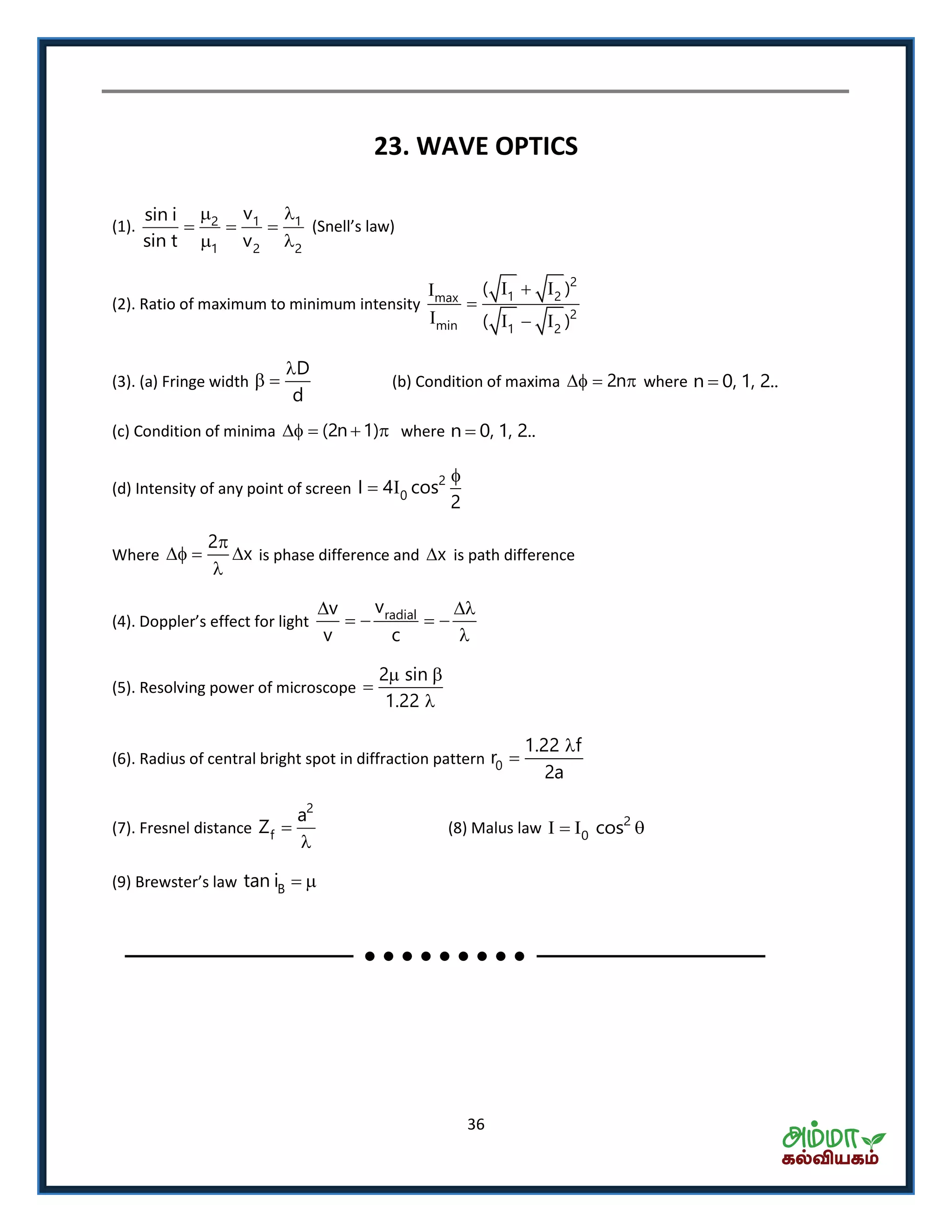
23. WAVE OPTICS
(1). 2 1 1
1 2 2
vsin i
sin t v
 
  
 
S ell s la
(2). Ratio of maximum to minimum intensity
2
1 2max
2
min 1 2
( )
( )
  

   
(3). (a) Fringe width
D
d

  (b) Condition of maxima 2n   where n 0, 1, 2..
(c) Condition of minima (2n 1)    where n 0, 1, 2..
(d) Intensity of any point of screen
2
0I 4 cos
2

 
Where
2
x

  

is phase difference and x is path difference
. Dopple s effe t fo light radialvv
v c
 
   

(5). Resolving power of microscope
2 sin
1.22
 


(6). Radius of central bright spot in diffraction pattern 0
1.22 f
r
2a


(7). Fresnel distance
2
f
a
Z 

(8) Malus law 2
0 cos   
9 B e ste s la Btan i  
37
24. DUAL NATURE OF RADIATION AND MATTER
. Ei stei s photoele t i ell e uatio ,
2
max 0
1
mv hf hf
2
 
Where 0f,f are frequencies of incident radiation.
(2). Work function and threshold frequency or threshold wavelength, 0 0
0
hc
hf  

(3). Energy of photon,
hc
E hf 

(4). Momentum of photon,
E h
P
c
 

(5). De Broglie wavelength of a material particle,
h
mv
 
(6). De Broglie wavelength of an electron accelerated through a potential V volt,
o
12.27 1.227
A nm
V V
  
(7). de Broglie wavelength of a particle in terms of temperature
h
(T),
3mkT
 
(8). de Broglie wavelength in terms of energy of a particle
h
(E),
2mE
 
38
25. ATOMS
Rutherford’s Model
Distance of closest approach
2
0
0
e
r
4 E


where E is the energy of  -particle at a large distance.
Bohr’s Model of hydroge ato
Postulates: (i) Radius of nth
orbit,
2 2
0
n 2
h n
r
me



(ii) Orbital speed, n
n
nh
V
2 mr


(iii) Energy of nth
orbit,
4
n 2 2 2 2
0
me 1 13.6
E eV
8 h n n
 
   
  
(iv) TE KE  (v) PE 2TE
‘ d e g s o sta t
2 2
1 2
1 1 1
R
n n
 
  
   
and
4
2 3
0
me
R
8 h c


26. NUCLEI
(1). Nuclear radius (R) is given by 1/3
0R R A Here 15
0R 1.2 10 m
  .
(2). Density of all nuclei is constant.
(3). Total binding energy
2
p n[Z m (A Z)m M]c J   
(4). Av. BE/nucleon = Total B.E/A
(5). Radioactivity decay law
dN
N
dt
  t
0N N e
 
(6). Half life 1/2
0.6931
T 

(7). Average or mean life is av 1/2
1
T 1.44 T 

.
39
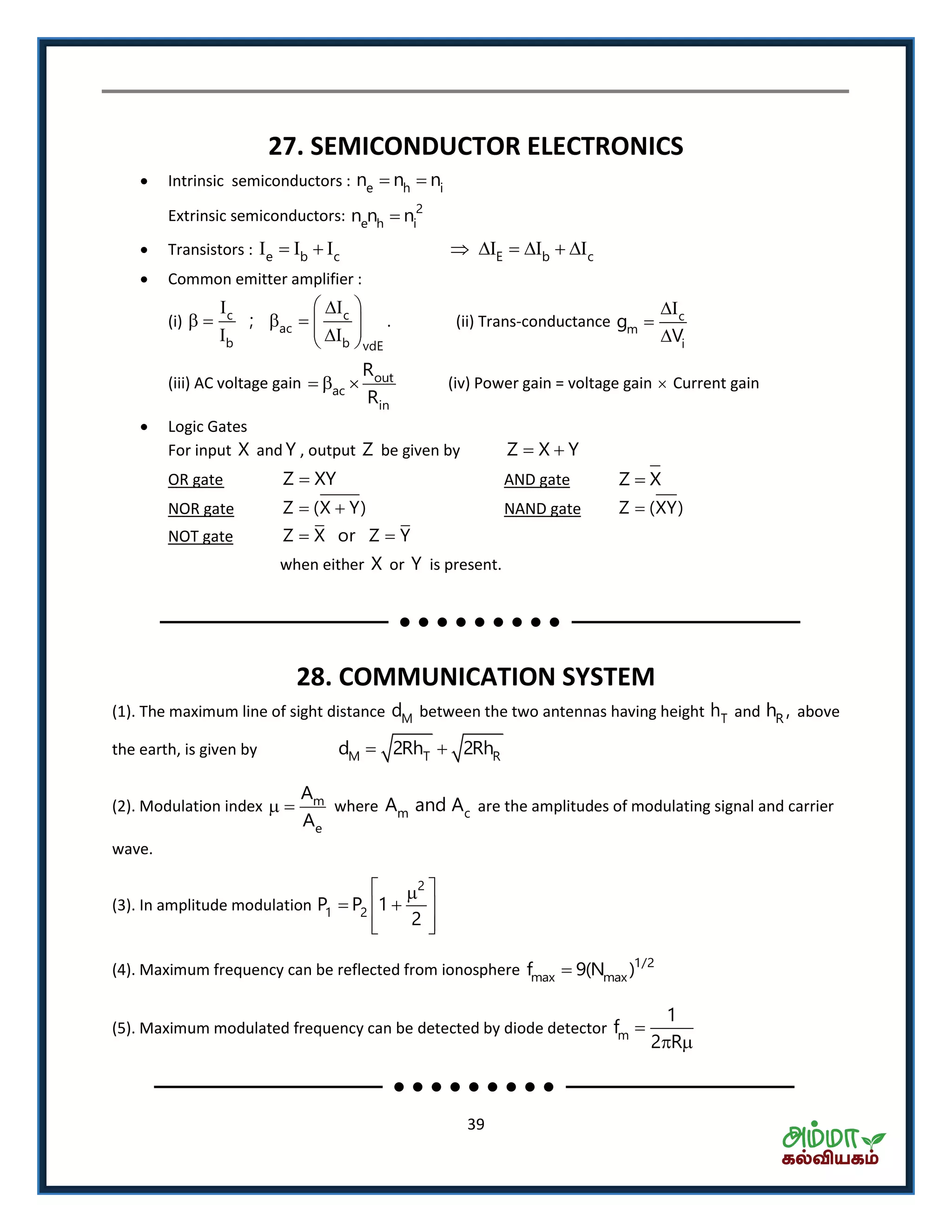
27. SEMICONDUCTOR ELECTRONICS
 Intrinsic semiconductors : e h in n n 
Extrinsic semiconductors: 2
e h in n n
 Transistors : e b c     E b c     
 Common emitter amplifier :
(i) c c
ac
b b vdE
;
  
        
. (ii) Trans-conductance c
m
i
g
V



(iii) AC voltage gain out
ac
in
R
R
   (iv) Power gain = voltage gain  Current gain
 Logic Gates
For input X and Y , output Z be given by Z X Y 
OR gate Z XY AND gate Z X
NOR gate Z (X Y)  NAND gate Z (XY)
NOT gate Z X or Z Y 
when either X or Y is present.
28. COMMUNICATION SYSTEM
(1). The maximum line of sight distance Md between the two antennas having height Th and Rh , above
the earth, is given by M T Rd 2Rh 2Rh 
(2). Modulation index m
e
A
A
  where m cA and A are the amplitudes of modulating signal and carrier
wave.
(3). In amplitude modulation
2
1 2P P 1
2
 
  
  
(4). Maximum frequency can be reflected from ionosphere 1/2
max maxf 9(N )
(5). Maximum modulated frequency can be detected by diode detector m
1
f
2 R

 
CHEMISTRY
FORMULA HAND BOOK
1
Chemistry
1. Some Basic Concepts of Chemistry...........................................................................................................2
2. Structure of Atom .....................................................................................................................................3
3. State of Matter..........................................................................................................................................5
4. Thermodynamics.......................................................................................................................................6
5. Equilibrium................................................................................................................................................7
6. Solid State .................................................................................................................................................9
7. Solutions..................................................................................................................................................10
8. Electrochemistry .....................................................................................................................................13
9. Chemical Kinetics and Nuclear Chemistry...............................................................................................16
10. Surface Chemistry.................................................................................................................................19
11. Hydrogen...............................................................................................................................................20
12. S-Block Elements...................................................................................................................................20
13. P-Block Elements...................................................................................................................................21
14. Coordination Compound.......................................................................................................................22
15. Organic Chemistry.................................................................................................................................22
16. Alcohols, Phenols and Ethers................................................................................................................24
17. Aldehydes, Ketones and Carboxylic Acids.............................................................................................36
18. Amines ..................................................................................................................................................47
19. Haloalkanes and Haloarenes.................................................................................................................58
20. Hydrocarbons........................................................................................................................................64
21. Polymers ...............................................................................................................................................74
2
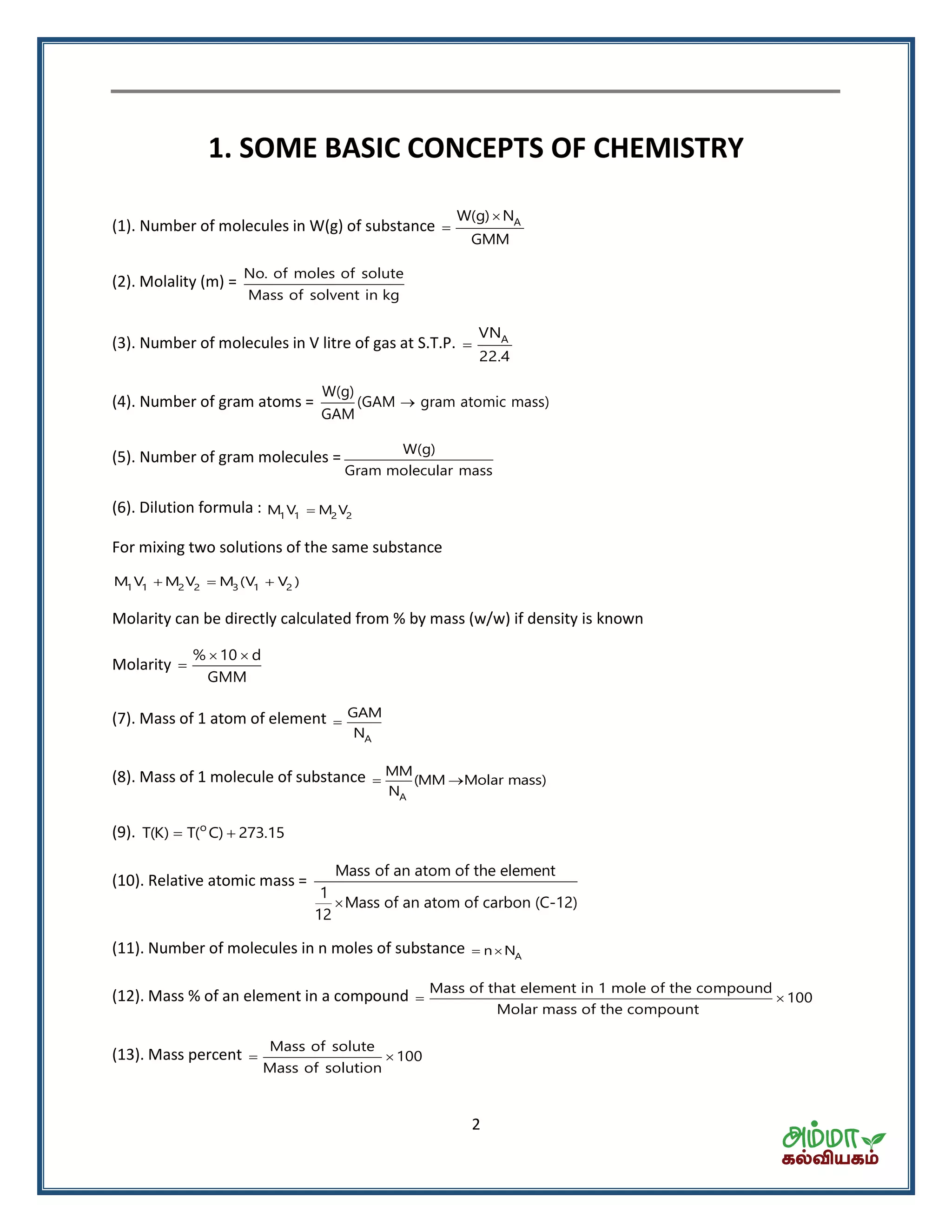
1. SOME BASIC CONCEPTS OF CHEMISTRY
(1). Number of molecules in W(g) of substance AW(g) N
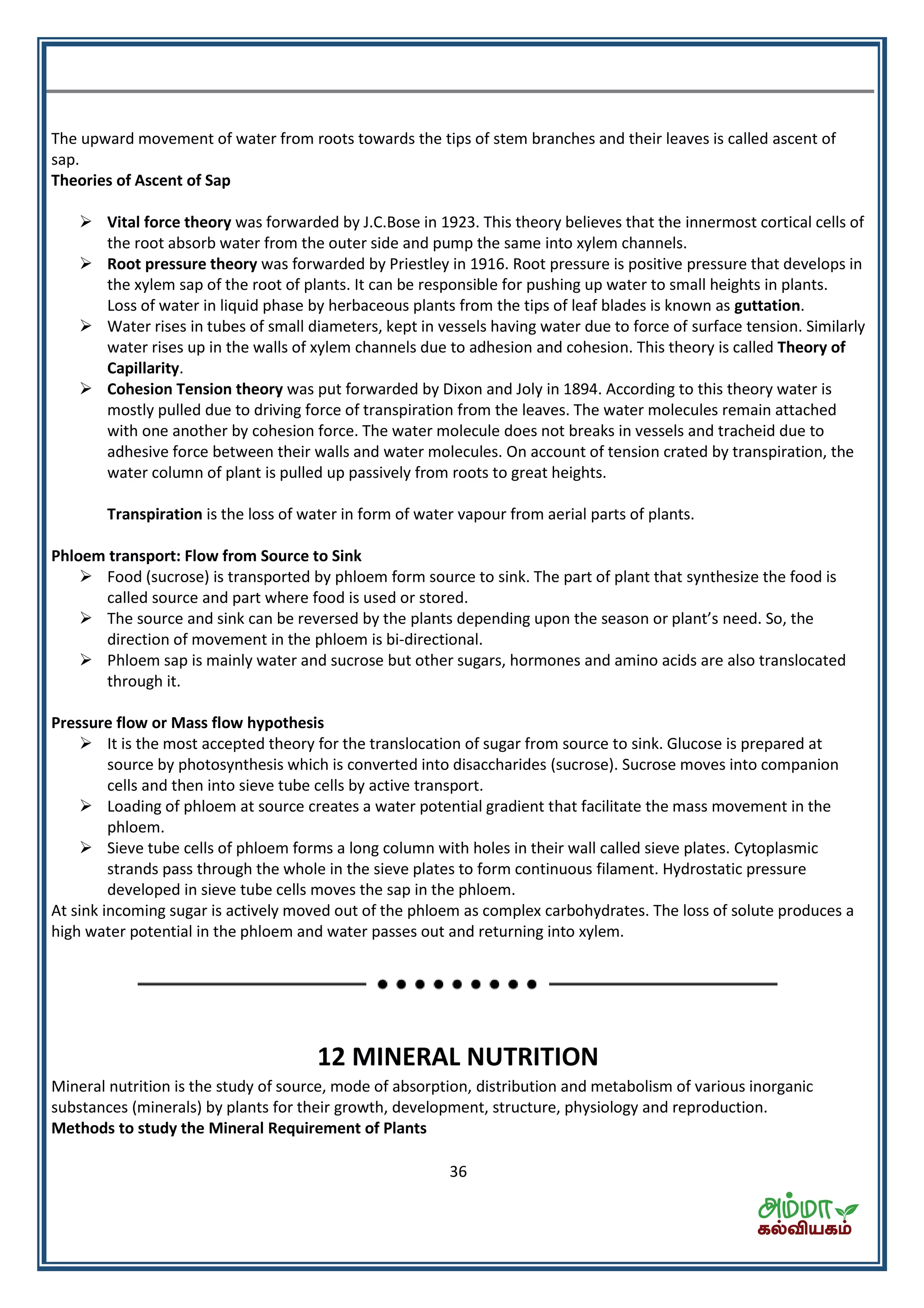
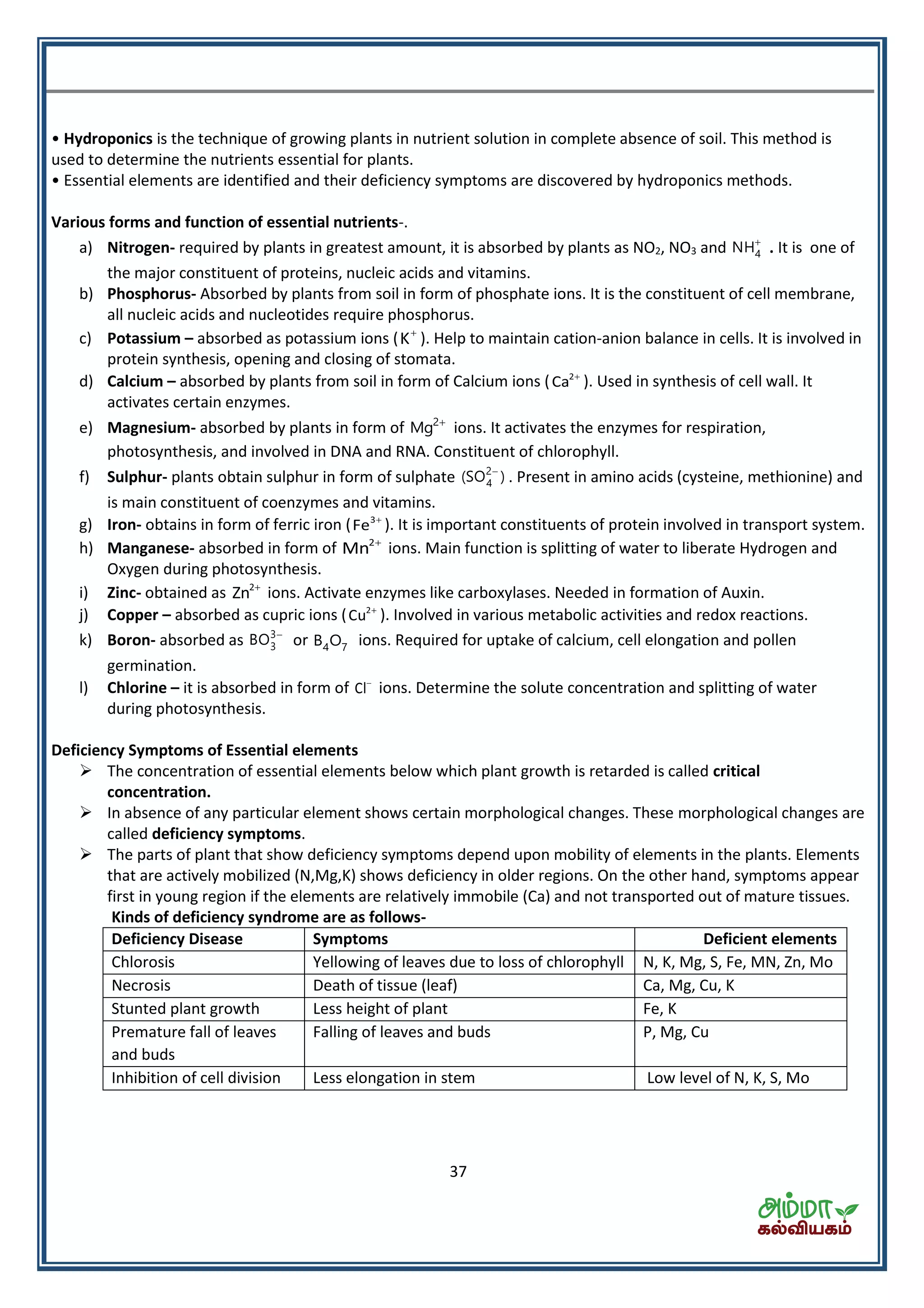
GMM


(2). Molality (m) = No. of moles of solute
Mass of solvent in kg
(3). Number of molecules in V litre of gas at S.T.P. AVN
22.4

(4). Number of gram atoms =
W(g)
(GAM gram atomic mass)
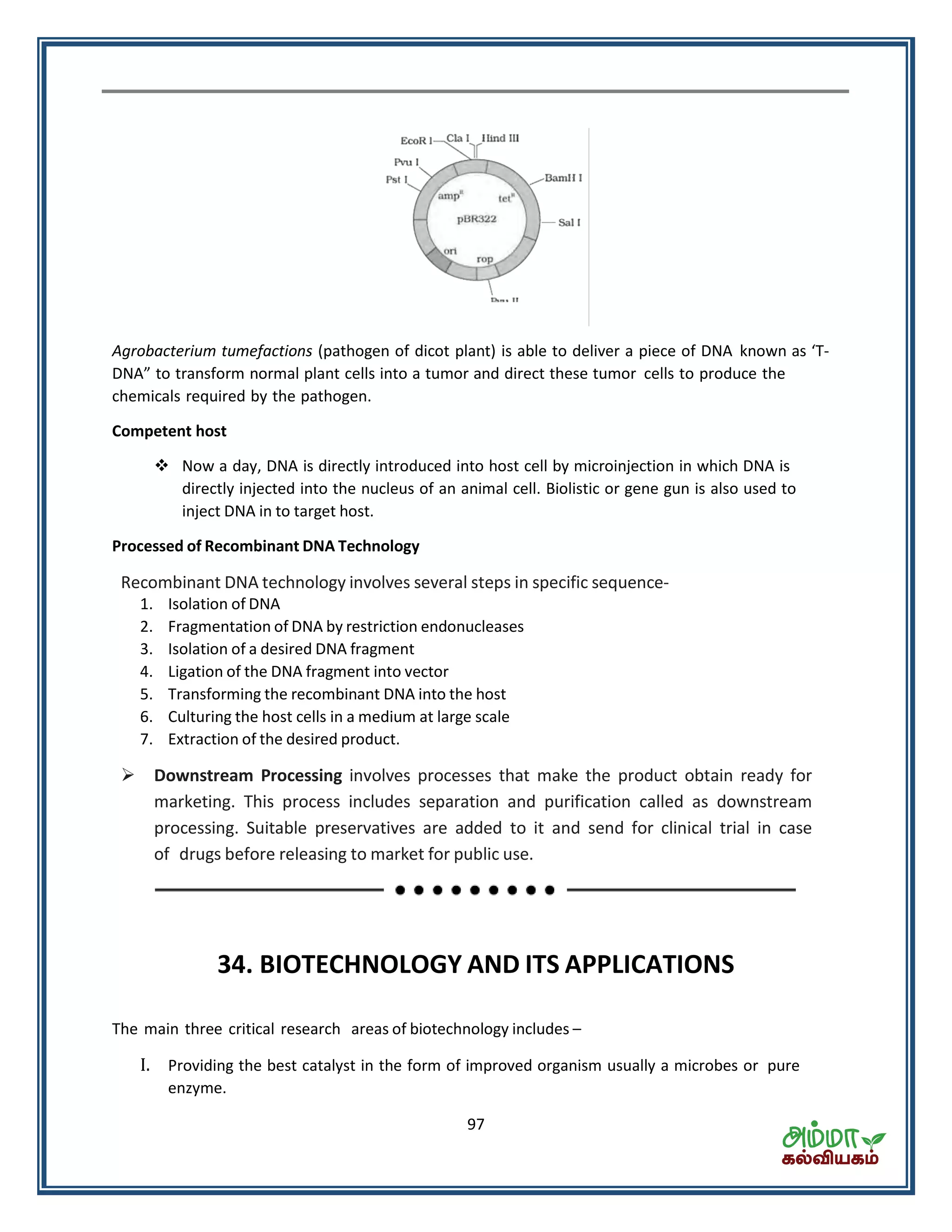
GAM

(5). Number of gram molecules = W(g)
Gram molecular mass
(6). Dilution formula : 1 1 2 2M V M V
For mixing two solutions of the same substance
1 1 2 2 3 1 2M V M V M (V V )  
Molarity can be directly calculated from % by mass (w/w) if density is known
Molarity
% 10 d
GMM
 

(7). Mass of 1 atom of element
A
GAM
N

(8). Mass of 1 molecule of substance  
A
MM
(MM Molar mass)
N
(9). o
T(K) T( C) 273.15 
(10). Relative atomic mass =

Mass of an atom of the element
1
Mass of an atom of carbon (C-12)
12
(11). Number of molecules in n moles of substance An N 
(12). Mass % of an element in a compound Mass of that element in 1 mole of the compound
100
Molar mass of the compount
 
(13). Mass percent
Mass of solute
100
Mass of solution
 
3
(14).
B A
B
X molality M
1 X 1000



where AM - mass of solvent
(15). Molarity (M) No. of moles of solute
mole / L
Volume of solution in litres

(16). A ogad o s No.
23
AN 6.022 10 
(17). o o9
T( F) T( C) 32
5
 
(18). Molecular mass 2 vapour density 
(19). Mole fraction of A
No. of moles of A
No. of moles of solution

2. STRUCTURE OF ATOM
(1). Wavelength of matter wave
h
mv
 
 
 
h
p
h
2Em
Where, E = Kinetic energy
(2). Total number of nodes = n – 1
Radial nodes = n – l – 1
Angular nodes = l
(3). Number of neutrons = A – Z
(4). Number of subshells in nth
shell = n
Number of orbitals in nth
shell = n2
4
Number of electrons in nth
shell = 2n2
Number of orbitals in subshell = 2l + 1
Number of electrons in subshell = 2 (2l + 1)
(5). Energy of quantum of radiation accordi g to Pla k s ua tu theo
E hv
(6).
Ei stei s photoele t i e uatio .
(7). Line spectrum of hydrogen
1
2 2
1 2
1 1
v 109677 cm
n n

 
  
 
 
where v is wave number and
1
v 

.
Where 1n 1,2,.....
2 1 1n n 1, n 2,.....  
(8). Bohr’s odel of hydroge ato
(a) Frequency of radiation absorbed or emitted during transition ;
E
v
h



 2 1E E
v
h
1E = Energy of lower energy state
2E = Energy of higher energy state.
(b) Orbit angular momentum of an electron,
Where, = , , ,…..
(c) Energy of stationary states
(d) Radii of the stationary states/orbits
  2
0 e
1
hv hv m v
2
e
h
m vr n
2
 

2
18
n 2
Z
E 2.18 10 J
n

 
    
 
 
2
n
n
r 52.9 pm
Z
 
   
 
 
5
(9). Energy gap between the two orbits
Where
18
HR 2.18 10
 
Where, in  initial orbit
fn  final orbit
(10). Atomic number (Z) = Number of protons in the nucleus of an atom
= Number of electrons in a neutral atom
. Heise e g s u ertainty principle
h
x p
4
   

;
(12). Speed of light is equal to the product of frequency and wavelength of light
c v 
(13). Mass Number (A) = Number of protons + Number of neutrons
3. STATE OF MATTER
(1). Van der Waals Equation :
2
2
an
P (V nb) nRT
V
 
   
 
 
(2). Combined Gas Equation :
1 1 2 2
1 2
P V P V
;
T T
 (n, R constant)
(3). Dalto ’s La of partial pressures : Total 1 2 3P P P P ....   
(4) Ideal gas equation : PV = nRT
H 2 2
i f
1 1
E R
n n
 
   
 
 
h
x m v
4
   

6
dRT
M
P

(5) Charles’s La : 1 2
1 2
V V
T T
(at constant P and n)
(6). A ogadro’s La : V = kn (at constant P and T)
(7). Partial Pressure in Terms of Mole Fraction : i i totalP x P
(8). Boyle’s La : 1 1 2 2P V P V (at constant T and n)
(9). Compressibility factor
PV
Z
RT
 (for 1 mole of Gas)
4. THERMODYNAMICS
 First law of thermodynamics
U q W  
 Enthalpy of reaction
   o o
i iH H (products) H (reactants)
By convention heat of formation of every element in its standard state is arbitrarily assumed to
be zero.
    o o o
sub fus vapH H H
 Heat Capacity Specific heat capacity s
q
c
m T


q
C
T


molar heat capacity m
q
c
n T


 Energy changes vq  heat exchange at constant volume
v pU q , H q    pq  heat exchange at constant pressure
7
 Enthalpy
H U pV 
 Relation between H and U
H U p V     Or
gH U n RT    
 p vC C R 
revq
S
T
 
G H T S    
o
G RT In K  
Atomicity  Cp Cv
Monoatomic 5/3 5R/2 3R/2
Diatomic 7/5 7R/2 5R/2
Triatomic non linear 4/3 4R 3R
5. EQUILIBRIUM
(1). w a bK K K 
(2). i
[A ][B ]
K
[AB]
 

(3). y x x y
spK [A ] [B ] 

(4).
o
G 2.303 RT log K  
(5).
3
a
[A ][H O ]
K
[HA]
 

b
[B ][OH ]
K
[BOH]
 

8
(6).       
   
16 o
wK H OH 10 at 25 C
(7). pH log [H ]
 
(8).
o
wpK pH pOH 14 at 25 C  
(9). n
p cK K (RT)

(10). Hydrolysis of salts
(i) For a salt of strong acid and weak base
w b
1
pH [pK pK log c]
2
  
(ii) for a salt of weak acid and strong base
w a
1
pH [pK pK log c]
2
  
(iii) For salts of weak acid and weak base
w a b
1
pH [pK pK pK ]
2
  
(11). Equilibrium constant,  a
eq
b
K
K
K
(12).
2
a bK or K c 
(13). Concentration quotient,
c d
a b
[C] [D]
Q
[A] [B]

9
6. SOLID STATE
(1). Density of Cubic Crystal System
3
3
A
Z M
(or d) g.cm
a N

 

Where, Z number of atoms per unit cell
AN Avogadro's Number
 -1
M Gram atomic weight of element (g. mol )
 a edge length
(2). Radius-ratio in ionic solids
Voids Triangular Tetrahedral Octahedral Cubical
Radius-ratio r
0.155 0.225
r


 
r
0.255 0.414
r


 
r
0.414 0.732
r


 
r
0.732 0.999
r


 
(3).
Crystal Radius of atom (r) No. of atoms per unit cell p.f.
Simple cubic a
2
1 52.4 %
F.C.C. a
2 2
2 74 %
B.C.C 3
a
4
2 68 %
(4). Packing Fraction (p.f.) = Volume occupied by particles (per unit cell)
Volume of unit cell
Contribution of each atom present on the corner =
1
8
Contribution of each atom present on the centre of face =
1
2
Contribution of each atom present on the body centre = 1
10
Contribution of each atom present on the edge centre =
1
4
(5). Seven crystal system with dimensions :
(a) Cubic :
o
90 , a b c       
(b) Tetragonal :
o
90 , a b c       
(c) Orthorhombic :
o
90 ; a b c       
(d) Monoclinic :
o o
90 ; 90 ; a b c       
(e) Hexagonal :
o o
90 ; 90 ; a b c       
(f) Rhombohedral or trigonal :
o
90 ; a b c       
(g) Triclinic :
o
90 ; a b c       
7. SOLUTIONS
(1). Depression in freezing point
f fT K m  
 

2 2
0 A 0
f
fusion fusion
RT M RT
K
1000 I 1000 H
(2) Dissociation of solute
n(A) nA
1 (n 1)
i
1
  
 { = degree of dissociation}
11
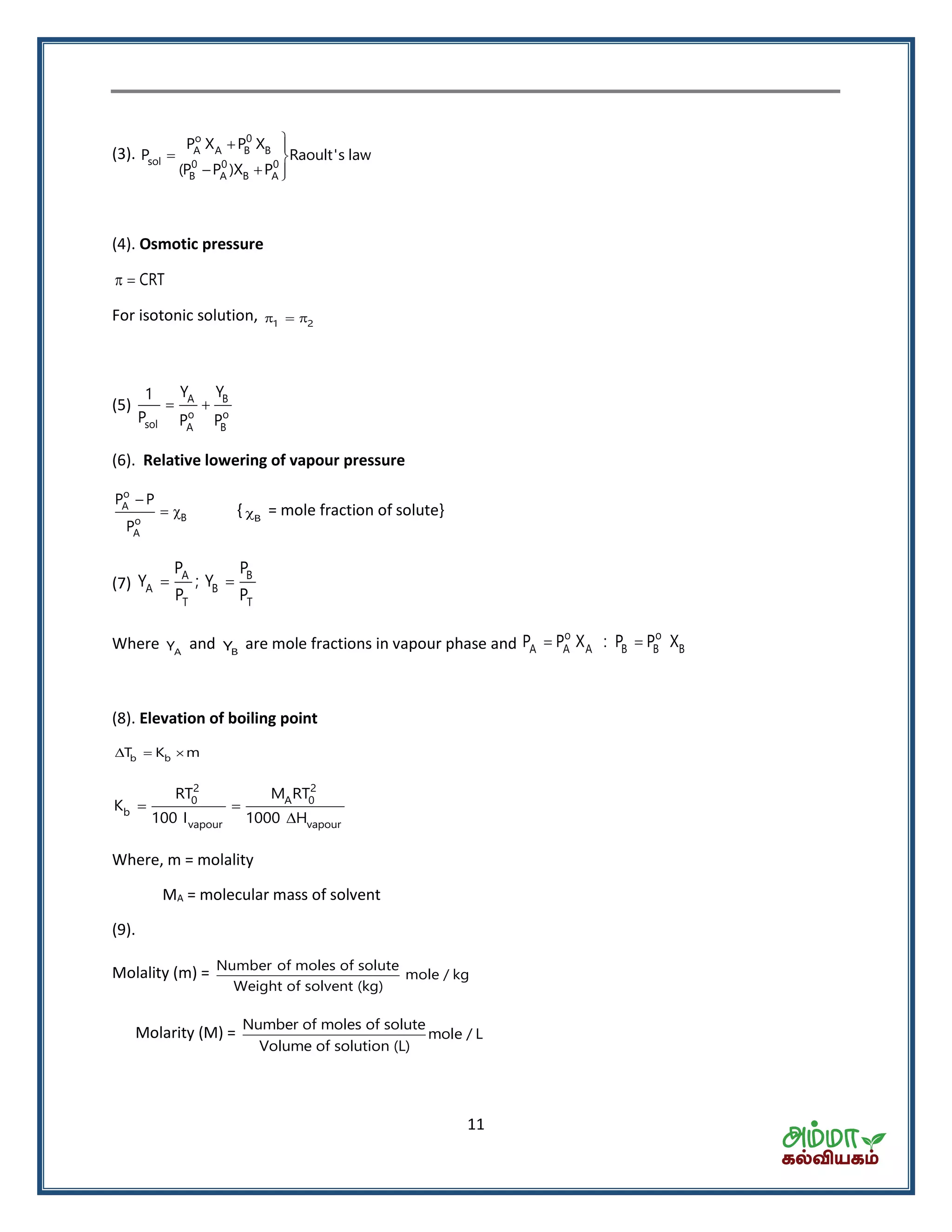
(3).
 
 
  
o 0
A A B B
sol 0 0 0
B A B A
P X P X
P Raoult's law
(P P )X P
(4). Osmotic pressure
CRT 
For isotonic solution, 1 2  
(5) A B
o o
sol A B
Y Y1
P P P
 
(6). Relative lowering of vapour pressure
o
A
Bo
A
P P
P

  { B = mole fraction of solute}
(7)
A B
A B
T T
P P
Y ; Y
P P
 
Where AY and BY are mole fractions in vapour phase and
o o
A A A B B BP P X : P P X 
(8). Elevation of boiling point
b bT K m  
2 2
0 A 0
b
vapour vapour
RT M RT
K
100 I 1000 H
 

Where, m = molality
MA = molecular mass of solvent
(9).
Molality (m) = Number of moles of solute
mole / kg
Weight of solvent (kg)
Molarity (M) = Number of moles of solute
mole / L
Volume of solution (L)
12
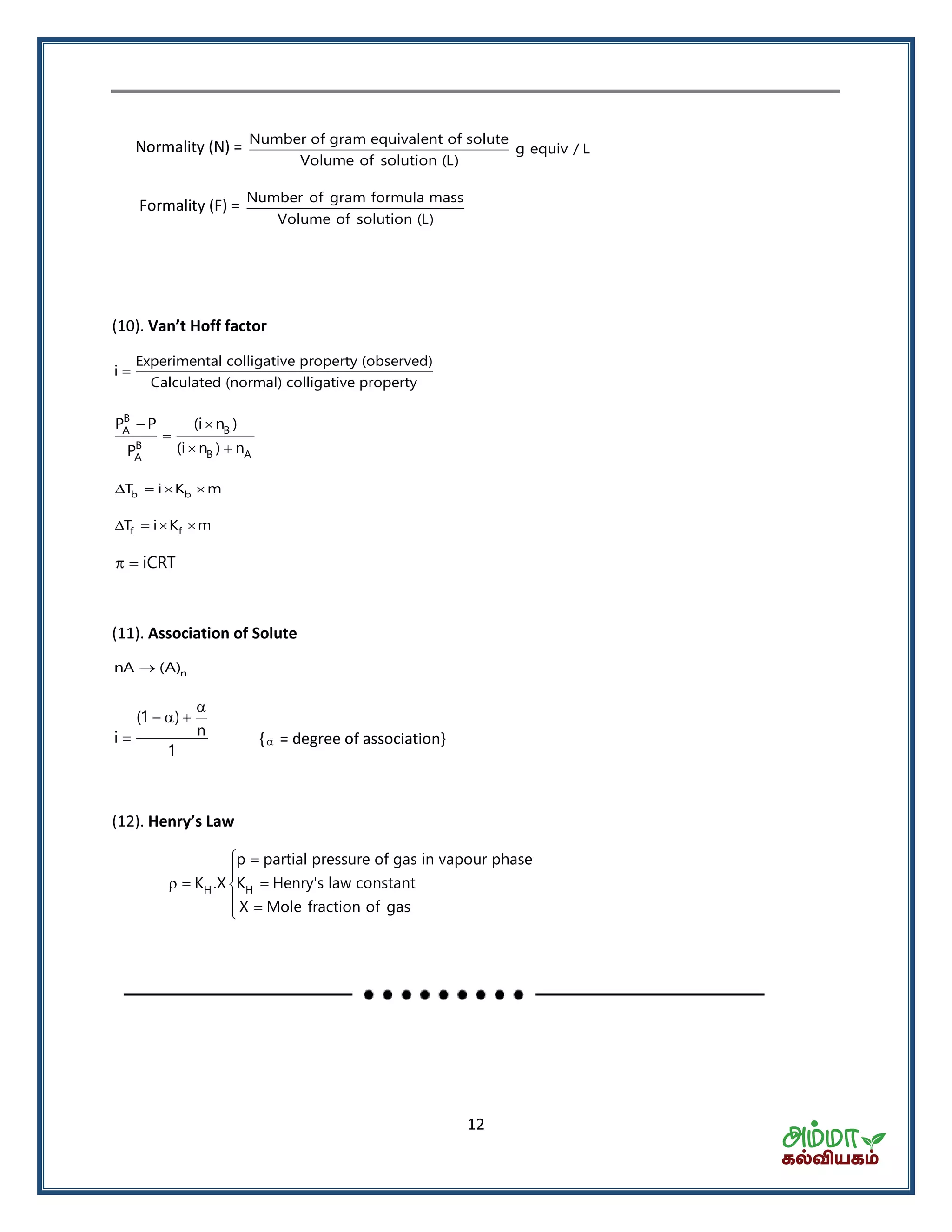
Normality (N) = Number of gram equivalent of solute
g equiv / L
Volume of solution (L)
Formality (F) = Number of gram formula mass
Volume of solution (L)
(10). Va ’t Hoff fa tor
Experimental colligative property (observed)
i
Calculated (normal) colligative property

B
A B
B
B AA
P P (i n )
(i n ) nP
 

 
b bT i K m   
f fT i K m   
iCRT 
(11). Association of Solute
nnA (A)
(1 )
ni
1

  
 { = degree of association}
(12). He ry’s La
H H
p partial pressure of gas in vapour phase
K .X K Henry's law constant
X Mole fraction of gas
 

  
 
13
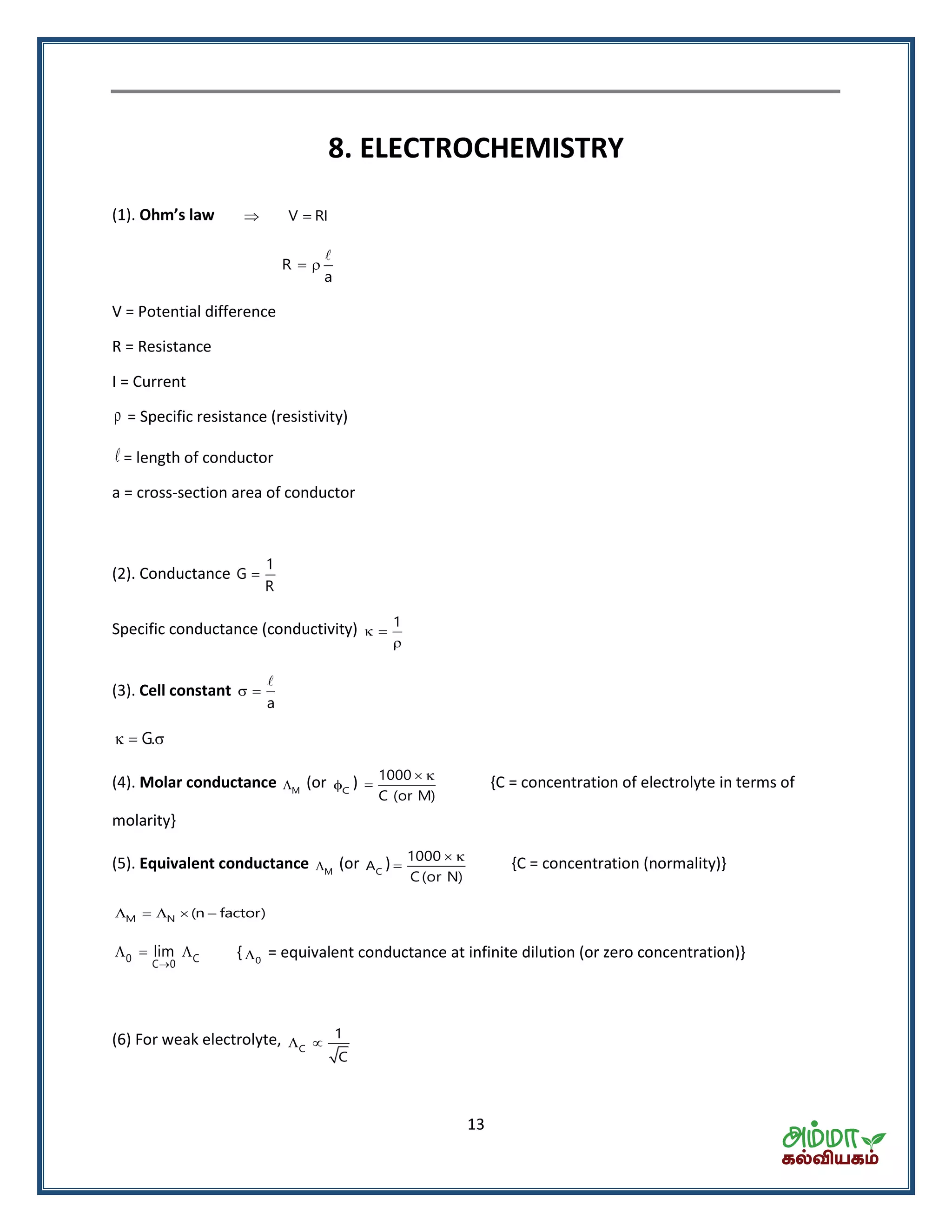
8. ELECTROCHEMISTRY
(1). Oh ’s la V RI 
R
a
 
V = Potential difference
R = Resistance
I = Current
 = Specific resistance (resistivity)
= length of conductor
a = cross-section area of conductor
(2). Conductance
1
G
R

Specific conductance (conductivity) 1
 

(3). Cell constant
a
 
G.  
(4). Molar conductance M (or C ) 1000
C (or M)
 
 {C = concentration of electrolyte in terms of
molarity}
(5). Equivalent conductance M (or CA ) 1000
C(or N)
 
 {C = concentration (normality)}
M N (n factor)    
0 C
C 0
lim

   { 0 = equivalent conductance at infinite dilution (or zero concentration)}
(6) For weak electrolyte, C
1
C
 
14
For strong electrolyte,
1/2
C 0 B(C)    {B = constant}
(7). At infinite dilution, for an electrolyte x yA B
y x
x yA B xA yB 

    o o o
A B A Bx y
x y {
o o
A B,  = equivalent conductance at infinite dilution of cation and anion}
    o o
x
o o
C ck   { = ionic mobility, K = 96500 coulomb}
Ionic velocity
Potential gradient
 
(8). For a weak electrolyte, 3 3(CH COOH CH COO H ) 

Degree of dissociation,
2
M 0M
eq
0 M 0
C( / )
, K
1 ( / )
 
  
   
(9). For solubility of salt (AgCl Ag Cl ) 

2
sp
0
1000 K
K
 
    
(10). For a cell reaction in an electrochemical cell,
4 4Zn CuSO Cu ZnSO 
Cell representation
2 2
Anode( ) Cathode( )
Zn | Zn (aq.) || Cu (aq.) | Cu 
 

(11). For half cell reaction  
  n
ox M/M
M M (aq.) ne ; E E
n
red M /M
M (aq) ne M ; E E 
  
emf of cell, o o o
cell right leftE E E 
o o
cathode anode
(R.P.) (R.P)
E E  {R.P. = Reduction potential}
15
(12). cellG nFE  
= - W
o
G 2.303 RT log Q  
o o
cellG nFE  
o
cell cell
2.303 RT
E E log Q
nF
 
G Change in free energy
W Useful work done
n Number of electrons exchanged
F Faraday constant (96500 coulomb)
Q Reaction quotient
  
 
 
 
 
 
  
At room temperature (25o
C)
o
cell cell
0.0591
Nernst's equation E E log Q
n
   
(13). For electrode concentration cell, 2 1 2 2
anode cathode
(Pt, H (P ) | H | | H (P ),Pt)
1
cell
2
P0.0591
E log
2 P
 (P = Pressure)
For electrolyte concentration cell 2 2
1 2
anode( ) cathode( )
(Cu | Cu (C ) || Cu (C ) | Cu) 
 
2
cell
1
C0.0591
E log
2 C

For concentration cells,
o
cellE 0
(14). At equilibrium, cellE 0 (as G 0)  
(15). Temperature coefficient (T.C.) = cell
P
E
T
 
 
 
Change in entropy, S nF (T.C.)    { H = heat of cell-reaction}
cell
H
E T.(T.C.)
nF
 
  
 
16
T.C. 0  Cell-reaction is endothermic and vice-versa.
6 . Fa ada s st
law of electrolysis
m = Zit
m = mass of substance deposited
Z = electrochemical equivalent
i = current
t = time
Atomic mass
Z
n F


Fa ada s nd
law of electrolysis
1 1
2 2
m E
m E
 (E = equivalent weight)
(17). Oxidation potential for half-cell reaction : n
M M ne 
 

 o n
ox ox
2.303
E E log [M ]
nF
Reduction potential for half-cell reaction : n
M ne M 
 
o n
red red
2.303 RT
E E log[M ]
nF

 
9. CHEMICAL KINETICS AND NUCLEAR CHEMISTRY
(1). For a general chemical transformation
nA mB pC qD  
1 d[A] 1 d[B] 1 d[C] 1 d[D]
Rate
n dt m dt p dt q dt
 
    
(2). For elementary chemical reaction
17
mA nB products 
Theoretical rate rm ndx
k[A] [B]
dt
  
(3). For a general reaction ; aA bB Pr oducts 
m ndx
Rate k[A] [B]
dt
  
Order of reaction w.r.t. A = m overall order of reaction = (m + n)
Order of reaction w.r.t. B = n
(4). Unit of rate constant = (mole)1-n
(litre)n-1
time-1
Where, n = order of reaction
(5) For a zero order reaction ; A B
Bd[A]
Rate k[A] k (cons tant)
dt

  
0[A ] [A]
K
K


(6). For a first order reaction ; A B
d[A]
Rate k[A]
dt

 
0
10 10
1
[A]2.303 2.303 a
k log log
t [A] t a x
 
   
 
(7). For a zero order reaction, 0
1/2
[A]
t
2k

For a first order reaction, 1/2
0.693
t
k

For an nth
order reaction, 1/2 n 1
0
1
t (for n 2)
[A] 
 
(8). For a parallel reaction
18
1 2
d[A]
(k k )[A]
dt

 
(9). For a first order reaction : A B C  , a reagent reacts with all A, B and C
0
10
t
V V2.303
k log
t V V


 
    
{V = vol. of reagent}
(10). Temperature coefficient =
oT 10 C
T
k
k

Arrhenius equation, E /RTak Ae


a2 2 1
10
1 2 1
Ek T T
log
k (2.303 R) T T
 
   
 
0
10 10
E
log k log A
2.303RT
 
a
A Arrhenius's constant
E Activation energy
 


0
10 10
E
log k log A
2.303 RT
 
(12). Binding energy, B.E. m 931.5 MeV  
m = mass defect = calculated At. Mass – observed At. Mass
B.E. per nucleon
B.E. (total)
mass number

10 1
1 MeV 9.6 10 Joule mol
 
(13). Packing fraction. P.F. 6Isotopic atomic mass-mass no.
10
mass numer
 
(14). In a radioactive decay,
t
t 0N N e

A ou t of adioa ti e su sta e afte half-life periods
19
n
0
1
N N
2
 
  
 
(15). Activity,
t
t 0A A e , A N
  
10. SURFACE CHEMISTRY
(1). Freundlich Adsorption isotherm
1
mx
Kp ; n 1
m
 
 
  
  
 
(2). Langmuir Adsorption isotherm
A
A
K'P
1 KP
 

Or,
x aP m 1 b
or
m 1 bP x aP a
  

(3)
1
nx
KC ; C
m
 
 
   Concentration of solute in solution.
(4). Zeta potential,
4
Z
D


20
11. HYDROGEN
(1) At. Wt. of
1 2 3
1 1 1% H 1 % H 2 % H 3
H
100
    

(2) Vapour density of a gas =
2
molar mass of gas
molar mass of H
LHS and RHS both are unitless
(3). Molecular wt. = 2 (V.D.)
(4). Vol. Strength of H2O2 = Molarity 11.2
= Normality 5.6
12. S-BLOCK ELEMENTS
(1) General Electronic Configuration ns1-2
.
(2) Atomic Radii increases down the group.
(3) Hydration enthalpy decreases down the group.
(4). Ionization enthalpy decreases down the group.
(5). On reaction with oxygen give oxide, peroxide and superoxides.
(6) On reaction with water produces hydroxide and hydrogen.
(7). Some important compounds and their general names.
Name Chemical Formula Prepared by
Caustic Soda NaOH Electrolysis in costner kellner cell
Washing Soda Na2CO3, 10H2O Sol a s p o ess
Baking Soda NaHCO3 Sol a s p o ess
Glau e s Salt Na2SO4, 10H2O NaCl + H2SO4
Microcosmic salt Na(NH4)HPO4 NH4Cl + Na2HPO4
21
Potash or Pearl Ash K2CO3 Leblanc Process
Caustic potash KOH Electrolysis of KCl
Quick lime CaO Decomposition of CaCO3
Slaked lime Ca(OH)2 Hydrolysis of CaO
Gypsum CaSO4, 2H2O CaCl2 + H2SO4
Plaster of Paris CaSO4, ½ H2O By heating gypsum
13. P-BLOCK ELEMENTS
(1). In general metallic character, electropositive character, atomic radii, basic character, reducing
character decreases on moving left to right in a period and increases down the group.
(2). Some important compound of p-block elements
i. Borax (Tincal) 2 4 7 2Na B O ,10H O
ii. Colomonite 2 6 11 2Ca B O ,5H O
iii. Kemite 2 4 7 2Na B O , 4H O
iv. Sassolite or boric acid 3 3H BO
v. Diborane 2 6B H
vi. Borazole 3 3 6B N H
vii. Alumina 2 3Al O
viii. Lithium aluminium hydride 4LiAlH
ix. Potash Alum 2 4 2 4 3 2K SO , Al (SO ) , 24 H O
22
14. COORDINATION COMPOUND
(1). Magnetic moment, n(n 2)B.M  
(2)  
    
    
          
        
0 e e
(t ) (e )2g g
(CFSE) 4 n 6 n Dq
(3). t e e
(t ) (e )2g g
(CFSE) 4 n 6 n Dq 
    
    
          
        
(4). t 0
4
9
  
(5). For the reaction : 4M 4L ML , overall stability constant of complex (ML4) is
4
4 4
[ML ]
[M][L]
 
(6).
(of metal atom/ion)
EAN Z O.N. 2(C.N.)  
15. ORGANIC CHEMISTRY
Relations for the estimation of elements in organic compounds.
2Mass of CO formed12
% of C 100
44 Mass of the compound
  
2Mass of H O formed2
% of H 100
18 Mass of the compound
  
  2
(Dumas's method)
Volume of N at NTP28
% of N 100
22400 Mass of compound
 

(kjeldahl's method)
1.4 Normality of acid used Volume of acid used
% of N
Mass of the compound
23
  

At. mass of X Mass of AgX formed
% of X(Halogens) 100
(108 At. mass of X) Mass of the compound
4Mass of BaSO formed32
% of S 100
233 Mass of the compound
  
2 2 2Mass of Mg P O formed62
% of P 100
222 Mass of the compound
  
(1). Inductive effect
(+I effect) 3 2 5 3 7 2 3CH C H C H R CH R C O R

      
(-I effect) 4 2 3 2 6 5R N NO CN SO H COOH F Cl 1 OR OH NH C H                
(2). Relative basic strength in aqueous medium.
3R CH o o o
32 1 3 NH  
2 5R C H o o o
32 3 1 NH  
2Me CH o o o
31 NH 2 3  
2M C o o o
3NH 1 2 3  
(3). Stability of free radical
   
  3 2 2
o1o oo 2 13
Me C Me CH MeCH Me
(4) Heat of hydrogenation of alkenes
1-butene > cis-2-butene > trans-2-butene
(5). Leaving nature in Nucleophilic substitution reaction
3 2 3ArSO ROSO CH COO CN O H MeO H R       
      
(6). Number of product formed during crossed aldol condensation
S.
No.
Carbonyl compound
(I)
Carbonyl compound (II) Self
Condensation
Product
Cross
Condensation
Product
Total
Product
1. One type of similar 
H-atom
One type of similar  H-
atoms
2 2 4
24
 3
O
||
CH C H
 3 2CH CH CHO
2. Two different types
of dissimilar  H-
atoms
3 2 3CH COCH CH
One type of similar  H-
atoms
 3 2CH CH CHO
3 3 6
3 Two different types
of dissimilar  H-
atoms
 3 2 3CH CO CH CH
Two different types of
dissimilar  H-atoms
2 2 3PhCH CO CH CH  
4 4 8
16. ALCOHOLS, PHENOLS AND ETHERS
Structure of Alcohols :
Preparation of Alcohols
(i) From alkenes
(a) By acid catalysed hydration in accordance with Ma ko ikoff s ule.
(b) By hydroboration-oxidation
25

     
B H ,H O /OH2 6 2 2
3 2 2 2 3 2 2 3CH CH CH (H BH ) CH CH CH OH B(OH)
(ii) From carbonyl compounds
(a) By reduction of aldehydes and ketones
Pd
2 2R CHO H RCH OH   
NaBH4RCOR' R CH R'
|
OH
  
(b) By reduction of carboxylic acids and ester
(i) LiAlH4
2
(ii) H O2
RCOOH RCH OH
H2
2
Catalyst
RCOOR' RCH OH R'OH 
Reduction of aldehyde, ketones and esters with No alcohol is called Bouveault-blanc reduction.
Reaction of carbonyl compound with Grignard Reagent.
(iv) Hydrolysis of alkyl halides
   (aq)R X KOH ROH KX
Ease of hydrolysis of alkyl halides RI > RBr > RCI > and 3o
> 2o
> 1o
alkyl halides.
(v) Hydrolysis of ethers
H SO2 4
2R O R H O 2ROH   
(vi) From primary amines by treatment with nitrous acid
(NaNO HCl)2
2 2 2RNH HONO ROH N H O

   
26
Methylamine does not give methyl alcohol when treated with HNO2. It gives CH3OCH3 and CH3ONO.
(vii) By alcoholic fermentation
Invertase
12 22 11 2 6 12 6 6 12 6
sucrose glucose fructose
C H O H O C H O C H O  
 
Zymase
6 12 6 2 5 2(g)
glucose and fructose ethyl alcohol
C H O 2C H OH 2CO
Preparation of Phenols
(i) From haloarenes
(ii) From benzene sulphonic acid
(iii) From diazonium salts
(iv) From cumene
Chemical properties of alcohols :
1. Reaction involving cleavage of O-H bond :
27
Alcohols react as nucleophiles :
(a) Reaction with metals
2
Sodium alkoxide
2R O H 2Na 2R O Na H      
(b) Esterification reaction
H
2
Alcohol
RO H R' COOH ROCOR' H O

    
H
2
Alcohol
RO H (R'CO )O ROCOR' R'COOH

   
    
Pyridine
Alcohol
RO H R'COCl R OCOR' HCl
(b) Reaction with phosphorus halides
5 3ROH PCl RCl POCl HCl   
P/Br2
3 3 33ROH PBr 3RBr H PO  
P/I2
3 3 33ROH PI 3RI H PO  
(c) Reaction with thionyl chloride
     2 2ROH SOCl RCl SO HCl
(c) Dehydration reaction
  
Protic acids (conc. H SO or H PO )2 4 3 4
Or
Catalysis (anhyd. ZnCl or alumina)2
2Alcohol C C H O
(d) Oxidation reaction

Acidified potassium permanganate
Alcohol Carboxylic acid
(i) 
Cu, 573k
Or
CrO3
Or
PCC
Primary Alchol Aldehyde
(ii) Secondary Alcohol 
Cu, 573k
Or
CrO3 Ketone
(iii) Tertiary Alcohol 
Cu, 573k
Or
KMnO4 Alkene
28
Phenols
Chemical properties of phenols :
(a) Reaction with metals
(b) Esterification reaction

     
H
2
Phenol
Ar OH R' COOH Ar OCOR' H O

    
H
2
Phenol
Ar OH (R'CO) O Ar OCOR' R'COOH
Pyridine
Phenol
Ar OH R 'COCl ArOCOR ' HCl   
(a) Halogenation
29
(b) Sulphonation
(c) Nitration
30
(d) Reimer-Tiemann reaction
(ii) Kol e’s rea tio
31
iii) Reaction with zinc dust
(iv) Oxidation
(v) Fries rearrangement
Ethers
Structure of Ethers
32
Preparation of Ethers
(i) By dehydration of alcohols
H SO (conc.)2 4
3 2 3 2 2 3 2
418Kexcess
2CH CH OH CH CH O CH CH H O      
Willia so ’s Sy thesis Only primary alkyl halides when react with sodium alkoxide give ether while
tertiary alkyl halides give alkene due to steric hindrance.
3 2 3 2 3 2 2 3CH CH Br CH CH ONa CH CH OCH CH NaBr  
Chemical Reactions of Ether
R O R' HX RX R'OR    
The order of reactivity of hydrogen halides is as follows
HI > HBr > HCl
(ii) Halogenation


Cl2
3 2 2 3 3 2 3
Dark ( monochloro diethyl ether)
CH CH OCH CH CH CHClOCH CH

  h
2 5 2 5 2 2 5 2 5
(light)(excess) (perchlorodiethyl ether)
C H OC H 10Cl C Cl OC Cl 10HCl
(iii) Reaction with PCl5

    5 3R O R PCl 2RCl POCl
33
(iv) Reaction with CO
 
oBF /150 C3
500 atm
ROR CO RCOOR
Electrophilic Substitution reactions
34
 Other conversion reactions :
(a) Phenol to salicylaldehyde
35
(b) Phenol to benzene diazonium chloride
Differentiate between organic compounds :
(a) Alcohols and phenols
Phenol on reaction with neutral FeCl3 gives purple colour whereas alcohols do not give
purple colour.
3 3
6 5 6 5 6
Purple colour
6C H OH Fe [Fe(OC H ) ] 6H  
  
(b) Primary, secondary and tertiary alcohols
Lucas reagent test :

  
conc. HCl ZnCl /lucas reagent2
2ROH HCl RCl H O
If it is a primary alcohol, no turbidity appears at room temperature. Turbidity appears
only on heating. If it is a secondary alcohol, turbidity appears in 5 minutes. If it is a
tertiary alcohol, turbidity appears immediately.
(c) Methanol and ethanol
Iodoform test : Ethanol when reacted with (I2 and NaOH) or NaOI gives yellow ppt of
iodoform since it has the presence of CH3-CH (OH)-group.
2 5 2 3 2
Yellow ppt
C H OH 4I 6NaOH CHI 5NaI 5H O HCOONa     
3 2CH OH I NaOH No yellow ppt  
36
17. ALDEHYDES, KETONES AND CARBOXYLIC ACIDS
Preparation of Aldehydes and Ketones
(i) By oxidation of alcohols
Aldehydes and ketones are generally prepared by oxidation of primary and secondary alcohols,
respectively.
CrO3
2RCH OH RCHO
CrO3R CH R' R C R'
| ||
OH O
    
By dehydrogenation of alcohols
Primary and secondary alcohols give aldehydes and ketones, respectively.
Cu
2
573 K
R CH OH RCHO  
Cu
573 KR CH R' R C R'
| ||
OH O

   
(iii) By ozonolysis of alkenes
(iv) By hydration of alkynes
HgSO4
2 3
H SO2 4acetylene acetaldehyde
CH CH H O CH CHO   
HgSO4
2 3
H SO2 4 ketone
R C CH H O R CO CH     
37
Preparation of Aldehydes
(i) Rosenmund reduction
Formaldehyde cannot be prepared by this method as HCOCl is highly unstable.
(ii) From nitriles
H O3
2RCN SnCl HCl RCH NH RCHO

    
This reaction is called Stephen reaction.
Alternatively, nitriles are selectively reduced by diisobutylaluminium hydride, [DiBAL-H] to imines which
on hydrolysis give aldehydes.

(i) AlH(iBu)2
(ii) H O2
RCN RCHO
Similarly, esters can also be reduced to aldehydes with DiBAL-H.
3 2 3 2 5CH (CH ) COOC H

 
(i) DiBAL H
3 2 3
(ii) H O2
CH (CH ) CHO
(iii) Etard reaction
Using chromium oxide (CrO3) : Toluene or substituted toluene is converted to benzaldehyde in presence
of chromic oxide in acetic anhydride.
38
(iv) Side chain halogenation is followed by hydrolysis of toluene
(v) Gattermann-Koch synthesis
Preparation of Ketones
(i) From acyl chlorides
39
(ii) From nitriles
(iii) Friedel-Crafts acylation
(iv) Oppenauer oxidation
[(CH ) CO] Al3 3 3
2 3 2 2 3 2
n ketone iso propyl2 alcohol
alcohol
R CHOH (CH ) C O R C O (CH ) CHOH

    
Chemical Reactions of Aldehydes and Ketones
(i) Addition of hydrogen cyanide
40
(ii) Addition of sodium hydrogen sulphite
(iii) Addition of Grignard reagent (RMgX) to form alcohol
(iv) Addition of ammonia and its derivatives
2 6 5 2Z Alkyl, aryl, OH, NH , C H NH, NHCONH , etc
41
Z Reagent name Carbonyl derivative Product Name
-R Amine  C NR
|
Substituted imine
S hiff s ase
-OH Hydroxyl
amine
  C N OH
|
Oxime
-NH2 Hydrazine    2C N NH
|
Hydrazone
Phenyl-
hydrazine
Phenylhydrazone
2, 4-
dinitrophenyl
hydrazine
2, 4-dinitrophenyl
hydrazone
Semi-
carbazide
Semi-carbazone
Reduction
(1). Clemmensen reduction
(2). Wolff-Kishner reduction
(3). Oxidation
(i) Aldehydes are oxidized to acids in presence of mild oxidizing agents 3 2 2 7 4HNO , K Cr O , KMnO
[O]
R CHO R COOH  
(ii) Ketones are oxidized under drastic conditions i.e. with powerful oxidizing agents like
3 2 2 7 2 4 4 2 4HNO , K Cr O / H SO , KMnO / H SO at higher temperature.
42
 
           
1 2 3
[O]
2 2 2 2
(By cleavage of C C bond) (By cleavage of C C bond)1 2 2 1
R CH CO CH R' R COOH R' CH COOH R CH COOH R' COOH
(iii) Haloform reaction :
(v) Aldol condensation
Cross aldol condensation
Base catalysed crossed aldol condensation between an aromatic aldehyde and an aliphatic aldehyde or
ketone is called Claisen-Schmidt condensation or Claisen reaction.
43
Cannizzaro reaction
Test to distinguish aldehydes and ketones :
Tolle ’s test : Whe a aldeh de is heated ith Tolle s eage t it fo s sil e i o .
Tolle s eage t is a o ia al solutio of AgNO3
  
     3 2 2 3RCHO 2[Ag(NH ) ] 3OH RCOO 2Ag 2H O 4NH
Ketones do not form silver mirror and hence do not give this test.
Fehli g’s test : When an aldehyde is heated ith Fehli g s reagent it forms reddish brown
precipitates of cuprous oxide.
Fehli g s eage t : Fehli g solutio A a ueous solutio of CuSO4) + Fehling solution B (alkaline solution
of sodium potassium tartarate)
2
2 2
Red Brown ppt
R CHO 2Cu 5OH RCOO Cu O 3H O  

     
Ketones do not give this test.
Carboxylic Acids
Methods of Preparation of carboxylic Acids
From primary alcohols and aldehydes
(a)


alkaline KMnO /H O4 3
2RCH OH RCOOH
(b)
CrO H SO3 2 4
2RCH OH RCOOH


44
From aldehydes
(a)
  
     3 2 2RCHOH 2[Ag(NH ) ] 3OH RCOO 2Ag 2H O 4N
(b)
2
2 2R CHO 2Cu 5OH RCOO Cu O 3H O  
     
From alkyl benzenes
From acid derivatives
All acid derivatives like amides (RCONH2 , a id halides ‘COCl , este s ‘COO‘ , a id a h d ides ‘CO-O-
COR) on hydrolysis give carboxylic acids. All acid derivatives break from RCO+
.

Dil. HCl
or dil. NaOH
RCOZ RCOOH
2Z NH , X(X Cl, Br,I), OR', RCOO etc     .
Ease of hydrolysis : 2 2RCOCl (RCO) O RCOOR' RCONH  
From nitriles and amides
From alkenes
Suitably substituted alkenes are oxidized to carboxylic acids on oxidation with acidic potassium
permanganate or acidic potassium dichromate.
(a)

    
KMnO /H4R CH CH R 2R COOH
(b)

      
KMnO /H4
1 1R CH CH R R COOH R COOH
From Grignard reagents
45
By heating germinal dicarboxylic acids
From alkynes
 
   
(i) O (ii), H O or3 2 2
KMnO /OH ,4
R C C R 2RCOOH
Reactions of Carboxylic acids
Formation of anhydride
Esterification
H
2RCOOH R'OH RCOOR' H O

 
Reactions with 5 3PCl , PCl and 2SOCl
5 3RCOOH PCl RCOCl POCl HCl   
3 3 33RCOOH PCl 3RCOCl H PO  
   2 2RCOOH SOCl RCOCl SO HCl
Reaction with ammonia (NH3)
Carboxylic acids react with ammonia to give ammonium salt which on further heating at high
temperature gives amides.
46
(a)
 
 
  
/ H O2
3 3 3 4 3 2
Ammonium acetate Acetamide
CH COOH NH CH COONH CH CONH
(b)
Chemical reactions involving – COOH group
(a) Reduction
(i) LiAlH /ether4
2
or B H (ii) H O2 6 3
RCOOH R CH OH

  
(b) Decarboxylation
NaOH, CaO (Ratio 3:1)
2 3RCOONa R H Na CO

  
Substitution reactions in the hydrocarbon part
Hell-Volhard-Zelinsky reaction

    

X /Red Phosphorus/H O2 2
2
Halocarboxylicacid
R CH COOH R CH COOH
|
X
X Cl, Br
Arndt-Eistert reaction
  
PCl CH N HOH5 2 2
2 2
diazo ketone
RCOOH RCOCl RCOCHN RCH COOH
Reducing property
2 2HCOOH HgCl Hg 2HCl CO   
Electrophilic substitution reactions of aromatic acids
47
18. AMINES
Methods of Preparation of Amines
(i) By reduction of nitro compounds :
Nitro compounds can be catalytically reduced by passing hydrogen gas in presence of Raney Ni, finely
divided Pt or Pd as catalyst at room temperature.
(a)
Ni, Pt or pd
2 2 2 2R NO 3H R NH 2H O    
48
(b)
Ni, Pt or pd
2 2 2 2Ar NO 3H Ar NH 2H O    
Nitro compounds can also be reduced with active metals such as Fe, Sn, Zn etc. with conc. HCl.
(a)
Sn/HCl or Fe/HCl
2 2 2 2R NO 3H R NH 2H O    
(b)
Sn/HCl or Fe/HCl
2 2 2 2Ar NO 3H Ar NH 2H O    
ii B Hoff a s ethod A o ol sis of alkyl halides):
RX RX RX
2 2 3 4
o o o Quaternary(1 ) (2 ) (3 )
ammonium salt
RNH R NH R N R NX
 
  
 The free amine can be obtained from the ammonium salt by treatment with a strong base :
(a) NaOH
3 2 23
o(1 amine)
NH RX RNH X RNH H O Na X   
    
(b) NaOH
2 2 2 2 2
o(2 amine)
RNH RX R NH X R NH H O Na X   
    
(c) NaOH
2 3 3 2
o(3 amine)
R NH RX R NH X R N H O Na X   
    
 Order of reactivity of halides is : RI > RBr > RCl
(iii) By reduction of nitriles :
Nitriles can be reduced to amines using H2/Ni, LiAlH4 or Na(Hg)/C2H5OH
    
H /Ni2
Or
Na(Hg)/C H OH2 5
Or
LiAlH4
2 2R C N R CH NH
(iv) By reduction of amides :
Amides are reduced to corresponding amines by LiAlH4
(v) Ga iel s phthali ide reaction
49
(vi) Hofmann bromamide degradation reaction
       2 2 2 2 3 2R CO NH Br 4NaOH RNH Na CO 2NaBr 2H O
Reactions of Amines
(i) Alkylation
(ii) Acylation
50
(iii) Benzoylation
Pyridine
3 2 6 5 3 6 5CH NH C H COCl CH NHCOC H HCl  
Benzoylation of aniline is known as Schotten Baumann reaction.
(iv) Carbylamine reaction [only by 1o
amines]
       Heat
2 3 2
isocyanide
(a bad smalling compound)
R NH CHCl 3KOH R N C 3KCl 3H O
Methyl isocyanate gas 3(CH N C O)   was responsible for Bhopal gas tragedy in December 1984.
(v) Reaction with nitrous acid
NaNO HCl H O2 2
2 2 2 2RNH HNO [RN Cl] ROH N HCl
 
    
Quantitative evolution of nitrogen is used in estimation of amino acids and proteins.
  

   
NaNO 2HCl2
6 6 2 6 5 2 2
273 278 K
C H NH C H N Cl NaCl 2H O
Reaction with aryl sulphonyl chloride [Hinsberg reagent]
51
Reaction with aldehydes
Schiff base is obtained.
ZnCl2
6 5 2 6 5 6 5 6 5
benzaldehyde benzylidene aniline
H O2 (Schiff base)
C H NH OHCC H C H N CHC H


  
Electrophilic substitution reactions
Nitration
(a) Under strongly acidic medium aniline gets protonated to form anilinium ion, which is deactivating
group and is meta directing. Hence m-nitroaniline is also formed in 47 % along with ortho and para
products.
52
Aromatic amines cannot be nitrated directly because HNO3 being a strong oxidizing agent oxidizes it
forming black mass.
(b) Nitration by protecting the –NH2 group by acetylation reaction with acetic anhydride :
(c) Sulphonation On sulphonation, aniline gives sulphanilic acid, as the major product.
Oxidation
Oxidising agent Product
Acidified KMnO4
(or 2 2 7 4Na Cr O CuSO dill acid  )
Aniline back (a dye)
Chromic acid 2 2 7 2 4(Na Cr O Conc H SO ) p-benzaquinone
Ca o s a id 2 5(H SO ) Nitrobenzene and nitrosobenzene
Conc. Nitric acid decomposes
Benzene Diazonium Chloride 6 5 2(C H N ; Cl ) 
Preparation (Diazotisation reaction)

      
273 278 K
6 5 2 2 6 5 2C H NH NaNO 2HCl C H N N Cl NaCl 2H O
53
Chemical reactions
(a) Reactions involving displacement of nitrogen :
54
Azo coupling reactions
Alkyl Cyanides
Methods of Preparation
(i) From alkyl halides
  
o100 C
(alc)
(major)
RX KCN RCN RNC
(ii) From acid amides
P O2 5
2
H O2
RCONH RC N


 
Reactions of Alkyl Cyanides
(i) Hydrolysis
H O H O2 2
2 3
Alk H O carboxylic acid2 2 Hamide
(partiial hydrolysis)
RCN RCONH RCOOH NH

  
(ii) Reduction
Na C H OH2 5
2 2RCN 4[H] RCH NH

 
LiAlH4
2 2RCN 4[H] RCH NH  (Mendius reduction)
SnCl /HCl H O2 2
4
aldehydeimine hydrochloride
RCN RCH NH HCl RCHO NH Cl    
(iii) Reaction with Grignard reagent
Ether 2H O2
R' R'
| |
R C NMgX R C ORCN R'MgX      
55
Alkyl isocyanides
Methods of Preparation
(a) From alkyl halides
C H OH2 5
(major)
R X AgCN RNC RCN

   
(b) Carbylamine reaction

    2 3 (alc) 2RNH CHCl 3KOH RNC 3KCl 3H O
(c) From N-alkyl formamide
     
POCl3
2
Pyridine
R NH CHO R N C H O
Reactions of Alkyl isocyanides
Hydrolysis

    H
2 2R N C 2H O RNH HCOOH
(ii) Reduction
  
Na/C H OH2 5
3
or Ni or Pt o2 amine
RN C 4[H] RNHCH
(iii) Addition reaction
Due to the presence of unshared pair of electrons on C atom, alkyl isocyanides give addition reaction.
RNC S RNCS 
RNC HgO RNCO Hg  
3RNC O RNCO 
(iv) Isomerisation At 250o
C, it isomerizes to nitrile.
RNC RCN

56
Nitro Compounds
Methods of Preparation
(i) From alkyl halides
2 2RX AgNO RNO AgX
  
(ii) Nitration: Nitrating mixture is conc HNO3 + conc H2SO4
Reactions of Nitro Compounds
Reduction
With Sn/HCl or catalytic hydrogenation, nitroalkanes are reduced to amines.
Sn/HCl
2 2 2RNO 6[H] R NH 2H O   
If neutral reducing agent like Zn dust + NH4Cl is used, hydroxylamines are obtained as major product.
Zn NH Cl4
2 2
N alkylhydroxylamine
RNO 4[H] R NHOH H O


   
In the presence of (NH4)2S or Na2S, selective reduction takes place.
Nitrobenzene gives different products with different reagents and in different mediums.
Medium Reagent Product
Acid Sn/HCl Aniline
Neutral Zn/NH4Cl
Na3AsO3/NaOH
N-phenyl hydroxylamine
Azoxbenzene
O
6 5 6 5(C H N NC H )


57
Alkaline Zn/NaOH, CH3OH
Zn/NaOH, C2H5OH
Azobenzene
hydrazobenzene
Metallic hydride LiAlH4 aniline
Electrolytic dil H2SO4 p-aminophenol
Action of HNO2
1o
nitroalkane gives nitrolic acid which gives red colour with NaOH.
HNO NaOH2
2 2 2 2
H O2 nitrolic acid (red)
RCH NH RC(NO ) NOH RC(NO ) NONa

   
2o
nitrolkanes give pseudonitrol with HNO2
HNO NaOH2
2 2 2
H O2
2
Pseudonitrol
R CH(NO ) R C NO Blue
|
NO

  
Nef carbonyl synthesis
50% H SO2 4
NaOH
aldehyde2 2
R CH O
R CH NO R CH N O Na
|
O

 

  
    
Electrophilic substitution On nitration
Nucleophilic substitution reaction -NO2 group activates the ring towards nucleophilic substitution.
58
19. HALOALKANES AND HALOARENES
General Methods of Preparation of Haloalkanes
From Alcohols
59
Free Radical Halogenation of Alkanes
 
Cl2
3 2 2 3 3 2 2 2 3 2 3
UV light or Heat
CH CH CH CH CH CH CH CH Cl CH CH CHCH
|
Cl
Addition of hydrogen Halides on Alkenes
Br
2 bromopropane
| | | |
C C C HBr C C C
| | | | |

        
Organic peroxide
| | | |
C C C HBr C C C Br
| | | | |
        
(i) Halogen Exchange method :
R X Nal R I NaX     (Finkelstein reaction)
R Br AgF R F AgBr     (Swarts reaction)
Hunsdiecker Reaction
3 2 3 2CCl4
CH COOAg Br CH Br AgBr CO   
 Preparation of haloarenes :
(a) By electrophilic substitution reaction :
(b) Sa d eyer’s rea tio :
60
(c) Gattermann reaction :
(d) From Diazonium Chloride :
(e) Balz-Schiemann reaction :
Nucleophilic Substitution Reactions
61
2. Elimination Reactions
Dehydrohalogenation is a  -elimination reaction in which halogen is from  -carbon atom
and the hydrogen from the  -carbon according to Saytzeff rule, e.g.
Alc. KOH
3 2 3 3 3 3 2 2
KBr, H O2 but 2 ene butene 1 (minor)
(major)
Br
|
CH CH CH CH CH CH CH CH CH CH CH CH
    
        
Reduction
Ni, 575 K
2 5 2 2 6C H Br H C H HBr   
Red P, 420 K
2 5 2 6 2C H I HI C H I  
62
Reaction with Metals
(i) Wurtz reaction
Dry ether
RX 2Na XR R R(alkane) 2NaX    
(ii) Wurtz-Fitting reaction
(iii) Reaction with Mg
Dry ether
2 5 2 5
Grignard's reagent)
C H Br Mg C H Mg Br   
Isomerisation
573 K
3 2 2 3 3
or anhy. AlCl5
Cl
|
CH CH CH Cl CH CH CH   
Chemical properties of haloarenes :
a Do ’s Pro ess
Electrophilic substitution Reactions
(b) With halogens
63
(c) With conc. sulphuric acid and nitric acid
(d) On heating with conc. sulphuric acid
(e) With methyl chloride
(f) With acetyl chloride
64
(i) Other conversions :
R X KCN R CN KX    
   
Na,C H OH or LiAH or Ni/H HONO2 5 4 2
2 2 2R CN R CH NH RCH OH
H O NH3 3
2R CN R COOH R CONH

    
LiAlH4
2R COOH RCH OH 
PCl or PCl or SOCl5 3 2R COOH R COCl  
Dry ether
R X Mg RMgX  
2RMgX CO RCOOH 
RMgX HCHO Primary alcohol 
RMgX RCHO Secondary alcohol 
   RMgx R CO R Tertiary alcohol
20. HYDROCARBONS
65
Alkanes
Preparation of Alkanes
(1) Wurtz reaction :
Dry
3 2 3 2 2 3
ether
2CH CH Br 2Na CH CH CH CH 2NaBr  
Frankland reaction
2RX Zn Rx R R ZnX    
(2) From Grignard reagent (RMgX)
RMgX HOH RH Mg(OH)X  
RMgX R'OH RH Mg(OR')X  
2RMgX R'NH RH Mg(NHR')X  
(3) From unsaturated hydrocarbons :-
Sabatier-Senderens reduction
Ni/
2 2 2 3R CH CH H R CH CH
     
Ni/
2 2 3R C CH H R CH CH
     
4. From carboxylic acids-
Decarboxylation –
 

  CaO
3 4 2 3
Sodium ethanoate
CH COO Na NaOH CH Na CO
Kol e s electrolytic method –
 
     
Electrolysis
3 2 3 3 2 2
Sodium acetate
2CH COO Na 2H O CH CH 2CO H 2NaOH
Reactions
Combustion :-
     4 2 2 2CH 2O CO 2H O, H 217.0 K cal / mole
Oxidation :-
66
Cu
4 2 3
573 K
CH O 2CH OH 
Mo O2 3
4 2 2
Methanal
CH O HCHO H O  
Substitution :-
Halogenation :-
UV
4 2 3CH Cl CH Cl HCl  
UV UV UV
3 2 2 3 4CH Cl CH Cl CHCl CCl  
(i) The reactivity of Halogens : 2 2 2 2F Cl Br I  
(ii) The rate of replacement of Hydrogens of alkanes is : o o o
3 2 1 

 
Cl2
3 2 2 3 3 2 2 2 3 2 3
hvn Butane
CH CH CH CH CH CH CH CH Cl CH CH ClCHCH
Nitration
   
o450 C
3 2 3 3 2 2 2 3 2 3 3 2 2 3 2
Conc. HNO3
CH CH CH CH CH CH NO CH CHNO CH CH CH NO CH NO
25 % 40 % 10 % 25 %
Sulphonation : - replacement of hydrogen atom of alkane by – SO3H group.
67
Aromatization :-
(6) Thermal decomposition or Pyrolysis or cracking or Fragmentation : - when higher alkanes are heated
at high temp (about 700 – 800 K) in the presence of alumina or silica catalysts, the alkanes break down
to lower alkenes and alkanes.
3 2 3 3 2 3 3 2 4 4CH CH CH CH CH CH CH CH C H CH        
(7) Action of steam : - Catalyst : nickel, alumina Al2O3
o1000 C
4 2 2CH H O(Steam) CO 3H  
Isomerization

 
     

3 2 2 3 3 2 2 3
Anhy. AlCl /HCl3
3 2 4 3
n Hexane
3 3
2 Methylpentane 3 Methylpentane
CH CH (CH ) CH CH CH CH CH CH
CH (CH ) CH | |
CH CH
Alkenes
Preparation :
1. From Alkynes : - Alkynes on partial reduction with partially deactivated palladised charcoal known as
Li dla s atal st gi e alk es.
Pd/C
2 2 2
Ethyne Ethene
CH CH H CH CH   
2. From Haloalkanes :- dehydrohalogenation (E2 or 1, 2-elimination or Beta-elimination)
68
3. From Dihaloalkanes :- Dehalogenation
4. From Alcohols :- Dehydration (E1 – elimination)
Conc. H SO2 4
3 2 2 3 2 2
o160
CH CH CH OH CH CH CH H O  
Al O2 3
3 2 2 2 3 2 2
o300 C
CH CH CH CH OH CH CH CH CH 
Reactions of Alkenes
(1) Addition Reaction :- Alkene show electrophilic addition reaction.
1. Addition of Hydrogen :-
H /Ni2
2 2 3RCH CH RCH CH 
2. Addition of Halogens :-
   
CCl4
2 2 2 2 2
Solvent
CH CH Br BrCH CH Br
H O2
2 2 2 2 2
Solvent (Colourless)
(Brown colour)
CH CH Br Br CH CH OH HBr      
3. Addition of hydrogen halides –
Addition reaction of HBr to symmetrical alkenes
2 2 3 2CH CH H Br CH CH Br     
Addition reaction of HBr to unsymmetrical alkenes takes place according to Markovnikov Rule
69
Markownikov rule :- negative part of the addendum (adding molecule) gets attached to that carbon
atom which possesses lesser number of hydrogen atoms. E.g.
Pe o ide effe t o Kha as h A ti Ma ko ikoff s additio :- In 1933 Kharasch and Mayo observed that
when HBr is added to an unsymmetrical double bond in the presence of organic peroxide, the reaction
take places opposite to the markovnikov rule.
HBr
3 2 3 2 2
Peroxide Pr opyl bromide
CH CH CH CH CH CH Br    
4. Addition of water (Hydration):- Acid catalyzed addition of water
2. Oxidation :-
1. Combustion : CO2 + H2O
2. Hydrocarboration-oxidation:- Alkenes react with diborane to form trialkyl boranes which on oxidation
with alkaline H2O2 give alcohols.
BH H O /OH3 2 2
2 2 3 2 3 2
Triethylborane Ethyl alcohol
3CH CH CH CH B 3CH CH OH

  
3. Oxymercuration-demercuration :-
Hg(OAC) NaBH2 4
2 2 2 2 3 2
THF, H O2 OH
H C CH OH CH CH Hg OAc CH CH OH Hg

      
4. Oxidation with potassium permanganate :-
70
4 2 22KMnO H O 2KOH 2MnO 3[O]   
Bayer’s Test
(i) Alk. KMnO4
3 2 3 2 2
(ii) H
CH CH CH CH COOH CO H O

    
Oxidation with Ozone :- Ozonolysis-give carbonyls compounds
Alkynes
Preparation :-
From vicinal dihalides :- dehalogenation

       
2KOH (alc)
3 2 3 2CH BrCH CH Br CH C CH 2KBr 2H O
By the action of water on calcium carbide :-
2 2 2CaC H O HC CH Ca(OH)   
Reactions
(1) Addition Reaction : Alkyne show electrophilic addition reaction.
1. Addition of Hydrogen – Hydrogenation.
Ni
3 2 3 2 3
Pr opyne
CH C CH 2H CH CH CH  
71
Birch Reduction
2. Addition of Halogens :-
  
2Br2
2 2HC CH Br HC CHBr
3. Addition of hydrogen halides :-
3 2HC CH 2HBr CH CHBr  
4. Addition of water (Hydration):- Acid catalyzed addition of water
HgSO4
2 2 3
H SO2 4 Unstable
HC CH H O [CH CHOH] CH CHO   
5. Polymerisation –
(a) Linear polymerization : of ethyne gives polyacetylene or polyethyne which is a high molecular weight
polyene containing repeating units of (CH = CH – CH = CH) and can be represented as – (CH = CH – CH=
CH)n-
(b) Cyclic polymerization-results in the formation of aromatic compound.
72
Aromatic Hydrocarbon
Preparation of Benzene
(i) Decarboxylation of aromatic acids.
(ii) Reduction of phenol: Phenol is reduced to benzene by passing its vapours over heated zinc dust
73
Benzene on treatment with excess of chlorine in the presence of anhydrous AlCl3 in dark yields
hexachlorobenzene (C6Cl6)
74
Directive influence of a functional group in monosubstituted benzene :-
1. Ortho and para directing groups and activating
2 3 3 3 2 5OH, NH , NHR, NHCOCH , OCH , CH , C H       etc.
2. Meta directing group and deactivating :- 2 3NO , CN, CHO, COR, COOH, COOR, SO H       ,
3. Ortho and para directing groups and deactivating – Halogens because of their strong – I effect, overall
electron density on benzene ring decreases. However due to resonance the electron density on o- and
p- position is greater than that at the m-position. Hence, they are also o- and p- directing groups.
21. POLYMERS
Important Addition Polymers
Polyolefins
1. Polythene
Polymer of ethylene or ethene.
(a) Low density polythene (LDP)
350 750k/1000 to 2000 atm traces of O2
2 2 2 2 n
Ethene Polythene
nCH CH (CH CH )

  
(b) High density polythene (HDP)
75
333 343k/6 7 atm zieglar Natta catalyst
2 2 2 2 n
Ethene Polythene
nCH CH (CH CH )
 
  
(d) Polyacrylonitrile
Polymerisation/Peroxide catalyst
2 2 n
Acrylonitrile Polyacrylonitrile
nCH CHCN (CH CN CN)   
2. Polystyrene (Styrone)
3. Polyvinylchloride (PVC)
4. Polypropylene (PP)
5. Polytetrafluoroethene (Teflon)
catalyst/High pressure
2 2 2 2 n
Tetrafluorethene Teflon
nCF CF (CF CF )  
6. Polyacrylonitrile
76
Condensation polymers
Polyamides
(a) Nylon 6, 6 : It is prepared by the condensation polymerization of hexamethylenediamine with adipic
acid under high pressure and at high temperature.
553 K/High pressure
2 4 2 2 6 2 2 6
H
|
nHOOC(CH ) COOH nH N(CH ) NH [N (CH )     2 4 n
Nylon 6,6
H O O
| || ||
N C(CH ) C]
(b) Nylon 6 : It is obtained by heating caprolactum with water at a high temperature
Polyesters
(a) Terylene or Dacron : It is manufactured by heating a mixture of ethylene glycol and terephtalic acid
at 420 to 460 K in the presence of zinc acetate-antimony trioxide catalyst.
77
2. Glyptal
Polymethylmethacrylate (PMMA)
The polymer is known by several commercial names such as lucite, acrylite, plexiglass and perspex.
Resins
1. Phenol-Formaldehyde Polymer
These polymers are obtained by the condensation reaction of phenol with formaldehyde in the presence
of either acid or a base catalyst. The reaction involves the formation of methylene bridge at ortho, para
or both ortho and para positions. A linear or cross linked material is obtained depending upon the
condition of reaction.
78
(b) Novolac on heating with formaldehyde forms Bakelite
2. Urea-Formaldehyde Resin
4. Melamine – formaldehyde polymer : Melamine formaldehyde polymer is formed by the condensation
polymerization of melamine and formaldehyde
79
4. Natural Rubber
Natural rubber is a coiled linear 1, 4-polymer of isoprene.
3
2 2
isoprene
CH
|
CH C CH CH  
(a) Natural rubber : Natural rubber is a linear polymer of isoprene (2-methyl-1, 3-butadiene) and is also
called as cis-1, 4-polyisoprene.
Vulcanisation of Rubber
The properties of natural rubber can be modified by introducing -S-S- polysulphide crosslinks in its
structure.
80
The process of heating a mixture of raw rubber with sulphur and an appropriate addictive in a
temperature range between 373 K to 415 K to improve upon physical properties like elasticity, strength
etc.
Synthetic rubber
(A) Neoprene or polychloroprene
Polymerisation
2 2 n2 2
Neoprene2 chloro 1,3 butadiene
Cl Cl
| |
[CH C CH CH ]nCH C CH CH
  
     
(B) Buna – N
Copolymerisation
2 2 2 n2 2 2
Buna NAcrylanitrile
1,3 butaline
CN CN
| |
[CH CH CH CH CH CH]nCH CH CH CH nCH CN


         
(C) Buna – S


          
6 5
2 2 6 5 2 2 2 2 n
Butadine styreme copolymerStyreme
(Buna S)1,3 butadine
C H
|
nCH CH CH CH nC H CH CH [CH CH CH CH CH CH]
Biopolymers and Biodegradable Polymers
Aliphatic polyesters are the common examples of biodegradable Polymers.
(a) Poly- -hydroxybutyrate-co- -hydroxy valerate (PHBV):
It is obtained by the copolymerization of 3-hydroxybutanoic acid and 3-hydroxypentanoic acid
81
(b) Nylon 2-nylon 6 : It is an alternating polyamide copolymer of glycine 2 2(H N CH COOH)  and amino
caproic acid 2 2 5(H N(CH ) COOH)
          2 2 2 2 5 2 2 5 n
Glycine Amino expronic acid
O O
|| ||
nH N CH COOH nH N (CH ) COOH (HN CH C HN (CH ) C)
Some polymers:
S.N Name of
polymer
Class of polymer Name/s of monomer/s Uses
1. Dynel Copolymer Vinyl chloride and
acrylonitrile
Human hair wigs
2. Glyptal Copolymer Ethylene glycol and
phthalic acid
In paints
3. Thiokol Condensation Ethylene chloride and
sodium (Polysulphide
rubber)
Rubber tetra sulphide
4. Superglue Homopolymer Methyl  -cyanoacrylate Glue
5. Kevlar Polyamide
condensation
Terephthalic acid chloride
and p-phenylene diamine
Bullet proof vests and
helmets
6. Nomex Polyamide
condensation
m-phthalic acid and m-
dinitrobenzene
Protective clothes for
race car drives and
fire fighters.
7. Lexan Polycarbonate Diethylcarbonate and
bisphenol Ester
condensation
Bullet proof windows
and helmets
viii) Polyurethane or
Thermocole
Copolymer glycol Toluene diisocyanate and
ethylene
For padding and
building insulation
ix) Saran Copolymer
chloride
Vinyl chloride and
vinylidene
Bumpers
BIOLOGY
FORMULA HAND BOOK
1
Contents
1. The Living World ........................................................................................................................................................... 3
2. Bilogical Classification ................................................................................................................................................... 5
3. Plant Kingdom............................................................................................................................................................... 9
4. Animal Kingdom.......................................................................................................................................................... 12
5. Morphology of Flowering Plants................................................................................................................................. 17
6. Anatomy of Flowering Plants...................................................................................................................................... 21
7. Structural Organization In Animals ............................................................................................................................. 24
8. Cell: Structure And Functions...................................................................................................................................... 27
9. Biomolecules............................................................................................................................................................... 30
10. Cell Cycle and Cell Division........................................................................................................................................ 32
11 Transport In Plants..................................................................................................................................................... 34
12 Mineral Nutrition ....................................................................................................................................................... 36
13 Photosynthesis In Higher Plants................................................................................................................................. 39
14 Respiration In Plants .................................................................................................................................................. 41
15 Plant Growth and Development ................................................................................................................................ 44
16 Digestion and Absorption........................................................................................................................................... 47
17 Breathing and Exchange f Gaoses.............................................................................................................................. 48
18 Body Fluids and Circulation........................................................................................................................................ 50
19 Excretory Products and Their Elimination.................................................................................................................. 53
20 Locomotion and Movement....................................................................................................................................... 55
21 Neural Control and Coordination............................................................................................................................... 57
22 Chemical Coordination and Integration..................................................................................................................... 59
23 Reproduction In Organisms........................................................................................................................................ 61
24. Sexual Reproduction In Flowering Plants.................................................................................................................. 63
25. Human Reproduction................................................................................................................................................ 65
26. ReproductiveHealth.................................................................................................................................................. 69
27. Principles of Inheritance and Variation..................................................................................................................... 72
28. Molecular Basis of Inheritance .................................................................................................................................. 77
29. Evolution ................................................................................................................................................................... 81
30. Human Health and Disease........................................................................................................................................ 84
31. Strategies For Enhancement In Food Production ..................................................................................................... 89
32. Microbes In Human Welfare..................................................................................................................................... 92
2
33. Biotechnology:Principles andProcesses................................................................................................................... 95
34. Biotechnology andIts Applications............................................................................................................................ 97
35. Organisms and Populations .................................................................................................................................... 100
36. Ecosystem ............................................................................................................................................................... 104
37. Biodiversity and Conservation ................................................................................................................................ 108
38. Enviromental Issues ................................................................................................................................................ 110
3
1. THE LIVING WORLD
Unique Features of Living organism:-
 Growth
 Reproduction
 Metabolism
 Consciousness
 Life span
All processes of life occur in protoplasm and hence Huxley Wrightly called protoplasm as the physical basis of
life. It is known as living matter because it shows all properties of life.
BIODIVERSITY
Currently there are some 1.7 – 1.8 million living organisms known to science.
Out of which 1.25 are animals and about 0.5 millions are plants.
Use of Systematics
1) Identification
2) Nomenclature
3) Classification
Biological nomenclature : For providing scientific name to known organisms.
Each name has two components- generic name (genus) and specific epithet (species).
This system of nomenclature was provided by Carolus Linnaeus.
Taxonomic categories : A taxonomic category is a rank or level in the hierarchical classification of organisms. There
are seven obligate categories and some intermediate categories.
Taxonomic hierarchy is given below :
Kingdom Division Class Order Family Genus Species
Taxonomic Aids : Techniques, procedures and stored information that are useful in identification and classification
of organisms are called taxonomic aids. Like:
1. Herbarium
2. Museums
3. Zoological park
4. Botanical Garden
5. Key
 Key stone species determine the biotic structure of an entire commonly.
 Taxonomy is divided into three types by Turil (1938).
(1)  (alpha) taxonomy – It deals with collection and identification of organisms on the basis of gross
morphology, field and herbarium studies that helps to comile monographs and flora and to identify
plants. It is classical taxonomy.
4
(2)  (beta) taxonomy – It deals with collection and identification on the basis of morphology and evidences
from genetics, cytology, anatomy, physiology, etc.
(3)  (omega) taxonomy – It consider all microscopic observations and biochemical evidences and is
equivalent to neosystematics (modern taxonomy) and based on phonetic classification.
 Father H. Santapau – Father of Indian Taxonomy.
 William Roxburgh – Father of Indian Botany and Indian Herbaria.
 The term taxonomy was coined and used by French botanist A.P. de Candolle (1813) in his book Theorie
Elementaire de La Botanique.
 Term systematic was used by Swedish botanist and doctor Linnaeus (father of Taxonomy for his book System
Nature (1735).
 Famous Books
The origin of Life Oparin
Principles of Systematic Zoology Emst Mayr
Phillosophic Zoologique Lamarck
Systema Naturae (1735, 1758) Linnaeus
Species Plantarum (1753) Linnaeus
Genera Plantarum (1737) Linnaeus
Philosophia Botanica Linnaeus
 Correlated characters are groups of common features present in different members of a group which are
used delimitation of various taxa e.g. common features in different species from a genus. This shows
common ancestry.
 Revision of Group. It is the grouping of species into distinct taxa of higher category on the basis of their
hormology and evolutionary relationship.
 Vegetation of an area is described but flora/fauna is listed.
 FAA (Formalin aceto-alcohol) is a liquid preservative, most commonly used for preserving anatomy
materials.
 Botanical survey of India (BSI) was established in 1890. Its head office is at Calcutta.
Species with two or more varieties/subspecies is known as polytypic species while the one which has no
race/variety/subspecies is called monotypic species.
Cohort A group of individuals of the same age within a population.
Sympatric species (Sym = Similar). These are genetically unrelated (different) individuals of species having same or
overlapping area of geographical distribution.
Allopatric species (Allo = different). These are genetically related species having different area of geographical
distribution.
Lamarck gave dyanamic concept stating that species is mutable and dynamic.
Biological concept of species was given by Dobzansky (1937) and Mayr (1942).
5
2. BILOGICAL CLASSIFICATION
Biological classification is the scientific procedure of arranging organisms into groups and subgroups on the basis of
their similarities and dissimilarities and placing the group in a hierarchy of categories.
Kingdom System of Classification
Two Kingdom Three Kingdom Five Kingdom
Plantae Plantae Monera
Animalia Protista Protista
Animalia Fungi
Plantae
Animalia
 Eichler and Engler and Prantl phylogenetic systems are transitional (partly) phylogenetic.
 Phylogeny is developmental history of entire race. Haeckel proposed concept of phylogeny.
 Term monera was used by Dogherty and Allen.
Phyletic Classification. It is a type of phylogenetic classification based on the relationship to a particular line
of descent. There are two components of phyletic relationships.
(i) Patristic (a term used for similarities between two plants due to a known common ancestry)
(ii) Cledistic (L Cledos = branch, term used for closeness of relationship in terms of phyletic lines).
Cladistlcs (phylogenetic systematics) is a method of classification (given by wiilii henning) (also called hennigian
classification)
 Green Data Book (GDB). It gives information about rare plants growing in botanical gardens/protected
areas.
 Blue Book. United Nations environment Programme (UNEP) has compiled endangered species of the world
under the title Blue Book.
 Traffic. Trade record analysis of flora and fauna in commerce
 UNESCO – United Nations Educational Scientific and Cultural Organisation.
 IUCNNR (IUCN) – International Union for Conservation of Nature and Natural Resources or IUCN.
 GEF – Global Environmental Facility.
 BHNS – Bombay Natural History Society, Mumbai (its logo is Hombill)
 WWF-N – World wide Fund for Nature (Old name was WWF – World wild life fund). Since 1986, it is WWF-N.
Its logo is giant panda Ailusopoda melanoleuca..
 IBWL – Indian Board for Wild life (1952)
 WPSI – Wild life Preservation Society of India. Dehradun.
 UNEP – United Nations Environments Programme.
 NBPGR – National Bureau of Plant Genetic Resources, New Delhi.
 NBAGR – National Bureau of Animal Genetic Resources, Karnal.
 Mixotrophy. This nutrition is found in eugienoids which show photosynthetic mode of nutrition in light and
become hotozoic in the absence of light.
 Albizzia falcate is world s fastest growing tree.
6
 Lornatia tasmanica is longest living plant (43000 years old).
 Butea monosperma is called flame of the forest.
1. Monera –
The kingdom includes all prokaryotes – mycoplasma, bacteria, actinomycetes, and cyanobacteria.
(a) Unicellular, prokaryotes and containing the most primitive of living forms.
(b) The cells are microscopic and cell wall is generally present.
(c) Genetic materials are not organized into nucleus and contain naked DNA.
(d) Membrane bounded organelles are absent.
(e) Reproduction is asexual except gene recombination.
(f) Flagella may be present and are of single stranded.
Example – Blue-green algae, Bacteria etc.
Bacteria:
Shapes:
Coccus: spherical shaped
Spirillum: spiral or coiled shaped
Bacillus: rod shaped
Vibrio: comma shaped
Archaeobacteria –
They are group of most primitive prokaryotes which live under most hostile conditions like extreme-salty area
(halophiles), hot springs (thermoacidiophiles) and marshy area (methanogens). The call wall structure shows
absence of peptidoglycan. Methanogens are responsible for production of biogas (methane).
Eubacteria – They are called as true bacteria contain rigid cell wall, if motile contain flagellum.
Cyanobacteria or blue-green algae are gram positive photosynthetic bacteria. They contain chlorophyll a and
carotenoids. They may be unicellular, colonial or filamentous, fresh water, marine or terrestrial. Some of them
have specialized heterocyst cells to perform nitrogen fixation (Nostoc and Anabaena).
Chemosynthetic bacteria oxidize inorganic substances like nitriate, nitrite, ammonia etc. to produce energy and
help in recycling of nitrogen, phosphorous, sulphur etc.
Heterotrophic bacteria are helpful in production of curd, antibiotic and fixing nitrogen in leguminous plants.
Mycoplasma –
They are the simplest free living prokaryotes. They are also known as PPLO (Pleuropneumonia like organism).
They lack cell wall and can survive without oxygen.
2. Protista –
Kingdom Protista includes Chrysophytes, Dinoflagellates, Eugleoids, Slime mould and Protozoans.
(a) It includes all unicellular and coloniel eukaryotes.
(b) Most of them are aquatic forming plankton.
(c) Mode of nutrition may be photosynthetic, saprobic, parasitic or holozoic.
(d) Flagella if present are 11 stranded with 9 + 2 arrangement of microtubules composed of tubulin.
(e) Genetic material consists of 2 or more DNA molecules.
7
Chrysophytes
 They includes diatoms and golden algae (desmids) found in fresh water as well as marine water.
 In diatoms cell wall forms two thin overlapping cells which fit together as in soap box.
 The siliceous indestructible cell wall pile up at the bottom of water reservoirs and form big heaps called
diatomaceous earth.
Dinoflagellates
 They are basically unicellular motile, biflagellate and photosynthetic protists.
 Predominate colour is golden brown but yellow, green, red and even blue.
 Some Dinoflagellates like Gymnodinium and Gonyaulax grow in large number in the sea and make the water
look red and cause the so called red tide .
Eugleoids
 They are Euglena like unicellular flagellates which possess pellicle instead of cell wall which make their body
flexible.
 They have two flagella, one short and other long.
 They are photosynthetic in presence of sunlight and act as predators in absence of sunlight.
 Example – Euglena, Peranema.
Slime Moulds
 They are saprophytic protists and feeds on decaying twinges and leaves.
 Under favorable condition, they form an aggregation called plasmodium which produce fruiting bodies
bearing spores.
 The cell wall of spores bears cellulose.
 Example – Physarum, Fuligo.
Protozoans
 All protozoans are heterotrophs and live as predators of parasites.
Classified as:
 Amoeboids: Amoeba, Entamoeba
 Flagellated protozoans: Trypanosoma
 Ciliated protozoans: Paramoecium
 Sporozoans: Plasmodium
3. Fungi –
 They are achlorophyllous, heterotrophic, spore forming, non-vesicular eukaryotic organisms.
 Cell wall is made up of chitin or fungal cellulose.
8
 Reserved food is glycogen.
 Mode of nutrition is saprophytic, parasitic or symbiotic.
 Reproduction may be vegetative (Fragmentation, fission or budding), asexual (conidia, sporangiospores or
zoospores) or sexual reproduction by oospores, ascospore and basidiospores.
 Sexual cycles involves the following steps –
a) Plasmogamy, fusion of male and female gametes.
b) Karyogamy, fusion of two nuclei.
c) Meiosis in zygote to produce haploid spores.
Phycomycetes-
 They are found in aquatic habitat and on decaying wood in moist and damp places.
 The mycelium is aseptate and coenocytic.
 Asexual reproduction by zoospores (motile) or aplanospores (non-motile).
 Example-Mucus, Rhizopus, Albugo etc.
(b) Ascomycetes (The sac fungi)
 They are saprophytic, decomposers, parasitic or coprophilous (growing on dung).
 Mycelium and branched and septate and asexual spores are conidia.
 Sexual spores are called ascospores produced inside the fruiting body called ascocarps.
Example- Neurospora, Asperigillus, Claviceps etc.
(c) Basidiomycetes (The club fungi)
 The mycelium is branched and septate.
 Vegetative reproduction is by fragmentation. Asexual spores are not found. Sexual reproduction is by two
vegetative or somatic cells forming basidium.
 Basidiospores are produced in basidium by developing a fruiting body called basidiocarps.
 Example – Agaricus, Ustilage, Puccinia
(d) Deuteromycetes (The fungi imperfect)
 Only vegetative and asexual phase is known.
 Mycelium is septate and branched. Some members are saprophytes or parasites.
 Example – Alternaria, Trichoderma, Colletotrichu
4. Plantae
 Kingdom plantae includes Algae, Bryophytes, Pteridophytes, Gymnosperms and Angiosperms.
5. Animalia
Heterotrophic, eukaryotic organisms that are multicellular and cell wall is absent in the cell.
Virus, Viroids and Lichens
9
Five kingdom system of classification does not includes Virus, Viroids and Lichens
 Viruses are non-cellular organisms having inert crystalline structure outside the living.
 In addition to proteins, viruses also contain genetic material that could be DNA or RNA. In general, virus that
infect plants have single stranded RNA and virus that infect animals have double stranded DNA.
 Bacteria feeding virus are called bacteriophage.
 Viroids are discovered by T.O. Diener as new infectious agent smaller than virus causing potato spindle tuber
disease. They are free RNA without protein coat.
 Lichens are symbiotic association between algae and fungi. The algal part is called Phycobiont and fungal
parts are called Mycobiont.
 The term protozoa was given by Goldfuess.
 Protozoans were observed for the first time by leeuwanhoek.
 Unicellular nature of the protozoans was recognized by von selbold.
 Dobel described protozoans as acellular animals.
 Food vacuoles in protozoans are also known as gastrioias. The term gastriole was given by volkovsky.
 Contents of food vacuoles in Amoeba are first acidic in nature and later alkaline.
 Hyman (1917) first proposed sol – gel theory.
 Pinocytosis in Amoeba was first studied by Mast and Doyle (1934).
 Giant amoeba is Pelomyxa or Choas chaos.
 Protarospongia. A colonial protozoan, a connecting link between protozoa/Protista and Porifera/Meta-zoa.
 Hydramoeba. Ectoparasitic protozoan which feeds on epidermal cells of Hydra..
 If a Amoeba is placed in distilled water its contractile vacuole works faster.
 If an Amoeba is placed in salt water, its contractile vacuole disappears.
 Study of viruses is called virology. Father of virology is Stanley STNV is parasite on another virus.
 Pseudo virion. A pseudo virion contains host cell DNA instead of the viral genome.
 Small pox eradication programs was started by WHO in 1967.
 Viruses can be cultured on living cells by (i) host tissue culture method. (ii) Chick embryo method.
Chorioallantoic membrane is widely used tissue to culture animal viruses.
 Hepatitis A virus (HAV) is most stable virus infecting humans. It can withstand heating at 56o
C for 30 minutes
and treatment with diethyl ether.
 Most mutable virus is HIV. Second most mutable is influenza virus. TMV is most resistance virus.
3. PLANT KINGDOM
Plant Kingdom is subdivided as follows:
(A) Cryptogamae (Plants without seeds) (B) Phanerogamae (Plants with seeds)
a. Thallophyta a. Gymnosperm
b. Bryophyta b. Angiosperm
c. Pteridophyta
10
Thallophyta – Comprises the simplest plants which possess undifferentiated or thallus like forms,
reproductive organs single called gametangia. It includes only algae.
Characteristic of algae
 Plant body is thallus, which may be unicellular, colonial, filamentous or parenchymatous.
 Vascular tissues and mechanical tissue are absent.
 Reproduction is vegetative by fragmentation, asexual by spore formation (zoospores) and sexual
reproduction by fusion of two gametes which may be Isogamous (Spirogyra) Anisogamous
(Chlamydomonous) or Oogamous (Volvox).
 Life cycle is various-haplontic or diplohaplontic.
 Algae is subdivided as: Chlorophyceae, Phaecophyceae, Rhodophyceae.
Green Algae Brown Algae Red Algae
Mostly fresh water and sub aerial Mostly marine Mostly marine
Chlorophyll a and b type Chlorophyll a and c type Chlorophyll a and b type
Reserve food is starch Reserve food is laminarin Reserve food is floridean starch
Cell wall is of cellulose Cell wall contains cellulose and
algin
Cell wall contains cellulose and poly-sulphate
esters
Zoospores present. Zoospores present. Zoospores absent
Chlamydomonas, Ulothrix,
Spirogyra
Focus, Sorgassum, ectocarpus Polysiphonia, Gelidium, Porphyra etc
Economic importance –
(i) A number of brown algae (Laminaria, Sargassum) are used as food in some countries.
(ii) Fungus and Laminaria are rich source of iodine.
(iii) Laminaria and Ascophyllum have antibiotic properties.
(iv) Alginic acid is obtained from fungus and liverworts that grow in moist shady region.
Bryophytes – They are non-vascular mosses and liverworts that grow in moist shady region. They are called
amphibians of plants kingdom because these plants live on soil but dependent on water for sexual reproduction.
Characteristic features –
 Roots are absent but contain rhizoids
 Vegetative reproduction is by fragmentation, tubers, gemmae, buds etc. Sex organs are multicellular and
jacketed. Antheridium and archegonium produce male and female gametes called antherozoids and egg or
oospore.
 Sporophyte is parasite on gametophyte.
 Bryophytes divided as: Hepaticopsida(Liverworts), Bryopsida (Mosses)
Liverworts
11
 The thallus is dorsiventral flattened, dichotomously branched with or without leaf-like appendage.
 Unicellular rhizoids, multicellular scales and completely parasitic sporophyte or sporangium.
 Asexual reproduction takes place by fragmentation thallus or formation of specialized structure called
gammae. Gemmae are given, multicellular, asexual buds, which develops in small receptacles called gemmae
cups. The gemmae becomes detached from the parent body and germinate to form new individuals.
 During sexual reproduction male and female sex organs are produced on same thallus or different.
 The sporophyte is differentiated into foot, seta and capsule.
Mosses –
 The gametophyte of mosses consists of two stages the first stage is protonema stage. The second stage is the
leafy stage.
 Vegatative reproduction by the fragmentation and budding in secondary protonema. A sex organ develops
on leafy shoots.
 Common examples are funaria, Polytrichum, Sphagnum etc.
Pteridophytes –
 They are seedless vascular plants that have sporophytic plant body and inconspicuous gametophyte.
 Vascular tissue are present but vessels are absent from xylem and companion cells and sieve tube are
absent.
 In some plants (Selaginella) compact structure called strobili or cone is formed.
 Sporangia produce spores by meiosis in spore mother cells. Spores germinate to produce multicellular
thalloid, prothallus.
 Gametophyte bears male and female sex organ called antheridia and archegonia. Water is required for
fertilization of male and female gametes.
 Most of Pteridophytes produce spores are of similar kind (homosporous) but in Selginella and Salvinia,
spores are of two kinds (heterosporous) larger called megaspore that produce female gematophyte and
smaller microspore that produce male gametes.
 Pteridophtyes Classes:
Psilopsida ( psilotum), Lycopsida (Lycopodium, Selaginella), Sphenopsida (Equisetum), Filicopsida (Pteris,
Adiantum).
Gymnosperms
 Gymnosperms are those plants in which the ovules are not enclosed inside the ovary wall and remain
exposed before and after fertilization.
 Stem may be unbranched (Cycas) or branched (Pinus). Root is tap. Leaves may be simple or compound.
 They are heterosporous, produce haploid microspore and megaspore in male and female Strobili
respectively.
 Example-Pines, Cycas, Cedrus, Ginkgo etc.
Angiosperms
 Pollen grain and ovules are developed in specialized structure. Flower seeds enclosed inside the fruits.
 Size varies from almost microscopic Wolfia (0.1 cm) to tall tree Eucalyptus (more than 100m).
 Angiosperms divided into two classes: Dicotyledons and Monocotyleons
12
Monocotyledons Dicotyledons
a. Single cotyledons. a. Two cotyledons.
b. Parallel venation. b. Reticulate venation.
c. Fibrous root system. c. Tap root system.
d. Closed vascular bundle. d. Open vascular bundle.
e. More number of vascular bundles. e. Less number of vascular bundles.
f. Banana, wheat, rice. f. Gram, mango, apple.
 Double fertilization- Each pollen grain produce two male gametes. One gamete fuses with egg to form
embryo, Syngamy and other gametes fuse with two polar nuclei to form endosperm, triple fission. Since
fertilization takes place twice so, it is called double fertilization.
Alternation of generation
Different plant groups complete their life cycles in different patterns. Angiosperms complete their life cycle in two
phases- a diploid sporophytes and haploid gametophyte. The two follows each other. This phenomenon is called
alternation of generation.
(a) Haplontic- Saprophytic generation is represented by only the one-celled zygote. Meiosis in zygote results into
haploid spores to form gametophytes, which is the dominant vegetative phase. Example- Volvox, Spirogyra etc.
(b) Diplontic- Diploid sporophytes is dominant, independent, photosynthetic plants. The gametophyte is represented
by single to few celled. All seed bearing plants fall under this category.
(c) Haplo-diplontic- Both phases are multicellular and intermediate condition is present. It is present in Bryophytes
and Pteridophytes.
4. ANIMAL KINGDOM
 Animals are classified on the basis of arrangement of cells, body symmetry, nature of coelom, pattern of
digestive, circulatory and reproductive system.
 Open circulatory system- blood is pumped out of heart and cells and tissue are directly bathed in it.
 Closed circulatory system- blood is circulated through arteries, veins and capillaries.
 The animals in which cells are arranged in two embryonic layer, external ectoderm and internal endoderm
are called diploblastic. Eg. Porifera and Cnidaria.
13
 The animals in which developing embryo has a third germinal layer, mesoderm besides ectoderm and
endoderm are called triploblastic. Eg. Platyhelminthes, Chordates.
The body cavity which is lined by mesoderm is called coelom. Animals possessing coelom are called coelomate
(Annelida, Chordates, Mollusca). In some animals cavity is not lined by mesoderm but scattered as pouches in
between ectoderm and endoderm, are called pseudo-coelomates (Aschelminthes). The animals in which body cavity
is absent are called acoelomate (Platyhelminthes).
In some animals, body is externally and internally divided into segments with serial repetition as in earthworm,
called metameric segmentation.
CLASSIFICATION OF ANIMALS
1. Phylum Porifera-
 Members of this phylum are commonly known as sponges. Mostly marine, asymmetrical and have cellular
level of organization.
 They have water transport or canal system. Water enters through minute pores, Ostia into central cavity
Spongocoel, from where it goes out through Osculum.
 Nutrition, respiration and excretion is performed by pathway of water transport system.
 Skeleton made up of spicules or spongin fibres.
14
 Egg and sperms are produced by same organism (hermaphrodite). Asexual reproduction by fragmentation
and sexual reproduction by gametes formation.
 Example- Sycon, Spongilla.
2. Phylum Cnidaria ( Coelenterate)-
 They are aquatic, mostly marine, sessile, free swimming, radially symmetrical animals.
 They exhibit tissue level of organization, diploblastic, coelomate with single opening.
 They show two types of body called polyp and medusa.
 Polyp is sessile, fixed, and cylindrical, without gonads such as Hydra, Adamsia and Medusa is free swimming,
umbrella like having four gonads like Aurelia and Jelly fish.
 Some cnidarians exhibits both forms (Obelia), polyp produce medusa asexually and medusa produce polyp
sexually.
3. Phylum Ctenophora-
 Commonly known as the Comb Jellies or Sea Walnuts.
 Exclusively marine, diploblastic, radially symmetrical, with tissue level of organization.
 Body bears eight ciliated comb plates which help in locomotion.
 Bioluminescence (to emit light) is present in Ctenophores.
 Hermaphrodite, fertilization external, development indirect,
 Example- Ctenoplana, Pleurobranchia.
4. Phylum Platyhelminthes (The Flat worms)
 Dorso-ventrally flattened body, bilaterally symmetrical, triploblastic, acoelomate with organs levels of
organization.
 Hooks and sucker are present in parasitic forms. Flame cells help in osmoregulation and excretion.
 Fertilization is internal, development is indirect, hermaphrodite.
 Example- Taenia, Planaria, Fasciola.
5. Phylum Aschelminthes ( The Round Worm)
 They may be free-living, aquatic, terrestrial or parasitic in plants or animals.
 Bilaterally symmetrical, triploblastic, pseudo coelomate.
 Alimentary canal is complete with well-developed muscular pharynx.
 Dioecious, females are longer than male.
 Example- Ascaris (round worm), Wucheriria (filarial worm), Ancyclostoma.
6. Phylum Annelida
 Aquatic or terrestrial, bilaterally symmetrical, segmented with organ system level of organization.
 Aquatic Annelids like Nereis possesses lateral appendages parapodia, for swimming.
Nephridia help in osmoregulation and excretion. Neural system consists of paired ganglia.
15
 Dioecious (Nereis) or monocious (earthworm, leech)
 Example- Pheretima (earthworm), Hirunidaria (Blood sucking leech).
7. Phylum Arthropoda
 Largest phylum of animals which includes insects. Organ system of organization, triploblastic, coelomate,
bilaterally symmetrical with chitinous exoskeleton.
 Body consists of head, thorax and abdomen, jointed appendages (jointed feet). Respiratory
organs are gills, book lungs or tracheal system with open circulatory system.
 Excretion through malpighian tubules, sense organs antenna or eyes. Fertilization internal,
mostly oviparous.
 Example- Economically important- Apis (honey bee), Bombyx (silk worm).
Vectors- Anopheles, Ades, Culex (mosquito).
Living fossils- Limulus (king crab)
8. Phylum Mollusca
 Terrestrial or aquatic, organ level of organization, bilaterally symmetrical, triploblastic and coelomate.
 Body divided into head, muscular foot and visceral hump. Unregimented and covered with calcareous shell.
 Feather like gills are present between hump and mantle.
 Mouth contains file like rasping organ for feeding called radula.
 Example- Pila, Octopus.
9. Phylum Echinodermata (The Spiny Skinned Animals)
 Endoskeleton of calcareous ossicles, marine with organ system of organization.
 Triploblastic, coelomate, presence of water vascular system help in locomotion, capture of food and
respiration.
 Sexes are separate, fertilization is external and development is indirect.
 Example- Asterias (Star fish), Cucumaria (Sea cucumber), Antedon (Sea lily).
10.Phylum Hemichordata
 Worm-like marine animals with organ system of organization, bilaterally symmetrical, triploblastic and
coelomate animals.
 Body is cylindrical, composed of anterior proboscis, a collar and a long trunk.
 Open circulatory system, respiration by gills, excretory organ is proboscis glands.
 Sex separate, fertilization is external, indirect development.
 Example- Balanoglossus, Saccoglossus.
11.Phylum Chordates
16
 Presence of notochord, a dorsal hollow nerve chord and paired pharyngeal gill slits.
 Bilaterally symmetrical, triploblastic, coelomate with organs system levels of organization.
 Closed circulatory system, ventral heart, post-anal tail is present.
 Subphylums are Urochordata, Cephalochordata, Vertebrata.
 In Urochordata, notochord is present only in larval tail.
 In Cephalochordate it extends from head to tail and persists throughout the life.
 Vertebrata possesses notochord in embryonic period which is replaced by vertebral column in the adults.
 Sub-phylum Vertebrata is further divided into two division Agnatha ( lacks jaw) and Gnathostomata ( bears
jaw).
 Gnathostomata is further divided into two super class- Pisces ( bears fins) and Tetrapoda (bears limbs).
Class Cyclostomata (Circular mouthed fishes)-
 They are ectoparasites on some fishes. Having sucking and circular mouth without jaws.
 Body devoid of scales, gill slits for respiration, cranium and vertebral column is cartilaginous.
 Circulation is closed type. They are marine but migrate to fresh water for spawning and die after few days.
Larva return to seas after metamorphosis.
 Example- Petromyzon (Lamprey), Maxine (Hag fish).
Class Chondrichithyes ( The Cartilaginous Fish)
 They are marine, streamlined body, bears cartilaginous endoskeleton, cold blooded, tough skin with minute
placoid scales.
 Gill slits are separate with operculum, powerful jaw and predator.
 Air bladder is absent, to avoid sinking swims constantly. Heart is two chambered, cold blooded
(Poikilothermus).
 Sexes separate, in males pelvic fins bears claspers. Internal fertilization, many are viviparous.
 Electric organ is present in Torpedo and Poison sting in Trygon
Example- Scoliodon (Dog fish), Carcharodron (great white shark).
Class Ostechthyes (The body fish)
 Marine and fresh water both with bony endoskeleton. Streamlined body with four pair of gills covered by
operculum.
 Skin is covered with scales, air bladder is present, and heart is two chambered, cold blooded.
 Sexes are separate, fertilization is external, oviparous and development direct.
Example: Marine- Hippocampus (Sea horse), Exocoetus (Flying fish).
Fresh water- Labeo (Rohu), Catla , Clarias (Magur).
Class Tetrapoda:
Subdivided as: Amphibia, Reptilia, Aves, Mammals.
Amphibia Reptilia Aves Mammals
17
Lives in aquatic as well
as terrestrial habitat.
Mostly terrestrial
animals.
Presence of feathers for
flying.
Mostly terrestrial, a few can fly
and live in water.
Two pairs of limbs. Limbs two pair if
present.
Forelimb is modified into
wings.
Two pair of limbs.
Moist skin without
scales.
Dry and cornified skin
having scale or scute.
Skin is dry without glands.
Long bones are hollow with
air cavities.
Mammary gland is present to
produce milk. Skin possesses hairs.
Respiration by gills,
lungs or skin.
Respiration by lungs. Respiration by lungs. Respiration by lungs.
Heart three
chambered, cold
blooded.
Heart three
chambered,
Crocodile 4-
chambered.
Heart is four chambered,
warm blooded.
Heart is four chambered.
Oviparous. Oviparous. Oviparous. Viviparous or Oviparous.
Rana (frog),
Salamander.
Chamelion,
Crocodilus, Naja
Columba, Pavo, Ostrich. Platypus(oviparous), Camel, Dog,
Blue whale.
5. MORPHOLOGY OF FLOWERING PLANTS
The Root
 In Dicotyledons, elongation of radicle forms the primary roots which bears lateral roots of several orders
called secondary roots, tertiary roots etc.
 Primary roots along with lateral roots forms the Tap root system. Mustard, Gram etc.
 In monocotyledons, primary root is replaced by large number of roots at its base of stem to constitute the
Fibrous root system. Wheat, rice etc.
 The roots that arise from other parts of plant beside radicle are called adventitious roots. Example- Grass,
Banyan tree, Maize etc.
Regions of Roots-
18
Modification of roots- Roots are modified for storage, nitrogen fixation, aeration and support.
 Tap root of carrot (conical tap root), radish (fusiform tap root), turnip (napiform tap root) and adventitious
root of sweet potato get swollen to store food.
 Prop root of Banyan and Stilt root of maize and sugarcane have supporting root coming out from lower node
of stems.
 In Rhizophora, Pneumatophores help to get oxygen for respiration as it grows in swampy areas.
The Stem
 It develops from Plumule of the embryo.
 Stem bears nodes and internodes. The region of stem where leaves are born called nodes and portion
between two nodes are called internodes.
Modification of stems-
 Underground stem modifications act as organ of perennation in unfavorable conditions.
Types are as follows:
Sucker: Mint, Chrysanthemum
Rhizome: Ginger
Corm: Colocasia
Tuber: Potato
Bulb: Onions, Garlic
 Stem tendril help plants to climb as in cucumber, pumpkins, and grapes.
 Axillary buds of stem may modify into woody, straight and pointed thorns as in Citrus and Bougainvillea.
The Leaf –
 Leaf is a green, dissimilar exogenous lateral flattened outgrowth which is borne on the node of a stem or its
branches.
 Leaves originate from shoot apical meristem and are arranged in an acropetal order.
 A typical leaf consists of three parts- Leaf base, Petiole, Lamina.
 Leaf is attached with stem by Leaf Base which may bear two small leaf like structure called stipule.
19
 Middle prominent vein is called mid vein.
 The arrangement of vein and veinlets in the lamina is called venation.
Reticulate venation Parallel venation
a. Veinlets form a near network. a. A network is absent.
b. Veins are irregularly distributed. b. Veins are parallel to one another.
c. It is present in all Dicotyledons like Gram, Pea,
Beans, and Mango etc.
c. It is present in Monocotyledons like Grass,
Banana, Rice etc.
Types of Leaves
(a) Simple Leaves
(b) Compound leaves: Pinnately compound leaves and Palmately compound leaves
 The pattern of arrangement of leaves on the stem or branch is called Phyllotaxy.
 In alternate type of phyllotaxy single leaf arise at each node as in China rose.
 In opposite type of phyllotaxy a pair of leaves arise from each node opposite to each other as in Guava.
 If more than two leaves arise at a node and form a whorl is called whorled type of phyllotaxy as in Alastonia.
Inflorescence
The arrangement of flowers on the floral axis is termed as inflorescence. Two main types of inflorescence are
racemose and cymose.
The flower
 A typical flower has four whorls arranged on a swollen end of stalk or pedicel called thalamus. They are
Calyx, Corolla, Androecium and Gynoecium.
 When flower can be divided into two equal radial halves in any radii passing through center the symmetry of
flower is called actinomorphic
 When flower can be divided into two similar parts only in one vertical plane it is zygomorphic
 Floral appendages are in multiple of 3,4 or 5 they are called trimerous, tetramerous and pentamerous
respectively. Flower with reduced small leaf at the base of pedicel are called bracteates and without it
ebracteate.
 Based on the position of ovary with respect to other floral part on thalamus flowers are of following types:
(a). Hypogynous flower
(b). Perigynous flowers
(c). Epigynous flowers
Calyx is the outermost whorls of the flower ; its members are called sepals.
It may be gamosepalous (sepals united) or polysepalous (sepals free).
Corolla consists of petals, they may be gamopetalous or polypetalous.
 The mode of arrangement of sepals or petals in floral bud with respect to the other members of same whorl
is called aestivation.
20
 Types are: Valvate, Twisted, Imbricate, and Vaxillary aestivation.
The Androecium
 Androecium represent the male reproductive parts of flower, consists of stamens. Each stamen consists of
filament and anther. Sterile stamen is called Stemenode.
 When stamens are attached with petals it is called epipetalous (Brinjal).
 Stamen may be free (polyandrous) or may be united in one bundle (monoadelphous), two bundles
(diadelphous), more than two (polyadelphous).
The Gynoecium
 Female reproductive part of flower consists of one or more carpels. Each carpel is made up of stigma style
and ovary.
 When more than one carpel is present, it may be free (apocarpous) as in lotus and rose or fused together
(syncarpous) as in mustard and tomato.
Placentation
 The arrangement of ovules within the ovary is called placentation.
 Types are:
a) Marginal (pea)
b) Axle (china rose)
c) Parietal (mustard)
d) Free central (dianthes)
e) Basal (sunflower)
The fruit
 Mature and ripened ovary developed after fertilization is fruit. If a fruit is formed without fertilization of
ovary it is called parthenocarpic fruit.
 Fruit consists of seeds and pericarp. Thick and fleshy pericarp is three layered called epicarp, mesocarp and
endocarp.
The Seed
 Dicotyledonous Seed is made up of a seed coat and an embryo. Embryo is made up of embryonal axis, radicle
and cotyledons.
 Seed coat has two layers outer testa and inner tegmen. Hilum is scar through which seed is attached to the
ovary. Small pore above the hilum is called micropyle.
 In monocotyledonous seed, outer covering of endosperm separate the embryo by a protienous layer called
aleurone layer.
 Single cotyledon is called as scutellum having a short axis bearing Plumule and radicle.
 Plumule and radicle are closed inside sheaths called as coleoptile and coleorhizae respectively.
21
6. ANATOMY OF FLOWERING PLANTS
The tissue
 A group of cells having a common origin and usually performing common function are called tissues.
 Plant tissues divided as:
 Meristematic Tissue: a). Apical Meristem
b). Intercalary Meristem
c). Lateral Meristem
 Permanent Tissue:
1. Simple Permanent Tissue: a). Parenchyma
b). Collenchyma
c). Sclerenchyma
2. Complex Permanent Tissue: a). Xylem
b). Phloem
 Parenchyma is a simple permanent living tissue
 Collenchyma Consists of cells which are much thickened at corner due to cellulose, hemicelluloses and
pectin. They provide mechanical support to the growing parts of the plant like young stem.
 Sclerenchymas are supportive tissue having highly thick walled cells with little or no protoplasm due to
deposition of cellulose or lignin. They are of two types fibres and sclereids.
Complex Tissues – Xylem and phloem constitute the complex tissues in plants and work together as a unit.
Xylem Phloem
(a). It conducts water or sap. (a). Phloem conducts organic food.
(b) Xylem is made up of vessels, tracheid, xylem
fibre and xylem parenchyma.
(b). Phloem is made up of sieve tube, companion cells, phloem
parenchyma and phloem fibres.
22
 Primary xylem is of two types – Protoxylem and mataxylem.
 In gymnosperms, albuminous cells and sieve cells, they lack sieve tube and companion cells.
Epidermal Tissue System
 It forms the outermost covering of whole plant body, which consists of epidermal cells, stomata, epidermal
appendages (trichomes and hairs).
 In dicots, stomata are bean-shaped having two guard cells closing the stomatal pore. In monocots, stoma is
dumbbell-shaped. Guard cells contain chloroplasts that help in opening and closing of stomata.
 Trichomes are present on stems, which are multicellular, branched or unbranched preventing water loss due
to transpiration.
The ground Tissue System
 All the tissue between epidermis and vascular bundle forms the ground tissues.
 Leaves the mesophyll, chloroplast containing cell forms the ground tissues.
The Vascular Tissue System
 The vascular system consists of complex tissue, xylem and phloem that together form vascular bundles.
 Open vascular bundle (cambium between xylem and phloem) found in dicot stem.
 Closed vascular bundle (cambium absent between xylem and phloem) found in moncot stem.
 When xylem and phloem within a vascular bundle are arranged in alternate manner on different radii, the
arrangement are called radial as in roots.
 When xylem and phloem are situated at the same radius of vascular bundle, it is called conjoint as in stem
and leaves.
Dicotyledonous Root
 The outermost layer of dicot root is epidermis containing unicellular root hairs.
 The innermost layer of cortex is called endodermis having waxy material suberin as casparian strips.
 Pericycle is present below endodermis.
 Two to four xylem and phloem patches are present.
Monocotyledonous Roots
 Anatomically monocots roots epidermis cortex, endodermis, pith are similar to dicots except having more
than 6 vascular bundles with larger pith.
23
Dicotyledonous Stem
 Epidermis is the outermost layer of dicot stems having thin layer of cuticle, may contain trichomes and hairs.
 Cortex is divided into three sub layers- outer hypodermis (collenchymatous), middle cortical layer
(parenchymatous) and inner endodermis, which is rich in starch grains so, also known as starch sheath.
 Vascular bundles are conjoint, open, endarch with protoxylem. Pith is the parenchymatous with intercellular
spaces.
Monocotyledonous Stem
 They have sclerenchymatous hypodermis, large number of scattered vascular bundles surrounded by
sclerenchymatous bundle sheath. Vascular bundles closed and conjoint. Phloem parenchyma is absent.
Dicotyledonous Leaf (Dorsi-ventral)
 Epidermis covers both upper (adaxial) and lower (abaxial) surface. Abaxial surface have more stomata.
 Mesophyll bears chlorophyll to carryout photosynthesis, are made up of parenchyma. Spongy parenchyma
are spherical and loosely arranged but palisade parenchyma are elongated.
 Vascular system includes vascular bundles, which are seen as veins and midribs.
Monocotyledonous leaf (Isobilateral)
24
 Stomata are present on both surfaces of epidermis and mesophyll cells are not differentiated as spongy and
palisade cells.
 In grasses, some adaxial epidermal cell with veins modify into large, empty, colourless cells called bulliform
cells.
Secondary Growth
 It is the growth in girth (thickness) due to the formation of secondary tissues by lateral meristems (vesicular
cambium and cork cambium).
 In dicot stem, cambium present between xylem and phloem is called intrafascicular cambium. The cells of
medullary rays become meristematic to form interfascicular cambium, which together form the complete
ring of cambium.
 Cork cambium or phellogen is formed in the outer cortex of stem.
 Cork is impervious to water due to deposition of suberin in cell wall. Phellogen, phellem and phelloderm are
collectively called periderm.
 Secondary growth also occurs in stem and root of Gymnosperms but not in monocotyledons.
7. STRUCTURAL ORGANIZATION IN ANIMALS
Epithelial Tissue
This tissue provides covering or lining for some part of the body. Types of tissues are:
 Simple epithelium
 The compound epithelium
 The squamous epithelium
 Cuboidal epithelium
 Columnar epitheliums
 Columnar ciliated epithelium
 Columnar and cuboidal epithelium specialized for secretion are known as glandular epithelium, which may
be unicellular as in goblet cells of alimentary canal or multicellular as in salivary gland.
25
Connective Tissues
They are most abundant and widely distributed tissues which link and support the other tissues. All connective tissue
except blood, cell secretes fibres of structural protein called collagen or elastin to provide elasticity and flexibility.
 Loose Connective Tissues contain cells and fibres loosely arranged in semi-fluid ground substance. It includes
areolar tissue and adipose tissue.
Areolar Connective Tissue Adipose Connective Tissue
It contains fibroblast, macrophages and mast cells Fibroblast, macrophages and mast cells are absent.
 Dense connective Tissue contains fibres and fibroblast compactly packed. The orientation of fibres may be
regular or irregular pattern.
Cartilage Bone
They are soft skeletal tissue Bones are hard skeletal tissue
Chondriocyctes are enclosed in small cavities with matrix They are rich in Calcium salt and collagen fibres
They are present in tips of nose, outer ear, between
vertebral bones
They form the skeletal framework of vertebrates like
limbs, legs etc.
 Blood is fluid connective tissue containing plasma, red blood cells, white blood cells and platelets.
Muscle Tissue
Each muscle is made up of long cylindrical fibres arranged parallel to each other. Fibres are composed
of fine fibrils called myofibrils. Muscle fibres contract and relax in response to stimulation.
Skeletal Smooth Cardiac
They are also known as striated,
voluntary muscles.
They are known as unstriated or
involuntary muscles.
They are known as heart muscles and
involuntary in nature.
Multinucleated with light and dark
bands.
They are uninucleate without
bands.
Uninucleate with faint light and dark
bands.
They are attached with bones Present in vessels, esophagus. Present in wall of heart.
Fibrous and un-branched, cylindrical
in shape
Fibrous and un-branched, spindle
shaped
Fibrous and branched, cylindrical in
shape.
26
Neural Tissue
The unit of neural system is neuron. Neuroglial cell protect and supports the neuron.
Earthworm
 The common Indian earthworms are Pheretima and Lumbricus.
 Earthworms have long cylindrical body divided into segments called metameres. The ventral surface contain
genital pore and dorsal surface contain mid dorsal line.
 First body segment is called peristomium which contain mouth. 14-16 segments are covered by dark band
called clitellum.
 Single genital pore is present on mid ventral line of 14th
segments. A pair of male genital pore is present on
18th
segment on ventro-lateral side.
 All the segment except 1st
, last and clitellum contain S-shaped setae for locomotion.
 Alimentary canal is straight tube from 1st
to last segment having, buccal cavity, muscular pharynx,
oesophagus that leads to gizzards, which help in grinding the soil particles and decaying leaves. Stomach and
small intestine leads to anus.
 Closed vascular system consists of heart, blood vessels and capillaries. Earthworms lack respiratory organs
and respire through moist skin.
 Excretory organs is coiled segmental tubules called nephridia. There are three types of nephridia. Septal
nephridia, integumentary nephridia and pharyngeal nephridia.
 Earthworm is hermaphrodite. Two pairs of testis is present 10th and 11th segment. Prostrate and spematic
duct open to surface as male genital pore on 18th segment.
 One pair of ovaries is attached to the intersegmental septum of 12th and 13th segments. Female genital pore
open on ventral side of 14th segment. Mutual exchange of sperms takes place during mating.
 Mature sperms and egg cells along with nutritive materials are deposited in cocoon in the soil where
fertilization takes place.
Cockroach (Periplaneta Americana)
 Cockroaches are nocturnal omnivorous organism that lives in damp places everywhere. The body of
cockroach is segmented and divisible into head, thorax and abdomen. The body is covered by hard
chitinous exoskeleton.
 Head is triangular in shape formed by fusion of six segments to show flexibility. Head bears compound eyes.
Antenna attached on head help in monitoring the environment.
 Thorax consists of three parts- prothorax, mesothorax and metathorax. Forewings and hind wings are
attached with thorax. Abdomen consists of 10 segments.
Digestive System of Cockroach-
 Alimentary canal is divided into foregut, midgut and hindgut. Food is stored in crop used for storing the food.
Gizzard help in grinding the food particles.
 At the junction of midgut and hindgut yellow coloured filamentous Malpighian tubules are present which
help in excretion.
 Blood vascular system is open type having poorly developed blood vessels. The haemolymph contains
colourless plasma and haemocycts.
 Respiratory system consists of network of trachea which open through 10 pairs of spiracles on lateral side.
27
 Cockroaches are dioecious. Male reproductive system consists of a pair of testes one lying on each lateral
side in 4th
– 6th
abdominal segments. The female reproductive system consists of two large ovaries situated
on 2nd
– 6th
abdominal segments.
 The fertilized eggs are encased in capsule called ootheacea. 9 to 10 ootheace are produced by each female.
Frog (Rana tigrina)
Frogs are cold-blooded organism having ability to change colours to hide from enemies. Body is divisible into head
and trunk, bulged eyes covered by nictating membrane. Male frog is different from female having vocal sacs and
copulatory pad on first digit of forelimb.
 Digestive system consists of alimentary canal and digestive glands.
 Skin acts as aquatic respiratory organs. On land skin, buccal cavity and lungs acts as respiratory organs.
 Heart is 3-chambered. Blood consist of plasma and blood cells. RBC is absent.
8. CELL: STRUCTURE AND FUNCTIONS
 Study of form, structure, and composition of cell is called cytology.
 Cell is the structural and functional unit of life.
 Melthias Schleiden and Theodore Schwann( 1938) proposed the cell theory.
(a). All living organisms are composed of cells and products of cells.
(b). All cells arise from pre-existing cells.
Prokaryotic cells Eukaryotic cells
(i) Membrane bound nucleus is absent. (i) Membrane bound nucleus is present.
(ii) Single chromosome is present. (ii) More than one chromosome is present.
(iii) Membrane bound organelles are absent. (iii) Membrane bound organelles are present.
Mycoplasma is the smallest cell and largest isolated cell is the ostrich egg.
Prokaryotic Cells
 Prokaryotic cells are represented by Bacteria, Blue green algae, Mycoplasma and PPLO. They multiply rapidly
and vary in size greatly.
All prokaryotic cells have cell wall surrounding the cell membrane except in Mycoplasma.
Genetic material is naked.
 Cell organelles like Mitochondria, Golgi bodies etc. are absent in prokaryotes. A specialized differentiated cell
membrane called Mesosome is the characteristic of prokaryotes.
 In bacterial cell a chemically complex cell envelope is present, which consist of three layers. The outermost is
Glycocalyx, middle one cell wall and inner innermost is the cell membrane.
 Glycocalyax may be as loose sheath in some bacteria called slime layer. In some other bacteria Glycocalyx
may be thick and tough called capsule.
28
 Plasma membrane is semi-permeable having mesosome in form of vesicles, tubules and lamellae. They help
in cell wall formation, DNA replication and distribution to daughter cells.
 Motile bacterial cell contain flagella, which is composed of filament, hook and basal body. Pili and fimbriae
are the other surface structure that help the bacteria in attach with host and other substance.
 In prokaryotes, ribosome are attached with cell membrane having two sub-units – 50S and 30S to form
together 70S prokaryotic ribosomes.
 Ribosomes are site of protein synthesis. Ribosomes attached with mRNA to form a chain called
polyribosomes.
 Reserved materials in prokaryotic cells are present in cytoplasm as cell inclusion bodies, which may contain
phosphate, granules, glycogen granules etc.
 Gas vacuoles are found in blue green algae and purple and green photosynthetic bacteria.
Eukaryotic Cell
 Eukaryotic cells are present in Protista, plants, Animals and Fungi.
 Plants cells differ in having cell wall, plastids and large central vacuole as compared to animal cells. Animal
cells have centrioles, which are absent in plant cells.
 Cell membrane is composed of lipids and that are arranged in bilayer. A lipid component is mainly
composed on phosphoglycerides. Later it was found that protein is also present in cell membrane. Ratio of
protein and lipids varies in different cells.
 Membrane protein may be integral or peripheral. Integral protein remains buried in membrane but
peripheral protein lies of surface.
 Singer and Nicholson (1972) proposed fluid mosaic model. According to this model the quasi-fluid nature of
lipid enables lateral movement of within the bilayer of lipids.
 The main function of plasma membrane is the transport of molecules across it.
Active Transport Passive Transport
(a). The transport involves an expenditure of
energy by the cells
(a). The cells do not spend energy in passive transport.
(b). It occurs against the concentration gradient. (b). It always occurs along the concentration gradient.
(c). It is rapid process (c). It is comparatively slow process.
 The movement of water from higher concentration to lower concentration by diffusion is called osmosis.
 Cell wall is present in plant cells and fungi. Algae have cell wall made up of cellulose, galactans and minerals
like calcium carbonate.
 Plasmodesmata connect the cytoplasm of neighboring cells.
 Endomembrane system of cell includes endoplasmic reticulum, golgi complex, lysosomes and vacuoles.
Endoplasmic Reticulum
Are the tubular scattered structure scattered in the cytoplasm.
(i) Rough endoplasmic reticulum bears ribosomes on its surface. RER is involved in protein synthesis and secretion.
(ii) Smooth endoplasmic reticulum does not bear ribosomes on its surface. SER is involved in lipid synthesis and
steroidal hormones.
29
Golgi apparatus was first observed by Camillo Golgi in 1898 near nucleus. Golgi apparatus is the site for synthesis of
Glycoprotiens and glycolipids.
Lysosomes are membrane bound vesicular structure formed by process of packaging in the Golgi apparatus. They are
rich in hydrolytic enzyme- lipase, protease, carbohydrases active at acidic pH. These enzymes are capable of
digesting carbohydrates, proteins, lipids and nucleic acids.
Vacuoles are membrane bound space found in cytoplasm water, sap and excretory product bounded by single
membrane. They form contractile vacuole and food vacuole in many organisms.
Mitochondria double membrane bound structure with the outer membrane and inner membrane dividing its lumen
in two compartments. The inner membrane forms a number of infoldings called cristae towards the matrix.
Mitochondria are sites for aerobic respiration.
Plastids are found only in plant cells and Eugleoids having specific pigments to provide colours to plants parts.
 Chloroplast contains chlorophyll that traps solar energy for photosynthesis. Chromoplast provides yellow,
orange and red colours to different parts of plants.
 Leucoplasts are colourless plastids that store food, amyloplasts (carbohydrates), elaioplasts (oils) and
aleuroplasts (proteins).
Chloroplasts are double membrane structure. The space limited by inner membrane is called stroma. Thylakoids
are present in stroma as stacks like the piles of coins called grana.
Stroma contain enzyme for synthesis of protein and carbohydrates. Double strand circular DNA and ribosomes
are also present in stroma.
Ribosomes are granular structure of 80S.
Centrosomes is an organelles containing two cylindrical structures called centrioles. Each centrioles is made up of 9
fibrils of tubulin protein. Central parts of centriole is called hub and peripheral fibrils are called spokes .
Nucleus has highly extended, elaborate nucleoprotein fibres called chromatin, nuclear matrix and nucleoli. The outer
membrane is continuous with endoplasmic reticulum and bears ribosomes.
The chromatin materials change into chromosome during active cell division consists of DNA and histone proteins.
Every chromosome has a primary constriction or the centromere, on the sides of which disc shaped kinetochores are
present.
On the basis of position of centromere chromosomes are of following types-
30
 Some chromosomes have non-staining secondary contraction at certain location. This give a small fragment
called satellite.
9. BIOMOLECULES
 Chemicals or molecules present in the living organism are known as biomolecules. Biomolecules are divided
into two types- inorganic and organic.
 Inorganic biomolecules includes minerals, gases and water and organic biomolecules includes carbohydrates,
fats, proteins, nucleic acids, vitamins etc.
 Proteins are polymers of amino acids.
 I u lei a ids, the phosphate ole ules li ks C of suga of o e u leoside to the C of suga of e t
u leosides eleasi g t o ate ole ules to fo - phosphodieste o d.
 In polysaccharides, the mono-saccharides are linked by glycosidic bonds formed by dehydration between
two carbon atoms of two adjacent monosaccharaides.
Carbohydrates (Polysaccharides)
 Polysaccharides are long chain of sugar containing different monosaccharaides as a building block.
 Starch is present in plants as store house of energy in plants. It forms helical secondary structure to hold the
I2 molecules.
 Cellulose molecules contain glucose molecules joined together by 1- β li kage. It is the ost a u da t
organic molecules on earth.
 Glycogen is called animal starch as it is the reserve food materials for animals, bacteria and fungi. Glucose
molecules are arranged in highly branched bush like chain having two types of linkage 1- α i st aight hai
and 1-6 linkage in branching.
Proteins
These are polypeptide chains made up of amino acids. There are 20 types of amino acids joined together by peptide
bond between amino and carboxylic group. There are two kinds of amino acids.
(a). Essential amino acids are obtained by living organism along with food.
(b). Non-essential amino acids can be prepared by our body from raw materials.
31
Collagen is the most abundant protein in animal world.
Primary structure of protein is the basic structure of protein in which a number of polypeptides are involved having
sequence of amino acids.
Secondary structure protein threads forms helix. There are three types of secondary structure- α heli , β pleated
and collagen.
In Tertiary structure long protein chain is folded upon itself like a hollow woolen ball to give three dimensional view
of proteins.
In Quaternary structure each polypeptide develops its own tertiary structure and function as subunit of protein.
Eg. Hemoglobin.
Nucleic Acid
Nucleic acids are polynucleotides. A nucleic acid has three chemically distinct components- heterocyclic compound
(nitrogenous base), polysaccharides (ribose/ deoxy-ribose sugar) and phosphate or phosphoric acid. There are two
kinds of nitrogenous bases - purines and pyrimidines.
Purines: Adenine and Guanine
Pyrimidines: Cytosine,Thymine and Uracil.
The sugar found in nucleic acid is either ribose or deoxyribose.
Nucleic acid containing deoxyribose sugar is called DNA (Deoxyribonucleic Acid) and those containing ribose sugars
are called RNA (Ribonucleic acid).
Metabolic Basis for living organism: The metabolic pathways that lead to more complex structure from simpler
structure are called biosynthetic or anabolic pathways and those pathways that lead to simpler structure from
complex structure are called catabolic pathways.
Enzymes
 Enzymes are commonly proteinaceous substances which are capable of catalyzing chemical reactions of
biological origin without themselves undergoing any change, commonly called as biocatalysts.
The nucleic acids that behave like enzymes are called ribozymes.
 The major difference between inorganic and organic catalyst is inorganic catalyst works effectively at high
temperature and pressure but enzyme get damaged at high temperature.
 The external energy required to start a chemical reaction is called activation energy.
Factors influencing Enzyme Activity
(a). Temperature
(b). pH
(c) Concentration of Substrate
Competitive Inhibitor- When the molecular structure of inhibitor resembles the substrate that inhibits the function
of enzymes.
 Enzymes are classified as
o Oxidoreductases/Dehydrogenases -
o Transferases
o Hydrolases
o Lyases
o Isomerases
o LIgases
32
Co-factors are the non-protein constituent of an enzyme to make the enzyme catalytically more active. The protein
portions of enzyme are called apoenzymes.
There are two types of cofactors: Coenzymes Prosthetic groups.
The essential chemical components of any coenzymes are vitamins. As NAD and NADP contains vitamins niacin.
10. CELL CYCLE AND CELL DIVISION
Phases of Cell cycle
Human cell divides once in approximately 24 hours, which may vary in different organisms. In yeasts it takes about
90 minutes to complete the cell division process.
(a). Interphase- It is the phase between two successive M phases. Interphase lasts for 95% of a cell cycle. This phase
is called as resting phase but during this period the cells prepare its self for nuclear division by cell growth.
(b). M Phase- When the actual cell division or mitosis occurs. It starts with karyokinesis (nuclear division) or
duplication of chromosome and end with cytokinesis or division of cell matrix (cytoplasm division).
 G1 phase represents the interval between mitosis and initiation of DNA replication.
 During S phase, replication or synthesis of DNA takes place and amount of DNA get doubles per cell.
 During G2 phase protein is synthesized in preparation for mitosis.
 In adult animals, some cells do not divide or may divide occasionally. These cells do not divide further and
exits the G1 phase to enter an inactive stage called Quiescent Stage (G0) of cell cycle.
 Mitosis cell division is also known as equational division.
Prophase is the first phase of mitosis followed by G2 phase. It involves following events-
(a) Initiation of condensation of chromosomal materials.
(b) Movement of centrioles towards opposite poles of the cell.
(c) At the end of prophase, endoplasmic reticulum, nuclear membrane, Golgi complex disappears.
Metaphase starts with complete disappearance of nuclear membrane. The most suitable stage for study of
morphology of chromosomes. It involves
(a) Condensation of chromosomal materials in to compact and distinct chromosomes made up of two sister
chromatids attached with spindle fibres with kinetochores.
(b) Chromosomes arrange at centre of cell called metaphase plate.
Anaphase involves the
(a) Splitting of each chromosome at centromere into two sister chromatids.
33
(b) Two chromatids start moving towards opposite poles.
Telophase is the last stage of mitosis which involves
(a) Chromosomes reach at opposite poles and loose its identity as discrete unit.
(b) Nuclear membrane reassembles around the chromosome clusters.
(c) Nucleolus, Golgi complex and ER reappear.
Cytokinesis is the division of cytoplasm of a cell after karyokinesis (division of chromosome) into two daughter cells.
Meiosis
The cell division that reduce the number of chromosome half and results in the production of haploid daughter cells.
It helps in production of haploid phase of life cycle of sexually reproducing organism. It involves following events.
(a) Two sequential cycles of nuclear and cell division called meiosis I and meiosis II but single cycle of DNA
replication.
(b) It involves pairing of homologous chromosome and recombination of them.
(c) Four haploid cells are formed at the end of meiosis II.
Meiosis I Meiosis II
Prophase I Prophase II
Metaphase I Metaphase II
Anaphase I Anaphase II
Telophase I Telophase II
Meiosis I
Prophase I of Meiosis is the first stage of meiosis and is defined by five different phases; Leptotene, Zygotene,
Pachytene, Diplotene and Diakinesis.
In metaphase I, the bivalent chromosome align at equatorial plate and microtubules from the opposite poles of the
spindle attached to the pair of homologous chromosomes.
In Anaphase I, homologous chromosome separate but sister chromatids remain attached at centromere.
During Telophase I, nuclear membrane and nucleolus reappears and cytokinesis follows. This is called as dyad of the
cells.
The stage between two meiotic divisions is called interkinesis and it is short lived that follows Prophase II.
Meiosis II
It is initiated immediately after cytokinesis before chromosome gets elongated.
In prophase II, nuclear membrane disappears and chromosome becomes compact.
At metaphase II stage, the chromosomes align at equator and microtubules attach with kinetochores of sister
chromatids.
Anaphase II start with splitting of centromere of each chromosome to move towards opposite poles.
Meiosis ends with Telophase II in which two groups of chromosomes get enclosed by nuclear membrane followed
by cytokinesis to form tetrad of cells (four daughter cells).
34
11 TRANSPORT IN PLANTS
Long distance transport occurs through vascular system, xylem and phloem phloem called translocation through
mass flow.
The direction of translocation may be unidirectional as in case of water and multidirectional as in minerals and
organic solutes.
Simple Diffusion-
• Mo e e t diffusio is passi e and flows along the concentration gradient through permeable membrane.
• No energy expenditure takes place. It occurs in liquid and gases.
• Rate of diffusion are affected by gradient of concentration, permeability of membrane, temperature and pressure.
Facilitated Diffusion-
• Lipid soluble particles easily pass through cell membrane but the hydrophilic solutes movement is facilitated.
• For facilitated diffusion, membrane possesses aquaporins or water channels. Aquaporins are membrane proteins
for passive transport of water soluble substances without utilization of energy.
• The porins are proteins that forms huge pores in the outer membrane of the plastids, mitochondria etc.
Symport, Antiport and Uniport-
• In Symport, both molecules cross the membrane in the same direction.
• In Antiport, both molecules moves in opposite direction.
• When a molecule moves across a membrane independent of other molecules, the process is called uniport.
Active Transport
• Uses energy to pump molecules against the concentration gradient. It is carried out by membrane proteins.
• In active transport, movable carrier proteins are called pumps.
• The pumps can transport substance from low concentration to high concentration. The carrier proteins are very
specific in what it carries across the membrane.
Plant Water Relationship
Terrestrial plants take lot of water and release most of it in form of water vapour by the process of
transpiration.
Water Pote tial Ψw - Water potential is determined by solute potential (Ψs) and pressure potential (Ψp .
 Water molecules possess kinetic energy. The greater the concentration of water in the system, the greater is
its kinetic energy or water potential. So pure water has greatest water potential.
 Water potential is denoted by Greek symbol Psi (Ψ and is expressed in pressure unit Pascal (Pa).
 Water pressure of pure water is taken as zero at standard temperature and pressure. A solution has less
water potential due to less water concentration.
 The magnitude of lowering of water potential due to dissolution of solute is called solute potential (Ψs ).
Solute potential is always negative. More the solute molecules in the solution lesser the solute potential.
 If a pressure greater than atmospheric pressure is applied to pure water or solution, its water potential
increases. Pressure potential is usually positive. Pressure potential is denoted by (Ψp .
 Water potential of a cell is affected by both solute and pressure potential. The relationship is as follows.
35
o Ψw = Ψs + Ψp
Osmosis is the diffusion of water across a semipermeable membrane. The net direction and rate of osmosis depends
upon the pressure gradient and concentration gradient. Water will move from its region of higher concentration to
region of lower concentration until equilibrium is reached.
Osmotic potential is the pressure required to prevent water from diffusing. More the solute concentration greater
will be the pressure required to prevent water from diffusing it.
Numerically osmotic pressure is equal to osmotic potential but sign is opposite. Osmotic pressure is the positive
pressure while osmotic potential is negative.
If the surrounding solution balances the osmotic pressure of cytoplasm, the solution is called isotonic.
If the external solution is more dilute than cytoplasm, it is hypotonic. The cells swell up when placed in hypotonic
solution.
If the external solution is more concentrated than cytoplasm, it is hypertonic. Cell will shrink in hypertonic solution.
Plasmolysis is the shrinkage of the cytoplasm of the cell from its cell wall under the influence of hypertonic solution.
The pressure of plasmolysis is usually reversible when the cell is placed in hypotonic solution.
The pressure build up against the wall due to movement of water inside is called turgor pressure. It is responsible for
enlargement and extension growth of cells.
Imbibition is a special type of diffusion when water is absorbed by solid colloids causing them to increase in volume.
For example absorption of water by seeds and dry woods. Imbibition is also a kind of diffusion because movement of
water is from higher concentration to lower concentration.
• Water potential gradient between the absorbent and liquid imbibed is essential for imbibition.
 Long distance transport of water in plants takes place by mass or bulk flow system. It is the movement of
substance in bulk from one point to another as a result of pressure difference between two points.
 The bulk movement of substances through the conducting or vascular tissue of plants is called Translocation.
Xylem is associated with translocation of water and mineral salts, some organic nitrogen and hormone from
roots to aerial parts of plants.
 Phloem transport organic and inorganic solutes from leaves to other part of plants.
Absorption of water by plants
• Water is absorbed along with mineral solutes by roots hairs by diffusion. The absorbed water passes to deeper
layer of by two pathways.
Apoplast pathway and Symplast pathway
Apoplast pathway consists of nonliving parts of plants body such as cell wall and intercellular spaces whereas
Symplast pathway consists of living parts of plant body such as protoplast connected to plasmodesmata.
• Most of the water flows in roots via apoplast pathway because cortical cells are loosely packed and offers no
resistance to water movement.
• The inner boundary of cortex, endodermis is impervious to water due to suberized matrix called Casperian strip.
Water molecules are directed through wall regions that are not suberized.
• Water flows through the different layers of roots to reach the xylem tissues as follows-
• A mycorrhiza is the symbiotic association between a fungus and angiosperic roots. The fungal filaments forms a
network around the young root to have large surface area that mineral ions and water from the soil. The fungus
provide minerals and waters and roots in turn provide organic and nitrogen containing compounds.
Ascent of sap (Translocation of water)
36
The upward movement of water from roots towards the tips of stem branches and their leaves is called ascent of
sap.
Theories of Ascent of Sap
 Vital force theory was forwarded by J.C.Bose in 1923. This theory believes that the innermost cortical cells of
the root absorb water from the outer side and pump the same into xylem channels.
 Root pressure theory was forwarded by Priestley in 1916. Root pressure is positive pressure that develops in
the xylem sap of the root of plants. It can be responsible for pushing up water to small heights in plants.
Loss of water in liquid phase by herbaceous plants from the tips of leaf blades is known as guttation.
 Water rises in tubes of small diameters, kept in vessels having water due to force of surface tension. Similarly
water rises up in the walls of xylem channels due to adhesion and cohesion. This theory is called Theory of
Capillarity.
 Cohesion Tension theory was put forwarded by Dixon and Joly in 1894. According to this theory water is
mostly pulled due to driving force of transpiration from the leaves. The water molecules remain attached
with one another by cohesion force. The water molecule does not breaks in vessels and tracheid due to
adhesive force between their walls and water molecules. On account of tension crated by transpiration, the
water column of plant is pulled up passively from roots to great heights.
Transpiration is the loss of water in form of water vapour from aerial parts of plants.
Phloem transport: Flow from Source to Sink
 Food (sucrose) is transported by phloem form source to sink. The part of plant that synthesize the food is
called source and part where food is used or stored.
 The source and sink can be reversed by the pla ts depe di g upo the seaso o pla t s need. So, the
direction of movement in the phloem is bi-directional.
 Phloem sap is mainly water and sucrose but other sugars, hormones and amino acids are also translocated
through it.
Pressure flow or Mass flow hypothesis
 It is the most accepted theory for the translocation of sugar from source to sink. Glucose is prepared at
source by photosynthesis which is converted into disaccharides (sucrose). Sucrose moves into companion
cells and then into sieve tube cells by active transport.
 Loading of phloem at source creates a water potential gradient that facilitate the mass movement in the
phloem.
 Sieve tube cells of phloem forms a long column with holes in their wall called sieve plates. Cytoplasmic
strands pass through the whole in the sieve plates to form continuous filament. Hydrostatic pressure
developed in sieve tube cells moves the sap in the phloem.
At sink incoming sugar is actively moved out of the phloem as complex carbohydrates. The loss of solute produces a
high water potential in the phloem and water passes out and returning into xylem.
12 MINERAL NUTRITION
Mineral nutrition is the study of source, mode of absorption, distribution and metabolism of various inorganic
substances (minerals) by plants for their growth, development, structure, physiology and reproduction.
Methods to study the Mineral Requirement of Plants
37
• Hydroponics is the technique of growing plants in nutrient solution in complete absence of soil. This method is
used to determine the nutrients essential for plants.
• Essential elements are identified and their deficiency symptoms are discovered by hydroponics methods.
Various forms and function of essential nutrients-.
a) Nitrogen- required by plants in greatest amount, it is absorbed by plants as NO2, NO3 and 4NH
. It is one of
the major constituent of proteins, nucleic acids and vitamins.
b) Phosphorus- Absorbed by plants from soil in form of phosphate ions. It is the constituent of cell membrane,
all nucleic acids and nucleotides require phosphorus.
c) Potassium – absorbed as potassium ions (K
). Help to maintain cation-anion balance in cells. It is involved in
protein synthesis, opening and closing of stomata.
d) Calcium – absorbed by plants from soil in form of Calcium ions ( 2
Ca 
). Used in synthesis of cell wall. It
activates certain enzymes.
e) Magnesium- absorbed by plants in form of 2
Mg 
ions. It activates the enzymes for respiration,
photosynthesis, and involved in DNA and RNA. Constituent of chlorophyll.
f) Sulphur- plants obtain sulphur in form of sulphate 2
4(SO )
. Present in amino acids (cysteine, methionine) and
is main constituent of coenzymes and vitamins.
g) Iron- obtains in form of ferric iron ( 3
Fe 
). It is important constituents of protein involved in transport system.
h) Manganese- absorbed in form of 2
Mn 
ions. Main function is splitting of water to liberate Hydrogen and
Oxygen during photosynthesis.
i) Zinc- obtained as 2
Zn 
ions. Activate enzymes like carboxylases. Needed in formation of Auxin.
j) Copper – absorbed as cupric ions ( 2
Cu 
). Involved in various metabolic activities and redox reactions.
k) Boron- absorbed as 3
3BO 
or 4 7B O ions. Required for uptake of calcium, cell elongation and pollen
germination.
l) Chlorine – it is absorbed in form of Cl
ions. Determine the solute concentration and splitting of water
during photosynthesis.
Deficiency Symptoms of Essential elements
 The concentration of essential elements below which plant growth is retarded is called critical
concentration.
 In absence of any particular element shows certain morphological changes. These morphological changes are
called deficiency symptoms.
 The parts of plant that show deficiency symptoms depend upon mobility of elements in the plants. Elements
that are actively mobilized (N,Mg,K) shows deficiency in older regions. On the other hand, symptoms appear
first in young region if the elements are relatively immobile (Ca) and not transported out of mature tissues.
Kinds of deficiency syndrome are as follows-
Deficiency Disease Symptoms Deficient elements
Chlorosis Yellowing of leaves due to loss of chlorophyll N, K, Mg, S, Fe, MN, Zn, Mo
Necrosis Death of tissue (leaf) Ca, Mg, Cu, K
Stunted plant growth Less height of plant Fe, K
Premature fall of leaves
and buds
Falling of leaves and buds P, Mg, Cu
Inhibition of cell division Less elongation in stem Low level of N, K, S, Mo
38
 Mechanism of absorption of elements takes place in two phases. In first phase, rapid intake of ions occurs
in free space or outer space of the cells, apoplast. In second phase, ions are taken slowly into inner space,
the symplast of the cells.
 Passive movement of ions in apoplast occurs through ion channels and trans-membrane protein. On the
other hand, movement of ions into symplast occurs by expenditure of energy by active process.
 The movement of ion is called flux. The inward movement is called influx and outward movement is called
efflux.
Metabolism of Nitrogen
• Nitrogen is the most prevalent elements in living world along with C, H and O. It is the main constituent of proteins,
nucleic acids, fats, hormones, enzymes etc.
• The process of conversion of nitrogen to ammonia is called nitrogen fixation. In nature lightening and ultraviolet
radiation provide energy to convert atmospheric nitrogen into nitrogen oxide 2 2(NO, NO and N O).
• The decomposition of organic nitrogen of dead plants and animals into ammonia is called ammonification.
• Ammonia is first oxidized to nitrite by bacteria Nitrosomonas or Nitrococcus. Which is further oxidized to nitrate
with help of bacteria Nitrobactor. These process are called nitrification.
3 2 2 22NH 3O 2NO 2H 2H O 
   
2 2 32NO O 2NO 
 
• Nitrates formed is absorbed by plants and transported to leaves. Nitrates is converted into free nitrogen by the
process called denitrificaion by bacteria Pseudomonas and Thiobacilus.
• Reduction of nitrogen to ammonia by living organism is called Biological Nitrogen Fixation. The enzyme
nitrogenase, present in prokaryotic organism called nitrogen fixer.
Nitrogenase
3N N NH 
• Nitrogen fixing microbes may be symbiotic ( Rhizobium) or free living (Nostoc, Azotobactor, Anabaena).
• Symbiotic biological nitrogen fixation includes legume-bacteria relationship in which rod shaped Rhizobium lives
with symbiotic relation with nodules of Leguminous plants.
• Central portion of nodule is pink or red due to presence of leguminous haemoglobin or leghaemoglobin.
Nodule contain all necessary biochemical components like enzyme nitrogenase and leghaemoglobin
Enzyme nitrogense is a Mo-Fe protein and catalyzes the conversion of atmospheric nitrogen into ammonia.
The reaction is as follows-
2 3 2 1N 8e 8H 16ATP 2NH H 16ADP 16P 
      
 The enzyme nitrogenase is highly sensitive to molecular oxygen and needs anaerobic condition. To protect
this enzyme from oxygen, the nodules contain an oxygen scavenger called leg-haemoglobin.
 The ammonia synthesized by nitrogenase enzyme require large amount of energy (18ATP) for each 3NH
produced.
Fat of ammonia- at physiological pH, ammonia is converted into ammonium ions ( 4NH
). It is toxic for plants in larger
concentration and ammonium ion is converted into amino acids by two methodsa.
Reductive animation- in this process ammonia reacts with α-ketoglutaric acid to form glutamic acid.

      Glutamate
4 2
Dehydrogenase
ketoglutaric acid NH NADPS glutamate H O NADP
Transamination involves the transfer of amino group from amino acids to keto group of keto acid. Glutamic acid is
the main amino acid from which transfer of NH3 takes place and another amino acid is formed by transamination.
Two important amides asparagine and glutamine found in plants in proteins. They are formed from aspartic acid and
glutamic acid by addition of another amino groups to it.
39
13 PHOTOSYNTHESIS IN HIGHER PLANTS
Photosynthesis is an enzyme regulated anabolic process of manufacture of organic compounds inside the chlorophyll
containing cells from carbon dioxide and water with the help of sunlight as source of energy.
Light
2 2 6 12 6 2 26CO 12H O C H O 6H O 6O   
 Chlorophyll, light and CO2 is required for photosynthesis. It occurs only in green part of leaves in presence of
light.
Early Experiments
 Joseph Priestley in 1770, concluded that foul air produced by animal is converted into pure air by plants.
Priestley discovered Oxygen gas in 1774.
 Julius Van Sachs in 1854 shows that green plant in plants produces glucose which is stored as starch. Starch
is the first visible product of photosynthesis.
 T.W.Engelmann (1843-1909) discovered the effect of different wavelength of light on photosynthesis (action
spectrum).
 Cornelius Van Neil (1897-1985) on the basis of studies with purple and green Sulphur bacteria shows that
photosynthesis is a light dependent reaction in which hydrogen from an oxidisable compound reduces CO2
to form sugar.
Light
2 2 2 22H A CO 2A CH O H O   
In green sulphur bacteria, when H2S, instead of H2O was used as hydrogen donor, no O2 was evolved. He
inferred that O2 evolved by green plants comes from H2O but not from CO2 as thought earlier.
Where Does Photosynthesis Takes Place?
• Chloroplasts are green plastids which function as the site of photosynthesis in eukaryotic photoautotrophs
• Within the chloroplast there is a membranous system consisting of grana, the stroma lamellae and the fluid
stroma.
• The reaction in which light energy is absorbed by grana to synthesis ATP and NADPH is called light reaction. The
later part of photosynthesis in which CO2 is reduced to sugar, in which light is not necessary is called dark reaction.
Pigments involved in Photosynthesis – The plant pigments are found in chloroplasts on the thylakoids.
The 4 Plant Pigments are-
 Chlorophyll a: Light to medium green. Main photosynthetic pigment.
 Chlorophyll b: Blue-green. Accessory Pigment.
 Carotene: Yellow- Orange . Accessory Pigment.
 Xanthophyll: Yellow. Accessory Pigment.
• Maximum absorption by chlorophyll a occurs in blue and red regions having higher rate of photosynthesis. So,
chlorophyll a is the chief pigment.
Light reaction
• Light reaction (photochemical phase) includes
a. Light absorption
b. Water splitting
c. Oxygen release
d. Formation of high energy chemical intermediates (ATP and NADPH).
40
• The pigments are organized into two discrete LHC( light harvesting complex) within photosystem I and
photosystem II.
• LHC are made up of hundreds of hundreds of pigments molecules containing all pigments except single chlorophyll
a molecules in each PS.
• The pigments in photosystem I and photosystem II absorbs the lights of different wavelength. Single chlorophyll
molecules make the reaction centre. In PS I reaction centre has highest peak 700nm, hence called P700. And PS II
reaction centre has highest peak at 680 nm, so called P680.
The Electron Transport System
 Reaction centre of photosystem II absorbs light of 680 nm in red region and causing electron to becomes
excited. These electrons are picked by electron an electron acceptor which passes to electron transport
system consisting of cytochrome.
 Electrons passed through electron transport chain and passed on to the pigment of PS I. electron in the PSI
also get excited due to light of wavelength 700nm and transferred to higher potential.
 When electron passes in downhill direction, energy is released that reduce the ADP to ATP and NADP+ to
NADPH. The whole scheme of transfer of electron is called Z-scheme due to its shape.
 Photolysis of water release electrons that provide electron to PS II. Oxygen is released during photosynthesis
due to this also.
2 22H O 4H O 4e 
  
 Difference between cyclic and non-cyclic photophosphorylation
Cyclic photophosphorylation Non-cyclic photophosphorylation
a. It is performed by photosystem I independently.
b. An external source of electron is not required.
c. It synthesizes only ATP.
d. It occurs only in stromal or intergranal thylakoids.
a. It is performed by collaboration of both PS I and PS II.
b. The process requires an external electron donar.
c. It synthesizes ATP and NADH both.
d. It occurs in the granal thylakoids only.
Chemiosmotic Hypothesis of ATP formation was proposed by Mitchell in 1961.
The product of light reaction is used to drive the process leading to synthesis of sugar are called biosynthetic phase
of photosynthesis.
Calvin Cycle/C3 cycle/Reductive Pentose Sugar Phosphate Pathway
 Malvin Calvin, Benson and their colleagues used radioactive 14C and Chlorealla and Scenedesmus algae to
discover that first CO2 fixation product is 3-carbon organic compound (3-phosphoglyceric acid) or PGA. Later
on a new compound was discovered which contain 4- carbon called Oxaloacetic Acid (AAO). On the basis of
number of carbon atoms in first stable product they are named C3 and C4 pathway.
• Carboxylation is the fixation of CO2 into 3-phosphoglyceric acid (3-PGA). Carboxylation of RuBP occurs in presence
of enzyme RuBP carboxylase (RuBisCO) which results in the formation of two molecules of 3-PGA.
• Reduction is series of reaction that leads to formation of glucose. Two molecules of ATP and two molecules of
NADPH are required for reduction of one molecules of CO2. Six turn of this cycle are required for removal of one
molecule of Glucose molecules from pathway.
• Regeneration is the generation of RuBP molecules for the continuation of cycle. This process require one
molecules of ATP.
Fig-Calvin Cycle/ C3 Cycle
• For every molecules of CO2 entering the Calvin Cycle, 3 molecules of ATP and 2 molecules of NADPH is required.
C4 pathway/Hatch Slack Pathway
41
 This pathway was worked out by Hatch and Slack (1965, 1967), mainly operational in plants growing in dry
tropical region like Maize, Sugarcane, Sorghum etc.
 In this pathway first stable product is a 4-carbon compound Oxaloacetic acid (AAO) so called as 4C pathway.
4C plants have Kranz Anatomy (vascular bundles are surrounded by bundle sheath cells arranged in wreath
like manner), characterized by large no of chloroplast, thick wall impervious to gases and absence of
intercellular spaces.
 The primary 2CO acceptor is a 3-carbon molecule Phosphoenol Pyruvate present in mesophyll cells and
enzyme involved is PEP carboxylase.
 OAA formed in mesophyll cell forms 4-carbon compound like malic acid or aspartic acid which is transported
to bundle sheath cells.
 In bundle sheath cell, it is broken into 2CO and a 3- carbon molecule. The 3-carbon molecule is returned back
to mesophyll cells to form PEP.
 The CO2 molecules released in bundle sheath cells enters the Calvin cycle, where enzyme RuBisCO is present
that forms sugar.
Photorespiration
It is a light dependent process of oxygenation of RuBP and release of carbon dioxide by photosynthetic organs of
plants.
Photorespiration decrease the rate of photosynthesis when oxygen concentration is increased from 2-3% to
21%.
This pathway involves Chloroplast, Peroxisome and Mitochondria. Photorespiration do not occurs in 4C plants.
Factors affecting photosynthesis
a. Light
b. Carbon dioxide concentration
c. Temperature- it does not influence the rate of photosynthesis directly but at higher temperature enzyme activity
is inhibited due to denaturation to affect the dark reaction.
d. Water
14 RESPIRATION IN PLANTS
Respiration is an energy releasing enzymatically controlled catabolic process which involves a step-wise oxidative
breakdown of food substance inside living cells.
6 12 6 2 2 2C H O 6O 6CO 6H O Energy   
• Cellular respiration is the mechanism of breaking down of food materials within the cell to release energy for
synthesis of ATP.
• Energy released during oxidation is not used directly but utilized in synthesis of ATP, which is broken down when
energy is required. Therefore, ATP is called energy currency of cells.
• The process of respiration requires oxygen. In plants oxygen is taken in by stomata, lenticels and root hairs.
• Respiratory Quotient is the ratio of the volume of carbon dioxide produced to the volume of oxygen consumed in
respiration over a period of time. RQ is equal to one for carbohydrate and less than one for protein and peptones.
Aerobic Respiration is an enzymatically controlled release of energy in a stepwise catabolic process of complete
oxidation of organic food into carbon dioxide and water with oxygen acting as terminal oxidant.
42
Glycolysis
• The scheme of glycolysis is given by Gustav Embden, Otto Meyerhof, and J. Parnas. It is also called as EMP
pathway.
• Glycolysis is the partial oxidation of glucose or similar hexose sugar into two molecules of pyruvic acid through a
series of enzyme mediated reaction releasing some ATP and 2NADH . It occurs in cytoplasm.
• In fermentation by yeast, pyruvic acid is converted to ethanol and 2CO . The enzyme involved is pyruvic acid
decarboxylase and alcohol dehydrogenase catalyze this reaction.
• In both lactic acid fermentation and alcohol fermentation very less amount of energy is released.
• Yeasts poison themselves to death if concentration of alcohol reaches above 13%.
Oxidation of Pyruvate to Acetyl-CoA is done to produce 2CO and NADH. The reaction catalyzed by pyruvic
dehydrogenase requires the participation of several Coenzymes including .NAD
2
Mg
2
Pyruvale dehy drogenase
Pyruvic CoA NAD AcetylCoA CO NADH H


     
 The A et l CoA e te s a li path a alled TCA le o K e s le.
43
Tricarboxylic Acid Cycle/Krebs Cycle
 TCA cycle was discovered by Hans Krebs in 1940. This cycle is called TCA cycle because initial product is citric
acid.
 The two molecules of pyruvate are completely degraded in Krebs cycle to form two molecules of
2ATP, 8NADH and 22FADH .
Mitochondrial Matrix
2 2 2Pyruvicacid 4NAD FAD 2H O ADP Pl 3CO 4NADH 4H FADH ATP  
       
Terminal Oxidation is the name of oxidation found in aerobic respiration that occurs towards end of catabolic
process and involves the passage of both electrons and protons of reduced coenzyme to oxygen to produce water.
Electron Transport Chain
• The metabolic pathway through which the electron passes from one carrier to another inside the inner
mitochondrial membrane is called ETC or mitochondrial respiratory chain.
• Electrons from NADH produced during citric acid cycle are oxidized by NADH dehydrogenase and electrons are
transferred to ubiquinone located within the inner membrane. Ubiquinone also receives electrons from FADH2 which
is transferred to cytochrome c via cytochrome 1bc complex.
44
• When the electrons pass from one carrier to another via electron transport chain, they produce ATP form ADP and
inorganic phosphate. The number of ATP molecules synthesized depends upon electron donor.
• Oxidation of one molecule of NADH give rise 3 molecules of ATP, while oxidation of one molecule of 2FADH
produce two molecules of ATP.
Oxidative phosphorylation Photophosphorylation
a) It occurs in respiration process. a) It occurs in photosynthesis.
b) Energy of oxidation reduction is used for production of
protein gradient required for phosphorylation.
b) Light energy is utilized for production of proton
gradient for phosphorylation.
Amphibolic Pathway
 Glucose is the favored substrate for respiration. All carbohydrates are usually converted into glucose before
used for respiration.
 Fats needs to be broken down into glycerol and fatty acid, which is further broken converted into Acetyl CoA
and enter the respiratory pathway.
 Proteins are broken into amino acids and further enter into Krebs cycle.
 Breaking down process within living organism is called catabolism and synthesis process is called anabolism
process. So, respiration is an Amphibolic pathway.
15 PLANT GROWTH AND DEVELOPMENT
• Development is the sum of two processes growth and differentiation.
Growth is a permanent or irreversible increase in dry weight, size, mass or volume of cell, organ or organism. It is
internal or intrinsic in living beings.
• In plants growth is accomplished by cell division, increase in cell number and cell enlargement. So, growth is a
quantitative phenomenon which can be measured in relation to time.
• Plant growth is generally indeterminate due to capacity of unlimited growth throughout the life. Meristem tissues
present at the certain locality of plant body.
• The plant growth in which new cells are always being added to plant body is due to meristem is called open form
of growth.
• Root apical meristem and shoot apical meristem are responsible for primary growth and elongation of plant body
along the axis.
• Intercalary meristem located at nodes produce buds and new branches in plants.
• Secondary growth in plants is the function of lateral meristem that is vascular cambium and cork cambium.
Phases Of Growth
 Formative phase is also called as the phase of cell formation or cell division. It occurs at root apex, shot apex
and other region having meristematic tissue. The rate of respiration is very high in the cells undergoing
mitosis division in formative phase.
 Phase of Enlargement- newly formed cells produced in formative phase undergo enlargement. Enlarging
cells also develops vacuoles that further increase the volume of cell. Cell enlargement occurs in all direction
with maximum elongation in conducting tissues and fibres.
 Phase of maturation- the enlarged cells develops into special or particular type of cells by undergoing
structural and physiological differentiation.
45
Growth Rate- increase in growth per unit time is called growth rate. Growth rate may be arithmetic or geometrical.
Arithmetic Growth- the rate of growth is constant and increase in growth occurs in arithmetic progression- 2,4,6,8
……. It is found in root and shot elongation.
t 0L L rt 
Length after time = length at beginning + growth rate x time.
 Geometric Growth- here initial growth is slow and increase rapidly thereafter. Every cell divides. The
daughter cells grow and divide and the granddaughter cells that result into exponential growth. Geometrical
growth is common in unicellular oranisms when grows in nutrient rich medium.
 Sigmoid growth curve consists of fast dividing exponential phase and stationary phase. It is typical of most
living organisms in their natural environment.
Exponential growth can be represented as follows-
rt
1 0W W e , W1 = final size, W0 = initial size, r = growth rate, t = time of growth and e is the base
of natural logarithms (2.71828).
• Cells produced by apical meristem become specialized to perform specific function. This act of maturation is called
differentiation.
• The living differentiated cells that have lost ability of division can regain the capacity of division. This phenomenon
is called dedifferentiation. For example interfascicular cambium and cork cambium.
• Dedifferentiated cells mature and lose the capacity of cell division again to perform specific functions. This process
is called redifferentiation.
Sequence of development process in plant cell
46
• Different structures develop in different phases of growth as well as in response to environment. The ability to
change under the influence of internal or external stimuli is called plasticity. Heterophylly is the example of
plasticity.
Plant Growth Regulators are simple molecules of diverse chemical composition which may be indole compounds,
adenine derivatives or derivatives of carotenoids.
• Auxin was isolated by F.W. Went from tips of coleoptiles of oat seedlings.
• The aka e disease of i e seedli gs is aused fu gal pathoge Gibberella fujikuroi. E. Kurosawa found that this
disease is caused due to presence of Gibberellin.
• Skoog and Miller identified and crystallized the cytokinins, promoting active substance called kinetin.
Auxin- It is commonly called indole-3-acetic acid (IAA). It is generally produced at stem and root apex.
Functions-
a) Cell enlargement and cell division
b) Apical dominance
c) Inhibition of abscission
d) Induce Parthenocarpy
Gibberellins- The most common one is 3GA (Gibberellic Acid).
Functions-
a) Cell elongation
b) Breaking of dormancy
c) Early maturity
d) Seed germination
Cytokinins- Most common forms includes kinetin, zeatin etc. They are mainly synthesized in roots.
Functions-
a) Cell division and cell differentiation
b) Overcome apical dominance
c) Promote nutrient metabolism
Ethylene – It is a gaseous hormone which stimulates transverse or isodiametric growth but retards the longitudinal
one.
Functions-
a) Inhibition of longitudinal growth
b) Fruit ripening
c) Senescence
d) Promote apical dominance
Abscisic Acid – It is also called stress hormone or dormin. It is mainly produced in chloroplast of leaves.
Functions-
a) Bud dormancy
b) Leaf senescence
c) Induce Parthenocarpy
d) Seed development and maturation
Photoperiodism- is the effect of photoperiods or day duration of light hours on the growth and development of
plant, especially flowering is called Photoperiodism. On the basis of photoperiodic response to flowering plants have
been divided into the following categoriesa.
a) Short Day Plants
b) Long Day Plants
47
c) Day Neutral Plants
Vernalisation- is the process of shortening of the juvenile or vegetative phase and hastening
flowering by a previous cold treatment.
16 DIGESTION AND ABSORPTION
The process of conversion of complex food into simpler absorbable form is called digestion
Digestive System- Human digestive system consists of alimentary canal and associated glands.
• Alimentary canal comprises of following parts
Mouth- Each teeth is embedded in socket of jaw bone ( thecodont). Milk teeth is replaced by permanent or adult
teeth, this type of dentation is called diphyodont. Four different types of teeth are incisors (I), canine (C), premolar
(PM) and molar (M).
2123
Dental formula
2124

Upper surface of tongue has small projections called papillae, some of which contain taste buds.
Pharynx passage for food and air. Cartilaginous flaps called epiglottis prevents the entry of food into wind pipe
(glottis) during swallowing.
Stomach- Oesophagus leads to stomach. The opening of stomach is guarded by a sphincter (gastro-esophageal).
Stomach is divided into three parts- cardiac, fundic and pyloric.
Small intestine- is the longest part of alimentary canal divided into duodenum, jejunum and ileum. Pyloric sphincter
is present between stomach and duodenum.
Large intestine- ileum opens into large intestine, which is divided into caecum, colon and rectum. Caecum is a blind
sac which host microbes. Vermiform appendix arises from caecum. Rectum opens through anus.
Histology of Alimentary canal-
The wall of alimentary canal from Oesophagus to rectum consists of four layers.
a) Serosa-
b) Muscularis-
c) Submucosa-
d) Mucosa-
Digestive Glands
Salivary Glands- secrete their release in oral cavity. In human beings salivary glands are three pairs- parotid,
sublingual, and submandibular.
Liver- it is the largest gland in human body lies in upper right side of the abdominal cavity just below the diaphragm.
Hepatic lobules, covered by Glisso s apsule, a e structural and functional unit of liver made up of hepatic cells. The
secretion is stored and concentrated in gall bladder. Bile duct and pancreatic duct open together in duodenum by
common duct guarded by sphincter of Oddi.
Pancreas- consists of exocrine and endocrine portion. The exocrine portion secretes alkaline pancreatic juice and
endocrine secretes hormones insulin and glucagon.
Digestion of food
48
• Chemical digestion of food starts in oral cavity by the action of enzyme salivary amylase and lysozyme. Lysozyme
acts as antibacterial agent in mouth to prevent infection.
• Mucosa of stomach have gastric glands having three types of cells- mucus neck cells that secrete mucus, peptic of
chief cells that secretes proenzyme pepsinogen and pariental or oxyntic cells that secretes HCl. HCl activates the
pepsinogen to pepsin to digest protein.
pepto
pepsin
Prote nes protin
HCl
eoses
• Mucus and bicarbonates present in gastric juice play important role in lubrication and protecting inner wall of
stomach form the action of HCl. Renin is a protolytic enzyme found in gastric juice of infants to digest milk protein.
• The Bile, pancreatic juice and intestinal juice are released in small intestine. Pancreatic juice contain inactive
trypsinogen, chymotrypsinogen, procarboxypeptidases, amylases, lipases and nucleases.
• Trypsinogen is activated by enzyme enterokinase in to trypsin, which further activates the other enzyme of
intestinal juice.
• Bile contains bile pigments ( bilirubin and bil-verdin), bile salts, cholesterol and phospholipids which help in
emulsification of fats.
Dipeptidases
Maltase
Lactase
Sucrase
Nucleotidases Nucleosidases
Dipeptides Amino acids
Maltose Glucose + Glucose
Lactose Glucose + Calactose
Sucrose Glucose + Fructose
Nucleotides Nucleosides





Lipases
Sugars Bases
Diand Monoglycerides Fatty acids Glycerol
 
 
Disorder of Digestive System
a. Jaundice- It is a disease of liver. In jaundice the skin and the eyes turn yellow due to large quantities of
bilirubin pigments in the extra cellular fluid.
b. Vomiting – It is the ejection of stomach content through the mouth. This reflex action is controlled by the
vomit Centre in the medulla.
c. Diarrhoea- Frequent defecation of liquid faeces is known as Diarrhoea. It reduces the absorption of food.
d. Constipation- In constipation the faeces are retained within the rectum as the bowel movements occur
irregularly.
e. Indigestion- Incomplete digestion is usually accompanied by one or more of the following symptoms- pain,
nausea, vomiting, heartburn, acid regurgitation, accumulation of gas.
17 BREATHING AND EXCHANGE OF GASES
Human Respiratory System
 Human respiratory system consists of a pair of nostrils, pharynx, larynx, bronchi and bronchioles that finally
terminates into alveoli.
49
 Nasal chamber open into pharynx that leads to larynx. Larynx contains voice box (sound box) that help in
sound production.
 The trachea, primary, secondary and tertiary bronchi and initial bronchioles are supported by incomplete
cartilaginous rings to prevent collapsing in absence of air.
 Each bronchiole terminates into a irregular walled, vascularized bag like structure called alveoli.
 Two lungs are covered with double layered pleura having pleural fluid between them to reduce the friction
on lung surface.
Steps of Respiration
a. Breathing in which Oxygen rich atmospheric air is diffused in and CO2 rich alveolar air is diffused out.
b. Diffusion of gases across alveolar membrane.
c. Transport of gases by blood.
d. Diffusion of 2O and 2CO between blood and tissues.
e. Utilization of 2O by cells to obtain energy and release of 2CO (cellular respiration).
Mechanism of Breathing
 Breathing involves inspiration and expiration.
 Movement of air in and out takes place due to difference in pressure gradient
 The diaphragm and external and internal intercostal muscles between the ribs help in developing pressure
gradient due to change in volume.
 The contraction of intercostal muscles lifts the ribs and sternum causing an increase in volume of thoracic
cavity that results the decrease in pressure than the atmospheric pressure to cause inspiration.
 Relaxation of the diaphragm and intercostal muscles reduce the thoracic volume and increase the pressure
to cause expiration.
 The volume of air involved in breathing movements is estimated by using spirometer to clinical assessment
of pulmonary functions.
Respiratory Volume and Capacities
Tidal volume (TV) - volume of air inspired or expired during a normal respiration. It is about 500mL in healthy man.
Inspiratory Reserve Volume (IRV) – additional volume of air a person can inspire by forceful inspiration. It is about
2500 mL o 3000mL.
Expiatory Reserve Volume (ERV) – additional volume of air a person can expire by forceful expiration. It is about
1000 mL to 1100mL.
Residual Volume (RV) - volume of air remains in lungs even after a forcible expiration. It is about 1100mL to 1200mL.
Inspiratory Capacity (IC) - TV + IRV
Expiratory Capacity (EC) – TV + ERV
Functional Residual Capacity (FRC) - ERV + RV
Vital Capacity (VC) - maximum volume of air a person can breathe in after a forceful expiration. ERV+ TV+ IRV
Total Lung Capacity (TLC) - total volume of air accommodated in lung at the end of forced inspiration. RV+ ERV+ TV+
IRV= Vital capacity + Residual Volume.
Exchange of Gases
• Exchange of gases takes place at two sites
a. Alveoli to blood
b. Between blood and tissues.
• Pressure contributed by individual gas in a mixture of gas is called partial pressure represented by 2pCO and 2pO .
Transport of Oxygen
 Haemoglobin in RBC combines with 2O to form Oxyhaemoglobin. Each haemoglobin combine with four
oxygen molecules.
50
 In the alveoli, pO2 is more and pCO2 is less
Transport of Carbon dioxide
 Carbon dioxide is transported by haemoglobin as carbamino-haemoglobin. In tissues 2pCO is high and 2pO is
less that favour the binding of carbon dioxide with haemoglobin. Opposite condition help in dissociation of
carbamino- haemoglobin in alveoli.
 Enzyme carbonic anhydrase help in formation of carbonate ions to transport carbon dioxide.
Regulation of Respiration
• Respiratory rhythm centre is located in medulla region of hind brain. Pneumtaxic centre in pons moderate the
function of respiratory rhythm centre.
Mountain Sickness is the condition characterised by the ill effect of hypoxia (shortage of oxygen) in the tissues at
high altitude commonly to person going to high altitude for the first time.
Disorder of Respiratory System
a) Asthma- it is due to allergic reaction to foreign particles that affect the respiratory tract. The symptoms
include coughing, wheezing and difficulty in breathing. This is due to excess of mucus in wall of respiratory
tract.
b) Emphysema- is the inflation or abnormal distension of the bronchioles or alveolar sacs of lungs. This occurs
due to destroying of septa between alveoli because of smoking and inhalation of other smokes.
c) Occupational Respiratory Disorders- occurs due to occupation of individual. This is caused by inhalation of
gas, fumes or dust present in surrounding of work place. This includes Silicosis, Asbestoses due to expose of
silica and asbestos. The symptom includes proliferation of fibrous connective tissue of upper part of lung
causing inflammation.
d) Pneumonia- it is acute infection or inflammation of the alveoli of the lungs due to bacterium Streptococcus
pneumoniae. Alveoli become acutely inflamed and most of air space of the alveoli is filled with fluid and dead
white blood corpuscles limiting gaseous exchange.
18 BODY FLUIDS AND CIRCULATION
Blood
Blood is a mobile connective tissue composed of a fluid, plasma and the cells, the blood corpuscles. It forms about
30-35% of the extracellular fluid. It is slightly alkaline fluid having pH7.4.
 Plasma is straw coloured viscous fluid that constitutes 55% of blood volume. It consists of 90-92% water, 6-
8% protein (fibrinogens, albumins and globulins), glucose, amino acids and small amount of minerals like
Na+, Ca++, Cl- etc.
 Erythrocytes, leucocytes and platelets are collectively called formed elements.
 Erythrocytes- Total blood count of RBCs is 5-5.5 million, which is slightly less in females due to menstruation.
It is formed in bone marrow. Nucleus is absent in mammalian RBCs having biconcave in shape.
 Every 100 ml of blood contain 12-16 gm. of haemoglobin. They have life span of 120 days. They are
destroyed in spleen( graveyard of RBCs).
 Leucocytes or WBCs are colourless due to absence of haemoglobin. 6000-8000 WBCs are present in each ml.
of blood.
 The different types of white blood cells (leukocytes) include neutrophils, basophils, eosinophils,
lymphocytes, monocytes, and macrophages.
51
 Neutrophils are most abundant and basophils are least abundant WBCs. Monocytes and neutrophils are
phagocytic cells which destroy foreign organisms.
 Basophils secrete histamine, serotonin and heparin that involve in inflammatory reactions.
 Eosinophils resist infection and allergic reactions. B and T lymphocytes are responsible for immune response
of the body.
Thrombocytes or platelets are cell fragments produced from megakaryocytes in bone marrow. 150000-350000
platelets are present in each ml of blood. Platelets are involved in clotting or coagulation of blood in case of injuries.
Blood Groups – blood of human beings differ in certain aspects although it appear same in all individuals.
Two main types of grouping are ABO and Rh.
ABO grouping is based on presence or absence of two surface antigens RBC, antigen A and antigen B. The plasma of
an individual also contains two antibodies produced in response of antigens.
Blood Group Antigens on RBCs Antibodies in Plasma Do or s Group
A A Anti-B A,O
B B Anti-A B,O
AB A,B Nil AB,A,B,O
O Ntl Anti-A,B O
• G oup O lood a e do ated to a i di idual ith any blood group, so it is called universal donor.
• Pe so ith AB lood g oup a e ei e lood f o a pe son of any group, so it is called universal recipient.
Rh grouping – Rh antigen (similar to Rhesus monkey) are observed on surface of RBCs of majority of individuals
(about 80%). Such people are called Rh positive (Rh+) and whom in which this antigen is absent are called Rh
negative (Rh-).
 Erythroblastosis foetalis- If father s blood is Rh+ and mother blood is Rh-, the foetus blood is Rh+. During
the delivery of first child there is a possibility of exposure of mother blood with foetus blood to develop
antibodies in mother blood. In subsequent pregnancy the mother blood can leak into foetus blood that
destroys the foetus RBC. This case is called erythroblastosis foetalis.
Circulatory Pathways
Human Circulatory System – consists of 4 chambered muscular heart, closed branching blood vessels and circulatory
fluid blood.
Heart is the mesodermally derived muscular organ, present in thoracic cavity between the two lungs protected by
double membrane of pericardium.
52
 The opening between right atrium and right ventricle is guarded by a three muscular flaps or cusps called
tricuspid valve. Bicuspid or mitral valve guards the left atrium and ventricle.
 The opening of right and left ventricle to pulmonary artery and aorta respectively is controlled by semilunar
valve.
 The nodal tissue present on upper right corner of right atrium is called SAN (sino-atrial node) and those on
lower left corner of right atrium is called AVN ( atrio-ventricular node).
 The purkinje fibres along with right and left bundles form the bundle of HIS. The nodal musculature has
ability to generate action potential.
 SAN generate maximum number of action potential and is responsible for rhythmic contraction of heart.
Therefore it is called pace maker.
Cardiac Cycle
• To begin with, all four chambers are in relaxed state called joint disystole.
• SA node generates action potential that contracts the both atria (atrial systole). The action potential is passes to AV
node and bundle of HIS transmit it to ventricular musculature to cause ventricular systole. At the same time atria
undergoes relaxation disystole to close the bicuspid and tricuspid valve.
• During each cardiac cycle two sounds are produced. The first sound (lub) is due to closure of bicuspid and tricuspid
valve and 2nd heart sound (dub) is due to closure of semilunar valve. ECG (Electrocardiograph) is a graphical
representation of electrical activity of heart during cardiac cycle.
• The P-wave represents the electrical excitation of atria (depolarization) which leads to contraction of atria.
• The PRS-wave represents the depolarization of ventricles, which initiates the ventricular contraction.
• The T-wave represents the return of ventricle from exited to normal state (repolarization). At the end of T-wave
marks the end of systole. Counting the number of QRS complex in given period of time determine the heartbeat rate.
Double Circulation
Flow of same blood twice through the heart once in oxygenated form and other in deoxygenated form is called
double circulation. It includes systematic and pulmonary circulation.
Systematic circulation includes flow of oxygenated blood for the left ventricle to all parts of body and deoxygenated
blood from various body parts to the right atrium. All systematic circulation starts form aorta and ends at superior
vena cava, inferior vena cava or coronary sinus to right atrium.
Pulmonary Circulation
The flow of deoxygenated blood from the right ventricle to the lungs and the return of oxygenated blood form the
lung to the left atrium is called pulmonary circulation.
Regulation of Cardiac Activity
Normal activities of heart are regulated by nodal tissue (SA and AV node), so the heart is myogenic. A special neural
centre in medulla oblongata moderates the cardiac function by ANS. Sympathetic nerve controls the can increase the
rate of heart beat and parasympathetic nerve of ANS decrease the rate of heart beat. Adrenal medullar hormone
also increases the cardiac output.
Disorder of Circulatory System
a) Hypertension (high blood pressure) – Blood pressure higher than (120/80). 120 mm Hg is the systolic that is
pumping pressure and 80 mm Hg is the diastolic, resting pressure. It leads to heart disease and affect vital
organs like brain and kidney.
53
b) Coronary Artery Disease (CAD)- commonly called atherosclerosis that affects the blood vessels that supply
blood to heart muscles due to deposition of fat, calcium, cholesterol that makes the arteries lumen
narrower.
c) Angina- also called angina pectoris, acute chest pain due to less supply of oxygen to heart muscles. It may
occur in elderly male and female. It occurs due to restricted blood flow.
d) Heart failure- heart not pumps enough blood to meet the requirement of body. It is also known as
congestive heart failure because congestion of lung is one of its causes. Heart failure is different from heart
attack (heart muscle is damaged by inadequate blood supply) and cardiac arrest (when heart stops beating).
e) Coronary Thrombosis- formation of clot in the coronary artery is coronary thrombosis. It occurs most
frequently in the left anterior descending coronary artery.
19 EXCRETORY PRODUCTS AND THEIR ELIMINATION
• Ammonia is the most toxic and uric acid is the least toxic. The process of removing ammonia is called
ammonotelism and organisms that excrete ammonia are called ammonotelic (bony fishes, aquatic amphibians and
insects).
• The organism that release urea as nitrogenous wastes are called ureotelic (mammals, terrestrial amphibians). The
organism that excretes uric acids are called urecotelic (reptiles, birds and land snails).
Animals Excretory organs
Flat worms, some annelids and cephalochordates Protonephridia or flame cells
Earthworms and annelids Nephridia
Insects including cockroaches Malpighian tubules
Mammals Kidney
Human Excretory System
Human excretory system consists of
i. A pair of kidneys
ii. A pair of ureters
iii. A urinary bladder
iv. A urethra
 Kidneys
54
 The functional unit of kidney is nephron. Each kidney contains about one million nephrons.
 Each nephron had two parts- the glomerulus and renal tubules.
 The malpighian tubules, PCT and DCT of nephron are situated in cortical region whe e as loops of Ha le s
into medulla.
Urine formation
• The amount of filtrate formed by kidneys per minute is called glomerular filtration rate (GFR) which is 125
ml/minute.
• Glomerular Filtration rate is controlled by carried out by Juxta glomerular apparatus (JGA).
• 99% of filtrate has been reabsorbed by renal tubules called reabsorption.
Function of Tubules
I. Proximal Convoluted Tubules (PCT) - all the important nutrients, 70-80% electrolytes and water are reabsorbed.
II. He le s Loop- maintains high osmolarity of medullary institutional fluid.
III. Distal Convoluted Tubules (DCT) – conditional reabsorption of Na+ and water. Maintain pH and sodium-
potassium balance.
IV. Collecting Duct- large amount of water is reabsorbed to produce concentrated urine.
 The transport of substance facilitated by spe ial a a ge e t of He le s loop a d vasa recta is called
counter current mechanism.
Disorders of Excretory System
• Uremia- there is high concentration of non-protein nitrogen (urea, uric acid, creatinine). Urea can be removed by
hemodialysis.
55
• Renal failure- also known as kidney failure which glomerular filtration is ceased and both kidney stops working.
Kidney transplant is the ultimate method in correction of acute kidney failure.
• Renal Calculi- formation of stone or insoluble mass of crystalized salts formed within the kidney.
• Glo erulo ephritis Bright s Disease - inflammation of glomeruli of kidney due to entry of protein or red blood
corpuscles in to filtrate due to injury.
20 LOCOMOTION AND MOVEMENT
Muscles are specialized tissues of mesodermal origin. They have property like excitability, contractility, extensibility
and elasticity.
 Skeletal Muscles is made up of muscles bundles (fascicles), held together by collagenous connective tissue
called fascia.
 Light bands contain actin and is called I-band (isotropic band) and dark band contain myosin, called A-band
(anisotropic band). Both bands are present parallel to each other in longitudinal fashion.
 In centre of each I-band is elastic fibre called Z li e. I the iddle of A-band is thin fibrous M li e. The
protein of myofibrils between t o su essi e Z li es is the fu tio al u it of contraction called a
sarcomere.
 At resting stage thin filament overlaps the thick filament. The part of thick filament not overlapped is called
H zo e.
 The mechanism of muscle contraction is explained by sliding mechanism theory in which thin filament slide
over thick filament.
 Red fibres (aerobic muscles) contain myoglobin that has plenty of mitochondria to produce large amount of
oxygen stored in them. The muscle fibres containing less number or myoglobin are called white fibres.
Skeletal System
Framework of bones and cartilage forms the skeletal system. In human beings, it consists of 206 bones and some
cartilage. The two principle division of skeletal system are
a. Axial Skeleton (80 bones)- includes skull, vertebral column, sternum and ribs constitute axial system.
 The skull (22 bones) is composed of cranial and facial bones. Cranial (8 bones) forms protective covering for
brain (cranium). The facial region consists of 14 skeletal systems that form front part of skull. Hyoid bone (U-
shaped) forms the base of buccal cavity.
 The middle ear bone (Malleus, Incus and Stapes) collectively called Ear Ossicles. Skull joins with vertebral
column with two occipital condyle.
 Vertebral column consists of 26 serially arranged vertebrae. First vertebra is atlas that combines with
occipital condyle other include Cervical-7, thoracic -12, lumbar -5, sacral – 1 coccoygeal -1.
56
 12 pairs of ribs connected dorsally to vertebral column and ventrally to sternum. 11th and 12th rib bones are
not connected with sternum and are called floating bones.
Appendicular Skeleton- of bones of limbs and girdles. Each limb contains 30 bones.
Upper Arm Lower Limb
Humerous, radius and ulna, 8- carpels, 5-
metacarpels, 14- phalanges,
Femur, tibia and fibula, 7-tarsal, 5-metataral, 14-
phalanges, cup shaped patella cover the knee.
Joints – are points of contact between bones, or between bones and cartilage.
I. Fibrous joints- do not allow any movements. Present in flat skull bones to form cranium.
II. Cartilaginous joints- bones are held together with the help of cartilage present in vertebrae. Permits limited
movements.
57
III. Synovial joints- fluid field synovial cavity, provide considerable movements. Ball and socket joint, hinge joints,
pivot joints, gliding joints etc.
Disorders of Muscular and Skeletal System
• Myasthenia gravis- auto immune disorder affecting neuromuscular junction causing fatigue, weakening and
paralysis of skeletal system.
• Muscular Dystrophy- degeneration of skeletal muscles due to genetic disorder.
• Osteoporosis – decreased bone mass in old age leading to chance of fracture due to decreased estrogen.
• Arthritis- inflammation of joints.
• Gout- inflammation of joints due to accumulation of uric acid crystals.
21 NEURAL CONTROL AND COORDINATION
Human neural system consists of two main parts, the central nervous system (CNS) and the peripheral nervous
system (PNS).
Afferent fibres- transmit impulses from tissue/organ to CNS.
• Efferent fibres- transmit regulatory impulses from CNS to concerned peripheral organs.
The peripheral nervous system is subdivided into the
 Sensory-somatic nervous system
 Autonomic nervous system
Somatic neural systems relay impulses from CNS to skeletal muscles.
Autonomic neural system transmits impulses from CNS to involuntary system and smooth muscles.
Neuron as Structural and Functional Unit of Neural System
Neuron is made up of three major parts- cell body, dendrite and axon.
• Cell body contains cytoplasm, cell orga elles a d Nissel s g a ules. Short fibres projecting out from cell body is
called dendrites. The axon is long fibre having branched structure at the end that terminates into knob like structure
called synaptic knob.
58
• Based on number of axon and dendrites neuron are of three types-
o Multipolar- one axon and two or more dendrite found in cerebral cortex.
o Bipolar – one axon and one dendrite found in retina of eyes.
o Unipolar- cell body with one axon only found in embryonic.
There are two types of axon-
o Myelinated neuron- fibres are enveloped with Schwann cells to form myelin sheath around the axon. The gap
between two myelin sheaths is called nodes of Ranvier. Found in spinal and cranial nerves.
o Unmylinated nerve fibre is enclosed by Schwann cells that do not form myelin sheath around the axon. Found in
autonomes and somatic neural system.
• The electrical potential difference across the resting membrane is called resting potential.
There are two types of synapses.
a. Electrical synapse-
b. Chemical synapse
Human brain is protected by skull (cranium) and cranial meninges, three layered membrane, outer dura meter,
middle arachnoid and inner pia meter.
Brain can be divided 3 parts- forebrain, midbrain and hindbrain. Forebrain- consists of cerebrum, thalamus and
hypothalamus. Cerebrum is divided into left and right cerebral hemispheres which are covered by cerebral cortex
(grey matter). Cerebral cortex contains sensory neuron, motor neuron and association area. Association area
controls the memory and communication like complex process.
59
Hypothalamus controls the urge for eating, drinking and body temperature. They also release hypothalamic
hormones. Limbic system is involved in controlling sexual behavior and expression of emotional reactions.
Midbrain is located between hypothalamus and pons of hindbrain. Dorsal portion consists of four round lobes called
corpora quadrigemina. They are involved in relay of impulses back and forth between cerebrum, cerebellum, pons
and medulla.
Hind brain consists of pons, medulla oblongata and cerebellum. Pneumatic centre is present in hindbrain that
control inspiration. They also relay impulses between the medulla and superior part of brain. Cerebellum controls
balance and posture.
The path followed by reflex action is called reflex arc.
Human Eye – spherical structure consists of three layers, external layer is sclera whose inner most layers is called
cornea, middle layer choroid and innermost layer is called retina.
Human Ears
Divided into three regions outer ear, middle ear and inner ear.
22 CHEMICAL COORDINATION AND INTEGRATION
 Hormones are non-nutrient chemicals which act as intercellular messengers and are produced in trace
amount.
Pituitary Gland is located in a body cavity called sella turcica and is attached to the hypothalamus by a stalk.
 The pituitary gland (hypophysis) is composed of the adenohypophysis (anterior lobe) and the
neurohypophysis (posterior lobe).
 In Anterior lobe, the pars distalis secretes Growth Hormone (GH), Thyroid-stimulating hormone (TSH),
Adrenocorticotrophic hormone (ACTH), Follicle-stimulating hormone(FSH), Lutenizing hormone
(LH),and Prolactin. The pars intermedia secretes Melanocyte-stimulating hormone (MSH).
60
 The posterior pituitary stores and secretes (but does not synthesize) the following important endocrine
hormones vasopressin and oxytocin.
 Over secretion of GH (growth hormone) causes over growth of the body leading to gigantism and low
secretion causes stunted growth called dwarfism.
 Prolactin stimulates growth of mammary gland secretion of milk. TSH stimulates and regulates thyroid
hormone.
 LH ans FSH stimulates gonadal activity. In male, LH stimulates synthesis and secretion of androgen hormone
from testis. In female, LH induce ovulation of fully mature ovum from ovary.
 Oxytocin helps in contraction of uterus during child birth and milk ejection from mammary glands.
Vasopressin stimulates absorption of water and electrolyte in kidney.
The pineal Gland- located on dorsal side of forebrain and release melatonin hormone that help in 24 hour rhythm of
body like sleeps wake cycle and body temperature.
Thyroid Gland- composed of two lobes on either side of trachea connected by isthmus.
 The 2 main thyroid hormones are T3 (triiodothyronine) and T4 (thyroxine).
 Iodine is essential for synthesis of thyroid hormones. Deficiency of iodine leads to hyperthyroidism (Goitre).
During pregnancy, hyperthyroidism may cause stunted growth of baby and mental retardation.
Parathyroid Gland- located on the back side of thyroid gland, secretes peptide hormone called parathyroid hormone
(PTH). PTH regulates the circulating level of calcium ions. It also helps in reabsorption of calcium from renal tubules
and digestive tracts.
Thymus- located on the dorsal side of heart and the aorta. This gland release peptide hormone thymosins that help
in differentiation of T-Lymphocytes. It also promotes production of antibodies to provide humeral immunity.
Adrenal Gland – located on anterior part of each kidney, composed of two types of tissues central adrenal medulla
and outside adrenal cortex. Adrenal medulla secretes adrenaline and noradrenaline hormone together called
emergency hormone. Adrenal cortex secretes many hormones together called corticoids which are involved in
metabolism of carbohydrates and maintaining water and electrolyte balance.
Pancreas – acts as both endocrine and exocrine gland. Endocrine pa eas o sists of Islets of La ge ha s hi h
o tai α-cells a d β- ells. The α-cells se ete ho o e glu ago a d β- cells secrete insulin. Both hormones are
involved in maintenance of blood sugar levels.
• Glycogen is a peptide hormone that stimulates glycogenolysis resulting increased blood sugar (hyperglycemia).
• Insulin is a peptide hormone that play major role in regulation of glucose hemostasis. The rapid movement of
glucose from glucose to hepatocytes and adipocytes resulting in decreased blood glucose levels (hypoglycemia).
Testis – perform dual functions as a primary sex organ as well as endocrine glands. Lyding cells or interstitial cells
produce androgen mainly testosterone which regulate regulation and maturation of primary sex organs.
Ovary – produce two groups of steroid hormones called estrogen and progesterone. Estrogen is synthesized and
secreted by growing ovarian follicles. After ovulation, raptured ovum called corpus luteum, which secretes
progesterone. Estrogen produces wide range actions like growth of female secondary sex organs. Progesterone
regulates pregnancy.
Atrial wall of heart secretes peptide hormone called atrial natriuretic factor ( ANF) that cause blood dilution. The
juxtaglomerular cells of kidney produce erythropoietin hormone which stimulate erythropoiesis.
61
23 REPRODUCTION IN ORGANISMS
Reproduction is the means of perpetuation of race as older individuals undergo senescence and die.
• When the offspring is produced by single parents with or without the involvement of gamete formation, the
reproduction is called asexual reproduction.
• When two parents (opposite sex) participates in reproduction process and also involves the fusion of male and
female gametes, it is called sexual reproduction.
Asexual Reproduction
Single individual is capable of producing offspring which are identical and exact copy of their parent. The
morphological and genetically individuals of same parents are called clone.
 Asexual reproduction is common among single celled organisms, plants and animals with simple
organization.
 In Protista and Monera, the parent cells divides into two to give rise to new individuals. Thus, in these
organisms cell division is the mode of reproduction itself.
 Binary fission- in this method of asexual reproduction, a cell divides into two halves and rapidly grows into
an adult. Ex- amoeba, paramecium.
 Budding- small buds are produced that remain attached initially with parents and get separated on
maturation. Ex. Yeast.
 Fungi and simple plants like algae reproduce through special reproductive structures like zoospores (motile
structure), conidia (penicillium), buds (hydra) and gemmules (sponges).
 In plants, vegetative reproduction occurs by vegetative propagules like runner, rhizome, sucker, tuber, offset
and bulb.
 Water hyacinth is alled te o of Be gal e ause it o e of the ost invasive weeds found growing
wherever there is standing water. It drains oxygen from the water which leads to death of fishes.
 The ability of plants like potato, zinger, sugarcane, banana etc. has ability to produce roots from their nodes
when come in contact of soil. This ability is used by gardeners and cultivators for commercial propagation.
 Bryophyllum develops adventitious buds from notches present at margin of leaves.
 Asexual reproduction is the most common method of reproduction in organisms having simpler body like in
algae and fungi but during unfavorable condition they shift to sexual reproduction.
Sexual Reproduction involves formation of male and female gametes, either by the same individual or different
individuals of opposite sex. These gametes fuse to form zygote which develops to form the new organisms.
 In sexual reproduction, fusion of male and female gametes results in offspring that are not identical to
parents.
 Some plants show flowering in particular season and some other flowers in all seasons. Some other plants
like bamboo species flowers once in life time (after 50-100 years), Strobilanthus kunthiana flowers once in 12
years.
 The female placental animals exhibit cyclic change in activities ovaries and accessary glands as well as
hormone during the reproductive phase.
 In non-primate animals ( cow, sheep, rat, deer, dog, tiger etc.) cyclic change in females is called oestrus
cycles and where as in primates ( monkey, apes, human beings) it is called menstrual cycle.
Pre-fertilization- all the events prior to fusion of gametes are included in it. It includes gametogenesis and gamete
transfer.
62
a. Gametogenesis is the process of formation of male and female gametes.
o Gametes are haploid cells which may be similar or dissimilar in structure. In algae, both gametes are similar
in structure called isogametes. In higher organism that reproduces sexually, two morphologically distinct
gametes are formed called heterogametes, male gametes are called antherozoid or sperm and female
gametes are called ovum or egg.
o In animals, species which possess both male and female reproductive organs in same individual are called
bisexual or hermaphrodites (earthworm, sponges, tapeworm etc.) and both having either male or female
reproductive organs are called unisexual (cockroach, human).
o Gametes are always haploid, although organisms may be haploid and diploid. Diploid organisms form
gametes by meiotic division. The organisms belonging to algae, fungi, and bryophytes have haploid plant
body and pteridophytes, gymnosperms, angiosperms and most of animals are diploid.
o In diploid organisms, gamete mother cell (meiocyte) undergoes meiosis in which one set of chromosome is
present in gametes.
b. Gamete Transfer – in majority of organisms, male gametes are motile and females gametes are non-motile,
except in fungi and algae in which both gametes are motile.
o In simple plants like algae, fungi, bryophytes and pteridophytes water is the medium through which male
and female gametes moves.
o In higher plants pollen grains are carrier of male gametes and ovule has eggs. Pollen grains must be
transferred from anther to stigma to facilitate fertilization. The transfer of pollen grains from anther to
stigma is called pollination. Pollination may be self (anther to stigma of flower) or cross (anther to stigma of
different flower).
o Pollen grains germinate on stigma to produce pollen tube that delivers the male gametes near the ovule.
Fertilization – the fusion of male and female gametes is called syngamy that results in the formation of
zygote, the process is called fertilization.
o The process of development of new organisms without fertilization of female gametes is called
parthenogenesis.
o In aquatic organism, fertilization occurs in water; outside the body of organism is called external
fertilization.
o In terrestrial organisms, syngamy occurs inside the body of organisms, so called internal fertilization.
Post Fertilization Events- events in the sexual reproduction after formation of zygote.
o In the organisms, having external fertilization, zygote is formed in external medium (water) and those having
internal fertilization zygote is formed inside the body of female.
o In algae and fungi, zygote develops a thick wall resistant to desiccation and damage. This germinates after a
period of rest.
o In the organisms having haplontic life cycle, zygote divides to form haploid spores that germinate to form
haploid individual.
Embryogenesis –is the process of development of embryo from the zygote. During this, zygote undergoes mitotic
division and cell differentiation. Cell division increase the number and cell differentiation help in formation of new
group of cells and organs.
o In flowering plants, zygote is formed inside the ovule. After fertilization, sepals, petals and stamens of flower
fall off. The zygote develops into embryo and ovules into seeds. The ovary develops into fruits which
develop a thick wall called pericarp, protective in function.
o After dispersal, seeds germinate under favorable condition to produce new plants.
63
24. SEXUAL REPRODUCTION IN FLOWERING PLANTS
Reproduction is the means of perpetuation of race as the older individuals undergo senescence and die. Flowering
plants shows sexual mode of reproduction and bears complex reproductive units as male and female reproductive
units along with accessary structures.
Pre-fertilization: Structures and Events
• Several structural and hormonal changes lead to formation and development of the floral primordium.
Inflorescence is formed that bears floral buds and then flower.
• In flowers, male (androecium) and female (gynoecium) differentiate and develops in which male and female
gametes are produced.
• Stamen consists of long and slender stalk called filament and generally bilobed anthers. Each lobe contains two
theca (dithecious).
• The anther is four-sided structure consisting of four microsporangia, two in each lobes.
• Microsporangia develop further and become pollen sacs which contain pollen grains.
• Microsporangium is generally surrounded by four layered walls- the epidermis, endothecium, middle layer and
tepetum. Innermost layer tepetum nourishes the developing pollen grains.
• Sporogenous tissues are present in the middle of microsporangium.
Microsporogenesis- is the process of formation of microspores from a pollen mother cell through meiotic division
• The cells of sporogenous tissues undergo meiotic division to form microspore tetrad. As the anther mature and
dehydrate, the microspore dissociate and develops into pollen grains.
• The pollen grain represents the male gametophytes. Each pollen grains have two layered wall, the outer exine
made up of sporopollenin and inner wall is called intine made up of cellulose and pectin.
• Pollen grain exine has prominent aperture called germ pores. Pollen grain contain 2 cells the vegetative cell and
generative cell.
• In most of the angiosperms, pollen grains are shed in 2-celled stage.
The Pistil, Megasporangium (Ovule) and Embryo sac
 Gynoecium may consists of single pistil (monocarpellary) or more than one pistil (polycarpellary) which may
be fused (syncarpous) or free (apocarpous).
 Each pistil has three parts the stigma, style and ovary. Inside the ovary is ovarian cavity (locule). The
placenta is located inside the ovarian cavity. Megasporangia (ovules) arise from placenta.
The Megasporangium (ovule) is small structure attached to the placenta by means of stalk called funicle.
Embryogenesis- is the process of formation of megaspores from the megaspore mother cell.
• Ovule differentiates a single megaspore mother cell (MMC) in the micropylar region of nucellus. MMC undergoes
meiotic division that results into the production of four megaspores.
64
• In most of the flowering plants three megaspores degenerate. 1 megaspore develops into female gametophyte
(embryo sac).
• The nucleus of functional megaspore divides mitotically to form two nuclei which move to opposite poles to form
2- nucleate embryo sac. Two more sequential mitotic division results into 8-nucleate embryo sac.
• Six of the eight nuclei surrounded by cell wall and remaining two nuclei (polar nuclei) are situated below the egg
apparatus.
• Three cells are grouped at micropylar end to constitute egg apparatus and three cells at chalazal end forms
antipodal cells. At maturity embryo sac is 8-nucleate and 7 celled.
Pollination –is transfer of pollen grains from anther to stigma.
a) Autogamy- transfer of pollen grain from anther to stigma of same flower. Types are as follows:
i. Cleistogamous – flower which do not open.
ii. Chasmogamous- exposed anther and stigma.
b) Geitonogamy – transfer of pollen grains from anther to stigma of different flower of same plant.
c) Xenogamy- transfer of pollen grain from anther to stigma of diffe e t pla t s flo e of same species.
Agents of pollination includes abiotic (water, wind) and biotic (insects, butterfly, honey bee etc.
Outbreeding Devices- the various mechanisms that discourage self-pollination and encourage cross pollination as
continued self-pollination leads to inbreeding depression. It includes
• Pollen release and stigma receptivity not synchronized.
• Anther and stigma are placed at different position.
• Inhibiting pollen germination in pistil.
• Production of unisexual flowers.
65
Pollen pistil interaction – the pistil has ability to recognize the compatible pollen to initiate post pollination events
that leads to fertilization. Pollen grain produce pollen tube through germ pores to facilitate transfer of male gametes
to embryo sac.
Double Fertilization- after entering the egg synergids, each pollen grain releases two male gametes. One male
gametes fuse with egg (syngamy) and other male gametes fuse with two polar nuclei (triple fusion) to produce
triploid primary endosperm nucleus (PEN).
Since two types of fusion takes place in an embryo sac the phenomenon is called double fertilization. The PEN
develops into the endosperm and zygote develops into embryo.
Post fertilization events include endosperm and embryo development, maturation of ovules into seeds and ovary
into fruits.
Endosperm- the primary endosperm cell divides many time to forms triploid endosperm tissue having reserve food
materials. In coconut, water is free nuclear endosperm and white kernel is the cellular endosperm.
• The wall of ovary develops into wall of fruit called pericarp. In true fruits only ovary contributes in fruit formation
by in false fruit thalamus also contributes in fruit formation.
• Apomixis – formation of seeds without fertilization.
• Polyembryony- occurrence of more than one embryo in a seed.
25. HUMAN REPRODUCTION
Humans are sexually reproducing and viviparous. The reproductive events in humans include formation of gametes,
sperms in male and ovum in females, transfer of sperms into female genital tract and fusion of male and female
gametes. The reproductive event occurs after puberty.
The Male Reproductive System
The male reproductive system includes a pair of testes, along with accessory ducts, glands and external genitalia.
• The testes are situated outside the abdominal cavity in a pouch called scrotum, which help in maintaining the low
temperature of testes necessary for spermatogenesis.
• Each testes has about 250 testicular lobules and each lobule contain highly coiled seminiferous tubules in which
sperms are produced. Each seminiferous tubules is lined by two types of cells, spermatogonia (male germ cell) and
Sertoli cells.
• Leydig cells present around the seminiferous tubules synthesize and secrete androgen hormone.
• Ejaculatory duct store and transport the sperm from testes to outside through urethra which originate from urinary
bladder and extend through penis to its external opening urethral meatus.
• The penis is male external genitalia. The enlarged end of penis is called the glans penis is covered by a loose fold of
skin called foreskin.
• Male accessary glands include paired seminal vesicles, prostrate and paired bulbourethral glands. Secretion of
these glands forms the seminal plasma which contains fructose, calcium and number enzymes. The secretion of
bulbourethral glands also helps in lubrication of the penis.
The Female Reproductive System
 Female reproductive system consists of a pair of ovaries, a pair of oviduct, uterus, cervix, vagina and external
genitalia located in pelvic region. A pair of mammary gland also supports the process of reproduction.
 Ovaries are primary female sex organ that produce the female gamete and several steroid hormones. Each
ovary is covered by thin epithelium which encloses the ovarian stroma, which is divided into a peripheral
cortex and an inner medulla.
66
 Fallopian tube extends from periphery of ovary to the uterus. The part closer to ovary is a funnel shaped
structure called infundibulum having finger like projection called fimbriae.
 Infundibulum leads to ampulla and join with uterus with isthmus. Uterus is pear shaped structure also called
womb.
 Uterus open vagina through a narrow cervix. The cavity of cervix (cervical canal) along with vagina forms the
birth canal.
 The wall of uterus has three layers of tissue
I. Perimetrium- external membrane.
II. Myometrium – middle thick layer of smooth muscles which exhibit strong contraction during delivery of baby.
III. Endometrium - line the uterine wall and undergo cyclic changes during menstrual cycle.
 Female external genitalia includes: Mons pubis, Labia majora and Labia minora,
 The opening of vagina is often partially covered by a membrane called hymen. The tiny finger like projection
present at the upper junction of two labia minora above the urethral opening is called clitoris.
 Mammary glands are paired structures that contain glandular tissues and variable fats. Each glandular tissue
contains 15-20 mammary lobes containing alveoli that secrete milk. Mammary ducts join to form mammary
ampulla.
Gametogenesis
The process of formation of male and female gametes in testes and ovary respectively is called gametogenesis.
Spermatogenesis- in testes immature, male germ cells (spermatogonia) produce sperm by spermatogenesis that
begin at puberty.
• The spermatogonia present at the inner side of seminiferous tubules multiply by mitotic division and increase in
number. Each spematogonium contain 46 chromosomes.
• Spermatogonia forms spermatocyte that undergo meiotic division to reproduce secondary spermatocytes having
23 chromosomes.
• The spermatids are transformed into spermatozoa by the process called spermiogenesis. The sperm heads remain
embedded in sertoli cells and are released from seminiferous tubules by the process of spermiation.
Structure of sperm- sperm is a microscopic structure composed of a head, neck, a middle piece and a tail. The sperm
head contain elongated haploid nucleus, anterior portion of which is covered by cap like structure acrosome.
67
• Human male ejaculates about 200-300 million sperms during a coitus. The seminal plasma along with the sperms
constitutes the semen. The function of male sex secondary ducts and glands are maintained by androgen hormones.
Oogenesis
The process of formation of mature female gametes is called oogenesis. It started during embryonic development
stage when millions of oogonia (gamete mother cells) are formed in each fetal ovary.
 The gamete mother cells start division and enter into prophase-I of meiotic division and get temporarily
arrested at that stage called primary oocytes.
 Each primary oocyte get surrounded by a layer of granulosa cell then it is called the primary follicle.
 At puberty, about 60,000- 80,000 primary follicles are left in each ovary.
 Primary follicle gets surrounded by more layers of granulosa cells called secondary follicle that
transform into tertiary follicle that contain fluid filled cavity called antrum.
 The tertiary follicles further changes into the mature follicle called Graafian follicle, which rapture to
release secondary oocytes (ovum) from the ovary by the process of ovulation.
68
Menstrual cycle
The reproductive cycles in female primates is called menstrual cycle. It start at puberty and is called menarche. The
cycle of events starting from one menstruation till the next one is called the menstrual cycle. One ovum is released
(ovulation) at the middle of this cycle.
 The cycle starts with menstrual phase, in which menstrual flow occurs for 3-5days due to breakdown of
endometrial lining of the uterus.
 The pituitary and ovarian hormones brings about changes in ovary and uterus. The LH and FSH hormone
causes rapture of Graafian follicle to cause ovulation.
 In human females menstrual cycle seized at around 50 years of age that is called menopause.
Fertilization and Implantation
The process of fusion of sperm with ovum is called fertilization.
• During coitus (copulation) semen is released into vagina. The motile sperms swim rapidly to reach the junction of
isthmus and ampulla of fallopian tube. The ovum also reaches there and fusion of gametes takes place in at
ampullary isthmic junction.
• During fertilization, a sperm come in contact of zona pellucida layer of ovum to change the membrane to prevent
entry of other sperms.
• The haploid gametes fuse together to form diploid zygote. As the zygote moves towards the uterus, the mitotic
division starts and form cleavage to change into 2, 4, 8, 16- celled blastomeres.
• The blastomeres with 8 to 16 cells are called morula. Morula divide to change into blastocysts. The outer layer of
blastocyst is called trophoblast that attach with endometrium of uterus, called implantation that leads to pregnancy.
69
Pregnancy and embryonic development
The finger-like projections on trophoblaste after implantation called is called chronic villi that along with uterine wall
forms functional unit between developing embryo and maternal body called placenta. Placenta is attached with
fetus with an umbilical cord that transport food and oxygen to embryo.
• Hormones hCG (human chorionic gonadotropin), hPL (human placental lactogen) and relaxin are produced in
woman only during pregnancy by placenta.
• The inner cell mass (embryo) contain certain cells called stem cells that have potency to give rise all tissues and
organs.
• I hu a , afte o e o th of p eg a the e o s hea t is fo ed. B the e d of d month limbs and digits
are formed. By the end of 12 months, major organs and external genital organs are well developed. The first
movement of foetus is observed in 5 months. By the end of 24 weeks body is covered with fine hair, eye lids and
eyeless are formed. At the end of 9 months fetus is fully developed.
Parturition- the process of delivery of fully developed foetus is called parturition. It occurs due to foetal ejection
reflex.
The mammary glands of female, start producing milk, to the end of pregnancy by the process of lactation. The milk
produced during the initial few days of lactation is called colostrum, which contain several antibodies.
26. REPRODUCTIVE HEALTH
70
According to WHO, reproductive health means total well-being in all aspects of reproduction i.e. physical,
emotional, social and behavioral.
Reproductive Health: Problem and Strategies
 To attain total reproductive health as social goal, action plans and programs at a national level are
initiated at national level. These programs are called family planning initiated in 1951.
 Proper information about reproductive organs, adolescence and related changes, safe and hygienic
sexual practice, STD and AIDS would help people to lead a reproductively healthy life.
 Amniocentesis is a foetal sex determination test based on chromosomal pattern in amniotic fluid is
surrounding the developing embryo.
 Better awareness about the sex related matters, increased number of medically assisted deliveries and
better post-natal care leading to decreased maternal and infant mortality rate, increased number of couples
with smaller families, better detection and cure of STDs.
Population Explosion and Birth Control
 Rapid decline in death rate, MMR (maternal mortality rate) and IMR (infant mortality rate) along with
increase in population of reproductive age is the main for population explosion.
 Steps to overcome population explosion-
o Using various contraceptive methods.
o Educating people about the demerits of large family.
o Increasing the marriageable age of female and male
o Providing incentive to parents having 1or 2 children
 Contraceptive methods are used to prevent the unwanted pregnancy and modifying the menstrual
cycle. An ideal contraceptive should be-
 User friendly
 Easily available
 Effective
 Reversible
 No side effects
 No way interferes with sexual desire and sexual act
Contraceptive methods could be divided into following categories-
a) Natural or traditional methods
b) Barriermethods
c) IUDs
d) Oral contraceptive methods
e) Injectable
f) Implants
g) Surgicalmethods.
 Natural methods works on the principle of avoiding chances of ovum and sperm meeting. It includes-
 Periodic absentee - the couples avoid coitus from day 10 to 17 of menstrual cycle.
71
 Withdrawal or coitus intercepts – male partner withdraws penis from vagina just before ejaculation.
 Lactational Amenorrhea – absence of menstruation after parturition and intense milk feeding and no
ovulation in this period.
 In Barrier methods, ovum and sperms are prevented from physical meeting with help of barrier.
Diaphragms, cervical cap and vaults are barrier made of rubber that is inserted into the female reproductive
tract during coitus.
 Intra uterine Devices- inserted by doctor or trained nurse into the female uterus through vagina. IUCDs
may be non-medicated (lippes loop), Cu-T, LNG-20 etc. IUCDs increase the phagocytosis of sperm in
uterus and copper reduce the motility and fertility capacity of sperms. It is ideal for female that wants to
delay pregnancy and spacing between two children.
 Oral Pills are progesterone or progesterone-estrogen combination used by females in form of tablets. They
inhibit ovulation and implantation as well as prevent entry of sperms into cervix. Administration of
progesterone or progesterone-estrogen combination within 72 hours of coitus is found to be very effective as
emergency contraceptive.
 Surgical method is used as terminal method of contraception in male and female to prevent any
more pregnancy.
 Vasectomy is the surgical method in male; a small portion of vas deference is removed or tied through a
small incision in scrotum to prevent release of sperms.
 Tubectomy is the surgical method in females in which small part of fallopian tube is removed surgically.
Medical Termination of Pregnancy
 Voluntary termination of pregnancy before full term is called MTP (medical termination of pregnancy) or
induced abortion. It plays important role in decreasing population by aborting unwantedpregnancy.
 In India, MTP is legalized in 1971 with some restriction to prevent its misuse such as indiscriminate
and illegal female foeticides.
 MTP is used to get rid of unwanted pregnancy due to unprotected intercourse or failure of
contraceptives used during coitus or rapes or when pregnancy continuation could be harmful or even fetal to
mother or foetus.
 MTPs are considered relatively safe during first trimester or up to 12 months of pregnancy. Second
trimester MTPs are much more riskier.
Sexually TransmittedDisease (STDs)
Diseases or infections which are transmitted through sexual intercourse are collectively called sexually
transmitted disease or venereal disease (VD) or reproductive tract infection (RTI).
 Some common STDs are Gonorrhea, syphilis, genital herpes, chlamydiasis, genital warts, trichomoniasis,
hepatitis-Ba and AIDS.
 Hepatitis-B and HIV is also transmitted by sharing of injection needles, surgical instruments with infected
person, transfusion of blood, or from infected mother to foetus.
 Except genital herpes, HIV and hepatitis-B are completely curable if detected earlier and treated
properly.
 Infections of STDs can be prevented by-
a) Avoid sex with unknown partners/multiple partners.
b) Always use condoms during coitus.
72
c) Go to a qualified doctor in case of doubt for early detection and get complete treatment if
diagnosed.
Infertility
Infertility may be due to physical, congenital, diseases, drugs, immunological or even physiological.
 Infertile couples can be assisted to have children through certain special techniques commonly
called assisted reproductive technologies (ART). Which includes-
 In vitro fertilization (IVF) - fertilization outside the body followed by embryo transfer, which is commonly
called test tube baby program. The ovum from wife/donor and sperms from husband/ donor are
collected and induced to fertilize in laboratory conditions. The zygote or early embryo (8 blastomeres)
could be transferred into fallopian tube called ZIFT (zygote intra fallopian transfer) and embryo with
more than 8 blastomeres IUT (intra uterine transfer) into the uterus to complete the further development.
 GIFT (gamete intra fallopian transfer) – transfer of gametes collected from a donor into fallopian tube
of another female who do not produce ovum.
 Intra cytoplasmic sperm injection (ICSI) - specialized procedure to form an embryo in laboratory in
which sperm is directly injected into ovum.
 Artificial insemination- infertility cases in which male partner is unable to produce healthy sperms are
treated by this technique in which semen collected from donor is artificially introduced into vagina or
into uterus, IUI ( intra uterine insemination) of the female.
All these techniques require extremely high precision handling by specialized professional and expensive
instruments. There for their benefits are limited to certain countries and people.
Emotional, religious and social factors also prevent the adaptation of these methods.
27. PRINCIPLES OF INHERITANCE AND VARIATION
Genetics is the study of principles and mechanism of heredity and variation. Gregor Johann Mendel is known as
fathe of Ge eti s .
 Inheritance is the process by which characters are passed from one parent to progeny. It is the basis of
heredity.
 Variation is the degree by which progeny differ from their parents. Variation may be in terms of morphology,
physiology, cytology and behavioristic traits of individual belonging to same species.
 Variation occurs due to Reshuffling of gene/chromosomes, Crossing over, Mutation and effect of
environment.
Me del s Law of I herita ce
Mendel selected 7 contrasting characters of garden pea for his hybridization experiments.
73
Characters Dominant traits Recessive traits
Plant height Tall dwarf
Flower/podposition Axillary Terminal
Fruit/podcolour Green Yellow
Seed shape Round Wrinkled
Seed colour Yellow Green
Flowercolour Violet White
Pod shape Inflated Constricted
Inheritance of one gene (Monohybrid cross)
 Mendel called the factors that passes through gametes from one generation to next generation. Now a
day it is called as genes (unit of inheritance).
 Genes that code for a pair of contrasting traits are known as alleles.
 Alphabetical symbols are used to represent each gene, capital letter (TT) for gene expressed in F1 generation
and small letter (tt) for other gene.
 Mendel also proposed that in true breeding tall and dwarf variety allelic pair of genes for height is
homozygous (TT or tt). TT, Tt or tt are called genotype and tall and dwarf are called phenotype.
 The hybrids which contain alleles which express contrasting traits are called heterozygous (Tt).
 The monohybrid ratio of F2 hybrid is 3:1(phenotypic) and 1:2:1(genotypic).
Test cross is the cross between an individual with dominant trait and a recessive organism in order to know
whether the dominant trait is homozygous or heterozygous.
74
Principle or Law of Inheritance
Based on observations of monohybrid cross, Mendel proposed two law of inheritance-
Law of dominance states that –
Characters are controlled by discrete units called factors.
Factors always occur in pair.
In a dissimilar pair of factors one member of pair dominate the other.
Law of Segregation- alleles do not blend and both the characters are recovered during gametes formation
as in F2 generation. During gamete formation traits segregate (separate) from each other and passes to
different gametes. Homozygous produce similar kinds of gametes but heterozygous produce to different
kinds of gametes with different traits.
Incompletedominance
 It is a post Mendelian discovery. Incomplete dominance is the phenomenon of neither of the two
alleles being dominant so that expression in the hybrid is a fine mixture or intermediate between the
expressions of two alleles.
 In snapdragon (Mirabilis jalapa), there are two types of pure breeding plants, red flowered and white
flowered. On crossing the two, F1 plants possess pink flowers. On selfing them, F2 generation has
1red: 2 pink: 1white. The pink flower is due to incomplete dominance.
Co-dominance
 It is the phenomenon of two alleles lacking dominance-recessive relationship and both expressing
themselves in the organism.
 Human beings, ABO blood grouping are controlled by gene I. The gene has three alleles IA, IB, i i. Any
person contains any two of three genes. IA, IB, are dominant over i.
MultipleAlleles
75
They are multiple forms of a mendelian factor or gene which occur on the same gene locus distributed in different
organisms in the gene pool with an organism carrying only two alleles and a gamete only one allele.
Inheritance of Two genes (Dihybrid Cross)
A cross made to study simultaneous inheritance of two pairs of mendelian factors of genes.
Law of independent Assortment – when two pairs of traits are combined in a hybrid, segregation of one pair of
character is independent of other pair of characters. In Dihybrid cross two new combinations, round and yellow
and wrinkled and green are formed due to independent assortment of four traits, round, wrinkled, yellow and
green.
Chromosomal Theory of Inheritance
76
 Chromosome as well as gene both occurs in pair. The two alleles of a gene pair are located on homologous
sites on homologous chromosomes.
 Sutton and Boveri argued that the pairing and separation of a pair of chromosomes would lead to
segregation of a pair of factors (gene) they carried.
 Sutton united the knowledge of chromosomal segregation with mendelian principles and called it the
chromosomal theory of inheritance.
Linkage and Recombination
 When two genes in a Dihybrid cross were situated on same chromosome, the proportion of parental gene
combination was much higher than the non-parental type. Morgan attributed this due to the physical
association or the linkage of the two genes and coined the linkage to describe the physical association of
genes on same chromosome.
 The generation of non-parental gene combination during Dihybrid cross is called recombination. When
genes are located on same chromosome, they are tightly linked and show very low recombination.
Sex Determination
 Latter it was observed that the ovum that receive the sperms with x body become female and those not
becomes males, so this x body was called as sex chromosome and other chromosomes are called
autosomes.
 In humans and other organisms XY types of sex determination is seen but in some insects like Drosophila, XO
type of sex determination is present.
 In both types of sex determination, male produce two different types of gametes either with or without X
chromosome or some with X chromosome and some with Y chromosomes. Such types of sex
determination are called male heterogamety.
 In birds, two different types of gametes are produced by females in terms of sex chromosomes; this
type of sex determination is called female heterogamety.
Mutation is a phenomenon which results in alternation of DNA sequence and consequently results in the change
in the genotype and phenotype of an organism. The mutations that arise due to due to change in single base pair
of DNA are called point mutation.
Genetic Disorder
The analysis of traits in several of generation of a family is called the pedigree analysis. The inheritance of a
particular trait is represented in family tree over several generations. It is used to trace the inheritance of
particular trait, abnormality and disease.
Mendelian disorder includes-
a. Hemophilia- sex linked recessive disease in which, in an infected individual, a minor cuts leads to non-stop
bleeding. Heterozygous female (carrier) can transmit the disease to their son.
b. Sickle cell anemia- an autosome linked recessive trait in which mutant hemoglobin molecules
77
undergo polymerization under low oxygen tension causing change in shape of the RBC from biconvex
disc to elongated sickle like structure.
c. Phenylketonuria- inborn error of metabolism inherited as autosomal recessive trait. The affected
individual lacks an enzyme that converts the amino acids phenylalanine to tyrosine that results into
mental retardation.
Chromosomal Disorders-Failure of segregation of chromatids during cell division results in loss or gain of
chromosome called aneuploidy. The failure of cytokinesis leads to two sets of chromosome called
polyploidy.
a. Dow s Syndrome- is due to presence of additional copy of the chromosome number 21. The affected
individual is short statured with small rounded head, furrowed tongue and partially opened mouth.
Mental development is retarded.
b. Kli efleter s Syndrome- due to presence of an additional copy of X-chromosome (XXY). Such persons
have overall masculine development. They are sterile.
c. Tur er s Syndrome – caused due to the absence of one of the X chromosome. 45 with XO, such females
are sterile as ovaries are rudimentary. They lack secondary sexual characters.
28. MOLECULAR BASIS OF INHERITANCE
DNA (Deoxyribonucleic Acid) and RNA (Ribonucleic Acid) are two types of nucleic acid found in living organisms.
The DNA
DNA is a long polymer of deoxyribonucleotides. A pair of nucleotide is also known as base pairs. Length of
DNA is usually defined as number nucleotides present in it. Escherichia coli have 4.6 x 10⁶ bp.
Structure of Polynucleotide Chain
78
Cytosine is common for both DNA and RNA and Thymine is present in DNA. Uracil is present in RNA at the place of
Thymine.
A nitrogenous base is linked to pentose sugar with N-glycosidic linkage to form to form a nucleoside. When
phosphate group is linked -OH of a nucleoside through phosphoester linkage nucleotide is formed. Two
nucleotides are linked through - phosphodiester linkage to form dinucleotide. More nucleotide joins
together to form polynucleotide.
In RNA, nucleotide residue has additional –OH group present at -position in ribose and uracil is found at the
place of Thymine.
Double Helix Model for Structure of DNA- James Watson and Francis Crick, based on X-ray diffraction data
produced by Wilkin and Rosalind proposed this model of DNA.
The sailent features of this model are-
 DNA is made of two polynucleotide chains in which backbone is made up of sugar- phosphate
and bases projected inside it.
 Two chains have anti-parallel polarity.
 The bases in two strands are paired through H-bonds. Adenine and Thymine forms double hydrogen
bond and Guanine and Cytosine forms triple hydrogen bonds.
 The bases in two strands are paired through H-bonds. Adenine and Thymine forms double hydrogen
bond and Guanine and Cytosine forms triple hydrogen bonds.
 Two chains are coiled in right handed fashion. The pitch of helix is 3.4 nm and roughly 10 bp in each turn.
 The plane of one base pair stacks over the other in double helix to confer stability.
Packing of DNA helix-
 In prokaryotes, well defined nucleus is absent and negatively charged DNA is combined with some
positively charged proteins called nucleoids.
 In eukaryotes, histones, positively charged protein organized to form 8 molecules unit called histone
octomer. Negatively charged DNA is wrapped around the histone octomer to form nucleosome. Single
nucleosome contains about 200 base pairs. Chromatin is the repeating unit of nucleosome.
Replication of DNA
Watson and Crick suggested that two strands of DNA separate from each other and act as template for synthesis
of new complementary strands. After the completion of replication each DNA molecule would have one
parental and one newly synthesised strand, this method is called semiconservativereplication.
79
Messelson and stahl s shows experimental evidence of semiconservative replication. Using radioactive Nitrogen
(N-15).
Replication of DNA require Enzyme DNA polymerase that catalyse the polymerisation in one strand → only.
So, replication in one stand is continuous and other strand it is discontinuous due to the synthesized
fragments that are joined together by enzyme DNA ligase.
Transcription is the process of copying genetic information from one strand of DNA into RNA. In transcription
only one segment of DNA and only one strand is copied in RNA. The Adenosine forms base pair with Uracil instead
of Thymine.
Transcription of DNA includes a promoter, the structural gene and a terminator. The strands that has polarity
→5 act as template and called template strand and other strand is called coding strand.
80
 Promoter is located at end and that bind the enzyme RNA polymerase to start transcription. The
terminator is located at e d of coding strand and usually defines the end of transcription.
 Exons are those sequences that appear in mature and processed RNA. Exons are interrupted by introns.
Introns do not appear in mature and processed RNA.
 In bacteria there are three types of ‘NA s- mRNA, t-RNA and r-RNA. All these are needed for synthesis of
protein in the cells.
 The m-RNA provide the template, t-RNA brings the amino acids and read the genetic code, the r-RNA play
structural and catalytic role during translation.
 The primary transcript contains both exon and intron and is non-functional. It undergoes the process of
splicing in which introns are removed and exons are joined in a defined order.
 The hnRNA (heterogeneous nuclear RNA) undergo additional processing called as capping and tailing. In
capping in unusual nucleotide (methyl guanosine triphosphate) to the e d of hnRNA. In tailing
adenylatelate is added at e d in a template at independent manner.
Genetic Code is the relationship of amino acids sequence in a polypeptide and nucleotide/base sequence in
mRNA. It directs the sequence of amino acids during synthesis of proteins.
Salient features of Genetic Code are-
i. The code is triplet. 61 codons code for amino acids and 3 codons do not code for any amino acids called
stop codons.
ii. Codon is unambiguous and specific, code for one amino acid.
iii. The code is degenerate. Some amino acids are coded by more than one codon.
iv. The codon is read in mRNA in a contiguous fashion without any punctuation.
v. The codon is nearly universal. AUG has dual functions. It codes for methionine and also act as initiator
codon.
Mutations and Genetic code
 A change of single base pair (point mutation) in the chain of Beta globin chain that results in the change
of amino acid residue glutamate to valine. These results into diseased condition called sickle cell
anaemia.
 Insertion and deletion of three or its multiple bases insert or delete one or multiple codons hence one
or more amino acids and reading frame remain unaltered from that point onwards. Such mutations are
called frame-shift insertion or deletion mutations.
The t-RNA called as adaptor molecules. It has an anticodon loop that has bases complementary to code and
also has an amino acid acceptor to which amino acid binds. t-RNA is specific for each amino acids.
It also contain another specific t-RNA referred as initiator t-RNA. The secondary structure of t-RNA is
depicted as clover-leaf. In actual structure, the t-RNA is a compact molecule which look like inverted L.
Translation process
81
 Translation is the process of polymerisation of amino acids to form a polypeptide. The order and
sequence of amino acids are defined by the sequence of bases in the mRNA. Amino acids are joined by
peptide bonds. It involved following steps-
o Charging of t-RNA.
o Formation of peptide bonds between two charged tRNA.
 The start codon is AUG. An mRNA has some additional sequence that are not translated called
untranslated region (UTR).
 For initiation ribosome binds to mRNA at the start codon. Ribosomes moves from codon to codon
along mRNA for elongation of protein chain. At the end release factors binds to the stop codon,
terminating the translation and release of polypeptide form ribosome.
The Lac Operon
 Lac operon consists of one regulatory gene (i ) and three structural genes (y,z and a). Gene i code for
the repressor of the lac operon. The z gene code for beta-galactodase, that is responsible for hydrolysis
of disaccharide, lactose into monomeric units, galactose and glucose. Gene y code for permease, which
increases permeability of the cell. Gene a encode for transacetylase.
 Lactose is the substrate for enzyme beta-galactosidase and it regulates switching on and off of the
operon, so it is called inducer.
 Regulation of Lac operon is done by repressor referred as negative regulation. Operation of Lac operon
is also under the control of positive regulation.
Human Genome Project was launched in 1990 to find out the complete DNA sequence of human
genome using genetic engineering technique to isolate and clone the DNA segment for determining DNA
sequence.
DNA fingerprinting is a very quick way to compare the DNA sequence of any two individual. It includes
identifying differences in some specific region in DNA sequence called as repetitive DNA because in this
region, a small stretch of DNA is repeated many times.
 Depending upon the base composition, length of segment and number of repetitive units satellite DNA is
classified into many categories.
 Polymorphism in DNA sequence is the basis for genetic mapping of human genome as well as
fingerprinting.
 The technique of fingerprinting was initially developed by Alec Jeffrey. He used a satellite DNA as probe to
so high polymorphism was called Variable Number of Tendon Repeats (VNTR).
29. EVOLUTION
82
Evolutionary biology is the study of history of life forms on earth, the evolution of life on earth, different
changes in flora and fauna around earth that co-exist along with human beings also forms parts of
evolution.
Origin of Life
 Big Bang Theory attempts to explain the origin of universe. According to this theory, a huge explosion
occurs that forms the different galaxies.
 In solar system of Milky Way galaxies, earth has been supposed to be formed about 4.5 billion years ago.
There was no atmosphere in early earth. Water vapour, methane, carbon dioxide and ammonia released
from molten covered the earth surface.
 UV rays from sun splits the water into hydrogen and oxygen. Life appeared 500 million years after the
formation of earth.
 There are different theories regarding the origin of life on earth-
o Some scientist believes that life comes from other planets. Early Greek thinker thoughts that unit of
life is called spores transferred from other planets.
o According to other theory, life comes out of dead and decaying matters like straw and mud. This
theory is called theory of spontaneous origin.
o Louis Pasteur experimentally proved that life arises only from pre-existing life.
o Oparin and Haldane proposed that the first form of life could have come from pre-existing non-living
organic molecules like RNA and protein etc. The formation of life preceded by chemical evolution.
At that time condition on earth were- high temperature, volcanic eruption, reducing atmosphere
containing CH4 and NH3.
Miller experiment of Origin of Life- S.L. Miller in 1953, conducted an experiment to show the origin of life
on earth in the physical environment similar to condition prevails at that time.
Miller created electric discharge in a flask containing CH4, H2 and NH3 and water vapour at 800oC. He observed
formation of amino acids after 15 days in the flask.
The theory that first form of life arose slowly through evolutionary forces from non-living molecules is called
biogenesis.
Evolution of Life forms
 Many theory were proposed by different thinkers, scientist and religious literatures about the origin of
different forms of life on earth. The main theories include-
 Religious literatures tell us about special creation theories.

Evidence of Evolution
Evidence that evolution of life forms has taken place on earth have many proofs as mentionedbelow-
1. Paleontological evidence- different aged rock sediments contain fossils of different life forms that
probably died during the formation of particular sediment.
2. Homologous organs- those organs that perform different function but have similar origin and structure
are called homologous organs.
83
In these animal similar structure developed along different directions due to adaptation of different
needs. This is called divergent evolution.
3. Analogous structures- they are not anatomically similar organs but perform similar function. This is
due to similar habitat that resulted in similar adaptive features in different groups of organisms. This
that of evolution is called convergent evolution.
4. Evolution by natural selection.
Adaptive Radiation- the process of evolution of different species in given geographical area starting from
a point and radiating to other areas of geography (habitat) is called adaptive radiation. Da i s finches
represent one of the best examples of adaptive radiation.
Biological Evolution – the nature select for fittest and fitness is based on characteristics which are inherited.
Some organisms are better adapted to survive in otherwise hostile environment. Fitness is the end result of
the ability to adapt and get selected by nature.
 Lamarck had said that evolution of life form had occurred but driven by use and disuse of organs. He
gave the example of giraffe to evolve their neck.
 Darwin theory of natural selection was based on certain observations like-
o Limited natural resources.
o Over population
o Struggle for existence
o Survival of the fittest.
o
Mechanism of Evolution
 Hugo de Vries based on his work on evening primrose brought forth the idea of mutation.
 Mutations are random and directionless while Darwin variations are small and directional.
Hugo de Vries believed that mutation causes speciation and hence called saltation.
Hardy-Weinberg Principle-
 This principle states that allele frequencies in a population are stable and is constant from generation
to generation. The gene pool remains constant. This is called genetic equilibrium and sum total of all the
allelic frequencies is 1.
 Binomial expansion of (p + q)2 = p2 + 2pq + q2 = 1. Where p and q are the frequency of different alleles.
 When frequency is measured, the actual value varies that indicates the extent of evolutionary changes.
Change of frequency in a alleles (Hardy-Weinberg equilibrium) in a population resulted due to evolution.
 The factors that affect Hardy-Weinberg equilibrium are-
 Gene migration or gene flow
 Genetic drift
 Mutation
 Geneticrecombination
 Naturalselection
Sometimes change in alleles frequency is so different in a sample of population that they become a different
species. The original drifted population becomes founder and that effect is called founder effect.
84
Origin and Evolution of Man
 About 15 maya, primates called Dryopithecus and Ramapithecus, exists. They are hairy and walked like
gorilla and chimpanzees. Ramapithecus are more man like and Dryopithecus are more like apes.
 The first creatures that was human like being the hominid and was called Homo habilis having brain
capacities 650-800 cc.
 The fossils discovered in java in 1891 revealed the Home erectus having brain about 900cc. Homo
sapiens arose is Africa and moved across the continents and developed into distinct races.
 During ice age between 75,000 to 10000 years ago modern Homo sapiens arose. Pre-historic cave art
developed about 18,000 years ago and agriculture comes around 10,000 years back to start human
settlement.
30. HUMAN HEALTH AND DISEASE
The state of complete physical, mental and social well beings is called health. Health simply does not simply
means disease free condition or physical fitness. Health is affected by-
I. Genetic disorders
II. Infection from microbes or other organisms.
III. Life style
Good health can be maintained by- Balanced diet, Personalhygiene, Regularexercise, Awareness about the disease
and their effect, Immunization against the infectious disease, Proper disposal of wastage, Control of vectors, and
Maintenance of hygienic food and water.
 The diseases which are easily transmitted from infected person to healthy persons are called infectious
disease and diseases which cannot be transmitted from one person to other are called non-infectious
disease.

Common Diseases in Humans
 The disease causing microorganisms like bacteria, virus, fungus, protozoa, helminthes are called
pathogen.
 The pathogen can enter the body by various means and multiply and interfere with normal vital activities
resulting in morphological and functional damage.
Name of disease /test Causal organisms Symptoms Effects
Typhoid / Widal test Salmonellatyphi Sustained high fever,
weakness, stomach
pain, constipation.
Intestinal perforation
and death may occur in
severe cases.
Pneumonia Streptococcus
pneumoniae and
Haemophilus influenzae
Fever, chills, cough
and headache.
Alveoli get filled with
fluid leading to severe
problems in respiration.
Biology – Formulae sheet
85
Common cold Rhino viruses Nasal congestion and
discharge, sore throat,
cough and headache.
Infect the nose and
respiratorypassage.
Malaria Plasmodium(P. vivax, P.
malaria and P.
falciparum)
Chill and high fever
recurring 3 to 4 days.
Parasite multiply within
liver cells and then attack
the RBCs.
Amoebiasis or Amoebic
dysentery
Entamoeba histolytica Constipation, abdominal
pain, cramps, stool
with mucous and blood
clot.
Infect the large
intestine.
Ascariasis Ascaris (Helminthes) Internal bleeding,
muscular pain, fever,
anemia etc.
Healthy person get
infected through water,
vegetable etc.
Elephantiasis
or filariasis
Wuchereria (W.
bancrofti and W. malayi)
Inflammation in the
lower limb and genital
organs.
Lymphatic vessels of
lower limbs get blocked.
Ring worms Microsporum,
Trichophyton and
Epidermophyton
Appearance of dry, scaly
lesions on various part
of body.
Infects the skin, nail and
scalp.
Life cycle of plasmodium
Plasmodium enters the human body as small sporozoites through the bite of infected female anopheles
mosquito and multiplies within the lever cells. Later attacks the RBCs resulting the rapture with release of
toxic substance, haemozoin, which is responsible for high fever and chill recurring every three to four days.
Malarial parasite requires two parasites, human and anopheles mosquito to complete their life cycle. Female
anopheles is vector of this disease to human beings.
86
Immunity – the ability of host cells to fight the disease causing microorganism due to immune system is
called immunity. There are two types of immunity.
 Innate immunity- non-specific types of defence presents at the time of birth and provide different kinds
of barriers to the entry of foreign agents into the body. it consists of four types of barrier-
1. Physical barrier- skin, mucus coating of epithelium lining the respiratory, gastrointestinal and
urogenital tract.
2. Physiological barrier- acid in stomach and saliva in mouth.
3. Cellular barrier- leucocytes, neutrophils, monocytes.
4. Cytokine barriers- virus infected cells secretes protein called interferon.
 Acquired Immunity- pathogen specific defence characterised by memory. When our body encounters a
87
pathogen first time produces a response called primary response of low intensity. Subsequent
encounter by same pathogen produce highly intensified response called secondary response or an
amnestic response due to memory of first encounter.
 Primary and secondary responses are carried out with the help of B-lymphocytes and T- lymphocytes.
B-lymphocytes produce army of protein called antibodies each having two light and two heavy chains.
 Different types of antibodies produce in blood include IgA, IgM, IgE etc. They are called humoral
immune response due to presence in blood.
Active immunity Passiveimmunity
1. Antibodies are produced in the host body.
2. It is slow and takes time to gives it full effective
response.
1. Ready-made antibodies are directly given
to protect the body.
2. It is fast and act quickly in response to
pathogen.
Allergies –
The exaggerated response of immune system to certain antigens present in the environment is called allergy.
The substance to which such immune response is produced is called allergens. The antibodies produced to these
are IgE types. Allergy is due to secretion of chemicals like histamine and serotonin from the mast cells.
Human immune system can distinguish between self and foreign molecules or foreign bodies. Sometimes,
due to genetic or unknown reasons, the body attack self-cells. This results in damage to the body and called
auto-immune disease. Rheumatoid arthritis is due to this effect.
Immune system in the body- the human immune system includes lymphoid organs, tissue, cells and soluble
molecules like antibodies.
 Lymphoid organs are the organs where origin and maturation and proliferation of lymphocytes occur.
Primary lymphoid organs include bone marrow and thymus.
 After maturation lymphocytes migrate to secondary lymphoid organ like spleen, lymph nodes, tonsils,
pe e s patches of small intestine and appendix. They provide the sites for interaction lymphocyte
with antigens.
 There is lymphoid tissue also located within the lining of respiratory, digestive and urogenital tract
called mucosal associated lymphoid tissue (MALT). It constitute 50% of lymphoid tissues in human
body.
AIDS (Acquired Immuno Deficiency Syndrome) was first reported in 1981. It is caused by HIV (human Immuno
deficiency virus), a retrovirus. Transmission of HIV virus occurs by-
1. Sexual contact with infected person
2. Transfusion of contaminated blood and blood products
3. Sharing infected needles as in intravenous drug abusers
4. Infected mother to her child through placenta.
88
Diagnostic test for AIDS is ELISA (enzyme-linked Immuno-sorbent assay).
NACO (national AIDS control organisation) and other NGOs are doing a lot to educate people about
AIDS.
Cancer is one of the most dreaded diseases of human beings and is a major cause of death all over the
world. Normal cells show a property called contact inhibition by virtue of which contact with other
cells inhibit their uncontrolled growth. Cancer cells lost this property.
Cancerous cells continue to divide giving rise to masses of cells called tumors. There are two kind so
tumors-
 Benign tumors- remain confined to original location and do not spread to other parts of the
body.
 Malignant tumors- cells grows rapidly, invading and damaging the surrounding normal tissues.
Metastasis is the most dangerous property of these tumors.
o Causes of cancer – cancerous neoplastic cell may be induced by physical, chemical and
biological agents called carcinogens. Cancer causing viruses called oncogenic virus have gene
called viral oncogenes.
o Cancer detection and diagnosis- Cancer detection is based on biopsy and histopathological
study of the tissues, blood and bone marrow test for increased cell counts. Radiography, CT
(computed tomography), MRI (magnetic resonance imaging) are very useful to cancers of
internal organs.
o Treatment of Cancer- the common method for treatment of cancer includes surgery,
radiation therapy and immunotherapy. Several chemotherapeutic drugs are used to kill
cancerous cells. They have side effects like loss of hair, anaemia. Biological response modifiers
such as interferon which activate their immune system.
Drugs and Alcohol Abuse
Commonly abused drugs include opioids, cannabinoids and coca alkaloids obtained from
flowering plants and a few from fungi.
 Opioids are the drugs which bind to specific opioids receptors present in our central
nervous system and gastrointestinal tract. Heroin commonly called smack is chemically
diacetylmorphine which is a white, odourless, bitter crystalline compound. It is extracted
from the latex of poppy plant (Papaver somniferum).
 Cannabinoids are a group of chemicals which interact with cannabinoid receptors present in
the brain. Natural cannabinoids are obtained from the inflorescence of the plant cannabis
sativa. They include marijuana, hashish, charas and gangja.
 Dependence is the tendency of the body to manifest a characteristic and unpleasant
withdrawal syndrome if regular dose of drug/alcohol is abruptly discontinued that includes
anxiety, shakiness, nausea and sweating.
89
31. STRATEGIES FOR ENHANCEMENT IN FOOD PRODUCTION
Animal husbandry- is the agricultural practice of breeding and raising livestock. Animal husbandry
deals with the care and breeding of livestock like buffaloes, cows, pigs, horses, cattle, sheep, camel goat
etc. it also includes poultry farming and fisheries. More than 70% of livestock population of the livestock
live in India and China.
Management of Farm and Farm Animals
Some of the management procedures applied in various livestock are as follows-
Dairy farm management
Dairying is the management of animals for its milk and its product for human consumption. Milk
production mainly depends upon the quality of breeds in the farm. Selection of good breeds having high
yielding potential combined with resistance to disease is very important.
Poultry Farm Management
Poultry is the class of domesticated birds used for food or for their eggs. It mainly includes chicken and
ducks and with turkey and geese. Important components of poultry farm management includes-
Selection of disease free and suitable breeds, Proper and safe farm condition, Proper feed and water,
and Hygiene and health care.
Animal Breeding – aims at increasing yields of animals and improving the desirable qualities of the
produce. A breed is a group of animals related by descent and similar in most of characters like general
appearance, features, size, configuration etc. there are two kinds of breeding
 Inbreeding – breeding between animals of same breeds.
 Outbreeding- crosses between different breeds.
 Mating of more closely related individuals within the same breed for 4-6 generation is done in
inbreeding. It includes- Identification and mating of superior males and females of same breeds
and Evaluation of progeny and identification of superior male and female form them.
 Inbreeding increases homozygosity. Close inbreeding usually reduce fertility and even
productivity. This is called breeding depression.
 Out-breeding is the breeding of unrelated animals, which may be between individuals of same
breed but, having no common ancestors or between different breeds (cross breeding) or
different species (interspecific hybridization).
 Out-crossing- this is the practice of mating of animals within the same breed but having no
common ancestors on either side of their pedigree up to 4-6 generation. The offspring are called
out-cross.
 Cross breeding- superior male of one breed are mated with superior female of another females
of another breed. Cross breeding allows the desirable qualities of two breeds to be combined.
 Interspecific hybridization- male and female animals of two different species are mated. The
progeny may combine desirable features of both and parents. Ex- mule.
90
 Controlled breeding experiments are carried out using artificial insemination. The semen is
collected from the male that is chosen as a parent and injected into the reproductive tract of the
selected female by the breeder.
 Multiple Ovulation Embryo Transfer Technology (MOET) is used to increase the success rate of
artificial insemination. In this method, a cow is administrated hormones (FSH) to induce
follicular maturation and super ovulation, instead of one egg; they produce 6-8 eggs. The
fertilised eggs 8-32 cells stages, are recovered non-surgically and transferred to surrogate
mothers.
Bee-keeping
Bee-keeping or apiculture is the maintenance of hives of honeybees for the production of honey. Honey
is a food of high nutritive value and also finds use in the indigenous systems of medicine. It also
produces beeswax. The most common species of honey bee is Apis indica.
Fisheries
Fishery is an industry devoted to catching, processing or selling of fish, shellfish or other aquatic animals.
 Fresh water fishes which are very common include catla, rohu and common carp. Common
marine fishes are Hilsa, sardines, mackerel and pomfrets.
 Different techniques have been applied to increase production like aquaculture and pisciculture.
Blue Revolution is implemented to increase fish production.
Plant Breeding is the purposeful manipulation of plant species in order to create desired plant species in
order to create desired plant types that are better suited for cultivation, give better yields and are
disease resistant.
The main steps in plant breeding are
a) Collection of variability is the collection and preservation of all the different wild varieties, species
and relatives of the cultivated species. The entire collection having all the diverse alleles for all genes in
a given crop is called germplasm collection.
b) Evaluation and selection of parents is the identification of plants with desirable combination of
characters. The selected plants are multiplied and used in the process of hybridization.
c) Cross hybridization among the selected parents to obtained desired crop characters.
d) Selection and testing of superior recombinants
e) Testing, releasing and commercialization of new cultivars.
Wheat and Rice
Production of wheat and rice increased tremendously between 1960-2000 due to introduction of semi-
dwarf varieties of rice and wheat. Several varieties such as Sonalika and Kalyan Sona, which were high
yielding and disease resistant were introduced all over the rice and wheat growing field of India. Semi
dwarf rice varities were derived from IR-8 and Taichung Native. Two new varieties are, better yielding
and semi-dwarf, Jaya and Ratana were developed in India.
91
Sugar cane
Sugar cane (Saccharum barberi) was grown in north India and Saccharum officinarum in south India.
Two species are successfully crossed to get sugar cane varieties combining the desirable qualities of high
yield, thick stems, high sugar and ability to grow in sugar cane areas of north India.
Millets
Hybrid maize, jowar and bajra are developed in India. These varieties are high yielding and resistant to
water stress.
Plant Breeding for Disease Resistance
Some crop varieties bred by hybridization and selection for disease resistance to fungi, bacterial and
viral disease are released
Crop Variety Resistance to diseases
Wheat Himgiri Leaf and stripe rust, hill bunt
Brassica Pusa swarnim (Karan rai) White rust
Cauliflower Pusa Shubhra, Pusa Snowball K-1 Black rot and Curi blight black rot
Cowpea Pusa komal Bacterial blight
Chilli Pusa Sadabahar Chilly mosaic virus, Tobacco mosaic virus and Leaf curl
Mutation is the process by which genetic variations are created through changes in the base sequence
within genes resulting in the creation of a new character or trait not found in the parental types. It is
done by using mutants like chemicals or radiations. This process is called mutation breeding. Mung bean
resistance to yellow mosaic virus and powdery mildew were induced by mutation.
Plant breeding for Developing Resistance to Insect Pests
 Crop plant and crop products are destructed by insects and pests on large scale. To prevent this
loss new varieties resistance to them are developed. Breeding is similar to other breeding
programme and resistance gene is obtained from cultivated varieties, germplasm collection of
crop or wild relatives.
Crop Variety Insect Pests
Brassica (rapeseed mustard) Pusa Gaurav Aphids
Flat bean Pusa sem 2, Pusa sem 3 Jassids, aphids and fruit borer
Okra (Bhindi) Pusa Sawani Pusa A-4 Shoot and Fruit borer
Bio-fortification -Breeding crops with higher levels of vitamins and minerals, or higher protein and
healthier fats. Breeding for improved nutritional qualities have following objectives of improving
 Protein content and quality.
 Oil content and quality
 Vitamin content
 Micronutrient and mineral content
92
IARI, New Delhi have released many varieties of vegetables crops rich in vitamins and minerals like
vitamin A enriched carrot, spinach and pumpkin and vitamin C enriched bitter gourd, bathua, mustard
etc.
Single Cell Protein (SCP)– alternate source of protein for animal and human nutrition. Microbes are
grown on industrial scale as a source of good protein. Microbes like spirullina can be grown easily on
materials like waste water from potato processing plants having starch, molasses, animal manure and
even sewage to produce large quantities and can serve as food rich in protein, minerals, fats,
carbohydrates and vitamins.
Tissue Culture
The capacity to generate whole plants form any cell/explant is called totipotency. Thousands of plants
can be produced from expalnts in short interval of time using suitable nutrient medium, aseptic
condition and use of phytohormones. This method of producing thousands of plant is called
micropropagation.
Somatic Hybridization
Isolation of single cells from their plants and after digesting their cell wall fusing the cytoplasms of two
different varieties is called somatic hybridization. The hybrid obtained is called somatic hybrid.
32. MICROBES IN HUMAN WELFARE
Microbes are diverse-protozoa, bacteria, fungi and microscopic plants viruses, viroid and also prions that
are proteinaceous infectious agents. Bacteria and fungi can be grown on nutritive media to form
colonies, which can be seen by necked eyes and very useful in study of microorganisms.
Microbes in household products
a. Microorganisms like Lactobacillus and other commonly called lactic acid bacteria (LAB) grow in milk
and convert it to curd. A small amount of curd added to fresh milk as inoculum or starter contain
millions of LAB which multiply at suitable temperature and convert milk into curd.
b. The dough is used for making foods such as dosa and idli is fermented by bacteria. The puffed-up
appearance of dough is due to the production of CO2 gas. The dough used for making bread is
fe e ted usi g ake s east (Saccharomyces cervisiae). Microbes are also used to ferment fish,
Soyabeans and bamboo shoots to make foods.
Microbes in industrial production
A number of products like beverages and antibiotics involve uses of microbes. Production on large scale
requires growing microbes in very large vessels called fermenters.
93
(a) Fermented Beverages- yeast (Saccharomyces cerevisiae) is used for production of beverages
like wine, bear, whisky and rum. Wine and bear are produced without distillation whereas whisky,
brandy and rum are produced by distillation of the fermented broth.
(b) Antibiotics- they are chemical substances produced by some microbes and can kill or retard the
growth of other microbes. Penicillin was first antibiotic to be discovered. Antibiotics have great
improved our capacity to treat deadly diseases such as plague, whooping cough, diphtheria and leprosy.
(c) Chemical, Enzymes and other Bioactive Molecules are commercially produced by microbes.
Apergillus niger (fungus) produce citric acid, Acetobacter aceti (bacteria) produce acetic acid and
Lactobacillus (bacterium) produce lactic acid etc. Bioactive molecules l i k e cyclosporine A , that is
used as an immunosuppressive agent in organ-transplant patients is produced by fungus Trichoderma
polysporium.
Microbes in sewage Treatment Municipal waste water (sewage) contains large amount of organic
matter and microbes which are pathogenic and cannot be discharged into natural water bodies
like rivers and streams. Sewage is treated in sewage treatment plant to make it less polluting by using
heterotrophic microbes naturally present in sewage. Sewage treatment is done in two stages-
 In primary treatment, floating debris is removed by sequential filtration. Grit (soil and small
pebbles) are removed by sedimentation.
 Secondary treatment or biological treatment involves passing of primary effluents in large
aeration tank to help the growth of aerobic microbes into flocs. These microbes increase the
consumption of organic wastes and decrease the BOD (biological oxygen demand) of the
effluents.
 BOD is the amount of oxygen that would be consumed if all the organic matter in one litre of
water were oxidised by bacteria. It measures the amount of organic matter present in the
water. Greater the BOD of water more it is polluted.
 Sludge is passed into large tanks called anaerobic sludge digesters in which anaerobic
bacteria digest the bacteria and fungi in the sludge and produce mixture of gas called
biogas, which is a mixture of methane, hydrogen sulphide and carbon dioxide.
 The effluents from the secondary treatment plant are released into water bodies.
94
Microbes in Production of Biogas
Biogas is a mixture of gases produced by the microbial activity that can be used as fuel. Certain
bacteria that grows anaerobically on cellulosic material produce large amount of methane along
with CO2 and H2. These bacteria are collectively called methanogens (Methanobacterium).
Biogas Plant – the excreta of cattle (gobar) is rich in methanogens bacteria and is used for generation
of biogas also called as gobar gas.
 Biogas plant consists of a concrete tank in which bio-wastes are collected and slurry of dung is
fed.
 A floating cover is placed over digester that moves upward when gas is produced. The gas
produced is removed and supplied through an outlet pipe for consumption.
 The spent slurry is removed through another outlet and used as fertilizers. Biogas plant is more
often build in rural areas as large amount of cattle dug is available easily.
Microbes as Biocontrol agent
Biocontrol means use of biochemical method for controlling plant disease and pests. The
chemical used as pesticides and insecticides are harmful to human beings and animals.
 Biological control of pests and disease is a method of controlling pest on natural
prediction rather than chemicals. The organic farmer creates a system where the pests are
not eradicated but kept at manageable level by complex system of check and balance within
the living and vibrant ecosystem. For example, the Ladybird and Dragonflies are used to get
rid of aphids and mosquitoes respectively. On brassicas and fruit tree, to control butterfly
caterpillars bacteria Bacillus thuringiensis is used.
 Biological control developed for used in the treatment of plant disease is the fungus
Trichodema. Trichoderma are free-living fungi that are very common in the root systems
that control several plant pathogens.
Microbes as Bio fertilizers
Bio fertilizers are organisms that enrich the nutrient quality of the soil. The main sources includes
bacteria, fungi and cyanobacteria.
 The root nodule formed by Rhizobium bacteria on root of leguminous plants increase the
nitrogen level of soil, necessary for various metabolic processes. Azotobacter and
Azospirillum are free living bacteria that live in soil and fix atmospheric nitrogen into
organic forms.
 Symbiotic association of fungi with angiosperm plants (mycorrhiza) also increase the
fertility of soil. Glomu form mycorrhiza that absorbs phosphorus from the soil and
passes it to the plant. These microbes also provide benefits like resistance to root-borne
pathogens, tolerance to salinity and drought.
95
Cyanobacteria (Nostoc, Anabaena), an autotrophic microbes found in aquatic and terrestrial
environment fix atmospheric nitrogen. In paddy field this acts as important bio-fertiliser. Blue green
algae also add organic matter to the soil and increase its fertility.
33. BIOTECHNOLOGY: PRINCIPLES AND PROCESSES
The European Federation of Biotechnology (EFB) definition of biotechnology is as follow- the
integration of natural science and organisms, cells, parts thereof, and molecular analogous for
products and se i es .
 Genetic Engineering- it is the technique of altering the chemistry of genetic material (DNA and
RNA) to introduce these into host organisms and thus changes the phenotype of the host
organism.
 In chromosome there is a specific DNA sequence called the origin of replication, which is
responsible for initiating replication. In genetic engineering the foreign DNA is linked with the
origin of replication, so the foreign DNA can replicate and multiply itself in the host organism,
which is also known as cloning or making multiple identical copies of any template DNA.
 Stanley Cohen and Herbert Boyer in 1972 isolated the antibiotic resistance gene by cutting
out a piece of DNA from a plasmid which was making multiple identical copies of any template
DNA. The cutting of DNA at specific locations became possible with the discovery of the so-called
molecular s isso s – restriction enzymes.
Steps of Genetically Modifying an organism-
I. Identification of DNA with desirable genes.
II. Introduction of the identified DNA into the host.
III. Maintenance of introduced DNA in the host and transfer of the DNA to its progeny.
Tools of Recombinant DNA Technology includes
 RestrictionEnzymes
 Polymeraseenzymes
 Ligases
 Vectors host organisms
 Restriction enzymes are responsible for restricting the growth of bacteriophage in E.coli
was called as restriction endonuclease. The first restriction endonuclease- Hind II always
cut DNA molecule at a particular point by recognizing a specific sequence of six base pairs,
called recognition sequence. Restriction enzymes belong to group of enzymes called
nucleases.
96
 Each restriction endonuclease recognises a specific palindromic nucleotide sequence in the
DNA. Palindromes are group of letters that form the same words when read both forward
and backward for example MALYALAM .
 Restriction enzymes cut the strand of DNA a little away from the centre of the palindrome
site between the same two bases on the opposite strands having sticky strand. The
stickiness of the strands facilities the action of the enzyme DNA ligase.
Separation and isolation of DNA fragments
The fragment of DNA obtained by cutting DNA using restriction enzyme is separated by technique
called gel electrophoresis. Negatively charged DNA fragments can be separated by forcing them to
move towards the anode under an electric field through medium. DNA fragments separate according
to their size through sieving effect provided by agarose gel.
The separated DNA fragment can be visualized after staining the DNA with ethodium bromide
followed by exposure to UV light. Separated bands of DNA are separated from agarose gel and
extracted from gel, called elution. The DNA fragment purified this way is used for recombination.
Cloning Vector
Plasmids and Bacteriophages is commonly used vector for cloning. They have ability to replicate
within bacterial cells independent of the control of chromosomal DNA.
Following features are required to facilitate cloning into a vector-
(a) Origin of replication (ori)
(b) Selectable marker
(c) Cloning sites
(d) Vector for cloning genes in plants and animals
97
Agrobacterium tumefactions (pathogen of dicot plant) is able to deliver a piece of DNA known as T-
DNA to transform normal plant cells into a tumor and direct these tumor cells to produce the
chemicals required by the pathogen.
Competent host
 Now a day, DNA is directly introduced into host cell by microinjection in which DNA is
directly injected into the nucleus of an animal cell. Biolistic or gene gun is also used to
inject DNA in to target host.
Processed of Recombinant DNA Technology
Recombinant DNA technology involves several steps in specific sequence-
1. Isolation of DNA
2. Fragmentation of DNA by restriction endonucleases
3. Isolation of a desired DNA fragment
4. Ligation of the DNA fragment into vector
5. Transforming the recombinant DNA into the host
6. Culturing the host cells in a medium at large scale
7. Extraction of the desired product.
 Downstream Processing involves processes that make the product obtain ready for
marketing. This process includes separation and purification called as downstream
processing. Suitable preservatives are added to it and send for clinical trial in case
of drugs before releasing to market for public use.
34. BIOTECHNOLOGY AND ITS APPLICATIONS
The main three critical research areas of biotechnology includes –
I. Providing the best catalyst in the form of improved organism usually a microbes or pure
enzyme.
98
II. Creating optimal conditions through engineering for a catalyst to act.
III. Downstream processing technologies to purify the protein or organic compounds.
Biotechnological Applications in Agriculture- food production can be increased by
a) Agro-chemical based agriculture
b) Organicagriculture
c) Genetically engineered crop-based agriculture.
 Plants, bacteria, fungi and animals whose genes have been altered by manipulation are
called Genetically Modified Organisms (GMO). GM plants have many applications-
 More tolerant to abiotic stress likes cold, drought, salt, heat etc.
 Reduced reliance of chemical pesticides (pest resistant crops)
 Reduced post-harvest losses.
 Increased efficiency of mineral usage by plants
 Enhanced nutritional value of food like Vitamin A enriched rice.
 Create tailor-made plants to supply alternative resources to industries as starch,
fuels and pharmaceuticals etc.
Application of Biotechnology in production of pest resistant plants-
Pest resistant plants decrease the amount of pesticides used. Bt toxin is produced by a bacterium
called Bacillus thuringiensis.
Bt cotton- Bacterium Bacillus thuringiensis produce proteins that kill certain insects like
lepidopterens, colepterans (beetels) and dipterans (flies, mosquitoes).
 The gene from B. thuringiensis has been incorporated into several crop plants like
cotton, maize, rice etc. The toxin is coded by a gene named cry. The protein coded by the genes
crylAb and cryIIAb control the cotton bollworms, cryIAb controls com borer.
Pest Resistant Plants
Nematodes like Meloidegyne incognitia infects the roots of tobacco plants and causes reduction in
yield. The infestation of these nematodes can be prevented by the process of RNA interference (RNAi).
RNAi is present in all eukaryotic organisms as cellular defence by silencing of specific mRNA due to
complementary dsRNA molecules that bind to and prevents translation of the mRNA.
Biotechnological Applications in Medicine
Genetically Engineered Insulin
 Insulin consists of two short polypeptide chains- chain A and chain B, that are linked
together by disulphide bridges.
99
 An American company, Eli Lilly in 1983 prepared two DNA sequence corresponding to A and B
chain of human insulin and introduced them in plasmids of E.coli to produce insulin chain.
Chain A and Chain B were produced separately, extracted and combined by creating
disulphide bonds to form human insulin.
Gene Therapy
It is a collection of methods that allows correction of a gene defect that has been diagnosed in a child
or embryo. This method is applied in a person with a hereditary disease. In this method, genes are
inserted into a pe so s cells and tissues to treat a disease.
 The correction of gene defect involves delivery of a normal gene into the individual or
embryo to take over the function of and compensate for non-functional gene.
 The first clinical gene therapy was done in 1990 to a 4 year old girl with adenosine
deaminase (ADA) deficiency.
MolecularDiagnosis
Conventional method of diagnosis such as serum or urine analysis is not able to early detection
of disease causing pathogens or virus. Following methods can be used to diagnosedearlier-
I. Recombinant DNA technology
II. Polymerase Chain Reaction (PCR)
III. Enzyme Linked Immuno-sorbent Assay (ELISA).
ELISA is based on the principle of antigen-antibody interaction.
TransgenicAnimals
Animals that have had their DNA manipulated to possess and express a foreign gene are known as
transgenic animals. Transgenic mice, rats, rabbits, pigs, sheep, cows and fish have been produced.
Common reasons for development of transgenic animals-
The first transgenic cow Rosie (in 1997) produced human protein-enriched milk. The milk contain the
human alpha-lactalbuim, which is nutritionally more balanced than cow milk.
Ethical Issues
 The Indian government has set up organisations like GEAC (Genetic Engineering Approval
Committee) which make decision regarding the validity or GM research and safety of
introducing GM-organisms for public services.
100
Biopiracy
Use of bio-resources by multinational companies and other organizations without proper
authorization from the countries and people concerned without compensatory payment. There has
been growing realization of injustice, inadequate compensation and benefit sharing between
developed and developing countries.
35. ORGANISMS AND POPULATIONS
Ecology is the branch of biology that deals with the inter-relationship amongst the organisms and
their environment.
 Applied ecology is the study of specialized field of ecology which are concerned with
conservation and economic exploitation of organisms. Example- agronomy, wild life
management etc.
 System ecology deals with interpretation of ecological concepts and processes in terms of
mathematical models of formulae.
 Genecology is the study of genetic composition and changes in relation to the origin of
ecades, ecotypes, new species etc.
Organism and Its Environment
 The variation in the intensity and duration of temperature along with annual variations in
precipitation results in formation of major biomes like desert, rain forest and tundra.
 Regional and local variations within each biome lead to the formation of different kinds of
habitats like tropical rain forest, deciduous forest, desert, sea coast etc.
101
Major Abiotic Factors
a) Temperature - The organisms that can tolerate wide range of temperature are called
eurythermal and those organism restricted to a narrow range of temperatures are called
stenothermal.
b) Water- Some organisms are tolerant to wide range of salinities are called euryhaline and
others are restricted to a narrow range are called stenohaline.
c) Light- Flowering in some plants occurs only in presence of critical day light called
Photoperiodism.
d) Soil- Soil composition, grain size and aggregation determine the percolation and water
holding capacity of the soils along with pH, mineral, composition and topography determine
the vegetation in any area.
Responses of Abiotic Factor
Regulate- All birds and animals are capable of maintaining homeostasis by physiological means
which ensures constant body temperature, constant osmotic concentration etc.
Conform- Most of animals and plants, their body temperature change with ambient temperature.
In aquatic animals osmotic concentration of the body fluid change with that of the ambient water
osmotic concentration. These animals are called conformer.
Migrate- The organism move away for time being from the stressful unfavorable habitat to more
suitable habitat and return back when stressful period is over. Siberia birds migrate to Keolado
National Park, Bharatpur, India.
Suspend- In microorganisms like bacteria, fungi and lower plants a thick wall is formed which help
them to survive unfavorable conditions.
Adaptation is the attribute of organism morphological, physiological and behavioral changes that
enables the organism to survive and reproduce in its habitat.
Mammals from colder climates have shorter ears and limbs to minimize heat loss. This is called Alle s
Rule. In polar seas aquatic mammals like seals have a thick layer of fat called blubber, below their skin
that acts as an insulator and reduces loss of body heat.
Populations
Individuals of any species live in groups in well-defined geographical area, share or compete for similar
resources, potentially interbreed and constitute a population.
Population Attributes
 The birth and death rates
 Sex Ratio
102
 A population at given time composed of different individual of different ages. If the age
distribution is plotted for the population, the resulting structure is called age pyramids.
 The shape of pyramids reflects the shape of growth status of population. Which may be
o Expending
o Stable
o Declining
Population Growth
The main factors that determine the population growth are-
o Natality (number of birth)
o Mortality ( number of death)
o Immigration (individual come into habitat)
o Emigration ( individual leaves the habitat)
If N is the population density at a ti e t , then its density at t+1 is
Growth model
Growth of population takes place according to availability of food, habit condition and
presence of other biotic and abiotic factors. There are two main types of models-
I. Exponential Growth- in this kinds of growth occurs when food and space is available in
sufficient amount. The population grows in an exponential or geometric fashion. If in a
population of size N, the birth rates as represented as and death rate as d . Then
increase and decrease in N during unit period time t will be
103
dN / dt (b d) N
Let (b d) r, then
dN / dt rN
  
 

Then, the r in this equation is called i t i si rate of natural i ease .
I. Logistic Growth- there is a completion between the individuals of a population for food and
space. The fittest organism survives and reproduces. In this types of growth initially shows a leg
phase followed by phases of acceleration and de-acceleration.
K N
dN / dt rN
K
 
  
 
Where N = Population density at time t
r = Intrinsic rate of natural increase
K = carrying capacity
Populationinteraction
Following types of interaction are seen-
a. Predation
b. Competition
c. Parasitism
d. Commensalism
e. Mutualism
Species A Species B Name of Interaction
+ + Mutalism
- - Competition
+ - Predation
+ - Parasitism
+ 0 Commensalism
- 0 Amensalism
104
36. ECOSYSTEM
Ecosystem is the functional unit of nature where living organisms interact among
themselves and also with the surroundings physical environment.
Ecosystem- Structure and Functions The biotic and abiotic factors of ecosystem work in integrated
manner for flow of energy within the components of ecosystem. Interaction of biotic and abiotic
components results in a physical structure that is characteristic for each type of ecosystem. The
vertical distribution of different species occupying different levels is called stratification.
Productivity- Primary production is defined as the amount of biomass or organic matter produced per
unit area over a time period by plants during photosynthesis. The rate of biomass production is called
productivity. It can be divided into gross primary productivity (GPP) and net primary productivity
(NPP). GPP of an ecosystem is the rate of production of organic matter during photosynthesis and
NPP is the remaining biomass after respiration (R).
GPP –R = NPP
NPP is the available biomass for consumption to heterotrophs. Secondary productivity is defined as
the rate of formation of new organic matter by consumers.
 Decomposition- Breakdown of complex organic matter into inorganic substances like carbon
dioxide, water and nutrients is called decomposition. Decomposition involves following
steps- fragmentation, leaching, catabolism, humification and mineralization. The detritivores
break down detritus into smaller particles called fragmentation. Humification leads to
accumulation of dark coloured amorphous substance called humus.
 Energy Flow- All living organisms are dependent for their food on producers, directly or
indirectly. There is a unidirectional flow of energy from the sun to producers and then to
consumers. Photosynthetically active radiation (PAR) is responsible for synthesis of food by
plants. The process of eating and being eaten is called food chain in which energy flow
from producers to consumers. In Grazing food chain (GFC)-
(Pr oducer) (Pr imary Consumer) (Secondary Consumer)
Grass Goat Man  
The detritus food chain begins (DFC) begins with dead organic matter. It is made up of decomposers
which are heterotrophic organisms (fungi and bacteria). Natural interconnection of food chain forms
the food web.
Based on source of food, organism occupies a specific place in food chain that is known as trophic
level.
Each tropic level has a certain mass of living material at particular time called as standing crop. It is
measured as mass of living organism or number in unit area.
The number of trophic levels in the grazing food chain is limited as the transfer of energy follows 10
percent law that is only 10 percent of the energy is transferred to each trophic level from the lower
105
trophic level. In GFC, following trophic levels are possible- producer, herbivore, primary carnivore,
secondary carnivore.
EcologicalPyramids
Ecological pyramid is the graphical representation of an ecological parameter (number, biomass,
energy) sequence wise in various trophic levels of a food chain with producers at the base and
herbivores in the middle and carnivores at the top tiers. It can be upright, inverted, or spindle
shaped.
a) Pyramids of number- Employs the number of individuals per unit area at various trophic
levels with producer at base and various consumers at successively higher levels. It is
generally upright.
b) Pyramids of biomass- represent the biomass in various trophic levels. A pyramid of mass is upright
except in aquatic food chain involving short lived plankton.
A pyramid of biomass in sea is generally invert because biomass of fishes generally exceeds
phytoplankton.
106
(c) Pyramids of energy- It gives graphic representation of amount of energy trapped by
different trophic levels per unit area. It is always upright because during transfer of energy
from one trophic levels to next lot of wastage occurs in feeding, digestion, assimilation and
respiration.
EcologicalSuccession
The gradual and fairly predictable change in species composition of a given area is called ecological
succession. During succession some species colonise an area and their population becomes more
numerous whereas population of other species decline and even disappear.
 Orderly and sequential change that leads to a community that is near equilibrium is called
climax community.
 The entire sequence of communities that successively changes in a given area is called sere
and individual transitional communities are termed seral stage or seral communities.
 Primary succession starts where no organism are there. For example bare rocks, cooled
volcano etc.
 Secondary succession occurs in the area where the living organisms have lost due to certain
regions like forest fire, Earthquake etc.
Succession of Plants
On the basis of nature of habitat, succession of plants can be grouped as-
 Hydrach succession takes place in wetter area and the successional series progress from
hydric to the mesic conditions.
 Xerarch succession takes place in dry areas and series progress from xeric to mesicconditions.
 The species that invade a bare area are called pioneer species. In primary succession on rocks
lichens are pioneer species that secrete acids to dissolve the rock for weathering to form soil.
 In primary succession in water, the pioneer species are the small phytoplanktons that are
replaced by free floating angiosperms.
Nutrient Cycling
The movement of nutrients elements through the various components of an ecosystem is called
nutrient cycling. It is also called as biogeochemical cycle. There are two types of nutrient cycles-
107
 Gaseous – exist in atmosphere.
 Sedimentary- exists in earth crust.
Environmental factors like soil, moisture, pH, temperature regulate the rate of release of nutrients
into the atmosphere.
Carbon Cycle
Carbon cycling occurs through atmosphere, ocean and through living and dead organisms. Most of
carbon is fixed by plants during the process of photosynthesis and returns to atmosphere in form of
CO2 during respiration. Burning of wood, forest fire and combustion of organic matter, fossil fuel, and
volcanic activity are other sources of releasing CO2 in the atmosphere.
Phosphorus Cycle
The natural reservoir of phosphorus is rock which contains phosphorus in the form of phosphates.
On weathering, minute amount of phosphates dissolve in soil solution and absorbed by the roots of
the plants. The waste products of dead organisms are decomposed by bacteria to release
phosphorus. Gaseous exchange between organism and environment is negligible as compared to
carbon.
EcosystemServices
The products of ecosystem processes are called ecosystem services. It includes-
 The healthy forest ecosystem purify air and water
 Mitigates floods and droughts
 Cycle nutrients
108
 Generate fertile soil
 Provide wildlife habitat
 Maintain biodiversity etc.
These fundamental ecosystem services are taken granted because they are free although
its value is twice the total global gross national product (GNP). Soil formation
accounts for about 50% of total ecosystem services.
37. BIODIVERSITY AND CONSERVATION
The important diversity at the levels of biological organization are-
I. Genetic Diversity- a single species might show high diversity at the genetic level over its distributional
range. India has more than 50,000 genetically different strains of rice and 1000 varieties of mango.
II. Species Diversity- diversity at species level for example, the Western Ghats have more amphibian
species diversity than the Eastern Ghats.
III. Ecological Diversity- deserts, rain forests, mangroves, coral reefs, wetlands, estuaries and alpine
meadows are types of ecological diversity.
 India has only 2.4% of land area of world but share 8.1% of global species diversity. Our
country is one of the 12 mega diversity countries of the world.
Species-Area relationships
Alexander von Humboldt observed that species richness increases with increasing explored area. The
relation between species richness and area for a wide variety of texa turns out to be a rectangular
hyperbola.
On logarithmic scale, the relationship is a straight line described by the equation
log S = log C + Z log A.
Where, S= species, A= Area, Z= slope of the line, C =Y- intercept.
Ecologists have discovered that the value of Z lies in range of 0.1 to 0.2 regardless of taxonomic group of
the region.
109
Loss of Biodiversity
In general, loss of biodiversity in a region may lead to
a. Decline in plant production
b. Lowered resistance to environmental perturbations, drought, and flood.
c. Increased variability in ecosystem processes such as productivity, water use, and pest and disease
cycles.
Causes of biodiversity losses
Faster rates of species extinctions are largely due to human activities. The four major causes are called
The E il Qua tet .
1) Habitat loss and fragmentation-
2) Over-exploitation
3) Alien species invasions
4) Co-extinction
How do we conserve Biodiversity ?
There are two ways of conservation of biodiversity –
In situ ( on site) conservation- Conservationists have identified for maximum protection certain
iodi e sit hotspots egio s ith e high le els of spe ies i h ess a d high deg ee of e de is ,
species found in that region and not found anywhere else. There are 34 biodiversity hot spots in the
world. These hotspots are also regions of accelerated habitat loss. India has 14 biosphere reserves, 90
national parks and 448 wildlife sanctuaries.
Ex situ (off site) conservation- In this method, threatened animals and plants are taken out from their
natural habitat and placed in special setting when they be protected and given special care . Zoological
parks, Botanical Gardens and wildlife safari parks are used for this purpose.
110
The historic convention on Biological Diversity (The Earth Summit) held in Rio de Janeiro in 1992,called
upon all nations to take appropriate measures for conservation of biodiversity and sustainable
development held in 2002 in Johannesburg, South Africa.
38. ENVIROMENTAL ISSUES
Pollution is undesirable change in physical, chemical or biological properties of air, land, water or soil.
The substances that cause undesirable change are called pollutants.
Air Pollution and its Control
Thermal power plants, smelters and other industries release particulate and gaseous air pollutants along
with harmless gases such as nitrogen, oxygen etc.
Electrostatic Precipitator- can remove over 99% of particulate matter present in the exhaust from
thermal power plant.
A scrubber can remove gases like sulphur dioxide.
 According to CPCB (Central Pollution Control Board) particulate size less than 2.5 micrometers
cause greatest harm to human health.
 Automobiles are main cause of atmospheric pollution in metro cities. Proper maintenance of
automobiles.
Catalytic converters contain platinum-palladium and rhodium as the catalyst, are fitted into automobiles
for reducing emission of poisonous gases. As the exhaust passes through the catalytic converter,
unburnt hydrocarbons are converted into carbon dioxide and water. The vehicles fitted with catalytic
converter should use unleaded petrol because lead in the petrol inactivates the catalyst.
In India, the Air (Prevention and Control of Pollution) Act came into force in 1981 and was amended in
1987 to include noise as an air pollutant.
Water Pollution and it control
The Government of India has passed the water (Prevention and Control of Pollution) Act, 1974 to
protect the water resources.
Domestic Sewage and Industrial Effluents-
The sewage that comes out from house and office makes the domestic sewage. A more 0.1% impurities
make domestic sewage unfit for human use.
111
Biological Oxygen Demand (BOD)
The microbes that decompose organic wastes in water bodies consume a lot of oxygen that result into
sharp decline in dissolved oxygen downstream from the point of sewage discharge. This decrease in
dissolved oxygen in water bodies is called BOD. The main effects include mortality of fish and other
aquatic creatures.
Algal Bloom
Presence of large amount of organic nutrients in water causes excessive growth of planktonic or free
floating algae called algal bloom. Due to this colour of water bodies get changed. This may cause
deterioration of the water quality and fish mortality. Water hyacinth (Eichhornia crassipes) is the
o ld s ost p o le ati a uati eed.
This eed is alled as Te o of Be gal .
Biomagnification or Biological Magnification
The increase in concentration of toxicant at each successive trophic levels is called biological
magnification. The most common toxicant that get accumulated at successive trophic levels includes
DDT and Mercury.
Eutrophication
It is the natural aging of a lake by biological enrichment of its water. Due to addition of nutrients such as
nitrogen and phosphorus that encourage the growth of aquatic organism the accumulation of organic
remains in course of time leads to shall lowing of lake.
The polluta ts f o a s a ti ities su h as efflue ts f o the i dustries and homes radically accelerate
the aging of lake. This phenomenon is called Cultural or Accelerated Eutrophication. Main
contaminants include nitrates, phosphates that act as plant nutrients.
Solid Wastes
Agro-chemicals and other effects
Use of inorganic fertilizers and pesticides has been increased many fold due to green revolution for
enhancing crop production. They are biomagnified in the terrestrial ecosystem.
Organic Farming
Integrated organic farming is a cyclic, zero-waste procedure in which waste products from one process
are cycled in as nutrients for other processes to allow the maximum utilization of resource and increase
the efficiency of production. It includes bee-keeping, dairy management, water harvesting, composting
and agriculture
112
Radioactive Wastes
Nuclear energy has two very serious problems –
 Accidental leakage
 Safe disposal of radioactive wastes
The radiation released from nuclear wastes is extremely damaging to biological organisms as it causes
mutations to occur at very high rate.
Green House Effect and Global Warming.
The g ee house effe t is a atu all o u i g phe o e o that is espo si le fo heati g of Ea th s
surface and atmosphere due to increase in concentration of carbon dioxide and methane gas.
Global warming is caused due to greenhouse effect.
Global warming can be controlled by
 Cutting down use of fossil fuel
 Improving efficiency of energy usage
 Reducing deforestation
 Planting trees
 Slowing down the growth of human population.
Ozone Depletion in the Stratosphere
The thickness of the ozone in a column of air from the ground to the top of the atmosphere is measured
in terms of Dobson units (DU).
113
Due to increase of ozone degradation by chlorofluorocarbons (CFCs) used in refrigerants ozone in
stratosphere is increased. Ozone depletion is marked over the Antarctic region called as ozone hole.
High dose of UV-B causes inflammation of cornea, called snow blindness cataract.
Deforestation
It is the conversion of forested areas to non-forested ones due to human activities like slash and burn
agriculture also called Jhum cultivation, use of fertilizers and cutting of trees for industries and
residential use. Main consequence of deforestation includes-
 Enhanced carbon dioxide concentration
 Loss of biodiversity
 Disturbed hydrologic cycles
 Soil erosion
 Desertification etc.
ABC
2+2=4
ABC
2+2=4
X-Y=?ABC
2+2=4
X-Y=?
2+2=4
X-Y=?
www.ammakalviyagam.in
- kh©òäF òu£Á¤jiyé m«kh
všnyhU« všyhK« bgw nt©L« …
ϧF Ïšyhik Ïšyhj ãiy nt©L«
“
”
ABC
2+2=4
ABC
2+2=4
X-Y=?

Amma kalviyagam-free-formula-hand-book

  • 1.
    ABC 2+2=4 ABC 2+2=4 X-Y=?ABC 2+2=4 X-Y=? 2+2=4 X-Y=? FREE READY RECKONER AllIndia Engineering & Medical Entrance FORMULA HAND BOOK tH§F«
  • 2.
  • 3.
    1 PHYSICS 1. Unit andMeasurement.............................................................................................................................2 2. Motion in a Straight line ...........................................................................................................................3 3. Motion in a Plane......................................................................................................................................3 4. Laws of Motion .........................................................................................................................................4 5. Work Energy and Power ...........................................................................................................................4 6. System of Particles and Rotational Motion ..............................................................................................6 7. Gravitation ..............................................................................................................................................11 8. Mechanical Properties of Solids..............................................................................................................12 9. Mechanical Properties of Fluids..............................................................................................................13 10. Thermal properties of Matter...............................................................................................................14 11. Thermodynamics...................................................................................................................................15 12. Kinetic Theory of gases .........................................................................................................................16 13. Oscillations............................................................................................................................................18 14. Waves....................................................................................................................................................20 15. Electric Charges and Fields....................................................................................................................22 16. Electrostatic Potential and Capacitance ...............................................................................................24 17. Current Electricity .................................................................................................................................27 18. Moving Charges and Magnetic Field.....................................................................................................28 19. Magnetism and Matter.........................................................................................................................30 20. Electromagnetic Induction....................................................................................................................32 21. Electromagnetic Waves ........................................................................................................................33 22. Ray Optics and Optical Instruments......................................................................................................34 23. Wave Optics..........................................................................................................................................36 24. Dual Nature of Radiation and Matter...................................................................................................37 25. Atoms....................................................................................................................................................38 26. Nuclei ....................................................................................................................................................38 27. Semiconductor Electronics ...................................................................................................................39 28. Communication System ........................................................................................................................39
  • 4.
    2 1. UNIT ANDMEASUREMENT  Fundamental Units : Sr. No. Physical Quantity SI Unit Symbol 1 Length Metre m 2 Mass Kilogram Kg 3 Time Second S 4 Electric Current Ampere A 5 Temperature Kelvin K 6 Luminous Intensity Candela Cd 7 Amount of Substance Mole mol  Supplementary Units : Sr. No. Physical Quantity SI Unit Symbol 1. Plane Angle Radian r 2 Solid Angle Steradian Sr (1). Distance of an object by parallax method, Basis D Parallax angle  (2). Absolute error = True value – Measured value n[ a ]  (3). True value = Arithmetic mean of the measured values 1 2 n mean a a .... a a n     (4). Relative error in the measurement of a quantity mean mean a a   (5). Percentage error mean mean a 100 a    (6). Maximum permissible error in addition or subtraction of two quantities (A A)  and (B B)  : A B    (7). When qp r a b z c   , then maximum relative in z is z a b C p q r z a b C       
  • 5.
    3 2. MOTION INA STRAIGHT LINE (1). For objects in uniformly accelerated rectilinear motion, the five quantities, displacement x, time taken t, initial velocity 0v , final velocity v and acceleration a are related by a set of kinematic equations of motions. These are 0v v at  2 0 1 x v t at 2   2 2 0v v 2ax  The above equations are the equations of motion for particle. If the position of the particle at t = 0 is 0. If the particle starts at 0x x i.e. if it is at 0x at t = 0, then in the above equation x is replaced by 0(x x ) . (2). The relative velocity of an object moving with velocity Av w.r.t. an object B moving with velocity Bv is given by AB A Bv v v  3. MOTION IN A PLANE (1). Law of cosines, if R P Q  then 2 2 R P Q 2PQ cos    Here,   angle between P and Q (2). Direction of R Q cos tan : angle between R and P P Q sin         (3). Position of an object at time t, if it is initially at 0r , having initial velocity v0 and moving with constant acceleration a, is
  • 6.
    4 2 0 0 1 r rv t a 2    4. LAWS OF MOTION (1). Force: dp dv dm F m v dt dt dt    , when m is constant dv F m ma dt   (2). Conservation of linear momentum: i jp p   (3). For motion of a car on level road maximum safest velocity is max sv Rg  (4). For motion of a car on banked road maximum safest velocity is s max s ( tan ) v Rg 1 tan            Angle of banking: 2 1 v tan rg    5. WORK ENERGY AND POWER (1). The work-energy theorem states that for conservative forces acting on the body, the change in kinetic energy of a body equal to the net work done by the net force on the body. f i netK K W  Where Ki and Kf are initial and final kinetic energies and Wnet is the net work done.
  • 7.
    5 (2). For aconservative force in one dimension, Potential energy function V(x) is defined such that dV(x) F(x) dx   (3). Average power of a force is defined as the ratio of the work, W, to the total time t taken. av W P t   (4). The instantaneous power is defined as the limiting value of the average power as time interval approaches zero. dW P dt  Power can also be expressed as dr P F F v dt     here, dr is displacement vector. (5). Work done by Constant Force : W F S  (6). Work done by multiple forces 1 2 3F F F F .....     W [ F] S   … i 1 2 3W F S F S F S ........       Or 1 2 3W W W W .....    (7). Work done by A variable force dW F ds  (8). Relation between momentum and kinetic energy 2 P K and P 2 m K ; P 2m    Linear momentum (9). Potential energy U r2 2 U r1 1 dU F dr    i.e., r2 2 1 r1 U U F dr W     r U F dr W      
  • 8.
    6 (10). Conservative Forces U F r  (11).Work-Energy theorem C NC PSW W W K    (12). Modified Form of work-Energy Theorem CW U  NC PSW W K U     NC PSW W E   (12). Power The average power av(P or P ) delivered by an agent is given by av W P or p t  F dS dS P F F v dt dt      6. SYSTEM OF PARTICLES AND ROTATIONAL MOTION (1). According to the theorem of perpendicular axes moment of inertia of a body about perpendicular axis is z x y'I I I  Where x y zI ,I ,I , are the moment of inertia of the rigid body about x, y and z axes respectively x and y axes lie in the plane of the body and z-axis lies perpendicular to the plane of the body and passes through the point of intersection of x and y. (2). According to the theorem of parallel axes c CI I Md  Where CI is the moment of inertia of the body about an axis passing through its centre of mass and d is the perpendicular distance between the two axes. Table 1: Moment of inertia of some symmetrical bodies
  • 9.
    7 Body Axis FigureM.I. (1) Rod (Length L) Perpendicular to rod, at the midpoint centre of mass 2 ML 12 (2) Circular ring (radius R) Passing through centre and perpendicular the plane 2 MR (3) Circular ring (Radius R) Diameter 2 MR 2 (4) Circular Disc (radius R) Perpendicular to the disc at centre 2 MR 2 (5) Circular Disc (radius R) Diameter 2 MR 4 (6) Hollow cylinder (radius R) Axis of cylinder 2 MR (7) Solid cylinder (radius R) Axis of cylinder 2 MR 2 (8) Solid sphere (radius R) Diameter 22 MR 5
  • 10.
    8 (9) Hollow sphere(radius R) Diameter 22 MR 3 (3). Relation between moment of inertia (I) and angular momentum L is given by L l  (4). Relation between moment of inertia (I) and kinetic energy of rotation is given by 2 rotation 1 K.E. l 2   (5). Relation between of inertia (l) and torque ( ) l    (6). If no external torque acts on the system, the total angular momentum of the system remains unchanged 1 1 2 2l l   (7). Position vector of centre of mass of a discrete particle system n i i 1 1 2 2 n n i 1 CM n 1 2 n i i 1 m rm r m r ...... m r r m m ...... m m            Where im is the mass of the th i particle and 1r is the position of the th i particle corresponding CM CMx y and CMz co-ordinates are n n n i i i i i i l 1 i 1 i 1 CM CM CMn n n i i i i 1 i 1 i 1 mn m y mz x , y , z m m m                (8). Velocity of centre of mass, n i i i 1 CM i mv v m     (9). Acceleration of CM, n i i i 1 CM n i i 1 ma a m     
  • 11.
    9 (10). Momentum ofsystem, n 1 2 n i CM i 1 P P P ..... P m v              (11). Centre of mass of continuous mass distribution e CM CM CM CM dmr xdm y dm zdm r , x , y , z dm dm dm dm            (12). Given below are the positions of centre of mass of some commonly used objects. S.No. Object Location of centre of mass i. CM L x 2  , CMy 0 , CMz 0 ii. CMx 0 , CM 2R y   , CMz 0 iii. CMx 0 , CM 4R y 3   , CMz 0 iv. CM 2R x   , CM 2R y   , CMz 0
  • 12.
    10 v. CM 4R x 3   , CM 4R y 3   , CMz0 vi. CMx 0 , CM R y 2  , CMz 0 vii. CMx 0 , CM 3R y 8  , CMz 0 (13). Head-on collision Velocity of bodies 1 2m ,m after collision are 1 2 2 1 1 2 1 2 1 2 m em m (1 e) v u u m m m m          ; 2 1 1 2 2 1 1 2 1 2 m em m (1 e) v u u m m m m          Here e is coefficient of restitution. Loss in kinetic energy, 2 21 2 1 2 1 2 m m1 KE (u u ) (1 e ) 2 m m      (14). For elastic collision KE 0  and e = 1, then velocities after collision are 1 2 2 1 1 2 1 2 1 2 m m 2m v u u m m m m                 ; 2 1 1 2 2 1 1 2 1 2 m m 2m v u u m m m m         (15). For perfectly inelastic collision, e = 0, then velocities after collision are
  • 13.
    11 1 1 22 1 2 1 2 m u m u v v m m     and loss in kinetic energy is 21 2 1 2 1 2 m m1 KE (u u ) 2 m m     7. GRAVITATION (1). Ne to s u i e sal la of g a itatio 1 2 2 Gm m F r  In vector form, 1 2 2 Gm m F (r) r   (2). According to Keple s IInd law dA L dt 2m  (3). A o di g to Keple s IIIrd law 2 2 34 T R GM   2 3 T R  Where, T = Time period of revolution, and R = Semi-major axis of the elliptical orbit. Ne to s u i e sal la of gravitation 1 2 2 Gm m F r  . A ele atio due to g a it g is e 2 e GM g R  (5). Variation of g at altitude h is 2 e h e R g g R h        If h < < R then, h e 2h g g 1 R        (6). Variation of g at depth d is d e d g g 1 R       
  • 14.
    12 (7). Gravitational potentialenergy AB 2 1 1 1 U W GMm r r          If, 1 2r , r r   GMm U r    8. MECHANICAL PROPERTIES OF SOLIDS (1). Elongation produced in rod of length ‘L’ due to its own weight is 2 gL MgL L 2Y 2AY     (2). Thermal Stress Y   (3). Elastic potential energy density 1 U (stress) (strain) 2   (4). Bulk modulus, P B V V     (5). Compressibility 1 B  (6). Restoring couple per unit twist 4 r 2   (7). r / r L / L      (8). Relation between Y,B,S 9BS Y 3B S    (9). Relation between Y,B,, Y 3B(1 2 )   (10). Relation between Y,S Y 2S(1 )   (11). Poisso s ‘atio 3B 2S 6B 2S     (12). Depression at the middle of a beam 3 3 Wt y 4Ybd  (13) Sheer Modulus Fh S Ax  (14) Relation between B,S, , 2S(1 ) B 3(1 2 )     
  • 15.
    13 9. MECHANICAL PROPERTIESOF FLUIDS (1). Relative density of a substance substance rel o water at 4 C     (2). Gauge pressure gP gh  (3). Apparent weight of a body of density  in a fluid of density  W' W 1        , W = weight of the body in air (4). Equation of continuity Av = constant Here, A = cross-sectional area of pipe and v = fluid velocity . Be oulli s e uatio : At any point in a streamline flow 21 P gh v constant 2      Here, P= pressure, v = fluid velocity and  is density. (6). Coefficient Of viscosity F vA   Here, F = Viscous force, = Separation between two lamina, A = Area of each lamina and v = Relative velocity of two lamina (7). According to Stokes la F 6 av   Here, a = radius a ball or drop and v = velocity of ball or drop (8). Formula for Terminal velocity is 2 T 2a v ( )g 9      Where,  = density of falling body,  = density of fluid and  = coefficient of viscosity (9). Reynolds number. e vd R    where, d = diameter of the pipe (10). Excess pressure inside a liquid drop or a cavity of radius R is i 0 2S P P R    where S is surface tension
  • 16.
    14 (11). Excess pressureinside an air bubble is i 0 4S P P R   (12). Height of a liquid in a capillary tube is 2Scos h r g    Where,  = angle of contact,  = density of the liquid and g = acceleration due to gravity 10. THERMAL PROPERTIES OF MATTER (1). Conversion of temperature from one scale to other. (a) From C F  C F F C 5 9 t (t 32), & t t 32 9 5     (b) From C K  C CT t 273.15, & t T 273.15    (c) ) From F K  F F 9 5 t T 459.67, & T t 255.37 5 9     Where C FT, t , t , stand for temperature reading on Kelvin scale, Celsius scale, Fahrenheit scale respectively. (2). 2 , 3      (Relation between , ,   ) (3). (a) 1 2kA(T T )t Q x   Where Q is the amount of heat that flows in time t across the opposite faces of a rod of length x and cross-section A. T1 and T2 are the temperatures of the faces in the steady state and k is the coefficient of thermal conductivity of the material of the rod. (b) dT Q kA t dx         Where dT dx represents the temperature gradient.
  • 17.
    15 (c) dQ dT H kA dtdx          H is called the heat current. (4). (a) Coefficient of reflectivity is 1Q r Q  (b) Coefficient of absorptivity 2Q a Q  (c)Coefficient of transitivity 3Q t Q  Where Q1 is the radiant energy reflected, Q2 is the radiant energy absorbed and Q3 is the radiant energy transmitted through a surface on which Q is the incident radiant energy (5). (a) 1 0 2 0 (T T ) ln Kt (T T )    (b) 1 2 1 2 0 (T T ) T T K T t 2         The a o e t o e uatio s ep ese ts Ne to s la of ooli g. He e, t is the ti e take a ody to cool from T1 to T2 in a surrounding at temperature T0. 11. THERMODYNAMICS (1). First law of thermodynamics Q U W     (2). Work done, W P V   Q U P V      (3). Relation between specific heats for a gas p rC C R  . Fo isothe al p o ess, i a o di g to Bo le s la PV = constant According to Charles law (For volume) V T constant and Charles law (for pressure) P T
  • 18.
    16 And (ii) Workdone is 2 2 1 1 V V W RT ln 2.303 RT log V V     . Fo adia ati p o ess, i A o di g to Bo le s la PV = constant Where, p v C C   And (ii) Work done is 1 21 1 2 2 R T TP V P V W 1 1           (6). Slope of adiabatic =  (slope of isotherm) (7). For Carnot engine, (i) Efficiency of engine is 2 2 1 Q T 1 1 Q T      1 1 2 2 Q T Q T        (ii) And work done is 1 2W Q Q  1 W Q    (8). For Refrigerator (i) Coefficient of performance is 2 2 1 2 Q Q Q Q W     1      (9). For Heat pump 1 1 1 2 Q Q 1 r W Q Q      12. KINETIC THEORY OF GASES (1). Ideal gas equation is PV RT  where  is number of moles and R is gas constant Pressure exerted by ideal gas on container is 21 mM P v 3 V 
  • 19.
    17 (2) R.M.S. velocityB rms 3k T v m  (3). Average velocity B av 8K T v m   (4). Most probable velocity B mp 2K T v m  (5). Mean free path 2 1 ( ) 2n d    Where n = number density and d = diameter of molecule Table 2: Some important points about molecules of gas S.No. Atomicity No. of degree of freedom pC vC P v C C   1. Monoatomic 3 5 R 2 3 R 2 5 3 2 Diatomic 5 7 R 2 5 R 2 7 5 3. Linear molecule (Triatomic) 7 7 R 2 5 R 2 7 5 4. Non-linear molecule (Triatomic) 6 4R 3R 4 3 (6). For mixture of gas, molar specific heat at constant volume is given by 1 v 2 v1 2 v(mix) 1 2 n C n C C n n    Where n1 and n2 are number of moles of two gases mixed together v1 C and v2 C are molar specific heat at constant volume of 2 gas. (7) For mixture of gases with 1 2n ,&n moles the following relation holds true. 1 2 1 2 1 2 n n n n 1 1 1         
  • 20.
    18 13. OSCILLATIONS (1) Displacementequation for SHM x A sin ( t )    Or x A cos[ t ]    where A is amplitude and  t   is phase of the wave (2). Velocity in SHM v A cos t   and 2 2 v A x   (3). Acceleration in SHM is 2 a A sin t   and 2 a x  (4). Energy in SHM is (i) Potential energy 2 21 U m x 2   (ii) Kinetic energy 2 2 21 K m (A x ) 2    (iii) Total energy 2 21 E m A 2   (5). For Simple pendulum (i) Time period of pendulum is L T 2 g   (ii) If L is large 1 T 2 1 1 g L R         (iii) T 1 L T 2 L    (iv) Accelerated pendulum L T 2 g a    (6). For torsional pendulum, time period of oscillation is l T 2 k   ; where I is moment of inertia (7). For physical pendulum, time period of oscillation is l T 2 mgd   ; where l is moment of inertia of body about axis passing through hinge and, d : Distance of centre of mass from hinge (8). Damped simple harmonic motion
  • 21.
    19 (i) Force actionon oscillation body is 2 2 d x dx m kx b dtdt     (ii) Equation of motion is u/2m x Ae cos( 't )     Where 2 2 k b ' m 4m    (9). Forced oscillator (i) Force acting on body is 2 02 md x kx bv F sin t dt      (ii) Equation of motion is x A sin [wt ]   Where 2 2 2 2 0 F A b m ( ) m             . Supe positio of T o SHM s (i) In same direction 1 1x A sin t  and 2 2x A sin ( t )    Resultant amplitude is 2 2 r 1 2 1 2A A A 2A A cos    (ii) In perpendicular direction 1 1x A sin t  and 1 2y A sin( t )    (a) Resultant motion is SHM along straight line, if 0  or    (b) Resultant motion is circular, if 1 2and A A 2     (c) Resultant motion is an (light) elliptical path, if 1 2and A A 2    
  • 22.
    20 14. WAVES (1). Equationof a plane progressive harmonic wave travelling along positive direction of X-axis is y(x, t) a sin (kx t )     And along negative direction of X-axis is y(x, t) a sin(kx t )     Where, y(x,t)  Displacement as a function of position x and time t, a  Amplitude of the wave,   Angular frequency of the wave, k  Angular wave number, (kx t )     Phase, And   Phase constant or initial phase angle (2). Angular wave number or propagation constant (k) 2 k    (3). Speed of a progressive wave v f k T       (4) Speed of a transverse wave on a stretched string T v   where, T  Tension in the string, and   Mass per unit length (5). Speed of sound wave in a fluid B v   where, B  Bulk modulus, and   density of medium (6). Speed of sound wave in metallic bar Y v   he e, Y = ou g s odulus of elasti it of etalli a . Speed of sou d i ai o gases Ne to s fo mula (connected)] v v   where, P  Pressure,   Density of air (or gas) and   Atomicity of air (or gas)
  • 23.
    21 (8). The effectof density on velocity of sound 2 1 1 2 v v    (9). The effect of temperature on velocity of sound 1 0 0 v T 273 t v T 273    (10). If two waves having the same amplitude and frequency, but differing by a constant phase  , travel in the same direction, the wave resulting from their superposition is given by y(x,t) 2a cos sin kx t 2 2                (11). If we have a wave 1y (x,t) a sin(kx t)   then, (i) Equation of wave reflected at a rigid boundary ry (x,t) a sin(kx t )     Or ry (x, t) a sin (kx t)    i.e. the reflected wave is 180o out of phase. (ii) Equation of wave reflected at an open boundary ry (x, t) a sin(kx t)   i.e. the reflected wave is a phase with the incident wave. (12). Equation of a standing wave on a string with fixed ends y(x,t) [2a sin kx]cos t  Frequency of normal modes of oscillation nv f n 1,2,3..... 2L   (13). Standing waves in a closed organ pipe (closed at one end) of length L. Frequency of normal modes of oscillation. 1 v f n n 1,2.... 2 2L         n 1f (2n 1)f   Where fn is the frequency of nth normal mode of oscillation. Only odd harmonics are present in a closed pipe. (14). Standing waves in an open organ pipe (open at both ends) Frequency of normal modes of oscillation nv f n 1,2,3.... 2L   n 1f nf 
  • 24.
    22 Where fn isfrequency of nth normal mode of oscillation. (15). Beat frequency (m) m  Difference in frequencies of two sources 1 2 2 1m (v v ) or (v v )   . Dopple s effe t 0 0 s v v f f v v         Where, f  Observed frequency, 0f  Source frequency, v  Speed of sound through the medium, 0v  Velocity of observer relative to the medium and sv  Source velocity relative to the medium  In using this formula, velocities in the directions (i.e. from observer to the source) should be treated as positive and those opposite to it should be taken as negative. 15. ELECTRIC CHARGES AND FIELDS (1). Electric force between two charges is given by 1 2 2 0 q q F 4 R   And 1F q E where 2 2 0 q E 4 R   is the electric field due to charge 2q (2) Electric potential energy for system of two charges is 1 2 0 1 2 q q 1 1 U W 4 r r           For 1 2 2 0 1 q q r , U 4 r    
  • 25.
    23 (3) Electrostatic potentialis U V q    (4). Electric field on the axis of a dipole of moment p 2aQ at a distance R from the centre is 2 2 2 0 2Rp E 4 (R a )    . If R > > a then 3 0 2p E 4 R   (5). Electric field on the equatorial line of the dipole at a distance R from the centre is 3 2 2 2 0 p E 4 (R a )     . If R > > a then 2 0 p E 4 R    (6). Torque  experienced by a short dipole kept in uniform external electric field E is ˆp E pE sin 0 n    (7). Perpendicular deflection of a charge q in a uniform electric field E after travelling a straight distance x is 2 2 0 qEx y 2mv , where m is mass of the charge and v0 is initial speed of perpendicular entry in the electric field. (8). Electric flux E E S ES cos    . Area vector S is perpendicular to the surface area. (9). Gauss law : 0 Q E dS   . Here E is the electric field due to all the charges inside as well as outside the Gaussian surface, while Q is the net charge enclosed inside Gaussian surface. (10). Electric field due to infinitely long charged wire of linear charge density  at a perpendicular distance R is 0 E 2 R    (11). Electric field due to singal layer of surface charge density  is 02   . Field due to oppositely charged conducting plates is 0   in between the gap but zero outside. (12). Field due to a uniformly charged thin spherical shell of radius R is 2 0 Q E 4 r   for outside points and zero inside (r is distance from the centre of shell)
  • 26.
    24 (13). Field dueto a charge uniformly distributed in a spherical volume is 2 3 00 d Q r E r dr 34 R           for inside points and 2 0 Q E 4 r   for outside point. Here 3 3Q 4 R    is volume charge density and Q is total charge inside the sphere. 16. ELECTROSTATIC POTENTIAL AND CAPACITANCE (1). Electric potential : (a) Potential due to a conducting sphere of radius r with charge q (solid or hollow) at a distance r from the centre 0 q1 V 4 r        if (r > R) or 0 q1 V 4 R        if (r = R) or 0 q1 V 4 R   if (r < R) (b) Relation between electric field potential | v |v | E |        (2). Electric dipole potential: (a) 2 0 p cos1 V 4 r         (b) Potential energy of a dipole in an external electric field U( ) P E   
  • 27.
    25 (3). Capacitors : Capacitanceof a potential plate capacitor 0 A C d   (4). Electric field energy : (a) 2 21 Q 1 U QV CV 2 2C 2    (b) Energy density of energy stored in electric field 2 0 1 u E 2   (5) Combination of capacitors : (a) When capacitors are combined in series, eq 1 2 3 1 1 1 1 ..... C C C C     (b) When capacitors are connected in parallel. eq 1 2 3C C C C ......    (c) Capacitance of spherical capacitor, 0 ab C 4 b a    . (When outer shell is earthed). or 2 0 b C 4 b a    . (When inner shell is earthed) or 0C 4 R  (For a sphere of radius R) (d) Cylindrical capacitor, 02 C b ln a         (6). Dielectrics : (a) Induced charge, 1 q' q 1 k        (b) Polarization Dipole moment p Volume  Electric dipole moment is ep E  e 0 K 1     where e is electrical susceptibility, and K is dielectric constant.
  • 28.
  • 29.
    27 17. CURRENT ELECTRICITY (1).Resistance of a uniform conductor of length L, area of cross-section A and resistivity  along its length, R A   (2). Current density di j ds  (3). Conductance 1 G R  . i4) Drift velocity d eE i v t. m neA   (5). Current di neAv (6) Resistivity is 2 m 1 ne t     where  is resistivity. (7) A o di g to Oh s la j E  and V iR (8) Mobility of free electrons dv E   (9) ne   (10). Thermal resistivity of material is T 0 0[1 (T T )]      (11). Potential difference across a cell during discharging R V ir R r       (12). Potential difference across a cell during charging V ir   (13) For n cells in series across load R, current through load n i R nt    (14). For n identical cells in parallel across load R, current through load n i nR r    (15). Wheatstone bridge network For balanced Wheatstone bridge 31 2 4 RR R R  (16). If unknown resistance X is in the left gap, known resistance R is in the right gap of meter bridge and balancing length from left end is l then R X 100   (17) Potentiometer
  • 30.
    28 (i) Comparison ofemf 1 1 2 2    (ii) Internal resistance of cell 1 2 r 1 R         18. MOVING CHARGES AND MAGNETIC FIELD S.No. Situation Formula 1. Lorentz force q[E v B]  2. Condition for a charged particle to go undeflected in a cross electric and magnetic field E B  3. A charge particle thrown perpendicular to uniform magnetic field (i) Path (ii) Radius (iii) Time period (i) Circular (ii) mv r qB  (iii) 2 m t qB   4. A charge particle thrown at some angle to a uniform magnetic field (i) Path (ii) Radius (iii) Time period (iv) Pitch (i) Helix (ii) mvsin r qB   (iii) 2 m t qB   (iv) T vcos  5. Cyclotron frequency qB f 2 m   6. Maximum kinetic energy of a charged particle in a cyclotron (With R as radius of dee) 2 2 2 q B R K 2m 
  • 31.
    29 7. Force on astraight current carrying conductor in a uniform magnetic field F i(l B)  8. Force on a arbitrary shaped current carrying conductor in a uniform magnetic field F i d B  i B  9. Magnetic moment of a current carrying loop M i A 10. Torque on a current carrying loop placed in a uniform magnetic field M B   11. Biot-Savart Law 0 3 i d r dB 4 r     12. Magnetic field at a point distance x from the centre of a current carrying circular loop 2 0 2 2 3/2 iR 2(R x )   13. Magnetic field at the centre of a current carrying circular loop 0i 2R  14. Magnetic field on the axis of a current carrying circular loop far away from the centre of the loop (Moment behaves as magnetic dipole) 0 3 2M 4 x   15. Magnetic field on the centre of current carrying circular arc 0 i 4 t    16. A pe e s i ula la 0B d i   17. Magnetic field due to a long thin current carrying wire 0i B 2 r    18. Magnetic field inside a long straight current carrying cylindrical conductor at a distance r from the axis. 0 2 i B r 2 R      19. Magnetic field outside a long straight current carrying conductor at a distance r from the axis 0 2i B 4 r     20. Magnetic field inside a long solenoid 0B ni 
  • 32.
    30 21. Magnetic field insidea toroid 0Ni B 2 r    22. Force per unit length between two current carrying wire 0 1 2i i F 2 r    23. Current sensitivity of moving coil galvanometer NBA i k   24. Voltage sensitivity of moving galvanometer NBA V kR   25. Shunt resistance required to convert galvanometer into ammeter of range i ( gi is the full scale deflected current of galvanometer) g g G r i 1 i          26. Resistance required to convert galvanometer into voltmeter of range V g V R G i   19. MAGNETISM AND MATTER (1). Bar magnet : The electrostatic Analog Electrostatics Magnetism Permittivity = 0 1  Permittivity = 0 Charge q Magnetic pole strength (qn) Dipole Moment p q l  Magnetic Dipole Moment mM q l
  • 33.
    31 1 2 2 0 q q F 4r   m(1) m(2)0 2 q q F 4 t    F qE mF q B Axial Field 2 0 2p E 4 r   0 3 2M B 4 r    Equatorial Field 2 0 p E 4 r    0 2 M B 4 r     Torque p E   M B   Potential Energy U p E   U M B   Work 1 2W pE(cos cos )    1 2W MB(cos cos )    (2). Field due to a magnetic monopole 0 m 2 q ˆB r 4 r     (3). B on the axial line or end on position of a bar magnet 0 0 2 2 2 2 2Mr 2M B for r l, B 4 4(r l ) r             (4). B on the equatorial line or broad side on position of a bar magnet 0 0 2 2 3/2 3 M M B for r l, B 4 4(r l ) r             (5). Time period angular SHM T 2 MB    here  is moment of inertia. . Gauss s la i ag etis B ds 0  (7). Fo ho izo tal a d e ti al o po e t of ea th s ag eti field, v H B tan B  
  • 34.
    32 (8). ' 1 tan tan cos     (9). 22 2 1 2cot cot cot     (10). Magnetic intensity is 0 B B H     (11). Relative magnetic permittivity is r 0     (12). Magnetic Susceptibility m M H   (13). r m1    (14). c 1 (T T )    20. ELECTROMAGNETIC INDUCTION (1). Average induced emf 2 1 2 1 e t t t            (2). Instantaneous induced emf (t) (t) d e dt    (3). Motional emf B v  (4). Motional emf e de (v B)dl (v B) j      (5). B d E dl dt     [E  electric (induced) field, B  Magnetic flux] (6). B Li L    self inductance of the coil (7). Induced emf di e L dt   (8). 2 0 rL n A i     Where L coefficient of self-inductance (9). 1 2 1 2 di Mi and M dt      Where M is co efficient of mutual inductance (10). The emf induced (in dynamo)  (t)e BA sin t   (11). Mutual inductance 0 1 1 2M n n Ai  
  • 35.
    33 21. ELECTROMAGNETIC WAVES (1).Displacement current E D 0 0 d E dsd CdV l dt dt dt        . Ma ell s E uatio : (a) 0 q E ds   (b) B ds 0  (c) B d d E dl B ds dt dt         (d) E 0 c 0 d B dl l dt            (3). y 0E E sin( t kx)   and 2 0B B sin ( t kx)   vacuum medium 0 0 r 0 r 0 1 1 c ; c        (4). RMS 0 RMS E E E c B B B     (5). Average of wave lav = Average energy density  (speed of light) Of 2 2 0 0 0 0 av av 0 0 0 E B E cB l U 2 2c 2         (6). Instantaneous energy density 2 2 2 2 av 0 0 0 0 1 B B u E E 2             Average energy density 2 2 2 2 0 0 0 0 av 0 0 0 0 B E B1 u E 4 4 2 2         (7). Energy = (momentum), c or U Pc (8). Radiation pressure 0I R.P. c  where 0I is intensity of source (when the wave is totally absorbed) And 02I R.P. c  (when the wave is totally reflected)
  • 36.
    34 (9). 2 1 I t  (for apoint source) and 1 I r  (for a line source) For a plane source intensity is independent of r. 22. RAY OPTICS AND OPTICAL INSTRUMENTS (1). The distance between the pole and centre of curvature of the mirror called radius of curvature R f 2  (2). Mirror equation 1 1 1 v u f   (u is Object distance, v is Image distance and f Focal length) (3). Linear magnification size of image image distance v m size of object Object distance u     (4). In case of lens 2 1 2 1 v u R        (R= Radius of curvature , 1 and 2 are refractive indices of medium) (5). Relationship between u, v and focal length f is 1 1 1 v u f   in case lens. (6). Longitudinal magnification = (Lateral magnification)2 (7) Equivalent lens (i) Lens in contact 1 2 1 1 1 F f f   (ii) Lens at a distance 1 2 1 2 1 1 1 d d, F f f f f    (8). Reciprocal of focal length is called as power of lens. 1 100 P f(in metres) f(in cm)  
  • 37.
    35 (9). For achromaticcombination of two lens 1 2 1 2 0 f f     (10). Refractive index of material of prism mA sin 2 A sin 2               m( ) Minimum deviation angle (11). For small-angled prism d ( 1)A   (where A= Angle of prism and B= Deviation angle) (12). Dispersive power of prism for two colors (blue and red) v R v R d 1                     (13). For simple microscope, (a) Magnification D m 1 f   (Where D= Least distance of distinct vision. and f= Focal length) (b) D M f  for image to form at infinity (14). For compound microscope. Magnification of objective O O O v M u  and Magnification of eye piece e e e v M 1 f         (a) o o e e e v D m m m 1 u f         for least distance of distinct vision. (b) o e L D m f f   for image to form at infinite. (15). Magnifying power of telescope o e f m f  and length of telescope e oL f f  
  • 38.
    36 23. WAVE OPTICS (1).2 1 1 1 2 2 vsin i sin t v        S ell s la (2). Ratio of maximum to minimum intensity 2 1 2max 2 min 1 2 ( ) ( )         (3). (a) Fringe width D d    (b) Condition of maxima 2n   where n 0, 1, 2.. (c) Condition of minima (2n 1)    where n 0, 1, 2.. (d) Intensity of any point of screen 2 0I 4 cos 2    Where 2 x      is phase difference and x is path difference . Dopple s effe t fo light radialvv v c        (5). Resolving power of microscope 2 sin 1.22     (6). Radius of central bright spot in diffraction pattern 0 1.22 f r 2a   (7). Fresnel distance 2 f a Z   (8) Malus law 2 0 cos    9 B e ste s la Btan i  
  • 39.
    37 24. DUAL NATUREOF RADIATION AND MATTER . Ei stei s photoele t i ell e uatio , 2 max 0 1 mv hf hf 2   Where 0f,f are frequencies of incident radiation. (2). Work function and threshold frequency or threshold wavelength, 0 0 0 hc hf    (3). Energy of photon, hc E hf   (4). Momentum of photon, E h P c    (5). De Broglie wavelength of a material particle, h mv   (6). De Broglie wavelength of an electron accelerated through a potential V volt, o 12.27 1.227 A nm V V    (7). de Broglie wavelength of a particle in terms of temperature h (T), 3mkT   (8). de Broglie wavelength in terms of energy of a particle h (E), 2mE  
  • 40.
    38 25. ATOMS Rutherford’s Model Distanceof closest approach 2 0 0 e r 4 E   where E is the energy of  -particle at a large distance. Bohr’s Model of hydroge ato Postulates: (i) Radius of nth orbit, 2 2 0 n 2 h n r me    (ii) Orbital speed, n n nh V 2 mr   (iii) Energy of nth orbit, 4 n 2 2 2 2 0 me 1 13.6 E eV 8 h n n          (iv) TE KE  (v) PE 2TE ‘ d e g s o sta t 2 2 1 2 1 1 1 R n n          and 4 2 3 0 me R 8 h c   26. NUCLEI (1). Nuclear radius (R) is given by 1/3 0R R A Here 15 0R 1.2 10 m   . (2). Density of all nuclei is constant. (3). Total binding energy 2 p n[Z m (A Z)m M]c J    (4). Av. BE/nucleon = Total B.E/A (5). Radioactivity decay law dN N dt   t 0N N e   (6). Half life 1/2 0.6931 T   (7). Average or mean life is av 1/2 1 T 1.44 T   .
  • 41.
    39 27. SEMICONDUCTOR ELECTRONICS Intrinsic semiconductors : e h in n n  Extrinsic semiconductors: 2 e h in n n  Transistors : e b c     E b c       Common emitter amplifier : (i) c c ac b b vdE ;             . (ii) Trans-conductance c m i g V    (iii) AC voltage gain out ac in R R    (iv) Power gain = voltage gain  Current gain  Logic Gates For input X and Y , output Z be given by Z X Y  OR gate Z XY AND gate Z X NOR gate Z (X Y)  NAND gate Z (XY) NOT gate Z X or Z Y  when either X or Y is present. 28. COMMUNICATION SYSTEM (1). The maximum line of sight distance Md between the two antennas having height Th and Rh , above the earth, is given by M T Rd 2Rh 2Rh  (2). Modulation index m e A A   where m cA and A are the amplitudes of modulating signal and carrier wave. (3). In amplitude modulation 2 1 2P P 1 2         (4). Maximum frequency can be reflected from ionosphere 1/2 max maxf 9(N ) (5). Maximum modulated frequency can be detected by diode detector m 1 f 2 R   
  • 42.
  • 43.
    1 Chemistry 1. Some BasicConcepts of Chemistry...........................................................................................................2 2. Structure of Atom .....................................................................................................................................3 3. State of Matter..........................................................................................................................................5 4. Thermodynamics.......................................................................................................................................6 5. Equilibrium................................................................................................................................................7 6. Solid State .................................................................................................................................................9 7. Solutions..................................................................................................................................................10 8. Electrochemistry .....................................................................................................................................13 9. Chemical Kinetics and Nuclear Chemistry...............................................................................................16 10. Surface Chemistry.................................................................................................................................19 11. Hydrogen...............................................................................................................................................20 12. S-Block Elements...................................................................................................................................20 13. P-Block Elements...................................................................................................................................21 14. Coordination Compound.......................................................................................................................22 15. Organic Chemistry.................................................................................................................................22 16. Alcohols, Phenols and Ethers................................................................................................................24 17. Aldehydes, Ketones and Carboxylic Acids.............................................................................................36 18. Amines ..................................................................................................................................................47 19. Haloalkanes and Haloarenes.................................................................................................................58 20. Hydrocarbons........................................................................................................................................64 21. Polymers ...............................................................................................................................................74
  • 44.
    2 1. SOME BASICCONCEPTS OF CHEMISTRY (1). Number of molecules in W(g) of substance AW(g) N GMM   (2). Molality (m) = No. of moles of solute Mass of solvent in kg (3). Number of molecules in V litre of gas at S.T.P. AVN 22.4  (4). Number of gram atoms = W(g) (GAM gram atomic mass) GAM  (5). Number of gram molecules = W(g) Gram molecular mass (6). Dilution formula : 1 1 2 2M V M V For mixing two solutions of the same substance 1 1 2 2 3 1 2M V M V M (V V )   Molarity can be directly calculated from % by mass (w/w) if density is known Molarity % 10 d GMM    (7). Mass of 1 atom of element A GAM N  (8). Mass of 1 molecule of substance   A MM (MM Molar mass) N (9). o T(K) T( C) 273.15  (10). Relative atomic mass =  Mass of an atom of the element 1 Mass of an atom of carbon (C-12) 12 (11). Number of molecules in n moles of substance An N  (12). Mass % of an element in a compound Mass of that element in 1 mole of the compound 100 Molar mass of the compount   (13). Mass percent Mass of solute 100 Mass of solution  
  • 45.
    3 (14). B A B X molalityM 1 X 1000    where AM - mass of solvent (15). Molarity (M) No. of moles of solute mole / L Volume of solution in litres  (16). A ogad o s No. 23 AN 6.022 10  (17). o o9 T( F) T( C) 32 5   (18). Molecular mass 2 vapour density  (19). Mole fraction of A No. of moles of A No. of moles of solution  2. STRUCTURE OF ATOM (1). Wavelength of matter wave h mv       h p h 2Em Where, E = Kinetic energy (2). Total number of nodes = n – 1 Radial nodes = n – l – 1 Angular nodes = l (3). Number of neutrons = A – Z (4). Number of subshells in nth shell = n Number of orbitals in nth shell = n2
  • 46.
    4 Number of electronsin nth shell = 2n2 Number of orbitals in subshell = 2l + 1 Number of electrons in subshell = 2 (2l + 1) (5). Energy of quantum of radiation accordi g to Pla k s ua tu theo E hv (6). Ei stei s photoele t i e uatio . (7). Line spectrum of hydrogen 1 2 2 1 2 1 1 v 109677 cm n n           where v is wave number and 1 v   . Where 1n 1,2,..... 2 1 1n n 1, n 2,.....   (8). Bohr’s odel of hydroge ato (a) Frequency of radiation absorbed or emitted during transition ; E v h     2 1E E v h 1E = Energy of lower energy state 2E = Energy of higher energy state. (b) Orbit angular momentum of an electron, Where, = , , ,….. (c) Energy of stationary states (d) Radii of the stationary states/orbits   2 0 e 1 hv hv m v 2 e h m vr n 2    2 18 n 2 Z E 2.18 10 J n             2 n n r 52.9 pm Z          
  • 47.
    5 (9). Energy gapbetween the two orbits Where 18 HR 2.18 10   Where, in  initial orbit fn  final orbit (10). Atomic number (Z) = Number of protons in the nucleus of an atom = Number of electrons in a neutral atom . Heise e g s u ertainty principle h x p 4      ; (12). Speed of light is equal to the product of frequency and wavelength of light c v  (13). Mass Number (A) = Number of protons + Number of neutrons 3. STATE OF MATTER (1). Van der Waals Equation : 2 2 an P (V nb) nRT V           (2). Combined Gas Equation : 1 1 2 2 1 2 P V P V ; T T  (n, R constant) (3). Dalto ’s La of partial pressures : Total 1 2 3P P P P ....    (4) Ideal gas equation : PV = nRT H 2 2 i f 1 1 E R n n           h x m v 4     
  • 48.
    6 dRT M P  (5) Charles’s La: 1 2 1 2 V V T T (at constant P and n) (6). A ogadro’s La : V = kn (at constant P and T) (7). Partial Pressure in Terms of Mole Fraction : i i totalP x P (8). Boyle’s La : 1 1 2 2P V P V (at constant T and n) (9). Compressibility factor PV Z RT  (for 1 mole of Gas) 4. THERMODYNAMICS  First law of thermodynamics U q W    Enthalpy of reaction    o o i iH H (products) H (reactants) By convention heat of formation of every element in its standard state is arbitrarily assumed to be zero.     o o o sub fus vapH H H  Heat Capacity Specific heat capacity s q c m T   q C T   molar heat capacity m q c n T    Energy changes vq  heat exchange at constant volume v pU q , H q    pq  heat exchange at constant pressure
  • 49.
    7  Enthalpy H UpV   Relation between H and U H U p V     Or gH U n RT      p vC C R  revq S T   G H T S     o G RT In K   Atomicity  Cp Cv Monoatomic 5/3 5R/2 3R/2 Diatomic 7/5 7R/2 5R/2 Triatomic non linear 4/3 4R 3R 5. EQUILIBRIUM (1). w a bK K K  (2). i [A ][B ] K [AB]    (3). y x x y spK [A ] [B ]   (4). o G 2.303 RT log K   (5). 3 a [A ][H O ] K [HA]    b [B ][OH ] K [BOH]   
  • 50.
    8 (6).           16 o wK H OH 10 at 25 C (7). pH log [H ]   (8). o wpK pH pOH 14 at 25 C   (9). n p cK K (RT)  (10). Hydrolysis of salts (i) For a salt of strong acid and weak base w b 1 pH [pK pK log c] 2    (ii) for a salt of weak acid and strong base w a 1 pH [pK pK log c] 2    (iii) For salts of weak acid and weak base w a b 1 pH [pK pK pK ] 2    (11). Equilibrium constant,  a eq b K K K (12). 2 a bK or K c  (13). Concentration quotient, c d a b [C] [D] Q [A] [B] 
  • 51.
    9 6. SOLID STATE (1).Density of Cubic Crystal System 3 3 A Z M (or d) g.cm a N     Where, Z number of atoms per unit cell AN Avogadro's Number  -1 M Gram atomic weight of element (g. mol )  a edge length (2). Radius-ratio in ionic solids Voids Triangular Tetrahedral Octahedral Cubical Radius-ratio r 0.155 0.225 r     r 0.255 0.414 r     r 0.414 0.732 r     r 0.732 0.999 r     (3). Crystal Radius of atom (r) No. of atoms per unit cell p.f. Simple cubic a 2 1 52.4 % F.C.C. a 2 2 2 74 % B.C.C 3 a 4 2 68 % (4). Packing Fraction (p.f.) = Volume occupied by particles (per unit cell) Volume of unit cell Contribution of each atom present on the corner = 1 8 Contribution of each atom present on the centre of face = 1 2 Contribution of each atom present on the body centre = 1
  • 52.
    10 Contribution of eachatom present on the edge centre = 1 4 (5). Seven crystal system with dimensions : (a) Cubic : o 90 , a b c        (b) Tetragonal : o 90 , a b c        (c) Orthorhombic : o 90 ; a b c        (d) Monoclinic : o o 90 ; 90 ; a b c        (e) Hexagonal : o o 90 ; 90 ; a b c        (f) Rhombohedral or trigonal : o 90 ; a b c        (g) Triclinic : o 90 ; a b c        7. SOLUTIONS (1). Depression in freezing point f fT K m      2 2 0 A 0 f fusion fusion RT M RT K 1000 I 1000 H (2) Dissociation of solute n(A) nA 1 (n 1) i 1     { = degree of dissociation}
  • 53.
    11 (3).       o 0 A A B B sol 0 0 0 B A B A P X P X P Raoult's law (P P )X P (4). Osmotic pressure CRT  For isotonic solution, 1 2   (5) A B o o sol A B Y Y1 P P P   (6). Relative lowering of vapour pressure o A Bo A P P P    { B = mole fraction of solute} (7) A B A B T T P P Y ; Y P P   Where AY and BY are mole fractions in vapour phase and o o A A A B B BP P X : P P X  (8). Elevation of boiling point b bT K m   2 2 0 A 0 b vapour vapour RT M RT K 100 I 1000 H    Where, m = molality MA = molecular mass of solvent (9). Molality (m) = Number of moles of solute mole / kg Weight of solvent (kg) Molarity (M) = Number of moles of solute mole / L Volume of solution (L)
  • 54.
    12 Normality (N) =Number of gram equivalent of solute g equiv / L Volume of solution (L) Formality (F) = Number of gram formula mass Volume of solution (L) (10). Va ’t Hoff fa tor Experimental colligative property (observed) i Calculated (normal) colligative property  B A B B B AA P P (i n ) (i n ) nP      b bT i K m    f fT i K m    iCRT  (11). Association of Solute nnA (A) (1 ) ni 1      { = degree of association} (12). He ry’s La H H p partial pressure of gas in vapour phase K .X K Henry's law constant X Mole fraction of gas        
  • 55.
    13 8. ELECTROCHEMISTRY (1). Oh’s la V RI  R a   V = Potential difference R = Resistance I = Current  = Specific resistance (resistivity) = length of conductor a = cross-section area of conductor (2). Conductance 1 G R  Specific conductance (conductivity) 1    (3). Cell constant a   G.   (4). Molar conductance M (or C ) 1000 C (or M)    {C = concentration of electrolyte in terms of molarity} (5). Equivalent conductance M (or CA ) 1000 C(or N)    {C = concentration (normality)} M N (n factor)     0 C C 0 lim     { 0 = equivalent conductance at infinite dilution (or zero concentration)} (6) For weak electrolyte, C 1 C  
  • 56.
    14 For strong electrolyte, 1/2 C0 B(C)    {B = constant} (7). At infinite dilution, for an electrolyte x yA B y x x yA B xA yB       o o o A B A Bx y x y { o o A B,  = equivalent conductance at infinite dilution of cation and anion}     o o x o o C ck   { = ionic mobility, K = 96500 coulomb} Ionic velocity Potential gradient   (8). For a weak electrolyte, 3 3(CH COOH CH COO H )   Degree of dissociation, 2 M 0M eq 0 M 0 C( / ) , K 1 ( / )          (9). For solubility of salt (AgCl Ag Cl )   2 sp 0 1000 K K        (10). For a cell reaction in an electrochemical cell, 4 4Zn CuSO Cu ZnSO  Cell representation 2 2 Anode( ) Cathode( ) Zn | Zn (aq.) || Cu (aq.) | Cu     (11). For half cell reaction     n ox M/M M M (aq.) ne ; E E n red M /M M (aq) ne M ; E E     emf of cell, o o o cell right leftE E E  o o cathode anode (R.P.) (R.P) E E  {R.P. = Reduction potential}
  • 57.
    15 (12). cellG nFE  = - W o G 2.303 RT log Q   o o cellG nFE   o cell cell 2.303 RT E E log Q nF   G Change in free energy W Useful work done n Number of electrons exchanged F Faraday constant (96500 coulomb) Q Reaction quotient                 At room temperature (25o C) o cell cell 0.0591 Nernst's equation E E log Q n     (13). For electrode concentration cell, 2 1 2 2 anode cathode (Pt, H (P ) | H | | H (P ),Pt) 1 cell 2 P0.0591 E log 2 P  (P = Pressure) For electrolyte concentration cell 2 2 1 2 anode( ) cathode( ) (Cu | Cu (C ) || Cu (C ) | Cu)    2 cell 1 C0.0591 E log 2 C  For concentration cells, o cellE 0 (14). At equilibrium, cellE 0 (as G 0)   (15). Temperature coefficient (T.C.) = cell P E T       Change in entropy, S nF (T.C.)    { H = heat of cell-reaction} cell H E T.(T.C.) nF       
  • 58.
    16 T.C. 0 Cell-reaction is endothermic and vice-versa. 6 . Fa ada s st law of electrolysis m = Zit m = mass of substance deposited Z = electrochemical equivalent i = current t = time Atomic mass Z n F   Fa ada s nd law of electrolysis 1 1 2 2 m E m E  (E = equivalent weight) (17). Oxidation potential for half-cell reaction : n M M ne      o n ox ox 2.303 E E log [M ] nF Reduction potential for half-cell reaction : n M ne M    o n red red 2.303 RT E E log[M ] nF    9. CHEMICAL KINETICS AND NUCLEAR CHEMISTRY (1). For a general chemical transformation nA mB pC qD   1 d[A] 1 d[B] 1 d[C] 1 d[D] Rate n dt m dt p dt q dt        (2). For elementary chemical reaction
  • 59.
    17 mA nB products Theoretical rate rm ndx k[A] [B] dt    (3). For a general reaction ; aA bB Pr oducts  m ndx Rate k[A] [B] dt    Order of reaction w.r.t. A = m overall order of reaction = (m + n) Order of reaction w.r.t. B = n (4). Unit of rate constant = (mole)1-n (litre)n-1 time-1 Where, n = order of reaction (5) For a zero order reaction ; A B Bd[A] Rate k[A] k (cons tant) dt     0[A ] [A] K K   (6). For a first order reaction ; A B d[A] Rate k[A] dt    0 10 10 1 [A]2.303 2.303 a k log log t [A] t a x         (7). For a zero order reaction, 0 1/2 [A] t 2k  For a first order reaction, 1/2 0.693 t k  For an nth order reaction, 1/2 n 1 0 1 t (for n 2) [A]    (8). For a parallel reaction
  • 60.
    18 1 2 d[A] (k k)[A] dt    (9). For a first order reaction : A B C  , a reagent reacts with all A, B and C 0 10 t V V2.303 k log t V V          {V = vol. of reagent} (10). Temperature coefficient = oT 10 C T k k  Arrhenius equation, E /RTak Ae   a2 2 1 10 1 2 1 Ek T T log k (2.303 R) T T         0 10 10 E log k log A 2.303RT   a A Arrhenius's constant E Activation energy     0 10 10 E log k log A 2.303 RT   (12). Binding energy, B.E. m 931.5 MeV   m = mass defect = calculated At. Mass – observed At. Mass B.E. per nucleon B.E. (total) mass number  10 1 1 MeV 9.6 10 Joule mol   (13). Packing fraction. P.F. 6Isotopic atomic mass-mass no. 10 mass numer   (14). In a radioactive decay, t t 0N N e  A ou t of adioa ti e su sta e afte half-life periods
  • 61.
    19 n 0 1 N N 2       (15). Activity, t t 0A A e , A N    10. SURFACE CHEMISTRY (1). Freundlich Adsorption isotherm 1 mx Kp ; n 1 m             (2). Langmuir Adsorption isotherm A A K'P 1 KP    Or, x aP m 1 b or m 1 bP x aP a     (3) 1 nx KC ; C m        Concentration of solute in solution. (4). Zeta potential, 4 Z D  
  • 62.
    20 11. HYDROGEN (1) At.Wt. of 1 2 3 1 1 1% H 1 % H 2 % H 3 H 100       (2) Vapour density of a gas = 2 molar mass of gas molar mass of H LHS and RHS both are unitless (3). Molecular wt. = 2 (V.D.) (4). Vol. Strength of H2O2 = Molarity 11.2 = Normality 5.6 12. S-BLOCK ELEMENTS (1) General Electronic Configuration ns1-2 . (2) Atomic Radii increases down the group. (3) Hydration enthalpy decreases down the group. (4). Ionization enthalpy decreases down the group. (5). On reaction with oxygen give oxide, peroxide and superoxides. (6) On reaction with water produces hydroxide and hydrogen. (7). Some important compounds and their general names. Name Chemical Formula Prepared by Caustic Soda NaOH Electrolysis in costner kellner cell Washing Soda Na2CO3, 10H2O Sol a s p o ess Baking Soda NaHCO3 Sol a s p o ess Glau e s Salt Na2SO4, 10H2O NaCl + H2SO4 Microcosmic salt Na(NH4)HPO4 NH4Cl + Na2HPO4
  • 63.
    21 Potash or PearlAsh K2CO3 Leblanc Process Caustic potash KOH Electrolysis of KCl Quick lime CaO Decomposition of CaCO3 Slaked lime Ca(OH)2 Hydrolysis of CaO Gypsum CaSO4, 2H2O CaCl2 + H2SO4 Plaster of Paris CaSO4, ½ H2O By heating gypsum 13. P-BLOCK ELEMENTS (1). In general metallic character, electropositive character, atomic radii, basic character, reducing character decreases on moving left to right in a period and increases down the group. (2). Some important compound of p-block elements i. Borax (Tincal) 2 4 7 2Na B O ,10H O ii. Colomonite 2 6 11 2Ca B O ,5H O iii. Kemite 2 4 7 2Na B O , 4H O iv. Sassolite or boric acid 3 3H BO v. Diborane 2 6B H vi. Borazole 3 3 6B N H vii. Alumina 2 3Al O viii. Lithium aluminium hydride 4LiAlH ix. Potash Alum 2 4 2 4 3 2K SO , Al (SO ) , 24 H O
  • 64.
    22 14. COORDINATION COMPOUND (1).Magnetic moment, n(n 2)B.M   (2)                                 0 e e (t ) (e )2g g (CFSE) 4 n 6 n Dq (3). t e e (t ) (e )2g g (CFSE) 4 n 6 n Dq                                (4). t 0 4 9    (5). For the reaction : 4M 4L ML , overall stability constant of complex (ML4) is 4 4 4 [ML ] [M][L]   (6). (of metal atom/ion) EAN Z O.N. 2(C.N.)   15. ORGANIC CHEMISTRY Relations for the estimation of elements in organic compounds. 2Mass of CO formed12 % of C 100 44 Mass of the compound    2Mass of H O formed2 % of H 100 18 Mass of the compound      2 (Dumas's method) Volume of N at NTP28 % of N 100 22400 Mass of compound    (kjeldahl's method) 1.4 Normality of acid used Volume of acid used % of N Mass of the compound
  • 65.
    23     At.mass of X Mass of AgX formed % of X(Halogens) 100 (108 At. mass of X) Mass of the compound 4Mass of BaSO formed32 % of S 100 233 Mass of the compound    2 2 2Mass of Mg P O formed62 % of P 100 222 Mass of the compound    (1). Inductive effect (+I effect) 3 2 5 3 7 2 3CH C H C H R CH R C O R         (-I effect) 4 2 3 2 6 5R N NO CN SO H COOH F Cl 1 OR OH NH C H                 (2). Relative basic strength in aqueous medium. 3R CH o o o 32 1 3 NH   2 5R C H o o o 32 3 1 NH   2Me CH o o o 31 NH 2 3   2M C o o o 3NH 1 2 3   (3). Stability of free radical       3 2 2 o1o oo 2 13 Me C Me CH MeCH Me (4) Heat of hydrogenation of alkenes 1-butene > cis-2-butene > trans-2-butene (5). Leaving nature in Nucleophilic substitution reaction 3 2 3ArSO ROSO CH COO CN O H MeO H R               (6). Number of product formed during crossed aldol condensation S. No. Carbonyl compound (I) Carbonyl compound (II) Self Condensation Product Cross Condensation Product Total Product 1. One type of similar  H-atom One type of similar  H- atoms 2 2 4
  • 66.
    24  3 O || CH CH  3 2CH CH CHO 2. Two different types of dissimilar  H- atoms 3 2 3CH COCH CH One type of similar  H- atoms  3 2CH CH CHO 3 3 6 3 Two different types of dissimilar  H- atoms  3 2 3CH CO CH CH Two different types of dissimilar  H-atoms 2 2 3PhCH CO CH CH   4 4 8 16. ALCOHOLS, PHENOLS AND ETHERS Structure of Alcohols : Preparation of Alcohols (i) From alkenes (a) By acid catalysed hydration in accordance with Ma ko ikoff s ule. (b) By hydroboration-oxidation
  • 67.
    25       B H ,H O /OH2 6 2 2 3 2 2 2 3 2 2 3CH CH CH (H BH ) CH CH CH OH B(OH) (ii) From carbonyl compounds (a) By reduction of aldehydes and ketones Pd 2 2R CHO H RCH OH    NaBH4RCOR' R CH R' | OH    (b) By reduction of carboxylic acids and ester (i) LiAlH4 2 (ii) H O2 RCOOH RCH OH H2 2 Catalyst RCOOR' RCH OH R'OH  Reduction of aldehyde, ketones and esters with No alcohol is called Bouveault-blanc reduction. Reaction of carbonyl compound with Grignard Reagent. (iv) Hydrolysis of alkyl halides    (aq)R X KOH ROH KX Ease of hydrolysis of alkyl halides RI > RBr > RCI > and 3o > 2o > 1o alkyl halides. (v) Hydrolysis of ethers H SO2 4 2R O R H O 2ROH    (vi) From primary amines by treatment with nitrous acid (NaNO HCl)2 2 2 2RNH HONO ROH N H O     
  • 68.
    26 Methylamine does notgive methyl alcohol when treated with HNO2. It gives CH3OCH3 and CH3ONO. (vii) By alcoholic fermentation Invertase 12 22 11 2 6 12 6 6 12 6 sucrose glucose fructose C H O H O C H O C H O     Zymase 6 12 6 2 5 2(g) glucose and fructose ethyl alcohol C H O 2C H OH 2CO Preparation of Phenols (i) From haloarenes (ii) From benzene sulphonic acid (iii) From diazonium salts (iv) From cumene Chemical properties of alcohols : 1. Reaction involving cleavage of O-H bond :
  • 69.
    27 Alcohols react asnucleophiles : (a) Reaction with metals 2 Sodium alkoxide 2R O H 2Na 2R O Na H       (b) Esterification reaction H 2 Alcohol RO H R' COOH ROCOR' H O       H 2 Alcohol RO H (R'CO )O ROCOR' R'COOH           Pyridine Alcohol RO H R'COCl R OCOR' HCl (b) Reaction with phosphorus halides 5 3ROH PCl RCl POCl HCl    P/Br2 3 3 33ROH PBr 3RBr H PO   P/I2 3 3 33ROH PI 3RI H PO   (c) Reaction with thionyl chloride      2 2ROH SOCl RCl SO HCl (c) Dehydration reaction    Protic acids (conc. H SO or H PO )2 4 3 4 Or Catalysis (anhyd. ZnCl or alumina)2 2Alcohol C C H O (d) Oxidation reaction  Acidified potassium permanganate Alcohol Carboxylic acid (i)  Cu, 573k Or CrO3 Or PCC Primary Alchol Aldehyde (ii) Secondary Alcohol  Cu, 573k Or CrO3 Ketone (iii) Tertiary Alcohol  Cu, 573k Or KMnO4 Alkene
  • 70.
    28 Phenols Chemical properties ofphenols : (a) Reaction with metals (b) Esterification reaction        H 2 Phenol Ar OH R' COOH Ar OCOR' H O       H 2 Phenol Ar OH (R'CO) O Ar OCOR' R'COOH Pyridine Phenol Ar OH R 'COCl ArOCOR ' HCl    (a) Halogenation
  • 71.
  • 72.
  • 73.
    31 iii) Reaction withzinc dust (iv) Oxidation (v) Fries rearrangement Ethers Structure of Ethers
  • 74.
    32 Preparation of Ethers (i)By dehydration of alcohols H SO (conc.)2 4 3 2 3 2 2 3 2 418Kexcess 2CH CH OH CH CH O CH CH H O       Willia so ’s Sy thesis Only primary alkyl halides when react with sodium alkoxide give ether while tertiary alkyl halides give alkene due to steric hindrance. 3 2 3 2 3 2 2 3CH CH Br CH CH ONa CH CH OCH CH NaBr   Chemical Reactions of Ether R O R' HX RX R'OR     The order of reactivity of hydrogen halides is as follows HI > HBr > HCl (ii) Halogenation   Cl2 3 2 2 3 3 2 3 Dark ( monochloro diethyl ether) CH CH OCH CH CH CHClOCH CH    h 2 5 2 5 2 2 5 2 5 (light)(excess) (perchlorodiethyl ether) C H OC H 10Cl C Cl OC Cl 10HCl (iii) Reaction with PCl5      5 3R O R PCl 2RCl POCl
  • 75.
    33 (iv) Reaction withCO   oBF /150 C3 500 atm ROR CO RCOOR Electrophilic Substitution reactions
  • 76.
    34  Other conversionreactions : (a) Phenol to salicylaldehyde
  • 77.
    35 (b) Phenol tobenzene diazonium chloride Differentiate between organic compounds : (a) Alcohols and phenols Phenol on reaction with neutral FeCl3 gives purple colour whereas alcohols do not give purple colour. 3 3 6 5 6 5 6 Purple colour 6C H OH Fe [Fe(OC H ) ] 6H      (b) Primary, secondary and tertiary alcohols Lucas reagent test :     conc. HCl ZnCl /lucas reagent2 2ROH HCl RCl H O If it is a primary alcohol, no turbidity appears at room temperature. Turbidity appears only on heating. If it is a secondary alcohol, turbidity appears in 5 minutes. If it is a tertiary alcohol, turbidity appears immediately. (c) Methanol and ethanol Iodoform test : Ethanol when reacted with (I2 and NaOH) or NaOI gives yellow ppt of iodoform since it has the presence of CH3-CH (OH)-group. 2 5 2 3 2 Yellow ppt C H OH 4I 6NaOH CHI 5NaI 5H O HCOONa      3 2CH OH I NaOH No yellow ppt  
  • 78.
    36 17. ALDEHYDES, KETONESAND CARBOXYLIC ACIDS Preparation of Aldehydes and Ketones (i) By oxidation of alcohols Aldehydes and ketones are generally prepared by oxidation of primary and secondary alcohols, respectively. CrO3 2RCH OH RCHO CrO3R CH R' R C R' | || OH O      By dehydrogenation of alcohols Primary and secondary alcohols give aldehydes and ketones, respectively. Cu 2 573 K R CH OH RCHO   Cu 573 KR CH R' R C R' | || OH O      (iii) By ozonolysis of alkenes (iv) By hydration of alkynes HgSO4 2 3 H SO2 4acetylene acetaldehyde CH CH H O CH CHO    HgSO4 2 3 H SO2 4 ketone R C CH H O R CO CH     
  • 79.
    37 Preparation of Aldehydes (i)Rosenmund reduction Formaldehyde cannot be prepared by this method as HCOCl is highly unstable. (ii) From nitriles H O3 2RCN SnCl HCl RCH NH RCHO       This reaction is called Stephen reaction. Alternatively, nitriles are selectively reduced by diisobutylaluminium hydride, [DiBAL-H] to imines which on hydrolysis give aldehydes.  (i) AlH(iBu)2 (ii) H O2 RCN RCHO Similarly, esters can also be reduced to aldehydes with DiBAL-H. 3 2 3 2 5CH (CH ) COOC H    (i) DiBAL H 3 2 3 (ii) H O2 CH (CH ) CHO (iii) Etard reaction Using chromium oxide (CrO3) : Toluene or substituted toluene is converted to benzaldehyde in presence of chromic oxide in acetic anhydride.
  • 80.
    38 (iv) Side chainhalogenation is followed by hydrolysis of toluene (v) Gattermann-Koch synthesis Preparation of Ketones (i) From acyl chlorides
  • 81.
    39 (ii) From nitriles (iii)Friedel-Crafts acylation (iv) Oppenauer oxidation [(CH ) CO] Al3 3 3 2 3 2 2 3 2 n ketone iso propyl2 alcohol alcohol R CHOH (CH ) C O R C O (CH ) CHOH       Chemical Reactions of Aldehydes and Ketones (i) Addition of hydrogen cyanide
  • 82.
    40 (ii) Addition ofsodium hydrogen sulphite (iii) Addition of Grignard reagent (RMgX) to form alcohol (iv) Addition of ammonia and its derivatives 2 6 5 2Z Alkyl, aryl, OH, NH , C H NH, NHCONH , etc
  • 83.
    41 Z Reagent nameCarbonyl derivative Product Name -R Amine  C NR | Substituted imine S hiff s ase -OH Hydroxyl amine   C N OH | Oxime -NH2 Hydrazine    2C N NH | Hydrazone Phenyl- hydrazine Phenylhydrazone 2, 4- dinitrophenyl hydrazine 2, 4-dinitrophenyl hydrazone Semi- carbazide Semi-carbazone Reduction (1). Clemmensen reduction (2). Wolff-Kishner reduction (3). Oxidation (i) Aldehydes are oxidized to acids in presence of mild oxidizing agents 3 2 2 7 4HNO , K Cr O , KMnO [O] R CHO R COOH   (ii) Ketones are oxidized under drastic conditions i.e. with powerful oxidizing agents like 3 2 2 7 2 4 4 2 4HNO , K Cr O / H SO , KMnO / H SO at higher temperature.
  • 84.
    42              1 2 3 [O] 2 2 2 2 (By cleavage of C C bond) (By cleavage of C C bond)1 2 2 1 R CH CO CH R' R COOH R' CH COOH R CH COOH R' COOH (iii) Haloform reaction : (v) Aldol condensation Cross aldol condensation Base catalysed crossed aldol condensation between an aromatic aldehyde and an aliphatic aldehyde or ketone is called Claisen-Schmidt condensation or Claisen reaction.
  • 85.
    43 Cannizzaro reaction Test todistinguish aldehydes and ketones : Tolle ’s test : Whe a aldeh de is heated ith Tolle s eage t it fo s sil e i o . Tolle s eage t is a o ia al solutio of AgNO3         3 2 2 3RCHO 2[Ag(NH ) ] 3OH RCOO 2Ag 2H O 4NH Ketones do not form silver mirror and hence do not give this test. Fehli g’s test : When an aldehyde is heated ith Fehli g s reagent it forms reddish brown precipitates of cuprous oxide. Fehli g s eage t : Fehli g solutio A a ueous solutio of CuSO4) + Fehling solution B (alkaline solution of sodium potassium tartarate) 2 2 2 Red Brown ppt R CHO 2Cu 5OH RCOO Cu O 3H O          Ketones do not give this test. Carboxylic Acids Methods of Preparation of carboxylic Acids From primary alcohols and aldehydes (a)   alkaline KMnO /H O4 3 2RCH OH RCOOH (b) CrO H SO3 2 4 2RCH OH RCOOH  
  • 86.
    44 From aldehydes (a)        3 2 2RCHOH 2[Ag(NH ) ] 3OH RCOO 2Ag 2H O 4N (b) 2 2 2R CHO 2Cu 5OH RCOO Cu O 3H O         From alkyl benzenes From acid derivatives All acid derivatives like amides (RCONH2 , a id halides ‘COCl , este s ‘COO‘ , a id a h d ides ‘CO-O- COR) on hydrolysis give carboxylic acids. All acid derivatives break from RCO+ .  Dil. HCl or dil. NaOH RCOZ RCOOH 2Z NH , X(X Cl, Br,I), OR', RCOO etc     . Ease of hydrolysis : 2 2RCOCl (RCO) O RCOOR' RCONH   From nitriles and amides From alkenes Suitably substituted alkenes are oxidized to carboxylic acids on oxidation with acidic potassium permanganate or acidic potassium dichromate. (a)       KMnO /H4R CH CH R 2R COOH (b)         KMnO /H4 1 1R CH CH R R COOH R COOH From Grignard reagents
  • 87.
    45 By heating germinaldicarboxylic acids From alkynes       (i) O (ii), H O or3 2 2 KMnO /OH ,4 R C C R 2RCOOH Reactions of Carboxylic acids Formation of anhydride Esterification H 2RCOOH R'OH RCOOR' H O    Reactions with 5 3PCl , PCl and 2SOCl 5 3RCOOH PCl RCOCl POCl HCl    3 3 33RCOOH PCl 3RCOCl H PO      2 2RCOOH SOCl RCOCl SO HCl Reaction with ammonia (NH3) Carboxylic acids react with ammonia to give ammonium salt which on further heating at high temperature gives amides.
  • 88.
    46 (a)       / H O2 3 3 3 4 3 2 Ammonium acetate Acetamide CH COOH NH CH COONH CH CONH (b) Chemical reactions involving – COOH group (a) Reduction (i) LiAlH /ether4 2 or B H (ii) H O2 6 3 RCOOH R CH OH     (b) Decarboxylation NaOH, CaO (Ratio 3:1) 2 3RCOONa R H Na CO     Substitution reactions in the hydrocarbon part Hell-Volhard-Zelinsky reaction        X /Red Phosphorus/H O2 2 2 Halocarboxylicacid R CH COOH R CH COOH | X X Cl, Br Arndt-Eistert reaction    PCl CH N HOH5 2 2 2 2 diazo ketone RCOOH RCOCl RCOCHN RCH COOH Reducing property 2 2HCOOH HgCl Hg 2HCl CO    Electrophilic substitution reactions of aromatic acids
  • 89.
    47 18. AMINES Methods ofPreparation of Amines (i) By reduction of nitro compounds : Nitro compounds can be catalytically reduced by passing hydrogen gas in presence of Raney Ni, finely divided Pt or Pd as catalyst at room temperature. (a) Ni, Pt or pd 2 2 2 2R NO 3H R NH 2H O    
  • 90.
    48 (b) Ni, Pt orpd 2 2 2 2Ar NO 3H Ar NH 2H O     Nitro compounds can also be reduced with active metals such as Fe, Sn, Zn etc. with conc. HCl. (a) Sn/HCl or Fe/HCl 2 2 2 2R NO 3H R NH 2H O     (b) Sn/HCl or Fe/HCl 2 2 2 2Ar NO 3H Ar NH 2H O     ii B Hoff a s ethod A o ol sis of alkyl halides): RX RX RX 2 2 3 4 o o o Quaternary(1 ) (2 ) (3 ) ammonium salt RNH R NH R N R NX       The free amine can be obtained from the ammonium salt by treatment with a strong base : (a) NaOH 3 2 23 o(1 amine) NH RX RNH X RNH H O Na X         (b) NaOH 2 2 2 2 2 o(2 amine) RNH RX R NH X R NH H O Na X         (c) NaOH 2 3 3 2 o(3 amine) R NH RX R NH X R N H O Na X          Order of reactivity of halides is : RI > RBr > RCl (iii) By reduction of nitriles : Nitriles can be reduced to amines using H2/Ni, LiAlH4 or Na(Hg)/C2H5OH      H /Ni2 Or Na(Hg)/C H OH2 5 Or LiAlH4 2 2R C N R CH NH (iv) By reduction of amides : Amides are reduced to corresponding amines by LiAlH4 (v) Ga iel s phthali ide reaction
  • 91.
    49 (vi) Hofmann bromamidedegradation reaction        2 2 2 2 3 2R CO NH Br 4NaOH RNH Na CO 2NaBr 2H O Reactions of Amines (i) Alkylation (ii) Acylation
  • 92.
    50 (iii) Benzoylation Pyridine 3 26 5 3 6 5CH NH C H COCl CH NHCOC H HCl   Benzoylation of aniline is known as Schotten Baumann reaction. (iv) Carbylamine reaction [only by 1o amines]        Heat 2 3 2 isocyanide (a bad smalling compound) R NH CHCl 3KOH R N C 3KCl 3H O Methyl isocyanate gas 3(CH N C O)   was responsible for Bhopal gas tragedy in December 1984. (v) Reaction with nitrous acid NaNO HCl H O2 2 2 2 2 2RNH HNO [RN Cl] ROH N HCl        Quantitative evolution of nitrogen is used in estimation of amino acids and proteins.         NaNO 2HCl2 6 6 2 6 5 2 2 273 278 K C H NH C H N Cl NaCl 2H O Reaction with aryl sulphonyl chloride [Hinsberg reagent]
  • 93.
    51 Reaction with aldehydes Schiffbase is obtained. ZnCl2 6 5 2 6 5 6 5 6 5 benzaldehyde benzylidene aniline H O2 (Schiff base) C H NH OHCC H C H N CHC H      Electrophilic substitution reactions Nitration (a) Under strongly acidic medium aniline gets protonated to form anilinium ion, which is deactivating group and is meta directing. Hence m-nitroaniline is also formed in 47 % along with ortho and para products.
  • 94.
    52 Aromatic amines cannotbe nitrated directly because HNO3 being a strong oxidizing agent oxidizes it forming black mass. (b) Nitration by protecting the –NH2 group by acetylation reaction with acetic anhydride : (c) Sulphonation On sulphonation, aniline gives sulphanilic acid, as the major product. Oxidation Oxidising agent Product Acidified KMnO4 (or 2 2 7 4Na Cr O CuSO dill acid  ) Aniline back (a dye) Chromic acid 2 2 7 2 4(Na Cr O Conc H SO ) p-benzaquinone Ca o s a id 2 5(H SO ) Nitrobenzene and nitrosobenzene Conc. Nitric acid decomposes Benzene Diazonium Chloride 6 5 2(C H N ; Cl )  Preparation (Diazotisation reaction)         273 278 K 6 5 2 2 6 5 2C H NH NaNO 2HCl C H N N Cl NaCl 2H O
  • 95.
    53 Chemical reactions (a) Reactionsinvolving displacement of nitrogen :
  • 96.
    54 Azo coupling reactions AlkylCyanides Methods of Preparation (i) From alkyl halides    o100 C (alc) (major) RX KCN RCN RNC (ii) From acid amides P O2 5 2 H O2 RCONH RC N     Reactions of Alkyl Cyanides (i) Hydrolysis H O H O2 2 2 3 Alk H O carboxylic acid2 2 Hamide (partiial hydrolysis) RCN RCONH RCOOH NH     (ii) Reduction Na C H OH2 5 2 2RCN 4[H] RCH NH    LiAlH4 2 2RCN 4[H] RCH NH  (Mendius reduction) SnCl /HCl H O2 2 4 aldehydeimine hydrochloride RCN RCH NH HCl RCHO NH Cl     (iii) Reaction with Grignard reagent Ether 2H O2 R' R' | | R C NMgX R C ORCN R'MgX      
  • 97.
    55 Alkyl isocyanides Methods ofPreparation (a) From alkyl halides C H OH2 5 (major) R X AgCN RNC RCN      (b) Carbylamine reaction      2 3 (alc) 2RNH CHCl 3KOH RNC 3KCl 3H O (c) From N-alkyl formamide       POCl3 2 Pyridine R NH CHO R N C H O Reactions of Alkyl isocyanides Hydrolysis      H 2 2R N C 2H O RNH HCOOH (ii) Reduction    Na/C H OH2 5 3 or Ni or Pt o2 amine RN C 4[H] RNHCH (iii) Addition reaction Due to the presence of unshared pair of electrons on C atom, alkyl isocyanides give addition reaction. RNC S RNCS  RNC HgO RNCO Hg   3RNC O RNCO  (iv) Isomerisation At 250o C, it isomerizes to nitrile. RNC RCN 
  • 98.
    56 Nitro Compounds Methods ofPreparation (i) From alkyl halides 2 2RX AgNO RNO AgX    (ii) Nitration: Nitrating mixture is conc HNO3 + conc H2SO4 Reactions of Nitro Compounds Reduction With Sn/HCl or catalytic hydrogenation, nitroalkanes are reduced to amines. Sn/HCl 2 2 2RNO 6[H] R NH 2H O    If neutral reducing agent like Zn dust + NH4Cl is used, hydroxylamines are obtained as major product. Zn NH Cl4 2 2 N alkylhydroxylamine RNO 4[H] R NHOH H O       In the presence of (NH4)2S or Na2S, selective reduction takes place. Nitrobenzene gives different products with different reagents and in different mediums. Medium Reagent Product Acid Sn/HCl Aniline Neutral Zn/NH4Cl Na3AsO3/NaOH N-phenyl hydroxylamine Azoxbenzene O 6 5 6 5(C H N NC H )  
  • 99.
    57 Alkaline Zn/NaOH, CH3OH Zn/NaOH,C2H5OH Azobenzene hydrazobenzene Metallic hydride LiAlH4 aniline Electrolytic dil H2SO4 p-aminophenol Action of HNO2 1o nitroalkane gives nitrolic acid which gives red colour with NaOH. HNO NaOH2 2 2 2 2 H O2 nitrolic acid (red) RCH NH RC(NO ) NOH RC(NO ) NONa      2o nitrolkanes give pseudonitrol with HNO2 HNO NaOH2 2 2 2 H O2 2 Pseudonitrol R CH(NO ) R C NO Blue | NO     Nef carbonyl synthesis 50% H SO2 4 NaOH aldehyde2 2 R CH O R CH NO R CH N O Na | O             Electrophilic substitution On nitration Nucleophilic substitution reaction -NO2 group activates the ring towards nucleophilic substitution.
  • 100.
    58 19. HALOALKANES ANDHALOARENES General Methods of Preparation of Haloalkanes From Alcohols
  • 101.
    59 Free Radical Halogenationof Alkanes   Cl2 3 2 2 3 3 2 2 2 3 2 3 UV light or Heat CH CH CH CH CH CH CH CH Cl CH CH CHCH | Cl Addition of hydrogen Halides on Alkenes Br 2 bromopropane | | | | C C C HBr C C C | | | | |           Organic peroxide | | | | C C C HBr C C C Br | | | | |          (i) Halogen Exchange method : R X Nal R I NaX     (Finkelstein reaction) R Br AgF R F AgBr     (Swarts reaction) Hunsdiecker Reaction 3 2 3 2CCl4 CH COOAg Br CH Br AgBr CO     Preparation of haloarenes : (a) By electrophilic substitution reaction : (b) Sa d eyer’s rea tio :
  • 102.
    60 (c) Gattermann reaction: (d) From Diazonium Chloride : (e) Balz-Schiemann reaction : Nucleophilic Substitution Reactions
  • 103.
    61 2. Elimination Reactions Dehydrohalogenationis a  -elimination reaction in which halogen is from  -carbon atom and the hydrogen from the  -carbon according to Saytzeff rule, e.g. Alc. KOH 3 2 3 3 3 3 2 2 KBr, H O2 but 2 ene butene 1 (minor) (major) Br | CH CH CH CH CH CH CH CH CH CH CH CH               Reduction Ni, 575 K 2 5 2 2 6C H Br H C H HBr    Red P, 420 K 2 5 2 6 2C H I HI C H I  
  • 104.
    62 Reaction with Metals (i)Wurtz reaction Dry ether RX 2Na XR R R(alkane) 2NaX     (ii) Wurtz-Fitting reaction (iii) Reaction with Mg Dry ether 2 5 2 5 Grignard's reagent) C H Br Mg C H Mg Br    Isomerisation 573 K 3 2 2 3 3 or anhy. AlCl5 Cl | CH CH CH Cl CH CH CH    Chemical properties of haloarenes : a Do ’s Pro ess Electrophilic substitution Reactions (b) With halogens
  • 105.
    63 (c) With conc.sulphuric acid and nitric acid (d) On heating with conc. sulphuric acid (e) With methyl chloride (f) With acetyl chloride
  • 106.
    64 (i) Other conversions: R X KCN R CN KX         Na,C H OH or LiAH or Ni/H HONO2 5 4 2 2 2 2R CN R CH NH RCH OH H O NH3 3 2R CN R COOH R CONH       LiAlH4 2R COOH RCH OH  PCl or PCl or SOCl5 3 2R COOH R COCl   Dry ether R X Mg RMgX   2RMgX CO RCOOH  RMgX HCHO Primary alcohol  RMgX RCHO Secondary alcohol     RMgx R CO R Tertiary alcohol 20. HYDROCARBONS
  • 107.
    65 Alkanes Preparation of Alkanes (1)Wurtz reaction : Dry 3 2 3 2 2 3 ether 2CH CH Br 2Na CH CH CH CH 2NaBr   Frankland reaction 2RX Zn Rx R R ZnX     (2) From Grignard reagent (RMgX) RMgX HOH RH Mg(OH)X   RMgX R'OH RH Mg(OR')X   2RMgX R'NH RH Mg(NHR')X   (3) From unsaturated hydrocarbons :- Sabatier-Senderens reduction Ni/ 2 2 2 3R CH CH H R CH CH       Ni/ 2 2 3R C CH H R CH CH       4. From carboxylic acids- Decarboxylation –      CaO 3 4 2 3 Sodium ethanoate CH COO Na NaOH CH Na CO Kol e s electrolytic method –         Electrolysis 3 2 3 3 2 2 Sodium acetate 2CH COO Na 2H O CH CH 2CO H 2NaOH Reactions Combustion :-      4 2 2 2CH 2O CO 2H O, H 217.0 K cal / mole Oxidation :-
  • 108.
    66 Cu 4 2 3 573K CH O 2CH OH  Mo O2 3 4 2 2 Methanal CH O HCHO H O   Substitution :- Halogenation :- UV 4 2 3CH Cl CH Cl HCl   UV UV UV 3 2 2 3 4CH Cl CH Cl CHCl CCl   (i) The reactivity of Halogens : 2 2 2 2F Cl Br I   (ii) The rate of replacement of Hydrogens of alkanes is : o o o 3 2 1     Cl2 3 2 2 3 3 2 2 2 3 2 3 hvn Butane CH CH CH CH CH CH CH CH Cl CH CH ClCHCH Nitration     o450 C 3 2 3 3 2 2 2 3 2 3 3 2 2 3 2 Conc. HNO3 CH CH CH CH CH CH NO CH CHNO CH CH CH NO CH NO 25 % 40 % 10 % 25 % Sulphonation : - replacement of hydrogen atom of alkane by – SO3H group.
  • 109.
    67 Aromatization :- (6) Thermaldecomposition or Pyrolysis or cracking or Fragmentation : - when higher alkanes are heated at high temp (about 700 – 800 K) in the presence of alumina or silica catalysts, the alkanes break down to lower alkenes and alkanes. 3 2 3 3 2 3 3 2 4 4CH CH CH CH CH CH CH CH C H CH         (7) Action of steam : - Catalyst : nickel, alumina Al2O3 o1000 C 4 2 2CH H O(Steam) CO 3H   Isomerization           3 2 2 3 3 2 2 3 Anhy. AlCl /HCl3 3 2 4 3 n Hexane 3 3 2 Methylpentane 3 Methylpentane CH CH (CH ) CH CH CH CH CH CH CH (CH ) CH | | CH CH Alkenes Preparation : 1. From Alkynes : - Alkynes on partial reduction with partially deactivated palladised charcoal known as Li dla s atal st gi e alk es. Pd/C 2 2 2 Ethyne Ethene CH CH H CH CH    2. From Haloalkanes :- dehydrohalogenation (E2 or 1, 2-elimination or Beta-elimination)
  • 110.
    68 3. From Dihaloalkanes:- Dehalogenation 4. From Alcohols :- Dehydration (E1 – elimination) Conc. H SO2 4 3 2 2 3 2 2 o160 CH CH CH OH CH CH CH H O   Al O2 3 3 2 2 2 3 2 2 o300 C CH CH CH CH OH CH CH CH CH  Reactions of Alkenes (1) Addition Reaction :- Alkene show electrophilic addition reaction. 1. Addition of Hydrogen :- H /Ni2 2 2 3RCH CH RCH CH  2. Addition of Halogens :-     CCl4 2 2 2 2 2 Solvent CH CH Br BrCH CH Br H O2 2 2 2 2 2 Solvent (Colourless) (Brown colour) CH CH Br Br CH CH OH HBr       3. Addition of hydrogen halides – Addition reaction of HBr to symmetrical alkenes 2 2 3 2CH CH H Br CH CH Br      Addition reaction of HBr to unsymmetrical alkenes takes place according to Markovnikov Rule
  • 111.
    69 Markownikov rule :-negative part of the addendum (adding molecule) gets attached to that carbon atom which possesses lesser number of hydrogen atoms. E.g. Pe o ide effe t o Kha as h A ti Ma ko ikoff s additio :- In 1933 Kharasch and Mayo observed that when HBr is added to an unsymmetrical double bond in the presence of organic peroxide, the reaction take places opposite to the markovnikov rule. HBr 3 2 3 2 2 Peroxide Pr opyl bromide CH CH CH CH CH CH Br     4. Addition of water (Hydration):- Acid catalyzed addition of water 2. Oxidation :- 1. Combustion : CO2 + H2O 2. Hydrocarboration-oxidation:- Alkenes react with diborane to form trialkyl boranes which on oxidation with alkaline H2O2 give alcohols. BH H O /OH3 2 2 2 2 3 2 3 2 Triethylborane Ethyl alcohol 3CH CH CH CH B 3CH CH OH     3. Oxymercuration-demercuration :- Hg(OAC) NaBH2 4 2 2 2 2 3 2 THF, H O2 OH H C CH OH CH CH Hg OAc CH CH OH Hg         4. Oxidation with potassium permanganate :-
  • 112.
    70 4 2 22KMnOH O 2KOH 2MnO 3[O]    Bayer’s Test (i) Alk. KMnO4 3 2 3 2 2 (ii) H CH CH CH CH COOH CO H O       Oxidation with Ozone :- Ozonolysis-give carbonyls compounds Alkynes Preparation :- From vicinal dihalides :- dehalogenation          2KOH (alc) 3 2 3 2CH BrCH CH Br CH C CH 2KBr 2H O By the action of water on calcium carbide :- 2 2 2CaC H O HC CH Ca(OH)    Reactions (1) Addition Reaction : Alkyne show electrophilic addition reaction. 1. Addition of Hydrogen – Hydrogenation. Ni 3 2 3 2 3 Pr opyne CH C CH 2H CH CH CH  
  • 113.
    71 Birch Reduction 2. Additionof Halogens :-    2Br2 2 2HC CH Br HC CHBr 3. Addition of hydrogen halides :- 3 2HC CH 2HBr CH CHBr   4. Addition of water (Hydration):- Acid catalyzed addition of water HgSO4 2 2 3 H SO2 4 Unstable HC CH H O [CH CHOH] CH CHO    5. Polymerisation – (a) Linear polymerization : of ethyne gives polyacetylene or polyethyne which is a high molecular weight polyene containing repeating units of (CH = CH – CH = CH) and can be represented as – (CH = CH – CH= CH)n- (b) Cyclic polymerization-results in the formation of aromatic compound.
  • 114.
    72 Aromatic Hydrocarbon Preparation ofBenzene (i) Decarboxylation of aromatic acids. (ii) Reduction of phenol: Phenol is reduced to benzene by passing its vapours over heated zinc dust
  • 115.
    73 Benzene on treatmentwith excess of chlorine in the presence of anhydrous AlCl3 in dark yields hexachlorobenzene (C6Cl6)
  • 116.
    74 Directive influence ofa functional group in monosubstituted benzene :- 1. Ortho and para directing groups and activating 2 3 3 3 2 5OH, NH , NHR, NHCOCH , OCH , CH , C H       etc. 2. Meta directing group and deactivating :- 2 3NO , CN, CHO, COR, COOH, COOR, SO H       , 3. Ortho and para directing groups and deactivating – Halogens because of their strong – I effect, overall electron density on benzene ring decreases. However due to resonance the electron density on o- and p- position is greater than that at the m-position. Hence, they are also o- and p- directing groups. 21. POLYMERS Important Addition Polymers Polyolefins 1. Polythene Polymer of ethylene or ethene. (a) Low density polythene (LDP) 350 750k/1000 to 2000 atm traces of O2 2 2 2 2 n Ethene Polythene nCH CH (CH CH )     (b) High density polythene (HDP)
  • 117.
    75 333 343k/6 7atm zieglar Natta catalyst 2 2 2 2 n Ethene Polythene nCH CH (CH CH )      (d) Polyacrylonitrile Polymerisation/Peroxide catalyst 2 2 n Acrylonitrile Polyacrylonitrile nCH CHCN (CH CN CN)    2. Polystyrene (Styrone) 3. Polyvinylchloride (PVC) 4. Polypropylene (PP) 5. Polytetrafluoroethene (Teflon) catalyst/High pressure 2 2 2 2 n Tetrafluorethene Teflon nCF CF (CF CF )   6. Polyacrylonitrile
  • 118.
    76 Condensation polymers Polyamides (a) Nylon6, 6 : It is prepared by the condensation polymerization of hexamethylenediamine with adipic acid under high pressure and at high temperature. 553 K/High pressure 2 4 2 2 6 2 2 6 H | nHOOC(CH ) COOH nH N(CH ) NH [N (CH )     2 4 n Nylon 6,6 H O O | || || N C(CH ) C] (b) Nylon 6 : It is obtained by heating caprolactum with water at a high temperature Polyesters (a) Terylene or Dacron : It is manufactured by heating a mixture of ethylene glycol and terephtalic acid at 420 to 460 K in the presence of zinc acetate-antimony trioxide catalyst.
  • 119.
    77 2. Glyptal Polymethylmethacrylate (PMMA) Thepolymer is known by several commercial names such as lucite, acrylite, plexiglass and perspex. Resins 1. Phenol-Formaldehyde Polymer These polymers are obtained by the condensation reaction of phenol with formaldehyde in the presence of either acid or a base catalyst. The reaction involves the formation of methylene bridge at ortho, para or both ortho and para positions. A linear or cross linked material is obtained depending upon the condition of reaction.
  • 120.
    78 (b) Novolac onheating with formaldehyde forms Bakelite 2. Urea-Formaldehyde Resin 4. Melamine – formaldehyde polymer : Melamine formaldehyde polymer is formed by the condensation polymerization of melamine and formaldehyde
  • 121.
    79 4. Natural Rubber Naturalrubber is a coiled linear 1, 4-polymer of isoprene. 3 2 2 isoprene CH | CH C CH CH   (a) Natural rubber : Natural rubber is a linear polymer of isoprene (2-methyl-1, 3-butadiene) and is also called as cis-1, 4-polyisoprene. Vulcanisation of Rubber The properties of natural rubber can be modified by introducing -S-S- polysulphide crosslinks in its structure.
  • 122.
    80 The process ofheating a mixture of raw rubber with sulphur and an appropriate addictive in a temperature range between 373 K to 415 K to improve upon physical properties like elasticity, strength etc. Synthetic rubber (A) Neoprene or polychloroprene Polymerisation 2 2 n2 2 Neoprene2 chloro 1,3 butadiene Cl Cl | | [CH C CH CH ]nCH C CH CH          (B) Buna – N Copolymerisation 2 2 2 n2 2 2 Buna NAcrylanitrile 1,3 butaline CN CN | | [CH CH CH CH CH CH]nCH CH CH CH nCH CN             (C) Buna – S              6 5 2 2 6 5 2 2 2 2 n Butadine styreme copolymerStyreme (Buna S)1,3 butadine C H | nCH CH CH CH nC H CH CH [CH CH CH CH CH CH] Biopolymers and Biodegradable Polymers Aliphatic polyesters are the common examples of biodegradable Polymers. (a) Poly- -hydroxybutyrate-co- -hydroxy valerate (PHBV): It is obtained by the copolymerization of 3-hydroxybutanoic acid and 3-hydroxypentanoic acid
  • 123.
    81 (b) Nylon 2-nylon6 : It is an alternating polyamide copolymer of glycine 2 2(H N CH COOH)  and amino caproic acid 2 2 5(H N(CH ) COOH)           2 2 2 2 5 2 2 5 n Glycine Amino expronic acid O O || || nH N CH COOH nH N (CH ) COOH (HN CH C HN (CH ) C) Some polymers: S.N Name of polymer Class of polymer Name/s of monomer/s Uses 1. Dynel Copolymer Vinyl chloride and acrylonitrile Human hair wigs 2. Glyptal Copolymer Ethylene glycol and phthalic acid In paints 3. Thiokol Condensation Ethylene chloride and sodium (Polysulphide rubber) Rubber tetra sulphide 4. Superglue Homopolymer Methyl  -cyanoacrylate Glue 5. Kevlar Polyamide condensation Terephthalic acid chloride and p-phenylene diamine Bullet proof vests and helmets 6. Nomex Polyamide condensation m-phthalic acid and m- dinitrobenzene Protective clothes for race car drives and fire fighters. 7. Lexan Polycarbonate Diethylcarbonate and bisphenol Ester condensation Bullet proof windows and helmets viii) Polyurethane or Thermocole Copolymer glycol Toluene diisocyanate and ethylene For padding and building insulation ix) Saran Copolymer chloride Vinyl chloride and vinylidene Bumpers
  • 124.
  • 125.
    1 Contents 1. The LivingWorld ........................................................................................................................................................... 3 2. Bilogical Classification ................................................................................................................................................... 5 3. Plant Kingdom............................................................................................................................................................... 9 4. Animal Kingdom.......................................................................................................................................................... 12 5. Morphology of Flowering Plants................................................................................................................................. 17 6. Anatomy of Flowering Plants...................................................................................................................................... 21 7. Structural Organization In Animals ............................................................................................................................. 24 8. Cell: Structure And Functions...................................................................................................................................... 27 9. Biomolecules............................................................................................................................................................... 30 10. Cell Cycle and Cell Division........................................................................................................................................ 32 11 Transport In Plants..................................................................................................................................................... 34 12 Mineral Nutrition ....................................................................................................................................................... 36 13 Photosynthesis In Higher Plants................................................................................................................................. 39 14 Respiration In Plants .................................................................................................................................................. 41 15 Plant Growth and Development ................................................................................................................................ 44 16 Digestion and Absorption........................................................................................................................................... 47 17 Breathing and Exchange f Gaoses.............................................................................................................................. 48 18 Body Fluids and Circulation........................................................................................................................................ 50 19 Excretory Products and Their Elimination.................................................................................................................. 53 20 Locomotion and Movement....................................................................................................................................... 55 21 Neural Control and Coordination............................................................................................................................... 57 22 Chemical Coordination and Integration..................................................................................................................... 59 23 Reproduction In Organisms........................................................................................................................................ 61 24. Sexual Reproduction In Flowering Plants.................................................................................................................. 63 25. Human Reproduction................................................................................................................................................ 65 26. ReproductiveHealth.................................................................................................................................................. 69 27. Principles of Inheritance and Variation..................................................................................................................... 72 28. Molecular Basis of Inheritance .................................................................................................................................. 77 29. Evolution ................................................................................................................................................................... 81 30. Human Health and Disease........................................................................................................................................ 84 31. Strategies For Enhancement In Food Production ..................................................................................................... 89 32. Microbes In Human Welfare..................................................................................................................................... 92
  • 126.
    2 33. Biotechnology:Principles andProcesses...................................................................................................................95 34. Biotechnology andIts Applications............................................................................................................................ 97 35. Organisms and Populations .................................................................................................................................... 100 36. Ecosystem ............................................................................................................................................................... 104 37. Biodiversity and Conservation ................................................................................................................................ 108 38. Enviromental Issues ................................................................................................................................................ 110
  • 127.
    3 1. THE LIVINGWORLD Unique Features of Living organism:-  Growth  Reproduction  Metabolism  Consciousness  Life span All processes of life occur in protoplasm and hence Huxley Wrightly called protoplasm as the physical basis of life. It is known as living matter because it shows all properties of life. BIODIVERSITY Currently there are some 1.7 – 1.8 million living organisms known to science. Out of which 1.25 are animals and about 0.5 millions are plants. Use of Systematics 1) Identification 2) Nomenclature 3) Classification Biological nomenclature : For providing scientific name to known organisms. Each name has two components- generic name (genus) and specific epithet (species). This system of nomenclature was provided by Carolus Linnaeus. Taxonomic categories : A taxonomic category is a rank or level in the hierarchical classification of organisms. There are seven obligate categories and some intermediate categories. Taxonomic hierarchy is given below : Kingdom Division Class Order Family Genus Species Taxonomic Aids : Techniques, procedures and stored information that are useful in identification and classification of organisms are called taxonomic aids. Like: 1. Herbarium 2. Museums 3. Zoological park 4. Botanical Garden 5. Key  Key stone species determine the biotic structure of an entire commonly.  Taxonomy is divided into three types by Turil (1938). (1)  (alpha) taxonomy – It deals with collection and identification of organisms on the basis of gross morphology, field and herbarium studies that helps to comile monographs and flora and to identify plants. It is classical taxonomy.
  • 128.
    4 (2)  (beta)taxonomy – It deals with collection and identification on the basis of morphology and evidences from genetics, cytology, anatomy, physiology, etc. (3)  (omega) taxonomy – It consider all microscopic observations and biochemical evidences and is equivalent to neosystematics (modern taxonomy) and based on phonetic classification.  Father H. Santapau – Father of Indian Taxonomy.  William Roxburgh – Father of Indian Botany and Indian Herbaria.  The term taxonomy was coined and used by French botanist A.P. de Candolle (1813) in his book Theorie Elementaire de La Botanique.  Term systematic was used by Swedish botanist and doctor Linnaeus (father of Taxonomy for his book System Nature (1735).  Famous Books The origin of Life Oparin Principles of Systematic Zoology Emst Mayr Phillosophic Zoologique Lamarck Systema Naturae (1735, 1758) Linnaeus Species Plantarum (1753) Linnaeus Genera Plantarum (1737) Linnaeus Philosophia Botanica Linnaeus  Correlated characters are groups of common features present in different members of a group which are used delimitation of various taxa e.g. common features in different species from a genus. This shows common ancestry.  Revision of Group. It is the grouping of species into distinct taxa of higher category on the basis of their hormology and evolutionary relationship.  Vegetation of an area is described but flora/fauna is listed.  FAA (Formalin aceto-alcohol) is a liquid preservative, most commonly used for preserving anatomy materials.  Botanical survey of India (BSI) was established in 1890. Its head office is at Calcutta. Species with two or more varieties/subspecies is known as polytypic species while the one which has no race/variety/subspecies is called monotypic species. Cohort A group of individuals of the same age within a population. Sympatric species (Sym = Similar). These are genetically unrelated (different) individuals of species having same or overlapping area of geographical distribution. Allopatric species (Allo = different). These are genetically related species having different area of geographical distribution. Lamarck gave dyanamic concept stating that species is mutable and dynamic. Biological concept of species was given by Dobzansky (1937) and Mayr (1942).
  • 129.
    5 2. BILOGICAL CLASSIFICATION Biologicalclassification is the scientific procedure of arranging organisms into groups and subgroups on the basis of their similarities and dissimilarities and placing the group in a hierarchy of categories. Kingdom System of Classification Two Kingdom Three Kingdom Five Kingdom Plantae Plantae Monera Animalia Protista Protista Animalia Fungi Plantae Animalia  Eichler and Engler and Prantl phylogenetic systems are transitional (partly) phylogenetic.  Phylogeny is developmental history of entire race. Haeckel proposed concept of phylogeny.  Term monera was used by Dogherty and Allen. Phyletic Classification. It is a type of phylogenetic classification based on the relationship to a particular line of descent. There are two components of phyletic relationships. (i) Patristic (a term used for similarities between two plants due to a known common ancestry) (ii) Cledistic (L Cledos = branch, term used for closeness of relationship in terms of phyletic lines). Cladistlcs (phylogenetic systematics) is a method of classification (given by wiilii henning) (also called hennigian classification)  Green Data Book (GDB). It gives information about rare plants growing in botanical gardens/protected areas.  Blue Book. United Nations environment Programme (UNEP) has compiled endangered species of the world under the title Blue Book.  Traffic. Trade record analysis of flora and fauna in commerce  UNESCO – United Nations Educational Scientific and Cultural Organisation.  IUCNNR (IUCN) – International Union for Conservation of Nature and Natural Resources or IUCN.  GEF – Global Environmental Facility.  BHNS – Bombay Natural History Society, Mumbai (its logo is Hombill)  WWF-N – World wide Fund for Nature (Old name was WWF – World wild life fund). Since 1986, it is WWF-N. Its logo is giant panda Ailusopoda melanoleuca..  IBWL – Indian Board for Wild life (1952)  WPSI – Wild life Preservation Society of India. Dehradun.  UNEP – United Nations Environments Programme.  NBPGR – National Bureau of Plant Genetic Resources, New Delhi.  NBAGR – National Bureau of Animal Genetic Resources, Karnal.  Mixotrophy. This nutrition is found in eugienoids which show photosynthetic mode of nutrition in light and become hotozoic in the absence of light.  Albizzia falcate is world s fastest growing tree.
  • 130.
    6  Lornatia tasmanicais longest living plant (43000 years old).  Butea monosperma is called flame of the forest. 1. Monera – The kingdom includes all prokaryotes – mycoplasma, bacteria, actinomycetes, and cyanobacteria. (a) Unicellular, prokaryotes and containing the most primitive of living forms. (b) The cells are microscopic and cell wall is generally present. (c) Genetic materials are not organized into nucleus and contain naked DNA. (d) Membrane bounded organelles are absent. (e) Reproduction is asexual except gene recombination. (f) Flagella may be present and are of single stranded. Example – Blue-green algae, Bacteria etc. Bacteria: Shapes: Coccus: spherical shaped Spirillum: spiral or coiled shaped Bacillus: rod shaped Vibrio: comma shaped Archaeobacteria – They are group of most primitive prokaryotes which live under most hostile conditions like extreme-salty area (halophiles), hot springs (thermoacidiophiles) and marshy area (methanogens). The call wall structure shows absence of peptidoglycan. Methanogens are responsible for production of biogas (methane). Eubacteria – They are called as true bacteria contain rigid cell wall, if motile contain flagellum. Cyanobacteria or blue-green algae are gram positive photosynthetic bacteria. They contain chlorophyll a and carotenoids. They may be unicellular, colonial or filamentous, fresh water, marine or terrestrial. Some of them have specialized heterocyst cells to perform nitrogen fixation (Nostoc and Anabaena). Chemosynthetic bacteria oxidize inorganic substances like nitriate, nitrite, ammonia etc. to produce energy and help in recycling of nitrogen, phosphorous, sulphur etc. Heterotrophic bacteria are helpful in production of curd, antibiotic and fixing nitrogen in leguminous plants. Mycoplasma – They are the simplest free living prokaryotes. They are also known as PPLO (Pleuropneumonia like organism). They lack cell wall and can survive without oxygen. 2. Protista – Kingdom Protista includes Chrysophytes, Dinoflagellates, Eugleoids, Slime mould and Protozoans. (a) It includes all unicellular and coloniel eukaryotes. (b) Most of them are aquatic forming plankton. (c) Mode of nutrition may be photosynthetic, saprobic, parasitic or holozoic. (d) Flagella if present are 11 stranded with 9 + 2 arrangement of microtubules composed of tubulin. (e) Genetic material consists of 2 or more DNA molecules.
  • 131.
    7 Chrysophytes  They includesdiatoms and golden algae (desmids) found in fresh water as well as marine water.  In diatoms cell wall forms two thin overlapping cells which fit together as in soap box.  The siliceous indestructible cell wall pile up at the bottom of water reservoirs and form big heaps called diatomaceous earth. Dinoflagellates  They are basically unicellular motile, biflagellate and photosynthetic protists.  Predominate colour is golden brown but yellow, green, red and even blue.  Some Dinoflagellates like Gymnodinium and Gonyaulax grow in large number in the sea and make the water look red and cause the so called red tide . Eugleoids  They are Euglena like unicellular flagellates which possess pellicle instead of cell wall which make their body flexible.  They have two flagella, one short and other long.  They are photosynthetic in presence of sunlight and act as predators in absence of sunlight.  Example – Euglena, Peranema. Slime Moulds  They are saprophytic protists and feeds on decaying twinges and leaves.  Under favorable condition, they form an aggregation called plasmodium which produce fruiting bodies bearing spores.  The cell wall of spores bears cellulose.  Example – Physarum, Fuligo. Protozoans  All protozoans are heterotrophs and live as predators of parasites. Classified as:  Amoeboids: Amoeba, Entamoeba  Flagellated protozoans: Trypanosoma  Ciliated protozoans: Paramoecium  Sporozoans: Plasmodium 3. Fungi –  They are achlorophyllous, heterotrophic, spore forming, non-vesicular eukaryotic organisms.  Cell wall is made up of chitin or fungal cellulose.
  • 132.
    8  Reserved foodis glycogen.  Mode of nutrition is saprophytic, parasitic or symbiotic.  Reproduction may be vegetative (Fragmentation, fission or budding), asexual (conidia, sporangiospores or zoospores) or sexual reproduction by oospores, ascospore and basidiospores.  Sexual cycles involves the following steps – a) Plasmogamy, fusion of male and female gametes. b) Karyogamy, fusion of two nuclei. c) Meiosis in zygote to produce haploid spores. Phycomycetes-  They are found in aquatic habitat and on decaying wood in moist and damp places.  The mycelium is aseptate and coenocytic.  Asexual reproduction by zoospores (motile) or aplanospores (non-motile).  Example-Mucus, Rhizopus, Albugo etc. (b) Ascomycetes (The sac fungi)  They are saprophytic, decomposers, parasitic or coprophilous (growing on dung).  Mycelium and branched and septate and asexual spores are conidia.  Sexual spores are called ascospores produced inside the fruiting body called ascocarps. Example- Neurospora, Asperigillus, Claviceps etc. (c) Basidiomycetes (The club fungi)  The mycelium is branched and septate.  Vegetative reproduction is by fragmentation. Asexual spores are not found. Sexual reproduction is by two vegetative or somatic cells forming basidium.  Basidiospores are produced in basidium by developing a fruiting body called basidiocarps.  Example – Agaricus, Ustilage, Puccinia (d) Deuteromycetes (The fungi imperfect)  Only vegetative and asexual phase is known.  Mycelium is septate and branched. Some members are saprophytes or parasites.  Example – Alternaria, Trichoderma, Colletotrichu 4. Plantae  Kingdom plantae includes Algae, Bryophytes, Pteridophytes, Gymnosperms and Angiosperms. 5. Animalia Heterotrophic, eukaryotic organisms that are multicellular and cell wall is absent in the cell. Virus, Viroids and Lichens
  • 133.
    9 Five kingdom systemof classification does not includes Virus, Viroids and Lichens  Viruses are non-cellular organisms having inert crystalline structure outside the living.  In addition to proteins, viruses also contain genetic material that could be DNA or RNA. In general, virus that infect plants have single stranded RNA and virus that infect animals have double stranded DNA.  Bacteria feeding virus are called bacteriophage.  Viroids are discovered by T.O. Diener as new infectious agent smaller than virus causing potato spindle tuber disease. They are free RNA without protein coat.  Lichens are symbiotic association between algae and fungi. The algal part is called Phycobiont and fungal parts are called Mycobiont.  The term protozoa was given by Goldfuess.  Protozoans were observed for the first time by leeuwanhoek.  Unicellular nature of the protozoans was recognized by von selbold.  Dobel described protozoans as acellular animals.  Food vacuoles in protozoans are also known as gastrioias. The term gastriole was given by volkovsky.  Contents of food vacuoles in Amoeba are first acidic in nature and later alkaline.  Hyman (1917) first proposed sol – gel theory.  Pinocytosis in Amoeba was first studied by Mast and Doyle (1934).  Giant amoeba is Pelomyxa or Choas chaos.  Protarospongia. A colonial protozoan, a connecting link between protozoa/Protista and Porifera/Meta-zoa.  Hydramoeba. Ectoparasitic protozoan which feeds on epidermal cells of Hydra..  If a Amoeba is placed in distilled water its contractile vacuole works faster.  If an Amoeba is placed in salt water, its contractile vacuole disappears.  Study of viruses is called virology. Father of virology is Stanley STNV is parasite on another virus.  Pseudo virion. A pseudo virion contains host cell DNA instead of the viral genome.  Small pox eradication programs was started by WHO in 1967.  Viruses can be cultured on living cells by (i) host tissue culture method. (ii) Chick embryo method. Chorioallantoic membrane is widely used tissue to culture animal viruses.  Hepatitis A virus (HAV) is most stable virus infecting humans. It can withstand heating at 56o C for 30 minutes and treatment with diethyl ether.  Most mutable virus is HIV. Second most mutable is influenza virus. TMV is most resistance virus. 3. PLANT KINGDOM Plant Kingdom is subdivided as follows: (A) Cryptogamae (Plants without seeds) (B) Phanerogamae (Plants with seeds) a. Thallophyta a. Gymnosperm b. Bryophyta b. Angiosperm c. Pteridophyta
  • 134.
    10 Thallophyta – Comprisesthe simplest plants which possess undifferentiated or thallus like forms, reproductive organs single called gametangia. It includes only algae. Characteristic of algae  Plant body is thallus, which may be unicellular, colonial, filamentous or parenchymatous.  Vascular tissues and mechanical tissue are absent.  Reproduction is vegetative by fragmentation, asexual by spore formation (zoospores) and sexual reproduction by fusion of two gametes which may be Isogamous (Spirogyra) Anisogamous (Chlamydomonous) or Oogamous (Volvox).  Life cycle is various-haplontic or diplohaplontic.  Algae is subdivided as: Chlorophyceae, Phaecophyceae, Rhodophyceae. Green Algae Brown Algae Red Algae Mostly fresh water and sub aerial Mostly marine Mostly marine Chlorophyll a and b type Chlorophyll a and c type Chlorophyll a and b type Reserve food is starch Reserve food is laminarin Reserve food is floridean starch Cell wall is of cellulose Cell wall contains cellulose and algin Cell wall contains cellulose and poly-sulphate esters Zoospores present. Zoospores present. Zoospores absent Chlamydomonas, Ulothrix, Spirogyra Focus, Sorgassum, ectocarpus Polysiphonia, Gelidium, Porphyra etc Economic importance – (i) A number of brown algae (Laminaria, Sargassum) are used as food in some countries. (ii) Fungus and Laminaria are rich source of iodine. (iii) Laminaria and Ascophyllum have antibiotic properties. (iv) Alginic acid is obtained from fungus and liverworts that grow in moist shady region. Bryophytes – They are non-vascular mosses and liverworts that grow in moist shady region. They are called amphibians of plants kingdom because these plants live on soil but dependent on water for sexual reproduction. Characteristic features –  Roots are absent but contain rhizoids  Vegetative reproduction is by fragmentation, tubers, gemmae, buds etc. Sex organs are multicellular and jacketed. Antheridium and archegonium produce male and female gametes called antherozoids and egg or oospore.  Sporophyte is parasite on gametophyte.  Bryophytes divided as: Hepaticopsida(Liverworts), Bryopsida (Mosses) Liverworts
  • 135.
    11  The thallusis dorsiventral flattened, dichotomously branched with or without leaf-like appendage.  Unicellular rhizoids, multicellular scales and completely parasitic sporophyte or sporangium.  Asexual reproduction takes place by fragmentation thallus or formation of specialized structure called gammae. Gemmae are given, multicellular, asexual buds, which develops in small receptacles called gemmae cups. The gemmae becomes detached from the parent body and germinate to form new individuals.  During sexual reproduction male and female sex organs are produced on same thallus or different.  The sporophyte is differentiated into foot, seta and capsule. Mosses –  The gametophyte of mosses consists of two stages the first stage is protonema stage. The second stage is the leafy stage.  Vegatative reproduction by the fragmentation and budding in secondary protonema. A sex organ develops on leafy shoots.  Common examples are funaria, Polytrichum, Sphagnum etc. Pteridophytes –  They are seedless vascular plants that have sporophytic plant body and inconspicuous gametophyte.  Vascular tissue are present but vessels are absent from xylem and companion cells and sieve tube are absent.  In some plants (Selaginella) compact structure called strobili or cone is formed.  Sporangia produce spores by meiosis in spore mother cells. Spores germinate to produce multicellular thalloid, prothallus.  Gametophyte bears male and female sex organ called antheridia and archegonia. Water is required for fertilization of male and female gametes.  Most of Pteridophytes produce spores are of similar kind (homosporous) but in Selginella and Salvinia, spores are of two kinds (heterosporous) larger called megaspore that produce female gematophyte and smaller microspore that produce male gametes.  Pteridophtyes Classes: Psilopsida ( psilotum), Lycopsida (Lycopodium, Selaginella), Sphenopsida (Equisetum), Filicopsida (Pteris, Adiantum). Gymnosperms  Gymnosperms are those plants in which the ovules are not enclosed inside the ovary wall and remain exposed before and after fertilization.  Stem may be unbranched (Cycas) or branched (Pinus). Root is tap. Leaves may be simple or compound.  They are heterosporous, produce haploid microspore and megaspore in male and female Strobili respectively.  Example-Pines, Cycas, Cedrus, Ginkgo etc. Angiosperms  Pollen grain and ovules are developed in specialized structure. Flower seeds enclosed inside the fruits.  Size varies from almost microscopic Wolfia (0.1 cm) to tall tree Eucalyptus (more than 100m).  Angiosperms divided into two classes: Dicotyledons and Monocotyleons
  • 136.
    12 Monocotyledons Dicotyledons a. Singlecotyledons. a. Two cotyledons. b. Parallel venation. b. Reticulate venation. c. Fibrous root system. c. Tap root system. d. Closed vascular bundle. d. Open vascular bundle. e. More number of vascular bundles. e. Less number of vascular bundles. f. Banana, wheat, rice. f. Gram, mango, apple.  Double fertilization- Each pollen grain produce two male gametes. One gamete fuses with egg to form embryo, Syngamy and other gametes fuse with two polar nuclei to form endosperm, triple fission. Since fertilization takes place twice so, it is called double fertilization. Alternation of generation Different plant groups complete their life cycles in different patterns. Angiosperms complete their life cycle in two phases- a diploid sporophytes and haploid gametophyte. The two follows each other. This phenomenon is called alternation of generation. (a) Haplontic- Saprophytic generation is represented by only the one-celled zygote. Meiosis in zygote results into haploid spores to form gametophytes, which is the dominant vegetative phase. Example- Volvox, Spirogyra etc. (b) Diplontic- Diploid sporophytes is dominant, independent, photosynthetic plants. The gametophyte is represented by single to few celled. All seed bearing plants fall under this category. (c) Haplo-diplontic- Both phases are multicellular and intermediate condition is present. It is present in Bryophytes and Pteridophytes. 4. ANIMAL KINGDOM  Animals are classified on the basis of arrangement of cells, body symmetry, nature of coelom, pattern of digestive, circulatory and reproductive system.  Open circulatory system- blood is pumped out of heart and cells and tissue are directly bathed in it.  Closed circulatory system- blood is circulated through arteries, veins and capillaries.  The animals in which cells are arranged in two embryonic layer, external ectoderm and internal endoderm are called diploblastic. Eg. Porifera and Cnidaria.
  • 137.
    13  The animalsin which developing embryo has a third germinal layer, mesoderm besides ectoderm and endoderm are called triploblastic. Eg. Platyhelminthes, Chordates. The body cavity which is lined by mesoderm is called coelom. Animals possessing coelom are called coelomate (Annelida, Chordates, Mollusca). In some animals cavity is not lined by mesoderm but scattered as pouches in between ectoderm and endoderm, are called pseudo-coelomates (Aschelminthes). The animals in which body cavity is absent are called acoelomate (Platyhelminthes). In some animals, body is externally and internally divided into segments with serial repetition as in earthworm, called metameric segmentation. CLASSIFICATION OF ANIMALS 1. Phylum Porifera-  Members of this phylum are commonly known as sponges. Mostly marine, asymmetrical and have cellular level of organization.  They have water transport or canal system. Water enters through minute pores, Ostia into central cavity Spongocoel, from where it goes out through Osculum.  Nutrition, respiration and excretion is performed by pathway of water transport system.  Skeleton made up of spicules or spongin fibres.
  • 138.
    14  Egg andsperms are produced by same organism (hermaphrodite). Asexual reproduction by fragmentation and sexual reproduction by gametes formation.  Example- Sycon, Spongilla. 2. Phylum Cnidaria ( Coelenterate)-  They are aquatic, mostly marine, sessile, free swimming, radially symmetrical animals.  They exhibit tissue level of organization, diploblastic, coelomate with single opening.  They show two types of body called polyp and medusa.  Polyp is sessile, fixed, and cylindrical, without gonads such as Hydra, Adamsia and Medusa is free swimming, umbrella like having four gonads like Aurelia and Jelly fish.  Some cnidarians exhibits both forms (Obelia), polyp produce medusa asexually and medusa produce polyp sexually. 3. Phylum Ctenophora-  Commonly known as the Comb Jellies or Sea Walnuts.  Exclusively marine, diploblastic, radially symmetrical, with tissue level of organization.  Body bears eight ciliated comb plates which help in locomotion.  Bioluminescence (to emit light) is present in Ctenophores.  Hermaphrodite, fertilization external, development indirect,  Example- Ctenoplana, Pleurobranchia. 4. Phylum Platyhelminthes (The Flat worms)  Dorso-ventrally flattened body, bilaterally symmetrical, triploblastic, acoelomate with organs levels of organization.  Hooks and sucker are present in parasitic forms. Flame cells help in osmoregulation and excretion.  Fertilization is internal, development is indirect, hermaphrodite.  Example- Taenia, Planaria, Fasciola. 5. Phylum Aschelminthes ( The Round Worm)  They may be free-living, aquatic, terrestrial or parasitic in plants or animals.  Bilaterally symmetrical, triploblastic, pseudo coelomate.  Alimentary canal is complete with well-developed muscular pharynx.  Dioecious, females are longer than male.  Example- Ascaris (round worm), Wucheriria (filarial worm), Ancyclostoma. 6. Phylum Annelida  Aquatic or terrestrial, bilaterally symmetrical, segmented with organ system level of organization.  Aquatic Annelids like Nereis possesses lateral appendages parapodia, for swimming. Nephridia help in osmoregulation and excretion. Neural system consists of paired ganglia.
  • 139.
    15  Dioecious (Nereis)or monocious (earthworm, leech)  Example- Pheretima (earthworm), Hirunidaria (Blood sucking leech). 7. Phylum Arthropoda  Largest phylum of animals which includes insects. Organ system of organization, triploblastic, coelomate, bilaterally symmetrical with chitinous exoskeleton.  Body consists of head, thorax and abdomen, jointed appendages (jointed feet). Respiratory organs are gills, book lungs or tracheal system with open circulatory system.  Excretion through malpighian tubules, sense organs antenna or eyes. Fertilization internal, mostly oviparous.  Example- Economically important- Apis (honey bee), Bombyx (silk worm). Vectors- Anopheles, Ades, Culex (mosquito). Living fossils- Limulus (king crab) 8. Phylum Mollusca  Terrestrial or aquatic, organ level of organization, bilaterally symmetrical, triploblastic and coelomate.  Body divided into head, muscular foot and visceral hump. Unregimented and covered with calcareous shell.  Feather like gills are present between hump and mantle.  Mouth contains file like rasping organ for feeding called radula.  Example- Pila, Octopus. 9. Phylum Echinodermata (The Spiny Skinned Animals)  Endoskeleton of calcareous ossicles, marine with organ system of organization.  Triploblastic, coelomate, presence of water vascular system help in locomotion, capture of food and respiration.  Sexes are separate, fertilization is external and development is indirect.  Example- Asterias (Star fish), Cucumaria (Sea cucumber), Antedon (Sea lily). 10.Phylum Hemichordata  Worm-like marine animals with organ system of organization, bilaterally symmetrical, triploblastic and coelomate animals.  Body is cylindrical, composed of anterior proboscis, a collar and a long trunk.  Open circulatory system, respiration by gills, excretory organ is proboscis glands.  Sex separate, fertilization is external, indirect development.  Example- Balanoglossus, Saccoglossus. 11.Phylum Chordates
  • 140.
    16  Presence ofnotochord, a dorsal hollow nerve chord and paired pharyngeal gill slits.  Bilaterally symmetrical, triploblastic, coelomate with organs system levels of organization.  Closed circulatory system, ventral heart, post-anal tail is present.  Subphylums are Urochordata, Cephalochordata, Vertebrata.  In Urochordata, notochord is present only in larval tail.  In Cephalochordate it extends from head to tail and persists throughout the life.  Vertebrata possesses notochord in embryonic period which is replaced by vertebral column in the adults.  Sub-phylum Vertebrata is further divided into two division Agnatha ( lacks jaw) and Gnathostomata ( bears jaw).  Gnathostomata is further divided into two super class- Pisces ( bears fins) and Tetrapoda (bears limbs). Class Cyclostomata (Circular mouthed fishes)-  They are ectoparasites on some fishes. Having sucking and circular mouth without jaws.  Body devoid of scales, gill slits for respiration, cranium and vertebral column is cartilaginous.  Circulation is closed type. They are marine but migrate to fresh water for spawning and die after few days. Larva return to seas after metamorphosis.  Example- Petromyzon (Lamprey), Maxine (Hag fish). Class Chondrichithyes ( The Cartilaginous Fish)  They are marine, streamlined body, bears cartilaginous endoskeleton, cold blooded, tough skin with minute placoid scales.  Gill slits are separate with operculum, powerful jaw and predator.  Air bladder is absent, to avoid sinking swims constantly. Heart is two chambered, cold blooded (Poikilothermus).  Sexes separate, in males pelvic fins bears claspers. Internal fertilization, many are viviparous.  Electric organ is present in Torpedo and Poison sting in Trygon Example- Scoliodon (Dog fish), Carcharodron (great white shark). Class Ostechthyes (The body fish)  Marine and fresh water both with bony endoskeleton. Streamlined body with four pair of gills covered by operculum.  Skin is covered with scales, air bladder is present, and heart is two chambered, cold blooded.  Sexes are separate, fertilization is external, oviparous and development direct. Example: Marine- Hippocampus (Sea horse), Exocoetus (Flying fish). Fresh water- Labeo (Rohu), Catla , Clarias (Magur). Class Tetrapoda: Subdivided as: Amphibia, Reptilia, Aves, Mammals. Amphibia Reptilia Aves Mammals
  • 141.
    17 Lives in aquaticas well as terrestrial habitat. Mostly terrestrial animals. Presence of feathers for flying. Mostly terrestrial, a few can fly and live in water. Two pairs of limbs. Limbs two pair if present. Forelimb is modified into wings. Two pair of limbs. Moist skin without scales. Dry and cornified skin having scale or scute. Skin is dry without glands. Long bones are hollow with air cavities. Mammary gland is present to produce milk. Skin possesses hairs. Respiration by gills, lungs or skin. Respiration by lungs. Respiration by lungs. Respiration by lungs. Heart three chambered, cold blooded. Heart three chambered, Crocodile 4- chambered. Heart is four chambered, warm blooded. Heart is four chambered. Oviparous. Oviparous. Oviparous. Viviparous or Oviparous. Rana (frog), Salamander. Chamelion, Crocodilus, Naja Columba, Pavo, Ostrich. Platypus(oviparous), Camel, Dog, Blue whale. 5. MORPHOLOGY OF FLOWERING PLANTS The Root  In Dicotyledons, elongation of radicle forms the primary roots which bears lateral roots of several orders called secondary roots, tertiary roots etc.  Primary roots along with lateral roots forms the Tap root system. Mustard, Gram etc.  In monocotyledons, primary root is replaced by large number of roots at its base of stem to constitute the Fibrous root system. Wheat, rice etc.  The roots that arise from other parts of plant beside radicle are called adventitious roots. Example- Grass, Banyan tree, Maize etc. Regions of Roots-
  • 142.
    18 Modification of roots-Roots are modified for storage, nitrogen fixation, aeration and support.  Tap root of carrot (conical tap root), radish (fusiform tap root), turnip (napiform tap root) and adventitious root of sweet potato get swollen to store food.  Prop root of Banyan and Stilt root of maize and sugarcane have supporting root coming out from lower node of stems.  In Rhizophora, Pneumatophores help to get oxygen for respiration as it grows in swampy areas. The Stem  It develops from Plumule of the embryo.  Stem bears nodes and internodes. The region of stem where leaves are born called nodes and portion between two nodes are called internodes. Modification of stems-  Underground stem modifications act as organ of perennation in unfavorable conditions. Types are as follows: Sucker: Mint, Chrysanthemum Rhizome: Ginger Corm: Colocasia Tuber: Potato Bulb: Onions, Garlic  Stem tendril help plants to climb as in cucumber, pumpkins, and grapes.  Axillary buds of stem may modify into woody, straight and pointed thorns as in Citrus and Bougainvillea. The Leaf –  Leaf is a green, dissimilar exogenous lateral flattened outgrowth which is borne on the node of a stem or its branches.  Leaves originate from shoot apical meristem and are arranged in an acropetal order.  A typical leaf consists of three parts- Leaf base, Petiole, Lamina.  Leaf is attached with stem by Leaf Base which may bear two small leaf like structure called stipule.
  • 143.
    19  Middle prominentvein is called mid vein.  The arrangement of vein and veinlets in the lamina is called venation. Reticulate venation Parallel venation a. Veinlets form a near network. a. A network is absent. b. Veins are irregularly distributed. b. Veins are parallel to one another. c. It is present in all Dicotyledons like Gram, Pea, Beans, and Mango etc. c. It is present in Monocotyledons like Grass, Banana, Rice etc. Types of Leaves (a) Simple Leaves (b) Compound leaves: Pinnately compound leaves and Palmately compound leaves  The pattern of arrangement of leaves on the stem or branch is called Phyllotaxy.  In alternate type of phyllotaxy single leaf arise at each node as in China rose.  In opposite type of phyllotaxy a pair of leaves arise from each node opposite to each other as in Guava.  If more than two leaves arise at a node and form a whorl is called whorled type of phyllotaxy as in Alastonia. Inflorescence The arrangement of flowers on the floral axis is termed as inflorescence. Two main types of inflorescence are racemose and cymose. The flower  A typical flower has four whorls arranged on a swollen end of stalk or pedicel called thalamus. They are Calyx, Corolla, Androecium and Gynoecium.  When flower can be divided into two equal radial halves in any radii passing through center the symmetry of flower is called actinomorphic  When flower can be divided into two similar parts only in one vertical plane it is zygomorphic  Floral appendages are in multiple of 3,4 or 5 they are called trimerous, tetramerous and pentamerous respectively. Flower with reduced small leaf at the base of pedicel are called bracteates and without it ebracteate.  Based on the position of ovary with respect to other floral part on thalamus flowers are of following types: (a). Hypogynous flower (b). Perigynous flowers (c). Epigynous flowers Calyx is the outermost whorls of the flower ; its members are called sepals. It may be gamosepalous (sepals united) or polysepalous (sepals free). Corolla consists of petals, they may be gamopetalous or polypetalous.  The mode of arrangement of sepals or petals in floral bud with respect to the other members of same whorl is called aestivation.
  • 144.
    20  Types are:Valvate, Twisted, Imbricate, and Vaxillary aestivation. The Androecium  Androecium represent the male reproductive parts of flower, consists of stamens. Each stamen consists of filament and anther. Sterile stamen is called Stemenode.  When stamens are attached with petals it is called epipetalous (Brinjal).  Stamen may be free (polyandrous) or may be united in one bundle (monoadelphous), two bundles (diadelphous), more than two (polyadelphous). The Gynoecium  Female reproductive part of flower consists of one or more carpels. Each carpel is made up of stigma style and ovary.  When more than one carpel is present, it may be free (apocarpous) as in lotus and rose or fused together (syncarpous) as in mustard and tomato. Placentation  The arrangement of ovules within the ovary is called placentation.  Types are: a) Marginal (pea) b) Axle (china rose) c) Parietal (mustard) d) Free central (dianthes) e) Basal (sunflower) The fruit  Mature and ripened ovary developed after fertilization is fruit. If a fruit is formed without fertilization of ovary it is called parthenocarpic fruit.  Fruit consists of seeds and pericarp. Thick and fleshy pericarp is three layered called epicarp, mesocarp and endocarp. The Seed  Dicotyledonous Seed is made up of a seed coat and an embryo. Embryo is made up of embryonal axis, radicle and cotyledons.  Seed coat has two layers outer testa and inner tegmen. Hilum is scar through which seed is attached to the ovary. Small pore above the hilum is called micropyle.  In monocotyledonous seed, outer covering of endosperm separate the embryo by a protienous layer called aleurone layer.  Single cotyledon is called as scutellum having a short axis bearing Plumule and radicle.  Plumule and radicle are closed inside sheaths called as coleoptile and coleorhizae respectively.
  • 145.
    21 6. ANATOMY OFFLOWERING PLANTS The tissue  A group of cells having a common origin and usually performing common function are called tissues.  Plant tissues divided as:  Meristematic Tissue: a). Apical Meristem b). Intercalary Meristem c). Lateral Meristem  Permanent Tissue: 1. Simple Permanent Tissue: a). Parenchyma b). Collenchyma c). Sclerenchyma 2. Complex Permanent Tissue: a). Xylem b). Phloem  Parenchyma is a simple permanent living tissue  Collenchyma Consists of cells which are much thickened at corner due to cellulose, hemicelluloses and pectin. They provide mechanical support to the growing parts of the plant like young stem.  Sclerenchymas are supportive tissue having highly thick walled cells with little or no protoplasm due to deposition of cellulose or lignin. They are of two types fibres and sclereids. Complex Tissues – Xylem and phloem constitute the complex tissues in plants and work together as a unit. Xylem Phloem (a). It conducts water or sap. (a). Phloem conducts organic food. (b) Xylem is made up of vessels, tracheid, xylem fibre and xylem parenchyma. (b). Phloem is made up of sieve tube, companion cells, phloem parenchyma and phloem fibres.
  • 146.
    22  Primary xylemis of two types – Protoxylem and mataxylem.  In gymnosperms, albuminous cells and sieve cells, they lack sieve tube and companion cells. Epidermal Tissue System  It forms the outermost covering of whole plant body, which consists of epidermal cells, stomata, epidermal appendages (trichomes and hairs).  In dicots, stomata are bean-shaped having two guard cells closing the stomatal pore. In monocots, stoma is dumbbell-shaped. Guard cells contain chloroplasts that help in opening and closing of stomata.  Trichomes are present on stems, which are multicellular, branched or unbranched preventing water loss due to transpiration. The ground Tissue System  All the tissue between epidermis and vascular bundle forms the ground tissues.  Leaves the mesophyll, chloroplast containing cell forms the ground tissues. The Vascular Tissue System  The vascular system consists of complex tissue, xylem and phloem that together form vascular bundles.  Open vascular bundle (cambium between xylem and phloem) found in dicot stem.  Closed vascular bundle (cambium absent between xylem and phloem) found in moncot stem.  When xylem and phloem within a vascular bundle are arranged in alternate manner on different radii, the arrangement are called radial as in roots.  When xylem and phloem are situated at the same radius of vascular bundle, it is called conjoint as in stem and leaves. Dicotyledonous Root  The outermost layer of dicot root is epidermis containing unicellular root hairs.  The innermost layer of cortex is called endodermis having waxy material suberin as casparian strips.  Pericycle is present below endodermis.  Two to four xylem and phloem patches are present. Monocotyledonous Roots  Anatomically monocots roots epidermis cortex, endodermis, pith are similar to dicots except having more than 6 vascular bundles with larger pith.
  • 147.
    23 Dicotyledonous Stem  Epidermisis the outermost layer of dicot stems having thin layer of cuticle, may contain trichomes and hairs.  Cortex is divided into three sub layers- outer hypodermis (collenchymatous), middle cortical layer (parenchymatous) and inner endodermis, which is rich in starch grains so, also known as starch sheath.  Vascular bundles are conjoint, open, endarch with protoxylem. Pith is the parenchymatous with intercellular spaces. Monocotyledonous Stem  They have sclerenchymatous hypodermis, large number of scattered vascular bundles surrounded by sclerenchymatous bundle sheath. Vascular bundles closed and conjoint. Phloem parenchyma is absent. Dicotyledonous Leaf (Dorsi-ventral)  Epidermis covers both upper (adaxial) and lower (abaxial) surface. Abaxial surface have more stomata.  Mesophyll bears chlorophyll to carryout photosynthesis, are made up of parenchyma. Spongy parenchyma are spherical and loosely arranged but palisade parenchyma are elongated.  Vascular system includes vascular bundles, which are seen as veins and midribs. Monocotyledonous leaf (Isobilateral)
  • 148.
    24  Stomata arepresent on both surfaces of epidermis and mesophyll cells are not differentiated as spongy and palisade cells.  In grasses, some adaxial epidermal cell with veins modify into large, empty, colourless cells called bulliform cells. Secondary Growth  It is the growth in girth (thickness) due to the formation of secondary tissues by lateral meristems (vesicular cambium and cork cambium).  In dicot stem, cambium present between xylem and phloem is called intrafascicular cambium. The cells of medullary rays become meristematic to form interfascicular cambium, which together form the complete ring of cambium.  Cork cambium or phellogen is formed in the outer cortex of stem.  Cork is impervious to water due to deposition of suberin in cell wall. Phellogen, phellem and phelloderm are collectively called periderm.  Secondary growth also occurs in stem and root of Gymnosperms but not in monocotyledons. 7. STRUCTURAL ORGANIZATION IN ANIMALS Epithelial Tissue This tissue provides covering or lining for some part of the body. Types of tissues are:  Simple epithelium  The compound epithelium  The squamous epithelium  Cuboidal epithelium  Columnar epitheliums  Columnar ciliated epithelium  Columnar and cuboidal epithelium specialized for secretion are known as glandular epithelium, which may be unicellular as in goblet cells of alimentary canal or multicellular as in salivary gland.
  • 149.
    25 Connective Tissues They aremost abundant and widely distributed tissues which link and support the other tissues. All connective tissue except blood, cell secretes fibres of structural protein called collagen or elastin to provide elasticity and flexibility.  Loose Connective Tissues contain cells and fibres loosely arranged in semi-fluid ground substance. It includes areolar tissue and adipose tissue. Areolar Connective Tissue Adipose Connective Tissue It contains fibroblast, macrophages and mast cells Fibroblast, macrophages and mast cells are absent.  Dense connective Tissue contains fibres and fibroblast compactly packed. The orientation of fibres may be regular or irregular pattern. Cartilage Bone They are soft skeletal tissue Bones are hard skeletal tissue Chondriocyctes are enclosed in small cavities with matrix They are rich in Calcium salt and collagen fibres They are present in tips of nose, outer ear, between vertebral bones They form the skeletal framework of vertebrates like limbs, legs etc.  Blood is fluid connective tissue containing plasma, red blood cells, white blood cells and platelets. Muscle Tissue Each muscle is made up of long cylindrical fibres arranged parallel to each other. Fibres are composed of fine fibrils called myofibrils. Muscle fibres contract and relax in response to stimulation. Skeletal Smooth Cardiac They are also known as striated, voluntary muscles. They are known as unstriated or involuntary muscles. They are known as heart muscles and involuntary in nature. Multinucleated with light and dark bands. They are uninucleate without bands. Uninucleate with faint light and dark bands. They are attached with bones Present in vessels, esophagus. Present in wall of heart. Fibrous and un-branched, cylindrical in shape Fibrous and un-branched, spindle shaped Fibrous and branched, cylindrical in shape.
  • 150.
    26 Neural Tissue The unitof neural system is neuron. Neuroglial cell protect and supports the neuron. Earthworm  The common Indian earthworms are Pheretima and Lumbricus.  Earthworms have long cylindrical body divided into segments called metameres. The ventral surface contain genital pore and dorsal surface contain mid dorsal line.  First body segment is called peristomium which contain mouth. 14-16 segments are covered by dark band called clitellum.  Single genital pore is present on mid ventral line of 14th segments. A pair of male genital pore is present on 18th segment on ventro-lateral side.  All the segment except 1st , last and clitellum contain S-shaped setae for locomotion.  Alimentary canal is straight tube from 1st to last segment having, buccal cavity, muscular pharynx, oesophagus that leads to gizzards, which help in grinding the soil particles and decaying leaves. Stomach and small intestine leads to anus.  Closed vascular system consists of heart, blood vessels and capillaries. Earthworms lack respiratory organs and respire through moist skin.  Excretory organs is coiled segmental tubules called nephridia. There are three types of nephridia. Septal nephridia, integumentary nephridia and pharyngeal nephridia.  Earthworm is hermaphrodite. Two pairs of testis is present 10th and 11th segment. Prostrate and spematic duct open to surface as male genital pore on 18th segment.  One pair of ovaries is attached to the intersegmental septum of 12th and 13th segments. Female genital pore open on ventral side of 14th segment. Mutual exchange of sperms takes place during mating.  Mature sperms and egg cells along with nutritive materials are deposited in cocoon in the soil where fertilization takes place. Cockroach (Periplaneta Americana)  Cockroaches are nocturnal omnivorous organism that lives in damp places everywhere. The body of cockroach is segmented and divisible into head, thorax and abdomen. The body is covered by hard chitinous exoskeleton.  Head is triangular in shape formed by fusion of six segments to show flexibility. Head bears compound eyes. Antenna attached on head help in monitoring the environment.  Thorax consists of three parts- prothorax, mesothorax and metathorax. Forewings and hind wings are attached with thorax. Abdomen consists of 10 segments. Digestive System of Cockroach-  Alimentary canal is divided into foregut, midgut and hindgut. Food is stored in crop used for storing the food. Gizzard help in grinding the food particles.  At the junction of midgut and hindgut yellow coloured filamentous Malpighian tubules are present which help in excretion.  Blood vascular system is open type having poorly developed blood vessels. The haemolymph contains colourless plasma and haemocycts.  Respiratory system consists of network of trachea which open through 10 pairs of spiracles on lateral side.
  • 151.
    27  Cockroaches aredioecious. Male reproductive system consists of a pair of testes one lying on each lateral side in 4th – 6th abdominal segments. The female reproductive system consists of two large ovaries situated on 2nd – 6th abdominal segments.  The fertilized eggs are encased in capsule called ootheacea. 9 to 10 ootheace are produced by each female. Frog (Rana tigrina) Frogs are cold-blooded organism having ability to change colours to hide from enemies. Body is divisible into head and trunk, bulged eyes covered by nictating membrane. Male frog is different from female having vocal sacs and copulatory pad on first digit of forelimb.  Digestive system consists of alimentary canal and digestive glands.  Skin acts as aquatic respiratory organs. On land skin, buccal cavity and lungs acts as respiratory organs.  Heart is 3-chambered. Blood consist of plasma and blood cells. RBC is absent. 8. CELL: STRUCTURE AND FUNCTIONS  Study of form, structure, and composition of cell is called cytology.  Cell is the structural and functional unit of life.  Melthias Schleiden and Theodore Schwann( 1938) proposed the cell theory. (a). All living organisms are composed of cells and products of cells. (b). All cells arise from pre-existing cells. Prokaryotic cells Eukaryotic cells (i) Membrane bound nucleus is absent. (i) Membrane bound nucleus is present. (ii) Single chromosome is present. (ii) More than one chromosome is present. (iii) Membrane bound organelles are absent. (iii) Membrane bound organelles are present. Mycoplasma is the smallest cell and largest isolated cell is the ostrich egg. Prokaryotic Cells  Prokaryotic cells are represented by Bacteria, Blue green algae, Mycoplasma and PPLO. They multiply rapidly and vary in size greatly. All prokaryotic cells have cell wall surrounding the cell membrane except in Mycoplasma. Genetic material is naked.  Cell organelles like Mitochondria, Golgi bodies etc. are absent in prokaryotes. A specialized differentiated cell membrane called Mesosome is the characteristic of prokaryotes.  In bacterial cell a chemically complex cell envelope is present, which consist of three layers. The outermost is Glycocalyx, middle one cell wall and inner innermost is the cell membrane.  Glycocalyax may be as loose sheath in some bacteria called slime layer. In some other bacteria Glycocalyx may be thick and tough called capsule.
  • 152.
    28  Plasma membraneis semi-permeable having mesosome in form of vesicles, tubules and lamellae. They help in cell wall formation, DNA replication and distribution to daughter cells.  Motile bacterial cell contain flagella, which is composed of filament, hook and basal body. Pili and fimbriae are the other surface structure that help the bacteria in attach with host and other substance.  In prokaryotes, ribosome are attached with cell membrane having two sub-units – 50S and 30S to form together 70S prokaryotic ribosomes.  Ribosomes are site of protein synthesis. Ribosomes attached with mRNA to form a chain called polyribosomes.  Reserved materials in prokaryotic cells are present in cytoplasm as cell inclusion bodies, which may contain phosphate, granules, glycogen granules etc.  Gas vacuoles are found in blue green algae and purple and green photosynthetic bacteria. Eukaryotic Cell  Eukaryotic cells are present in Protista, plants, Animals and Fungi.  Plants cells differ in having cell wall, plastids and large central vacuole as compared to animal cells. Animal cells have centrioles, which are absent in plant cells.  Cell membrane is composed of lipids and that are arranged in bilayer. A lipid component is mainly composed on phosphoglycerides. Later it was found that protein is also present in cell membrane. Ratio of protein and lipids varies in different cells.  Membrane protein may be integral or peripheral. Integral protein remains buried in membrane but peripheral protein lies of surface.  Singer and Nicholson (1972) proposed fluid mosaic model. According to this model the quasi-fluid nature of lipid enables lateral movement of within the bilayer of lipids.  The main function of plasma membrane is the transport of molecules across it. Active Transport Passive Transport (a). The transport involves an expenditure of energy by the cells (a). The cells do not spend energy in passive transport. (b). It occurs against the concentration gradient. (b). It always occurs along the concentration gradient. (c). It is rapid process (c). It is comparatively slow process.  The movement of water from higher concentration to lower concentration by diffusion is called osmosis.  Cell wall is present in plant cells and fungi. Algae have cell wall made up of cellulose, galactans and minerals like calcium carbonate.  Plasmodesmata connect the cytoplasm of neighboring cells.  Endomembrane system of cell includes endoplasmic reticulum, golgi complex, lysosomes and vacuoles. Endoplasmic Reticulum Are the tubular scattered structure scattered in the cytoplasm. (i) Rough endoplasmic reticulum bears ribosomes on its surface. RER is involved in protein synthesis and secretion. (ii) Smooth endoplasmic reticulum does not bear ribosomes on its surface. SER is involved in lipid synthesis and steroidal hormones.
  • 153.
    29 Golgi apparatus wasfirst observed by Camillo Golgi in 1898 near nucleus. Golgi apparatus is the site for synthesis of Glycoprotiens and glycolipids. Lysosomes are membrane bound vesicular structure formed by process of packaging in the Golgi apparatus. They are rich in hydrolytic enzyme- lipase, protease, carbohydrases active at acidic pH. These enzymes are capable of digesting carbohydrates, proteins, lipids and nucleic acids. Vacuoles are membrane bound space found in cytoplasm water, sap and excretory product bounded by single membrane. They form contractile vacuole and food vacuole in many organisms. Mitochondria double membrane bound structure with the outer membrane and inner membrane dividing its lumen in two compartments. The inner membrane forms a number of infoldings called cristae towards the matrix. Mitochondria are sites for aerobic respiration. Plastids are found only in plant cells and Eugleoids having specific pigments to provide colours to plants parts.  Chloroplast contains chlorophyll that traps solar energy for photosynthesis. Chromoplast provides yellow, orange and red colours to different parts of plants.  Leucoplasts are colourless plastids that store food, amyloplasts (carbohydrates), elaioplasts (oils) and aleuroplasts (proteins). Chloroplasts are double membrane structure. The space limited by inner membrane is called stroma. Thylakoids are present in stroma as stacks like the piles of coins called grana. Stroma contain enzyme for synthesis of protein and carbohydrates. Double strand circular DNA and ribosomes are also present in stroma. Ribosomes are granular structure of 80S. Centrosomes is an organelles containing two cylindrical structures called centrioles. Each centrioles is made up of 9 fibrils of tubulin protein. Central parts of centriole is called hub and peripheral fibrils are called spokes . Nucleus has highly extended, elaborate nucleoprotein fibres called chromatin, nuclear matrix and nucleoli. The outer membrane is continuous with endoplasmic reticulum and bears ribosomes. The chromatin materials change into chromosome during active cell division consists of DNA and histone proteins. Every chromosome has a primary constriction or the centromere, on the sides of which disc shaped kinetochores are present. On the basis of position of centromere chromosomes are of following types-
  • 154.
    30  Some chromosomeshave non-staining secondary contraction at certain location. This give a small fragment called satellite. 9. BIOMOLECULES  Chemicals or molecules present in the living organism are known as biomolecules. Biomolecules are divided into two types- inorganic and organic.  Inorganic biomolecules includes minerals, gases and water and organic biomolecules includes carbohydrates, fats, proteins, nucleic acids, vitamins etc.  Proteins are polymers of amino acids.  I u lei a ids, the phosphate ole ules li ks C of suga of o e u leoside to the C of suga of e t u leosides eleasi g t o ate ole ules to fo - phosphodieste o d.  In polysaccharides, the mono-saccharides are linked by glycosidic bonds formed by dehydration between two carbon atoms of two adjacent monosaccharaides. Carbohydrates (Polysaccharides)  Polysaccharides are long chain of sugar containing different monosaccharaides as a building block.  Starch is present in plants as store house of energy in plants. It forms helical secondary structure to hold the I2 molecules.  Cellulose molecules contain glucose molecules joined together by 1- β li kage. It is the ost a u da t organic molecules on earth.  Glycogen is called animal starch as it is the reserve food materials for animals, bacteria and fungi. Glucose molecules are arranged in highly branched bush like chain having two types of linkage 1- α i st aight hai and 1-6 linkage in branching. Proteins These are polypeptide chains made up of amino acids. There are 20 types of amino acids joined together by peptide bond between amino and carboxylic group. There are two kinds of amino acids. (a). Essential amino acids are obtained by living organism along with food. (b). Non-essential amino acids can be prepared by our body from raw materials.
  • 155.
    31 Collagen is themost abundant protein in animal world. Primary structure of protein is the basic structure of protein in which a number of polypeptides are involved having sequence of amino acids. Secondary structure protein threads forms helix. There are three types of secondary structure- α heli , β pleated and collagen. In Tertiary structure long protein chain is folded upon itself like a hollow woolen ball to give three dimensional view of proteins. In Quaternary structure each polypeptide develops its own tertiary structure and function as subunit of protein. Eg. Hemoglobin. Nucleic Acid Nucleic acids are polynucleotides. A nucleic acid has three chemically distinct components- heterocyclic compound (nitrogenous base), polysaccharides (ribose/ deoxy-ribose sugar) and phosphate or phosphoric acid. There are two kinds of nitrogenous bases - purines and pyrimidines. Purines: Adenine and Guanine Pyrimidines: Cytosine,Thymine and Uracil. The sugar found in nucleic acid is either ribose or deoxyribose. Nucleic acid containing deoxyribose sugar is called DNA (Deoxyribonucleic Acid) and those containing ribose sugars are called RNA (Ribonucleic acid). Metabolic Basis for living organism: The metabolic pathways that lead to more complex structure from simpler structure are called biosynthetic or anabolic pathways and those pathways that lead to simpler structure from complex structure are called catabolic pathways. Enzymes  Enzymes are commonly proteinaceous substances which are capable of catalyzing chemical reactions of biological origin without themselves undergoing any change, commonly called as biocatalysts. The nucleic acids that behave like enzymes are called ribozymes.  The major difference between inorganic and organic catalyst is inorganic catalyst works effectively at high temperature and pressure but enzyme get damaged at high temperature.  The external energy required to start a chemical reaction is called activation energy. Factors influencing Enzyme Activity (a). Temperature (b). pH (c) Concentration of Substrate Competitive Inhibitor- When the molecular structure of inhibitor resembles the substrate that inhibits the function of enzymes.  Enzymes are classified as o Oxidoreductases/Dehydrogenases - o Transferases o Hydrolases o Lyases o Isomerases o LIgases
  • 156.
    32 Co-factors are thenon-protein constituent of an enzyme to make the enzyme catalytically more active. The protein portions of enzyme are called apoenzymes. There are two types of cofactors: Coenzymes Prosthetic groups. The essential chemical components of any coenzymes are vitamins. As NAD and NADP contains vitamins niacin. 10. CELL CYCLE AND CELL DIVISION Phases of Cell cycle Human cell divides once in approximately 24 hours, which may vary in different organisms. In yeasts it takes about 90 minutes to complete the cell division process. (a). Interphase- It is the phase between two successive M phases. Interphase lasts for 95% of a cell cycle. This phase is called as resting phase but during this period the cells prepare its self for nuclear division by cell growth. (b). M Phase- When the actual cell division or mitosis occurs. It starts with karyokinesis (nuclear division) or duplication of chromosome and end with cytokinesis or division of cell matrix (cytoplasm division).  G1 phase represents the interval between mitosis and initiation of DNA replication.  During S phase, replication or synthesis of DNA takes place and amount of DNA get doubles per cell.  During G2 phase protein is synthesized in preparation for mitosis.  In adult animals, some cells do not divide or may divide occasionally. These cells do not divide further and exits the G1 phase to enter an inactive stage called Quiescent Stage (G0) of cell cycle.  Mitosis cell division is also known as equational division. Prophase is the first phase of mitosis followed by G2 phase. It involves following events- (a) Initiation of condensation of chromosomal materials. (b) Movement of centrioles towards opposite poles of the cell. (c) At the end of prophase, endoplasmic reticulum, nuclear membrane, Golgi complex disappears. Metaphase starts with complete disappearance of nuclear membrane. The most suitable stage for study of morphology of chromosomes. It involves (a) Condensation of chromosomal materials in to compact and distinct chromosomes made up of two sister chromatids attached with spindle fibres with kinetochores. (b) Chromosomes arrange at centre of cell called metaphase plate. Anaphase involves the (a) Splitting of each chromosome at centromere into two sister chromatids.
  • 157.
    33 (b) Two chromatidsstart moving towards opposite poles. Telophase is the last stage of mitosis which involves (a) Chromosomes reach at opposite poles and loose its identity as discrete unit. (b) Nuclear membrane reassembles around the chromosome clusters. (c) Nucleolus, Golgi complex and ER reappear. Cytokinesis is the division of cytoplasm of a cell after karyokinesis (division of chromosome) into two daughter cells. Meiosis The cell division that reduce the number of chromosome half and results in the production of haploid daughter cells. It helps in production of haploid phase of life cycle of sexually reproducing organism. It involves following events. (a) Two sequential cycles of nuclear and cell division called meiosis I and meiosis II but single cycle of DNA replication. (b) It involves pairing of homologous chromosome and recombination of them. (c) Four haploid cells are formed at the end of meiosis II. Meiosis I Meiosis II Prophase I Prophase II Metaphase I Metaphase II Anaphase I Anaphase II Telophase I Telophase II Meiosis I Prophase I of Meiosis is the first stage of meiosis and is defined by five different phases; Leptotene, Zygotene, Pachytene, Diplotene and Diakinesis. In metaphase I, the bivalent chromosome align at equatorial plate and microtubules from the opposite poles of the spindle attached to the pair of homologous chromosomes. In Anaphase I, homologous chromosome separate but sister chromatids remain attached at centromere. During Telophase I, nuclear membrane and nucleolus reappears and cytokinesis follows. This is called as dyad of the cells. The stage between two meiotic divisions is called interkinesis and it is short lived that follows Prophase II. Meiosis II It is initiated immediately after cytokinesis before chromosome gets elongated. In prophase II, nuclear membrane disappears and chromosome becomes compact. At metaphase II stage, the chromosomes align at equator and microtubules attach with kinetochores of sister chromatids. Anaphase II start with splitting of centromere of each chromosome to move towards opposite poles. Meiosis ends with Telophase II in which two groups of chromosomes get enclosed by nuclear membrane followed by cytokinesis to form tetrad of cells (four daughter cells).
  • 158.
    34 11 TRANSPORT INPLANTS Long distance transport occurs through vascular system, xylem and phloem phloem called translocation through mass flow. The direction of translocation may be unidirectional as in case of water and multidirectional as in minerals and organic solutes. Simple Diffusion- • Mo e e t diffusio is passi e and flows along the concentration gradient through permeable membrane. • No energy expenditure takes place. It occurs in liquid and gases. • Rate of diffusion are affected by gradient of concentration, permeability of membrane, temperature and pressure. Facilitated Diffusion- • Lipid soluble particles easily pass through cell membrane but the hydrophilic solutes movement is facilitated. • For facilitated diffusion, membrane possesses aquaporins or water channels. Aquaporins are membrane proteins for passive transport of water soluble substances without utilization of energy. • The porins are proteins that forms huge pores in the outer membrane of the plastids, mitochondria etc. Symport, Antiport and Uniport- • In Symport, both molecules cross the membrane in the same direction. • In Antiport, both molecules moves in opposite direction. • When a molecule moves across a membrane independent of other molecules, the process is called uniport. Active Transport • Uses energy to pump molecules against the concentration gradient. It is carried out by membrane proteins. • In active transport, movable carrier proteins are called pumps. • The pumps can transport substance from low concentration to high concentration. The carrier proteins are very specific in what it carries across the membrane. Plant Water Relationship Terrestrial plants take lot of water and release most of it in form of water vapour by the process of transpiration. Water Pote tial Ψw - Water potential is determined by solute potential (Ψs) and pressure potential (Ψp .  Water molecules possess kinetic energy. The greater the concentration of water in the system, the greater is its kinetic energy or water potential. So pure water has greatest water potential.  Water potential is denoted by Greek symbol Psi (Ψ and is expressed in pressure unit Pascal (Pa).  Water pressure of pure water is taken as zero at standard temperature and pressure. A solution has less water potential due to less water concentration.  The magnitude of lowering of water potential due to dissolution of solute is called solute potential (Ψs ). Solute potential is always negative. More the solute molecules in the solution lesser the solute potential.  If a pressure greater than atmospheric pressure is applied to pure water or solution, its water potential increases. Pressure potential is usually positive. Pressure potential is denoted by (Ψp .  Water potential of a cell is affected by both solute and pressure potential. The relationship is as follows.
  • 159.
    35 o Ψw =Ψs + Ψp Osmosis is the diffusion of water across a semipermeable membrane. The net direction and rate of osmosis depends upon the pressure gradient and concentration gradient. Water will move from its region of higher concentration to region of lower concentration until equilibrium is reached. Osmotic potential is the pressure required to prevent water from diffusing. More the solute concentration greater will be the pressure required to prevent water from diffusing it. Numerically osmotic pressure is equal to osmotic potential but sign is opposite. Osmotic pressure is the positive pressure while osmotic potential is negative. If the surrounding solution balances the osmotic pressure of cytoplasm, the solution is called isotonic. If the external solution is more dilute than cytoplasm, it is hypotonic. The cells swell up when placed in hypotonic solution. If the external solution is more concentrated than cytoplasm, it is hypertonic. Cell will shrink in hypertonic solution. Plasmolysis is the shrinkage of the cytoplasm of the cell from its cell wall under the influence of hypertonic solution. The pressure of plasmolysis is usually reversible when the cell is placed in hypotonic solution. The pressure build up against the wall due to movement of water inside is called turgor pressure. It is responsible for enlargement and extension growth of cells. Imbibition is a special type of diffusion when water is absorbed by solid colloids causing them to increase in volume. For example absorption of water by seeds and dry woods. Imbibition is also a kind of diffusion because movement of water is from higher concentration to lower concentration. • Water potential gradient between the absorbent and liquid imbibed is essential for imbibition.  Long distance transport of water in plants takes place by mass or bulk flow system. It is the movement of substance in bulk from one point to another as a result of pressure difference between two points.  The bulk movement of substances through the conducting or vascular tissue of plants is called Translocation. Xylem is associated with translocation of water and mineral salts, some organic nitrogen and hormone from roots to aerial parts of plants.  Phloem transport organic and inorganic solutes from leaves to other part of plants. Absorption of water by plants • Water is absorbed along with mineral solutes by roots hairs by diffusion. The absorbed water passes to deeper layer of by two pathways. Apoplast pathway and Symplast pathway Apoplast pathway consists of nonliving parts of plants body such as cell wall and intercellular spaces whereas Symplast pathway consists of living parts of plant body such as protoplast connected to plasmodesmata. • Most of the water flows in roots via apoplast pathway because cortical cells are loosely packed and offers no resistance to water movement. • The inner boundary of cortex, endodermis is impervious to water due to suberized matrix called Casperian strip. Water molecules are directed through wall regions that are not suberized. • Water flows through the different layers of roots to reach the xylem tissues as follows- • A mycorrhiza is the symbiotic association between a fungus and angiosperic roots. The fungal filaments forms a network around the young root to have large surface area that mineral ions and water from the soil. The fungus provide minerals and waters and roots in turn provide organic and nitrogen containing compounds. Ascent of sap (Translocation of water)
  • 160.
    36 The upward movementof water from roots towards the tips of stem branches and their leaves is called ascent of sap. Theories of Ascent of Sap  Vital force theory was forwarded by J.C.Bose in 1923. This theory believes that the innermost cortical cells of the root absorb water from the outer side and pump the same into xylem channels.  Root pressure theory was forwarded by Priestley in 1916. Root pressure is positive pressure that develops in the xylem sap of the root of plants. It can be responsible for pushing up water to small heights in plants. Loss of water in liquid phase by herbaceous plants from the tips of leaf blades is known as guttation.  Water rises in tubes of small diameters, kept in vessels having water due to force of surface tension. Similarly water rises up in the walls of xylem channels due to adhesion and cohesion. This theory is called Theory of Capillarity.  Cohesion Tension theory was put forwarded by Dixon and Joly in 1894. According to this theory water is mostly pulled due to driving force of transpiration from the leaves. The water molecules remain attached with one another by cohesion force. The water molecule does not breaks in vessels and tracheid due to adhesive force between their walls and water molecules. On account of tension crated by transpiration, the water column of plant is pulled up passively from roots to great heights. Transpiration is the loss of water in form of water vapour from aerial parts of plants. Phloem transport: Flow from Source to Sink  Food (sucrose) is transported by phloem form source to sink. The part of plant that synthesize the food is called source and part where food is used or stored.  The source and sink can be reversed by the pla ts depe di g upo the seaso o pla t s need. So, the direction of movement in the phloem is bi-directional.  Phloem sap is mainly water and sucrose but other sugars, hormones and amino acids are also translocated through it. Pressure flow or Mass flow hypothesis  It is the most accepted theory for the translocation of sugar from source to sink. Glucose is prepared at source by photosynthesis which is converted into disaccharides (sucrose). Sucrose moves into companion cells and then into sieve tube cells by active transport.  Loading of phloem at source creates a water potential gradient that facilitate the mass movement in the phloem.  Sieve tube cells of phloem forms a long column with holes in their wall called sieve plates. Cytoplasmic strands pass through the whole in the sieve plates to form continuous filament. Hydrostatic pressure developed in sieve tube cells moves the sap in the phloem. At sink incoming sugar is actively moved out of the phloem as complex carbohydrates. The loss of solute produces a high water potential in the phloem and water passes out and returning into xylem. 12 MINERAL NUTRITION Mineral nutrition is the study of source, mode of absorption, distribution and metabolism of various inorganic substances (minerals) by plants for their growth, development, structure, physiology and reproduction. Methods to study the Mineral Requirement of Plants
  • 161.
    37 • Hydroponics isthe technique of growing plants in nutrient solution in complete absence of soil. This method is used to determine the nutrients essential for plants. • Essential elements are identified and their deficiency symptoms are discovered by hydroponics methods. Various forms and function of essential nutrients-. a) Nitrogen- required by plants in greatest amount, it is absorbed by plants as NO2, NO3 and 4NH . It is one of the major constituent of proteins, nucleic acids and vitamins. b) Phosphorus- Absorbed by plants from soil in form of phosphate ions. It is the constituent of cell membrane, all nucleic acids and nucleotides require phosphorus. c) Potassium – absorbed as potassium ions (K ). Help to maintain cation-anion balance in cells. It is involved in protein synthesis, opening and closing of stomata. d) Calcium – absorbed by plants from soil in form of Calcium ions ( 2 Ca  ). Used in synthesis of cell wall. It activates certain enzymes. e) Magnesium- absorbed by plants in form of 2 Mg  ions. It activates the enzymes for respiration, photosynthesis, and involved in DNA and RNA. Constituent of chlorophyll. f) Sulphur- plants obtain sulphur in form of sulphate 2 4(SO ) . Present in amino acids (cysteine, methionine) and is main constituent of coenzymes and vitamins. g) Iron- obtains in form of ferric iron ( 3 Fe  ). It is important constituents of protein involved in transport system. h) Manganese- absorbed in form of 2 Mn  ions. Main function is splitting of water to liberate Hydrogen and Oxygen during photosynthesis. i) Zinc- obtained as 2 Zn  ions. Activate enzymes like carboxylases. Needed in formation of Auxin. j) Copper – absorbed as cupric ions ( 2 Cu  ). Involved in various metabolic activities and redox reactions. k) Boron- absorbed as 3 3BO  or 4 7B O ions. Required for uptake of calcium, cell elongation and pollen germination. l) Chlorine – it is absorbed in form of Cl ions. Determine the solute concentration and splitting of water during photosynthesis. Deficiency Symptoms of Essential elements  The concentration of essential elements below which plant growth is retarded is called critical concentration.  In absence of any particular element shows certain morphological changes. These morphological changes are called deficiency symptoms.  The parts of plant that show deficiency symptoms depend upon mobility of elements in the plants. Elements that are actively mobilized (N,Mg,K) shows deficiency in older regions. On the other hand, symptoms appear first in young region if the elements are relatively immobile (Ca) and not transported out of mature tissues. Kinds of deficiency syndrome are as follows- Deficiency Disease Symptoms Deficient elements Chlorosis Yellowing of leaves due to loss of chlorophyll N, K, Mg, S, Fe, MN, Zn, Mo Necrosis Death of tissue (leaf) Ca, Mg, Cu, K Stunted plant growth Less height of plant Fe, K Premature fall of leaves and buds Falling of leaves and buds P, Mg, Cu Inhibition of cell division Less elongation in stem Low level of N, K, S, Mo
  • 162.
    38  Mechanism ofabsorption of elements takes place in two phases. In first phase, rapid intake of ions occurs in free space or outer space of the cells, apoplast. In second phase, ions are taken slowly into inner space, the symplast of the cells.  Passive movement of ions in apoplast occurs through ion channels and trans-membrane protein. On the other hand, movement of ions into symplast occurs by expenditure of energy by active process.  The movement of ion is called flux. The inward movement is called influx and outward movement is called efflux. Metabolism of Nitrogen • Nitrogen is the most prevalent elements in living world along with C, H and O. It is the main constituent of proteins, nucleic acids, fats, hormones, enzymes etc. • The process of conversion of nitrogen to ammonia is called nitrogen fixation. In nature lightening and ultraviolet radiation provide energy to convert atmospheric nitrogen into nitrogen oxide 2 2(NO, NO and N O). • The decomposition of organic nitrogen of dead plants and animals into ammonia is called ammonification. • Ammonia is first oxidized to nitrite by bacteria Nitrosomonas or Nitrococcus. Which is further oxidized to nitrate with help of bacteria Nitrobactor. These process are called nitrification. 3 2 2 22NH 3O 2NO 2H 2H O      2 2 32NO O 2NO    • Nitrates formed is absorbed by plants and transported to leaves. Nitrates is converted into free nitrogen by the process called denitrificaion by bacteria Pseudomonas and Thiobacilus. • Reduction of nitrogen to ammonia by living organism is called Biological Nitrogen Fixation. The enzyme nitrogenase, present in prokaryotic organism called nitrogen fixer. Nitrogenase 3N N NH  • Nitrogen fixing microbes may be symbiotic ( Rhizobium) or free living (Nostoc, Azotobactor, Anabaena). • Symbiotic biological nitrogen fixation includes legume-bacteria relationship in which rod shaped Rhizobium lives with symbiotic relation with nodules of Leguminous plants. • Central portion of nodule is pink or red due to presence of leguminous haemoglobin or leghaemoglobin. Nodule contain all necessary biochemical components like enzyme nitrogenase and leghaemoglobin Enzyme nitrogense is a Mo-Fe protein and catalyzes the conversion of atmospheric nitrogen into ammonia. The reaction is as follows- 2 3 2 1N 8e 8H 16ATP 2NH H 16ADP 16P          The enzyme nitrogenase is highly sensitive to molecular oxygen and needs anaerobic condition. To protect this enzyme from oxygen, the nodules contain an oxygen scavenger called leg-haemoglobin.  The ammonia synthesized by nitrogenase enzyme require large amount of energy (18ATP) for each 3NH produced. Fat of ammonia- at physiological pH, ammonia is converted into ammonium ions ( 4NH ). It is toxic for plants in larger concentration and ammonium ion is converted into amino acids by two methodsa. Reductive animation- in this process ammonia reacts with α-ketoglutaric acid to form glutamic acid.        Glutamate 4 2 Dehydrogenase ketoglutaric acid NH NADPS glutamate H O NADP Transamination involves the transfer of amino group from amino acids to keto group of keto acid. Glutamic acid is the main amino acid from which transfer of NH3 takes place and another amino acid is formed by transamination. Two important amides asparagine and glutamine found in plants in proteins. They are formed from aspartic acid and glutamic acid by addition of another amino groups to it.
  • 163.
    39 13 PHOTOSYNTHESIS INHIGHER PLANTS Photosynthesis is an enzyme regulated anabolic process of manufacture of organic compounds inside the chlorophyll containing cells from carbon dioxide and water with the help of sunlight as source of energy. Light 2 2 6 12 6 2 26CO 12H O C H O 6H O 6O     Chlorophyll, light and CO2 is required for photosynthesis. It occurs only in green part of leaves in presence of light. Early Experiments  Joseph Priestley in 1770, concluded that foul air produced by animal is converted into pure air by plants. Priestley discovered Oxygen gas in 1774.  Julius Van Sachs in 1854 shows that green plant in plants produces glucose which is stored as starch. Starch is the first visible product of photosynthesis.  T.W.Engelmann (1843-1909) discovered the effect of different wavelength of light on photosynthesis (action spectrum).  Cornelius Van Neil (1897-1985) on the basis of studies with purple and green Sulphur bacteria shows that photosynthesis is a light dependent reaction in which hydrogen from an oxidisable compound reduces CO2 to form sugar. Light 2 2 2 22H A CO 2A CH O H O    In green sulphur bacteria, when H2S, instead of H2O was used as hydrogen donor, no O2 was evolved. He inferred that O2 evolved by green plants comes from H2O but not from CO2 as thought earlier. Where Does Photosynthesis Takes Place? • Chloroplasts are green plastids which function as the site of photosynthesis in eukaryotic photoautotrophs • Within the chloroplast there is a membranous system consisting of grana, the stroma lamellae and the fluid stroma. • The reaction in which light energy is absorbed by grana to synthesis ATP and NADPH is called light reaction. The later part of photosynthesis in which CO2 is reduced to sugar, in which light is not necessary is called dark reaction. Pigments involved in Photosynthesis – The plant pigments are found in chloroplasts on the thylakoids. The 4 Plant Pigments are-  Chlorophyll a: Light to medium green. Main photosynthetic pigment.  Chlorophyll b: Blue-green. Accessory Pigment.  Carotene: Yellow- Orange . Accessory Pigment.  Xanthophyll: Yellow. Accessory Pigment. • Maximum absorption by chlorophyll a occurs in blue and red regions having higher rate of photosynthesis. So, chlorophyll a is the chief pigment. Light reaction • Light reaction (photochemical phase) includes a. Light absorption b. Water splitting c. Oxygen release d. Formation of high energy chemical intermediates (ATP and NADPH).
  • 164.
    40 • The pigmentsare organized into two discrete LHC( light harvesting complex) within photosystem I and photosystem II. • LHC are made up of hundreds of hundreds of pigments molecules containing all pigments except single chlorophyll a molecules in each PS. • The pigments in photosystem I and photosystem II absorbs the lights of different wavelength. Single chlorophyll molecules make the reaction centre. In PS I reaction centre has highest peak 700nm, hence called P700. And PS II reaction centre has highest peak at 680 nm, so called P680. The Electron Transport System  Reaction centre of photosystem II absorbs light of 680 nm in red region and causing electron to becomes excited. These electrons are picked by electron an electron acceptor which passes to electron transport system consisting of cytochrome.  Electrons passed through electron transport chain and passed on to the pigment of PS I. electron in the PSI also get excited due to light of wavelength 700nm and transferred to higher potential.  When electron passes in downhill direction, energy is released that reduce the ADP to ATP and NADP+ to NADPH. The whole scheme of transfer of electron is called Z-scheme due to its shape.  Photolysis of water release electrons that provide electron to PS II. Oxygen is released during photosynthesis due to this also. 2 22H O 4H O 4e      Difference between cyclic and non-cyclic photophosphorylation Cyclic photophosphorylation Non-cyclic photophosphorylation a. It is performed by photosystem I independently. b. An external source of electron is not required. c. It synthesizes only ATP. d. It occurs only in stromal or intergranal thylakoids. a. It is performed by collaboration of both PS I and PS II. b. The process requires an external electron donar. c. It synthesizes ATP and NADH both. d. It occurs in the granal thylakoids only. Chemiosmotic Hypothesis of ATP formation was proposed by Mitchell in 1961. The product of light reaction is used to drive the process leading to synthesis of sugar are called biosynthetic phase of photosynthesis. Calvin Cycle/C3 cycle/Reductive Pentose Sugar Phosphate Pathway  Malvin Calvin, Benson and their colleagues used radioactive 14C and Chlorealla and Scenedesmus algae to discover that first CO2 fixation product is 3-carbon organic compound (3-phosphoglyceric acid) or PGA. Later on a new compound was discovered which contain 4- carbon called Oxaloacetic Acid (AAO). On the basis of number of carbon atoms in first stable product they are named C3 and C4 pathway. • Carboxylation is the fixation of CO2 into 3-phosphoglyceric acid (3-PGA). Carboxylation of RuBP occurs in presence of enzyme RuBP carboxylase (RuBisCO) which results in the formation of two molecules of 3-PGA. • Reduction is series of reaction that leads to formation of glucose. Two molecules of ATP and two molecules of NADPH are required for reduction of one molecules of CO2. Six turn of this cycle are required for removal of one molecule of Glucose molecules from pathway. • Regeneration is the generation of RuBP molecules for the continuation of cycle. This process require one molecules of ATP. Fig-Calvin Cycle/ C3 Cycle • For every molecules of CO2 entering the Calvin Cycle, 3 molecules of ATP and 2 molecules of NADPH is required. C4 pathway/Hatch Slack Pathway
  • 165.
    41  This pathwaywas worked out by Hatch and Slack (1965, 1967), mainly operational in plants growing in dry tropical region like Maize, Sugarcane, Sorghum etc.  In this pathway first stable product is a 4-carbon compound Oxaloacetic acid (AAO) so called as 4C pathway. 4C plants have Kranz Anatomy (vascular bundles are surrounded by bundle sheath cells arranged in wreath like manner), characterized by large no of chloroplast, thick wall impervious to gases and absence of intercellular spaces.  The primary 2CO acceptor is a 3-carbon molecule Phosphoenol Pyruvate present in mesophyll cells and enzyme involved is PEP carboxylase.  OAA formed in mesophyll cell forms 4-carbon compound like malic acid or aspartic acid which is transported to bundle sheath cells.  In bundle sheath cell, it is broken into 2CO and a 3- carbon molecule. The 3-carbon molecule is returned back to mesophyll cells to form PEP.  The CO2 molecules released in bundle sheath cells enters the Calvin cycle, where enzyme RuBisCO is present that forms sugar. Photorespiration It is a light dependent process of oxygenation of RuBP and release of carbon dioxide by photosynthetic organs of plants. Photorespiration decrease the rate of photosynthesis when oxygen concentration is increased from 2-3% to 21%. This pathway involves Chloroplast, Peroxisome and Mitochondria. Photorespiration do not occurs in 4C plants. Factors affecting photosynthesis a. Light b. Carbon dioxide concentration c. Temperature- it does not influence the rate of photosynthesis directly but at higher temperature enzyme activity is inhibited due to denaturation to affect the dark reaction. d. Water 14 RESPIRATION IN PLANTS Respiration is an energy releasing enzymatically controlled catabolic process which involves a step-wise oxidative breakdown of food substance inside living cells. 6 12 6 2 2 2C H O 6O 6CO 6H O Energy    • Cellular respiration is the mechanism of breaking down of food materials within the cell to release energy for synthesis of ATP. • Energy released during oxidation is not used directly but utilized in synthesis of ATP, which is broken down when energy is required. Therefore, ATP is called energy currency of cells. • The process of respiration requires oxygen. In plants oxygen is taken in by stomata, lenticels and root hairs. • Respiratory Quotient is the ratio of the volume of carbon dioxide produced to the volume of oxygen consumed in respiration over a period of time. RQ is equal to one for carbohydrate and less than one for protein and peptones. Aerobic Respiration is an enzymatically controlled release of energy in a stepwise catabolic process of complete oxidation of organic food into carbon dioxide and water with oxygen acting as terminal oxidant.
  • 166.
    42 Glycolysis • The schemeof glycolysis is given by Gustav Embden, Otto Meyerhof, and J. Parnas. It is also called as EMP pathway. • Glycolysis is the partial oxidation of glucose or similar hexose sugar into two molecules of pyruvic acid through a series of enzyme mediated reaction releasing some ATP and 2NADH . It occurs in cytoplasm. • In fermentation by yeast, pyruvic acid is converted to ethanol and 2CO . The enzyme involved is pyruvic acid decarboxylase and alcohol dehydrogenase catalyze this reaction. • In both lactic acid fermentation and alcohol fermentation very less amount of energy is released. • Yeasts poison themselves to death if concentration of alcohol reaches above 13%. Oxidation of Pyruvate to Acetyl-CoA is done to produce 2CO and NADH. The reaction catalyzed by pyruvic dehydrogenase requires the participation of several Coenzymes including .NAD 2 Mg 2 Pyruvale dehy drogenase Pyruvic CoA NAD AcetylCoA CO NADH H          The A et l CoA e te s a li path a alled TCA le o K e s le.
  • 167.
    43 Tricarboxylic Acid Cycle/KrebsCycle  TCA cycle was discovered by Hans Krebs in 1940. This cycle is called TCA cycle because initial product is citric acid.  The two molecules of pyruvate are completely degraded in Krebs cycle to form two molecules of 2ATP, 8NADH and 22FADH . Mitochondrial Matrix 2 2 2Pyruvicacid 4NAD FAD 2H O ADP Pl 3CO 4NADH 4H FADH ATP           Terminal Oxidation is the name of oxidation found in aerobic respiration that occurs towards end of catabolic process and involves the passage of both electrons and protons of reduced coenzyme to oxygen to produce water. Electron Transport Chain • The metabolic pathway through which the electron passes from one carrier to another inside the inner mitochondrial membrane is called ETC or mitochondrial respiratory chain. • Electrons from NADH produced during citric acid cycle are oxidized by NADH dehydrogenase and electrons are transferred to ubiquinone located within the inner membrane. Ubiquinone also receives electrons from FADH2 which is transferred to cytochrome c via cytochrome 1bc complex.
  • 168.
    44 • When theelectrons pass from one carrier to another via electron transport chain, they produce ATP form ADP and inorganic phosphate. The number of ATP molecules synthesized depends upon electron donor. • Oxidation of one molecule of NADH give rise 3 molecules of ATP, while oxidation of one molecule of 2FADH produce two molecules of ATP. Oxidative phosphorylation Photophosphorylation a) It occurs in respiration process. a) It occurs in photosynthesis. b) Energy of oxidation reduction is used for production of protein gradient required for phosphorylation. b) Light energy is utilized for production of proton gradient for phosphorylation. Amphibolic Pathway  Glucose is the favored substrate for respiration. All carbohydrates are usually converted into glucose before used for respiration.  Fats needs to be broken down into glycerol and fatty acid, which is further broken converted into Acetyl CoA and enter the respiratory pathway.  Proteins are broken into amino acids and further enter into Krebs cycle.  Breaking down process within living organism is called catabolism and synthesis process is called anabolism process. So, respiration is an Amphibolic pathway. 15 PLANT GROWTH AND DEVELOPMENT • Development is the sum of two processes growth and differentiation. Growth is a permanent or irreversible increase in dry weight, size, mass or volume of cell, organ or organism. It is internal or intrinsic in living beings. • In plants growth is accomplished by cell division, increase in cell number and cell enlargement. So, growth is a quantitative phenomenon which can be measured in relation to time. • Plant growth is generally indeterminate due to capacity of unlimited growth throughout the life. Meristem tissues present at the certain locality of plant body. • The plant growth in which new cells are always being added to plant body is due to meristem is called open form of growth. • Root apical meristem and shoot apical meristem are responsible for primary growth and elongation of plant body along the axis. • Intercalary meristem located at nodes produce buds and new branches in plants. • Secondary growth in plants is the function of lateral meristem that is vascular cambium and cork cambium. Phases Of Growth  Formative phase is also called as the phase of cell formation or cell division. It occurs at root apex, shot apex and other region having meristematic tissue. The rate of respiration is very high in the cells undergoing mitosis division in formative phase.  Phase of Enlargement- newly formed cells produced in formative phase undergo enlargement. Enlarging cells also develops vacuoles that further increase the volume of cell. Cell enlargement occurs in all direction with maximum elongation in conducting tissues and fibres.  Phase of maturation- the enlarged cells develops into special or particular type of cells by undergoing structural and physiological differentiation.
  • 169.
    45 Growth Rate- increasein growth per unit time is called growth rate. Growth rate may be arithmetic or geometrical. Arithmetic Growth- the rate of growth is constant and increase in growth occurs in arithmetic progression- 2,4,6,8 ……. It is found in root and shot elongation. t 0L L rt  Length after time = length at beginning + growth rate x time.  Geometric Growth- here initial growth is slow and increase rapidly thereafter. Every cell divides. The daughter cells grow and divide and the granddaughter cells that result into exponential growth. Geometrical growth is common in unicellular oranisms when grows in nutrient rich medium.  Sigmoid growth curve consists of fast dividing exponential phase and stationary phase. It is typical of most living organisms in their natural environment. Exponential growth can be represented as follows- rt 1 0W W e , W1 = final size, W0 = initial size, r = growth rate, t = time of growth and e is the base of natural logarithms (2.71828). • Cells produced by apical meristem become specialized to perform specific function. This act of maturation is called differentiation. • The living differentiated cells that have lost ability of division can regain the capacity of division. This phenomenon is called dedifferentiation. For example interfascicular cambium and cork cambium. • Dedifferentiated cells mature and lose the capacity of cell division again to perform specific functions. This process is called redifferentiation. Sequence of development process in plant cell
  • 170.
    46 • Different structuresdevelop in different phases of growth as well as in response to environment. The ability to change under the influence of internal or external stimuli is called plasticity. Heterophylly is the example of plasticity. Plant Growth Regulators are simple molecules of diverse chemical composition which may be indole compounds, adenine derivatives or derivatives of carotenoids. • Auxin was isolated by F.W. Went from tips of coleoptiles of oat seedlings. • The aka e disease of i e seedli gs is aused fu gal pathoge Gibberella fujikuroi. E. Kurosawa found that this disease is caused due to presence of Gibberellin. • Skoog and Miller identified and crystallized the cytokinins, promoting active substance called kinetin. Auxin- It is commonly called indole-3-acetic acid (IAA). It is generally produced at stem and root apex. Functions- a) Cell enlargement and cell division b) Apical dominance c) Inhibition of abscission d) Induce Parthenocarpy Gibberellins- The most common one is 3GA (Gibberellic Acid). Functions- a) Cell elongation b) Breaking of dormancy c) Early maturity d) Seed germination Cytokinins- Most common forms includes kinetin, zeatin etc. They are mainly synthesized in roots. Functions- a) Cell division and cell differentiation b) Overcome apical dominance c) Promote nutrient metabolism Ethylene – It is a gaseous hormone which stimulates transverse or isodiametric growth but retards the longitudinal one. Functions- a) Inhibition of longitudinal growth b) Fruit ripening c) Senescence d) Promote apical dominance Abscisic Acid – It is also called stress hormone or dormin. It is mainly produced in chloroplast of leaves. Functions- a) Bud dormancy b) Leaf senescence c) Induce Parthenocarpy d) Seed development and maturation Photoperiodism- is the effect of photoperiods or day duration of light hours on the growth and development of plant, especially flowering is called Photoperiodism. On the basis of photoperiodic response to flowering plants have been divided into the following categoriesa. a) Short Day Plants b) Long Day Plants
  • 171.
    47 c) Day NeutralPlants Vernalisation- is the process of shortening of the juvenile or vegetative phase and hastening flowering by a previous cold treatment. 16 DIGESTION AND ABSORPTION The process of conversion of complex food into simpler absorbable form is called digestion Digestive System- Human digestive system consists of alimentary canal and associated glands. • Alimentary canal comprises of following parts Mouth- Each teeth is embedded in socket of jaw bone ( thecodont). Milk teeth is replaced by permanent or adult teeth, this type of dentation is called diphyodont. Four different types of teeth are incisors (I), canine (C), premolar (PM) and molar (M). 2123 Dental formula 2124  Upper surface of tongue has small projections called papillae, some of which contain taste buds. Pharynx passage for food and air. Cartilaginous flaps called epiglottis prevents the entry of food into wind pipe (glottis) during swallowing. Stomach- Oesophagus leads to stomach. The opening of stomach is guarded by a sphincter (gastro-esophageal). Stomach is divided into three parts- cardiac, fundic and pyloric. Small intestine- is the longest part of alimentary canal divided into duodenum, jejunum and ileum. Pyloric sphincter is present between stomach and duodenum. Large intestine- ileum opens into large intestine, which is divided into caecum, colon and rectum. Caecum is a blind sac which host microbes. Vermiform appendix arises from caecum. Rectum opens through anus. Histology of Alimentary canal- The wall of alimentary canal from Oesophagus to rectum consists of four layers. a) Serosa- b) Muscularis- c) Submucosa- d) Mucosa- Digestive Glands Salivary Glands- secrete their release in oral cavity. In human beings salivary glands are three pairs- parotid, sublingual, and submandibular. Liver- it is the largest gland in human body lies in upper right side of the abdominal cavity just below the diaphragm. Hepatic lobules, covered by Glisso s apsule, a e structural and functional unit of liver made up of hepatic cells. The secretion is stored and concentrated in gall bladder. Bile duct and pancreatic duct open together in duodenum by common duct guarded by sphincter of Oddi. Pancreas- consists of exocrine and endocrine portion. The exocrine portion secretes alkaline pancreatic juice and endocrine secretes hormones insulin and glucagon. Digestion of food
  • 172.
    48 • Chemical digestionof food starts in oral cavity by the action of enzyme salivary amylase and lysozyme. Lysozyme acts as antibacterial agent in mouth to prevent infection. • Mucosa of stomach have gastric glands having three types of cells- mucus neck cells that secrete mucus, peptic of chief cells that secretes proenzyme pepsinogen and pariental or oxyntic cells that secretes HCl. HCl activates the pepsinogen to pepsin to digest protein. pepto pepsin Prote nes protin HCl eoses • Mucus and bicarbonates present in gastric juice play important role in lubrication and protecting inner wall of stomach form the action of HCl. Renin is a protolytic enzyme found in gastric juice of infants to digest milk protein. • The Bile, pancreatic juice and intestinal juice are released in small intestine. Pancreatic juice contain inactive trypsinogen, chymotrypsinogen, procarboxypeptidases, amylases, lipases and nucleases. • Trypsinogen is activated by enzyme enterokinase in to trypsin, which further activates the other enzyme of intestinal juice. • Bile contains bile pigments ( bilirubin and bil-verdin), bile salts, cholesterol and phospholipids which help in emulsification of fats. Dipeptidases Maltase Lactase Sucrase Nucleotidases Nucleosidases Dipeptides Amino acids Maltose Glucose + Glucose Lactose Glucose + Calactose Sucrose Glucose + Fructose Nucleotides Nucleosides      Lipases Sugars Bases Diand Monoglycerides Fatty acids Glycerol     Disorder of Digestive System a. Jaundice- It is a disease of liver. In jaundice the skin and the eyes turn yellow due to large quantities of bilirubin pigments in the extra cellular fluid. b. Vomiting – It is the ejection of stomach content through the mouth. This reflex action is controlled by the vomit Centre in the medulla. c. Diarrhoea- Frequent defecation of liquid faeces is known as Diarrhoea. It reduces the absorption of food. d. Constipation- In constipation the faeces are retained within the rectum as the bowel movements occur irregularly. e. Indigestion- Incomplete digestion is usually accompanied by one or more of the following symptoms- pain, nausea, vomiting, heartburn, acid regurgitation, accumulation of gas. 17 BREATHING AND EXCHANGE OF GASES Human Respiratory System  Human respiratory system consists of a pair of nostrils, pharynx, larynx, bronchi and bronchioles that finally terminates into alveoli.
  • 173.
    49  Nasal chamberopen into pharynx that leads to larynx. Larynx contains voice box (sound box) that help in sound production.  The trachea, primary, secondary and tertiary bronchi and initial bronchioles are supported by incomplete cartilaginous rings to prevent collapsing in absence of air.  Each bronchiole terminates into a irregular walled, vascularized bag like structure called alveoli.  Two lungs are covered with double layered pleura having pleural fluid between them to reduce the friction on lung surface. Steps of Respiration a. Breathing in which Oxygen rich atmospheric air is diffused in and CO2 rich alveolar air is diffused out. b. Diffusion of gases across alveolar membrane. c. Transport of gases by blood. d. Diffusion of 2O and 2CO between blood and tissues. e. Utilization of 2O by cells to obtain energy and release of 2CO (cellular respiration). Mechanism of Breathing  Breathing involves inspiration and expiration.  Movement of air in and out takes place due to difference in pressure gradient  The diaphragm and external and internal intercostal muscles between the ribs help in developing pressure gradient due to change in volume.  The contraction of intercostal muscles lifts the ribs and sternum causing an increase in volume of thoracic cavity that results the decrease in pressure than the atmospheric pressure to cause inspiration.  Relaxation of the diaphragm and intercostal muscles reduce the thoracic volume and increase the pressure to cause expiration.  The volume of air involved in breathing movements is estimated by using spirometer to clinical assessment of pulmonary functions. Respiratory Volume and Capacities Tidal volume (TV) - volume of air inspired or expired during a normal respiration. It is about 500mL in healthy man. Inspiratory Reserve Volume (IRV) – additional volume of air a person can inspire by forceful inspiration. It is about 2500 mL o 3000mL. Expiatory Reserve Volume (ERV) – additional volume of air a person can expire by forceful expiration. It is about 1000 mL to 1100mL. Residual Volume (RV) - volume of air remains in lungs even after a forcible expiration. It is about 1100mL to 1200mL. Inspiratory Capacity (IC) - TV + IRV Expiratory Capacity (EC) – TV + ERV Functional Residual Capacity (FRC) - ERV + RV Vital Capacity (VC) - maximum volume of air a person can breathe in after a forceful expiration. ERV+ TV+ IRV Total Lung Capacity (TLC) - total volume of air accommodated in lung at the end of forced inspiration. RV+ ERV+ TV+ IRV= Vital capacity + Residual Volume. Exchange of Gases • Exchange of gases takes place at two sites a. Alveoli to blood b. Between blood and tissues. • Pressure contributed by individual gas in a mixture of gas is called partial pressure represented by 2pCO and 2pO . Transport of Oxygen  Haemoglobin in RBC combines with 2O to form Oxyhaemoglobin. Each haemoglobin combine with four oxygen molecules.
  • 174.
    50  In thealveoli, pO2 is more and pCO2 is less Transport of Carbon dioxide  Carbon dioxide is transported by haemoglobin as carbamino-haemoglobin. In tissues 2pCO is high and 2pO is less that favour the binding of carbon dioxide with haemoglobin. Opposite condition help in dissociation of carbamino- haemoglobin in alveoli.  Enzyme carbonic anhydrase help in formation of carbonate ions to transport carbon dioxide. Regulation of Respiration • Respiratory rhythm centre is located in medulla region of hind brain. Pneumtaxic centre in pons moderate the function of respiratory rhythm centre. Mountain Sickness is the condition characterised by the ill effect of hypoxia (shortage of oxygen) in the tissues at high altitude commonly to person going to high altitude for the first time. Disorder of Respiratory System a) Asthma- it is due to allergic reaction to foreign particles that affect the respiratory tract. The symptoms include coughing, wheezing and difficulty in breathing. This is due to excess of mucus in wall of respiratory tract. b) Emphysema- is the inflation or abnormal distension of the bronchioles or alveolar sacs of lungs. This occurs due to destroying of septa between alveoli because of smoking and inhalation of other smokes. c) Occupational Respiratory Disorders- occurs due to occupation of individual. This is caused by inhalation of gas, fumes or dust present in surrounding of work place. This includes Silicosis, Asbestoses due to expose of silica and asbestos. The symptom includes proliferation of fibrous connective tissue of upper part of lung causing inflammation. d) Pneumonia- it is acute infection or inflammation of the alveoli of the lungs due to bacterium Streptococcus pneumoniae. Alveoli become acutely inflamed and most of air space of the alveoli is filled with fluid and dead white blood corpuscles limiting gaseous exchange. 18 BODY FLUIDS AND CIRCULATION Blood Blood is a mobile connective tissue composed of a fluid, plasma and the cells, the blood corpuscles. It forms about 30-35% of the extracellular fluid. It is slightly alkaline fluid having pH7.4.  Plasma is straw coloured viscous fluid that constitutes 55% of blood volume. It consists of 90-92% water, 6- 8% protein (fibrinogens, albumins and globulins), glucose, amino acids and small amount of minerals like Na+, Ca++, Cl- etc.  Erythrocytes, leucocytes and platelets are collectively called formed elements.  Erythrocytes- Total blood count of RBCs is 5-5.5 million, which is slightly less in females due to menstruation. It is formed in bone marrow. Nucleus is absent in mammalian RBCs having biconcave in shape.  Every 100 ml of blood contain 12-16 gm. of haemoglobin. They have life span of 120 days. They are destroyed in spleen( graveyard of RBCs).  Leucocytes or WBCs are colourless due to absence of haemoglobin. 6000-8000 WBCs are present in each ml. of blood.  The different types of white blood cells (leukocytes) include neutrophils, basophils, eosinophils, lymphocytes, monocytes, and macrophages.
  • 175.
    51  Neutrophils aremost abundant and basophils are least abundant WBCs. Monocytes and neutrophils are phagocytic cells which destroy foreign organisms.  Basophils secrete histamine, serotonin and heparin that involve in inflammatory reactions.  Eosinophils resist infection and allergic reactions. B and T lymphocytes are responsible for immune response of the body. Thrombocytes or platelets are cell fragments produced from megakaryocytes in bone marrow. 150000-350000 platelets are present in each ml of blood. Platelets are involved in clotting or coagulation of blood in case of injuries. Blood Groups – blood of human beings differ in certain aspects although it appear same in all individuals. Two main types of grouping are ABO and Rh. ABO grouping is based on presence or absence of two surface antigens RBC, antigen A and antigen B. The plasma of an individual also contains two antibodies produced in response of antigens. Blood Group Antigens on RBCs Antibodies in Plasma Do or s Group A A Anti-B A,O B B Anti-A B,O AB A,B Nil AB,A,B,O O Ntl Anti-A,B O • G oup O lood a e do ated to a i di idual ith any blood group, so it is called universal donor. • Pe so ith AB lood g oup a e ei e lood f o a pe son of any group, so it is called universal recipient. Rh grouping – Rh antigen (similar to Rhesus monkey) are observed on surface of RBCs of majority of individuals (about 80%). Such people are called Rh positive (Rh+) and whom in which this antigen is absent are called Rh negative (Rh-).  Erythroblastosis foetalis- If father s blood is Rh+ and mother blood is Rh-, the foetus blood is Rh+. During the delivery of first child there is a possibility of exposure of mother blood with foetus blood to develop antibodies in mother blood. In subsequent pregnancy the mother blood can leak into foetus blood that destroys the foetus RBC. This case is called erythroblastosis foetalis. Circulatory Pathways Human Circulatory System – consists of 4 chambered muscular heart, closed branching blood vessels and circulatory fluid blood. Heart is the mesodermally derived muscular organ, present in thoracic cavity between the two lungs protected by double membrane of pericardium.
  • 176.
    52  The openingbetween right atrium and right ventricle is guarded by a three muscular flaps or cusps called tricuspid valve. Bicuspid or mitral valve guards the left atrium and ventricle.  The opening of right and left ventricle to pulmonary artery and aorta respectively is controlled by semilunar valve.  The nodal tissue present on upper right corner of right atrium is called SAN (sino-atrial node) and those on lower left corner of right atrium is called AVN ( atrio-ventricular node).  The purkinje fibres along with right and left bundles form the bundle of HIS. The nodal musculature has ability to generate action potential.  SAN generate maximum number of action potential and is responsible for rhythmic contraction of heart. Therefore it is called pace maker. Cardiac Cycle • To begin with, all four chambers are in relaxed state called joint disystole. • SA node generates action potential that contracts the both atria (atrial systole). The action potential is passes to AV node and bundle of HIS transmit it to ventricular musculature to cause ventricular systole. At the same time atria undergoes relaxation disystole to close the bicuspid and tricuspid valve. • During each cardiac cycle two sounds are produced. The first sound (lub) is due to closure of bicuspid and tricuspid valve and 2nd heart sound (dub) is due to closure of semilunar valve. ECG (Electrocardiograph) is a graphical representation of electrical activity of heart during cardiac cycle. • The P-wave represents the electrical excitation of atria (depolarization) which leads to contraction of atria. • The PRS-wave represents the depolarization of ventricles, which initiates the ventricular contraction. • The T-wave represents the return of ventricle from exited to normal state (repolarization). At the end of T-wave marks the end of systole. Counting the number of QRS complex in given period of time determine the heartbeat rate. Double Circulation Flow of same blood twice through the heart once in oxygenated form and other in deoxygenated form is called double circulation. It includes systematic and pulmonary circulation. Systematic circulation includes flow of oxygenated blood for the left ventricle to all parts of body and deoxygenated blood from various body parts to the right atrium. All systematic circulation starts form aorta and ends at superior vena cava, inferior vena cava or coronary sinus to right atrium. Pulmonary Circulation The flow of deoxygenated blood from the right ventricle to the lungs and the return of oxygenated blood form the lung to the left atrium is called pulmonary circulation. Regulation of Cardiac Activity Normal activities of heart are regulated by nodal tissue (SA and AV node), so the heart is myogenic. A special neural centre in medulla oblongata moderates the cardiac function by ANS. Sympathetic nerve controls the can increase the rate of heart beat and parasympathetic nerve of ANS decrease the rate of heart beat. Adrenal medullar hormone also increases the cardiac output. Disorder of Circulatory System a) Hypertension (high blood pressure) – Blood pressure higher than (120/80). 120 mm Hg is the systolic that is pumping pressure and 80 mm Hg is the diastolic, resting pressure. It leads to heart disease and affect vital organs like brain and kidney.
  • 177.
    53 b) Coronary ArteryDisease (CAD)- commonly called atherosclerosis that affects the blood vessels that supply blood to heart muscles due to deposition of fat, calcium, cholesterol that makes the arteries lumen narrower. c) Angina- also called angina pectoris, acute chest pain due to less supply of oxygen to heart muscles. It may occur in elderly male and female. It occurs due to restricted blood flow. d) Heart failure- heart not pumps enough blood to meet the requirement of body. It is also known as congestive heart failure because congestion of lung is one of its causes. Heart failure is different from heart attack (heart muscle is damaged by inadequate blood supply) and cardiac arrest (when heart stops beating). e) Coronary Thrombosis- formation of clot in the coronary artery is coronary thrombosis. It occurs most frequently in the left anterior descending coronary artery. 19 EXCRETORY PRODUCTS AND THEIR ELIMINATION • Ammonia is the most toxic and uric acid is the least toxic. The process of removing ammonia is called ammonotelism and organisms that excrete ammonia are called ammonotelic (bony fishes, aquatic amphibians and insects). • The organism that release urea as nitrogenous wastes are called ureotelic (mammals, terrestrial amphibians). The organism that excretes uric acids are called urecotelic (reptiles, birds and land snails). Animals Excretory organs Flat worms, some annelids and cephalochordates Protonephridia or flame cells Earthworms and annelids Nephridia Insects including cockroaches Malpighian tubules Mammals Kidney Human Excretory System Human excretory system consists of i. A pair of kidneys ii. A pair of ureters iii. A urinary bladder iv. A urethra  Kidneys
  • 178.
    54  The functionalunit of kidney is nephron. Each kidney contains about one million nephrons.  Each nephron had two parts- the glomerulus and renal tubules.  The malpighian tubules, PCT and DCT of nephron are situated in cortical region whe e as loops of Ha le s into medulla. Urine formation • The amount of filtrate formed by kidneys per minute is called glomerular filtration rate (GFR) which is 125 ml/minute. • Glomerular Filtration rate is controlled by carried out by Juxta glomerular apparatus (JGA). • 99% of filtrate has been reabsorbed by renal tubules called reabsorption. Function of Tubules I. Proximal Convoluted Tubules (PCT) - all the important nutrients, 70-80% electrolytes and water are reabsorbed. II. He le s Loop- maintains high osmolarity of medullary institutional fluid. III. Distal Convoluted Tubules (DCT) – conditional reabsorption of Na+ and water. Maintain pH and sodium- potassium balance. IV. Collecting Duct- large amount of water is reabsorbed to produce concentrated urine.  The transport of substance facilitated by spe ial a a ge e t of He le s loop a d vasa recta is called counter current mechanism. Disorders of Excretory System • Uremia- there is high concentration of non-protein nitrogen (urea, uric acid, creatinine). Urea can be removed by hemodialysis.
  • 179.
    55 • Renal failure-also known as kidney failure which glomerular filtration is ceased and both kidney stops working. Kidney transplant is the ultimate method in correction of acute kidney failure. • Renal Calculi- formation of stone or insoluble mass of crystalized salts formed within the kidney. • Glo erulo ephritis Bright s Disease - inflammation of glomeruli of kidney due to entry of protein or red blood corpuscles in to filtrate due to injury. 20 LOCOMOTION AND MOVEMENT Muscles are specialized tissues of mesodermal origin. They have property like excitability, contractility, extensibility and elasticity.  Skeletal Muscles is made up of muscles bundles (fascicles), held together by collagenous connective tissue called fascia.  Light bands contain actin and is called I-band (isotropic band) and dark band contain myosin, called A-band (anisotropic band). Both bands are present parallel to each other in longitudinal fashion.  In centre of each I-band is elastic fibre called Z li e. I the iddle of A-band is thin fibrous M li e. The protein of myofibrils between t o su essi e Z li es is the fu tio al u it of contraction called a sarcomere.  At resting stage thin filament overlaps the thick filament. The part of thick filament not overlapped is called H zo e.  The mechanism of muscle contraction is explained by sliding mechanism theory in which thin filament slide over thick filament.  Red fibres (aerobic muscles) contain myoglobin that has plenty of mitochondria to produce large amount of oxygen stored in them. The muscle fibres containing less number or myoglobin are called white fibres. Skeletal System Framework of bones and cartilage forms the skeletal system. In human beings, it consists of 206 bones and some cartilage. The two principle division of skeletal system are a. Axial Skeleton (80 bones)- includes skull, vertebral column, sternum and ribs constitute axial system.  The skull (22 bones) is composed of cranial and facial bones. Cranial (8 bones) forms protective covering for brain (cranium). The facial region consists of 14 skeletal systems that form front part of skull. Hyoid bone (U- shaped) forms the base of buccal cavity.  The middle ear bone (Malleus, Incus and Stapes) collectively called Ear Ossicles. Skull joins with vertebral column with two occipital condyle.  Vertebral column consists of 26 serially arranged vertebrae. First vertebra is atlas that combines with occipital condyle other include Cervical-7, thoracic -12, lumbar -5, sacral – 1 coccoygeal -1.
  • 180.
    56  12 pairsof ribs connected dorsally to vertebral column and ventrally to sternum. 11th and 12th rib bones are not connected with sternum and are called floating bones. Appendicular Skeleton- of bones of limbs and girdles. Each limb contains 30 bones. Upper Arm Lower Limb Humerous, radius and ulna, 8- carpels, 5- metacarpels, 14- phalanges, Femur, tibia and fibula, 7-tarsal, 5-metataral, 14- phalanges, cup shaped patella cover the knee. Joints – are points of contact between bones, or between bones and cartilage. I. Fibrous joints- do not allow any movements. Present in flat skull bones to form cranium. II. Cartilaginous joints- bones are held together with the help of cartilage present in vertebrae. Permits limited movements.
  • 181.
    57 III. Synovial joints-fluid field synovial cavity, provide considerable movements. Ball and socket joint, hinge joints, pivot joints, gliding joints etc. Disorders of Muscular and Skeletal System • Myasthenia gravis- auto immune disorder affecting neuromuscular junction causing fatigue, weakening and paralysis of skeletal system. • Muscular Dystrophy- degeneration of skeletal muscles due to genetic disorder. • Osteoporosis – decreased bone mass in old age leading to chance of fracture due to decreased estrogen. • Arthritis- inflammation of joints. • Gout- inflammation of joints due to accumulation of uric acid crystals. 21 NEURAL CONTROL AND COORDINATION Human neural system consists of two main parts, the central nervous system (CNS) and the peripheral nervous system (PNS). Afferent fibres- transmit impulses from tissue/organ to CNS. • Efferent fibres- transmit regulatory impulses from CNS to concerned peripheral organs. The peripheral nervous system is subdivided into the  Sensory-somatic nervous system  Autonomic nervous system Somatic neural systems relay impulses from CNS to skeletal muscles. Autonomic neural system transmits impulses from CNS to involuntary system and smooth muscles. Neuron as Structural and Functional Unit of Neural System Neuron is made up of three major parts- cell body, dendrite and axon. • Cell body contains cytoplasm, cell orga elles a d Nissel s g a ules. Short fibres projecting out from cell body is called dendrites. The axon is long fibre having branched structure at the end that terminates into knob like structure called synaptic knob.
  • 182.
    58 • Based onnumber of axon and dendrites neuron are of three types- o Multipolar- one axon and two or more dendrite found in cerebral cortex. o Bipolar – one axon and one dendrite found in retina of eyes. o Unipolar- cell body with one axon only found in embryonic. There are two types of axon- o Myelinated neuron- fibres are enveloped with Schwann cells to form myelin sheath around the axon. The gap between two myelin sheaths is called nodes of Ranvier. Found in spinal and cranial nerves. o Unmylinated nerve fibre is enclosed by Schwann cells that do not form myelin sheath around the axon. Found in autonomes and somatic neural system. • The electrical potential difference across the resting membrane is called resting potential. There are two types of synapses. a. Electrical synapse- b. Chemical synapse Human brain is protected by skull (cranium) and cranial meninges, three layered membrane, outer dura meter, middle arachnoid and inner pia meter. Brain can be divided 3 parts- forebrain, midbrain and hindbrain. Forebrain- consists of cerebrum, thalamus and hypothalamus. Cerebrum is divided into left and right cerebral hemispheres which are covered by cerebral cortex (grey matter). Cerebral cortex contains sensory neuron, motor neuron and association area. Association area controls the memory and communication like complex process.
  • 183.
    59 Hypothalamus controls theurge for eating, drinking and body temperature. They also release hypothalamic hormones. Limbic system is involved in controlling sexual behavior and expression of emotional reactions. Midbrain is located between hypothalamus and pons of hindbrain. Dorsal portion consists of four round lobes called corpora quadrigemina. They are involved in relay of impulses back and forth between cerebrum, cerebellum, pons and medulla. Hind brain consists of pons, medulla oblongata and cerebellum. Pneumatic centre is present in hindbrain that control inspiration. They also relay impulses between the medulla and superior part of brain. Cerebellum controls balance and posture. The path followed by reflex action is called reflex arc. Human Eye – spherical structure consists of three layers, external layer is sclera whose inner most layers is called cornea, middle layer choroid and innermost layer is called retina. Human Ears Divided into three regions outer ear, middle ear and inner ear. 22 CHEMICAL COORDINATION AND INTEGRATION  Hormones are non-nutrient chemicals which act as intercellular messengers and are produced in trace amount. Pituitary Gland is located in a body cavity called sella turcica and is attached to the hypothalamus by a stalk.  The pituitary gland (hypophysis) is composed of the adenohypophysis (anterior lobe) and the neurohypophysis (posterior lobe).  In Anterior lobe, the pars distalis secretes Growth Hormone (GH), Thyroid-stimulating hormone (TSH), Adrenocorticotrophic hormone (ACTH), Follicle-stimulating hormone(FSH), Lutenizing hormone (LH),and Prolactin. The pars intermedia secretes Melanocyte-stimulating hormone (MSH).
  • 184.
    60  The posteriorpituitary stores and secretes (but does not synthesize) the following important endocrine hormones vasopressin and oxytocin.  Over secretion of GH (growth hormone) causes over growth of the body leading to gigantism and low secretion causes stunted growth called dwarfism.  Prolactin stimulates growth of mammary gland secretion of milk. TSH stimulates and regulates thyroid hormone.  LH ans FSH stimulates gonadal activity. In male, LH stimulates synthesis and secretion of androgen hormone from testis. In female, LH induce ovulation of fully mature ovum from ovary.  Oxytocin helps in contraction of uterus during child birth and milk ejection from mammary glands. Vasopressin stimulates absorption of water and electrolyte in kidney. The pineal Gland- located on dorsal side of forebrain and release melatonin hormone that help in 24 hour rhythm of body like sleeps wake cycle and body temperature. Thyroid Gland- composed of two lobes on either side of trachea connected by isthmus.  The 2 main thyroid hormones are T3 (triiodothyronine) and T4 (thyroxine).  Iodine is essential for synthesis of thyroid hormones. Deficiency of iodine leads to hyperthyroidism (Goitre). During pregnancy, hyperthyroidism may cause stunted growth of baby and mental retardation. Parathyroid Gland- located on the back side of thyroid gland, secretes peptide hormone called parathyroid hormone (PTH). PTH regulates the circulating level of calcium ions. It also helps in reabsorption of calcium from renal tubules and digestive tracts. Thymus- located on the dorsal side of heart and the aorta. This gland release peptide hormone thymosins that help in differentiation of T-Lymphocytes. It also promotes production of antibodies to provide humeral immunity. Adrenal Gland – located on anterior part of each kidney, composed of two types of tissues central adrenal medulla and outside adrenal cortex. Adrenal medulla secretes adrenaline and noradrenaline hormone together called emergency hormone. Adrenal cortex secretes many hormones together called corticoids which are involved in metabolism of carbohydrates and maintaining water and electrolyte balance. Pancreas – acts as both endocrine and exocrine gland. Endocrine pa eas o sists of Islets of La ge ha s hi h o tai α-cells a d β- ells. The α-cells se ete ho o e glu ago a d β- cells secrete insulin. Both hormones are involved in maintenance of blood sugar levels. • Glycogen is a peptide hormone that stimulates glycogenolysis resulting increased blood sugar (hyperglycemia). • Insulin is a peptide hormone that play major role in regulation of glucose hemostasis. The rapid movement of glucose from glucose to hepatocytes and adipocytes resulting in decreased blood glucose levels (hypoglycemia). Testis – perform dual functions as a primary sex organ as well as endocrine glands. Lyding cells or interstitial cells produce androgen mainly testosterone which regulate regulation and maturation of primary sex organs. Ovary – produce two groups of steroid hormones called estrogen and progesterone. Estrogen is synthesized and secreted by growing ovarian follicles. After ovulation, raptured ovum called corpus luteum, which secretes progesterone. Estrogen produces wide range actions like growth of female secondary sex organs. Progesterone regulates pregnancy. Atrial wall of heart secretes peptide hormone called atrial natriuretic factor ( ANF) that cause blood dilution. The juxtaglomerular cells of kidney produce erythropoietin hormone which stimulate erythropoiesis.
  • 185.
    61 23 REPRODUCTION INORGANISMS Reproduction is the means of perpetuation of race as older individuals undergo senescence and die. • When the offspring is produced by single parents with or without the involvement of gamete formation, the reproduction is called asexual reproduction. • When two parents (opposite sex) participates in reproduction process and also involves the fusion of male and female gametes, it is called sexual reproduction. Asexual Reproduction Single individual is capable of producing offspring which are identical and exact copy of their parent. The morphological and genetically individuals of same parents are called clone.  Asexual reproduction is common among single celled organisms, plants and animals with simple organization.  In Protista and Monera, the parent cells divides into two to give rise to new individuals. Thus, in these organisms cell division is the mode of reproduction itself.  Binary fission- in this method of asexual reproduction, a cell divides into two halves and rapidly grows into an adult. Ex- amoeba, paramecium.  Budding- small buds are produced that remain attached initially with parents and get separated on maturation. Ex. Yeast.  Fungi and simple plants like algae reproduce through special reproductive structures like zoospores (motile structure), conidia (penicillium), buds (hydra) and gemmules (sponges).  In plants, vegetative reproduction occurs by vegetative propagules like runner, rhizome, sucker, tuber, offset and bulb.  Water hyacinth is alled te o of Be gal e ause it o e of the ost invasive weeds found growing wherever there is standing water. It drains oxygen from the water which leads to death of fishes.  The ability of plants like potato, zinger, sugarcane, banana etc. has ability to produce roots from their nodes when come in contact of soil. This ability is used by gardeners and cultivators for commercial propagation.  Bryophyllum develops adventitious buds from notches present at margin of leaves.  Asexual reproduction is the most common method of reproduction in organisms having simpler body like in algae and fungi but during unfavorable condition they shift to sexual reproduction. Sexual Reproduction involves formation of male and female gametes, either by the same individual or different individuals of opposite sex. These gametes fuse to form zygote which develops to form the new organisms.  In sexual reproduction, fusion of male and female gametes results in offspring that are not identical to parents.  Some plants show flowering in particular season and some other flowers in all seasons. Some other plants like bamboo species flowers once in life time (after 50-100 years), Strobilanthus kunthiana flowers once in 12 years.  The female placental animals exhibit cyclic change in activities ovaries and accessary glands as well as hormone during the reproductive phase.  In non-primate animals ( cow, sheep, rat, deer, dog, tiger etc.) cyclic change in females is called oestrus cycles and where as in primates ( monkey, apes, human beings) it is called menstrual cycle. Pre-fertilization- all the events prior to fusion of gametes are included in it. It includes gametogenesis and gamete transfer.
  • 186.
    62 a. Gametogenesis isthe process of formation of male and female gametes. o Gametes are haploid cells which may be similar or dissimilar in structure. In algae, both gametes are similar in structure called isogametes. In higher organism that reproduces sexually, two morphologically distinct gametes are formed called heterogametes, male gametes are called antherozoid or sperm and female gametes are called ovum or egg. o In animals, species which possess both male and female reproductive organs in same individual are called bisexual or hermaphrodites (earthworm, sponges, tapeworm etc.) and both having either male or female reproductive organs are called unisexual (cockroach, human). o Gametes are always haploid, although organisms may be haploid and diploid. Diploid organisms form gametes by meiotic division. The organisms belonging to algae, fungi, and bryophytes have haploid plant body and pteridophytes, gymnosperms, angiosperms and most of animals are diploid. o In diploid organisms, gamete mother cell (meiocyte) undergoes meiosis in which one set of chromosome is present in gametes. b. Gamete Transfer – in majority of organisms, male gametes are motile and females gametes are non-motile, except in fungi and algae in which both gametes are motile. o In simple plants like algae, fungi, bryophytes and pteridophytes water is the medium through which male and female gametes moves. o In higher plants pollen grains are carrier of male gametes and ovule has eggs. Pollen grains must be transferred from anther to stigma to facilitate fertilization. The transfer of pollen grains from anther to stigma is called pollination. Pollination may be self (anther to stigma of flower) or cross (anther to stigma of different flower). o Pollen grains germinate on stigma to produce pollen tube that delivers the male gametes near the ovule. Fertilization – the fusion of male and female gametes is called syngamy that results in the formation of zygote, the process is called fertilization. o The process of development of new organisms without fertilization of female gametes is called parthenogenesis. o In aquatic organism, fertilization occurs in water; outside the body of organism is called external fertilization. o In terrestrial organisms, syngamy occurs inside the body of organisms, so called internal fertilization. Post Fertilization Events- events in the sexual reproduction after formation of zygote. o In the organisms, having external fertilization, zygote is formed in external medium (water) and those having internal fertilization zygote is formed inside the body of female. o In algae and fungi, zygote develops a thick wall resistant to desiccation and damage. This germinates after a period of rest. o In the organisms having haplontic life cycle, zygote divides to form haploid spores that germinate to form haploid individual. Embryogenesis –is the process of development of embryo from the zygote. During this, zygote undergoes mitotic division and cell differentiation. Cell division increase the number and cell differentiation help in formation of new group of cells and organs. o In flowering plants, zygote is formed inside the ovule. After fertilization, sepals, petals and stamens of flower fall off. The zygote develops into embryo and ovules into seeds. The ovary develops into fruits which develop a thick wall called pericarp, protective in function. o After dispersal, seeds germinate under favorable condition to produce new plants.
  • 187.
    63 24. SEXUAL REPRODUCTIONIN FLOWERING PLANTS Reproduction is the means of perpetuation of race as the older individuals undergo senescence and die. Flowering plants shows sexual mode of reproduction and bears complex reproductive units as male and female reproductive units along with accessary structures. Pre-fertilization: Structures and Events • Several structural and hormonal changes lead to formation and development of the floral primordium. Inflorescence is formed that bears floral buds and then flower. • In flowers, male (androecium) and female (gynoecium) differentiate and develops in which male and female gametes are produced. • Stamen consists of long and slender stalk called filament and generally bilobed anthers. Each lobe contains two theca (dithecious). • The anther is four-sided structure consisting of four microsporangia, two in each lobes. • Microsporangia develop further and become pollen sacs which contain pollen grains. • Microsporangium is generally surrounded by four layered walls- the epidermis, endothecium, middle layer and tepetum. Innermost layer tepetum nourishes the developing pollen grains. • Sporogenous tissues are present in the middle of microsporangium. Microsporogenesis- is the process of formation of microspores from a pollen mother cell through meiotic division • The cells of sporogenous tissues undergo meiotic division to form microspore tetrad. As the anther mature and dehydrate, the microspore dissociate and develops into pollen grains. • The pollen grain represents the male gametophytes. Each pollen grains have two layered wall, the outer exine made up of sporopollenin and inner wall is called intine made up of cellulose and pectin. • Pollen grain exine has prominent aperture called germ pores. Pollen grain contain 2 cells the vegetative cell and generative cell. • In most of the angiosperms, pollen grains are shed in 2-celled stage. The Pistil, Megasporangium (Ovule) and Embryo sac  Gynoecium may consists of single pistil (monocarpellary) or more than one pistil (polycarpellary) which may be fused (syncarpous) or free (apocarpous).  Each pistil has three parts the stigma, style and ovary. Inside the ovary is ovarian cavity (locule). The placenta is located inside the ovarian cavity. Megasporangia (ovules) arise from placenta. The Megasporangium (ovule) is small structure attached to the placenta by means of stalk called funicle. Embryogenesis- is the process of formation of megaspores from the megaspore mother cell. • Ovule differentiates a single megaspore mother cell (MMC) in the micropylar region of nucellus. MMC undergoes meiotic division that results into the production of four megaspores.
  • 188.
    64 • In mostof the flowering plants three megaspores degenerate. 1 megaspore develops into female gametophyte (embryo sac). • The nucleus of functional megaspore divides mitotically to form two nuclei which move to opposite poles to form 2- nucleate embryo sac. Two more sequential mitotic division results into 8-nucleate embryo sac. • Six of the eight nuclei surrounded by cell wall and remaining two nuclei (polar nuclei) are situated below the egg apparatus. • Three cells are grouped at micropylar end to constitute egg apparatus and three cells at chalazal end forms antipodal cells. At maturity embryo sac is 8-nucleate and 7 celled. Pollination –is transfer of pollen grains from anther to stigma. a) Autogamy- transfer of pollen grain from anther to stigma of same flower. Types are as follows: i. Cleistogamous – flower which do not open. ii. Chasmogamous- exposed anther and stigma. b) Geitonogamy – transfer of pollen grains from anther to stigma of different flower of same plant. c) Xenogamy- transfer of pollen grain from anther to stigma of diffe e t pla t s flo e of same species. Agents of pollination includes abiotic (water, wind) and biotic (insects, butterfly, honey bee etc. Outbreeding Devices- the various mechanisms that discourage self-pollination and encourage cross pollination as continued self-pollination leads to inbreeding depression. It includes • Pollen release and stigma receptivity not synchronized. • Anther and stigma are placed at different position. • Inhibiting pollen germination in pistil. • Production of unisexual flowers.
  • 189.
    65 Pollen pistil interaction– the pistil has ability to recognize the compatible pollen to initiate post pollination events that leads to fertilization. Pollen grain produce pollen tube through germ pores to facilitate transfer of male gametes to embryo sac. Double Fertilization- after entering the egg synergids, each pollen grain releases two male gametes. One male gametes fuse with egg (syngamy) and other male gametes fuse with two polar nuclei (triple fusion) to produce triploid primary endosperm nucleus (PEN). Since two types of fusion takes place in an embryo sac the phenomenon is called double fertilization. The PEN develops into the endosperm and zygote develops into embryo. Post fertilization events include endosperm and embryo development, maturation of ovules into seeds and ovary into fruits. Endosperm- the primary endosperm cell divides many time to forms triploid endosperm tissue having reserve food materials. In coconut, water is free nuclear endosperm and white kernel is the cellular endosperm. • The wall of ovary develops into wall of fruit called pericarp. In true fruits only ovary contributes in fruit formation by in false fruit thalamus also contributes in fruit formation. • Apomixis – formation of seeds without fertilization. • Polyembryony- occurrence of more than one embryo in a seed. 25. HUMAN REPRODUCTION Humans are sexually reproducing and viviparous. The reproductive events in humans include formation of gametes, sperms in male and ovum in females, transfer of sperms into female genital tract and fusion of male and female gametes. The reproductive event occurs after puberty. The Male Reproductive System The male reproductive system includes a pair of testes, along with accessory ducts, glands and external genitalia. • The testes are situated outside the abdominal cavity in a pouch called scrotum, which help in maintaining the low temperature of testes necessary for spermatogenesis. • Each testes has about 250 testicular lobules and each lobule contain highly coiled seminiferous tubules in which sperms are produced. Each seminiferous tubules is lined by two types of cells, spermatogonia (male germ cell) and Sertoli cells. • Leydig cells present around the seminiferous tubules synthesize and secrete androgen hormone. • Ejaculatory duct store and transport the sperm from testes to outside through urethra which originate from urinary bladder and extend through penis to its external opening urethral meatus. • The penis is male external genitalia. The enlarged end of penis is called the glans penis is covered by a loose fold of skin called foreskin. • Male accessary glands include paired seminal vesicles, prostrate and paired bulbourethral glands. Secretion of these glands forms the seminal plasma which contains fructose, calcium and number enzymes. The secretion of bulbourethral glands also helps in lubrication of the penis. The Female Reproductive System  Female reproductive system consists of a pair of ovaries, a pair of oviduct, uterus, cervix, vagina and external genitalia located in pelvic region. A pair of mammary gland also supports the process of reproduction.  Ovaries are primary female sex organ that produce the female gamete and several steroid hormones. Each ovary is covered by thin epithelium which encloses the ovarian stroma, which is divided into a peripheral cortex and an inner medulla.
  • 190.
    66  Fallopian tubeextends from periphery of ovary to the uterus. The part closer to ovary is a funnel shaped structure called infundibulum having finger like projection called fimbriae.  Infundibulum leads to ampulla and join with uterus with isthmus. Uterus is pear shaped structure also called womb.  Uterus open vagina through a narrow cervix. The cavity of cervix (cervical canal) along with vagina forms the birth canal.  The wall of uterus has three layers of tissue I. Perimetrium- external membrane. II. Myometrium – middle thick layer of smooth muscles which exhibit strong contraction during delivery of baby. III. Endometrium - line the uterine wall and undergo cyclic changes during menstrual cycle.  Female external genitalia includes: Mons pubis, Labia majora and Labia minora,  The opening of vagina is often partially covered by a membrane called hymen. The tiny finger like projection present at the upper junction of two labia minora above the urethral opening is called clitoris.  Mammary glands are paired structures that contain glandular tissues and variable fats. Each glandular tissue contains 15-20 mammary lobes containing alveoli that secrete milk. Mammary ducts join to form mammary ampulla. Gametogenesis The process of formation of male and female gametes in testes and ovary respectively is called gametogenesis. Spermatogenesis- in testes immature, male germ cells (spermatogonia) produce sperm by spermatogenesis that begin at puberty. • The spermatogonia present at the inner side of seminiferous tubules multiply by mitotic division and increase in number. Each spematogonium contain 46 chromosomes. • Spermatogonia forms spermatocyte that undergo meiotic division to reproduce secondary spermatocytes having 23 chromosomes. • The spermatids are transformed into spermatozoa by the process called spermiogenesis. The sperm heads remain embedded in sertoli cells and are released from seminiferous tubules by the process of spermiation. Structure of sperm- sperm is a microscopic structure composed of a head, neck, a middle piece and a tail. The sperm head contain elongated haploid nucleus, anterior portion of which is covered by cap like structure acrosome.
  • 191.
    67 • Human maleejaculates about 200-300 million sperms during a coitus. The seminal plasma along with the sperms constitutes the semen. The function of male sex secondary ducts and glands are maintained by androgen hormones. Oogenesis The process of formation of mature female gametes is called oogenesis. It started during embryonic development stage when millions of oogonia (gamete mother cells) are formed in each fetal ovary.  The gamete mother cells start division and enter into prophase-I of meiotic division and get temporarily arrested at that stage called primary oocytes.  Each primary oocyte get surrounded by a layer of granulosa cell then it is called the primary follicle.  At puberty, about 60,000- 80,000 primary follicles are left in each ovary.  Primary follicle gets surrounded by more layers of granulosa cells called secondary follicle that transform into tertiary follicle that contain fluid filled cavity called antrum.  The tertiary follicles further changes into the mature follicle called Graafian follicle, which rapture to release secondary oocytes (ovum) from the ovary by the process of ovulation.
  • 192.
    68 Menstrual cycle The reproductivecycles in female primates is called menstrual cycle. It start at puberty and is called menarche. The cycle of events starting from one menstruation till the next one is called the menstrual cycle. One ovum is released (ovulation) at the middle of this cycle.  The cycle starts with menstrual phase, in which menstrual flow occurs for 3-5days due to breakdown of endometrial lining of the uterus.  The pituitary and ovarian hormones brings about changes in ovary and uterus. The LH and FSH hormone causes rapture of Graafian follicle to cause ovulation.  In human females menstrual cycle seized at around 50 years of age that is called menopause. Fertilization and Implantation The process of fusion of sperm with ovum is called fertilization. • During coitus (copulation) semen is released into vagina. The motile sperms swim rapidly to reach the junction of isthmus and ampulla of fallopian tube. The ovum also reaches there and fusion of gametes takes place in at ampullary isthmic junction. • During fertilization, a sperm come in contact of zona pellucida layer of ovum to change the membrane to prevent entry of other sperms. • The haploid gametes fuse together to form diploid zygote. As the zygote moves towards the uterus, the mitotic division starts and form cleavage to change into 2, 4, 8, 16- celled blastomeres. • The blastomeres with 8 to 16 cells are called morula. Morula divide to change into blastocysts. The outer layer of blastocyst is called trophoblast that attach with endometrium of uterus, called implantation that leads to pregnancy.
  • 193.
    69 Pregnancy and embryonicdevelopment The finger-like projections on trophoblaste after implantation called is called chronic villi that along with uterine wall forms functional unit between developing embryo and maternal body called placenta. Placenta is attached with fetus with an umbilical cord that transport food and oxygen to embryo. • Hormones hCG (human chorionic gonadotropin), hPL (human placental lactogen) and relaxin are produced in woman only during pregnancy by placenta. • The inner cell mass (embryo) contain certain cells called stem cells that have potency to give rise all tissues and organs. • I hu a , afte o e o th of p eg a the e o s hea t is fo ed. B the e d of d month limbs and digits are formed. By the end of 12 months, major organs and external genital organs are well developed. The first movement of foetus is observed in 5 months. By the end of 24 weeks body is covered with fine hair, eye lids and eyeless are formed. At the end of 9 months fetus is fully developed. Parturition- the process of delivery of fully developed foetus is called parturition. It occurs due to foetal ejection reflex. The mammary glands of female, start producing milk, to the end of pregnancy by the process of lactation. The milk produced during the initial few days of lactation is called colostrum, which contain several antibodies. 26. REPRODUCTIVE HEALTH
  • 194.
    70 According to WHO,reproductive health means total well-being in all aspects of reproduction i.e. physical, emotional, social and behavioral. Reproductive Health: Problem and Strategies  To attain total reproductive health as social goal, action plans and programs at a national level are initiated at national level. These programs are called family planning initiated in 1951.  Proper information about reproductive organs, adolescence and related changes, safe and hygienic sexual practice, STD and AIDS would help people to lead a reproductively healthy life.  Amniocentesis is a foetal sex determination test based on chromosomal pattern in amniotic fluid is surrounding the developing embryo.  Better awareness about the sex related matters, increased number of medically assisted deliveries and better post-natal care leading to decreased maternal and infant mortality rate, increased number of couples with smaller families, better detection and cure of STDs. Population Explosion and Birth Control  Rapid decline in death rate, MMR (maternal mortality rate) and IMR (infant mortality rate) along with increase in population of reproductive age is the main for population explosion.  Steps to overcome population explosion- o Using various contraceptive methods. o Educating people about the demerits of large family. o Increasing the marriageable age of female and male o Providing incentive to parents having 1or 2 children  Contraceptive methods are used to prevent the unwanted pregnancy and modifying the menstrual cycle. An ideal contraceptive should be-  User friendly  Easily available  Effective  Reversible  No side effects  No way interferes with sexual desire and sexual act Contraceptive methods could be divided into following categories- a) Natural or traditional methods b) Barriermethods c) IUDs d) Oral contraceptive methods e) Injectable f) Implants g) Surgicalmethods.  Natural methods works on the principle of avoiding chances of ovum and sperm meeting. It includes-  Periodic absentee - the couples avoid coitus from day 10 to 17 of menstrual cycle.
  • 195.
    71  Withdrawal orcoitus intercepts – male partner withdraws penis from vagina just before ejaculation.  Lactational Amenorrhea – absence of menstruation after parturition and intense milk feeding and no ovulation in this period.  In Barrier methods, ovum and sperms are prevented from physical meeting with help of barrier. Diaphragms, cervical cap and vaults are barrier made of rubber that is inserted into the female reproductive tract during coitus.  Intra uterine Devices- inserted by doctor or trained nurse into the female uterus through vagina. IUCDs may be non-medicated (lippes loop), Cu-T, LNG-20 etc. IUCDs increase the phagocytosis of sperm in uterus and copper reduce the motility and fertility capacity of sperms. It is ideal for female that wants to delay pregnancy and spacing between two children.  Oral Pills are progesterone or progesterone-estrogen combination used by females in form of tablets. They inhibit ovulation and implantation as well as prevent entry of sperms into cervix. Administration of progesterone or progesterone-estrogen combination within 72 hours of coitus is found to be very effective as emergency contraceptive.  Surgical method is used as terminal method of contraception in male and female to prevent any more pregnancy.  Vasectomy is the surgical method in male; a small portion of vas deference is removed or tied through a small incision in scrotum to prevent release of sperms.  Tubectomy is the surgical method in females in which small part of fallopian tube is removed surgically. Medical Termination of Pregnancy  Voluntary termination of pregnancy before full term is called MTP (medical termination of pregnancy) or induced abortion. It plays important role in decreasing population by aborting unwantedpregnancy.  In India, MTP is legalized in 1971 with some restriction to prevent its misuse such as indiscriminate and illegal female foeticides.  MTP is used to get rid of unwanted pregnancy due to unprotected intercourse or failure of contraceptives used during coitus or rapes or when pregnancy continuation could be harmful or even fetal to mother or foetus.  MTPs are considered relatively safe during first trimester or up to 12 months of pregnancy. Second trimester MTPs are much more riskier. Sexually TransmittedDisease (STDs) Diseases or infections which are transmitted through sexual intercourse are collectively called sexually transmitted disease or venereal disease (VD) or reproductive tract infection (RTI).  Some common STDs are Gonorrhea, syphilis, genital herpes, chlamydiasis, genital warts, trichomoniasis, hepatitis-Ba and AIDS.  Hepatitis-B and HIV is also transmitted by sharing of injection needles, surgical instruments with infected person, transfusion of blood, or from infected mother to foetus.  Except genital herpes, HIV and hepatitis-B are completely curable if detected earlier and treated properly.  Infections of STDs can be prevented by- a) Avoid sex with unknown partners/multiple partners. b) Always use condoms during coitus.
  • 196.
    72 c) Go toa qualified doctor in case of doubt for early detection and get complete treatment if diagnosed. Infertility Infertility may be due to physical, congenital, diseases, drugs, immunological or even physiological.  Infertile couples can be assisted to have children through certain special techniques commonly called assisted reproductive technologies (ART). Which includes-  In vitro fertilization (IVF) - fertilization outside the body followed by embryo transfer, which is commonly called test tube baby program. The ovum from wife/donor and sperms from husband/ donor are collected and induced to fertilize in laboratory conditions. The zygote or early embryo (8 blastomeres) could be transferred into fallopian tube called ZIFT (zygote intra fallopian transfer) and embryo with more than 8 blastomeres IUT (intra uterine transfer) into the uterus to complete the further development.  GIFT (gamete intra fallopian transfer) – transfer of gametes collected from a donor into fallopian tube of another female who do not produce ovum.  Intra cytoplasmic sperm injection (ICSI) - specialized procedure to form an embryo in laboratory in which sperm is directly injected into ovum.  Artificial insemination- infertility cases in which male partner is unable to produce healthy sperms are treated by this technique in which semen collected from donor is artificially introduced into vagina or into uterus, IUI ( intra uterine insemination) of the female. All these techniques require extremely high precision handling by specialized professional and expensive instruments. There for their benefits are limited to certain countries and people. Emotional, religious and social factors also prevent the adaptation of these methods. 27. PRINCIPLES OF INHERITANCE AND VARIATION Genetics is the study of principles and mechanism of heredity and variation. Gregor Johann Mendel is known as fathe of Ge eti s .  Inheritance is the process by which characters are passed from one parent to progeny. It is the basis of heredity.  Variation is the degree by which progeny differ from their parents. Variation may be in terms of morphology, physiology, cytology and behavioristic traits of individual belonging to same species.  Variation occurs due to Reshuffling of gene/chromosomes, Crossing over, Mutation and effect of environment. Me del s Law of I herita ce Mendel selected 7 contrasting characters of garden pea for his hybridization experiments.
  • 197.
    73 Characters Dominant traitsRecessive traits Plant height Tall dwarf Flower/podposition Axillary Terminal Fruit/podcolour Green Yellow Seed shape Round Wrinkled Seed colour Yellow Green Flowercolour Violet White Pod shape Inflated Constricted Inheritance of one gene (Monohybrid cross)  Mendel called the factors that passes through gametes from one generation to next generation. Now a day it is called as genes (unit of inheritance).  Genes that code for a pair of contrasting traits are known as alleles.  Alphabetical symbols are used to represent each gene, capital letter (TT) for gene expressed in F1 generation and small letter (tt) for other gene.  Mendel also proposed that in true breeding tall and dwarf variety allelic pair of genes for height is homozygous (TT or tt). TT, Tt or tt are called genotype and tall and dwarf are called phenotype.  The hybrids which contain alleles which express contrasting traits are called heterozygous (Tt).  The monohybrid ratio of F2 hybrid is 3:1(phenotypic) and 1:2:1(genotypic). Test cross is the cross between an individual with dominant trait and a recessive organism in order to know whether the dominant trait is homozygous or heterozygous.
  • 198.
    74 Principle or Lawof Inheritance Based on observations of monohybrid cross, Mendel proposed two law of inheritance- Law of dominance states that – Characters are controlled by discrete units called factors. Factors always occur in pair. In a dissimilar pair of factors one member of pair dominate the other. Law of Segregation- alleles do not blend and both the characters are recovered during gametes formation as in F2 generation. During gamete formation traits segregate (separate) from each other and passes to different gametes. Homozygous produce similar kinds of gametes but heterozygous produce to different kinds of gametes with different traits. Incompletedominance  It is a post Mendelian discovery. Incomplete dominance is the phenomenon of neither of the two alleles being dominant so that expression in the hybrid is a fine mixture or intermediate between the expressions of two alleles.  In snapdragon (Mirabilis jalapa), there are two types of pure breeding plants, red flowered and white flowered. On crossing the two, F1 plants possess pink flowers. On selfing them, F2 generation has 1red: 2 pink: 1white. The pink flower is due to incomplete dominance. Co-dominance  It is the phenomenon of two alleles lacking dominance-recessive relationship and both expressing themselves in the organism.  Human beings, ABO blood grouping are controlled by gene I. The gene has three alleles IA, IB, i i. Any person contains any two of three genes. IA, IB, are dominant over i. MultipleAlleles
  • 199.
    75 They are multipleforms of a mendelian factor or gene which occur on the same gene locus distributed in different organisms in the gene pool with an organism carrying only two alleles and a gamete only one allele. Inheritance of Two genes (Dihybrid Cross) A cross made to study simultaneous inheritance of two pairs of mendelian factors of genes. Law of independent Assortment – when two pairs of traits are combined in a hybrid, segregation of one pair of character is independent of other pair of characters. In Dihybrid cross two new combinations, round and yellow and wrinkled and green are formed due to independent assortment of four traits, round, wrinkled, yellow and green. Chromosomal Theory of Inheritance
  • 200.
    76  Chromosome aswell as gene both occurs in pair. The two alleles of a gene pair are located on homologous sites on homologous chromosomes.  Sutton and Boveri argued that the pairing and separation of a pair of chromosomes would lead to segregation of a pair of factors (gene) they carried.  Sutton united the knowledge of chromosomal segregation with mendelian principles and called it the chromosomal theory of inheritance. Linkage and Recombination  When two genes in a Dihybrid cross were situated on same chromosome, the proportion of parental gene combination was much higher than the non-parental type. Morgan attributed this due to the physical association or the linkage of the two genes and coined the linkage to describe the physical association of genes on same chromosome.  The generation of non-parental gene combination during Dihybrid cross is called recombination. When genes are located on same chromosome, they are tightly linked and show very low recombination. Sex Determination  Latter it was observed that the ovum that receive the sperms with x body become female and those not becomes males, so this x body was called as sex chromosome and other chromosomes are called autosomes.  In humans and other organisms XY types of sex determination is seen but in some insects like Drosophila, XO type of sex determination is present.  In both types of sex determination, male produce two different types of gametes either with or without X chromosome or some with X chromosome and some with Y chromosomes. Such types of sex determination are called male heterogamety.  In birds, two different types of gametes are produced by females in terms of sex chromosomes; this type of sex determination is called female heterogamety. Mutation is a phenomenon which results in alternation of DNA sequence and consequently results in the change in the genotype and phenotype of an organism. The mutations that arise due to due to change in single base pair of DNA are called point mutation. Genetic Disorder The analysis of traits in several of generation of a family is called the pedigree analysis. The inheritance of a particular trait is represented in family tree over several generations. It is used to trace the inheritance of particular trait, abnormality and disease. Mendelian disorder includes- a. Hemophilia- sex linked recessive disease in which, in an infected individual, a minor cuts leads to non-stop bleeding. Heterozygous female (carrier) can transmit the disease to their son. b. Sickle cell anemia- an autosome linked recessive trait in which mutant hemoglobin molecules
  • 201.
    77 undergo polymerization underlow oxygen tension causing change in shape of the RBC from biconvex disc to elongated sickle like structure. c. Phenylketonuria- inborn error of metabolism inherited as autosomal recessive trait. The affected individual lacks an enzyme that converts the amino acids phenylalanine to tyrosine that results into mental retardation. Chromosomal Disorders-Failure of segregation of chromatids during cell division results in loss or gain of chromosome called aneuploidy. The failure of cytokinesis leads to two sets of chromosome called polyploidy. a. Dow s Syndrome- is due to presence of additional copy of the chromosome number 21. The affected individual is short statured with small rounded head, furrowed tongue and partially opened mouth. Mental development is retarded. b. Kli efleter s Syndrome- due to presence of an additional copy of X-chromosome (XXY). Such persons have overall masculine development. They are sterile. c. Tur er s Syndrome – caused due to the absence of one of the X chromosome. 45 with XO, such females are sterile as ovaries are rudimentary. They lack secondary sexual characters. 28. MOLECULAR BASIS OF INHERITANCE DNA (Deoxyribonucleic Acid) and RNA (Ribonucleic Acid) are two types of nucleic acid found in living organisms. The DNA DNA is a long polymer of deoxyribonucleotides. A pair of nucleotide is also known as base pairs. Length of DNA is usually defined as number nucleotides present in it. Escherichia coli have 4.6 x 10⁶ bp. Structure of Polynucleotide Chain
  • 202.
    78 Cytosine is commonfor both DNA and RNA and Thymine is present in DNA. Uracil is present in RNA at the place of Thymine. A nitrogenous base is linked to pentose sugar with N-glycosidic linkage to form to form a nucleoside. When phosphate group is linked -OH of a nucleoside through phosphoester linkage nucleotide is formed. Two nucleotides are linked through - phosphodiester linkage to form dinucleotide. More nucleotide joins together to form polynucleotide. In RNA, nucleotide residue has additional –OH group present at -position in ribose and uracil is found at the place of Thymine. Double Helix Model for Structure of DNA- James Watson and Francis Crick, based on X-ray diffraction data produced by Wilkin and Rosalind proposed this model of DNA. The sailent features of this model are-  DNA is made of two polynucleotide chains in which backbone is made up of sugar- phosphate and bases projected inside it.  Two chains have anti-parallel polarity.  The bases in two strands are paired through H-bonds. Adenine and Thymine forms double hydrogen bond and Guanine and Cytosine forms triple hydrogen bonds.  The bases in two strands are paired through H-bonds. Adenine and Thymine forms double hydrogen bond and Guanine and Cytosine forms triple hydrogen bonds.  Two chains are coiled in right handed fashion. The pitch of helix is 3.4 nm and roughly 10 bp in each turn.  The plane of one base pair stacks over the other in double helix to confer stability. Packing of DNA helix-  In prokaryotes, well defined nucleus is absent and negatively charged DNA is combined with some positively charged proteins called nucleoids.  In eukaryotes, histones, positively charged protein organized to form 8 molecules unit called histone octomer. Negatively charged DNA is wrapped around the histone octomer to form nucleosome. Single nucleosome contains about 200 base pairs. Chromatin is the repeating unit of nucleosome. Replication of DNA Watson and Crick suggested that two strands of DNA separate from each other and act as template for synthesis of new complementary strands. After the completion of replication each DNA molecule would have one parental and one newly synthesised strand, this method is called semiconservativereplication.
  • 203.
    79 Messelson and stahls shows experimental evidence of semiconservative replication. Using radioactive Nitrogen (N-15). Replication of DNA require Enzyme DNA polymerase that catalyse the polymerisation in one strand → only. So, replication in one stand is continuous and other strand it is discontinuous due to the synthesized fragments that are joined together by enzyme DNA ligase. Transcription is the process of copying genetic information from one strand of DNA into RNA. In transcription only one segment of DNA and only one strand is copied in RNA. The Adenosine forms base pair with Uracil instead of Thymine. Transcription of DNA includes a promoter, the structural gene and a terminator. The strands that has polarity →5 act as template and called template strand and other strand is called coding strand.
  • 204.
    80  Promoter islocated at end and that bind the enzyme RNA polymerase to start transcription. The terminator is located at e d of coding strand and usually defines the end of transcription.  Exons are those sequences that appear in mature and processed RNA. Exons are interrupted by introns. Introns do not appear in mature and processed RNA.  In bacteria there are three types of ‘NA s- mRNA, t-RNA and r-RNA. All these are needed for synthesis of protein in the cells.  The m-RNA provide the template, t-RNA brings the amino acids and read the genetic code, the r-RNA play structural and catalytic role during translation.  The primary transcript contains both exon and intron and is non-functional. It undergoes the process of splicing in which introns are removed and exons are joined in a defined order.  The hnRNA (heterogeneous nuclear RNA) undergo additional processing called as capping and tailing. In capping in unusual nucleotide (methyl guanosine triphosphate) to the e d of hnRNA. In tailing adenylatelate is added at e d in a template at independent manner. Genetic Code is the relationship of amino acids sequence in a polypeptide and nucleotide/base sequence in mRNA. It directs the sequence of amino acids during synthesis of proteins. Salient features of Genetic Code are- i. The code is triplet. 61 codons code for amino acids and 3 codons do not code for any amino acids called stop codons. ii. Codon is unambiguous and specific, code for one amino acid. iii. The code is degenerate. Some amino acids are coded by more than one codon. iv. The codon is read in mRNA in a contiguous fashion without any punctuation. v. The codon is nearly universal. AUG has dual functions. It codes for methionine and also act as initiator codon. Mutations and Genetic code  A change of single base pair (point mutation) in the chain of Beta globin chain that results in the change of amino acid residue glutamate to valine. These results into diseased condition called sickle cell anaemia.  Insertion and deletion of three or its multiple bases insert or delete one or multiple codons hence one or more amino acids and reading frame remain unaltered from that point onwards. Such mutations are called frame-shift insertion or deletion mutations. The t-RNA called as adaptor molecules. It has an anticodon loop that has bases complementary to code and also has an amino acid acceptor to which amino acid binds. t-RNA is specific for each amino acids. It also contain another specific t-RNA referred as initiator t-RNA. The secondary structure of t-RNA is depicted as clover-leaf. In actual structure, the t-RNA is a compact molecule which look like inverted L. Translation process
  • 205.
    81  Translation isthe process of polymerisation of amino acids to form a polypeptide. The order and sequence of amino acids are defined by the sequence of bases in the mRNA. Amino acids are joined by peptide bonds. It involved following steps- o Charging of t-RNA. o Formation of peptide bonds between two charged tRNA.  The start codon is AUG. An mRNA has some additional sequence that are not translated called untranslated region (UTR).  For initiation ribosome binds to mRNA at the start codon. Ribosomes moves from codon to codon along mRNA for elongation of protein chain. At the end release factors binds to the stop codon, terminating the translation and release of polypeptide form ribosome. The Lac Operon  Lac operon consists of one regulatory gene (i ) and three structural genes (y,z and a). Gene i code for the repressor of the lac operon. The z gene code for beta-galactodase, that is responsible for hydrolysis of disaccharide, lactose into monomeric units, galactose and glucose. Gene y code for permease, which increases permeability of the cell. Gene a encode for transacetylase.  Lactose is the substrate for enzyme beta-galactosidase and it regulates switching on and off of the operon, so it is called inducer.  Regulation of Lac operon is done by repressor referred as negative regulation. Operation of Lac operon is also under the control of positive regulation. Human Genome Project was launched in 1990 to find out the complete DNA sequence of human genome using genetic engineering technique to isolate and clone the DNA segment for determining DNA sequence. DNA fingerprinting is a very quick way to compare the DNA sequence of any two individual. It includes identifying differences in some specific region in DNA sequence called as repetitive DNA because in this region, a small stretch of DNA is repeated many times.  Depending upon the base composition, length of segment and number of repetitive units satellite DNA is classified into many categories.  Polymorphism in DNA sequence is the basis for genetic mapping of human genome as well as fingerprinting.  The technique of fingerprinting was initially developed by Alec Jeffrey. He used a satellite DNA as probe to so high polymorphism was called Variable Number of Tendon Repeats (VNTR). 29. EVOLUTION
  • 206.
    82 Evolutionary biology isthe study of history of life forms on earth, the evolution of life on earth, different changes in flora and fauna around earth that co-exist along with human beings also forms parts of evolution. Origin of Life  Big Bang Theory attempts to explain the origin of universe. According to this theory, a huge explosion occurs that forms the different galaxies.  In solar system of Milky Way galaxies, earth has been supposed to be formed about 4.5 billion years ago. There was no atmosphere in early earth. Water vapour, methane, carbon dioxide and ammonia released from molten covered the earth surface.  UV rays from sun splits the water into hydrogen and oxygen. Life appeared 500 million years after the formation of earth.  There are different theories regarding the origin of life on earth- o Some scientist believes that life comes from other planets. Early Greek thinker thoughts that unit of life is called spores transferred from other planets. o According to other theory, life comes out of dead and decaying matters like straw and mud. This theory is called theory of spontaneous origin. o Louis Pasteur experimentally proved that life arises only from pre-existing life. o Oparin and Haldane proposed that the first form of life could have come from pre-existing non-living organic molecules like RNA and protein etc. The formation of life preceded by chemical evolution. At that time condition on earth were- high temperature, volcanic eruption, reducing atmosphere containing CH4 and NH3. Miller experiment of Origin of Life- S.L. Miller in 1953, conducted an experiment to show the origin of life on earth in the physical environment similar to condition prevails at that time. Miller created electric discharge in a flask containing CH4, H2 and NH3 and water vapour at 800oC. He observed formation of amino acids after 15 days in the flask. The theory that first form of life arose slowly through evolutionary forces from non-living molecules is called biogenesis. Evolution of Life forms  Many theory were proposed by different thinkers, scientist and religious literatures about the origin of different forms of life on earth. The main theories include-  Religious literatures tell us about special creation theories.  Evidence of Evolution Evidence that evolution of life forms has taken place on earth have many proofs as mentionedbelow- 1. Paleontological evidence- different aged rock sediments contain fossils of different life forms that probably died during the formation of particular sediment. 2. Homologous organs- those organs that perform different function but have similar origin and structure are called homologous organs.
  • 207.
    83 In these animalsimilar structure developed along different directions due to adaptation of different needs. This is called divergent evolution. 3. Analogous structures- they are not anatomically similar organs but perform similar function. This is due to similar habitat that resulted in similar adaptive features in different groups of organisms. This that of evolution is called convergent evolution. 4. Evolution by natural selection. Adaptive Radiation- the process of evolution of different species in given geographical area starting from a point and radiating to other areas of geography (habitat) is called adaptive radiation. Da i s finches represent one of the best examples of adaptive radiation. Biological Evolution – the nature select for fittest and fitness is based on characteristics which are inherited. Some organisms are better adapted to survive in otherwise hostile environment. Fitness is the end result of the ability to adapt and get selected by nature.  Lamarck had said that evolution of life form had occurred but driven by use and disuse of organs. He gave the example of giraffe to evolve their neck.  Darwin theory of natural selection was based on certain observations like- o Limited natural resources. o Over population o Struggle for existence o Survival of the fittest. o Mechanism of Evolution  Hugo de Vries based on his work on evening primrose brought forth the idea of mutation.  Mutations are random and directionless while Darwin variations are small and directional. Hugo de Vries believed that mutation causes speciation and hence called saltation. Hardy-Weinberg Principle-  This principle states that allele frequencies in a population are stable and is constant from generation to generation. The gene pool remains constant. This is called genetic equilibrium and sum total of all the allelic frequencies is 1.  Binomial expansion of (p + q)2 = p2 + 2pq + q2 = 1. Where p and q are the frequency of different alleles.  When frequency is measured, the actual value varies that indicates the extent of evolutionary changes. Change of frequency in a alleles (Hardy-Weinberg equilibrium) in a population resulted due to evolution.  The factors that affect Hardy-Weinberg equilibrium are-  Gene migration or gene flow  Genetic drift  Mutation  Geneticrecombination  Naturalselection Sometimes change in alleles frequency is so different in a sample of population that they become a different species. The original drifted population becomes founder and that effect is called founder effect.
  • 208.
    84 Origin and Evolutionof Man  About 15 maya, primates called Dryopithecus and Ramapithecus, exists. They are hairy and walked like gorilla and chimpanzees. Ramapithecus are more man like and Dryopithecus are more like apes.  The first creatures that was human like being the hominid and was called Homo habilis having brain capacities 650-800 cc.  The fossils discovered in java in 1891 revealed the Home erectus having brain about 900cc. Homo sapiens arose is Africa and moved across the continents and developed into distinct races.  During ice age between 75,000 to 10000 years ago modern Homo sapiens arose. Pre-historic cave art developed about 18,000 years ago and agriculture comes around 10,000 years back to start human settlement. 30. HUMAN HEALTH AND DISEASE The state of complete physical, mental and social well beings is called health. Health simply does not simply means disease free condition or physical fitness. Health is affected by- I. Genetic disorders II. Infection from microbes or other organisms. III. Life style Good health can be maintained by- Balanced diet, Personalhygiene, Regularexercise, Awareness about the disease and their effect, Immunization against the infectious disease, Proper disposal of wastage, Control of vectors, and Maintenance of hygienic food and water.  The diseases which are easily transmitted from infected person to healthy persons are called infectious disease and diseases which cannot be transmitted from one person to other are called non-infectious disease.  Common Diseases in Humans  The disease causing microorganisms like bacteria, virus, fungus, protozoa, helminthes are called pathogen.  The pathogen can enter the body by various means and multiply and interfere with normal vital activities resulting in morphological and functional damage. Name of disease /test Causal organisms Symptoms Effects Typhoid / Widal test Salmonellatyphi Sustained high fever, weakness, stomach pain, constipation. Intestinal perforation and death may occur in severe cases. Pneumonia Streptococcus pneumoniae and Haemophilus influenzae Fever, chills, cough and headache. Alveoli get filled with fluid leading to severe problems in respiration.
  • 209.
    Biology – Formulaesheet 85 Common cold Rhino viruses Nasal congestion and discharge, sore throat, cough and headache. Infect the nose and respiratorypassage. Malaria Plasmodium(P. vivax, P. malaria and P. falciparum) Chill and high fever recurring 3 to 4 days. Parasite multiply within liver cells and then attack the RBCs. Amoebiasis or Amoebic dysentery Entamoeba histolytica Constipation, abdominal pain, cramps, stool with mucous and blood clot. Infect the large intestine. Ascariasis Ascaris (Helminthes) Internal bleeding, muscular pain, fever, anemia etc. Healthy person get infected through water, vegetable etc. Elephantiasis or filariasis Wuchereria (W. bancrofti and W. malayi) Inflammation in the lower limb and genital organs. Lymphatic vessels of lower limbs get blocked. Ring worms Microsporum, Trichophyton and Epidermophyton Appearance of dry, scaly lesions on various part of body. Infects the skin, nail and scalp. Life cycle of plasmodium Plasmodium enters the human body as small sporozoites through the bite of infected female anopheles mosquito and multiplies within the lever cells. Later attacks the RBCs resulting the rapture with release of toxic substance, haemozoin, which is responsible for high fever and chill recurring every three to four days. Malarial parasite requires two parasites, human and anopheles mosquito to complete their life cycle. Female anopheles is vector of this disease to human beings.
  • 210.
    86 Immunity – theability of host cells to fight the disease causing microorganism due to immune system is called immunity. There are two types of immunity.  Innate immunity- non-specific types of defence presents at the time of birth and provide different kinds of barriers to the entry of foreign agents into the body. it consists of four types of barrier- 1. Physical barrier- skin, mucus coating of epithelium lining the respiratory, gastrointestinal and urogenital tract. 2. Physiological barrier- acid in stomach and saliva in mouth. 3. Cellular barrier- leucocytes, neutrophils, monocytes. 4. Cytokine barriers- virus infected cells secretes protein called interferon.  Acquired Immunity- pathogen specific defence characterised by memory. When our body encounters a
  • 211.
    87 pathogen first timeproduces a response called primary response of low intensity. Subsequent encounter by same pathogen produce highly intensified response called secondary response or an amnestic response due to memory of first encounter.  Primary and secondary responses are carried out with the help of B-lymphocytes and T- lymphocytes. B-lymphocytes produce army of protein called antibodies each having two light and two heavy chains.  Different types of antibodies produce in blood include IgA, IgM, IgE etc. They are called humoral immune response due to presence in blood. Active immunity Passiveimmunity 1. Antibodies are produced in the host body. 2. It is slow and takes time to gives it full effective response. 1. Ready-made antibodies are directly given to protect the body. 2. It is fast and act quickly in response to pathogen. Allergies – The exaggerated response of immune system to certain antigens present in the environment is called allergy. The substance to which such immune response is produced is called allergens. The antibodies produced to these are IgE types. Allergy is due to secretion of chemicals like histamine and serotonin from the mast cells. Human immune system can distinguish between self and foreign molecules or foreign bodies. Sometimes, due to genetic or unknown reasons, the body attack self-cells. This results in damage to the body and called auto-immune disease. Rheumatoid arthritis is due to this effect. Immune system in the body- the human immune system includes lymphoid organs, tissue, cells and soluble molecules like antibodies.  Lymphoid organs are the organs where origin and maturation and proliferation of lymphocytes occur. Primary lymphoid organs include bone marrow and thymus.  After maturation lymphocytes migrate to secondary lymphoid organ like spleen, lymph nodes, tonsils, pe e s patches of small intestine and appendix. They provide the sites for interaction lymphocyte with antigens.  There is lymphoid tissue also located within the lining of respiratory, digestive and urogenital tract called mucosal associated lymphoid tissue (MALT). It constitute 50% of lymphoid tissues in human body. AIDS (Acquired Immuno Deficiency Syndrome) was first reported in 1981. It is caused by HIV (human Immuno deficiency virus), a retrovirus. Transmission of HIV virus occurs by- 1. Sexual contact with infected person 2. Transfusion of contaminated blood and blood products 3. Sharing infected needles as in intravenous drug abusers 4. Infected mother to her child through placenta.
  • 212.
    88 Diagnostic test forAIDS is ELISA (enzyme-linked Immuno-sorbent assay). NACO (national AIDS control organisation) and other NGOs are doing a lot to educate people about AIDS. Cancer is one of the most dreaded diseases of human beings and is a major cause of death all over the world. Normal cells show a property called contact inhibition by virtue of which contact with other cells inhibit their uncontrolled growth. Cancer cells lost this property. Cancerous cells continue to divide giving rise to masses of cells called tumors. There are two kind so tumors-  Benign tumors- remain confined to original location and do not spread to other parts of the body.  Malignant tumors- cells grows rapidly, invading and damaging the surrounding normal tissues. Metastasis is the most dangerous property of these tumors. o Causes of cancer – cancerous neoplastic cell may be induced by physical, chemical and biological agents called carcinogens. Cancer causing viruses called oncogenic virus have gene called viral oncogenes. o Cancer detection and diagnosis- Cancer detection is based on biopsy and histopathological study of the tissues, blood and bone marrow test for increased cell counts. Radiography, CT (computed tomography), MRI (magnetic resonance imaging) are very useful to cancers of internal organs. o Treatment of Cancer- the common method for treatment of cancer includes surgery, radiation therapy and immunotherapy. Several chemotherapeutic drugs are used to kill cancerous cells. They have side effects like loss of hair, anaemia. Biological response modifiers such as interferon which activate their immune system. Drugs and Alcohol Abuse Commonly abused drugs include opioids, cannabinoids and coca alkaloids obtained from flowering plants and a few from fungi.  Opioids are the drugs which bind to specific opioids receptors present in our central nervous system and gastrointestinal tract. Heroin commonly called smack is chemically diacetylmorphine which is a white, odourless, bitter crystalline compound. It is extracted from the latex of poppy plant (Papaver somniferum).  Cannabinoids are a group of chemicals which interact with cannabinoid receptors present in the brain. Natural cannabinoids are obtained from the inflorescence of the plant cannabis sativa. They include marijuana, hashish, charas and gangja.  Dependence is the tendency of the body to manifest a characteristic and unpleasant withdrawal syndrome if regular dose of drug/alcohol is abruptly discontinued that includes anxiety, shakiness, nausea and sweating.
  • 213.
    89 31. STRATEGIES FORENHANCEMENT IN FOOD PRODUCTION Animal husbandry- is the agricultural practice of breeding and raising livestock. Animal husbandry deals with the care and breeding of livestock like buffaloes, cows, pigs, horses, cattle, sheep, camel goat etc. it also includes poultry farming and fisheries. More than 70% of livestock population of the livestock live in India and China. Management of Farm and Farm Animals Some of the management procedures applied in various livestock are as follows- Dairy farm management Dairying is the management of animals for its milk and its product for human consumption. Milk production mainly depends upon the quality of breeds in the farm. Selection of good breeds having high yielding potential combined with resistance to disease is very important. Poultry Farm Management Poultry is the class of domesticated birds used for food or for their eggs. It mainly includes chicken and ducks and with turkey and geese. Important components of poultry farm management includes- Selection of disease free and suitable breeds, Proper and safe farm condition, Proper feed and water, and Hygiene and health care. Animal Breeding – aims at increasing yields of animals and improving the desirable qualities of the produce. A breed is a group of animals related by descent and similar in most of characters like general appearance, features, size, configuration etc. there are two kinds of breeding  Inbreeding – breeding between animals of same breeds.  Outbreeding- crosses between different breeds.  Mating of more closely related individuals within the same breed for 4-6 generation is done in inbreeding. It includes- Identification and mating of superior males and females of same breeds and Evaluation of progeny and identification of superior male and female form them.  Inbreeding increases homozygosity. Close inbreeding usually reduce fertility and even productivity. This is called breeding depression.  Out-breeding is the breeding of unrelated animals, which may be between individuals of same breed but, having no common ancestors or between different breeds (cross breeding) or different species (interspecific hybridization).  Out-crossing- this is the practice of mating of animals within the same breed but having no common ancestors on either side of their pedigree up to 4-6 generation. The offspring are called out-cross.  Cross breeding- superior male of one breed are mated with superior female of another females of another breed. Cross breeding allows the desirable qualities of two breeds to be combined.  Interspecific hybridization- male and female animals of two different species are mated. The progeny may combine desirable features of both and parents. Ex- mule.
  • 214.
    90  Controlled breedingexperiments are carried out using artificial insemination. The semen is collected from the male that is chosen as a parent and injected into the reproductive tract of the selected female by the breeder.  Multiple Ovulation Embryo Transfer Technology (MOET) is used to increase the success rate of artificial insemination. In this method, a cow is administrated hormones (FSH) to induce follicular maturation and super ovulation, instead of one egg; they produce 6-8 eggs. The fertilised eggs 8-32 cells stages, are recovered non-surgically and transferred to surrogate mothers. Bee-keeping Bee-keeping or apiculture is the maintenance of hives of honeybees for the production of honey. Honey is a food of high nutritive value and also finds use in the indigenous systems of medicine. It also produces beeswax. The most common species of honey bee is Apis indica. Fisheries Fishery is an industry devoted to catching, processing or selling of fish, shellfish or other aquatic animals.  Fresh water fishes which are very common include catla, rohu and common carp. Common marine fishes are Hilsa, sardines, mackerel and pomfrets.  Different techniques have been applied to increase production like aquaculture and pisciculture. Blue Revolution is implemented to increase fish production. Plant Breeding is the purposeful manipulation of plant species in order to create desired plant species in order to create desired plant types that are better suited for cultivation, give better yields and are disease resistant. The main steps in plant breeding are a) Collection of variability is the collection and preservation of all the different wild varieties, species and relatives of the cultivated species. The entire collection having all the diverse alleles for all genes in a given crop is called germplasm collection. b) Evaluation and selection of parents is the identification of plants with desirable combination of characters. The selected plants are multiplied and used in the process of hybridization. c) Cross hybridization among the selected parents to obtained desired crop characters. d) Selection and testing of superior recombinants e) Testing, releasing and commercialization of new cultivars. Wheat and Rice Production of wheat and rice increased tremendously between 1960-2000 due to introduction of semi- dwarf varieties of rice and wheat. Several varieties such as Sonalika and Kalyan Sona, which were high yielding and disease resistant were introduced all over the rice and wheat growing field of India. Semi dwarf rice varities were derived from IR-8 and Taichung Native. Two new varieties are, better yielding and semi-dwarf, Jaya and Ratana were developed in India.
  • 215.
    91 Sugar cane Sugar cane(Saccharum barberi) was grown in north India and Saccharum officinarum in south India. Two species are successfully crossed to get sugar cane varieties combining the desirable qualities of high yield, thick stems, high sugar and ability to grow in sugar cane areas of north India. Millets Hybrid maize, jowar and bajra are developed in India. These varieties are high yielding and resistant to water stress. Plant Breeding for Disease Resistance Some crop varieties bred by hybridization and selection for disease resistance to fungi, bacterial and viral disease are released Crop Variety Resistance to diseases Wheat Himgiri Leaf and stripe rust, hill bunt Brassica Pusa swarnim (Karan rai) White rust Cauliflower Pusa Shubhra, Pusa Snowball K-1 Black rot and Curi blight black rot Cowpea Pusa komal Bacterial blight Chilli Pusa Sadabahar Chilly mosaic virus, Tobacco mosaic virus and Leaf curl Mutation is the process by which genetic variations are created through changes in the base sequence within genes resulting in the creation of a new character or trait not found in the parental types. It is done by using mutants like chemicals or radiations. This process is called mutation breeding. Mung bean resistance to yellow mosaic virus and powdery mildew were induced by mutation. Plant breeding for Developing Resistance to Insect Pests  Crop plant and crop products are destructed by insects and pests on large scale. To prevent this loss new varieties resistance to them are developed. Breeding is similar to other breeding programme and resistance gene is obtained from cultivated varieties, germplasm collection of crop or wild relatives. Crop Variety Insect Pests Brassica (rapeseed mustard) Pusa Gaurav Aphids Flat bean Pusa sem 2, Pusa sem 3 Jassids, aphids and fruit borer Okra (Bhindi) Pusa Sawani Pusa A-4 Shoot and Fruit borer Bio-fortification -Breeding crops with higher levels of vitamins and minerals, or higher protein and healthier fats. Breeding for improved nutritional qualities have following objectives of improving  Protein content and quality.  Oil content and quality  Vitamin content  Micronutrient and mineral content
  • 216.
    92 IARI, New Delhihave released many varieties of vegetables crops rich in vitamins and minerals like vitamin A enriched carrot, spinach and pumpkin and vitamin C enriched bitter gourd, bathua, mustard etc. Single Cell Protein (SCP)– alternate source of protein for animal and human nutrition. Microbes are grown on industrial scale as a source of good protein. Microbes like spirullina can be grown easily on materials like waste water from potato processing plants having starch, molasses, animal manure and even sewage to produce large quantities and can serve as food rich in protein, minerals, fats, carbohydrates and vitamins. Tissue Culture The capacity to generate whole plants form any cell/explant is called totipotency. Thousands of plants can be produced from expalnts in short interval of time using suitable nutrient medium, aseptic condition and use of phytohormones. This method of producing thousands of plant is called micropropagation. Somatic Hybridization Isolation of single cells from their plants and after digesting their cell wall fusing the cytoplasms of two different varieties is called somatic hybridization. The hybrid obtained is called somatic hybrid. 32. MICROBES IN HUMAN WELFARE Microbes are diverse-protozoa, bacteria, fungi and microscopic plants viruses, viroid and also prions that are proteinaceous infectious agents. Bacteria and fungi can be grown on nutritive media to form colonies, which can be seen by necked eyes and very useful in study of microorganisms. Microbes in household products a. Microorganisms like Lactobacillus and other commonly called lactic acid bacteria (LAB) grow in milk and convert it to curd. A small amount of curd added to fresh milk as inoculum or starter contain millions of LAB which multiply at suitable temperature and convert milk into curd. b. The dough is used for making foods such as dosa and idli is fermented by bacteria. The puffed-up appearance of dough is due to the production of CO2 gas. The dough used for making bread is fe e ted usi g ake s east (Saccharomyces cervisiae). Microbes are also used to ferment fish, Soyabeans and bamboo shoots to make foods. Microbes in industrial production A number of products like beverages and antibiotics involve uses of microbes. Production on large scale requires growing microbes in very large vessels called fermenters.
  • 217.
    93 (a) Fermented Beverages-yeast (Saccharomyces cerevisiae) is used for production of beverages like wine, bear, whisky and rum. Wine and bear are produced without distillation whereas whisky, brandy and rum are produced by distillation of the fermented broth. (b) Antibiotics- they are chemical substances produced by some microbes and can kill or retard the growth of other microbes. Penicillin was first antibiotic to be discovered. Antibiotics have great improved our capacity to treat deadly diseases such as plague, whooping cough, diphtheria and leprosy. (c) Chemical, Enzymes and other Bioactive Molecules are commercially produced by microbes. Apergillus niger (fungus) produce citric acid, Acetobacter aceti (bacteria) produce acetic acid and Lactobacillus (bacterium) produce lactic acid etc. Bioactive molecules l i k e cyclosporine A , that is used as an immunosuppressive agent in organ-transplant patients is produced by fungus Trichoderma polysporium. Microbes in sewage Treatment Municipal waste water (sewage) contains large amount of organic matter and microbes which are pathogenic and cannot be discharged into natural water bodies like rivers and streams. Sewage is treated in sewage treatment plant to make it less polluting by using heterotrophic microbes naturally present in sewage. Sewage treatment is done in two stages-  In primary treatment, floating debris is removed by sequential filtration. Grit (soil and small pebbles) are removed by sedimentation.  Secondary treatment or biological treatment involves passing of primary effluents in large aeration tank to help the growth of aerobic microbes into flocs. These microbes increase the consumption of organic wastes and decrease the BOD (biological oxygen demand) of the effluents.  BOD is the amount of oxygen that would be consumed if all the organic matter in one litre of water were oxidised by bacteria. It measures the amount of organic matter present in the water. Greater the BOD of water more it is polluted.  Sludge is passed into large tanks called anaerobic sludge digesters in which anaerobic bacteria digest the bacteria and fungi in the sludge and produce mixture of gas called biogas, which is a mixture of methane, hydrogen sulphide and carbon dioxide.  The effluents from the secondary treatment plant are released into water bodies.
  • 218.
    94 Microbes in Productionof Biogas Biogas is a mixture of gases produced by the microbial activity that can be used as fuel. Certain bacteria that grows anaerobically on cellulosic material produce large amount of methane along with CO2 and H2. These bacteria are collectively called methanogens (Methanobacterium). Biogas Plant – the excreta of cattle (gobar) is rich in methanogens bacteria and is used for generation of biogas also called as gobar gas.  Biogas plant consists of a concrete tank in which bio-wastes are collected and slurry of dung is fed.  A floating cover is placed over digester that moves upward when gas is produced. The gas produced is removed and supplied through an outlet pipe for consumption.  The spent slurry is removed through another outlet and used as fertilizers. Biogas plant is more often build in rural areas as large amount of cattle dug is available easily. Microbes as Biocontrol agent Biocontrol means use of biochemical method for controlling plant disease and pests. The chemical used as pesticides and insecticides are harmful to human beings and animals.  Biological control of pests and disease is a method of controlling pest on natural prediction rather than chemicals. The organic farmer creates a system where the pests are not eradicated but kept at manageable level by complex system of check and balance within the living and vibrant ecosystem. For example, the Ladybird and Dragonflies are used to get rid of aphids and mosquitoes respectively. On brassicas and fruit tree, to control butterfly caterpillars bacteria Bacillus thuringiensis is used.  Biological control developed for used in the treatment of plant disease is the fungus Trichodema. Trichoderma are free-living fungi that are very common in the root systems that control several plant pathogens. Microbes as Bio fertilizers Bio fertilizers are organisms that enrich the nutrient quality of the soil. The main sources includes bacteria, fungi and cyanobacteria.  The root nodule formed by Rhizobium bacteria on root of leguminous plants increase the nitrogen level of soil, necessary for various metabolic processes. Azotobacter and Azospirillum are free living bacteria that live in soil and fix atmospheric nitrogen into organic forms.  Symbiotic association of fungi with angiosperm plants (mycorrhiza) also increase the fertility of soil. Glomu form mycorrhiza that absorbs phosphorus from the soil and passes it to the plant. These microbes also provide benefits like resistance to root-borne pathogens, tolerance to salinity and drought.
  • 219.
    95 Cyanobacteria (Nostoc, Anabaena),an autotrophic microbes found in aquatic and terrestrial environment fix atmospheric nitrogen. In paddy field this acts as important bio-fertiliser. Blue green algae also add organic matter to the soil and increase its fertility. 33. BIOTECHNOLOGY: PRINCIPLES AND PROCESSES The European Federation of Biotechnology (EFB) definition of biotechnology is as follow- the integration of natural science and organisms, cells, parts thereof, and molecular analogous for products and se i es .  Genetic Engineering- it is the technique of altering the chemistry of genetic material (DNA and RNA) to introduce these into host organisms and thus changes the phenotype of the host organism.  In chromosome there is a specific DNA sequence called the origin of replication, which is responsible for initiating replication. In genetic engineering the foreign DNA is linked with the origin of replication, so the foreign DNA can replicate and multiply itself in the host organism, which is also known as cloning or making multiple identical copies of any template DNA.  Stanley Cohen and Herbert Boyer in 1972 isolated the antibiotic resistance gene by cutting out a piece of DNA from a plasmid which was making multiple identical copies of any template DNA. The cutting of DNA at specific locations became possible with the discovery of the so-called molecular s isso s – restriction enzymes. Steps of Genetically Modifying an organism- I. Identification of DNA with desirable genes. II. Introduction of the identified DNA into the host. III. Maintenance of introduced DNA in the host and transfer of the DNA to its progeny. Tools of Recombinant DNA Technology includes  RestrictionEnzymes  Polymeraseenzymes  Ligases  Vectors host organisms  Restriction enzymes are responsible for restricting the growth of bacteriophage in E.coli was called as restriction endonuclease. The first restriction endonuclease- Hind II always cut DNA molecule at a particular point by recognizing a specific sequence of six base pairs, called recognition sequence. Restriction enzymes belong to group of enzymes called nucleases.
  • 220.
    96  Each restrictionendonuclease recognises a specific palindromic nucleotide sequence in the DNA. Palindromes are group of letters that form the same words when read both forward and backward for example MALYALAM .  Restriction enzymes cut the strand of DNA a little away from the centre of the palindrome site between the same two bases on the opposite strands having sticky strand. The stickiness of the strands facilities the action of the enzyme DNA ligase. Separation and isolation of DNA fragments The fragment of DNA obtained by cutting DNA using restriction enzyme is separated by technique called gel electrophoresis. Negatively charged DNA fragments can be separated by forcing them to move towards the anode under an electric field through medium. DNA fragments separate according to their size through sieving effect provided by agarose gel. The separated DNA fragment can be visualized after staining the DNA with ethodium bromide followed by exposure to UV light. Separated bands of DNA are separated from agarose gel and extracted from gel, called elution. The DNA fragment purified this way is used for recombination. Cloning Vector Plasmids and Bacteriophages is commonly used vector for cloning. They have ability to replicate within bacterial cells independent of the control of chromosomal DNA. Following features are required to facilitate cloning into a vector- (a) Origin of replication (ori) (b) Selectable marker (c) Cloning sites (d) Vector for cloning genes in plants and animals
  • 221.
    97 Agrobacterium tumefactions (pathogenof dicot plant) is able to deliver a piece of DNA known as T- DNA to transform normal plant cells into a tumor and direct these tumor cells to produce the chemicals required by the pathogen. Competent host  Now a day, DNA is directly introduced into host cell by microinjection in which DNA is directly injected into the nucleus of an animal cell. Biolistic or gene gun is also used to inject DNA in to target host. Processed of Recombinant DNA Technology Recombinant DNA technology involves several steps in specific sequence- 1. Isolation of DNA 2. Fragmentation of DNA by restriction endonucleases 3. Isolation of a desired DNA fragment 4. Ligation of the DNA fragment into vector 5. Transforming the recombinant DNA into the host 6. Culturing the host cells in a medium at large scale 7. Extraction of the desired product.  Downstream Processing involves processes that make the product obtain ready for marketing. This process includes separation and purification called as downstream processing. Suitable preservatives are added to it and send for clinical trial in case of drugs before releasing to market for public use. 34. BIOTECHNOLOGY AND ITS APPLICATIONS The main three critical research areas of biotechnology includes – I. Providing the best catalyst in the form of improved organism usually a microbes or pure enzyme.
  • 222.
    98 II. Creating optimalconditions through engineering for a catalyst to act. III. Downstream processing technologies to purify the protein or organic compounds. Biotechnological Applications in Agriculture- food production can be increased by a) Agro-chemical based agriculture b) Organicagriculture c) Genetically engineered crop-based agriculture.  Plants, bacteria, fungi and animals whose genes have been altered by manipulation are called Genetically Modified Organisms (GMO). GM plants have many applications-  More tolerant to abiotic stress likes cold, drought, salt, heat etc.  Reduced reliance of chemical pesticides (pest resistant crops)  Reduced post-harvest losses.  Increased efficiency of mineral usage by plants  Enhanced nutritional value of food like Vitamin A enriched rice.  Create tailor-made plants to supply alternative resources to industries as starch, fuels and pharmaceuticals etc. Application of Biotechnology in production of pest resistant plants- Pest resistant plants decrease the amount of pesticides used. Bt toxin is produced by a bacterium called Bacillus thuringiensis. Bt cotton- Bacterium Bacillus thuringiensis produce proteins that kill certain insects like lepidopterens, colepterans (beetels) and dipterans (flies, mosquitoes).  The gene from B. thuringiensis has been incorporated into several crop plants like cotton, maize, rice etc. The toxin is coded by a gene named cry. The protein coded by the genes crylAb and cryIIAb control the cotton bollworms, cryIAb controls com borer. Pest Resistant Plants Nematodes like Meloidegyne incognitia infects the roots of tobacco plants and causes reduction in yield. The infestation of these nematodes can be prevented by the process of RNA interference (RNAi). RNAi is present in all eukaryotic organisms as cellular defence by silencing of specific mRNA due to complementary dsRNA molecules that bind to and prevents translation of the mRNA. Biotechnological Applications in Medicine Genetically Engineered Insulin  Insulin consists of two short polypeptide chains- chain A and chain B, that are linked together by disulphide bridges.
  • 223.
    99  An Americancompany, Eli Lilly in 1983 prepared two DNA sequence corresponding to A and B chain of human insulin and introduced them in plasmids of E.coli to produce insulin chain. Chain A and Chain B were produced separately, extracted and combined by creating disulphide bonds to form human insulin. Gene Therapy It is a collection of methods that allows correction of a gene defect that has been diagnosed in a child or embryo. This method is applied in a person with a hereditary disease. In this method, genes are inserted into a pe so s cells and tissues to treat a disease.  The correction of gene defect involves delivery of a normal gene into the individual or embryo to take over the function of and compensate for non-functional gene.  The first clinical gene therapy was done in 1990 to a 4 year old girl with adenosine deaminase (ADA) deficiency. MolecularDiagnosis Conventional method of diagnosis such as serum or urine analysis is not able to early detection of disease causing pathogens or virus. Following methods can be used to diagnosedearlier- I. Recombinant DNA technology II. Polymerase Chain Reaction (PCR) III. Enzyme Linked Immuno-sorbent Assay (ELISA). ELISA is based on the principle of antigen-antibody interaction. TransgenicAnimals Animals that have had their DNA manipulated to possess and express a foreign gene are known as transgenic animals. Transgenic mice, rats, rabbits, pigs, sheep, cows and fish have been produced. Common reasons for development of transgenic animals- The first transgenic cow Rosie (in 1997) produced human protein-enriched milk. The milk contain the human alpha-lactalbuim, which is nutritionally more balanced than cow milk. Ethical Issues  The Indian government has set up organisations like GEAC (Genetic Engineering Approval Committee) which make decision regarding the validity or GM research and safety of introducing GM-organisms for public services.
  • 224.
    100 Biopiracy Use of bio-resourcesby multinational companies and other organizations without proper authorization from the countries and people concerned without compensatory payment. There has been growing realization of injustice, inadequate compensation and benefit sharing between developed and developing countries. 35. ORGANISMS AND POPULATIONS Ecology is the branch of biology that deals with the inter-relationship amongst the organisms and their environment.  Applied ecology is the study of specialized field of ecology which are concerned with conservation and economic exploitation of organisms. Example- agronomy, wild life management etc.  System ecology deals with interpretation of ecological concepts and processes in terms of mathematical models of formulae.  Genecology is the study of genetic composition and changes in relation to the origin of ecades, ecotypes, new species etc. Organism and Its Environment  The variation in the intensity and duration of temperature along with annual variations in precipitation results in formation of major biomes like desert, rain forest and tundra.  Regional and local variations within each biome lead to the formation of different kinds of habitats like tropical rain forest, deciduous forest, desert, sea coast etc.
  • 225.
    101 Major Abiotic Factors a)Temperature - The organisms that can tolerate wide range of temperature are called eurythermal and those organism restricted to a narrow range of temperatures are called stenothermal. b) Water- Some organisms are tolerant to wide range of salinities are called euryhaline and others are restricted to a narrow range are called stenohaline. c) Light- Flowering in some plants occurs only in presence of critical day light called Photoperiodism. d) Soil- Soil composition, grain size and aggregation determine the percolation and water holding capacity of the soils along with pH, mineral, composition and topography determine the vegetation in any area. Responses of Abiotic Factor Regulate- All birds and animals are capable of maintaining homeostasis by physiological means which ensures constant body temperature, constant osmotic concentration etc. Conform- Most of animals and plants, their body temperature change with ambient temperature. In aquatic animals osmotic concentration of the body fluid change with that of the ambient water osmotic concentration. These animals are called conformer. Migrate- The organism move away for time being from the stressful unfavorable habitat to more suitable habitat and return back when stressful period is over. Siberia birds migrate to Keolado National Park, Bharatpur, India. Suspend- In microorganisms like bacteria, fungi and lower plants a thick wall is formed which help them to survive unfavorable conditions. Adaptation is the attribute of organism morphological, physiological and behavioral changes that enables the organism to survive and reproduce in its habitat. Mammals from colder climates have shorter ears and limbs to minimize heat loss. This is called Alle s Rule. In polar seas aquatic mammals like seals have a thick layer of fat called blubber, below their skin that acts as an insulator and reduces loss of body heat. Populations Individuals of any species live in groups in well-defined geographical area, share or compete for similar resources, potentially interbreed and constitute a population. Population Attributes  The birth and death rates  Sex Ratio
  • 226.
    102  A populationat given time composed of different individual of different ages. If the age distribution is plotted for the population, the resulting structure is called age pyramids.  The shape of pyramids reflects the shape of growth status of population. Which may be o Expending o Stable o Declining Population Growth The main factors that determine the population growth are- o Natality (number of birth) o Mortality ( number of death) o Immigration (individual come into habitat) o Emigration ( individual leaves the habitat) If N is the population density at a ti e t , then its density at t+1 is Growth model Growth of population takes place according to availability of food, habit condition and presence of other biotic and abiotic factors. There are two main types of models- I. Exponential Growth- in this kinds of growth occurs when food and space is available in sufficient amount. The population grows in an exponential or geometric fashion. If in a population of size N, the birth rates as represented as and death rate as d . Then increase and decrease in N during unit period time t will be
  • 227.
    103 dN / dt(b d) N Let (b d) r, then dN / dt rN       Then, the r in this equation is called i t i si rate of natural i ease . I. Logistic Growth- there is a completion between the individuals of a population for food and space. The fittest organism survives and reproduces. In this types of growth initially shows a leg phase followed by phases of acceleration and de-acceleration. K N dN / dt rN K        Where N = Population density at time t r = Intrinsic rate of natural increase K = carrying capacity Populationinteraction Following types of interaction are seen- a. Predation b. Competition c. Parasitism d. Commensalism e. Mutualism Species A Species B Name of Interaction + + Mutalism - - Competition + - Predation + - Parasitism + 0 Commensalism - 0 Amensalism
  • 228.
    104 36. ECOSYSTEM Ecosystem isthe functional unit of nature where living organisms interact among themselves and also with the surroundings physical environment. Ecosystem- Structure and Functions The biotic and abiotic factors of ecosystem work in integrated manner for flow of energy within the components of ecosystem. Interaction of biotic and abiotic components results in a physical structure that is characteristic for each type of ecosystem. The vertical distribution of different species occupying different levels is called stratification. Productivity- Primary production is defined as the amount of biomass or organic matter produced per unit area over a time period by plants during photosynthesis. The rate of biomass production is called productivity. It can be divided into gross primary productivity (GPP) and net primary productivity (NPP). GPP of an ecosystem is the rate of production of organic matter during photosynthesis and NPP is the remaining biomass after respiration (R). GPP –R = NPP NPP is the available biomass for consumption to heterotrophs. Secondary productivity is defined as the rate of formation of new organic matter by consumers.  Decomposition- Breakdown of complex organic matter into inorganic substances like carbon dioxide, water and nutrients is called decomposition. Decomposition involves following steps- fragmentation, leaching, catabolism, humification and mineralization. The detritivores break down detritus into smaller particles called fragmentation. Humification leads to accumulation of dark coloured amorphous substance called humus.  Energy Flow- All living organisms are dependent for their food on producers, directly or indirectly. There is a unidirectional flow of energy from the sun to producers and then to consumers. Photosynthetically active radiation (PAR) is responsible for synthesis of food by plants. The process of eating and being eaten is called food chain in which energy flow from producers to consumers. In Grazing food chain (GFC)- (Pr oducer) (Pr imary Consumer) (Secondary Consumer) Grass Goat Man   The detritus food chain begins (DFC) begins with dead organic matter. It is made up of decomposers which are heterotrophic organisms (fungi and bacteria). Natural interconnection of food chain forms the food web. Based on source of food, organism occupies a specific place in food chain that is known as trophic level. Each tropic level has a certain mass of living material at particular time called as standing crop. It is measured as mass of living organism or number in unit area. The number of trophic levels in the grazing food chain is limited as the transfer of energy follows 10 percent law that is only 10 percent of the energy is transferred to each trophic level from the lower
  • 229.
    105 trophic level. InGFC, following trophic levels are possible- producer, herbivore, primary carnivore, secondary carnivore. EcologicalPyramids Ecological pyramid is the graphical representation of an ecological parameter (number, biomass, energy) sequence wise in various trophic levels of a food chain with producers at the base and herbivores in the middle and carnivores at the top tiers. It can be upright, inverted, or spindle shaped. a) Pyramids of number- Employs the number of individuals per unit area at various trophic levels with producer at base and various consumers at successively higher levels. It is generally upright. b) Pyramids of biomass- represent the biomass in various trophic levels. A pyramid of mass is upright except in aquatic food chain involving short lived plankton. A pyramid of biomass in sea is generally invert because biomass of fishes generally exceeds phytoplankton.
  • 230.
    106 (c) Pyramids ofenergy- It gives graphic representation of amount of energy trapped by different trophic levels per unit area. It is always upright because during transfer of energy from one trophic levels to next lot of wastage occurs in feeding, digestion, assimilation and respiration. EcologicalSuccession The gradual and fairly predictable change in species composition of a given area is called ecological succession. During succession some species colonise an area and their population becomes more numerous whereas population of other species decline and even disappear.  Orderly and sequential change that leads to a community that is near equilibrium is called climax community.  The entire sequence of communities that successively changes in a given area is called sere and individual transitional communities are termed seral stage or seral communities.  Primary succession starts where no organism are there. For example bare rocks, cooled volcano etc.  Secondary succession occurs in the area where the living organisms have lost due to certain regions like forest fire, Earthquake etc. Succession of Plants On the basis of nature of habitat, succession of plants can be grouped as-  Hydrach succession takes place in wetter area and the successional series progress from hydric to the mesic conditions.  Xerarch succession takes place in dry areas and series progress from xeric to mesicconditions.  The species that invade a bare area are called pioneer species. In primary succession on rocks lichens are pioneer species that secrete acids to dissolve the rock for weathering to form soil.  In primary succession in water, the pioneer species are the small phytoplanktons that are replaced by free floating angiosperms. Nutrient Cycling The movement of nutrients elements through the various components of an ecosystem is called nutrient cycling. It is also called as biogeochemical cycle. There are two types of nutrient cycles-
  • 231.
    107  Gaseous –exist in atmosphere.  Sedimentary- exists in earth crust. Environmental factors like soil, moisture, pH, temperature regulate the rate of release of nutrients into the atmosphere. Carbon Cycle Carbon cycling occurs through atmosphere, ocean and through living and dead organisms. Most of carbon is fixed by plants during the process of photosynthesis and returns to atmosphere in form of CO2 during respiration. Burning of wood, forest fire and combustion of organic matter, fossil fuel, and volcanic activity are other sources of releasing CO2 in the atmosphere. Phosphorus Cycle The natural reservoir of phosphorus is rock which contains phosphorus in the form of phosphates. On weathering, minute amount of phosphates dissolve in soil solution and absorbed by the roots of the plants. The waste products of dead organisms are decomposed by bacteria to release phosphorus. Gaseous exchange between organism and environment is negligible as compared to carbon. EcosystemServices The products of ecosystem processes are called ecosystem services. It includes-  The healthy forest ecosystem purify air and water  Mitigates floods and droughts  Cycle nutrients
  • 232.
    108  Generate fertilesoil  Provide wildlife habitat  Maintain biodiversity etc. These fundamental ecosystem services are taken granted because they are free although its value is twice the total global gross national product (GNP). Soil formation accounts for about 50% of total ecosystem services. 37. BIODIVERSITY AND CONSERVATION The important diversity at the levels of biological organization are- I. Genetic Diversity- a single species might show high diversity at the genetic level over its distributional range. India has more than 50,000 genetically different strains of rice and 1000 varieties of mango. II. Species Diversity- diversity at species level for example, the Western Ghats have more amphibian species diversity than the Eastern Ghats. III. Ecological Diversity- deserts, rain forests, mangroves, coral reefs, wetlands, estuaries and alpine meadows are types of ecological diversity.  India has only 2.4% of land area of world but share 8.1% of global species diversity. Our country is one of the 12 mega diversity countries of the world. Species-Area relationships Alexander von Humboldt observed that species richness increases with increasing explored area. The relation between species richness and area for a wide variety of texa turns out to be a rectangular hyperbola. On logarithmic scale, the relationship is a straight line described by the equation log S = log C + Z log A. Where, S= species, A= Area, Z= slope of the line, C =Y- intercept. Ecologists have discovered that the value of Z lies in range of 0.1 to 0.2 regardless of taxonomic group of the region.
  • 233.
    109 Loss of Biodiversity Ingeneral, loss of biodiversity in a region may lead to a. Decline in plant production b. Lowered resistance to environmental perturbations, drought, and flood. c. Increased variability in ecosystem processes such as productivity, water use, and pest and disease cycles. Causes of biodiversity losses Faster rates of species extinctions are largely due to human activities. The four major causes are called The E il Qua tet . 1) Habitat loss and fragmentation- 2) Over-exploitation 3) Alien species invasions 4) Co-extinction How do we conserve Biodiversity ? There are two ways of conservation of biodiversity – In situ ( on site) conservation- Conservationists have identified for maximum protection certain iodi e sit hotspots egio s ith e high le els of spe ies i h ess a d high deg ee of e de is , species found in that region and not found anywhere else. There are 34 biodiversity hot spots in the world. These hotspots are also regions of accelerated habitat loss. India has 14 biosphere reserves, 90 national parks and 448 wildlife sanctuaries. Ex situ (off site) conservation- In this method, threatened animals and plants are taken out from their natural habitat and placed in special setting when they be protected and given special care . Zoological parks, Botanical Gardens and wildlife safari parks are used for this purpose.
  • 234.
    110 The historic conventionon Biological Diversity (The Earth Summit) held in Rio de Janeiro in 1992,called upon all nations to take appropriate measures for conservation of biodiversity and sustainable development held in 2002 in Johannesburg, South Africa. 38. ENVIROMENTAL ISSUES Pollution is undesirable change in physical, chemical or biological properties of air, land, water or soil. The substances that cause undesirable change are called pollutants. Air Pollution and its Control Thermal power plants, smelters and other industries release particulate and gaseous air pollutants along with harmless gases such as nitrogen, oxygen etc. Electrostatic Precipitator- can remove over 99% of particulate matter present in the exhaust from thermal power plant. A scrubber can remove gases like sulphur dioxide.  According to CPCB (Central Pollution Control Board) particulate size less than 2.5 micrometers cause greatest harm to human health.  Automobiles are main cause of atmospheric pollution in metro cities. Proper maintenance of automobiles. Catalytic converters contain platinum-palladium and rhodium as the catalyst, are fitted into automobiles for reducing emission of poisonous gases. As the exhaust passes through the catalytic converter, unburnt hydrocarbons are converted into carbon dioxide and water. The vehicles fitted with catalytic converter should use unleaded petrol because lead in the petrol inactivates the catalyst. In India, the Air (Prevention and Control of Pollution) Act came into force in 1981 and was amended in 1987 to include noise as an air pollutant. Water Pollution and it control The Government of India has passed the water (Prevention and Control of Pollution) Act, 1974 to protect the water resources. Domestic Sewage and Industrial Effluents- The sewage that comes out from house and office makes the domestic sewage. A more 0.1% impurities make domestic sewage unfit for human use.
  • 235.
    111 Biological Oxygen Demand(BOD) The microbes that decompose organic wastes in water bodies consume a lot of oxygen that result into sharp decline in dissolved oxygen downstream from the point of sewage discharge. This decrease in dissolved oxygen in water bodies is called BOD. The main effects include mortality of fish and other aquatic creatures. Algal Bloom Presence of large amount of organic nutrients in water causes excessive growth of planktonic or free floating algae called algal bloom. Due to this colour of water bodies get changed. This may cause deterioration of the water quality and fish mortality. Water hyacinth (Eichhornia crassipes) is the o ld s ost p o le ati a uati eed. This eed is alled as Te o of Be gal . Biomagnification or Biological Magnification The increase in concentration of toxicant at each successive trophic levels is called biological magnification. The most common toxicant that get accumulated at successive trophic levels includes DDT and Mercury. Eutrophication It is the natural aging of a lake by biological enrichment of its water. Due to addition of nutrients such as nitrogen and phosphorus that encourage the growth of aquatic organism the accumulation of organic remains in course of time leads to shall lowing of lake. The polluta ts f o a s a ti ities su h as efflue ts f o the i dustries and homes radically accelerate the aging of lake. This phenomenon is called Cultural or Accelerated Eutrophication. Main contaminants include nitrates, phosphates that act as plant nutrients. Solid Wastes Agro-chemicals and other effects Use of inorganic fertilizers and pesticides has been increased many fold due to green revolution for enhancing crop production. They are biomagnified in the terrestrial ecosystem. Organic Farming Integrated organic farming is a cyclic, zero-waste procedure in which waste products from one process are cycled in as nutrients for other processes to allow the maximum utilization of resource and increase the efficiency of production. It includes bee-keeping, dairy management, water harvesting, composting and agriculture
  • 236.
    112 Radioactive Wastes Nuclear energyhas two very serious problems –  Accidental leakage  Safe disposal of radioactive wastes The radiation released from nuclear wastes is extremely damaging to biological organisms as it causes mutations to occur at very high rate. Green House Effect and Global Warming. The g ee house effe t is a atu all o u i g phe o e o that is espo si le fo heati g of Ea th s surface and atmosphere due to increase in concentration of carbon dioxide and methane gas. Global warming is caused due to greenhouse effect. Global warming can be controlled by  Cutting down use of fossil fuel  Improving efficiency of energy usage  Reducing deforestation  Planting trees  Slowing down the growth of human population. Ozone Depletion in the Stratosphere The thickness of the ozone in a column of air from the ground to the top of the atmosphere is measured in terms of Dobson units (DU).
  • 237.
    113 Due to increaseof ozone degradation by chlorofluorocarbons (CFCs) used in refrigerants ozone in stratosphere is increased. Ozone depletion is marked over the Antarctic region called as ozone hole. High dose of UV-B causes inflammation of cornea, called snow blindness cataract. Deforestation It is the conversion of forested areas to non-forested ones due to human activities like slash and burn agriculture also called Jhum cultivation, use of fertilizers and cutting of trees for industries and residential use. Main consequence of deforestation includes-  Enhanced carbon dioxide concentration  Loss of biodiversity  Disturbed hydrologic cycles  Soil erosion  Desertification etc.
  • 238.
    ABC 2+2=4 ABC 2+2=4 X-Y=?ABC 2+2=4 X-Y=? 2+2=4 X-Y=? www.ammakalviyagam.in - kh©òäF òu£Á¤jiyém«kh všnyhU« všyhK« bgw nt©L« … ϧF Ïšyhik Ïšyhj ãiy nt©L« “ ” ABC 2+2=4 ABC 2+2=4 X-Y=?