FE Exam: Dynamics review
D. A. Lyn
School of Civil Engineering
21 February 2012
Preliminaries
• Units (relevant quantities: g, displacement,
velocity, acceleration, energy, momentum, etc.)
• Notation (dot, vector)
• Vectors (components and directions/signs,
addition (graphical), dot and cross products,
vector polygons)
• Coordinate systems (Cartesian and curvilinear,
fixed and moving or relative, unit vectors)
• Statics (free body diagram)
Classification of dynamics and problems
• Kinematics: description of motion without reference to forces
– Particle (no rotation about itself) and rigid-body
– Coordinate systems (Cartesian, curvilinear, rotation)
– Constraints on motion
• Kinetics: inclusion of forces (mass, or momentum or energy)
– Types of forces: conservative (gravitational, spring, elastic
collisions) and non-conservative (friction, inelastic collisions)
– Newton’s 2nd
law: linear and angular momentum
• Use of free body diagram to deal with external forces
– Particles and rigid body (system of particles)
– Impulse (time involved) and momentum
• still working with vectors
– Work (distances involved) and energy (velocities involved)
• working with scalars (usually easier)
Particle kinematics
• General relations between displacement
(r), velocity (u), and acceleration (a)
• Given a formula for (or graph of) r as
function of t, take derivatives to find u and
a
– Given a formula for u or a as function of t,
integrate to find r or u
Special case: constant acceleration,
( ) , ( ) = ( , , ), ( , , ), ( , , )
d d
t t x y z x y z x y z
dt dt
      
r u
u r a u r r u a
 
    
 
0

a a
2
0 0
1
( ) ( 0) , ( ) ( 0) ( 0)
2
t t t t t t t t


          
 
u u a r r u a
Sample problems
• The position of a particle moving horizontally is described by
, with s in m and t in s. At t = 2 s, what
is its acceleration?
Soln: Take derivatives of s with respect to t, and evaluate at
t=2s ( ) so a(t=2s) = 4
m/s2
.
• Projectile problem: A projectile is launched with an initial speed
of v0=100 ft/s at =30° to the horizontal, what is the horizontal
distance, L, covered by the projectile when it lands again?
Soln: constant acceleration (only gravitational
acceleration involved) problem, so apply
formulae in two directions
2
( ) 2 8 3
s t t t
  
( ) ( ) 4 8, ( ) ( ) 4
u t s t t a t s t
     
 
 
 
2
0 0
2
0 0
/ 2
/ 2
end x end x end
end y end y end
x x v t a t
y y v t a t
  
  
0 0
0, , 100cos30 , 100sin30
x y x y
a a g v v
     
wish to find L=xend-x0, for yend-y0=0, so we solve
L=v0xt end and 0=v0ytend-g(tend
2
/2) for tend and L;
tend=3.1 s and L=269.2 ft
L
v0

x
y
Kinetics of a particle
• Linear momentum, L=mu (appearance of mass, i.e., inertia)
• Newton’s 2nd
law:
• Forces determined from free body diagram (as in statics)
– Types of forces: gravitational, frictional, external
• Angular momentum (about a point O) ,
• Newton’s 2nd
law:
• Impulse (used in impact and collision problems),
– momentum conservation:
– mini-problem: A golf ball of mass 50-g is hit with a club. If the initial
velocity of the ball is 20 m/s, what is the impulse imparted to the ball? If
the contact duration was 0.05 s, what was the average force on the ball?
m
 
F a L

0 m
 
H r u
0 0

M H

2
1
1 2
t
t
dt
 
Imp F
2
1
2 1 1 2
t
t
dt

  
L L Imp F
1 2 1 2 2
1 2
0
0 Imp (0.05 kg)(20 m/s) = 1 Ns
Imp 1 Ns 1 Ns / 0.05 s 20 N
t
avg avg
L L mv
F dt F t F



    
      

Problem: kinetics of a particle (truck)
• A truck of weight W = 4000 lbf moves down a
=10° incline at an initial speed of u0 = 20 ft/s.
A constant braking force of Fbrk=1200 lbf is
experienced by the truck from a time, t = 0.
What is the distance covered by the truck
before it stops from the time that the braking
force is applied?
• kinematics problem:
2
sin , sin 4.1 ft/s
brk
brk net s s
F
F W F ma W mg a g
W
 


         
 
 
0
2 2
0 0
( ) ( 0) / 4.9 s
( ) ( 0) ( / 2) / 2 48.8 ft
end s end end s
end end s end s
u t t u t a t t u a
s t t s t u t a t u a
      
      
Notes: forces involved – kinetics problem, rectilinear (straight-line) motion:
determine net force on truck in direction of motion, apply Newton’s 2nd
law to
evaluate distance covered
From free body diagram, sum of forces in direction of motion,
u0

W
Fbrk
W sin
mas
s
Curvilinear coordinates and motion
• Plane motion (motion on a surface, i.e., in only two
dimensions)
– Tangential (t) and normal (n) coordinates
where  is the radius of curvature of
particle path
– Radial (r) and transverse () or polar coordinates
– Special case: pure circular motion at an angular frequency,
t
2
( ) , ( ) ( ) ( 2 )
r r
t r r t r r r r
 
   
     
v e e a e e
   
  
2
( ) , ( )
t n t
v
t v t v



  


 
v e a e e

2
2 2
, 0, , ,
0, ,
t r n
r v r r
v
r r r v r r r
r

   
    
     
     
e e e e
 

  
 
x
x 1
y
y 1
r

er
en
et
e
particle
path
particle
at tim e t
r
v
=
r


a r
r= 
2
a
r
r

= 
.
( is the angular acceleration)
Particle kinetics problem
• Find the tension, T, in the string and the
angular acceleration, , if at the position
shown the a sphere of mass, m=10 kg,
has a tangential velocity of v0=4 m/s.
• Choose a polar coordinate system,
perform free body analysis to determine
sum of forces, and set equal to ma.
2
0
2
0 0 0
2
0 0
dir'n: - cos / cos 352 N
dir'n: sin sin / 8.2/s
r
v
r T W ma mv R T m g
R
W ma mR W mR

 
     


       


 
       
 
W
T
r

R
0
v0
m
Energy and work
• Work of a force,F, resulting in a change in position from state 1
to state 2:
– Constant force in rectilinear motion, Fxx2-x1)
– Gravitational force, -Wy2-y1), y>0 upwards
– Spring force, -k(x2
2
-x1
2
)/2, (x2<x1, returning to undeformed state)
• Kinetic energy,
• Relation between work and kinetic energy:
• for conservative forces (such as gravitational and spring forces,
but not frictional forces), a potential energy function, V, can be
defined such that
– Gravitational force: V = Wy, spring force, V=kx2
/2
• For conservative forces, an equation for conservation of energy
can be expressed as or
2
1 2
1
U d
  
F r
2
/ 2
T mv

1 2 2 1
U T T
  
1 2 1 2
U V V
  
1 2 2 1
V V T T
   1 1 2 2
T V T V
  
A problem solved using energy
principles
• A 2-kg block (A) rests on a frictionless
plane inclined at an angle =30°. It is
attached by an inextensible cable to a
3-kg block (B) and to a fixed support.
Assume pulleys are frictionless and
weightless. If initially both blocks are
stationary, how far will the 2-kg block
travel before its speed is 4 m/s?
• Motion constraints: sB=sA/2 (and yA=-2yBsin), and vB=vA/2
• Frictionless system  conservative gravitational forces only, only
distances and speeds explicitly involved apply energy equation
        
2
2 2 2
1 2
Initially, 0; at end, / 2 / 2 / 2 1 / /
A A B A B A
A B
T T mv mv m v m m v v
 
    
 
   
 
1 2 2 1 2 1 2
1 2
2
2
2
2
1
1 1 1
2 2sin
1 2.24 m 0 (
2 1 / 2 sin
A A B B A A B B A A B B
A A B B B B B
A A A A
A A A A A
A B B
A
B A A A
V V T T T W y W y W y W y W y W y U
m v m v W y W
W y W y
m v W y W
v m v
y
g W W m v



            
 

 
 

  
      
 

 

   

  
  
   
 
 


     
 
 
  
 
 
Block A rises)
/ sin 2 4.48 m
A A
s y y

     
3 kg
2 kg
=30
State 1
B
A
3 kg
3 kg
2 kg
2 kg
= 30 = 30
State 1 State 2
s y
B = B
yA
v
B
B
A
A sA
Constrained motion, reference frames,
relative motion
• Constrained-motion problems – choice of reference
frames: relative motion (in a plane)
• Choice of reference frames – motion relative to a point A
in a moving reference frame
– For plane motion, note direction of components, e.g., rB/A is
perpendicular to rB/A, etc.
– For points on the same rigid body,
/ / /
= , = , =
B A B A B A B A B A B A
  
r r r u u u a a a
       
/ / / / / / / /
, 2
B A B A B A B A B A B A B A B A
         
u Ω r r a Ω r Ω Ω×r r Ω r

  
   
/ /
0
B A B A
 
r r
 
Problem: Kinematics of rigid body example
• The end A of rod AB of length L = 0.6 m moves
at velocity VA = 2 m/s and acceleration, aA = 0.2
m/s2
, both to the left, at the instant shown, when
 = 60°. What is the velocity, VB ,and
acceleration, aB , of end B at the same instant?
Pure kinematics problem:
 
/
2
/ /
2
2
2
2
cos , sin cot 1.16 m/s
0 sin cos cos
sin cos sin sin
cos sin
B A B A B A
B A B A
B A B A B A B A
A A A
Bx A
By B
V V L
V L V L V V
a a L L
a a V
a a L L
L L L
a a L L

    
 

     
   
   
       
     
          


          
 
    
u u Ω r
a a Ω r Ω Ω×r

  
 
2
2
1 cos 11.7 m/s
sin
A
A
V
a
L


  
V , a
A , A
A
B
V ?
B
a ?
B

x
y
aA
aB
 

L
2
L
rB/A
VA
VB


L
rB/A
Kinetics of a system of particles (or rigid
body)
• For a system of particles (or a rigid body), analysis is performed
in terms of the mass center, G, located at radial vector, rG, and
total mass m
• Equations of motions:
where aG is the acceleration of the mass center, and HG is the
angular momentum about the mass center
− For a system with no external forces or moment acting, then linear
momentum, L, and angular momentum, H, is conserved, i.e., remains
constant
• For a system of particles (or a rigid body), and
where the mass moment of inertia I is defined by
(Standard formulae for I = mk2
, where k is the radius of
gyration, for standard bodies are listed in tables; be careful about
which axis I is defined, whether centroidal axis or not, remember
parallel axis theorem)
or
G i i G
m m m dm
 
 
r r r r
eff eff
= and
G G G
m
   
 
F a L F M H M
 
G G G
I I
 
H ω α
 
2 2
or
i i
I r m I r dm
 
 
G G
I

H ω
Problem: two-particle system
• A particle A of mass m and and a particle B, of
mass 2m are connected by rigid massless rod of
length R. If mass B is suddenly given a vertical
velocity v perpendicular to the connecting rod,
determine the location of the mass center, the
velocity of the mass center, the angular
momentum, and the angular velocity of the
system soon after the motion begins.
     
   
       
 
/ /
2 2
/ /
2
3 2
3
2 2
3 2
3 3
2 1 2
0 2
3 3 3
A B G A A B B G A B G A B A
G A B G A A B B G A B G B
G A G A A B G B B
G G G A A G B B G
m m m m m m
m m m m m m v
m m m R m R v mvR
I I m r m r 
         
         
 
 
      
   
 
 
    
r r r r r r r r r r
L u u u u u u u u j
H r u r u k k k
H ω ω k
2 2
2
0
2
0
2 1 2
2
3 3 3
2 2
3 3
m R m R mR
v
mv R mR
R
 
 
 
 
 
 
 
   
 
 
 
 
   
k k
k k
v
x
y j
rA
rB
r r
B A
-
A B
G
m 2m
(2 /3)
v j
A B
G
m 2m

Problem: rigid-body kinetics
• What is the angular acceleration, , of the
60-kg (cylindrical) pulley of radius R = 0.2 m
and the tension in the cable if a 30-kg block
is attached to the end of the cable?
• Analysis of block
− Kinematic constraint (ablock=R)
O
R
m=30-kg
m pulley=60-kg
 
( )
y y y
F ma T W ma m R
T m g R


     
  

• Analysis of pulley
 
2 2
0 0 0 pulley pulley
where / 2 / 2
M I I m R TR m R
 
   

  2
pulley pulley
2 1
Solve for and : 147 N, 24.5
1 2 / s
mg T
T T
m m m R
 
   

R
T T
W =mg

a R
y= 
y
+
Dynamics Outline and
Problem - Solutions
as Provided by Kaplan
Copyright Kaplan AEC Education,
2008
Dynamics Outline Overview
DYNAMICS, p. 205
KINEMATICS OF A PARTICLE, p. 206
• Relating Distance, Velocity and the Tangential
Component of Acceleration
• Constant Tangential Acceleration
• Rectilinear Motion
• Rectangular Cartesian Coordinates
• Circular Cylindrical Coordinates
• Circular Path
Copyright Kaplan AEC Education,
2008
Dynamics Outline Overview Continued
RIGID BODY KINEMATICS, p. 203
• The Constraint of Rigidity
• The Angular Velocity Vector
• Instantaneous Center of Zero Velocity
• Accelerations in Rigid Bodies
Copyright Kaplan AEC Education,
2008
Dynamics Outline Overview Continued
NEWTON’S LAWS OF MOTION, p. 210
• Applications to a Particle
• Systems of Particles
• Linear Momentum and Center of Mass
• Impulse and Momentum
• Moments of Force and Momentum
Copyright Kaplan AEC Education,
2008
Dynamics Outline Overview Continued
WORK AND KINETIC ENERGY, p. 219
• A Single Particle
• Work of a Constant Force
• Distance-Dependent Central Force
Copyright Kaplan AEC Education,
2008
Dynamics Outline Overview Continued
KINETICS OF RIGID BODIES, p. 225
• Moment Relationships for Planar Motion
• Work and Kinetic Energy
Copyright Kaplan AEC Education,
2008
Kinematics of Particles—1D Motion
Copyright Kaplan AEC Education,
2008
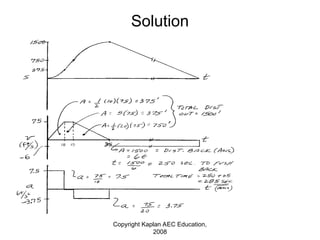
Solution
Copyright Kaplan AEC Education,
2008
Kinematics of Particles—1D Motion
Copyright Kaplan AEC Education,
2008
Solution
Copyright Kaplan AEC Education,
2008
Solution (continued)
Copyright Kaplan AEC Education,
2008
2D Motion—Rectangular Cartesian
Coordinates
Copyright Kaplan AEC Education,
2008
Solution
Copyright Kaplan AEC Education,
2008
2D Motion—Plane Polar Coordinates
Copyright Kaplan AEC Education,
2008
Solution
Copyright Kaplan AEC Education,
2008
Instantaneous Center of Zero Velocity
Copyright Kaplan AEC Education,
2008
Solution
Copyright Kaplan AEC Education,
2008
Evaluation of Accelerations
Copyright Kaplan AEC Education,
2008
Solution
Copyright Kaplan AEC Education,
2008
Solution (continued)
Copyright Kaplan AEC Education,
2008
Solution (continued)
Copyright Kaplan AEC Education,
2008
Newton’s 2nd
Law
Copyright Kaplan AEC Education,
2008
Solution
Copyright Kaplan AEC Education,
2008
Solution (continued)
Copyright Kaplan AEC Education,
2008
Solution (continued)
Copyright Kaplan AEC Education,
2008
Newton’s 2nd
Law
Copyright Kaplan AEC Education,
2008
Solution
Copyright Kaplan AEC Education,
2008
Work & Kinetic Energy
Copyright Kaplan AEC Education,
2008
Solution
Copyright Kaplan AEC Education,
2008
Moments of Force & Momentum
Copyright Kaplan AEC Education,
2008
Solution
Copyright Kaplan AEC Education,
2008
Solution (continued)
Copyright Kaplan AEC Education,
2008
Solution (continued)
Copyright Kaplan AEC Education,
2008
Work & Kinetic Energy
Copyright Kaplan AEC Education,
2008
Solution
Copyright Kaplan AEC Education,
2008
Solution
Copyright Kaplan AEC Education,
2008
Work & Kinetic Energy
Copyright Kaplan AEC Education,
2008
Solution
Copyright Kaplan AEC Education,
2008
Solution (continued)
Copyright Kaplan AEC Education,
2008
Work & Kinetic Energy
Copyright Kaplan AEC Education,
2008
Solution
Copyright Kaplan AEC Education,
2008
Solution (continued)

2012 Spring Dynamics - Spring Dynamics - Spring Dynamics

  • 1.
    FE Exam: Dynamicsreview D. A. Lyn School of Civil Engineering 21 February 2012
  • 2.
    Preliminaries • Units (relevantquantities: g, displacement, velocity, acceleration, energy, momentum, etc.) • Notation (dot, vector) • Vectors (components and directions/signs, addition (graphical), dot and cross products, vector polygons) • Coordinate systems (Cartesian and curvilinear, fixed and moving or relative, unit vectors) • Statics (free body diagram)
  • 3.
    Classification of dynamicsand problems • Kinematics: description of motion without reference to forces – Particle (no rotation about itself) and rigid-body – Coordinate systems (Cartesian, curvilinear, rotation) – Constraints on motion • Kinetics: inclusion of forces (mass, or momentum or energy) – Types of forces: conservative (gravitational, spring, elastic collisions) and non-conservative (friction, inelastic collisions) – Newton’s 2nd law: linear and angular momentum • Use of free body diagram to deal with external forces – Particles and rigid body (system of particles) – Impulse (time involved) and momentum • still working with vectors – Work (distances involved) and energy (velocities involved) • working with scalars (usually easier)
  • 4.
    Particle kinematics • Generalrelations between displacement (r), velocity (u), and acceleration (a) • Given a formula for (or graph of) r as function of t, take derivatives to find u and a – Given a formula for u or a as function of t, integrate to find r or u Special case: constant acceleration, ( ) , ( ) = ( , , ), ( , , ), ( , , ) d d t t x y z x y z x y z dt dt        r u u r a u r r u a          0  a a 2 0 0 1 ( ) ( 0) , ( ) ( 0) ( 0) 2 t t t t t t t t                u u a r r u a
  • 5.
    Sample problems • Theposition of a particle moving horizontally is described by , with s in m and t in s. At t = 2 s, what is its acceleration? Soln: Take derivatives of s with respect to t, and evaluate at t=2s ( ) so a(t=2s) = 4 m/s2 . • Projectile problem: A projectile is launched with an initial speed of v0=100 ft/s at =30° to the horizontal, what is the horizontal distance, L, covered by the projectile when it lands again? Soln: constant acceleration (only gravitational acceleration involved) problem, so apply formulae in two directions 2 ( ) 2 8 3 s t t t    ( ) ( ) 4 8, ( ) ( ) 4 u t s t t a t s t             2 0 0 2 0 0 / 2 / 2 end x end x end end y end y end x x v t a t y y v t a t       0 0 0, , 100cos30 , 100sin30 x y x y a a g v v       wish to find L=xend-x0, for yend-y0=0, so we solve L=v0xt end and 0=v0ytend-g(tend 2 /2) for tend and L; tend=3.1 s and L=269.2 ft L v0  x y
  • 6.
    Kinetics of aparticle • Linear momentum, L=mu (appearance of mass, i.e., inertia) • Newton’s 2nd law: • Forces determined from free body diagram (as in statics) – Types of forces: gravitational, frictional, external • Angular momentum (about a point O) , • Newton’s 2nd law: • Impulse (used in impact and collision problems), – momentum conservation: – mini-problem: A golf ball of mass 50-g is hit with a club. If the initial velocity of the ball is 20 m/s, what is the impulse imparted to the ball? If the contact duration was 0.05 s, what was the average force on the ball? m   F a L  0 m   H r u 0 0  M H  2 1 1 2 t t dt   Imp F 2 1 2 1 1 2 t t dt     L L Imp F 1 2 1 2 2 1 2 0 0 Imp (0.05 kg)(20 m/s) = 1 Ns Imp 1 Ns 1 Ns / 0.05 s 20 N t avg avg L L mv F dt F t F                
  • 7.
    Problem: kinetics ofa particle (truck) • A truck of weight W = 4000 lbf moves down a =10° incline at an initial speed of u0 = 20 ft/s. A constant braking force of Fbrk=1200 lbf is experienced by the truck from a time, t = 0. What is the distance covered by the truck before it stops from the time that the braking force is applied? • kinematics problem: 2 sin , sin 4.1 ft/s brk brk net s s F F W F ma W mg a g W                   0 2 2 0 0 ( ) ( 0) / 4.9 s ( ) ( 0) ( / 2) / 2 48.8 ft end s end end s end end s end s u t t u t a t t u a s t t s t u t a t u a               Notes: forces involved – kinetics problem, rectilinear (straight-line) motion: determine net force on truck in direction of motion, apply Newton’s 2nd law to evaluate distance covered From free body diagram, sum of forces in direction of motion, u0  W Fbrk W sin mas s
  • 8.
    Curvilinear coordinates andmotion • Plane motion (motion on a surface, i.e., in only two dimensions) – Tangential (t) and normal (n) coordinates where  is the radius of curvature of particle path – Radial (r) and transverse () or polar coordinates – Special case: pure circular motion at an angular frequency, t 2 ( ) , ( ) ( ) ( 2 ) r r t r r t r r r r             v e e a e e        2 ( ) , ( ) t n t v t v t v           v e a e e  2 2 2 , 0, , , 0, , t r n r v r r v r r r v r r r r                       e e e e         x x 1 y y 1 r  er en et e particle path particle at tim e t r v = r   a r r=  2 a r r  =  . ( is the angular acceleration)
  • 9.
    Particle kinetics problem •Find the tension, T, in the string and the angular acceleration, , if at the position shown the a sphere of mass, m=10 kg, has a tangential velocity of v0=4 m/s. • Choose a polar coordinate system, perform free body analysis to determine sum of forces, and set equal to ma. 2 0 2 0 0 0 2 0 0 dir'n: - cos / cos 352 N dir'n: sin sin / 8.2/s r v r T W ma mv R T m g R W ma mR W mR                                  W T r  R 0 v0 m
  • 10.
    Energy and work •Work of a force,F, resulting in a change in position from state 1 to state 2: – Constant force in rectilinear motion, Fxx2-x1) – Gravitational force, -Wy2-y1), y>0 upwards – Spring force, -k(x2 2 -x1 2 )/2, (x2<x1, returning to undeformed state) • Kinetic energy, • Relation between work and kinetic energy: • for conservative forces (such as gravitational and spring forces, but not frictional forces), a potential energy function, V, can be defined such that – Gravitational force: V = Wy, spring force, V=kx2 /2 • For conservative forces, an equation for conservation of energy can be expressed as or 2 1 2 1 U d    F r 2 / 2 T mv  1 2 2 1 U T T    1 2 1 2 U V V    1 2 2 1 V V T T    1 1 2 2 T V T V   
  • 11.
    A problem solvedusing energy principles • A 2-kg block (A) rests on a frictionless plane inclined at an angle =30°. It is attached by an inextensible cable to a 3-kg block (B) and to a fixed support. Assume pulleys are frictionless and weightless. If initially both blocks are stationary, how far will the 2-kg block travel before its speed is 4 m/s? • Motion constraints: sB=sA/2 (and yA=-2yBsin), and vB=vA/2 • Frictionless system  conservative gravitational forces only, only distances and speeds explicitly involved apply energy equation          2 2 2 2 1 2 Initially, 0; at end, / 2 / 2 / 2 1 / / A A B A B A A B T T mv mv m v m m v v                1 2 2 1 2 1 2 1 2 2 2 2 2 1 1 1 1 2 2sin 1 2.24 m 0 ( 2 1 / 2 sin A A B B A A B B A A B B A A B B B B B A A A A A A A A A A B B A B A A A V V T T T W y W y W y W y W y W y U m v m v W y W W y W y m v W y W v m v y g W W m v                                                                               Block A rises) / sin 2 4.48 m A A s y y        3 kg 2 kg =30 State 1 B A 3 kg 3 kg 2 kg 2 kg = 30 = 30 State 1 State 2 s y B = B yA v B B A A sA
  • 12.
    Constrained motion, referenceframes, relative motion • Constrained-motion problems – choice of reference frames: relative motion (in a plane) • Choice of reference frames – motion relative to a point A in a moving reference frame – For plane motion, note direction of components, e.g., rB/A is perpendicular to rB/A, etc. – For points on the same rigid body, / / / = , = , = B A B A B A B A B A B A    r r r u u u a a a         / / / / / / / / , 2 B A B A B A B A B A B A B A B A           u Ω r r a Ω r Ω Ω×r r Ω r         / / 0 B A B A   r r  
  • 13.
    Problem: Kinematics ofrigid body example • The end A of rod AB of length L = 0.6 m moves at velocity VA = 2 m/s and acceleration, aA = 0.2 m/s2 , both to the left, at the instant shown, when  = 60°. What is the velocity, VB ,and acceleration, aB , of end B at the same instant? Pure kinematics problem:   / 2 / / 2 2 2 2 cos , sin cot 1.16 m/s 0 sin cos cos sin cos sin sin cos sin B A B A B A B A B A B A B A B A B A A A A Bx A By B V V L V L V L V V a a L L a a V a a L L L L L a a L L                                                                     u u Ω r a a Ω r Ω Ω×r       2 2 1 cos 11.7 m/s sin A A V a L      V , a A , A A B V ? B a ? B  x y aA aB    L 2 L rB/A VA VB   L rB/A
  • 14.
    Kinetics of asystem of particles (or rigid body) • For a system of particles (or a rigid body), analysis is performed in terms of the mass center, G, located at radial vector, rG, and total mass m • Equations of motions: where aG is the acceleration of the mass center, and HG is the angular momentum about the mass center − For a system with no external forces or moment acting, then linear momentum, L, and angular momentum, H, is conserved, i.e., remains constant • For a system of particles (or a rigid body), and where the mass moment of inertia I is defined by (Standard formulae for I = mk2 , where k is the radius of gyration, for standard bodies are listed in tables; be careful about which axis I is defined, whether centroidal axis or not, remember parallel axis theorem) or G i i G m m m dm     r r r r eff eff = and G G G m       F a L F M H M   G G G I I   H ω α   2 2 or i i I r m I r dm     G G I  H ω
  • 16.
    Problem: two-particle system •A particle A of mass m and and a particle B, of mass 2m are connected by rigid massless rod of length R. If mass B is suddenly given a vertical velocity v perpendicular to the connecting rod, determine the location of the mass center, the velocity of the mass center, the angular momentum, and the angular velocity of the system soon after the motion begins.                     / / 2 2 / / 2 3 2 3 2 2 3 2 3 3 2 1 2 0 2 3 3 3 A B G A A B B G A B G A B A G A B G A A B B G A B G B G A G A A B G B B G G G A A G B B G m m m m m m m m m m m m v m m m R m R v mvR I I m r m r                                              r r r r r r r r r r L u u u u u u u u j H r u r u k k k H ω ω k 2 2 2 0 2 0 2 1 2 2 3 3 3 2 2 3 3 m R m R mR v mv R mR R                               k k k k v x y j rA rB r r B A - A B G m 2m (2 /3) v j A B G m 2m 
  • 17.
    Problem: rigid-body kinetics •What is the angular acceleration, , of the 60-kg (cylindrical) pulley of radius R = 0.2 m and the tension in the cable if a 30-kg block is attached to the end of the cable? • Analysis of block − Kinematic constraint (ablock=R) O R m=30-kg m pulley=60-kg   ( ) y y y F ma T W ma m R T m g R             • Analysis of pulley   2 2 0 0 0 pulley pulley where / 2 / 2 M I I m R TR m R          2 pulley pulley 2 1 Solve for and : 147 N, 24.5 1 2 / s mg T T T m m m R        R T T W =mg  a R y=  y +
  • 18.
    Dynamics Outline and Problem- Solutions as Provided by Kaplan
  • 19.
    Copyright Kaplan AECEducation, 2008 Dynamics Outline Overview DYNAMICS, p. 205 KINEMATICS OF A PARTICLE, p. 206 • Relating Distance, Velocity and the Tangential Component of Acceleration • Constant Tangential Acceleration • Rectilinear Motion • Rectangular Cartesian Coordinates • Circular Cylindrical Coordinates • Circular Path
  • 20.
    Copyright Kaplan AECEducation, 2008 Dynamics Outline Overview Continued RIGID BODY KINEMATICS, p. 203 • The Constraint of Rigidity • The Angular Velocity Vector • Instantaneous Center of Zero Velocity • Accelerations in Rigid Bodies
  • 21.
    Copyright Kaplan AECEducation, 2008 Dynamics Outline Overview Continued NEWTON’S LAWS OF MOTION, p. 210 • Applications to a Particle • Systems of Particles • Linear Momentum and Center of Mass • Impulse and Momentum • Moments of Force and Momentum
  • 22.
    Copyright Kaplan AECEducation, 2008 Dynamics Outline Overview Continued WORK AND KINETIC ENERGY, p. 219 • A Single Particle • Work of a Constant Force • Distance-Dependent Central Force
  • 23.
    Copyright Kaplan AECEducation, 2008 Dynamics Outline Overview Continued KINETICS OF RIGID BODIES, p. 225 • Moment Relationships for Planar Motion • Work and Kinetic Energy
  • 24.
    Copyright Kaplan AECEducation, 2008 Kinematics of Particles—1D Motion
  • 25.
    Copyright Kaplan AECEducation, 2008 Solution
  • 26.
    Copyright Kaplan AECEducation, 2008 Kinematics of Particles—1D Motion
  • 27.
    Copyright Kaplan AECEducation, 2008 Solution
  • 28.
    Copyright Kaplan AECEducation, 2008 Solution (continued)
  • 29.
    Copyright Kaplan AECEducation, 2008 2D Motion—Rectangular Cartesian Coordinates
  • 30.
    Copyright Kaplan AECEducation, 2008 Solution
  • 31.
    Copyright Kaplan AECEducation, 2008 2D Motion—Plane Polar Coordinates
  • 32.
    Copyright Kaplan AECEducation, 2008 Solution
  • 33.
    Copyright Kaplan AECEducation, 2008 Instantaneous Center of Zero Velocity
  • 34.
    Copyright Kaplan AECEducation, 2008 Solution
  • 35.
    Copyright Kaplan AECEducation, 2008 Evaluation of Accelerations
  • 36.
    Copyright Kaplan AECEducation, 2008 Solution
  • 37.
    Copyright Kaplan AECEducation, 2008 Solution (continued)
  • 38.
    Copyright Kaplan AECEducation, 2008 Solution (continued)
  • 39.
    Copyright Kaplan AECEducation, 2008 Newton’s 2nd Law
  • 40.
    Copyright Kaplan AECEducation, 2008 Solution
  • 41.
    Copyright Kaplan AECEducation, 2008 Solution (continued)
  • 42.
    Copyright Kaplan AECEducation, 2008 Solution (continued)
  • 43.
    Copyright Kaplan AECEducation, 2008 Newton’s 2nd Law
  • 44.
    Copyright Kaplan AECEducation, 2008 Solution
  • 45.
    Copyright Kaplan AECEducation, 2008 Work & Kinetic Energy
  • 46.
    Copyright Kaplan AECEducation, 2008 Solution
  • 47.
    Copyright Kaplan AECEducation, 2008 Moments of Force & Momentum
  • 48.
    Copyright Kaplan AECEducation, 2008 Solution
  • 49.
    Copyright Kaplan AECEducation, 2008 Solution (continued)
  • 50.
    Copyright Kaplan AECEducation, 2008 Solution (continued)
  • 51.
    Copyright Kaplan AECEducation, 2008 Work & Kinetic Energy
  • 52.
    Copyright Kaplan AECEducation, 2008 Solution
  • 53.
    Copyright Kaplan AECEducation, 2008 Solution
  • 54.
    Copyright Kaplan AECEducation, 2008 Work & Kinetic Energy
  • 55.
    Copyright Kaplan AECEducation, 2008 Solution
  • 56.
    Copyright Kaplan AECEducation, 2008 Solution (continued)
  • 57.
    Copyright Kaplan AECEducation, 2008 Work & Kinetic Energy
  • 58.
    Copyright Kaplan AECEducation, 2008 Solution
  • 59.
    Copyright Kaplan AECEducation, 2008 Solution (continued)

Editor's Notes

  • #19 DYNAMICS, p. 205 Adding the parameters of positions, velocities, and accelerations differentiates dynamics from statics. KINEMATICS OF A PARTICLE, p. 206 The velocity vector of a point moving on a path is tangent to the path; the acceleration is the derivative of the velocity with respect to time and may have components that are tangential and normal (figures and formulas pp. 206-207). Relating Distance, Velocity and the Tangential Component of Acceleration Acceleration, velocity, and distance may vary with time, and acceleration and velocity may vary with distance (formulas p. 208). Constant Tangential Acceleration Simplified formulas for velocity and distance apply when tangential acceleration is constant (formulas p. 210). Rectilinear Motion During motion in a straight line, the formula for acceleration is simplified by omitting the normal component. Rectangular Cartesian Coordinates Mutually perpendicular fixed unit vectors can be used to express position, velocity, and acceleration of a point which is moving in more than one dimension (formulas p. 211). Circular Cylindrical Coordinates Another coordinate system replaces two of the perpendicular coordinates with an angle at and a distance from the origin (figure and formulas pp. 213-214). Circular Path Simplified formulas used in the cylindrical coordinate system to find velocity and acceleration apply when the distance to the origin is constant (formulas pp. 214-215).
  • #20 RIGID BODY KINEMATICS, p. 203 Rigid bodies undergo little deformation when force is applied. The Constraint of Rigidity For any two points of a rigid body, the magnitude of the position vector between them is constant, and the dot products of their velocities and a unit vector in the direction of that position vector are equal (figure and formulas pp. 215-216). The Angular Velocity Vector For any two points of a rigid two-dimensional body moving on a plane, the change in the position vector from one point to the other during a time increment equals the cross product of the original position vector and the angular velocity vector (figures and formulas pp. 217-219). Instantaneous Center of Zero Velocity For a body as described above, with angular velocity not equal to zero, there exists a point at each instant such that the entire body is rotating around that point and the point itself has zero velocity (formula p. 219). Accelerations in Rigid Bodies For a body as described above, the dot product of the acceleration of one point and the unit vector in the direction from that point to a second point is equal to the dot product of the acceleration of the second point and the same unit vector, minus the product of the magnitude of the position vector from one point to the other and the square of the magnitude of the angular velocity of the body (formulas p. 211).
  • #21 NEWTON’S LAWS OF MOTION, p. 210 For any element of a mechanical system, the resultant force on the element is equal to the product of its mass and acceleration; the force exerted by one body on a second body has equal magnitude and opposite direction compared to the force exerted by the second body on the first (formula p. 222). Applications to a Particle A material element, all of whose parts have the same acceleration, may be idealized as a particle whose spatial extent is disregarded. Systems of Particles A collection of material elements under consideration is a system; forces on an element may arise from outside the system or result from interactions between elements; because the internal forces must be equal and opposite, their sum is zero (formulas p. 225). Linear Momentum and Center of Mass The linear momentum of a system is the sum of the linear momentums of its elements; the sum of external forces on a system is the derivative with respect to time of the linear momentum of the system; the center of mass of the system is the point which accelerates under the resultant of the external forces exactly as would a single particle having the mass of the system (formulas pp. 225-226). Impulse and Momentum The change in momentum of a system over a period of time due to the resultant external force is the impulse of that force; the three coordinate components of the momentum may not all be changed by the impulse, and the unchanged components are said to be conserved (formulas pp. 227-228). Moments of Force and Momentum The moment with respect to a point of an external force on a system is the sum of the cross products of the position vectors from the point to each of the elements of the system and the product of each element’s mass and acceleration; it is also the time rate of change of angular momentum about that point (figures and formulas pp.229-231).
  • #22 WORK AND KINETIC ENERGY, p. 219 Changes in velocity and acceleration with distance have implications for calculations of work and kinetic energy. A Single Particle The integral of the product of the magnitude of a force on a particle and the change of position of the particle is the work done on that particle by that force over that distance; it is equal to the change in the particle’s kinetic energy (formulas pp. 231-232). Work of a Constant Force Work is only done by a force over the component of a particle’s movement that is parallel to that force (figure and formulas p. 233). Distance-Dependent Central Force For a force of attraction or repulsion which varies with distance from a fixed central point, work is done by the variable force over the net change of radial distance; the sum of the work done by internal forces of a rigid body or by an internal force between two particles that depends only on the distance between them is zero (figure and formulas pp. 234-237).
  • #23 KINETICS OF RIGID BODIES, p. 225 For a rigid body, the principle of motion of the mass center is applicable to problems of kinetics, whereas the moment equation must be adapted to relate accelerations to angular velocity and angular acceleration. Moment Relationships for Planar Motion The moment of inertia about an axis through the center of mass of a rigid body, perpendicular to the plane of motion, measures the body’s resistance to change in its angular velocity, and is found by taking the moment about a point of reference of a force on an element of mass and relating the acceleration of the point of reference to that of the center of mass (figure and formulas pp. 238-239). Work and Kinetic Energy The power transmitted to a rigid body from several forces is the dot product of the resultant force and the velocity of a selected point plus the dot product of the resultant moment about the selected point and the angular velocity vector; the kinetic energy of the body is related to the velocity of a selected point, the mass of the body, the angular velocity of the body, a position vector from the selected point to the center of mass, and the moment of inertia of the selected point (formulas pp. 243-244).