The United  States of  America “ American History”
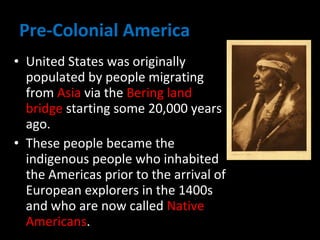
Pre-Colonial America United States was originally populated by people migrating from  Asia  via the  Bering land bridge  starting some 20,000 years ago.  These people became the indigenous people who inhabited the Americas prior to the arrival of European explorers in the 1400s and who are now called  Native Americans .
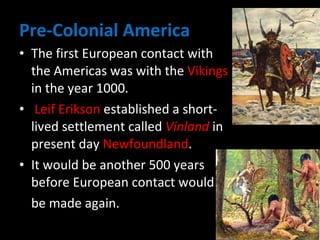
Pre-Colonial America The first European contact with the Americas was with the  Vikings  in the year 1000. Leif Erikson  established a short-lived settlement called  Vinland  in present day  Newfoundland .  It would be another 500 years before European contact would  be made again.
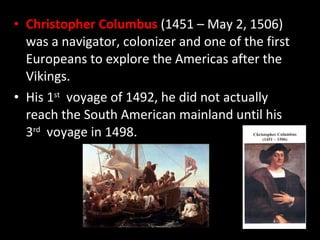
Christopher Columbus   (1451 – May 2, 1506) was a navigator, colonizer and one of the first Europeans to explore the Americas after the Vikings. His 1 st   voyage of 1492, he did not actually reach the South American mainland until his 3 rd   voyage in 1498.
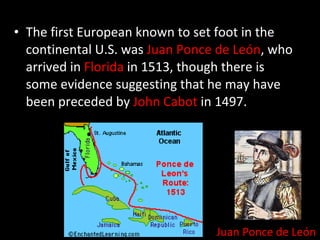
The first European known to set foot in the continental U.S. was  Juan Ponce de León , who arrived in  Florida  in 1513, though there is some evidence suggesting that he may have been preceded by  John Cabot  in 1497. Juan Ponce de León
English/British Colonial America (1585-1776) The first successful English colony was established in 1607, on the  James River  at  Jamestown .  One example of conflict between Native Americans and English settlers was the 1622  Powhatan  uprising in Virginia, in which Indians had killed hundreds of English settlers.  The largest conflict between Native Americans and English settlers in the 17th century was  King Philip's War  in  New England .
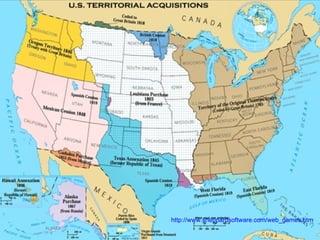
http://www.sheppardsoftware.com/web_games.htm
English/British Colonial America (1585-1776) The  Plymouth Colony  was established in 1620.  New England was founded primarily by  Puritans  who established the  Massachusetts Bay Colony  in 1629.  The Middle Colonies, consisting of the present-day states of  New York, New Jersey, Pennsylvania , and  Delaware , were characterized by a large degree of diversity.  The first attempted English settlement south of Virginia was the  Province of Carolina , with  Georgia Colony  the last of the  13 Colonies  established in 1733.  Several colonies were used as  penal settlements  from the 1620s until the American Revolution.
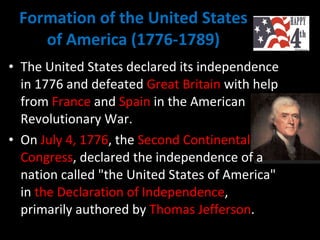
Formation of the United States of America (1776-1789) The United States declared its independence in 1776 and defeated  Great Britain  with help from  France  and  Spain  in the American Revolutionary War.  On  July 4, 1776 , the  Second Continental Congress , declared the independence of a nation called "the United States of America" in  the Declaration of Independence , primarily authored by  Thomas Jefferson .
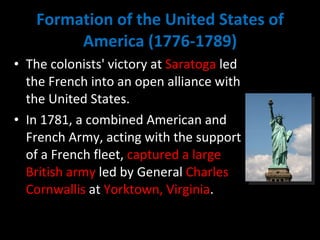
Formation of the United States of America (1776-1789) The colonists' victory at  Saratoga  led the French into an open alliance with the United States.  In 1781, a combined American and French Army, acting with the support of a French fleet,  captured a large British army  led by General  Charles Cornwallis  at  Yorktown, Virginia .
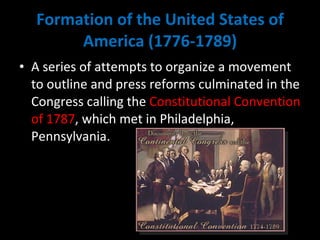
Formation of the United States of America (1776-1789) A series of attempts to organize a movement to outline and press reforms culminated in the Congress calling the  Constitutional Convention of 1787 , which met in Philadelphia, Pennsylvania.
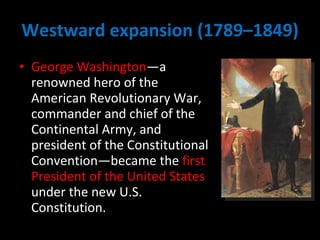
Westward expansion (1789–1849) George Washington —a renowned hero of the American Revolutionary War, commander and chief of the Continental Army, and president of the Constitutional Convention—became the  first President of the United States  under the new U.S. Constitution.
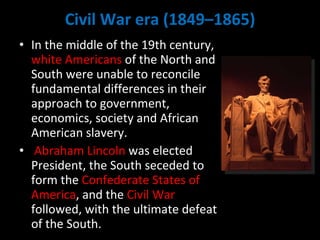
Civil War era (1849–1865) In the middle of the 19th century,  white Americans  of the North and South were unable to reconcile fundamental differences in their approach to government, economics, society and African American slavery. Abraham Lincoln  was elected President, the South seceded to form the  Confederate States of America , and the  Civil War  followed, with the ultimate defeat of the South.
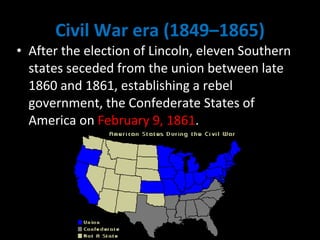
Civil War era (1849–1865) After the election of Lincoln, eleven Southern states seceded from the union between late 1860 and 1861, establishing a rebel government, the Confederate States of America on  February 9, 1861 .
Civil War era (1849–1865) The Civil War began when Confederate General  Pierre Beauregard  opened fire upon  Fort Sumter .  The  Battle of Antietam , on  September 17 ,  1862 , was the bloodiest single day in American history.
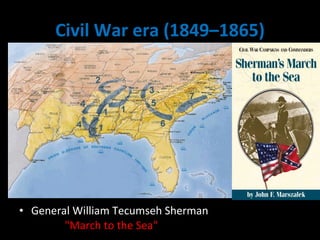
Civil War era (1849–1865) General William Tecumseh Sherman   "March to the Sea"
World War II (1940-1945) and Home front-United States-World War II As with World War I, the United States did not enter World War II until after the rest of the active  Allied countries  had done so.  Its decision to declare war followed  Japan 's surprise attack on  Pearl Harbor  on 7 December 1941. Until then, the United States’ isolationism had bound the country to neutrality.  the American armed forces were significantly smaller than the equivalent forces of  France, Germany, Britain, the Soviet Union and Japan.
Cold War beginnings and the Civil Rights Movement (1945–1964) In the decades after World War II, the United States became a global influence in  economic, political, military, cultural and technological affairs . John F. Kennedy  was elected President in 1960.  The Kennedy's brought a new life and vigor to the atmosphere of the  White House .  During his time in office, the Cold War reached its height with the Cuban Missile Crisis in 1962. He was assassinated in Dallas, Texas, on November 22, 1963.
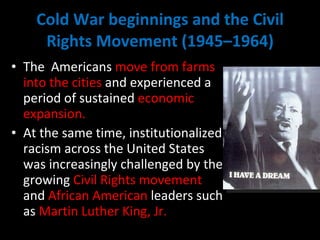
Cold War beginnings and the Civil Rights Movement (1945–1964) The  Americans  move from farms into the cities  and experienced a period of sustained  economic expansion.  At the same time, institutionalized racism across the United States was increasingly challenged by the growing  Civil Rights movement  and  African American  leaders such as  Martin Luther King, Jr.
History of the United States  (1988–present) After the fall of the Soviet Union, the United States emerged as the world's sole remaining superpower and continued to involve itself in military action overseas, including the 1991  Gulf War .  Following his election in 1992, President  Bill Clinton  oversaw the longest economic expansion in American history.
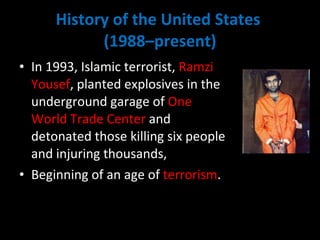
History of the United States  (1988–present) In 1993, Islamic terrorist,  Ramzi Yousef , planted explosives in the underground garage of  One World Trade Center  and detonated those killing six people and injuring thousands,  Beginning of an age of  terrorism .
History of the United States  (1988–2008) The  presidential election in 2000  between  George W. Bush  (R) and  Al Gore  (D) was one of the closest in American history. VS
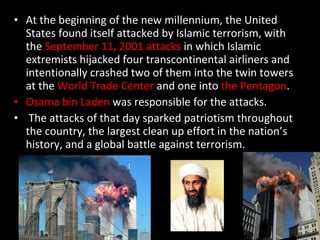
At the beginning of the new millennium, the United States found itself attacked by Islamic terrorism, with the  September 11, 2001 attacks  in which Islamic extremists hijacked four transcontinental airliners and intentionally crashed two of them into the twin towers at the  World Trade Center  and one into  the Pentagon .  Osama bin Laden  was responsible for the attacks. The attacks of that day sparked patriotism throughout the country, the largest clean up effort in the nation’s history, and a global battle against terrorism.
History of the United States  (1988–present) President Bush continued what he dubbed the  War on Terrorism  with the invasion of Iraq by overthrowing and capturing  Saddam Hussein  in 2003.
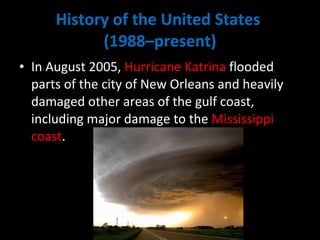
History of the United States  (1988–present) In August 2005,  Hurricane Katrina  flooded parts of the city of New Orleans and heavily damaged other areas of the gulf coast, including major damage to the  Mississippi coast .
United States presidential election, 2008   ~ The influences of the Media ~

American History updated

  • 1.
    The United States of America “ American History”
  • 2.
    Pre-Colonial America UnitedStates was originally populated by people migrating from Asia via the Bering land bridge starting some 20,000 years ago. These people became the indigenous people who inhabited the Americas prior to the arrival of European explorers in the 1400s and who are now called Native Americans .
  • 3.
    Pre-Colonial America Thefirst European contact with the Americas was with the Vikings in the year 1000. Leif Erikson established a short-lived settlement called Vinland in present day Newfoundland . It would be another 500 years before European contact would be made again.
  • 4.
    Christopher Columbus (1451 – May 2, 1506) was a navigator, colonizer and one of the first Europeans to explore the Americas after the Vikings. His 1 st voyage of 1492, he did not actually reach the South American mainland until his 3 rd voyage in 1498.
  • 5.
    The first Europeanknown to set foot in the continental U.S. was Juan Ponce de León , who arrived in Florida in 1513, though there is some evidence suggesting that he may have been preceded by John Cabot in 1497. Juan Ponce de León
  • 6.
    English/British Colonial America(1585-1776) The first successful English colony was established in 1607, on the James River at Jamestown . One example of conflict between Native Americans and English settlers was the 1622 Powhatan uprising in Virginia, in which Indians had killed hundreds of English settlers. The largest conflict between Native Americans and English settlers in the 17th century was King Philip's War in New England .
  • 7.
  • 8.
    English/British Colonial America(1585-1776) The Plymouth Colony was established in 1620. New England was founded primarily by Puritans who established the Massachusetts Bay Colony in 1629. The Middle Colonies, consisting of the present-day states of New York, New Jersey, Pennsylvania , and Delaware , were characterized by a large degree of diversity. The first attempted English settlement south of Virginia was the Province of Carolina , with Georgia Colony the last of the 13 Colonies established in 1733. Several colonies were used as penal settlements from the 1620s until the American Revolution.
  • 9.
    Formation of theUnited States of America (1776-1789) The United States declared its independence in 1776 and defeated Great Britain with help from France and Spain in the American Revolutionary War. On July 4, 1776 , the Second Continental Congress , declared the independence of a nation called "the United States of America" in the Declaration of Independence , primarily authored by Thomas Jefferson .
  • 10.
    Formation of theUnited States of America (1776-1789) The colonists' victory at Saratoga led the French into an open alliance with the United States. In 1781, a combined American and French Army, acting with the support of a French fleet, captured a large British army led by General Charles Cornwallis at Yorktown, Virginia .
  • 11.
    Formation of theUnited States of America (1776-1789) A series of attempts to organize a movement to outline and press reforms culminated in the Congress calling the Constitutional Convention of 1787 , which met in Philadelphia, Pennsylvania.
  • 12.
    Westward expansion (1789–1849)George Washington —a renowned hero of the American Revolutionary War, commander and chief of the Continental Army, and president of the Constitutional Convention—became the first President of the United States under the new U.S. Constitution.
  • 13.
    Civil War era(1849–1865) In the middle of the 19th century, white Americans of the North and South were unable to reconcile fundamental differences in their approach to government, economics, society and African American slavery. Abraham Lincoln was elected President, the South seceded to form the Confederate States of America , and the Civil War followed, with the ultimate defeat of the South.
  • 14.
    Civil War era(1849–1865) After the election of Lincoln, eleven Southern states seceded from the union between late 1860 and 1861, establishing a rebel government, the Confederate States of America on February 9, 1861 .
  • 15.
    Civil War era(1849–1865) The Civil War began when Confederate General Pierre Beauregard opened fire upon Fort Sumter . The Battle of Antietam , on September 17 , 1862 , was the bloodiest single day in American history.
  • 16.
    Civil War era(1849–1865) General William Tecumseh Sherman "March to the Sea"
  • 17.
    World War II(1940-1945) and Home front-United States-World War II As with World War I, the United States did not enter World War II until after the rest of the active Allied countries had done so. Its decision to declare war followed Japan 's surprise attack on Pearl Harbor on 7 December 1941. Until then, the United States’ isolationism had bound the country to neutrality. the American armed forces were significantly smaller than the equivalent forces of France, Germany, Britain, the Soviet Union and Japan.
  • 18.
    Cold War beginningsand the Civil Rights Movement (1945–1964) In the decades after World War II, the United States became a global influence in economic, political, military, cultural and technological affairs . John F. Kennedy was elected President in 1960. The Kennedy's brought a new life and vigor to the atmosphere of the White House . During his time in office, the Cold War reached its height with the Cuban Missile Crisis in 1962. He was assassinated in Dallas, Texas, on November 22, 1963.
  • 19.
    Cold War beginningsand the Civil Rights Movement (1945–1964) The Americans move from farms into the cities and experienced a period of sustained economic expansion. At the same time, institutionalized racism across the United States was increasingly challenged by the growing Civil Rights movement and African American leaders such as Martin Luther King, Jr.
  • 20.
    History of theUnited States (1988–present) After the fall of the Soviet Union, the United States emerged as the world's sole remaining superpower and continued to involve itself in military action overseas, including the 1991 Gulf War . Following his election in 1992, President Bill Clinton oversaw the longest economic expansion in American history.
  • 21.
    History of theUnited States (1988–present) In 1993, Islamic terrorist, Ramzi Yousef , planted explosives in the underground garage of One World Trade Center and detonated those killing six people and injuring thousands, Beginning of an age of terrorism .
  • 22.
    History of theUnited States (1988–2008) The presidential election in 2000 between George W. Bush (R) and Al Gore (D) was one of the closest in American history. VS
  • 23.
    At the beginningof the new millennium, the United States found itself attacked by Islamic terrorism, with the September 11, 2001 attacks in which Islamic extremists hijacked four transcontinental airliners and intentionally crashed two of them into the twin towers at the World Trade Center and one into the Pentagon . Osama bin Laden was responsible for the attacks. The attacks of that day sparked patriotism throughout the country, the largest clean up effort in the nation’s history, and a global battle against terrorism.
  • 24.
    History of theUnited States (1988–present) President Bush continued what he dubbed the War on Terrorism with the invasion of Iraq by overthrowing and capturing Saddam Hussein in 2003.
  • 25.
    History of theUnited States (1988–present) In August 2005, Hurricane Katrina flooded parts of the city of New Orleans and heavily damaged other areas of the gulf coast, including major damage to the Mississippi coast .
  • 26.
    United States presidentialelection, 2008 ~ The influences of the Media ~