Extending the Bill Of Rights Protecting All Americans
Bill of rights originally protects only adult white males Women could not vote African Americans had no rights at all
Purpose Limit the national government State and local used the reserved powers to limit civil rights
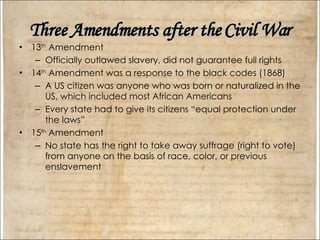
Three Amendments after the Civil War 13 th  Amendment Officially outlawed slavery, did not guarantee full rights 14 th  Amendment was a response to the black codes (1868) A US citizen was anyone who was born or naturalized in the US, which included most African Americans Every state had to give its citizens “equal protection under the laws” 15 th  Amendment No state has the right to take away suffrage (right to vote) from anyone on the basis of race, color, or previous enslavement
15 th  Amendment Designed to guarantee suffrage to African Americans Many states get around Women could not vote States still found a way to restrict voting
1913-1971 Congress passed 5 amendments to make suffrage more widespread and elections more democratic
17 th  Amendment (1913) Allowed for direct election of senators Before this time senators were elected by state legislators
19 th  Amendment (1920) Before 1920 states made their own laws with regard to women voting  Guaranteed women the right to vote in all national and state elections
23 rd  Amendment Before 1961 people living in Washington DC could not vote in national elections Guaranteed voters in Washington DC the right to vote for president and vice president
24 th  Amendment  Made poll taxes illegal in national elections
26 th  Amendment (1971) Guaranteed the right to vote to people 18 and older for national and state elections
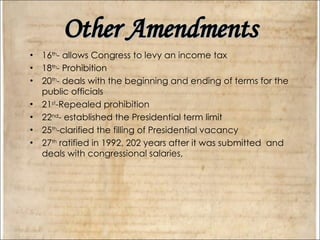
Other Amendments 16 th - allows Congress to levy an income tax 18 th - Prohibition 20 th - deals with the beginning and ending of terms for the public officials 21 st -Repealed prohibition 22 nd - established the Presidential term limit 25 th -clarified the filling of Presidential vacancy 27 th  ratified in 1992, 202 years after it was submitted  and deals with congressional salaries,

Amendments

  • 1.
    Extending the BillOf Rights Protecting All Americans
  • 2.
    Bill of rightsoriginally protects only adult white males Women could not vote African Americans had no rights at all
  • 3.
    Purpose Limit thenational government State and local used the reserved powers to limit civil rights
  • 4.
    Three Amendments afterthe Civil War 13 th Amendment Officially outlawed slavery, did not guarantee full rights 14 th Amendment was a response to the black codes (1868) A US citizen was anyone who was born or naturalized in the US, which included most African Americans Every state had to give its citizens “equal protection under the laws” 15 th Amendment No state has the right to take away suffrage (right to vote) from anyone on the basis of race, color, or previous enslavement
  • 5.
    15 th Amendment Designed to guarantee suffrage to African Americans Many states get around Women could not vote States still found a way to restrict voting
  • 6.
    1913-1971 Congress passed5 amendments to make suffrage more widespread and elections more democratic
  • 7.
    17 th Amendment (1913) Allowed for direct election of senators Before this time senators were elected by state legislators
  • 8.
    19 th Amendment (1920) Before 1920 states made their own laws with regard to women voting Guaranteed women the right to vote in all national and state elections
  • 9.
    23 rd Amendment Before 1961 people living in Washington DC could not vote in national elections Guaranteed voters in Washington DC the right to vote for president and vice president
  • 10.
    24 th Amendment Made poll taxes illegal in national elections
  • 11.
    26 th Amendment (1971) Guaranteed the right to vote to people 18 and older for national and state elections
  • 12.
    Other Amendments 16th - allows Congress to levy an income tax 18 th - Prohibition 20 th - deals with the beginning and ending of terms for the public officials 21 st -Repealed prohibition 22 nd - established the Presidential term limit 25 th -clarified the filling of Presidential vacancy 27 th ratified in 1992, 202 years after it was submitted and deals with congressional salaries,