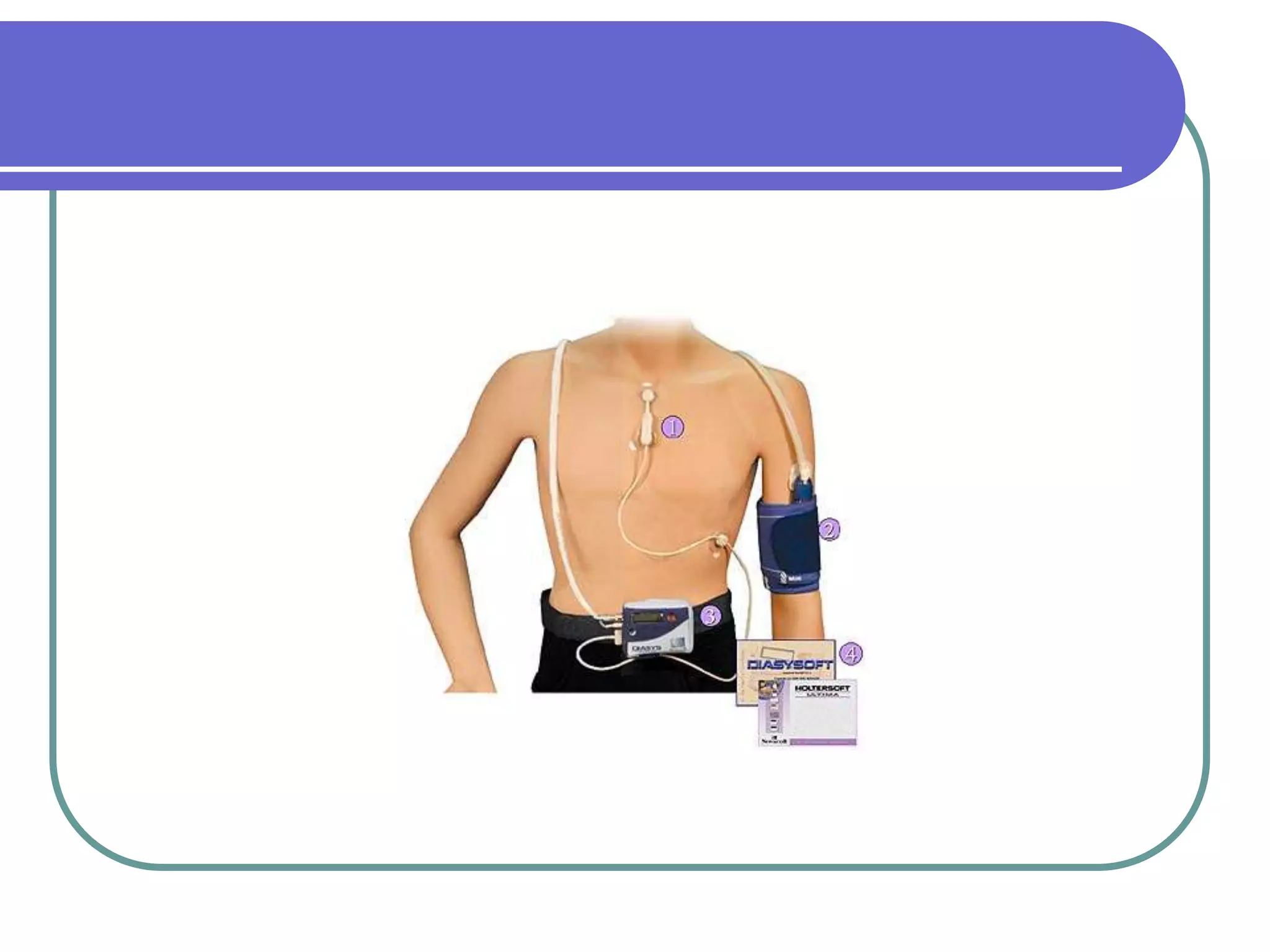
Ambulatory BP monitor
Geriatrics department
HMC
D. Ibrahim Alomari
2012
ABPM
 One of the most important indications for
ambulatory monitoring is to exclude white
coat hypertension
 The technique is also valuable in diagnosing
and treating elderly patients and is used
increasingly in pregnancy .
Fitting the monitor
 This will take about 15 to 30 minutes.
 Have the patient relax in a quiet room.
 Enter the patient's details, such as name and
identification number, into the monitor.
 Measure blood pressure in both arms :
 If the difference in systolic blood pressure is <10 mm
Hg use the non-dominant arm for monitoring.
 If the difference in systolic blood pressure is 10 mm
Hg use the monitor on the arm with higher pressure.
…. Fitting the monitor
 Select the appropriate cuff.
 Select the frequency of measurement (usually
every 30 minutes)
 Inactivate the display to prevent the patient
becoming distracted by the measurements
 Give the patient written instructions
 Show the patient how to remove and inactivate
the monitor after 24 hours
Recommended size of cuffs for
measuring blood pressure
 Child or lean adult
 Adult
 Adult with large arm
 12 cm 18 cm
 12 cm 26 cm
 12 cm 40 cm
How to prepare the patient so that
monitoring is successful
 Explain :-
 the procedure .
 the frequency of inflation
and deflation .
 how to manually deflate
the cuff .
 that in the event of failed
measurements the
monitor will repeat the
measurement .
Instruct patients
 to keep their arm steady during
measurement .
 to keep their arm at heart level during
measurement .
 to engage in normal activities between
measurements .
 to keep the monitor attached at night .
 to place the monitor under a pillow or on
the bed at night.
Provide
 a diary card for the patient to record:
their activity level at the time of measurement
the time they go to bed
the time they get up
the time they take their drug treatment
any symptoms
Recommended standards for normal and abnormal pressures during
ambulatory measurement. These pressures are only a guide, and lower
pressures may be abnormal in patients whose total risk factor profile is
high and in whom there is concomitant disease
 Normal
 Day ---- <=135/85
 Night ---- <=120/70
 24 hour --<=130/80
 Abnormal
 >140/90
 >125/75
 >135/85
Normal BP
Systolic & diastolic HTN with night-
time drop
Isolated systolic HTN
Systolic & diastolic HTN without
night- time drop
Isolated diastolic HTN
Clinical indications for ABPM
 In excluding white coat hypertension.
 In helping with the diagnosis of patients with
borderline hypertension.
 In deciding on treatment for elderly patients.
 In identifying nocturnal hypertension .
 In assessing patients whose hypertension has been
resistant.
 As a guide to determining the efficacy of drug
treatment over 24 hours.
 In diagnosing and treating hypertension in pregnancy.
 In diagnosing hypotension.
White coat HTN
White coat hypertension
 Definition
 Blood pressure 140/90 mm Hg when measured in office
 Normal daytime ambulatory pressure <135/85 mm Hg
 Prevalence of white coat hypertension
 15-30% of general population
 Common in elderly people and pregnant women
 Risks
 Less than that of sustained hypertension.
 Probably small risk when compared with people with normal
blood pressure.
 Possibly a precursor to hypertension.
Clinical implications of white coat
hypertension
 No clinical characteristics assist in diagnosis
 Must be considered in people newly diagnosed with
hypertension
 Should be considered before drug treatment is
prescribed (could lead to fewer drugs being
prescribed)
 Must be placed in context of the overall risk profile
 Should reassure patients, employers, and insurers that
risk from white coat hypertension is low or absent
 Patients need follow up and monitoring again
Borderline hypertension
 Patients whose blood pressure is
considered to be borderline may also
benefit from ambulatory monitoring,
 especially young patients in whom
lifelong drug treatment may otherwise be
prescribed inappropriately and who may
be penalized in terms of insurance or
employment if the diagnosis of
hypertension is misapplied.
Borderline HTN
Considering treatment in elderly patients
 The results of the ambulatory study of the systolic
hypertension in Europe trial show :
 1) that conventional measurement of systolic pressure
in elderly people may produce results that are on
average 20 mm Hg higher than daytime ambulatory
pressure, leading to an overestimation of the
occurrence of isolated systolic hypertension among
elderly patients and probably excessive treatment.
 2) ambulatory systolic pressure is a better predictor of
cardiovascular risk than pressure measured
conventionally.
.. Considering treatment in elderly patients
 A variety of ambulatory patterns are found among elderly people,
including a number of hypotensive states associated with
baroreceptor or autonomic failure. These blood pressure patterns
include:-
 * white coat HTN ,
 * isolated systolic HTN,
 * postural hypotension,
 *post-prandial hypotension,
 * daytime hypotension ,
 * nocturnal HTN ,
 *drug induced hypotension,
 *autonomic failure.
.. Considering treatment in elderly patients
 elderly people can be particularly susceptible to the
adverse effects of drug treatment given to lower blood
pressure.
 identifying hypotension is particularly important,
although its management may be challenging
Nocturnal hypertension
 Ambulatory measurement is the only non-invasive technique that
permits blood pressure to be monitored during sleep.
 The relevance of nocturnal hypertension is still controversial, but
there is increasing evidence that nocturnal blood pressure may
provide important information; for example, blood pressure at
night is independently associated with end organ damage above
the risk associated with daytime values.
 It has also been shown that the absence of a night-time drop in
blood pressure is associated with target organ involvement, and it
may be a useful (although non-specific) clue to the presence of
secondary hypertension.
 (Patients whose blood pressure drops at night are sometimes
known as "dippers," and those whose blood pressure does not
drop are sometimes known as "non-dippers
Nocturnal HTN
Hypertension resistant to
treatment
 patients are classed as having resistant hypertension when their blood
pressure remains consistently above 150/90 mm Hg with conventional
measurement despite being treated with three or more drugs.
 In these patients ambulatory monitoring may indicate that the apparent
lack of response is caused by the white coat phenomenon;
alternatively, the absence of a night-time drop in blood pressure may
suggest secondary hypertension.
Pregnancy
 The main use of ambulatory measurement in
pregnancy is to identify white coat
hypertension;
 it may occur in nearly 30% of pregnant
women.
 Recognizing it is important so that pregnant
women are not admitted to hospital or given
antihypertensive drugs unnecessarily.
… Pregnancy
 The evidence that ambulatory measurement may predict pre-
eclampsia is not conclusive.
 ambulatory blood pressure correlates better with proteinuria than does
conventional sphygmomanometry, and it is a better predictor of
complications of hypertension.
 women with white coat hypertension tend to be more likely to have a
caesarean section than women with normal blood pressure, suggesting
that if ambulatory measurement was used rather than conventional
measurement, some caesarean deliveries might be avoided
Ambulatory hypotension
 Ambulatory measurement may be useful in
identifying hypotensive episodes in young
patients in whom hypotension is suspected of
causing symptoms.
 Ambulatory measurement may also identify
drops in blood pressure induced by the drugs
used to treat hypertension, which may have
untoward effects in patients with compromised
arterial circulation, such as those with
coronary and cerebrovascular disease
As a guide to drug treatment
 The role of ambulatory measurement in guiding drug
treatment is the subject of much research, and its role
in this regard has not been fully established. However,
recent reviews of the clinical value of ambulatory
measurement have highlighted the potential
usefulness of 24 hour recordings of blood pressure in
guiding drug treatment.
 a recent well controlled study showed that when
ambulatory measurement rather than measurement in
a clinic was used as the basis for prescribing
treatment, significantly less antihypertensive drug
treatment was prescribed.
…As a guide to drug treatment
 Ambulatory measurement gives the
prescribing doctor an assessment of the
patient's response to treatment that
conventional measurement cannot provide
 the efficacy of treatment without the white
coat effect can be ascertained.
 an excessive effect of drugs and the
occurrence of symptoms can be determined.
 the duration of the effect of drugs over
24 hours can be shown.
The patients for whom monitoring
again may be helpful are:
 Patients with white coat hypertension
 Patients being treated for hypertension who
also have evidence of white coat hypertension
 Elderly patients with hypotension
 Patients with night-time hypertension, and
 Patients who have had their drug treatment
changed.
 Thank you

Ambulatory BP monitoring - elderly

  • 1.
    Ambulatory BP monitor Geriatricsdepartment HMC D. Ibrahim Alomari 2012
  • 5.
    ABPM  One ofthe most important indications for ambulatory monitoring is to exclude white coat hypertension  The technique is also valuable in diagnosing and treating elderly patients and is used increasingly in pregnancy .
  • 6.
    Fitting the monitor This will take about 15 to 30 minutes.  Have the patient relax in a quiet room.  Enter the patient's details, such as name and identification number, into the monitor.  Measure blood pressure in both arms :  If the difference in systolic blood pressure is <10 mm Hg use the non-dominant arm for monitoring.  If the difference in systolic blood pressure is 10 mm Hg use the monitor on the arm with higher pressure.
  • 7.
    …. Fitting themonitor  Select the appropriate cuff.  Select the frequency of measurement (usually every 30 minutes)  Inactivate the display to prevent the patient becoming distracted by the measurements  Give the patient written instructions  Show the patient how to remove and inactivate the monitor after 24 hours
  • 8.
    Recommended size ofcuffs for measuring blood pressure  Child or lean adult  Adult  Adult with large arm  12 cm 18 cm  12 cm 26 cm  12 cm 40 cm
  • 9.
    How to preparethe patient so that monitoring is successful  Explain :-  the procedure .  the frequency of inflation and deflation .  how to manually deflate the cuff .  that in the event of failed measurements the monitor will repeat the measurement .
  • 10.
    Instruct patients  tokeep their arm steady during measurement .  to keep their arm at heart level during measurement .  to engage in normal activities between measurements .  to keep the monitor attached at night .  to place the monitor under a pillow or on the bed at night.
  • 11.
    Provide  a diarycard for the patient to record: their activity level at the time of measurement the time they go to bed the time they get up the time they take their drug treatment any symptoms
  • 12.
    Recommended standards fornormal and abnormal pressures during ambulatory measurement. These pressures are only a guide, and lower pressures may be abnormal in patients whose total risk factor profile is high and in whom there is concomitant disease  Normal  Day ---- <=135/85  Night ---- <=120/70  24 hour --<=130/80  Abnormal  >140/90  >125/75  >135/85
  • 14.
  • 15.
    Systolic & diastolicHTN with night- time drop
  • 16.
  • 17.
    Systolic & diastolicHTN without night- time drop
  • 18.
  • 19.
    Clinical indications forABPM  In excluding white coat hypertension.  In helping with the diagnosis of patients with borderline hypertension.  In deciding on treatment for elderly patients.  In identifying nocturnal hypertension .  In assessing patients whose hypertension has been resistant.  As a guide to determining the efficacy of drug treatment over 24 hours.  In diagnosing and treating hypertension in pregnancy.  In diagnosing hypotension.
  • 20.
  • 21.
    White coat hypertension Definition  Blood pressure 140/90 mm Hg when measured in office  Normal daytime ambulatory pressure <135/85 mm Hg  Prevalence of white coat hypertension  15-30% of general population  Common in elderly people and pregnant women  Risks  Less than that of sustained hypertension.  Probably small risk when compared with people with normal blood pressure.  Possibly a precursor to hypertension.
  • 23.
    Clinical implications ofwhite coat hypertension  No clinical characteristics assist in diagnosis  Must be considered in people newly diagnosed with hypertension  Should be considered before drug treatment is prescribed (could lead to fewer drugs being prescribed)  Must be placed in context of the overall risk profile  Should reassure patients, employers, and insurers that risk from white coat hypertension is low or absent  Patients need follow up and monitoring again
  • 24.
    Borderline hypertension  Patientswhose blood pressure is considered to be borderline may also benefit from ambulatory monitoring,  especially young patients in whom lifelong drug treatment may otherwise be prescribed inappropriately and who may be penalized in terms of insurance or employment if the diagnosis of hypertension is misapplied.
  • 25.
  • 26.
    Considering treatment inelderly patients  The results of the ambulatory study of the systolic hypertension in Europe trial show :  1) that conventional measurement of systolic pressure in elderly people may produce results that are on average 20 mm Hg higher than daytime ambulatory pressure, leading to an overestimation of the occurrence of isolated systolic hypertension among elderly patients and probably excessive treatment.  2) ambulatory systolic pressure is a better predictor of cardiovascular risk than pressure measured conventionally.
  • 27.
    .. Considering treatmentin elderly patients  A variety of ambulatory patterns are found among elderly people, including a number of hypotensive states associated with baroreceptor or autonomic failure. These blood pressure patterns include:-  * white coat HTN ,  * isolated systolic HTN,  * postural hypotension,  *post-prandial hypotension,  * daytime hypotension ,  * nocturnal HTN ,  *drug induced hypotension,  *autonomic failure.
  • 28.
    .. Considering treatmentin elderly patients  elderly people can be particularly susceptible to the adverse effects of drug treatment given to lower blood pressure.  identifying hypotension is particularly important, although its management may be challenging
  • 29.
    Nocturnal hypertension  Ambulatorymeasurement is the only non-invasive technique that permits blood pressure to be monitored during sleep.  The relevance of nocturnal hypertension is still controversial, but there is increasing evidence that nocturnal blood pressure may provide important information; for example, blood pressure at night is independently associated with end organ damage above the risk associated with daytime values.  It has also been shown that the absence of a night-time drop in blood pressure is associated with target organ involvement, and it may be a useful (although non-specific) clue to the presence of secondary hypertension.  (Patients whose blood pressure drops at night are sometimes known as "dippers," and those whose blood pressure does not drop are sometimes known as "non-dippers
  • 30.
  • 31.
    Hypertension resistant to treatment patients are classed as having resistant hypertension when their blood pressure remains consistently above 150/90 mm Hg with conventional measurement despite being treated with three or more drugs.  In these patients ambulatory monitoring may indicate that the apparent lack of response is caused by the white coat phenomenon; alternatively, the absence of a night-time drop in blood pressure may suggest secondary hypertension.
  • 32.
    Pregnancy  The mainuse of ambulatory measurement in pregnancy is to identify white coat hypertension;  it may occur in nearly 30% of pregnant women.  Recognizing it is important so that pregnant women are not admitted to hospital or given antihypertensive drugs unnecessarily.
  • 33.
    … Pregnancy  Theevidence that ambulatory measurement may predict pre- eclampsia is not conclusive.  ambulatory blood pressure correlates better with proteinuria than does conventional sphygmomanometry, and it is a better predictor of complications of hypertension.  women with white coat hypertension tend to be more likely to have a caesarean section than women with normal blood pressure, suggesting that if ambulatory measurement was used rather than conventional measurement, some caesarean deliveries might be avoided
  • 34.
    Ambulatory hypotension  Ambulatorymeasurement may be useful in identifying hypotensive episodes in young patients in whom hypotension is suspected of causing symptoms.  Ambulatory measurement may also identify drops in blood pressure induced by the drugs used to treat hypertension, which may have untoward effects in patients with compromised arterial circulation, such as those with coronary and cerebrovascular disease
  • 35.
    As a guideto drug treatment  The role of ambulatory measurement in guiding drug treatment is the subject of much research, and its role in this regard has not been fully established. However, recent reviews of the clinical value of ambulatory measurement have highlighted the potential usefulness of 24 hour recordings of blood pressure in guiding drug treatment.  a recent well controlled study showed that when ambulatory measurement rather than measurement in a clinic was used as the basis for prescribing treatment, significantly less antihypertensive drug treatment was prescribed.
  • 36.
    …As a guideto drug treatment  Ambulatory measurement gives the prescribing doctor an assessment of the patient's response to treatment that conventional measurement cannot provide  the efficacy of treatment without the white coat effect can be ascertained.  an excessive effect of drugs and the occurrence of symptoms can be determined.  the duration of the effect of drugs over 24 hours can be shown.
  • 37.
    The patients forwhom monitoring again may be helpful are:  Patients with white coat hypertension  Patients being treated for hypertension who also have evidence of white coat hypertension  Elderly patients with hypotension  Patients with night-time hypertension, and  Patients who have had their drug treatment changed.
  • 38.