skilled nursing facility SNF
2012
Rumailah Hospital
Dr. Ibrahim Mahamoud (Al –Omary)
Geriatrics Department
Rumailah Hospital
Aspiration
 Aspiration is defined as the inhalation of food, fluid,
saliva, medication or other foreign material into the
trachea and lungs.
 Any material can be aspirated on the way to the
stomach or as stomach contents are refluxed back into
the throat.
Aspiration Pneumonia Prevention
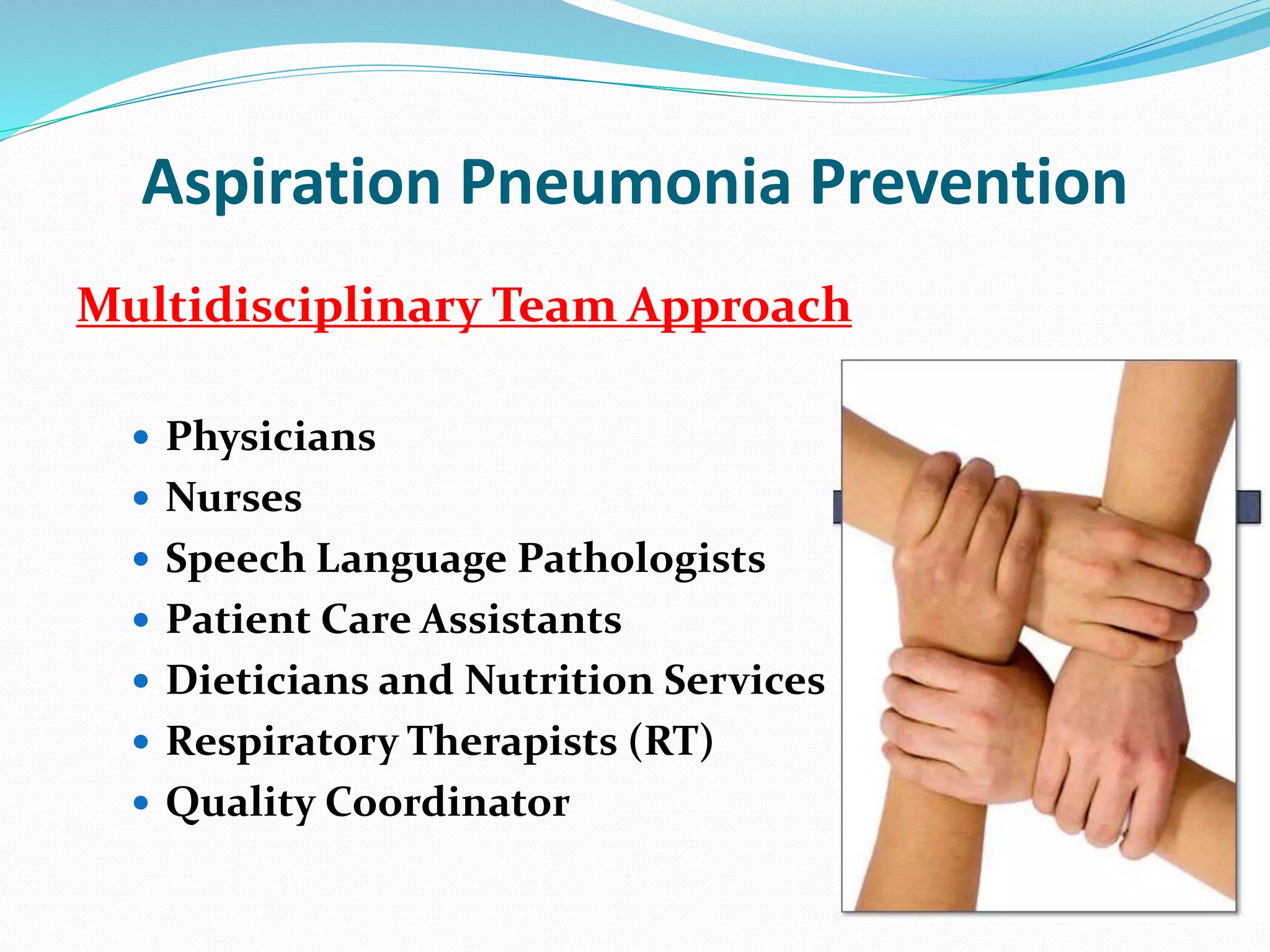
Multidisciplinary Team Approach
 Physicians
 Nurses
 Speech Language Pathologists
 Patient Care Assistants
 Dieticians and Nutrition Services
 Respiratory Therapists (RT)
 Quality Coordinator
Patients at RISK for Aspiration
1) Being fed by others. (Caregiver , family member,....)
2) Inadequately trained caregivers assisting with
eating/drinking .
3) Weak or absent coughing/gagging reflexes .
4) Poor chewing or swallowing skills Gastro-esophageal
reflux disease (GERD, GER) .
5) Food stuffing, rapid eating/drinking and pooling of food
in the mouth
6) Inappropriate fluid consistency and/or food textures
7) Medication side effects that cause drowsiness and/or relax
muscles causing delayed swallowing and suppression of gag
and cough reflexes
8) Impaired mobility that may leave individuals unable to sit
upright while eating
9) Epileptic seizures that may occur during oral intake or failure
to position a person on their side after a seizure, allowing oral
secretions to enter the airway.
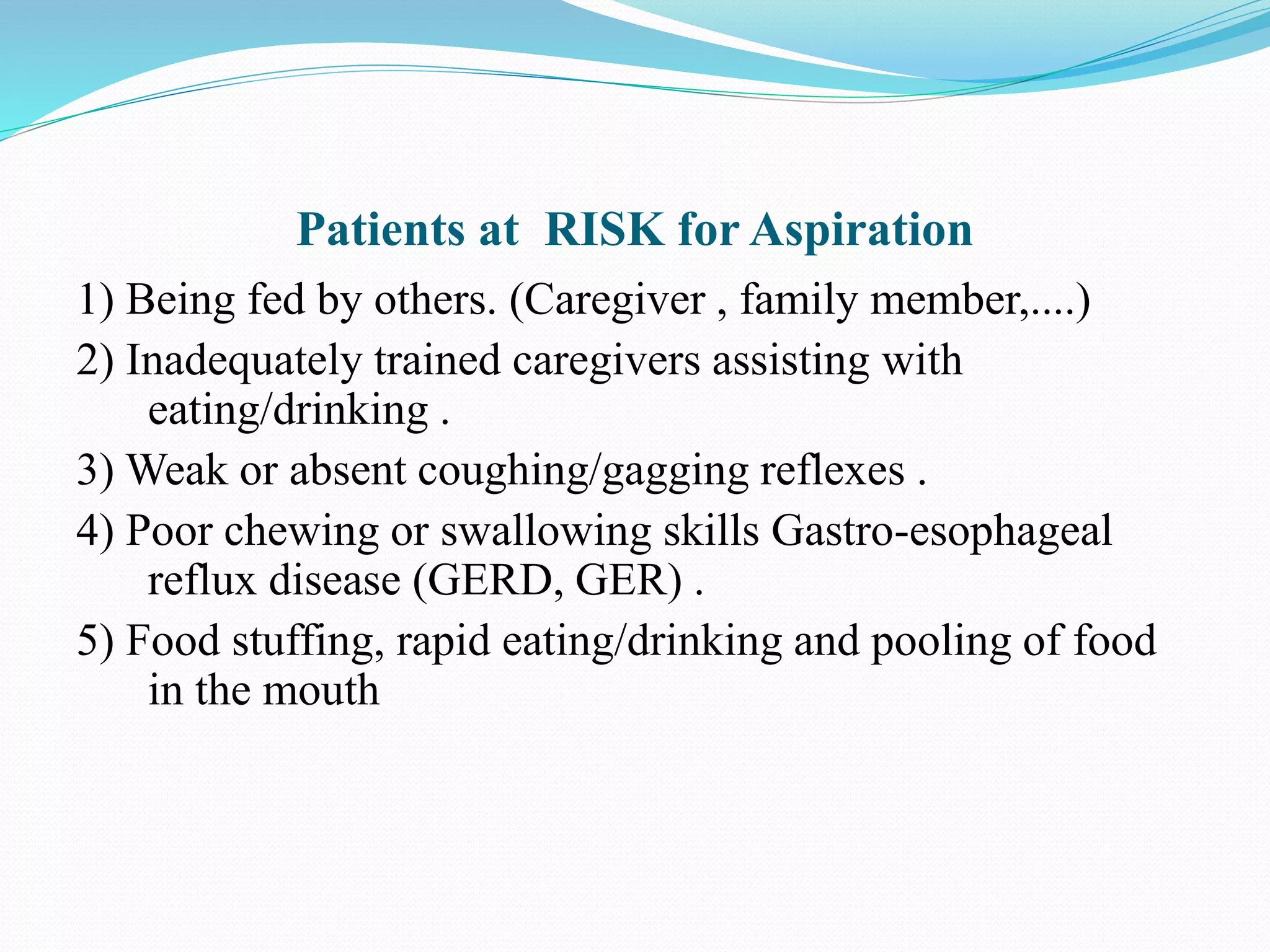
past medical history for aspiration risks
 Hx of past episodes of aspiration
 Hx of cerebral palsy, muscular dystrophy, epilepsy,
GERD, Dysphagia or hiatal hernia
 Hx of aspiration pneumonia
 Needing to be fed by others
 Hx of choking, coughing, gagging while eating
MEALTIME BEHAVIORS THAT MAY
INDICATE ASPIRATION
 Eating slowly
 Fear or reluctance to eat
 Coughing or choking during meals
 Refusing foods and/or fluids
 Food and fluid falling out the person’s mouth
 Eating in odd or unusual positions, such as throwing
head back when swallowing or swallowing large
amounts of food rapidly
 Refusing to eat except from a “favourite caregiver.”
SIGNS AND SYMTPOMS THAT MAY
INDICATE ASPRIATION RISK
 Gagging/choking during meals
 Persistent coughing during or after meals
 Irregular breathing, turning blue, moist respirations,
wheezing or rapid respirations
 Food or fluid falling out of the person’s mouth or drooling
 Intermittent fevers
 Chronic dehydration
 Unexplained weight loss
 Vomiting, regurgitation, rumination and/or odour of vomit
or formula after meals
ASPIRATION INTERVENTIONS
 Call 999 if the person stops breathing and start CPR
 Stop feeding/eating immediately
 Keep person in an upright position and encourage
coughing
 Use suction machine
 If in doubt on what to do, call for help (? Doctor)
GUIDELINES ON HOW TO PREVENT OR
MINIMIZE THE RISK OF ASPIRATION
1) Obtain a consultation by a swallowing specialist if
symptoms occur
2) Change diet consistency, texture or temperature (need a
physician’s order)
3) Slow the pace of eating and decrease the size of the bites
4) Position to enhance swallowing during meal times
5) Keep in an upright position after meals for 45 minutes or
as ordered
6) Elevate the head of the bed 30 to 45 degrees
7) Avoid food/fluids 2-3 hours before bedtime
8) Consider the use of medications to promote stomach
emptying, reduce reflux and acidity
9) Write an aspiration protocol and written instructions on
how the person is to eat or be fed and provide caregiver
training.
ASPIRATION RISKS AND FEEDING TUBES
Have a feeding tube does not eliminate the risk of aspiration.
Stomach contents can still enter the airway via
regurgitation or oral secretions can be aspirated if the
person has dysphagia.
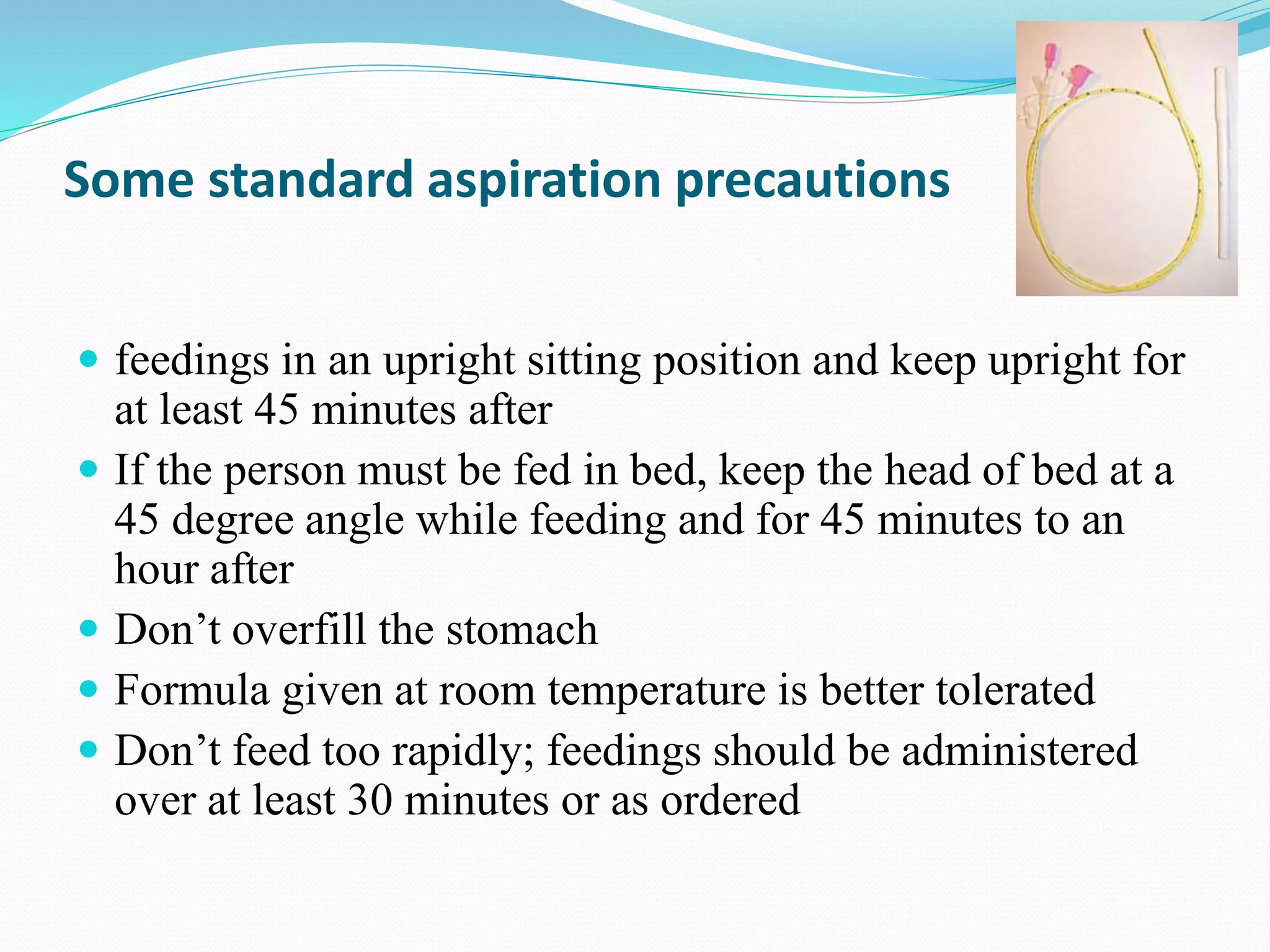
Some standard aspiration precautions
 feedings in an upright sitting position and keep upright for
at least 45 minutes after
 If the person must be fed in bed, keep the head of bed at a
45 degree angle while feeding and for 45 minutes to an
hour after
 Don’t overfill the stomach
 Formula given at room temperature is better tolerated
 Don’t feed too rapidly; feedings should be administered
over at least 30 minutes or as ordered
Aspiration & Aspiration Pneumonia
Bundle
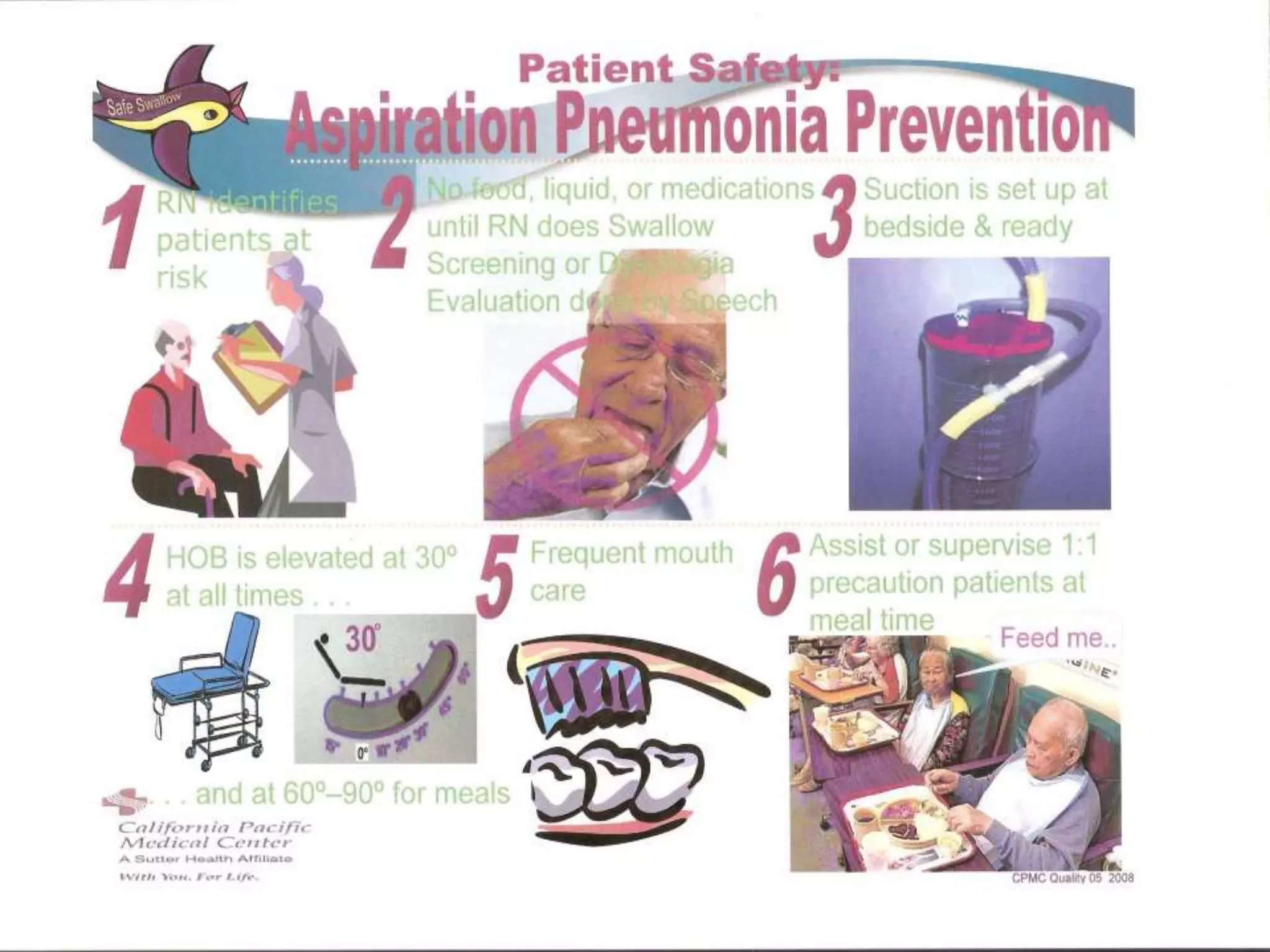
6 Bundle Elements:
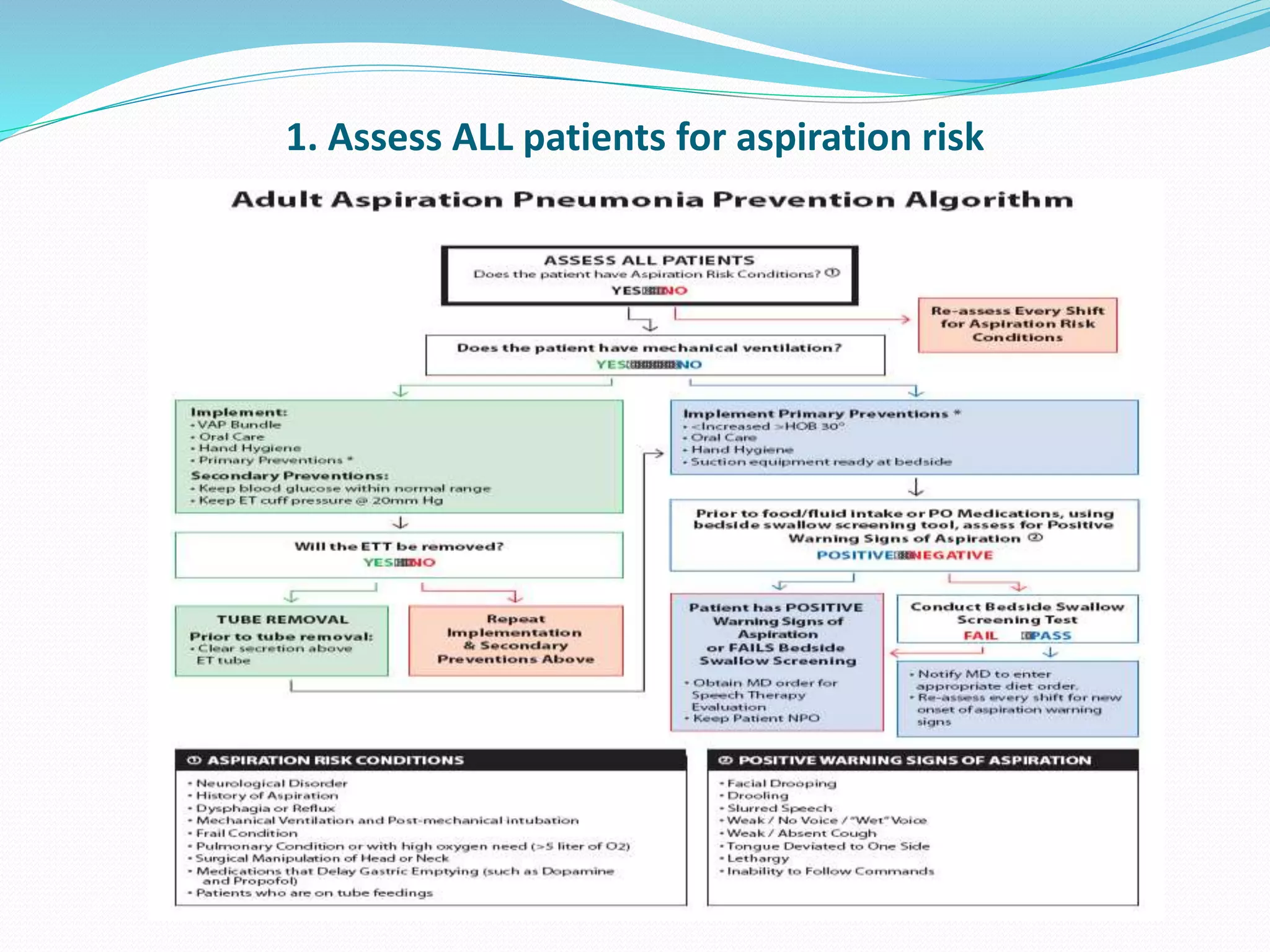
1. Assess ALL patients for aspiration risk.
2. Bedside Swallow Screening.
3. Suction set-up at bed-side.
4. HOB at 30 degrees.
5. Frequent Oral Care.
6. Safe care delivery of 1:1 supervise/assist meals.
1. Assess ALL patients for aspiration risk
Posting at Head of Bed
5. Frequent Oral Care
2. Bedside Swallow Screening
Education Tools:
 ‘Bundle’ poster
 Oral Care Table
 Bedside Swallow Screening Tool
 Risk Assessment Flow Chart
 Nursing Bedside Swallow Screening
summary for prevention
 HOB 30°-45°
 Frequent and Thorough Oral Hygiene
 Routinely verify appropriate placement of feeding tubes
 Implement Bedside Swallow Screening
Investigations
 Blood count: CBC
 Electrolytes and renal function.
 Blood culture
 Blood gases ABG , if hypoxia
 Culture of sputum: (Many aspiration pneumonias are mixed
aerobic-anaerobic infections).
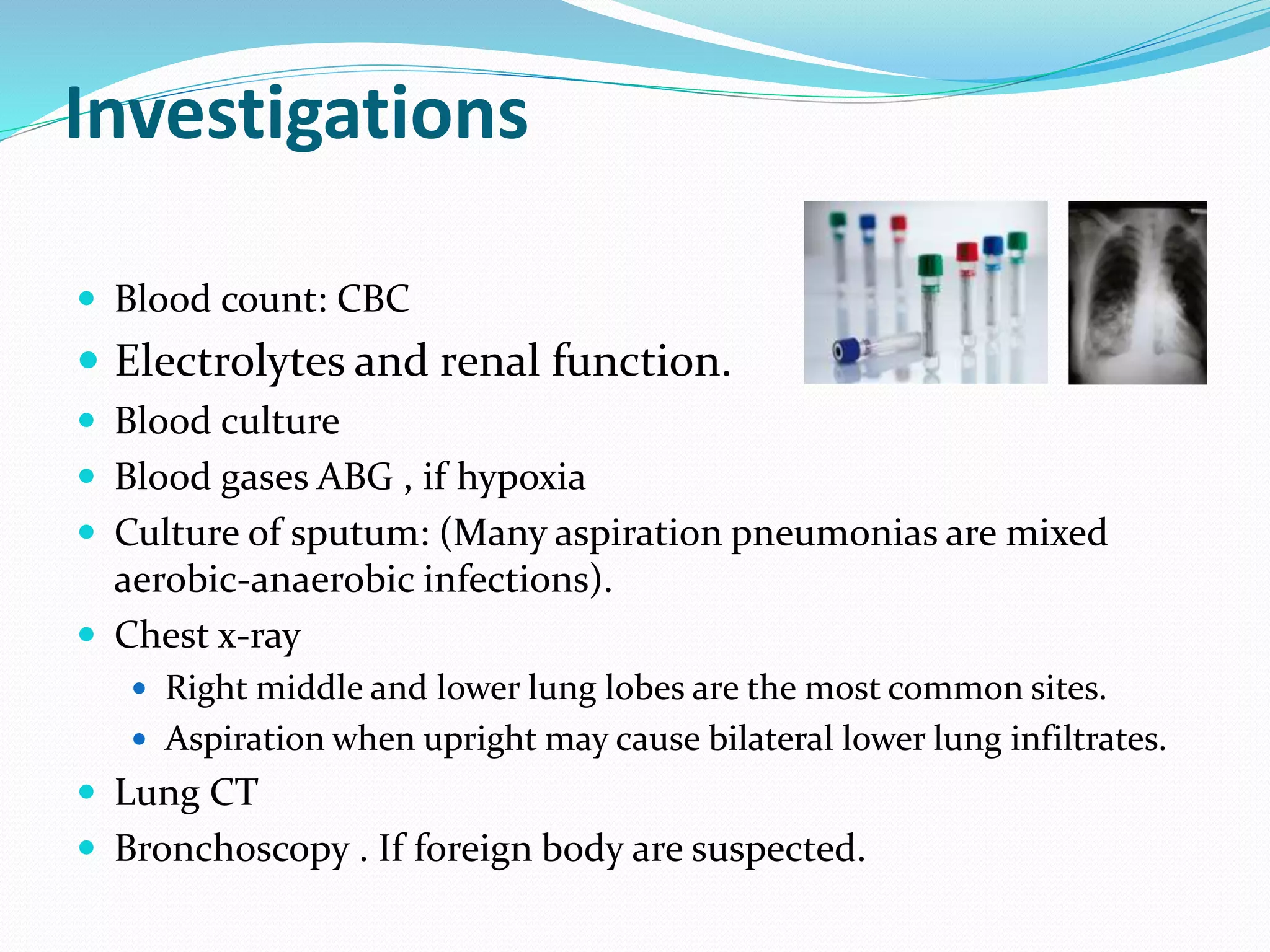
 Chest x-ray
 Right middle and lower lung lobes are the most common sites.
 Aspiration when upright may cause bilateral lower lung infiltrates.
 Lung CT
 Bronchoscopy . If foreign body are suspected.
Management
 Oxygen
 Tracheal suction if seen early.
 Initial empirical antibiotic therapy while awaiting culture
results.( cefuroxime plus metronidazole) or Tazocin
(piperacillin and tazobactam).
 Mechanical obstruction: removal of object normally by
Bronchoscopy
 Intubation with positive pressure ventilation may be required..
Thank you

Aspiration pneumonia prevention skilled nurse facility 2012

  • 1.
    skilled nursing facilitySNF 2012 Rumailah Hospital Dr. Ibrahim Mahamoud (Al –Omary) Geriatrics Department Rumailah Hospital
  • 2.
    Aspiration  Aspiration isdefined as the inhalation of food, fluid, saliva, medication or other foreign material into the trachea and lungs.  Any material can be aspirated on the way to the stomach or as stomach contents are refluxed back into the throat.
  • 3.
    Aspiration Pneumonia Prevention MultidisciplinaryTeam Approach  Physicians  Nurses  Speech Language Pathologists  Patient Care Assistants  Dieticians and Nutrition Services  Respiratory Therapists (RT)  Quality Coordinator
  • 4.
    Patients at RISKfor Aspiration 1) Being fed by others. (Caregiver , family member,....) 2) Inadequately trained caregivers assisting with eating/drinking . 3) Weak or absent coughing/gagging reflexes . 4) Poor chewing or swallowing skills Gastro-esophageal reflux disease (GERD, GER) . 5) Food stuffing, rapid eating/drinking and pooling of food in the mouth
  • 5.
    6) Inappropriate fluidconsistency and/or food textures 7) Medication side effects that cause drowsiness and/or relax muscles causing delayed swallowing and suppression of gag and cough reflexes 8) Impaired mobility that may leave individuals unable to sit upright while eating 9) Epileptic seizures that may occur during oral intake or failure to position a person on their side after a seizure, allowing oral secretions to enter the airway.
  • 6.
    past medical historyfor aspiration risks  Hx of past episodes of aspiration  Hx of cerebral palsy, muscular dystrophy, epilepsy, GERD, Dysphagia or hiatal hernia  Hx of aspiration pneumonia  Needing to be fed by others  Hx of choking, coughing, gagging while eating
  • 7.
    MEALTIME BEHAVIORS THATMAY INDICATE ASPIRATION  Eating slowly  Fear or reluctance to eat  Coughing or choking during meals  Refusing foods and/or fluids  Food and fluid falling out the person’s mouth  Eating in odd or unusual positions, such as throwing head back when swallowing or swallowing large amounts of food rapidly  Refusing to eat except from a “favourite caregiver.”
  • 8.
    SIGNS AND SYMTPOMSTHAT MAY INDICATE ASPRIATION RISK  Gagging/choking during meals  Persistent coughing during or after meals  Irregular breathing, turning blue, moist respirations, wheezing or rapid respirations  Food or fluid falling out of the person’s mouth or drooling  Intermittent fevers  Chronic dehydration  Unexplained weight loss  Vomiting, regurgitation, rumination and/or odour of vomit or formula after meals
  • 9.
    ASPIRATION INTERVENTIONS  Call999 if the person stops breathing and start CPR  Stop feeding/eating immediately  Keep person in an upright position and encourage coughing  Use suction machine  If in doubt on what to do, call for help (? Doctor)
  • 10.
    GUIDELINES ON HOWTO PREVENT OR MINIMIZE THE RISK OF ASPIRATION 1) Obtain a consultation by a swallowing specialist if symptoms occur 2) Change diet consistency, texture or temperature (need a physician’s order) 3) Slow the pace of eating and decrease the size of the bites 4) Position to enhance swallowing during meal times 5) Keep in an upright position after meals for 45 minutes or as ordered
  • 11.
    6) Elevate thehead of the bed 30 to 45 degrees 7) Avoid food/fluids 2-3 hours before bedtime 8) Consider the use of medications to promote stomach emptying, reduce reflux and acidity 9) Write an aspiration protocol and written instructions on how the person is to eat or be fed and provide caregiver training.
  • 12.
    ASPIRATION RISKS ANDFEEDING TUBES Have a feeding tube does not eliminate the risk of aspiration. Stomach contents can still enter the airway via regurgitation or oral secretions can be aspirated if the person has dysphagia.
  • 13.
    Some standard aspirationprecautions  feedings in an upright sitting position and keep upright for at least 45 minutes after  If the person must be fed in bed, keep the head of bed at a 45 degree angle while feeding and for 45 minutes to an hour after  Don’t overfill the stomach  Formula given at room temperature is better tolerated  Don’t feed too rapidly; feedings should be administered over at least 30 minutes or as ordered
  • 14.
    Aspiration & AspirationPneumonia Bundle 6 Bundle Elements: 1. Assess ALL patients for aspiration risk. 2. Bedside Swallow Screening. 3. Suction set-up at bed-side. 4. HOB at 30 degrees. 5. Frequent Oral Care. 6. Safe care delivery of 1:1 supervise/assist meals.
  • 16.
    1. Assess ALLpatients for aspiration risk
  • 17.
  • 18.
  • 19.
  • 20.
    Education Tools:  ‘Bundle’poster  Oral Care Table  Bedside Swallow Screening Tool  Risk Assessment Flow Chart  Nursing Bedside Swallow Screening
  • 21.
    summary for prevention HOB 30°-45°  Frequent and Thorough Oral Hygiene  Routinely verify appropriate placement of feeding tubes  Implement Bedside Swallow Screening
  • 22.
    Investigations  Blood count:CBC  Electrolytes and renal function.  Blood culture  Blood gases ABG , if hypoxia  Culture of sputum: (Many aspiration pneumonias are mixed aerobic-anaerobic infections).  Chest x-ray  Right middle and lower lung lobes are the most common sites.  Aspiration when upright may cause bilateral lower lung infiltrates.  Lung CT  Bronchoscopy . If foreign body are suspected.
  • 23.
    Management  Oxygen  Trachealsuction if seen early.  Initial empirical antibiotic therapy while awaiting culture results.( cefuroxime plus metronidazole) or Tazocin (piperacillin and tazobactam).  Mechanical obstruction: removal of object normally by Bronchoscopy  Intubation with positive pressure ventilation may be required..
  • 24.