Secure and Reliable Power Consumption
Monitoring in Untrustworthy Micro-grids
Pacome Ambassa1
, Anne Kayem 1
, Stephen Wolthusen 2
Christoph Meinel 3
1
Department of Computer Science 2
NISlab 3
Hasso Plattner Institute
University of Cape Town Department of Computer Science University of Potsdam
South Africa Gjøvik University College, Norway Germany
pambassa, akayem@cs.uct.ac.za stephen.wolthusen@hig.no meinel@hpi.de
International Conference on Future Network Systems and Security (FNSS 2015)
June 13, 2015 Paris, France
Ambassa, Kayem, Wolthusen & Meinel (UCT, HIG & HPI) Power monitoring in a micro-grid 1 / 17
Outline
1 Introduction
2 Related Work
3 System Description
4 Asynchronous Collection of Household Power Consumption
Data
5 Noise Characterization in Power Consumption Data
6 Conclusion
Ambassa, Kayem, Wolthusen & Meinel (UCT, HIG & HPI) Power monitoring in a micro-grid 2 / 17
Introduction
Introduction: Context
Low income communities in developing countries:
Computational limitations
Intermittent network connectivity
Unstable power connectivity
Do not have reliable access to electricity
Not connected to national power networks
Access negatively influenced by load shedding
Governments, private developers and NGOs could setup a
Micro-grids for power sharing.
Challenge: Generation does not satisfy demand
Ambassa, Kayem, Wolthusen & Meinel (UCT, HIG & HPI) Power monitoring in a micro-grid 3 / 17
Introduction
Introduction: Motivation
Design effective and efficient micro-grids architecture...
Re-modeled the power network to incorporate
Incorporate portable and cheap information and communication
technology
Mobile computing devices – popular in developing countries
Sensors
Wireless communication technology.
Reliability and trust properties: critical for grid stability
Reliability: Fair access to the network amongst the Stakeholder,
Trust
Limited computational system enable power network monitoring
Determine power consumption
Ensure reliable operation of the network
state estimations : precondition for grid stability
Integrity of data guide the power distribution
Ambassa, Kayem, Wolthusen & Meinel (UCT, HIG & HPI) Power monitoring in a micro-grid 4 / 17
Related Work
Related Work
Power network monitoring
Conventional power network monitoring solutions are based on
utilizing smart meters and trustworthy calibrated sensor installed
into home networks for consumption monitoring.
They either don’t make any assumption on the aggregation
process or assume a synchronized system
Monitoring and state estimation in distributed system
Centered on snapshot algorithms
Snapshot algorithm for fully connected network, reliable
communication channel and FIFO message ordering.
Most are not suitable for network with limitation on computation
because of high communication overhead
Ambassa, Kayem, Wolthusen & Meinel (UCT, HIG & HPI) Power monitoring in a micro-grid 5 / 17
System Description
Micro-Grid network
Ambassa, Kayem, Wolthusen & Meinel (UCT, HIG & HPI) Power monitoring in a micro-grid 6 / 17
Asynchronous Collection of Household Power Consumption Data
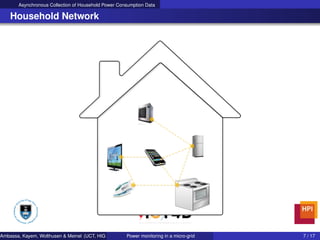
Household Network
Ambassa, Kayem, Wolthusen & Meinel (UCT, HIG & HPI) Power monitoring in a micro-grid 7 / 17
Asynchronous Collection of Household Power Consumption Data
Notations
Let A the set of all appliances within the house, n = |A|.
Aj the set of active devices, Aj ⊆ A and j ∈ [1,p].
The set of sensors s1,s2,...,sn installed to monitor home
appliances power consumption.
M mobile device represents base station /sink/aggregation point
Ambassa, Kayem, Wolthusen & Meinel (UCT, HIG & HPI) Power monitoring in a micro-grid 8 / 17
Asynchronous Collection of Household Power Consumption Data
Notations
Let A the set of all appliances within the house, n = |A|.
Aj the set of active devices, Aj ⊆ A and j ∈ [1,p].
The set of sensors s1,s2,...,sn installed to monitor home
appliances power consumption.
M mobile device represents base station /sink/aggregation point
Network model
system can be modeled by an undirected and connected graph
G = (S,E), where S is the set of nodes in the networks and E is a
set of communication links among the nodes in S
G is the communication graph of this WSN.
Two nodes si and sj are connected if and only if si communicates
directly with sj. si and sj are neighbors
The set N (si) is the set of vertices adjacent to si.
Ambassa, Kayem, Wolthusen & Meinel (UCT, HIG & HPI) Power monitoring in a micro-grid 8 / 17
Asynchronous Collection of Household Power Consumption Data
Challenge
Data collection in a distributed communication network under the
following conditions:
1 Lack of globally shared clock between different nodes
(synchronization problems)
2 Unpredictable communication latency
3 Power consumption values are spread across several appliances
4 Nodes and link are susceptible to failure
5 The presence of network adversaries : (data modification attack,
denial of service attacks)
Ambassa, Kayem, Wolthusen & Meinel (UCT, HIG & HPI) Power monitoring in a micro-grid 9 / 17
Asynchronous Collection of Household Power Consumption Data
Challenge
Data collection in a distributed communication network under the
following conditions:
1 Lack of globally shared clock between different nodes
(synchronization problems)
2 Unpredictable communication latency
3 Power consumption values are spread across several appliances
4 Nodes and link are susceptible to failure
5 The presence of network adversaries : (data modification attack,
denial of service attacks)
Problem
Recording and for collection of power consumption data in
asynchronous networks.
Ambassa, Kayem, Wolthusen & Meinel (UCT, HIG & HPI) Power monitoring in a micro-grid 9 / 17
Asynchronous Collection of Household Power Consumption Data
Challenge
Data collection in a distributed communication network under the
following conditions:
1 Lack of globally shared clock between different nodes
(synchronization problems)
2 Unpredictable communication latency
3 Power consumption values are spread across several appliances
4 Nodes and link are susceptible to failure
5 The presence of network adversaries : (data modification attack,
denial of service attacks)
Problem
Recording and for collection of power consumption data in
asynchronous networks.
Similar to the computation problem of recording the in global state
distributed system
Ambassa, Kayem, Wolthusen & Meinel (UCT, HIG & HPI) Power monitoring in a micro-grid 9 / 17
Asynchronous Collection of Household Power Consumption Data
Snapshot Algorithm: A solution for Global State collection
The distributed snapshot produce a global state of a DS
Collection of local states of process Pi .
Collection of the channel state .
The state of process Pi is the content of processors, register, stack
and memory
The state of the channel is characterize by the set of message in
transit
A global state corresponds to the entire household’s energy
consumption compute from per appliance consumption.
Ambassa, Kayem, Wolthusen & Meinel (UCT, HIG & HPI) Power monitoring in a micro-grid 10 / 17
Asynchronous Collection of Household Power Consumption Data
The Proposed Snapshot Algorithm
Marker: the control message that informs the sensor node to
record the value(s) measured. It contains: sid, the ID of the sender
node; and snapnumb, the snapshot number.
Feedback: the message sent by a sensor to the sink node. It
contains: sid , identifier of the sender node; Nsnd, the new value
recorded; snapnumb an integer which indicates the snapshot; and
Mid , the ID of the sink node.
lmd: a real number which is the reading of the sensor at a given
point in time.
Osnd: the old value collected in the previous snapshot
flag: A Boolean value that indicates if a sensor node has received
the marker.
Ambassa, Kayem, Wolthusen & Meinel (UCT, HIG & HPI) Power monitoring in a micro-grid 11 / 17
Asynchronous Collection of Household Power Consumption Data
The Proposed Algorithm
‚ Assume a spanning tree for communication [Li et al, 2005]
ƒ Three steps algorithm:
® Snapshot initiation
® Reception of Marker
® Feedback response
Phase 1: Snapshot initiation
The mobile device broadcast Marker (sid ,snapnumb) over a spanning
tree initiate the collection
Ambassa, Kayem, Wolthusen & Meinel (UCT, HIG & HPI) Power monitoring in a micro-grid 12 / 17
Asynchronous Collection of Household Power Consumption Data
The Proposed Algorithm
‚ Assume a spanning tree for communication [Li et al, 2005]
ƒ Three steps algorithm:
® Snapshot initiation
® Reception of Marker
® Feedback response
Phase 2: Reception of Marker
Upon receiving the marker message, Marker (sid ,snapnumb), the
receiver (an adjacent neighbor sj ∈ N (si) first check the flag value.
If the value of flag is false, sj has not yet received the marker then
it records its current readings lmd.
sj broadcast the control message Marker (sj,snapnumb) to its
adjacent neighbor.
Ambassa, Kayem, Wolthusen & Meinel (UCT, HIG & HPI) Power monitoring in a micro-grid 12 / 17
Asynchronous Collection of Household Power Consumption Data
The Proposed Algorithm
‚ Assume a spanning tree for communication [Li et al, 2005]
ƒ Three steps algorithm:
® Snapshot initiation
® Reception of Marker
® Feedback response
Phase 3: Feedback response
If Nsnd = Osnd send Feedback with (sid ,Nsnd,snapnumb,Mid ) .
Osnd ← Nsnd.
Ambassa, Kayem, Wolthusen & Meinel (UCT, HIG & HPI) Power monitoring in a micro-grid 12 / 17
Noise Characterization in Power Consumption Data
Noise in Power Data
Noisy in measured data are due to:Errors from the physical
measurement and Malicious measurements
1 Errors from the physical measurement (measurement errors):
The difference between the measured value and the true value
Let u be the true value, x be the measured value and β be the
measurement error. Then, β = x −u or u = x −β.
Three different types of measurement errors: systematic errors,
random errors and negligent errors
2 Malicious measurements: false data injection:
Random false data injection attacks
Targeted false data injection attacks
Ambassa, Kayem, Wolthusen & Meinel (UCT, HIG & HPI) Power monitoring in a micro-grid 13 / 17
Noise Characterization in Power Consumption Data
Measurement Errors
1 Systematic errors
Result from imperfections of the metering equipment, inexact
adjustment and pre-settings
No statistical techniques to quantify systematic errors
[Hughes,2010]
2 Random errors
The reading of si taken at different time fluctuates.
The combination of such tiny perturbations is represented as a
random variable X
X follow Gaussian distributions.
3 Negligent errors
Result from mistakes or a malfunction of the measuring device
Ambassa, Kayem, Wolthusen & Meinel (UCT, HIG & HPI) Power monitoring in a micro-grid 14 / 17
Noise Characterization in Power Consumption Data
Malicious measurements: false data injection
Maliciously inject bad measurement into the data stream in order
to misreport consumption
Two attacks scenarios [Liu,2009]
Random data injection attacks
Targeted data injection attacks.
Ambassa, Kayem, Wolthusen & Meinel (UCT, HIG & HPI) Power monitoring in a micro-grid 15 / 17
Conclusion
Conclusion
Most of the daily activity are electricity dependent
Framework for a cost efficient micro grid architecture for power
distribution in low resource environment
Efficient distributed snapshot algorithm for power consumption
collection in an asynchronous and distributed network
Message complexity is O(N) in a network with N nodes
Characterization of noise in data collection
On-going work: demand load management over distributed
network as a method of scheduling to optimize power consumption
in such a ways to guarantee grid stability
Ambassa, Kayem, Wolthusen & Meinel (UCT, HIG & HPI) Power monitoring in a micro-grid 16 / 17
Thank for your kind attention !!!
Ambassa, Kayem, Wolthusen & Meinel (UCT, HIG & HPI) Power monitoring in a micro-grid 17 / 17

Ambassa fnss 2015

  • 1.
    Secure and ReliablePower Consumption Monitoring in Untrustworthy Micro-grids Pacome Ambassa1 , Anne Kayem 1 , Stephen Wolthusen 2 Christoph Meinel 3 1 Department of Computer Science 2 NISlab 3 Hasso Plattner Institute University of Cape Town Department of Computer Science University of Potsdam South Africa Gjøvik University College, Norway Germany pambassa, akayem@cs.uct.ac.za stephen.wolthusen@hig.no meinel@hpi.de International Conference on Future Network Systems and Security (FNSS 2015) June 13, 2015 Paris, France Ambassa, Kayem, Wolthusen & Meinel (UCT, HIG & HPI) Power monitoring in a micro-grid 1 / 17
  • 2.
    Outline 1 Introduction 2 RelatedWork 3 System Description 4 Asynchronous Collection of Household Power Consumption Data 5 Noise Characterization in Power Consumption Data 6 Conclusion Ambassa, Kayem, Wolthusen & Meinel (UCT, HIG & HPI) Power monitoring in a micro-grid 2 / 17
  • 3.
    Introduction Introduction: Context Low incomecommunities in developing countries: Computational limitations Intermittent network connectivity Unstable power connectivity Do not have reliable access to electricity Not connected to national power networks Access negatively influenced by load shedding Governments, private developers and NGOs could setup a Micro-grids for power sharing. Challenge: Generation does not satisfy demand Ambassa, Kayem, Wolthusen & Meinel (UCT, HIG & HPI) Power monitoring in a micro-grid 3 / 17
  • 4.
    Introduction Introduction: Motivation Design effectiveand efficient micro-grids architecture... Re-modeled the power network to incorporate Incorporate portable and cheap information and communication technology Mobile computing devices – popular in developing countries Sensors Wireless communication technology. Reliability and trust properties: critical for grid stability Reliability: Fair access to the network amongst the Stakeholder, Trust Limited computational system enable power network monitoring Determine power consumption Ensure reliable operation of the network state estimations : precondition for grid stability Integrity of data guide the power distribution Ambassa, Kayem, Wolthusen & Meinel (UCT, HIG & HPI) Power monitoring in a micro-grid 4 / 17
  • 5.
    Related Work Related Work Powernetwork monitoring Conventional power network monitoring solutions are based on utilizing smart meters and trustworthy calibrated sensor installed into home networks for consumption monitoring. They either don’t make any assumption on the aggregation process or assume a synchronized system Monitoring and state estimation in distributed system Centered on snapshot algorithms Snapshot algorithm for fully connected network, reliable communication channel and FIFO message ordering. Most are not suitable for network with limitation on computation because of high communication overhead Ambassa, Kayem, Wolthusen & Meinel (UCT, HIG & HPI) Power monitoring in a micro-grid 5 / 17
  • 6.
    System Description Micro-Grid network Ambassa,Kayem, Wolthusen & Meinel (UCT, HIG & HPI) Power monitoring in a micro-grid 6 / 17
  • 7.
    Asynchronous Collection ofHousehold Power Consumption Data Household Network Ambassa, Kayem, Wolthusen & Meinel (UCT, HIG & HPI) Power monitoring in a micro-grid 7 / 17
  • 8.
    Asynchronous Collection ofHousehold Power Consumption Data Notations Let A the set of all appliances within the house, n = |A|. Aj the set of active devices, Aj ⊆ A and j ∈ [1,p]. The set of sensors s1,s2,...,sn installed to monitor home appliances power consumption. M mobile device represents base station /sink/aggregation point Ambassa, Kayem, Wolthusen & Meinel (UCT, HIG & HPI) Power monitoring in a micro-grid 8 / 17
  • 9.
    Asynchronous Collection ofHousehold Power Consumption Data Notations Let A the set of all appliances within the house, n = |A|. Aj the set of active devices, Aj ⊆ A and j ∈ [1,p]. The set of sensors s1,s2,...,sn installed to monitor home appliances power consumption. M mobile device represents base station /sink/aggregation point Network model system can be modeled by an undirected and connected graph G = (S,E), where S is the set of nodes in the networks and E is a set of communication links among the nodes in S G is the communication graph of this WSN. Two nodes si and sj are connected if and only if si communicates directly with sj. si and sj are neighbors The set N (si) is the set of vertices adjacent to si. Ambassa, Kayem, Wolthusen & Meinel (UCT, HIG & HPI) Power monitoring in a micro-grid 8 / 17
  • 10.
    Asynchronous Collection ofHousehold Power Consumption Data Challenge Data collection in a distributed communication network under the following conditions: 1 Lack of globally shared clock between different nodes (synchronization problems) 2 Unpredictable communication latency 3 Power consumption values are spread across several appliances 4 Nodes and link are susceptible to failure 5 The presence of network adversaries : (data modification attack, denial of service attacks) Ambassa, Kayem, Wolthusen & Meinel (UCT, HIG & HPI) Power monitoring in a micro-grid 9 / 17
  • 11.
    Asynchronous Collection ofHousehold Power Consumption Data Challenge Data collection in a distributed communication network under the following conditions: 1 Lack of globally shared clock between different nodes (synchronization problems) 2 Unpredictable communication latency 3 Power consumption values are spread across several appliances 4 Nodes and link are susceptible to failure 5 The presence of network adversaries : (data modification attack, denial of service attacks) Problem Recording and for collection of power consumption data in asynchronous networks. Ambassa, Kayem, Wolthusen & Meinel (UCT, HIG & HPI) Power monitoring in a micro-grid 9 / 17
  • 12.
    Asynchronous Collection ofHousehold Power Consumption Data Challenge Data collection in a distributed communication network under the following conditions: 1 Lack of globally shared clock between different nodes (synchronization problems) 2 Unpredictable communication latency 3 Power consumption values are spread across several appliances 4 Nodes and link are susceptible to failure 5 The presence of network adversaries : (data modification attack, denial of service attacks) Problem Recording and for collection of power consumption data in asynchronous networks. Similar to the computation problem of recording the in global state distributed system Ambassa, Kayem, Wolthusen & Meinel (UCT, HIG & HPI) Power monitoring in a micro-grid 9 / 17
  • 13.
    Asynchronous Collection ofHousehold Power Consumption Data Snapshot Algorithm: A solution for Global State collection The distributed snapshot produce a global state of a DS Collection of local states of process Pi . Collection of the channel state . The state of process Pi is the content of processors, register, stack and memory The state of the channel is characterize by the set of message in transit A global state corresponds to the entire household’s energy consumption compute from per appliance consumption. Ambassa, Kayem, Wolthusen & Meinel (UCT, HIG & HPI) Power monitoring in a micro-grid 10 / 17
  • 14.
    Asynchronous Collection ofHousehold Power Consumption Data The Proposed Snapshot Algorithm Marker: the control message that informs the sensor node to record the value(s) measured. It contains: sid, the ID of the sender node; and snapnumb, the snapshot number. Feedback: the message sent by a sensor to the sink node. It contains: sid , identifier of the sender node; Nsnd, the new value recorded; snapnumb an integer which indicates the snapshot; and Mid , the ID of the sink node. lmd: a real number which is the reading of the sensor at a given point in time. Osnd: the old value collected in the previous snapshot flag: A Boolean value that indicates if a sensor node has received the marker. Ambassa, Kayem, Wolthusen & Meinel (UCT, HIG & HPI) Power monitoring in a micro-grid 11 / 17
  • 15.
    Asynchronous Collection ofHousehold Power Consumption Data The Proposed Algorithm ‚ Assume a spanning tree for communication [Li et al, 2005] ƒ Three steps algorithm: ® Snapshot initiation ® Reception of Marker ® Feedback response Phase 1: Snapshot initiation The mobile device broadcast Marker (sid ,snapnumb) over a spanning tree initiate the collection Ambassa, Kayem, Wolthusen & Meinel (UCT, HIG & HPI) Power monitoring in a micro-grid 12 / 17
  • 16.
    Asynchronous Collection ofHousehold Power Consumption Data The Proposed Algorithm ‚ Assume a spanning tree for communication [Li et al, 2005] ƒ Three steps algorithm: ® Snapshot initiation ® Reception of Marker ® Feedback response Phase 2: Reception of Marker Upon receiving the marker message, Marker (sid ,snapnumb), the receiver (an adjacent neighbor sj ∈ N (si) first check the flag value. If the value of flag is false, sj has not yet received the marker then it records its current readings lmd. sj broadcast the control message Marker (sj,snapnumb) to its adjacent neighbor. Ambassa, Kayem, Wolthusen & Meinel (UCT, HIG & HPI) Power monitoring in a micro-grid 12 / 17
  • 17.
    Asynchronous Collection ofHousehold Power Consumption Data The Proposed Algorithm ‚ Assume a spanning tree for communication [Li et al, 2005] ƒ Three steps algorithm: ® Snapshot initiation ® Reception of Marker ® Feedback response Phase 3: Feedback response If Nsnd = Osnd send Feedback with (sid ,Nsnd,snapnumb,Mid ) . Osnd ← Nsnd. Ambassa, Kayem, Wolthusen & Meinel (UCT, HIG & HPI) Power monitoring in a micro-grid 12 / 17
  • 18.
    Noise Characterization inPower Consumption Data Noise in Power Data Noisy in measured data are due to:Errors from the physical measurement and Malicious measurements 1 Errors from the physical measurement (measurement errors): The difference between the measured value and the true value Let u be the true value, x be the measured value and β be the measurement error. Then, β = x −u or u = x −β. Three different types of measurement errors: systematic errors, random errors and negligent errors 2 Malicious measurements: false data injection: Random false data injection attacks Targeted false data injection attacks Ambassa, Kayem, Wolthusen & Meinel (UCT, HIG & HPI) Power monitoring in a micro-grid 13 / 17
  • 19.
    Noise Characterization inPower Consumption Data Measurement Errors 1 Systematic errors Result from imperfections of the metering equipment, inexact adjustment and pre-settings No statistical techniques to quantify systematic errors [Hughes,2010] 2 Random errors The reading of si taken at different time fluctuates. The combination of such tiny perturbations is represented as a random variable X X follow Gaussian distributions. 3 Negligent errors Result from mistakes or a malfunction of the measuring device Ambassa, Kayem, Wolthusen & Meinel (UCT, HIG & HPI) Power monitoring in a micro-grid 14 / 17
  • 20.
    Noise Characterization inPower Consumption Data Malicious measurements: false data injection Maliciously inject bad measurement into the data stream in order to misreport consumption Two attacks scenarios [Liu,2009] Random data injection attacks Targeted data injection attacks. Ambassa, Kayem, Wolthusen & Meinel (UCT, HIG & HPI) Power monitoring in a micro-grid 15 / 17
  • 21.
    Conclusion Conclusion Most of thedaily activity are electricity dependent Framework for a cost efficient micro grid architecture for power distribution in low resource environment Efficient distributed snapshot algorithm for power consumption collection in an asynchronous and distributed network Message complexity is O(N) in a network with N nodes Characterization of noise in data collection On-going work: demand load management over distributed network as a method of scheduling to optimize power consumption in such a ways to guarantee grid stability Ambassa, Kayem, Wolthusen & Meinel (UCT, HIG & HPI) Power monitoring in a micro-grid 16 / 17
  • 22.
    Thank for yourkind attention !!! Ambassa, Kayem, Wolthusen & Meinel (UCT, HIG & HPI) Power monitoring in a micro-grid 17 / 17