
CONTENTS

WHAT’S AMAZON?
INTRODUCTION
HISTORY & FACTS
HOW DID THEY MANAGE TO GROW?
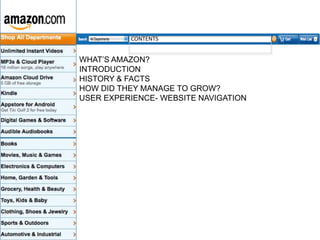
USER EXPERIENCE- WEBSITE NAVIGATION
WHAT’S AMAZON?

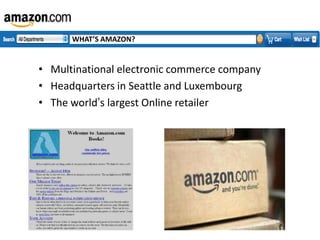
• Multinational electronic commerce company
• Headquarters in Seattle and Luxembourg
• The world’s largest Online retailer
HISTORY & FACTS

•

Founded by Jeff Bezos in 1994 and went online in 1995

•

Named after the Amazon River: a place that is “exotic and different”
– it was almost called Cadabra as in Abracadabra, until someone asked, is the name cadaver?

•

Started as an Online Bookstore that later diversified (Cd’s, DVD’s, software,
etc.)

•

The logo: evolved from a river to a smiling arrow (pointing A to Z) forming a
smile, saying "we're happy to deliver anything, anywhere.”

•

It went from a tiny startup operating on second-hand computers in a garage to
a global company with 12 major retail websites.

•

Ranked Global Website #7 – Sites linking in 1,043,079 (www.alexa.com)
HOW DID THEY MANAGE TO GROW?

• 50% of Amazon revenues lie outside the U.S. whereas
WalMart, Sears, Target, etc. have struggled in foreign markets

• Half of all Amazon book sales are digital, creating growth
where most competitors have stagnated and declined
• Amazon developed game-changing technology and
capabilities allowing it to do what customers wanted, but
other retailers were unwilling to create
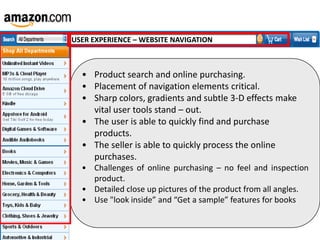
USER EXPERIENCE – WEBSITE NAVIGATION

• Product search and online purchasing.
• Placement of navigation elements critical.
• Sharp colors, gradients and subtle 3-D effects make
vital user tools stand – out.
• The user is able to quickly find and purchase
products.
• The seller is able to quickly process the online
purchases.
• Challenges of online purchasing – no feel and inspection
product.
• Detailed close up pictures of the product from all angles.
• Use "look inside” and “Get a sample” features for books
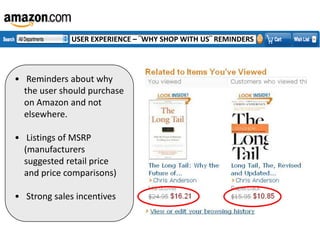
USER EXPERIENCE – ¨WHY SHOP WITH US¨ REMINDERS

• Reminders about why
the user should purchase
on Amazon and not
elsewhere.
• Listings of MSRP
(manufacturers
suggested retail price
and price comparisons)

• Strong sales incentives
KEY PEOPLE & BOARD OF DIRECTORS
Jeffrey P. Bezos
Chairman, President &
Chief Executive Officer
Marc A. Onetto
Senior Vice PresidentWorldwide Operations
Thomas J. Szkutak
Chief Financial Officer &
Senior Vice President
Mary Kay Bowman
Director-Product
Management
Robert Eldridge
Vice President-International
Retail Finance
Sebastian J. Gunningham
Senior Vice President-Seller
Services
Frederick C. Kiga
Director-Tax Policy
Ezequiel Szafir
Vice President-European
Operations
Michael Paull
VP-Content Acquisition &
Business Development

Diego Piacentini
Senior VP-International
Consumer
Ty Rogers
Head-Public Relations
Sean Boyle
Vice President-Investor
Relations
David A. Zapolsky
Secretary, Vice President &
General
H. Brian Valentine
Senior Vice PresidentEcommerce Platform
Jeff M. Blackburn
Senior Vice PresidentBusiness Development
Steven R. Kessel
Senior Vice President
Jeffrey A. Wilke
Senior Vice PresidentConsumer Business
Kathy Sheehan
Associate General Counsel
Craig Berman
Vice President

•
•

•
•
•
•
•
•
•

Jonathan J. Rubinstein
– Independent Director
Thomas O. Ryder
– Lead Independent Director
Tom A. Alberg
– Independent Director
Alain Monié
– Independent Director
Jamie S. Gorelick
– Independent Director
William Bing Gordon
– Independent Director
John Seely Brown
– Independent Director
Patricia Q. Stonesifer
– Independent Director
Shelley L. Reynolds
– Chief Accounting Officer, VP &
Controller
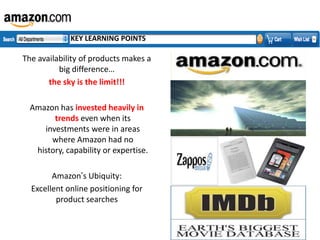
KEY LEARNING POINTS

The availability of products makes a
big difference…
the sky is the limit!!!

Amazon has invested heavily in
trends even when its
investments were in areas
where Amazon had no
history, capability or expertise.
Amazon’s Ubiquity:
Excellent online positioning for
product searches
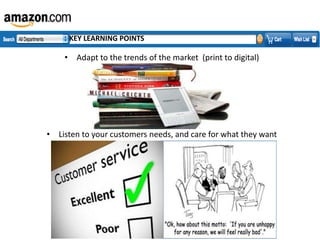
KEY LEARNING POINTS

• Adapt to the trends of the market (print to digital)

• Listen to your customers needs, and care for what they want
KEY LEARNING POINTS

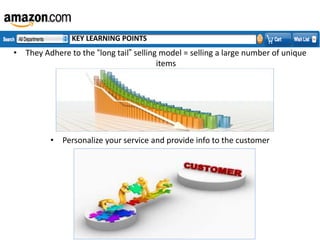
• They Adhere to the “long tail” selling model = selling a large number of unique
items

• Personalize your service and provide info to the customer
CONCLUSIONS

• The shopping experience needs to keep up with new Technologies
& Trends.
• In website design a first concern is not being cool, but fulfillment of
its purpose, which is… maximum sales.
• Amazon’s willingness to go beyond the conventional wisdom of investing
in its “core” has been critical to its success.
• The quality of the operations and logistics high standards are within the
level of the online user experience making the Amazon brand stronger.
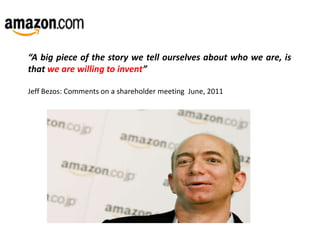
“A big piece of the story we tell ourselves about who we are, is
that we are willing to invent”
Jeff Bezos: Comments on a shareholder meeting June, 2011
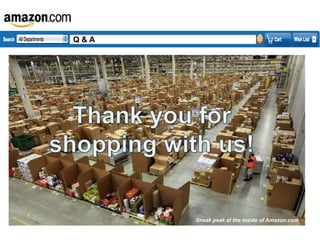
Q&A

Sneak peak at the inside of Amazon.com
• They may account for a third of
all
U.S.
E-commerce
sales, boast over 33,000
employees around the world
and own such big names as
IMDB, Zappos.com

• Call the service desk you might
get the CEO
• 3
Private
brands
(Pike
Street, Pinzon, Strathwood)
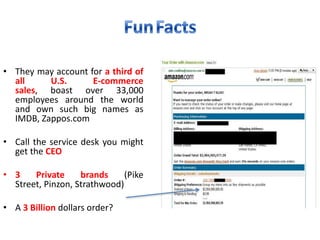
• A 3 Billion dollars order?
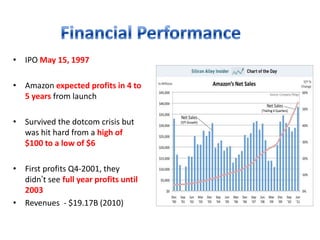
• IPO May 15, 1997
• Amazon expected profits in 4 to
5 years from launch
• Survived the dotcom crisis but
was hit hard from a high of
$100 to a low of $6
• First profits Q4-2001, they
didn’t see full year profits until
2003
• Revenues - $19.17B (2010)

Amazon.com

  • 2.
    CONTENTS WHAT’S AMAZON? INTRODUCTION HISTORY &FACTS HOW DID THEY MANAGE TO GROW? USER EXPERIENCE- WEBSITE NAVIGATION
  • 3.
    WHAT’S AMAZON? • Multinationalelectronic commerce company • Headquarters in Seattle and Luxembourg • The world’s largest Online retailer
  • 4.
    HISTORY & FACTS • Foundedby Jeff Bezos in 1994 and went online in 1995 • Named after the Amazon River: a place that is “exotic and different” – it was almost called Cadabra as in Abracadabra, until someone asked, is the name cadaver? • Started as an Online Bookstore that later diversified (Cd’s, DVD’s, software, etc.) • The logo: evolved from a river to a smiling arrow (pointing A to Z) forming a smile, saying "we're happy to deliver anything, anywhere.” • It went from a tiny startup operating on second-hand computers in a garage to a global company with 12 major retail websites. • Ranked Global Website #7 – Sites linking in 1,043,079 (www.alexa.com)
  • 5.
    HOW DID THEYMANAGE TO GROW? • 50% of Amazon revenues lie outside the U.S. whereas WalMart, Sears, Target, etc. have struggled in foreign markets • Half of all Amazon book sales are digital, creating growth where most competitors have stagnated and declined • Amazon developed game-changing technology and capabilities allowing it to do what customers wanted, but other retailers were unwilling to create
  • 6.
    USER EXPERIENCE –WEBSITE NAVIGATION • Product search and online purchasing. • Placement of navigation elements critical. • Sharp colors, gradients and subtle 3-D effects make vital user tools stand – out. • The user is able to quickly find and purchase products. • The seller is able to quickly process the online purchases. • Challenges of online purchasing – no feel and inspection product. • Detailed close up pictures of the product from all angles. • Use "look inside” and “Get a sample” features for books
  • 7.
    USER EXPERIENCE –¨WHY SHOP WITH US¨ REMINDERS • Reminders about why the user should purchase on Amazon and not elsewhere. • Listings of MSRP (manufacturers suggested retail price and price comparisons) • Strong sales incentives
  • 8.
    KEY PEOPLE &BOARD OF DIRECTORS Jeffrey P. Bezos Chairman, President & Chief Executive Officer Marc A. Onetto Senior Vice PresidentWorldwide Operations Thomas J. Szkutak Chief Financial Officer & Senior Vice President Mary Kay Bowman Director-Product Management Robert Eldridge Vice President-International Retail Finance Sebastian J. Gunningham Senior Vice President-Seller Services Frederick C. Kiga Director-Tax Policy Ezequiel Szafir Vice President-European Operations Michael Paull VP-Content Acquisition & Business Development Diego Piacentini Senior VP-International Consumer Ty Rogers Head-Public Relations Sean Boyle Vice President-Investor Relations David A. Zapolsky Secretary, Vice President & General H. Brian Valentine Senior Vice PresidentEcommerce Platform Jeff M. Blackburn Senior Vice PresidentBusiness Development Steven R. Kessel Senior Vice President Jeffrey A. Wilke Senior Vice PresidentConsumer Business Kathy Sheehan Associate General Counsel Craig Berman Vice President • • • • • • • • • Jonathan J. Rubinstein – Independent Director Thomas O. Ryder – Lead Independent Director Tom A. Alberg – Independent Director Alain Monié – Independent Director Jamie S. Gorelick – Independent Director William Bing Gordon – Independent Director John Seely Brown – Independent Director Patricia Q. Stonesifer – Independent Director Shelley L. Reynolds – Chief Accounting Officer, VP & Controller
  • 12.
    KEY LEARNING POINTS Theavailability of products makes a big difference… the sky is the limit!!! Amazon has invested heavily in trends even when its investments were in areas where Amazon had no history, capability or expertise. Amazon’s Ubiquity: Excellent online positioning for product searches
  • 13.
    KEY LEARNING POINTS •Adapt to the trends of the market (print to digital) • Listen to your customers needs, and care for what they want
  • 14.
    KEY LEARNING POINTS •They Adhere to the “long tail” selling model = selling a large number of unique items • Personalize your service and provide info to the customer
  • 15.
    CONCLUSIONS • The shoppingexperience needs to keep up with new Technologies & Trends. • In website design a first concern is not being cool, but fulfillment of its purpose, which is… maximum sales. • Amazon’s willingness to go beyond the conventional wisdom of investing in its “core” has been critical to its success. • The quality of the operations and logistics high standards are within the level of the online user experience making the Amazon brand stronger.
  • 16.
    “A big pieceof the story we tell ourselves about who we are, is that we are willing to invent” Jeff Bezos: Comments on a shareholder meeting June, 2011
  • 17.
    Q&A Sneak peak atthe inside of Amazon.com
  • 18.
    • They mayaccount for a third of all U.S. E-commerce sales, boast over 33,000 employees around the world and own such big names as IMDB, Zappos.com • Call the service desk you might get the CEO • 3 Private brands (Pike Street, Pinzon, Strathwood) • A 3 Billion dollars order?
  • 20.
    • IPO May15, 1997 • Amazon expected profits in 4 to 5 years from launch • Survived the dotcom crisis but was hit hard from a high of $100 to a low of $6 • First profits Q4-2001, they didn’t see full year profits until 2003 • Revenues - $19.17B (2010)