1
"work hard. Have fun. Make history."
Company Profile
Amazon is an American electronic commerce and cloud computing company based in Seattle, Washington that
was founded by Jeff Bezos on July 5, 1994 and who is still the company's CEO.Bezos initially incorporated the
company with the name Cadabra, Inc. Bezos changed the name to Amazon.com, Inc. a few months later, after a
lawyer misheard its original name as "cadaver".In September 1994, Bezos purchased the URL Relentless.com
and briefly considered naming his online store Relentless, but friends told him the name sounded a bit sinister.
The domain is still owned by Bezos and still redirects to the retailer.The company went online as Amazon.com
in 1995.
The tech guru, he is a Princeton graduate, was born in New Mexico in 1964.
The married dad-of-four has a background in banking, and founded Amazon in 1994 - originally running the
company out of his garage in Seattle. Amazon's company headquarters are in downtown Seattle, Washington,
USA. Amazon is the largest private employer in the city - with 40,000 members of staff. The company is now
on the hunt for another city to launch its second headquarters, after making the announcement it was set to
expend in September 2017.
Jeff Bezos
Amazon founder‟s and CEO
2
Brand Name History:
Amazon.com is the global superstore that places everything from diapers to streaming original
sitcoms to questionably legal botanicals a single click away from increasing your credit card debt. But what
does the name “Amazon” have to do with the site‟s original niche—books—let alone with its expanded mission
as an electronics manufacturer and a seller of all things sellable?
Well, they‟re both big, and they both start with the right letter.
Founder Jeff Bezos had originally dubbed his company “Cadabra” (as in “abracadabra”). But when his lawyer
misheard the name as “cadaver” (as in “dead person”), Bezos decided his company needed a new, less morgue-
friendly name.
Back in the pre-Google world, a company‟s position near the front of alphabetized phonebooks (and of early
web approximations of phonebooks) was still a chief concern. “A” was where you wanted to be.
So Bezos went rummaging through the dictionary‟s first chapter in search of a likely business name—and
eventually settled on “Amazon.” Why? According to him, because it referred to the biggest river in the world.
The biggest by a long shot.
In 2000 Amazon introduced the logo that most people can probably recognize. The logo was just shortened to
include the web address against a white background with a yellow arrow underneath. The arrow, which points
from A to Z in the Amazon logo, symbolizes how a customer could find everything they needed at Amazon.
This logo was meant to be simple and easy to understand, catering to the customers who were interested in 1-
stop shopping
On a tangential note: Take a look at the subliminal messaging in the current Amazon logo, which features a
slightly askew smirk beneath the Amazon name. Note how the smirk resembles an arrow connecting the first
“a” in “Amazon” to the letter “z,” subtly driving home the point that the store delivers everything from A to Z.
In 1998, Amazon started to expand. A large music selection was added to their collection of books and Amazon
decided to market these new products. To that end that created a logo that advertised exactly what they offered.
They also simplified the background to a plain white one, with the Amazon letters in gold upon it. This was
made so as to be more pleasing to the eye online hopefully reaching a wider audience.
There can be no doubt that the logo is extremely effective. People from around the world can recognize that it‟s
an Amazon logo and company can and do spend billions of dollars for that kind of brand recognition. The
reason that it probably works so well is because it‟s simple but offers consumers exactly what they want. To put
it plainly, what they want is place where they can find everything from A to Z.
3
Brand development strategy:
In their 2008 SEC filing, Amazon describes the vision of their business as to:
“Relentlessly focus on customer experience by offering our customers low prices, convenience, and a wide
selection of merchandise.”
The vision is still to consider how these core marketing messages summarizing the Amazon online value
proposition are communicated both on-site and through offline communications.
Of course, achieving customer loyalty and repeat purchases has been key to Amazon‟s success. Many dot-coms
failed because they succeeded in achieving awareness, but not loyalty. Amazon achieved both. In their SEC
filing they stress how they seek to achieve this. They say:
"We work to earn repeat purchases by providing easy-to-use functionality, fast and reliable fulfillment, timely
customer service, feature-rich content, and a trusted transaction environment.
Key features of our websites include editorial and customer reviews; manufacturer product information; Web
pages tailored to individual preferences, such as recommendations and notifications; 1-Click® technology;
secure payment systems; image uploads; searching on our websites as well as the Internet; browsing; and the
ability to view selected interior pages and citations, and search the entire contents of many of the books we offer
with our “Look Inside the Book” and “Search Inside the Book” features. Our community of online customers
also creates feature-rich content, including product reviews, online recommendation lists, wish lists, buying
guides, and wedding and baby registries."
In practice, as is the practice for many online retailers, the lowest prices are for the most popular products, with
less popular products commanding higher prices and a greater margin for Amazon.
Free shipping offers are used to encourage increase in basket size since customers have to spend over a certain
amount to receive free shipping. The level at which free-shipping is set is critical to profitability and Amazon
has changed it as competition has changed and for promotional reasons.
Amazon communicate the fulfillment promise in several ways including presentation of latest inventory
availability information, delivery date estimates, and options for expedited delivery, as well as delivery
shipment notifications and update facilities.
Competition:
In its 2017 SEC filing Amazon describes the environment for our products and services as „intensely
competitive‟. It views its main current and potential competitors as:
(1) Online, offline, and multichannel retailers, publishers, vendors, distributors, manufacturers, and
producers of the products we offer and sell to consumers and businesses;
(2) Publishers, producers, and distributors of physical, digital, and interactive media of all types and all
distribution channels;
(3) Web search engines, comparison shopping websites, social networks, web portals, and other online and
app-based means of discovering, using, or acquiring goods and services, either directly or in collaboration
with other retailers;
(4) Companies that provide e-commerce services, including website development, advertising, fulfillment,
customer service, and payment processing.
4
(5) Companies that provide fulfillment and logistics services for themselves or for third parties, whether
online or offline;
(6) Companies that provide information technology services or products, including on- premises or cloud-
based infrastructure and other services; and
(7) Companies that design, manufacture, market, or sell consumer electronics, telecommunication, and
electronic devices.
It believes the main competitive factors in its market segments include "selection, price, availability,
convenience, information, discovery, brand recognition, personalized services, accessibility, customer service,
reliability, speed of fulfillment, ease of use, and ability to adapt to changing conditions, as well as our
customers‟ overall experience and trust in transactions with us and facilitated by us on behalf of third-party
sellers".
For services offered to business and individual sellers, additional competitive factors include the quality of our
services and tools, their ability to generate sales for third parties we serve, and the speed of performance for our
services.
I aim to keep this case study up-to-date for readers of the books and Smart Insights readers who may be
interested. In it we look at Amazon's background, revenue model and sources for the latest business results.
We can also learn from their approach to digital marketing since they use digital marketing efficiently across all
customer communications touch points in our race marketing planning framework:
Reach:
Amazon's initial business growth based on detailed approach to SEO and Ad Words targeting millions of
keywords.
Act:
Creating clear simple experiences through testing and learning.
Convert:
Using personalization to make relevant recommendations and a clear checkout process that many now
imitate.
Engage:
Their focus on customer experience, "Customer Obsession" as they call it is shown by the way
they consistently outperform other retailers in their ACSI customer satisfaction rating too. We have our own
internal experimentation platform called “Weblab” that we use to evaluate improvements.
5
Services of the company:
Amazon Marketplace is an e-commerce platform owned and operated by Amazon.com that enables third-party
sellers to sell new or used products on a fixed-price online marketplace alongside Amazon's regular offerings.
Using Amazon Marketplace, third-party sellers gain access to Amazon's customer base, and Amazon expands
the offerings on its site without having to invest in additional inventory.
Items purchased on Amazon from third-party sellers are either fulfilled by the merchant (FBM) or by Amazon
(FBA). FBM goods are kept in the third-party seller's inventory, and shipping and customer service are handled
by the third-party merchant. FBA goods are stored in Amazon's fulfillment centers, and shipping and customer
service are handled by Amazon.
Amazon charges its third-party merchants a referral fee for each sale which is a percentage of the sales price.
Additionally, sellers using FBA must pay additional fees which include a pick, pack and weight charge.
Third-party sales on Amazon account for around 31% of Amazon's annual sales.In 2016 Amazon.com aided
more than 10,000 sellers to generate more than $1 billion of annual sales.
Amazon.com's product lines available at its website include several media (books, DVDs, music
CDs, videotapes and software), apparel, baby products, consumer electronics, beauty products, gourmet food,
groceries, health and personal-care items, industrial & scientific supplies, kitchen items, jewelry, watches, lawn
and garden items, musical instruments, sporting goods, tools, automotive items and toys & games. Amazon is
now gearing up in India to play a role in the grocery retail sector aimed at delivering customer needs.
Amazon.com has a number of products and services available, including:
Amazon product lines include several media (books, DVDs, music CDs, videotapes, and software), apparel,
baby products, consumer electronics, beauty products, gourmet food, groceries, health and personal-care items,
industrial & scientific supplies, kitchen items, jewelry and watches, lawn and garden items, musical
instruments, sporting goods, tools, automotive items and toys & games.
The company launched amazon.com Auctions, a web auctions service, in March 1999. However, it failed to
chip away at the large market share of the industry pioneer, eBay. Later, the company launched a fixed-
price marketplace business, zShops, in September 1999, and the now defunct partnership with Sotheby's,
called Sothebys.amazon.com, in November. Auctions and zShops evolved into Amazon Marketplace, a service
launched in November 2000 that let customers sell used books, CDs, DVDs, and other products alongside new
items. As of October 2014, Amazon Marketplace is the largest of its kind, followed by similar marketplaces
from Sears, Rakuten and Newegg.
In August 2007, Amazon announced Amazon Fresh, a grocery service offering perishable and nonperishable
foods. Customers could have orders delivered to their homes at dawn or during a specified daytime window.
Delivery was initially restricted to residents of Mercer Island, Washington, and was later expanded to
several ZIP codes in Seattle proper.[1]
Amazon Fresh also operated pick-up locations in the suburbs
of Bellevue and Kirkland from summer 2007 through early 2008.
In 2012, Amazon announced the launch of Vine.com for buying green products, including groceries, household
items, and apparel. It is part of Quidsi, the company that Amazon bought in 2010 that also runs the
sites Diapers.com (baby), Wag.com (pets), and YoYo.com (toys). Amazon also owns other e-commerce sites
like Shopbop.com,Woot.com, and Zappos.com.
Amazon's Subscribe & Save program offers a discounted price on an item (usually sold in bulk), free shipping
on every Subscribe & Save shipment, and automatic shipment of the item every one, two, three, or six months.[3]
In 2013, Amazon launched its site in India, Amazon.in. It started with electronic goods. In July 2014, Amazon
said it would invest $2 billion (Rs. 12,000 core) in India to expand business, after its largest Indian rival Flipkart
announced $1 billion in funding.
In 2014, Amazon sold 63% of all books bought online and 40% of all books sold overall.
Fulfillment by Amazon Small and Light is a service introduced in 2015 that will provide fulfillment for small,
light items from a center in Florence, Kentucky. The service will offer free standard shipping for small, light,
6
low-value items offered on the site by third-party sellers. In 2015, a study by Survata found that 44% of
respondents searching for products went directly to Amazon.com.
Amazon Selling Products:
Books:
The contents of books are also called books, as are other compositions of that length. For
instance, Aristotle's Physics, the constituent sections of the Bible, and even the Egyptian Book of the Dead are
called books independently of their physical form. Conversely, some long literary compositions are divided
into books of varying sizes, which typically do not correspond to physically bound units. This tradition derives
from ancient scroll formats, where long works needed several scrolls. Where very long books in codex format
still need to be physically divided, the term volume is now normally used. Books may be distributed in
electronic form as e-books and other formats.
Consumer electronics:
November 2007, Amazon launched the Kindle, an e-reader which downloads content over "Whisper net",
via Sprint's EV-DO wireless network. The screen uses E Ink technology to reduce battery consumption and to
provide a more legible display. As of July 2014, there are over 2.7 million e-books available for purchase at
the Kindle Store. Starting in 2012 Amazon began offering differing models within generations of its readers
starting with the Paper white, Voyage, and most recently the Oasis 2 released in October 2017.
In September 2011, Amazon announced its entry into the tablet computer market by introducing the Kindle Fire,
which runs a customized fork of the Android operating system. The low pricing of Fire ($199 USD) was widely
perceived as a strategy backed by Amazon's revenue from its content sales, to be stimulated by access to Fire
tablets.
In September 2012, Amazon unveiled the second generation tablet, called the Kindle Fire HD. On September
25, 2013, Amazon.com unveiled its third generation tablet, called the Kindle Fire HDX.
In April 2014, Amazon announced its Amazon Fire TV set-top box system, a device targeted to compete with
such systems like Apple TV or Google's Chrome cast device. The Amazon set-top box allows for streaming
videos from sites like Amazon's own streaming service as well as others such as Netflix or Hulu. The device
also supports voice search for movies, as well as gaming, which includes special versions of Mine craft, Asphalt
8, and The Walking Dead. Amazon announced the Fire TV Stick in October 2014. The device replicates much
of the functionality of the Fire TV. The company entered the smartphone market in July 2014 with the release of
the Fire Phone. Due to poor sales and reception, Amazon discontinued it on August 2015, and has not
announced any newer model as of August 2016. In 2014, Amazon sold a voice-enabled smart speaker
called Echo. In March 2016, Amazon launched Amazon Echo dot, a smaller, more affordable version of the
Echo.
Game equipment’s:
Balls:
Sports are often named after the ball used, such as football, American football, baseball and basketball, or the
ball is named after the sport.
Flying discs:
Flying discs are used for various games such as freestyle, disc golf and ultimate.
Nets:
Nets are used for table tennis, volleyball, football, basketball, hockey and badminton. A different type of net is
used for various forms of fishing.
Racquets:
Racquets are used for racquet sports such as tennis, squash and badminton.
Sticks, bats and clubs:
Sticks are used for sports such as hockey and lacrosse. Bats are used for sports such as baseball and cricket.
Clubs are used mainly for golf (Golf club)
7
Wickets and bases:
Wickets and bails are used in cricket, and bases are used in baseball etc.
Digital content:
Amazon's Honor System was launched in 2001 to allow customers to make donations or buy digital content,
with Amazon collecting a percentage of the payment plus a fee; however, the service was discontinued in
2008 and replaced by Amazon Payments.
On September 25, 2007, Amazon Music, an online music store, was launched as Amazon MP3 in the US selling
downloads exclusively in MP3 format without digital rights management. (In addition to copyright law,
Amazon's terms of use agreements restrict use of the MP3s, but Amazon does not use digital rights management
(DRM) to enforce those terms) .In addition to independent music labels, Amazon MP3 primarily sells music
from the "Big 4" record labels: EMI, Universal, Warner Bros. Records, and Sony Music. Prior to the launch of
this service, Amazon made an investment in Amie Street, a music store with a variable pricing model based
on demand. Amazon MP3 was the first online offering of DRM-free music from all four major record
companies. In November 2007, the Kindle Store was launched as an e-book e-commerce store and can be
accessed from any Amazon Kindle, Fire tablet or Kindle mobile app. At its launch, the store had more than
88,000 digital titles available. This number increased to more than 765,000 by August 2011 and as of January
2017 there were over five million e-books available in the U.S.
In January 2008, Amazon began distributing its MP3 service to subsidiary websites worldwide and, in
December 2008, Amazon MP3 was made available in the UK. At the launch of Amazon MP3 in the UK, over 3
million Digital Rights Management (DRM)-free songs were made available to consumers, with prices that
started at 59p, compared to Apple's 79p starting price.
In July 2010, Amazon announced that e-book sales for its Kindle reader outnumbered sales of hardcover books
for the first time ever during the second quarter of 2010. Amazon claims that, during that period, 143 e-books
were sold for every 100 hardcover books, including hardcovers for which there is no digital edition; and during
late June and early July, sales rose to 180 digital books for every 100 hardcovers.
On March 22, 2011, Amazon launched the Amazon App store for Android devices and the service was made
available in over 200 countries. Also in 2011, Amazon announced that it was releasing a Mac download store to
offer dozens of games and hundreds of pieces of software for Apple computers. In January 2013, Amazon
launched Auto Rip, a digital music service. The service allows customers to receive a free MP3 copy of select
CDs purchased through Amazon. Amazon announced in September 2013 that it would launch Kindle Match
Book in October 2013, a similar service for books allowing customers who buy books from Amazon to acquire
an e-book copy for free, or at a discounted price of US$3 or less. Match Book was launched on the company's
site on October 29, 2013.
Amazon Games:
In October 2008, Amazon acquired game developer and distributor Reflexive Entertainment. This studio
continued to develop games for PC, Mac and Kindle eReaders under the brands Reflexive and Amazon Digital
Services. Notable titles include Every Word for Kindle Paper white and Airport Mania for Kindle Fire, Android,
iOS Windows and Mac.
In August 2012, Amazon announced it would be adding a gaming department to its company titled Amazon
Game Studios. Amazon stated that it would introduce "innovative, fun and well-crafted games" to
consumers. According to the Amazon Game Studios website, the last game that was launched by the department
was Amazon's first ever mobile game Air Patriots, released on November 1, 2012.
On February 6, 2014, Amazon confirmed the acquisition of the gaming company Double Helix Games without
any indication of the financial terms. The 75 Double Helix employees were to become Amazon employees and
their Orange County, California, headquarters was to remain their operating base. Amazon informed the Tech
Crunch media company that it "acquired Double Helix as part of our [Amazon's] ongoing commitment to build
innovative games for customers" and confirmed that Double Helix's current game roster and other future
developments will receive support following the acquisition. On August 25, 2014, Amazon announced its intent
to acquire the video game streaming website Twitch for $970 million. The acquisition of Twitch is expected to
help Amazon drive Internet traffic and potentially boost its Prime membership program, and promote its video
ad and Fire TV set top box business.
8
Amazon art:
In August 2013, Amazon launched Amazon Art as an online marketplace selling original and limited edition
fine art from selected galleries. The initial 40000 items listed for sale included Norman Rockwell's
painting Willie Gillis: Package from Home priced at $4.85 million, L'Enfant a la tasse by Claude Monet for
$1.45 million and Andy Warhol's Sachiko for $45 000.
Amazon Video:
Amazon Video, Amazon Instant Video UK, and Amazon Instant Video German
Amazon Video is an Internet video on demand service by Amazon in the United States, United Kingdom, India,
Japan, Austria and Germany. In 2015, the Prime Instant Video exclusive series Transparent earned two Golden
Globe Awards and Transparent is the first series from a streaming service to win a Golden Globe for best series.
Amazon Drive:
Amazon Drive, formerly known as Cloud Drive, is a cloud storage application offering secure cloud storage, file
synchronization, file sharing, and Photo printing. Using an Amazon account, the files and folders can be
transferred and managed from multiple devices including web browsers, desktop applications, mobiles, and
tablets. Amazon Drive also lets their U.S. users order photo prints and photo books using Amazon Prints service
Amazon majorly offers two plans in their marketplaces - Prime Photos and Unlimited Storage. The Prime
Photos plan offers unlimited storage for photos and RAW files, and 5 gigabytes of storage for videos and other
files, whereas Unlimited Storage plan, intended for non-business customer sections, offers unlimited storage for
photos, videos, documents, and files in other formats.
Amazon Studio:
Amazon studio is Amazon.com's division that develops television shows, movies and comics from online
submissions and crowd-sourced feedback. It was started in late 2010. Content would be distributed
through Amazon Video, Amazon‟s digital video streaming service, and a competitor to services
like Netflix and Hulu For film, Warner Bros. is a partner.
Amazon Web Services:
Amazon launched Amazon Web Services (AWS) in 2002, which provides programmatic access to latent
features on its website. As of December 2014, Amazon Web Services operated 1.4 Million servers across 11
regions and 28 availability zones.
New book content production:
Amazon Publishing is Amazon's publishing unit launched in May 2009. Launched in 2005, Amazon Shorts
offered exclusive short stories and non-fiction pieces from best-selling authors for download from the Kindle
Store.
Donation:
Amazon also created "channels" to benefit certain causes. In 2004, Amazon allowed customers to donate $5 to
$200 to the campaigns of 2004 US presidential hopefuls, providing links that raised $300,000 for the
candidates. Amazon has periodically reactivated a Red Cross donation channel after crises such as Hurricane
Sandy, Hurricane Katrina, and the 2004 earthquake and tsunami in the Indian Ocean. By January 2005, nearly
200,000 people had donated over $15.7 million in the US.
Amazon local:
It was launched gradually in the United Kingdom on August 29, 2012, starting in London and expanding to
more towns and cities. Amazon Local is a daily deal service launched in June 2011 in Boise, Idaho. As of 2013,
Amazon Local offers daily deals to over 100 regions in 36 U.S. states. Amazon Local also acts as a deal
aggregator; some of the deals are actually offered through Living Social, a firm in which Amazon has heavily
invested. On December 18, 2015, Amazon Local stopped selling daily deals.
9
Amazon wireless:
In July 2009, Amazon.com launched an Amazon Wireless website, which offers cellular devices and service
plans for Verizon Wireless, AT&T, Sprint and T-Mobile in the US.
Amazon tickets:
Amazon launched a ticket service called "Amazon Tickets" in 2015 in the UK and soon will expand it across
Europe, US, and Asia to compete with the likes of industry leader Ticketmaster while also disrupting the Live
Entertainment market.
Amazon home service:
In March 2015 Amazon launched a new on-demand service, Amazon Home Services, aimed at offering
homeowners a marketplace for professional services such as plumbing, electrical, audio/visual installation, and
lawn services. The Home Services category designed to make finding a specialist easy by verifying that
providers are properly licensed and insured for the job. Service is "Satisfaction Guaranteed" and offers a refund
if you are not happy in the end. Additionally, reviews are verified so you know the reviewer actually paid for
and used the services.
There are many services are provided in the country.
World leading brand:
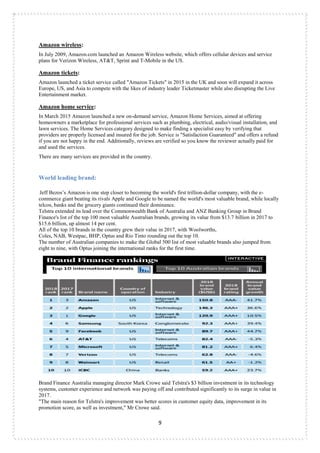
Jeff Bezos‟s Amazon is one step closer to becoming the world's first trillion-dollar company, with the e-
commerce giant beating its rivals Apple and Google to be named the world's most valuable brand, while locally
telcos, banks and the grocery giants continued their dominance.
Telstra extended its lead over the Commonwealth Bank of Australia and ANZ Banking Group in Brand
Finance's list of the top 100 most valuable Australian brands, growing its value from $13.7 billion in 2017 to
$15.6 billion, up almost 14 per cent.
All of the top 10 brands in the country grew their value in 2017, with Woolworths,
Coles, NAB, Westpac, BHP, Optus and Rio Tinto rounding out the top 10.
The number of Australian companies to make the Global 500 list of most valuable brands also jumped from
eight to nine, with Optus joining the international ranks for the first time.
Brand Finance Australia managing director Mark Crowe said Telstra's $3 billion investment in its technology
systems, customer experience and network was paying off and contributed significantly to its surge in value in
2017.
"The main reason for Telstra's improvement was better scores in customer equity data, improvement in its
promotion score, as well as investment," Mr Crowe said.
10
"What's really telling is how much Telstra's brand value is contributing to the business. Despite the negative
change in the market the brand itself is performing well. It's helping to address the negative perceptions in the
telecommunications market."
Conclusion:
Amazon allows users to submit reviews to the web page of each product. Reviewers must rate the
product on a rating scale from one to five stars. Amazon provides a badging option for reviewers which indicate
the real name of the reviewer (based on confirmation of a credit card account) or which indicate that the
reviewer is one of the top reviewers by popularity. Customers may comment or vote on the reviews, indicating
whether they found a review helpful to them. If a review is given enough "helpful" hits, it appears on the front
page of the product. In 2010, Amazon was reported as being the largest single source of Internet consumer
reviews.
When publishers asked Bezos why Amazon would publish negative reviews, he defended the practice by
claiming that Amazon.com was "taking a different approach ... we want to make every book available—the
good, the bad and the ugly ... to let truth loose".
There have been cases of positive reviews being written and posted by public relations companies on behalf of
their clients and instances of writers using pseudonyms to leave negative reviews of their rivals' works.
COMPILED & ASSEMBLED BY-
A K M Sahedujjaman (Saju)
Date: 01/04/2018
11

Amazon Documents

  • 1.
    1 "work hard. Havefun. Make history." Company Profile Amazon is an American electronic commerce and cloud computing company based in Seattle, Washington that was founded by Jeff Bezos on July 5, 1994 and who is still the company's CEO.Bezos initially incorporated the company with the name Cadabra, Inc. Bezos changed the name to Amazon.com, Inc. a few months later, after a lawyer misheard its original name as "cadaver".In September 1994, Bezos purchased the URL Relentless.com and briefly considered naming his online store Relentless, but friends told him the name sounded a bit sinister. The domain is still owned by Bezos and still redirects to the retailer.The company went online as Amazon.com in 1995. The tech guru, he is a Princeton graduate, was born in New Mexico in 1964. The married dad-of-four has a background in banking, and founded Amazon in 1994 - originally running the company out of his garage in Seattle. Amazon's company headquarters are in downtown Seattle, Washington, USA. Amazon is the largest private employer in the city - with 40,000 members of staff. The company is now on the hunt for another city to launch its second headquarters, after making the announcement it was set to expend in September 2017. Jeff Bezos Amazon founder‟s and CEO
  • 2.
    2 Brand Name History: Amazon.comis the global superstore that places everything from diapers to streaming original sitcoms to questionably legal botanicals a single click away from increasing your credit card debt. But what does the name “Amazon” have to do with the site‟s original niche—books—let alone with its expanded mission as an electronics manufacturer and a seller of all things sellable? Well, they‟re both big, and they both start with the right letter. Founder Jeff Bezos had originally dubbed his company “Cadabra” (as in “abracadabra”). But when his lawyer misheard the name as “cadaver” (as in “dead person”), Bezos decided his company needed a new, less morgue- friendly name. Back in the pre-Google world, a company‟s position near the front of alphabetized phonebooks (and of early web approximations of phonebooks) was still a chief concern. “A” was where you wanted to be. So Bezos went rummaging through the dictionary‟s first chapter in search of a likely business name—and eventually settled on “Amazon.” Why? According to him, because it referred to the biggest river in the world. The biggest by a long shot. In 2000 Amazon introduced the logo that most people can probably recognize. The logo was just shortened to include the web address against a white background with a yellow arrow underneath. The arrow, which points from A to Z in the Amazon logo, symbolizes how a customer could find everything they needed at Amazon. This logo was meant to be simple and easy to understand, catering to the customers who were interested in 1- stop shopping On a tangential note: Take a look at the subliminal messaging in the current Amazon logo, which features a slightly askew smirk beneath the Amazon name. Note how the smirk resembles an arrow connecting the first “a” in “Amazon” to the letter “z,” subtly driving home the point that the store delivers everything from A to Z. In 1998, Amazon started to expand. A large music selection was added to their collection of books and Amazon decided to market these new products. To that end that created a logo that advertised exactly what they offered. They also simplified the background to a plain white one, with the Amazon letters in gold upon it. This was made so as to be more pleasing to the eye online hopefully reaching a wider audience. There can be no doubt that the logo is extremely effective. People from around the world can recognize that it‟s an Amazon logo and company can and do spend billions of dollars for that kind of brand recognition. The reason that it probably works so well is because it‟s simple but offers consumers exactly what they want. To put it plainly, what they want is place where they can find everything from A to Z.
  • 3.
    3 Brand development strategy: Intheir 2008 SEC filing, Amazon describes the vision of their business as to: “Relentlessly focus on customer experience by offering our customers low prices, convenience, and a wide selection of merchandise.” The vision is still to consider how these core marketing messages summarizing the Amazon online value proposition are communicated both on-site and through offline communications. Of course, achieving customer loyalty and repeat purchases has been key to Amazon‟s success. Many dot-coms failed because they succeeded in achieving awareness, but not loyalty. Amazon achieved both. In their SEC filing they stress how they seek to achieve this. They say: "We work to earn repeat purchases by providing easy-to-use functionality, fast and reliable fulfillment, timely customer service, feature-rich content, and a trusted transaction environment. Key features of our websites include editorial and customer reviews; manufacturer product information; Web pages tailored to individual preferences, such as recommendations and notifications; 1-Click® technology; secure payment systems; image uploads; searching on our websites as well as the Internet; browsing; and the ability to view selected interior pages and citations, and search the entire contents of many of the books we offer with our “Look Inside the Book” and “Search Inside the Book” features. Our community of online customers also creates feature-rich content, including product reviews, online recommendation lists, wish lists, buying guides, and wedding and baby registries." In practice, as is the practice for many online retailers, the lowest prices are for the most popular products, with less popular products commanding higher prices and a greater margin for Amazon. Free shipping offers are used to encourage increase in basket size since customers have to spend over a certain amount to receive free shipping. The level at which free-shipping is set is critical to profitability and Amazon has changed it as competition has changed and for promotional reasons. Amazon communicate the fulfillment promise in several ways including presentation of latest inventory availability information, delivery date estimates, and options for expedited delivery, as well as delivery shipment notifications and update facilities. Competition: In its 2017 SEC filing Amazon describes the environment for our products and services as „intensely competitive‟. It views its main current and potential competitors as: (1) Online, offline, and multichannel retailers, publishers, vendors, distributors, manufacturers, and producers of the products we offer and sell to consumers and businesses; (2) Publishers, producers, and distributors of physical, digital, and interactive media of all types and all distribution channels; (3) Web search engines, comparison shopping websites, social networks, web portals, and other online and app-based means of discovering, using, or acquiring goods and services, either directly or in collaboration with other retailers; (4) Companies that provide e-commerce services, including website development, advertising, fulfillment, customer service, and payment processing.
  • 4.
    4 (5) Companies thatprovide fulfillment and logistics services for themselves or for third parties, whether online or offline; (6) Companies that provide information technology services or products, including on- premises or cloud- based infrastructure and other services; and (7) Companies that design, manufacture, market, or sell consumer electronics, telecommunication, and electronic devices. It believes the main competitive factors in its market segments include "selection, price, availability, convenience, information, discovery, brand recognition, personalized services, accessibility, customer service, reliability, speed of fulfillment, ease of use, and ability to adapt to changing conditions, as well as our customers‟ overall experience and trust in transactions with us and facilitated by us on behalf of third-party sellers". For services offered to business and individual sellers, additional competitive factors include the quality of our services and tools, their ability to generate sales for third parties we serve, and the speed of performance for our services. I aim to keep this case study up-to-date for readers of the books and Smart Insights readers who may be interested. In it we look at Amazon's background, revenue model and sources for the latest business results. We can also learn from their approach to digital marketing since they use digital marketing efficiently across all customer communications touch points in our race marketing planning framework: Reach: Amazon's initial business growth based on detailed approach to SEO and Ad Words targeting millions of keywords. Act: Creating clear simple experiences through testing and learning. Convert: Using personalization to make relevant recommendations and a clear checkout process that many now imitate. Engage: Their focus on customer experience, "Customer Obsession" as they call it is shown by the way they consistently outperform other retailers in their ACSI customer satisfaction rating too. We have our own internal experimentation platform called “Weblab” that we use to evaluate improvements.
  • 5.
    5 Services of thecompany: Amazon Marketplace is an e-commerce platform owned and operated by Amazon.com that enables third-party sellers to sell new or used products on a fixed-price online marketplace alongside Amazon's regular offerings. Using Amazon Marketplace, third-party sellers gain access to Amazon's customer base, and Amazon expands the offerings on its site without having to invest in additional inventory. Items purchased on Amazon from third-party sellers are either fulfilled by the merchant (FBM) or by Amazon (FBA). FBM goods are kept in the third-party seller's inventory, and shipping and customer service are handled by the third-party merchant. FBA goods are stored in Amazon's fulfillment centers, and shipping and customer service are handled by Amazon. Amazon charges its third-party merchants a referral fee for each sale which is a percentage of the sales price. Additionally, sellers using FBA must pay additional fees which include a pick, pack and weight charge. Third-party sales on Amazon account for around 31% of Amazon's annual sales.In 2016 Amazon.com aided more than 10,000 sellers to generate more than $1 billion of annual sales. Amazon.com's product lines available at its website include several media (books, DVDs, music CDs, videotapes and software), apparel, baby products, consumer electronics, beauty products, gourmet food, groceries, health and personal-care items, industrial & scientific supplies, kitchen items, jewelry, watches, lawn and garden items, musical instruments, sporting goods, tools, automotive items and toys & games. Amazon is now gearing up in India to play a role in the grocery retail sector aimed at delivering customer needs. Amazon.com has a number of products and services available, including: Amazon product lines include several media (books, DVDs, music CDs, videotapes, and software), apparel, baby products, consumer electronics, beauty products, gourmet food, groceries, health and personal-care items, industrial & scientific supplies, kitchen items, jewelry and watches, lawn and garden items, musical instruments, sporting goods, tools, automotive items and toys & games. The company launched amazon.com Auctions, a web auctions service, in March 1999. However, it failed to chip away at the large market share of the industry pioneer, eBay. Later, the company launched a fixed- price marketplace business, zShops, in September 1999, and the now defunct partnership with Sotheby's, called Sothebys.amazon.com, in November. Auctions and zShops evolved into Amazon Marketplace, a service launched in November 2000 that let customers sell used books, CDs, DVDs, and other products alongside new items. As of October 2014, Amazon Marketplace is the largest of its kind, followed by similar marketplaces from Sears, Rakuten and Newegg. In August 2007, Amazon announced Amazon Fresh, a grocery service offering perishable and nonperishable foods. Customers could have orders delivered to their homes at dawn or during a specified daytime window. Delivery was initially restricted to residents of Mercer Island, Washington, and was later expanded to several ZIP codes in Seattle proper.[1] Amazon Fresh also operated pick-up locations in the suburbs of Bellevue and Kirkland from summer 2007 through early 2008. In 2012, Amazon announced the launch of Vine.com for buying green products, including groceries, household items, and apparel. It is part of Quidsi, the company that Amazon bought in 2010 that also runs the sites Diapers.com (baby), Wag.com (pets), and YoYo.com (toys). Amazon also owns other e-commerce sites like Shopbop.com,Woot.com, and Zappos.com. Amazon's Subscribe & Save program offers a discounted price on an item (usually sold in bulk), free shipping on every Subscribe & Save shipment, and automatic shipment of the item every one, two, three, or six months.[3] In 2013, Amazon launched its site in India, Amazon.in. It started with electronic goods. In July 2014, Amazon said it would invest $2 billion (Rs. 12,000 core) in India to expand business, after its largest Indian rival Flipkart announced $1 billion in funding. In 2014, Amazon sold 63% of all books bought online and 40% of all books sold overall. Fulfillment by Amazon Small and Light is a service introduced in 2015 that will provide fulfillment for small, light items from a center in Florence, Kentucky. The service will offer free standard shipping for small, light,
  • 6.
    6 low-value items offeredon the site by third-party sellers. In 2015, a study by Survata found that 44% of respondents searching for products went directly to Amazon.com. Amazon Selling Products: Books: The contents of books are also called books, as are other compositions of that length. For instance, Aristotle's Physics, the constituent sections of the Bible, and even the Egyptian Book of the Dead are called books independently of their physical form. Conversely, some long literary compositions are divided into books of varying sizes, which typically do not correspond to physically bound units. This tradition derives from ancient scroll formats, where long works needed several scrolls. Where very long books in codex format still need to be physically divided, the term volume is now normally used. Books may be distributed in electronic form as e-books and other formats. Consumer electronics: November 2007, Amazon launched the Kindle, an e-reader which downloads content over "Whisper net", via Sprint's EV-DO wireless network. The screen uses E Ink technology to reduce battery consumption and to provide a more legible display. As of July 2014, there are over 2.7 million e-books available for purchase at the Kindle Store. Starting in 2012 Amazon began offering differing models within generations of its readers starting with the Paper white, Voyage, and most recently the Oasis 2 released in October 2017. In September 2011, Amazon announced its entry into the tablet computer market by introducing the Kindle Fire, which runs a customized fork of the Android operating system. The low pricing of Fire ($199 USD) was widely perceived as a strategy backed by Amazon's revenue from its content sales, to be stimulated by access to Fire tablets. In September 2012, Amazon unveiled the second generation tablet, called the Kindle Fire HD. On September 25, 2013, Amazon.com unveiled its third generation tablet, called the Kindle Fire HDX. In April 2014, Amazon announced its Amazon Fire TV set-top box system, a device targeted to compete with such systems like Apple TV or Google's Chrome cast device. The Amazon set-top box allows for streaming videos from sites like Amazon's own streaming service as well as others such as Netflix or Hulu. The device also supports voice search for movies, as well as gaming, which includes special versions of Mine craft, Asphalt 8, and The Walking Dead. Amazon announced the Fire TV Stick in October 2014. The device replicates much of the functionality of the Fire TV. The company entered the smartphone market in July 2014 with the release of the Fire Phone. Due to poor sales and reception, Amazon discontinued it on August 2015, and has not announced any newer model as of August 2016. In 2014, Amazon sold a voice-enabled smart speaker called Echo. In March 2016, Amazon launched Amazon Echo dot, a smaller, more affordable version of the Echo. Game equipment’s: Balls: Sports are often named after the ball used, such as football, American football, baseball and basketball, or the ball is named after the sport. Flying discs: Flying discs are used for various games such as freestyle, disc golf and ultimate. Nets: Nets are used for table tennis, volleyball, football, basketball, hockey and badminton. A different type of net is used for various forms of fishing. Racquets: Racquets are used for racquet sports such as tennis, squash and badminton. Sticks, bats and clubs: Sticks are used for sports such as hockey and lacrosse. Bats are used for sports such as baseball and cricket. Clubs are used mainly for golf (Golf club)
  • 7.
    7 Wickets and bases: Wicketsand bails are used in cricket, and bases are used in baseball etc. Digital content: Amazon's Honor System was launched in 2001 to allow customers to make donations or buy digital content, with Amazon collecting a percentage of the payment plus a fee; however, the service was discontinued in 2008 and replaced by Amazon Payments. On September 25, 2007, Amazon Music, an online music store, was launched as Amazon MP3 in the US selling downloads exclusively in MP3 format without digital rights management. (In addition to copyright law, Amazon's terms of use agreements restrict use of the MP3s, but Amazon does not use digital rights management (DRM) to enforce those terms) .In addition to independent music labels, Amazon MP3 primarily sells music from the "Big 4" record labels: EMI, Universal, Warner Bros. Records, and Sony Music. Prior to the launch of this service, Amazon made an investment in Amie Street, a music store with a variable pricing model based on demand. Amazon MP3 was the first online offering of DRM-free music from all four major record companies. In November 2007, the Kindle Store was launched as an e-book e-commerce store and can be accessed from any Amazon Kindle, Fire tablet or Kindle mobile app. At its launch, the store had more than 88,000 digital titles available. This number increased to more than 765,000 by August 2011 and as of January 2017 there were over five million e-books available in the U.S. In January 2008, Amazon began distributing its MP3 service to subsidiary websites worldwide and, in December 2008, Amazon MP3 was made available in the UK. At the launch of Amazon MP3 in the UK, over 3 million Digital Rights Management (DRM)-free songs were made available to consumers, with prices that started at 59p, compared to Apple's 79p starting price. In July 2010, Amazon announced that e-book sales for its Kindle reader outnumbered sales of hardcover books for the first time ever during the second quarter of 2010. Amazon claims that, during that period, 143 e-books were sold for every 100 hardcover books, including hardcovers for which there is no digital edition; and during late June and early July, sales rose to 180 digital books for every 100 hardcovers. On March 22, 2011, Amazon launched the Amazon App store for Android devices and the service was made available in over 200 countries. Also in 2011, Amazon announced that it was releasing a Mac download store to offer dozens of games and hundreds of pieces of software for Apple computers. In January 2013, Amazon launched Auto Rip, a digital music service. The service allows customers to receive a free MP3 copy of select CDs purchased through Amazon. Amazon announced in September 2013 that it would launch Kindle Match Book in October 2013, a similar service for books allowing customers who buy books from Amazon to acquire an e-book copy for free, or at a discounted price of US$3 or less. Match Book was launched on the company's site on October 29, 2013. Amazon Games: In October 2008, Amazon acquired game developer and distributor Reflexive Entertainment. This studio continued to develop games for PC, Mac and Kindle eReaders under the brands Reflexive and Amazon Digital Services. Notable titles include Every Word for Kindle Paper white and Airport Mania for Kindle Fire, Android, iOS Windows and Mac. In August 2012, Amazon announced it would be adding a gaming department to its company titled Amazon Game Studios. Amazon stated that it would introduce "innovative, fun and well-crafted games" to consumers. According to the Amazon Game Studios website, the last game that was launched by the department was Amazon's first ever mobile game Air Patriots, released on November 1, 2012. On February 6, 2014, Amazon confirmed the acquisition of the gaming company Double Helix Games without any indication of the financial terms. The 75 Double Helix employees were to become Amazon employees and their Orange County, California, headquarters was to remain their operating base. Amazon informed the Tech Crunch media company that it "acquired Double Helix as part of our [Amazon's] ongoing commitment to build innovative games for customers" and confirmed that Double Helix's current game roster and other future developments will receive support following the acquisition. On August 25, 2014, Amazon announced its intent to acquire the video game streaming website Twitch for $970 million. The acquisition of Twitch is expected to help Amazon drive Internet traffic and potentially boost its Prime membership program, and promote its video ad and Fire TV set top box business.
  • 8.
    8 Amazon art: In August2013, Amazon launched Amazon Art as an online marketplace selling original and limited edition fine art from selected galleries. The initial 40000 items listed for sale included Norman Rockwell's painting Willie Gillis: Package from Home priced at $4.85 million, L'Enfant a la tasse by Claude Monet for $1.45 million and Andy Warhol's Sachiko for $45 000. Amazon Video: Amazon Video, Amazon Instant Video UK, and Amazon Instant Video German Amazon Video is an Internet video on demand service by Amazon in the United States, United Kingdom, India, Japan, Austria and Germany. In 2015, the Prime Instant Video exclusive series Transparent earned two Golden Globe Awards and Transparent is the first series from a streaming service to win a Golden Globe for best series. Amazon Drive: Amazon Drive, formerly known as Cloud Drive, is a cloud storage application offering secure cloud storage, file synchronization, file sharing, and Photo printing. Using an Amazon account, the files and folders can be transferred and managed from multiple devices including web browsers, desktop applications, mobiles, and tablets. Amazon Drive also lets their U.S. users order photo prints and photo books using Amazon Prints service Amazon majorly offers two plans in their marketplaces - Prime Photos and Unlimited Storage. The Prime Photos plan offers unlimited storage for photos and RAW files, and 5 gigabytes of storage for videos and other files, whereas Unlimited Storage plan, intended for non-business customer sections, offers unlimited storage for photos, videos, documents, and files in other formats. Amazon Studio: Amazon studio is Amazon.com's division that develops television shows, movies and comics from online submissions and crowd-sourced feedback. It was started in late 2010. Content would be distributed through Amazon Video, Amazon‟s digital video streaming service, and a competitor to services like Netflix and Hulu For film, Warner Bros. is a partner. Amazon Web Services: Amazon launched Amazon Web Services (AWS) in 2002, which provides programmatic access to latent features on its website. As of December 2014, Amazon Web Services operated 1.4 Million servers across 11 regions and 28 availability zones. New book content production: Amazon Publishing is Amazon's publishing unit launched in May 2009. Launched in 2005, Amazon Shorts offered exclusive short stories and non-fiction pieces from best-selling authors for download from the Kindle Store. Donation: Amazon also created "channels" to benefit certain causes. In 2004, Amazon allowed customers to donate $5 to $200 to the campaigns of 2004 US presidential hopefuls, providing links that raised $300,000 for the candidates. Amazon has periodically reactivated a Red Cross donation channel after crises such as Hurricane Sandy, Hurricane Katrina, and the 2004 earthquake and tsunami in the Indian Ocean. By January 2005, nearly 200,000 people had donated over $15.7 million in the US. Amazon local: It was launched gradually in the United Kingdom on August 29, 2012, starting in London and expanding to more towns and cities. Amazon Local is a daily deal service launched in June 2011 in Boise, Idaho. As of 2013, Amazon Local offers daily deals to over 100 regions in 36 U.S. states. Amazon Local also acts as a deal aggregator; some of the deals are actually offered through Living Social, a firm in which Amazon has heavily invested. On December 18, 2015, Amazon Local stopped selling daily deals.
  • 9.
    9 Amazon wireless: In July2009, Amazon.com launched an Amazon Wireless website, which offers cellular devices and service plans for Verizon Wireless, AT&T, Sprint and T-Mobile in the US. Amazon tickets: Amazon launched a ticket service called "Amazon Tickets" in 2015 in the UK and soon will expand it across Europe, US, and Asia to compete with the likes of industry leader Ticketmaster while also disrupting the Live Entertainment market. Amazon home service: In March 2015 Amazon launched a new on-demand service, Amazon Home Services, aimed at offering homeowners a marketplace for professional services such as plumbing, electrical, audio/visual installation, and lawn services. The Home Services category designed to make finding a specialist easy by verifying that providers are properly licensed and insured for the job. Service is "Satisfaction Guaranteed" and offers a refund if you are not happy in the end. Additionally, reviews are verified so you know the reviewer actually paid for and used the services. There are many services are provided in the country. World leading brand: Jeff Bezos‟s Amazon is one step closer to becoming the world's first trillion-dollar company, with the e- commerce giant beating its rivals Apple and Google to be named the world's most valuable brand, while locally telcos, banks and the grocery giants continued their dominance. Telstra extended its lead over the Commonwealth Bank of Australia and ANZ Banking Group in Brand Finance's list of the top 100 most valuable Australian brands, growing its value from $13.7 billion in 2017 to $15.6 billion, up almost 14 per cent. All of the top 10 brands in the country grew their value in 2017, with Woolworths, Coles, NAB, Westpac, BHP, Optus and Rio Tinto rounding out the top 10. The number of Australian companies to make the Global 500 list of most valuable brands also jumped from eight to nine, with Optus joining the international ranks for the first time. Brand Finance Australia managing director Mark Crowe said Telstra's $3 billion investment in its technology systems, customer experience and network was paying off and contributed significantly to its surge in value in 2017. "The main reason for Telstra's improvement was better scores in customer equity data, improvement in its promotion score, as well as investment," Mr Crowe said.
  • 10.
    10 "What's really tellingis how much Telstra's brand value is contributing to the business. Despite the negative change in the market the brand itself is performing well. It's helping to address the negative perceptions in the telecommunications market." Conclusion: Amazon allows users to submit reviews to the web page of each product. Reviewers must rate the product on a rating scale from one to five stars. Amazon provides a badging option for reviewers which indicate the real name of the reviewer (based on confirmation of a credit card account) or which indicate that the reviewer is one of the top reviewers by popularity. Customers may comment or vote on the reviews, indicating whether they found a review helpful to them. If a review is given enough "helpful" hits, it appears on the front page of the product. In 2010, Amazon was reported as being the largest single source of Internet consumer reviews. When publishers asked Bezos why Amazon would publish negative reviews, he defended the practice by claiming that Amazon.com was "taking a different approach ... we want to make every book available—the good, the bad and the ugly ... to let truth loose". There have been cases of positive reviews being written and posted by public relations companies on behalf of their clients and instances of writers using pseudonyms to leave negative reviews of their rivals' works. COMPILED & ASSEMBLED BY- A K M Sahedujjaman (Saju) Date: 01/04/2018
  • 11.