PROJECT
MANAGEMENT
STEP-BY-STEP
PROJECT
MANAGEMENT
STEP-BY-STEP
Larry Richman
American Management Association
New York • Atlanta • Brussels • Buenos Aires • Chicago • London • Mexico City
San Francisco • Shanghai • Tokyo • Toronto • Washington, D.C.
Special discounts on bulk quantities of AMACOM books are
available to corporations, professional associations, and other
organizations. For details, contact Special Sales Department,
AMACOM, a division of American Management Association,
1601 Broadway, New York, NY 10019.
Tel.: 212-903-8316. Fax: 212-903-8083.
Web site: www.amacombooks.org
This publication is designed to provide accurate and authoritative
information in regard to the subject matter covered. It is sold with the
understanding that the publisher is not engaged in rendering legal,
accounting, or other professional service. If legal advice or other expert
assistance is required, the services of a competent professional person
should be sought.
‘‘PMI’’ is a service and trademark of the Project Management Institute,
Inc., which is registered in the United States and other nations. ‘‘PMP’’
is a certification mark of the Project Management Institute, Inc., which
is registered in the United States and other nations. ‘‘PMBOK’’ is a
trademark of the Project Management Institute, Inc., which is
registered in the United States and other nations.
Library of Congress Cataloging-in-Publication Data
Richman, Larry.
Project management step-by-step / Larry Richman.
p. cm.
Includes bibliographical references and index.
ISBN 0-8144-0727-7
1. Project management. I. Title.
HD69.P75 R53 2002
658.4⬘04—dc21
2002001987
 2002 Larry Richman.
All rights reserved.
Printed in the United States of America.
This publication may not be reproduced,
stored in a retrieval system,
or transmitted in whole or in part,
in any form or by any means, electronic,
mechanical, photocopying, recording, or otherwise,
without the prior written permission of AMACOM,
a division of American Management Association,
1601 Broadway, New York, NY 10019.
Printing number
10 9 8 7 6 5 4 3 2 1
This Page Intentionally Left Blank
To my wife,
Teri,
for her patience during the thousands of hours in
writing, editing, and refining the book
This Page Intentionally Left Blank
CONTENTS
Preface ix
Section 1: Preparing for Project Management Success 1
Chapter 1: Understanding the Importance of
Project Management 3
Chapter 2: Organizing for Project
Management Efficiency 15
Chapter 3: Defining the Roles of the Project
Manager and the Team 29
Chapter 4: Defining the Roles of Clients,
Customers, and Other
Stakeholders 44
Chapter 5: Setting Up a Planning and Control
System 49
Section 2: Planning the Project 57
Chapter 6: Defining the Project 59
Chapter 7: Creating a Work Breakdown Structure 75
Chapter 8: Estimating Activities 79
Chapter 9: Sequencing Activities 97
viii CONTENTS
Chapter 10: Calculating the Critical Path 107
Chapter 11: Preparing Schedules 116
Chapter 12: Preparing Resource Plans 123
Chapter 13: Preparing Budget Plans 130
Chapter 14: Getting Approvals and Compiling a
Project Charter 134
Chapter 15: Setting Up a Monitoring and
Control Process 138
Section 3: Executing the Project 147
Chapter 16: Initiating the Project 149
Chapter 17: Controlling Project Objectives 151
Chapter 18: Reporting on Project Objectives 171
Chapter 19: Controlling Changes in the Project 184
Chapter 20: Conducting Project Evaluations 189
Chapter 21: Managing Risk 194
Chapter 22: Closing the Project 203
Section 4: Leading the Project Team 209
Chapter 23: Developing Project Teams 211
Chapter 24: Managing Conflict 216
Chapter 25: Communicating Effectively 221
Chapter 26: Holding Effective Meetings 231
Chapter 27: Making Team Decisions 237
Chapter 28: Using Sources of Power Wisely 241
Chapter 29: Managing Change 247
Chapter 30: Managing Performance 250
Appendix A: Answers to Exercises and Case
Studies 257
Appendix B: Glossary 271
Appendix C: Suggested Readings and
Resources 283
Index 287
PREFACE
ORGANIZATION OF THIS BOOK
This book is divided into four sections. The first section de-
scribes the importance and function of project management. It
defines the roles of the project managers, team members, cli-
ents, and customers. The second section teaches the skills and
techniques of planning, estimating, budgeting, and scheduling a
project. The third section describes how to execute a project,
including controlling, reporting, and managing change and risk.
The fourth section teaches the people skills needed to lead proj-
ect teams.
HOW TO APPLY THIS BOOK TO REAL LIFE
To make this book more practical, consider a project you have
recently worked on, or one you are currently working on, and
keep it in mind as you read the book. Each chapter has applica-
tion questions and exercises to help you consider how the con-
cepts in the book apply to your real-life project. Several chapters
x PREFACE
also contain case studies that will help you understand and apply
the issues to other projects.
The chapters in this book take you through the process of
project management step-by-step. As you read each chapter,
consider the tools, techniques, and processes you want to incor-
porate in your organization. Even if you intuitively already do
many of the steps outlined in this book, you can increase your
success at managing projects by setting up a process whereby
everyone in your organization consistently uses these methods,
tools, and techniques.
For the sake of simplicity in instruction, this book presents
project management as a series of discrete steps performed in a
defined sequence. In reality, these steps may be performed sev-
eral times throughout the project. For example, some project
planning steps may need to be repeated in various phases of
project execution. Steps may also overlap and interact in various
ways.
ADDITIONAL PROJECT MANAGEMENT
INFORMATION
There are three Appendixes at the end of the book, which pro-
vide additional information and project management training.
Appendix A contains suggested answers for the application ex-
ercises and case studies in the text. Appendix B is a glossary
that defines all the project management terms used in this book.
Appendix C provides suggested readings, resources, and Web
sites, all of which are helpful sources of project management
information.
The purchase of this book also grants you access to a special
Internet site with additional resources to use with this book. Log
on to the Project Management Center at www.projectman.org and
access special areas of that site using the password projectboy.
Preface xi
ACKNOWLEDGMENT
I gratefully acknowledge the help of Gregg Johnson of the Uni-
versity of Phoenix for encouraging me to take on this project and
for his review of the manuscript.
❖❖❖
SECTION
1
PREPARING FOR
PROJECT
MANAGEMENT
SUCCESS
SECTION OBJECTIVES
Identify the differences between func-
tional and project management.
Understand trends in business man-
agement today and the need for proj-
ect management.
Identify the requirements of an effec-
tive project management system.
This Page Intentionally Left Blank
❖❖❖
C H A P T E R
1
UNDERSTANDING THE
IMPORTANCE OF
PROJECT
MANAGEMENT
Many people become project managers
by accident. Someone assigns them to manage a project because
of their areas of expertise, not because they have received any
project management training. However, if you manage a project
by accident, it will become a disaster!
Learning project management skills can help you complete
projects on time, on budget, and on target. The discipline of
project management includes proven strategies for clarifying
project objectives, avoiding serious errors of omission, and elim-
inating costly mistakes. It also addresses the necessary people
skills for getting the cooperation, support, and resources to get
the job done.
Project management is not just for project managers. Team
members need to know how carry out their parts of the project
4 PREPARING FOR PROJECT MANAGEMENT SUCCESS
and business executives need to understand how to support
project management efforts in the organization.
This chapter should help you understand what project man-
agement is and how projects are different from traditional func-
tional work. It also explains why project management is necessary
in today’s business and non-profit organizations.
WHAT IS PROJECT MANAGEMENT?
Project management is a set of principles, methods, and tech-
niques that people use to effectively plan and control project
work. It establishes a sound basis for effective planning, sched-
uling, resourcing, decision-making, controlling, and replanning.
Project management principles and techniques help com-
plete projects on schedule, within budget, and in full accordance
with project specifications. At the same time, they help achieve
the other goals of the organization, such as productivity, quality,
and cost effectiveness.
The objective of project management is to optimize project
cost, time, and quality.
THE HISTORY OF PROJECT MANAGEMENT
Project management has been around since the beginning of
time. Noah was a project manager. It took careful planning and
execution to construct the ark and gather two of every animal
on earth, including all the necessary food and water. The pyra-
mids of Egypt stand today because of thousands of projects and
hundreds of project managers.
Although there have been brilliant project managers over the
years, project management was not recognized as a formal man-
agement concept until operations research in the 1950s and
1960s pioneered methods and specialized tools to manage ex-
Understanding the Importance of P roject Management 5
pensive, high-profile aerospace projects such as Polaris and
Apollo. NASA and the U.S. Department of Defense established
project management standards that they expected their contrac-
tors to follow. In the middle and late 1960s, business managers
began searching for new techniques and organizational struc-
tures that would help them adapt quickly to changing environ-
ments. The 1970s and 1980s brought more published data on
project management, leading to the development of theories,
methods, and standards. The construction industry, for exam-
ple, saw the potential benefits of formal project management
and began to adopt standards and develop new techniques.
Large-scale initiatives such as quality improvement and reengin-
eering provided data, analysis, and problem solving techniques,
but no structured discipline to implement them. Therefore,
managers turned to project management for direction in imple-
menting and tracking such large-scale projects.
By the 1990s, industries in both profit and nonprofit sectors
came to realize that the size and complexity of their activities
were unmanageable without adopting formal project manage-
ment processes and tools.
PROJECT MANAGEMENT TODAY
Today, modern project management has emerged as a premier
solution in business operations. Large and small organizations
recognize that a structured approach to planning and controlling
projects is a necessary core competency for success.
International organizations such as the Project Management
Institute娃 (PMI娃) and the International Project Management
Association (IPMA) promote project management by providing
professional development programs. (See the ‘‘Suggested Re-
sources’’ section in Appendix C at the end of this book for con-
tact information on these and other organizations.) PMI offers
Project Management Professional (PMP) certification to those
who demonstrate competency in the field of project manage-
6 PREPARING FOR PROJECT MANAGEMENT SUCCESS
ment through education and experience and by passing a rigor-
ous certification exam. PMI sets standards and accredits degree-
granting educational programs in project management. In 1987,
PMI published the first Project Management Body of Knowledge威
(PMBOK威) in an attempt to document and standardize generally
accepted project management information and practices. The
current edition, A Guide to the Project Management Body of Knowl-
edge,1
is a basic reference for anyone interested in project man-
agement. It provides a common lexicon and consistent structure
for the field of project management.
Universities offer undergraduate and graduate degree pro-
grams in project management. Organizations such as PMI and
ProjectWorld hold symposia and seminars throughout the year,
which are great opportunities to increase basic skills, get new
ideas by hearing current success stories, and network with other
professionals. (See Appendix C at the end of this book for a list
of organizations and Web sites.)
FUNCTIONAL WORK VERSUS PROJECT WORK
Project work and traditional functional work differ in significant
ways, and it is important to understand these differences.
Functional Work
Functional work is routine, ongoing work. Each day, secretaries,
financial analysts, and car salesmen perform functional work
that is routine, even if their activities vary somewhat from day
to day. A manager assigned to the specific function gives them
training and supervision and manages them according to stan-
dards of productivity in terms of typing speed or sales quotas.
The following are distinguishing characteristics of functional
work:
Understanding the Importance of P roject Management 7
Functional work is ongoing, routine work.
Managers manage the specific function and provide technical
direction.
People and other resources are assigned to the functional de-
partment.
Functional departments are responsible for the approved ob-
jectives of the function, such as technical competency, stan-
dards of performance and quality, and efficient use of
resources.
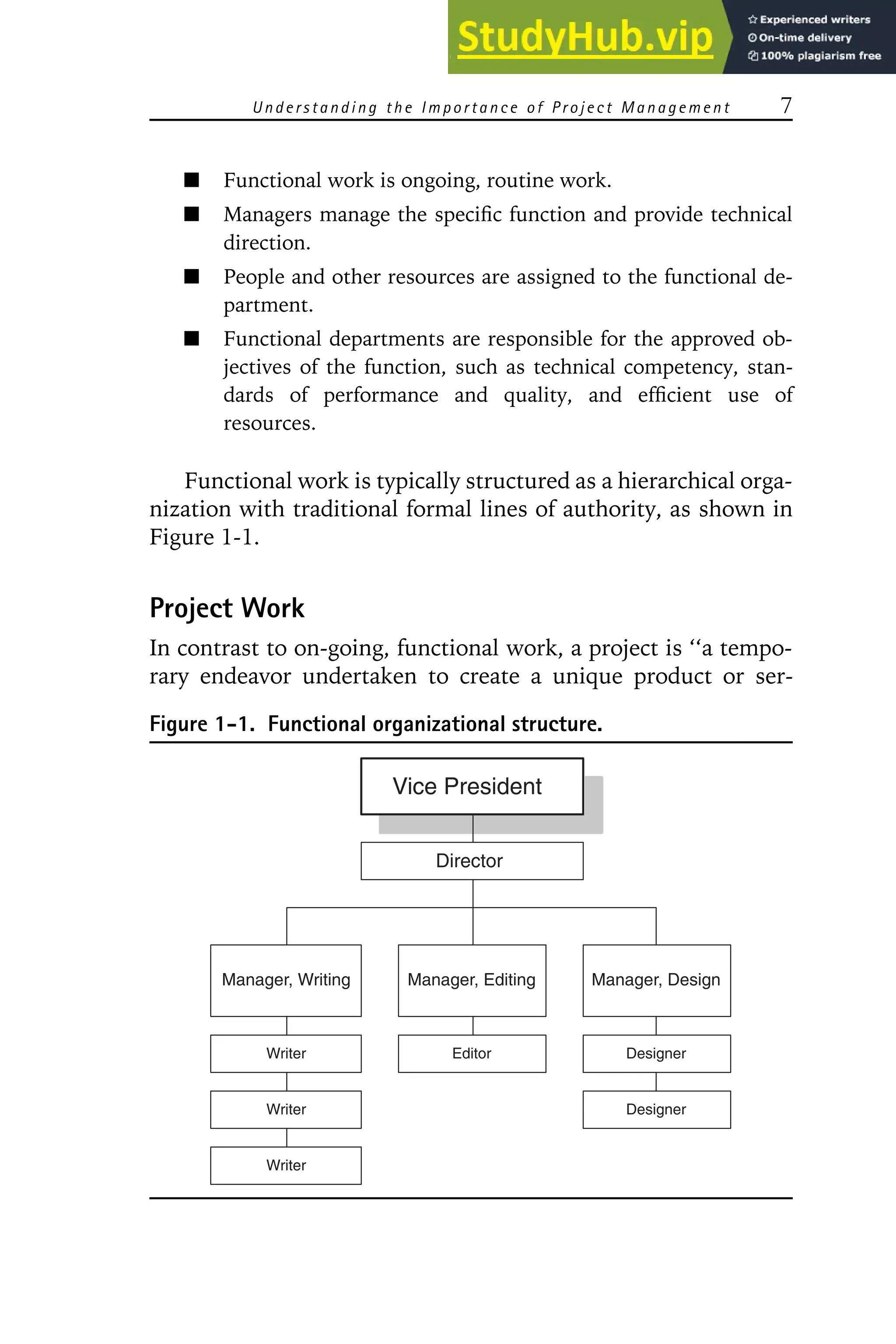
Functional work is typically structured as a hierarchical orga-
nization with traditional formal lines of authority, as shown in
Figure 1-1.
Project Work
In contrast to on-going, functional work, a project is ‘‘a tempo-
rary endeavor undertaken to create a unique product or ser-
Figure 1-1. Functional organizational structure.
Vice President
Manager, Writing Manager, Editing Manager, Design
Director
Editor
Designer
Designer
Writer
Writer
Writer
8 PREPARING FOR PROJECT MANAGEMENT SUCCESS
vice.’’2
Projects are temporary because they have a definite
beginning and a definite end. They are unique because the prod-
uct or service they create is different in some distinguishing way
from similar products or services. The construction of a head-
quarters building for ABC Industries is an example of a project.
The unique work is defined by the building plans and has a spe-
cific beginning and end. A project manager is responsible for the
project, overseeing the contractors and managing the schedule
and budget.
The following are distinguishing characteristics of project
work:
Project work is a unique, temporary endeavor.
A project manager manages a specific project.
People and other resources are not assigned to project manag-
ers on an ongoing basis, except for project management sup-
port.
A project manager is responsible for the approved objectives
of a project—such as budget, schedule, and specifications.
Project teams are typically not organized in the same hierar-
chical structure as that of typical functional groups. They are
organized in one of various ways, which will be described in
Chapter 2.
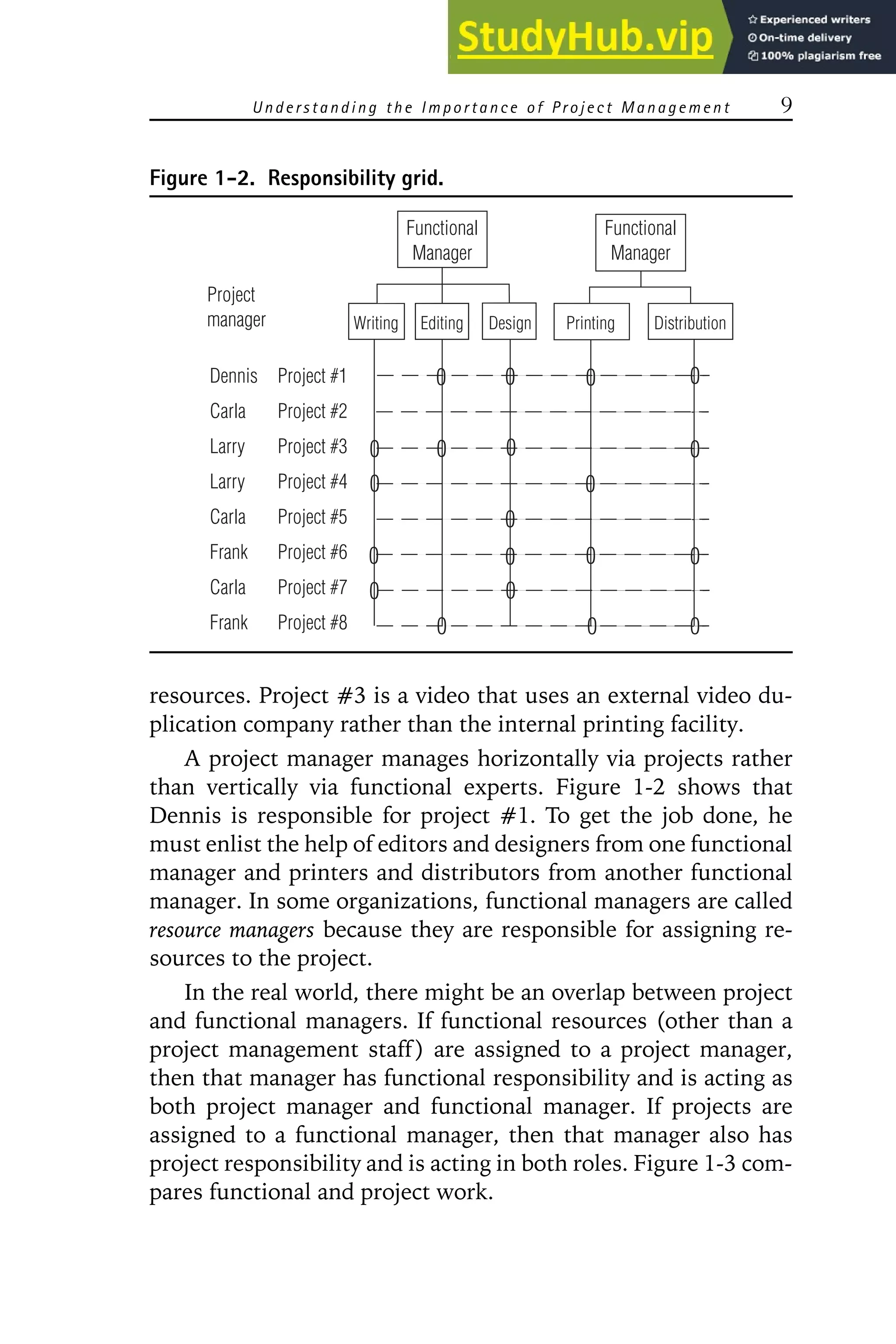
Figure 1-2 shows how functional and project responsibility
fit together, using the functional departments in a publishing
company, with project managers assigned to accomplish specific
publication projects. Solid vertical lines show the functional re-
sponsibilities of the writing, editing, design, printing, and distri-
bution departments. Broken horizontal lines show the project
responsibilities of specific project managers assigned to given
publications (projects). Since not all projects require the ser-
vices of every functional department, circles indicate where peo-
ple are assigned to a project. Project 噛2 uses outsourced
Understanding the Importance of P roject Management 9
Figure 1-2. Responsibility grid.
Project
manager
Functional
Manager
Functional
Manager
Writing Editing Design Printing Distribution
Dennis
Carla
Larry
Larry
Carla
Frank
Carla
Frank
Project #1
Project #2
Project #3
Project #4
Project #5
Project #6
Project #7
Project #8
0
0
0
0
0
0
0
0
0
0
0
0
0
0
0
0
0
0
0
0
resources. Project 噛3 is a video that uses an external video du-
plication company rather than the internal printing facility.
A project manager manages horizontally via projects rather
than vertically via functional experts. Figure 1-2 shows that
Dennis is responsible for project 噛1. To get the job done, he
must enlist the help of editors and designers from one functional
manager and printers and distributors from another functional
manager. In some organizations, functional managers are called
resource managers because they are responsible for assigning re-
sources to the project.
In the real world, there might be an overlap between project
and functional managers. If functional resources (other than a
project management staff) are assigned to a project manager,
then that manager has functional responsibility and is acting as
both project manager and functional manager. If projects are
assigned to a functional manager, then that manager also has
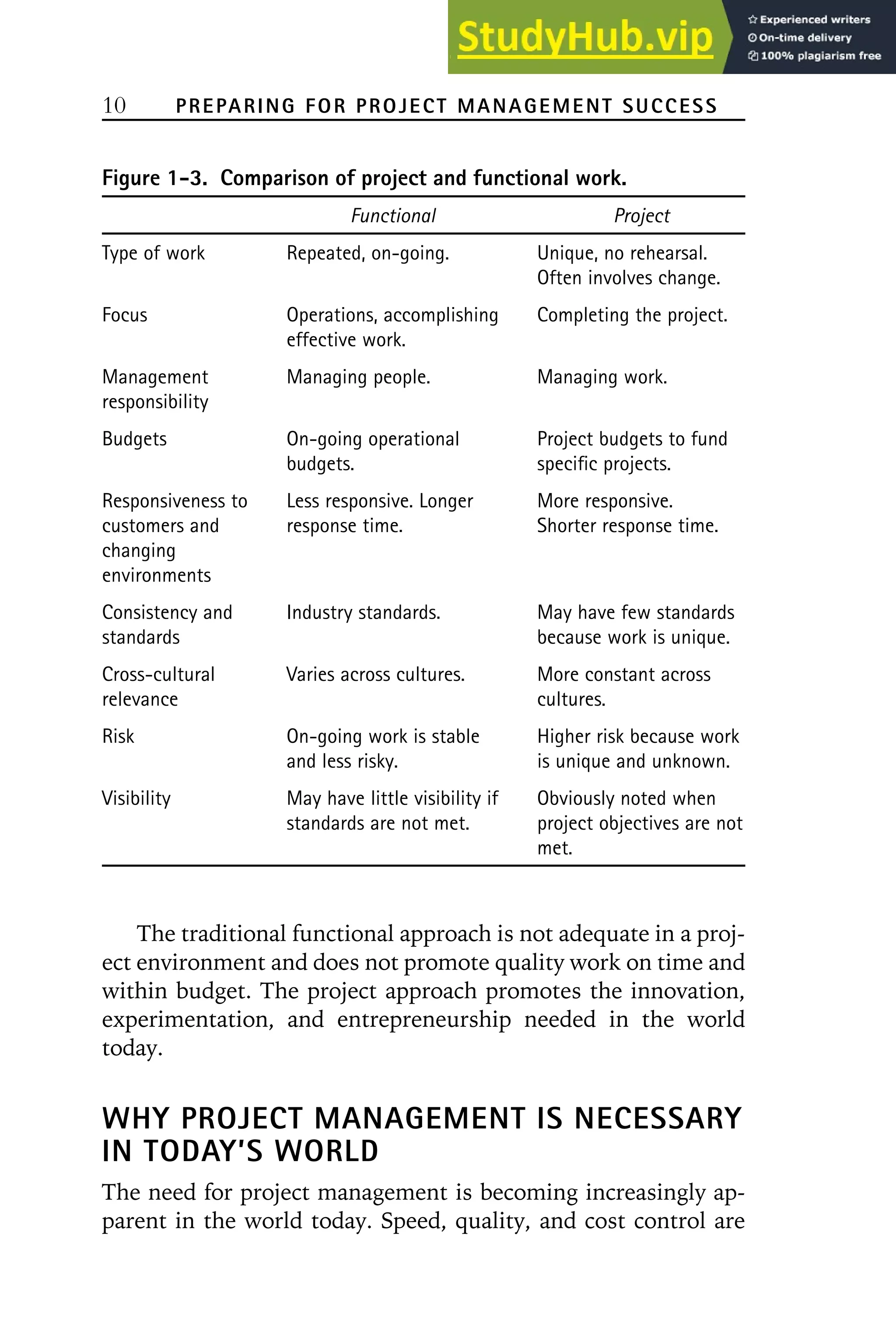
project responsibility and is acting in both roles. Figure 1-3 com-
pares functional and project work.
10 PREPARING FOR PROJECT MANAGEMENT SUCCESS
Figure 1-3. Comparison of project and functional work.
Functional Project
Type of work Repeated, on-going. Unique, no rehearsal.
Often involves change.
Focus Operations, accomplishing Completing the project.
effective work.
Management Managing people. Managing work.
responsibility
Budgets On-going operational Project budgets to fund
budgets. specific projects.
Responsiveness to Less responsive. Longer More responsive.
customers and response time. Shorter response time.
changing
environments
Consistency and Industry standards. May have few standards
standards because work is unique.
Cross-cultural Varies across cultures. More constant across
relevance cultures.
Risk On-going work is stable Higher risk because work
and less risky. is unique and unknown.
Visibility May have little visibility if Obviously noted when
standards are not met. project objectives are not
met.
The traditional functional approach is not adequate in a proj-
ect environment and does not promote quality work on time and
within budget. The project approach promotes the innovation,
experimentation, and entrepreneurship needed in the world
today.
WHY PROJECT MANAGEMENT IS NECESSARY
IN TODAY’S WORLD
The need for project management is becoming increasingly ap-
parent in the world today. Speed, quality, and cost control are
Understanding the Importance of Project Management 11
taking on increased significance in business, government, and
nonprofit sectors. Project management allows managers to plan
and manage strategic initiatives that generate new revenue in
expanding sectors of the market. Project management tools de-
crease time to market, control expenses, ensure quality prod-
ucts, and enhance profitability. Project management helps to sell
products and services by positively differentiating them from
their competitors. Project management is one of the most im-
portant management techniques for ensuring the success of an
organization.
The global marketplace and e-commerce are forcing organi-
zations to change. Consider the business trends in the next sec-
tion.
Today’s Business Trends
The focus is on high-quality, speed-to-market, and superior
customer satisfaction. This can be accomplished only across
functional lines of authority in a project environment. With
the shift from mass production to custom production of goods
and services, project management is an increasingly important
aspect of a responsive management style. Businesses are shift-
ing from traditional hierarchical management to project man-
agement. Organizational charts are changing from vertical
structures to team-centered project structures.
The traditional job of doing the same tasks every day is disap-
pearing as routine office and factory work become automated.
Middle management is also disappearing as companies rely on
computers to gather and analyze information. The new focus
is on projects and project teams assigned to solve specific
problems. Teams might be set up to design a new product or
re-engineer the ordering process. Projects are conceived,
staffed up, completed, then shut down. Project teams come
and go with problems and opportunities.
The traditional career path is changing. Companies offer less
job security as they refocus on core competencies and out-
12 PREPARING FOR PROJECT MANAGEMENT SUCCESS
source noncore work. They teach marketable skills but don’t
promise a job tomorrow. People define their careers less by
companies (‘‘I work for Microsoft’’) and more by professions
(‘‘I design computer programs’’). Personal success is mea-
sured by the value of the projects on which a person works.
The goal is growth in the profession, not movement up the
corporate ladder into management. Pay is determined by skill
level and the marketability of the person’s services rather than
by managerial hierarchy.
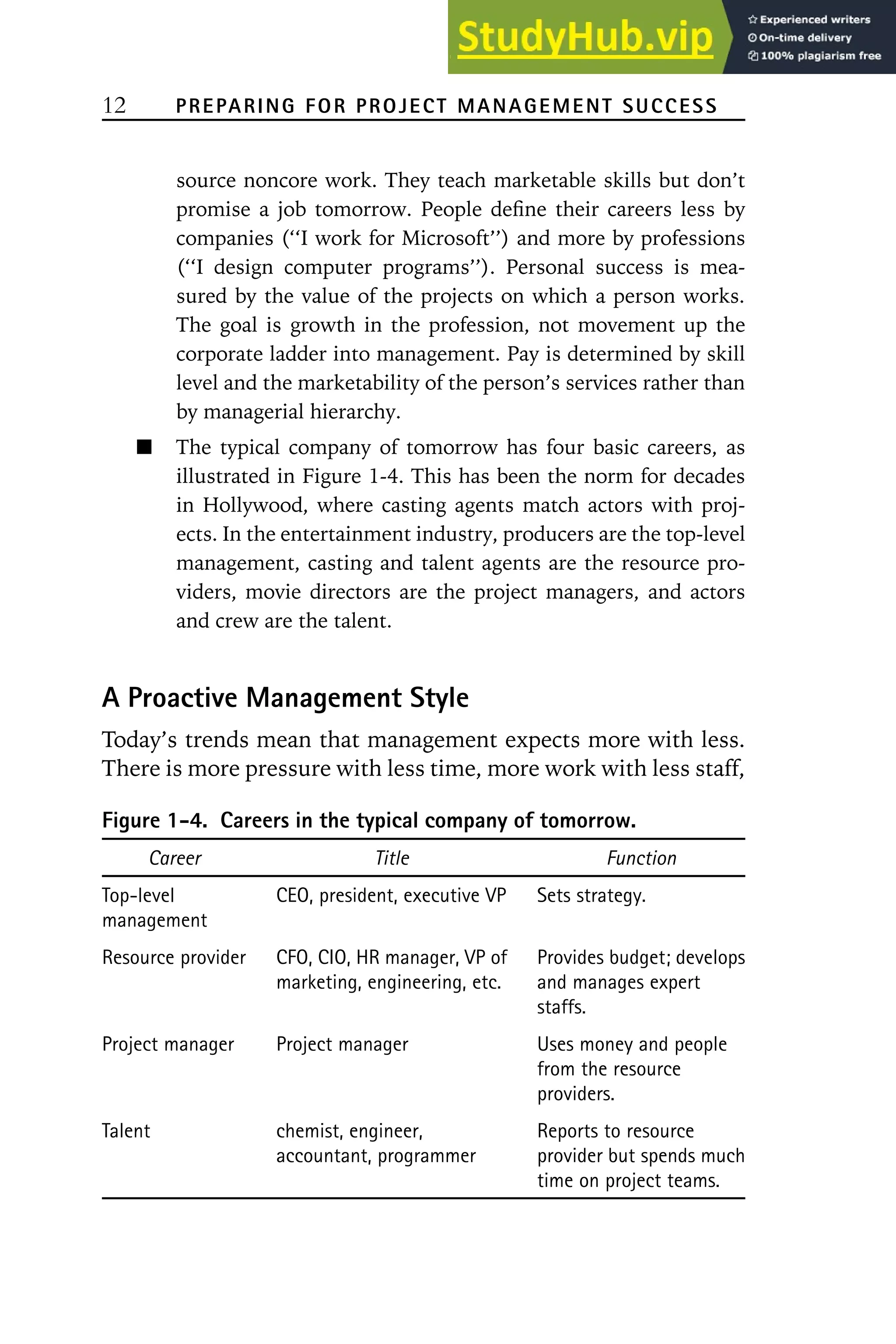
The typical company of tomorrow has four basic careers, as
illustrated in Figure 1-4. This has been the norm for decades
in Hollywood, where casting agents match actors with proj-
ects. In the entertainment industry, producers are the top-level
management, casting and talent agents are the resource pro-
viders, movie directors are the project managers, and actors
and crew are the talent.
A Proactive Management Style
Today’s trends mean that management expects more with less.
There is more pressure with less time, more work with less staff,
Figure 1-4. Careers in the typical company of tomorrow.
Career Title Function
Top-level CEO, president, executive VP Sets strategy.
management
Resource provider CFO, CIO, HR manager, VP of Provides budget; develops
marketing, engineering, etc. and manages expert
staffs.
Project manager Project manager Uses money and people
from the resource
providers.
Talent chemist, engineer, Reports to resource
accountant, programmer provider but spends much
time on project teams.
Understanding the Importance of Project Management 13
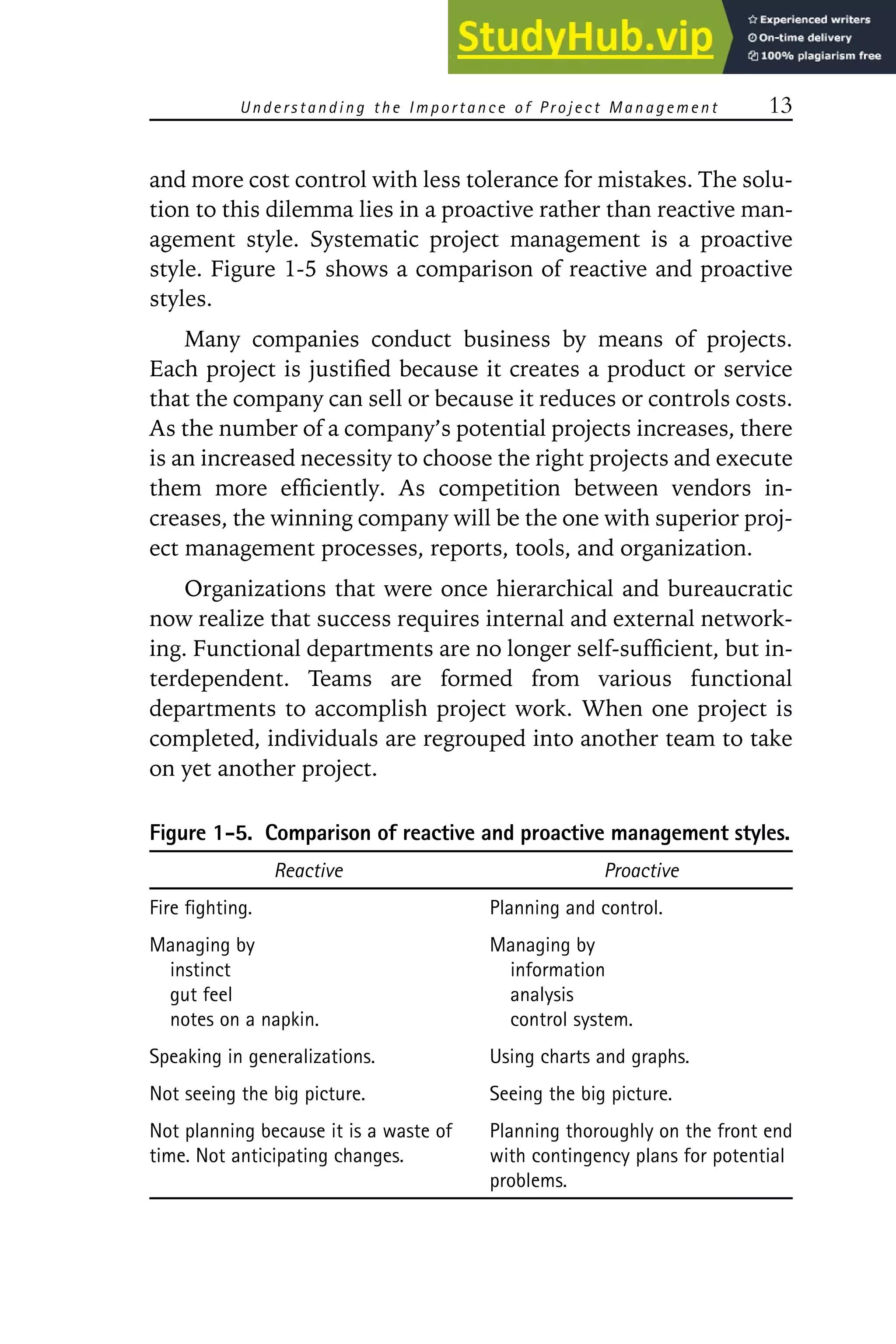
and more cost control with less tolerance for mistakes. The solu-
tion to this dilemma lies in a proactive rather than reactive man-
agement style. Systematic project management is a proactive
style. Figure 1-5 shows a comparison of reactive and proactive
styles.
Many companies conduct business by means of projects.
Each project is justified because it creates a product or service
that the company can sell or because it reduces or controls costs.
As the number of a company’s potential projects increases, there
is an increased necessity to choose the right projects and execute
them more efficiently. As competition between vendors in-
creases, the winning company will be the one with superior proj-
ect management processes, reports, tools, and organization.
Organizations that were once hierarchical and bureaucratic
now realize that success requires internal and external network-
ing. Functional departments are no longer self-sufficient, but in-
terdependent. Teams are formed from various functional
departments to accomplish project work. When one project is
completed, individuals are regrouped into another team to take
on yet another project.
Figure 1-5. Comparison of reactive and proactive management styles.
Reactive Proactive
Fire fighting. Planning and control.
Managing by Managing by
instinct information
gut feel analysis
notes on a napkin. control system.
Speaking in generalizations. Using charts and graphs.
Not seeing the big picture. Seeing the big picture.
Not planning because it is a waste of Planning thoroughly on the front end
time. Not anticipating changes. with contingency plans for potential
problems.
14 PREPARING FOR PROJECT MANAGEMENT SUCCESS
DEFINITIONS
Functional manager. A person assigned to manage a specific function
(such as accounting, manufacturing, or marketing) and to provide
technical direction. Also called a resource manager.
Project. ‘‘A temporary endeavor undertaken to create a unique
product or service.’’ A project has a definite beginning and end.3
Project management. A set of principles, methods, and techniques
used to plan and control project work effectively.
Project manager. The person who manages a specific project, who is
expected to meet the approved objectives of the project, including
project scope, budget, and schedule.
APPLICATION QUESTIONS
1. How could you benefit from using more project management
principles?
2. Does your organization understand the difference between proj-
ect and functional work? How can you help co-workers and
management implement project management philosophies?
3. Why is project management a sound strategy in today’s busi-
ness world?
APPLICATION EXERCISES
1. Draw a responsibility grid for your organization and define proj-
ect and functional responsibility.
2. List problems you currently experience in managing projects.
As you read subsequent chapters, identify ways in which you
can address these problems.
NOTES
1. Project Management Institute, A Guide to the Project Man-
agement Body of Knowledge (PMBOK䉸
Guide), 2000, p. 4.
2. Ibid.
3. Ibid.
❖❖❖
C H A P T E R
2
ORGANIZING FOR PROJECT
MANAGEMENT
EFFICIENCY
Many organizations have no formal proj-
ect management structure. When a project is conceived, man-
agement might appoint a project manager and team members
with little attention to the skills needed for the job. They take
people from their regular jobs to work on the project—or worse
yet, they ask team members to do the project in addition to their
regular work.
This chapter discusses the need for the organization to for-
mally adopt project management methodologies. It presents the
major organizational structures and discusses the advantages
and disadvantages of each. Finally, it gives some considerations
on how to organize for greater efficiency and continuity in proj-
ects.
16 PREPARING FOR PROJECT MANAGEMENT SUCCESS
ADOPTING A PROJECT MANAGEMENT
PHILOSOPHY
People throughout the organization must understand and im-
plement common project management principles. Everyone
must recognize project management as a professional discipline
with specific skills and tools.
Senior management must recognize the need for project
management and be willing to establish a formal project man-
agement system. Managing projects is considerably different
from managing functional groups. Senior executives need to rec-
ognize that project management requires special concepts,
skills, and tools. Managers schooled in traditional concepts of
business management might find this difficult to understand.
Functional line managers might have difficulty understanding
the difference between functional and project responsibilities.
Implementing a project management system requires more
than lip service; senior management must provide the time, bud-
get, and resources to do it. The entire organization must have a
long-term commitment to the project management process and
support it without constantly shifting priorities.
The role and authority of the project managers must be
clearly defined and supported. Project managers are not simply
people selected from among the project teams; they need to have
project management skills. If management simply assigns a
technical person to be the project manager, the organization
loses in two ways. First, if the person does not also have project
management skills, the project might fail. Second, the organiza-
tion loses a good technical person from the project team.
The organization also must be willing to change. Functional
departments with a strong sense of uniqueness might feel that
project managers cannot fully understand or correct their prob-
lems. Functional managers who have been unable to solve prob-
lems might work against the project manager’s success. In some
cases, people resist the project manager’s tools (such as network
Organizing for Project Management Efficiency 17
planning and computerized tracking) because they represent
change. Change is often painful and takes time.
Your project management system needs to be adapted to
your organization’s specific corporate culture and needs. No one
system works equally well in all organizations. Be willing to
adapt the system as you experience successes or failures so the
system can operate a optimum efficiency in your organization.
For project management to be effective in any organization,
there should be formal, written policies and procedures that ex-
plain the role and authority of project managers and how project
management functions in the organization. Figure 2-1 is an ex-
ample of such a written policy statement.
ORGANIZATIONAL STRUCTURES
The organizational structure strongly influences how efficiently
project management operates. It often constrains the availability
of resources or the terms under which resources are available to
the project. Organizational structures typically span the spec-
trum from functional to project, with a variety of matrix struc-
tures in between, as will be discussed below. Any of these
variations might be appropriate and effective if the advantages
and disadvantages are understood and handled properly. The
next sections cover characteristics, advantages, and disadvan-
tages of functional, project, and matrix organizational struc-
tures.
Functional
The classic functional organization is a hierarchy in which peo-
ple are grouped into functional divisions, such as marketing or
production. Each employee has one clear superior. In functional
organizations, the scope of projects is typically limited to the
boundaries of the functional division. Each division has its own
18 PREPARING FOR PROJECT MANAGEMENT SUCCESS
Figure 2-1. Example of a project management policy statement.
Project Management Division
Subject: Project Management System Policy 5
Date of Origin: 15 April 2003 Revised 16 May 2004
Policy
The company manages projects according to the project management sys-
tem outlined in this policy.
Definition of a project
A temporary endeavor undertaken to create a unique product or service.
Responsibility
The director of the Project Management Division is responsible for the oper-
ation of the project management system. The director prepares policy state-
ments and maintains the policy and procedure manual. The director tracks all
approved projects and reports project status to senior management.
Project objectives
All projects are defined in terms of (1) cost, (2) time, and (3) project scope.
These objectives are the basis for project approval, budgeting, tracking, and
reporting.
Project managers
A project manager is assigned to each project when it is approved. The
manager may be from the Project Management Division or from another func-
tional division as needed. The project manager is responsible to see that the
project accomplishes its objectives of cost, time, and project scope. The lines of
responsibility and communication with senior management will be identified as
needed with each project.
project managers who report to the head of the division, as illus-
trated in Figure 2-2. These project managers operate indepen-
dently from project managers in other divisions.
Characteristics
Project managers operate within the division and have a level
of expertise within their areas of responsibility. For example,
Organizing for Project Management Efficiency 19
Figure 2-2. Functional organizational structure.
CEO
V.P. of
Marketing
V.P. of
Production
Project Managers
Project Managers
project managers in the marketing division come from the
ranks of salespeople and have a level of knowledge or experi-
ence in sales.
Directors of the functional divisions manage both project and
functional personnel. They are responsible for defining re-
quirements, scheduling work, setting priorities, providing
facilities, acquiring and managing resources, adhering to com-
pany policies, and ensuring quality.
People are assigned to work on projects for which their skills
and services are needed. They might be moved around within
the division wherever they are needed.
Advantages
Projects can be completed more accurately. Because project
managers and team members have expertise in the functional
area, project requirements can be defined and challenged intel-
ligently. This means that fewer changes will be made during
the life of a project and that a more practical end product can
result.
20 PREPARING FOR PROJECT MANAGEMENT SUCCESS
Project personnel are accountable for their work and must ac-
cept success or failure. Since they must live with the end result
of the project, they are committed to it.
Because personnel have functional expertise, learning time is
reduced and projects can be completed quickly. Problem situa-
tions can be identified and corrected quickly.
Disadvantages
The focus on the needs of the functional division might make
it difficult to see and respond to the needs of the organization
as a whole. Enterprise policies and practices might not be en-
forced uniformly across divisions.
Project control and status reporting to upper management is
not standardized across the organization. It might be difficult
for senior executives to manage the various projects within the
organization.
Project costs tend to have little or no accounting. Many aspects
of a project are handled as ongoing functional work of the divi-
sion, so it might be difficult to identify and account for the true
cost of a project.
The distinction between project and functional roles might be
vague and projects might be lost in routine work.
Project
In a project organization, projects are centralized in a separate
division of skilled project managers that serves the project man-
agement needs of all divisions of the company (See Figure 2-3).
This is often referred to as a project office and is becoming increas-
ingly popular in organizations.
Characteristics
A central group is responsible for planning, controlling, man-
aging, and reporting the progress of all projects in the organi-
zation.
Organizing for Project Management Efficiency 21
Figure 2-3. Project organizational structure.
CEO
V.P. of
Finance
V.P. of
Sales
V.P. of
Projects
Project managers have a great deal of independence and au-
thority.
Team members can be colocated.
Advantages
A formal project management system is adopted and applied
uniformly throughout the organization. This common under-
standing and application of project management practices typi-
cally creates high efficiency in the organization. Projects are
more often completed on time, within budget, and in accor-
dance with project scope.
Common standards of planning, controlling, and reporting
exist throughout the life of each project and are applied across
all projects. These common standards aid communication and
provide efficiency.
Highly-skilled project managers can be available for the benefit
of all. Costs can be reduced by using common tools (such as
project management software) to manage all projects.
Centralized data from all projects can be analyzed and applied
to future projects to improve the accuracy of estimates and
practices. A centralized organizational structure makes it eas-
22 PREPARING FOR PROJECT MANAGEMENT SUCCESS
ier to see productivity trends and take steps to improve pro-
cesses in the organization.
All projects of the organization can be managed as a whole.
Enterprise portfolio management allows senior management
to set priorities across projects and allocate resources for the
overall good of the organization.
Disadvantages
Standards and documentation can become excessive, and
without careful vigilance, this centralization of project manag-
ers and practices can become self-serving. Rather than serving
the needs of the project office, careful focus must be given to
the needs of the project and the people it benefits.
If processes become excessive, the total cost to manage a proj-
ect under a centralized organizational structure can be higher
than under other structures. The project office must constantly
assess the value they provide to ensure that the value exceeds
cost.
Qualified technical leaders might be scarce. Project managers
might not have the technical background needed for a project,
and might have little access to people with the appropriate
knowledge and skills.
Project managers might seem unresponsive to the needs of
people who request their time and skills. Because project man-
agers are located in a separate project office, they might be-
come out of touch with the needs and practices of individual
departments.
Matrix
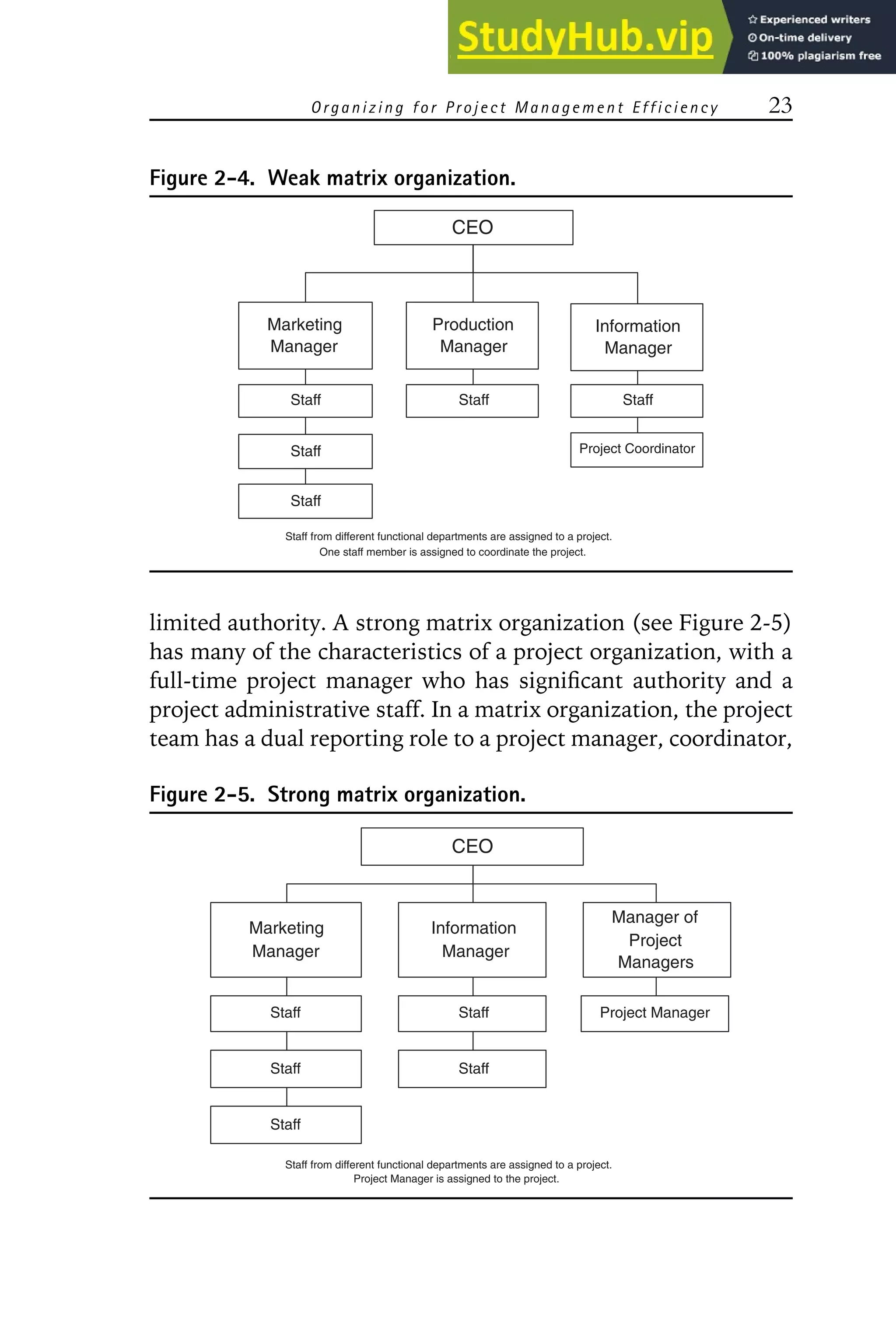
Matrix organizations are a blend of functional and project orga-
nizations. A weak matrix organization (see Figure 2-4) has many
of the characteristics of a functional organization, and the proj-
ect manager role is more that of a coordinator or expediter with
Organizing for Project Management Efficiency 23
Figure 2-4. Weak matrix organization.
Information
Manager
Project Coordinator
Marketing
Manager
Production
Manager
CEO
Staff Staff
Staff
Staff
Staff
Staff from different functional departments are assigned to a project.
One staff member is assigned to coordinate the project.
limited authority. A strong matrix organization (see Figure 2-5)
has many of the characteristics of a project organization, with a
full-time project manager who has significant authority and a
project administrative staff. In a matrix organization, the project
team has a dual reporting role to a project manager, coordinator,
Figure 2-5. Strong matrix organization.
Marketing
Manager
Information
Manager
Manager of
Project
Managers
CEO
Staff Project Manager
Staff
Staff
Staff
Staff from different functional departments are assigned to a project.
Project Manager is assigned to the project.
Staff
24 PREPARING FOR PROJECT MANAGEMENT SUCCESS
or expediter (who provides project management skills) and a
functional manager (who provides technical and functional
skills).
Characteristics
Because a matrix organization has characteristics of both the
project and functional organizations, project personnel report
both to functional and project lines.
Project personnel report to a functional manager for definition
of requirements, feasibility and economic evaluation, changes
in priorities, allocation of work, and ultimate success or failure
in meeting their goals.
Project personnel report to a project manager for refining tasks
and assignments, planning and budgets, and project schedules.
In a strong matrix organizational structure, the project manager
has more power than the functional manager. In a weak matrix
structure, the balance of power leans toward the functional man-
ager.
Advantages
A matrix structure capitalizes on the advantages of both a proj-
ect structure (project office) and a functional structure. Per-
sonnel and skills are less redundant, and when expertise is
scarce, it can be applied more flexibly and efficiently to differ-
ent projects.
The focus on teamwork easily accommodates changes in per-
sonnel requirements. Conflicts between project requirements
and functional organization policies are perceived and resolved
more readily.
The expertise of both project and functional management is
available to assist in the project, and both can be applied to
handle complex issues and coordinate various tasks.
Organizing for Project Management Efficiency 25
This can often result in completing the project in less time and
at lower cost.
Disadvantages
Dual management lines make communications more difficult
to manage. When team members receive conflicting instruc-
tions from project and functional managers, time and effort
are wasted clarifying the communication. The team might be
unable to react fast enough to meet changing project require-
ments.
Conflicts and competition can exist between project and func-
tional management. In the process of resolving conflicting
priorities, project personnel can become confused and demor-
alized.
If conflicting priorities and personal power struggles are not
quickly resolved, it can be damaging—or fatal—to the project.
Projects are influenced by the organizational structure under
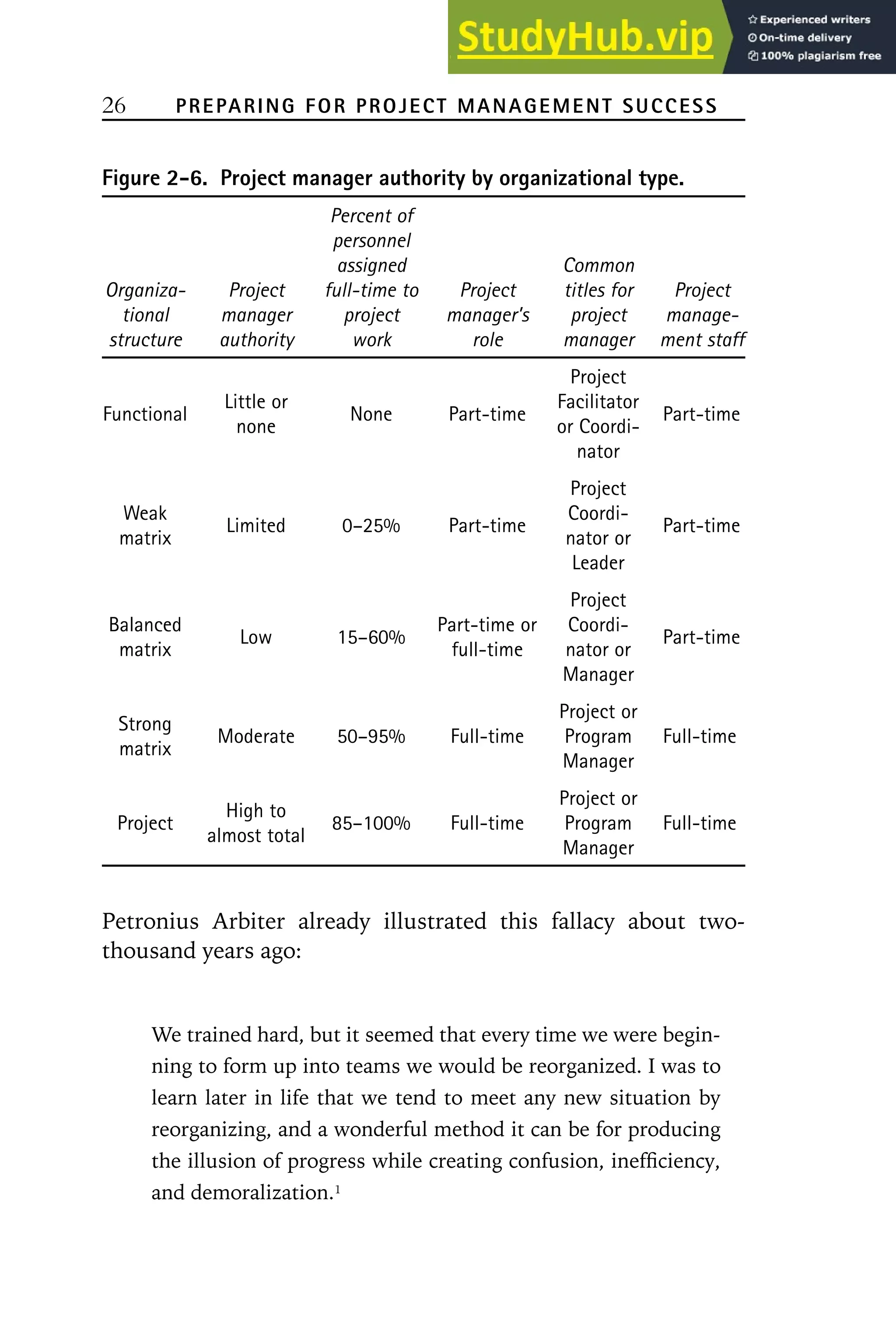
which they operate. The chart in Figure 2-6 shows the project
manager authority in each of the organizational types.
FUNCTIONING EFFECTIVELY
Now that you understand the basic organizational structures,
compare them with your organization and identify your current
structure. Reread the advantages and disadvantages of your or-
ganizational structure and keep them in mind as you operate
within that structure.
When faced with difficulties, many project managers jump
to the conclusion that restructuring the organization will solve
all the problems. Although it is important to have the right orga-
nizational structure, it is unhealthy to reorganize too often.
26 PREPARING FOR PROJECT MANAGEMENT SUCCESS
Figure 2-6. Project manager authority by organizational type.
Percent of
personnel
assigned Common
Organiza- Project full-time to Project titles for Project
tional manager project manager’s project manage-
structure authority work role manager ment staff
Project
Little or Facilitator
Functional None Part-time Part-time
none or Coordi-
nator
Project
Weak Coordi-
Limited 0–25% Part-time Part-time
matrix nator or
Leader
Project
Balanced Part-time or Coordi-
Low 15–60% Part-time
matrix full-time nator or
Manager
Project or
Strong
Moderate 50–95% Full-time Program Full-time
matrix
Manager
Project or
High to
Project 85–100% Full-time Program Full-time
almost total
Manager
Petronius Arbiter already illustrated this fallacy about two-
thousand years ago:
We trained hard, but it seemed that every time we were begin-
ning to form up into teams we would be reorganized. I was to
learn later in life that we tend to meet any new situation by
reorganizing, and a wonderful method it can be for producing
the illusion of progress while creating confusion, inefficiency,
and demoralization.1
Organizing for Project Management Efficiency 27
As you have seen, each possible organizational structure has
both advantages and disadvantages. Before you reorganize, be
sure that the advantages outweigh the disadvantages to your or-
ganization. The advantages must also be significant enough to
make up for the confusion and pain of making the change. Reor-
ganizing has a significant impact on any organization. Don’t un-
derestimate the lost productivity during the time it takes to
make the change. It will take time for people to begin to function
efficiently under the new structure.
DEFINITIONS
Enterprise portfolio management. Managing all projects of the organi-
zation as a whole by setting priorities and allocating resources
across projects.
Functional organization. A hierarchical organizational structure in
which each functional division has its own project managers who
operate independently from project managers in other divisions.
Matrix organizational structure. An organizational structure that is a
blend of functional and project structures. The project team reports
both to a project manager (who provides project management
skills) and a functional manager (who provides specific job-related
skills).
Project organization. An organizational structure in which an auton-
omous division of project managers is responsible for planning,
controlling, managing, and reporting the progress of all projects in
the organization.
APPLICATION EXERCISES
1. Determine which of the basic organizational types describes
your current organization. Draw a chart of your current organi-
zational structure, using solid lines to show formal reporting
relationships and broken lines to show lines of communication.
28 PREPARING FOR PROJECT MANAGEMENT SUCCESS
2. Review the characteristics, advantages, and disadvantages listed
in this chapter for your organizational type. List the things you
need to do to work effectively within this structure.
APPLICATION QUESTIONS
1. Is your current organizational structure the most appropriate,
given the culture and current needs of your organization? Why
or why not?
2. What other organizational type might be appropriate for your
organization? Considering the relative advantages and disad-
vantages of the current and alternative structures, what addi-
tional value would the alternative structure provide?
3. What is the current level of implementation of project manage-
ment in your organization?
4. What can you do to better implement project management?
NOTE
1. Quoted in Robert Townsend, Up the Organization (New
York: Alfred A. Knopf, 1970), p. 162. Robert Townsend lists the
date as ‘‘circa AD 60.’’
❖❖❖
C H A P T E R
3
DEFINING THE ROLES OF
THE PROJECT
MANAGER AND
THE TEAM
The role of the project
manager can be a tricky one, especially
when the project manager has no formal
authority over the people he or she must
work with to get the job done. This chap-
ter defines the roles of the project manager and the project team
members. It defines the skills of a project manager and discusses
the balance needed in responsibility, accountability, and au-
thority.
THE ROLE OF THE PROJECT MANAGER
The project manager is the person assigned to manage a specific
project and is expected to meet the approved objectives of a proj-
30 PREPARING FOR PROJECT MANAGEMENT SUCCESS
ect, including project scope, budget, and schedule. The project
manager leads the project and provides vision, direction, and
encouragement. The project manager’s job is to ensure that the
project is realistic, necessary, and well defined. The project man-
ager takes the lead in project planning to determine the sched-
ules, resource plans, and budgets necessary to accomplish the
project objectives. Once the project plan has been approved by
top management, the project manager carries out the plan. This
includes carefully monitoring and reporting on progress, resolv-
ing problems as they arise, controlling any changes in the project
plan, and managing risk. When all project objectives have been
met, the project manager declares the project completed.
The project manager has overall responsibility for planning,
organizing, integrating, controlling, leading, decision-making,
communicating, and building a supportive climate for the
project.
Except for a project management support team, people and
other resources are not typically assigned directly to project
managers. In a large project, the project manager might have a
staff of clerks, accountants, and other people to help with the
numerous responsibilities involved in managing the project. In
a small project, there might be no support team.
PROJECT MANAGER SKILLS
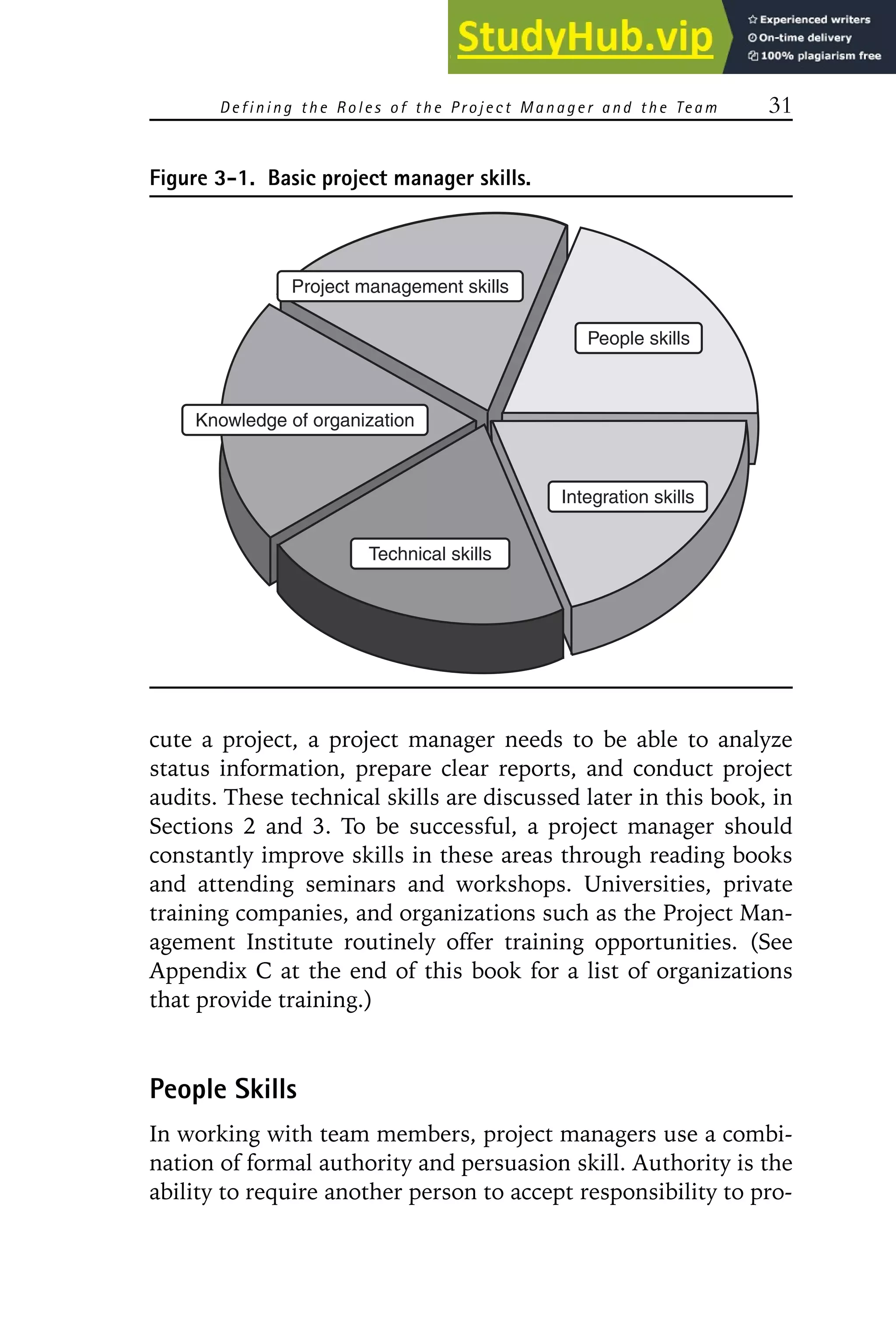
Figure 3-1 shows the basic skills a project manager needs. A
project manager needs to be strong in all five areas to be suc-
cessful.
Project Management Skills
Project management skills include the tools of the trade to plan
and execute a project, such as being able to estimate costs and
prepare workable schedules and adequate budget plans. To exe-
Defining the R oles of the P roject Manager and the Team 31
Figure 3-1. Basic project manager skills.
Project management skills
Knowledge of organization
People skills
Integration skills
Technical skills
cute a project, a project manager needs to be able to analyze
status information, prepare clear reports, and conduct project
audits. These technical skills are discussed later in this book, in
Sections 2 and 3. To be successful, a project manager should
constantly improve skills in these areas through reading books
and attending seminars and workshops. Universities, private
training companies, and organizations such as the Project Man-
agement Institute routinely offer training opportunities. (See
Appendix C at the end of this book for a list of organizations
that provide training.)
People Skills
In working with team members, project managers use a combi-
nation of formal authority and persuasion skill. Authority is the
ability to require another person to accept responsibility to pro-
32 PREPARING FOR PROJECT MANAGEMENT SUCCESS
duce a desired result. Persuasion is the ability to convince an-
other person to accept such responsibility. The stronger a
project manager’s people skills, the greater the chance of suc-
cessfully leading the project team. The project manager needs to
be a master at communication and have the skills to manage
conflict and change. (See Chapters 24, 25, and 29 for a discus-
sion of these skills.)
Integration Skills
One of the project manager’s primary duties is to be sure that
the many elements of the project are properly coordinated. In
particular, the various phases of project work such as planning,
execution, reporting, and control must be integrated. The more
complex the product, the more integration is needed. For exam-
ple, the project manager might have to integrate electrical draw-
ings from the engineering staff with functional specifications
from the civil engineers. Engineers and designers should be in-
volved not only in the design process, but also in the approval of
the final design and specifications. Other players that likely need
to be involved in the approval and acceptance phases include
accounting and executive management to sign off on the project.
Project integration management also involves making trade-
offs among competing options to accomplish the project objec-
tives.
Technical Skills
Since project managers do not do the actual work of the project,
they do not need the same technical skill level as the people
performing the work. However, the more expertise the project
manager has in the technical area of the project, the greater his
effectiveness in managing the project. As the project manager
Defining the R oles of the P roject Manager and the Team 33
integrates all aspects of the project, technical expertise is essen-
tial to identify potential problems.
However, as the project manager gains technical experience,
she must also be careful to maintain a broad perspective and not
let technical expertise lead to micro-managing—or worse yet,
doing—the project work! She must concentrate on managing the
project, allowing team members to perform the technical work
and confining her technical involvement to evaluating the work
of the team.
Knowledge of the Organization
The most proficient project management skills in the world will
not compensate for a procedural blunder caused by not under-
standing the company culture, policies, personalities, or politics.
The project manager negotiates with many people and needs to
know their personalities, needs, and desires. The more he knows
about the organization, the better equipped that manager is to
maneuver around pitfalls and get what is needed for the project.
Every organization has a unique culture and individual divisions
within an organization often have their own personalities. Un-
derstanding these cultures and personalities can help a project
manager be more successful.
THE MAKEUP OF A PROJECT MANAGER
Project management is a combination of many ingredients.
Among these are large measures of common sense, ambition,
flexibility, resourcefulness, and a healthy appetite for negotia-
tion, and a genuine belief that the service performed is of value
to the organization.
An effective project manager involves many people in the
planning process and asks many questions: ‘‘What could go
wrong?’’ ‘‘What if this happens?’’ The project manager antici-
34 PREPARING FOR PROJECT MANAGEMENT SUCCESS
pates problems and disagreements and builds agreements out of
these conflicts. She takes every opportunity to build commit-
ment from the various members of the project team, and she
keeps appropriate people informed and involved throughout the
process, soliciting input and suggestions.
No matter how well a project manager plans and executes a
project, there will always be problems. The creative challenge is
to be able to use imagination and experience to solve the prob-
lems in creative ways. The problems that arise are seldom
unique. Successful project managers solve problems by applying
their cumulative knowledge and experience to each obstacle.
Over time, their realm of experience likely offers a precedent to
almost any problem. Lessons learned in dealing with one project
can, if applied imaginatively, go a long way toward solving simi-
lar problems in other projects.
However, experience alone is not enough to make an individ-
ual a successful project manager. Experience without the imagi-
nation to use it constructively and creatively is more likely to be
a handicap than an advantage. For some people, years of experi-
ence serve as a straitjacket. They are blinded by their past experi-
ence and can only repeat what they first learned. They can’t
imagine new ways of addressing problems. Instead of adapting
what they know to new situations, they try to make all new situ-
ations conform to patterns with which they are familiar.
The successful project manager is both a specialist and a gen-
eralist. As a generalist, the manager has broad technical knowl-
edge of the diverse factors that affect a project, including aspects
of the organization’s operation and the related industry. As a
specialist, the manager has a depth of technical knowledge about
the project at hand. He succeeds because of a drive to under-
stand the requirements, operations, and problems of clients, the
project team, and the industry in general.
A good example of the importance of gaining both specific
and general knowledge is found in the book How to Be a Successful
Defining the R oles of the P roject Manager and the Team 35
Executive,1
where J. Paul Getty tells of a company that was em-
barking on an extensive plant modernization and expansion
program. Just before the company placed an order for very ex-
pensive production machinery, one of the company’s junior ex-
ecutives learned of an obscure company that had developed
vastly improved machinery. The company was saved from mak-
ing a huge investment in machinery that would have soon been
obsolete, and instead obtained the latest equipment well ahead
of its competitors.
This is a good example of an individual’s alertness and enter-
prise, but it is not the full story. The junior executive was not a
technical expert or engineer. His duties were concerned with
sales, not production. After a meeting at which the plant mod-
ernization program was discussed, he took the initiative to re-
search information about the new machinery in an obscure trade
journal. His keen interest helped the company succeed.
A project manager who shows this type of initiative and un-
derstanding can have positive impact on the cost, quality, and
timeliness of projects.
PROJECT MANAGER RELATIONSHIPS AND
TOOLS
The skills you use as a project manager vary depending on your
relationship with others. You might be more effective as a
leader, negotiator, salesperson, or broker of information and ser-
vices, depending on whom you are dealing with and the nature
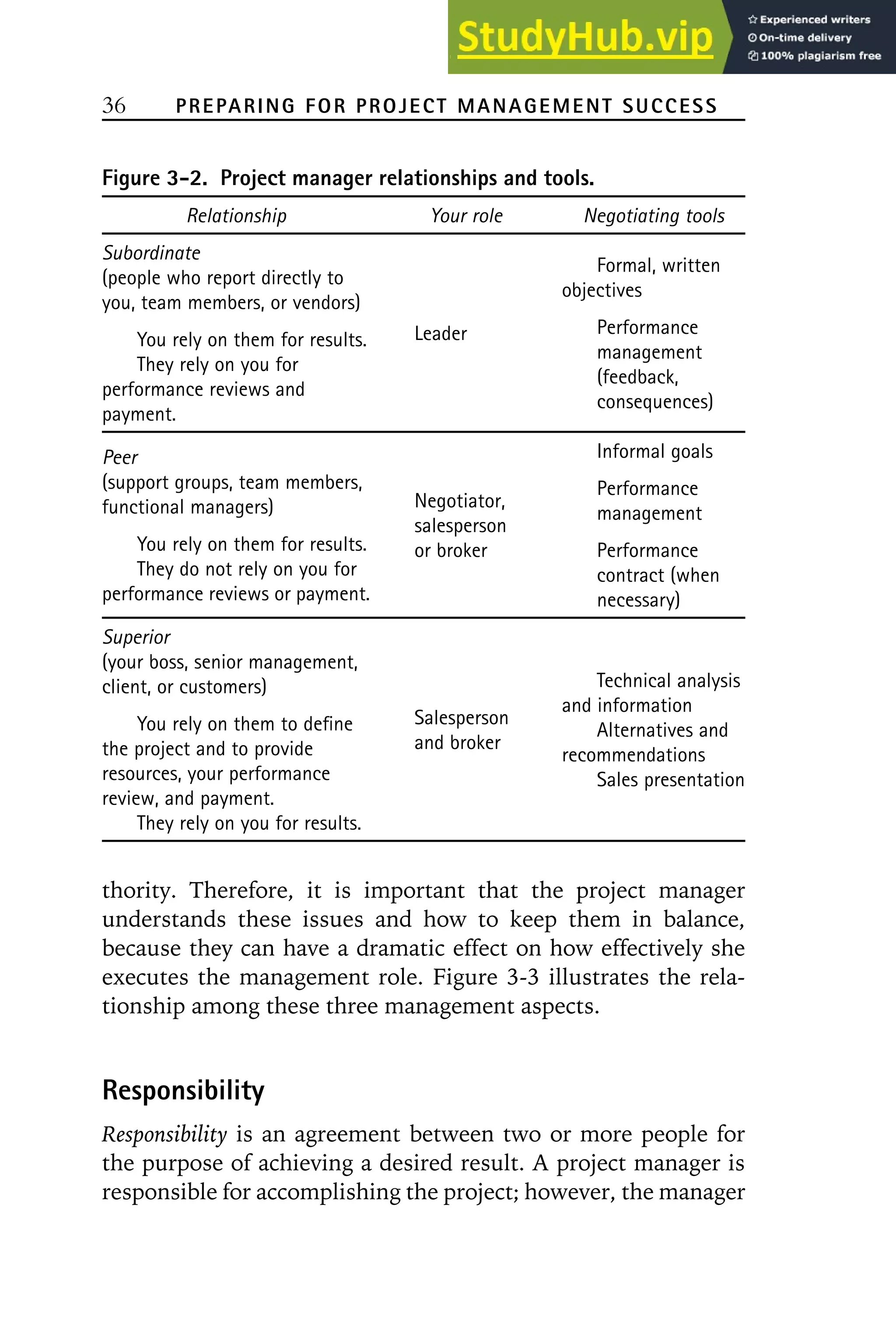
of your relationship with them, as illustrated in Figure 3-2.
RESPONSIBILITY, ACCOUNTABILITY, AND
AUTHORITY
A common cause of problems in managing projects is a break-
down in the balance of responsibility, accountability, and au-
36 PREPARING FOR PROJECT MANAGEMENT SUCCESS
Figure 3-2. Project manager relationships and tools.
Relationship Your role Negotiating tools
Subordinate
Formal, written
(people who report directly to
objectives
you, team members, or vendors)
Performance
Leader
You rely on them for results.
management
They rely on you for
(feedback,
performance reviews and
consequences)
payment.
Informal goals
Peer
(support groups, team members, Performance
Negotiator,
functional managers) management
salesperson
You rely on them for results. or broker Performance
They do not rely on you for contract (when
performance reviews or payment. necessary)
Superior
(your boss, senior management,
Technical analysis
client, or customers)
and information
Salesperson
You rely on them to define Alternatives and
and broker
the project and to provide recommendations
resources, your performance Sales presentation
review, and payment.
They rely on you for results.
thority. Therefore, it is important that the project manager
understands these issues and how to keep them in balance,
because they can have a dramatic effect on how effectively she
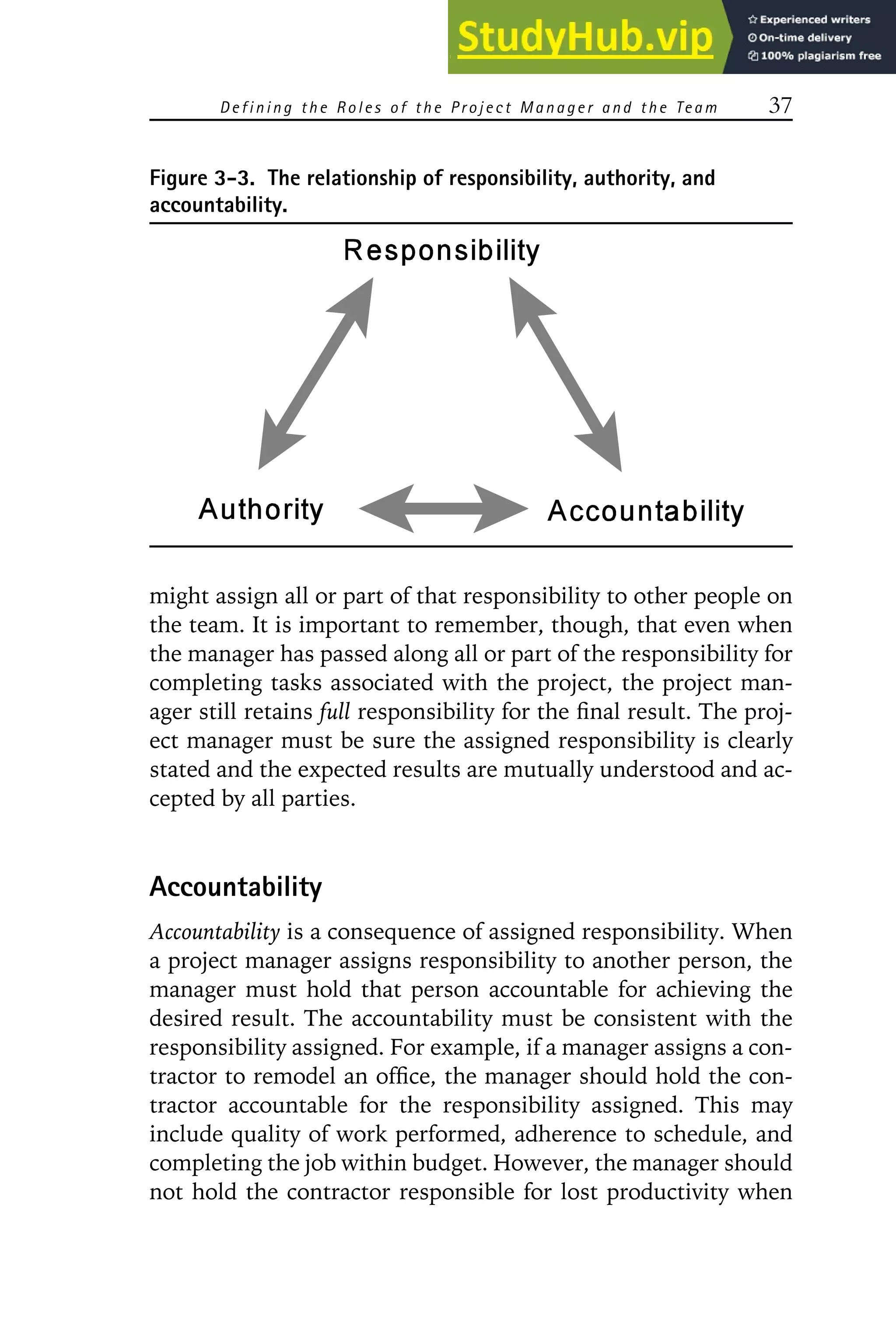
executes the management role. Figure 3-3 illustrates the rela-
tionship among these three management aspects.
Responsibility
Responsibility is an agreement between two or more people for
the purpose of achieving a desired result. A project manager is
responsible for accomplishing the project; however, the manager
Defining the R oles of the P roject Manager and the Team 37
Figure 3-3. The relationship of responsibility, authority, and
accountability.
might assign all or part of that responsibility to other people on
the team. It is important to remember, though, that even when
the manager has passed along all or part of the responsibility for
completing tasks associated with the project, the project man-
ager still retains full responsibility for the final result. The proj-
ect manager must be sure the assigned responsibility is clearly
stated and the expected results are mutually understood and ac-
cepted by all parties.
Accountability
Accountability is a consequence of assigned responsibility. When
a project manager assigns responsibility to another person, the
manager must hold that person accountable for achieving the
desired result. The accountability must be consistent with the
responsibility assigned. For example, if a manager assigns a con-
tractor to remodel an office, the manager should hold the con-
tractor accountable for the responsibility assigned. This may
include quality of work performed, adherence to schedule, and
completing the job within budget. However, the manager should
not hold the contractor responsible for lost productivity when
38 PREPARING FOR PROJECT MANAGEMENT SUCCESS
workers moved to a temporary office before the remodeling
began, because this was out of the control of the contractor and
not part of the responsibility of the remodeling job. Although
such inconsistent accountability is clearly unreasonable, it often
happens.
Accountability is a major source of information and motiva-
tion. A reliable system of accountability makes good perfor-
mance visible and provides a basis for accurate performance
appraisals. It shows team members that good performance mat-
ters and is rewarded. When a project manager holds team mem-
bers accountable, it helps to identify and focus on the sources of
problems. Accountability helps decrease poor performance and
increase good performance.
Authority
Authority is the power given to a person to complete the assigned
responsibility. It includes the appropriate access to resources to
complete the job, such as access to personnel or signature au-
thority for the expenditure of funds. Authority must be com-
mensurate with the responsibility assigned and appropriate to
the accountability. To continue with our previous example of the
office remodeling job, the manager should give the contractor
the appropriate authority to complete the work. This may in-
clude a budget and access to the building commensurate with
the size and scope of the remodeling job. A budget of $25,000
for a job estimated at $50,000 would not grant the contractor
the authority, or power, to complete the job. If the schedule re-
quires overtime and night work, the manager needs to grant
workers 24-hour access to the building. If he does not, he should
not hold the contractor accountable if the job runs over
schedule.
If a person has little experience or skill in a particular area,
the project manager might need to give authority in increments
and do more checking up at the beginning. Then, as skill level
Defining the R oles of the P roject Manager and the Team 39
and experience increase, the manager can grant more authority
and check up less often, until full authority is warranted.
Maintaining the Balance
Project managers must maintain good balance in assigning re-
sponsibility, delegating authority, and holding people account-
able. The authority must be appropriate for the responsibility
and the accountability must be commensurate with the author-
ity and the responsibility.
Successful organizations have written policies and proce-
dures that define how responsibility, accountability, and author-
ity work in the project management environment. It is important
to define in writing the specific responsibilities and authority
the project manager will have in terms of personnel, equipment,
materials, and funds. Will the project manager have authority to
hire and terminate team members or will the functional manag-
ers handle these responsibilities? What purchase authority will
the project manager have over equipment and materials neces-
sary to the project? What signature authority will the project
manager have over other project expenditures?
ROLE OF TEAM MEMBERS
Team members are the people who work with the project man-
ager directly or indirectly to accomplish project goals and com-
plete project activities. Team members can have various roles in
the project, such as engineers, technicians, construction work-
ers, and others needed to perform the project work. Each project
is unique, and so are the roles of the people performing the
work.
In each project, it is important to identify all the players and
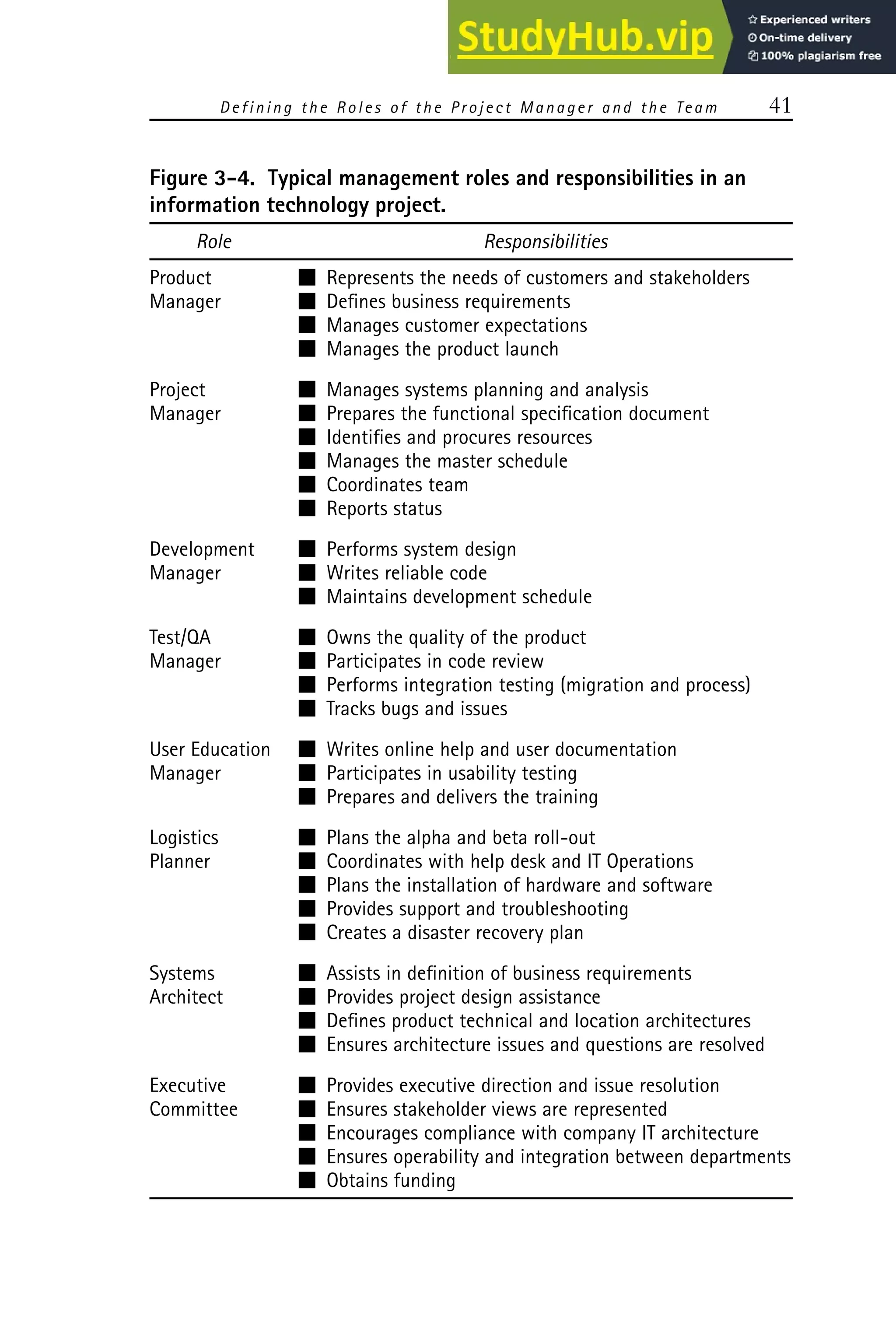
define their roles and responsibilities. An information technol-
ogy project, for example, might include the roles shown in Fig-
40 PREPARING FOR PROJECT MANAGEMENT SUCCESS
ure 3-4. It only takes a short while and pays great dividends
throughout the life of the project as individual understands their
roles and how to interface with other team members. When it
does not happen, communications are often confused or misdi-
rected and conflicts and power struggles arise.
DEFINITIONS
Integration management. The processes required to ensure that the
various elements of the project are properly coordinated.
Project manager. The person assigned to manage a specific project,
who is expected to meet the approved objectives of the project,
including project scope, budget, and schedule.
Team members. The people who work with the project manager di-
rectly or indirectly to accomplish project goals and complete proj-
ect activities.
APPLICATION EXERCISE
1. List five factors that inhibit your success in managing projects.
Prioritize them in order of their importance to you (with num-
ber 1 being the most important).
2. Rank each factor on your ability to change it (with number 1
being the most open to change). Plot the factors on the grid in
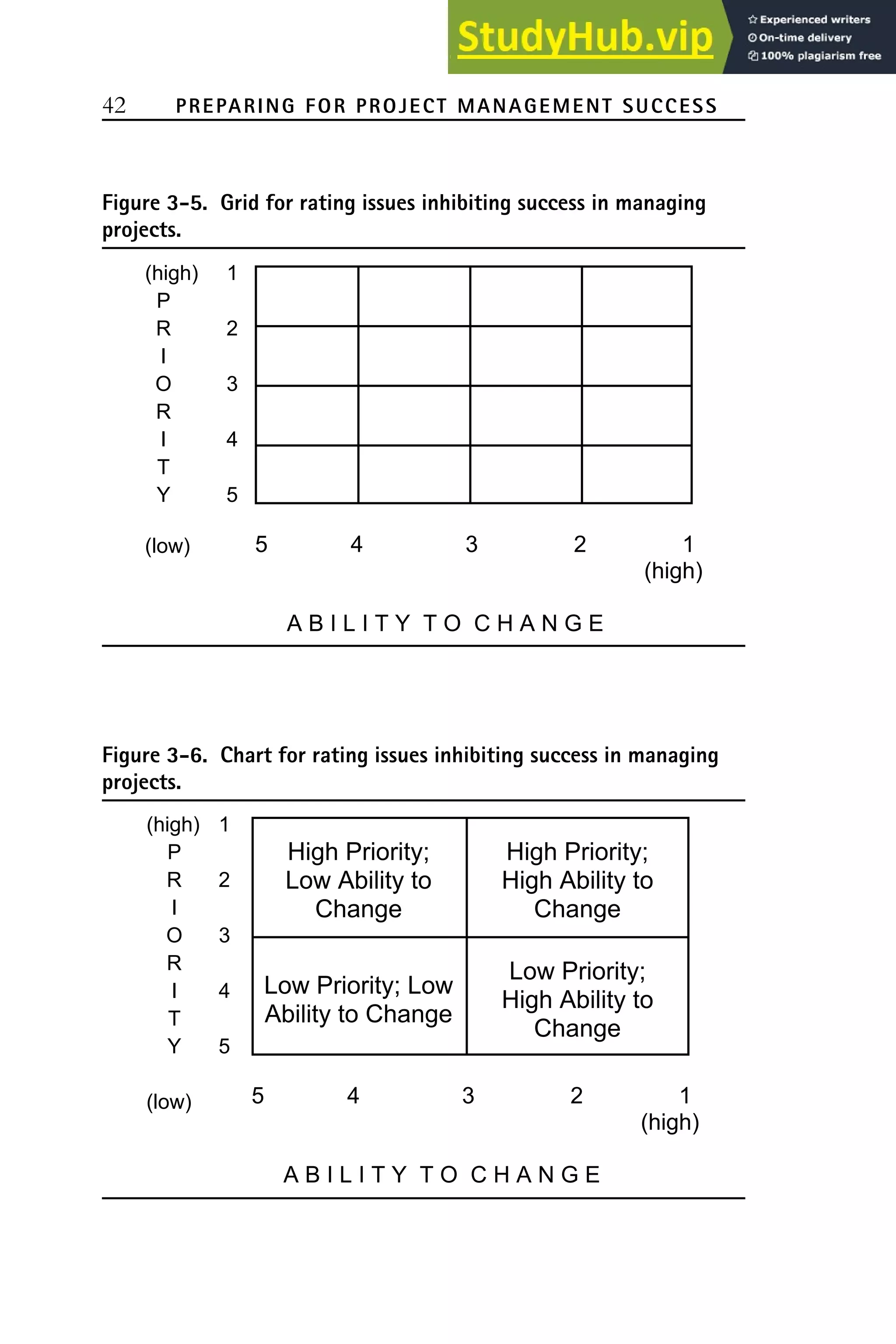
Figure 3-5. Locate the Priority ranking along the left side and
the Ability to Change across the bottom. Place the letter of the
factor (A–E) in the grid where the two coordinates meet.
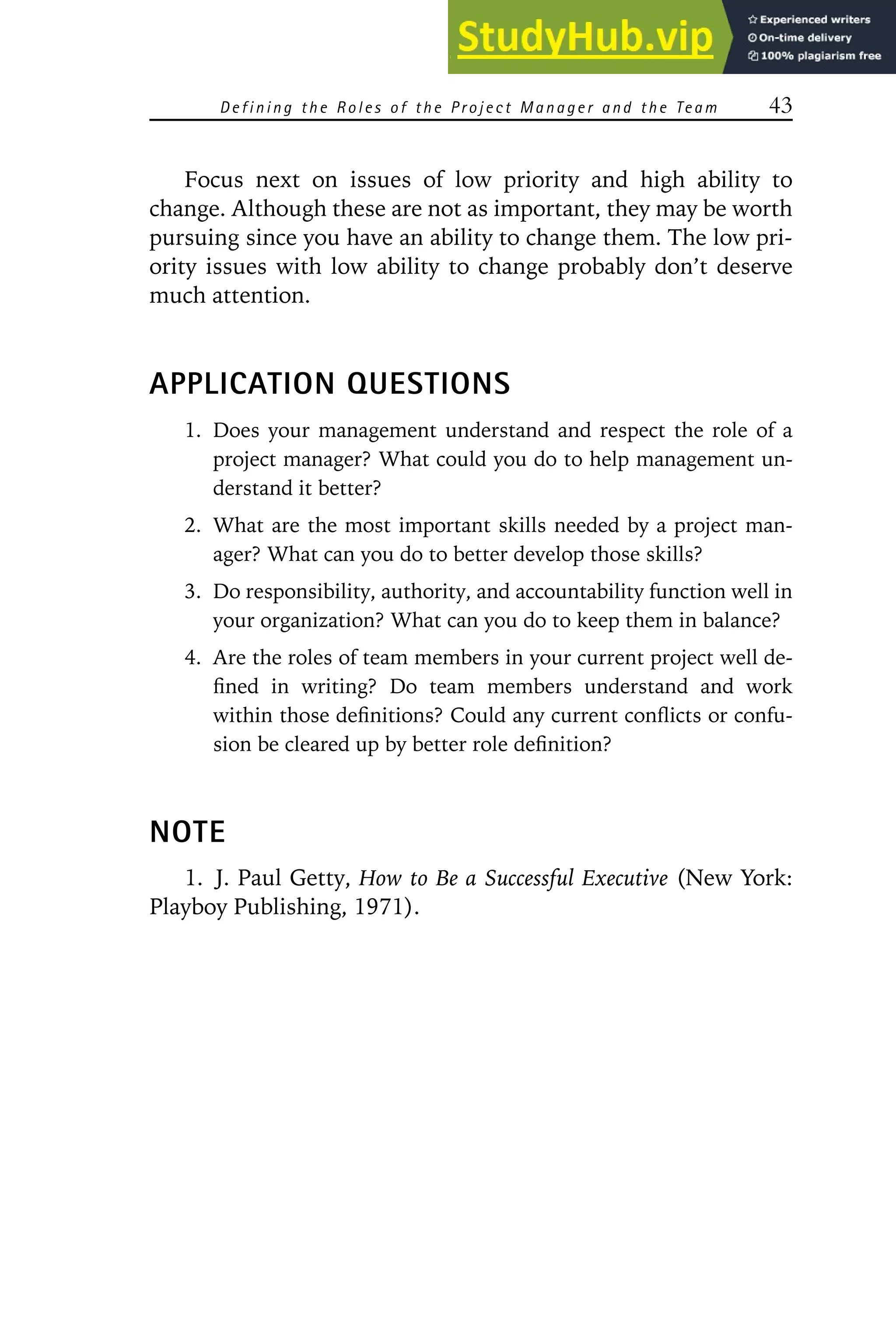
The chart in Figure 3-6 rates the items as they fall into the
four quadrants. Focus first on issues with high priority and high
ability to change. These are the issues that are most important,
and deserve your attention. Bring to the attention of manage-
ment those with high priority and low ability to change so they
can determine how these issues can be addressed.
Defining the R oles of the P roject Manager and the Team 41
Figure 3-4. Typical management roles and responsibilities in an
information technology project.
Role Responsibilities
Product 䡵 Represents the needs of customers and stakeholders
Manager 䡵 Defines business requirements
䡵 Manages customer expectations
䡵 Manages the product launch
Project 䡵 Manages systems planning and analysis
Manager 䡵 Prepares the functional specification document
䡵 Identifies and procures resources
䡵 Manages the master schedule
䡵 Coordinates team
䡵 Reports status
Development 䡵 Performs system design
Manager 䡵 Writes reliable code
䡵 Maintains development schedule
Test/QA 䡵 Owns the quality of the product
Manager 䡵 Participates in code review
䡵 Performs integration testing (migration and process)
䡵 Tracks bugs and issues
User Education 䡵 Writes online help and user documentation
Manager 䡵 Participates in usability testing
䡵 Prepares and delivers the training
Logistics 䡵 Plans the alpha and beta roll-out
Planner 䡵 Coordinates with help desk and IT Operations
䡵 Plans the installation of hardware and software
䡵 Provides support and troubleshooting
䡵 Creates a disaster recovery plan
Systems 䡵 Assists in definition of business requirements
Architect 䡵 Provides project design assistance
䡵 Defines product technical and location architectures
䡵 Ensures architecture issues and questions are resolved
Executive 䡵 Provides executive direction and issue resolution
Committee 䡵 Ensures stakeholder views are represented
䡵 Encourages compliance with company IT architecture
䡵 Ensures operability and integration between departments
䡵 Obtains funding
42 PREPARING FOR PROJECT MANAGEMENT SUCCESS
Figure 3-5. Grid for rating issues inhibiting success in managing
projects.
5 4 3 2 1
(high)
A B I L I T Y T O C H A N G E
(high) 1
P
R 2
I
O 3
R
I 4
T
Y 5
(low)
Figure 3-6. Chart for rating issues inhibiting success in managing
projects.
High Priority;
Low Ability to
Change
High Priority;
High Ability to
Change
Low Priority; Low
Ability to Change
Low Priority;
High Ability to
Change
5 4 3 2 1
(high)
A B I L I T Y T O C H A N G E
(high) 1
P
R 2
I
O 3
R
I 4
T
Y 5
(low)
Defining the R oles of the P roject Manager and the Team 43
Focus next on issues of low priority and high ability to
change. Although these are not as important, they may be worth
pursuing since you have an ability to change them. The low pri-
ority issues with low ability to change probably don’t deserve
much attention.
APPLICATION QUESTIONS
1. Does your management understand and respect the role of a
project manager? What could you do to help management un-
derstand it better?
2. What are the most important skills needed by a project man-
ager? What can you do to better develop those skills?
3. Do responsibility, authority, and accountability function well in
your organization? What can you do to keep them in balance?
4. Are the roles of team members in your current project well de-
fined in writing? Do team members understand and work
within those definitions? Could any current conflicts or confu-
sion be cleared up by better role definition?
NOTE
1. J. Paul Getty, How to Be a Successful Executive (New York:
Playboy Publishing, 1971).
❖❖❖
C H A P T E R
4
DEFINING THE ROLES OF
CLIENTS,
CUSTOMERS, AND
OTHER
STAKEHOLDERS
This chapter discusses
the roles of client, customer, and other
stakeholders, and presents how to iden-
tify the individuals involved and how to
define the roles they will play in the project.
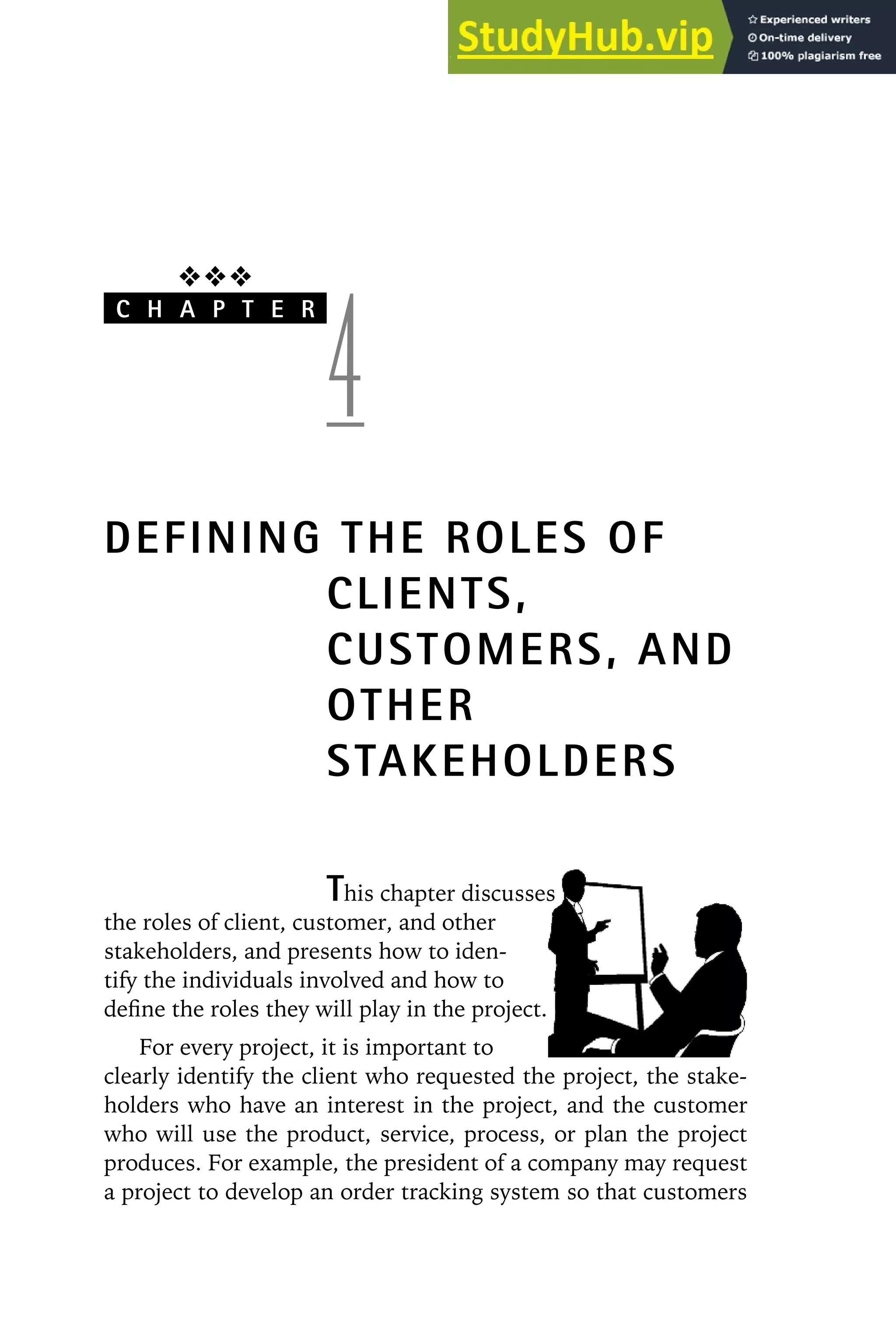
For every project, it is important to
clearly identify the client who requested the project, the stake-
holders who have an interest in the project, and the customer
who will use the product, service, process, or plan the project
produces. For example, the president of a company may request
a project to develop an order tracking system so that customers
Defining the Roles of Clients, Customers . . . 45
can look up the status of their orders on the Internet. The presi-
dent is the client, the customers of the project are the people
who will use the system to look up the status of their orders,
and the stakeholders include others in the company who benefit
from the system, such as the marketing or finance departments.
Although you might think these roles are obvious, they often
are not.
Some projects get into serious trouble because they have sev-
eral clients (requesters) who each want something different
from the project. Other projects have no clients who want to
take responsibility for the project. Still other projects are in trou-
ble because the customer is not well defined—believe it or not,
sometimes no one knows who will use the product or service
the project will create! Other projects fail because the needs of a
stakeholder were not addressed.
CLIENT
The client is the person (or group) who requests the project.
The client might come from a variety of sources—usually from
within the organization, such as senior management, middle
management, functional managers, or other project managers.
Someone in the organization might generate an idea for a proj-
ect, which then percolates to someone in upper management,
who approves the project. In this case, who is the client? The
individual who came up with the idea or senior manager who
approved the project? The key is in determining who takes re-
sponsibility for the project and has the authority to give direc-
tion to the project by approving the project objectives and
deciding on issues that arise.
It is critical that you identify the individual or group of indi-
viduals with the authority to approve the project objectives and
give direction to the project. If senior management identifies a
person to be the client for a project, be sure that management
also delegates to that individual the authority to approve project
46 PREPARING FOR PROJECT MANAGEMENT SUCCESS
objectives and make decisions for the project. Some project
managers assume that an individual has such authority, only to
find out much too late in the project that someone else actually
has approval authority and has reversed earlier decisions!
Once you have identified the client, it is important to get a
commitment of support for the project. Discussions with the
client can confirm understanding of the project scope and its
relative priority with other projects in the organization.
For each project, determine the following about the project’s
clients:
Who (by name) is authorized to make decisions for the
project?
What access does the project manager have to this client?
What approvals does the client require at which stages of the
project?
How will these approvals be obtained and how long will they
take?
Who (by name) has the authority to formally accept the proj-
ect when it is completed?
If the project is cosponsored by more than one individual or
group, it is important to define the role each will play in the
decision-making process.
CUSTOMERS
The customer is the person or group of people who will use what
the project is intended to provide—the product, service, process,
or plan.
For each project, it is important to determine the following
about the project’s customers:
Defining the Roles of Clients, Customers . . . 47
Who are the customers who will use the outcome of the
project?
What access does the project team have to the customer?
What approvals does the customer require at what stages of
the project?
How will these approvals be obtained and how long will they
take?
Once you have identified your customers, it is important to get
their commitment to support the project. If there is more than
one group of customers, it is important to define the role each
will play in the project.
It is important to identify and consult with the customer
throughout the life of the project. Many projects fail because
they do not meet the needs of the customer. You cannot assume
that the needs of the customer have been fairly represented by
the client when the project was approved. You must confirm and
reconfirm customer needs as the project progresses to ensure
that the final result meets the requirements.
OTHER STAKEHOLDERS
Most projects have stakeholders in addition to the client and
customers, who have an interest in (and perhaps control over)
the project. It is important to identify people who have a stake
(interest) in the project and define their needs relative to the
project. Stakeholders may be people in other departments, sup-
pliers, contractors, vendors, government agencies, management,
or stockholders in the company. Some projects fail because the
needs of a stakeholder were not addressed. It is as important to
manage the expectations of stakeholders as it is to manage the
expectations of clients and customers. If a stakeholder has con-
cerns about the project, he or she may be able to exert consider-
able influence on those who make project decisions.
For each project, it is important to determine the following
about the project’s stakeholders:
48 PREPARING FOR PROJECT MANAGEMENT SUCCESS
Who are the stakeholders in the project and what role will
each play?
What access does the project team have to the stakeholders?
What approvals, review, or information does each stakeholder
require at what stages of the project?
How will the approvals and reviews take place? How will the
appropriate information be communicated?
If there is more than one group of stakeholders, it is impor-
tant to define the role each will play in the project and get a
commitment from each to support the project.
DEFINITIONS
Client. The person or group that requests a project, takes responsi-
bility for the project, and has the authority to give direction to the
project.
Customers. A person or group that will use what the project is in-
tended to provide: the product, service, process, or plan.
Stakeholders. People who are involved in or impacted by the project,
including clients, senior management, middle management, func-
tional managers, project managers, project team members, cus-
tomers, and vendors.
APPLICATION QUESTIONS
1. In your current project, can you clearly identify the client, cus-
tomer(s), and other stakeholders?
2. Is your relationship with each of these people or groups clear
and functional?
3. What can you do to better define these relationships?
❖❖❖
C H A P T E R
5
SETTING UP A PLANNING
AND CONTROL
SYSTEM
Planning and control
go hand in hand. With a solid plan, a pro-
ject manager can exercise proper control.
Without a plan, there is nothing to com-
pare progress against and project control
is impossible. You cannot control without
a plan.
Many organizations have no formal planning and control sys-
tem. They operate using rationalizations:
‘‘We have a set delivery date, so the project has to be completed by
then.’’
‘‘Budget as much as you think will be approved, then don’t spend
any more than that.’’
50 PREPARING FOR PROJECT MANAGEMENT SUCCESS
‘‘Since the project must fit into our current environment, estimate
its size to be no larger than we can handle.’’
This chapter discusses why a planning and control system is
important and gives the basic components of such a system.
THE NEED FOR A PLANNING AND CONTROL
SYSTEM
Some people put a minimum of effort into planning. They argue
that since things invariably change during the life of the project,
it is a waste of effort to make extensive up-front plans. The aver-
age organization spends only 5 percent of the total project effort
on planning. More successful organizations spend up to 45 per-
cent. A good rule of thumb is to spend at least 25 percent of
the project effort in concept and development and 75 percent in
implementation and termination.
Although it is true that factors might be introduced during
the life of the project that necessitate minor or major adjust-
ments to the plan, it is still important to have a solid plan in
place. Without a solid plan, a project becomes even more chaotic
in the face of change. If plans are made using project manage-
ment software, it is easy to make adjustments to the plan as
needed.
In an ideal world, a project would be planned and approved,
then work would start and be completed according to the plan.
In actual practice, however, you might have to adjust the plan
throughout the life of the project. Therefore, any good planning
and control system must be flexible enough to operate in the
real world, but still be rigorous enough to provide control.
Some projects are managed in pieces. Because of time con-
straints or other factors, the project manager might have to de-
velop a plan for only part of the project, get it approved, and
S ett in g Up a P la nn in g an d Con tro l S yste m 51
begin that portion while other parts of the project are still in the
planning stage.
Often, planning continues to some extent throughout the life
of the project. Recognizing this reality, the successful project
manager establishes a project management system that allows
for adjustments to the plan as needed throughout the project’s
life.
ELEMENTS OF A PLANNING AND CONTROL
SYSTEM
Figure 5-1 shows a generic model for a project planning and
control system that allows a project to react to the changing con-
ditions of the world.
Define the problem or opportunity. The first phase of project plan-
ning is to clearly define the problem to be solved by the project
or the opportunity of which the project will take advantage.
This includes understanding the business reasons for the proj-
ect and the client’s motive in requesting it. This step is impor-
tant because you will use it to keep the project focused and it
might help you avoid damaging oversights that are not obvious
to the client. As the project manager seeks to clarify the justi-
fication for the project, it may bring to light issues that the
client was not able to see. (See Chapter 6 for information on
defining the project.)
Establish project objectives. Once you have clearly identified the
problem or opportunity, the next step is to define the basic
objectives of the project in terms of time, cost, and scope.
These define the strategy (the overall approach to the project).
They describe what the project will accomplish and ensure that
customer requirements are met. (See Chapter 6 for more de-
tailed information on establishing project objectives.)
52 PREPARING FOR PROJECT MANAGEMENT SUCCESS
Figure 5-1. Project planning and control system.
Define the
problem
or opportunity
Establish project
objectives
(strategy)
Cost, time, scope
Develop the plan
(tactics)
• Activities
• Schedules
• Resources
Begin project
work
Monitor
• Determine status
• Compare with plan
• Analyze
• Prepare reports
Close project
Control
Take Action
Replan
Reprogram
Readdress
S ett in g Up a P la nn in g an d Con tro l S yste m 53
Develop the plan. Within the framework of the project objec-
tives, detailed plans are developed, including the activities,
schedules, cost plans, and resources required to complete the
project work. These are the tactics (the specific steps you take
to implement the strategy). See Chapters 7–14 for information
on developing project plans.
Begin project work. When all plans are in place, approved, and
communicated to project personnel, project work can begin.
(See Chapter 16 for detailed information on initiating the
project.)
Monitor. As project work progresses, the project manager gath-
ers status information and compares it to the plan to deter-
mine variances. These deviations from the plan are then
analyzed to determine if corrective action should be taken.
(Chapters 17 and 18 contain information on how to monitor
and report on time, cost, and project scope.)
Control. When necessary, the project manager takes corrective
action to get the project back on track. Some deviations might
require replanning the tactics by resequencing activities, re-
scheduling, rebudgeting, or reallocating resources. Larger
deviations can necessitate reprogramming the strategy by re-
negotiating the basic project objectives of cost, time, and
scope. In some cases, the situation might be serious enough to
warrant readdressing the problem or opportunity to determine
if it has been identified correctly and if the organization has
the resources, expertise, and commitment necessary to handle
it. Chapters 19 through 21 explain various aspects of project
control.
Close project. Chapter 22 explains the steps involved in formally
closing a project.
Planning, monitoring, and controlling are not one-time
events. They continue throughout the life of the project to refine
and adjust to current conditions.
54 PREPARING FOR PROJECT MANAGEMENT SUCCESS
The remaining chapters take you through project planning
and control step by step. Even though you might spend less ef-
fort on each step for a small project, it is important to address
the concepts in each step.
To help you understand these steps, they are presented in a
specific sequence. In reality, you might perform these steps sev-
eral times throughout the project. For example, you might need
to repeat some project planning steps in various phases of proj-
ect execution. Steps can also overlap and interact in various
ways. Every project will be different by definition. Therefore, you
might need to apply some of the concepts in this book differently
with each project.
APPLICATION QUESTIONS
1. How does the level of detail in the project plan affect your abil-
ity to control the project effectively? Do you currently plan to a
sufficient level of detail?
2. Does your level of control match your plan? Are you currently
managing at a greater level of detail than necessary?
3. Are you able to respond adequately to changes during the life
of your project? What concepts from the planning and control
model presented in this chapter could you implement in your
current work?
C A S E S T U D Y ❖❖❖❖❖❖❖❖❖
CXI Cellular
CXI Cellular of Salt Lake City, Utah, is an innovative manufacturer
of cellular phone products. One of their bright, young engineers
has designed a new cellular phone that is 25 percent smaller and
lighter than any competitor’s phone. The vice president of market-
S ett in g Up a P la nn in g an d Con tro l S yste m 55
ing has named Robert, his top salesman, to manage a project to
engineer and manufacture the new product. He asks Robert to de-
velop a schedule and budget and present it to the executive man-
agement team the following week.
When Robert present his plans to the executive management
team, there is considerable discussion about whether the company
should begin manufacturing the new phone. After the meeting, the
chief operations officer (COO) of the company approaches Robert
and asks him to move forward with the project and report directly
to him. The COO asks to personally approve each project expense.
In the meantime, the COO will work on getting the approval of
the executive team.
Assignment: Based on the concepts presented in Chapters 1
through 5, what steps should Robert take to ensure the success of
the project? Consider the following in your answer:
Have project management principles been followed?
Have roles and responsibilities been properly defined?
Is Robert qualified?
Has there been proper management approval?
(Suggested answers are given in Appendix A at the back of the
book.)
This Page Intentionally Left Blank
❖❖❖
SECTION
2
PLANNING THE
PROJECT
SECTION OBJECTIVES
Learn the steps in project planning to
develop a defensible plan and logical
schedule.
Learn the tools needed to plan, sched-
ule, and budget a project.
This Page Intentionally Left Blank
❖❖❖
C H A P T E R
6
DEFINING THE PROJECT
A clear project definition
and detailed objectives are critical to the
success of the project. If the definition and
objectives are ambiguous, unrealistic, not
agreed upon, or not written down, the pro-
ject is in serious trouble before it begins. Whatever time and
energy you need to define the project properly in the planning
stage is much less than what it will cost to fix problems after the
project is completed.
This chapter covers the first steps in project planning. It ex-
plains how to define the problem or opportunity that the project
will address. It then discusses how to define the project objec-
tives in terms of time, cost, and project scope. Finally, it recom-
mends various reviews to ensure the integrity of the project
plan.
DEFINING THE PROBLEM OR OPPORTUNITY
Although clients might spend hours discussing a proposed proj-
ect, they might not think to communicate this insight to the
60 PLANNING THE PROJECT
project manager. The more the project manager understands the
issues surrounding the project, the better chance the project has
of success. For example, if a project involves the construction of
a new plant, the project manager needs::
To know how the new plant will operate.
To understand the needs of the users of the new plant.
To understand why the client wants the new plant.
A clear view of what is involved in constructing the plant and what
is expected of him.
To be sure the new plant will actually solve the problem at hand or
appropriately address the presenting opportunity. If the problem
or opportunity has not been correctly identified, the plant, even if
constructed successfully, could be a failure!
The following actions help you define the problem or oppor-
tunity:
Get from the client a clear definition of the problem to be solved by the
project or the opportunity the project will take advantage of. Work
with the client to define it clearly and succinctly. This is impor-
tant because it will be used to keep the project focused and
may help you avoid damaging oversights that may not be obvi-
ous to the client.
Determine the client’s needs and wants. It might take some time to
help the client distinguish between needs and wants, but it is
important to understand them because during the planning
and budgeting process, some wants might have to be sacrificed
in favor of needs when time and money are limited. If the cli-
ent does not know what she needs or wants, document what
you think she wants and ask her for a response. If the client
can’t commit, try a phased approach in which you agree to a
smaller project that addresses the portion of the problem or
D e f i n i n g t h e Pr o j e c t 61
opportunity she can agree on. Continue trying to define the
larger project that can be undertaken when the preliminary
project is completed.
Gather sufficient background information about the current situation.
Don’t blindly accept information presented to you without ap-
propriate confirmation. Well-intentioned stakeholders may
mislead you because they only see things from their point of
view. Be sure you investigate sufficiently to discover all the
issues.
Learn and thoroughly understand the business reasons for the project
and the client’s motive in undertaking it. This is important because
it gives a basis for balancing the budget, schedule, and project
scope. It might also help you capitalize on opportunities to
improve the outcome of the project.
Types of Projects
It might help to categorize your project into one of these three
types:
1. Market-driven: Producing a new product in response to market
needs. A software company sells product and maintains market-
share by creating quality programs that meet consumer needs.
2. Crisis-driven: A fast solution to a specific problem. In response
to complaints about defective automobile tires, a manufacturer
may quickly organize a project to manage the recall and replace-
ment, as well as a public relations campaign.
3. Change-driven: the need to change operations to match the cur-
rent environment or to be more effective. A retail sales company
may approve a project to create an Internet commerce site to
maintain its share of the market.
Understanding the purpose of the project is essential to com-
prehending the underlying needs so you can make appropriate
tradeoffs in time, cost, and scope as you manage the project.
62 PLANNING THE PROJECT
ESTABLISHING PROJECT OBJECTIVES
Once you have clearly identified the problem or opportunity, the
next step is to define the basic objectives of the project, includ-
ing what is to be done (specific end results), how (quantity, quality,
or special requirements), when (deadline), and how much it will
cost.
Clearly define the project objectives in terms of the desired
end results. The project objectives should describe what the
project will accomplish. Ask yourself, ‘‘If we achieve these stated
objectives, will we consider the project a success?’’
Consider the three main aspects of project objectives:
1. Cost: The money and resources required to get the job done,
including people, equipment, and other allocations.
2. Time: the time required to get the job done.
3. Scope: A description of the features and functions of the end
products or services to be provided by the project. Define all
the deliverables and their features and functions. A deliverable is
something provided at the end of the project, such as a product,
service, process, or plan.
The project objectives must define the completion condition,
describing what will and will not have been completed when the
project is finished. This provides measurable criteria for project
success.
These objectives define not only the project, but also the re-
sponsibilities of the project manager, who is measured against
the objectives and held accountable for them. The project objec-
tives must be SMART (Specific, Measurable, Agreed upon, Real-
istic, and Time-limited):
Specific. The objectives must be so clear and well defined that
anyone with a basic knowledge of the project area can under-
D e f i n i n g t h e Pr o j e c t 63
stand them. They must precisely define what the project will
and will not do.
Measurable. Objectives must be defined in measurable terms. If
they cannot be measured, they are too ambiguous and fuzzy
and you need to define them more clearly. To be successful,
you must be able to measure and report on the progress.
Agreed upon. The project manager, clients, and customers must
agree on the project objectives. There must be agreement that
the end result will solve the problem or respond to the oppor-
tunity defined.
Realistic. The project objectives must be possible to achieve,
given the available resources, knowledge, skills, and time. It
might take some time and energy to negotiate project objec-
tives that are realistic.
Time (cost) limited. The objectives need to be framed within
clear time (cost) goals. Define how much time (budget) is
available and if there is any flexibility.
If the objectives are not SMART, keep working with them
until they are. Objectives that are excessive can be detrimental
to the project and the company. If project managers include too
large a contingency (in an effort to insure their success), they
run the risk of the project being too expensive and not being
approved. Even if approved, such a project ties up large amounts
of allocated funds that the company could better use elsewhere.
The other extreme is an objective that is too lean. Project man-
agers should include reasonable contingency in the objectives to
give the project manager and team a fair chance for success. The
project manager’s task is to find a competitive, yet fair middle
ground between these two extremes
Keep the Objectives in Balance
The triangle in Figure 6-1 shows the three principal aspects of a
project: time, cost, and scope. The project manager’s job is to
keep these three aspects in balance.
64 PLANNING THE PROJECT
Figure 6-1. The project objectives triangle.
If time is short, the resources (cost) must increase or scope
must decrease, or both.
If funds are short, the time can be extended or scope must
decrease, or both.
If the scope is large, the cost will be greater or the time must
be extended, or both.
The frustration of trying to keep these three aspects in bal-
ance has led to the saying, ‘‘You can have it quick, cheap, or done
right. Pick any two.’’
In an ideal world, project objectives would remain constant
throughout the life of the project. In reality, however, the rela-
tive importance of each objective can change over time. It can be
fatal to overemphasize the schedule when funds have become
critical. The skillful project manager aims for a balanced empha-
sis, remaining flexible to adapt to new circumstances as they
occur.
Consider the following issues as you balance cost, time, and
scope.
D e f i n i n g t h e Pr o j e c t 65
Cost Considerations
Costs include the money and resources required to complete the
project, including people, equipment, and materials. The client
usually wants the project at the lowest cost possible. The budget
for the project is approved based on the scope and schedule. The
cost of the project is influenced by:
Specifications of the end products (such as levels of perform-
ance, quality, and reliability).
Compliance with governmental, institutional, or internal stan-
dards.
Technical requirements (such as a need to upgrade computer
hardware) and administrative needs (such as a company’s fi-
nancial policies).
The project manager must establish performance standards
to determine how to measure cost performance.
Time Considerations
The project schedule is easy to measure and is often given more
attention than cost and scope.
The client usually wants the project NOW.
Clients might choose speed over cost and quality.
Project managers must balance the schedule with the project
scope, budget, and resources available. Project managers must
establish performance standards to determine how schedule
performance will be measured.
Scope Considerations
Scope is often the most difficult project feature to define and on
which to get agreement. The project scope is balanced with the
66 PLANNING THE PROJECT
time, budget, and resources available. It can increase over time
(‘‘scope creep’’) because of an inadequately defined problem or
opportunity, overlooked details, unforeseen problems, or changes
in the market or company.
A good scope statement clearly defines the end products or
services. It describes what will and will not be completed at the
end of the project. A complete scope statement includes tech-
nical specifications, performance requirements, facilities re-
quirements, ground rules, constraints, exclusions, procedures,
logistics, safety regulations, security issues, and environmental
considerations. The scope statement should also consider how
this project will change the way the company does business.
What other aspects of the business will be affected by this proj-
ect (in positive or negative ways)? What other departments will
be involved with this project and what are the impacts on their
resources?
The scope statement identifies which quality standards are
relevant to the project and establishes performance standards to
determine how to measure quality and compliance with scope
specifications. Good quality is often difficult to produce because
of the following factors:
Time and cost are key. However, when too much emphasis is
placed on time or cost and workers are up against tight time
and cost restrictions, the quality of the final product often suf-
fers. Modern approaches to quality control, such as Total Qual-
ity Management and Continuous Improvement, can help you
balance quality with time and cost. When you measure only
time and cost, you send the message that quality is less impor-
tant. You should hold workers accountable for quality as much
as for meeting the schedule and budget.
Work is becoming more complex and workers are becoming more ex-
pert. The more technical the work, the more control the worker
has over quality. Although all workers should accept responsi-
D e f i n i n g t h e Pr o j e c t 67
bility for the quality of their work, those with highly special-
ized skills have an even greater responsibility for controlling
quality when it is more difficult to find similar experts to re-
view their work.
Managers often lack the technical expertise to adequately supervise the
work.
Quality is not planned. If quality standards are not part of the
initial plan, no amount of inspection will produce good quality.
Poor project quality leads to customer and management dis-
satisfaction, high maintenance costs, and increased outsourcing
of critical functions.
Final Statement of Project Objectives
Once project objectives are defined, they should be clearly
spelled out in a comprehensive scope statement that provides a
documented basis for making future project decisions. It should
include justification for the project, description of the product
or service the project is to create, and a list of the project deliver-
ables. This narrative description is shared with all stakeholders
and project team members. As the project progresses, you might
need to refine or revise the scope statement to reflect approved
changes in scope.
PERFORMING PROJECT REVIEWS
Before a project is approved, a number of reviews are in order to
be sure the project makes sense, that it is feasible, worthwhile,
and not overly risky. The project manager can perform many of
these reviews with input from management and the project
team. In some cases, an independent appraisal can be helpful to
reinforce the project manager’s recommendations to manage-
ment.
68 PLANNING THE PROJECT
Conceptual Review
A conceptual review addresses these questions:
Does the project fit within the mission, goals, and objectives
of the company?
Does this project support a specific business plan already in
place?
Will the project solve the stated problem or appropriately take
advantage of the current opportunity?
This type of review is typically undertaken by a management
team within the organization. It simply involves asking the hard
questions of how the project fits within the organization’s goals.
However, if management is enamored with a project that has
no place within the organization’s objectives, it might take an
objective third party to help them see the project’s unsuitability.
Feasibility Study
A feasibility study addresses questions such as the following:
How realistic is it to expect that the project can meet the stated
objectives?
How realistic are the project scope, budget, and time require-
ments?
Can the appropriate resources be made available when needed
to complete the project?
Are sufficient funds available to complete the project?
Does the organization have the technical expertise to accom-
plish the project?
D e f i n i n g t h e Pr o j e c t 69
A feasibility study can be done in house or by an external
group. It can be useful to benchmark other organizations that
have tried similar projects and learn from their failures and suc-
cesses. A complex or high profile project might warrant a feasi-
bility review by an independent party to be sure that the
organization has the expertise and experience to handle the
project. If a small utility company planned to build its first nu-
clear power plant, an extensive feasibility study by an indepen-
dent party would certainly be in order.
Benefit-Cost Analysis
A benefit-cost review analyzes the costs and expected benefits of
the project:
What benefit will the organization get from completing this
project?
What is the value of the promised advantages, considering the
amount of money involved, the time needed to complete the
project, and the resources required?
What is the project’s value compared to other projects that
could be done instead (‘‘opportunity cost’’)?
A benefit-cost ratio provides a measure of the expected
profitability of a project by dividing expected revenues by ex-
pected costs. A ratio of 1.0 means that expected benefits and
costs are equal and you have a ‘‘break-even’’ project. Ratios less
than 1.0 mean that costs are expected to exceed benefits and
the project is not financially attractive. Ratios greater than 1.0
indicate profitable projects. The higher the ratio, the better the
project. A major overhaul of a company’s telephone system,
which is expected to save the company $1 Million, has estimated
costs of $800,000. Thus the overhaul project has a benefit-cost
ratio of 1.25.
70 PLANNING THE PROJECT
Benchmarking data from other organizations may be helpful
to confirm the expected costs and returns.
Profitability Measures
You can make several quantitative measures that indicate the
expected profitability of a project. Some of the more common
are:
Payback period is defined as the number of periods (usually years)
until cumulative revenues exceed cumulative costs; that is, the
project has turned a profit. The shorter the payback period, the
better. However, payback period does not identify the expected
magnitude of the total profit.
Internal rate of return represents an average rate of return for the
project, expressed as a percentage. A rate of 35 percent means you
expect the project to return an average of 35 percent per year.
Return on assets is a measure of net profit divided by total assets.
Return on investment is a measure of net profit divided by total in-
vestment.
Return on sales is a measure of net profit divided by total sales.
Alternative Course of Action Review
A review of alternative courses of action is to ensure that the
intended course of action is the best. It addresses these ques-
tions:
What other things could be done to solve the problem or take
advantage of the opportunity instead of the approach taken by
the proposed project?
D e f i n i n g t h e Pr o j e c t 71
What are the positive and negative consequences of each po-
tential course of action?
What would happen if you take no action at all?
Opportunity Cost Review
Opportunity cost is the cost of choosing one among several alter-
natives (projects) and, therefore, giving up the potential benefits
of another. If an organization chooses Project A (to manufacture
a product that has an identified buyer and will generate a profit
of $500,000) instead of Project B (to develop an experimental
product with no identified buyer and a potential profit of
$800,000), the organization is knowingly giving up the potential
$800,000 for the more secure $500,000 profit. In selecting a
project, the company commits finite resources, time, and energy.
Therefore, it is important to take project selection seriously.
Making poor choices in approving projects can cause the com-
pany to miss out on better opportunities.
Preliminary Risk Assessment
A risk assessment addresses these questions:
What could go wrong in the project and what are the potential
consequences?
What are the uncertainties in the project?
What are the consequences if the project fails to meet its ob-
jectives?
What is the risk that it will not solve the problem?
The project manager and management need to determine
whether the expected benefits of the project are worth the risk.
72 PLANNING THE PROJECT
They might decide to modify certain aspects of the project to
reduce risk.
Possible Review Outcomes
At the conclusion of the reviews, the client, project manager,
and customer determine whether to:
Proceed with the project.
Change the project objectives.
Drop the project.
You might need to repeat one or more of these reviews at
certain points during the project to ensure the integrity of the
project—especially if project objectives or assumptions change
during the life of the project.
DEFINITIONS
Alternative course of action review. A review that identifies other ways
to solve the problem or take advantage of the opportunity instead
of the approach being taken by the proposed project.
Conceptual review. A review that determines whether the project fits
within the organization’s goals and whether the project will solve
the stated problem or appropriately take advantage of the current
opportunity.
Cost. The money and resources required to complete a project.
Deliverable. Something delivered at the end of a project, such as a
product, service, process, or plan.
Feasibility study. A review that determines whether the project can
realistically be accomplished.
D e f i n i n g t h e Pr o j e c t 73
Internal rate of return. A profitability measure that represents an av-
erage rate of return for the project, expressed as a percentage.
Objectives. The statement of cost, time, and scope required to com-
plete a project.
Opportunity cost. The cost associated with choosing one project and,
therefore, giving up the potential benefits of an alternative project.
Payback period. The number of periods (usually years) until cumula-
tive revenues exceed cumulative costs; that is, the project has
‘‘turned a profit.’’
Preliminary risk review. An initial review of the potential risks in-
volved in a project that determines whether the expected benefits
of the project are worth the risk.
Return on assets. A measure of net profit divided by total assets.
Return on investment. A measure of net profit divided by total invest-
ment.
Return on sales. A measure of net profit divided by total sales.
Scope. A description of the features and functions of the end prod-
ucts or services to be provided by the project.
Scope creep. The tendency for scope to increase during the course of
the project without proportionate increases in time or cost.
Scope statement. A narrative description of the project objectives,
including justification for the project, a description of the product
or service to be created, and a list of the project deliverables.
Time. The time required to complete a project.
APPLICATION EXERCISES
1. For your current project, draw a triangle and define the time,
cost, and scope. Determine which of the three is currently the
most important in your project. Re-read the considerations for
time, cost, and scope and be sure you have considered all these
issues in your project.
74 PLANNING THE PROJECT
2. For your current project, perform a mini-conceptual review, fea-
sibility study, benefit-cost analysis, alternative course of action
review, opportunity cost review, and risk review. Write down
the outcomes of each review showing the advantage (or disad-
vantage) of proceeding with this project.
APPLICATION QUESTIONS
1. Think of a past project that did not have a clear definition of the
problem to be solved or the opportunity of which it was meant
to take advantage. What are the dangers of proceeding with
such a project?
2. What are the potential dangers of proceeding with a project that
has no clear distinction between the client’s needs and wants?
3. Give an example of a market-driven, crisis-driven, and change-
driven project. How would your approach to each one differ in
timing and priority?
4. Consider a past project that did not have project reviews. In
retrospect, would you have made any changes in the project
plan based on the outcome of such reviews?
❖❖❖
C H A P T E R
7
CREATING A WORK
BREAKDOWN
STRUCTURE
After defining the objectives of the proj-
ect, the next step is to break the project down into manageable
pieces in a work breakdown structure.
A work breakdown structure defines the work to be completed
in the project. It is a graphical representation (diagram) of the
project showing its component parts. It provides definition to
the project scope by showing the hierarchical breakdown of ac-
tivities and end products that must be completed to finish the
project.
The work breakdown structure is the basis for time estimat-
ing, resource allocation, and cost estimating and collection. If
the work breakdown structure is faulty, all further planning will
also be faulty. The work breakdown structure example in Figure
7-1 illustrates the Noah’s Ark project.
76 PLANNING THE PROJECT
Figure 7-1. Noah’s Ark: work breakdown structure.
Noah's Ark
Animals People Boat
Gather Feed
Get
lions
1M, 1F
Get
elephants
1M, 1F
House Feed
Design
boat
Build
boat
Interior
design
Exterior
design
Level 0
Level 1
Level 2
Level 3
In preparing a work breakdown structure, keep the following
in mind:
Use any category that makes sense for your project. This might in-
clude components of the product, functions, organizational
units, geographical areas, cost accounts, time phases, or activi-
ties.
Don’t be constrained by sequence. The diagram does not need to
represent a logical or time sequence of events.
The diagram does not have to be symmetrical. The number of levels
might vary from one branch to the next. Break each branch
down to the number of levels necessary to adequately define
the project.
Creating a W ork Breakdown Structure 77
Each box is a summary of the boxes in the levels below it.
The final box in each branch must end in a product or deliverable.
These must be measurable and definable in terms of an end
result.
The boxes in the lowest level are called work packages. They repre-
sent the lowest level of detail you want to estimate, schedule,
monitor, and control. They should represent eight to eighty
hours of work. Each work package can be divided into specific
activities. For each work package, describe the completion
condition. Ask yourself what must be delivered to consider the
activity finished.
The sum total of boxes must represent the complete project. You can
leave nothing out. When all these deliverables are completed,
will the project be done?
The entire project team should be involved in developing the work
breakdown structure.
When completed, you should review the work breakdown with the cli-
ent and customers. This is to ensure that it is complete and that
it addresses their specific concerns.
When you develop a work breakdown structure, be sure to
include these often overlooked activities:
Project management. Include the budgets and resources needed
to manage the project. Include costs for the project manager,
support staff, project office, and computer support.
Documentation. The documentation includes lessons learned,
how the end product differs from the project plan (describe
the ‘‘as built’’ condition), and how the end product functions.
Product implementation. Projects that deliver a great product or
system can fail if they do not implement the product or sys-
78 PLANNING THE PROJECT
tem. This can include product delivery, user training, commu-
nication plans, or marketing plans.
End product evaluation. Does the product perform as expected?
Is the problem solved? Have you successfully taken advantage
of the opportunity?
Project closure. This includes the time, budget, and resources
needed to close the project office, reassign project personnel,
and close financial accounts (see Chapter 22).
Product retirement. Include the plans to retire the product after
its useful life. Organizations often require that the project that
created the product or system include the plans—and even the
budget and resources—to retire it at the end of its useful life.
DEFINITIONS
Work breakdown structure. A hierarchical diagram of activities and
end products that organizes and defines all work to be completed
in a project.
Work packages. The deliverables in the lowest level of the work
breakdown structure. A work package can be divided into the spe-
cific activities to be performed.
APPLICATION EXERCISE
Create a work breakdown structure for your current project. Try
to define it in no more than five levels.
APPLICATION QUESTION
Why should the entire project team be involved in creating the
work breakdown structure? What are the dangers of one person
creating a work breakdown structure?
❖❖❖
C H A P T E R
8
ESTIMATING ACTIVITIES
The work packages (the boxes in the low-
est level of the work breakdown structure) identify the specific
activities that must be performed to complete the project. This
chapter explains how to estimate the time and cost needed to
complete each of these activities.
To properly estimate each activity, use the following three
steps:
1. Referring to the work breakdown structure, ask the team mem-
bers to complete an estimate sheet such as the one shown in
Figure 8-1 for each work package. For each activity, develop a
statement of work that succinctly defines the work to be accom-
plished in the activity. Each statement of work should be sup-
ported by the following:
Technical specifications of the end products, such as perform-
ance, quality, reliability, survivability, operability, and main-
tainability.
80 PLANNING THE PROJECT
Figure 8-1. Activity estimate sheet.
Activity # Title
Team Responsible
Team Leader
Statement of work:
Describe completion condition:
Describe assumptions, exclusions, constraints:
Time Number of working days needed
Personnel
person hours of skill group
Direct costs
item cost $ needed at day . days to pay
Predecessor steps
This activity cannot begin until Define if less than 100%
% of activity # is complete.
Successor steps
This activity cannot begin until Define if less than 100%
% of activity # is complete.
Signature Date
Estimating Activities 81
Compliance with standards (governmental, institutional, in-
ternational, and organizational).
Project assumptions, constraints, and exclusions (a descrip-
tion of what is not included in this work package).
2. Ask the functional groups to document how the estimate is
made, including assumptions and factors that might affect the
validity of the estimate. For example, did the cost projections
make allowances for the suppliers’ annual price increases?
3. Review the estimate sheets and clear up discrepancies. For ex-
ample, the estimate sheet requests both predecessor activities
and successor activities. Predecessor activities are those that occur
before the current activity and successor activities are those that
occur after it. If the successor activity listed on one sheet does
not show up as a predecessor activity on the other, check with
the team members to make sure they have a common under-
standing of the intended workflow. (This is the reason for ask-
ing for both successor and predecessor activities on each sheet.)
You might also want to compare relative material costs and per-
son hours across various activities.
Although you might be tempted to skip over some informa-
tion on this sheet, it is all essential. For example, the breakdown
by skill group in the personnel section is necessary to identify
the specific resources (personnel) needed (and to determine
whether they are available when needed) and the cost for each
(since people with different skill levels are typically paid differ-
ent rates). The detail by item in the direct costs section can iden-
tify any costs overlap from one activity to the next. For example,
if two activities each require purchasing the same equipment,
the equipment cost can be charged to one activity for use by
both. The identification of the number of days to pay for each
cost is necessary to determine cash flow. Although it might ap-
pear redundant to ask each activity to list both the predecessor
82 PLANNING THE PROJECT
and successor activities, it can help isolate inconsistencies from
one activity sheet to another. Not all activity workers view their
interrelationships in the same way.
THE IMPORTANCE OF ESTIMATING
A novice project manager might believe it a waste of time to
spend much effort estimating. However, experienced project
managers recognize the importance of estimating as precisely as
possible using the best estimating methods. For this reason, it
is preferable to have estimates created by those who are experts
in the field—preferably those who will actually work on the
project.
Project estimating is difficult for two important reasons:
1. Estimating is not an exact science. Even under the best condi-
tions, an estimate is only a prediction of the time, resources,
and funds required to complete an activity.
2. By its very nature, a project is a unique undertaking and in-
volves a degree of uncertainty.
Avoid creating estimates based on predetermined deadlines
or budgets. Although those constraints might be real, you must
be objective and honest in your assessment of the time, re-
sources, and funds needed to complete your project. Once you
complete the estimates, you can negotiate with the client to rec-
oncile them with the project requirements. If they do not fit, it
might be possible to adjust the project scope, deadline, or basic
approach. It might also be possible to sequence the activities
differently to complete the project in less time or to use alterna-
tive resources to complete the project at a lower cost.
ESTIMATING METHODS
The four most common estimating approaches are analogous,
parametric, bottom-up, and simulation.
Estimating Activities 83
Analogous Approach
The analogous approach uses the actual costs and durations of
previous, similar projects as the basis for estimating the current
project. It uses historical information from the organization as
well as industry standards. It is also called a top-down estimate,
because it relies on information from the top row of activities of
the work breakdown structure. It can be used to estimate proj-
ects with a limited amount of detailed information. For example,
a project to implement a new accounts payable process in one
company might be estimated by reference to a similar accounts
payable process that was recently implemented in another com-
pany. Such an analogous approach is generally less costly than
other approaches, but is also generally less accurate.
Parametric Modeling
Parametric modeling uses mathematical parameters to predict
project costs. An example is residential home construction that
is often estimated using a certain dollar amount per square foot
of floor space. Complex examples can be found in the software
development industry where one model uses thirteen separate
adjustment factors, each of which has five to seven points. The
cost and accuracy of parametric estimates vary widely.
Bottom-Up Estimate
This approach estimates the cost and duration of the individual
work packages from the bottom row of activities of the work
breakdown structure, then totals the amounts up each row until
reaching an estimate for the total project. This approach can pro-
duce a more accurate estimate, but at a higher cost.
Simulation
In this approach, a computer calculates multiple costs or dura-
tions with different sets of assumptions. The most common is
84 PLANNING THE PROJECT
the Monte Carlo Analysis, in which a range of probable results is
defined for each activity and used to calculate a range of probable
results for the total project. Simulation can be more accurate
than other types of estimates, and is principally used on large or
complex projects.
PRECISION OF ESTIMATES
In early planning, you might be asked to provide a preliminary
or conceptual estimate, also called an order-of-magnitude estimate.
This level of estimate is usually ⳮ25 percent to Ⳮ75 percent.
Thus, the range of the order-of-magnitude for a $50,000 esti-
mate would be $37,500 to $87,500. Later, at the project approval
stage when more definition is available, you might be asked for
a budget estimate, which usually ranges from ⳮ10 percent to
Ⳮ25 percent. During project planning, when well-defined speci-
fications are available for individual activities, you might need to
provide definitive estimates that can be used for bid proposals
or contract negotiations. Definitive estimates usually use a
bottom-up approach, and typically range from ⳮ5 percent to
Ⳮ10 percent.
The more specific the details, the better the estimate, and
therefore the greater the chance of meeting the project objec-
tives. However, the greater the detail, the greater the cost and
time to get the estimate and the less time and budget will be left
to accomplish the project.
To increase the accuracy and consistency of your estimates,
you might want to:
Use several independent techniques and sources.
Compare and iterate estimates. For example, you might ask
two independent groups to use the same estimating method,
or one group to use two different methods. Investigate the dif-
ferences among the estimates and adjust the estimating ap-
Estimating Activities 85
proach to what is appropriate for your project. An analysis
after the project is important to determine if your approach
was valid. This helps you learn from each project and produce
a better estimate on the next.
Underestimating Activities
Managers often underestimate activities, and projects run over
budget and over schedule. Here are some common reasons:
Team members are usually optimistic and desire to please.
They might say what they think the project manager wants to
hear.
People might underestimate the amount of nonproductive
time in a day (such as personal distractions, fatigue, interrup-
tions, meetings, administrative tasks, sick leave, vacations,
training, crisis management, and so on).
Workers might be overly optimistic about the number of calen-
dar days it takes to complete the number of work hours esti-
mated.
People tend to have incomplete recall of previous experience.
They remember successes better than failures and tend to for-
get pain.
Team members might not be familiar with the complete scope
of the project when they make their estimates.
Workers might have no experience with this activity to draw
upon.
Before beginning the estimating process, it may be helpful to
discuss these issues with all who will be involved so they can
deal with them appropriately. Peer reviews during the process
may also help identify underestimating.
86 PLANNING THE PROJECT
Inflating Estimates
Novice project managers might be tempted to inflate estimates
so they can come in ahead of schedule and under budget. How-
ever, from the point of view of resource utilization, projects run-
ning ahead of schedule may be as bad as projects running behind
schedule. If a new office building is completed six months ahead
of schedule because of an inflated estimate, the building may sit
vacant until tenants are able to occupy it. The owner may lose
months of rental revenue that he otherwise could have received
had he known when the building would be available and had
scheduled the tenants for occupancy sooner. Inflating the esti-
mates defeats the purpose of planning. Expert project managers
have a few projects that come in ahead of schedule and under
budget, a few behind schedule and over budget, and many that
come in close to the plan.
Project managers should estimate what they think the proj-
ect will actually cost, then add a reasonable contingency amount
for unknown variables. The percentage of contingency varies de-
pending on the kind of activity, environment, and degree of risk.
There is no magical percentage to plan as a contingency. A 3 to
5 percent contingency might be sufficient for work that is fairly
routine, whereas 10 to 15 percent might be appropriate for un-
usual work that has many unknowns. Managers can establish a
contingency reserve within the project to be drawn upon to re-
duce the impact of missing cost or schedule objectives.
Estimating Familiar vs. New Work
If the work to be estimated is familiar, the work breakdown
structure is also familiar and you can rely on performance stan-
dards, historical databases, established guidelines, and standard
costs. You can improve performance on these projects over time.
However, how do you reliably estimate new work or work that
uses new technology? Consider the estimating issues shown in
Figure 8-2.
Estimating Activities 87
Figure 8-2. Estimating familiar vs. new work.
Familiar work New work
Familiar 䡵 Needs accurate 䡵 Difficult to predict since
technology performance data. activities may be different.
䡵 Draw on performance 䡵 No performance history
history and measure available or not useful.
performance 䡵 High probability of
improvement. estimates being
䡵 Easiest type of project understated.
work to plan. 䡵 Needs frequent project
reviews and estimate
revisions.
New 䡵 Performance history needs 䡵 Use a group of experts to
technology to be adjusted for the produce the estimate.
complexity of technology. 䡵 Very short planning
䡵 Important issue is the horizons.
similarity of activities. 䡵 No performance history
䡵 New activities required by available or not useful.
the technology are 䡵 Needs close monitoring
difficult to estimate. and frequent replanning.
Weighted Estimating Formulas
If the activity is well-known and has little risk, a single estimate
might be sufficient. However, if the activity is less well-known
or the risk is higher, you might want to gather three estimates:
a most likely estimate (given what you expect to happen), an opti-
mistic estimate (if everything goes very well), and a pessimistic
estimate (if things go poorly). You can then combine the three
estimates to calculate the average expected duration or cost for
the activity, using the following formula, based on principles of
statistics:
Estimated time ⳱
optimistic Ⳮ (4 ⳯ most likely) Ⳮ pessimistic
6
This formula calculates the PERT (Program Evaluation and Review
Technique) weighted average, sometimes called expected time. This
88 PLANNING THE PROJECT
estimate accounts for the uncertainty and variability inherent
in project work and provides a risk-adjusted estimate. It works
equally well for both time and cost estimates.
Range Estimates
Traditionally, we consider budgets as fixed amounts. For exam-
ple, we estimate $3,875,350 to complete the project, or we
budget $459,750 for the annual operation of a functional depart-
ment. However, in today’s business world, it can be more help-
ful to view functional budgets as limitations (‘‘We expect to
spend $450,000 this year to operate the functional department,
and will spend no more than $475,000.’’). In the same vein, we
view budgets as targets within limitations (‘‘We estimate the
project to cost $3.8 to $4 million, not to exceed $4.2 million.’’).
Using a target range for projects is especially useful for the fol-
lowing types of projects:
Large projects
Projects with greater risk
Projects that are more difficult to define, such as research proj-
ects
Consider an aircraft flight plan. Because of factors beyond
the pilot’s control (air currents, temperature variations, side
winds, etc.), the flight plan allows a range rather than a fixed
course, as illustrated in Figure 8-3. The pilot’s target is to stay
in the center of the band, but as long as he stays within the
eight-mile wide band, he is within the accepted tolerance limits.
The difference between the target and the limit is the contin-
gency. The pilot takes periodic readings to determine his posi-
tion from the center of the band and makes course corrections
during the trip to ensure that the plane’s flight stays within the
accepted limits. The pilot also analyzes the corrections he makes
Estimating Activities 89
Figure 8-3. Range limits for an aircraft flight plan.
to determine if there are trends for which he needs to account.
In today’s business world, many accounting and budgeting pro-
cedures are changing from fixed-amount methods to ranges or
limitations.
Activity-based costing uses accounting and budgeting meth-
ods that relate all work activity in the organization to projects.
This forces the company to focus on its end products (sales and
services) and gives managers a better picture of the real profit-
ability of the company’s products and services.
Rolling Wave Estimates
In some projects, detailed estimates might be valid for only three
months. In an environment where the cost of materials changes
rapidly, for example, you might want to calculate detailed esti-
mates for only the coming three months. As you get closer to
the conclusion of the project, the nondetailed (‘‘gross’’) portion
of the estimate grows progressively smaller and you can forecast
the outcome of the project with increasing accuracy (see Figure
8-4).
Rolling wave estimates are especially useful for engineering,
information technology, and research and development projects
because subsequent phases of the project are dependent on re-
quirements defined in earlier phases. For example, you may not
be able to plan the second phase of an engineering project in
90 PLANNING THE PROJECT
Figure 8-4. Rolling wave estimate.
month 1 month 2 month 3 month 4 month 5 month 6 month 7
Detailed estimate Gross estimate
Detailed estimate Gross
Detailed estimate
much detail until you gather the test results at the end of the
first phase. Those test results provide the necessary require-
ments to plan the second phase in detail.
Rolling wave estimates present an increased risk. If the proj-
ect is long, it might not be efficient to break later activities into
great detail from the beginning. A five-year research project to
find a drug for treating an illness is a good example of a project
that is difficult to plan in detail from the beginning. Planning
too much detail may be a waste of effort because you may end
up reworking these activities because of information gathered
later or because the project changes as it progresses.
TYPE OF CONTRACT
When estimates depend on the performance of outside vendors
or contractors, the type of contract is critical. For example, a
fixed-price contract provides greater confidence in the estimate
than does a cost-plus contract. Different types of contracts
might be appropriate in different circumstances. There are three
basic types of contracts: fixed price, unit price, and cost plus.
Estimating Activities 91
Fixed-Price Contract
With a fixed-price (also called a lump sum) contract, the vendor
agrees to do the total work for a fixed price. The vendor assumes
the risk of unforeseen problems in exchange for a larger profit.
This type of contract is appropriate when dealing with unknown
vendors or when the project manager anticipates the work is
risky.
Unit-Price Contract
With a unit-price contract, the vendor agrees to a preset amount
per unit of service (such as $90 per hour for professional services
or $1.80 per cubic yard of earth removed), and the total value of
the contract is a function of the quantities needed to complete
the work.
Cost-Plus Contract
With a cost-plus contract, the vendor agrees to do the work for
the cost of time and materials, plus an agreed-upon amount of
profit. Cost-plus contracts, also called time-and-materials con-
tracts or cost-reimbursable contracts, are used when dealing with
in-house providers or trusted vendors over whom you have great
control. With these contracts, the project manager assumes the
risk of unforeseen conditions, but is usually able to complete the
project at a lower cost.
Incentives
Incentives or awards, such as completing work before a given
date or controlling costs to a given level, can be included in any
of the above contract types. If final project costs are less than the
expected costs, for example, both the buyer (the organization)
92 PLANNING THE PROJECT
and the seller (the contractor) might benefit in the cost savings
based on a pre-negotiated sharing formula. An 85/15 sharing
formula means the buyer absorbs 85 percent of the risk and the
seller absorbs 15 percent. If the expected project cost is
$1,000,000 and the actual cost is only $800,000, the $200,000
savings is split 85/15: the seller gets $30,000 and the buyer
saves $170,000. A cost-plus contract with an incentive, for ex-
ample, is referred to as a cost-plus-incentive contract.
WORK ENVIRONMENT AND SKILL LEVEL
When preparing estimates, it is also important to consider the
work environment and the skill level of those who will do the
work.
Adjust the estimates depending on situations in the work envi-
ronment that make it more or less difficult to complete the
work.
Increase estimates if workers will be distracted by other re-
sponsibilities or interrupted by other projects. If you change
the amount of time a worker spends on a project from 100
percent to 50 percent, it takes the worker more than twice as
long to complete it because time is wasted shifting between
projects.
Increase the estimates when using less-skilled workers or
workers with whom you have little experience.
USING PROJECT MANAGEMENT
SOFTWARE
Hundreds of computer software products exist to
help you manage project estimates and other
plans more accurately and in much less time.
Estimating Activities 93
Most software pays for itself in one six-month project. Managers
can use project management software to store and update proj-
ect plans and also to enter status information once project work
begins.
Using computer software is not a substitute for practical
management and control of project schedules and costs. A com-
mon error is to automate a function that has been a problem in
the past, mistakenly believing that computerization will solve
the problem. Automating a problem only helps you make the
same mistake faster and more efficiently. Management problems
should be identified and solved before implementing computer
software, the value of which is in the efficiency in updating and
processing information.
Project management software cannot establish project objec-
tives, define project tasks or dependencies, determine and man-
age project constraints, or estimate timelines and budgets.
Software can provide data that is easy to modify and update, run
‘‘what-if’’ scenarios, make complex calculations and determine
variances, present information in easy-to-read formats, and
make it immediately available to many people.
Consider the following when you choose project manage-
ment software:
Ease of use. How easy is it to learn and to use? Does the software
have a good balance of powerful features and ease of use? Although
the software might make it easy to begin projects quickly, will it
still have the power you need when you are ready for it? Tutorials
are helpful. Clear documentation and context-sensitive online help
are a must.
Project planning. The best programs let you generate activity out-
lines and summaries, such as work breakdown structures, organi-
zation breakdown structures, and resource breakdown structures.
They allow you to create custom calendars for both activities and
resources. They also provide planning tools to do ‘‘what-if’’ analy-
ses to evaluate alternative scheduling scenarios.
94 PLANNING THE PROJECT
Resource management. If you manage several projects that use com-
mon resources, be sure the software can manage the projects by
sharing a central resource pool. This macro view of resource avail-
ability helps maximize available resources by resolving scheduling
conflicts and working within resource limitations.
Baseline comparison. As your project moves from the planning stage
to the operational stage, you will likely need to adjust schedules
and budgets from time to time. A good project management sys-
tem maintains the original schedules and budgets as a baseline for
future comparison.
Reporting. Does the system have the power to produce custom re-
ports or are you limited to standard, pre-programmed reports?
How easy is the report writer to use?
Multiple projects. Some software programs have a limit on the num-
ber of projects or activities in a given project. Be sure the software
can handle your workload. Also determine how the software
merges or groups projects for analysis. If you have dependencies
across projects, look for software that maintains an independent
file for each project, performs true critical path calculations across
projects, and automatically incorporates schedule constraints in in-
dividual project files. This helps avoid scheduling errors and re-
source conflicts.
Customization. Look for software that lets you customize screen lay-
outs, spreadsheets, and diagrams to your company preferences.
Will you have to change your procedures to suit the program’s lim-
itations or is the program flexible enough to match your processes?
Access to project data. Can project data be shared with other soft-
ware, such as spreadsheets, databases, and word processing pro-
grams?
Graphics. Can the program produce the graphs, charts, and dia-
grams you regularly use, or will you have to export the data to
another software product to produce them?
Product support. Can you expect professional technical support from
the vendor? Does the vendor understand project management?
Can the vendor help you apply the product to your needs?
Estimating Activities 95
DEFINITIONS
Activity estimate sheet. A form used to gather information needed to
estimate a project activity.
Analogy estimate. A method of estimating that uses the actual costs
and durations of previous, similar projects as the basis for estimat-
ing the current project. Also called top-down estimating.
Bottom-up estimate. A method of estimating that sums the cost and
duration of the individual work packages.
Contingency reserve. A planned amount used to allow for future situ-
ations that might be planned for only in part. Intended to reduce
the impact of unknown variables on cost, schedule, or both.
Cost-plus contract. A contract in which the vendor agrees to do the
work for the cost of time and materials, plus an agreed amount of
profit. Also called time-and-materials contract and cost-reimbursable
contract.
Fixed-price contract. A contract in which the vendor agrees to do the
total work for a fixed price.
Parametric estimate. A method of estimating that uses mathematical
parameters (such as a dollar amount per square foot) to predict
project costs.
Predecessor activity. An activity that occurs before another activity in
a project.
Rolling wave estimate. A method of estimating that provides a gross
estimate for the entire project and periodically calculates detailed
estimates for the next short period of time.
Simulation estimate. A method of estimating that calculates multiple
costs or durations with different sets of assumptions.
Statement of work. A narrative description of the work to be accom-
plished in a project. A general statement of work might apply to
the entire project, while a more specific statement of work might
apply to a project activity or the work of an individual team
member.
96 PLANNING THE PROJECT
Successor activity. An activity that occurs after another activity in a
project.
Unit-price contract. A contract in which the vendor agrees to a preset
amount per unit of service (for example, $90 per hour).
APPLICATION EXERCISES
1. Complete an estimate sheet for one activity of your current
project.
2. Determine which estimating approach is most appropriate for
this activity and describe how you determined the estimate.
3. Prepare three time estimates for the activity: a most likely, an
optimistic, and a pessimistic estimate. Then use the PERT
weighted-average estimating formula to calculate a risk-adjusted
estimate.
APPLICATION QUESTIONS
1. Why is estimating not an exact science?
2. How precise do the estimates need to be in your current
project?
3. Why might different estimating approaches be appropriate
under different conditions? How can you help your organization
understand this?
4. Why do people tend to underestimate activities?
5. How would your approach to estimating new work be different
from estimating familiar work?
6. Would it be more helpful in your organization to use a range
rather than a fixed estimate? Why or why not?
7. What type of contract is appropriate for your project? Why?
8. Does your organization typically use one type of contract in all
situations? Would it be more appropriate to use different types?
Why?
❖❖❖
C H A P T E R
9
SEQUENCING ACTIVITIES
An important part of project planning is
determining the logical work flow of the various activities you
identified in the work breakdown structure. This chapter ex-
plains how to create a network diagram, which is a graphical flow
plan of the activities that must be accomplished to complete the
project. The diagram illustrates which activities must be per-
formed in sequence (after the previous activity is completed)
and which can be done in parallel (at the same time). The dia-
gram shows the planned sequence of steps, with all dependen-
cies and relationships. It shows what is logically possible
without the constraints of resource availability.
DIAGRAMMING METHODS
Bar charts (such as Gantt charts) are helpful ways of communi-
cating project information, but because they don’t show the logi-
cal relationships among activities, they are not as helpful in
planning. (See Chapter 11 for a discussion of using Gantt charts
after a project schedule has been established.) Project managers
98 PLANNING THE PROJECT
commonly use three network diagramming methods that show
the logical relationships among activities: precedence diagramming
method, arrow diagramming method, and conditional diagramming
method.
Precedence Diagramming Method
Precedence Diagramming Method (PDM) is also referred to as
activity-on-node because it shows the activities in a node (box)
with arrows showing dependencies. (See Figure 9-1.) It is the
most common form used in project management software pack-
ages and is the method illustrated in this book. This method
makes it easy to describe in each box as much detail as you want
about the activity.
Arrow Diagramming Method
A less common diagramming method is to represent the activi-
ties on arrows and connect them at nodes (circles) to show the
dependencies. These are called arrow diagrams or activity-on-
arrow. Figure 9-2 diagrams the same project as in Figure 9-1.
With this method, it is more difficult to provide detailed infor-
Figure 9-1. Precedence diagramming method.
Start
Order
Pipe
Deliver
Pipe
Dig
Trench
Finish
Lay
Pipe
B
C
D
A
Sequencing Activities 99
Figure 9-2. Arrow diagramming method.
Start
Order Pipe
Dig Trench
Deliver Pipe
Lay Pipe
Finish
mation about each activity because text must be placed on the
arrows or in footnotes at the bottom.
Conditional Diagramming Method
Project managers use this method in specialized situations, such
as research and development projects, where some activities
might be performed more than once, only partially, or not at all.
This method would be helpful in an investigational drug study
where you would not know up front the number of trial test
periods needed to gather sufficient data to complete the study.
CREATING A NETWORK DIAGRAM
Application Exercise
Prepare a network diagram by using the following steps:
1. For each work package activity in the work breakdown structure, deter-
mine the logical relationships (also called precedence relationships) with
other activities. That is, determine which activities depend on
other activities. Some dependencies are mandatory, being in-
herent in the nature of the work. These often involve physical
limitations, such as the framework of a house being dependent
100 PLANNING THE PROJECT
on a foundation being completed first. Other dependencies are
discretionary, and are defined by the project team. These are
preferred dependencies based on ‘‘best practices.’’ Remember
that an activity may depend on more than one other activity. In
Figures 9-1 and 9-2, for example, the task lay pipe is dependent
on two tasks: deliver pipe and dig trench.
2. Arrange the activities into logical sequences or paths. Place activities
that are not physically or logically dependent on each other in
separate paths. Each activity in a given path must be dependent
on the activity that immediately precedes it. In other words,
an activity cannot begin until its preceding activities have been
completed.
3. Review each path to be sure it makes sense. The activities in a given
path build on each other. All paths come together at the end of
the project. No activity can lead to a dead end. If you discover
you have overlooked an activity that should be part of the proj-
ect, go back and add it to the work breakdown structure.
UNDERSTANDING A NETWORK DIAGRAM
As shown in Figure 9-1, activities A and B start at the beginning
of the project. Activity A must be completed before C can begin
and activities C and B must both be completed before activity D
can begin. This example has been simplified for the purpose of
illustration. In reality, if part of the pipe is delivered and part of
the trench is dug, that portion of pipe can be laid. However, this
diagram shows that all pipe must be delivered and the entire
trench dug before pipe laying can begin.
Activity Relationships
Network diagramming requires that you indicate the relation-
ships between the activities. All activities are related in some
Sequencing Activities 101
direct way and may be further constrained by indirect relation-
ships.
Direct Relationships
All activities in the network diagram must be linked using one
of the relationships shown in Figure 9-3.
Indirect Relationships
Activities can be further defined using the constraints shown in
Figure 9-4.
As an example, let’s assume we are to construct a pump sta-
tion. Figure 9-5 lists the project activities identified in the work
breakdown structure. The duration of each activity was identi-
fied in the estimating process and the preceding activities were
determined in the logical process of sequencing the activities.
The network diagram in Figure 9-6 shows the planned sequence
of steps and interdependencies.
DEFINITIONS
Finish-to-finish activity relationship. A dependency between activities
where one activity must finish before the other can finish.
(text continues on page 104)
Figure 9-3. Direct relationships among project-related activities.
Activity A must finish
Finish to Start
before activity B can begin.
Activity A must begin
Start to Start
before activity B can begin.
Activity A must begin
Start to Finish
before activity B can finish.
Activity A must finish
Finish to Finish
before activity B can finish.
102 PLANNING THE PROJECT
Figure 9-4. Indirect relationship constraints among project-related
activities.
Must start on . . . Activity must start on a given date.
Must start before . . . Activity must start before a given
date.
Must start after . . . Activity must start after a given
date.
Must finish on . . . Activity must finish on a given date.
Must finish Activity must finish before a given
before . . . date.
Must finish after . . . Activity must finish after a given
date.
Figure 9-5. Activities to construct a pump station.
Duration in Preceding
Activity no. Activity description days activity
1 Start 0
2 Mobilize 2 1
3 Survey 1 2
4 Grade site 2 2
5 Trench footings 5 3, 4
6 Form and pour concrete 5 5, 8
7 Cure concrete 8 6
8 Concrete and material design 5 1
9 Spec prefab metal building 4 1
10 Plumbing materials, pump 5 1
11 Electrical materials, lights, panel 5 1
12 Install pump 7 7, 9, 10
13 Erect structural steel 4 7, 9, 10
14 Install roofing and siding 5 13
15 Install lights and panels 3 11, 14
16 Test pump 2 12
17 Paint 3 15
18 End 0 16, 17
Figure 9-6. Network diagram for construction of a pump station.
104 PLANNING THE PROJECT
Finish-to-start activity relationship. A dependency between activities
in which one activity must finish before the other can begin.
Network diagram. A graphical flow plan of the activities that must
be accomplished to complete the project. It shows the planned se-
quence of steps, time requirements, interdependencies, and inter-
relationships. Also called precedence diagram.
Parallel activities. Two or more activities that occur at the same time.
Also called concurrent or simultaneous activities.
Sequential activities. Two or more activities that occur one after the
other. Also called consecutive activities.
Stakeholders. People who are involved in or impacted by the project.
Start-to-finish activity relationship. A dependency between activities
where one activity must begin before the other can finish.
Start-to-start activity relationship. A dependency between activities
where one activity must begin before the other can begin.
APPLICATION EXERCISES
1. A husband and wife have decided to have a picnic at the lake.
For each of the activities listed in Figure 9-7, determine the pre-
ceding activity and draw a network diagram.
(The answers are given in Appendix A at the back of the
book.)
Figure 9-7. Picnic at the lake: planned activities.
Duration Preceding
Activity Description Person Responsible (mins.) activity
1. Decide on trip Husband  wife 2
2. Get money from bank Husband 12
3. Boil eggs Wife 10
4. Make egg sandwiches Wife 10
5. Load car Husband  wife 5
6. Drive to lake Husband  wife 30
Sequencing Activities 105
2. Draw a network diagram for your current project. Identify the
direct relationships between each activity.
APPLICATION QUESTIONS
1. Do you draw a network diagram for all your projects?
2. What can you do to help your organization understand the
value of a network diagram?
C A S E S T U D Y ❖❖❖❖❖❖❖❖❖
Geebold Manufacturing
Five months ago, the board of directors of Geebold Manufacturing
approved the building of a new facility to manufacture a new line
of clothing. The company has already selected the project manager
and the project team.
Ann, the project manager, has spent the past five months plan-
ning the project. She carefully defined the project in terms of cost,
time, and scope, and obtained the approval of the board of direc-
tors on the statement of work.
Working diligently, she created a work breakdown structure to
the best of her knowledge. The diagram contains over one hundred
boxes in eight levels. Some of the work packages represent two to
three hours of work and a few represent 150 hours work. She then
estimated each of the activities using an analogous approach,
drawing on plans she discovered of a similar facility the company
planned three years ago but never completed.
Ann then drew a graphical network diagram including each of
the work packages from the work breakdown structure. The dia-
gram showed the sequence of activities and their interrelation-
106 PLANNING THE PROJECT
ships. Ann is now ready to select the project team and get the
project rolling.
What has Ann done correctly? If you were the project manager,
what would you do differently?
(Suggested answers are given in Appendix A at the back of the
book.)
❖❖❖
C H A P T E R
1 0
CALCULATING THE CRITICAL
PATH
Mathematical techniques for calculating
schedules appeared in the early 1950s with the PERT (Program
Evaluation and Review Technique) and CPM (Critical Path
Method). These techniques allowed project managers to plan,
analyze, and control complex projects. The United States Navy,
Booz-Allen, and Lockheed developed PERT for the Polaris pro-
gram. PERT emphasized meeting schedules with cost flexibility.
It was developed to estimate project duration for projects with
a high degree of uncertainty in the individual activity duration
estimates. PERT provided three time estimates for each activity:
a most likely (m), an optimistic (o), and a pessimistic (p), which
were computed as follows with an emphasis on the most likely:
Estimated time ⳱ (o Ⳮ 4m Ⳮ p) / 6
108 PLANNING THE PROJECT
Although the PERT weighted-average estimate formula is
still used, the entire PERT system is seldom used today.
The most common method used today is the CPM, which
was developed by DuPont and Remington Rand for planning and
scheduling plant maintenance and construction programs. It
emphasizes controlling cost and leaving the schedule flexible.
USING THE CRITICAL PATH METHOD
Using the network diagram (Chapter 9), the next step is to de-
termine the critical path. The critical path is the path through the
network that takes the longest total time. It therefore deter-
mines the earliest possible time the project can be completed.
It is important to know the activities that are on the critical
path. These activities are not inherently more important than
the others, but they have the least scheduling flexibility. Critical
path tasks require more careful monitoring because if they are
not completed on time, the project will be late—unless subse-
quent activities are completed in less than the scheduled time.
The critical path method calculates the following dates for
each activity:
Early start is the earliest date the activity can begin.
Late start is the latest date the activity can begin and still allow
the project to be completed on time.
Early finish is the earliest date the activity can end.
Late finish is the latest date the activity can end and still allow
the project to be completed on time.
For activities on the critical path, the early and late start (and
early and late finish) are the same.
Another important concept to understand is float (also
known as slack, float, and path float). Float is the time an activity
Calculating the Critical Path 109
can slip without delaying the project. It is equal to the difference
between the early start and late start (or the difference between
the early finish and late finish). Activities on the critical path
generally have zero float. Activities on the same noncritical path
have the same, shared float. (Free float is the amount of time an
activity can be delayed without delaying the early start of any
immediately succeeding activities.)
One final concept is lag, which is the time delay between
activities. A lag of 5 between activities A and B (with a finish-to-
start relationship) means that B cannot start until five days after
A is finished; for example, the curing time needed after pouring
concrete. Lag can also be expressed as a negative number, in
which case it indicates an overlap in the activities. In the same
example, a lag of –5 means that B can begin five days before A is
finished. Negative lag (overlap) is also called lead.
The network diagram in Figure 10-1 again shows the exam-
ple of the pump station from Chapter 9. The critical path is iden-
tified by activities in heavy boxes.
CRITICAL PATH CALCULATIONS
Project management software (see Chapter 8) is commonly used
for critical path calculations. Once the manager enters the activ-
ity durations and preceding activities, the program determines
the critical path, early start, early finish, late start, late finish,
and float. This saves significant time creating the original sched-
ule and subsequent reschedules. Some programs also run simula-
tions that calculate a range of possible schedule or cost outcomes
by ‘‘performing’’ the project multiple times using different sets
of assumptions. The most common is Monte Carlo Analysis, in
which a distribution of probable results is defined for each activ-
ity and used to calculate a range of possible outcomes. Simula-
tions are more accurate than PERT and CPM because they
provide more predictive estimates as a result of the multiple
project outcomes simulated.
Figure 10-1. Critical path for construction of a pump station.
Mobilize
2 2 days
Grade site
4 2 days
Trench footings
5 5 days
Form and pour
concrete
6 5 days
Cure concrete
7 8 days
Start
1 0 days
Erect structural
steel
13 4 days
Install roofing and
siding
14 5 days
Install lights and
panels
15 3 days
Paint
17 3 days
End
18 0 days
Install pump Test pump
12 7 days 16 2 days
Survey
3 1 day
Concrete and
material design
8 5 days
Spec prefab metal
building
9 4 days
Plumbing materials,
pump and controls
10 5 days
Electrical materials,
lights, panels, etc.
11 5 days
Calculating the Critical Path 111
The following sections explain how to manually calculate the
early start, early finish, late start, late finish, float, and critical
path. We will use the example of the picnic at the lake from
Chapter 9 (see Figure 10-2).
Calculating Early Start and Early Finish
A forward pass calculation is used to determine the early start
and early finish times for activities. The calculations, which are
expressed as units of time (such as hours, days, or weeks), do
not represent scheduled dates. Calculate the early start and fin-
ish times as follows:
1. Write 0 for the early start time for the first activity.
2. Add the duration to the early start time to calculate the early
finish time. Write these calculations in each box. The early fin-
ish time of one activity becomes the early start time for the next
activity.
3. Repeat Step 2 for each activity working from the beginning of
the network to the end.
Calculating Late Start and Late Finish
A backward pass through the network computes the late start
and late finish times for activities as follows:
1. For late finish of the last activity, write the latest time you want
the project to finish (generally, this would be the early finish
time for the last activity computed from the forward pass).
112 PLANNING THE PROJECT
Figure 10-2. Picnic at the lake: planned and preceding activities.
Person Duration Preceding
Activity Description Responsible (mins.) activity
1. Decide on trip husband  wife 2 none
2. Get money from bank husband 12 1
3. Boil eggs wife 10 1
4. Make egg sandwiches wife 10 3
5. Load car husband  wife 5 2, 4
6. Drive to lake husband  wife 30 5
Decide on trip
min: 2 float:
Early start:
Early finish:
Late start:
Late finish:
Boil eggs
min: 10 float:
Early start:
Early finish:
Late start:
Late finish:
Get money
from bank
min: 12 float:
Early start:
Early finish:
Late start:
Late finish:
Load car
min: 5 float:
Early start:
Early finish:
Late start:
Late finish:
Drive to lake
min: 30 float:
Early start:
Early finish:
Late start:
Late finish:
Make egg
sandwiches
min: 10 float:
Early start:
Early finish:
Late start:
Late finish:
2. Subtract the duration from the late finish to calculate the late
start time. Write these calculations in each box. The late start
time of one activity becomes the late finish time for the previous
activity.
3. Repeat Step 2 for each activity working from the end of the net-
work to the beginning.
Calculating the Critical Path 113
Calculating Float
Float (slack) is calculated for each activity by subtracting the
early finish from the late finish. Float is the amount of time the
activity can slip without delaying the project finish date.
Calculating Critical Path
The critical path can be determined by finding the path of activi-
ties that have zero float. Figure 10-3 shows the calculations for
the picnic at the lake. The critical path is shown with heavy
boxes.
DEFINITIONS
Critical activity. An activity on the critical path.
Critical path. The path through the network that takes the longest
total time, and therefore determines the earliest possible time the
project can be completed. All activities on this path have zero float;
the early and late start (and early and late finish) are the same.
Early finish. The earliest date an activity can end.
Early start. The earliest date an activity can begin.
Float. The time an activity can slip without delaying the project
finish date. It is equal to the difference between the early start and
late start (or the difference between the early finish and late fin-
ish). Also known as slack, total float, and path float. Free float is the
amount of time an activity can slip without delaying the early start
of any activity that immediately follows it.
Lag. The time delay between the start or finish of one activity and
the start or finish of another activity. When expressed as a negative
number, lag indicates an overlap in the activities and is also called
lead.
Figure 10-3. Picnic at the lake: critical path.
Decide on trip
min: 2 float: 0
Early start: 0
Early finish: 2
Late start: 0
Late finish:2
Boil eggs
min: 10 float: 0
Early start: 2
Early finish: 12
Late start: 2
Late finish:12
Get money from bank
min: 12 float: 8
Early start: 2
Early finish: 14
Late start: 10
Late finish:22
Load car
min: 5 float: 0
Early start: 22
Early finish: 27
Late start: 22
Late finish: 27
Drive to lake
min: 30 float: 0
Early start: 27
Early finish: 57
Late start: 27
Late finish: 57
Make egg sandwiches
min: 10 float: 0
Early start: 12
Early finish: 22
Late start: 12
Late finish: 22
Calculating the Critical Path 115
Late finish. The latest date an activity can end and still allow the
project to be completed on time.
Late start. The latest date an activity can begin and still allow the
project to be completed on time.
APPLICATION EXERCISE
In Chapter 9, you prepared a network diagram for your current
project. Referring to that diagram, calculate the early start and
finish and the late start and finish for each activity. Highlight the
critical path.
APPLICATION QUESTION
Why do all activities on the critical path have zero float?
❖❖❖
C H A P T E R
1 1
PREPARING SCHEDULES
After you have prepared the network dia-
gram and identified the critical path identified, you are ready to
prepare schedules by following two simple steps:
1. Create the initial schedule using the early start and early finish
times. If necessary, you can adjust the schedule later to the late
start and late finish times to account for the availability of re-
sources. In other words, if the necessary resources are not avail-
able on the early start date, the project manager can determine
to begin the activity on the late start date.
2. Assign a calendar date to the beginning of the first activity and
convert the time durations on each activity to a calendar date.
Alternatively, you may assign a calendar date to the completion
of the project and work backward to the beginning of the
project.
If the schedule shows the project will complete before the
requested date, keep this extra time (float) at the end of the
Preparing Schedules 117
project to allow recovery options if the schedule slips during the
life of the project. The project manager owns the float and
should not give it away indiscriminately. The manager uses float
to compensate for estimating variability or unforeseen prob-
lems. Team members should not be allowed to use float at their
discretion.
The network diagram in Figure 11-1 shows the pump station
example with calendar dates based on the early start and early
finish times.
GANTT CHARTS
Once the schedule is developed, a bar chart is a helpful way to
communicate schedule information since it provides an easy-to-
read visual picture of the project activities. It can very quickly
convey considerable information. Gantt charts (originally devel-
oped by Henry Gantt) are bar charts with time graduations along
the horizontal axis and activities listed on separate lines down
the vertical axis, making it easy to see the relationship between
activities and time. The horizontal bars show the scheduled time
frames for each activity. Connecting lines and arrows show de-
pendencies. Figure 11-2 shows the example of the pump station
shown as a Gantt chart.
CRASHING THE SCHEDULE
If the schedule you develop does not allow the project to com-
plete when desired, you might have to take action to decrease
the total project duration. This is known as crashing the schedule.
Analyze all the available options and choose those that pro-
vide the greatest compression for the lowest cost. Concentrate
on the activities on the critical path. (Remember, shortening
noncritical activities will not complete the project any sooner.)
Figure 11-1. Calendar dates for construction of a pump station.
Mobilize
2 2 days
Grade site
4 2 days
Trench footings
5 5 days
Form and pour
concrete
6 5 days
Cure concrete
7 8 days
Start
1 0 days
Erect structural
steel
13 4 days
Install roofing and
siding
14 5 days
Install lights and
panels
15 3 days
Paint
17 3 days
End
18 0 days
Install pump Test pump
12 7 days 16 2 days
Survey
3 1 day
Concrete and
material design
8 5 days
Spec prefab metal
building
9 4 days
Plumbing materials,
pump and controls
10 5 days
Electrical materials,
lights, panels, etc.
11 5 days
01/03/01 01/03/01 01/03/01 01/08/01
01/03/01 01/09/01
01/03/01 01/04/01
01/05/01 01/05/01
01/05/01 01/08/01
01/09/01 01/15/01
01/16/01 01/22/01 01/23/01 02/01/01
02/02/01 02/12/01 02/13/01 02/14/01
02/22/01 02/22/01
02/20/01 02/22/01
02/15/01 02/19/01
02/02/01 02/07/01 02/08/01 02/14/01
01/03/01 01/09/01
01/03/01 01/09/01
Preparing Schedules 119
Figure 11-2. Gantt chart representation of pump station project.
Focus first on activities that occur early in the project and also
those with the longest durations.
Resources
One way to crash a schedule is to change the way resources are
applied to the project. The following are some options to con-
sider:
Relieve employees of other responsibilities to allow them to devote
more hours each day to the project.
Reallocate resources from noncritical activities to provide the extra
help you need. After you reassign the resources, check to see
if the critical path has shifted to include other activities.
120 PLANNING THE PROJECT
Add resources to provide additional staff, overtime, additional
equipment, vendor incentives to complete sooner, or the abil-
ity to outsource. Make wise choices because adding too many
resources can cause problems in communication and interper-
sonal relations.
Schedule overtime sparingly. Rather than scheduling overtime in
the original plan, keep it as a contingency for unforeseen prob-
lems. When using overtime, realize it is not as effective as reg-
ular work hours. Studies show that twelve hours overtime by
a knowledge worker increases actual output only by the equiv-
alent of two hours regular work. Overtime might be useful if a
small increment (three to four days) will make a difference in
the project, if the staff can see light at the end of the tunnel,
and if extra money is an incentive to them.
Activities
Another way to crash a schedule is to change the sequence of
activities or re-evaluate their estimates. The following are some
options to consider:
Fast track the project by changing the sequence of activities in
the network diagram to allow activities to be done in parallel
(at the same time) rather than in sequence (one after another)
or to allow some to overlap (for example, starting to write code
on a software project before the entire design is complete).
Fast tracking usually increases risk.
Reconsider the accuracy of the estimates for activities on the critical
path. However, don’t arbitrarily reduce the estimates to fit the
time available.
Project objectives
A third way to crash a schedule is to modify the project objec-
tives. The following are some options to consider:
Preparing Schedules 121
Rethink the basic strategy to determine better ways to accomplish
the same objectives.
Renegotiate the project objectives. Reduce the scope, increase the
budget, or increase the time.
If the schedule still won’t work, readdress the basic problem or oppor-
tunity to verify that it warrants the effort it will take to com-
plete the project.
DEFINITIONS
Crashing the schedule. Taking action to decrease the total project du-
ration after analyzing the options to determine how to get the max-
imum compression for the least cost.
Fast tracking. Compressing the project schedule by changing the
sequence of activities to allow activities to be done in parallel (at
the same time) or to allow some to overlap.
Gantt chart. A bar chart of schedule information, typically with
dates across the horizontal axis, activities listed down the vertical
axis, and activity durations shown as horizontal bars under the ap-
propriate dates.
APPLICATION EXERCISES
1. Assign calendar dates to your current project using the network
diagram with critical path analysis that you completed in the
previous chapter.
2. Create a Gantt chart for your current project.
APPLICATION QUESTIONS
1. To communicate project information, when would you use net-
work diagrams and when would you use Gantt charts?
122 PLANNING THE PROJECT
2. What are some options in crashing a schedule? What are the
trade-offs in the various options? Which options are most ap-
propriate for your current project?
❖❖❖
C H A P T E R
1 2
PREPARING RESOURCE
PLANS
The best project plan in the world cannot
be accomplished without the right people, materials, and equip-
ment at the right place at the right time. This chapter explains
how to assign the right resources when and where they are
needed.
Consider the following principles when assigning resources:
Schedules are meaningless unless the right resources are avail-
able when the activity is scheduled to begin.
If you cannot get the right resources at the right time, you may
need to replan. Do not assign the wrong person to the job just
because no one else is available at that time.
Assign scarce resources to activities on the critical path first.
Obtain firm commitments from team members, functional
managers, and senior management. Once commitments are
124 PLANNING THE PROJECT
made, the committed hours no longer belong to the function,
but to the project.
Too few people on a project cannot solve the problems; too
many people can create more problems than they solve.
Balance critical resources by adjusting schedules where there
is float. If the activity was scheduled to begin on the early start
date, try adjusting it to the late start date to see if the appro-
priate resources are available at that time. Meet with func-
tional sections to level the workload as much as possible to
keep in-house resources busy and to use preferred outside re-
sources as much as possible.
It may be necessary to increase the project duration to get the
right resources at the right times.
The following steps may be helpful in allocating resources.
Although the steps refer specifically to allocating people, the
same process can be followed for allocating equipment, materi-
als, and other nonhuman resources.
IDENTIFYING THE REQUIRED SKILLS
Identify the skills required for each activity as identified on the
activity estimate sheets. Also note the skill level required. You
don’t want to assign an entry-level editor to do a job specified
for a senior editor. Likewise, you usually would not assign a sen-
ior (and higher paid) editor to do a job that could be accom-
plished by an entry-level editor.
RECRUITING PERSONNEL
Recruit individuals who best meet the skill requirements that
were identified during the creation of the work breakdown
structure. Plot each person (or group of people) and the skill
Preparing Resource Plans 125
requirements on a responsibility assignment matrix such as the
one shown in Figure 12-1.
ASSIGNING PEOPLE TO ACTIVITIES
Assign the most appropriate people to each activity. A useful
tool for determining the availability of resources is a resource
histogram (Figure 12-2), which may be prepared for an individ-
ual or as a composite of a group of people with a similar skill
set.
On the resource histogram, block out time needed for the
following:
Administrative activities (such as time cards, personnel meet-
ings, breaks, personal leave, and sick leave).
Operational support (such as training classes, coordination
meetings, internal consulting, answering phone calls, travel,
research, problem solving, crisis management, and other activ-
ities needed to maintain the operation).
Project work—the days and hours the person (or other resource,
such as equipment) is committed to project activities.
Figure 12-1. Responsibility assignment matrix.
Skill requirement
Technical Proof- Layout Customer
Person writing reading design relations
Joe Brady ⻫
Mary Fox ⻫
Bill Jones ⻫ ⻫
Sue Bird ⻫
126 PLANNING THE PROJECT
Figure 12-2. Resource histogram.
Schedules often fail because administrative and operational
activities are underestimated. When this happens, fewer hours
than expected can be devoted to project work.
LEVELING THE RESOURCES
When a person or other resource is over committed (such as on
weeks beginning 4/27, 5/4, and 5/18 in Figure 12-2), try to level
the workload using one or more of the following options.
Resources. Reallocate other available personnel or resources to pro-
vide assistance or as a replacement. Authorize overtime.
Activities. When float is available, use it to shift the schedules by
using the late start rather than the early start times. Use float to
extend the activity duration. (For example, rather than committing
a person 100 percent for two days, use her 50 percent for four
days.)
Preparing Resource Plans 127
Project objectives. Reduce the scope of the activity, if possible, by
approaching the activity in a different way.
As you allocate resources, it is important to consider the
trade-offs in time, cost, and resources. For example, putting
more employees on a particular project may get the job done
faster, but may be less efficient. As Figure 12-3 illustrates, one
employee can complete the job in twenty days working full time,
whereas it would require forty-two days if she worked half time.
(Working half time wastes a couple of days stopping and starting
project work each day.) Two employees can complete the job in
thirteen days and three can do it in ten days. There is no
straight-line correlation between the number of employees and
the days to complete the project because adding more employees
means they have to expend extra time to coordinate their work.
The total cost of the project increases as you add more employ-
ees: one employee half time would cost twenty-one days’ work
Figure 12-3. Trade-offs in time, cost, and resources.
128 PLANNING THE PROJECT
(working 1/2 day for 42 calendar days), one employee full time
would cost twenty days’ work, two employees would cost
twenty-six days’ work (2 ⳯ 13), and three would cost thirty
days’ work (3 ⳯ 10).
Allocate more employees if time is critical and fewer employ-
ees if resources are critical. In the example above, one employee
is the most cost-effective choice, but three employees could
complete the job most quickly if time is critical.
Some activities may take a given amount of time regardless
of the number of people involved. For example, a woman can
have a baby in nine months, but two women cannot do it in four
and a half months.
ADJUSTING THE PROJECT SCHEDULE
Finally, adjust the project schedule based on the availability of
the right resources at the right time. Leveling the workload often
results in increasing the total project duration.
DEFINITIONS
Resource histogram. A chart showing the commitment of resources
over a period of time.
Resource leveling. Taking action to minimize the peaks when re-
sources are over allocated.
Responsibility Assignment Matrix. A chart that relates skill require-
ments to people (or groups of people).
APPLICATION EXERCISES
1. Select two activities in your current project and identify the
skills required by the people who will work on each of those
activities.
2. Prepare a resource histogram for each person.
Preparing Resource Plans 129
APPLICATION QUESTIONS
1. What options for leveling the workload would be appropriate in
your project?
2. What are the trade-offs in choosing one option over another?
❖❖❖
C H A P T E R
1 3
PREPARING BUDGET PLANS
Budgeting is the process of allocating the
cost estimates to work items to establish a cost baseline for mea-
suring project performance. Small projects may not need exten-
sive budget plans if you use in-house resources. Larger projects
may require extensive budget plans, including basic spread-
sheets, cumulative spreadsheets, and cost line graphs.
To prepare a simple budget plan, do the following:
Total the personnel costs from each activity estimate sheet.
Total the direct costs from each activity estimate sheet. Re-
member to include project management and other operational
costs.
Total indirect (overhead) costs if your organization requires
they be included in your budget.
Calculate cumulative costs.
Determine when expenditures will be made to calculate the
cash flow needed. Cash flow is usually planned according to a
time interval (daily, weekly, or monthly, depending on the size
and length of the project).
Preparing Budget Plans 131
Prepare tables, charts, or graphs for each activity, for each
functional section, and for the project as a whole.
The result is a project cost baseline, which is a time-phased
budget that will be used to measure performance as the project
progresses. It is developed by summing the cost estimates by
time period and is often displayed in the form of an S-curve, as
illustrated in Figure 13-1.
The following pages show examples of budget plans and
graphs.
The basic spreadsheet in Figure 13-2 shows the amount of
money planned for each category. As the project progresses, the
actual amounts are entered and the variance calculated.
The cumulative spreadsheet in Figure 13-3 shows the cumu-
lative costs to date and the anticipated total cost at the comple-
tion of the project.
The cumulative cost line graph in Figure 13-4 shows the cu-
mulative actual costs to date (dashed line) compared with the
Figure 13-1. Project cost baseline.
Time
Cumulative
Costs
Estimated Cash Flow
132 PLANNING THE PROJECT
Figure 13-2. Basic cost spreadsheet.
January February
Cost categories Plan Actual Variance Plan Actual Variance
Select demo site $5,000 $0
Prepare demo $7,000 $9,000
Conduct demo $0 $7,500
Evaluate demo $0 $0
Prepare final report $0 $0
Other $200 $200
Total direct labor $12,200 $16,700
Materials, etc. $8,000 $9,500
Total direct costs $8,000 $9,500
Project mgmt. support $5,000 $5,000
Other $550 $550
Total operational costs $5,550 $5,550
Total Project Costs $25,750 $31,750
Figure 13-3. Cumulative cost spreadsheet.
Anticipated total
Cumulative costs to date at completion
Cost categories Plan Actual Var. Plan Actual Var.
Select demo site $15,000 $14,500 $500 $15,000 $14,500 $500
Prepare demo $17,000 $17,500 ($500) $17,000 $17,500 ($500)
Conduct demo $8,500 $9,000 ($500) $9,500 $10,000 ($500)
Evaluate demo $1,500 $50 $1,450 $2,000 $2,000 $0
Prepare final report $750 $0 $750 $750 $750
Other $1,275 $750 $525 $2,500 $2,500 $0
Total direct labor $44,025 $41,800 $2,225 $46,750 $46,500 $250
Materials, etc. $8,000 $8,025 ($25) $10,000 $10,500 ($500)
Total direct costs $8,000 $8,025 ($25) $10,000 $10,500 ($500)
Project mgmt. support $12,500 $12,500 $0 $15,000 $15,000 $0
Other $350 $325 $25 $550 $550 $0
Total operational costs $12,850 $12,825 $25 $15,550 $15,550 $0
Total Project Costs $64,875 $62,650 $2,225 $72,300 $72,550 ($250)
Preparing Budget Plans 133
Figure 13-4. Cumulative cost line graph.
cumulative planned costs (solid line). It also shows the pro-
jected future costs (dotted line). This example shows that actual
expenses to date are more than was planned. Furthermore, it
anticipates that future costs will exceed the planned costs even
more.
DEFINITIONS
Budgeting. The process of allocating the cost estimates to work
items to establish a cost baseline for measuring project perfor-
mance.
APPLICATION EXERCISES
1. Prepare a cost spreadsheet for at least one activity in your
project.
2. Prepare a cumulative cost spreadsheet for the same activity.
3. Prepare a cumulative cost line graph for the same activity.
❖❖❖
C H A P T E R
1 4
GETTING APPROVALS AND
COMPILING A
PROJECT
CHARTER
Now that detailed planning has been
completed, compare the final schedules, cost plans, and project
specifications with the original project objectives. Where there
are discrepancies, you will need to negotiate adjustments and
get final approvals and commitment from the customer, client,
senior management, functional managers, and the project team.
This chapter details these steps, as well as the creation of a
project charter—a document (or collection of documents) that
formally recognizes a project and states the project approvals by
the client or senior management and the authority granted to
the project manager. It explains what the customer expects from
the project, defines where the project begins and ends, and es-
tablishes the factors critical to the success of the project.
Getting Approvals and Compiling a Project Charter 135
RECONCILING THE PROJECT OBJECTIVES
Compare the final schedules, cost plans, and project specifica-
tions with the original project objectives (see Figure 14-1).
If the project plans show the time, cost, or scope is more
than the original project objectives are able to support, now is
the time to negotiate any final adjustments.
Internal adjustments. Negotiate revised estimates with the proj-
ect team, find a different approach to complete the project, in-
crease personnel, schedule shift work, run some activities in
parallel, or take more risks.
External negotiations. Renegotiate the basic project objectives
with the client.
In many projects, a core piece gives 80 percent of the value
of the project. Once you identify that, you may be able to reduce
Figure 14-1. Comparison of final vs. original project objectives.
136 PLANNING THE PROJECT
the size of the project by trimming back the additional pieces
that give only marginal value. For example, a project to build a
bridge may consist of the bridge (80 percent of the cost) and the
support to the bridge (20 percent of the cost), such as toll
booths, approach ramps, signs, landscaping, parkways, etc. You
may be able to reduce or eliminate some of these support ele-
ments and still maintain the functionality of the bridge. How-
ever, be careful not to eliminate critical pieces of the project,
such as the approach ramps.
GETTING APPROVALS AND COMMITMENTS
Get written approvals from the customer, client, senior manage-
ment, functional managers, and project team. Get everything in
writing. Unless it’s on paper, it has not been said. Over time,
people may forget the conditions attached to a promise and only
remember the promise.
Determine what the commitments mean. To what lengths
will the person go to meet the project objectives? What will hap-
pen if other work conflicts with commitments to this project?
What support will senior management give the project? What
do you expect from them? Do they understand the expectations
the same way you do?
Get the appropriation of budgets, personnel, equipment, and
other resources.
CREATE A PROJECT CHARTER
Compile a project charter, including at least the following:
Purpose of the project, including the business need the project
addresses
Getting Approvals and Compiling a Project Charter 137
Scope statement, including project objectives of time and cost
Description of the final product or service the project will
create
Statement of the authority of the project manager to apply re-
sources to project activities
Schedules, budgets, and other project plans prepared in the
previous steps
It is important that these documents be formalized in writing
and kept in a single binder or Web site so that they are accessible
to all members of the project team, the client, and the customer.
The project charter is a dynamic document that is updated and
refined as needed. However, any changes in project objectives,
schedules, or budgets must be controlled through a formal
change process (see Chapter 19). When such changes are ap-
proved, the project charter must be updated.
DEFINITIONS
Project charter. A set of documents that states the purpose and re-
quirements of the project, including approvals by the client or sen-
ior management and the authority of the project manager to
expend resources.
APPLICATION EXERCISE
1. List the items that would be included in a charter for your cur-
rent project.
2. Explain where the documents would be kept and how they
would be made available to all interested parties.
APPLICATION QUESTION
1. How can a project charter help you manage projects better?
❖❖❖
C H A P T E R
1 5
SETTING UP A MONITORING
AND CONTROL
PROCESS
Control is the process
of comparing actual performance to the
plan to determine the variances, evaluate
possible alternatives, and take appropriate
corrective action.
The ability to control a project is directly tied to the effective-
ness of the project plan. You need a plan to tell you where you
are supposed to be and you need status information to tell you
where you are. Even with the best of planning, problems will
still occur but they will be fewer and less serious. This chapter
explains how to set up a monitoring and control process you can
use throughout the life of the project.
PRINCIPLES OF MONITORING AND CONTROL
Establish a formal process to control changes in the project
(see Chapter 19). Revise project plans as needed to keep them
S e t t i n g U p a M o n i t o r i n g an d C o n t r o l Pr o c e s s 139
realistic and accurate, but only allow them to be revised by
those who are authorized.
Don’t micro-manage the project. Let functional managers and
line supervisors develop for their own use a set of subactivi-
ties, cost plans, and detailed checklists to help them accom-
plish their activities.
Elevate problems to the lowest level of management that can
make the decision and take action. Never present a problem
without a recommended solution (or two). Otherwise, man-
agement may come up with an inappropriate solution or never
give you a decision.
Be sure that schedule progress, cost expenditures, and scope
performance are calculated and reported using methods con-
sistent with the way the plan was established.
If you manage several projects at once, you may wish to rank
them so you can handle regular-schedule projects differently
from fast-track-schedule projects.
A. Significant, highly-visible projects. They require more moni-
toring.
B. Average projects. They require average monitoring.
C. Low priority projects. They require less monitoring.
ESTABLISHING A PLAN TO MONITOR AND
CONTROL THE PROJECT
Before the project begins, the project manager should consult
with the project team, the customer, and the client to determine
the information needs, data collection methods, and frequency
of data collection.
Determining Information Needs
The project manager determines what information is needed to
control the project. If the needed information is not collected,
140 PLANNING THE PROJECT
the project cannot be controlled. Gathering information that is
not needed is a waste of effort.
To control the project, the project manager compares the cur-
rent status with the plan to determine variances. Since the proj-
ect objectives were specified in terms of time, cost, and scope, it
is helpful to collect status information in the same terms. Sug-
gestions for specific information to collect about the time, cost,
and scope can be found in the following chapters.
Determining Data Collection Methods
The project manager determines how project status information
will be collected.
Electronic
Electronic data collection can be quick and cost-effective. When
team members have access to a computerized system, they can
input status information directly into the computer and it is im-
mediately accessible by the project manager and others. Elec-
tronic systems can share information, so information need be
entered only once. For example, work hours entered by team
members can update project cost reports and also be transmitted
directly to the finance department for payroll.
Although electronic data collection is preferred by many, it
is not recommended unless:
The organization operates consistently under sound project
management principles.
The project team members have been trained in project man-
agement concepts and methods.
The project team has the skills and discipline to report correct
data consistently.
S e t t i n g U p a M o n i t o r i n g an d C o n t r o l Pr o c e s s 141
Manual
If the organization lacks the maturity described above, manual
data collection methods may be preferred. These consist of tradi-
tional methods of paper time cards and status reports.
Onsite Inspections
The project manager gathers additional information by conduct-
ing scheduled and unscheduled onsite inspections. In addition
to what the numbers say, the project manager needs to see
firsthand how well the team works together and if there are con-
flicts or other factors influencing performance.
One-on-One Interviews
A face-to-face interview is an effective way to gather informa-
tion. In this setting, team members can give their opinions, sug-
gestions, and critiques of the work.
Team Meetings
Although a meeting can be used to collect project information,
is usually not an efficient use of team members’ time. However,
it is important that the team meet together occasionally to con-
firm that the data collected matches the perspectives of the team
as a whole. This is especially appropriate when the team com-
pletes a milestone event or a major phase of the project. With
team synergy, issues may surface that would not come to light
in any other way. Team meetings are also helpful for brainstorm-
ing, coordinating work, building team spirit and comradery,
group decision making, and achieving group consensus.
Determining Frequency of Data Collection
The project manager establishes an update cycle for various
types of data. This cycle may be immediate (data is entered when
142 PLANNING THE PROJECT
an event happens), daily, twice a week, weekly, twice monthly,
monthly, or quarterly.
Issues to consider when determining frequency may include:
The requirements and expectations of the client.
The average duration of the project activities. (For example, if
most activities are scheduled to last a day or two, a weekly
update cycle would not be frequent enough.)
Experience. (For example, in dealing with unknown personnel
or subject matter, it may be appropriate to collect data more
often for early problem identification.)
STATUS INFORMATION
Once project work begins, the project manager systematically
collects status information according to the methods and fre-
quency previously determined. When status information is col-
lected, the project manager compares it with the schedule,
budgets, and scope identified in the project plan to determine
the variances. A variance exists when the actual status does not
equal the planned status.
VARIANCES
Not all variances have a negative impact on the project and not
all variances deserve corrective action. The project manager ana-
lyzes any variance to determine:
The impact of the variance on the project
Whether the impact is a problem
The cause of the variance, including reasons and the people
involved
S e t t i n g U p a M o n i t o r i n g an d C o n t r o l Pr o c e s s 143
Whether the cause of the variance will create variances else-
where in the project
REPORTS
Prepare and publish reports that show:
What the plan says should be happening
What is actually happening (status)
Variance between the plan and the status
COURSE OF ACTION
The project manager develops and analyzes solutions to the
problem. If the project manager has sufficient authority, she de-
cides on a course of action. If not, she takes recommendations
to the level of management that can make that decision.
Taking action includes the following steps:
Implement the decision.
Follow up to be sure the action solves the problem.
Take additional action if necessary to solve the problem.
Document the decisions that make significant changes in ap-
proved project plans.
Take preventive action to be sure similar problems do not hap-
pen. (For example, double-check other estimates or analyze
procedures.)
APPLICATION EXERCISE
Develop a written plan for monitoring your current project. De-
termine the information needs, data collection methods, and fre-
quency.
144 PLANNING THE PROJECT
APPLICATION QUESTIONS
1. Consider a potential problem that could occur in your current
project. What recommendation would you make to solve the
problem and to whom would you make it?
2. What alternatives would you suggest if they don’t accept your
recommendation?
C A S E S T U D Y ❖❖❖❖❖❖❖❖❖
Urgent Care Hospital
Urgent Care Hospital has recently received several large grants to
modernize and upgrade the care they provide to the community.
The hospital has determined to spend some of the money to up-
grade the radiology department and has hired you to manage a
project to install a new CAT scanner (computerized axial tomogra-
phy scanner) to provide better care to critical patients.
The new CAT scanner will require a major renovation of the
radiology department, which is estimated to take eight weeks. Al-
though the head of the department is eager to have the new ma-
chinery, she is not happy about the disruption the construction
will cause. The scanner is expected to arrive March 1 and will take
three weeks to install. The construction renovation cannot begin
until after the installation is complete. The four operators who will
use the new equipment also need two weeks of training.
The estimated costs are as follows:
Purchase: $1,000,000
Installation: $45,000
Operator training: $16,000
Renovation: $96,000
S e t t i n g U p a M o n i t o r i n g an d C o n t r o l Pr o c e s s 145
Since the hospital expects to generate income of $50,000 a
month on the new scanner, its managers are anxious to begin
using it as soon as possible with the least possible disruption to
hospital functions. The head of the radiology department has come
to you asking you to reduce the total project time as much as possi-
ble. She feels that thirteen weeks is too long of a disruption.
To accommodate the request, you now need to complete the
following tasks:
Determine what can be done to ‘‘crash the schedule.’’
Prepare a network diagram and assign calendar dates
to each activity.
Determine what resources are needed for each activity.
Prepare a cash flow report showing the projected ex-
penditures for each week of the project.
(Suggested answers are given in Appendix A at the back of the
book.)
This Page Intentionally Left Blank
❖❖❖
SECTION
3
EXECUTING THE
PROJECT
SECTION OBJECTIVES
Learn the steps of project monitoring
and control.
Understand the methods of control-
ling the project schedule, cost, and
scope.
Discover how to report project infor-
mation effectively in order to support
corrective actions.
This Page Intentionally Left Blank
❖❖❖
C H A P T E R
1 6
INITIATING THE PROJECT
KICKOFF MEETING
You can start a project on the right foot by holding a formal
kickoff meeting with the client, customers, project team mem-
bers, and other stakeholders. This is a great opportunity to de-
fine the roles and responsibilities of everyone present and
communicate the project plans clearly and concisely. It is the
first step in establishing a team identity and building comradery.
On large projects, you may wish to build team spirit and
identity by developing a project logo or slogan to use on letter-
head, project reports, and even t-shirts and mugs.
COMMUNICATING PROJECT PLANS
Be sure to communicate project information to all stakeholders:
the project team, functional managers, senior management, cus-
tomers, and the client.
Present the appropriate level of detail to each group. Man-
agement may be interested in summary-level information
150 EXECUTING THE PROJECT
whereas team members need much more detail. Be sure to cover
all areas of planning, including:
Statement of the project objectives
Work breakdown structure
Logic network diagrams
Schedules for individual activities and the project as a whole
Charts showing estimated costs and projected cash flow
Resource histograms
APPLICATION QUESTIONS
1. In your current project, which project plans would you commu-
nicate to the client, customers, and team members?
2. What level of detail would you provide to each?
❖❖❖
C H A P T E R
1 7
CONTROLLING PROJECT
OBJECTIVES
Logic network diagrams, schedules, and
budget plans are not just planning tools that are archived once
planning is completed. They are used regularly in controlling
the project throughout its life. This chapter explains how to use
project plans, together with status information you collect as the
project progresses, to control time, cost, scope, and resources.
TIME CONTROL
Time control is the process of comparing actual
schedule performance to the baseline schedule
to determine variances, evaluate possible alterna-
tives, and take the appropriate action. To effec-
tively control time, be sure the schedule plans
are in sufficient detail to adequately control the
activities.
152 EXECUTING THE PROJECT
Actions
Consider the following actions to control time:
Systematically collect schedule performance data, including the fol-
lowing:
Actual start time of each activity
Estimated remaining duration of activities in process
Actual finish time of each activity
Changes in time estimates
New activities that have been identified
Previously planned activities that are no longer needed
Compare this status information with the baseline schedule.
Analyze variances to determine their impact. Variances can be posi-
tive or negative. The activity may have taken three days too
long, or it may have been completed three days early. Not all
variances have a negative impact on the project and some vari-
ances are so small they don’t deserve corrective action. Also
try to determine the cause of the variance so you can take cor-
rective action, where needed, to prevent it from happening
again.
Prepare and publish reports. See Chapter 18 for ideas on report-
ing, including example time control reports.
Determine a course of action. If you determine the variance war-
rants action, determine what that action will be.
Take corrective action. Act on schedule deviations quickly, espe-
cially in the early stages of the project where the tone of the
entire project is set.
Delays often happen near the conclusion of a project as
workers scramble to complete extra tasks identified during the
course of the project. Hence the following humorous adage:
‘‘The first 90 percent of the project takes the first 90 percent of
Controlling Project Objectives 153
the time; the other 10 percent of the project takes the other 90
percent of the time.’’
COST CONTROL
Cost control is the process of comparing actual
expenditures to the baseline cost plans to
determine variances, evaluate possible alter-
natives, and take appropriate action. To
effectively control costs, be sure cost plans
are prepared with sufficient detail.
Actions
Consider the following actions to control costs:
Systematically collect cost performance data, including the fol-
lowing:
Labor hours expended
Estimated remaining labor hours needed to complete activities
Percentage complete of activities in process
Nonlabor expenditures to date
Estimated remaining nonlabor expenditures needed to com-
plete activities
Funds committed but not paid and dates when these obliga-
tions must be paid
New activities that have been identified
Previously planned activities that are no longer needed
Compare expenditures to the baseline cost plans.
Analyze variances to determine their impact. Cost variances can
be positive or negative. The activity may have cost more or less
than budgeted. Not all variances have a negative impact on
the project and some variances are so small they don’t deserve
154 EXECUTING THE PROJECT
corrective action. Also try to determine the cause of the vari-
ance so you can take corrective action, where needed, to pre-
vent it from happening again.
Prepare and publish reports. See the next chapter for ideas on
reporting, including example cost control reports.
Determine course of action. If you determine the variance war-
rants action, determine what that action will be.
Take corrective action. Act on cost overruns in a timely manner,
especially in the early stages of the project where the tone of
the entire project is set.
Be aware that expenditures may escalate near the end of a
project to cover labor and purchases that had not been antici-
pated.
Common Causes of Cost Problems
Since costs can be a major source of frustration in a project, it is
helpful to have a good understanding of where costs can get out
of control. Consider the following list of common causes:
Poor budgeting practices, such as (1) basing the estimates on
vague information from similar projects rather than the de-
tailed specifications of the project at hand, (2) failure to plan
sufficient contingency budget, (3) failure to correctly estimate
research and development activities, or (4) failure to consider
the effects of inflation on the cost of materials or labor.
Receiving or analyzing status information too late to take cor-
rective action.
A climate that does not support open and honest disclosure of
information.
Indiscriminate use of the contingency budget by activities who
overrun their budgeted cost.
Controlling Project Objectives 155
Failure to rebudget when (1) flaws are discovered, (2) techni-
cal performance falls below performance standards, or (3)
changes in project scope are approved. During the course of
the project, many small decisions are made that ultimately im-
pact costs. For example, when engineering decides on the final
design of a product feature, conventional accounting reports
may not show the impact of these design decisions on produc-
tion costs. In that case, the project manager must make sure
that the cost impact is known before such decisions are made.
Avoiding Common Cost Problems
You can avoid such cost problems by following good estimating
and budgeting practices, as described in earlier chapters. Careful
monitoring and quick corrective action will also help keep cost
problems to a minimum. If you find yourself in budget trouble,
you may be able to recover by focusing on critical activities.
Many projects have certain activities that consume a great per-
centage of the total cost of the project. With the aid of a detailed
cost breakdown and current information on costs committed,
you may be able to make adjustments in these key activities to
contain costs.
SCOPE AND QUALITY CONTROL
The scope document includes not only a description
of the features and functions of the product or service
but also quality measures (such as technical specifi-
cations, performance requirements, quality standards,
safety regulations, security issues, and environmental
considerations). These measurements are used regu-
larly in controlling quality once the project begins. To effectively
manage scope, quality standards must be defined in the project
scope statement in quantifiable terms that can be measured and
reported. Scope management is interested in both the manage-
156 EXECUTING THE PROJECT
ment of the project work and the quality of the product or ser-
vice that is created by the project.
Scope and quality control is the process of comparing actual
performance to the scope statement to determine variances,
evaluate possible alternatives, and take the appropriate action.
As you do so, consider the following issues:
Scope and quality may be more difficult to measure and con-
trol than time or cost.
The more complex the project, the more control the worker
has over quality because managers may not have the technical
expertise to recognize good or poor quality.
When workers are up against tight time and cost restrictions,
they may tend to cut corners on scope and the quality of the
final product suffers. In these cases, the project manager needs
to pay particular attention to scope.
Actions
Consider the following actions to control scope and quality:
Systematically collect performance data.
Are the specifications being met as identified in the scope
statement?
Are the quality standards being met as identified in the scope
statement?
Compare performance to the scope statement.
Analyze variances to determine their impact. Variances can be posi-
tive or negative. The finished product may not meet the speci-
fications or it may exceed them. Not all variances have a
negative impact on the project and some variances are so small
they don’t deserve corrective action. Also try to determine the
Controlling Project Objectives 157
cause of the variance so you can take corrective action, where
needed, to prevent it from happening again.
Prepare and publish reports that detail where the project is meet-
ing, not meeting or exceeding project specifications.
Determine a course of action. If you determine the variance war-
rants action, determine what that action will be.
Take corrective action. Act on scope deviations quickly, especially
in the early stages of the project where the tone of the entire
project is set.
Although quality is the responsibility of everyone on the
project team, there should also be a quality management func-
tion within the project team to ensure that all aspects of the
project satisfy the quality standards.
RESOURCE CONTROL
The project manager must maintain control over all resources
used in a project. Although nonhuman resources may be con-
trolled easily, human resources may be more difficult to manage.
Resource control is the process of comparing actual perform-
ance to the resource plans to determine variances, evaluate pos-
sible alternatives, and take the appropriate action.
A project is in control at the macro level only when all team
members are in control of their own work at the micro level.
Rather than micromanaging team members, the project man-
ager sets up an environment wherein team members can control
their own work.
Actions
Be sure that all team members understand the basic objectives
of the project and know how their tasks contribute to the proj-
ect as a whole.
158 EXECUTING THE PROJECT
Have team members prepare individual plans for accomplish-
ing their work.
Ensure that team members have the appropriate skills and re-
sources to do the job.
Empower team members to accomplish their tasks by giving
appropriate authority and information. Also provide supervi-
sion and performance feedback.
If team members practice proper control, then weekly re-
ports can just serve as checks and balances.
CONTROL THRESHOLDS
Consider again the example of an aircraft flight plan presented
in Chapter 8. The pilot’s flight plan (see Figure 17-1) allows a
range rather than a fixed course. As long as the pilot stays within
the 8-mile-wide band, he is within the accepted tolerance limits,
and is considered ‘‘in control.’’ By comparison, a project man-
ager determines the ranges in schedule, budget, and scope that
are acceptable variances from the plan. Should the project man-
ager report and take action on a schedule variance of one day?
Or two days? Should he take action if the team spends $100 over
the planned cash flow for the week? Or $1,000? Or $10,000?
Some projects can be more tightly controlled than others.
Work that can be measured accurately can be controlled with
Figure 17-1. Range limits for an aircraft flight plan.
Controlling Project Objectives 159
tighter tolerances. Work that is less precise (such as research or
knowledge work) must be allowed greater tolerances.
TOOLS TO USE IN CONTROLLING PROJECT
OBJECTIVES
A variety of tools and techniques may be used to determine
whether work is being accomplished according to the quality
level and specifications defined in the project planning stage.
Some of the more typical methods are discussed in the following
section.
Inspection
Inspection includes measuring, examining, and testing—
performed to determine whether the results conform to prede-
fined specifications. Inspections should be performed on
individual activities and also on the final product of the project.
A variety of inspection forms and checklists may be developed to
allow information to be collected quickly and in a standardized
format.
Statistical Sampling
Because it is not always possible or practical to inspect every
activity or every item produced, principles of statistical sampling
may be applied to ensure that inspection results are reliable. For
example, you can choose to inspect ten activities at random out
of the total one hundred activities. Principles of statistical sam-
pling and probability must be used to determine the number of
items out of the total that must be inspected in order to apply
those results to the total with reasonable accuracy. A great body
of literature is available on appropriate sampling techniques.
160 EXECUTING THE PROJECT
Flowcharting
Flowcharts can provide useful information about process flow
and may be helpful to analyze how problems occur. It may be
sufficient to have a general top-down flowchart that shows the
major steps in the process (see Figure 17-2). If more specific
information is needed, a detailed flowchart may be created to
show each process step, including decision points and feedback
loops.
Control Charts
Control charts are graphs that display periodic results along
with established control limits. They are used to determine if a
process is in control or in need of adjustment. Control charting
helps to distinguish between normal variations that are to be
expected and unusual variations produced by special causes that
need to be identified and corrected. The sample control chart in
Figure 17-3 shows the average daily rejections in a production
facility for two weeks.
Control limits identify the natural variation that occurs in
the process. In the example, if the production facility had estab-
lished an upper control limit of 8 and a lower control limit of
3.5, all the points in this two-week period would be within the
normal and expected variation except the rejection rate of 8.3 on
Day Six. Points outside the control limits generally signal that
something has occurred that requires attention, such as a prob-
lem with equipment, defective materials, or an employee. In ad-
dition, the rule of seven indicates that when seven or more points
in a row occur on the same side of the mean, or when they tend
in the same direction—even though they may be within the con-
trol limits—they should be investigated. It is extremely unlikely
that seven points in a row would be on the same side of the
mean if the process is in control.
Figure 17-2. Flowchart of publications process.
Planning and
Project Request
Executive
Committee
Approval
$
VISIO CORPORATION
Budget
Approval
Writing
Editing
Design
Translation Printing Shipping Delivery to
Customer
Project
Planning
162 EXECUTING THE PROJECT
Figure 17-3. Sample control chart.
Trend Analysis
Trend analysis uses mathematical techniques to forecast future
outcomes based on historical results. Line graphs, pie charts, bar
charts, and histograms may be used to identify trends and to
focus on controlling the influencing factors (see Figure 17-4).
Pareto Diagrams
The Pareto Principle states that a few vital elements (20 percent)
account for the majority (80 percent) of the problems. For exam-
ple, in a manufacturing facility, 20 percent of the equipment
problems may account for 80 percent of manufacturing down
time. Therefore, it would be advantageous to identify and focus
on correcting that 20 percent of the equipment problems. A Par-
eto diagram (see Figure 17-5) may be used to focus attention on
the most critical issues. It is a bar chart with elements arranged
in descending order of importance, generally by magnitude of
frequency, cost, or time.
Controlling Project Objectives 163
Figure 17-4. Sample graphs for a printing facility.
Cause-and-Effect Diagrams
A cause-and-effect diagram is a graphical representation of the
relationships that exist between factors (see Figure 17-6). It can
be used to explore a wide variety of factors and how they relate
to factors that may cause them. Also called a fish bone diagram,
164 EXECUTING THE PROJECT
Figure 17-5. Pareto diagram.
Figure 17-6. Cause-and-effect diagram.
Controlling Project Objectives 165
it is a useful tool in brainstorming, planning activities, and ex-
amining processes.
Earned Value Analysis
Earned value analysis (also known as variance analysis) is a way
to measure and evaluate project performance. It compares the
amount of work planned with what is actually accomplished to
determine whether the project is on track.
Earned value analysis, which was developed in the 1960s to
allow government agencies to determine when a contractor
should receive progress payments for work, is a helpful tool for
monitoring and controlling projects. It uses various calculations
and ratios to measure and report on the status and effectiveness
of project work.
Although earned value calculations are usually done by com-
puter, it is important to know the basis of each calculation and
understand what they mean.
The first step in earned value analysis is to determine the
following three key values:
1. Planned Value (PV) is the planned cost of work scheduled to be
done in a given time period. The amount of PV is determined
by totaling the cost estimates for the activities scheduled to be
completed in the time period. Planned Value is also called the
Budgeted Cost of Work Scheduled (BCWS).
2. Earned Value (EV) is the planned cost of work actually performed
in a given time period. This is a measure of the dollar value of
the work actually performed. The amount of EV is determined
by totaling the cost estimates for the activities that were actu-
ally completed in the time period. Earned Value is also called
the Budgeted Cost of Work Performed (BCWP).
3. Actual Cost (AC) is the cost incurred to complete the work that
166 EXECUTING THE PROJECT
was actually performed in a given time period. The amount of
AC is determined by totaling the expenditures for the work per-
formed in the given time period. It should include only the
types of costs included in the budget. For example, if indirect
costs were not included in the budget, they should not be in-
cluded in AC calculations. Actual Cost is also called the Actual
Cost of Work Performed (ACWP).
Once these values are determined, you can use them in vari-
ous combinations to provide measures of whether work is being
accomplished as planned. For example:
Schedule Variance. Schedule variance is determined by subtracting
the earned value from the planned value. This calculation measures
the difference between the planned and the actual work completed.
A positive result means the project is ahead of schedule; a negative
result means the project is behind schedule.
SV ⳱ EV ⳮ PV
Cost Variance. Cost variance is determined by subtracting the
earned value from the actual cost. It measures the difference be-
tween the planned (budgeted) cost and the actual cost of work
completed. A positive result means the project is under budget; a
negative result means the project is over budget.
CV ⳱ EV ⳮ AC
Once these calculations are made, various indices or ratios
can be used to evaluate the status and effectiveness of project
work. These efficiency indicators provide valuable information
that can be used to control the project. The two most commonly
Controlling Project Objectives 167
used indices are the schedule performance index and the cost
performance index.
1. Schedule Performance Index. This is a ratio of work performed to
work scheduled. The index is calculated by dividing the earned
value by the planned value. This ratio is a measure of efficiency
in the schedule. A value less than 1 means the project has ac-
complished less than planned and is behind schedule; a value
greater than 1 means the project is ahead of schedule. Analyzing
the SPI several times during the project provides an indication
of how the project is performing compared to the project plan.
This index may also be used to forecast the project completion
date.
SPI ⳱ EV / PV
2. Cost Performance Index. This is a ratio of budgeted costs to actual
costs. This index is calculated by dividing the earned value by
the actual cost. This ratio is a measure of cost efficiency (how
efficiently dollars are being spent). A value less than 1 means
the work is costing more than planned; a value greater than 1
means the work is being produced for less than planned. For
example, a CPI of .67 means that for each $1.00 spent on the
project, we produce $0.67 worth of value. Analyzing the CPI
several times during the project provides an indication of the
project’s direction concerning costs.
CPI ⳱ EV / AC
These indices provide a quick snapshot of the project’s effi-
ciencies at a given point in time. However, they are more valu-
able when used periodically during the life of the project to track
trends and take corrective action. They also provide an element
168 EXECUTING THE PROJECT
used in the following calculations to forecast the completion of
the project:
Budget at Completion (BAC) is the estimated total cost of the project
when completed. It is calculated by totaling the cost of all activities
outlined on the work breakdown structure.
Estimate to Complete. This is the expected additional cost needed to
complete the project. It is calculated by subtracting the budgeted
cost of work performed from the earned value, then dividing the result
by the cost performance index. This estimate shows the expected ad-
ditional cost needed to finish the project, including adjustments to
the BAC based on project performance to date.
ETC ⳱ (BAC ⳮ EV) / CPI
Estimate at Completion. This is the expected total cost of the project
when completed. It is calculated by adding the actual cost and the
estimate to complete. This estimate includes adjustments to the
BAC based on performance to date.
EAC ⳱ AC Ⳮ ETC
DEFINITIONS
Cause-and-effect diagram. A graphical representation of the relation-
ships that exist between factors. Used to explore a wide variety of
factors and their relationships to factors that may cause them. Also
called a fish bone diagram.
Control charts. Graphs that display periodic results along with es-
tablished control limits. They are used to determine if a process is
in control or in need of adjustment.
Controlling Project Objectives 169
Cost control. The process of comparing actual expenditures to the
baseline cost plans to determine variances, evaluate possible alter-
natives, and take the appropriate action.
Earned value analysis. A method of measuring and evaluating project
performance. It compares the amount of work planned with what
is actually accomplished to determine whether the project is on
track. Earned value analysis is also known as variance analysis.
Flowchart. A quality control tool that provides information about
process flow.
Pareto diagram. A bar chart with elements arranged in descending
order of importance, generally by magnitude of frequency, cost, or
time. Used to focus attention on the most critical issues.
Pareto Principle. A vital few elements (20 percent) account for the
majority (80 percent) of the problems.
Resource control. The process of comparing actual performance to
the resource plans to determine variances, evaluate possible alter-
natives, and take the appropriate action.
Rule of seven. A rule of thumb in control charting that indicates that
when seven or more points in a row occur on the same side of the
mean, or when they tend in the same direction—even though they
may be within the control limits—they should be investigated.
Scope control. The process of comparing actual performance to the
scope statement to determine variances, evaluate possible alterna-
tives, and take the appropriate action.
Time control. The process of comparing actual schedule performance
to the baseline schedule to determine variances, evaluate possible
alternatives, and take the appropriate action.
Trend analysis. Using mathematical techniques to forecast future
outcomes based on historical results.
APPLICATION EXERCISES
1. Develop a plan to control time on your current project. Specify
what data you will collect and how.
170 EXECUTING THE PROJECT
2. Determine how you will control costs on your current project.
Review the common causes of cost problems and explain how
you will avoid these errors.
3. Write down a plan for controlling scope on your current project.
Explain how you will ensure that workers maintain high
quality.
4. Plan how to control resources on your current project. List the
specific actions you will take.
5. To be sure you understand the concepts of earned value, read
the following example and perform the calculations:
The Dunbar Project was scheduled to cost $1,500 and was origi-
nally scheduled to be completed today. As of today, however, the
project has spent $1,350 and it is estimated that only two-thirds of
the work has been completed..
Calculate the schedule and cost variances and the schedule and
cost indices.
(The answers are given in Appendix A at the back of the
book.)
❖❖❖
C H A P T E R
1 8
REPORTING ON PROJECT
OBJECTIVES
Project managers spend much time pre-
paring reports, but often they exert too little effort to determine
what information needs to be communicated to whom. Reports
should be designed to communicate exactly what needs to be
communicated. Because projects are approved based on the ob-
jectives of time, cost, and scope, it makes sense to focus reports
on the same three aspects.
This chapter discusses issues to consider as you prepare and
publish reports, and then provides samples of various kinds of
reports.
REPORTING CONSIDERATIONS
As you prepare reports, use the following guidelines:
Maintain concise, top-quality project plans and status reports.
Be sure everything you publish is accurate.
172 EXECUTING THE PROJECT
Keep all stakeholders appropriately informed, including team
members, customers, clients, functional managers, and senior
management. Determine for each audience what information
they need to perform their functions and design reports ac-
cordingly. Keep them informed—but not over-informed—with
the information they need to make decisions and take correc-
tive action.
Use exception reporting by including only major variations
from the plan. Stakeholders don’t have time to digest pages
and pages of project information, and there is little need to
report on items where status matches the plans. Use software
programs to analyze project information and report on vari-
ances from the project plans.
Establish problem-reporting thresholds. Determine how sig-
nificant a variation from the plan needs to be before you report
on it. For example, establish thresholds for how many dollars
over budget or how many days late.
Choose the best format for the report, such as a table, line
graph, histogram, or bar or Gantt chart.
On each report, clearly state the purpose of the report and the
action to be taken.
GRAPHICAL REPORTS
It is important to make reports easy to read. The first step is
to be sure reports contain only the information needed by the
recipient. Next, determine whether the reports can be further
simplified by converting data to graphics. This is particularly
useful in summary reports sent to upper management. A simple
pie chart or line graph may be much easier to interpret than a
page full of text or numbers.
Some reports use the symbol of a traffic signal as a visual
indicator of project status (see Figure 18-1). Green means the
project is on track, yellow indicates minor trouble, and red
Reporting on P roject Objectives 173
Figure 18-1. Traffic signal as indicator of project status.
warns of major trouble. The project manager establishes the
thresholds for each project. For example, green may indicate less
than 5 percent variance from the plan, yellow could be a variance
of 5 percent to 10 percent, and red indicates any variance over
10 percent.
REPORTING PERCENT COMPLETE
Planning and reporting on percent complete is particularly use-
ful when one part of the activity is more difficult than another
part. Consider the construction of a brick wall (see Figure 18-
2). What happened? Did the workers slack off as the days went
by? Actually, the construction plan was faulty because it speci-
fied laying 100 bricks per day, with the unstated assumption that
it takes the same effort to lay each of the 1,000 bricks. To assume
this—and to measure and report it as such—is misleading. As
you can see from our example, the workers laid more bricks per
day in the early days of the project and fewer bricks per day
toward the end of the project, because the higher rows of bricks
required scaffolding and additional time to move materials up
and down. This should have been considered by the project team
in the original estimates and the project should have been
planned accordingly.
174 EXECUTING THE PROJECT
Figure 18-2. Construction of a brick wall: plan vs. actual.
Specifications:
1,000 total bricks
20 bricks wide by 50 bricks high
Construction plan:
lay 100 bricks per day
for 10 days
Actual performance:
Day Bricks laid
1 139
2 131
3 127
4 119
5 113
6 98
7 85
8 76
9 61
10 51
The theory of percent complete provides a more accurate way
of planning and reporting on an activity where one part of the
activity is more difficult than another. Rather than measuring
and reporting on the number of bricks laid, this method mea-
sures and reports the percent complete. A report of ‘‘629 bricks
laid of the total 1,000 bricks at Day 5’’ may be misleading to
those who don’t understand how the project was planned. A
report of ‘‘Job 50 percent complete at Day 5’’ is clear.
SAMPLE REPORTS
Status Report
The status report in Figure 18-3 is highly graphical and presents
a lot of information quickly. It was designed to report summary
Reporting on P roject Objectives 175
Figure 18-3. Sample status report.
176 EXECUTING THE PROJECT
information to upper management on the three aspects of the
project objectives: schedule, cost, and scope.
Schedule information is presented on a single timeline with a solid
arrow above the line indicating performance to date (in the exam-
ple, positioned at the end of the first week of May). A quick visual
comparison with the dashed vertical line indicating the date of the
report (1 June) tells the recipient of the report that the project is
running three weeks late (the difference between the end of the
first week of May and 1 June). The solid horizontal bar shows the
scheduled length of the project. In this example, the project is
scheduled to be completed at the end of June. However, the dashed
line and arrow indicates that the expected completion date has
been extended to the end of July. Therefore, although the project
is only three weeks late as of the date of the report, additional
delays are anticipated such that the project is expected to complete
four weeks late (at the end of July rather than at the end of June).
Cost information is presented next in a chart showing cumulative
project expenditures. The dashed line shows that actual expendi-
tures to date are more than was planned. Furthermore, the dotted
line shows a projection to overspend even more before the project
is completed.
Scope identifies a few key indicators, which are listed with a simple
‘‘ok’’ or a warning of potential problems.
Schedule Baseline Plan
The Gantt chart in Figure 18-4 shows the baseline plan for a
software demonstration project. The activities are shown as gray
bars. The black bars represent a summary of the activities in
each phase of the project. The lines show dependencies between
the activities. This is the baseline schedule plan distributed to
everyone involved in the project.
Figure 18-4. Schedule baseline plan: Gantt chart.
178 EXECUTING THE PROJECT
Schedule Status Report
Because everyone involved with the project is familiar with the
baseline plan, a project manager may decide to use the same
chart to monitor and report on progress throughout the life of
the project (see Figure 18-5). As activities are completed, solid
lines are drawn through the gray activity bars and actual start
and finish dates appear in the appropriate columns.
Summary Schedule Status Report
The chart in Figure 18-6 is identical to the chart in Figure 18-5
except the individual activities have been removed, leaving only
the summary steps. This report is sent to recipients who only
require summary information. It is also called a milestone
schedule.
Cost Report
The simple spreadsheet in Figure 18-7 lists the same steps as
the previous schedule reports, but provides financial data
(rather than schedule data) for a given period.
Cumulative Cost Report
The spreadsheet in Figure 18-8 is similar to the cost report but
shows cumulative costs to date and the anticipated total costs at
the completion of the project.
Cumulative Cost Line Graph
The report in Figure 18-9 shows the same information as the
previous report, but in graphical form.
(text continues on page 182)
Figure 18-5. Schedule status report.
Figure 18-6. Summary schedule status report.
Reporting on P roject Objectives 181
Figure 18-7. Sample cost report.
January February
Cost categories Plan Actual Variance Plan Actual Variance
Select demo site $5,000 $0
Prepare demo $7,000 $9,000
Conduct demo $0 $7,500
Evaluate demo $0 $0
Prepare final report $0 $0
Other $200 $200
Total direct labor $12,200 $16,700
Materials, etc. $8,000 $9,500
Total direct costs $8,000 $9,500
Project mgmt. support $5,000 $5,000
Other $550 $550
Total operational costs $5,550 $5,550
Total Project Costs $25,750 $31,750
Figure 18-8. Cumulative cost report.
Cumulative costs to date Anticipated total at completion
Cost categories Plan Actual Var. Plan Actual Var.
Select demo site $15,000 $14,500 $500 $15,000 $14,500 $500
Prepare demo $17,000 $17,500 ($500) $17,000 $17,500 ($500)
Conduct demo $8,500 $9,000 ($500) $9,500 $10,000 ($500)
Evaluate demo $1,500 $50 $1,450 $2,000 $2,000 $0
Prepare final report $750 $0 $750 $750 $750
Other $1,275 $750 $525 $2,500 $2,500 $0
Total direct labor $44,025 $41,800 $2,225 $46,750 $46,500 $250
Materials, etc. $8,000 $8,025 ($25) $12,700 $17,950 ($5,250)
Total direct costs $8,000 $8,025 ($25) $12,700 $17,950 ($5,250)
Project mgmt. support $12,500 $12,500 $0 $15,000 $15,000 $0
Other $350 $325 $25 $550 $550 $0
Total operational costs $12,850 $12,825 $25 $15,550 $15,550 $0
Total Project Costs $64,875 $62,650 $2,225 $75,000 $80,000 ($5,000)
182 EXECUTING THE PROJECT
Figure 18-9. Cumulative cost line graph.
Instructions on Reports
Reports are most helpful when they clearly explain the purpose
of the report and the action requested. Consider the report in
Figure 18-10 from one company division to another.
DEFINITIONS
Exception report. A report that shows only major deviations from
the project plan, rather than all deviations.
Percent complete. A method of reporting where the amount of work
completed on an activity is expressed as a percent of the total work
required for the activity.
APPLICATION EXERCISE
Review the reports you use in your current project. Using the
suggestions in this chapter, determine how you can revise the
reports to make them more useful.
Reporting on P roject Objectives 183
Figure 18-10. Sample report instructions.
To: Europe Translation Division
From: Headquarters Production Control
Date: 15 December 2004
Re: Resubmission of Translations in French
According to the central tracking system, the following manuals have been
translated but not yet received in the production division for graphics
production.
Please submit these jobs to us at your earliest convenience so they may be
processed without delay.
Date
Translation
Item # Language Title Completed
52206 French PRT Software Manual 14 Jan 04
31596 German T5 Software Screens 13 Mar 04
52206 Spanish PRT Software Manual 10 Mar 04
❖❖❖
C H A P T E R
1 9
CONTROLLING CHANGES IN
THE PROJECT
During the course of a project, circum-
stances may come to light that necessitate minor or major ad-
justments to the plan. Not all changes are bad, yet not all
changes can be made once a project is underway and after time,
cost, and scope have been established.
Frequent scope changes may be an indication of inadequate
up-front planning. They most often occur because of errors or
omissions in the planning stage. Frequent changes may also be
an indication of weak management in the organization, or a sign
that the organization is trying to handle more work than it has
resources available. Changes may also be brought on by external
events, such as changes in government regulations, new tech-
nologies, or adding new products or competitors.
It is important to put in place a formal change control pro-
cess to handle proposed changes to the plan. The system should
include processes for submitting, evaluating, approving, and
communicating changes in the project plan. However, don’t
Controlling C hanges in the P roject 185
make the system more complex than it needs to be. A lack of
control can mean chaos, whereas an excessive amount of red
tape can be overly burdensome to the project. Large projects
with high visibility or a great degree of risk deserve a more rigor-
ous change control process.
Change control is necessary to manage the potential effects
on the project budget, schedule, and scope. Remember that the
project triangle must be kept in balance. Changes in the time,
cost, or scope of the project must be accompanied by appropriate
changes in at least one other side of the triangle. After the proj-
ect is underway, the client may decide he wants new features
added to the product, but he may still expect it to come in on
the original schedule and budget. Change control can protect the
project from ‘‘scope creep’’ (the tendency for scope to increase
during the course of the project without proportionate increases
in time or cost). Change control is sometimes called configura-
tion management.
Actions
Establish processes for submitting, evaluating, approving, and
communicating changes in the project plan, including changes
in time, cost, or scope. Define tolerance guidelines so team
members know which minor changes they can accept and
which changes must go through the formal change control
process.
Review change requests with the project team. Consider the
impact of the change on all aspects of the project. Determine
the added value the change represents for the client, customer,
or project team. Identify the causes of the change and deter-
mine if these causes necessitate changes in other areas of the
project or in future projects.
Study alternative courses of action and determine their effect
on the project.
186 EXECUTING THE PROJECT
Approve or reject changes, or provide alternative solutions.
Communicate approved changes to all concerned.
Document and track all changes, reporting on their effect on
the project.
Change Request and Approval Form
The form in Figure 19-1 illustrates the kind of information
needed to control change requests. Develop an appropriate form
to use with your project.
Change Control Log
A change control log (see Figure 19-2) also may be used by the
project manager to document and track changes. Such a form
helps:
Keep track of changes.
Determine why changes are made.
Justify changes to management.
Capture lessons learned for future projects.
DEFINITIONS
Change control. A formal process to manage proposed changes to
the project plan. Includes processes for submitting, evaluating, ap-
proving, and communicating changes. Sometimes called configu-
ration management.
APPLICATION EXERCISE
Define the change control process for your current project. Spec-
ify the processes to be followed and the forms to be used.
Controlling C hanges in the P roject 187
Figure 19-1. Project change request and approval form.
Project title: Software Demo Date: 8/30/2004
Activity # 15 Revision # 1
Activity description:
Set-up demonstration equipment
Submitted by: Date:
Description of request for change:
Since this activity was originally estimated, new equipment has become
available that can greatly increase the effectiveness of the software demo.
Senior management requests that we use the new equipment. The demo
staff also prefers the new equipment.
Reason for change:
The new equipment was not considered in the original project plan
because it was not available at that time. This new equipment should be
considered for all future demo projects.
Impact of change on this activity and other activities
Impact on Impact on
Activity schedule Impact on cost scope
#15 s/w demo No impact. New equipment Better quality
costs $500 demo; not more
more than old difficult to
equipment. operate.
#13 site 2 additional Increase of Change in
preparation hours to install $100. specifications
cables; can to allow
complete the additional
same day. cables.
Approvals
Project Manager: Date:
Activity Owner: Date:
Functional Manager: Date:
Senior Manager: Date:
188 EXECUTING THE PROJECT
Figure 19-2. Change control log.
Impact on
Date of schedule, Decision
change Description of change resources, (date, by
# request and business reason and risk whom)
1 9/20/04 New equipment for Cost Approved
software demo. New increased 9/22/04 by
equipment became $600; better Bob Tagg.
available after the demo quality demo;
project was planned. no schedule
impact.
2
3
❖❖❖
C H A P T E R
2 0
CONDUCTING PROJECT
EVALUATIONS
To ensure project success, you need peri-
odic project evaluations to be sure work is being accomplished
as planned. Even though you constantly collect data about costs,
schedules, and work accomplished, you should plan specific re-
views as a chance to step back and take a good look at the project
to be sure that everything is progressing as it should.
A project is like a journey, and project plans (such as work
breakdown structures, schedules, and cost reports) serve as road
maps to help team members measure their precise location.
Project reviews are checkpoints along the way to ensure the
project is on course. If the project has deviated from course, the
review can identify the variance and help you make the proper
adjustments.
Project reviews also help to motivate team members, cus-
tomers, and clients. The evaluations provide feedback to help
everyone stay focused on the project objectives. People work
best when they know how they are progressing toward the goal.
190 EXECUTING THE PROJECT
Feedback helps people stay committed and motivated. People
thrive on constructive feedback.
WHEN TO PERFORM PROJECT EVALUATIONS
Project work should be evaluated in four general ways: on-going
reviews, periodic inspections, milestone evaluations, and final
project audit.
On-Going Reviews
Work on the project should be reviewed constantly by project
team members as part of an on-going quality assurance program.
Even though others may inspect for quality at specified check-
points, the responsibility for quality rests with individual work-
ers. They must feel a commitment to produce quality
work—even if no one were to inspect it! Quality must be incor-
porated into the project from the beginning. It cannot be in-
spected in later.
On-going reviews should ensure that the standards included
in the project scope statement are being applied to the work.
Such standards may include safety regulations, security issues,
licensing requirements, environmental considerations, and legal
requirements. On-going reviews should also ensure that fi-
nances are being handled according to guidelines and that other
project data, such as schedule data, are being reported correctly.
Periodic Inspections
Team leaders, functional supervisors, or quality inspectors
should review project work periodically to ensure that project
objectives are being met. These may be daily, weekly, or monthly
inspections according to the needs of the project. Since it is gen-
erally not feasible to inspect every bit of work produced, it
Conducting Project E valuations 191
should be determined at the beginning of the project what will
be inspected at what frequency.
Milestone Evaluations
Additional project evaluations should take place when milestone
events are reached, for example, at the conclusion of each major
phase of the project. Such an evaluation is used to certify that all
work scheduled to be accomplished on that phase of the project
has been completed according to specifications.
Final Project Audit
A final audit should be made at the conclusion of the project to
verify that everything was completed as agreed to by the client,
customer, and project team. This audit provides information
that may be used in project closure and acceptance. This is also a
time to gather and document lessons learned during the project.
What was done well? What could be improved? What could be
learned from this project to help on future projects?
CONSIDERATIONS IN PROJECT EVALUATIONS
Each of these four types of project evaluation should consider
quality of work, team performance, and project status.
Quality of Work
Each evaluation should review the work performed to ensure it
is according to specifications. The project charter contains the
project scope and quality specifications that should be met. The
audit should determine whether proper quality has been main-
tained, or whether quality has been compromised to meet
schedule and cost objectives.
192 EXECUTING THE PROJECT
Team Performance
Sports teams review game films periodically to evaluate their
performance and see where they need to improve. Without this
kind of review, they may become very good at playing badly.
Project teams also need to evaluate whether they are performing
as well as they can. Such reviews may be conducted by the proj-
ect team members themselves, by the project manager, or by an
independent auditor.
Comparison with Past Performance
If consistent data is gathered over time, periodic reviews provide
a history to which current performance may be compared. This
comparison over time shows whether team performance is im-
proving or declining.
Comparison with Benchmarks
Team performance may also be compared with that of other
companies or industry standards. Benchmarking is the process
of defining a standard or point of reference to measure quality or
performance. A survey of comparable companies showing their
performance or quality levels could be used as a reference point
in evaluating your project. If the industry standard to construct
a comparable building is $75 per square foot, you could measure
your results against that to see if you are doing as well as the
industry average.
Project Status
The project status review compares the planned with actual re-
sults and notes the variances. It reports on any deviations in the
schedule, cost, scope, or performance, or whether such appear
to be likely in the future.
Conducting Project E valuations 193
Special attention should be given to activities on the critical
path, because any delay in these activities will cause the project
to be late (unless, of course, subsequent activities are completed
in less than the scheduled time). Also give special review to ac-
tivities with high risk. Early identification and mitigation of
problems can minimize their impact on your project.
DEFINITIONS
Benchmarking. The process of defining a standard or point of refer-
ence to measure quality or performance.
APPLICATION QUESTIONS
1. Does your organization have a formal evaluation process? What
project reviews do you currently perform?
2. What improvements could you make in evaluating perfor-
mance, quality, or status?
❖❖❖
C H A P T E R
2 1
MANAGING RISK
Risks are uncertain events or conditions
that, if they occur, have a positive or negative effect on the proj-
ect objectives. All projects have a certain degree of risk that
needs to be managed. The project manager determines where
risks are likely to affect the project, makes contingency plans for
them, and responds to them when they occur.
This chapter describes the risk management processes of
identifying, analyzing, and responding to project risk. The pur-
pose of risk management is to maximize the results of positive
events and minimize the results of adverse events.
IDENTIFYING RISK
The first step in developing a risk management plan is to identify
the potential risk events.
Consider Possible Sources
The chart in Figure 21-1 identifies the major categories of risk
and gives common examples of each.
Managing Risk 195
Figure 21-1. Major categories of risk.
Risk category Examples
Technical New breakthroughs, design errors or omissions
Administrative Processes, procedures, changes in roles or
responsibilities
Environmental Culture of the organization, change in management
or priorities, office politics
Financial Budget cuts, cash flow problems, corporate
unprofitability, unchecked expenditures, changing
economic conditions
Resource availability Specialized skills or critical equipment not available
Human Human error, poor worker performance, personality
conflicts, communication breakdown
Logistical Inability to deliver materials to work face-to-face
Governmental Government regulations
Market Product fails in the marketplace, consumer
expectations change, new competitor products
Determine Likely Risks
To identify potential risks, simply ask yourself ‘‘What could go
wrong?’’ Review the work breakdown structure for the project,
the cost estimates, and resource plans and consider what might
happen that could cause any aspect of the project to deviate from
the plans. Define specific risk events and describe what specifi-
cally might go wrong. For example, ground-breaking may be de-
layed because of legal problems in securing the building permit.
Describe the effect of each potential event. Identify what would
cause the risk event to happen (often called triggers) and de-
scribe any conditions or signs that may warn you of the impend-
ing event.
Consider both internal and external events that could effect
the project. Internal events are things under the control of the
project team, such as work assignments or cost estimates. Exter-
196 EXECUTING THE PROJECT
nal events are things beyond the influence of the project team,
such as technology shifts or changing economic conditions.
We typically think of risk as a negative event that would
cause harm or loss to the project. However, risk events can also
include opportunities with positive outcomes. A change in eco-
nomic conditions may increase the available labor force and
allow you to hire more workers to complete the project sooner.
Although a potentially positive outcome, you need to assess the
impact on the project schedule and cost plans and determine
your course of action.
You can never anticipate all possible risks, nor should you
expend the effort to try to identify every conceivable problem.
Simply identify those that are fairly likely. The cost of prevention
should never exceed the cost of impact should the potential
problems actually occur!
Conduct Ongoing Risk Identification
Risk identification is not a one-time event. Economic, organiza-
tional, and other factors will change during the course of the
project that may bring to light additional sources of risk. Risk
identification should first be accomplished at the outset of the
project, then be updated on a regular basis throughout the life
of the project.
ASSESSING RISK
Once you have identified the potential risk events to be included
in the plan, the next step is to estimate the probability of occur-
rence and determine the impact if the event were to occur.
You may wish to give greater analysis to potential risks asso-
ciated with activities on the critical path, since a delay in these
activities is more likely to delay the final outcome of the project.
Managing Risk 197
Also give attention to points in the network where activities
converge, because these tend to have a greater degree of risk.
For each potential risk event, estimate its impact on the
time, cost, and scope of the project. Remember that a single risk
event could have multiple effects. For example, the late delivery
of a key component could cause schedule delays, cost overruns,
and a lower-quality product.
To help prioritize the potential risks, you may wish to plot
them on a chart, such as the one shown in Figure 21-2, to help
you determine which risks are most critical.
Focus primarily on risks with high impact and a high ability
to influence, (the top-right quadrant). These are critical risks
that you can do something about, either in preventing them
from happening or in responding to their impact when they do
happen. In a highway construction project, potential equipment
breakdowns may be one such risk. The impact is great because
construction stops when there is no functioning equipment. In
such situations you have high ability to influence the potential
risks by using reliable equipment and having good preventive
maintenance plans.
Secondly, focus on risks with high impact but low ability to
influence (the top-left quadrant). In our example of a highway
Figure 21-2. Prioritizing potential risks.
High impact;
Low ability to
influence
High impact;
High ability to
influence
I
M
P
A
C
T
Low impact;
Low ability to
influence
Low impact;
High ability to
influence
ABILITY TO INFLUENCE
198 EXECUTING THE PROJECT
construction project, such a risk may be the threat of a union
strike over a requested pay raise. Such a potential risk has great
impact because it would halt construction. Since you have little
control over whether the union calls a strike, you must delegate
this potential problem to company management and union rep-
resentatives. Contingency plans should be made for these types
of risks because of their high impact.
Of lesser priority are the risk events that fall in the bottom
two quadrants because their impact on the project is low. An
example of a risk that may appear in the bottom-right quadrant
(low impact but high ability to influence) is late delivery of trees
and bushes for landscaping along the roadside. The impact is
low because traffic can begin using the highway even if the land-
scaping is not yet completed. Your contingency plan may be to
have an alternate vendor in place, ready to deliver the trees and
bushes if the primary vendor fails.
Finally, consider the potential risk events in the bottom-left
quadrant (low impact and low ability to influence). An example
of such a risk may be the late arrival of permanent signs for the
highway. If the signs are manufactured in a state facility, you
may not be able to choose another vendor. However, the impact
is low because you can continue to use the temporary signs until
the permanent ones are installed.
RESPONDING TO RISK
The purpose of risk response is to minimize the probability and
consequences of negative events and maximize the probability
and consequences of positive events.
Planning Responses
A response plan should be developed before the risk event oc-
curs. Then, if the event should occur, you simply execute the
Managing Risk 199
plan already developed. Planning ahead allows you the time to
carefully analyze the various options and determine the best
course of action, so you aren’t forced to make a quick and per-
haps not-well-thought-out response to a threatening situation.
Possible Responses
In developing a response plan, consider ways to avoid the risk,
transfer it to someone else, mitigate it, or simply accept it.
Avoiding
It may be possible to eliminate the cause, and therefore, prevent
the risk from happening. This may involve an alternative strat-
egy for completing the project. For example, rather than assign-
ing work to a new, less expensive contractor, you may choose to
reduce the risk of failure by using a known and trusted contrac-
tor even though the cost may be higher. You can never avoid all
risk, but you can try to eliminate as many possible causes as
possible.
Transferring
It may also be possible to transfer some risk to a third party,
usually for the payment of a risk premium. For example, you can
avoid the chance of a cost overrun on a specific activity by writ-
ing a fixed-price contract. In such a case, the contractor agrees
to complete the job for a predetermined (higher) price and as-
sumes the potential consequences of risk events. If the risk is
low, you could choose to accept the risk and write a cost-plus
contract, paying the contractor only the actual costs plus a pre-
determined profit. Other examples of risk transference include
the purchase of insurance, bonds, guarantees, and warranties.
Mitigating
Mitigation plans are steps taken to lower the probability of the
risk event happening or reduce the impact should it occur. For
200 EXECUTING THE PROJECT
example, you can reduce the likelihood of a product failure by
using proven technology rather than ‘‘cutting-edge’’ technology.
Mitigation costs should be appropriate to the likelihood of the
risk event and its potential impact on the project. Some mitiga-
tion strategies may not take a lot of effort, but may have large
pay-offs in eliminating the potential for disaster. On a project
with a tight deadline, the risk of delayed delivery of raw materi-
als may be disastrous. If two vendors can provide materials at
essentially the same price, but one has a much larger inventory
and a significantly better history of on-time delivery, choosing
the vendor with the better track record may be an easy mitiga-
tion strategy with a potentially large pay-off.
Accepting
When there is a low likelihood of a risk event, when the poten-
tial impact on the project is low, or when he cost of mitigation
is high, a satisfactory response may be to accept the risk. For
example, midway into a project to reengineer a manufacturing
plant to increase its efficiency and output, the economy moves
into a recession. The company chooses to proceed with the proj-
ect anyway and accept the risk that lower sales may reduce the
return on investment below what was expected.
Response Plan Outcomes
After considering the options of avoiding, transferring, mitigat-
ing, or accepting the risk, the outcome of response planning is a
risk management plan, contingency plans, and reserves. The risk
management plan documents the procedures that will be used
to manage risk throughout the project. It lists potential risk
events, the conditions or signs that may warn you of the im-
pending event, and the specific actions to be taken in response.
Contingency plans describe the actions to be taken if a risk event
should occur. Reserves are provisions in the project plan to miti-
gate the impact of risk events. These are usually in the form of
contingency reserves (funds to cover unplanned costs), schedule
Managing Risk 201
reserves (extra time to apply to schedule overruns), or manage-
ment reserves (funds held by general management to be applied
to projects that overrun).
RESPONDING TO RISK
The project manager and other team members monitor the proj-
ect throughout its life, looking for triggers and signs that may
warn of impending risk events. When risk events happen, they
take the corrective action identified in the risk management
plan.
When an unplanned risk event occurs, a response must be
developed and implemented. This is often called a workaround.
After the response is implemented, the risk management plan
should be reviewed and updated if necessary. It may also be nec-
essary to adjust other project plans or the basic project objec-
tives.
As changes in the project occur, it may be necessary to repeat
the steps of identifying risk, assessing risk, and planning re-
sponses to risk.
DEFINITIONS
Contingency plan. A plan that describes the actions to be taken if a
risk event should occur.
Mitigation plans. Steps taken to lower the probability of the risk
event happening or reduce the impact should it occur.
Reserves. Provisions in the project plan to mitigate the impact of
risk events. Usually in the form of contingency reserves (funds to
cover unplanned costs), schedule reserves (extra time to apply to
schedule overruns), or management reserves (funds held by gen-
eral management to apply to projects that overrun).
202 EXECUTING THE PROJECT
Risk management. The process of identifying possible risks, making
preventive and contingency plans, and executing those plans when
risk events occur.
Risk management plan. A plan that documents the procedures that
will be used to manage risk throughout the project.
Trigger. An occurrence or condition that causes an event to happen.
Workaround. The response to an unplanned risk event.
APPLICATION EXERCISE
Evaluate your organization’s ability to manage risk and explain
what you can do to improve the way you manage the risk in
projects.
❖❖❖
C H A P T E R
2 2
CLOSING THE PROJECT
A good project management methodol-
ogy includes formal steps to close the project. The purpose of
project closure is to verify that all work has been accomplished
as agreed and that the client or customer accepts the final prod-
uct. This is often called scope verification. The steps involved in
project closure ensure that all payments are made and finances
reconciled. Project documentation and final reports are com-
pleted and any remaining budget, materials, or other resources
are properly dispersed.
Project closure is also a time to recognize individual efforts
and celebrate project success. Typically, employee evaluations,
vendor evaluations, and customer satisfaction reviews are com-
pleted at this time as well. The project manager ensures that
team members have a smooth transition to other projects or
work assignments.
In large projects, many of these actions may be appropriate
at the end of each phase of the project as well as at the conclu-
sion of the entire project.
The checklist in Figure 22-1 gives further detail on items you
may need to consider in the project closeout.
204 EXECUTING THE PROJECT
Figure 22-1. Project closure checklist.
Check here
when
completed
Project
1 Have all activities in the project plan been completed?
2 Have all work orders been completed?
3 Have all contracts been completed?
4 Have all outstanding commitments been resolved?
5 Has the client or customer accepted the final products?
6 Are all deliverables completed?
7 Has agreement been reached with the client on the
disposition of any remaining deliverables?
8 Have external certifications and authorizations been
signed and approved?
9 Have all audits been completed and issues resolved?
10 Have ongoing maintenance procedures been activated?
Finances
11 Have all payments been made to vendors and
contractors?
12 Have all costs been charged to the project?
13 Have project accounts been closed?
14 Have remaining project funds been returned?
Project documentation
15 Have project plans and supporting documentation been
revised to reflect the ‘‘as-built’’ condition?
16 Have final project reports been prepared and
distributed?
17 Has the project plan been archived with all supporting
data?
Closing t he Project 205
18 Have ‘‘lessons learned’’ been documented, shared with
appropriate prople, and archived with the project
plans?
Personnel
19 Are all parties aware of the pending closeout?
20 Has effort been recognized and rewarded?
21 Have project personnel been reassigned?
Resources
22 Has excess project material been dealt with?
23 Have project facilities, equipment, and other resources
been reallocated?
DEFINITIONS
Project closure. Formal steps taken at the conclusion of a project
to get acceptance of the final product, close project records, and
reallocate personnel and other resources.
Scope verification. Verifying that all project deliverables have been
accomplished as agreed.
APPLICATION EXERCISE
Consider how you closed your previous projects. Explain what
you will do at the end of your current project to make project
closure more effective.
C A S E S T U D Y ❖❖❖❖❖❖❖❖❖
Western Power
To respond to growth in southern California, Western Power de-
cided to build an innovative, $1 billion power plant near San
206 EXECUTING THE PROJECT
Diego. The new power plant would implement new technologies
not only to produce higher levels of clean power to benefit the
nearby cities, but also to generate enough power to sell to other
utility companies in the rest of southern California and parts of
adjacent states. The executive management of Western Power was
most anxious to complete the project as soon as possible because
of the tremendous revenue they anticipated from the additional
sales.
However, once news of the proposed power plant got out, it
generated much opposition from nearby residents. As construction
began, they initiated several lawsuits in an attempt to stop con-
struction. Western Power responded with an intense public rela-
tions campaign to convince local residents of the benefits of the
project.
After a few months’ delay, the project got underway and the
marketing department began contacting other utility companies to
develop contracts for selling power. When it became apparent that
income from power sales would not be as great as originally antici-
pated, management asked Rob Hedge, the project manager, to find
ways to reduce the construction budget so the company could
maintain the expected level of profitability from the new plant.
Rob couldn’t find many ways to reduce construction costs be-
cause of tight regulations by environmental protection organiza-
tions and numerous other governmental agencies. Therefore, he
asked the architects and engineers to see what design changes
could be made to reduce costs. The architects made several sugges-
tions that would have reduced costs substantially, but the engi-
neers could not make the new technologies work with the
suggested changes. They did agree on a few changes that were im-
plemented immediately. Rob asked the architects and engineers to
be on the construction site regularly, looking for other ways to
modify the design to reduce costs.
Closing t he Project 207
One year into the five-year project, the president of the con-
struction company approached the president of Western Power
complaining of numerous changes that caused confusion and extra
work. He explained that engineers were making on-site changes
without notifying the architects to update the blueprints. Con-
struction managers were often unaware of these changes, which
meant that subsequent tasks were sometimes done in error. Also,
the architects had made some unsuitable design changes without
consulting the engineers, which caused rework.
Upon investigation, Western Power management learned from
the regulatory agencies that two portions of the first phase of the
project did not meet government standards, and would have to be
rebuilt. When management also learned that the project was six
months behind schedule and 10 percent over budget, it fired the
project manager.
You have been hired as the new project manager. What actions
would you take to remedy the problems and gain better control of
this project? Consider the following in your answer:
Project objectives
Project change control
Risk
Quality, time, and cost control
Project justification
(Suggested answers are given in Appendix A at the back of the
book.)
This Page Intentionally Left Blank
❖❖❖
SECTION
4
LEADING THE
PROJECT TEAM
SECTION OBJECTIVE
Learn management and interaction skills
needed by project managers in such areas
as teamwork, communication, decision-
making, managing change, and managing
performance.
This Page Intentionally Left Blank
❖❖❖
C H A P T E R
2 3
DEVELOPING PROJECT
TEAMS
Successful project
managers need more than just the tools
of planning, scheduling, and control-
ling—they must be able to effectively
develop and lead a project team. Whether
that team is one person or a hundred people, internal employees
or external contractors, the project manager must be able to turn
a group of diverse people into a cohesive team. Time and again,
studies reveal that projects fail when the project manager does
not build a strong project team.
This chapter points out how a project manager leading a
project team differs from a functional manager supervising indi-
vidual workers. It also discusses the stages of growth as teams
mature. Many books have been written about project teams, and
project managers would be wise to learn how to lead teams suc-
cessfully.
212 LEADING THE PROJECT TEAM
LEADERSHIP ENVIRONMENT
The team-oriented method of working today is different from
the traditional hierarchical style of management. The roles of
superior (‘‘boss’’) and subordinate (‘‘worker’’) have given way
to equal adult-adult relationships. In technical fields where the
worker often knows more about the job than the manager does,
the equal adult-adult relationships allow responsibility to be
shared, which increases quality and reduces project costs.
In a leadership environment, as opposed to a management
environment, the project manager becomes a partner or facilita-
tor with the project team to accomplish the work at hand. The
project manager helps the team catch the vision of what needs
to be done, then provides what the team needs to accomplish
the work. Figure 23-1 illustrates the differences between man-
agement and leadership.
Figure 23-1. Differences between management and leadership.
Management Leadership
Organizational type Functional Project
Type of work Similar work Unique work
Worker skill level Skilled Higher skilled
Authority Delegates authority Empowers people
Organizational Hierarchy Team
structure
Management style Superior-subordinate; the Facilitated; the leader
employee ‘‘works for the ‘‘works for the team’’
boss’’
Criteria for decisions Data, policies, Experience, intuition, and
administrative vision
requirements
Focus Today Tomorrow
Developing Project Teams 213
One of the most important roles of a project manager is to
lead the project team. A leader inspires (rather than dictates or
manages) others to do things to help the organization reach its
goals. A project manager who cannot lead people finds it difficult
to manage a project—especially when the project team does not
belong to the project manager.
TEAM DEVELOPMENT
Individuals brought together to work on a project don’t auto-
matically become a team the day the project begins. It takes time
and energy to transform a group of people into a team. The indi-
viduals likely come from varied backgrounds and they may have
different reasons for being involved in the project. They may rep-
resent different levels (positions) from various departments
within the company, or come from other organizations alto-
gether. There may be cultural, linguistic, religious, or social di-
versity among team members, and it may take time for them to
get to know each other and understand each other’s motiva-
tions. Even if they are all committed to the project, they will
likely have different reasons for that commitment and different
perspectives on what constitutes success in the project. For ex-
ample, it may be difficult for managers representing information
technology, purchasing, and sales to agree on the right mix of
quality, cost, and schedule.
Stages of Team Development
Teams go through several stages of growth on their way to be-
coming a cohesive and productive team. A helpful way to under-
stand this maturation process is to consider the four stages as
forming, storming, norming, and performing. Teams typically
progress through these four stages, although there may be times
in the team’s development when members regress to one of the
previous stages, especially when dealing with complex prob-
lems.
214 LEADING THE PROJECT TEAM
Forming
In this initial stage, people feel excitement, anticipation, opti-
mism, suspicion, fear, or anxiety. There is typically a level of
confusion, and team members look to the team leader to provide
structure as they identify the role of each member and determine
how to function as a team. They also attempt to define their
assigned task and decide how to accomplish it. In this stage, the
project manager concentrates on providing leadership, direction,
and a lot of information.
Storming
As goals and objectives are clarified, team members see the gap
between reality and their initial expectations. They may experi-
ence dissatisfaction and begin to reexamine their goals and
structure. They may also question the role of the team leader or
other team members and become defensive or competitive. At
this stage, it is critical for the project manager to keep the team
focused and provide encouragement.
Norming
In this stage, team members begin to resolve conflicts through
increased cooperation and trust. They settle on ground rules and
boundaries and establish norms about how to work together.
They rally around each other with common spirit and goals and
get down to work. In this stage, the project manager provides
leadership and continued encouragement.
Performing
In this final stage, team members work together productively
and produce high-quality results. They prevent problems or
work through them constructively. They provide their own di-
rection and encouragement and feel satisfaction in working with
Developing Project Teams 215
the team. In this stage, the project manager can focus on getting
the team the resources and recognition it needs.
APPLICATION QUESTIONS
1. What is the difference between a manager and a leader?
2. What leadership skills do you still need to work on to become
a truly effective team leader? How will you do so?
3. What is the current level of development of the team on your
current project?
4. What can you do to help them progress to the next stage?
❖❖❖
C H A P T E R
2 4
MANAGING CONFLICT
Conflict is a disagreement between peo-
ple caused by personality differences, miscommunication, or
technical and administrative issues. If you have a heterogeneous
project team—which is ideal—you will experience conflict. Con-
flict exists in almost any human interaction and the project man-
ager must be prepared to deal with it. Don’t try to eliminate
conflict, but manage it. This chapter presents potential causes of
conflict then offers suggestions on how to handle conflict.
Conflict is beneficial when it pushes people to higher levels
of performance or when it results in the development of new
information that enhances the decision-making process. Con-
flict is detrimental when it impedes project objectives with no
positive consequences.
Little or no conflict decreases effectiveness in the organiza-
tion. It produces apathy, stagnation, and a lack of new ideas. A
high level of conflict also decreases effectiveness in the organiza-
tion. It creates disruption, chaos, and a lack of cooperation.
However, an optimal level of conflict increases organizational
effectiveness. It produces self-evaluation and innovation.
Managing Conflict 217
POTENTIAL CAUSES OF CONFLICT
The chart in Figure 24-1 shows some of the major potential
sources of conflict. Although conflict may emerge from many
sources, it would be prudent to consider each of those sources
listed to anticipate problems from those areas and think through
how you would deal with each.
If your project is on a tight time frame, what conflicts may
arise due to schedules and how will you resolve them?
Do you anticipate conflicts in priorities among the team mem-
bers or other stakeholders?
If resources are scarce, how will you resolve the conflicts that
will likely arise in allocating sufficient resources to get the job
done?
Figure 24-1. Potential causes of conflict.
Potential cause Characteristics
Schedules Disagreements about the timing, sequencing, or
scheduling of project activities.
Project priorities Conflicts about the sequence of activities or the
relative importance of one project over another.
Resource allocation Disagreements about the availability, allocation, or
scheduling of personnel or other resources.
Technical and Disagreements about technical issues, performance
performance specifications, technical trade-offs, and the means to
achieve performance.
Administrative Conflicts about how the project is managed, such as
procedures role definition, reporting relationships, responsibilities,
plans of execution, or work agreements with other
groups.
Cost Conflict over cost estimates or the allocation of funds.
Personality conflict Disagreements about interpersonal differences. These
are often ego-centered.
218 LEADING THE PROJECT TEAM
Given the nature of your project, are there specific technical or
performance issues that may cause conflict?
Do you anticipate administrative conflicts and how will you
work them out?
If the budget is tight, how will you manage conflicts that may
arise over the allocation of funds?
Given the personalities of the team members assigned to your
project, do you foresee any interpersonal conflicts?
Spending a few minutes thinking through these issues ahead
of time may help you be more keenly aware of potential conflicts
so you can identify them early and solve them quickly.
HANDLING CONFLICT
Because many people have never been taught how to sit down
and work out their differences, even a small conflict may escalate
into a major problem. Therefore, the project manager may need
to provide training on interpersonal skills to team members.
Below are listed various methods of handing conflict, or-
dered from the most effective (listed first) to the least effective
(listed last).
Problem Solving
This is a rational, fact-based approach where disputing parties
solve their differences by focusing on the issues, looking at alter-
native approaches, and selecting the best alternative. Problem
solving may contain some elements of compromising and
smoothing. This is usually the most effective way to handle con-
flict. It helps the parties learn to work together to resolve differ-
ences and find solutions that are not based on emotion or power
plays.
Managing Conflict 219
Compromising
Compromising involves bargaining and searching for solutions
that bring some degree of satisfaction to the parties involved.
Since compromise yields less than optimum results, the project
manager must weigh such actions against program goals.
Smoothing
Smoothing seeks to maintain friendly relations by emphasizing
common areas of agreement and de-emphasizing areas of differ-
ence. Although it may not address the real issues, it may be
effective because identifying areas of agreement may put the dis-
agreement in clearer perspective. Thus, project work can often
continue in areas where there is agreement.
Forcing
Forcing involves a straightforward use of authority power in re-
solving the conflict by exerting one’s viewpoint over the others.
This method should be used only as a last resort or in urgent
situations because it may cause resentment and deterioration of
the work climate.
Withdrawing
Withdrawing means retreating from the conflict issue. In this
method, the person purposely ignores the conflict because he
wants to avoid causing problems, or he withdraws from it out of
fear, perhaps feeling inadequate to resolve the issue. This
method may be precarious because if the issue at hand is impor-
tant to the other party, withdrawing or ignoring it may intensify
the situation. However, it may be an appropriate strategy in situ-
ations where other methods are not effective. For example, it
220 LEADING THE PROJECT TEAM
may be a temporary strategy to allow the other party to cool off
or to buy time to study the issue further.
APPLICATION QUESTIONS
1. Identify conflict situations that have occurred in your project.
What caused the conflict? How was the conflict handled? What
better ways may have been used to deal with the conflict?
2. What method do you typically use to manage conflict? If you
use more than one method, which have you found to be the
most effective?
3. What ideas from this chapter can you implement in your cur-
rent project?
❖❖❖
C H A P T E R
2 5
COMMUNICATING
EFFECTIVELY
One of the most
important skills for a project manager is
the ability to communicate well. Although
effective communication is not a panacea
for all problems, it is essential in running
a successful project. When there is conflict or dissatisfaction in
the project team, it can often be traced to difficulties in commu-
nication.
Communication is a function of trust. When trust is high,
communication is effective. It is important for project teams to
communicate effectively in all forms: verbal, nonverbal, writing,
and listening. Studies show that improving communication is
perhaps the most critical improvement needed in organizations.
A written communication plan for your project can help you
focus on communication issues. This chapter discusses the pro-
cess of communication and provides suggestions on improving
communication skills in the areas of listening, nonverbal com-
munication, and focused conversation.
222 LEADING THE PROJECT TEAM
PROJECT COMMUNICATION PLAN
The project manager should develop a communication plan for
each project. A communication plan describes what information
is communicated, to whom, how, and how often. You may wish
to use a communication matrix like the one shown in Figure 25-1.
As you read the remainder of this chapter, consider issues
you need to incorporate into your communication plan.
THE PROCESS OF COMMUNICATION
Effective communication requires that:
The information is transmitted properly.
The receiver understands the communication.
The receiver interprets the information correctly.
As illustrated in Figure 25-2, the sender determines what
information to share and encodes the message. The receiver de-
codes the message to determine its meaning and then responds
accordingly. Encoding and decoding may be affected by values,
Figure 25-1. Communication matrix.
Team Team
Method Client Customer member A member B
Formal status Monthly Quarterly Weekly Weekly
reports
Phone calls and As needed As needed As needed As needed
e-mail
Team meetings Minutes As needed Attends Attends
weekly weekly weekly
Status report on Daily Daily Daily Daily
project web site
C omm unicating E ffectively 223
Figure 25-2. Communication process.
attitudes, beliefs, perceptions, education, language, culture, and
emotions. Communication is successful if the decoded message
is the same as the sender intended.
BARRIERS TO COMMUNICATION
The chart in Figure 25-3 shows common barriers to communica-
tion with examples of each. These barriers may disrupt commu-
nication or stop it all together.
Communication may also be complicated by the number of
people involved. Each additional individual involved in commu-
nication significantly increases the number of interactions and
communications requirements (see Figure 25-4). It is difficult
for a project manager to communicate on a regular basis with
more than six to eight key people.
IMPROVING YOUR COMMUNICATION SKILLS
You can improve communication by taking the following ac-
tions:
Choose the most appropriate method of transmission for your
communication: face-to-face, telephone conversation, voice
mail, e-mail, video conference, memo, letter, etc. Determine
which method is most appropriate considering the urgency
224 LEADING THE PROJECT TEAM
Figure 25-3. Common barriers to communication.
Category Examples
Logistics 䡵 Geography
䡵 Time zones
䡵 Method (face-to-face, telephone, voice mail, memo, e-mail)
䡵 Culture (from country to country or even within the same
country)
Language 䡵 Terminology (jargon)
䡵 Nonverbal (gestures, tone, body language)
䡵 Mother tongue vs. learned language
䡵 Mistranslations
People 䡵 Background (frame of reference)
䡵 Education
䡵 Values
䡵 Attitudes
䡵 Social status
Organization 䡵 Organizational culture
䡵 Rumor (grapevine)
䡵 Conflicting priorities
䡵 Departmental relationships
䡵 Territorial issues
and importance of the message or the need to discuss the
issue, make a decision, or negotiate.
Prepare your message in advance. Determine how and when
to deliver the message. Identify the problem that needs action,
gather relevant information, and focus on the most important
issues.
Deliver the message in a clear and constructive way. Use ap-
propriate nonverbal communication. Be aware of the other
person’s feelings and show genuine concern.
Listen to the receiver’s message. Really listen. Ask questions
until you are sure you understand the response. Accept the
fact that the other person may see things differently from how
you see them.
Verify understanding by summarizing or paraphrasing the re-
sponse to be sure you understand correctly.
C omm unicating E ffectively 225
Figure 25-4. Number of people involved in communications.
3 individuals
3 potential interactions
5 individuals
10 potential interactions
10 individuals
45 potential interactions
interactions = individuals u (individuals  1)
2
Listening
Listening is a critical part of communication. The
purpose of listening is to understand the
message from the point of view of the other
person rather than filter it through your own
frame of reference. Effective project managers take the time and
effort to carefully listen to others.
226 LEADING THE PROJECT TEAM
Listening is not discussion. Listening is a one-way process that in-
volves hearing and understanding the message the another person
is conveying. Discussing, on the other hand, is a two-way inter-
change of ideas. Effective listening requires full attention, rather
than the rapid switching between listening and talking that is in-
volved in discussion. This rapid switching can prevent the more
intensive, careful listening that allows the speakers to reveal their
feelings.
Listening is not problem solving. Listen to understand—not to propose
solutions. Finding solutions might be a next step, but it is not part
of the listening process. In fact, moving too quickly from listening
to proposing solutions may interfere with the communication
process. If you impose your solution without giving others a
chance to be heard, they may stop coming to you with problems
and questions.
The purpose of listening is to understand the message from
the point of view of the other person. Understanding the other
person does not mean you agree with him. Whether you agree
is not the issue in the listening process.
The following actions can help you improve your listening
skills:
Listen intently, concentrating on the individual and what is
being said. Listen for content, not just verbiage. Listen to the
emotions and needs being expressed. Read between the lines
and try to understand the other person’s point of view.
Seek clarification and confirmation. If a person makes a re-
quest or provides information, clarify what was said so that
you both are sure the message has been conveyed correctly.
Resist the urge to correct errors made by the speaker. When
people express strong feelings, they often exaggerate or over-
state the facts—sometimes in anger and with accusations. As
C omm unicating E ffectively 227
you listen, concentrate on hearing the message rather than
correcting the facts.
Don’t allow biases to interfere. People tend to pay more atten-
tion to some people than to others, and to give certain infor-
mation more credence because of who delivers it. If you
assume that the information is important, regardless of who
delivers it, you are more likely to remember it.
Nonverbal Communication
We communicate in many more ways
than just talking. We also communicate
nonverbally by our body language, such
as eye contact, expressions, gestures,
body movements, and body positioning.
Nonverbal communication affects
both the speaker and listener. Negative
nonverbal feedback can cause the speaker to lose concentration,
drift off the topic, and get discouraged. In such communications,
the listener cannot organize his thoughts or recall important in-
formation.
Focused Conversation
Workers who are not performing may try to steer you away from
the conversation at hand. You can direct a conversation and keep
the speaker on track without being rude or discourteous if you
follow four basic steps:
1. State the purpose of the conversation (or ask the other person to state
her purpose. This step can be brief, but helps establish a common
understanding of the purpose of the conversation. For example,
‘‘Let’s talk for a few minutes about the problems we’re having
228 LEADING THE PROJECT TEAM
getting on-time delivery of raw materials. We talked yesterday
about the vendor’s transportation problems, so let’s focus today
on problems we may be having in placing orders.’’ Such a brief
sentence or two can help get the conversation focused quickly
and reduce the chance of misunderstandings and conflict.
2. Gather information using open- and closed-ended questions. Closed-
ended questions are usually answered with ‘‘yes,’’ ‘‘no,’’ or a
specific piece of information. For example, ‘‘Did you receive the
materials on time?’’ or ‘‘What was the cost of that activity?’’
Open-ended questions require more thought and usually pro-
vide more insight. For example, ‘‘Why do you think we are hav-
ing problems with on-time delivery of materials?’’ or ‘‘What can
we do to decrease the cost of that activity?’’
3. Verify understanding by paraphrasing or summarizing (or ask the other
person to summarize). This step involves more than merely par-
roting back information. The focus should be on summarizing
key points or assignments to be sure that there is clear under-
standing.
4. Direct the conversation by using questions and nonverbal behavior.
When there is a problem or conflict, the other person may try
to steer the conversation away from the points you want to dis-
cuss. Keep the conversation focused on the issues at hand by
using tactful questions and body language.
DEFINITIONS
Communication plan. A description of what information is communi-
cated, to whom, how, and how often.
APPLICATION EXERCISES
1. To understand how nonverbal behavior can influence communi-
cation, try the following exercise with a friend: In thirty seconds
or less, tell your friend about your current project. Show enthu-
C omm unicating E ffectively 229
siasm and try to get your friend interested in the project. Your
friend’s job is to use body language and nonverbal behavior that
shows total disinterest. You may be surprised how much non-
verbal behavior affects both the speaker and listener.
2. Consider how you will offer feedback to a project team member.
Considering the suggestions in this chapter, write down specific
plans.
3. Practice using the four basic steps of focused conversation. Ask
your friend to play the part of a project team member who is
behind schedule on a project task. Instruct your friend to be
defensive and not offer detailed information unless specifically
asked. You play the part of the project manager who is deter-
mined to get to the bottom of the project delay.
APPLICATION QUESTIONS
1. Are you satisfied with how effectively you communicate?
2. Are you satisfied with how effectively your team communi-
cates? What can you do to improve your listening skills?
C A S E S T U D Y ❖❖❖❖❖❖❖❖❖
Global Industries
Global Industries prepares an annual stockholder report in ten lan-
guages. This year’s report gives important information about a
pending merger that requires a vote at the annual stockholders
meeting on June 3. Therefore, the president requested that the ten
versions of the report be mailed by May 1. On March 1, Larry, the
project manager, scheduled the four-week’s work of editing and
designing the primary document (in English) to be completed by
230 LEADING THE PROJECT TEAM
April 1. This would give time for translation, graphic production,
and printing in the other nine languages by May 1.
The project team consists of an editor and a designer located
at company headquarters, nine language translators located in var-
ious countries, and customer services representatives from five
printing companies also located in various countries. At the begin-
ning of the project, Larry set up a telephone conference call with
all members of the team to explain the project objectives and
schedules. Because the representatives from the printing compa-
nies didn’t speak English very well, Larry was careful to speak
slowly and clearly. He asked each team member to provide a status
report every two weeks.
In the beginning, Larry was confident that the schedules would
be met, but at the first status report, the editor informed him that
she was ten days behind in writing the report because the presi-
dent had not returned her phone calls requesting clarification on
some details of the merger. Furthermore, the designer and editor
couldn’t agree on the basic design of the report. The editor wanted
a formal, traditional design and the designer wanted an informal,
modern layout.
What potential problems do you see in Larry’s communication
plan? What communication barriers exist and how would you
solve them? What conflicts exist and how would you resolve
them?
(Suggested answers are given in Appendix A at the back of the
book.)
❖❖❖
C H A P T E R
2 6
HOLDING EFFECTIVE
MEETINGS
Running an effec-
tive meeting requires planning and effort.
When a project manager needs to find
out or disseminate information, she may be
tempted to call a meeting. Although this
may be a quick solution for her, it may not be the best use of
everyone’s time. She may need to use other methods so team
members can stay focused on the work at hand.
Meetings are essential for building teams, solving group
problems, making group decisions, and achieving group con-
sensus.
This chapter suggests ways to make meetings more effective,
including the use of an agenda and other tools.
PREPARING FOR MEETINGS
You must plan and prepare for a meeting to make it an efficient
use of time for all who attend.
232 LEADING THE PROJECT TEAM
Purpose and Format of the Meeting
A meeting is most effective as a forum for discussion, brain-
storming, problem-solving, decision-making, coordinating, and
improving communication and relationships between individu-
als or departments. Fact-finding and disseminating information
can often be handled more effectively in other ways.
Consider the appropriate format (directed discussion, open
discussion) to achieve the desired result.
Scheduling Meetings
Avoid holding meetings at the busiest times. When people have
other things on their minds, they will not be productive partici-
pants. Set time limits for meetings and don’t worry if they run
shorter. Be creative by calling a meeting to begin at 8:13 A.M. or
set a 23-minute time limit for the meeting. Schedule hour meet-
ings to last no longer than 50 minutes to give participants time
to get to their next appointments.
Determining Whom to Invite
Carefully consider the list of people to invite to a meeting. If the
meeting is too large, it may be impossible to accomplish the
business at hand. On the other hand, if too few are invited, the
attendees may lack the information, experience, or knowledge
needed to deal with the issues. Also consider the positions (lev-
els) of the people involved. Do you need a meeting of people
who are empowered to make a decision or do you need the
workers who have first-hand knowledge of the situation?
Agenda
A simple agenda—even a handwritten list—may be sufficient for
an informal meeting where team members discuss a handful of
Holding E ffective Meetings 233
uncomplicated items. But as meetings grow in size, involve
more individuals at different levels in the organization, and
focus on more complex issues, an agenda needs to be more for-
mal and exact.
Meetings can be more effective when an agenda is prepared
and distributed before the meeting. This advanced notice gives
presenters the information they need to appropriately prepare
their presentations and attendees can review the topics and
come prepared for discussions. Attach any materials the atten-
dees should review before the meeting. The sample agenda in
Figure 26-1 shows a helpful format. Adapt it to the particular
needs of your organization.
Figure 26-1. Sample agenda.
Agenda
Date: 5 December 2004
Where: East Boardroom
Attending: Larry Smith, Scott Johnson, Brent Andersen, Ron Biltmore.
Objective: Plan the publication of the annual stockholders report.
What Who How long Notes
1. Review proposed publication: Larry 5 min
䡵 why needed
䡵 who will use it
䡵 discuss specifications
2. Concerns about its use and need Scott 5 min
3. Discuss production steps: Brent 10 min
䡵 who
䡵 resources needed
䡵 time frames
䡵 impact on other jobs in process
4. Create tentative schedule. Larry 3 min
5. Give go-ahead to designer and editor. Ron 1 min
234 LEADING THE PROJECT TEAM
After preparing the agenda, ask yourself again whether there
is a real need for the meeting. See whether you can turn the
agenda into a memo and skip holding the meeting.
CONDUCTING MEETINGS
At the beginning of the meeting, state the purpose of the meet-
ing to confirm the understanding with everyone in attendance.
If all agenda items don’t pertain to everyone at the meeting, try
to cover the general topics first and dismiss people as appro-
priate.
The responsibility of the person conducting the meeting is
to achieve the purpose of the meeting and make it an efficient
use of everyone’s time. Therefore, keep discussions focused on
the agenda and deviate from it only when it makes sense to do
so.
The following techniques may be helpful to keep the meeting
focused.
Group Memory
Using the group memory tool, the meeting leader writes brief
lists on large sheets of paper or a whiteboard (see Figure 26-2).
The purpose is to capture ideas, discussions, and decisions.
Use key words. Abbreviate.
Use speaker’s own words.
Print large and use colors.
Keep sheets in view.
The benefits of group memory are the following:
Holding E ffective Meetings 235
Figure 26-2. Group memory tool.
It keeps group on task.
It provides quick recall.
It prevents backtracking.
It reduces trivial pursuits.
Issues List
An issues list (see Figure 26-3) can be used to keep a meeting
focused. It is used to list issues or ideas that come up in conver-
sation but that are not the main topic of the discussion. Writing
the issues on a list shows the meeting participants that you care
236 LEADING THE PROJECT TEAM
Figure 26-3. Sample issues list.
ISSUES:
Vendor problems
Rumors about
layoffs
Candy machine
broken
about their issues and have noted them for later discussion, but
be sure that you hold follow-up discussions to cover the issues
on the list.
Next Steps
A list of next steps (see Figure 26-4) can also be kept to record
ideas as they come up. By recording them on a list you force
commitment.
APPLICATION QUESTIONS
1. How well do you run meetings? What techniques from this
chapter do you want to implement to improve your meetings?
2. For your current project, describe when it would be appropriate
to hold a meeting and when other methods of communication
should be used.
Figure 26-4. Sample next steps list.
❖❖❖
C H A P T E R
2 7
MAKING TEAM DECISIONS
During the course of a project,
many decisions are made each day that ultimately
affect the project for good or ill. Some are small
decisions with relatively little impact, whereas
others have major impact.
Some decisions are made by the project man-
ager with little or no input from the team. Other decisions are
more important and require that the project manager get more
information from the team or the support of the team. In such
cases, the project manager may wish to make a group decision
with the project team.
The guidelines in this chapter can help the project manager
determine when and how to involve others in a decision. Involv-
ing other people in a decision offers both advantages and disad-
vantages. Advantages of a group decision are as follows:
It provides a broader perspective.
It contributes more experience and ideas.
It gets the commitment of others in the decision.
238 LEADING THE PROJECT TEAM
The disadvantages of involving others in a decision include
the following:
You must be willing to negotiate.
The meeting may be more difficult to control—it may get
bogged down because of the size of the group.
The decision may alienate some people—you can’t please
everyone.
Not everyone has helpful insights or expertise.
When to Involve Others
In most cases, it will be obvious when you need to involve oth-
ers. When it is less readily apparent, a good rule of thumb is to
include others when:
You need their commitment.
You don’t have the expertise.
When Not to Involve Others
It is usually not a good idea to involve others in a decision in the
following conditions:
The decision is about a trivial issue.
The decision involves a personnel issue.
You are unable or unwilling to negotiate.
You need a quick decision and you have adequate expertise
(when the need for speed is greater than the need for commit-
ment).
Making Te am Decisions 239
Whom to Involve
All too often, we surround ourselves with people who think and
act like we do. But remember that two heads are better than one
only if they disagree. The following adaptation of a popular say-
ing gives good advice for providing the needed diversity:
Someone old: One who has been around a long time
Someone new: One who has new ideas
Someone borrowed: A person from a user or requestor group or from
another department in the organization
Someone blue: A devil’s advocate who asks the tough questions
Team Decision Making
When you determine to make a decision as a team, be prepared
to take the time needed and be willing to respect the decision of
the group. Consider the following guidelines:
The leader sets the agenda.
All team members take an active role.
Each person listens with respect.
Each person expresses his or her point of view.
The team focuses on what is best for the organization.
The decision is made by the group, and the group agrees on
appropriate assignments, follow-up, and evaluation.
Following these guidelines can help the project manager
make better decisions that involve the project team when appro-
priate.
240 LEADING THE PROJECT TEAM
APPLICATION QUESTIONS
1. How well do you make decisions individually? How could a
team decision-making process lead to a better decision?
2. Considering your current project, what problems are appro-
priate for team decisions?
❖❖❖
C H A P T E R
2 8
USING SOURCES OF POWER
WISELY
People regularly associate
power with authority, and most people believe
that if they just had more authority they
could accomplish what they want to do.
This chapter discusses the need for
power, the types and sources of power, and
how to negotiate for the power you need.
THE NEED FOR POWER
Project managers may not always have direct authority over the
team members they must rely on to get things done. Further-
more, traditional authoritarian methods don’t work in the new
team environment, where the roles of superior (‘‘boss’’) and
subordinate (‘‘worker’’) have given way to more equal adult-to-
adult relationships.
242 LEADING THE PROJECT TEAM
To get things done, project managers must create and nur-
ture useful bases of power.
SOURCES OF POWER
Power comes from one of the basic sources listed below. Project
managers need two or three of these sources to be successful.
Expert
Expert power is the ability to gain support because people per-
ceive that the project manager has special knowledge or exper-
tise they consider important. Even if the manager doesn’t
actually have the knowledge or expertise, he may possess expert
power if others perceive he does.
Relationship
Relationship power is the ability to gain support because others
feel they have a caring work relationship with the project man-
ager. Team members feel close to the manager and desire to sup-
port her because of the friendship they have developed. Since
they feel she cares about them, they are willing to follow her
lead.
Referent
Referent power is the ability to gain support because of the de-
sire of others to identify with the project manager or the project.
Team members may support the project manager because he is
seen as a leader and they want to gain from the implied credibil-
ity they will receive by associating with him. Likewise, team
members may want to be involved in a successful, high-profile
project to give them visibility or status in the organization.
Using S ources of Power Wisely 243
Expert, relationship, and referent power are sources of per-
sonal power that come from personal characteristics. They ema-
nate from an individual’s personality and attitudes rather than
from his position or title. These three sources of power are effec-
tive, and the more they are used the more the base of power
grows.
Authority
Authority power is the ability to gain support because others
perceive the project manager has the power to issue orders. This
source of power is called ‘‘position power’’ because it comes
from the position a person holds.
Reward
Reward power is the ability to gain support because people per-
ceive that the project manager is capable of directly or indirectly
dispensing valued rewards, such as salary increases, bonuses,
promotions, better office space, furniture, equipment, future
work assignments, or fund allocations.
Penalty
Penalty power is the ability to gain support because others per-
ceive that the project manager is capable of directly or indirectly
dispensing penalties or negative consequences. Penalty power
usually derives from the same sources as reward power, with
one being a necessary condition for the other.
Authority, reward, and penalty are all referred to as ‘‘position
power.’’ This power is not earned, but delegated to the manager
because of her title or position. Although this power has its le-
gitimate uses, it should not be over-used. It is not the most ef-
fective ways to inspire and motivate.
244 LEADING THE PROJECT TEAM
TYPES OF POWER
The three main types of power are influence, negotiation, and
coercion.
Influence
Influence is sharing power and getting others to cooperate for
common goals. It is the most practical strategy to use. It is low
cost, good politics, and effective no matter what your formal
level of authority.
Negotiation
Negotiation is trading for power. This win-win strategy is good
for both parties because neither feels taken advantage of. Nego-
tiation is often used between people of differing levels of author-
ity where influence alone is not effective. It is also a useful
strategy when you feel that there is a high risk that you will not
get what you need.
Coercion
Coercion is imposing power through formal organizational
lines. It is generally the least practical and, politically, the most
expensive strategy to use. It should be used only as a last resort.
Some project managers start out trying to accomplish a proj-
ect goal by influencing others, then get confused between the
project’s needs and their own emotional needs for control, and
finally revert to coercion. Team members may get confused over
the same issues. When this happens, we often refer to it as ‘‘pol-
itics’’ or a ‘‘power struggle.’’
Using S ources of Power Wisely 245
WINNING STRATEGIES FOR NEGOTIATING
AND SHARING POWER
People have emotional needs to be in
control or to avoid being controlled.
We all want to be recognized and
respected by other people, and these
emotional needs are easily stirred when one person tries to get
another to do something. We constantly share power with oth-
ers in the team environment.
Trust and good will are key to building relationships where
power is shared. Such relationships are facilitated in an environ-
ment where people focus on facts and work content rather than
emotions.
The first step in determining how to negotiate or share
power is to clearly understand what you want and need as well
as what the other person wants and needs. Determine what you
are willing and not willing to give up to get what you want and
then try to determine what the other party might be willing to
give up. Using a chart like the one shown in Figure 28-1 may
help you determine what can be negotiated so that both parties’
wants and needs can be met.
Suppose the project manager needs to confront a team mem-
ber who is not performing. Before launching into the interac-
tion, the project manager may want to take a moment to
determine the best strategy, so that the interaction will build
(and not damage) the relationship. In such cases it is usually
helpful to focus on long-term goals rather than short-term gains.
When you negotiate or share power with another person,
keep in mind the following key steps:
Make clear the goal of the organization and the project and
establish that ‘‘we are all in this together.’’
State what you need to be successful. (Tap their power
sources.)
246 LEADING THE PROJECT TEAM
Figure 28-1. Negotiating power: determining needs and wants.
My needs Other party’s ability to provide
Needs:
Wants:
Other party’s needs My ability to provide
Needs:
Wants:
Ask what they need from you to be successful. (Offer to share
your power.)
Resolve the difference between your position and the other
party’s position.
Reach agreement.
APPLICATION QUESTIONS
1. What sources of power described in this chapter are available
to you? How can you most effectively use each one?
2. How will you implement ideas from this chapter to negotiate or
share power more effectively?
❖❖❖
C H A P T E R
2 9
MANAGING CHANGE
Because change is a product or byproduct
of most projects, you must deal with the fears and perceptions
of the people involved and manage the process of change. People
do not welcome a new and better way simply because it is new
and better. People resist change because it upsets their familiar
environment and makes them feel insecure.
The process of change may require people to let go of the
past and accept new processes or environments. This change
may be disruptive, slow, and difficult to manage. Thus, you need
to consider what changes will be required of people and deter-
mine how you will manage the process of change. Before you
jump into managing the change, consider the issues in this chap-
ter that may have a major impact on your success in managing
change.
248 LEADING THE PROJECT TEAM
GUIDELINES FOR MANAGING CHANGE
Identify the Problem
Clearly identify the reasons for the change and the impact the
changes will have on the people involved. Although they may be
obvious to you as the project manager, other people who will be
affected may not have the same vision. Determine exactly what
needs to change, and when, how fast, and how much. Describe
the payoffs and the risks involved.
Create a Transition Plan
In creating a transition plan, involve the people who will be ef-
fected by the change. Give them a chance to study the old meth-
ods and the proposed changes and suggest other possibilities.
Help them gain a positive attitude about the change and ask for
their cooperation.
Create a team to manage the transition. Have a plan in place
to anticipate problems and coordinate the change process.
Sell people on the personal benefits of the change rather than
the features of the product or service. They won’t care that it
works better unless they can clearly see how it will benefit them.
The following are potential personal benefits. Consider which of
these benefits apply to your current project and how you would
provide them.
Adventure
Affection
Appearance
Comfort
Convenience
Dependability
Ease of operation
Managing Change 249
Economy
Efficiency
Fear
Health
Play and recreation
Prestige
Pride
Protection
Recognition
Service
Implement the Plan
Carefully articulate the reasons for the change and its potential
impact on the people involved. Explain why, when, how fast,
and how much. Describe to everyone affected by the change the
payoffs and the risks. Explain what would happen if the change
were not implemented.
Communicate regularly with people, both individually and
in groups. Keep them aware of the progress and listen to their
concerns. Acknowledge and reward efforts. As change begins to
take place, recognize the achievements of the people who made
it happen. Acknowledge their struggles and sacrifices.
APPLICATION EXERCISE
1. Identify a change that will be a result of your current project.
Define the change carefully in terms of who will be effected and
how.
2. Create a transition plan, including who would be involved and
what the expected outcome would be. Explain how the plan
would be implemented.
❖❖❖
C H A P T E R
3 0
MANAGING PERFORMANCE
A primary job of the project manager is
to manage project performance. This chapter describes a per-
formance management system and gives ideas on how to develop
a performance management plan. It also provides suggestions
on how to use feedback effectively.
PERFORMANCE MANAGEMENT
Performance management is the on-going process of minimizing
the number and impact of problems and providing an environ-
ment wherein the project can succeed.
Figure 30-1 illustrates a performance management system.
A request for action should always be followed by feedback and
consequences. When you ask a team member to perform a task,
you need to provide positive feedback if it was done well and
constructive criticism if her performance needs to improve. You
also need to provide positive or negative consequences. In the
Managing Performance 251
Figure 30-1. Performance management system.
absence of feedback and consequences, the quality of perfor-
mance will decline or the performance will stop all together.
Take the following steps to manage performance:
Establish a clear goal.
Request action.
Give feedback. Determine beforehand what feedback is needed
to keep performance on track, when, and how often.
Administer consequences. Determine beforehand the conse-
quence to workers for performance or nonperformance.
Manage the environment by removing obstacles and providing
resources and other conditions for success.
MANAGING BY MEASUREMENT
Managers often manage by observing workers, which is also
called ‘‘management by walking around.’’ Although it can pro-
vide valuable first-hand information, it has the following disad-
vantages:
252 LEADING THE PROJECT TEAM
It is frequently out of context and may be inaccurate.
It sees activities rather than results.
It often focuses on the negative. The employee seldom wins.
A more effective method for project managers is manage-
ment by measurement. This involves measuring performance
based on project objectives and has the following advantages:
It is more accurate and is self-correcting over time.
It focuses on results and keeps the focus on critical informa-
tion.
It focuses on the positive. The employee can win.
When performance is measured, performance improves.
When performance is measured and reported, the rate of im-
provement accelerates.
Have the courage to keep score; don’t keep track of excuses.
(Many people would rather not know the score than run the risk
of knowing they are losing!)
PERFORMANCE MANAGEMENT PLAN
Use the following four steps to develop a performance manage-
ment plan:
1. Write a clear goal statement describing the deliverable you
need. Describe what you need and when you need it.
2. Describe the feedback you will use to keep performance on
track. Determine the methods will you use to give feedback.
Describe the timing of the feedback in terms of frequency or
dates.
Managing Performance 253
3. Plan the consequences. Describe what will happen to the per-
former as a result of performing or not performing. If there is
no natural consequence, you must create one using feedback.
4. Determine the factors in the performer’s environment that
could interfere with the performance and find a way to reduce
the likelihood or impact of those factors.
USING FEEDBACK EFFECTIVELY
Feedback is a way of making people aware
of how their behavior affects others.
Just as a guided missile system continu-
ously corrects the course of a missile,
feedback helps individuals keep their behavior ‘‘on target’’ and
thus better achieve their goals. Consider the following sugges-
tions as you plan the feedback you will give.
Make feedback descriptive rather than evaluative. Describe the
behavior you see and its effect on you without evaluating or
imagining the reason for the behavior. This reduces the need
for the individual to respond defensively. An evaluative exam-
ple: ‘‘You were deliberately tapping your foot to distract me.’’
A descriptive example: ‘‘When I was talking you were tapping
your foot, and I found it hard to concentrate on what I was
saying.’’
Make feedback specific rather than general. A general example
would be: ‘‘You’re careless.’’ A specific example would be:
‘‘Yesterday’s report had several grammatical errors and the
chart on page 4 presented the wrong information.’’
Direct the feedback toward a behavior the person can do some-
thing about. It only increases frustration when a person is re-
minded of a shortcoming over which she has no control. Not
helpful: ‘‘Sally, you shouldn’t be so shy.’’ More helpful: ‘‘Sally,
I’d like you to present the budget figures in tomorrow’s project
254 LEADING THE PROJECT TEAM
meeting. I’d be happy to review them with you before the
meeting and give you some ideas on what to say about them.’’
Give feedback immediately. Feedback given on the spot is
more meaningful because the situation surrounding the be-
havior is fresh in the person’s mind. A poorly-timed example:
‘‘Hey Bob, that class you gave last month was great.’’ A well-
timed example: ‘‘Bob, I really liked that class you just gave. I
found it to be interesting and to the point, and you were easy
to understand.’’
Limit feedback to a few items. Giving too much feedback may
cause the person to become defensive.
Encourage an environment where feedback is welcomed. If
feedback is threatening, people will dread giving and receiving
it. The ideal situation is to give feedback only when requested.
Such feedback is more useful and is usually better accepted
than unsolicited feedback. Because some people may never re-
quest feedback, if you feel it is important you might say ‘‘John,
you haven’t asked for it, but I have some feedback for you if
you want it.’’ This lets John know you care and gives him the
option to ask for the feedback.
Use feedback to help the person become more effective. If your
intent is to punish or get even, your feedback will not be effec-
tive. Feedback is a corrective mechanism for an individual who
wants to learn to match behavior to his or her intentions.
DEFINITIONS
Performance management. The on-going process of minimizing the
number and impact of problems and providing an environment
wherein the project can succeed.
APPLICATION EXERCISE
Think of a project activity that needs to be accomplished by
someone else. Choose someone who has a nonsubordinate rela-
Managing Performance 255
tionship to you (that is, you do not pay them, nor do you con-
duct or contribute to their performance review). Review the four
steps listed above to develop a performance plan for your project
activity.
APPLICATION QUESTIONS
1. In your current project, what can you do to improve how you
manage performance?
2. What feedback and consequences can you provide to people
working on your current project?
3. Why is management by measurement effective for project man-
agers?
4. What measurements are needed to effectively manage your cur-
rent project?
C A S E S T U D Y ❖❖❖❖❖❖❖❖❖
Chip Technologies
In response to increasing competition by computer chip manufac-
turers, Chip Technologies held a series of strategy meetings to de-
termine their future direction. Dan, one of the vice presidents,
proposed a new product he felt could become a major product for
the company. The president liked Dan’s idea and appointed Jan as
project manager of a team to develop a comprehensive plan for its
development, manufacture, and marketing. Jan was an aggressive
new employee who had the confidence of the president. Although
Dan was not an official member of the project team, he wanted to
maintain a high profile in the project and be recognized as a major
reason for its success.
256 LEADING THE PROJECT TEAM
Dan began attending project meetings and asked to review all
recommendations before they were presented to upper manage-
ment. He told Jan that he was to approve all project expenses and
use of company resources. Jan consented to his requests because
he was a vice president and had initiated the idea for the product.
Jan requested that five engineers be assigned to the project.
Bob, the functional manager over engineering, provided only three
engineers because he was skeptical of the product idea and he had
designs of his own he wanted to develop. Bob had been with the
company for twenty years and resented the fact that an employee
as new as Jan was given such an important project.
In frustration, Jan became more aggressive and insisted that
Bob provide all five engineers. When he refused, she made vigor-
ous attempts to gain control of the issue, including belittling him
in front of other employees. In a project meeting, when Dan an-
nounced he would not approve an important project expense, Jan
openly challenged his authority and threatened to take it to the
company president.
Identify the power struggles in this case study and propose so-
lutions.
(Suggested answers are given in Appendix A at the back of the
book.)
❖❖❖
A P P E N D I X
A
ANSWERS TO EXERCISES
AND CASE
STUDIES
CHAPTER 5
Case Study: CXI Cellular
This case study illustrates mistakes commonly made in manag-
ing projects. Some of these problems are listed below, along
with suggestions on what Robert (the project manager) could
do to help the project succeed.
Understanding of Project Management Principles
The company appears not to know much about project manage-
ment. For example, the vice president of marketing appointed
Robert to be the project manager. Why is marketing taking the
lead in managing an engineering and manufacturing project?
258 ANSWERS TO EXERCISES AND CASE STUDIES
Robert was also asked to develop a schedule and budget in a
week for a large project. Robert may need to take steps to edu-
cate the management team about project management if, in-
deed, he knows much about project management himself, given
that his background is in sales.
Definition of Roles and Responsibilities
The vice president of marketing appointed Robert to be the proj-
ect manager. Later, the COO asks Robert to report directly to
him. Robert needs to clarify his role as a project manager and
clearly define the reporting relationships. He needs to define his
authority to form and manage a project team. He also needs to
be given financial authority to approve project expenses himself,
at least up to a certain dollar amount.
Skills of the Project Manager
Robert was the top salesman in the marketing department, yet
he was chosen to be the project manager. Being a good salesman
does not qualify him to be a good project manager. If he doesn’t
somehow acquire project management skills quickly, the project
will fail. Not only will the company lose financially with a failed
project, but they will also lose out on the sales Robert would
have made if he had been left in marketing.
Approval and Buy-In by Management
When Robert presented his plans to the executive management
team, there was considerable discussion about whether the com-
pany should begin manufacturing the new phone. Robert needs
the approval and support of the management team. While the
COO’s support is helpful, it will not be sufficient to accomplish
such a large engineering and manufacturing project.
Answers to E xercises and Case Studies 259
CHAPTER 9
Application Exercise: Picnic at the Lake
The chart in Figure A-1 shows the preceding activities. Figure
A-2 shows the network diagram based on the information in
Figure A-1.
Case Study: Geebold Manufacturing
This case study illustrates mistakes commonly made by project
managers in planning projects. In her enthusiasm, Ann has
spent five months planning and estimating the project all by her-
self. Although she may be complimented on her diligence, she
appears to lack common sense. She should have used those five
months involving the project team from the beginning of the
planning process. The team members should have helped to de-
velop the work breakdown structure, provided the estimates,
and given input on all phases of planning. Not only may Ann’s
plans have serious faults, it may now be difficult for Ann to get
Figure A-1. Picnic at the lake: preceding activities.
Person Duration Preceding
Activity Description Responsible (mins.) activity
1. Decide on trip Husband  wife 2 none
2. Get money from bank Husband 12 1
3. Boil eggs Wife 10 1
4. Make egg sandwiches Wife 10 3
5. Load car Husband  wife 5 2, 4
6. Drive to lake Husband  wife 30 5
260 ANSWERS TO EXERCISES AND CASE STUDIES
Figure A-2. Picnic at the lake: network diagram.
Decide on trip
min: 2
Boil eggs
min: 10
Get money
from bank
min: 12
Load car
min: 5
Drive to lake
min: 30
Make egg
sandwiches
min: 10
the support of the project team when she presents the plans to
them.
Project Objectives
It appears that she carefully defined the project objectives of
cost, time, and scope, and she wisely got the approval of the
board of directors on the scope statement.
Project Reviews
No mention is made of project reviews, such as a conceptual
review, feasibility study, benefit-cost analysis, alternative course
of action review, or risk assessment. These are critical in a large
project.
Work Breakdown Structure
The work breakdown structure appears to be imbalanced. Typi-
cally, the work packages should represent eight to eighty hours
Answers to E xercises and Case Studies 261
of work. Her packages with two to three hours of work are prob-
ably too detailed to be scheduled and managed by the project
manager. The packages with 150 hours of work probably need
to be broken down further.
Estimating
Ann estimated each of the activities using an analogous ap-
proach, drawing on plans she discovered of a similar project that
the company had planned three years ago but never completed.
The time and costs in these three-year-old plans need to be veri-
fied in the current economy. Further, because this old plan was
never executed, the assumptions in the plan should be carefully
tested. She should have used skilled team members to create
accurate plans and estimates. Parametric estimating may be
more appropriate for this construction project, or even a bot-
tom-up estimate because she has created a very detailed work
breakdown structure.
Sequencing the Activities
Ann has drawn a network diagram showing the sequence each
activity and their interrelationships. As she involves the project
team in the planning process, she should verify the accuracy of
the diagram with the team.
CHAPTER 15
Case Study: Urgent Care Hospital
This case study asks you to find a way to crash the schedule.
Although the four activities could be done in sequence (one after
another), the schedule can be fast tracked by beginning the
training before the renovation is completed. As a result, two ac-
tivities can be performed in parallel (at the same time) and the
262 ANSWERS TO EXERCISES AND CASE STUDIES
project can be completed two weeks sooner, as illustrated in Fig-
ure A-3.
Figure A-4 is the network diagram based on the information
in the chart in Figure A-3. The scheduled dates have been in-
cluded.
The cash flow report in Figure A-5 shows the projected ex-
penditures during each week of the project.
CHAPTER 17
Application Exercise 噜5: Earned Value Calculations
The following explains the calculations of the schedule and cost
variances and the schedule and cost indices in the exercise.
The planned value (PV) is the planned cost of work sched-
uled to be done in a given time period. In this example, it is
$1,500, because all work was scheduled to be completed by
today.
The earned value (EV) is the planned cost of work actually
performed. Since only two-thirds of the planned work has actu-
ally been performed as of today, the EV is 2/3 of $1,500, or
$1,000.
Figure A-3. CATSCAN project: crashed schedule.
Activity Description Duration (weeks) Preceding activity
1. Receive CATSCAN 0 None
2. Install CATSCAN 3 1
3. Renovate radiology department 8 2
4. Train CATSCAN operators 2 2
5. End 0 3, 4
Figure A-4. CATSCAN project: network diagram.
264 ANSWERS TO EXERCISES AND CASE STUDIES
Figure A-5. CATSCAN project: anticipated cash flow.
Weeks
Cost Total
categories 0 1 2 3 4 5 6 7 8 9 10 11 (in 000s)
Purchase $1,000 $1,000
Installation $15 $15 $15 $45
Renovation $12 $12 $12 $12 $12 $12 $12 $12 $96
Training $8 $8 $16
Total $1,000 $15 $15 $15 $12 $12 $12 $12 $12 $12 $20 $20 $1,157
The actual cost (AC) is the cost incurred to complete the
work actually performed as of today. The exercise stated the
amount as $1,350.
The schedule variance is earned value minus planned value,
or SV ⳱ EV ⳮ PV. In this example, $1,000 ⳮ $1,500 ⳱ ⳮ$500.
This calculation measures the difference between the planned
and the actual work completed. The large negative result means
the project is significantly behind schedule.
The cost variance is earned value minus actual cost, or CV ⳱
EV ⳮ AC. In this example, $1,000 ⳮ $1,350 ⳱ ⳮ $350. This
calculation measures the difference between the planned (bud-
geted) cost and the actual cost of work completed. The negative
result means the project is over budget.
The schedule performance index is earned value divided by
planned value, or SPI ⳱ EV / PV. In this example, $1,000 /
$1,500 ⳱ .67. This ratio is a measure of efficiency in the sched-
ule. Since the value is significantly less than1, it indicates that
the project has accomplished less than planned and is signifi-
cantly behind schedule.
The cost performance index is earned value divided by actual
cost, or CPI ⳱ EV / AC. In this example, $1,000 / $1,350 ⳱ .74.
This ratio is a measure of cost efficiency (how efficiently dollars
are being spent). Since the value is less than 1, it indicates that
Answers to E xercises and Case Studies 265
the project is costing more than planned. Each $1.00 spent on
the project has produced only $0.74 worth of value.
CHAPTER 22
Case Study: Western Power
The major areas of concern in the case study are listed below.
Many of the control processes discussed in Section 3 could be
implemented to better control this project.
Project Objectives
The project objectives of time, cost, and scope must be carefully
managed in this project. In the beginning, management was anx-
ious to complete the project as soon as possible because of the
plant’s anticipated revenue. Time was of the essence, especially
when lawsuits delayed the start of construction by a few
months. However, shortly after construction began it was deter-
mined that the plant would not produce the expected revenue,
and management’s focus shifted to controlling and reducing
costs. One year into the project, it was discovered that scope and
quality were not being adequately controlled and the resulting
rework had additional impact on both budget and schedule.
As the new project manager, you should discuss various re-
covery options with company executives. With deficits in all
three areas (time, cost, and scope), you need clear direction from
them on priorities, since recovery in any one of the three areas
will likely impact the other two.
Project Change Control
It appears there was little or no formal process to control
changes made in design and construction. This is a major error
266 ANSWERS TO EXERCISES AND CASE STUDIES
in a project of this magnitude. As the new project manager, you
should implement a formal process to submit, evaluate, ap-
prove, and communicate changes in the project plan. Your pro-
cess should focus on improving communication and agreement
between all parties involved (engineers, architects, construction
managers, and workers).
Project Risk
The numerous design changes may also be an indication of the
risk of implementing new technologies in this innovative power
plant. The architects and engineers often couldn’t agree on how
the plant should best be constructed to make the new technolo-
gies work. As the new project manager, you should carefully an-
alyze the risks and develop both preventive and contingency
plans. Be sure the company management understands the risks
involved.
Quality Control
The fact that portions of the construction do not meet govern-
ment standards and must be rebuilt is an indication that quality
is not being controlled. In addition to the cost and time required
for rework, news reports of poor quality may cause further pub-
lic relations problems. As the new project manager, you need
to ensure that quality standards are clearly communicated and
monitored. This project undoubtedly requires a formal quality
assurance team to audit work against the quality standards and
ensure that workers have the proper skills to do quality work.
Time Control
The project started a few months late because of pending law-
suits. The numerous design changes and rework added another
few months delay. As the new project manager, you should care-
fully review existing time control procedures. Be sure that
schedule data is being collected, evaluated, and reported in ap-
Answers to E xercises and Case Studies 267
propriate ways. Implement routine project evaluations, which
could have uncovered problem areas sooner.
As mentioned previously, you should discuss various recov-
ery options with company executives. With deficits in time, cost,
and scope, you need clear direction from them on priorities,
since recovery from the six-month delay in project schedule will
likely impact both cost and project scope. If it is determined to
make up some or all of the time, various strategies may be em-
ployed to crash the schedule, such as finding a different ap-
proach to complete the project, modifying the project objectives,
increasing personnel, scheduling shift work, or running some
activities in parallel.
Cost Control
The numerous design changes and rework may be contributing
to the cost overruns. As the new project manager, carefully re-
view existing cost control procedures. Ensure that financial data
is being collected, evaluated, and reported in appropriate ways
to control costs. It is likely that routine project evaluations could
have uncovered problem areas sooner.
As mentioned previously, you should discuss various recov-
ery options with company executives. With deficits in time, cost,
and scope, you need clear direction from them on priorities,
since recovery from the ten percent cost overrun will likely im-
pact both schedule and project scope. If it is determined to make
up some or all of the cost overrun, it will likely be necessary to
reduce the project scope and find less costly ways to complete
the rest of the project.
Financial Justification for the Project
It appears that Western Power did not do their homework before
launching the project. Since the company didn’t begin negotiat-
ing contracts with other utility companies until after construc-
tion began, they discovered too late that their return on
268 ANSWERS TO EXERCISES AND CASE STUDIES
investment would not be what they anticipated. They then asked
the project manager to reduce the construction budget to main-
tain the expected level of profitability. This was a difficult re-
quest for a tightly-regulated, high-profile construction project.
Unfortunately, the project manager’s efforts to reduce costs pro-
duced confusion, rework, higher costs, and greater delays.
CHAPTER 25
Case Study: Global Industries
This case presents typical issues in communications and conflict
resolution.
Communication Plan
Larry began well by gathering the entire team together in a con-
ference call to explain the project objectives and schedules.
Because the team was dispersed in several countries, this confer-
ence call was probably the next best option to having a face-to-
face meeting. However, because several team members are not
native English speakers, Larry needs to be sure they understand
his communications with them. He could consider using the
translators to interpret his communications into the languages
spoken by the representatives from the printing companies.
A fault in the communication plan appears to be the fre-
quency of status reports. Since the major project tasks are in
increments of one month, a status report every two weeks is not
often enough to spot potential problems in time to take correc-
tive action before the problems become serious. For example, at
the end of the first two-week period, the project manager discov-
ered the project was already ten days late. Status reporting on
this project should be at least weekly.
Answers to E xercises and Case Studies 269
Communication Barriers
The communication barriers between the editor and the presi-
dent are typical in many organizations. Although the editor was
responsible for writing about the merger, she could not get the
necessary information from the company president. In this case,
the project manager needs to help open up channels of commu-
nication and get the needed access to the president. This access
may have been blocked by organizational culture or formal lines
of communication.
Conflict Resolution
The project manager also needs to help resolve the conflict be-
tween the editor and designer on the layout of the report. The
most effective strategy would be to facilitate a rational, problem-
solving meeting where the editor and designer discuss their con-
cerns, look at alternatives, and select the best approach. It may
involve compromising on some issues. The project manager
could help maintain a friendly atmosphere by emphasizing com-
mon areas of agreement. Getting more input from the company
president may also help both parties better understand the in-
tent of the report.
CHAPTER 30
Case Study: Chip Technologies
This case illustrates typical power struggles in project manage-
ment between upper management, project managers, functional
managers, and project team members.
Jan, the project manager was doomed from the beginning
because Dan, the vice president, wanted control of the project
and usurped her authority. Jan also didn’t have the support of
270 ANSWERS TO EXERCISES AND CASE STUDIES
Bob, the functional manager over engineering. Then, in an at-
tempt to gain control, she used inappropriate methods to try to
gain power.
To resolve these issues, all parties need to have an in-depth
discussion about their roles and responsibilities and come to a
consensus on how they will work together. Such a discussion
may have to be mediated by the company president or an inde-
pendent third party. Training on the types of power (influence,
negotiation, and coercion) and the sources of power (expert, au-
thority, reward, etc.) may help all parties appreciate each other’s
needs and understand better how to work together.
Jan may wish to try to gain expert power by showing Dan
and Bob that she has the expertise to manage the project. Her
power will also increase as she builds a better relationship with
them. She can increase her referent power by finding ways to
appropriately involve Dan in the project. If these approaches fail,
she could approach the president and ask for formal authority to
force Dan out of the project and require Bob to give her the
resources she needs. This should be a last resort, because it
would alienate key people who she should have on her side.
❖❖❖
A P P E N D I X
B
GLOSSARY
Activity. A unit of work performed during a project. An activity
usually has a duration, a cost, and resource requirements. Also
called task.
Activity estimate sheet. A form used to gather information
needed to estimate a project activity.
Activity-on-arrow. A diagraming method that shows the activi-
ties on arrows, which are connected at nodes (circles) to show
the dependencies. Also called arrow diagrams.
Activity-on-node. A diagraming method that shows the activi-
ties in a node (box) with arrows showing the dependencies. Also
called precedence diagraming method.
Actual Cost (AC). The cost incurred to complete the work that
was actually performed in a given time period. Also called actual
cost of work performed (ACWP).
Alternative course of action review. A review to identify other
things that could be done to solve the problem or take advantage
of the opportunity instead of the approach being taken by the
proposed project.
272 GLOSSARY
Analogy estimate. A method of estimating that uses the actual
costs and durations of previous, similar projects as the basis for
estimating the current project. Also called top-down estimating.
Arrow diagram. A diagram that shows the activities on arrows,
which are connected at nodes (circles) to show the dependen-
cies. Also called activity-on-arrow.
Baseline. The original schedule or cost plan for the project, in-
cluding approved changes. This is the basis from which actual
performance is measured to determine variances.
Bottom-up estimate. A method of estimating that sums the
cost and duration of the individual work packages.
Budget at Completion (BAC). The estimated total cost of the
project when completed.
Budgeted Cost of Work Performed (BCWP). See Earned
value (EV).
Budgeted Cost of Work Scheduled (BCWS). See Planned
value (PV).
Budgeting. The process of allocating the cost estimates to work
items to establish a cost baseline for measuring project perfor-
mance.
Cause-and-effect diagram. A graphical representation of the
relationships that exist between factors. Used to explore a wide
variety of factors and their relationships to factors that may
cause them. Also called a fish bone diagram.
Change control. A formal process to manage proposed changes
to the project plan. Includes processes for submitting, evaluat-
ing, approving, and communicating changes. Sometimes called
configuration management.
Client. The person or group that requests a project.
Communication plan. A description of what information is
communicated, to whom, how, and how often.
Conceptual review. A review to determine if the project fits
within the organization’s goals and if the project will solve the
G l o s s a r y 273
stated problem or appropriately take advantage of the current
opportunity.
Configuration management. See Change control.
Contingency plan. A plan that describes the actions to be taken
if a risk event should occur.
Contingency reserve. See Reserve.
Contract, cost-plus. See Cost-plus contract.
Contract, cost-reimbursable. See Cost-plus contract.
Contract, firm-fixed-price. See Fixed-price contract.
Contract, fixed-price. See Fixed-price contract.
Contract, time-and-materials. See Cost-plus contract.
Contract incentives. Additional payments included in contract
terms, such as completing work before a given date or control-
ling costs to a given level.
Control charts. Graphs that display periodic results along with
established control limits. They are used to determine if a pro-
cess is in control or in need of adjustment.
Cost. The money and resources required to complete a project.
Cost budgeting. See Budgeting.
Cost control. The process of comparing actual expenditures to
the baseline cost plans to determine variances, evaluate possible
alternatives, and take the appropriate action.
Cost Performance Index (CPI). A ratio that measures cost ef-
ficiency by comparing budgeted costs to actual costs. In earned
value analysis, the budgeted cost of work performed divided by
the actual cost of work performed.
Cost-plus contract. A contract where the vendor agrees to do
the work for the cost of time and materials, plus an agreed
amount of profit. Also called cost-plus-fixed-fee, cost-reimburs-
able, or time-and-materials contract.
274 GLOSSARY
Cost-reimbursable contract. See Cost-plus contract.
Cost Variance (CV). The difference between the planned and
actual cost of an activity. In earned value analysis, the difference
between the budgeted cost of work performed and the actual
cost of work performed.
CPM. See Critical path method.
Crashing the schedule. Taking action to decrease the total proj-
ect duration after analyzing the options to determine how to get
the maximum compression for the least cost.
Critical activity. An activity on the critical path.
Critical path. The path through the network that takes the lon-
gest total time, and therefore determines the earliest possible
time the project can be completed. All activities on this path
generally have zero float, meaning that the early and late start
(and early and late finish) are the same.
Critical Path Method (CPM). A technique used to estimate
project duration. It analyzes which sequence of activities (which
path) has the least amount of scheduling flexibility (the least
amount of float).
Customer. A person or group that will use the result of the
project (the product, service, process, or plan).
Deliverable. Something delivered at the end of a project, such
as a product, service, process, or plan.
Duration. The number of work periods (such as hours, days, or
weeks) required to complete an activity. Does not include holi-
days or other non-working periods. Not the same as effort.
Early finish. The earliest date an activity can end.
Early start. The earliest date an activity can begin.
Earned Value (EV). The planned cost of work actually per-
formed in a given time period. Also called budgeted cost of work
performed (BCWP).
Earned value analysis. A method of measuring and evaluating
project performance. It compares the amount of work planned
G l o s s a r y 275
with what is actually accomplished to determine if the project is
on track. Earned value analysis is also known as variance anal-
ysis.
Effort. The number of labor units required to complete an activ-
ity. Also called work effort. Not the same as duration.
Enterprise portfolio management. Managing all projects of
the organization as a whole by setting priorities and allocating
resources across projects.
Estimate at Completion (EAC). The expected total cost of the
project when completed, including adjustments to the original
estimate based on project performance to date. In earned value
analysis, AC Ⳮ ETC.
Estimate to Complete (ETC). The expected additional cost
needed to complete the project, including adjustments to the
original estimate based on project performance to date. In
earned value analysis, (BAC ⳮ EV) / CPI.
Exception report. A report that shows only major deviations
from the project plan, rather than all deviations.
Fast tracking. Compressing the project schedule by changing
the sequence of activities to allow activities to be done in parallel
(at the same time) or to allow some to overlap.
Feasibility study. A review to determine if the project can real-
istically be accomplished.
Finish-to-finish activity relationship. A dependency between
activities where one activity must finish before the other can
finish.
Finish-to-start activity relationship. A dependency between
activities where one activity must finish before the other can
begin.
Firm-fixed-price contract. See Fixed-price contract.
Fish bone diagram. See Cause-and-effect diagram.
276 GLOSSARY
Fixed-price contract. A contract where the vendor agrees to do
the total work for a fixed price. Also called firm-fixed-price con-
tract or lump-sum contract.
Float. The time an activity can slip without delaying the project
finish date. It is equal to the difference between the early start
and late start (or the difference between the early finish and late
finish). Also known as slack, total float, and path float. See also
Free float.
Flowchart. A quality control tool that provides information
about process flow.
Free float. The amount of time an activity can slip without de-
laying the early start of any activity that immediately follows it.
See also Float.
Functional manager. A person assigned to manage a specific
function (such as accounting, manufacturing, or marketing) and
provide technical direction. Also called resource manager.
Functional organization. A hierarchical organizational struc-
ture where each functional division has its own project manag-
ers who operate independently from project managers in other
divisions.
Gantt chart. A bar chart of schedule information, typically with
dates across the horizontal axis, activities listed down the verti-
cal axis, and activity durations shown as horizontal bars under
the appropriate dates.
Incentives. See Contract incentives.
Integration management. The processes required to ensure
that the various elements of the project are properly coordi-
nated.
Internal rate of return. A profitability measure that represents
an average rate of return for the project, expressed as a per-
centage.
Lag. The time delay between the start or finish of one activity
and the start or finish of another activity. When expressed as a
G l o s s a r y 277
negative number, lag indicates an overlap in the activities and is
also called lead.
Late finish. The latest date an activity can end and still allow
the project to be completed on time.
Late start. The latest date an activity can begin and still allow
the project to be completed on time.
Lead. The time overlap between the start or finish of one activity
and the start or finish of another activity. See also Lag.
Logic network diagram. See Network diagram.
Lump-sum contract. See Fixed-price contract.
Management reserves. See Reserves.
Matrix organizational structure. An organizational structure
which is a blend of functional and project structures. The project
team reports both to a project manager (who provides project
management skills) and to a functional manager (who provides
specific job-related skills).
Milestone. A point in time that marks the start or finish of a
significant activity or group of activities, usually the completion
of a major deliverable. A milestone has no duration, cost, or re-
source requirements.
Milestone schedule. A schedule that includes only significant
(milestone) activities. Also called a summary schedule.
Mitigation plans. Steps taken to lower the probability of the
risk event happening or reduce the impact should it occur.
Network diagram. A graphical flow plan of the activities that
must be accomplished to complete the project. It shows the
planned sequence of steps, time requirements, interdependen-
cies, and interrelationships. Also called precedence diagram.
Objectives. The statement of cost, time, and scope required to
complete a project.
Opportunity cost. The cost of choosing one alternative (proj-
ect) and, therefore, giving up the potential benefits of another
alternative (project).
278 GLOSSARY
Parallel activities. Two or more activities that occur at the same
time. Also called concurrent or simultaneous activities.
Parametric estimate. A method of estimating that uses mathe-
matical parameters (such as a dollar amount per square foot) to
predict project costs.
Pareto diagram. A bar chart with elements arranged in de-
scending order of importance, generally by magnitude of fre-
quency, cost, or time. Used to focus attention on the most
critical issues.
Pareto Principle. A vital few elements (20 percent) account for
the majority (80 percent) of the problems.
Path float. See Float.
Payback period. The number of periods (usually years) until
cumulative revenues exceed cumulative costs, and therefore, the
project has ‘‘turned a profit.’’
Percent complete. A method of reporting where the amount of
work completed on an activity is expressed as a percent of the
total work required for the activity.
Performance management. The ongoing process of minimiz-
ing the number and impact of problems and providing an envi-
ronment wherein the project can succeed.
PERT. See Program Evaluation and Review Technique.
Planned Value (PV). The planned cost of work scheduled to be
done in a given time period. Also called budgeted cost of work
scheduled (BCWS).
Portfolio management. Managing all projects of the organiza-
tion as a portfolio.
Precedence diagram. See Network diagram.
Precedence diagraming method (PDM). A network diagram-
ing method that shows the activities in a node (box) with arrows
showing the dependencies. Also called activity-on-node.
Predecessor activity. An activity that occurs before another ac-
tivity in a project.
G l o s s a r y 279
Preliminary risk review. An initial review of the potential risks
involved in a project to determine if the expected benefits of the
project are worth the risk.
Program Evaluation and Review Technique (PERT). A tech-
nique used to estimate project duration. It uses the critical path
method and a weighted average of estimates for each activity.
Project. ‘‘A temporary endeavor undertaken to create a unique
product or service.’’ A project has a definite beginning and end.
(See PMI, A Guide to the Project Management Body of Knowledge,
2000, p. 4.)
Project charter. A set of documents that states the purpose and
requirements of the project, including approvals by the client or
senior management and the authority of the project manager to
expend resources.
Project closure. Formal steps taken at the conclusion of a proj-
ect to get acceptance of the final product, close project records,
and reallocate personnel and other resources.
Project management. A set of principles, methods, and tech-
niques used to plan and control project work effectively.
Project manager. The person who manages a specific project,
who is expected to meet the approved objectives of the project,
including project scope, budget, and schedule.
Project objectives. See Objectives.
Project organization. An organizational structure in which an
autonomous division of project managers is responsible for
planning, controlling, managing, and reporting the progress of
all projects in the organization.
Quality assurance. The process of evaluating project perfor-
mance to ensure compliance with quality standards.
Reserves. Provisions in the project plan to mitigate the impact
of risk events. Usually in the form of contingency reserves
(funds to cover unplanned costs), schedule reserves (extra time
280 GLOSSARY
to apply to schedule overruns), or management reserves (funds
held by general management to apply to projects that overrun).
Resource. Funds, personnel, equipment, facilities, or materials
needed to complete an activity or a project.
Resource control. The process of comparing actual perfor-
mance to the resource plans to determine variances, evaluate
possible alternatives, and take the appropriate action.
Resource histogram. A chart showing the commitment of re-
sources over a period of time.
Resource leveling. Taking action to minimize the peaks when
resources are over allocated.
Resource manager. See Functional manager.
Responsibility Assignment Matrix. A chart that relates skill
requirements to people (or groups of people).
Return on assets. A measure of net profit divided by total
assets.
Return on investment. A measure of net profit divided by total
investment.
Return on sales. A measure of net profit divided by total sales.
Risk management. The process of identifying possible risks,
making preventive and contingency plans, and executing those
plans when risk events occur.
Risk management plan. A plan that documents the procedures
that will be used to manage risk throughout the project.
Risk review, preliminary. See Preliminary risk review.
Rolling wave estimate. A method of estimating that provides a
gross estimate for the entire project and periodically calculates
detailed estimates for the next short period of time.
Schedule Performance Index (SPI). A ratio that measures
schedule efficiency by comparing work performed to work
scheduled. In earned value analysis, the budgeted cost of work
performed divided by the budgeted cost of work scheduled.
G l o s s a r y 281
Schedule reserves. See Reserves.
Schedule Variance (SV). The difference between the scheduled
and actual completion of an activity. In earned value analysis,
the difference between the budgeted cost of work scheduled and
the budgeted cost of work performed.
Scope. A description of the features and functions of the end
products or services to be provided by the project.
Scope control. The process of comparing actual performance to
the scope statement to determine variances, evaluate possible
alternatives, and take the appropriate action.
Scope creep. The tendency for scope to increase during the
course of the project without proportionate increases in time or
cost.
Scope statement. A narrative description of the project objec-
tives, including justification for the project, description of the
product or service to be created, and a list of the project delivera-
bles.
Scope verification. Verifying that all project deliverables have
been accomplished as agreed.
Sequential activities. Two or more activities that occur one
after the other. Also called consecutive activities.
Simulation estimate. A method of estimating that calculates
multiple costs or durations with different sets of assumptions.
Slack. See Float.
Stakeholders. People who are affected by or have an interest in
the project, including clients, senior management, middle man-
agement, functional managers, project managers, project team
members, customers, and vendors.
Start-to-finish activity relationship. A dependency between
activities where one activity must begin before the other can
finish.
Start-to-start activity relationship. A dependency between ac-
tivities where one activity must begin before the other can begin.
282 GLOSSARY
Statement of work. A narrative description of the work to be
accomplished. A general statement of work may apply to the
entire project while a more specific statement of work may apply
to a project activity or the work of an individual team member.
Successor activity. An activity that occurs after another activity
in a project.
Summary schedule. A schedule that includes only significant
(milestone) activities. Also called a milestone schedule.
Task. See Activity.
Team members. The people who work with the project man-
ager directly or indirectly to accomplish project goals and com-
plete project activities.
Time. The time required to complete a project.
Time-and-materials contract. See Cost-plus contract.
Time control. The process of comparing actual schedule per-
formance to the baseline schedule to determine variances, evalu-
ate possible alternatives, and take the appropriate action.
Total float. See Float.
Trend analysis. Using mathematical techniques to forecast fu-
ture outcomes based on historical results.
Trigger. An occurrence or condition that causes an event to
happen.
Unit-price contract. A contract where the vendor agrees to a
preset amount per unit of service (for example, $90 per hour).
Work breakdown structure. A hierarchical breakdown of activ-
ities and end products which organizes and defines all work to
be completed in a project.
Work effort. The number of labor units required to complete an
activity. Also called effort. Not the same as duration.
Work packages. The deliverables in the lowest level of the work
breakdown structure. A work package may be divided into the
specific activities to be performed.
Workaround. The response to an unplanned risk event.
❖❖❖
A P P E N D I X
C
SUGGESTED READINGS AND
RESOURCES
READINGS
James P. Lewis. Fundamentals of Project Management. New York:
AMACOM, 1997.
The Project Management Institute. A Guide to the Project Manage-
ment Body of Knowledge (PMBOK Guide). Upper Darby, Pa: PMI,
2000.
Harold Kerzner. Project Management: A Systems Approach to Plan-
ning, Scheduling, and Controlling, 7th edition. New York: John
Wiley  Sons, 2001.
Harold Kerzner. In Search of Excellence in Project Management. New
York: Van Nostrand Reinhold, 1998.
J. Davidson Frame. The New Project Management. San Francisco:
Jossey-Bass, 1994.
David I. Cleland and William R. King. Project Management Hand-
book. New York: Van Nostrand Reinhold, 1983.
284 SUGGESTED READINGS AND RESOURCES
Jack R. Meredith and Samuel J. Mantel, Jr. Project Management: A
Managerial Approach. New York: John Wiley  Sons, 1995.
RESOURCES
Project Management Institute (PMI) (Four Campus Blvd., New-
ton Square, PA 19073, phone: 610-356-4600, www.pmi.org) es-
tablishes project management standards, provides seminars,
educational programs and the PMP䉸 professional certification.
Founded in 1969, this professional organization has over 70,000
members worldwide.
International Project Management Association, P.O. Box 30,
Monmouth NP25 4YZ, United Kingdom, phone: Ⳮ44 1594
531007, fax: Ⳮ44 1594 531008, www.ipma.ch, admin@ipma.
freeserve.co.uk. IPMA is a nonprofit organization founded in
1965 that promotes project management internationally
through its membership network of project management associ-
ations, individuals, and companies. It provides certification, con-
ferences, seminars, courses, research, and publications.
American Management Association, 1601 Broadway, New York,
NY 10019, phone: 800-262-9699, www.amanet.org. AMA offers
courses on project management. AMA’s publishing arm, AMA-
COM, is one of the world’s largest publishers of books on proj-
ect management.
George Washington University, in association with Educa-
tional Services Institute (2100 Pennsylvania Ave., N.W., Suite
250, Washington, D.C. 20037-3202, phone: 202-994-7375,
www.esi-intl.com) offers classes, including masters and doctorate
degrees in project management.
University of Phoenix (phone: 800-228-7240, www.phoenix.edu)
has campuses in more than fifteen states, and offers classes, in-
cluding a bachelor of science degree in project management.
ProjectWorld events (www.ProjectWorld.com, phone: 888-827-
6699) combine a practical education in project management
Suggested Readings a nd Resources 285
with a world-class exposition hall to meet the needs of today’s
project and business professionals.
WEB SITES
Need help solving a project problem? Searching for an online
forum or information exchange? The following portals bring a
community of project managers and information right to your
fingertips.
www.pmi.org
www.ipma.org
www.ProjectConnections.com
www.projectmanagement.com
www.project-manager.com
www.pmforum.org
www.pmboulevard.com
www.gantthead.com
www.ipma.ch
www.projectman.org
The purchase of this book grants you access to a special Internet
site with additional project management information. Log on to
the Project Management Center at www.projectman.org and ac-
cess special areas of the site using the password projectboy.
This Page Intentionally Left Blank
INDEX
accountability, 37
activity, 79, 271
activity estimate sheet, 79, 80, 95,
271
activity estimating, 79
activity links, 101
activity relationship,100
activity-on-arrow, 98, 271, 272
activity-on-node, 98, 271, 278
actual cost, 165, 271
actual cost of work performed,
166, 271
agendas for meetings, 233
alternative course of action, 70,
72, 271
American Management Associa-
tion, 284
analogy, 272
analogy estimate, 95, 272
Apollo, 5
approvals, 136
arrow diagram, 98, 271, 272
arrow diagramming method, 98
assumptions, 81
audits, 189, 191
authority, 31, 38, 243
bar chart, 97, 117, 121, 276
baseline, 94, 151–153, 176, 272
baseline comparison, 94, 176
benchmark, 70, 192, 193
benefit-cost analysis, 69
benefits of project management, 4
body language, 227
bottom-up estimate, 83, 95, 272
brainstorming, 141, 232
budget at completion, 168, 272
budget estimate, 4
budget plans, 130
budgeted cost of work performed,
165, 272, 274
budgeted cost of work scheduled,
165, 167, 272, 278, 280
budgeting, 130, 133, 272
business trends, 11
288 INDEX
cash flow, 131
cause-and-effect diagram, 163,
168, 272
change control, 184, 186, 272
change management, 247
change-driven project, 61
charter, project, 137, 279
client, 44, 45, 48, 272
closure, 78, 203, 205, 279
coercion, 244
commitments, 136
communication, 221
communication matrix, 222
communication plan, 222, 228,
272
completion condition, 62
compromising, 219
computer software, 92
comradery, 141
conceptual estimate, 84
conceptual review, 68, 72, 272
concurrent activities, 104, 277
conditional diagramming
method, 98, 99
configuration management, 185,
186, 273
conflict management, 216
conflict, causes, 217
consecutive activities, 104, 281
constraints, 81
contingency, 86, 95, 154, 273
contingency plan, 200
contingency reserve, 86, 95, 200,
201, 273, 279
contract incentives, 91, 273, 276
contract, cost-plus, 91, 95, 273
contract, cost-reimbursable, 91,
95, 273
contract, firm-fixed-price, 273
contract, fixed-price, 91, 95, 273,
275
contract, lump sum, 91, 275
contract, time and materials, 91,
95, 273
contract, unit-price, 91, 96, 282
control, 138
control charts, 160, 168, 273
control system, 51
control, project team, 157
control, resources, 157
controlling quality, 155
controlling scope, 155
conversation, focused, 227
corrective action, 138
cost, 72, 273
cost budgeting, 130, 133, 273
cost control, 153, 169, 273
cost line graph, 131, 178
cost performance index, 167, 168,
273
cost spreadsheet, 131, 178
cost variance, 166, 274
cost-plus contract, 91, 95, 273
cost-plus-fixed-fee contract, 273
cost-reimbursable contract, 91,
95, 273, 274
CPM, 107, 109, 274
crashing schedule, 117, 121, 274
crisis-driven project, 61
critical activity, 113, 274
critical path, 113, 274
critical path analysis, 108
Critical Path Method, 107, 109,
274
customer, 44, 46, 48, 274
data collection, 140
decision-making, 237
define project, 59
definitive estimate, 84
deliverable, 72, 274
dependencies, 100
diagram, cause-and-effect, 163,
272
diagram, fish bone, 163, 275
direct relationship, 100
documentation, 77, 134, 137, 279
duration, 274
Index 289
early finish, 108, 113, 274
early start, 108, 113, 274
earned value, 165, 274
earned value analysis, 169, 274
education, 5, 284
Educational Services Institute,
284
effort, 275
end result, 77
enterprise portfolio management,
22, 27, 275, 278
environmental considerations, 66
estimate at completion, 168, 275
estimate sheet, 95, 271
estimate to complete, 168, 275
estimate, analogous, 83
estimate, analogy, 95, 272
estimate, bottom-up, 83, 95, 272
estimate, budget, 84
estimate, conceptual, 84
estimate, definitive, 84
estimate, order-of-magnitude, 84
estimate, parametric, 83, 95, 278
estimate, preliminary, 84
estimate, ranges, 88
estimate, rolling wave, 95, 280
estimate, simulation, 83, 95, 281
estimate, top-down, 83
estimating, 79
estimating formulas, 87
estimating precision, 84
evaluation, 78, 189
exception report, 172, 182, 275
exclusions, 81
experience, 34
expert power, 242
fast-track schedule, 120, 121, 275
feasibility study, 68, 72, 275
feedback, 189, 253
finish-to-finish relationship, 101,
275
finish-to-start relationship, 104,
275
firm-fixed-price contract, 275
fish bone diagram, 163, 168, 272,
275
fixed-price contract, 91, 95, 275
float, 108, 113, 276
float, free, 109, 276
float, path, 108, 113, 276
float, total, 108, 113, 276
flowchart, 160, 169, 276
focused conversation, 227
forcing, 219
formulas, estimating, 87
formulas, weighted estimating,
87
free float, 109, 113, 276
functional manager, 7, 14, 276,
280
functional organization, 17, 27,
276
functional vs. project work, 6, 9
Gantt chart, 97, 117, 121, 276
generalist, 34
George Washington University,
284
gestures, 227
glossary, 257, 271
graphs, 162
group memory, 234
hierarchical organization, 11
histogram, resource, 125, 128,
280
implementation, 77
implementing project manage-
ment, 15
incentives, 91, 273, 276
indirect relationships, 101
inflating estimates, 86
influence, 244
information needs, 139, 172
inspections, 141
integration, 78
290 INDEX
integration management, 32, 40,
276
internal rate of return, 70, 73, 276
International Project Manage-
ment Association, 5
interviews, 141
issues list, 235
kickoff meeting, 149
lag, 109, 113, 276, 277
late finish, 108, 113, 276
late start, 108, 115, 277
lead, 109, 113, 276, 277
leadership, 212
lessons learned, 77, 191
listening, 224, 225
logic network diagram, 277
lump sum contract, 91, 275, 277
management reserve, 201
management reserves, 201, 277,
280
managing by measurement, 251
managing by observation, 251
managing change, 247
managing conflict, 216
managing performance, 250
market-driven project, 61
mathematical estimates, 83, 95,
278
matrix organization, 22, 27, 277
measurement, 251
meetings, 141, 231
micro-managing, 157
milestone, 191, 277
milestone schedule, 178, 277, 282
mitigation, 199, 201, 277
modeling, parametric, 83
monitoring, 138
Monte Carlo Analysis, 84, 109
NASA, 5
needs, 60, 246
negotiation, 244, 245
network diagram, 97, 104, 277
next steps list, 236
non-verbal communication, 224,
227
objectives, 59, 73, 277, 279
observation, 251
opportunity, 59
opportunity cost, 69, 71, 73, 277
order-of-magnitude estimate, 84
overtime, 120, 126
parallel activities, 97, 104, 277
parametric estimate, 83, 95, 278
parametric modeling, 83
paraphrasing, 224
Pareto diagram, 162, 169, 278
Pareto principle, 162, 169, 278
path float, 108, 113, 276, 278
payback period, 70, 73, 278
PDM, 98, 278
penalty, 243
percent complete, 173, 182, 278
performance management, 250,
254, 278
personality conflicts, 217
persuasion, 32
PERT, 87, 93, 107, 109, 278, 279
planned value, 165, 278
planning, 49
Polaris, 5, 107
portfolio management, 22, 27,
275, 278
power, 241
precedence diagram, 278
precedence diagramming method,
98, 271, 278
precision of estimates, 84
predecessor activity, 81, 95, 278
preliminary estimate, 84
preliminary risk review, 73, 279
priorities, 139, 184, 217
proactive management, 13
Index 291
problem definition, 59
problem solving, 218
Program Evaluation and Review
Technique, 107, 109, 278,
279
project audits, 189, 191
project charter, 134, 137, 279
project closure, 78, 203, 205, 279
project control, 138
project definition, 59
project evaluation, 189
Project Management Institute, 5,
284
project management organiza-
tions, 17
project management, defined, 4,
14, 279
project manager, 8, 14, 29, 40,
279
project manager, role, 16, 29
project monitoring, 138
project objectives, 59, 73, 277,
279
project objectives, reconciling,
135
project organizational structure,
20, 27, 279
project planning, 49
project priorities, 139, 184
project reviews, 67, 189
project scope, 62
project team control, 157
project teams, 211, 213
project vs. functional work, 9
project work, 8
project, definition, 7, 14, 279
ProjectWorld, 6, 285
quality, 66, 191
quality assurance, 190, 279
quality control, 155, 191
quality improvement, 5
range estimate, 88
reengineering, 5
referent power, 242
relationship power, 242
reporting, 143, 171
requestor, 44
reserves, 200, 279
resource, 280
resource allocation, 94, 123, 217
resource control, 157, 169, 280
resource histogram, 125, 128,
280
resource leveling, 128, 280
resource manager, 9, 14, 280
responsibility, 35
responsibility assignment matrix,
125, 128, 280
responsibility grid, 8
retirement, 78
return on assets, 70, 73, 280
return on investment, 70, 73, 280
return on sales, 70, 73, 280
review, alternative course of ac-
tion, 72, 271
reward, 243
risk management, 194, 202, 280
risk management plan, 200, 202,
280
risk review, preliminary, 71, 73,
279, 280
rolling wave estimate, 89, 95, 280
rule of seven, 160, 169
safety, 66
sampling, statistical, 159
schedule, 116
schedule performance index, 167,
280
schedule reserves, 201, 279, 281
schedule variance, 166, 281
schedule, crashing, 117, 121, 274
scheduling, fast track, 120, 121,
275
scheduling, overtime, 120
scope, 62, 73, 281
292 INDEX
scope control, 155, 169, 281
scope creep, 66, 73, 185, 281
scope management, 155
scope statement, 67, 73, 281
scope verification, 203, 205, 281
sequential activities, 97, 104, 281
simulation, 83, 109
simulation estimating, 83, 95,
281
simultaneous activities, 104, 277
skill requirements, 124
slack, 108, 113, 276, 281
smoothing, 219
software, 92
specialist, 34
specifications, 66
stakeholder, 44, 47, 48, 104, 281
standards, 66
start-to-finish relationship, 104,
281
start-to-start relationship, 104,
281
statement of work, 79, 95, 282
statistical sampling, 159
strong matrix, 23, 24
successor activity, 81, 96, 282
summarizing, 224
summary schedule, 178, 277, 282
task, 271, 282
team control, 157
team decision making, 239
team development, 213
team meetings, 141
team members, 39, 40, 282
team spirit, 141
team-centered project organiza-
tion, 11
teams, 213
thresholds, 158, 172
time, 73, 282
time control, 151, 169, 282
time-and-materials contract, 91,
95, 273, 282
top-down estimate, 83, 95, 272
total float, 108, 113, 276, 282
training, 5, 284
trend analysis, 162, 169, 282
trends in business, 11
trigger, 195, 202, 282
U.S. Department of Defense, 5
underestimating, 85
unit-price contract, 91, 96, 282
University of Phoenix, 284
university programs, 5, 284
value, 69
variance analysis, 142, 152, 153,
156, 165, 169, 275
wants, 60
weak matrix, 22, 24
weighted estimating formulas, 87
what-if analysis, 93
withdrawing, 219
work breakdown structure, 75,
78, 124, 282
work effort, 275, 282
work packages, 77, 78, 282
workaround, 201, 202, 282
workload leveling, 126
www.pmforum.org, 285
www.pmi.org, 285
www.project-manager.com, 285
www.projectconnections.com, 285
www.projectmanagement.com, 285

Amacom - Project Management Step By Step

  • 2.
  • 3.
    PROJECT MANAGEMENT STEP-BY-STEP Larry Richman American ManagementAssociation New York • Atlanta • Brussels • Buenos Aires • Chicago • London • Mexico City San Francisco • Shanghai • Tokyo • Toronto • Washington, D.C.
  • 4.
    Special discounts onbulk quantities of AMACOM books are available to corporations, professional associations, and other organizations. For details, contact Special Sales Department, AMACOM, a division of American Management Association, 1601 Broadway, New York, NY 10019. Tel.: 212-903-8316. Fax: 212-903-8083. Web site: www.amacombooks.org This publication is designed to provide accurate and authoritative information in regard to the subject matter covered. It is sold with the understanding that the publisher is not engaged in rendering legal, accounting, or other professional service. If legal advice or other expert assistance is required, the services of a competent professional person should be sought. ‘‘PMI’’ is a service and trademark of the Project Management Institute, Inc., which is registered in the United States and other nations. ‘‘PMP’’ is a certification mark of the Project Management Institute, Inc., which is registered in the United States and other nations. ‘‘PMBOK’’ is a trademark of the Project Management Institute, Inc., which is registered in the United States and other nations. Library of Congress Cataloging-in-Publication Data Richman, Larry. Project management step-by-step / Larry Richman. p. cm. Includes bibliographical references and index. ISBN 0-8144-0727-7 1. Project management. I. Title. HD69.P75 R53 2002 658.4⬘04—dc21 2002001987 2002 Larry Richman. All rights reserved. Printed in the United States of America. This publication may not be reproduced, stored in a retrieval system, or transmitted in whole or in part, in any form or by any means, electronic, mechanical, photocopying, recording, or otherwise, without the prior written permission of AMACOM, a division of American Management Association, 1601 Broadway, New York, NY 10019. Printing number 10 9 8 7 6 5 4 3 2 1
  • 5.
  • 6.
    To my wife, Teri, forher patience during the thousands of hours in writing, editing, and refining the book
  • 7.
  • 8.
    CONTENTS Preface ix Section 1:Preparing for Project Management Success 1 Chapter 1: Understanding the Importance of Project Management 3 Chapter 2: Organizing for Project Management Efficiency 15 Chapter 3: Defining the Roles of the Project Manager and the Team 29 Chapter 4: Defining the Roles of Clients, Customers, and Other Stakeholders 44 Chapter 5: Setting Up a Planning and Control System 49 Section 2: Planning the Project 57 Chapter 6: Defining the Project 59 Chapter 7: Creating a Work Breakdown Structure 75 Chapter 8: Estimating Activities 79 Chapter 9: Sequencing Activities 97
  • 9.
    viii CONTENTS Chapter 10:Calculating the Critical Path 107 Chapter 11: Preparing Schedules 116 Chapter 12: Preparing Resource Plans 123 Chapter 13: Preparing Budget Plans 130 Chapter 14: Getting Approvals and Compiling a Project Charter 134 Chapter 15: Setting Up a Monitoring and Control Process 138 Section 3: Executing the Project 147 Chapter 16: Initiating the Project 149 Chapter 17: Controlling Project Objectives 151 Chapter 18: Reporting on Project Objectives 171 Chapter 19: Controlling Changes in the Project 184 Chapter 20: Conducting Project Evaluations 189 Chapter 21: Managing Risk 194 Chapter 22: Closing the Project 203 Section 4: Leading the Project Team 209 Chapter 23: Developing Project Teams 211 Chapter 24: Managing Conflict 216 Chapter 25: Communicating Effectively 221 Chapter 26: Holding Effective Meetings 231 Chapter 27: Making Team Decisions 237 Chapter 28: Using Sources of Power Wisely 241 Chapter 29: Managing Change 247 Chapter 30: Managing Performance 250 Appendix A: Answers to Exercises and Case Studies 257 Appendix B: Glossary 271 Appendix C: Suggested Readings and Resources 283 Index 287
  • 10.
    PREFACE ORGANIZATION OF THISBOOK This book is divided into four sections. The first section de- scribes the importance and function of project management. It defines the roles of the project managers, team members, cli- ents, and customers. The second section teaches the skills and techniques of planning, estimating, budgeting, and scheduling a project. The third section describes how to execute a project, including controlling, reporting, and managing change and risk. The fourth section teaches the people skills needed to lead proj- ect teams. HOW TO APPLY THIS BOOK TO REAL LIFE To make this book more practical, consider a project you have recently worked on, or one you are currently working on, and keep it in mind as you read the book. Each chapter has applica- tion questions and exercises to help you consider how the con- cepts in the book apply to your real-life project. Several chapters
  • 11.
    x PREFACE also containcase studies that will help you understand and apply the issues to other projects. The chapters in this book take you through the process of project management step-by-step. As you read each chapter, consider the tools, techniques, and processes you want to incor- porate in your organization. Even if you intuitively already do many of the steps outlined in this book, you can increase your success at managing projects by setting up a process whereby everyone in your organization consistently uses these methods, tools, and techniques. For the sake of simplicity in instruction, this book presents project management as a series of discrete steps performed in a defined sequence. In reality, these steps may be performed sev- eral times throughout the project. For example, some project planning steps may need to be repeated in various phases of project execution. Steps may also overlap and interact in various ways. ADDITIONAL PROJECT MANAGEMENT INFORMATION There are three Appendixes at the end of the book, which pro- vide additional information and project management training. Appendix A contains suggested answers for the application ex- ercises and case studies in the text. Appendix B is a glossary that defines all the project management terms used in this book. Appendix C provides suggested readings, resources, and Web sites, all of which are helpful sources of project management information. The purchase of this book also grants you access to a special Internet site with additional resources to use with this book. Log on to the Project Management Center at www.projectman.org and access special areas of that site using the password projectboy.
  • 12.
    Preface xi ACKNOWLEDGMENT I gratefullyacknowledge the help of Gregg Johnson of the Uni- versity of Phoenix for encouraging me to take on this project and for his review of the manuscript.
  • 13.
    ❖❖❖ SECTION 1 PREPARING FOR PROJECT MANAGEMENT SUCCESS SECTION OBJECTIVES Identifythe differences between func- tional and project management. Understand trends in business man- agement today and the need for proj- ect management. Identify the requirements of an effec- tive project management system.
  • 14.
  • 15.
    ❖❖❖ C H AP T E R 1 UNDERSTANDING THE IMPORTANCE OF PROJECT MANAGEMENT Many people become project managers by accident. Someone assigns them to manage a project because of their areas of expertise, not because they have received any project management training. However, if you manage a project by accident, it will become a disaster! Learning project management skills can help you complete projects on time, on budget, and on target. The discipline of project management includes proven strategies for clarifying project objectives, avoiding serious errors of omission, and elim- inating costly mistakes. It also addresses the necessary people skills for getting the cooperation, support, and resources to get the job done. Project management is not just for project managers. Team members need to know how carry out their parts of the project
  • 16.
    4 PREPARING FORPROJECT MANAGEMENT SUCCESS and business executives need to understand how to support project management efforts in the organization. This chapter should help you understand what project man- agement is and how projects are different from traditional func- tional work. It also explains why project management is necessary in today’s business and non-profit organizations. WHAT IS PROJECT MANAGEMENT? Project management is a set of principles, methods, and tech- niques that people use to effectively plan and control project work. It establishes a sound basis for effective planning, sched- uling, resourcing, decision-making, controlling, and replanning. Project management principles and techniques help com- plete projects on schedule, within budget, and in full accordance with project specifications. At the same time, they help achieve the other goals of the organization, such as productivity, quality, and cost effectiveness. The objective of project management is to optimize project cost, time, and quality. THE HISTORY OF PROJECT MANAGEMENT Project management has been around since the beginning of time. Noah was a project manager. It took careful planning and execution to construct the ark and gather two of every animal on earth, including all the necessary food and water. The pyra- mids of Egypt stand today because of thousands of projects and hundreds of project managers. Although there have been brilliant project managers over the years, project management was not recognized as a formal man- agement concept until operations research in the 1950s and 1960s pioneered methods and specialized tools to manage ex-
  • 17.
    Understanding the Importanceof P roject Management 5 pensive, high-profile aerospace projects such as Polaris and Apollo. NASA and the U.S. Department of Defense established project management standards that they expected their contrac- tors to follow. In the middle and late 1960s, business managers began searching for new techniques and organizational struc- tures that would help them adapt quickly to changing environ- ments. The 1970s and 1980s brought more published data on project management, leading to the development of theories, methods, and standards. The construction industry, for exam- ple, saw the potential benefits of formal project management and began to adopt standards and develop new techniques. Large-scale initiatives such as quality improvement and reengin- eering provided data, analysis, and problem solving techniques, but no structured discipline to implement them. Therefore, managers turned to project management for direction in imple- menting and tracking such large-scale projects. By the 1990s, industries in both profit and nonprofit sectors came to realize that the size and complexity of their activities were unmanageable without adopting formal project manage- ment processes and tools. PROJECT MANAGEMENT TODAY Today, modern project management has emerged as a premier solution in business operations. Large and small organizations recognize that a structured approach to planning and controlling projects is a necessary core competency for success. International organizations such as the Project Management Institute娃 (PMI娃) and the International Project Management Association (IPMA) promote project management by providing professional development programs. (See the ‘‘Suggested Re- sources’’ section in Appendix C at the end of this book for con- tact information on these and other organizations.) PMI offers Project Management Professional (PMP) certification to those who demonstrate competency in the field of project manage-
  • 18.
    6 PREPARING FORPROJECT MANAGEMENT SUCCESS ment through education and experience and by passing a rigor- ous certification exam. PMI sets standards and accredits degree- granting educational programs in project management. In 1987, PMI published the first Project Management Body of Knowledge威 (PMBOK威) in an attempt to document and standardize generally accepted project management information and practices. The current edition, A Guide to the Project Management Body of Knowl- edge,1 is a basic reference for anyone interested in project man- agement. It provides a common lexicon and consistent structure for the field of project management. Universities offer undergraduate and graduate degree pro- grams in project management. Organizations such as PMI and ProjectWorld hold symposia and seminars throughout the year, which are great opportunities to increase basic skills, get new ideas by hearing current success stories, and network with other professionals. (See Appendix C at the end of this book for a list of organizations and Web sites.) FUNCTIONAL WORK VERSUS PROJECT WORK Project work and traditional functional work differ in significant ways, and it is important to understand these differences. Functional Work Functional work is routine, ongoing work. Each day, secretaries, financial analysts, and car salesmen perform functional work that is routine, even if their activities vary somewhat from day to day. A manager assigned to the specific function gives them training and supervision and manages them according to stan- dards of productivity in terms of typing speed or sales quotas. The following are distinguishing characteristics of functional work:
  • 19.
    Understanding the Importanceof P roject Management 7 Functional work is ongoing, routine work. Managers manage the specific function and provide technical direction. People and other resources are assigned to the functional de- partment. Functional departments are responsible for the approved ob- jectives of the function, such as technical competency, stan- dards of performance and quality, and efficient use of resources. Functional work is typically structured as a hierarchical orga- nization with traditional formal lines of authority, as shown in Figure 1-1. Project Work In contrast to on-going, functional work, a project is ‘‘a tempo- rary endeavor undertaken to create a unique product or ser- Figure 1-1. Functional organizational structure. Vice President Manager, Writing Manager, Editing Manager, Design Director Editor Designer Designer Writer Writer Writer
  • 20.
    8 PREPARING FORPROJECT MANAGEMENT SUCCESS vice.’’2 Projects are temporary because they have a definite beginning and a definite end. They are unique because the prod- uct or service they create is different in some distinguishing way from similar products or services. The construction of a head- quarters building for ABC Industries is an example of a project. The unique work is defined by the building plans and has a spe- cific beginning and end. A project manager is responsible for the project, overseeing the contractors and managing the schedule and budget. The following are distinguishing characteristics of project work: Project work is a unique, temporary endeavor. A project manager manages a specific project. People and other resources are not assigned to project manag- ers on an ongoing basis, except for project management sup- port. A project manager is responsible for the approved objectives of a project—such as budget, schedule, and specifications. Project teams are typically not organized in the same hierar- chical structure as that of typical functional groups. They are organized in one of various ways, which will be described in Chapter 2. Figure 1-2 shows how functional and project responsibility fit together, using the functional departments in a publishing company, with project managers assigned to accomplish specific publication projects. Solid vertical lines show the functional re- sponsibilities of the writing, editing, design, printing, and distri- bution departments. Broken horizontal lines show the project responsibilities of specific project managers assigned to given publications (projects). Since not all projects require the ser- vices of every functional department, circles indicate where peo- ple are assigned to a project. Project 噛2 uses outsourced
  • 21.
    Understanding the Importanceof P roject Management 9 Figure 1-2. Responsibility grid. Project manager Functional Manager Functional Manager Writing Editing Design Printing Distribution Dennis Carla Larry Larry Carla Frank Carla Frank Project #1 Project #2 Project #3 Project #4 Project #5 Project #6 Project #7 Project #8 0 0 0 0 0 0 0 0 0 0 0 0 0 0 0 0 0 0 0 0 resources. Project 噛3 is a video that uses an external video du- plication company rather than the internal printing facility. A project manager manages horizontally via projects rather than vertically via functional experts. Figure 1-2 shows that Dennis is responsible for project 噛1. To get the job done, he must enlist the help of editors and designers from one functional manager and printers and distributors from another functional manager. In some organizations, functional managers are called resource managers because they are responsible for assigning re- sources to the project. In the real world, there might be an overlap between project and functional managers. If functional resources (other than a project management staff) are assigned to a project manager, then that manager has functional responsibility and is acting as both project manager and functional manager. If projects are assigned to a functional manager, then that manager also has project responsibility and is acting in both roles. Figure 1-3 com- pares functional and project work.
  • 22.
    10 PREPARING FORPROJECT MANAGEMENT SUCCESS Figure 1-3. Comparison of project and functional work. Functional Project Type of work Repeated, on-going. Unique, no rehearsal. Often involves change. Focus Operations, accomplishing Completing the project. effective work. Management Managing people. Managing work. responsibility Budgets On-going operational Project budgets to fund budgets. specific projects. Responsiveness to Less responsive. Longer More responsive. customers and response time. Shorter response time. changing environments Consistency and Industry standards. May have few standards standards because work is unique. Cross-cultural Varies across cultures. More constant across relevance cultures. Risk On-going work is stable Higher risk because work and less risky. is unique and unknown. Visibility May have little visibility if Obviously noted when standards are not met. project objectives are not met. The traditional functional approach is not adequate in a proj- ect environment and does not promote quality work on time and within budget. The project approach promotes the innovation, experimentation, and entrepreneurship needed in the world today. WHY PROJECT MANAGEMENT IS NECESSARY IN TODAY’S WORLD The need for project management is becoming increasingly ap- parent in the world today. Speed, quality, and cost control are
  • 23.
    Understanding the Importanceof Project Management 11 taking on increased significance in business, government, and nonprofit sectors. Project management allows managers to plan and manage strategic initiatives that generate new revenue in expanding sectors of the market. Project management tools de- crease time to market, control expenses, ensure quality prod- ucts, and enhance profitability. Project management helps to sell products and services by positively differentiating them from their competitors. Project management is one of the most im- portant management techniques for ensuring the success of an organization. The global marketplace and e-commerce are forcing organi- zations to change. Consider the business trends in the next sec- tion. Today’s Business Trends The focus is on high-quality, speed-to-market, and superior customer satisfaction. This can be accomplished only across functional lines of authority in a project environment. With the shift from mass production to custom production of goods and services, project management is an increasingly important aspect of a responsive management style. Businesses are shift- ing from traditional hierarchical management to project man- agement. Organizational charts are changing from vertical structures to team-centered project structures. The traditional job of doing the same tasks every day is disap- pearing as routine office and factory work become automated. Middle management is also disappearing as companies rely on computers to gather and analyze information. The new focus is on projects and project teams assigned to solve specific problems. Teams might be set up to design a new product or re-engineer the ordering process. Projects are conceived, staffed up, completed, then shut down. Project teams come and go with problems and opportunities. The traditional career path is changing. Companies offer less job security as they refocus on core competencies and out-
  • 24.
    12 PREPARING FORPROJECT MANAGEMENT SUCCESS source noncore work. They teach marketable skills but don’t promise a job tomorrow. People define their careers less by companies (‘‘I work for Microsoft’’) and more by professions (‘‘I design computer programs’’). Personal success is mea- sured by the value of the projects on which a person works. The goal is growth in the profession, not movement up the corporate ladder into management. Pay is determined by skill level and the marketability of the person’s services rather than by managerial hierarchy. The typical company of tomorrow has four basic careers, as illustrated in Figure 1-4. This has been the norm for decades in Hollywood, where casting agents match actors with proj- ects. In the entertainment industry, producers are the top-level management, casting and talent agents are the resource pro- viders, movie directors are the project managers, and actors and crew are the talent. A Proactive Management Style Today’s trends mean that management expects more with less. There is more pressure with less time, more work with less staff, Figure 1-4. Careers in the typical company of tomorrow. Career Title Function Top-level CEO, president, executive VP Sets strategy. management Resource provider CFO, CIO, HR manager, VP of Provides budget; develops marketing, engineering, etc. and manages expert staffs. Project manager Project manager Uses money and people from the resource providers. Talent chemist, engineer, Reports to resource accountant, programmer provider but spends much time on project teams.
  • 25.
    Understanding the Importanceof Project Management 13 and more cost control with less tolerance for mistakes. The solu- tion to this dilemma lies in a proactive rather than reactive man- agement style. Systematic project management is a proactive style. Figure 1-5 shows a comparison of reactive and proactive styles. Many companies conduct business by means of projects. Each project is justified because it creates a product or service that the company can sell or because it reduces or controls costs. As the number of a company’s potential projects increases, there is an increased necessity to choose the right projects and execute them more efficiently. As competition between vendors in- creases, the winning company will be the one with superior proj- ect management processes, reports, tools, and organization. Organizations that were once hierarchical and bureaucratic now realize that success requires internal and external network- ing. Functional departments are no longer self-sufficient, but in- terdependent. Teams are formed from various functional departments to accomplish project work. When one project is completed, individuals are regrouped into another team to take on yet another project. Figure 1-5. Comparison of reactive and proactive management styles. Reactive Proactive Fire fighting. Planning and control. Managing by Managing by instinct information gut feel analysis notes on a napkin. control system. Speaking in generalizations. Using charts and graphs. Not seeing the big picture. Seeing the big picture. Not planning because it is a waste of Planning thoroughly on the front end time. Not anticipating changes. with contingency plans for potential problems.
  • 26.
    14 PREPARING FORPROJECT MANAGEMENT SUCCESS DEFINITIONS Functional manager. A person assigned to manage a specific function (such as accounting, manufacturing, or marketing) and to provide technical direction. Also called a resource manager. Project. ‘‘A temporary endeavor undertaken to create a unique product or service.’’ A project has a definite beginning and end.3 Project management. A set of principles, methods, and techniques used to plan and control project work effectively. Project manager. The person who manages a specific project, who is expected to meet the approved objectives of the project, including project scope, budget, and schedule. APPLICATION QUESTIONS 1. How could you benefit from using more project management principles? 2. Does your organization understand the difference between proj- ect and functional work? How can you help co-workers and management implement project management philosophies? 3. Why is project management a sound strategy in today’s busi- ness world? APPLICATION EXERCISES 1. Draw a responsibility grid for your organization and define proj- ect and functional responsibility. 2. List problems you currently experience in managing projects. As you read subsequent chapters, identify ways in which you can address these problems. NOTES 1. Project Management Institute, A Guide to the Project Man- agement Body of Knowledge (PMBOK䉸 Guide), 2000, p. 4. 2. Ibid. 3. Ibid.
  • 27.
    ❖❖❖ C H AP T E R 2 ORGANIZING FOR PROJECT MANAGEMENT EFFICIENCY Many organizations have no formal proj- ect management structure. When a project is conceived, man- agement might appoint a project manager and team members with little attention to the skills needed for the job. They take people from their regular jobs to work on the project—or worse yet, they ask team members to do the project in addition to their regular work. This chapter discusses the need for the organization to for- mally adopt project management methodologies. It presents the major organizational structures and discusses the advantages and disadvantages of each. Finally, it gives some considerations on how to organize for greater efficiency and continuity in proj- ects.
  • 28.
    16 PREPARING FORPROJECT MANAGEMENT SUCCESS ADOPTING A PROJECT MANAGEMENT PHILOSOPHY People throughout the organization must understand and im- plement common project management principles. Everyone must recognize project management as a professional discipline with specific skills and tools. Senior management must recognize the need for project management and be willing to establish a formal project man- agement system. Managing projects is considerably different from managing functional groups. Senior executives need to rec- ognize that project management requires special concepts, skills, and tools. Managers schooled in traditional concepts of business management might find this difficult to understand. Functional line managers might have difficulty understanding the difference between functional and project responsibilities. Implementing a project management system requires more than lip service; senior management must provide the time, bud- get, and resources to do it. The entire organization must have a long-term commitment to the project management process and support it without constantly shifting priorities. The role and authority of the project managers must be clearly defined and supported. Project managers are not simply people selected from among the project teams; they need to have project management skills. If management simply assigns a technical person to be the project manager, the organization loses in two ways. First, if the person does not also have project management skills, the project might fail. Second, the organiza- tion loses a good technical person from the project team. The organization also must be willing to change. Functional departments with a strong sense of uniqueness might feel that project managers cannot fully understand or correct their prob- lems. Functional managers who have been unable to solve prob- lems might work against the project manager’s success. In some cases, people resist the project manager’s tools (such as network
  • 29.
    Organizing for ProjectManagement Efficiency 17 planning and computerized tracking) because they represent change. Change is often painful and takes time. Your project management system needs to be adapted to your organization’s specific corporate culture and needs. No one system works equally well in all organizations. Be willing to adapt the system as you experience successes or failures so the system can operate a optimum efficiency in your organization. For project management to be effective in any organization, there should be formal, written policies and procedures that ex- plain the role and authority of project managers and how project management functions in the organization. Figure 2-1 is an ex- ample of such a written policy statement. ORGANIZATIONAL STRUCTURES The organizational structure strongly influences how efficiently project management operates. It often constrains the availability of resources or the terms under which resources are available to the project. Organizational structures typically span the spec- trum from functional to project, with a variety of matrix struc- tures in between, as will be discussed below. Any of these variations might be appropriate and effective if the advantages and disadvantages are understood and handled properly. The next sections cover characteristics, advantages, and disadvan- tages of functional, project, and matrix organizational struc- tures. Functional The classic functional organization is a hierarchy in which peo- ple are grouped into functional divisions, such as marketing or production. Each employee has one clear superior. In functional organizations, the scope of projects is typically limited to the boundaries of the functional division. Each division has its own
  • 30.
    18 PREPARING FORPROJECT MANAGEMENT SUCCESS Figure 2-1. Example of a project management policy statement. Project Management Division Subject: Project Management System Policy 5 Date of Origin: 15 April 2003 Revised 16 May 2004 Policy The company manages projects according to the project management sys- tem outlined in this policy. Definition of a project A temporary endeavor undertaken to create a unique product or service. Responsibility The director of the Project Management Division is responsible for the oper- ation of the project management system. The director prepares policy state- ments and maintains the policy and procedure manual. The director tracks all approved projects and reports project status to senior management. Project objectives All projects are defined in terms of (1) cost, (2) time, and (3) project scope. These objectives are the basis for project approval, budgeting, tracking, and reporting. Project managers A project manager is assigned to each project when it is approved. The manager may be from the Project Management Division or from another func- tional division as needed. The project manager is responsible to see that the project accomplishes its objectives of cost, time, and project scope. The lines of responsibility and communication with senior management will be identified as needed with each project. project managers who report to the head of the division, as illus- trated in Figure 2-2. These project managers operate indepen- dently from project managers in other divisions. Characteristics Project managers operate within the division and have a level of expertise within their areas of responsibility. For example,
  • 31.
    Organizing for ProjectManagement Efficiency 19 Figure 2-2. Functional organizational structure. CEO V.P. of Marketing V.P. of Production Project Managers Project Managers project managers in the marketing division come from the ranks of salespeople and have a level of knowledge or experi- ence in sales. Directors of the functional divisions manage both project and functional personnel. They are responsible for defining re- quirements, scheduling work, setting priorities, providing facilities, acquiring and managing resources, adhering to com- pany policies, and ensuring quality. People are assigned to work on projects for which their skills and services are needed. They might be moved around within the division wherever they are needed. Advantages Projects can be completed more accurately. Because project managers and team members have expertise in the functional area, project requirements can be defined and challenged intel- ligently. This means that fewer changes will be made during the life of a project and that a more practical end product can result.
  • 32.
    20 PREPARING FORPROJECT MANAGEMENT SUCCESS Project personnel are accountable for their work and must ac- cept success or failure. Since they must live with the end result of the project, they are committed to it. Because personnel have functional expertise, learning time is reduced and projects can be completed quickly. Problem situa- tions can be identified and corrected quickly. Disadvantages The focus on the needs of the functional division might make it difficult to see and respond to the needs of the organization as a whole. Enterprise policies and practices might not be en- forced uniformly across divisions. Project control and status reporting to upper management is not standardized across the organization. It might be difficult for senior executives to manage the various projects within the organization. Project costs tend to have little or no accounting. Many aspects of a project are handled as ongoing functional work of the divi- sion, so it might be difficult to identify and account for the true cost of a project. The distinction between project and functional roles might be vague and projects might be lost in routine work. Project In a project organization, projects are centralized in a separate division of skilled project managers that serves the project man- agement needs of all divisions of the company (See Figure 2-3). This is often referred to as a project office and is becoming increas- ingly popular in organizations. Characteristics A central group is responsible for planning, controlling, man- aging, and reporting the progress of all projects in the organi- zation.
  • 33.
    Organizing for ProjectManagement Efficiency 21 Figure 2-3. Project organizational structure. CEO V.P. of Finance V.P. of Sales V.P. of Projects Project managers have a great deal of independence and au- thority. Team members can be colocated. Advantages A formal project management system is adopted and applied uniformly throughout the organization. This common under- standing and application of project management practices typi- cally creates high efficiency in the organization. Projects are more often completed on time, within budget, and in accor- dance with project scope. Common standards of planning, controlling, and reporting exist throughout the life of each project and are applied across all projects. These common standards aid communication and provide efficiency. Highly-skilled project managers can be available for the benefit of all. Costs can be reduced by using common tools (such as project management software) to manage all projects. Centralized data from all projects can be analyzed and applied to future projects to improve the accuracy of estimates and practices. A centralized organizational structure makes it eas-
  • 34.
    22 PREPARING FORPROJECT MANAGEMENT SUCCESS ier to see productivity trends and take steps to improve pro- cesses in the organization. All projects of the organization can be managed as a whole. Enterprise portfolio management allows senior management to set priorities across projects and allocate resources for the overall good of the organization. Disadvantages Standards and documentation can become excessive, and without careful vigilance, this centralization of project manag- ers and practices can become self-serving. Rather than serving the needs of the project office, careful focus must be given to the needs of the project and the people it benefits. If processes become excessive, the total cost to manage a proj- ect under a centralized organizational structure can be higher than under other structures. The project office must constantly assess the value they provide to ensure that the value exceeds cost. Qualified technical leaders might be scarce. Project managers might not have the technical background needed for a project, and might have little access to people with the appropriate knowledge and skills. Project managers might seem unresponsive to the needs of people who request their time and skills. Because project man- agers are located in a separate project office, they might be- come out of touch with the needs and practices of individual departments. Matrix Matrix organizations are a blend of functional and project orga- nizations. A weak matrix organization (see Figure 2-4) has many of the characteristics of a functional organization, and the proj- ect manager role is more that of a coordinator or expediter with
  • 35.
    Organizing for ProjectManagement Efficiency 23 Figure 2-4. Weak matrix organization. Information Manager Project Coordinator Marketing Manager Production Manager CEO Staff Staff Staff Staff Staff Staff from different functional departments are assigned to a project. One staff member is assigned to coordinate the project. limited authority. A strong matrix organization (see Figure 2-5) has many of the characteristics of a project organization, with a full-time project manager who has significant authority and a project administrative staff. In a matrix organization, the project team has a dual reporting role to a project manager, coordinator, Figure 2-5. Strong matrix organization. Marketing Manager Information Manager Manager of Project Managers CEO Staff Project Manager Staff Staff Staff Staff from different functional departments are assigned to a project. Project Manager is assigned to the project. Staff
  • 36.
    24 PREPARING FORPROJECT MANAGEMENT SUCCESS or expediter (who provides project management skills) and a functional manager (who provides technical and functional skills). Characteristics Because a matrix organization has characteristics of both the project and functional organizations, project personnel report both to functional and project lines. Project personnel report to a functional manager for definition of requirements, feasibility and economic evaluation, changes in priorities, allocation of work, and ultimate success or failure in meeting their goals. Project personnel report to a project manager for refining tasks and assignments, planning and budgets, and project schedules. In a strong matrix organizational structure, the project manager has more power than the functional manager. In a weak matrix structure, the balance of power leans toward the functional man- ager. Advantages A matrix structure capitalizes on the advantages of both a proj- ect structure (project office) and a functional structure. Per- sonnel and skills are less redundant, and when expertise is scarce, it can be applied more flexibly and efficiently to differ- ent projects. The focus on teamwork easily accommodates changes in per- sonnel requirements. Conflicts between project requirements and functional organization policies are perceived and resolved more readily. The expertise of both project and functional management is available to assist in the project, and both can be applied to handle complex issues and coordinate various tasks.
  • 37.
    Organizing for ProjectManagement Efficiency 25 This can often result in completing the project in less time and at lower cost. Disadvantages Dual management lines make communications more difficult to manage. When team members receive conflicting instruc- tions from project and functional managers, time and effort are wasted clarifying the communication. The team might be unable to react fast enough to meet changing project require- ments. Conflicts and competition can exist between project and func- tional management. In the process of resolving conflicting priorities, project personnel can become confused and demor- alized. If conflicting priorities and personal power struggles are not quickly resolved, it can be damaging—or fatal—to the project. Projects are influenced by the organizational structure under which they operate. The chart in Figure 2-6 shows the project manager authority in each of the organizational types. FUNCTIONING EFFECTIVELY Now that you understand the basic organizational structures, compare them with your organization and identify your current structure. Reread the advantages and disadvantages of your or- ganizational structure and keep them in mind as you operate within that structure. When faced with difficulties, many project managers jump to the conclusion that restructuring the organization will solve all the problems. Although it is important to have the right orga- nizational structure, it is unhealthy to reorganize too often.
  • 38.
    26 PREPARING FORPROJECT MANAGEMENT SUCCESS Figure 2-6. Project manager authority by organizational type. Percent of personnel assigned Common Organiza- Project full-time to Project titles for Project tional manager project manager’s project manage- structure authority work role manager ment staff Project Little or Facilitator Functional None Part-time Part-time none or Coordi- nator Project Weak Coordi- Limited 0–25% Part-time Part-time matrix nator or Leader Project Balanced Part-time or Coordi- Low 15–60% Part-time matrix full-time nator or Manager Project or Strong Moderate 50–95% Full-time Program Full-time matrix Manager Project or High to Project 85–100% Full-time Program Full-time almost total Manager Petronius Arbiter already illustrated this fallacy about two- thousand years ago: We trained hard, but it seemed that every time we were begin- ning to form up into teams we would be reorganized. I was to learn later in life that we tend to meet any new situation by reorganizing, and a wonderful method it can be for producing the illusion of progress while creating confusion, inefficiency, and demoralization.1
  • 39.
    Organizing for ProjectManagement Efficiency 27 As you have seen, each possible organizational structure has both advantages and disadvantages. Before you reorganize, be sure that the advantages outweigh the disadvantages to your or- ganization. The advantages must also be significant enough to make up for the confusion and pain of making the change. Reor- ganizing has a significant impact on any organization. Don’t un- derestimate the lost productivity during the time it takes to make the change. It will take time for people to begin to function efficiently under the new structure. DEFINITIONS Enterprise portfolio management. Managing all projects of the organi- zation as a whole by setting priorities and allocating resources across projects. Functional organization. A hierarchical organizational structure in which each functional division has its own project managers who operate independently from project managers in other divisions. Matrix organizational structure. An organizational structure that is a blend of functional and project structures. The project team reports both to a project manager (who provides project management skills) and a functional manager (who provides specific job-related skills). Project organization. An organizational structure in which an auton- omous division of project managers is responsible for planning, controlling, managing, and reporting the progress of all projects in the organization. APPLICATION EXERCISES 1. Determine which of the basic organizational types describes your current organization. Draw a chart of your current organi- zational structure, using solid lines to show formal reporting relationships and broken lines to show lines of communication.
  • 40.
    28 PREPARING FORPROJECT MANAGEMENT SUCCESS 2. Review the characteristics, advantages, and disadvantages listed in this chapter for your organizational type. List the things you need to do to work effectively within this structure. APPLICATION QUESTIONS 1. Is your current organizational structure the most appropriate, given the culture and current needs of your organization? Why or why not? 2. What other organizational type might be appropriate for your organization? Considering the relative advantages and disad- vantages of the current and alternative structures, what addi- tional value would the alternative structure provide? 3. What is the current level of implementation of project manage- ment in your organization? 4. What can you do to better implement project management? NOTE 1. Quoted in Robert Townsend, Up the Organization (New York: Alfred A. Knopf, 1970), p. 162. Robert Townsend lists the date as ‘‘circa AD 60.’’
  • 41.
    ❖❖❖ C H AP T E R 3 DEFINING THE ROLES OF THE PROJECT MANAGER AND THE TEAM The role of the project manager can be a tricky one, especially when the project manager has no formal authority over the people he or she must work with to get the job done. This chap- ter defines the roles of the project manager and the project team members. It defines the skills of a project manager and discusses the balance needed in responsibility, accountability, and au- thority. THE ROLE OF THE PROJECT MANAGER The project manager is the person assigned to manage a specific project and is expected to meet the approved objectives of a proj-
  • 42.
    30 PREPARING FORPROJECT MANAGEMENT SUCCESS ect, including project scope, budget, and schedule. The project manager leads the project and provides vision, direction, and encouragement. The project manager’s job is to ensure that the project is realistic, necessary, and well defined. The project man- ager takes the lead in project planning to determine the sched- ules, resource plans, and budgets necessary to accomplish the project objectives. Once the project plan has been approved by top management, the project manager carries out the plan. This includes carefully monitoring and reporting on progress, resolv- ing problems as they arise, controlling any changes in the project plan, and managing risk. When all project objectives have been met, the project manager declares the project completed. The project manager has overall responsibility for planning, organizing, integrating, controlling, leading, decision-making, communicating, and building a supportive climate for the project. Except for a project management support team, people and other resources are not typically assigned directly to project managers. In a large project, the project manager might have a staff of clerks, accountants, and other people to help with the numerous responsibilities involved in managing the project. In a small project, there might be no support team. PROJECT MANAGER SKILLS Figure 3-1 shows the basic skills a project manager needs. A project manager needs to be strong in all five areas to be suc- cessful. Project Management Skills Project management skills include the tools of the trade to plan and execute a project, such as being able to estimate costs and prepare workable schedules and adequate budget plans. To exe-
  • 43.
    Defining the Roles of the P roject Manager and the Team 31 Figure 3-1. Basic project manager skills. Project management skills Knowledge of organization People skills Integration skills Technical skills cute a project, a project manager needs to be able to analyze status information, prepare clear reports, and conduct project audits. These technical skills are discussed later in this book, in Sections 2 and 3. To be successful, a project manager should constantly improve skills in these areas through reading books and attending seminars and workshops. Universities, private training companies, and organizations such as the Project Man- agement Institute routinely offer training opportunities. (See Appendix C at the end of this book for a list of organizations that provide training.) People Skills In working with team members, project managers use a combi- nation of formal authority and persuasion skill. Authority is the ability to require another person to accept responsibility to pro-
  • 44.
    32 PREPARING FORPROJECT MANAGEMENT SUCCESS duce a desired result. Persuasion is the ability to convince an- other person to accept such responsibility. The stronger a project manager’s people skills, the greater the chance of suc- cessfully leading the project team. The project manager needs to be a master at communication and have the skills to manage conflict and change. (See Chapters 24, 25, and 29 for a discus- sion of these skills.) Integration Skills One of the project manager’s primary duties is to be sure that the many elements of the project are properly coordinated. In particular, the various phases of project work such as planning, execution, reporting, and control must be integrated. The more complex the product, the more integration is needed. For exam- ple, the project manager might have to integrate electrical draw- ings from the engineering staff with functional specifications from the civil engineers. Engineers and designers should be in- volved not only in the design process, but also in the approval of the final design and specifications. Other players that likely need to be involved in the approval and acceptance phases include accounting and executive management to sign off on the project. Project integration management also involves making trade- offs among competing options to accomplish the project objec- tives. Technical Skills Since project managers do not do the actual work of the project, they do not need the same technical skill level as the people performing the work. However, the more expertise the project manager has in the technical area of the project, the greater his effectiveness in managing the project. As the project manager
  • 45.
    Defining the Roles of the P roject Manager and the Team 33 integrates all aspects of the project, technical expertise is essen- tial to identify potential problems. However, as the project manager gains technical experience, she must also be careful to maintain a broad perspective and not let technical expertise lead to micro-managing—or worse yet, doing—the project work! She must concentrate on managing the project, allowing team members to perform the technical work and confining her technical involvement to evaluating the work of the team. Knowledge of the Organization The most proficient project management skills in the world will not compensate for a procedural blunder caused by not under- standing the company culture, policies, personalities, or politics. The project manager negotiates with many people and needs to know their personalities, needs, and desires. The more he knows about the organization, the better equipped that manager is to maneuver around pitfalls and get what is needed for the project. Every organization has a unique culture and individual divisions within an organization often have their own personalities. Un- derstanding these cultures and personalities can help a project manager be more successful. THE MAKEUP OF A PROJECT MANAGER Project management is a combination of many ingredients. Among these are large measures of common sense, ambition, flexibility, resourcefulness, and a healthy appetite for negotia- tion, and a genuine belief that the service performed is of value to the organization. An effective project manager involves many people in the planning process and asks many questions: ‘‘What could go wrong?’’ ‘‘What if this happens?’’ The project manager antici-
  • 46.
    34 PREPARING FORPROJECT MANAGEMENT SUCCESS pates problems and disagreements and builds agreements out of these conflicts. She takes every opportunity to build commit- ment from the various members of the project team, and she keeps appropriate people informed and involved throughout the process, soliciting input and suggestions. No matter how well a project manager plans and executes a project, there will always be problems. The creative challenge is to be able to use imagination and experience to solve the prob- lems in creative ways. The problems that arise are seldom unique. Successful project managers solve problems by applying their cumulative knowledge and experience to each obstacle. Over time, their realm of experience likely offers a precedent to almost any problem. Lessons learned in dealing with one project can, if applied imaginatively, go a long way toward solving simi- lar problems in other projects. However, experience alone is not enough to make an individ- ual a successful project manager. Experience without the imagi- nation to use it constructively and creatively is more likely to be a handicap than an advantage. For some people, years of experi- ence serve as a straitjacket. They are blinded by their past experi- ence and can only repeat what they first learned. They can’t imagine new ways of addressing problems. Instead of adapting what they know to new situations, they try to make all new situ- ations conform to patterns with which they are familiar. The successful project manager is both a specialist and a gen- eralist. As a generalist, the manager has broad technical knowl- edge of the diverse factors that affect a project, including aspects of the organization’s operation and the related industry. As a specialist, the manager has a depth of technical knowledge about the project at hand. He succeeds because of a drive to under- stand the requirements, operations, and problems of clients, the project team, and the industry in general. A good example of the importance of gaining both specific and general knowledge is found in the book How to Be a Successful
  • 47.
    Defining the Roles of the P roject Manager and the Team 35 Executive,1 where J. Paul Getty tells of a company that was em- barking on an extensive plant modernization and expansion program. Just before the company placed an order for very ex- pensive production machinery, one of the company’s junior ex- ecutives learned of an obscure company that had developed vastly improved machinery. The company was saved from mak- ing a huge investment in machinery that would have soon been obsolete, and instead obtained the latest equipment well ahead of its competitors. This is a good example of an individual’s alertness and enter- prise, but it is not the full story. The junior executive was not a technical expert or engineer. His duties were concerned with sales, not production. After a meeting at which the plant mod- ernization program was discussed, he took the initiative to re- search information about the new machinery in an obscure trade journal. His keen interest helped the company succeed. A project manager who shows this type of initiative and un- derstanding can have positive impact on the cost, quality, and timeliness of projects. PROJECT MANAGER RELATIONSHIPS AND TOOLS The skills you use as a project manager vary depending on your relationship with others. You might be more effective as a leader, negotiator, salesperson, or broker of information and ser- vices, depending on whom you are dealing with and the nature of your relationship with them, as illustrated in Figure 3-2. RESPONSIBILITY, ACCOUNTABILITY, AND AUTHORITY A common cause of problems in managing projects is a break- down in the balance of responsibility, accountability, and au-
  • 48.
    36 PREPARING FORPROJECT MANAGEMENT SUCCESS Figure 3-2. Project manager relationships and tools. Relationship Your role Negotiating tools Subordinate Formal, written (people who report directly to objectives you, team members, or vendors) Performance Leader You rely on them for results. management They rely on you for (feedback, performance reviews and consequences) payment. Informal goals Peer (support groups, team members, Performance Negotiator, functional managers) management salesperson You rely on them for results. or broker Performance They do not rely on you for contract (when performance reviews or payment. necessary) Superior (your boss, senior management, Technical analysis client, or customers) and information Salesperson You rely on them to define Alternatives and and broker the project and to provide recommendations resources, your performance Sales presentation review, and payment. They rely on you for results. thority. Therefore, it is important that the project manager understands these issues and how to keep them in balance, because they can have a dramatic effect on how effectively she executes the management role. Figure 3-3 illustrates the rela- tionship among these three management aspects. Responsibility Responsibility is an agreement between two or more people for the purpose of achieving a desired result. A project manager is responsible for accomplishing the project; however, the manager
  • 49.
    Defining the Roles of the P roject Manager and the Team 37 Figure 3-3. The relationship of responsibility, authority, and accountability. might assign all or part of that responsibility to other people on the team. It is important to remember, though, that even when the manager has passed along all or part of the responsibility for completing tasks associated with the project, the project man- ager still retains full responsibility for the final result. The proj- ect manager must be sure the assigned responsibility is clearly stated and the expected results are mutually understood and ac- cepted by all parties. Accountability Accountability is a consequence of assigned responsibility. When a project manager assigns responsibility to another person, the manager must hold that person accountable for achieving the desired result. The accountability must be consistent with the responsibility assigned. For example, if a manager assigns a con- tractor to remodel an office, the manager should hold the con- tractor accountable for the responsibility assigned. This may include quality of work performed, adherence to schedule, and completing the job within budget. However, the manager should not hold the contractor responsible for lost productivity when
  • 50.
    38 PREPARING FORPROJECT MANAGEMENT SUCCESS workers moved to a temporary office before the remodeling began, because this was out of the control of the contractor and not part of the responsibility of the remodeling job. Although such inconsistent accountability is clearly unreasonable, it often happens. Accountability is a major source of information and motiva- tion. A reliable system of accountability makes good perfor- mance visible and provides a basis for accurate performance appraisals. It shows team members that good performance mat- ters and is rewarded. When a project manager holds team mem- bers accountable, it helps to identify and focus on the sources of problems. Accountability helps decrease poor performance and increase good performance. Authority Authority is the power given to a person to complete the assigned responsibility. It includes the appropriate access to resources to complete the job, such as access to personnel or signature au- thority for the expenditure of funds. Authority must be com- mensurate with the responsibility assigned and appropriate to the accountability. To continue with our previous example of the office remodeling job, the manager should give the contractor the appropriate authority to complete the work. This may in- clude a budget and access to the building commensurate with the size and scope of the remodeling job. A budget of $25,000 for a job estimated at $50,000 would not grant the contractor the authority, or power, to complete the job. If the schedule re- quires overtime and night work, the manager needs to grant workers 24-hour access to the building. If he does not, he should not hold the contractor accountable if the job runs over schedule. If a person has little experience or skill in a particular area, the project manager might need to give authority in increments and do more checking up at the beginning. Then, as skill level
  • 51.
    Defining the Roles of the P roject Manager and the Team 39 and experience increase, the manager can grant more authority and check up less often, until full authority is warranted. Maintaining the Balance Project managers must maintain good balance in assigning re- sponsibility, delegating authority, and holding people account- able. The authority must be appropriate for the responsibility and the accountability must be commensurate with the author- ity and the responsibility. Successful organizations have written policies and proce- dures that define how responsibility, accountability, and author- ity work in the project management environment. It is important to define in writing the specific responsibilities and authority the project manager will have in terms of personnel, equipment, materials, and funds. Will the project manager have authority to hire and terminate team members or will the functional manag- ers handle these responsibilities? What purchase authority will the project manager have over equipment and materials neces- sary to the project? What signature authority will the project manager have over other project expenditures? ROLE OF TEAM MEMBERS Team members are the people who work with the project man- ager directly or indirectly to accomplish project goals and com- plete project activities. Team members can have various roles in the project, such as engineers, technicians, construction work- ers, and others needed to perform the project work. Each project is unique, and so are the roles of the people performing the work. In each project, it is important to identify all the players and define their roles and responsibilities. An information technol- ogy project, for example, might include the roles shown in Fig-
  • 52.
    40 PREPARING FORPROJECT MANAGEMENT SUCCESS ure 3-4. It only takes a short while and pays great dividends throughout the life of the project as individual understands their roles and how to interface with other team members. When it does not happen, communications are often confused or misdi- rected and conflicts and power struggles arise. DEFINITIONS Integration management. The processes required to ensure that the various elements of the project are properly coordinated. Project manager. The person assigned to manage a specific project, who is expected to meet the approved objectives of the project, including project scope, budget, and schedule. Team members. The people who work with the project manager di- rectly or indirectly to accomplish project goals and complete proj- ect activities. APPLICATION EXERCISE 1. List five factors that inhibit your success in managing projects. Prioritize them in order of their importance to you (with num- ber 1 being the most important). 2. Rank each factor on your ability to change it (with number 1 being the most open to change). Plot the factors on the grid in Figure 3-5. Locate the Priority ranking along the left side and the Ability to Change across the bottom. Place the letter of the factor (A–E) in the grid where the two coordinates meet. The chart in Figure 3-6 rates the items as they fall into the four quadrants. Focus first on issues with high priority and high ability to change. These are the issues that are most important, and deserve your attention. Bring to the attention of manage- ment those with high priority and low ability to change so they can determine how these issues can be addressed.
  • 53.
    Defining the Roles of the P roject Manager and the Team 41 Figure 3-4. Typical management roles and responsibilities in an information technology project. Role Responsibilities Product 䡵 Represents the needs of customers and stakeholders Manager 䡵 Defines business requirements 䡵 Manages customer expectations 䡵 Manages the product launch Project 䡵 Manages systems planning and analysis Manager 䡵 Prepares the functional specification document 䡵 Identifies and procures resources 䡵 Manages the master schedule 䡵 Coordinates team 䡵 Reports status Development 䡵 Performs system design Manager 䡵 Writes reliable code 䡵 Maintains development schedule Test/QA 䡵 Owns the quality of the product Manager 䡵 Participates in code review 䡵 Performs integration testing (migration and process) 䡵 Tracks bugs and issues User Education 䡵 Writes online help and user documentation Manager 䡵 Participates in usability testing 䡵 Prepares and delivers the training Logistics 䡵 Plans the alpha and beta roll-out Planner 䡵 Coordinates with help desk and IT Operations 䡵 Plans the installation of hardware and software 䡵 Provides support and troubleshooting 䡵 Creates a disaster recovery plan Systems 䡵 Assists in definition of business requirements Architect 䡵 Provides project design assistance 䡵 Defines product technical and location architectures 䡵 Ensures architecture issues and questions are resolved Executive 䡵 Provides executive direction and issue resolution Committee 䡵 Ensures stakeholder views are represented 䡵 Encourages compliance with company IT architecture 䡵 Ensures operability and integration between departments 䡵 Obtains funding
  • 54.
    42 PREPARING FORPROJECT MANAGEMENT SUCCESS Figure 3-5. Grid for rating issues inhibiting success in managing projects. 5 4 3 2 1 (high) A B I L I T Y T O C H A N G E (high) 1 P R 2 I O 3 R I 4 T Y 5 (low) Figure 3-6. Chart for rating issues inhibiting success in managing projects. High Priority; Low Ability to Change High Priority; High Ability to Change Low Priority; Low Ability to Change Low Priority; High Ability to Change 5 4 3 2 1 (high) A B I L I T Y T O C H A N G E (high) 1 P R 2 I O 3 R I 4 T Y 5 (low)
  • 55.
    Defining the Roles of the P roject Manager and the Team 43 Focus next on issues of low priority and high ability to change. Although these are not as important, they may be worth pursuing since you have an ability to change them. The low pri- ority issues with low ability to change probably don’t deserve much attention. APPLICATION QUESTIONS 1. Does your management understand and respect the role of a project manager? What could you do to help management un- derstand it better? 2. What are the most important skills needed by a project man- ager? What can you do to better develop those skills? 3. Do responsibility, authority, and accountability function well in your organization? What can you do to keep them in balance? 4. Are the roles of team members in your current project well de- fined in writing? Do team members understand and work within those definitions? Could any current conflicts or confu- sion be cleared up by better role definition? NOTE 1. J. Paul Getty, How to Be a Successful Executive (New York: Playboy Publishing, 1971).
  • 56.
    ❖❖❖ C H AP T E R 4 DEFINING THE ROLES OF CLIENTS, CUSTOMERS, AND OTHER STAKEHOLDERS This chapter discusses the roles of client, customer, and other stakeholders, and presents how to iden- tify the individuals involved and how to define the roles they will play in the project. For every project, it is important to clearly identify the client who requested the project, the stake- holders who have an interest in the project, and the customer who will use the product, service, process, or plan the project produces. For example, the president of a company may request a project to develop an order tracking system so that customers
  • 57.
    Defining the Rolesof Clients, Customers . . . 45 can look up the status of their orders on the Internet. The presi- dent is the client, the customers of the project are the people who will use the system to look up the status of their orders, and the stakeholders include others in the company who benefit from the system, such as the marketing or finance departments. Although you might think these roles are obvious, they often are not. Some projects get into serious trouble because they have sev- eral clients (requesters) who each want something different from the project. Other projects have no clients who want to take responsibility for the project. Still other projects are in trou- ble because the customer is not well defined—believe it or not, sometimes no one knows who will use the product or service the project will create! Other projects fail because the needs of a stakeholder were not addressed. CLIENT The client is the person (or group) who requests the project. The client might come from a variety of sources—usually from within the organization, such as senior management, middle management, functional managers, or other project managers. Someone in the organization might generate an idea for a proj- ect, which then percolates to someone in upper management, who approves the project. In this case, who is the client? The individual who came up with the idea or senior manager who approved the project? The key is in determining who takes re- sponsibility for the project and has the authority to give direc- tion to the project by approving the project objectives and deciding on issues that arise. It is critical that you identify the individual or group of indi- viduals with the authority to approve the project objectives and give direction to the project. If senior management identifies a person to be the client for a project, be sure that management also delegates to that individual the authority to approve project
  • 58.
    46 PREPARING FORPROJECT MANAGEMENT SUCCESS objectives and make decisions for the project. Some project managers assume that an individual has such authority, only to find out much too late in the project that someone else actually has approval authority and has reversed earlier decisions! Once you have identified the client, it is important to get a commitment of support for the project. Discussions with the client can confirm understanding of the project scope and its relative priority with other projects in the organization. For each project, determine the following about the project’s clients: Who (by name) is authorized to make decisions for the project? What access does the project manager have to this client? What approvals does the client require at which stages of the project? How will these approvals be obtained and how long will they take? Who (by name) has the authority to formally accept the proj- ect when it is completed? If the project is cosponsored by more than one individual or group, it is important to define the role each will play in the decision-making process. CUSTOMERS The customer is the person or group of people who will use what the project is intended to provide—the product, service, process, or plan. For each project, it is important to determine the following about the project’s customers:
  • 59.
    Defining the Rolesof Clients, Customers . . . 47 Who are the customers who will use the outcome of the project? What access does the project team have to the customer? What approvals does the customer require at what stages of the project? How will these approvals be obtained and how long will they take? Once you have identified your customers, it is important to get their commitment to support the project. If there is more than one group of customers, it is important to define the role each will play in the project. It is important to identify and consult with the customer throughout the life of the project. Many projects fail because they do not meet the needs of the customer. You cannot assume that the needs of the customer have been fairly represented by the client when the project was approved. You must confirm and reconfirm customer needs as the project progresses to ensure that the final result meets the requirements. OTHER STAKEHOLDERS Most projects have stakeholders in addition to the client and customers, who have an interest in (and perhaps control over) the project. It is important to identify people who have a stake (interest) in the project and define their needs relative to the project. Stakeholders may be people in other departments, sup- pliers, contractors, vendors, government agencies, management, or stockholders in the company. Some projects fail because the needs of a stakeholder were not addressed. It is as important to manage the expectations of stakeholders as it is to manage the expectations of clients and customers. If a stakeholder has con- cerns about the project, he or she may be able to exert consider- able influence on those who make project decisions. For each project, it is important to determine the following about the project’s stakeholders:
  • 60.
    48 PREPARING FORPROJECT MANAGEMENT SUCCESS Who are the stakeholders in the project and what role will each play? What access does the project team have to the stakeholders? What approvals, review, or information does each stakeholder require at what stages of the project? How will the approvals and reviews take place? How will the appropriate information be communicated? If there is more than one group of stakeholders, it is impor- tant to define the role each will play in the project and get a commitment from each to support the project. DEFINITIONS Client. The person or group that requests a project, takes responsi- bility for the project, and has the authority to give direction to the project. Customers. A person or group that will use what the project is in- tended to provide: the product, service, process, or plan. Stakeholders. People who are involved in or impacted by the project, including clients, senior management, middle management, func- tional managers, project managers, project team members, cus- tomers, and vendors. APPLICATION QUESTIONS 1. In your current project, can you clearly identify the client, cus- tomer(s), and other stakeholders? 2. Is your relationship with each of these people or groups clear and functional? 3. What can you do to better define these relationships?
  • 61.
    ❖❖❖ C H AP T E R 5 SETTING UP A PLANNING AND CONTROL SYSTEM Planning and control go hand in hand. With a solid plan, a pro- ject manager can exercise proper control. Without a plan, there is nothing to com- pare progress against and project control is impossible. You cannot control without a plan. Many organizations have no formal planning and control sys- tem. They operate using rationalizations: ‘‘We have a set delivery date, so the project has to be completed by then.’’ ‘‘Budget as much as you think will be approved, then don’t spend any more than that.’’
  • 62.
    50 PREPARING FORPROJECT MANAGEMENT SUCCESS ‘‘Since the project must fit into our current environment, estimate its size to be no larger than we can handle.’’ This chapter discusses why a planning and control system is important and gives the basic components of such a system. THE NEED FOR A PLANNING AND CONTROL SYSTEM Some people put a minimum of effort into planning. They argue that since things invariably change during the life of the project, it is a waste of effort to make extensive up-front plans. The aver- age organization spends only 5 percent of the total project effort on planning. More successful organizations spend up to 45 per- cent. A good rule of thumb is to spend at least 25 percent of the project effort in concept and development and 75 percent in implementation and termination. Although it is true that factors might be introduced during the life of the project that necessitate minor or major adjust- ments to the plan, it is still important to have a solid plan in place. Without a solid plan, a project becomes even more chaotic in the face of change. If plans are made using project manage- ment software, it is easy to make adjustments to the plan as needed. In an ideal world, a project would be planned and approved, then work would start and be completed according to the plan. In actual practice, however, you might have to adjust the plan throughout the life of the project. Therefore, any good planning and control system must be flexible enough to operate in the real world, but still be rigorous enough to provide control. Some projects are managed in pieces. Because of time con- straints or other factors, the project manager might have to de- velop a plan for only part of the project, get it approved, and
  • 63.
    S ett ing Up a P la nn in g an d Con tro l S yste m 51 begin that portion while other parts of the project are still in the planning stage. Often, planning continues to some extent throughout the life of the project. Recognizing this reality, the successful project manager establishes a project management system that allows for adjustments to the plan as needed throughout the project’s life. ELEMENTS OF A PLANNING AND CONTROL SYSTEM Figure 5-1 shows a generic model for a project planning and control system that allows a project to react to the changing con- ditions of the world. Define the problem or opportunity. The first phase of project plan- ning is to clearly define the problem to be solved by the project or the opportunity of which the project will take advantage. This includes understanding the business reasons for the proj- ect and the client’s motive in requesting it. This step is impor- tant because you will use it to keep the project focused and it might help you avoid damaging oversights that are not obvious to the client. As the project manager seeks to clarify the justi- fication for the project, it may bring to light issues that the client was not able to see. (See Chapter 6 for information on defining the project.) Establish project objectives. Once you have clearly identified the problem or opportunity, the next step is to define the basic objectives of the project in terms of time, cost, and scope. These define the strategy (the overall approach to the project). They describe what the project will accomplish and ensure that customer requirements are met. (See Chapter 6 for more de- tailed information on establishing project objectives.)
  • 64.
    52 PREPARING FORPROJECT MANAGEMENT SUCCESS Figure 5-1. Project planning and control system. Define the problem or opportunity Establish project objectives (strategy) Cost, time, scope Develop the plan (tactics) • Activities • Schedules • Resources Begin project work Monitor • Determine status • Compare with plan • Analyze • Prepare reports Close project Control Take Action Replan Reprogram Readdress
  • 65.
    S ett ing Up a P la nn in g an d Con tro l S yste m 53 Develop the plan. Within the framework of the project objec- tives, detailed plans are developed, including the activities, schedules, cost plans, and resources required to complete the project work. These are the tactics (the specific steps you take to implement the strategy). See Chapters 7–14 for information on developing project plans. Begin project work. When all plans are in place, approved, and communicated to project personnel, project work can begin. (See Chapter 16 for detailed information on initiating the project.) Monitor. As project work progresses, the project manager gath- ers status information and compares it to the plan to deter- mine variances. These deviations from the plan are then analyzed to determine if corrective action should be taken. (Chapters 17 and 18 contain information on how to monitor and report on time, cost, and project scope.) Control. When necessary, the project manager takes corrective action to get the project back on track. Some deviations might require replanning the tactics by resequencing activities, re- scheduling, rebudgeting, or reallocating resources. Larger deviations can necessitate reprogramming the strategy by re- negotiating the basic project objectives of cost, time, and scope. In some cases, the situation might be serious enough to warrant readdressing the problem or opportunity to determine if it has been identified correctly and if the organization has the resources, expertise, and commitment necessary to handle it. Chapters 19 through 21 explain various aspects of project control. Close project. Chapter 22 explains the steps involved in formally closing a project. Planning, monitoring, and controlling are not one-time events. They continue throughout the life of the project to refine and adjust to current conditions.
  • 66.
    54 PREPARING FORPROJECT MANAGEMENT SUCCESS The remaining chapters take you through project planning and control step by step. Even though you might spend less ef- fort on each step for a small project, it is important to address the concepts in each step. To help you understand these steps, they are presented in a specific sequence. In reality, you might perform these steps sev- eral times throughout the project. For example, you might need to repeat some project planning steps in various phases of proj- ect execution. Steps can also overlap and interact in various ways. Every project will be different by definition. Therefore, you might need to apply some of the concepts in this book differently with each project. APPLICATION QUESTIONS 1. How does the level of detail in the project plan affect your abil- ity to control the project effectively? Do you currently plan to a sufficient level of detail? 2. Does your level of control match your plan? Are you currently managing at a greater level of detail than necessary? 3. Are you able to respond adequately to changes during the life of your project? What concepts from the planning and control model presented in this chapter could you implement in your current work? C A S E S T U D Y ❖❖❖❖❖❖❖❖❖ CXI Cellular CXI Cellular of Salt Lake City, Utah, is an innovative manufacturer of cellular phone products. One of their bright, young engineers has designed a new cellular phone that is 25 percent smaller and lighter than any competitor’s phone. The vice president of market-
  • 67.
    S ett ing Up a P la nn in g an d Con tro l S yste m 55 ing has named Robert, his top salesman, to manage a project to engineer and manufacture the new product. He asks Robert to de- velop a schedule and budget and present it to the executive man- agement team the following week. When Robert present his plans to the executive management team, there is considerable discussion about whether the company should begin manufacturing the new phone. After the meeting, the chief operations officer (COO) of the company approaches Robert and asks him to move forward with the project and report directly to him. The COO asks to personally approve each project expense. In the meantime, the COO will work on getting the approval of the executive team. Assignment: Based on the concepts presented in Chapters 1 through 5, what steps should Robert take to ensure the success of the project? Consider the following in your answer: Have project management principles been followed? Have roles and responsibilities been properly defined? Is Robert qualified? Has there been proper management approval? (Suggested answers are given in Appendix A at the back of the book.)
  • 68.
  • 69.
    ❖❖❖ SECTION 2 PLANNING THE PROJECT SECTION OBJECTIVES Learnthe steps in project planning to develop a defensible plan and logical schedule. Learn the tools needed to plan, sched- ule, and budget a project.
  • 70.
  • 71.
    ❖❖❖ C H AP T E R 6 DEFINING THE PROJECT A clear project definition and detailed objectives are critical to the success of the project. If the definition and objectives are ambiguous, unrealistic, not agreed upon, or not written down, the pro- ject is in serious trouble before it begins. Whatever time and energy you need to define the project properly in the planning stage is much less than what it will cost to fix problems after the project is completed. This chapter covers the first steps in project planning. It ex- plains how to define the problem or opportunity that the project will address. It then discusses how to define the project objec- tives in terms of time, cost, and project scope. Finally, it recom- mends various reviews to ensure the integrity of the project plan. DEFINING THE PROBLEM OR OPPORTUNITY Although clients might spend hours discussing a proposed proj- ect, they might not think to communicate this insight to the
  • 72.
    60 PLANNING THEPROJECT project manager. The more the project manager understands the issues surrounding the project, the better chance the project has of success. For example, if a project involves the construction of a new plant, the project manager needs:: To know how the new plant will operate. To understand the needs of the users of the new plant. To understand why the client wants the new plant. A clear view of what is involved in constructing the plant and what is expected of him. To be sure the new plant will actually solve the problem at hand or appropriately address the presenting opportunity. If the problem or opportunity has not been correctly identified, the plant, even if constructed successfully, could be a failure! The following actions help you define the problem or oppor- tunity: Get from the client a clear definition of the problem to be solved by the project or the opportunity the project will take advantage of. Work with the client to define it clearly and succinctly. This is impor- tant because it will be used to keep the project focused and may help you avoid damaging oversights that may not be obvi- ous to the client. Determine the client’s needs and wants. It might take some time to help the client distinguish between needs and wants, but it is important to understand them because during the planning and budgeting process, some wants might have to be sacrificed in favor of needs when time and money are limited. If the cli- ent does not know what she needs or wants, document what you think she wants and ask her for a response. If the client can’t commit, try a phased approach in which you agree to a smaller project that addresses the portion of the problem or
  • 73.
    D e fi n i n g t h e Pr o j e c t 61 opportunity she can agree on. Continue trying to define the larger project that can be undertaken when the preliminary project is completed. Gather sufficient background information about the current situation. Don’t blindly accept information presented to you without ap- propriate confirmation. Well-intentioned stakeholders may mislead you because they only see things from their point of view. Be sure you investigate sufficiently to discover all the issues. Learn and thoroughly understand the business reasons for the project and the client’s motive in undertaking it. This is important because it gives a basis for balancing the budget, schedule, and project scope. It might also help you capitalize on opportunities to improve the outcome of the project. Types of Projects It might help to categorize your project into one of these three types: 1. Market-driven: Producing a new product in response to market needs. A software company sells product and maintains market- share by creating quality programs that meet consumer needs. 2. Crisis-driven: A fast solution to a specific problem. In response to complaints about defective automobile tires, a manufacturer may quickly organize a project to manage the recall and replace- ment, as well as a public relations campaign. 3. Change-driven: the need to change operations to match the cur- rent environment or to be more effective. A retail sales company may approve a project to create an Internet commerce site to maintain its share of the market. Understanding the purpose of the project is essential to com- prehending the underlying needs so you can make appropriate tradeoffs in time, cost, and scope as you manage the project.
  • 74.
    62 PLANNING THEPROJECT ESTABLISHING PROJECT OBJECTIVES Once you have clearly identified the problem or opportunity, the next step is to define the basic objectives of the project, includ- ing what is to be done (specific end results), how (quantity, quality, or special requirements), when (deadline), and how much it will cost. Clearly define the project objectives in terms of the desired end results. The project objectives should describe what the project will accomplish. Ask yourself, ‘‘If we achieve these stated objectives, will we consider the project a success?’’ Consider the three main aspects of project objectives: 1. Cost: The money and resources required to get the job done, including people, equipment, and other allocations. 2. Time: the time required to get the job done. 3. Scope: A description of the features and functions of the end products or services to be provided by the project. Define all the deliverables and their features and functions. A deliverable is something provided at the end of the project, such as a product, service, process, or plan. The project objectives must define the completion condition, describing what will and will not have been completed when the project is finished. This provides measurable criteria for project success. These objectives define not only the project, but also the re- sponsibilities of the project manager, who is measured against the objectives and held accountable for them. The project objec- tives must be SMART (Specific, Measurable, Agreed upon, Real- istic, and Time-limited): Specific. The objectives must be so clear and well defined that anyone with a basic knowledge of the project area can under-
  • 75.
    D e fi n i n g t h e Pr o j e c t 63 stand them. They must precisely define what the project will and will not do. Measurable. Objectives must be defined in measurable terms. If they cannot be measured, they are too ambiguous and fuzzy and you need to define them more clearly. To be successful, you must be able to measure and report on the progress. Agreed upon. The project manager, clients, and customers must agree on the project objectives. There must be agreement that the end result will solve the problem or respond to the oppor- tunity defined. Realistic. The project objectives must be possible to achieve, given the available resources, knowledge, skills, and time. It might take some time and energy to negotiate project objec- tives that are realistic. Time (cost) limited. The objectives need to be framed within clear time (cost) goals. Define how much time (budget) is available and if there is any flexibility. If the objectives are not SMART, keep working with them until they are. Objectives that are excessive can be detrimental to the project and the company. If project managers include too large a contingency (in an effort to insure their success), they run the risk of the project being too expensive and not being approved. Even if approved, such a project ties up large amounts of allocated funds that the company could better use elsewhere. The other extreme is an objective that is too lean. Project man- agers should include reasonable contingency in the objectives to give the project manager and team a fair chance for success. The project manager’s task is to find a competitive, yet fair middle ground between these two extremes Keep the Objectives in Balance The triangle in Figure 6-1 shows the three principal aspects of a project: time, cost, and scope. The project manager’s job is to keep these three aspects in balance.
  • 76.
    64 PLANNING THEPROJECT Figure 6-1. The project objectives triangle. If time is short, the resources (cost) must increase or scope must decrease, or both. If funds are short, the time can be extended or scope must decrease, or both. If the scope is large, the cost will be greater or the time must be extended, or both. The frustration of trying to keep these three aspects in bal- ance has led to the saying, ‘‘You can have it quick, cheap, or done right. Pick any two.’’ In an ideal world, project objectives would remain constant throughout the life of the project. In reality, however, the rela- tive importance of each objective can change over time. It can be fatal to overemphasize the schedule when funds have become critical. The skillful project manager aims for a balanced empha- sis, remaining flexible to adapt to new circumstances as they occur. Consider the following issues as you balance cost, time, and scope.
  • 77.
    D e fi n i n g t h e Pr o j e c t 65 Cost Considerations Costs include the money and resources required to complete the project, including people, equipment, and materials. The client usually wants the project at the lowest cost possible. The budget for the project is approved based on the scope and schedule. The cost of the project is influenced by: Specifications of the end products (such as levels of perform- ance, quality, and reliability). Compliance with governmental, institutional, or internal stan- dards. Technical requirements (such as a need to upgrade computer hardware) and administrative needs (such as a company’s fi- nancial policies). The project manager must establish performance standards to determine how to measure cost performance. Time Considerations The project schedule is easy to measure and is often given more attention than cost and scope. The client usually wants the project NOW. Clients might choose speed over cost and quality. Project managers must balance the schedule with the project scope, budget, and resources available. Project managers must establish performance standards to determine how schedule performance will be measured. Scope Considerations Scope is often the most difficult project feature to define and on which to get agreement. The project scope is balanced with the
  • 78.
    66 PLANNING THEPROJECT time, budget, and resources available. It can increase over time (‘‘scope creep’’) because of an inadequately defined problem or opportunity, overlooked details, unforeseen problems, or changes in the market or company. A good scope statement clearly defines the end products or services. It describes what will and will not be completed at the end of the project. A complete scope statement includes tech- nical specifications, performance requirements, facilities re- quirements, ground rules, constraints, exclusions, procedures, logistics, safety regulations, security issues, and environmental considerations. The scope statement should also consider how this project will change the way the company does business. What other aspects of the business will be affected by this proj- ect (in positive or negative ways)? What other departments will be involved with this project and what are the impacts on their resources? The scope statement identifies which quality standards are relevant to the project and establishes performance standards to determine how to measure quality and compliance with scope specifications. Good quality is often difficult to produce because of the following factors: Time and cost are key. However, when too much emphasis is placed on time or cost and workers are up against tight time and cost restrictions, the quality of the final product often suf- fers. Modern approaches to quality control, such as Total Qual- ity Management and Continuous Improvement, can help you balance quality with time and cost. When you measure only time and cost, you send the message that quality is less impor- tant. You should hold workers accountable for quality as much as for meeting the schedule and budget. Work is becoming more complex and workers are becoming more ex- pert. The more technical the work, the more control the worker has over quality. Although all workers should accept responsi-
  • 79.
    D e fi n i n g t h e Pr o j e c t 67 bility for the quality of their work, those with highly special- ized skills have an even greater responsibility for controlling quality when it is more difficult to find similar experts to re- view their work. Managers often lack the technical expertise to adequately supervise the work. Quality is not planned. If quality standards are not part of the initial plan, no amount of inspection will produce good quality. Poor project quality leads to customer and management dis- satisfaction, high maintenance costs, and increased outsourcing of critical functions. Final Statement of Project Objectives Once project objectives are defined, they should be clearly spelled out in a comprehensive scope statement that provides a documented basis for making future project decisions. It should include justification for the project, description of the product or service the project is to create, and a list of the project deliver- ables. This narrative description is shared with all stakeholders and project team members. As the project progresses, you might need to refine or revise the scope statement to reflect approved changes in scope. PERFORMING PROJECT REVIEWS Before a project is approved, a number of reviews are in order to be sure the project makes sense, that it is feasible, worthwhile, and not overly risky. The project manager can perform many of these reviews with input from management and the project team. In some cases, an independent appraisal can be helpful to reinforce the project manager’s recommendations to manage- ment.
  • 80.
    68 PLANNING THEPROJECT Conceptual Review A conceptual review addresses these questions: Does the project fit within the mission, goals, and objectives of the company? Does this project support a specific business plan already in place? Will the project solve the stated problem or appropriately take advantage of the current opportunity? This type of review is typically undertaken by a management team within the organization. It simply involves asking the hard questions of how the project fits within the organization’s goals. However, if management is enamored with a project that has no place within the organization’s objectives, it might take an objective third party to help them see the project’s unsuitability. Feasibility Study A feasibility study addresses questions such as the following: How realistic is it to expect that the project can meet the stated objectives? How realistic are the project scope, budget, and time require- ments? Can the appropriate resources be made available when needed to complete the project? Are sufficient funds available to complete the project? Does the organization have the technical expertise to accom- plish the project?
  • 81.
    D e fi n i n g t h e Pr o j e c t 69 A feasibility study can be done in house or by an external group. It can be useful to benchmark other organizations that have tried similar projects and learn from their failures and suc- cesses. A complex or high profile project might warrant a feasi- bility review by an independent party to be sure that the organization has the expertise and experience to handle the project. If a small utility company planned to build its first nu- clear power plant, an extensive feasibility study by an indepen- dent party would certainly be in order. Benefit-Cost Analysis A benefit-cost review analyzes the costs and expected benefits of the project: What benefit will the organization get from completing this project? What is the value of the promised advantages, considering the amount of money involved, the time needed to complete the project, and the resources required? What is the project’s value compared to other projects that could be done instead (‘‘opportunity cost’’)? A benefit-cost ratio provides a measure of the expected profitability of a project by dividing expected revenues by ex- pected costs. A ratio of 1.0 means that expected benefits and costs are equal and you have a ‘‘break-even’’ project. Ratios less than 1.0 mean that costs are expected to exceed benefits and the project is not financially attractive. Ratios greater than 1.0 indicate profitable projects. The higher the ratio, the better the project. A major overhaul of a company’s telephone system, which is expected to save the company $1 Million, has estimated costs of $800,000. Thus the overhaul project has a benefit-cost ratio of 1.25.
  • 82.
    70 PLANNING THEPROJECT Benchmarking data from other organizations may be helpful to confirm the expected costs and returns. Profitability Measures You can make several quantitative measures that indicate the expected profitability of a project. Some of the more common are: Payback period is defined as the number of periods (usually years) until cumulative revenues exceed cumulative costs; that is, the project has turned a profit. The shorter the payback period, the better. However, payback period does not identify the expected magnitude of the total profit. Internal rate of return represents an average rate of return for the project, expressed as a percentage. A rate of 35 percent means you expect the project to return an average of 35 percent per year. Return on assets is a measure of net profit divided by total assets. Return on investment is a measure of net profit divided by total in- vestment. Return on sales is a measure of net profit divided by total sales. Alternative Course of Action Review A review of alternative courses of action is to ensure that the intended course of action is the best. It addresses these ques- tions: What other things could be done to solve the problem or take advantage of the opportunity instead of the approach taken by the proposed project?
  • 83.
    D e fi n i n g t h e Pr o j e c t 71 What are the positive and negative consequences of each po- tential course of action? What would happen if you take no action at all? Opportunity Cost Review Opportunity cost is the cost of choosing one among several alter- natives (projects) and, therefore, giving up the potential benefits of another. If an organization chooses Project A (to manufacture a product that has an identified buyer and will generate a profit of $500,000) instead of Project B (to develop an experimental product with no identified buyer and a potential profit of $800,000), the organization is knowingly giving up the potential $800,000 for the more secure $500,000 profit. In selecting a project, the company commits finite resources, time, and energy. Therefore, it is important to take project selection seriously. Making poor choices in approving projects can cause the com- pany to miss out on better opportunities. Preliminary Risk Assessment A risk assessment addresses these questions: What could go wrong in the project and what are the potential consequences? What are the uncertainties in the project? What are the consequences if the project fails to meet its ob- jectives? What is the risk that it will not solve the problem? The project manager and management need to determine whether the expected benefits of the project are worth the risk.
  • 84.
    72 PLANNING THEPROJECT They might decide to modify certain aspects of the project to reduce risk. Possible Review Outcomes At the conclusion of the reviews, the client, project manager, and customer determine whether to: Proceed with the project. Change the project objectives. Drop the project. You might need to repeat one or more of these reviews at certain points during the project to ensure the integrity of the project—especially if project objectives or assumptions change during the life of the project. DEFINITIONS Alternative course of action review. A review that identifies other ways to solve the problem or take advantage of the opportunity instead of the approach being taken by the proposed project. Conceptual review. A review that determines whether the project fits within the organization’s goals and whether the project will solve the stated problem or appropriately take advantage of the current opportunity. Cost. The money and resources required to complete a project. Deliverable. Something delivered at the end of a project, such as a product, service, process, or plan. Feasibility study. A review that determines whether the project can realistically be accomplished.
  • 85.
    D e fi n i n g t h e Pr o j e c t 73 Internal rate of return. A profitability measure that represents an av- erage rate of return for the project, expressed as a percentage. Objectives. The statement of cost, time, and scope required to com- plete a project. Opportunity cost. The cost associated with choosing one project and, therefore, giving up the potential benefits of an alternative project. Payback period. The number of periods (usually years) until cumula- tive revenues exceed cumulative costs; that is, the project has ‘‘turned a profit.’’ Preliminary risk review. An initial review of the potential risks in- volved in a project that determines whether the expected benefits of the project are worth the risk. Return on assets. A measure of net profit divided by total assets. Return on investment. A measure of net profit divided by total invest- ment. Return on sales. A measure of net profit divided by total sales. Scope. A description of the features and functions of the end prod- ucts or services to be provided by the project. Scope creep. The tendency for scope to increase during the course of the project without proportionate increases in time or cost. Scope statement. A narrative description of the project objectives, including justification for the project, a description of the product or service to be created, and a list of the project deliverables. Time. The time required to complete a project. APPLICATION EXERCISES 1. For your current project, draw a triangle and define the time, cost, and scope. Determine which of the three is currently the most important in your project. Re-read the considerations for time, cost, and scope and be sure you have considered all these issues in your project.
  • 86.
    74 PLANNING THEPROJECT 2. For your current project, perform a mini-conceptual review, fea- sibility study, benefit-cost analysis, alternative course of action review, opportunity cost review, and risk review. Write down the outcomes of each review showing the advantage (or disad- vantage) of proceeding with this project. APPLICATION QUESTIONS 1. Think of a past project that did not have a clear definition of the problem to be solved or the opportunity of which it was meant to take advantage. What are the dangers of proceeding with such a project? 2. What are the potential dangers of proceeding with a project that has no clear distinction between the client’s needs and wants? 3. Give an example of a market-driven, crisis-driven, and change- driven project. How would your approach to each one differ in timing and priority? 4. Consider a past project that did not have project reviews. In retrospect, would you have made any changes in the project plan based on the outcome of such reviews?
  • 87.
    ❖❖❖ C H AP T E R 7 CREATING A WORK BREAKDOWN STRUCTURE After defining the objectives of the proj- ect, the next step is to break the project down into manageable pieces in a work breakdown structure. A work breakdown structure defines the work to be completed in the project. It is a graphical representation (diagram) of the project showing its component parts. It provides definition to the project scope by showing the hierarchical breakdown of ac- tivities and end products that must be completed to finish the project. The work breakdown structure is the basis for time estimat- ing, resource allocation, and cost estimating and collection. If the work breakdown structure is faulty, all further planning will also be faulty. The work breakdown structure example in Figure 7-1 illustrates the Noah’s Ark project.
  • 88.
    76 PLANNING THEPROJECT Figure 7-1. Noah’s Ark: work breakdown structure. Noah's Ark Animals People Boat Gather Feed Get lions 1M, 1F Get elephants 1M, 1F House Feed Design boat Build boat Interior design Exterior design Level 0 Level 1 Level 2 Level 3 In preparing a work breakdown structure, keep the following in mind: Use any category that makes sense for your project. This might in- clude components of the product, functions, organizational units, geographical areas, cost accounts, time phases, or activi- ties. Don’t be constrained by sequence. The diagram does not need to represent a logical or time sequence of events. The diagram does not have to be symmetrical. The number of levels might vary from one branch to the next. Break each branch down to the number of levels necessary to adequately define the project.
  • 89.
    Creating a Work Breakdown Structure 77 Each box is a summary of the boxes in the levels below it. The final box in each branch must end in a product or deliverable. These must be measurable and definable in terms of an end result. The boxes in the lowest level are called work packages. They repre- sent the lowest level of detail you want to estimate, schedule, monitor, and control. They should represent eight to eighty hours of work. Each work package can be divided into specific activities. For each work package, describe the completion condition. Ask yourself what must be delivered to consider the activity finished. The sum total of boxes must represent the complete project. You can leave nothing out. When all these deliverables are completed, will the project be done? The entire project team should be involved in developing the work breakdown structure. When completed, you should review the work breakdown with the cli- ent and customers. This is to ensure that it is complete and that it addresses their specific concerns. When you develop a work breakdown structure, be sure to include these often overlooked activities: Project management. Include the budgets and resources needed to manage the project. Include costs for the project manager, support staff, project office, and computer support. Documentation. The documentation includes lessons learned, how the end product differs from the project plan (describe the ‘‘as built’’ condition), and how the end product functions. Product implementation. Projects that deliver a great product or system can fail if they do not implement the product or sys-
  • 90.
    78 PLANNING THEPROJECT tem. This can include product delivery, user training, commu- nication plans, or marketing plans. End product evaluation. Does the product perform as expected? Is the problem solved? Have you successfully taken advantage of the opportunity? Project closure. This includes the time, budget, and resources needed to close the project office, reassign project personnel, and close financial accounts (see Chapter 22). Product retirement. Include the plans to retire the product after its useful life. Organizations often require that the project that created the product or system include the plans—and even the budget and resources—to retire it at the end of its useful life. DEFINITIONS Work breakdown structure. A hierarchical diagram of activities and end products that organizes and defines all work to be completed in a project. Work packages. The deliverables in the lowest level of the work breakdown structure. A work package can be divided into the spe- cific activities to be performed. APPLICATION EXERCISE Create a work breakdown structure for your current project. Try to define it in no more than five levels. APPLICATION QUESTION Why should the entire project team be involved in creating the work breakdown structure? What are the dangers of one person creating a work breakdown structure?
  • 91.
    ❖❖❖ C H AP T E R 8 ESTIMATING ACTIVITIES The work packages (the boxes in the low- est level of the work breakdown structure) identify the specific activities that must be performed to complete the project. This chapter explains how to estimate the time and cost needed to complete each of these activities. To properly estimate each activity, use the following three steps: 1. Referring to the work breakdown structure, ask the team mem- bers to complete an estimate sheet such as the one shown in Figure 8-1 for each work package. For each activity, develop a statement of work that succinctly defines the work to be accom- plished in the activity. Each statement of work should be sup- ported by the following: Technical specifications of the end products, such as perform- ance, quality, reliability, survivability, operability, and main- tainability.
  • 92.
    80 PLANNING THEPROJECT Figure 8-1. Activity estimate sheet. Activity # Title Team Responsible Team Leader Statement of work: Describe completion condition: Describe assumptions, exclusions, constraints: Time Number of working days needed Personnel person hours of skill group person hours of skill group person hours of skill group person hours of skill group person hours of skill group Direct costs item cost $ needed at day . days to pay item cost $ needed at day . days to pay item cost $ needed at day . days to pay item cost $ needed at day . days to pay item cost $ needed at day . days to pay Predecessor steps This activity cannot begin until Define if less than 100% % of activity # is complete. % of activity # is complete. % of activity # is complete. Successor steps This activity cannot begin until Define if less than 100% % of activity # is complete. % of activity # is complete. % of activity # is complete. Signature Date
  • 93.
    Estimating Activities 81 Compliancewith standards (governmental, institutional, in- ternational, and organizational). Project assumptions, constraints, and exclusions (a descrip- tion of what is not included in this work package). 2. Ask the functional groups to document how the estimate is made, including assumptions and factors that might affect the validity of the estimate. For example, did the cost projections make allowances for the suppliers’ annual price increases? 3. Review the estimate sheets and clear up discrepancies. For ex- ample, the estimate sheet requests both predecessor activities and successor activities. Predecessor activities are those that occur before the current activity and successor activities are those that occur after it. If the successor activity listed on one sheet does not show up as a predecessor activity on the other, check with the team members to make sure they have a common under- standing of the intended workflow. (This is the reason for ask- ing for both successor and predecessor activities on each sheet.) You might also want to compare relative material costs and per- son hours across various activities. Although you might be tempted to skip over some informa- tion on this sheet, it is all essential. For example, the breakdown by skill group in the personnel section is necessary to identify the specific resources (personnel) needed (and to determine whether they are available when needed) and the cost for each (since people with different skill levels are typically paid differ- ent rates). The detail by item in the direct costs section can iden- tify any costs overlap from one activity to the next. For example, if two activities each require purchasing the same equipment, the equipment cost can be charged to one activity for use by both. The identification of the number of days to pay for each cost is necessary to determine cash flow. Although it might ap- pear redundant to ask each activity to list both the predecessor
  • 94.
    82 PLANNING THEPROJECT and successor activities, it can help isolate inconsistencies from one activity sheet to another. Not all activity workers view their interrelationships in the same way. THE IMPORTANCE OF ESTIMATING A novice project manager might believe it a waste of time to spend much effort estimating. However, experienced project managers recognize the importance of estimating as precisely as possible using the best estimating methods. For this reason, it is preferable to have estimates created by those who are experts in the field—preferably those who will actually work on the project. Project estimating is difficult for two important reasons: 1. Estimating is not an exact science. Even under the best condi- tions, an estimate is only a prediction of the time, resources, and funds required to complete an activity. 2. By its very nature, a project is a unique undertaking and in- volves a degree of uncertainty. Avoid creating estimates based on predetermined deadlines or budgets. Although those constraints might be real, you must be objective and honest in your assessment of the time, re- sources, and funds needed to complete your project. Once you complete the estimates, you can negotiate with the client to rec- oncile them with the project requirements. If they do not fit, it might be possible to adjust the project scope, deadline, or basic approach. It might also be possible to sequence the activities differently to complete the project in less time or to use alterna- tive resources to complete the project at a lower cost. ESTIMATING METHODS The four most common estimating approaches are analogous, parametric, bottom-up, and simulation.
  • 95.
    Estimating Activities 83 AnalogousApproach The analogous approach uses the actual costs and durations of previous, similar projects as the basis for estimating the current project. It uses historical information from the organization as well as industry standards. It is also called a top-down estimate, because it relies on information from the top row of activities of the work breakdown structure. It can be used to estimate proj- ects with a limited amount of detailed information. For example, a project to implement a new accounts payable process in one company might be estimated by reference to a similar accounts payable process that was recently implemented in another com- pany. Such an analogous approach is generally less costly than other approaches, but is also generally less accurate. Parametric Modeling Parametric modeling uses mathematical parameters to predict project costs. An example is residential home construction that is often estimated using a certain dollar amount per square foot of floor space. Complex examples can be found in the software development industry where one model uses thirteen separate adjustment factors, each of which has five to seven points. The cost and accuracy of parametric estimates vary widely. Bottom-Up Estimate This approach estimates the cost and duration of the individual work packages from the bottom row of activities of the work breakdown structure, then totals the amounts up each row until reaching an estimate for the total project. This approach can pro- duce a more accurate estimate, but at a higher cost. Simulation In this approach, a computer calculates multiple costs or dura- tions with different sets of assumptions. The most common is
  • 96.
    84 PLANNING THEPROJECT the Monte Carlo Analysis, in which a range of probable results is defined for each activity and used to calculate a range of probable results for the total project. Simulation can be more accurate than other types of estimates, and is principally used on large or complex projects. PRECISION OF ESTIMATES In early planning, you might be asked to provide a preliminary or conceptual estimate, also called an order-of-magnitude estimate. This level of estimate is usually ⳮ25 percent to Ⳮ75 percent. Thus, the range of the order-of-magnitude for a $50,000 esti- mate would be $37,500 to $87,500. Later, at the project approval stage when more definition is available, you might be asked for a budget estimate, which usually ranges from ⳮ10 percent to Ⳮ25 percent. During project planning, when well-defined speci- fications are available for individual activities, you might need to provide definitive estimates that can be used for bid proposals or contract negotiations. Definitive estimates usually use a bottom-up approach, and typically range from ⳮ5 percent to Ⳮ10 percent. The more specific the details, the better the estimate, and therefore the greater the chance of meeting the project objec- tives. However, the greater the detail, the greater the cost and time to get the estimate and the less time and budget will be left to accomplish the project. To increase the accuracy and consistency of your estimates, you might want to: Use several independent techniques and sources. Compare and iterate estimates. For example, you might ask two independent groups to use the same estimating method, or one group to use two different methods. Investigate the dif- ferences among the estimates and adjust the estimating ap-
  • 97.
    Estimating Activities 85 proachto what is appropriate for your project. An analysis after the project is important to determine if your approach was valid. This helps you learn from each project and produce a better estimate on the next. Underestimating Activities Managers often underestimate activities, and projects run over budget and over schedule. Here are some common reasons: Team members are usually optimistic and desire to please. They might say what they think the project manager wants to hear. People might underestimate the amount of nonproductive time in a day (such as personal distractions, fatigue, interrup- tions, meetings, administrative tasks, sick leave, vacations, training, crisis management, and so on). Workers might be overly optimistic about the number of calen- dar days it takes to complete the number of work hours esti- mated. People tend to have incomplete recall of previous experience. They remember successes better than failures and tend to for- get pain. Team members might not be familiar with the complete scope of the project when they make their estimates. Workers might have no experience with this activity to draw upon. Before beginning the estimating process, it may be helpful to discuss these issues with all who will be involved so they can deal with them appropriately. Peer reviews during the process may also help identify underestimating.
  • 98.
    86 PLANNING THEPROJECT Inflating Estimates Novice project managers might be tempted to inflate estimates so they can come in ahead of schedule and under budget. How- ever, from the point of view of resource utilization, projects run- ning ahead of schedule may be as bad as projects running behind schedule. If a new office building is completed six months ahead of schedule because of an inflated estimate, the building may sit vacant until tenants are able to occupy it. The owner may lose months of rental revenue that he otherwise could have received had he known when the building would be available and had scheduled the tenants for occupancy sooner. Inflating the esti- mates defeats the purpose of planning. Expert project managers have a few projects that come in ahead of schedule and under budget, a few behind schedule and over budget, and many that come in close to the plan. Project managers should estimate what they think the proj- ect will actually cost, then add a reasonable contingency amount for unknown variables. The percentage of contingency varies de- pending on the kind of activity, environment, and degree of risk. There is no magical percentage to plan as a contingency. A 3 to 5 percent contingency might be sufficient for work that is fairly routine, whereas 10 to 15 percent might be appropriate for un- usual work that has many unknowns. Managers can establish a contingency reserve within the project to be drawn upon to re- duce the impact of missing cost or schedule objectives. Estimating Familiar vs. New Work If the work to be estimated is familiar, the work breakdown structure is also familiar and you can rely on performance stan- dards, historical databases, established guidelines, and standard costs. You can improve performance on these projects over time. However, how do you reliably estimate new work or work that uses new technology? Consider the estimating issues shown in Figure 8-2.
  • 99.
    Estimating Activities 87 Figure8-2. Estimating familiar vs. new work. Familiar work New work Familiar 䡵 Needs accurate 䡵 Difficult to predict since technology performance data. activities may be different. 䡵 Draw on performance 䡵 No performance history history and measure available or not useful. performance 䡵 High probability of improvement. estimates being 䡵 Easiest type of project understated. work to plan. 䡵 Needs frequent project reviews and estimate revisions. New 䡵 Performance history needs 䡵 Use a group of experts to technology to be adjusted for the produce the estimate. complexity of technology. 䡵 Very short planning 䡵 Important issue is the horizons. similarity of activities. 䡵 No performance history 䡵 New activities required by available or not useful. the technology are 䡵 Needs close monitoring difficult to estimate. and frequent replanning. Weighted Estimating Formulas If the activity is well-known and has little risk, a single estimate might be sufficient. However, if the activity is less well-known or the risk is higher, you might want to gather three estimates: a most likely estimate (given what you expect to happen), an opti- mistic estimate (if everything goes very well), and a pessimistic estimate (if things go poorly). You can then combine the three estimates to calculate the average expected duration or cost for the activity, using the following formula, based on principles of statistics: Estimated time ⳱ optimistic Ⳮ (4 ⳯ most likely) Ⳮ pessimistic 6 This formula calculates the PERT (Program Evaluation and Review Technique) weighted average, sometimes called expected time. This
  • 100.
    88 PLANNING THEPROJECT estimate accounts for the uncertainty and variability inherent in project work and provides a risk-adjusted estimate. It works equally well for both time and cost estimates. Range Estimates Traditionally, we consider budgets as fixed amounts. For exam- ple, we estimate $3,875,350 to complete the project, or we budget $459,750 for the annual operation of a functional depart- ment. However, in today’s business world, it can be more help- ful to view functional budgets as limitations (‘‘We expect to spend $450,000 this year to operate the functional department, and will spend no more than $475,000.’’). In the same vein, we view budgets as targets within limitations (‘‘We estimate the project to cost $3.8 to $4 million, not to exceed $4.2 million.’’). Using a target range for projects is especially useful for the fol- lowing types of projects: Large projects Projects with greater risk Projects that are more difficult to define, such as research proj- ects Consider an aircraft flight plan. Because of factors beyond the pilot’s control (air currents, temperature variations, side winds, etc.), the flight plan allows a range rather than a fixed course, as illustrated in Figure 8-3. The pilot’s target is to stay in the center of the band, but as long as he stays within the eight-mile wide band, he is within the accepted tolerance limits. The difference between the target and the limit is the contin- gency. The pilot takes periodic readings to determine his posi- tion from the center of the band and makes course corrections during the trip to ensure that the plane’s flight stays within the accepted limits. The pilot also analyzes the corrections he makes
  • 101.
    Estimating Activities 89 Figure8-3. Range limits for an aircraft flight plan. to determine if there are trends for which he needs to account. In today’s business world, many accounting and budgeting pro- cedures are changing from fixed-amount methods to ranges or limitations. Activity-based costing uses accounting and budgeting meth- ods that relate all work activity in the organization to projects. This forces the company to focus on its end products (sales and services) and gives managers a better picture of the real profit- ability of the company’s products and services. Rolling Wave Estimates In some projects, detailed estimates might be valid for only three months. In an environment where the cost of materials changes rapidly, for example, you might want to calculate detailed esti- mates for only the coming three months. As you get closer to the conclusion of the project, the nondetailed (‘‘gross’’) portion of the estimate grows progressively smaller and you can forecast the outcome of the project with increasing accuracy (see Figure 8-4). Rolling wave estimates are especially useful for engineering, information technology, and research and development projects because subsequent phases of the project are dependent on re- quirements defined in earlier phases. For example, you may not be able to plan the second phase of an engineering project in
  • 102.
    90 PLANNING THEPROJECT Figure 8-4. Rolling wave estimate. month 1 month 2 month 3 month 4 month 5 month 6 month 7 Detailed estimate Gross estimate Detailed estimate Gross estimate Detailed estimate Gross estimate Detailed estimate Gross Detailed estimate much detail until you gather the test results at the end of the first phase. Those test results provide the necessary require- ments to plan the second phase in detail. Rolling wave estimates present an increased risk. If the proj- ect is long, it might not be efficient to break later activities into great detail from the beginning. A five-year research project to find a drug for treating an illness is a good example of a project that is difficult to plan in detail from the beginning. Planning too much detail may be a waste of effort because you may end up reworking these activities because of information gathered later or because the project changes as it progresses. TYPE OF CONTRACT When estimates depend on the performance of outside vendors or contractors, the type of contract is critical. For example, a fixed-price contract provides greater confidence in the estimate than does a cost-plus contract. Different types of contracts might be appropriate in different circumstances. There are three basic types of contracts: fixed price, unit price, and cost plus.
  • 103.
    Estimating Activities 91 Fixed-PriceContract With a fixed-price (also called a lump sum) contract, the vendor agrees to do the total work for a fixed price. The vendor assumes the risk of unforeseen problems in exchange for a larger profit. This type of contract is appropriate when dealing with unknown vendors or when the project manager anticipates the work is risky. Unit-Price Contract With a unit-price contract, the vendor agrees to a preset amount per unit of service (such as $90 per hour for professional services or $1.80 per cubic yard of earth removed), and the total value of the contract is a function of the quantities needed to complete the work. Cost-Plus Contract With a cost-plus contract, the vendor agrees to do the work for the cost of time and materials, plus an agreed-upon amount of profit. Cost-plus contracts, also called time-and-materials con- tracts or cost-reimbursable contracts, are used when dealing with in-house providers or trusted vendors over whom you have great control. With these contracts, the project manager assumes the risk of unforeseen conditions, but is usually able to complete the project at a lower cost. Incentives Incentives or awards, such as completing work before a given date or controlling costs to a given level, can be included in any of the above contract types. If final project costs are less than the expected costs, for example, both the buyer (the organization)
  • 104.
    92 PLANNING THEPROJECT and the seller (the contractor) might benefit in the cost savings based on a pre-negotiated sharing formula. An 85/15 sharing formula means the buyer absorbs 85 percent of the risk and the seller absorbs 15 percent. If the expected project cost is $1,000,000 and the actual cost is only $800,000, the $200,000 savings is split 85/15: the seller gets $30,000 and the buyer saves $170,000. A cost-plus contract with an incentive, for ex- ample, is referred to as a cost-plus-incentive contract. WORK ENVIRONMENT AND SKILL LEVEL When preparing estimates, it is also important to consider the work environment and the skill level of those who will do the work. Adjust the estimates depending on situations in the work envi- ronment that make it more or less difficult to complete the work. Increase estimates if workers will be distracted by other re- sponsibilities or interrupted by other projects. If you change the amount of time a worker spends on a project from 100 percent to 50 percent, it takes the worker more than twice as long to complete it because time is wasted shifting between projects. Increase the estimates when using less-skilled workers or workers with whom you have little experience. USING PROJECT MANAGEMENT SOFTWARE Hundreds of computer software products exist to help you manage project estimates and other plans more accurately and in much less time.
  • 105.
    Estimating Activities 93 Mostsoftware pays for itself in one six-month project. Managers can use project management software to store and update proj- ect plans and also to enter status information once project work begins. Using computer software is not a substitute for practical management and control of project schedules and costs. A com- mon error is to automate a function that has been a problem in the past, mistakenly believing that computerization will solve the problem. Automating a problem only helps you make the same mistake faster and more efficiently. Management problems should be identified and solved before implementing computer software, the value of which is in the efficiency in updating and processing information. Project management software cannot establish project objec- tives, define project tasks or dependencies, determine and man- age project constraints, or estimate timelines and budgets. Software can provide data that is easy to modify and update, run ‘‘what-if’’ scenarios, make complex calculations and determine variances, present information in easy-to-read formats, and make it immediately available to many people. Consider the following when you choose project manage- ment software: Ease of use. How easy is it to learn and to use? Does the software have a good balance of powerful features and ease of use? Although the software might make it easy to begin projects quickly, will it still have the power you need when you are ready for it? Tutorials are helpful. Clear documentation and context-sensitive online help are a must. Project planning. The best programs let you generate activity out- lines and summaries, such as work breakdown structures, organi- zation breakdown structures, and resource breakdown structures. They allow you to create custom calendars for both activities and resources. They also provide planning tools to do ‘‘what-if’’ analy- ses to evaluate alternative scheduling scenarios.
  • 106.
    94 PLANNING THEPROJECT Resource management. If you manage several projects that use com- mon resources, be sure the software can manage the projects by sharing a central resource pool. This macro view of resource avail- ability helps maximize available resources by resolving scheduling conflicts and working within resource limitations. Baseline comparison. As your project moves from the planning stage to the operational stage, you will likely need to adjust schedules and budgets from time to time. A good project management sys- tem maintains the original schedules and budgets as a baseline for future comparison. Reporting. Does the system have the power to produce custom re- ports or are you limited to standard, pre-programmed reports? How easy is the report writer to use? Multiple projects. Some software programs have a limit on the num- ber of projects or activities in a given project. Be sure the software can handle your workload. Also determine how the software merges or groups projects for analysis. If you have dependencies across projects, look for software that maintains an independent file for each project, performs true critical path calculations across projects, and automatically incorporates schedule constraints in in- dividual project files. This helps avoid scheduling errors and re- source conflicts. Customization. Look for software that lets you customize screen lay- outs, spreadsheets, and diagrams to your company preferences. Will you have to change your procedures to suit the program’s lim- itations or is the program flexible enough to match your processes? Access to project data. Can project data be shared with other soft- ware, such as spreadsheets, databases, and word processing pro- grams? Graphics. Can the program produce the graphs, charts, and dia- grams you regularly use, or will you have to export the data to another software product to produce them? Product support. Can you expect professional technical support from the vendor? Does the vendor understand project management? Can the vendor help you apply the product to your needs?
  • 107.
    Estimating Activities 95 DEFINITIONS Activityestimate sheet. A form used to gather information needed to estimate a project activity. Analogy estimate. A method of estimating that uses the actual costs and durations of previous, similar projects as the basis for estimat- ing the current project. Also called top-down estimating. Bottom-up estimate. A method of estimating that sums the cost and duration of the individual work packages. Contingency reserve. A planned amount used to allow for future situ- ations that might be planned for only in part. Intended to reduce the impact of unknown variables on cost, schedule, or both. Cost-plus contract. A contract in which the vendor agrees to do the work for the cost of time and materials, plus an agreed amount of profit. Also called time-and-materials contract and cost-reimbursable contract. Fixed-price contract. A contract in which the vendor agrees to do the total work for a fixed price. Parametric estimate. A method of estimating that uses mathematical parameters (such as a dollar amount per square foot) to predict project costs. Predecessor activity. An activity that occurs before another activity in a project. Rolling wave estimate. A method of estimating that provides a gross estimate for the entire project and periodically calculates detailed estimates for the next short period of time. Simulation estimate. A method of estimating that calculates multiple costs or durations with different sets of assumptions. Statement of work. A narrative description of the work to be accom- plished in a project. A general statement of work might apply to the entire project, while a more specific statement of work might apply to a project activity or the work of an individual team member.
  • 108.
    96 PLANNING THEPROJECT Successor activity. An activity that occurs after another activity in a project. Unit-price contract. A contract in which the vendor agrees to a preset amount per unit of service (for example, $90 per hour). APPLICATION EXERCISES 1. Complete an estimate sheet for one activity of your current project. 2. Determine which estimating approach is most appropriate for this activity and describe how you determined the estimate. 3. Prepare three time estimates for the activity: a most likely, an optimistic, and a pessimistic estimate. Then use the PERT weighted-average estimating formula to calculate a risk-adjusted estimate. APPLICATION QUESTIONS 1. Why is estimating not an exact science? 2. How precise do the estimates need to be in your current project? 3. Why might different estimating approaches be appropriate under different conditions? How can you help your organization understand this? 4. Why do people tend to underestimate activities? 5. How would your approach to estimating new work be different from estimating familiar work? 6. Would it be more helpful in your organization to use a range rather than a fixed estimate? Why or why not? 7. What type of contract is appropriate for your project? Why? 8. Does your organization typically use one type of contract in all situations? Would it be more appropriate to use different types? Why?
  • 109.
    ❖❖❖ C H AP T E R 9 SEQUENCING ACTIVITIES An important part of project planning is determining the logical work flow of the various activities you identified in the work breakdown structure. This chapter ex- plains how to create a network diagram, which is a graphical flow plan of the activities that must be accomplished to complete the project. The diagram illustrates which activities must be per- formed in sequence (after the previous activity is completed) and which can be done in parallel (at the same time). The dia- gram shows the planned sequence of steps, with all dependen- cies and relationships. It shows what is logically possible without the constraints of resource availability. DIAGRAMMING METHODS Bar charts (such as Gantt charts) are helpful ways of communi- cating project information, but because they don’t show the logi- cal relationships among activities, they are not as helpful in planning. (See Chapter 11 for a discussion of using Gantt charts after a project schedule has been established.) Project managers
  • 110.
    98 PLANNING THEPROJECT commonly use three network diagramming methods that show the logical relationships among activities: precedence diagramming method, arrow diagramming method, and conditional diagramming method. Precedence Diagramming Method Precedence Diagramming Method (PDM) is also referred to as activity-on-node because it shows the activities in a node (box) with arrows showing dependencies. (See Figure 9-1.) It is the most common form used in project management software pack- ages and is the method illustrated in this book. This method makes it easy to describe in each box as much detail as you want about the activity. Arrow Diagramming Method A less common diagramming method is to represent the activi- ties on arrows and connect them at nodes (circles) to show the dependencies. These are called arrow diagrams or activity-on- arrow. Figure 9-2 diagrams the same project as in Figure 9-1. With this method, it is more difficult to provide detailed infor- Figure 9-1. Precedence diagramming method. Start Order Pipe Deliver Pipe Dig Trench Finish Lay Pipe B C D A
  • 111.
    Sequencing Activities 99 Figure9-2. Arrow diagramming method. Start Order Pipe Dig Trench Deliver Pipe Lay Pipe Finish mation about each activity because text must be placed on the arrows or in footnotes at the bottom. Conditional Diagramming Method Project managers use this method in specialized situations, such as research and development projects, where some activities might be performed more than once, only partially, or not at all. This method would be helpful in an investigational drug study where you would not know up front the number of trial test periods needed to gather sufficient data to complete the study. CREATING A NETWORK DIAGRAM Application Exercise Prepare a network diagram by using the following steps: 1. For each work package activity in the work breakdown structure, deter- mine the logical relationships (also called precedence relationships) with other activities. That is, determine which activities depend on other activities. Some dependencies are mandatory, being in- herent in the nature of the work. These often involve physical limitations, such as the framework of a house being dependent
  • 112.
    100 PLANNING THEPROJECT on a foundation being completed first. Other dependencies are discretionary, and are defined by the project team. These are preferred dependencies based on ‘‘best practices.’’ Remember that an activity may depend on more than one other activity. In Figures 9-1 and 9-2, for example, the task lay pipe is dependent on two tasks: deliver pipe and dig trench. 2. Arrange the activities into logical sequences or paths. Place activities that are not physically or logically dependent on each other in separate paths. Each activity in a given path must be dependent on the activity that immediately precedes it. In other words, an activity cannot begin until its preceding activities have been completed. 3. Review each path to be sure it makes sense. The activities in a given path build on each other. All paths come together at the end of the project. No activity can lead to a dead end. If you discover you have overlooked an activity that should be part of the proj- ect, go back and add it to the work breakdown structure. UNDERSTANDING A NETWORK DIAGRAM As shown in Figure 9-1, activities A and B start at the beginning of the project. Activity A must be completed before C can begin and activities C and B must both be completed before activity D can begin. This example has been simplified for the purpose of illustration. In reality, if part of the pipe is delivered and part of the trench is dug, that portion of pipe can be laid. However, this diagram shows that all pipe must be delivered and the entire trench dug before pipe laying can begin. Activity Relationships Network diagramming requires that you indicate the relation- ships between the activities. All activities are related in some
  • 113.
    Sequencing Activities 101 directway and may be further constrained by indirect relation- ships. Direct Relationships All activities in the network diagram must be linked using one of the relationships shown in Figure 9-3. Indirect Relationships Activities can be further defined using the constraints shown in Figure 9-4. As an example, let’s assume we are to construct a pump sta- tion. Figure 9-5 lists the project activities identified in the work breakdown structure. The duration of each activity was identi- fied in the estimating process and the preceding activities were determined in the logical process of sequencing the activities. The network diagram in Figure 9-6 shows the planned sequence of steps and interdependencies. DEFINITIONS Finish-to-finish activity relationship. A dependency between activities where one activity must finish before the other can finish. (text continues on page 104) Figure 9-3. Direct relationships among project-related activities. Activity A must finish Finish to Start before activity B can begin. Activity A must begin Start to Start before activity B can begin. Activity A must begin Start to Finish before activity B can finish. Activity A must finish Finish to Finish before activity B can finish.
  • 114.
    102 PLANNING THEPROJECT Figure 9-4. Indirect relationship constraints among project-related activities. Must start on . . . Activity must start on a given date. Must start before . . . Activity must start before a given date. Must start after . . . Activity must start after a given date. Must finish on . . . Activity must finish on a given date. Must finish Activity must finish before a given before . . . date. Must finish after . . . Activity must finish after a given date. Figure 9-5. Activities to construct a pump station. Duration in Preceding Activity no. Activity description days activity 1 Start 0 2 Mobilize 2 1 3 Survey 1 2 4 Grade site 2 2 5 Trench footings 5 3, 4 6 Form and pour concrete 5 5, 8 7 Cure concrete 8 6 8 Concrete and material design 5 1 9 Spec prefab metal building 4 1 10 Plumbing materials, pump 5 1 11 Electrical materials, lights, panel 5 1 12 Install pump 7 7, 9, 10 13 Erect structural steel 4 7, 9, 10 14 Install roofing and siding 5 13 15 Install lights and panels 3 11, 14 16 Test pump 2 12 17 Paint 3 15 18 End 0 16, 17
  • 115.
    Figure 9-6. Networkdiagram for construction of a pump station.
  • 116.
    104 PLANNING THEPROJECT Finish-to-start activity relationship. A dependency between activities in which one activity must finish before the other can begin. Network diagram. A graphical flow plan of the activities that must be accomplished to complete the project. It shows the planned se- quence of steps, time requirements, interdependencies, and inter- relationships. Also called precedence diagram. Parallel activities. Two or more activities that occur at the same time. Also called concurrent or simultaneous activities. Sequential activities. Two or more activities that occur one after the other. Also called consecutive activities. Stakeholders. People who are involved in or impacted by the project. Start-to-finish activity relationship. A dependency between activities where one activity must begin before the other can finish. Start-to-start activity relationship. A dependency between activities where one activity must begin before the other can begin. APPLICATION EXERCISES 1. A husband and wife have decided to have a picnic at the lake. For each of the activities listed in Figure 9-7, determine the pre- ceding activity and draw a network diagram. (The answers are given in Appendix A at the back of the book.) Figure 9-7. Picnic at the lake: planned activities. Duration Preceding Activity Description Person Responsible (mins.) activity 1. Decide on trip Husband wife 2 2. Get money from bank Husband 12 3. Boil eggs Wife 10 4. Make egg sandwiches Wife 10 5. Load car Husband wife 5 6. Drive to lake Husband wife 30
  • 117.
    Sequencing Activities 105 2.Draw a network diagram for your current project. Identify the direct relationships between each activity. APPLICATION QUESTIONS 1. Do you draw a network diagram for all your projects? 2. What can you do to help your organization understand the value of a network diagram? C A S E S T U D Y ❖❖❖❖❖❖❖❖❖ Geebold Manufacturing Five months ago, the board of directors of Geebold Manufacturing approved the building of a new facility to manufacture a new line of clothing. The company has already selected the project manager and the project team. Ann, the project manager, has spent the past five months plan- ning the project. She carefully defined the project in terms of cost, time, and scope, and obtained the approval of the board of direc- tors on the statement of work. Working diligently, she created a work breakdown structure to the best of her knowledge. The diagram contains over one hundred boxes in eight levels. Some of the work packages represent two to three hours of work and a few represent 150 hours work. She then estimated each of the activities using an analogous approach, drawing on plans she discovered of a similar facility the company planned three years ago but never completed. Ann then drew a graphical network diagram including each of the work packages from the work breakdown structure. The dia- gram showed the sequence of activities and their interrelation-
  • 118.
    106 PLANNING THEPROJECT ships. Ann is now ready to select the project team and get the project rolling. What has Ann done correctly? If you were the project manager, what would you do differently? (Suggested answers are given in Appendix A at the back of the book.)
  • 119.
    ❖❖❖ C H AP T E R 1 0 CALCULATING THE CRITICAL PATH Mathematical techniques for calculating schedules appeared in the early 1950s with the PERT (Program Evaluation and Review Technique) and CPM (Critical Path Method). These techniques allowed project managers to plan, analyze, and control complex projects. The United States Navy, Booz-Allen, and Lockheed developed PERT for the Polaris pro- gram. PERT emphasized meeting schedules with cost flexibility. It was developed to estimate project duration for projects with a high degree of uncertainty in the individual activity duration estimates. PERT provided three time estimates for each activity: a most likely (m), an optimistic (o), and a pessimistic (p), which were computed as follows with an emphasis on the most likely: Estimated time ⳱ (o Ⳮ 4m Ⳮ p) / 6
  • 120.
    108 PLANNING THEPROJECT Although the PERT weighted-average estimate formula is still used, the entire PERT system is seldom used today. The most common method used today is the CPM, which was developed by DuPont and Remington Rand for planning and scheduling plant maintenance and construction programs. It emphasizes controlling cost and leaving the schedule flexible. USING THE CRITICAL PATH METHOD Using the network diagram (Chapter 9), the next step is to de- termine the critical path. The critical path is the path through the network that takes the longest total time. It therefore deter- mines the earliest possible time the project can be completed. It is important to know the activities that are on the critical path. These activities are not inherently more important than the others, but they have the least scheduling flexibility. Critical path tasks require more careful monitoring because if they are not completed on time, the project will be late—unless subse- quent activities are completed in less than the scheduled time. The critical path method calculates the following dates for each activity: Early start is the earliest date the activity can begin. Late start is the latest date the activity can begin and still allow the project to be completed on time. Early finish is the earliest date the activity can end. Late finish is the latest date the activity can end and still allow the project to be completed on time. For activities on the critical path, the early and late start (and early and late finish) are the same. Another important concept to understand is float (also known as slack, float, and path float). Float is the time an activity
  • 121.
    Calculating the CriticalPath 109 can slip without delaying the project. It is equal to the difference between the early start and late start (or the difference between the early finish and late finish). Activities on the critical path generally have zero float. Activities on the same noncritical path have the same, shared float. (Free float is the amount of time an activity can be delayed without delaying the early start of any immediately succeeding activities.) One final concept is lag, which is the time delay between activities. A lag of 5 between activities A and B (with a finish-to- start relationship) means that B cannot start until five days after A is finished; for example, the curing time needed after pouring concrete. Lag can also be expressed as a negative number, in which case it indicates an overlap in the activities. In the same example, a lag of –5 means that B can begin five days before A is finished. Negative lag (overlap) is also called lead. The network diagram in Figure 10-1 again shows the exam- ple of the pump station from Chapter 9. The critical path is iden- tified by activities in heavy boxes. CRITICAL PATH CALCULATIONS Project management software (see Chapter 8) is commonly used for critical path calculations. Once the manager enters the activ- ity durations and preceding activities, the program determines the critical path, early start, early finish, late start, late finish, and float. This saves significant time creating the original sched- ule and subsequent reschedules. Some programs also run simula- tions that calculate a range of possible schedule or cost outcomes by ‘‘performing’’ the project multiple times using different sets of assumptions. The most common is Monte Carlo Analysis, in which a distribution of probable results is defined for each activ- ity and used to calculate a range of possible outcomes. Simula- tions are more accurate than PERT and CPM because they provide more predictive estimates as a result of the multiple project outcomes simulated.
  • 122.
    Figure 10-1. Criticalpath for construction of a pump station. Mobilize 2 2 days Grade site 4 2 days Trench footings 5 5 days Form and pour concrete 6 5 days Cure concrete 7 8 days Start 1 0 days Erect structural steel 13 4 days Install roofing and siding 14 5 days Install lights and panels 15 3 days Paint 17 3 days End 18 0 days Install pump Test pump 12 7 days 16 2 days Survey 3 1 day Concrete and material design 8 5 days Spec prefab metal building 9 4 days Plumbing materials, pump and controls 10 5 days Electrical materials, lights, panels, etc. 11 5 days
  • 123.
    Calculating the CriticalPath 111 The following sections explain how to manually calculate the early start, early finish, late start, late finish, float, and critical path. We will use the example of the picnic at the lake from Chapter 9 (see Figure 10-2). Calculating Early Start and Early Finish A forward pass calculation is used to determine the early start and early finish times for activities. The calculations, which are expressed as units of time (such as hours, days, or weeks), do not represent scheduled dates. Calculate the early start and fin- ish times as follows: 1. Write 0 for the early start time for the first activity. 2. Add the duration to the early start time to calculate the early finish time. Write these calculations in each box. The early fin- ish time of one activity becomes the early start time for the next activity. 3. Repeat Step 2 for each activity working from the beginning of the network to the end. Calculating Late Start and Late Finish A backward pass through the network computes the late start and late finish times for activities as follows: 1. For late finish of the last activity, write the latest time you want the project to finish (generally, this would be the early finish time for the last activity computed from the forward pass).
  • 124.
    112 PLANNING THEPROJECT Figure 10-2. Picnic at the lake: planned and preceding activities. Person Duration Preceding Activity Description Responsible (mins.) activity 1. Decide on trip husband wife 2 none 2. Get money from bank husband 12 1 3. Boil eggs wife 10 1 4. Make egg sandwiches wife 10 3 5. Load car husband wife 5 2, 4 6. Drive to lake husband wife 30 5 Decide on trip min: 2 float: Early start: Early finish: Late start: Late finish: Boil eggs min: 10 float: Early start: Early finish: Late start: Late finish: Get money from bank min: 12 float: Early start: Early finish: Late start: Late finish: Load car min: 5 float: Early start: Early finish: Late start: Late finish: Drive to lake min: 30 float: Early start: Early finish: Late start: Late finish: Make egg sandwiches min: 10 float: Early start: Early finish: Late start: Late finish: 2. Subtract the duration from the late finish to calculate the late start time. Write these calculations in each box. The late start time of one activity becomes the late finish time for the previous activity. 3. Repeat Step 2 for each activity working from the end of the net- work to the beginning.
  • 125.
    Calculating the CriticalPath 113 Calculating Float Float (slack) is calculated for each activity by subtracting the early finish from the late finish. Float is the amount of time the activity can slip without delaying the project finish date. Calculating Critical Path The critical path can be determined by finding the path of activi- ties that have zero float. Figure 10-3 shows the calculations for the picnic at the lake. The critical path is shown with heavy boxes. DEFINITIONS Critical activity. An activity on the critical path. Critical path. The path through the network that takes the longest total time, and therefore determines the earliest possible time the project can be completed. All activities on this path have zero float; the early and late start (and early and late finish) are the same. Early finish. The earliest date an activity can end. Early start. The earliest date an activity can begin. Float. The time an activity can slip without delaying the project finish date. It is equal to the difference between the early start and late start (or the difference between the early finish and late fin- ish). Also known as slack, total float, and path float. Free float is the amount of time an activity can slip without delaying the early start of any activity that immediately follows it. Lag. The time delay between the start or finish of one activity and the start or finish of another activity. When expressed as a negative number, lag indicates an overlap in the activities and is also called lead.
  • 126.
    Figure 10-3. Picnicat the lake: critical path. Decide on trip min: 2 float: 0 Early start: 0 Early finish: 2 Late start: 0 Late finish:2 Boil eggs min: 10 float: 0 Early start: 2 Early finish: 12 Late start: 2 Late finish:12 Get money from bank min: 12 float: 8 Early start: 2 Early finish: 14 Late start: 10 Late finish:22 Load car min: 5 float: 0 Early start: 22 Early finish: 27 Late start: 22 Late finish: 27 Drive to lake min: 30 float: 0 Early start: 27 Early finish: 57 Late start: 27 Late finish: 57 Make egg sandwiches min: 10 float: 0 Early start: 12 Early finish: 22 Late start: 12 Late finish: 22
  • 127.
    Calculating the CriticalPath 115 Late finish. The latest date an activity can end and still allow the project to be completed on time. Late start. The latest date an activity can begin and still allow the project to be completed on time. APPLICATION EXERCISE In Chapter 9, you prepared a network diagram for your current project. Referring to that diagram, calculate the early start and finish and the late start and finish for each activity. Highlight the critical path. APPLICATION QUESTION Why do all activities on the critical path have zero float?
  • 128.
    ❖❖❖ C H AP T E R 1 1 PREPARING SCHEDULES After you have prepared the network dia- gram and identified the critical path identified, you are ready to prepare schedules by following two simple steps: 1. Create the initial schedule using the early start and early finish times. If necessary, you can adjust the schedule later to the late start and late finish times to account for the availability of re- sources. In other words, if the necessary resources are not avail- able on the early start date, the project manager can determine to begin the activity on the late start date. 2. Assign a calendar date to the beginning of the first activity and convert the time durations on each activity to a calendar date. Alternatively, you may assign a calendar date to the completion of the project and work backward to the beginning of the project. If the schedule shows the project will complete before the requested date, keep this extra time (float) at the end of the
  • 129.
    Preparing Schedules 117 projectto allow recovery options if the schedule slips during the life of the project. The project manager owns the float and should not give it away indiscriminately. The manager uses float to compensate for estimating variability or unforeseen prob- lems. Team members should not be allowed to use float at their discretion. The network diagram in Figure 11-1 shows the pump station example with calendar dates based on the early start and early finish times. GANTT CHARTS Once the schedule is developed, a bar chart is a helpful way to communicate schedule information since it provides an easy-to- read visual picture of the project activities. It can very quickly convey considerable information. Gantt charts (originally devel- oped by Henry Gantt) are bar charts with time graduations along the horizontal axis and activities listed on separate lines down the vertical axis, making it easy to see the relationship between activities and time. The horizontal bars show the scheduled time frames for each activity. Connecting lines and arrows show de- pendencies. Figure 11-2 shows the example of the pump station shown as a Gantt chart. CRASHING THE SCHEDULE If the schedule you develop does not allow the project to com- plete when desired, you might have to take action to decrease the total project duration. This is known as crashing the schedule. Analyze all the available options and choose those that pro- vide the greatest compression for the lowest cost. Concentrate on the activities on the critical path. (Remember, shortening noncritical activities will not complete the project any sooner.)
  • 130.
    Figure 11-1. Calendardates for construction of a pump station. Mobilize 2 2 days Grade site 4 2 days Trench footings 5 5 days Form and pour concrete 6 5 days Cure concrete 7 8 days Start 1 0 days Erect structural steel 13 4 days Install roofing and siding 14 5 days Install lights and panels 15 3 days Paint 17 3 days End 18 0 days Install pump Test pump 12 7 days 16 2 days Survey 3 1 day Concrete and material design 8 5 days Spec prefab metal building 9 4 days Plumbing materials, pump and controls 10 5 days Electrical materials, lights, panels, etc. 11 5 days 01/03/01 01/03/01 01/03/01 01/08/01 01/03/01 01/09/01 01/03/01 01/04/01 01/05/01 01/05/01 01/05/01 01/08/01 01/09/01 01/15/01 01/16/01 01/22/01 01/23/01 02/01/01 02/02/01 02/12/01 02/13/01 02/14/01 02/22/01 02/22/01 02/20/01 02/22/01 02/15/01 02/19/01 02/02/01 02/07/01 02/08/01 02/14/01 01/03/01 01/09/01 01/03/01 01/09/01
  • 131.
    Preparing Schedules 119 Figure11-2. Gantt chart representation of pump station project. Focus first on activities that occur early in the project and also those with the longest durations. Resources One way to crash a schedule is to change the way resources are applied to the project. The following are some options to con- sider: Relieve employees of other responsibilities to allow them to devote more hours each day to the project. Reallocate resources from noncritical activities to provide the extra help you need. After you reassign the resources, check to see if the critical path has shifted to include other activities.
  • 132.
    120 PLANNING THEPROJECT Add resources to provide additional staff, overtime, additional equipment, vendor incentives to complete sooner, or the abil- ity to outsource. Make wise choices because adding too many resources can cause problems in communication and interper- sonal relations. Schedule overtime sparingly. Rather than scheduling overtime in the original plan, keep it as a contingency for unforeseen prob- lems. When using overtime, realize it is not as effective as reg- ular work hours. Studies show that twelve hours overtime by a knowledge worker increases actual output only by the equiv- alent of two hours regular work. Overtime might be useful if a small increment (three to four days) will make a difference in the project, if the staff can see light at the end of the tunnel, and if extra money is an incentive to them. Activities Another way to crash a schedule is to change the sequence of activities or re-evaluate their estimates. The following are some options to consider: Fast track the project by changing the sequence of activities in the network diagram to allow activities to be done in parallel (at the same time) rather than in sequence (one after another) or to allow some to overlap (for example, starting to write code on a software project before the entire design is complete). Fast tracking usually increases risk. Reconsider the accuracy of the estimates for activities on the critical path. However, don’t arbitrarily reduce the estimates to fit the time available. Project objectives A third way to crash a schedule is to modify the project objec- tives. The following are some options to consider:
  • 133.
    Preparing Schedules 121 Rethinkthe basic strategy to determine better ways to accomplish the same objectives. Renegotiate the project objectives. Reduce the scope, increase the budget, or increase the time. If the schedule still won’t work, readdress the basic problem or oppor- tunity to verify that it warrants the effort it will take to com- plete the project. DEFINITIONS Crashing the schedule. Taking action to decrease the total project du- ration after analyzing the options to determine how to get the max- imum compression for the least cost. Fast tracking. Compressing the project schedule by changing the sequence of activities to allow activities to be done in parallel (at the same time) or to allow some to overlap. Gantt chart. A bar chart of schedule information, typically with dates across the horizontal axis, activities listed down the vertical axis, and activity durations shown as horizontal bars under the ap- propriate dates. APPLICATION EXERCISES 1. Assign calendar dates to your current project using the network diagram with critical path analysis that you completed in the previous chapter. 2. Create a Gantt chart for your current project. APPLICATION QUESTIONS 1. To communicate project information, when would you use net- work diagrams and when would you use Gantt charts?
  • 134.
    122 PLANNING THEPROJECT 2. What are some options in crashing a schedule? What are the trade-offs in the various options? Which options are most ap- propriate for your current project?
  • 135.
    ❖❖❖ C H AP T E R 1 2 PREPARING RESOURCE PLANS The best project plan in the world cannot be accomplished without the right people, materials, and equip- ment at the right place at the right time. This chapter explains how to assign the right resources when and where they are needed. Consider the following principles when assigning resources: Schedules are meaningless unless the right resources are avail- able when the activity is scheduled to begin. If you cannot get the right resources at the right time, you may need to replan. Do not assign the wrong person to the job just because no one else is available at that time. Assign scarce resources to activities on the critical path first. Obtain firm commitments from team members, functional managers, and senior management. Once commitments are
  • 136.
    124 PLANNING THEPROJECT made, the committed hours no longer belong to the function, but to the project. Too few people on a project cannot solve the problems; too many people can create more problems than they solve. Balance critical resources by adjusting schedules where there is float. If the activity was scheduled to begin on the early start date, try adjusting it to the late start date to see if the appro- priate resources are available at that time. Meet with func- tional sections to level the workload as much as possible to keep in-house resources busy and to use preferred outside re- sources as much as possible. It may be necessary to increase the project duration to get the right resources at the right times. The following steps may be helpful in allocating resources. Although the steps refer specifically to allocating people, the same process can be followed for allocating equipment, materi- als, and other nonhuman resources. IDENTIFYING THE REQUIRED SKILLS Identify the skills required for each activity as identified on the activity estimate sheets. Also note the skill level required. You don’t want to assign an entry-level editor to do a job specified for a senior editor. Likewise, you usually would not assign a sen- ior (and higher paid) editor to do a job that could be accom- plished by an entry-level editor. RECRUITING PERSONNEL Recruit individuals who best meet the skill requirements that were identified during the creation of the work breakdown structure. Plot each person (or group of people) and the skill
  • 137.
    Preparing Resource Plans125 requirements on a responsibility assignment matrix such as the one shown in Figure 12-1. ASSIGNING PEOPLE TO ACTIVITIES Assign the most appropriate people to each activity. A useful tool for determining the availability of resources is a resource histogram (Figure 12-2), which may be prepared for an individ- ual or as a composite of a group of people with a similar skill set. On the resource histogram, block out time needed for the following: Administrative activities (such as time cards, personnel meet- ings, breaks, personal leave, and sick leave). Operational support (such as training classes, coordination meetings, internal consulting, answering phone calls, travel, research, problem solving, crisis management, and other activ- ities needed to maintain the operation). Project work—the days and hours the person (or other resource, such as equipment) is committed to project activities. Figure 12-1. Responsibility assignment matrix. Skill requirement Technical Proof- Layout Customer Person writing reading design relations Joe Brady ⻫ Mary Fox ⻫ Bill Jones ⻫ ⻫ Sue Bird ⻫
  • 138.
    126 PLANNING THEPROJECT Figure 12-2. Resource histogram. Schedules often fail because administrative and operational activities are underestimated. When this happens, fewer hours than expected can be devoted to project work. LEVELING THE RESOURCES When a person or other resource is over committed (such as on weeks beginning 4/27, 5/4, and 5/18 in Figure 12-2), try to level the workload using one or more of the following options. Resources. Reallocate other available personnel or resources to pro- vide assistance or as a replacement. Authorize overtime. Activities. When float is available, use it to shift the schedules by using the late start rather than the early start times. Use float to extend the activity duration. (For example, rather than committing a person 100 percent for two days, use her 50 percent for four days.)
  • 139.
    Preparing Resource Plans127 Project objectives. Reduce the scope of the activity, if possible, by approaching the activity in a different way. As you allocate resources, it is important to consider the trade-offs in time, cost, and resources. For example, putting more employees on a particular project may get the job done faster, but may be less efficient. As Figure 12-3 illustrates, one employee can complete the job in twenty days working full time, whereas it would require forty-two days if she worked half time. (Working half time wastes a couple of days stopping and starting project work each day.) Two employees can complete the job in thirteen days and three can do it in ten days. There is no straight-line correlation between the number of employees and the days to complete the project because adding more employees means they have to expend extra time to coordinate their work. The total cost of the project increases as you add more employ- ees: one employee half time would cost twenty-one days’ work Figure 12-3. Trade-offs in time, cost, and resources.
  • 140.
    128 PLANNING THEPROJECT (working 1/2 day for 42 calendar days), one employee full time would cost twenty days’ work, two employees would cost twenty-six days’ work (2 ⳯ 13), and three would cost thirty days’ work (3 ⳯ 10). Allocate more employees if time is critical and fewer employ- ees if resources are critical. In the example above, one employee is the most cost-effective choice, but three employees could complete the job most quickly if time is critical. Some activities may take a given amount of time regardless of the number of people involved. For example, a woman can have a baby in nine months, but two women cannot do it in four and a half months. ADJUSTING THE PROJECT SCHEDULE Finally, adjust the project schedule based on the availability of the right resources at the right time. Leveling the workload often results in increasing the total project duration. DEFINITIONS Resource histogram. A chart showing the commitment of resources over a period of time. Resource leveling. Taking action to minimize the peaks when re- sources are over allocated. Responsibility Assignment Matrix. A chart that relates skill require- ments to people (or groups of people). APPLICATION EXERCISES 1. Select two activities in your current project and identify the skills required by the people who will work on each of those activities. 2. Prepare a resource histogram for each person.
  • 141.
    Preparing Resource Plans129 APPLICATION QUESTIONS 1. What options for leveling the workload would be appropriate in your project? 2. What are the trade-offs in choosing one option over another?
  • 142.
    ❖❖❖ C H AP T E R 1 3 PREPARING BUDGET PLANS Budgeting is the process of allocating the cost estimates to work items to establish a cost baseline for mea- suring project performance. Small projects may not need exten- sive budget plans if you use in-house resources. Larger projects may require extensive budget plans, including basic spread- sheets, cumulative spreadsheets, and cost line graphs. To prepare a simple budget plan, do the following: Total the personnel costs from each activity estimate sheet. Total the direct costs from each activity estimate sheet. Re- member to include project management and other operational costs. Total indirect (overhead) costs if your organization requires they be included in your budget. Calculate cumulative costs. Determine when expenditures will be made to calculate the cash flow needed. Cash flow is usually planned according to a time interval (daily, weekly, or monthly, depending on the size and length of the project).
  • 143.
    Preparing Budget Plans131 Prepare tables, charts, or graphs for each activity, for each functional section, and for the project as a whole. The result is a project cost baseline, which is a time-phased budget that will be used to measure performance as the project progresses. It is developed by summing the cost estimates by time period and is often displayed in the form of an S-curve, as illustrated in Figure 13-1. The following pages show examples of budget plans and graphs. The basic spreadsheet in Figure 13-2 shows the amount of money planned for each category. As the project progresses, the actual amounts are entered and the variance calculated. The cumulative spreadsheet in Figure 13-3 shows the cumu- lative costs to date and the anticipated total cost at the comple- tion of the project. The cumulative cost line graph in Figure 13-4 shows the cu- mulative actual costs to date (dashed line) compared with the Figure 13-1. Project cost baseline. Time Cumulative Costs Estimated Cash Flow
  • 144.
    132 PLANNING THEPROJECT Figure 13-2. Basic cost spreadsheet. January February Cost categories Plan Actual Variance Plan Actual Variance Select demo site $5,000 $0 Prepare demo $7,000 $9,000 Conduct demo $0 $7,500 Evaluate demo $0 $0 Prepare final report $0 $0 Other $200 $200 Total direct labor $12,200 $16,700 Materials, etc. $8,000 $9,500 Total direct costs $8,000 $9,500 Project mgmt. support $5,000 $5,000 Other $550 $550 Total operational costs $5,550 $5,550 Total Project Costs $25,750 $31,750 Figure 13-3. Cumulative cost spreadsheet. Anticipated total Cumulative costs to date at completion Cost categories Plan Actual Var. Plan Actual Var. Select demo site $15,000 $14,500 $500 $15,000 $14,500 $500 Prepare demo $17,000 $17,500 ($500) $17,000 $17,500 ($500) Conduct demo $8,500 $9,000 ($500) $9,500 $10,000 ($500) Evaluate demo $1,500 $50 $1,450 $2,000 $2,000 $0 Prepare final report $750 $0 $750 $750 $750 Other $1,275 $750 $525 $2,500 $2,500 $0 Total direct labor $44,025 $41,800 $2,225 $46,750 $46,500 $250 Materials, etc. $8,000 $8,025 ($25) $10,000 $10,500 ($500) Total direct costs $8,000 $8,025 ($25) $10,000 $10,500 ($500) Project mgmt. support $12,500 $12,500 $0 $15,000 $15,000 $0 Other $350 $325 $25 $550 $550 $0 Total operational costs $12,850 $12,825 $25 $15,550 $15,550 $0 Total Project Costs $64,875 $62,650 $2,225 $72,300 $72,550 ($250)
  • 145.
    Preparing Budget Plans133 Figure 13-4. Cumulative cost line graph. cumulative planned costs (solid line). It also shows the pro- jected future costs (dotted line). This example shows that actual expenses to date are more than was planned. Furthermore, it anticipates that future costs will exceed the planned costs even more. DEFINITIONS Budgeting. The process of allocating the cost estimates to work items to establish a cost baseline for measuring project perfor- mance. APPLICATION EXERCISES 1. Prepare a cost spreadsheet for at least one activity in your project. 2. Prepare a cumulative cost spreadsheet for the same activity. 3. Prepare a cumulative cost line graph for the same activity.
  • 146.
    ❖❖❖ C H AP T E R 1 4 GETTING APPROVALS AND COMPILING A PROJECT CHARTER Now that detailed planning has been completed, compare the final schedules, cost plans, and project specifications with the original project objectives. Where there are discrepancies, you will need to negotiate adjustments and get final approvals and commitment from the customer, client, senior management, functional managers, and the project team. This chapter details these steps, as well as the creation of a project charter—a document (or collection of documents) that formally recognizes a project and states the project approvals by the client or senior management and the authority granted to the project manager. It explains what the customer expects from the project, defines where the project begins and ends, and es- tablishes the factors critical to the success of the project.
  • 147.
    Getting Approvals andCompiling a Project Charter 135 RECONCILING THE PROJECT OBJECTIVES Compare the final schedules, cost plans, and project specifica- tions with the original project objectives (see Figure 14-1). If the project plans show the time, cost, or scope is more than the original project objectives are able to support, now is the time to negotiate any final adjustments. Internal adjustments. Negotiate revised estimates with the proj- ect team, find a different approach to complete the project, in- crease personnel, schedule shift work, run some activities in parallel, or take more risks. External negotiations. Renegotiate the basic project objectives with the client. In many projects, a core piece gives 80 percent of the value of the project. Once you identify that, you may be able to reduce Figure 14-1. Comparison of final vs. original project objectives.
  • 148.
    136 PLANNING THEPROJECT the size of the project by trimming back the additional pieces that give only marginal value. For example, a project to build a bridge may consist of the bridge (80 percent of the cost) and the support to the bridge (20 percent of the cost), such as toll booths, approach ramps, signs, landscaping, parkways, etc. You may be able to reduce or eliminate some of these support ele- ments and still maintain the functionality of the bridge. How- ever, be careful not to eliminate critical pieces of the project, such as the approach ramps. GETTING APPROVALS AND COMMITMENTS Get written approvals from the customer, client, senior manage- ment, functional managers, and project team. Get everything in writing. Unless it’s on paper, it has not been said. Over time, people may forget the conditions attached to a promise and only remember the promise. Determine what the commitments mean. To what lengths will the person go to meet the project objectives? What will hap- pen if other work conflicts with commitments to this project? What support will senior management give the project? What do you expect from them? Do they understand the expectations the same way you do? Get the appropriation of budgets, personnel, equipment, and other resources. CREATE A PROJECT CHARTER Compile a project charter, including at least the following: Purpose of the project, including the business need the project addresses
  • 149.
    Getting Approvals andCompiling a Project Charter 137 Scope statement, including project objectives of time and cost Description of the final product or service the project will create Statement of the authority of the project manager to apply re- sources to project activities Schedules, budgets, and other project plans prepared in the previous steps It is important that these documents be formalized in writing and kept in a single binder or Web site so that they are accessible to all members of the project team, the client, and the customer. The project charter is a dynamic document that is updated and refined as needed. However, any changes in project objectives, schedules, or budgets must be controlled through a formal change process (see Chapter 19). When such changes are ap- proved, the project charter must be updated. DEFINITIONS Project charter. A set of documents that states the purpose and re- quirements of the project, including approvals by the client or sen- ior management and the authority of the project manager to expend resources. APPLICATION EXERCISE 1. List the items that would be included in a charter for your cur- rent project. 2. Explain where the documents would be kept and how they would be made available to all interested parties. APPLICATION QUESTION 1. How can a project charter help you manage projects better?
  • 150.
    ❖❖❖ C H AP T E R 1 5 SETTING UP A MONITORING AND CONTROL PROCESS Control is the process of comparing actual performance to the plan to determine the variances, evaluate possible alternatives, and take appropriate corrective action. The ability to control a project is directly tied to the effective- ness of the project plan. You need a plan to tell you where you are supposed to be and you need status information to tell you where you are. Even with the best of planning, problems will still occur but they will be fewer and less serious. This chapter explains how to set up a monitoring and control process you can use throughout the life of the project. PRINCIPLES OF MONITORING AND CONTROL Establish a formal process to control changes in the project (see Chapter 19). Revise project plans as needed to keep them
  • 151.
    S e tt i n g U p a M o n i t o r i n g an d C o n t r o l Pr o c e s s 139 realistic and accurate, but only allow them to be revised by those who are authorized. Don’t micro-manage the project. Let functional managers and line supervisors develop for their own use a set of subactivi- ties, cost plans, and detailed checklists to help them accom- plish their activities. Elevate problems to the lowest level of management that can make the decision and take action. Never present a problem without a recommended solution (or two). Otherwise, man- agement may come up with an inappropriate solution or never give you a decision. Be sure that schedule progress, cost expenditures, and scope performance are calculated and reported using methods con- sistent with the way the plan was established. If you manage several projects at once, you may wish to rank them so you can handle regular-schedule projects differently from fast-track-schedule projects. A. Significant, highly-visible projects. They require more moni- toring. B. Average projects. They require average monitoring. C. Low priority projects. They require less monitoring. ESTABLISHING A PLAN TO MONITOR AND CONTROL THE PROJECT Before the project begins, the project manager should consult with the project team, the customer, and the client to determine the information needs, data collection methods, and frequency of data collection. Determining Information Needs The project manager determines what information is needed to control the project. If the needed information is not collected,
  • 152.
    140 PLANNING THEPROJECT the project cannot be controlled. Gathering information that is not needed is a waste of effort. To control the project, the project manager compares the cur- rent status with the plan to determine variances. Since the proj- ect objectives were specified in terms of time, cost, and scope, it is helpful to collect status information in the same terms. Sug- gestions for specific information to collect about the time, cost, and scope can be found in the following chapters. Determining Data Collection Methods The project manager determines how project status information will be collected. Electronic Electronic data collection can be quick and cost-effective. When team members have access to a computerized system, they can input status information directly into the computer and it is im- mediately accessible by the project manager and others. Elec- tronic systems can share information, so information need be entered only once. For example, work hours entered by team members can update project cost reports and also be transmitted directly to the finance department for payroll. Although electronic data collection is preferred by many, it is not recommended unless: The organization operates consistently under sound project management principles. The project team members have been trained in project man- agement concepts and methods. The project team has the skills and discipline to report correct data consistently.
  • 153.
    S e tt i n g U p a M o n i t o r i n g an d C o n t r o l Pr o c e s s 141 Manual If the organization lacks the maturity described above, manual data collection methods may be preferred. These consist of tradi- tional methods of paper time cards and status reports. Onsite Inspections The project manager gathers additional information by conduct- ing scheduled and unscheduled onsite inspections. In addition to what the numbers say, the project manager needs to see firsthand how well the team works together and if there are con- flicts or other factors influencing performance. One-on-One Interviews A face-to-face interview is an effective way to gather informa- tion. In this setting, team members can give their opinions, sug- gestions, and critiques of the work. Team Meetings Although a meeting can be used to collect project information, is usually not an efficient use of team members’ time. However, it is important that the team meet together occasionally to con- firm that the data collected matches the perspectives of the team as a whole. This is especially appropriate when the team com- pletes a milestone event or a major phase of the project. With team synergy, issues may surface that would not come to light in any other way. Team meetings are also helpful for brainstorm- ing, coordinating work, building team spirit and comradery, group decision making, and achieving group consensus. Determining Frequency of Data Collection The project manager establishes an update cycle for various types of data. This cycle may be immediate (data is entered when
  • 154.
    142 PLANNING THEPROJECT an event happens), daily, twice a week, weekly, twice monthly, monthly, or quarterly. Issues to consider when determining frequency may include: The requirements and expectations of the client. The average duration of the project activities. (For example, if most activities are scheduled to last a day or two, a weekly update cycle would not be frequent enough.) Experience. (For example, in dealing with unknown personnel or subject matter, it may be appropriate to collect data more often for early problem identification.) STATUS INFORMATION Once project work begins, the project manager systematically collects status information according to the methods and fre- quency previously determined. When status information is col- lected, the project manager compares it with the schedule, budgets, and scope identified in the project plan to determine the variances. A variance exists when the actual status does not equal the planned status. VARIANCES Not all variances have a negative impact on the project and not all variances deserve corrective action. The project manager ana- lyzes any variance to determine: The impact of the variance on the project Whether the impact is a problem The cause of the variance, including reasons and the people involved
  • 155.
    S e tt i n g U p a M o n i t o r i n g an d C o n t r o l Pr o c e s s 143 Whether the cause of the variance will create variances else- where in the project REPORTS Prepare and publish reports that show: What the plan says should be happening What is actually happening (status) Variance between the plan and the status COURSE OF ACTION The project manager develops and analyzes solutions to the problem. If the project manager has sufficient authority, she de- cides on a course of action. If not, she takes recommendations to the level of management that can make that decision. Taking action includes the following steps: Implement the decision. Follow up to be sure the action solves the problem. Take additional action if necessary to solve the problem. Document the decisions that make significant changes in ap- proved project plans. Take preventive action to be sure similar problems do not hap- pen. (For example, double-check other estimates or analyze procedures.) APPLICATION EXERCISE Develop a written plan for monitoring your current project. De- termine the information needs, data collection methods, and fre- quency.
  • 156.
    144 PLANNING THEPROJECT APPLICATION QUESTIONS 1. Consider a potential problem that could occur in your current project. What recommendation would you make to solve the problem and to whom would you make it? 2. What alternatives would you suggest if they don’t accept your recommendation? C A S E S T U D Y ❖❖❖❖❖❖❖❖❖ Urgent Care Hospital Urgent Care Hospital has recently received several large grants to modernize and upgrade the care they provide to the community. The hospital has determined to spend some of the money to up- grade the radiology department and has hired you to manage a project to install a new CAT scanner (computerized axial tomogra- phy scanner) to provide better care to critical patients. The new CAT scanner will require a major renovation of the radiology department, which is estimated to take eight weeks. Al- though the head of the department is eager to have the new ma- chinery, she is not happy about the disruption the construction will cause. The scanner is expected to arrive March 1 and will take three weeks to install. The construction renovation cannot begin until after the installation is complete. The four operators who will use the new equipment also need two weeks of training. The estimated costs are as follows: Purchase: $1,000,000 Installation: $45,000 Operator training: $16,000 Renovation: $96,000
  • 157.
    S e tt i n g U p a M o n i t o r i n g an d C o n t r o l Pr o c e s s 145 Since the hospital expects to generate income of $50,000 a month on the new scanner, its managers are anxious to begin using it as soon as possible with the least possible disruption to hospital functions. The head of the radiology department has come to you asking you to reduce the total project time as much as possi- ble. She feels that thirteen weeks is too long of a disruption. To accommodate the request, you now need to complete the following tasks: Determine what can be done to ‘‘crash the schedule.’’ Prepare a network diagram and assign calendar dates to each activity. Determine what resources are needed for each activity. Prepare a cash flow report showing the projected ex- penditures for each week of the project. (Suggested answers are given in Appendix A at the back of the book.)
  • 158.
  • 159.
    ❖❖❖ SECTION 3 EXECUTING THE PROJECT SECTION OBJECTIVES Learnthe steps of project monitoring and control. Understand the methods of control- ling the project schedule, cost, and scope. Discover how to report project infor- mation effectively in order to support corrective actions.
  • 160.
  • 161.
    ❖❖❖ C H AP T E R 1 6 INITIATING THE PROJECT KICKOFF MEETING You can start a project on the right foot by holding a formal kickoff meeting with the client, customers, project team mem- bers, and other stakeholders. This is a great opportunity to de- fine the roles and responsibilities of everyone present and communicate the project plans clearly and concisely. It is the first step in establishing a team identity and building comradery. On large projects, you may wish to build team spirit and identity by developing a project logo or slogan to use on letter- head, project reports, and even t-shirts and mugs. COMMUNICATING PROJECT PLANS Be sure to communicate project information to all stakeholders: the project team, functional managers, senior management, cus- tomers, and the client. Present the appropriate level of detail to each group. Man- agement may be interested in summary-level information
  • 162.
    150 EXECUTING THEPROJECT whereas team members need much more detail. Be sure to cover all areas of planning, including: Statement of the project objectives Work breakdown structure Logic network diagrams Schedules for individual activities and the project as a whole Charts showing estimated costs and projected cash flow Resource histograms APPLICATION QUESTIONS 1. In your current project, which project plans would you commu- nicate to the client, customers, and team members? 2. What level of detail would you provide to each?
  • 163.
    ❖❖❖ C H AP T E R 1 7 CONTROLLING PROJECT OBJECTIVES Logic network diagrams, schedules, and budget plans are not just planning tools that are archived once planning is completed. They are used regularly in controlling the project throughout its life. This chapter explains how to use project plans, together with status information you collect as the project progresses, to control time, cost, scope, and resources. TIME CONTROL Time control is the process of comparing actual schedule performance to the baseline schedule to determine variances, evaluate possible alterna- tives, and take the appropriate action. To effec- tively control time, be sure the schedule plans are in sufficient detail to adequately control the activities.
  • 164.
    152 EXECUTING THEPROJECT Actions Consider the following actions to control time: Systematically collect schedule performance data, including the fol- lowing: Actual start time of each activity Estimated remaining duration of activities in process Actual finish time of each activity Changes in time estimates New activities that have been identified Previously planned activities that are no longer needed Compare this status information with the baseline schedule. Analyze variances to determine their impact. Variances can be posi- tive or negative. The activity may have taken three days too long, or it may have been completed three days early. Not all variances have a negative impact on the project and some vari- ances are so small they don’t deserve corrective action. Also try to determine the cause of the variance so you can take cor- rective action, where needed, to prevent it from happening again. Prepare and publish reports. See Chapter 18 for ideas on report- ing, including example time control reports. Determine a course of action. If you determine the variance war- rants action, determine what that action will be. Take corrective action. Act on schedule deviations quickly, espe- cially in the early stages of the project where the tone of the entire project is set. Delays often happen near the conclusion of a project as workers scramble to complete extra tasks identified during the course of the project. Hence the following humorous adage: ‘‘The first 90 percent of the project takes the first 90 percent of
  • 165.
    Controlling Project Objectives153 the time; the other 10 percent of the project takes the other 90 percent of the time.’’ COST CONTROL Cost control is the process of comparing actual expenditures to the baseline cost plans to determine variances, evaluate possible alter- natives, and take appropriate action. To effectively control costs, be sure cost plans are prepared with sufficient detail. Actions Consider the following actions to control costs: Systematically collect cost performance data, including the fol- lowing: Labor hours expended Estimated remaining labor hours needed to complete activities Percentage complete of activities in process Nonlabor expenditures to date Estimated remaining nonlabor expenditures needed to com- plete activities Funds committed but not paid and dates when these obliga- tions must be paid New activities that have been identified Previously planned activities that are no longer needed Compare expenditures to the baseline cost plans. Analyze variances to determine their impact. Cost variances can be positive or negative. The activity may have cost more or less than budgeted. Not all variances have a negative impact on the project and some variances are so small they don’t deserve
  • 166.
    154 EXECUTING THEPROJECT corrective action. Also try to determine the cause of the vari- ance so you can take corrective action, where needed, to pre- vent it from happening again. Prepare and publish reports. See the next chapter for ideas on reporting, including example cost control reports. Determine course of action. If you determine the variance war- rants action, determine what that action will be. Take corrective action. Act on cost overruns in a timely manner, especially in the early stages of the project where the tone of the entire project is set. Be aware that expenditures may escalate near the end of a project to cover labor and purchases that had not been antici- pated. Common Causes of Cost Problems Since costs can be a major source of frustration in a project, it is helpful to have a good understanding of where costs can get out of control. Consider the following list of common causes: Poor budgeting practices, such as (1) basing the estimates on vague information from similar projects rather than the de- tailed specifications of the project at hand, (2) failure to plan sufficient contingency budget, (3) failure to correctly estimate research and development activities, or (4) failure to consider the effects of inflation on the cost of materials or labor. Receiving or analyzing status information too late to take cor- rective action. A climate that does not support open and honest disclosure of information. Indiscriminate use of the contingency budget by activities who overrun their budgeted cost.
  • 167.
    Controlling Project Objectives155 Failure to rebudget when (1) flaws are discovered, (2) techni- cal performance falls below performance standards, or (3) changes in project scope are approved. During the course of the project, many small decisions are made that ultimately im- pact costs. For example, when engineering decides on the final design of a product feature, conventional accounting reports may not show the impact of these design decisions on produc- tion costs. In that case, the project manager must make sure that the cost impact is known before such decisions are made. Avoiding Common Cost Problems You can avoid such cost problems by following good estimating and budgeting practices, as described in earlier chapters. Careful monitoring and quick corrective action will also help keep cost problems to a minimum. If you find yourself in budget trouble, you may be able to recover by focusing on critical activities. Many projects have certain activities that consume a great per- centage of the total cost of the project. With the aid of a detailed cost breakdown and current information on costs committed, you may be able to make adjustments in these key activities to contain costs. SCOPE AND QUALITY CONTROL The scope document includes not only a description of the features and functions of the product or service but also quality measures (such as technical specifi- cations, performance requirements, quality standards, safety regulations, security issues, and environmental considerations). These measurements are used regu- larly in controlling quality once the project begins. To effectively manage scope, quality standards must be defined in the project scope statement in quantifiable terms that can be measured and reported. Scope management is interested in both the manage-
  • 168.
    156 EXECUTING THEPROJECT ment of the project work and the quality of the product or ser- vice that is created by the project. Scope and quality control is the process of comparing actual performance to the scope statement to determine variances, evaluate possible alternatives, and take the appropriate action. As you do so, consider the following issues: Scope and quality may be more difficult to measure and con- trol than time or cost. The more complex the project, the more control the worker has over quality because managers may not have the technical expertise to recognize good or poor quality. When workers are up against tight time and cost restrictions, they may tend to cut corners on scope and the quality of the final product suffers. In these cases, the project manager needs to pay particular attention to scope. Actions Consider the following actions to control scope and quality: Systematically collect performance data. Are the specifications being met as identified in the scope statement? Are the quality standards being met as identified in the scope statement? Compare performance to the scope statement. Analyze variances to determine their impact. Variances can be posi- tive or negative. The finished product may not meet the speci- fications or it may exceed them. Not all variances have a negative impact on the project and some variances are so small they don’t deserve corrective action. Also try to determine the
  • 169.
    Controlling Project Objectives157 cause of the variance so you can take corrective action, where needed, to prevent it from happening again. Prepare and publish reports that detail where the project is meet- ing, not meeting or exceeding project specifications. Determine a course of action. If you determine the variance war- rants action, determine what that action will be. Take corrective action. Act on scope deviations quickly, especially in the early stages of the project where the tone of the entire project is set. Although quality is the responsibility of everyone on the project team, there should also be a quality management func- tion within the project team to ensure that all aspects of the project satisfy the quality standards. RESOURCE CONTROL The project manager must maintain control over all resources used in a project. Although nonhuman resources may be con- trolled easily, human resources may be more difficult to manage. Resource control is the process of comparing actual perform- ance to the resource plans to determine variances, evaluate pos- sible alternatives, and take the appropriate action. A project is in control at the macro level only when all team members are in control of their own work at the micro level. Rather than micromanaging team members, the project man- ager sets up an environment wherein team members can control their own work. Actions Be sure that all team members understand the basic objectives of the project and know how their tasks contribute to the proj- ect as a whole.
  • 170.
    158 EXECUTING THEPROJECT Have team members prepare individual plans for accomplish- ing their work. Ensure that team members have the appropriate skills and re- sources to do the job. Empower team members to accomplish their tasks by giving appropriate authority and information. Also provide supervi- sion and performance feedback. If team members practice proper control, then weekly re- ports can just serve as checks and balances. CONTROL THRESHOLDS Consider again the example of an aircraft flight plan presented in Chapter 8. The pilot’s flight plan (see Figure 17-1) allows a range rather than a fixed course. As long as the pilot stays within the 8-mile-wide band, he is within the accepted tolerance limits, and is considered ‘‘in control.’’ By comparison, a project man- ager determines the ranges in schedule, budget, and scope that are acceptable variances from the plan. Should the project man- ager report and take action on a schedule variance of one day? Or two days? Should he take action if the team spends $100 over the planned cash flow for the week? Or $1,000? Or $10,000? Some projects can be more tightly controlled than others. Work that can be measured accurately can be controlled with Figure 17-1. Range limits for an aircraft flight plan.
  • 171.
    Controlling Project Objectives159 tighter tolerances. Work that is less precise (such as research or knowledge work) must be allowed greater tolerances. TOOLS TO USE IN CONTROLLING PROJECT OBJECTIVES A variety of tools and techniques may be used to determine whether work is being accomplished according to the quality level and specifications defined in the project planning stage. Some of the more typical methods are discussed in the following section. Inspection Inspection includes measuring, examining, and testing— performed to determine whether the results conform to prede- fined specifications. Inspections should be performed on individual activities and also on the final product of the project. A variety of inspection forms and checklists may be developed to allow information to be collected quickly and in a standardized format. Statistical Sampling Because it is not always possible or practical to inspect every activity or every item produced, principles of statistical sampling may be applied to ensure that inspection results are reliable. For example, you can choose to inspect ten activities at random out of the total one hundred activities. Principles of statistical sam- pling and probability must be used to determine the number of items out of the total that must be inspected in order to apply those results to the total with reasonable accuracy. A great body of literature is available on appropriate sampling techniques.
  • 172.
    160 EXECUTING THEPROJECT Flowcharting Flowcharts can provide useful information about process flow and may be helpful to analyze how problems occur. It may be sufficient to have a general top-down flowchart that shows the major steps in the process (see Figure 17-2). If more specific information is needed, a detailed flowchart may be created to show each process step, including decision points and feedback loops. Control Charts Control charts are graphs that display periodic results along with established control limits. They are used to determine if a process is in control or in need of adjustment. Control charting helps to distinguish between normal variations that are to be expected and unusual variations produced by special causes that need to be identified and corrected. The sample control chart in Figure 17-3 shows the average daily rejections in a production facility for two weeks. Control limits identify the natural variation that occurs in the process. In the example, if the production facility had estab- lished an upper control limit of 8 and a lower control limit of 3.5, all the points in this two-week period would be within the normal and expected variation except the rejection rate of 8.3 on Day Six. Points outside the control limits generally signal that something has occurred that requires attention, such as a prob- lem with equipment, defective materials, or an employee. In ad- dition, the rule of seven indicates that when seven or more points in a row occur on the same side of the mean, or when they tend in the same direction—even though they may be within the con- trol limits—they should be investigated. It is extremely unlikely that seven points in a row would be on the same side of the mean if the process is in control.
  • 173.
    Figure 17-2. Flowchartof publications process. Planning and Project Request Executive Committee Approval $ VISIO CORPORATION Budget Approval Writing Editing Design Translation Printing Shipping Delivery to Customer Project Planning
  • 174.
    162 EXECUTING THEPROJECT Figure 17-3. Sample control chart. Trend Analysis Trend analysis uses mathematical techniques to forecast future outcomes based on historical results. Line graphs, pie charts, bar charts, and histograms may be used to identify trends and to focus on controlling the influencing factors (see Figure 17-4). Pareto Diagrams The Pareto Principle states that a few vital elements (20 percent) account for the majority (80 percent) of the problems. For exam- ple, in a manufacturing facility, 20 percent of the equipment problems may account for 80 percent of manufacturing down time. Therefore, it would be advantageous to identify and focus on correcting that 20 percent of the equipment problems. A Par- eto diagram (see Figure 17-5) may be used to focus attention on the most critical issues. It is a bar chart with elements arranged in descending order of importance, generally by magnitude of frequency, cost, or time.
  • 175.
    Controlling Project Objectives163 Figure 17-4. Sample graphs for a printing facility. Cause-and-Effect Diagrams A cause-and-effect diagram is a graphical representation of the relationships that exist between factors (see Figure 17-6). It can be used to explore a wide variety of factors and how they relate to factors that may cause them. Also called a fish bone diagram,
  • 176.
    164 EXECUTING THEPROJECT Figure 17-5. Pareto diagram. Figure 17-6. Cause-and-effect diagram.
  • 177.
    Controlling Project Objectives165 it is a useful tool in brainstorming, planning activities, and ex- amining processes. Earned Value Analysis Earned value analysis (also known as variance analysis) is a way to measure and evaluate project performance. It compares the amount of work planned with what is actually accomplished to determine whether the project is on track. Earned value analysis, which was developed in the 1960s to allow government agencies to determine when a contractor should receive progress payments for work, is a helpful tool for monitoring and controlling projects. It uses various calculations and ratios to measure and report on the status and effectiveness of project work. Although earned value calculations are usually done by com- puter, it is important to know the basis of each calculation and understand what they mean. The first step in earned value analysis is to determine the following three key values: 1. Planned Value (PV) is the planned cost of work scheduled to be done in a given time period. The amount of PV is determined by totaling the cost estimates for the activities scheduled to be completed in the time period. Planned Value is also called the Budgeted Cost of Work Scheduled (BCWS). 2. Earned Value (EV) is the planned cost of work actually performed in a given time period. This is a measure of the dollar value of the work actually performed. The amount of EV is determined by totaling the cost estimates for the activities that were actu- ally completed in the time period. Earned Value is also called the Budgeted Cost of Work Performed (BCWP). 3. Actual Cost (AC) is the cost incurred to complete the work that
  • 178.
    166 EXECUTING THEPROJECT was actually performed in a given time period. The amount of AC is determined by totaling the expenditures for the work per- formed in the given time period. It should include only the types of costs included in the budget. For example, if indirect costs were not included in the budget, they should not be in- cluded in AC calculations. Actual Cost is also called the Actual Cost of Work Performed (ACWP). Once these values are determined, you can use them in vari- ous combinations to provide measures of whether work is being accomplished as planned. For example: Schedule Variance. Schedule variance is determined by subtracting the earned value from the planned value. This calculation measures the difference between the planned and the actual work completed. A positive result means the project is ahead of schedule; a negative result means the project is behind schedule. SV ⳱ EV ⳮ PV Cost Variance. Cost variance is determined by subtracting the earned value from the actual cost. It measures the difference be- tween the planned (budgeted) cost and the actual cost of work completed. A positive result means the project is under budget; a negative result means the project is over budget. CV ⳱ EV ⳮ AC Once these calculations are made, various indices or ratios can be used to evaluate the status and effectiveness of project work. These efficiency indicators provide valuable information that can be used to control the project. The two most commonly
  • 179.
    Controlling Project Objectives167 used indices are the schedule performance index and the cost performance index. 1. Schedule Performance Index. This is a ratio of work performed to work scheduled. The index is calculated by dividing the earned value by the planned value. This ratio is a measure of efficiency in the schedule. A value less than 1 means the project has ac- complished less than planned and is behind schedule; a value greater than 1 means the project is ahead of schedule. Analyzing the SPI several times during the project provides an indication of how the project is performing compared to the project plan. This index may also be used to forecast the project completion date. SPI ⳱ EV / PV 2. Cost Performance Index. This is a ratio of budgeted costs to actual costs. This index is calculated by dividing the earned value by the actual cost. This ratio is a measure of cost efficiency (how efficiently dollars are being spent). A value less than 1 means the work is costing more than planned; a value greater than 1 means the work is being produced for less than planned. For example, a CPI of .67 means that for each $1.00 spent on the project, we produce $0.67 worth of value. Analyzing the CPI several times during the project provides an indication of the project’s direction concerning costs. CPI ⳱ EV / AC These indices provide a quick snapshot of the project’s effi- ciencies at a given point in time. However, they are more valu- able when used periodically during the life of the project to track trends and take corrective action. They also provide an element
  • 180.
    168 EXECUTING THEPROJECT used in the following calculations to forecast the completion of the project: Budget at Completion (BAC) is the estimated total cost of the project when completed. It is calculated by totaling the cost of all activities outlined on the work breakdown structure. Estimate to Complete. This is the expected additional cost needed to complete the project. It is calculated by subtracting the budgeted cost of work performed from the earned value, then dividing the result by the cost performance index. This estimate shows the expected ad- ditional cost needed to finish the project, including adjustments to the BAC based on project performance to date. ETC ⳱ (BAC ⳮ EV) / CPI Estimate at Completion. This is the expected total cost of the project when completed. It is calculated by adding the actual cost and the estimate to complete. This estimate includes adjustments to the BAC based on performance to date. EAC ⳱ AC Ⳮ ETC DEFINITIONS Cause-and-effect diagram. A graphical representation of the relation- ships that exist between factors. Used to explore a wide variety of factors and their relationships to factors that may cause them. Also called a fish bone diagram. Control charts. Graphs that display periodic results along with es- tablished control limits. They are used to determine if a process is in control or in need of adjustment.
  • 181.
    Controlling Project Objectives169 Cost control. The process of comparing actual expenditures to the baseline cost plans to determine variances, evaluate possible alter- natives, and take the appropriate action. Earned value analysis. A method of measuring and evaluating project performance. It compares the amount of work planned with what is actually accomplished to determine whether the project is on track. Earned value analysis is also known as variance analysis. Flowchart. A quality control tool that provides information about process flow. Pareto diagram. A bar chart with elements arranged in descending order of importance, generally by magnitude of frequency, cost, or time. Used to focus attention on the most critical issues. Pareto Principle. A vital few elements (20 percent) account for the majority (80 percent) of the problems. Resource control. The process of comparing actual performance to the resource plans to determine variances, evaluate possible alter- natives, and take the appropriate action. Rule of seven. A rule of thumb in control charting that indicates that when seven or more points in a row occur on the same side of the mean, or when they tend in the same direction—even though they may be within the control limits—they should be investigated. Scope control. The process of comparing actual performance to the scope statement to determine variances, evaluate possible alterna- tives, and take the appropriate action. Time control. The process of comparing actual schedule performance to the baseline schedule to determine variances, evaluate possible alternatives, and take the appropriate action. Trend analysis. Using mathematical techniques to forecast future outcomes based on historical results. APPLICATION EXERCISES 1. Develop a plan to control time on your current project. Specify what data you will collect and how.
  • 182.
    170 EXECUTING THEPROJECT 2. Determine how you will control costs on your current project. Review the common causes of cost problems and explain how you will avoid these errors. 3. Write down a plan for controlling scope on your current project. Explain how you will ensure that workers maintain high quality. 4. Plan how to control resources on your current project. List the specific actions you will take. 5. To be sure you understand the concepts of earned value, read the following example and perform the calculations: The Dunbar Project was scheduled to cost $1,500 and was origi- nally scheduled to be completed today. As of today, however, the project has spent $1,350 and it is estimated that only two-thirds of the work has been completed.. Calculate the schedule and cost variances and the schedule and cost indices. (The answers are given in Appendix A at the back of the book.)
  • 183.
    ❖❖❖ C H AP T E R 1 8 REPORTING ON PROJECT OBJECTIVES Project managers spend much time pre- paring reports, but often they exert too little effort to determine what information needs to be communicated to whom. Reports should be designed to communicate exactly what needs to be communicated. Because projects are approved based on the ob- jectives of time, cost, and scope, it makes sense to focus reports on the same three aspects. This chapter discusses issues to consider as you prepare and publish reports, and then provides samples of various kinds of reports. REPORTING CONSIDERATIONS As you prepare reports, use the following guidelines: Maintain concise, top-quality project plans and status reports. Be sure everything you publish is accurate.
  • 184.
    172 EXECUTING THEPROJECT Keep all stakeholders appropriately informed, including team members, customers, clients, functional managers, and senior management. Determine for each audience what information they need to perform their functions and design reports ac- cordingly. Keep them informed—but not over-informed—with the information they need to make decisions and take correc- tive action. Use exception reporting by including only major variations from the plan. Stakeholders don’t have time to digest pages and pages of project information, and there is little need to report on items where status matches the plans. Use software programs to analyze project information and report on vari- ances from the project plans. Establish problem-reporting thresholds. Determine how sig- nificant a variation from the plan needs to be before you report on it. For example, establish thresholds for how many dollars over budget or how many days late. Choose the best format for the report, such as a table, line graph, histogram, or bar or Gantt chart. On each report, clearly state the purpose of the report and the action to be taken. GRAPHICAL REPORTS It is important to make reports easy to read. The first step is to be sure reports contain only the information needed by the recipient. Next, determine whether the reports can be further simplified by converting data to graphics. This is particularly useful in summary reports sent to upper management. A simple pie chart or line graph may be much easier to interpret than a page full of text or numbers. Some reports use the symbol of a traffic signal as a visual indicator of project status (see Figure 18-1). Green means the project is on track, yellow indicates minor trouble, and red
  • 185.
    Reporting on Project Objectives 173 Figure 18-1. Traffic signal as indicator of project status. warns of major trouble. The project manager establishes the thresholds for each project. For example, green may indicate less than 5 percent variance from the plan, yellow could be a variance of 5 percent to 10 percent, and red indicates any variance over 10 percent. REPORTING PERCENT COMPLETE Planning and reporting on percent complete is particularly use- ful when one part of the activity is more difficult than another part. Consider the construction of a brick wall (see Figure 18- 2). What happened? Did the workers slack off as the days went by? Actually, the construction plan was faulty because it speci- fied laying 100 bricks per day, with the unstated assumption that it takes the same effort to lay each of the 1,000 bricks. To assume this—and to measure and report it as such—is misleading. As you can see from our example, the workers laid more bricks per day in the early days of the project and fewer bricks per day toward the end of the project, because the higher rows of bricks required scaffolding and additional time to move materials up and down. This should have been considered by the project team in the original estimates and the project should have been planned accordingly.
  • 186.
    174 EXECUTING THEPROJECT Figure 18-2. Construction of a brick wall: plan vs. actual. Specifications: 1,000 total bricks 20 bricks wide by 50 bricks high Construction plan: lay 100 bricks per day for 10 days Actual performance: Day Bricks laid 1 139 2 131 3 127 4 119 5 113 6 98 7 85 8 76 9 61 10 51 The theory of percent complete provides a more accurate way of planning and reporting on an activity where one part of the activity is more difficult than another. Rather than measuring and reporting on the number of bricks laid, this method mea- sures and reports the percent complete. A report of ‘‘629 bricks laid of the total 1,000 bricks at Day 5’’ may be misleading to those who don’t understand how the project was planned. A report of ‘‘Job 50 percent complete at Day 5’’ is clear. SAMPLE REPORTS Status Report The status report in Figure 18-3 is highly graphical and presents a lot of information quickly. It was designed to report summary
  • 187.
    Reporting on Project Objectives 175 Figure 18-3. Sample status report.
  • 188.
    176 EXECUTING THEPROJECT information to upper management on the three aspects of the project objectives: schedule, cost, and scope. Schedule information is presented on a single timeline with a solid arrow above the line indicating performance to date (in the exam- ple, positioned at the end of the first week of May). A quick visual comparison with the dashed vertical line indicating the date of the report (1 June) tells the recipient of the report that the project is running three weeks late (the difference between the end of the first week of May and 1 June). The solid horizontal bar shows the scheduled length of the project. In this example, the project is scheduled to be completed at the end of June. However, the dashed line and arrow indicates that the expected completion date has been extended to the end of July. Therefore, although the project is only three weeks late as of the date of the report, additional delays are anticipated such that the project is expected to complete four weeks late (at the end of July rather than at the end of June). Cost information is presented next in a chart showing cumulative project expenditures. The dashed line shows that actual expendi- tures to date are more than was planned. Furthermore, the dotted line shows a projection to overspend even more before the project is completed. Scope identifies a few key indicators, which are listed with a simple ‘‘ok’’ or a warning of potential problems. Schedule Baseline Plan The Gantt chart in Figure 18-4 shows the baseline plan for a software demonstration project. The activities are shown as gray bars. The black bars represent a summary of the activities in each phase of the project. The lines show dependencies between the activities. This is the baseline schedule plan distributed to everyone involved in the project.
  • 189.
    Figure 18-4. Schedulebaseline plan: Gantt chart.
  • 190.
    178 EXECUTING THEPROJECT Schedule Status Report Because everyone involved with the project is familiar with the baseline plan, a project manager may decide to use the same chart to monitor and report on progress throughout the life of the project (see Figure 18-5). As activities are completed, solid lines are drawn through the gray activity bars and actual start and finish dates appear in the appropriate columns. Summary Schedule Status Report The chart in Figure 18-6 is identical to the chart in Figure 18-5 except the individual activities have been removed, leaving only the summary steps. This report is sent to recipients who only require summary information. It is also called a milestone schedule. Cost Report The simple spreadsheet in Figure 18-7 lists the same steps as the previous schedule reports, but provides financial data (rather than schedule data) for a given period. Cumulative Cost Report The spreadsheet in Figure 18-8 is similar to the cost report but shows cumulative costs to date and the anticipated total costs at the completion of the project. Cumulative Cost Line Graph The report in Figure 18-9 shows the same information as the previous report, but in graphical form. (text continues on page 182)
  • 191.
    Figure 18-5. Schedulestatus report.
  • 192.
    Figure 18-6. Summaryschedule status report.
  • 193.
    Reporting on Project Objectives 181 Figure 18-7. Sample cost report. January February Cost categories Plan Actual Variance Plan Actual Variance Select demo site $5,000 $0 Prepare demo $7,000 $9,000 Conduct demo $0 $7,500 Evaluate demo $0 $0 Prepare final report $0 $0 Other $200 $200 Total direct labor $12,200 $16,700 Materials, etc. $8,000 $9,500 Total direct costs $8,000 $9,500 Project mgmt. support $5,000 $5,000 Other $550 $550 Total operational costs $5,550 $5,550 Total Project Costs $25,750 $31,750 Figure 18-8. Cumulative cost report. Cumulative costs to date Anticipated total at completion Cost categories Plan Actual Var. Plan Actual Var. Select demo site $15,000 $14,500 $500 $15,000 $14,500 $500 Prepare demo $17,000 $17,500 ($500) $17,000 $17,500 ($500) Conduct demo $8,500 $9,000 ($500) $9,500 $10,000 ($500) Evaluate demo $1,500 $50 $1,450 $2,000 $2,000 $0 Prepare final report $750 $0 $750 $750 $750 Other $1,275 $750 $525 $2,500 $2,500 $0 Total direct labor $44,025 $41,800 $2,225 $46,750 $46,500 $250 Materials, etc. $8,000 $8,025 ($25) $12,700 $17,950 ($5,250) Total direct costs $8,000 $8,025 ($25) $12,700 $17,950 ($5,250) Project mgmt. support $12,500 $12,500 $0 $15,000 $15,000 $0 Other $350 $325 $25 $550 $550 $0 Total operational costs $12,850 $12,825 $25 $15,550 $15,550 $0 Total Project Costs $64,875 $62,650 $2,225 $75,000 $80,000 ($5,000)
  • 194.
    182 EXECUTING THEPROJECT Figure 18-9. Cumulative cost line graph. Instructions on Reports Reports are most helpful when they clearly explain the purpose of the report and the action requested. Consider the report in Figure 18-10 from one company division to another. DEFINITIONS Exception report. A report that shows only major deviations from the project plan, rather than all deviations. Percent complete. A method of reporting where the amount of work completed on an activity is expressed as a percent of the total work required for the activity. APPLICATION EXERCISE Review the reports you use in your current project. Using the suggestions in this chapter, determine how you can revise the reports to make them more useful.
  • 195.
    Reporting on Project Objectives 183 Figure 18-10. Sample report instructions. To: Europe Translation Division From: Headquarters Production Control Date: 15 December 2004 Re: Resubmission of Translations in French According to the central tracking system, the following manuals have been translated but not yet received in the production division for graphics production. Please submit these jobs to us at your earliest convenience so they may be processed without delay. Date Translation Item # Language Title Completed 52206 French PRT Software Manual 14 Jan 04 31596 German T5 Software Screens 13 Mar 04 52206 Spanish PRT Software Manual 10 Mar 04
  • 196.
    ❖❖❖ C H AP T E R 1 9 CONTROLLING CHANGES IN THE PROJECT During the course of a project, circum- stances may come to light that necessitate minor or major ad- justments to the plan. Not all changes are bad, yet not all changes can be made once a project is underway and after time, cost, and scope have been established. Frequent scope changes may be an indication of inadequate up-front planning. They most often occur because of errors or omissions in the planning stage. Frequent changes may also be an indication of weak management in the organization, or a sign that the organization is trying to handle more work than it has resources available. Changes may also be brought on by external events, such as changes in government regulations, new tech- nologies, or adding new products or competitors. It is important to put in place a formal change control pro- cess to handle proposed changes to the plan. The system should include processes for submitting, evaluating, approving, and communicating changes in the project plan. However, don’t
  • 197.
    Controlling C hangesin the P roject 185 make the system more complex than it needs to be. A lack of control can mean chaos, whereas an excessive amount of red tape can be overly burdensome to the project. Large projects with high visibility or a great degree of risk deserve a more rigor- ous change control process. Change control is necessary to manage the potential effects on the project budget, schedule, and scope. Remember that the project triangle must be kept in balance. Changes in the time, cost, or scope of the project must be accompanied by appropriate changes in at least one other side of the triangle. After the proj- ect is underway, the client may decide he wants new features added to the product, but he may still expect it to come in on the original schedule and budget. Change control can protect the project from ‘‘scope creep’’ (the tendency for scope to increase during the course of the project without proportionate increases in time or cost). Change control is sometimes called configura- tion management. Actions Establish processes for submitting, evaluating, approving, and communicating changes in the project plan, including changes in time, cost, or scope. Define tolerance guidelines so team members know which minor changes they can accept and which changes must go through the formal change control process. Review change requests with the project team. Consider the impact of the change on all aspects of the project. Determine the added value the change represents for the client, customer, or project team. Identify the causes of the change and deter- mine if these causes necessitate changes in other areas of the project or in future projects. Study alternative courses of action and determine their effect on the project.
  • 198.
    186 EXECUTING THEPROJECT Approve or reject changes, or provide alternative solutions. Communicate approved changes to all concerned. Document and track all changes, reporting on their effect on the project. Change Request and Approval Form The form in Figure 19-1 illustrates the kind of information needed to control change requests. Develop an appropriate form to use with your project. Change Control Log A change control log (see Figure 19-2) also may be used by the project manager to document and track changes. Such a form helps: Keep track of changes. Determine why changes are made. Justify changes to management. Capture lessons learned for future projects. DEFINITIONS Change control. A formal process to manage proposed changes to the project plan. Includes processes for submitting, evaluating, ap- proving, and communicating changes. Sometimes called configu- ration management. APPLICATION EXERCISE Define the change control process for your current project. Spec- ify the processes to be followed and the forms to be used.
  • 199.
    Controlling C hangesin the P roject 187 Figure 19-1. Project change request and approval form. Project title: Software Demo Date: 8/30/2004 Activity # 15 Revision # 1 Activity description: Set-up demonstration equipment Submitted by: Date: Description of request for change: Since this activity was originally estimated, new equipment has become available that can greatly increase the effectiveness of the software demo. Senior management requests that we use the new equipment. The demo staff also prefers the new equipment. Reason for change: The new equipment was not considered in the original project plan because it was not available at that time. This new equipment should be considered for all future demo projects. Impact of change on this activity and other activities Impact on Impact on Activity schedule Impact on cost scope #15 s/w demo No impact. New equipment Better quality costs $500 demo; not more more than old difficult to equipment. operate. #13 site 2 additional Increase of Change in preparation hours to install $100. specifications cables; can to allow complete the additional same day. cables. Approvals Project Manager: Date: Activity Owner: Date: Functional Manager: Date: Senior Manager: Date:
  • 200.
    188 EXECUTING THEPROJECT Figure 19-2. Change control log. Impact on Date of schedule, Decision change Description of change resources, (date, by # request and business reason and risk whom) 1 9/20/04 New equipment for Cost Approved software demo. New increased 9/22/04 by equipment became $600; better Bob Tagg. available after the demo quality demo; project was planned. no schedule impact. 2 3
  • 201.
    ❖❖❖ C H AP T E R 2 0 CONDUCTING PROJECT EVALUATIONS To ensure project success, you need peri- odic project evaluations to be sure work is being accomplished as planned. Even though you constantly collect data about costs, schedules, and work accomplished, you should plan specific re- views as a chance to step back and take a good look at the project to be sure that everything is progressing as it should. A project is like a journey, and project plans (such as work breakdown structures, schedules, and cost reports) serve as road maps to help team members measure their precise location. Project reviews are checkpoints along the way to ensure the project is on course. If the project has deviated from course, the review can identify the variance and help you make the proper adjustments. Project reviews also help to motivate team members, cus- tomers, and clients. The evaluations provide feedback to help everyone stay focused on the project objectives. People work best when they know how they are progressing toward the goal.
  • 202.
    190 EXECUTING THEPROJECT Feedback helps people stay committed and motivated. People thrive on constructive feedback. WHEN TO PERFORM PROJECT EVALUATIONS Project work should be evaluated in four general ways: on-going reviews, periodic inspections, milestone evaluations, and final project audit. On-Going Reviews Work on the project should be reviewed constantly by project team members as part of an on-going quality assurance program. Even though others may inspect for quality at specified check- points, the responsibility for quality rests with individual work- ers. They must feel a commitment to produce quality work—even if no one were to inspect it! Quality must be incor- porated into the project from the beginning. It cannot be in- spected in later. On-going reviews should ensure that the standards included in the project scope statement are being applied to the work. Such standards may include safety regulations, security issues, licensing requirements, environmental considerations, and legal requirements. On-going reviews should also ensure that fi- nances are being handled according to guidelines and that other project data, such as schedule data, are being reported correctly. Periodic Inspections Team leaders, functional supervisors, or quality inspectors should review project work periodically to ensure that project objectives are being met. These may be daily, weekly, or monthly inspections according to the needs of the project. Since it is gen- erally not feasible to inspect every bit of work produced, it
  • 203.
    Conducting Project Evaluations 191 should be determined at the beginning of the project what will be inspected at what frequency. Milestone Evaluations Additional project evaluations should take place when milestone events are reached, for example, at the conclusion of each major phase of the project. Such an evaluation is used to certify that all work scheduled to be accomplished on that phase of the project has been completed according to specifications. Final Project Audit A final audit should be made at the conclusion of the project to verify that everything was completed as agreed to by the client, customer, and project team. This audit provides information that may be used in project closure and acceptance. This is also a time to gather and document lessons learned during the project. What was done well? What could be improved? What could be learned from this project to help on future projects? CONSIDERATIONS IN PROJECT EVALUATIONS Each of these four types of project evaluation should consider quality of work, team performance, and project status. Quality of Work Each evaluation should review the work performed to ensure it is according to specifications. The project charter contains the project scope and quality specifications that should be met. The audit should determine whether proper quality has been main- tained, or whether quality has been compromised to meet schedule and cost objectives.
  • 204.
    192 EXECUTING THEPROJECT Team Performance Sports teams review game films periodically to evaluate their performance and see where they need to improve. Without this kind of review, they may become very good at playing badly. Project teams also need to evaluate whether they are performing as well as they can. Such reviews may be conducted by the proj- ect team members themselves, by the project manager, or by an independent auditor. Comparison with Past Performance If consistent data is gathered over time, periodic reviews provide a history to which current performance may be compared. This comparison over time shows whether team performance is im- proving or declining. Comparison with Benchmarks Team performance may also be compared with that of other companies or industry standards. Benchmarking is the process of defining a standard or point of reference to measure quality or performance. A survey of comparable companies showing their performance or quality levels could be used as a reference point in evaluating your project. If the industry standard to construct a comparable building is $75 per square foot, you could measure your results against that to see if you are doing as well as the industry average. Project Status The project status review compares the planned with actual re- sults and notes the variances. It reports on any deviations in the schedule, cost, scope, or performance, or whether such appear to be likely in the future.
  • 205.
    Conducting Project Evaluations 193 Special attention should be given to activities on the critical path, because any delay in these activities will cause the project to be late (unless, of course, subsequent activities are completed in less than the scheduled time). Also give special review to ac- tivities with high risk. Early identification and mitigation of problems can minimize their impact on your project. DEFINITIONS Benchmarking. The process of defining a standard or point of refer- ence to measure quality or performance. APPLICATION QUESTIONS 1. Does your organization have a formal evaluation process? What project reviews do you currently perform? 2. What improvements could you make in evaluating perfor- mance, quality, or status?
  • 206.
    ❖❖❖ C H AP T E R 2 1 MANAGING RISK Risks are uncertain events or conditions that, if they occur, have a positive or negative effect on the proj- ect objectives. All projects have a certain degree of risk that needs to be managed. The project manager determines where risks are likely to affect the project, makes contingency plans for them, and responds to them when they occur. This chapter describes the risk management processes of identifying, analyzing, and responding to project risk. The pur- pose of risk management is to maximize the results of positive events and minimize the results of adverse events. IDENTIFYING RISK The first step in developing a risk management plan is to identify the potential risk events. Consider Possible Sources The chart in Figure 21-1 identifies the major categories of risk and gives common examples of each.
  • 207.
    Managing Risk 195 Figure21-1. Major categories of risk. Risk category Examples Technical New breakthroughs, design errors or omissions Administrative Processes, procedures, changes in roles or responsibilities Environmental Culture of the organization, change in management or priorities, office politics Financial Budget cuts, cash flow problems, corporate unprofitability, unchecked expenditures, changing economic conditions Resource availability Specialized skills or critical equipment not available Human Human error, poor worker performance, personality conflicts, communication breakdown Logistical Inability to deliver materials to work face-to-face Governmental Government regulations Market Product fails in the marketplace, consumer expectations change, new competitor products Determine Likely Risks To identify potential risks, simply ask yourself ‘‘What could go wrong?’’ Review the work breakdown structure for the project, the cost estimates, and resource plans and consider what might happen that could cause any aspect of the project to deviate from the plans. Define specific risk events and describe what specifi- cally might go wrong. For example, ground-breaking may be de- layed because of legal problems in securing the building permit. Describe the effect of each potential event. Identify what would cause the risk event to happen (often called triggers) and de- scribe any conditions or signs that may warn you of the impend- ing event. Consider both internal and external events that could effect the project. Internal events are things under the control of the project team, such as work assignments or cost estimates. Exter-
  • 208.
    196 EXECUTING THEPROJECT nal events are things beyond the influence of the project team, such as technology shifts or changing economic conditions. We typically think of risk as a negative event that would cause harm or loss to the project. However, risk events can also include opportunities with positive outcomes. A change in eco- nomic conditions may increase the available labor force and allow you to hire more workers to complete the project sooner. Although a potentially positive outcome, you need to assess the impact on the project schedule and cost plans and determine your course of action. You can never anticipate all possible risks, nor should you expend the effort to try to identify every conceivable problem. Simply identify those that are fairly likely. The cost of prevention should never exceed the cost of impact should the potential problems actually occur! Conduct Ongoing Risk Identification Risk identification is not a one-time event. Economic, organiza- tional, and other factors will change during the course of the project that may bring to light additional sources of risk. Risk identification should first be accomplished at the outset of the project, then be updated on a regular basis throughout the life of the project. ASSESSING RISK Once you have identified the potential risk events to be included in the plan, the next step is to estimate the probability of occur- rence and determine the impact if the event were to occur. You may wish to give greater analysis to potential risks asso- ciated with activities on the critical path, since a delay in these activities is more likely to delay the final outcome of the project.
  • 209.
    Managing Risk 197 Alsogive attention to points in the network where activities converge, because these tend to have a greater degree of risk. For each potential risk event, estimate its impact on the time, cost, and scope of the project. Remember that a single risk event could have multiple effects. For example, the late delivery of a key component could cause schedule delays, cost overruns, and a lower-quality product. To help prioritize the potential risks, you may wish to plot them on a chart, such as the one shown in Figure 21-2, to help you determine which risks are most critical. Focus primarily on risks with high impact and a high ability to influence, (the top-right quadrant). These are critical risks that you can do something about, either in preventing them from happening or in responding to their impact when they do happen. In a highway construction project, potential equipment breakdowns may be one such risk. The impact is great because construction stops when there is no functioning equipment. In such situations you have high ability to influence the potential risks by using reliable equipment and having good preventive maintenance plans. Secondly, focus on risks with high impact but low ability to influence (the top-left quadrant). In our example of a highway Figure 21-2. Prioritizing potential risks. High impact; Low ability to influence High impact; High ability to influence I M P A C T Low impact; Low ability to influence Low impact; High ability to influence ABILITY TO INFLUENCE
  • 210.
    198 EXECUTING THEPROJECT construction project, such a risk may be the threat of a union strike over a requested pay raise. Such a potential risk has great impact because it would halt construction. Since you have little control over whether the union calls a strike, you must delegate this potential problem to company management and union rep- resentatives. Contingency plans should be made for these types of risks because of their high impact. Of lesser priority are the risk events that fall in the bottom two quadrants because their impact on the project is low. An example of a risk that may appear in the bottom-right quadrant (low impact but high ability to influence) is late delivery of trees and bushes for landscaping along the roadside. The impact is low because traffic can begin using the highway even if the land- scaping is not yet completed. Your contingency plan may be to have an alternate vendor in place, ready to deliver the trees and bushes if the primary vendor fails. Finally, consider the potential risk events in the bottom-left quadrant (low impact and low ability to influence). An example of such a risk may be the late arrival of permanent signs for the highway. If the signs are manufactured in a state facility, you may not be able to choose another vendor. However, the impact is low because you can continue to use the temporary signs until the permanent ones are installed. RESPONDING TO RISK The purpose of risk response is to minimize the probability and consequences of negative events and maximize the probability and consequences of positive events. Planning Responses A response plan should be developed before the risk event oc- curs. Then, if the event should occur, you simply execute the
  • 211.
    Managing Risk 199 planalready developed. Planning ahead allows you the time to carefully analyze the various options and determine the best course of action, so you aren’t forced to make a quick and per- haps not-well-thought-out response to a threatening situation. Possible Responses In developing a response plan, consider ways to avoid the risk, transfer it to someone else, mitigate it, or simply accept it. Avoiding It may be possible to eliminate the cause, and therefore, prevent the risk from happening. This may involve an alternative strat- egy for completing the project. For example, rather than assign- ing work to a new, less expensive contractor, you may choose to reduce the risk of failure by using a known and trusted contrac- tor even though the cost may be higher. You can never avoid all risk, but you can try to eliminate as many possible causes as possible. Transferring It may also be possible to transfer some risk to a third party, usually for the payment of a risk premium. For example, you can avoid the chance of a cost overrun on a specific activity by writ- ing a fixed-price contract. In such a case, the contractor agrees to complete the job for a predetermined (higher) price and as- sumes the potential consequences of risk events. If the risk is low, you could choose to accept the risk and write a cost-plus contract, paying the contractor only the actual costs plus a pre- determined profit. Other examples of risk transference include the purchase of insurance, bonds, guarantees, and warranties. Mitigating Mitigation plans are steps taken to lower the probability of the risk event happening or reduce the impact should it occur. For
  • 212.
    200 EXECUTING THEPROJECT example, you can reduce the likelihood of a product failure by using proven technology rather than ‘‘cutting-edge’’ technology. Mitigation costs should be appropriate to the likelihood of the risk event and its potential impact on the project. Some mitiga- tion strategies may not take a lot of effort, but may have large pay-offs in eliminating the potential for disaster. On a project with a tight deadline, the risk of delayed delivery of raw materi- als may be disastrous. If two vendors can provide materials at essentially the same price, but one has a much larger inventory and a significantly better history of on-time delivery, choosing the vendor with the better track record may be an easy mitiga- tion strategy with a potentially large pay-off. Accepting When there is a low likelihood of a risk event, when the poten- tial impact on the project is low, or when he cost of mitigation is high, a satisfactory response may be to accept the risk. For example, midway into a project to reengineer a manufacturing plant to increase its efficiency and output, the economy moves into a recession. The company chooses to proceed with the proj- ect anyway and accept the risk that lower sales may reduce the return on investment below what was expected. Response Plan Outcomes After considering the options of avoiding, transferring, mitigat- ing, or accepting the risk, the outcome of response planning is a risk management plan, contingency plans, and reserves. The risk management plan documents the procedures that will be used to manage risk throughout the project. It lists potential risk events, the conditions or signs that may warn you of the im- pending event, and the specific actions to be taken in response. Contingency plans describe the actions to be taken if a risk event should occur. Reserves are provisions in the project plan to miti- gate the impact of risk events. These are usually in the form of contingency reserves (funds to cover unplanned costs), schedule
  • 213.
    Managing Risk 201 reserves(extra time to apply to schedule overruns), or manage- ment reserves (funds held by general management to be applied to projects that overrun). RESPONDING TO RISK The project manager and other team members monitor the proj- ect throughout its life, looking for triggers and signs that may warn of impending risk events. When risk events happen, they take the corrective action identified in the risk management plan. When an unplanned risk event occurs, a response must be developed and implemented. This is often called a workaround. After the response is implemented, the risk management plan should be reviewed and updated if necessary. It may also be nec- essary to adjust other project plans or the basic project objec- tives. As changes in the project occur, it may be necessary to repeat the steps of identifying risk, assessing risk, and planning re- sponses to risk. DEFINITIONS Contingency plan. A plan that describes the actions to be taken if a risk event should occur. Mitigation plans. Steps taken to lower the probability of the risk event happening or reduce the impact should it occur. Reserves. Provisions in the project plan to mitigate the impact of risk events. Usually in the form of contingency reserves (funds to cover unplanned costs), schedule reserves (extra time to apply to schedule overruns), or management reserves (funds held by gen- eral management to apply to projects that overrun).
  • 214.
    202 EXECUTING THEPROJECT Risk management. The process of identifying possible risks, making preventive and contingency plans, and executing those plans when risk events occur. Risk management plan. A plan that documents the procedures that will be used to manage risk throughout the project. Trigger. An occurrence or condition that causes an event to happen. Workaround. The response to an unplanned risk event. APPLICATION EXERCISE Evaluate your organization’s ability to manage risk and explain what you can do to improve the way you manage the risk in projects.
  • 215.
    ❖❖❖ C H AP T E R 2 2 CLOSING THE PROJECT A good project management methodol- ogy includes formal steps to close the project. The purpose of project closure is to verify that all work has been accomplished as agreed and that the client or customer accepts the final prod- uct. This is often called scope verification. The steps involved in project closure ensure that all payments are made and finances reconciled. Project documentation and final reports are com- pleted and any remaining budget, materials, or other resources are properly dispersed. Project closure is also a time to recognize individual efforts and celebrate project success. Typically, employee evaluations, vendor evaluations, and customer satisfaction reviews are com- pleted at this time as well. The project manager ensures that team members have a smooth transition to other projects or work assignments. In large projects, many of these actions may be appropriate at the end of each phase of the project as well as at the conclu- sion of the entire project. The checklist in Figure 22-1 gives further detail on items you may need to consider in the project closeout.
  • 216.
    204 EXECUTING THEPROJECT Figure 22-1. Project closure checklist. Check here when completed Project 1 Have all activities in the project plan been completed? 2 Have all work orders been completed? 3 Have all contracts been completed? 4 Have all outstanding commitments been resolved? 5 Has the client or customer accepted the final products? 6 Are all deliverables completed? 7 Has agreement been reached with the client on the disposition of any remaining deliverables? 8 Have external certifications and authorizations been signed and approved? 9 Have all audits been completed and issues resolved? 10 Have ongoing maintenance procedures been activated? Finances 11 Have all payments been made to vendors and contractors? 12 Have all costs been charged to the project? 13 Have project accounts been closed? 14 Have remaining project funds been returned? Project documentation 15 Have project plans and supporting documentation been revised to reflect the ‘‘as-built’’ condition? 16 Have final project reports been prepared and distributed? 17 Has the project plan been archived with all supporting data?
  • 217.
    Closing t heProject 205 18 Have ‘‘lessons learned’’ been documented, shared with appropriate prople, and archived with the project plans? Personnel 19 Are all parties aware of the pending closeout? 20 Has effort been recognized and rewarded? 21 Have project personnel been reassigned? Resources 22 Has excess project material been dealt with? 23 Have project facilities, equipment, and other resources been reallocated? DEFINITIONS Project closure. Formal steps taken at the conclusion of a project to get acceptance of the final product, close project records, and reallocate personnel and other resources. Scope verification. Verifying that all project deliverables have been accomplished as agreed. APPLICATION EXERCISE Consider how you closed your previous projects. Explain what you will do at the end of your current project to make project closure more effective. C A S E S T U D Y ❖❖❖❖❖❖❖❖❖ Western Power To respond to growth in southern California, Western Power de- cided to build an innovative, $1 billion power plant near San
  • 218.
    206 EXECUTING THEPROJECT Diego. The new power plant would implement new technologies not only to produce higher levels of clean power to benefit the nearby cities, but also to generate enough power to sell to other utility companies in the rest of southern California and parts of adjacent states. The executive management of Western Power was most anxious to complete the project as soon as possible because of the tremendous revenue they anticipated from the additional sales. However, once news of the proposed power plant got out, it generated much opposition from nearby residents. As construction began, they initiated several lawsuits in an attempt to stop con- struction. Western Power responded with an intense public rela- tions campaign to convince local residents of the benefits of the project. After a few months’ delay, the project got underway and the marketing department began contacting other utility companies to develop contracts for selling power. When it became apparent that income from power sales would not be as great as originally antici- pated, management asked Rob Hedge, the project manager, to find ways to reduce the construction budget so the company could maintain the expected level of profitability from the new plant. Rob couldn’t find many ways to reduce construction costs be- cause of tight regulations by environmental protection organiza- tions and numerous other governmental agencies. Therefore, he asked the architects and engineers to see what design changes could be made to reduce costs. The architects made several sugges- tions that would have reduced costs substantially, but the engi- neers could not make the new technologies work with the suggested changes. They did agree on a few changes that were im- plemented immediately. Rob asked the architects and engineers to be on the construction site regularly, looking for other ways to modify the design to reduce costs.
  • 219.
    Closing t heProject 207 One year into the five-year project, the president of the con- struction company approached the president of Western Power complaining of numerous changes that caused confusion and extra work. He explained that engineers were making on-site changes without notifying the architects to update the blueprints. Con- struction managers were often unaware of these changes, which meant that subsequent tasks were sometimes done in error. Also, the architects had made some unsuitable design changes without consulting the engineers, which caused rework. Upon investigation, Western Power management learned from the regulatory agencies that two portions of the first phase of the project did not meet government standards, and would have to be rebuilt. When management also learned that the project was six months behind schedule and 10 percent over budget, it fired the project manager. You have been hired as the new project manager. What actions would you take to remedy the problems and gain better control of this project? Consider the following in your answer: Project objectives Project change control Risk Quality, time, and cost control Project justification (Suggested answers are given in Appendix A at the back of the book.)
  • 220.
  • 221.
    ❖❖❖ SECTION 4 LEADING THE PROJECT TEAM SECTIONOBJECTIVE Learn management and interaction skills needed by project managers in such areas as teamwork, communication, decision- making, managing change, and managing performance.
  • 222.
  • 223.
    ❖❖❖ C H AP T E R 2 3 DEVELOPING PROJECT TEAMS Successful project managers need more than just the tools of planning, scheduling, and control- ling—they must be able to effectively develop and lead a project team. Whether that team is one person or a hundred people, internal employees or external contractors, the project manager must be able to turn a group of diverse people into a cohesive team. Time and again, studies reveal that projects fail when the project manager does not build a strong project team. This chapter points out how a project manager leading a project team differs from a functional manager supervising indi- vidual workers. It also discusses the stages of growth as teams mature. Many books have been written about project teams, and project managers would be wise to learn how to lead teams suc- cessfully.
  • 224.
    212 LEADING THEPROJECT TEAM LEADERSHIP ENVIRONMENT The team-oriented method of working today is different from the traditional hierarchical style of management. The roles of superior (‘‘boss’’) and subordinate (‘‘worker’’) have given way to equal adult-adult relationships. In technical fields where the worker often knows more about the job than the manager does, the equal adult-adult relationships allow responsibility to be shared, which increases quality and reduces project costs. In a leadership environment, as opposed to a management environment, the project manager becomes a partner or facilita- tor with the project team to accomplish the work at hand. The project manager helps the team catch the vision of what needs to be done, then provides what the team needs to accomplish the work. Figure 23-1 illustrates the differences between man- agement and leadership. Figure 23-1. Differences between management and leadership. Management Leadership Organizational type Functional Project Type of work Similar work Unique work Worker skill level Skilled Higher skilled Authority Delegates authority Empowers people Organizational Hierarchy Team structure Management style Superior-subordinate; the Facilitated; the leader employee ‘‘works for the ‘‘works for the team’’ boss’’ Criteria for decisions Data, policies, Experience, intuition, and administrative vision requirements Focus Today Tomorrow
  • 225.
    Developing Project Teams213 One of the most important roles of a project manager is to lead the project team. A leader inspires (rather than dictates or manages) others to do things to help the organization reach its goals. A project manager who cannot lead people finds it difficult to manage a project—especially when the project team does not belong to the project manager. TEAM DEVELOPMENT Individuals brought together to work on a project don’t auto- matically become a team the day the project begins. It takes time and energy to transform a group of people into a team. The indi- viduals likely come from varied backgrounds and they may have different reasons for being involved in the project. They may rep- resent different levels (positions) from various departments within the company, or come from other organizations alto- gether. There may be cultural, linguistic, religious, or social di- versity among team members, and it may take time for them to get to know each other and understand each other’s motiva- tions. Even if they are all committed to the project, they will likely have different reasons for that commitment and different perspectives on what constitutes success in the project. For ex- ample, it may be difficult for managers representing information technology, purchasing, and sales to agree on the right mix of quality, cost, and schedule. Stages of Team Development Teams go through several stages of growth on their way to be- coming a cohesive and productive team. A helpful way to under- stand this maturation process is to consider the four stages as forming, storming, norming, and performing. Teams typically progress through these four stages, although there may be times in the team’s development when members regress to one of the previous stages, especially when dealing with complex prob- lems.
  • 226.
    214 LEADING THEPROJECT TEAM Forming In this initial stage, people feel excitement, anticipation, opti- mism, suspicion, fear, or anxiety. There is typically a level of confusion, and team members look to the team leader to provide structure as they identify the role of each member and determine how to function as a team. They also attempt to define their assigned task and decide how to accomplish it. In this stage, the project manager concentrates on providing leadership, direction, and a lot of information. Storming As goals and objectives are clarified, team members see the gap between reality and their initial expectations. They may experi- ence dissatisfaction and begin to reexamine their goals and structure. They may also question the role of the team leader or other team members and become defensive or competitive. At this stage, it is critical for the project manager to keep the team focused and provide encouragement. Norming In this stage, team members begin to resolve conflicts through increased cooperation and trust. They settle on ground rules and boundaries and establish norms about how to work together. They rally around each other with common spirit and goals and get down to work. In this stage, the project manager provides leadership and continued encouragement. Performing In this final stage, team members work together productively and produce high-quality results. They prevent problems or work through them constructively. They provide their own di- rection and encouragement and feel satisfaction in working with
  • 227.
    Developing Project Teams215 the team. In this stage, the project manager can focus on getting the team the resources and recognition it needs. APPLICATION QUESTIONS 1. What is the difference between a manager and a leader? 2. What leadership skills do you still need to work on to become a truly effective team leader? How will you do so? 3. What is the current level of development of the team on your current project? 4. What can you do to help them progress to the next stage?
  • 228.
    ❖❖❖ C H AP T E R 2 4 MANAGING CONFLICT Conflict is a disagreement between peo- ple caused by personality differences, miscommunication, or technical and administrative issues. If you have a heterogeneous project team—which is ideal—you will experience conflict. Con- flict exists in almost any human interaction and the project man- ager must be prepared to deal with it. Don’t try to eliminate conflict, but manage it. This chapter presents potential causes of conflict then offers suggestions on how to handle conflict. Conflict is beneficial when it pushes people to higher levels of performance or when it results in the development of new information that enhances the decision-making process. Con- flict is detrimental when it impedes project objectives with no positive consequences. Little or no conflict decreases effectiveness in the organiza- tion. It produces apathy, stagnation, and a lack of new ideas. A high level of conflict also decreases effectiveness in the organiza- tion. It creates disruption, chaos, and a lack of cooperation. However, an optimal level of conflict increases organizational effectiveness. It produces self-evaluation and innovation.
  • 229.
    Managing Conflict 217 POTENTIALCAUSES OF CONFLICT The chart in Figure 24-1 shows some of the major potential sources of conflict. Although conflict may emerge from many sources, it would be prudent to consider each of those sources listed to anticipate problems from those areas and think through how you would deal with each. If your project is on a tight time frame, what conflicts may arise due to schedules and how will you resolve them? Do you anticipate conflicts in priorities among the team mem- bers or other stakeholders? If resources are scarce, how will you resolve the conflicts that will likely arise in allocating sufficient resources to get the job done? Figure 24-1. Potential causes of conflict. Potential cause Characteristics Schedules Disagreements about the timing, sequencing, or scheduling of project activities. Project priorities Conflicts about the sequence of activities or the relative importance of one project over another. Resource allocation Disagreements about the availability, allocation, or scheduling of personnel or other resources. Technical and Disagreements about technical issues, performance performance specifications, technical trade-offs, and the means to achieve performance. Administrative Conflicts about how the project is managed, such as procedures role definition, reporting relationships, responsibilities, plans of execution, or work agreements with other groups. Cost Conflict over cost estimates or the allocation of funds. Personality conflict Disagreements about interpersonal differences. These are often ego-centered.
  • 230.
    218 LEADING THEPROJECT TEAM Given the nature of your project, are there specific technical or performance issues that may cause conflict? Do you anticipate administrative conflicts and how will you work them out? If the budget is tight, how will you manage conflicts that may arise over the allocation of funds? Given the personalities of the team members assigned to your project, do you foresee any interpersonal conflicts? Spending a few minutes thinking through these issues ahead of time may help you be more keenly aware of potential conflicts so you can identify them early and solve them quickly. HANDLING CONFLICT Because many people have never been taught how to sit down and work out their differences, even a small conflict may escalate into a major problem. Therefore, the project manager may need to provide training on interpersonal skills to team members. Below are listed various methods of handing conflict, or- dered from the most effective (listed first) to the least effective (listed last). Problem Solving This is a rational, fact-based approach where disputing parties solve their differences by focusing on the issues, looking at alter- native approaches, and selecting the best alternative. Problem solving may contain some elements of compromising and smoothing. This is usually the most effective way to handle con- flict. It helps the parties learn to work together to resolve differ- ences and find solutions that are not based on emotion or power plays.
  • 231.
    Managing Conflict 219 Compromising Compromisinginvolves bargaining and searching for solutions that bring some degree of satisfaction to the parties involved. Since compromise yields less than optimum results, the project manager must weigh such actions against program goals. Smoothing Smoothing seeks to maintain friendly relations by emphasizing common areas of agreement and de-emphasizing areas of differ- ence. Although it may not address the real issues, it may be effective because identifying areas of agreement may put the dis- agreement in clearer perspective. Thus, project work can often continue in areas where there is agreement. Forcing Forcing involves a straightforward use of authority power in re- solving the conflict by exerting one’s viewpoint over the others. This method should be used only as a last resort or in urgent situations because it may cause resentment and deterioration of the work climate. Withdrawing Withdrawing means retreating from the conflict issue. In this method, the person purposely ignores the conflict because he wants to avoid causing problems, or he withdraws from it out of fear, perhaps feeling inadequate to resolve the issue. This method may be precarious because if the issue at hand is impor- tant to the other party, withdrawing or ignoring it may intensify the situation. However, it may be an appropriate strategy in situ- ations where other methods are not effective. For example, it
  • 232.
    220 LEADING THEPROJECT TEAM may be a temporary strategy to allow the other party to cool off or to buy time to study the issue further. APPLICATION QUESTIONS 1. Identify conflict situations that have occurred in your project. What caused the conflict? How was the conflict handled? What better ways may have been used to deal with the conflict? 2. What method do you typically use to manage conflict? If you use more than one method, which have you found to be the most effective? 3. What ideas from this chapter can you implement in your cur- rent project?
  • 233.
    ❖❖❖ C H AP T E R 2 5 COMMUNICATING EFFECTIVELY One of the most important skills for a project manager is the ability to communicate well. Although effective communication is not a panacea for all problems, it is essential in running a successful project. When there is conflict or dissatisfaction in the project team, it can often be traced to difficulties in commu- nication. Communication is a function of trust. When trust is high, communication is effective. It is important for project teams to communicate effectively in all forms: verbal, nonverbal, writing, and listening. Studies show that improving communication is perhaps the most critical improvement needed in organizations. A written communication plan for your project can help you focus on communication issues. This chapter discusses the pro- cess of communication and provides suggestions on improving communication skills in the areas of listening, nonverbal com- munication, and focused conversation.
  • 234.
    222 LEADING THEPROJECT TEAM PROJECT COMMUNICATION PLAN The project manager should develop a communication plan for each project. A communication plan describes what information is communicated, to whom, how, and how often. You may wish to use a communication matrix like the one shown in Figure 25-1. As you read the remainder of this chapter, consider issues you need to incorporate into your communication plan. THE PROCESS OF COMMUNICATION Effective communication requires that: The information is transmitted properly. The receiver understands the communication. The receiver interprets the information correctly. As illustrated in Figure 25-2, the sender determines what information to share and encodes the message. The receiver de- codes the message to determine its meaning and then responds accordingly. Encoding and decoding may be affected by values, Figure 25-1. Communication matrix. Team Team Method Client Customer member A member B Formal status Monthly Quarterly Weekly Weekly reports Phone calls and As needed As needed As needed As needed e-mail Team meetings Minutes As needed Attends Attends weekly weekly weekly Status report on Daily Daily Daily Daily project web site
  • 235.
    C omm unicatingE ffectively 223 Figure 25-2. Communication process. attitudes, beliefs, perceptions, education, language, culture, and emotions. Communication is successful if the decoded message is the same as the sender intended. BARRIERS TO COMMUNICATION The chart in Figure 25-3 shows common barriers to communica- tion with examples of each. These barriers may disrupt commu- nication or stop it all together. Communication may also be complicated by the number of people involved. Each additional individual involved in commu- nication significantly increases the number of interactions and communications requirements (see Figure 25-4). It is difficult for a project manager to communicate on a regular basis with more than six to eight key people. IMPROVING YOUR COMMUNICATION SKILLS You can improve communication by taking the following ac- tions: Choose the most appropriate method of transmission for your communication: face-to-face, telephone conversation, voice mail, e-mail, video conference, memo, letter, etc. Determine which method is most appropriate considering the urgency
  • 236.
    224 LEADING THEPROJECT TEAM Figure 25-3. Common barriers to communication. Category Examples Logistics 䡵 Geography 䡵 Time zones 䡵 Method (face-to-face, telephone, voice mail, memo, e-mail) 䡵 Culture (from country to country or even within the same country) Language 䡵 Terminology (jargon) 䡵 Nonverbal (gestures, tone, body language) 䡵 Mother tongue vs. learned language 䡵 Mistranslations People 䡵 Background (frame of reference) 䡵 Education 䡵 Values 䡵 Attitudes 䡵 Social status Organization 䡵 Organizational culture 䡵 Rumor (grapevine) 䡵 Conflicting priorities 䡵 Departmental relationships 䡵 Territorial issues and importance of the message or the need to discuss the issue, make a decision, or negotiate. Prepare your message in advance. Determine how and when to deliver the message. Identify the problem that needs action, gather relevant information, and focus on the most important issues. Deliver the message in a clear and constructive way. Use ap- propriate nonverbal communication. Be aware of the other person’s feelings and show genuine concern. Listen to the receiver’s message. Really listen. Ask questions until you are sure you understand the response. Accept the fact that the other person may see things differently from how you see them. Verify understanding by summarizing or paraphrasing the re- sponse to be sure you understand correctly.
  • 237.
    C omm unicatingE ffectively 225 Figure 25-4. Number of people involved in communications. 3 individuals 3 potential interactions 5 individuals 10 potential interactions 10 individuals 45 potential interactions interactions = individuals u (individuals 1) 2 Listening Listening is a critical part of communication. The purpose of listening is to understand the message from the point of view of the other person rather than filter it through your own frame of reference. Effective project managers take the time and effort to carefully listen to others.
  • 238.
    226 LEADING THEPROJECT TEAM Listening is not discussion. Listening is a one-way process that in- volves hearing and understanding the message the another person is conveying. Discussing, on the other hand, is a two-way inter- change of ideas. Effective listening requires full attention, rather than the rapid switching between listening and talking that is in- volved in discussion. This rapid switching can prevent the more intensive, careful listening that allows the speakers to reveal their feelings. Listening is not problem solving. Listen to understand—not to propose solutions. Finding solutions might be a next step, but it is not part of the listening process. In fact, moving too quickly from listening to proposing solutions may interfere with the communication process. If you impose your solution without giving others a chance to be heard, they may stop coming to you with problems and questions. The purpose of listening is to understand the message from the point of view of the other person. Understanding the other person does not mean you agree with him. Whether you agree is not the issue in the listening process. The following actions can help you improve your listening skills: Listen intently, concentrating on the individual and what is being said. Listen for content, not just verbiage. Listen to the emotions and needs being expressed. Read between the lines and try to understand the other person’s point of view. Seek clarification and confirmation. If a person makes a re- quest or provides information, clarify what was said so that you both are sure the message has been conveyed correctly. Resist the urge to correct errors made by the speaker. When people express strong feelings, they often exaggerate or over- state the facts—sometimes in anger and with accusations. As
  • 239.
    C omm unicatingE ffectively 227 you listen, concentrate on hearing the message rather than correcting the facts. Don’t allow biases to interfere. People tend to pay more atten- tion to some people than to others, and to give certain infor- mation more credence because of who delivers it. If you assume that the information is important, regardless of who delivers it, you are more likely to remember it. Nonverbal Communication We communicate in many more ways than just talking. We also communicate nonverbally by our body language, such as eye contact, expressions, gestures, body movements, and body positioning. Nonverbal communication affects both the speaker and listener. Negative nonverbal feedback can cause the speaker to lose concentration, drift off the topic, and get discouraged. In such communications, the listener cannot organize his thoughts or recall important in- formation. Focused Conversation Workers who are not performing may try to steer you away from the conversation at hand. You can direct a conversation and keep the speaker on track without being rude or discourteous if you follow four basic steps: 1. State the purpose of the conversation (or ask the other person to state her purpose. This step can be brief, but helps establish a common understanding of the purpose of the conversation. For example, ‘‘Let’s talk for a few minutes about the problems we’re having
  • 240.
    228 LEADING THEPROJECT TEAM getting on-time delivery of raw materials. We talked yesterday about the vendor’s transportation problems, so let’s focus today on problems we may be having in placing orders.’’ Such a brief sentence or two can help get the conversation focused quickly and reduce the chance of misunderstandings and conflict. 2. Gather information using open- and closed-ended questions. Closed- ended questions are usually answered with ‘‘yes,’’ ‘‘no,’’ or a specific piece of information. For example, ‘‘Did you receive the materials on time?’’ or ‘‘What was the cost of that activity?’’ Open-ended questions require more thought and usually pro- vide more insight. For example, ‘‘Why do you think we are hav- ing problems with on-time delivery of materials?’’ or ‘‘What can we do to decrease the cost of that activity?’’ 3. Verify understanding by paraphrasing or summarizing (or ask the other person to summarize). This step involves more than merely par- roting back information. The focus should be on summarizing key points or assignments to be sure that there is clear under- standing. 4. Direct the conversation by using questions and nonverbal behavior. When there is a problem or conflict, the other person may try to steer the conversation away from the points you want to dis- cuss. Keep the conversation focused on the issues at hand by using tactful questions and body language. DEFINITIONS Communication plan. A description of what information is communi- cated, to whom, how, and how often. APPLICATION EXERCISES 1. To understand how nonverbal behavior can influence communi- cation, try the following exercise with a friend: In thirty seconds or less, tell your friend about your current project. Show enthu-
  • 241.
    C omm unicatingE ffectively 229 siasm and try to get your friend interested in the project. Your friend’s job is to use body language and nonverbal behavior that shows total disinterest. You may be surprised how much non- verbal behavior affects both the speaker and listener. 2. Consider how you will offer feedback to a project team member. Considering the suggestions in this chapter, write down specific plans. 3. Practice using the four basic steps of focused conversation. Ask your friend to play the part of a project team member who is behind schedule on a project task. Instruct your friend to be defensive and not offer detailed information unless specifically asked. You play the part of the project manager who is deter- mined to get to the bottom of the project delay. APPLICATION QUESTIONS 1. Are you satisfied with how effectively you communicate? 2. Are you satisfied with how effectively your team communi- cates? What can you do to improve your listening skills? C A S E S T U D Y ❖❖❖❖❖❖❖❖❖ Global Industries Global Industries prepares an annual stockholder report in ten lan- guages. This year’s report gives important information about a pending merger that requires a vote at the annual stockholders meeting on June 3. Therefore, the president requested that the ten versions of the report be mailed by May 1. On March 1, Larry, the project manager, scheduled the four-week’s work of editing and designing the primary document (in English) to be completed by
  • 242.
    230 LEADING THEPROJECT TEAM April 1. This would give time for translation, graphic production, and printing in the other nine languages by May 1. The project team consists of an editor and a designer located at company headquarters, nine language translators located in var- ious countries, and customer services representatives from five printing companies also located in various countries. At the begin- ning of the project, Larry set up a telephone conference call with all members of the team to explain the project objectives and schedules. Because the representatives from the printing compa- nies didn’t speak English very well, Larry was careful to speak slowly and clearly. He asked each team member to provide a status report every two weeks. In the beginning, Larry was confident that the schedules would be met, but at the first status report, the editor informed him that she was ten days behind in writing the report because the presi- dent had not returned her phone calls requesting clarification on some details of the merger. Furthermore, the designer and editor couldn’t agree on the basic design of the report. The editor wanted a formal, traditional design and the designer wanted an informal, modern layout. What potential problems do you see in Larry’s communication plan? What communication barriers exist and how would you solve them? What conflicts exist and how would you resolve them? (Suggested answers are given in Appendix A at the back of the book.)
  • 243.
    ❖❖❖ C H AP T E R 2 6 HOLDING EFFECTIVE MEETINGS Running an effec- tive meeting requires planning and effort. When a project manager needs to find out or disseminate information, she may be tempted to call a meeting. Although this may be a quick solution for her, it may not be the best use of everyone’s time. She may need to use other methods so team members can stay focused on the work at hand. Meetings are essential for building teams, solving group problems, making group decisions, and achieving group con- sensus. This chapter suggests ways to make meetings more effective, including the use of an agenda and other tools. PREPARING FOR MEETINGS You must plan and prepare for a meeting to make it an efficient use of time for all who attend.
  • 244.
    232 LEADING THEPROJECT TEAM Purpose and Format of the Meeting A meeting is most effective as a forum for discussion, brain- storming, problem-solving, decision-making, coordinating, and improving communication and relationships between individu- als or departments. Fact-finding and disseminating information can often be handled more effectively in other ways. Consider the appropriate format (directed discussion, open discussion) to achieve the desired result. Scheduling Meetings Avoid holding meetings at the busiest times. When people have other things on their minds, they will not be productive partici- pants. Set time limits for meetings and don’t worry if they run shorter. Be creative by calling a meeting to begin at 8:13 A.M. or set a 23-minute time limit for the meeting. Schedule hour meet- ings to last no longer than 50 minutes to give participants time to get to their next appointments. Determining Whom to Invite Carefully consider the list of people to invite to a meeting. If the meeting is too large, it may be impossible to accomplish the business at hand. On the other hand, if too few are invited, the attendees may lack the information, experience, or knowledge needed to deal with the issues. Also consider the positions (lev- els) of the people involved. Do you need a meeting of people who are empowered to make a decision or do you need the workers who have first-hand knowledge of the situation? Agenda A simple agenda—even a handwritten list—may be sufficient for an informal meeting where team members discuss a handful of
  • 245.
    Holding E ffectiveMeetings 233 uncomplicated items. But as meetings grow in size, involve more individuals at different levels in the organization, and focus on more complex issues, an agenda needs to be more for- mal and exact. Meetings can be more effective when an agenda is prepared and distributed before the meeting. This advanced notice gives presenters the information they need to appropriately prepare their presentations and attendees can review the topics and come prepared for discussions. Attach any materials the atten- dees should review before the meeting. The sample agenda in Figure 26-1 shows a helpful format. Adapt it to the particular needs of your organization. Figure 26-1. Sample agenda. Agenda Date: 5 December 2004 Where: East Boardroom Attending: Larry Smith, Scott Johnson, Brent Andersen, Ron Biltmore. Objective: Plan the publication of the annual stockholders report. What Who How long Notes 1. Review proposed publication: Larry 5 min 䡵 why needed 䡵 who will use it 䡵 discuss specifications 2. Concerns about its use and need Scott 5 min 3. Discuss production steps: Brent 10 min 䡵 who 䡵 resources needed 䡵 time frames 䡵 impact on other jobs in process 4. Create tentative schedule. Larry 3 min 5. Give go-ahead to designer and editor. Ron 1 min
  • 246.
    234 LEADING THEPROJECT TEAM After preparing the agenda, ask yourself again whether there is a real need for the meeting. See whether you can turn the agenda into a memo and skip holding the meeting. CONDUCTING MEETINGS At the beginning of the meeting, state the purpose of the meet- ing to confirm the understanding with everyone in attendance. If all agenda items don’t pertain to everyone at the meeting, try to cover the general topics first and dismiss people as appro- priate. The responsibility of the person conducting the meeting is to achieve the purpose of the meeting and make it an efficient use of everyone’s time. Therefore, keep discussions focused on the agenda and deviate from it only when it makes sense to do so. The following techniques may be helpful to keep the meeting focused. Group Memory Using the group memory tool, the meeting leader writes brief lists on large sheets of paper or a whiteboard (see Figure 26-2). The purpose is to capture ideas, discussions, and decisions. Use key words. Abbreviate. Use speaker’s own words. Print large and use colors. Keep sheets in view. The benefits of group memory are the following:
  • 247.
    Holding E ffectiveMeetings 235 Figure 26-2. Group memory tool. It keeps group on task. It provides quick recall. It prevents backtracking. It reduces trivial pursuits. Issues List An issues list (see Figure 26-3) can be used to keep a meeting focused. It is used to list issues or ideas that come up in conver- sation but that are not the main topic of the discussion. Writing the issues on a list shows the meeting participants that you care
  • 248.
    236 LEADING THEPROJECT TEAM Figure 26-3. Sample issues list. ISSUES: Vendor problems Rumors about layoffs Candy machine broken about their issues and have noted them for later discussion, but be sure that you hold follow-up discussions to cover the issues on the list. Next Steps A list of next steps (see Figure 26-4) can also be kept to record ideas as they come up. By recording them on a list you force commitment. APPLICATION QUESTIONS 1. How well do you run meetings? What techniques from this chapter do you want to implement to improve your meetings? 2. For your current project, describe when it would be appropriate to hold a meeting and when other methods of communication should be used. Figure 26-4. Sample next steps list.
  • 249.
    ❖❖❖ C H AP T E R 2 7 MAKING TEAM DECISIONS During the course of a project, many decisions are made each day that ultimately affect the project for good or ill. Some are small decisions with relatively little impact, whereas others have major impact. Some decisions are made by the project man- ager with little or no input from the team. Other decisions are more important and require that the project manager get more information from the team or the support of the team. In such cases, the project manager may wish to make a group decision with the project team. The guidelines in this chapter can help the project manager determine when and how to involve others in a decision. Involv- ing other people in a decision offers both advantages and disad- vantages. Advantages of a group decision are as follows: It provides a broader perspective. It contributes more experience and ideas. It gets the commitment of others in the decision.
  • 250.
    238 LEADING THEPROJECT TEAM The disadvantages of involving others in a decision include the following: You must be willing to negotiate. The meeting may be more difficult to control—it may get bogged down because of the size of the group. The decision may alienate some people—you can’t please everyone. Not everyone has helpful insights or expertise. When to Involve Others In most cases, it will be obvious when you need to involve oth- ers. When it is less readily apparent, a good rule of thumb is to include others when: You need their commitment. You don’t have the expertise. When Not to Involve Others It is usually not a good idea to involve others in a decision in the following conditions: The decision is about a trivial issue. The decision involves a personnel issue. You are unable or unwilling to negotiate. You need a quick decision and you have adequate expertise (when the need for speed is greater than the need for commit- ment).
  • 251.
    Making Te amDecisions 239 Whom to Involve All too often, we surround ourselves with people who think and act like we do. But remember that two heads are better than one only if they disagree. The following adaptation of a popular say- ing gives good advice for providing the needed diversity: Someone old: One who has been around a long time Someone new: One who has new ideas Someone borrowed: A person from a user or requestor group or from another department in the organization Someone blue: A devil’s advocate who asks the tough questions Team Decision Making When you determine to make a decision as a team, be prepared to take the time needed and be willing to respect the decision of the group. Consider the following guidelines: The leader sets the agenda. All team members take an active role. Each person listens with respect. Each person expresses his or her point of view. The team focuses on what is best for the organization. The decision is made by the group, and the group agrees on appropriate assignments, follow-up, and evaluation. Following these guidelines can help the project manager make better decisions that involve the project team when appro- priate.
  • 252.
    240 LEADING THEPROJECT TEAM APPLICATION QUESTIONS 1. How well do you make decisions individually? How could a team decision-making process lead to a better decision? 2. Considering your current project, what problems are appro- priate for team decisions?
  • 253.
    ❖❖❖ C H AP T E R 2 8 USING SOURCES OF POWER WISELY People regularly associate power with authority, and most people believe that if they just had more authority they could accomplish what they want to do. This chapter discusses the need for power, the types and sources of power, and how to negotiate for the power you need. THE NEED FOR POWER Project managers may not always have direct authority over the team members they must rely on to get things done. Further- more, traditional authoritarian methods don’t work in the new team environment, where the roles of superior (‘‘boss’’) and subordinate (‘‘worker’’) have given way to more equal adult-to- adult relationships.
  • 254.
    242 LEADING THEPROJECT TEAM To get things done, project managers must create and nur- ture useful bases of power. SOURCES OF POWER Power comes from one of the basic sources listed below. Project managers need two or three of these sources to be successful. Expert Expert power is the ability to gain support because people per- ceive that the project manager has special knowledge or exper- tise they consider important. Even if the manager doesn’t actually have the knowledge or expertise, he may possess expert power if others perceive he does. Relationship Relationship power is the ability to gain support because others feel they have a caring work relationship with the project man- ager. Team members feel close to the manager and desire to sup- port her because of the friendship they have developed. Since they feel she cares about them, they are willing to follow her lead. Referent Referent power is the ability to gain support because of the de- sire of others to identify with the project manager or the project. Team members may support the project manager because he is seen as a leader and they want to gain from the implied credibil- ity they will receive by associating with him. Likewise, team members may want to be involved in a successful, high-profile project to give them visibility or status in the organization.
  • 255.
    Using S ourcesof Power Wisely 243 Expert, relationship, and referent power are sources of per- sonal power that come from personal characteristics. They ema- nate from an individual’s personality and attitudes rather than from his position or title. These three sources of power are effec- tive, and the more they are used the more the base of power grows. Authority Authority power is the ability to gain support because others perceive the project manager has the power to issue orders. This source of power is called ‘‘position power’’ because it comes from the position a person holds. Reward Reward power is the ability to gain support because people per- ceive that the project manager is capable of directly or indirectly dispensing valued rewards, such as salary increases, bonuses, promotions, better office space, furniture, equipment, future work assignments, or fund allocations. Penalty Penalty power is the ability to gain support because others per- ceive that the project manager is capable of directly or indirectly dispensing penalties or negative consequences. Penalty power usually derives from the same sources as reward power, with one being a necessary condition for the other. Authority, reward, and penalty are all referred to as ‘‘position power.’’ This power is not earned, but delegated to the manager because of her title or position. Although this power has its le- gitimate uses, it should not be over-used. It is not the most ef- fective ways to inspire and motivate.
  • 256.
    244 LEADING THEPROJECT TEAM TYPES OF POWER The three main types of power are influence, negotiation, and coercion. Influence Influence is sharing power and getting others to cooperate for common goals. It is the most practical strategy to use. It is low cost, good politics, and effective no matter what your formal level of authority. Negotiation Negotiation is trading for power. This win-win strategy is good for both parties because neither feels taken advantage of. Nego- tiation is often used between people of differing levels of author- ity where influence alone is not effective. It is also a useful strategy when you feel that there is a high risk that you will not get what you need. Coercion Coercion is imposing power through formal organizational lines. It is generally the least practical and, politically, the most expensive strategy to use. It should be used only as a last resort. Some project managers start out trying to accomplish a proj- ect goal by influencing others, then get confused between the project’s needs and their own emotional needs for control, and finally revert to coercion. Team members may get confused over the same issues. When this happens, we often refer to it as ‘‘pol- itics’’ or a ‘‘power struggle.’’
  • 257.
    Using S ourcesof Power Wisely 245 WINNING STRATEGIES FOR NEGOTIATING AND SHARING POWER People have emotional needs to be in control or to avoid being controlled. We all want to be recognized and respected by other people, and these emotional needs are easily stirred when one person tries to get another to do something. We constantly share power with oth- ers in the team environment. Trust and good will are key to building relationships where power is shared. Such relationships are facilitated in an environ- ment where people focus on facts and work content rather than emotions. The first step in determining how to negotiate or share power is to clearly understand what you want and need as well as what the other person wants and needs. Determine what you are willing and not willing to give up to get what you want and then try to determine what the other party might be willing to give up. Using a chart like the one shown in Figure 28-1 may help you determine what can be negotiated so that both parties’ wants and needs can be met. Suppose the project manager needs to confront a team mem- ber who is not performing. Before launching into the interac- tion, the project manager may want to take a moment to determine the best strategy, so that the interaction will build (and not damage) the relationship. In such cases it is usually helpful to focus on long-term goals rather than short-term gains. When you negotiate or share power with another person, keep in mind the following key steps: Make clear the goal of the organization and the project and establish that ‘‘we are all in this together.’’ State what you need to be successful. (Tap their power sources.)
  • 258.
    246 LEADING THEPROJECT TEAM Figure 28-1. Negotiating power: determining needs and wants. My needs Other party’s ability to provide Needs: Wants: Other party’s needs My ability to provide Needs: Wants: Ask what they need from you to be successful. (Offer to share your power.) Resolve the difference between your position and the other party’s position. Reach agreement. APPLICATION QUESTIONS 1. What sources of power described in this chapter are available to you? How can you most effectively use each one? 2. How will you implement ideas from this chapter to negotiate or share power more effectively?
  • 259.
    ❖❖❖ C H AP T E R 2 9 MANAGING CHANGE Because change is a product or byproduct of most projects, you must deal with the fears and perceptions of the people involved and manage the process of change. People do not welcome a new and better way simply because it is new and better. People resist change because it upsets their familiar environment and makes them feel insecure. The process of change may require people to let go of the past and accept new processes or environments. This change may be disruptive, slow, and difficult to manage. Thus, you need to consider what changes will be required of people and deter- mine how you will manage the process of change. Before you jump into managing the change, consider the issues in this chap- ter that may have a major impact on your success in managing change.
  • 260.
    248 LEADING THEPROJECT TEAM GUIDELINES FOR MANAGING CHANGE Identify the Problem Clearly identify the reasons for the change and the impact the changes will have on the people involved. Although they may be obvious to you as the project manager, other people who will be affected may not have the same vision. Determine exactly what needs to change, and when, how fast, and how much. Describe the payoffs and the risks involved. Create a Transition Plan In creating a transition plan, involve the people who will be ef- fected by the change. Give them a chance to study the old meth- ods and the proposed changes and suggest other possibilities. Help them gain a positive attitude about the change and ask for their cooperation. Create a team to manage the transition. Have a plan in place to anticipate problems and coordinate the change process. Sell people on the personal benefits of the change rather than the features of the product or service. They won’t care that it works better unless they can clearly see how it will benefit them. The following are potential personal benefits. Consider which of these benefits apply to your current project and how you would provide them. Adventure Affection Appearance Comfort Convenience Dependability Ease of operation
  • 261.
    Managing Change 249 Economy Efficiency Fear Health Playand recreation Prestige Pride Protection Recognition Service Implement the Plan Carefully articulate the reasons for the change and its potential impact on the people involved. Explain why, when, how fast, and how much. Describe to everyone affected by the change the payoffs and the risks. Explain what would happen if the change were not implemented. Communicate regularly with people, both individually and in groups. Keep them aware of the progress and listen to their concerns. Acknowledge and reward efforts. As change begins to take place, recognize the achievements of the people who made it happen. Acknowledge their struggles and sacrifices. APPLICATION EXERCISE 1. Identify a change that will be a result of your current project. Define the change carefully in terms of who will be effected and how. 2. Create a transition plan, including who would be involved and what the expected outcome would be. Explain how the plan would be implemented.
  • 262.
    ❖❖❖ C H AP T E R 3 0 MANAGING PERFORMANCE A primary job of the project manager is to manage project performance. This chapter describes a per- formance management system and gives ideas on how to develop a performance management plan. It also provides suggestions on how to use feedback effectively. PERFORMANCE MANAGEMENT Performance management is the on-going process of minimizing the number and impact of problems and providing an environ- ment wherein the project can succeed. Figure 30-1 illustrates a performance management system. A request for action should always be followed by feedback and consequences. When you ask a team member to perform a task, you need to provide positive feedback if it was done well and constructive criticism if her performance needs to improve. You also need to provide positive or negative consequences. In the
  • 263.
    Managing Performance 251 Figure30-1. Performance management system. absence of feedback and consequences, the quality of perfor- mance will decline or the performance will stop all together. Take the following steps to manage performance: Establish a clear goal. Request action. Give feedback. Determine beforehand what feedback is needed to keep performance on track, when, and how often. Administer consequences. Determine beforehand the conse- quence to workers for performance or nonperformance. Manage the environment by removing obstacles and providing resources and other conditions for success. MANAGING BY MEASUREMENT Managers often manage by observing workers, which is also called ‘‘management by walking around.’’ Although it can pro- vide valuable first-hand information, it has the following disad- vantages:
  • 264.
    252 LEADING THEPROJECT TEAM It is frequently out of context and may be inaccurate. It sees activities rather than results. It often focuses on the negative. The employee seldom wins. A more effective method for project managers is manage- ment by measurement. This involves measuring performance based on project objectives and has the following advantages: It is more accurate and is self-correcting over time. It focuses on results and keeps the focus on critical informa- tion. It focuses on the positive. The employee can win. When performance is measured, performance improves. When performance is measured and reported, the rate of im- provement accelerates. Have the courage to keep score; don’t keep track of excuses. (Many people would rather not know the score than run the risk of knowing they are losing!) PERFORMANCE MANAGEMENT PLAN Use the following four steps to develop a performance manage- ment plan: 1. Write a clear goal statement describing the deliverable you need. Describe what you need and when you need it. 2. Describe the feedback you will use to keep performance on track. Determine the methods will you use to give feedback. Describe the timing of the feedback in terms of frequency or dates.
  • 265.
    Managing Performance 253 3.Plan the consequences. Describe what will happen to the per- former as a result of performing or not performing. If there is no natural consequence, you must create one using feedback. 4. Determine the factors in the performer’s environment that could interfere with the performance and find a way to reduce the likelihood or impact of those factors. USING FEEDBACK EFFECTIVELY Feedback is a way of making people aware of how their behavior affects others. Just as a guided missile system continu- ously corrects the course of a missile, feedback helps individuals keep their behavior ‘‘on target’’ and thus better achieve their goals. Consider the following sugges- tions as you plan the feedback you will give. Make feedback descriptive rather than evaluative. Describe the behavior you see and its effect on you without evaluating or imagining the reason for the behavior. This reduces the need for the individual to respond defensively. An evaluative exam- ple: ‘‘You were deliberately tapping your foot to distract me.’’ A descriptive example: ‘‘When I was talking you were tapping your foot, and I found it hard to concentrate on what I was saying.’’ Make feedback specific rather than general. A general example would be: ‘‘You’re careless.’’ A specific example would be: ‘‘Yesterday’s report had several grammatical errors and the chart on page 4 presented the wrong information.’’ Direct the feedback toward a behavior the person can do some- thing about. It only increases frustration when a person is re- minded of a shortcoming over which she has no control. Not helpful: ‘‘Sally, you shouldn’t be so shy.’’ More helpful: ‘‘Sally, I’d like you to present the budget figures in tomorrow’s project
  • 266.
    254 LEADING THEPROJECT TEAM meeting. I’d be happy to review them with you before the meeting and give you some ideas on what to say about them.’’ Give feedback immediately. Feedback given on the spot is more meaningful because the situation surrounding the be- havior is fresh in the person’s mind. A poorly-timed example: ‘‘Hey Bob, that class you gave last month was great.’’ A well- timed example: ‘‘Bob, I really liked that class you just gave. I found it to be interesting and to the point, and you were easy to understand.’’ Limit feedback to a few items. Giving too much feedback may cause the person to become defensive. Encourage an environment where feedback is welcomed. If feedback is threatening, people will dread giving and receiving it. The ideal situation is to give feedback only when requested. Such feedback is more useful and is usually better accepted than unsolicited feedback. Because some people may never re- quest feedback, if you feel it is important you might say ‘‘John, you haven’t asked for it, but I have some feedback for you if you want it.’’ This lets John know you care and gives him the option to ask for the feedback. Use feedback to help the person become more effective. If your intent is to punish or get even, your feedback will not be effec- tive. Feedback is a corrective mechanism for an individual who wants to learn to match behavior to his or her intentions. DEFINITIONS Performance management. The on-going process of minimizing the number and impact of problems and providing an environment wherein the project can succeed. APPLICATION EXERCISE Think of a project activity that needs to be accomplished by someone else. Choose someone who has a nonsubordinate rela-
  • 267.
    Managing Performance 255 tionshipto you (that is, you do not pay them, nor do you con- duct or contribute to their performance review). Review the four steps listed above to develop a performance plan for your project activity. APPLICATION QUESTIONS 1. In your current project, what can you do to improve how you manage performance? 2. What feedback and consequences can you provide to people working on your current project? 3. Why is management by measurement effective for project man- agers? 4. What measurements are needed to effectively manage your cur- rent project? C A S E S T U D Y ❖❖❖❖❖❖❖❖❖ Chip Technologies In response to increasing competition by computer chip manufac- turers, Chip Technologies held a series of strategy meetings to de- termine their future direction. Dan, one of the vice presidents, proposed a new product he felt could become a major product for the company. The president liked Dan’s idea and appointed Jan as project manager of a team to develop a comprehensive plan for its development, manufacture, and marketing. Jan was an aggressive new employee who had the confidence of the president. Although Dan was not an official member of the project team, he wanted to maintain a high profile in the project and be recognized as a major reason for its success.
  • 268.
    256 LEADING THEPROJECT TEAM Dan began attending project meetings and asked to review all recommendations before they were presented to upper manage- ment. He told Jan that he was to approve all project expenses and use of company resources. Jan consented to his requests because he was a vice president and had initiated the idea for the product. Jan requested that five engineers be assigned to the project. Bob, the functional manager over engineering, provided only three engineers because he was skeptical of the product idea and he had designs of his own he wanted to develop. Bob had been with the company for twenty years and resented the fact that an employee as new as Jan was given such an important project. In frustration, Jan became more aggressive and insisted that Bob provide all five engineers. When he refused, she made vigor- ous attempts to gain control of the issue, including belittling him in front of other employees. In a project meeting, when Dan an- nounced he would not approve an important project expense, Jan openly challenged his authority and threatened to take it to the company president. Identify the power struggles in this case study and propose so- lutions. (Suggested answers are given in Appendix A at the back of the book.)
  • 269.
    ❖❖❖ A P PE N D I X A ANSWERS TO EXERCISES AND CASE STUDIES CHAPTER 5 Case Study: CXI Cellular This case study illustrates mistakes commonly made in manag- ing projects. Some of these problems are listed below, along with suggestions on what Robert (the project manager) could do to help the project succeed. Understanding of Project Management Principles The company appears not to know much about project manage- ment. For example, the vice president of marketing appointed Robert to be the project manager. Why is marketing taking the lead in managing an engineering and manufacturing project?
  • 270.
    258 ANSWERS TOEXERCISES AND CASE STUDIES Robert was also asked to develop a schedule and budget in a week for a large project. Robert may need to take steps to edu- cate the management team about project management if, in- deed, he knows much about project management himself, given that his background is in sales. Definition of Roles and Responsibilities The vice president of marketing appointed Robert to be the proj- ect manager. Later, the COO asks Robert to report directly to him. Robert needs to clarify his role as a project manager and clearly define the reporting relationships. He needs to define his authority to form and manage a project team. He also needs to be given financial authority to approve project expenses himself, at least up to a certain dollar amount. Skills of the Project Manager Robert was the top salesman in the marketing department, yet he was chosen to be the project manager. Being a good salesman does not qualify him to be a good project manager. If he doesn’t somehow acquire project management skills quickly, the project will fail. Not only will the company lose financially with a failed project, but they will also lose out on the sales Robert would have made if he had been left in marketing. Approval and Buy-In by Management When Robert presented his plans to the executive management team, there was considerable discussion about whether the com- pany should begin manufacturing the new phone. Robert needs the approval and support of the management team. While the COO’s support is helpful, it will not be sufficient to accomplish such a large engineering and manufacturing project.
  • 271.
    Answers to Exercises and Case Studies 259 CHAPTER 9 Application Exercise: Picnic at the Lake The chart in Figure A-1 shows the preceding activities. Figure A-2 shows the network diagram based on the information in Figure A-1. Case Study: Geebold Manufacturing This case study illustrates mistakes commonly made by project managers in planning projects. In her enthusiasm, Ann has spent five months planning and estimating the project all by her- self. Although she may be complimented on her diligence, she appears to lack common sense. She should have used those five months involving the project team from the beginning of the planning process. The team members should have helped to de- velop the work breakdown structure, provided the estimates, and given input on all phases of planning. Not only may Ann’s plans have serious faults, it may now be difficult for Ann to get Figure A-1. Picnic at the lake: preceding activities. Person Duration Preceding Activity Description Responsible (mins.) activity 1. Decide on trip Husband wife 2 none 2. Get money from bank Husband 12 1 3. Boil eggs Wife 10 1 4. Make egg sandwiches Wife 10 3 5. Load car Husband wife 5 2, 4 6. Drive to lake Husband wife 30 5
  • 272.
    260 ANSWERS TOEXERCISES AND CASE STUDIES Figure A-2. Picnic at the lake: network diagram. Decide on trip min: 2 Boil eggs min: 10 Get money from bank min: 12 Load car min: 5 Drive to lake min: 30 Make egg sandwiches min: 10 the support of the project team when she presents the plans to them. Project Objectives It appears that she carefully defined the project objectives of cost, time, and scope, and she wisely got the approval of the board of directors on the scope statement. Project Reviews No mention is made of project reviews, such as a conceptual review, feasibility study, benefit-cost analysis, alternative course of action review, or risk assessment. These are critical in a large project. Work Breakdown Structure The work breakdown structure appears to be imbalanced. Typi- cally, the work packages should represent eight to eighty hours
  • 273.
    Answers to Exercises and Case Studies 261 of work. Her packages with two to three hours of work are prob- ably too detailed to be scheduled and managed by the project manager. The packages with 150 hours of work probably need to be broken down further. Estimating Ann estimated each of the activities using an analogous ap- proach, drawing on plans she discovered of a similar project that the company had planned three years ago but never completed. The time and costs in these three-year-old plans need to be veri- fied in the current economy. Further, because this old plan was never executed, the assumptions in the plan should be carefully tested. She should have used skilled team members to create accurate plans and estimates. Parametric estimating may be more appropriate for this construction project, or even a bot- tom-up estimate because she has created a very detailed work breakdown structure. Sequencing the Activities Ann has drawn a network diagram showing the sequence each activity and their interrelationships. As she involves the project team in the planning process, she should verify the accuracy of the diagram with the team. CHAPTER 15 Case Study: Urgent Care Hospital This case study asks you to find a way to crash the schedule. Although the four activities could be done in sequence (one after another), the schedule can be fast tracked by beginning the training before the renovation is completed. As a result, two ac- tivities can be performed in parallel (at the same time) and the
  • 274.
    262 ANSWERS TOEXERCISES AND CASE STUDIES project can be completed two weeks sooner, as illustrated in Fig- ure A-3. Figure A-4 is the network diagram based on the information in the chart in Figure A-3. The scheduled dates have been in- cluded. The cash flow report in Figure A-5 shows the projected ex- penditures during each week of the project. CHAPTER 17 Application Exercise 噜5: Earned Value Calculations The following explains the calculations of the schedule and cost variances and the schedule and cost indices in the exercise. The planned value (PV) is the planned cost of work sched- uled to be done in a given time period. In this example, it is $1,500, because all work was scheduled to be completed by today. The earned value (EV) is the planned cost of work actually performed. Since only two-thirds of the planned work has actu- ally been performed as of today, the EV is 2/3 of $1,500, or $1,000. Figure A-3. CATSCAN project: crashed schedule. Activity Description Duration (weeks) Preceding activity 1. Receive CATSCAN 0 None 2. Install CATSCAN 3 1 3. Renovate radiology department 8 2 4. Train CATSCAN operators 2 2 5. End 0 3, 4
  • 275.
    Figure A-4. CATSCANproject: network diagram.
  • 276.
    264 ANSWERS TOEXERCISES AND CASE STUDIES Figure A-5. CATSCAN project: anticipated cash flow. Weeks Cost Total categories 0 1 2 3 4 5 6 7 8 9 10 11 (in 000s) Purchase $1,000 $1,000 Installation $15 $15 $15 $45 Renovation $12 $12 $12 $12 $12 $12 $12 $12 $96 Training $8 $8 $16 Total $1,000 $15 $15 $15 $12 $12 $12 $12 $12 $12 $20 $20 $1,157 The actual cost (AC) is the cost incurred to complete the work actually performed as of today. The exercise stated the amount as $1,350. The schedule variance is earned value minus planned value, or SV ⳱ EV ⳮ PV. In this example, $1,000 ⳮ $1,500 ⳱ ⳮ$500. This calculation measures the difference between the planned and the actual work completed. The large negative result means the project is significantly behind schedule. The cost variance is earned value minus actual cost, or CV ⳱ EV ⳮ AC. In this example, $1,000 ⳮ $1,350 ⳱ ⳮ $350. This calculation measures the difference between the planned (bud- geted) cost and the actual cost of work completed. The negative result means the project is over budget. The schedule performance index is earned value divided by planned value, or SPI ⳱ EV / PV. In this example, $1,000 / $1,500 ⳱ .67. This ratio is a measure of efficiency in the sched- ule. Since the value is significantly less than1, it indicates that the project has accomplished less than planned and is signifi- cantly behind schedule. The cost performance index is earned value divided by actual cost, or CPI ⳱ EV / AC. In this example, $1,000 / $1,350 ⳱ .74. This ratio is a measure of cost efficiency (how efficiently dollars are being spent). Since the value is less than 1, it indicates that
  • 277.
    Answers to Exercises and Case Studies 265 the project is costing more than planned. Each $1.00 spent on the project has produced only $0.74 worth of value. CHAPTER 22 Case Study: Western Power The major areas of concern in the case study are listed below. Many of the control processes discussed in Section 3 could be implemented to better control this project. Project Objectives The project objectives of time, cost, and scope must be carefully managed in this project. In the beginning, management was anx- ious to complete the project as soon as possible because of the plant’s anticipated revenue. Time was of the essence, especially when lawsuits delayed the start of construction by a few months. However, shortly after construction began it was deter- mined that the plant would not produce the expected revenue, and management’s focus shifted to controlling and reducing costs. One year into the project, it was discovered that scope and quality were not being adequately controlled and the resulting rework had additional impact on both budget and schedule. As the new project manager, you should discuss various re- covery options with company executives. With deficits in all three areas (time, cost, and scope), you need clear direction from them on priorities, since recovery in any one of the three areas will likely impact the other two. Project Change Control It appears there was little or no formal process to control changes made in design and construction. This is a major error
  • 278.
    266 ANSWERS TOEXERCISES AND CASE STUDIES in a project of this magnitude. As the new project manager, you should implement a formal process to submit, evaluate, ap- prove, and communicate changes in the project plan. Your pro- cess should focus on improving communication and agreement between all parties involved (engineers, architects, construction managers, and workers). Project Risk The numerous design changes may also be an indication of the risk of implementing new technologies in this innovative power plant. The architects and engineers often couldn’t agree on how the plant should best be constructed to make the new technolo- gies work. As the new project manager, you should carefully an- alyze the risks and develop both preventive and contingency plans. Be sure the company management understands the risks involved. Quality Control The fact that portions of the construction do not meet govern- ment standards and must be rebuilt is an indication that quality is not being controlled. In addition to the cost and time required for rework, news reports of poor quality may cause further pub- lic relations problems. As the new project manager, you need to ensure that quality standards are clearly communicated and monitored. This project undoubtedly requires a formal quality assurance team to audit work against the quality standards and ensure that workers have the proper skills to do quality work. Time Control The project started a few months late because of pending law- suits. The numerous design changes and rework added another few months delay. As the new project manager, you should care- fully review existing time control procedures. Be sure that schedule data is being collected, evaluated, and reported in ap-
  • 279.
    Answers to Exercises and Case Studies 267 propriate ways. Implement routine project evaluations, which could have uncovered problem areas sooner. As mentioned previously, you should discuss various recov- ery options with company executives. With deficits in time, cost, and scope, you need clear direction from them on priorities, since recovery from the six-month delay in project schedule will likely impact both cost and project scope. If it is determined to make up some or all of the time, various strategies may be em- ployed to crash the schedule, such as finding a different ap- proach to complete the project, modifying the project objectives, increasing personnel, scheduling shift work, or running some activities in parallel. Cost Control The numerous design changes and rework may be contributing to the cost overruns. As the new project manager, carefully re- view existing cost control procedures. Ensure that financial data is being collected, evaluated, and reported in appropriate ways to control costs. It is likely that routine project evaluations could have uncovered problem areas sooner. As mentioned previously, you should discuss various recov- ery options with company executives. With deficits in time, cost, and scope, you need clear direction from them on priorities, since recovery from the ten percent cost overrun will likely im- pact both schedule and project scope. If it is determined to make up some or all of the cost overrun, it will likely be necessary to reduce the project scope and find less costly ways to complete the rest of the project. Financial Justification for the Project It appears that Western Power did not do their homework before launching the project. Since the company didn’t begin negotiat- ing contracts with other utility companies until after construc- tion began, they discovered too late that their return on
  • 280.
    268 ANSWERS TOEXERCISES AND CASE STUDIES investment would not be what they anticipated. They then asked the project manager to reduce the construction budget to main- tain the expected level of profitability. This was a difficult re- quest for a tightly-regulated, high-profile construction project. Unfortunately, the project manager’s efforts to reduce costs pro- duced confusion, rework, higher costs, and greater delays. CHAPTER 25 Case Study: Global Industries This case presents typical issues in communications and conflict resolution. Communication Plan Larry began well by gathering the entire team together in a con- ference call to explain the project objectives and schedules. Because the team was dispersed in several countries, this confer- ence call was probably the next best option to having a face-to- face meeting. However, because several team members are not native English speakers, Larry needs to be sure they understand his communications with them. He could consider using the translators to interpret his communications into the languages spoken by the representatives from the printing companies. A fault in the communication plan appears to be the fre- quency of status reports. Since the major project tasks are in increments of one month, a status report every two weeks is not often enough to spot potential problems in time to take correc- tive action before the problems become serious. For example, at the end of the first two-week period, the project manager discov- ered the project was already ten days late. Status reporting on this project should be at least weekly.
  • 281.
    Answers to Exercises and Case Studies 269 Communication Barriers The communication barriers between the editor and the presi- dent are typical in many organizations. Although the editor was responsible for writing about the merger, she could not get the necessary information from the company president. In this case, the project manager needs to help open up channels of commu- nication and get the needed access to the president. This access may have been blocked by organizational culture or formal lines of communication. Conflict Resolution The project manager also needs to help resolve the conflict be- tween the editor and designer on the layout of the report. The most effective strategy would be to facilitate a rational, problem- solving meeting where the editor and designer discuss their con- cerns, look at alternatives, and select the best approach. It may involve compromising on some issues. The project manager could help maintain a friendly atmosphere by emphasizing com- mon areas of agreement. Getting more input from the company president may also help both parties better understand the in- tent of the report. CHAPTER 30 Case Study: Chip Technologies This case illustrates typical power struggles in project manage- ment between upper management, project managers, functional managers, and project team members. Jan, the project manager was doomed from the beginning because Dan, the vice president, wanted control of the project and usurped her authority. Jan also didn’t have the support of
  • 282.
    270 ANSWERS TOEXERCISES AND CASE STUDIES Bob, the functional manager over engineering. Then, in an at- tempt to gain control, she used inappropriate methods to try to gain power. To resolve these issues, all parties need to have an in-depth discussion about their roles and responsibilities and come to a consensus on how they will work together. Such a discussion may have to be mediated by the company president or an inde- pendent third party. Training on the types of power (influence, negotiation, and coercion) and the sources of power (expert, au- thority, reward, etc.) may help all parties appreciate each other’s needs and understand better how to work together. Jan may wish to try to gain expert power by showing Dan and Bob that she has the expertise to manage the project. Her power will also increase as she builds a better relationship with them. She can increase her referent power by finding ways to appropriately involve Dan in the project. If these approaches fail, she could approach the president and ask for formal authority to force Dan out of the project and require Bob to give her the resources she needs. This should be a last resort, because it would alienate key people who she should have on her side.
  • 283.
    ❖❖❖ A P PE N D I X B GLOSSARY Activity. A unit of work performed during a project. An activity usually has a duration, a cost, and resource requirements. Also called task. Activity estimate sheet. A form used to gather information needed to estimate a project activity. Activity-on-arrow. A diagraming method that shows the activi- ties on arrows, which are connected at nodes (circles) to show the dependencies. Also called arrow diagrams. Activity-on-node. A diagraming method that shows the activi- ties in a node (box) with arrows showing the dependencies. Also called precedence diagraming method. Actual Cost (AC). The cost incurred to complete the work that was actually performed in a given time period. Also called actual cost of work performed (ACWP). Alternative course of action review. A review to identify other things that could be done to solve the problem or take advantage of the opportunity instead of the approach being taken by the proposed project.
  • 284.
    272 GLOSSARY Analogy estimate.A method of estimating that uses the actual costs and durations of previous, similar projects as the basis for estimating the current project. Also called top-down estimating. Arrow diagram. A diagram that shows the activities on arrows, which are connected at nodes (circles) to show the dependen- cies. Also called activity-on-arrow. Baseline. The original schedule or cost plan for the project, in- cluding approved changes. This is the basis from which actual performance is measured to determine variances. Bottom-up estimate. A method of estimating that sums the cost and duration of the individual work packages. Budget at Completion (BAC). The estimated total cost of the project when completed. Budgeted Cost of Work Performed (BCWP). See Earned value (EV). Budgeted Cost of Work Scheduled (BCWS). See Planned value (PV). Budgeting. The process of allocating the cost estimates to work items to establish a cost baseline for measuring project perfor- mance. Cause-and-effect diagram. A graphical representation of the relationships that exist between factors. Used to explore a wide variety of factors and their relationships to factors that may cause them. Also called a fish bone diagram. Change control. A formal process to manage proposed changes to the project plan. Includes processes for submitting, evaluat- ing, approving, and communicating changes. Sometimes called configuration management. Client. The person or group that requests a project. Communication plan. A description of what information is communicated, to whom, how, and how often. Conceptual review. A review to determine if the project fits within the organization’s goals and if the project will solve the
  • 285.
    G l os s a r y 273 stated problem or appropriately take advantage of the current opportunity. Configuration management. See Change control. Contingency plan. A plan that describes the actions to be taken if a risk event should occur. Contingency reserve. See Reserve. Contract, cost-plus. See Cost-plus contract. Contract, cost-reimbursable. See Cost-plus contract. Contract, firm-fixed-price. See Fixed-price contract. Contract, fixed-price. See Fixed-price contract. Contract, time-and-materials. See Cost-plus contract. Contract incentives. Additional payments included in contract terms, such as completing work before a given date or control- ling costs to a given level. Control charts. Graphs that display periodic results along with established control limits. They are used to determine if a pro- cess is in control or in need of adjustment. Cost. The money and resources required to complete a project. Cost budgeting. See Budgeting. Cost control. The process of comparing actual expenditures to the baseline cost plans to determine variances, evaluate possible alternatives, and take the appropriate action. Cost Performance Index (CPI). A ratio that measures cost ef- ficiency by comparing budgeted costs to actual costs. In earned value analysis, the budgeted cost of work performed divided by the actual cost of work performed. Cost-plus contract. A contract where the vendor agrees to do the work for the cost of time and materials, plus an agreed amount of profit. Also called cost-plus-fixed-fee, cost-reimburs- able, or time-and-materials contract.
  • 286.
    274 GLOSSARY Cost-reimbursable contract.See Cost-plus contract. Cost Variance (CV). The difference between the planned and actual cost of an activity. In earned value analysis, the difference between the budgeted cost of work performed and the actual cost of work performed. CPM. See Critical path method. Crashing the schedule. Taking action to decrease the total proj- ect duration after analyzing the options to determine how to get the maximum compression for the least cost. Critical activity. An activity on the critical path. Critical path. The path through the network that takes the lon- gest total time, and therefore determines the earliest possible time the project can be completed. All activities on this path generally have zero float, meaning that the early and late start (and early and late finish) are the same. Critical Path Method (CPM). A technique used to estimate project duration. It analyzes which sequence of activities (which path) has the least amount of scheduling flexibility (the least amount of float). Customer. A person or group that will use the result of the project (the product, service, process, or plan). Deliverable. Something delivered at the end of a project, such as a product, service, process, or plan. Duration. The number of work periods (such as hours, days, or weeks) required to complete an activity. Does not include holi- days or other non-working periods. Not the same as effort. Early finish. The earliest date an activity can end. Early start. The earliest date an activity can begin. Earned Value (EV). The planned cost of work actually per- formed in a given time period. Also called budgeted cost of work performed (BCWP). Earned value analysis. A method of measuring and evaluating project performance. It compares the amount of work planned
  • 287.
    G l os s a r y 275 with what is actually accomplished to determine if the project is on track. Earned value analysis is also known as variance anal- ysis. Effort. The number of labor units required to complete an activ- ity. Also called work effort. Not the same as duration. Enterprise portfolio management. Managing all projects of the organization as a whole by setting priorities and allocating resources across projects. Estimate at Completion (EAC). The expected total cost of the project when completed, including adjustments to the original estimate based on project performance to date. In earned value analysis, AC Ⳮ ETC. Estimate to Complete (ETC). The expected additional cost needed to complete the project, including adjustments to the original estimate based on project performance to date. In earned value analysis, (BAC ⳮ EV) / CPI. Exception report. A report that shows only major deviations from the project plan, rather than all deviations. Fast tracking. Compressing the project schedule by changing the sequence of activities to allow activities to be done in parallel (at the same time) or to allow some to overlap. Feasibility study. A review to determine if the project can real- istically be accomplished. Finish-to-finish activity relationship. A dependency between activities where one activity must finish before the other can finish. Finish-to-start activity relationship. A dependency between activities where one activity must finish before the other can begin. Firm-fixed-price contract. See Fixed-price contract. Fish bone diagram. See Cause-and-effect diagram.
  • 288.
    276 GLOSSARY Fixed-price contract.A contract where the vendor agrees to do the total work for a fixed price. Also called firm-fixed-price con- tract or lump-sum contract. Float. The time an activity can slip without delaying the project finish date. It is equal to the difference between the early start and late start (or the difference between the early finish and late finish). Also known as slack, total float, and path float. See also Free float. Flowchart. A quality control tool that provides information about process flow. Free float. The amount of time an activity can slip without de- laying the early start of any activity that immediately follows it. See also Float. Functional manager. A person assigned to manage a specific function (such as accounting, manufacturing, or marketing) and provide technical direction. Also called resource manager. Functional organization. A hierarchical organizational struc- ture where each functional division has its own project manag- ers who operate independently from project managers in other divisions. Gantt chart. A bar chart of schedule information, typically with dates across the horizontal axis, activities listed down the verti- cal axis, and activity durations shown as horizontal bars under the appropriate dates. Incentives. See Contract incentives. Integration management. The processes required to ensure that the various elements of the project are properly coordi- nated. Internal rate of return. A profitability measure that represents an average rate of return for the project, expressed as a per- centage. Lag. The time delay between the start or finish of one activity and the start or finish of another activity. When expressed as a
  • 289.
    G l os s a r y 277 negative number, lag indicates an overlap in the activities and is also called lead. Late finish. The latest date an activity can end and still allow the project to be completed on time. Late start. The latest date an activity can begin and still allow the project to be completed on time. Lead. The time overlap between the start or finish of one activity and the start or finish of another activity. See also Lag. Logic network diagram. See Network diagram. Lump-sum contract. See Fixed-price contract. Management reserves. See Reserves. Matrix organizational structure. An organizational structure which is a blend of functional and project structures. The project team reports both to a project manager (who provides project management skills) and to a functional manager (who provides specific job-related skills). Milestone. A point in time that marks the start or finish of a significant activity or group of activities, usually the completion of a major deliverable. A milestone has no duration, cost, or re- source requirements. Milestone schedule. A schedule that includes only significant (milestone) activities. Also called a summary schedule. Mitigation plans. Steps taken to lower the probability of the risk event happening or reduce the impact should it occur. Network diagram. A graphical flow plan of the activities that must be accomplished to complete the project. It shows the planned sequence of steps, time requirements, interdependen- cies, and interrelationships. Also called precedence diagram. Objectives. The statement of cost, time, and scope required to complete a project. Opportunity cost. The cost of choosing one alternative (proj- ect) and, therefore, giving up the potential benefits of another alternative (project).
  • 290.
    278 GLOSSARY Parallel activities.Two or more activities that occur at the same time. Also called concurrent or simultaneous activities. Parametric estimate. A method of estimating that uses mathe- matical parameters (such as a dollar amount per square foot) to predict project costs. Pareto diagram. A bar chart with elements arranged in de- scending order of importance, generally by magnitude of fre- quency, cost, or time. Used to focus attention on the most critical issues. Pareto Principle. A vital few elements (20 percent) account for the majority (80 percent) of the problems. Path float. See Float. Payback period. The number of periods (usually years) until cumulative revenues exceed cumulative costs, and therefore, the project has ‘‘turned a profit.’’ Percent complete. A method of reporting where the amount of work completed on an activity is expressed as a percent of the total work required for the activity. Performance management. The ongoing process of minimiz- ing the number and impact of problems and providing an envi- ronment wherein the project can succeed. PERT. See Program Evaluation and Review Technique. Planned Value (PV). The planned cost of work scheduled to be done in a given time period. Also called budgeted cost of work scheduled (BCWS). Portfolio management. Managing all projects of the organiza- tion as a portfolio. Precedence diagram. See Network diagram. Precedence diagraming method (PDM). A network diagram- ing method that shows the activities in a node (box) with arrows showing the dependencies. Also called activity-on-node. Predecessor activity. An activity that occurs before another ac- tivity in a project.
  • 291.
    G l os s a r y 279 Preliminary risk review. An initial review of the potential risks involved in a project to determine if the expected benefits of the project are worth the risk. Program Evaluation and Review Technique (PERT). A tech- nique used to estimate project duration. It uses the critical path method and a weighted average of estimates for each activity. Project. ‘‘A temporary endeavor undertaken to create a unique product or service.’’ A project has a definite beginning and end. (See PMI, A Guide to the Project Management Body of Knowledge, 2000, p. 4.) Project charter. A set of documents that states the purpose and requirements of the project, including approvals by the client or senior management and the authority of the project manager to expend resources. Project closure. Formal steps taken at the conclusion of a proj- ect to get acceptance of the final product, close project records, and reallocate personnel and other resources. Project management. A set of principles, methods, and tech- niques used to plan and control project work effectively. Project manager. The person who manages a specific project, who is expected to meet the approved objectives of the project, including project scope, budget, and schedule. Project objectives. See Objectives. Project organization. An organizational structure in which an autonomous division of project managers is responsible for planning, controlling, managing, and reporting the progress of all projects in the organization. Quality assurance. The process of evaluating project perfor- mance to ensure compliance with quality standards. Reserves. Provisions in the project plan to mitigate the impact of risk events. Usually in the form of contingency reserves (funds to cover unplanned costs), schedule reserves (extra time
  • 292.
    280 GLOSSARY to applyto schedule overruns), or management reserves (funds held by general management to apply to projects that overrun). Resource. Funds, personnel, equipment, facilities, or materials needed to complete an activity or a project. Resource control. The process of comparing actual perfor- mance to the resource plans to determine variances, evaluate possible alternatives, and take the appropriate action. Resource histogram. A chart showing the commitment of re- sources over a period of time. Resource leveling. Taking action to minimize the peaks when resources are over allocated. Resource manager. See Functional manager. Responsibility Assignment Matrix. A chart that relates skill requirements to people (or groups of people). Return on assets. A measure of net profit divided by total assets. Return on investment. A measure of net profit divided by total investment. Return on sales. A measure of net profit divided by total sales. Risk management. The process of identifying possible risks, making preventive and contingency plans, and executing those plans when risk events occur. Risk management plan. A plan that documents the procedures that will be used to manage risk throughout the project. Risk review, preliminary. See Preliminary risk review. Rolling wave estimate. A method of estimating that provides a gross estimate for the entire project and periodically calculates detailed estimates for the next short period of time. Schedule Performance Index (SPI). A ratio that measures schedule efficiency by comparing work performed to work scheduled. In earned value analysis, the budgeted cost of work performed divided by the budgeted cost of work scheduled.
  • 293.
    G l os s a r y 281 Schedule reserves. See Reserves. Schedule Variance (SV). The difference between the scheduled and actual completion of an activity. In earned value analysis, the difference between the budgeted cost of work scheduled and the budgeted cost of work performed. Scope. A description of the features and functions of the end products or services to be provided by the project. Scope control. The process of comparing actual performance to the scope statement to determine variances, evaluate possible alternatives, and take the appropriate action. Scope creep. The tendency for scope to increase during the course of the project without proportionate increases in time or cost. Scope statement. A narrative description of the project objec- tives, including justification for the project, description of the product or service to be created, and a list of the project delivera- bles. Scope verification. Verifying that all project deliverables have been accomplished as agreed. Sequential activities. Two or more activities that occur one after the other. Also called consecutive activities. Simulation estimate. A method of estimating that calculates multiple costs or durations with different sets of assumptions. Slack. See Float. Stakeholders. People who are affected by or have an interest in the project, including clients, senior management, middle man- agement, functional managers, project managers, project team members, customers, and vendors. Start-to-finish activity relationship. A dependency between activities where one activity must begin before the other can finish. Start-to-start activity relationship. A dependency between ac- tivities where one activity must begin before the other can begin.
  • 294.
    282 GLOSSARY Statement ofwork. A narrative description of the work to be accomplished. A general statement of work may apply to the entire project while a more specific statement of work may apply to a project activity or the work of an individual team member. Successor activity. An activity that occurs after another activity in a project. Summary schedule. A schedule that includes only significant (milestone) activities. Also called a milestone schedule. Task. See Activity. Team members. The people who work with the project man- ager directly or indirectly to accomplish project goals and com- plete project activities. Time. The time required to complete a project. Time-and-materials contract. See Cost-plus contract. Time control. The process of comparing actual schedule per- formance to the baseline schedule to determine variances, evalu- ate possible alternatives, and take the appropriate action. Total float. See Float. Trend analysis. Using mathematical techniques to forecast fu- ture outcomes based on historical results. Trigger. An occurrence or condition that causes an event to happen. Unit-price contract. A contract where the vendor agrees to a preset amount per unit of service (for example, $90 per hour). Work breakdown structure. A hierarchical breakdown of activ- ities and end products which organizes and defines all work to be completed in a project. Work effort. The number of labor units required to complete an activity. Also called effort. Not the same as duration. Work packages. The deliverables in the lowest level of the work breakdown structure. A work package may be divided into the specific activities to be performed. Workaround. The response to an unplanned risk event.
  • 295.
    ❖❖❖ A P PE N D I X C SUGGESTED READINGS AND RESOURCES READINGS James P. Lewis. Fundamentals of Project Management. New York: AMACOM, 1997. The Project Management Institute. A Guide to the Project Manage- ment Body of Knowledge (PMBOK Guide). Upper Darby, Pa: PMI, 2000. Harold Kerzner. Project Management: A Systems Approach to Plan- ning, Scheduling, and Controlling, 7th edition. New York: John Wiley Sons, 2001. Harold Kerzner. In Search of Excellence in Project Management. New York: Van Nostrand Reinhold, 1998. J. Davidson Frame. The New Project Management. San Francisco: Jossey-Bass, 1994. David I. Cleland and William R. King. Project Management Hand- book. New York: Van Nostrand Reinhold, 1983.
  • 296.
    284 SUGGESTED READINGSAND RESOURCES Jack R. Meredith and Samuel J. Mantel, Jr. Project Management: A Managerial Approach. New York: John Wiley Sons, 1995. RESOURCES Project Management Institute (PMI) (Four Campus Blvd., New- ton Square, PA 19073, phone: 610-356-4600, www.pmi.org) es- tablishes project management standards, provides seminars, educational programs and the PMP䉸 professional certification. Founded in 1969, this professional organization has over 70,000 members worldwide. International Project Management Association, P.O. Box 30, Monmouth NP25 4YZ, United Kingdom, phone: Ⳮ44 1594 531007, fax: Ⳮ44 1594 531008, www.ipma.ch, admin@ipma. freeserve.co.uk. IPMA is a nonprofit organization founded in 1965 that promotes project management internationally through its membership network of project management associ- ations, individuals, and companies. It provides certification, con- ferences, seminars, courses, research, and publications. American Management Association, 1601 Broadway, New York, NY 10019, phone: 800-262-9699, www.amanet.org. AMA offers courses on project management. AMA’s publishing arm, AMA- COM, is one of the world’s largest publishers of books on proj- ect management. George Washington University, in association with Educa- tional Services Institute (2100 Pennsylvania Ave., N.W., Suite 250, Washington, D.C. 20037-3202, phone: 202-994-7375, www.esi-intl.com) offers classes, including masters and doctorate degrees in project management. University of Phoenix (phone: 800-228-7240, www.phoenix.edu) has campuses in more than fifteen states, and offers classes, in- cluding a bachelor of science degree in project management. ProjectWorld events (www.ProjectWorld.com, phone: 888-827- 6699) combine a practical education in project management
  • 297.
    Suggested Readings and Resources 285 with a world-class exposition hall to meet the needs of today’s project and business professionals. WEB SITES Need help solving a project problem? Searching for an online forum or information exchange? The following portals bring a community of project managers and information right to your fingertips. www.pmi.org www.ipma.org www.ProjectConnections.com www.projectmanagement.com www.project-manager.com www.pmforum.org www.pmboulevard.com www.gantthead.com www.ipma.ch www.projectman.org The purchase of this book grants you access to a special Internet site with additional project management information. Log on to the Project Management Center at www.projectman.org and ac- cess special areas of the site using the password projectboy.
  • 298.
  • 299.
    INDEX accountability, 37 activity, 79,271 activity estimate sheet, 79, 80, 95, 271 activity estimating, 79 activity links, 101 activity relationship,100 activity-on-arrow, 98, 271, 272 activity-on-node, 98, 271, 278 actual cost, 165, 271 actual cost of work performed, 166, 271 agendas for meetings, 233 alternative course of action, 70, 72, 271 American Management Associa- tion, 284 analogy, 272 analogy estimate, 95, 272 Apollo, 5 approvals, 136 arrow diagram, 98, 271, 272 arrow diagramming method, 98 assumptions, 81 audits, 189, 191 authority, 31, 38, 243 bar chart, 97, 117, 121, 276 baseline, 94, 151–153, 176, 272 baseline comparison, 94, 176 benchmark, 70, 192, 193 benefit-cost analysis, 69 benefits of project management, 4 body language, 227 bottom-up estimate, 83, 95, 272 brainstorming, 141, 232 budget at completion, 168, 272 budget estimate, 4 budget plans, 130 budgeted cost of work performed, 165, 272, 274 budgeted cost of work scheduled, 165, 167, 272, 278, 280 budgeting, 130, 133, 272 business trends, 11
  • 300.
    288 INDEX cash flow,131 cause-and-effect diagram, 163, 168, 272 change control, 184, 186, 272 change management, 247 change-driven project, 61 charter, project, 137, 279 client, 44, 45, 48, 272 closure, 78, 203, 205, 279 coercion, 244 commitments, 136 communication, 221 communication matrix, 222 communication plan, 222, 228, 272 completion condition, 62 compromising, 219 computer software, 92 comradery, 141 conceptual estimate, 84 conceptual review, 68, 72, 272 concurrent activities, 104, 277 conditional diagramming method, 98, 99 configuration management, 185, 186, 273 conflict management, 216 conflict, causes, 217 consecutive activities, 104, 281 constraints, 81 contingency, 86, 95, 154, 273 contingency plan, 200 contingency reserve, 86, 95, 200, 201, 273, 279 contract incentives, 91, 273, 276 contract, cost-plus, 91, 95, 273 contract, cost-reimbursable, 91, 95, 273 contract, firm-fixed-price, 273 contract, fixed-price, 91, 95, 273, 275 contract, lump sum, 91, 275 contract, time and materials, 91, 95, 273 contract, unit-price, 91, 96, 282 control, 138 control charts, 160, 168, 273 control system, 51 control, project team, 157 control, resources, 157 controlling quality, 155 controlling scope, 155 conversation, focused, 227 corrective action, 138 cost, 72, 273 cost budgeting, 130, 133, 273 cost control, 153, 169, 273 cost line graph, 131, 178 cost performance index, 167, 168, 273 cost spreadsheet, 131, 178 cost variance, 166, 274 cost-plus contract, 91, 95, 273 cost-plus-fixed-fee contract, 273 cost-reimbursable contract, 91, 95, 273, 274 CPM, 107, 109, 274 crashing schedule, 117, 121, 274 crisis-driven project, 61 critical activity, 113, 274 critical path, 113, 274 critical path analysis, 108 Critical Path Method, 107, 109, 274 customer, 44, 46, 48, 274 data collection, 140 decision-making, 237 define project, 59 definitive estimate, 84 deliverable, 72, 274 dependencies, 100 diagram, cause-and-effect, 163, 272 diagram, fish bone, 163, 275 direct relationship, 100 documentation, 77, 134, 137, 279 duration, 274
  • 301.
    Index 289 early finish,108, 113, 274 early start, 108, 113, 274 earned value, 165, 274 earned value analysis, 169, 274 education, 5, 284 Educational Services Institute, 284 effort, 275 end result, 77 enterprise portfolio management, 22, 27, 275, 278 environmental considerations, 66 estimate at completion, 168, 275 estimate sheet, 95, 271 estimate to complete, 168, 275 estimate, analogous, 83 estimate, analogy, 95, 272 estimate, bottom-up, 83, 95, 272 estimate, budget, 84 estimate, conceptual, 84 estimate, definitive, 84 estimate, order-of-magnitude, 84 estimate, parametric, 83, 95, 278 estimate, preliminary, 84 estimate, ranges, 88 estimate, rolling wave, 95, 280 estimate, simulation, 83, 95, 281 estimate, top-down, 83 estimating, 79 estimating formulas, 87 estimating precision, 84 evaluation, 78, 189 exception report, 172, 182, 275 exclusions, 81 experience, 34 expert power, 242 fast-track schedule, 120, 121, 275 feasibility study, 68, 72, 275 feedback, 189, 253 finish-to-finish relationship, 101, 275 finish-to-start relationship, 104, 275 firm-fixed-price contract, 275 fish bone diagram, 163, 168, 272, 275 fixed-price contract, 91, 95, 275 float, 108, 113, 276 float, free, 109, 276 float, path, 108, 113, 276 float, total, 108, 113, 276 flowchart, 160, 169, 276 focused conversation, 227 forcing, 219 formulas, estimating, 87 formulas, weighted estimating, 87 free float, 109, 113, 276 functional manager, 7, 14, 276, 280 functional organization, 17, 27, 276 functional vs. project work, 6, 9 Gantt chart, 97, 117, 121, 276 generalist, 34 George Washington University, 284 gestures, 227 glossary, 257, 271 graphs, 162 group memory, 234 hierarchical organization, 11 histogram, resource, 125, 128, 280 implementation, 77 implementing project manage- ment, 15 incentives, 91, 273, 276 indirect relationships, 101 inflating estimates, 86 influence, 244 information needs, 139, 172 inspections, 141 integration, 78
  • 302.
    290 INDEX integration management,32, 40, 276 internal rate of return, 70, 73, 276 International Project Manage- ment Association, 5 interviews, 141 issues list, 235 kickoff meeting, 149 lag, 109, 113, 276, 277 late finish, 108, 113, 276 late start, 108, 115, 277 lead, 109, 113, 276, 277 leadership, 212 lessons learned, 77, 191 listening, 224, 225 logic network diagram, 277 lump sum contract, 91, 275, 277 management reserve, 201 management reserves, 201, 277, 280 managing by measurement, 251 managing by observation, 251 managing change, 247 managing conflict, 216 managing performance, 250 market-driven project, 61 mathematical estimates, 83, 95, 278 matrix organization, 22, 27, 277 measurement, 251 meetings, 141, 231 micro-managing, 157 milestone, 191, 277 milestone schedule, 178, 277, 282 mitigation, 199, 201, 277 modeling, parametric, 83 monitoring, 138 Monte Carlo Analysis, 84, 109 NASA, 5 needs, 60, 246 negotiation, 244, 245 network diagram, 97, 104, 277 next steps list, 236 non-verbal communication, 224, 227 objectives, 59, 73, 277, 279 observation, 251 opportunity, 59 opportunity cost, 69, 71, 73, 277 order-of-magnitude estimate, 84 overtime, 120, 126 parallel activities, 97, 104, 277 parametric estimate, 83, 95, 278 parametric modeling, 83 paraphrasing, 224 Pareto diagram, 162, 169, 278 Pareto principle, 162, 169, 278 path float, 108, 113, 276, 278 payback period, 70, 73, 278 PDM, 98, 278 penalty, 243 percent complete, 173, 182, 278 performance management, 250, 254, 278 personality conflicts, 217 persuasion, 32 PERT, 87, 93, 107, 109, 278, 279 planned value, 165, 278 planning, 49 Polaris, 5, 107 portfolio management, 22, 27, 275, 278 power, 241 precedence diagram, 278 precedence diagramming method, 98, 271, 278 precision of estimates, 84 predecessor activity, 81, 95, 278 preliminary estimate, 84 preliminary risk review, 73, 279 priorities, 139, 184, 217 proactive management, 13
  • 303.
    Index 291 problem definition,59 problem solving, 218 Program Evaluation and Review Technique, 107, 109, 278, 279 project audits, 189, 191 project charter, 134, 137, 279 project closure, 78, 203, 205, 279 project control, 138 project definition, 59 project evaluation, 189 Project Management Institute, 5, 284 project management organiza- tions, 17 project management, defined, 4, 14, 279 project manager, 8, 14, 29, 40, 279 project manager, role, 16, 29 project monitoring, 138 project objectives, 59, 73, 277, 279 project objectives, reconciling, 135 project organizational structure, 20, 27, 279 project planning, 49 project priorities, 139, 184 project reviews, 67, 189 project scope, 62 project team control, 157 project teams, 211, 213 project vs. functional work, 9 project work, 8 project, definition, 7, 14, 279 ProjectWorld, 6, 285 quality, 66, 191 quality assurance, 190, 279 quality control, 155, 191 quality improvement, 5 range estimate, 88 reengineering, 5 referent power, 242 relationship power, 242 reporting, 143, 171 requestor, 44 reserves, 200, 279 resource, 280 resource allocation, 94, 123, 217 resource control, 157, 169, 280 resource histogram, 125, 128, 280 resource leveling, 128, 280 resource manager, 9, 14, 280 responsibility, 35 responsibility assignment matrix, 125, 128, 280 responsibility grid, 8 retirement, 78 return on assets, 70, 73, 280 return on investment, 70, 73, 280 return on sales, 70, 73, 280 review, alternative course of ac- tion, 72, 271 reward, 243 risk management, 194, 202, 280 risk management plan, 200, 202, 280 risk review, preliminary, 71, 73, 279, 280 rolling wave estimate, 89, 95, 280 rule of seven, 160, 169 safety, 66 sampling, statistical, 159 schedule, 116 schedule performance index, 167, 280 schedule reserves, 201, 279, 281 schedule variance, 166, 281 schedule, crashing, 117, 121, 274 scheduling, fast track, 120, 121, 275 scheduling, overtime, 120 scope, 62, 73, 281
  • 304.
    292 INDEX scope control,155, 169, 281 scope creep, 66, 73, 185, 281 scope management, 155 scope statement, 67, 73, 281 scope verification, 203, 205, 281 sequential activities, 97, 104, 281 simulation, 83, 109 simulation estimating, 83, 95, 281 simultaneous activities, 104, 277 skill requirements, 124 slack, 108, 113, 276, 281 smoothing, 219 software, 92 specialist, 34 specifications, 66 stakeholder, 44, 47, 48, 104, 281 standards, 66 start-to-finish relationship, 104, 281 start-to-start relationship, 104, 281 statement of work, 79, 95, 282 statistical sampling, 159 strong matrix, 23, 24 successor activity, 81, 96, 282 summarizing, 224 summary schedule, 178, 277, 282 task, 271, 282 team control, 157 team decision making, 239 team development, 213 team meetings, 141 team members, 39, 40, 282 team spirit, 141 team-centered project organiza- tion, 11 teams, 213 thresholds, 158, 172 time, 73, 282 time control, 151, 169, 282 time-and-materials contract, 91, 95, 273, 282 top-down estimate, 83, 95, 272 total float, 108, 113, 276, 282 training, 5, 284 trend analysis, 162, 169, 282 trends in business, 11 trigger, 195, 202, 282 U.S. Department of Defense, 5 underestimating, 85 unit-price contract, 91, 96, 282 University of Phoenix, 284 university programs, 5, 284 value, 69 variance analysis, 142, 152, 153, 156, 165, 169, 275 wants, 60 weak matrix, 22, 24 weighted estimating formulas, 87 what-if analysis, 93 withdrawing, 219 work breakdown structure, 75, 78, 124, 282 work effort, 275, 282 work packages, 77, 78, 282 workaround, 201, 202, 282 workload leveling, 126 www.pmforum.org, 285 www.pmi.org, 285 www.project-manager.com, 285 www.projectconnections.com, 285 www.projectmanagement.com, 285