AM2: What every new
trustee should know
Myles Kunzli, Consultant, NCVO
Ian Joseph, Trustees Unlimited
Purpose of the Session
• Outline core trustee roles and responsibilities
• Outline trustee liabilities and protections
• Identify the principles of good governance for the
voluntary and community sector
• Identify good practice in trustee recruitment
and induction
Answer other queries you have on new trusteeship
Governance nuts and bolts
Governance is the
systems and processes
concerned with ensuring
the overall direction,
effectiveness,
supervision and
accountability of an
organisation.
Cornforth, CJ 2003
Governance and leadership
Governance is about leadership and ensuring that
an organisation is effectively and properly run
Good Trustee Guide, NCVO
Governance is not necessarily about doing, it is
about ensuring things are done
The Good Governance Action Plan for Voluntary
Organisations, NCVO
Three key strands of governance
1. Impact focus on mission/users/beneficiaries
2. Strategic focus on organisation
3. Corporate/fiduciary focus on assets
Dorothy Dalton, Good Governance: a practical guide for
trustees, chairs and CEOs (NCVO 2011)
Who are the trustees?
The persons having the general control and
management of the administration of a charity
Section 177 of the Charities Act 2011
Who are the trustees?
Trustees have and must accept ultimate responsibility for
directing the affairs of the charity, and ensuring that it is
solvent, well-run, and delivering the charitable outcomes
for the benefit of the public for which it has been set up
Charity Commission guidance: The Essential Trustee:
What you need to know
Who are the trustees?
• Voting members of the governing body
• Usually elected or appointed in accordance with the
charity’s governing document
• Entrusted with the resources (money, reputation,
property, equipment) of the organisation
• Operate within a formal set of rules
• In a charitable company, company directors and trustees
are the same people
• Trustees often delegate day to day tasks to staff and/or
volunteers
The essential tasks of the board
• Set and maintain vision, mission and values
• Develop strategy
• Establish and monitor policies
• Ensure compliance with the governing document
• Ensure accountability
• Ensure compliance with the law
• Maintain proper fiscal oversight
• Respect the role of staff / volunteers
• Maintain effective board performance
• Promote the organisation
Where staff are employed:
• Set up employment procedures
• Select and support the chief executive
Three essential questions for a trustee
1. Why does my organisation exist?
2. Where is it going in the future?
3. Are we meeting our objects in the most effective and
efficient way?
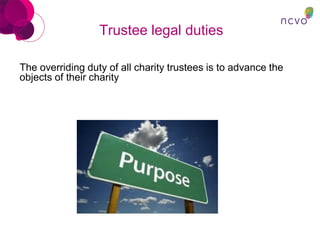
Trustee legal duties
The overriding duty of all charity trustees is to advance the
objects of their charity
What are the legal duties of trustees?
• Duty to comply with the governing document
• Duty of care
• Duty to safeguard and protect the charity’s resources
• Duty to act in the best interests of beneficiaries and to
avoid conflicts of interest
• Duty to act personally or directly
• Duty to act collectively
• Duty not to profit
• Other statutory duties
Trustee personal liability
Image: The Scream by Edvard Munch
Trustee personal liability
• Governance liabilities
– e.g. breach of duty under charity law
• Operational liabilities
– e.g. claims from third parties
• Failure to comply with relevant statutory requirements
– e.g. health and safety, PAYE, trade descriptions, financial
services, filing requirements
Trustee liability – protection!
• Incorporation (CIO, charitable company) but does not
offer complete protection
• Trustee indemnity insurance
• Plus –
– good management practices
– clear roles and responsibilities
– records of decisions taken
– provisions in governing document
– contingency funds
– professional advice
– board development
– risk management
Six key principles of good
governance
An effective board will provide good governance and leadership by:
1. Understanding their role;
2. Ensuring delivery of organisational purpose;
3. Working effectively both as individuals and as a team;
4. Exercising effective control;
5. Behaving with integrity; and
6. Being open and accountable.
Good Governance: A Code for the Voluntary and Community Sector
Getting Started:
trustee recruitment and
induction
Useful resources
• NCVO governance pages: www.ncvo.org.uk
• Trustees Unlimited knowledge bank: http://www.trustees-
unlimited.co.uk
• Charity Commission website and guidance: www.charity-
commission.gov.uk
• Good Governance: A code for the voluntary and
community sector www.governancecode.org
• NCVO’s The Good Trustee Guide (print)
• NCVO’s Good Governance: a practical guide for
trustees, chairs & CEOs (print)
Summary & Close
• Today we covered:
- trustee roles and responsibilities
- trustee liabilities and protections
- principles and code of good governance
- good practice in trustee recruitment
and induction
• Final questions and comments
• What will you take away to your
trusteeship or board?
Thank you
myles.kunzli@ncvo.org.uk
ian.joseph@russam-gms.co.uk

What every new trustee should know

  • 1.
    AM2: What everynew trustee should know Myles Kunzli, Consultant, NCVO Ian Joseph, Trustees Unlimited
  • 2.
    Purpose of theSession • Outline core trustee roles and responsibilities • Outline trustee liabilities and protections • Identify the principles of good governance for the voluntary and community sector • Identify good practice in trustee recruitment and induction Answer other queries you have on new trusteeship
  • 3.
    Governance nuts andbolts Governance is the systems and processes concerned with ensuring the overall direction, effectiveness, supervision and accountability of an organisation. Cornforth, CJ 2003
  • 4.
    Governance and leadership Governanceis about leadership and ensuring that an organisation is effectively and properly run Good Trustee Guide, NCVO Governance is not necessarily about doing, it is about ensuring things are done The Good Governance Action Plan for Voluntary Organisations, NCVO
  • 5.
    Three key strandsof governance 1. Impact focus on mission/users/beneficiaries 2. Strategic focus on organisation 3. Corporate/fiduciary focus on assets Dorothy Dalton, Good Governance: a practical guide for trustees, chairs and CEOs (NCVO 2011)
  • 6.
    Who are thetrustees? The persons having the general control and management of the administration of a charity Section 177 of the Charities Act 2011
  • 7.
    Who are thetrustees? Trustees have and must accept ultimate responsibility for directing the affairs of the charity, and ensuring that it is solvent, well-run, and delivering the charitable outcomes for the benefit of the public for which it has been set up Charity Commission guidance: The Essential Trustee: What you need to know
  • 8.
    Who are thetrustees? • Voting members of the governing body • Usually elected or appointed in accordance with the charity’s governing document • Entrusted with the resources (money, reputation, property, equipment) of the organisation • Operate within a formal set of rules • In a charitable company, company directors and trustees are the same people • Trustees often delegate day to day tasks to staff and/or volunteers
  • 9.
    The essential tasksof the board • Set and maintain vision, mission and values • Develop strategy • Establish and monitor policies • Ensure compliance with the governing document • Ensure accountability • Ensure compliance with the law • Maintain proper fiscal oversight • Respect the role of staff / volunteers • Maintain effective board performance • Promote the organisation Where staff are employed: • Set up employment procedures • Select and support the chief executive
  • 10.
    Three essential questionsfor a trustee 1. Why does my organisation exist? 2. Where is it going in the future? 3. Are we meeting our objects in the most effective and efficient way?
  • 11.
    Trustee legal duties Theoverriding duty of all charity trustees is to advance the objects of their charity
  • 12.
    What are thelegal duties of trustees? • Duty to comply with the governing document • Duty of care • Duty to safeguard and protect the charity’s resources • Duty to act in the best interests of beneficiaries and to avoid conflicts of interest • Duty to act personally or directly • Duty to act collectively • Duty not to profit • Other statutory duties
  • 13.
    Trustee personal liability Image:The Scream by Edvard Munch
  • 14.
    Trustee personal liability •Governance liabilities – e.g. breach of duty under charity law • Operational liabilities – e.g. claims from third parties • Failure to comply with relevant statutory requirements – e.g. health and safety, PAYE, trade descriptions, financial services, filing requirements
  • 15.
    Trustee liability –protection! • Incorporation (CIO, charitable company) but does not offer complete protection • Trustee indemnity insurance • Plus – – good management practices – clear roles and responsibilities – records of decisions taken – provisions in governing document – contingency funds – professional advice – board development – risk management
  • 16.
    Six key principlesof good governance An effective board will provide good governance and leadership by: 1. Understanding their role; 2. Ensuring delivery of organisational purpose; 3. Working effectively both as individuals and as a team; 4. Exercising effective control; 5. Behaving with integrity; and 6. Being open and accountable. Good Governance: A Code for the Voluntary and Community Sector
  • 17.
  • 18.
    Useful resources • NCVOgovernance pages: www.ncvo.org.uk • Trustees Unlimited knowledge bank: http://www.trustees- unlimited.co.uk • Charity Commission website and guidance: www.charity- commission.gov.uk • Good Governance: A code for the voluntary and community sector www.governancecode.org • NCVO’s The Good Trustee Guide (print) • NCVO’s Good Governance: a practical guide for trustees, chairs & CEOs (print)
  • 19.
    Summary & Close •Today we covered: - trustee roles and responsibilities - trustee liabilities and protections - principles and code of good governance - good practice in trustee recruitment and induction • Final questions and comments • What will you take away to your trusteeship or board?
  • 20.