Download to read offline
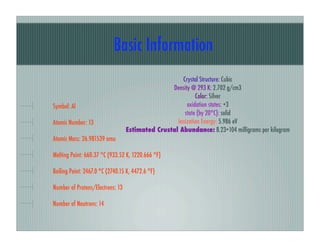
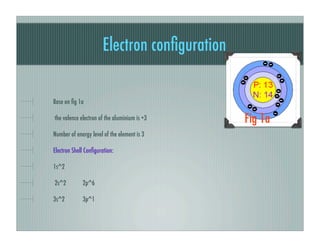
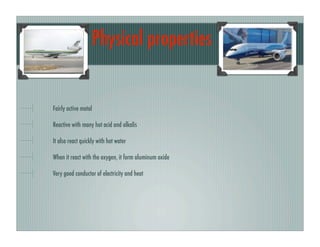
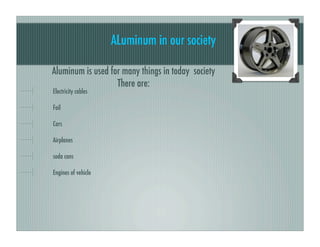


Aluminum is a silvery-white metal that is the third most abundant element in the Earth's crust. It has a cubic crystal structure and a melting point of 660.37°C. Aluminum is highly reactive and forms a protective oxide layer that prevents further corrosion. It is extracted through electrolysis of molten aluminum oxide (alumina). Aluminum has many applications due to its light weight, conductivity, and resistance to corrosion including use in transportation, packaging, and construction. It was first isolated in 1825 but its commercial production began in 1886 with the Hall-Héroult process of electrolysis.


