Alanine Aminotransferase (ALT)/
Glutamate pyruvate
transaminase [GPT]
• Alanine Aminotransferase (ALT) belongs to the group of
transaminases which catalyze the conversion of amino acids to the
corresponding α-keto acids via the transfer of amino groups; they also
catalyze the reverse process.
• Although higher activity exist in the liver, minor activity can also be
detected in the kidneys, heart, skeletal muscle, pancreas, spleen and
lungs.
• Elevated levels of transaminases are indicative of mycocardial
infarction, hepatopathies, muscular dystrophy, and damage to
internal organs.
• In the hepatocyte, ALT is located only in the cytosol whereas AST is
found in the cytosol and in the mitochondria and thus it has been
suggested, that in the context of liver disease a serum AST value in
excess of the serum ALT value indicates a severe disease process.
• Increased ALT activity in the serum, however , is a rather specific
indicator of damage to the liver parenchyma, while AST is not
necessarily a liver specific parameter
• Alcoholic liver disease is associated with a high AST:ALT ratio; and it is
further suggested that when the serum transaminase concentrations
are raised, but less than ten-fold the upper reference limit (i.e., <400
UL).
• An AST:ALT ratio greater than 2 is strong evidence for alcoholic liver
disease.
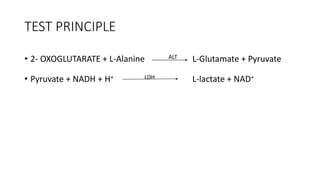
TEST PRINCIPLE
• 2- OXOGLUTARATE + L-Alanine ALT L-Glutamate + Pyruvate
• Pyruvate + NADH + H+ LDH L-lactate + NAD+
REAGENT HANDLING AND PREPARATION
• Mix the contents of each bottle by gently swirling them before use.
• Mix 1 volume of R2 with 5 volumes of R1.
• Wait at least 5 minutes before use
• This solution is stable: 35 days at 2 – 8 oC
SPECIMEN
• Collect serum using standard sampling tubes
• SST, HEPARIN or EDTA PLASMA
• Separate serum/plasma from clot/cells within 8 hours at room
temperature or 48 hours at 2 – 8 oC
• Centrifuge samples containing precipitate before performing the
assay.
PIPETTE INTO TEST TUBES AS FOLLOWS:
BLANK TEST
WORKING REAGENT 1000 µL 1000 µl
Distilled Water 100 µL ----
Sample ----- 100 µL
Mix gently, incubate for 1 min at 37oC, measure initial absorbance and start stopwatch simultaneously. Read
again after exactly 1, 2 and 3 minutes
CALCULATION
• IU/L = (ΔA/min) x 1746
LINEARITY
• Up to 418 U/l
• Samples with higher values should be diluted with 0.9% NaCl or
distilled /deionized water (e.g. 1+9).
• Multiply the result by the appropriate dilution factor (e.g factor 10)
SENSITIVITY
• Detection limit: 3 U/l
• The lower detection limit represents the lowest measurable ALT
concentration that can be distinguished from zero (0)
NORMAL VALUES
30oC 37oC
Women Up to 22 U/l Up to 31 U/l
Men Up to 29 U/l Up to 41 U/l
REFERENCES
• International Federation of Clinical Chemistry, Scientific committee. J
Clin Chem clin Biochem 1980 18:521 – 534.
• Glick MR, Ryder KW, Jackson SA. Graphical Comparisons of
Interferences in Clinical Chemistry Instrumentation. Clin Clem
1986;32:470-474
• Wroblewski F, LaDue JS. Proc Soc Exp Biol Med 1956;91:569

ALT.pptx

  • 1.
    Alanine Aminotransferase (ALT)/ Glutamatepyruvate transaminase [GPT]
  • 2.
    • Alanine Aminotransferase(ALT) belongs to the group of transaminases which catalyze the conversion of amino acids to the corresponding α-keto acids via the transfer of amino groups; they also catalyze the reverse process.
  • 3.
    • Although higheractivity exist in the liver, minor activity can also be detected in the kidneys, heart, skeletal muscle, pancreas, spleen and lungs. • Elevated levels of transaminases are indicative of mycocardial infarction, hepatopathies, muscular dystrophy, and damage to internal organs.
  • 4.
    • In thehepatocyte, ALT is located only in the cytosol whereas AST is found in the cytosol and in the mitochondria and thus it has been suggested, that in the context of liver disease a serum AST value in excess of the serum ALT value indicates a severe disease process.
  • 5.
    • Increased ALTactivity in the serum, however , is a rather specific indicator of damage to the liver parenchyma, while AST is not necessarily a liver specific parameter
  • 6.
    • Alcoholic liverdisease is associated with a high AST:ALT ratio; and it is further suggested that when the serum transaminase concentrations are raised, but less than ten-fold the upper reference limit (i.e., <400 UL). • An AST:ALT ratio greater than 2 is strong evidence for alcoholic liver disease.
  • 7.
    TEST PRINCIPLE • 2-OXOGLUTARATE + L-Alanine ALT L-Glutamate + Pyruvate • Pyruvate + NADH + H+ LDH L-lactate + NAD+
  • 8.
    REAGENT HANDLING ANDPREPARATION • Mix the contents of each bottle by gently swirling them before use. • Mix 1 volume of R2 with 5 volumes of R1. • Wait at least 5 minutes before use • This solution is stable: 35 days at 2 – 8 oC
  • 9.
    SPECIMEN • Collect serumusing standard sampling tubes • SST, HEPARIN or EDTA PLASMA • Separate serum/plasma from clot/cells within 8 hours at room temperature or 48 hours at 2 – 8 oC • Centrifuge samples containing precipitate before performing the assay.
  • 10.
    PIPETTE INTO TESTTUBES AS FOLLOWS: BLANK TEST WORKING REAGENT 1000 µL 1000 µl Distilled Water 100 µL ---- Sample ----- 100 µL Mix gently, incubate for 1 min at 37oC, measure initial absorbance and start stopwatch simultaneously. Read again after exactly 1, 2 and 3 minutes
  • 11.
    CALCULATION • IU/L =(ΔA/min) x 1746
  • 12.
    LINEARITY • Up to418 U/l • Samples with higher values should be diluted with 0.9% NaCl or distilled /deionized water (e.g. 1+9). • Multiply the result by the appropriate dilution factor (e.g factor 10)
  • 13.
    SENSITIVITY • Detection limit:3 U/l • The lower detection limit represents the lowest measurable ALT concentration that can be distinguished from zero (0)
  • 14.
    NORMAL VALUES 30oC 37oC WomenUp to 22 U/l Up to 31 U/l Men Up to 29 U/l Up to 41 U/l
  • 15.
    REFERENCES • International Federationof Clinical Chemistry, Scientific committee. J Clin Chem clin Biochem 1980 18:521 – 534. • Glick MR, Ryder KW, Jackson SA. Graphical Comparisons of Interferences in Clinical Chemistry Instrumentation. Clin Clem 1986;32:470-474 • Wroblewski F, LaDue JS. Proc Soc Exp Biol Med 1956;91:569