Alternative Sewage Treatment Option:  The Effect of use of Water Hyacinth  (Eichornia crassipes) in the Treatment of Domestic Sewage   A. E. Adeniran Works & Physical Planning Department University of Lagos, Nigeria [email_address] [email_address]
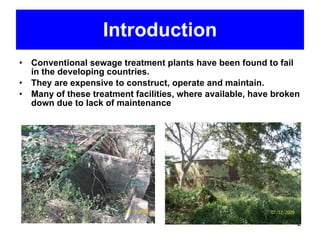
Conventional sewage treatment plants have been found to fail in the developing countries. They are expensive to construct, operate and maintain.  Many of these treatment facilities, where available, have broken down due to lack of maintenance Introduction
The result is polluted canals and water streams
Constructed Wetland and Sewage Treatment Constructed wetlands (CW), are now widely used as an accepted method of treating wastewater and are cheaper than traditional wastewater treatment plants   CW is appealing to developing nations in the tropics due to the high rate of plant growth (Kivaisi, 2001.  Campbell and Ogden, 1999; Gopal, 1999; Kadlec and Knight, 1995; Kadlec, 1995)  Water Hyacinth sewage treatment plant as a form of CW  in improving the sewage effluent quality parameters is examined here.
Introduction Continued We examined the effect of the growth of water hyacinth as a form of constructed wetland with surface flow on selected sewage quality parameters on weekly basis for a period of 24 weeks.  Observation after 24 weeks show: 100%  - Colour 92.95%  - Turbidity,  84%  - BOD 88%  - TDS, 76%  - Nitrate, 87%  - Phosphate  99.65%  - e-coli It is concluded that the use of water hyacinth plant on domestic sewage pond is a viable and cheaper alternative method of domestic sewage treatment
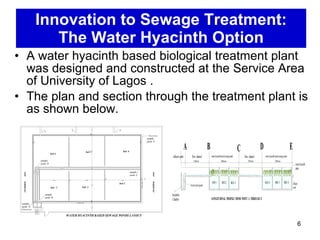
Innovation to Sewage Treatment: The Water Hyacinth Option A water hyacinth based biological treatment plant was designed and constructed at the Service Area of University of Lagos .  The plan and section through the treatment plant is as shown below.
Operation & Hyacinth Growth Domestic sewage, from the University of Lagos sewer system, at a flow rate of 7.87m3/s (680m3/day) was introduced into the beds. Water hyacinth plants (Eichhornia crassipes) obtained from natural specimens grown in polluted canal at Iwaya, near the University of Lagos, Nigeria were planted on the ponds  Initially, a total of 15.6m3 of water hyacinth was planted on the pond i.e. an average of 2.6m2 per bed. The area covered by the water hyacinth on each bed was measured weekly for 24 weeks from 18th March, 2010 to 31st August, 2010..
OBSERVATIONS Samples of the sewage influent and effluent were collected at Influent and Effluent Points on a weekly basis Observation Period was from 18th March, 2010 to 31st August, 2010.  The samples were analysed in the laboratory to determine the level of concentration of the observed parameters  Also, the growth patterns of the water hyacinth plants on each bed were monitored and measured.  Methods
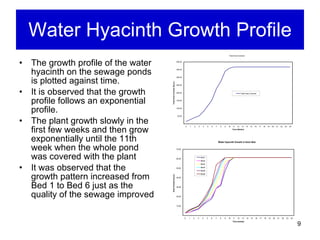
Water Hyacinth Growth Profile The growth profile of the water hyacinth on the sewage ponds is plotted against time.  It is observed that the growth profile follows an exponential profile.  The plant growth slowly in the first few weeks and then grow exponentially until the 11th week when the whole pond was covered with the plant It was observed that the growth pattern increased from Bed 1 to Bed 6 just as the quality of the sewage improved
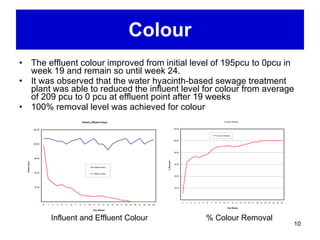
Colour The effluent colour improved from initial level of 195pcu to 0pcu in week 19 and remain so until week 24.  It was observed that the water hyacinth-based sewage treatment plant was able to reduced the influent level for colour from average of 209 pcu to 0 pcu at effluent point after 19 weeks  100% removal level was achieved for colour  Influent and Effluent Colour % Colour Removal
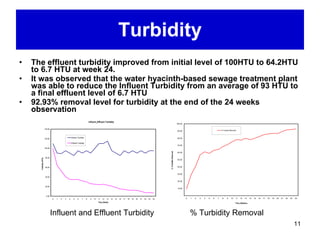
Turbidity The effluent turbidity improved from initial level of 100HTU to 64.2HTU  to 6.7 HTU at week 24.  It was observed that the water hyacinth-based sewage treatment plant was able to reduce the Influent Turbidity from an average of 93 HTU to a final effluent level of 6.7 HTU 92.93% removal level for turbidity at the end of the 24 weeks observation   Influent and Effluent Turbidity % Turbidity Removal
Biochemical Oxygen Demands (BOD)   The effluent BOD improved from initial level of 508 to 83 mg/l.  The average Influent BOD level of 513mg/l was reduced to a final effluent level of 83mg/l 83.84% removal level for BOD was achieved. Influent Vs Effluent BOD   % TDS Removal
Removal of Nitrate The effluent Nitrate improved from initial level of 9.5 to 2.33 mg/l.  The average Influent Nitrate level of 10.91mg/l was reduced to a final effluent level of 2.33mg/l 78.64% removal level for Nitrate was achieved Influent and Effluent Nitrate   % Nitrate Removal
Removal of Phosphate The effluent Phosphate improved from initial level of 20.60 to 2.60 mg/l.  The average Influent Phosphate level of 21.75mg/l was reduced to a final effluent level of 2.60mg/l 88.05% removal level for Phosphate was achieved Influent and Effluent Phosphate   % Phosphate Removal
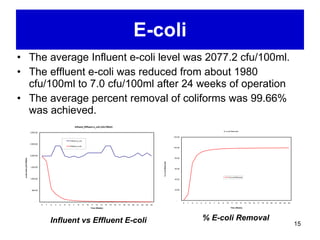
E-coli The average Influent e-coli level was 2077.2 cfu/100ml. The effluent e-coli was reduced from about 1980 cfu/100ml to 7.0 cfu/100ml after 24 weeks of operation The average percent removal of coliforms was 99.66% was achieved.  Influent vs Effluent E-coli   % E-coli Removal
Summary of Results 99.66 7.0 2077.2 E-coli (cfu/100ml) 88.05 2.60 21.75 Phosphate (mg/l) 78.64 2.33 10.91 Nitrate (mg/l) 83.84 83 513 BOD 5  (mg/l) 88.00 74 616 TDS (mg/l) 92.96 6.7 95 Turbidity (HTU) 100.00 0 209 Colour (pcu) %  Removal Final Effluent Level Average Influent Level Parameter
Energy Requirements and Cost Savings Treatment Capacity =  680m3/day 87 N17,136,000.00 N2,268,000.00 Cost/yr (12 mths) 87 N1,428,000.00 N189,000.00 Cost/mth (30days) 87 N47,600.00 N6,300.00 Cost/day (20 hrs) 87 N2,380.00 N315.00 Cost/hr 87 340 KWh 45 KWh Energy Requirement %  Saving Conventional Sewage Treatment Water Hyacinth System Items
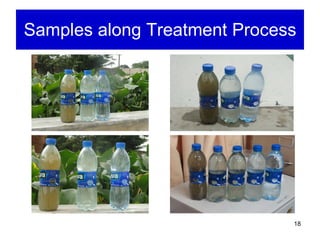
Samples along Treatment Process
From Influent to Effluent The Difference is Clear!
THANK YOU

Alternative sewage treatment option for Developing Countries

  • 1.
    Alternative Sewage TreatmentOption: The Effect of use of Water Hyacinth (Eichornia crassipes) in the Treatment of Domestic Sewage A. E. Adeniran Works & Physical Planning Department University of Lagos, Nigeria [email_address] [email_address]
  • 2.
    Conventional sewage treatmentplants have been found to fail in the developing countries. They are expensive to construct, operate and maintain. Many of these treatment facilities, where available, have broken down due to lack of maintenance Introduction
  • 3.
    The result ispolluted canals and water streams
  • 4.
    Constructed Wetland andSewage Treatment Constructed wetlands (CW), are now widely used as an accepted method of treating wastewater and are cheaper than traditional wastewater treatment plants CW is appealing to developing nations in the tropics due to the high rate of plant growth (Kivaisi, 2001. Campbell and Ogden, 1999; Gopal, 1999; Kadlec and Knight, 1995; Kadlec, 1995) Water Hyacinth sewage treatment plant as a form of CW in improving the sewage effluent quality parameters is examined here.
  • 5.
    Introduction Continued Weexamined the effect of the growth of water hyacinth as a form of constructed wetland with surface flow on selected sewage quality parameters on weekly basis for a period of 24 weeks. Observation after 24 weeks show: 100% - Colour 92.95% - Turbidity, 84% - BOD 88% - TDS, 76% - Nitrate, 87% - Phosphate 99.65% - e-coli It is concluded that the use of water hyacinth plant on domestic sewage pond is a viable and cheaper alternative method of domestic sewage treatment
  • 6.
    Innovation to SewageTreatment: The Water Hyacinth Option A water hyacinth based biological treatment plant was designed and constructed at the Service Area of University of Lagos . The plan and section through the treatment plant is as shown below.
  • 7.
    Operation & HyacinthGrowth Domestic sewage, from the University of Lagos sewer system, at a flow rate of 7.87m3/s (680m3/day) was introduced into the beds. Water hyacinth plants (Eichhornia crassipes) obtained from natural specimens grown in polluted canal at Iwaya, near the University of Lagos, Nigeria were planted on the ponds Initially, a total of 15.6m3 of water hyacinth was planted on the pond i.e. an average of 2.6m2 per bed. The area covered by the water hyacinth on each bed was measured weekly for 24 weeks from 18th March, 2010 to 31st August, 2010..
  • 8.
    OBSERVATIONS Samples ofthe sewage influent and effluent were collected at Influent and Effluent Points on a weekly basis Observation Period was from 18th March, 2010 to 31st August, 2010. The samples were analysed in the laboratory to determine the level of concentration of the observed parameters Also, the growth patterns of the water hyacinth plants on each bed were monitored and measured. Methods
  • 9.
    Water Hyacinth GrowthProfile The growth profile of the water hyacinth on the sewage ponds is plotted against time. It is observed that the growth profile follows an exponential profile. The plant growth slowly in the first few weeks and then grow exponentially until the 11th week when the whole pond was covered with the plant It was observed that the growth pattern increased from Bed 1 to Bed 6 just as the quality of the sewage improved
  • 10.
    Colour The effluentcolour improved from initial level of 195pcu to 0pcu in week 19 and remain so until week 24. It was observed that the water hyacinth-based sewage treatment plant was able to reduced the influent level for colour from average of 209 pcu to 0 pcu at effluent point after 19 weeks 100% removal level was achieved for colour Influent and Effluent Colour % Colour Removal
  • 11.
    Turbidity The effluentturbidity improved from initial level of 100HTU to 64.2HTU to 6.7 HTU at week 24. It was observed that the water hyacinth-based sewage treatment plant was able to reduce the Influent Turbidity from an average of 93 HTU to a final effluent level of 6.7 HTU 92.93% removal level for turbidity at the end of the 24 weeks observation Influent and Effluent Turbidity % Turbidity Removal
  • 12.
    Biochemical Oxygen Demands(BOD) The effluent BOD improved from initial level of 508 to 83 mg/l. The average Influent BOD level of 513mg/l was reduced to a final effluent level of 83mg/l 83.84% removal level for BOD was achieved. Influent Vs Effluent BOD % TDS Removal
  • 13.
    Removal of NitrateThe effluent Nitrate improved from initial level of 9.5 to 2.33 mg/l. The average Influent Nitrate level of 10.91mg/l was reduced to a final effluent level of 2.33mg/l 78.64% removal level for Nitrate was achieved Influent and Effluent Nitrate % Nitrate Removal
  • 14.
    Removal of PhosphateThe effluent Phosphate improved from initial level of 20.60 to 2.60 mg/l. The average Influent Phosphate level of 21.75mg/l was reduced to a final effluent level of 2.60mg/l 88.05% removal level for Phosphate was achieved Influent and Effluent Phosphate % Phosphate Removal
  • 15.
    E-coli The averageInfluent e-coli level was 2077.2 cfu/100ml. The effluent e-coli was reduced from about 1980 cfu/100ml to 7.0 cfu/100ml after 24 weeks of operation The average percent removal of coliforms was 99.66% was achieved. Influent vs Effluent E-coli % E-coli Removal
  • 16.
    Summary of Results99.66 7.0 2077.2 E-coli (cfu/100ml) 88.05 2.60 21.75 Phosphate (mg/l) 78.64 2.33 10.91 Nitrate (mg/l) 83.84 83 513 BOD 5 (mg/l) 88.00 74 616 TDS (mg/l) 92.96 6.7 95 Turbidity (HTU) 100.00 0 209 Colour (pcu) % Removal Final Effluent Level Average Influent Level Parameter
  • 17.
    Energy Requirements andCost Savings Treatment Capacity = 680m3/day 87 N17,136,000.00 N2,268,000.00 Cost/yr (12 mths) 87 N1,428,000.00 N189,000.00 Cost/mth (30days) 87 N47,600.00 N6,300.00 Cost/day (20 hrs) 87 N2,380.00 N315.00 Cost/hr 87 340 KWh 45 KWh Energy Requirement % Saving Conventional Sewage Treatment Water Hyacinth System Items
  • 18.
  • 19.
    From Influent toEffluent The Difference is Clear!
  • 20.