ALTERNATE ENERGY
SOURCES
INTRODUCTION
 Any physical activity in this world, whether carried
out by human beings or by nature, is cause due to
flow of energy in one form or the other.
 The word ‘energy’ itself is derived from the Greek
word ‘en-ergon’, which means ‘in-work’ or ‘work
content’.
 The work output depends on the energy input.
 Energy is one of the major inputs for the economic
development of any country.
Classification of energy
 Primary and Secondary energy
 Renewable and Non-Renewable energy
 Conventional and Non-conventional energy
Primary energy sources
 Primary energy sources are those that are either found
or stored in nature.
 Common primary energy sources are coal, oil, natural gas,
and biomass (such as wood).
 Other primary energy sources available include nuclear
energy from radioactive substances, thermal energy stored
in earth's interior, and potential energy due to earth's
gravity.
Primary and Secondary Energy
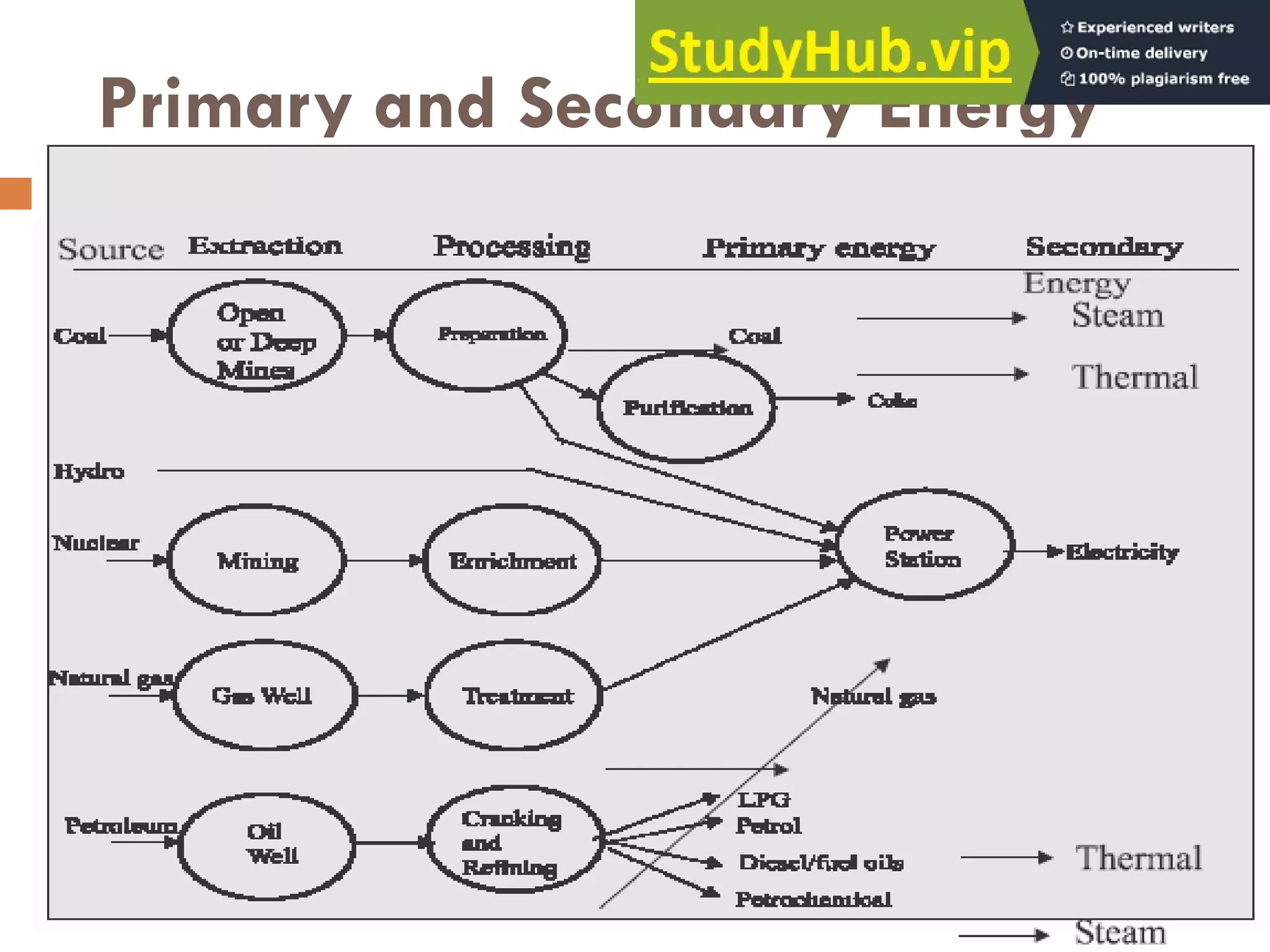
 Primary energy sources are costly converted in
industrial utilities into secondary energy sources;
 for example coal, oil or gas converted into steam
and electricity. Primary energy can also be used
directly.
Primary and Secondary Energy
Conventional Energy
 Conventional energy resources which are being
traditionally used for many decades and were in
common use around oil crisis of 1973 are called
conventional energy resources, e.g., fossil fuel,
nuclear and hydro resources.
NonConventional Energy
 Non-conventional energy resources which are
considered for large scale use after oil crisis of
1973, are called non-conventional energy sources,
e.g., solar, wind, biomass, etc.
Global Primary Energy Reserves*
Coal
 The proven global coal reserve was estimated to be
9,84,453 million tonnes by end of 2003.
 The USA had the largest share of the global
reserve (25.4%) followed by Russia (15.9%), China
(11.6%).
 India was 4th in the list with 8.6%.
Oil
 The global proven oil reserve was estimated to be
1147 billion barrels by the end of 2003.
 Saudi Arabia had the largest share of the reserve
with almost 23%. (One barrel of oil is
approximately 160 liters)
Global Primary Energy Reserves*
Gas
 The global proven gas reserve was estimated to be
176 trillion cubic metres by the end of 2003.
 The Russian Federation had the largest share of the
reserve with almost 27%.
Global Primary Energy Reserves*
Energy distribution between
developed and developing Countries
 Although 80 percent of the world's population lies in the
developing countries (a four- fold population increase in the
past 25 years), their energy consumption amounts to only 40
percent of the world total energy consumption.
 The high standards of living in the developed countries are
attributable to high energy consumption levels.
 The world average energy consumption per person is
equivalent to 2.2 tones of coal. In industrialized countries,
people use four to five times more than the world average and
nine times more than the average for the developing countries.
An American uses 32 times more commercial energy than an
Indian.
Indian Energy Scenario
 Coal dominates the energy mix in India, contributing
to 55% of the total primary energy production.
 Over the years, there has been a marked increase
in the share of natural gas in primary energy
production from 10% in 1994 to 13% in 1999.
There has been a decline in the share of oil in
primary energy production from 20% to 17%
during the same period.
What is the current energy scenario?
 75% of energy requirement is met by fossil fuels.
 Nuclear energy contributes to about 3%.
 9% is met by hydoenergy.
 12% of energy consumption is met by biogas.
 Renewable sources like wind, tidal, wave, solar,
contribute to about 1%.
Why should we look for alternate
energy sources?
 Fossil fuels, which are the main source of energy,
are getting depleted at a rapid rate. As a
consequence the cost of fossil fuels are increasing.
 Fossil fuel based systems produce detrimental
effects on the environments. This in turn will affect
our health. This means that indirectly, the medical
bills will be rising the world over.
What is the annual world energy
consumption?
 Energy consumption in a year can be calculated by
taking the sum of energy generated by different
sources in a year.
 Statistics indicate that the energy consumption in
year 2004 was 70×1012KWh.
 Estimates indicate that the energy consumption is
increasing at the rate of 7% pa.
How long will fossil fuel last?
 The energy density of fuel is in the range of
10000Wh/Lt.
 The energy content in the fuel within the earth is
obtained as 1.1×1025KWh. Assuming that growth rate
is maintained at 7% and the entire energy is supplied
using fossil fuels. The energy requirement at any time, t
can be calculated using 70×1012e0.07tKWh
 t is obtained as 368 years. The fossil fuels will get
depleted in about 368 years.
How long will fossil fuel last?
 As the annual energy consumption rate is continually
growing. fuel may get exhausted in about 70-100
years.
 If the reserves of fuels decrease there will be a
sharp increase in the price of energy. This will lead
to decrease in energy consumption through fossil
fuels. If alternative sources are explored and
utilized, then the fuel may be actually used for
more number of years.
Is nuclear energy really an alternative?
 Nuclear energy as an alternative source is not a
feasible option. To increase the present 3%
consumption to say 20% it requires the installation
of a 400MW plant every day for the next 10
years!!!.
 The disposal of nuclear waste also poses a problem.
What about energy densities?
 The alternative sources considered have energy
density in the range of 10Wh/Lt where as fossil
fuel energy density is in the range of 10000Wh/Lt.
What are the alternative energy
possibilities?
 Solar photovoltaic
 Solar thermal
 Wave
 Tidal
 Wind
 Geothermal
 Bio
Hazards of concentrated energy usage
pattern
 Depletion of fossil fuels
 Environmental hazards
 Health hazards
A case for enviroment…
 Green house effects
 Climate change
 Depletion of stratospheric ozone layer
Green house effect
 Green house gases make the Earth warmer by
trapping energy in the atmosphere.
Green house effect
 Green house gases –carbon dioxide, nitrous oxide,
methane, chloro fluorocarbons.
 Green house gases are the temperature stabilisers
of the earth’s atmosphere.
 Temperature stabilisation is by trapping radiated
heat from the earth’s surface by these green house
gases.
Green house effect
Climate change
 Climate is the long-term average of a region's
weather. For example, it's possible that a winter
day in Bangalore could be sunny and mild, but the
average weather –the climate –tells us that
Bangalore's winters will mainly be cold and include
rain. Climate change represents a change in these
long-term weather patterns. They can become
warmer or colder. Annual amounts of rainfall or
snowfall can increase or decrease.
Global warming
 Due to emissions from the fossil fuel based systems,
the green house gases in the atmosphere increases.
 As a result, the average temperature of the earth is
becoming higher.
Global warming
 Global warming refers to an average increase in
the Earth's temperature, which in turn causes
changes in climate.
 A warmer Earth may lead to changes in rainfall
patterns, a rise in sea level, and a wide range of
impacts on plants, wildlife, and humans.
 When scientists talk about the issue of climate
change, their concern is about global warming
caused by human activities.
Effects of Global warming
 changes in rainfall patterns
 rise in sea level
 impacts on flora and fauna
 impacts on human health
Health is an issue!
 CO poisoning.
 Asthma.
 Skin diseases and cancer due to depletion of
stratospheric ozone.
When Do You Send Greenhouse
Gases into the Air?
 Whenever you ...
 Watch TV
 Use the Air Conditioner
 Turn on a Light ·Use a Hair Dryer
 Ride in a Car
 Play a Video Game
 Listen to a Stereo
 Wash or Dry Clothes
 Use a Dish Washer
 Microwave a Meal
.. you are helping to send greenhouse gas into the air.
 To perform many of these functions, you need to use electricity.
Electricity comes from power plants. Most power plants use coal
and oil to make electricity. Burning coal and oil produces
greenhouse gases.
Other things we do that send
greenhouse gases into the air !
 The trash that we send to landfills produces a
greenhouse gas called methane.
 Methane is also produced by the animals we raise
for dairy and meat products and when we take
coal out of the ground.
 Whenever we drive or ride in a car, we are adding
greenhouse gases to the atmosphere.
 And, when factories make the things that we buy
and use everyday, they too are sending greenhouse
gases into the air.
Scope for alternative energies…
 75% of energy comes from fossil fuels such as crude
oils, coal and natural gas
 12% from bio fuels such as methane
 9% from hydro based
 3% from nuclear
 1% from windmills and
photovoltaic put together Scope to increase

ALTERNATE ENERGY SOURCES

  • 1.
  • 2.
    INTRODUCTION  Any physicalactivity in this world, whether carried out by human beings or by nature, is cause due to flow of energy in one form or the other.  The word ‘energy’ itself is derived from the Greek word ‘en-ergon’, which means ‘in-work’ or ‘work content’.  The work output depends on the energy input.  Energy is one of the major inputs for the economic development of any country.
  • 3.
    Classification of energy Primary and Secondary energy  Renewable and Non-Renewable energy  Conventional and Non-conventional energy
  • 4.
    Primary energy sources Primary energy sources are those that are either found or stored in nature.  Common primary energy sources are coal, oil, natural gas, and biomass (such as wood).  Other primary energy sources available include nuclear energy from radioactive substances, thermal energy stored in earth's interior, and potential energy due to earth's gravity.
  • 5.
  • 6.
     Primary energysources are costly converted in industrial utilities into secondary energy sources;  for example coal, oil or gas converted into steam and electricity. Primary energy can also be used directly. Primary and Secondary Energy
  • 7.
    Conventional Energy  Conventionalenergy resources which are being traditionally used for many decades and were in common use around oil crisis of 1973 are called conventional energy resources, e.g., fossil fuel, nuclear and hydro resources.
  • 8.
    NonConventional Energy  Non-conventionalenergy resources which are considered for large scale use after oil crisis of 1973, are called non-conventional energy sources, e.g., solar, wind, biomass, etc.
  • 9.
    Global Primary EnergyReserves* Coal  The proven global coal reserve was estimated to be 9,84,453 million tonnes by end of 2003.  The USA had the largest share of the global reserve (25.4%) followed by Russia (15.9%), China (11.6%).  India was 4th in the list with 8.6%.
  • 10.
    Oil  The globalproven oil reserve was estimated to be 1147 billion barrels by the end of 2003.  Saudi Arabia had the largest share of the reserve with almost 23%. (One barrel of oil is approximately 160 liters) Global Primary Energy Reserves*
  • 11.
    Gas  The globalproven gas reserve was estimated to be 176 trillion cubic metres by the end of 2003.  The Russian Federation had the largest share of the reserve with almost 27%. Global Primary Energy Reserves*
  • 12.
    Energy distribution between developedand developing Countries  Although 80 percent of the world's population lies in the developing countries (a four- fold population increase in the past 25 years), their energy consumption amounts to only 40 percent of the world total energy consumption.  The high standards of living in the developed countries are attributable to high energy consumption levels.  The world average energy consumption per person is equivalent to 2.2 tones of coal. In industrialized countries, people use four to five times more than the world average and nine times more than the average for the developing countries. An American uses 32 times more commercial energy than an Indian.
  • 13.
    Indian Energy Scenario Coal dominates the energy mix in India, contributing to 55% of the total primary energy production.  Over the years, there has been a marked increase in the share of natural gas in primary energy production from 10% in 1994 to 13% in 1999. There has been a decline in the share of oil in primary energy production from 20% to 17% during the same period.
  • 14.
    What is thecurrent energy scenario?
  • 15.
    What is thecurrent energy scenario?  75% of energy requirement is met by fossil fuels.  Nuclear energy contributes to about 3%.  9% is met by hydoenergy.  12% of energy consumption is met by biogas.  Renewable sources like wind, tidal, wave, solar, contribute to about 1%.
  • 16.
    Why should welook for alternate energy sources?  Fossil fuels, which are the main source of energy, are getting depleted at a rapid rate. As a consequence the cost of fossil fuels are increasing.  Fossil fuel based systems produce detrimental effects on the environments. This in turn will affect our health. This means that indirectly, the medical bills will be rising the world over.
  • 17.
    What is theannual world energy consumption?  Energy consumption in a year can be calculated by taking the sum of energy generated by different sources in a year.  Statistics indicate that the energy consumption in year 2004 was 70×1012KWh.  Estimates indicate that the energy consumption is increasing at the rate of 7% pa.
  • 18.
    How long willfossil fuel last?  The energy density of fuel is in the range of 10000Wh/Lt.  The energy content in the fuel within the earth is obtained as 1.1×1025KWh. Assuming that growth rate is maintained at 7% and the entire energy is supplied using fossil fuels. The energy requirement at any time, t can be calculated using 70×1012e0.07tKWh  t is obtained as 368 years. The fossil fuels will get depleted in about 368 years.
  • 19.
    How long willfossil fuel last?  As the annual energy consumption rate is continually growing. fuel may get exhausted in about 70-100 years.  If the reserves of fuels decrease there will be a sharp increase in the price of energy. This will lead to decrease in energy consumption through fossil fuels. If alternative sources are explored and utilized, then the fuel may be actually used for more number of years.
  • 20.
    Is nuclear energyreally an alternative?  Nuclear energy as an alternative source is not a feasible option. To increase the present 3% consumption to say 20% it requires the installation of a 400MW plant every day for the next 10 years!!!.  The disposal of nuclear waste also poses a problem.
  • 21.
    What about energydensities?  The alternative sources considered have energy density in the range of 10Wh/Lt where as fossil fuel energy density is in the range of 10000Wh/Lt.
  • 22.
    What are thealternative energy possibilities?  Solar photovoltaic  Solar thermal  Wave  Tidal  Wind  Geothermal  Bio
  • 23.
    Hazards of concentratedenergy usage pattern  Depletion of fossil fuels  Environmental hazards  Health hazards
  • 24.
    A case forenviroment…  Green house effects  Climate change  Depletion of stratospheric ozone layer
  • 26.
    Green house effect Green house gases make the Earth warmer by trapping energy in the atmosphere.
  • 27.
    Green house effect Green house gases –carbon dioxide, nitrous oxide, methane, chloro fluorocarbons.  Green house gases are the temperature stabilisers of the earth’s atmosphere.  Temperature stabilisation is by trapping radiated heat from the earth’s surface by these green house gases.
  • 28.
  • 29.
    Climate change  Climateis the long-term average of a region's weather. For example, it's possible that a winter day in Bangalore could be sunny and mild, but the average weather –the climate –tells us that Bangalore's winters will mainly be cold and include rain. Climate change represents a change in these long-term weather patterns. They can become warmer or colder. Annual amounts of rainfall or snowfall can increase or decrease.
  • 30.
    Global warming  Dueto emissions from the fossil fuel based systems, the green house gases in the atmosphere increases.  As a result, the average temperature of the earth is becoming higher.
  • 31.
    Global warming  Globalwarming refers to an average increase in the Earth's temperature, which in turn causes changes in climate.  A warmer Earth may lead to changes in rainfall patterns, a rise in sea level, and a wide range of impacts on plants, wildlife, and humans.  When scientists talk about the issue of climate change, their concern is about global warming caused by human activities.
  • 32.
    Effects of Globalwarming  changes in rainfall patterns  rise in sea level  impacts on flora and fauna  impacts on human health
  • 33.
    Health is anissue!  CO poisoning.  Asthma.  Skin diseases and cancer due to depletion of stratospheric ozone.
  • 34.
    When Do YouSend Greenhouse Gases into the Air?  Whenever you ...  Watch TV  Use the Air Conditioner  Turn on a Light ·Use a Hair Dryer  Ride in a Car  Play a Video Game  Listen to a Stereo  Wash or Dry Clothes  Use a Dish Washer  Microwave a Meal .. you are helping to send greenhouse gas into the air.  To perform many of these functions, you need to use electricity. Electricity comes from power plants. Most power plants use coal and oil to make electricity. Burning coal and oil produces greenhouse gases.
  • 35.
    Other things wedo that send greenhouse gases into the air !  The trash that we send to landfills produces a greenhouse gas called methane.  Methane is also produced by the animals we raise for dairy and meat products and when we take coal out of the ground.  Whenever we drive or ride in a car, we are adding greenhouse gases to the atmosphere.  And, when factories make the things that we buy and use everyday, they too are sending greenhouse gases into the air.
  • 36.
    Scope for alternativeenergies…  75% of energy comes from fossil fuels such as crude oils, coal and natural gas  12% from bio fuels such as methane  9% from hydro based  3% from nuclear  1% from windmills and photovoltaic put together Scope to increase