ALPORT  SYNDROME
                INTRODUCTIONALPORT (1927) described the features of “HEREDITARY ALPORT SYNDROME”
Alport syndrome is otherwise called as “single gene syndrome”
One of the important characteristic features are “HEREDITARY NEPHRITIS AND DEAFNESS”  MODE OF INHERITANCEAlport syndrome is inherited in an “X-linked” pattern due to mutations in the COL4A5 gene. In males, who have only one X chromosome one altered copy of the COL4A5 gene is sufficient to cause severe alport syndrome. In female who have two X chromosomes, a mutation in one copy of the col4A5 gene usually results in blood in the urine.Autosomal domination inheritance.
                   INCIDENCE               The disorder is uncommon, and most often affects males. Women can transmit the gene for the disorder to their children, even if they have no symptoms.                74% of males are usually  diagnosed as having the disease before age 6.
              PREVALENCE          Alport syndrome is approximately reported 1 of 5000 births.
   CHARACTERISTIC FEATURESChronic nephritis
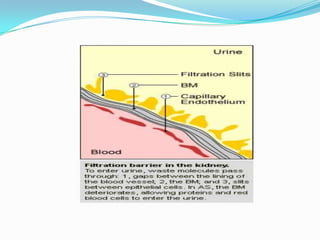
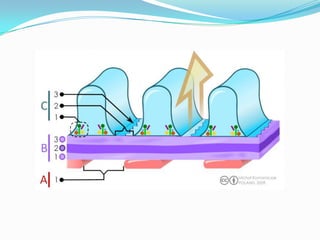
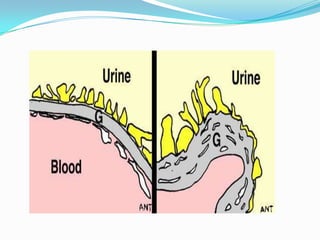
Renal disease->ultra structural changes of  the glomerular capillary basement membrane with absence of the immune phenomenon seen in other glomerular disease.
                 SYMPTOMSHematuria
Nephropathy
Hypertension in female patients
Slow progressive hearing loss
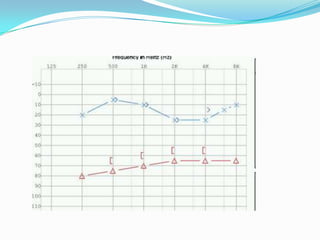
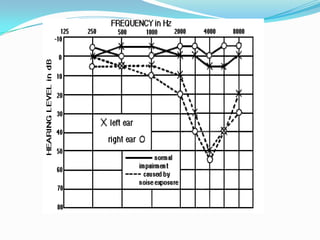
HEARING  CHARACTRISTICSIn Alport syndrome “BILATERAL PROGRESSIVE SENSORINEURAL HEARING IMPAIRMENT”Genetically based hearing impairmentThe hearing impairment occurs more frequently in patients and begins with gradual onset at about age 10.Loss of cochlear neurons and haircellsAtrophy of striavascularis and spiral ligament and endolympatichydrops.
According to Rintleman(1976)3 types of audiogram          -trough shaped         -slop and flat shapedBilateral symmetrical hearing loss
Degree of hearing loss ranges from mild to severe
SPEECH  CHARACTERISTICS Lack of articulation precision with high frequency consonants such as “fricatives”
Difficulty in monitoring vocal frequency and intensity level and in controlling the stress effort of speech production.           MANAGEMENTGENETICS AND MEDICAL:-Primary medical concern will be centered around maintenance of renal function.
Heamodilusis (or) kidney transplantation may be necessary in severe cases of nephritics.
Careful review of family pedigree is essential in differentiating between modes of inheritance              HEARING In view of the progressive nature of this disorder, careful and frequent monitoring of audiological status and amplification program is strongly advised.                SPEECHAural rehabilitation, speech therapy and hearing aid fitting             PROGNOSISPoor prognosis for affected male patient

Alport

  • 1.
  • 3.
    INTRODUCTIONALPORT (1927) described the features of “HEREDITARY ALPORT SYNDROME”
  • 4.
    Alport syndrome isotherwise called as “single gene syndrome”
  • 5.
    One of theimportant characteristic features are “HEREDITARY NEPHRITIS AND DEAFNESS” MODE OF INHERITANCEAlport syndrome is inherited in an “X-linked” pattern due to mutations in the COL4A5 gene. In males, who have only one X chromosome one altered copy of the COL4A5 gene is sufficient to cause severe alport syndrome. In female who have two X chromosomes, a mutation in one copy of the col4A5 gene usually results in blood in the urine.Autosomal domination inheritance.
  • 7.
    INCIDENCE The disorder is uncommon, and most often affects males. Women can transmit the gene for the disorder to their children, even if they have no symptoms. 74% of males are usually diagnosed as having the disease before age 6.
  • 8.
    PREVALENCE Alport syndrome is approximately reported 1 of 5000 births.
  • 9.
    CHARACTERISTIC FEATURESChronic nephritis
  • 10.
    Renal disease->ultra structuralchanges of the glomerular capillary basement membrane with absence of the immune phenomenon seen in other glomerular disease.
  • 13.
    SYMPTOMSHematuria
  • 14.
  • 15.
  • 16.
  • 17.
    HEARING CHARACTRISTICSInAlport syndrome “BILATERAL PROGRESSIVE SENSORINEURAL HEARING IMPAIRMENT”Genetically based hearing impairmentThe hearing impairment occurs more frequently in patients and begins with gradual onset at about age 10.Loss of cochlear neurons and haircellsAtrophy of striavascularis and spiral ligament and endolympatichydrops.
  • 18.
    According to Rintleman(1976)3types of audiogram -trough shaped -slop and flat shapedBilateral symmetrical hearing loss
  • 19.
    Degree of hearingloss ranges from mild to severe
  • 22.
    SPEECH CHARACTERISTICSLack of articulation precision with high frequency consonants such as “fricatives”
  • 23.
    Difficulty in monitoringvocal frequency and intensity level and in controlling the stress effort of speech production. MANAGEMENTGENETICS AND MEDICAL:-Primary medical concern will be centered around maintenance of renal function.
  • 24.
    Heamodilusis (or) kidneytransplantation may be necessary in severe cases of nephritics.
  • 25.
    Careful review offamily pedigree is essential in differentiating between modes of inheritance HEARING In view of the progressive nature of this disorder, careful and frequent monitoring of audiological status and amplification program is strongly advised. SPEECHAural rehabilitation, speech therapy and hearing aid fitting PROGNOSISPoor prognosis for affected male patient