Course name: Enzymology
II
Course code: BMB 224
Total credit: 2.0
Presenter:
Mohammad Abul Hasnat
Assistant Professor
Dept. of BMB
SUST Lec-02
Classification of allosteric enzyme:
Based on the nature of modulator, Allosteric enzymes are two types:
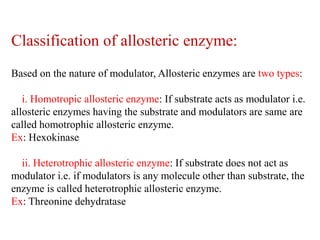
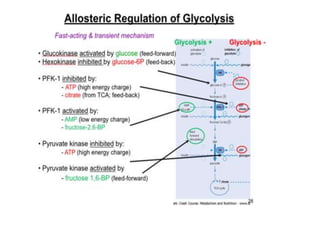
i. Homotropic allosteric enzyme: If substrate acts as modulator i.e.
allosteric enzymes having the substrate and modulators are same are
called homotrophic allosteric enzyme.
Ex: Hexokinase
ii. Heterotrophic allosteric enzyme: If substrate does not act as
modulator i.e. if modulators is any molecule other than substrate, the
enzyme is called heterotrophic allosteric enzyme.
Ex: Threonine dehydratase
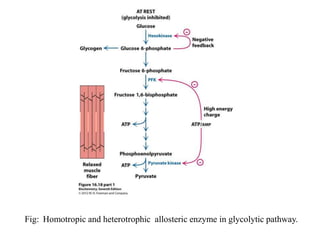
Fig: Homotropic and heterotrophic allosteric enzyme in glycolytic pathway.
Application of allosteric enzymes :-
# Allosteric enzyme are used in the physical technique.
Such as they are used as x-ray crystallography and solution
small angle x-ray scattering (SAXS).
# Allosteric enzyme are also important in the genetic
technique such as used in the site directed mutagenesis
(SDM).
# In genetic technique they are also used for the researchers to
investigate much deeply the molecular basis of allostery.
# This type of enzymes are also used in the pharmaceutical
industry as a making different drugs and vaccines.
Application of allosteric enzymes…
# They are also important in the biochemistry used as alter activity of
molecules and enzymes.
# Allosteric regulators are also important in cell signaling because of
long range of allostary are used in the cell signaling.
# This enzyme are also involve in the conformational change in
protein dynamics.
So that allosteric enzymes are important in the pharmalogy and
biochemistry. Allosteric enzymes are also important in the genetic
engineering.
Pattern of allosteric regulation:
i. Allosteric feedback inhibition/Feedback inhibition
ii. Allosteric feed forward stimulation
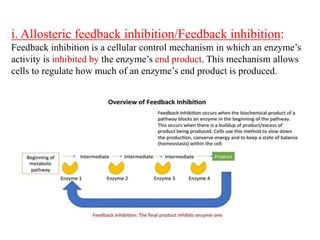
i. Allosteric feedback inhibition/Feedback inhibition:
Feedback inhibition is a cellular control mechanism in which an enzyme’s
activity is inhibited by the enzyme’s end product. This mechanism allows
cells to regulate how much of an enzyme’s end product is produced.
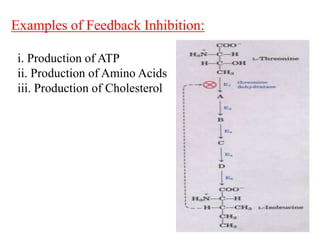
Examples of Feedback Inhibition:
i. Production of ATP
ii. Production of Amino Acids
iii. Production of Cholesterol
Function of Feedback Inhibition:
Feedback inhibition allows the body to avoid many potentially dangerous
situations, including:
Waste: Without feedback inhibition, energy or raw materials that could be
used for important cellular functions might be wasted on unnecessary ones.
Prevents depletion: Without feedback inhibition, raw materials and energy
might be depleted by biochemical processes that don’t stop, even when
their end product is not needed. A good example of this is the production of
ATP from glucose. The enzymes that produce ATP from glucose are subject
to feedback inhibition by ATP. This saves glucose by preventing its
unnecessary breakdown when the cell has plenty of ATP.
Prevents dangerous build-up: The end products of some
biochemical pathways can actually be dangerous in high
concentrations. Cholesterol is an excellent example of
something our body can make that is good in small quantities
but dangerous in large quantities.
Maintain homeostasis: An essential function of life is the
ability to maintain constant internal circumstances in the face
of changing environmental circumstances. Some chemical
messengers that are involved in maintaining homeostasis are
regulated through feedback regulation.
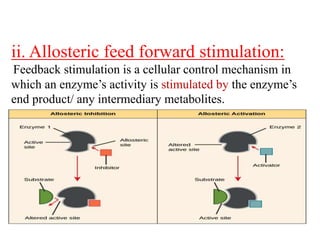
ii. Allosteric feed forward stimulation:
Feedback stimulation is a cellular control mechanism in
which an enzyme’s activity is stimulated by the enzyme’s
end product/ any intermediary metabolites.
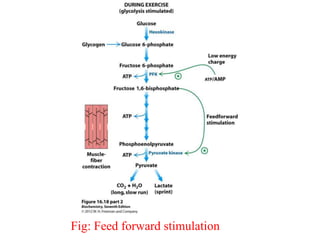
Fig: Feed forward stimulation
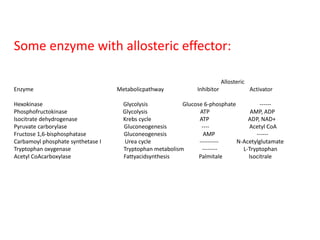
Some enzyme with allosteric effector:
Allosteric
Enzyme Metabolicpathway Inhibitor Activator
Hexokinase Glycolysis Glucose 6-phosphate ------
Phosphofructokinase Glycolysis ATP AMP, ADP
lsocitrate dehydrogenase Krebs cycle ATP ADP, NAD+
Pyruvate carborylase Gluconeogenesis ---- Acetyl CoA
Fructose 1,6-bisphosphatase Gluconeogenesis AMP ------
Carbamoyl phosphate synthetase I Urea cycle ---------- N-Acetylglutamate
Tryptophan oxygenase Tryptophan metabolism -------- L-Tryptophan
Acetyl CoAcarboxylase Fattyacidsynthesis Palmitale lsocitrale
Allosteric Enzyme

Allosteric Enzyme

  • 1.
    Course name: Enzymology II Coursecode: BMB 224 Total credit: 2.0 Presenter: Mohammad Abul Hasnat Assistant Professor Dept. of BMB SUST Lec-02
  • 2.
    Classification of allostericenzyme: Based on the nature of modulator, Allosteric enzymes are two types: i. Homotropic allosteric enzyme: If substrate acts as modulator i.e. allosteric enzymes having the substrate and modulators are same are called homotrophic allosteric enzyme. Ex: Hexokinase ii. Heterotrophic allosteric enzyme: If substrate does not act as modulator i.e. if modulators is any molecule other than substrate, the enzyme is called heterotrophic allosteric enzyme. Ex: Threonine dehydratase
  • 3.
    Fig: Homotropic andheterotrophic allosteric enzyme in glycolytic pathway.
  • 4.
    Application of allostericenzymes :- # Allosteric enzyme are used in the physical technique. Such as they are used as x-ray crystallography and solution small angle x-ray scattering (SAXS). # Allosteric enzyme are also important in the genetic technique such as used in the site directed mutagenesis (SDM). # In genetic technique they are also used for the researchers to investigate much deeply the molecular basis of allostery. # This type of enzymes are also used in the pharmaceutical industry as a making different drugs and vaccines.
  • 5.
    Application of allostericenzymes… # They are also important in the biochemistry used as alter activity of molecules and enzymes. # Allosteric regulators are also important in cell signaling because of long range of allostary are used in the cell signaling. # This enzyme are also involve in the conformational change in protein dynamics. So that allosteric enzymes are important in the pharmalogy and biochemistry. Allosteric enzymes are also important in the genetic engineering.
  • 6.
    Pattern of allostericregulation: i. Allosteric feedback inhibition/Feedback inhibition ii. Allosteric feed forward stimulation
  • 7.
    i. Allosteric feedbackinhibition/Feedback inhibition: Feedback inhibition is a cellular control mechanism in which an enzyme’s activity is inhibited by the enzyme’s end product. This mechanism allows cells to regulate how much of an enzyme’s end product is produced.
  • 8.
    Examples of FeedbackInhibition: i. Production of ATP ii. Production of Amino Acids iii. Production of Cholesterol
  • 10.
    Function of FeedbackInhibition: Feedback inhibition allows the body to avoid many potentially dangerous situations, including: Waste: Without feedback inhibition, energy or raw materials that could be used for important cellular functions might be wasted on unnecessary ones. Prevents depletion: Without feedback inhibition, raw materials and energy might be depleted by biochemical processes that don’t stop, even when their end product is not needed. A good example of this is the production of ATP from glucose. The enzymes that produce ATP from glucose are subject to feedback inhibition by ATP. This saves glucose by preventing its unnecessary breakdown when the cell has plenty of ATP.
  • 11.
    Prevents dangerous build-up:The end products of some biochemical pathways can actually be dangerous in high concentrations. Cholesterol is an excellent example of something our body can make that is good in small quantities but dangerous in large quantities. Maintain homeostasis: An essential function of life is the ability to maintain constant internal circumstances in the face of changing environmental circumstances. Some chemical messengers that are involved in maintaining homeostasis are regulated through feedback regulation.
  • 12.
    ii. Allosteric feedforward stimulation: Feedback stimulation is a cellular control mechanism in which an enzyme’s activity is stimulated by the enzyme’s end product/ any intermediary metabolites.
  • 13.
    Fig: Feed forwardstimulation
  • 14.
    Some enzyme withallosteric effector: Allosteric Enzyme Metabolicpathway Inhibitor Activator Hexokinase Glycolysis Glucose 6-phosphate ------ Phosphofructokinase Glycolysis ATP AMP, ADP lsocitrate dehydrogenase Krebs cycle ATP ADP, NAD+ Pyruvate carborylase Gluconeogenesis ---- Acetyl CoA Fructose 1,6-bisphosphatase Gluconeogenesis AMP ------ Carbamoyl phosphate synthetase I Urea cycle ---------- N-Acetylglutamate Tryptophan oxygenase Tryptophan metabolism -------- L-Tryptophan Acetyl CoAcarboxylase Fattyacidsynthesis Palmitale lsocitrale