1
PMG Engineering Private Limited
The End-to-End Engineering Company in Food Industry
info@pmg.engineering | www.pmg.engineering
Competent People. Smarter Work Systems. Exceptional Customer Interactions.
Allergen Management Components
Human immune system is quite complex, while it shows normal sensitivity to some food materials
and shows hypersensitivity to other. Food allergy is an immune system reaction that occurs soon
after eating a certain food and even a small amount of allergy causing food can trigger signs and
symptoms. Food allergies are increasing in prevalence, are potentially life-threatening and there is
no cure. Allergens can enter the body by being inhaled, swallowed or touched and successful
management is through avoidance of the food. Though consumer’s lives are at risk from eating
formulated foods (hidden ingredients). Only awareness, education & communication can prevent
deaths & improve quality of life of food allergic consumers.
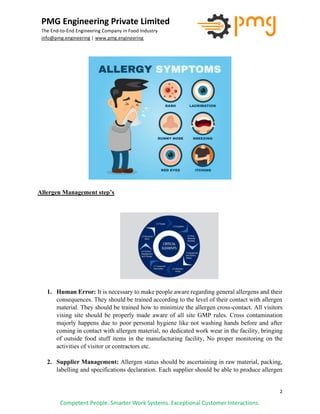
Some of the general category of allergens are peanuts, milk and dairy products, eggs, tree-nuts,
wheat, fish and sea foods, sesames and crustacean. Symptoms to these hyper immunity varies in
different age group. In common allergies can be determined by rashes, difficulty breathing, drop
in blood pressure, loss of consciousness, hives, flushed skin or rash, tingling or itchy sensation in
the mouth, face, tongue, or lip swelling, vomiting and/or diarrhea, abdominal cramps, coughing or
wheezing, dizziness and/or light headedness etc. and symptoms of food allergies typically appear
from within minutes or up to 2 hours after a person has eaten the food to which they are allergic.
2
PMG Engineering Private Limited
The End-to-End Engineering Company in Food Industry
info@pmg.engineering | www.pmg.engineering
Competent People. Smarter Work Systems. Exceptional Customer Interactions.
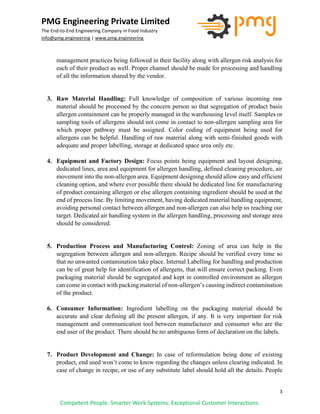
Allergen Management step’s
1. Human Error: It is necessary to make people aware regarding general allergens and their
consequences. They should be trained according to the level of their contact with allergen
material. They should be trained how to minimize the allergen cross-contact. All visitors
vising site should be properly made aware of all site GMP rules. Cross contamination
majorly happens due to poor personal hygiene like not washing hands before and after
coming in contact with allergen material, no dedicated work wear in the facility, bringing
of outside food stuff items in the manufacturing facility, No proper monitoring on the
activities of visitor or contractors etc.
2. Supplier Management: Allergen status should be ascertaining in raw material, packing,
labelling and specifications declaration. Each supplier should be able to produce allergen
3
PMG Engineering Private Limited
The End-to-End Engineering Company in Food Industry
info@pmg.engineering | www.pmg.engineering
Competent People. Smarter Work Systems. Exceptional Customer Interactions.
management practices being followed in their facility along with allergen risk analysis for
each of their product as well. Proper channel should be made for processing and handling
of all the information shared by the vendor.
3. Raw Material Handling: Full knowledge of composition of various incoming raw
material should be processed by the concern person so that segregation of product basis
allergen containment can be properly managed in the warehousing level itself. Samples or
sampling tools of allergens should not come in contact to non-allergen sampling area for
which proper pathway must be assigned. Color coding of equipment being used for
allergens can be helpful. Handling of raw material along with semi-finished goods with
adequate and proper labelling, storage at dedicated space area only etc.
4. Equipment and Factory Design: Focus points being equipment and layout designing,
dedicated lines, area and equipment for allergen handling, defined cleaning procedure, air
movement into the non-allergen area. Equipment designing should allow easy and efficient
cleaning option, and where ever possible there should be dedicated line for manufacturing
of product containing allergen or else allergen containing ingredient should be used at the
end of process line. By limiting movement, having dedicated material handling equipment,
avoiding personal contact between allergen and non-allergen can also help us reaching our
target. Dedicated air handling system in the allergen handling, processing and storage area
should be considered.
5. Production Process and Manufacturing Control: Zoning of area can help in the
segregation between allergen and non-allergen. Recipe should be verified every time so
that no unwanted contamination take place. Internal Labelling for handling and production
can be of great help for identification of allergens, that will ensure correct packing. Even
packaging material should be segregated and kept in controlled environment as allergen
can come in contact with packing material of non-allergen’s causing indirect contamination
of the product.
6. Consumer Information: Ingredient labelling on the packaging material should be
accurate and clear defining all the present allergen, if any. It is very important for risk
management and communication tool between manufacturer and consumer who are the
end user of the product. There should be no ambiguous form of declaration on the labels.
7. Product Development and Change: In case of reformulation being done of existing
product, end used won’t come to know regarding the changes unless clearing indicated. In
case of change in recipe, or use of any substitute label should hold all the details. People
4
PMG Engineering Private Limited
The End-to-End Engineering Company in Food Industry
info@pmg.engineering | www.pmg.engineering
Competent People. Smarter Work Systems. Exceptional Customer Interactions.
behind new product development should have profound knowledge regarding the whole
risk that can arise due to the development. All risk should be accessed and should have
management procedure for whole process and ingredients being used.
8. Documentation and Record Keeping: Within food safety program, it is necessary to
have efficient documentation and record keeping for the future reference. It can be good
communication medium between risk management system and employees. The details
when maintained in written along with procedures to be followed, are properly jotted down,
they can be easily implemented, verified and validated.

Allergen Management Components- Allergen Management Step

  • 1.
    1 PMG Engineering PrivateLimited The End-to-End Engineering Company in Food Industry info@pmg.engineering | www.pmg.engineering Competent People. Smarter Work Systems. Exceptional Customer Interactions. Allergen Management Components Human immune system is quite complex, while it shows normal sensitivity to some food materials and shows hypersensitivity to other. Food allergy is an immune system reaction that occurs soon after eating a certain food and even a small amount of allergy causing food can trigger signs and symptoms. Food allergies are increasing in prevalence, are potentially life-threatening and there is no cure. Allergens can enter the body by being inhaled, swallowed or touched and successful management is through avoidance of the food. Though consumer’s lives are at risk from eating formulated foods (hidden ingredients). Only awareness, education & communication can prevent deaths & improve quality of life of food allergic consumers. Some of the general category of allergens are peanuts, milk and dairy products, eggs, tree-nuts, wheat, fish and sea foods, sesames and crustacean. Symptoms to these hyper immunity varies in different age group. In common allergies can be determined by rashes, difficulty breathing, drop in blood pressure, loss of consciousness, hives, flushed skin or rash, tingling or itchy sensation in the mouth, face, tongue, or lip swelling, vomiting and/or diarrhea, abdominal cramps, coughing or wheezing, dizziness and/or light headedness etc. and symptoms of food allergies typically appear from within minutes or up to 2 hours after a person has eaten the food to which they are allergic.
  • 2.
    2 PMG Engineering PrivateLimited The End-to-End Engineering Company in Food Industry info@pmg.engineering | www.pmg.engineering Competent People. Smarter Work Systems. Exceptional Customer Interactions. Allergen Management step’s 1. Human Error: It is necessary to make people aware regarding general allergens and their consequences. They should be trained according to the level of their contact with allergen material. They should be trained how to minimize the allergen cross-contact. All visitors vising site should be properly made aware of all site GMP rules. Cross contamination majorly happens due to poor personal hygiene like not washing hands before and after coming in contact with allergen material, no dedicated work wear in the facility, bringing of outside food stuff items in the manufacturing facility, No proper monitoring on the activities of visitor or contractors etc. 2. Supplier Management: Allergen status should be ascertaining in raw material, packing, labelling and specifications declaration. Each supplier should be able to produce allergen
  • 3.
    3 PMG Engineering PrivateLimited The End-to-End Engineering Company in Food Industry info@pmg.engineering | www.pmg.engineering Competent People. Smarter Work Systems. Exceptional Customer Interactions. management practices being followed in their facility along with allergen risk analysis for each of their product as well. Proper channel should be made for processing and handling of all the information shared by the vendor. 3. Raw Material Handling: Full knowledge of composition of various incoming raw material should be processed by the concern person so that segregation of product basis allergen containment can be properly managed in the warehousing level itself. Samples or sampling tools of allergens should not come in contact to non-allergen sampling area for which proper pathway must be assigned. Color coding of equipment being used for allergens can be helpful. Handling of raw material along with semi-finished goods with adequate and proper labelling, storage at dedicated space area only etc. 4. Equipment and Factory Design: Focus points being equipment and layout designing, dedicated lines, area and equipment for allergen handling, defined cleaning procedure, air movement into the non-allergen area. Equipment designing should allow easy and efficient cleaning option, and where ever possible there should be dedicated line for manufacturing of product containing allergen or else allergen containing ingredient should be used at the end of process line. By limiting movement, having dedicated material handling equipment, avoiding personal contact between allergen and non-allergen can also help us reaching our target. Dedicated air handling system in the allergen handling, processing and storage area should be considered. 5. Production Process and Manufacturing Control: Zoning of area can help in the segregation between allergen and non-allergen. Recipe should be verified every time so that no unwanted contamination take place. Internal Labelling for handling and production can be of great help for identification of allergens, that will ensure correct packing. Even packaging material should be segregated and kept in controlled environment as allergen can come in contact with packing material of non-allergen’s causing indirect contamination of the product. 6. Consumer Information: Ingredient labelling on the packaging material should be accurate and clear defining all the present allergen, if any. It is very important for risk management and communication tool between manufacturer and consumer who are the end user of the product. There should be no ambiguous form of declaration on the labels. 7. Product Development and Change: In case of reformulation being done of existing product, end used won’t come to know regarding the changes unless clearing indicated. In case of change in recipe, or use of any substitute label should hold all the details. People
  • 4.
    4 PMG Engineering PrivateLimited The End-to-End Engineering Company in Food Industry info@pmg.engineering | www.pmg.engineering Competent People. Smarter Work Systems. Exceptional Customer Interactions. behind new product development should have profound knowledge regarding the whole risk that can arise due to the development. All risk should be accessed and should have management procedure for whole process and ingredients being used. 8. Documentation and Record Keeping: Within food safety program, it is necessary to have efficient documentation and record keeping for the future reference. It can be good communication medium between risk management system and employees. The details when maintained in written along with procedures to be followed, are properly jotted down, they can be easily implemented, verified and validated.