University of the armed
forces ESPE
Types of syllabus
Melissa illapa
what is the syllabus?
• The syllabus is the first document written by the teacher, read by the student
and socialized by both in any teaching-learning process.
What for?
Learning objectives or competencies.
Topics to be addressed.
Educational resources available for learning.
Evaluation activities (diagnostic, formative and summative).
Types of syllabus
There are six types of syllabus:
• A structural syllabus
• A notional/functional syllabus
• A situational syllabus
• A skill- based syllabus
• A task – based syllabus
• A content-based syllabus
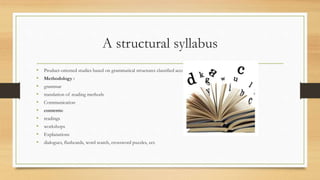
A structural syllabus
• Product-oriented studies based on grammatical structures classified according to complexity.
• Methodology :
• grammar
• translation of reading methods
• Communication
• contents:
• readings
• workshops
• Explanations
• dialogues, flashcards, word search, crossword puzzles, ect.
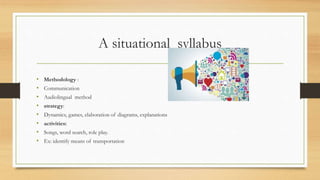
A situational syllabus
• Methodology :
• Communication
• Audiolingual method
• strategy:
• Dynamics, games, elaboration of diagrams, explanations
• activities:
• Songs, word search, role play.
• Ex: identify means of transportation
Notional Syllabus
• Methodology:
• communicative approach, natural method.
• Strategies:
• Interactions, identification with classroom resources, games, dynamics.
• Activities:
• Flashcards. songs, observation of movies, dialogues, etc.
Skill Syllabus
• Metodology:
• Audiolingual method, communicative approach, reading method, direct method,
audiolingual method
• Strategies:
• Interactions, use of classroom material, games, dynamics.
• Activities:
• Reading stories, movies, role-playing, songs.
Task – based syllabus
• Methodology:
• Reading method , grammar translation, audiolingual method, communicative
approach.
• Strategy:
• Interactions, use of classroom materials, games, dynamics, descriptions, creation of
fables.
• Activities:
• Flashcards, songs, creation of texts, descriptions
Content – based Syllabus
• Methodology:
• Natural approach, direct method, communicative approach
• Strategy:
• Interactions, use of classroom material, description, exposure
• Activities:
• Observe and understand other subjects that are in Spanish in the English language
• Syllabu function
• The main function of the Syllabus is to act as a contract between the teacher and the
student, in which each one is committed to the teaching-learning process, the teacher
with the information that will be transmitted and how it will be transmitted and the
students in what what should they learn
• Its importance lies in making known (guide) the topics and everything that will be
presented in the school year.

A1.illapa.melissa.catedra

  • 1.
    University of thearmed forces ESPE Types of syllabus Melissa illapa
  • 2.
    what is thesyllabus? • The syllabus is the first document written by the teacher, read by the student and socialized by both in any teaching-learning process. What for? Learning objectives or competencies. Topics to be addressed. Educational resources available for learning. Evaluation activities (diagnostic, formative and summative).
  • 3.
    Types of syllabus Thereare six types of syllabus: • A structural syllabus • A notional/functional syllabus • A situational syllabus • A skill- based syllabus • A task – based syllabus • A content-based syllabus
  • 4.
    A structural syllabus •Product-oriented studies based on grammatical structures classified according to complexity. • Methodology : • grammar • translation of reading methods • Communication • contents: • readings • workshops • Explanations • dialogues, flashcards, word search, crossword puzzles, ect.
  • 5.
    A situational syllabus •Methodology : • Communication • Audiolingual method • strategy: • Dynamics, games, elaboration of diagrams, explanations • activities: • Songs, word search, role play. • Ex: identify means of transportation
  • 6.
    Notional Syllabus • Methodology: •communicative approach, natural method. • Strategies: • Interactions, identification with classroom resources, games, dynamics. • Activities: • Flashcards. songs, observation of movies, dialogues, etc.
  • 7.
    Skill Syllabus • Metodology: •Audiolingual method, communicative approach, reading method, direct method, audiolingual method • Strategies: • Interactions, use of classroom material, games, dynamics. • Activities: • Reading stories, movies, role-playing, songs.
  • 8.
    Task – basedsyllabus • Methodology: • Reading method , grammar translation, audiolingual method, communicative approach. • Strategy: • Interactions, use of classroom materials, games, dynamics, descriptions, creation of fables. • Activities: • Flashcards, songs, creation of texts, descriptions
  • 9.
    Content – basedSyllabus • Methodology: • Natural approach, direct method, communicative approach • Strategy: • Interactions, use of classroom material, description, exposure • Activities: • Observe and understand other subjects that are in Spanish in the English language
  • 10.
    • Syllabu function •The main function of the Syllabus is to act as a contract between the teacher and the student, in which each one is committed to the teaching-learning process, the teacher with the information that will be transmitted and how it will be transmitted and the students in what what should they learn • Its importance lies in making known (guide) the topics and everything that will be presented in the school year.