All hail the service
SERVICE ORIENTED STRATEGY EXECUTION
What I promised to cover
Service managers, operations managers, service desk managers,
architects, engineers, programme managers, project managers,
business analysts. Unless we all orient around the service, as a team of
peers, we are not going to be able to deliver value to the digital
enterprise.
In this session Paddy Baxter, a veteran in IT architecture and IT service management, will
attempt to disrupt traditional thinking to show how the service construct can be used to bring
us together as a service team, where accountability and responsibility for value delivery is much
more closely aligned than is the case today in many organisations.
MY PROPOSITION FOR TODAY
• The service is the key concept/structure of the
digital age.
• Teams and organisations must be service
oriented.
• And OK … it’s not easy … but it is necessary!
Introductions
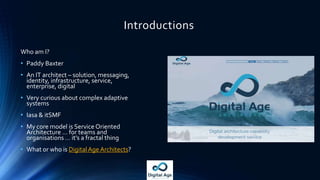
Who am I?
• Paddy Baxter
• An IT architect – solution, messaging,
identity, infrastructure, service,
enterprise, digital
• Very curious about complex adaptive
systems
• Iasa & itSMF
• My core model is Service Oriented
Architecture … for teams and
organisations … it’s a fractal thing
• What or who is DigitalAge Architects?
Agenda
• Services vs. Products
• Definition of a Service
• Some Key Design Principles
• The ServiceTeam (orTeam as a Service)
• The Need for New Org Structures
• Are you with me!!??
• Charge!
Products vs. Services
Industrial vs. Digital
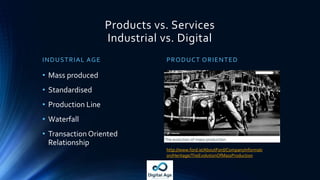
INDUSTRIAL AGE PRODUCT ORIENTED
http://www.ford.ie/AboutFord/CompanyInformati
on/Heritage/TheEvolutionOfMassProduction
• Mass produced
• Standardised
• Production Line
• Waterfall
• Transaction Oriented
Relationship
Products vs. Services
Industrial vs. Digital
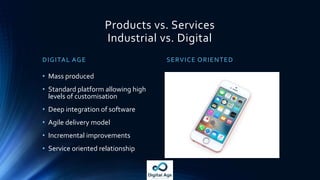
DIGITAL AGE SERVICE ORIENTED
• Mass produced
• Standard platform allowing high
levels of customisation
• Deep integration of software
• Agile delivery model
• Incremental improvements
• Service oriented relationship
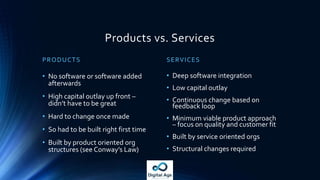
Products vs. Services
PRODUCTS
• No software or software added
afterwards
• High capital outlay up front –
didn’t have to be great
• Hard to change once made
• So had to be built right first time
• Built by product oriented org
structures (see Conway’s Law)
SERVICES
• Deep software integration
• Low capital outlay
• Continuous change based on
feedback loop
• Minimum viable product approach
– focus on quality and customer fit
• Built by service oriented orgs
• Structural changes required
Digital Age Teams
Conway's Law is an adage named after computer programmer
Melvin Conway, who introduced the idea in 1968. It concerns the structure of
organizations and the corresponding structure of systems (particularly
computer software) designed by those organizations. In various versions,
Conway's Law states:
• Organizations which design systems are constrained to produce designs which are
copies of the communication structures of these organizations.
• If you have four groups working on a compiler, you'll get a 4-pass compiler.
Or more concisely:
• Any piece of software reflects the organizational structure that produced it.
Conway's Law - Caltech Engineering Design Research Laboratory
www.design.caltech.edu/erik/Misc/Conway.html
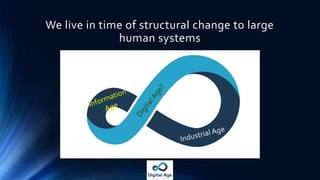
We live in time of structural change to large
human systems
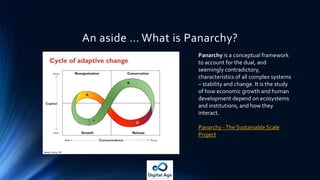
An aside … What is Panarchy?
Panarchy is a conceptual framework
to account for the dual, and
seemingly contradictory,
characteristics of all complex systems
– stability and change. It is the study
of how economic growth and human
development depend on ecosystems
and institutions, and how they
interact.
Panarchy -The Sustainable Scale
Project
So services are important … So what is a
service really?
• “The action of helping or doing work for someone” – Google
• “A means of delivering value to customers by facilitating outcomes
customers want to achieve, but without the ownership of specific costs
and risks.” – ITIL©
• “A Service presents a simple interface to the requester that abstracts
away the underlying complexity acting as a black box.” -Wikipedia –
definition of SOA
• “Services in microservice architecture (MSA) are processes that
communicate with each other over a network in order to fulfill a goal” -
Wikipedia - Definition of a Microservice
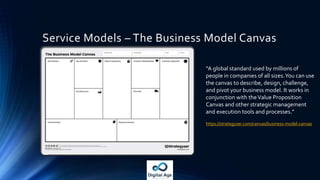
Service Models – The Business Model Canvas
“A global standard used by millions of
people in companies of all sizes.You can use
the canvas to describe, design, challenge,
and pivot your business model. It works in
conjunction with theValue Proposition
Canvas and other strategic management
and execution tools and processes.”
https://strategyzer.com/canvas/business-model-canvas
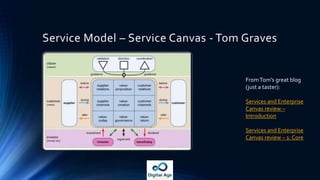
Service Model – Service Canvas - Tom Graves
FromTom’s great blog
(just a taster):
Services and Enterprise
Canvas review –
Introduction
Services and Enterprise
Canvas review – 1: Core
Some of Tom’s key points
• a service is a means via which someone’s or something’s needs are served
• everything in the enterprise is or represents or implies a service
• service-relationships and structures are often fractal and recursive, with services clustered together to provide broader
or more abstract services
• to make sense of services, it’s all but essential to think fractal, not linear
• affordances – ‘unexpected services’ – arise from the ways in which the capabilities that underpin services may be re-
used in or for other services
• a platform is a cluster of related services used as a base for affordance of other services
• what services act on, and deliver, may take many forms, including physical ‘things’, virtual information, relational links
between people, or an aspirational sense of meaning or purpose
• to make sense of a service, we also need to explore themes such as service-contract, service-policy, service-level,
service-guarantee, service-status and service-completeness
• without adequate verification of service-completeness, a service may fail, or deliver a ‘disservice’ or ‘anti-service’,
destroying value rather than creating value
Taken from :
http://weblog.tetradian.com/2014/10/14/services-and-ecanvas-review-1-core/
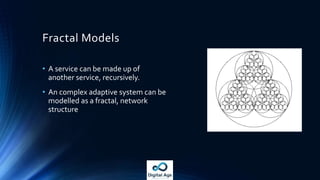
Fractal Models
• A service can be made up of
another service, recursively.
• An complex adaptive system can be
modelled as a fractal, network
structure
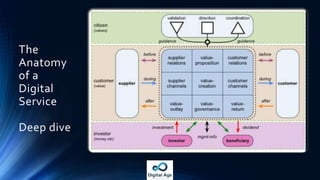
The
Anatomy
of a
Digital
Service
Deep dive
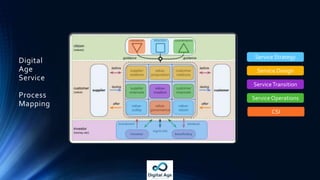
Digital
Age
Service
Process
Mapping
Service Strategy
ServiceTransition
Service Operations
CSI
Service Design
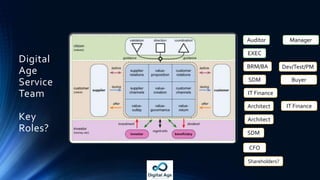
Digital Age
Service
Team
Can we
map
traditional
roles to
service
construct?
Auditor
EXEC
Manager
BRM/BA
SDM
IT Finance
Architect
Dev/Test/PM
Buyer
Architect
SDM
IT Finance
CFO
Shareholders?
Digital Age
Service
Team
Can we
map
traditional
roles to
service
construct?
Auditor EXEC Manager
BRM/BA
SDM
IT Finance
Architect
Dev/Test/PM
Buyer
Architect
SDM
IT Finance
CFO Shareholders?
Here’s my first
attempt at this.
It’s not perfect but
it’s an interesting
exercise …
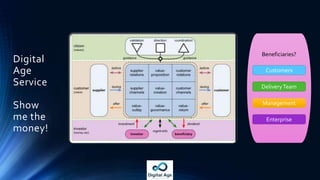
Service
Beneficiaries?
Many stakeholders –
incentives must
continuously
managed!
Digital
Age
Service
Show
me the
money!
Customers? Obviously
(you’d think)
DeliveryTeam
(definitely)
Management –
indirectly usually as
part of bigger picture
Suppliers
Required in long term
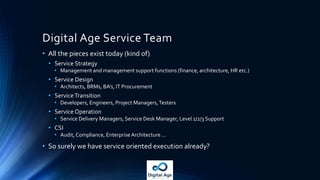
Digital Age Service Team
• All the pieces exist today (kind of)
• Service Strategy
• Management and management support functions (finance, architecture, HR etc.)
• Service Design
• Architects, BRMs, BA’s, IT Procurement
• ServiceTransition
• Developers, Engineers, Project Managers,Testers
• Service Operation
• Service Delivery Managers, Service Desk Manager, Level 1/2/3 Support
• CSI
• Audit, Compliance, Enterprise Architecture …
• So surely we have service oriented execution already?Yes and no.
• The challenge is that they have to operate in org structures from the industrial age.
Industrial Age Org Structures
• Hierarchical
• Function oriented
• Stability oriented
• Accountability and responsibility misaligned
• Job descriptions not connected to real world
Digital Age Org Structures
• Network
• Service oriented
• Dynamic
• Agile
• Accountability aligned with responsibility
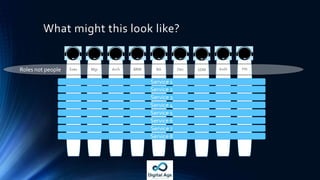
Mgr Arch BRM BA Dev SDM Audit FIN
What might this look like?
Exec
Service 1
Service 2
Service 3
Service 4
Service 5
Service 6
Service 7
Service 8
Roles not people
New ways of working needed as well
• MSFTeam Model – June 2002
“The MSF team model was developed over a period of several years to compensate for
some of the disadvantages imposed by the top-down, hierarchical structure of
traditional project teams. “
• KeyTeam ModelValues
• Clear Accountability, Shared Responsibility
• EmpowerTeam Members (“Team of Peers”)
• Focus on BusinessValue
• Stay Agile, Expect Change
• Foster Open Communications
• Worth checking it out for tips and tricks on building a digital age, service oriented
team … some imagination required though!
Easy peasy then?
• Org changes are the hardest thing to do in any organisation
• Service oriented orgs redistribute power – that will be resisted
• Distribution of value to beneficiaries may change (or at least become more
transparent) – that will be resisted
• So not easy … but it has to happen for most organisations if they want to
survive in the Digital Age.
• We’re still working out new ways of doing this – there is no blueprint (yet),
so try and drive change via small experiments (see Popcorn Flow for one
way to do this).
But there is a way … (I think)
• Organisations are made up of teams
• Teams exist to do stuff for someone (don’t they)
• What if you thought of your team as a service?
• Who are your customers?
• Do you treat them as customers?
• Who are your suppliers?
• Do you treat them as supplier?
• Are you aligned to wider strategy?
• Are you being a good citizen from a costs and benefits perspective?
• Small changes at the team level can have a ripple effect that could change the
organisation.
MY PROPOSITION FOR TODAY – HAVE I CONVINCED YOU?
1. The service is the key concept/structure of
the digital age.
2. Teams and organisations must be service
oriented.
3. And OK … it’s not easy … but it is necessary
And just remember one last thing
All hail the service!
If you would like to hear more let me know.
Paddy Baxter
Principal Consultant
Digital Age Architects
paddybaxter@digitalagearchitects.com
www.digitalagearchitects.com

All hail the service (online version)

  • 1.
    All hail theservice SERVICE ORIENTED STRATEGY EXECUTION
  • 2.
    What I promisedto cover Service managers, operations managers, service desk managers, architects, engineers, programme managers, project managers, business analysts. Unless we all orient around the service, as a team of peers, we are not going to be able to deliver value to the digital enterprise. In this session Paddy Baxter, a veteran in IT architecture and IT service management, will attempt to disrupt traditional thinking to show how the service construct can be used to bring us together as a service team, where accountability and responsibility for value delivery is much more closely aligned than is the case today in many organisations.
  • 3.
    MY PROPOSITION FORTODAY • The service is the key concept/structure of the digital age. • Teams and organisations must be service oriented. • And OK … it’s not easy … but it is necessary!
  • 4.
    Introductions Who am I? •Paddy Baxter • An IT architect – solution, messaging, identity, infrastructure, service, enterprise, digital • Very curious about complex adaptive systems • Iasa & itSMF • My core model is Service Oriented Architecture … for teams and organisations … it’s a fractal thing • What or who is DigitalAge Architects?
  • 5.
    Agenda • Services vs.Products • Definition of a Service • Some Key Design Principles • The ServiceTeam (orTeam as a Service) • The Need for New Org Structures • Are you with me!!?? • Charge!
  • 6.
    Products vs. Services Industrialvs. Digital INDUSTRIAL AGE PRODUCT ORIENTED http://www.ford.ie/AboutFord/CompanyInformati on/Heritage/TheEvolutionOfMassProduction • Mass produced • Standardised • Production Line • Waterfall • Transaction Oriented Relationship
  • 7.
    Products vs. Services Industrialvs. Digital DIGITAL AGE SERVICE ORIENTED • Mass produced • Standard platform allowing high levels of customisation • Deep integration of software • Agile delivery model • Incremental improvements • Service oriented relationship
  • 8.
    Products vs. Services PRODUCTS •No software or software added afterwards • High capital outlay up front – didn’t have to be great • Hard to change once made • So had to be built right first time • Built by product oriented org structures (see Conway’s Law) SERVICES • Deep software integration • Low capital outlay • Continuous change based on feedback loop • Minimum viable product approach – focus on quality and customer fit • Built by service oriented orgs • Structural changes required
  • 9.
    Digital Age Teams Conway'sLaw is an adage named after computer programmer Melvin Conway, who introduced the idea in 1968. It concerns the structure of organizations and the corresponding structure of systems (particularly computer software) designed by those organizations. In various versions, Conway's Law states: • Organizations which design systems are constrained to produce designs which are copies of the communication structures of these organizations. • If you have four groups working on a compiler, you'll get a 4-pass compiler. Or more concisely: • Any piece of software reflects the organizational structure that produced it. Conway's Law - Caltech Engineering Design Research Laboratory www.design.caltech.edu/erik/Misc/Conway.html
  • 10.
    We live intime of structural change to large human systems
  • 11.
    An aside …What is Panarchy? Panarchy is a conceptual framework to account for the dual, and seemingly contradictory, characteristics of all complex systems – stability and change. It is the study of how economic growth and human development depend on ecosystems and institutions, and how they interact. Panarchy -The Sustainable Scale Project
  • 12.
    So services areimportant … So what is a service really? • “The action of helping or doing work for someone” – Google • “A means of delivering value to customers by facilitating outcomes customers want to achieve, but without the ownership of specific costs and risks.” – ITIL© • “A Service presents a simple interface to the requester that abstracts away the underlying complexity acting as a black box.” -Wikipedia – definition of SOA • “Services in microservice architecture (MSA) are processes that communicate with each other over a network in order to fulfill a goal” - Wikipedia - Definition of a Microservice
  • 13.
    Service Models –The Business Model Canvas “A global standard used by millions of people in companies of all sizes.You can use the canvas to describe, design, challenge, and pivot your business model. It works in conjunction with theValue Proposition Canvas and other strategic management and execution tools and processes.” https://strategyzer.com/canvas/business-model-canvas
  • 14.
    Service Model –Service Canvas - Tom Graves FromTom’s great blog (just a taster): Services and Enterprise Canvas review – Introduction Services and Enterprise Canvas review – 1: Core
  • 15.
    Some of Tom’skey points • a service is a means via which someone’s or something’s needs are served • everything in the enterprise is or represents or implies a service • service-relationships and structures are often fractal and recursive, with services clustered together to provide broader or more abstract services • to make sense of services, it’s all but essential to think fractal, not linear • affordances – ‘unexpected services’ – arise from the ways in which the capabilities that underpin services may be re- used in or for other services • a platform is a cluster of related services used as a base for affordance of other services • what services act on, and deliver, may take many forms, including physical ‘things’, virtual information, relational links between people, or an aspirational sense of meaning or purpose • to make sense of a service, we also need to explore themes such as service-contract, service-policy, service-level, service-guarantee, service-status and service-completeness • without adequate verification of service-completeness, a service may fail, or deliver a ‘disservice’ or ‘anti-service’, destroying value rather than creating value Taken from : http://weblog.tetradian.com/2014/10/14/services-and-ecanvas-review-1-core/
  • 16.
    Fractal Models • Aservice can be made up of another service, recursively. • An complex adaptive system can be modelled as a fractal, network structure
  • 17.
  • 18.
  • 19.
    Digital Age Service Team Can we map traditional rolesto service construct? Auditor EXEC Manager BRM/BA SDM IT Finance Architect Dev/Test/PM Buyer Architect SDM IT Finance CFO Shareholders?
  • 20.
    Digital Age Service Team Can we map traditional rolesto service construct? Auditor EXEC Manager BRM/BA SDM IT Finance Architect Dev/Test/PM Buyer Architect SDM IT Finance CFO Shareholders? Here’s my first attempt at this. It’s not perfect but it’s an interesting exercise …
  • 21.
    Service Beneficiaries? Many stakeholders – incentivesmust continuously managed! Digital Age Service Show me the money! Customers? Obviously (you’d think) DeliveryTeam (definitely) Management – indirectly usually as part of bigger picture Suppliers Required in long term
  • 22.
    Digital Age ServiceTeam • All the pieces exist today (kind of) • Service Strategy • Management and management support functions (finance, architecture, HR etc.) • Service Design • Architects, BRMs, BA’s, IT Procurement • ServiceTransition • Developers, Engineers, Project Managers,Testers • Service Operation • Service Delivery Managers, Service Desk Manager, Level 1/2/3 Support • CSI • Audit, Compliance, Enterprise Architecture … • So surely we have service oriented execution already?Yes and no. • The challenge is that they have to operate in org structures from the industrial age.
  • 23.
    Industrial Age OrgStructures • Hierarchical • Function oriented • Stability oriented • Accountability and responsibility misaligned • Job descriptions not connected to real world
  • 24.
    Digital Age OrgStructures • Network • Service oriented • Dynamic • Agile • Accountability aligned with responsibility
  • 25.
    Mgr Arch BRMBA Dev SDM Audit FIN What might this look like? Exec Service 1 Service 2 Service 3 Service 4 Service 5 Service 6 Service 7 Service 8 Roles not people
  • 26.
    New ways ofworking needed as well • MSFTeam Model – June 2002 “The MSF team model was developed over a period of several years to compensate for some of the disadvantages imposed by the top-down, hierarchical structure of traditional project teams. “ • KeyTeam ModelValues • Clear Accountability, Shared Responsibility • EmpowerTeam Members (“Team of Peers”) • Focus on BusinessValue • Stay Agile, Expect Change • Foster Open Communications • Worth checking it out for tips and tricks on building a digital age, service oriented team … some imagination required though!
  • 27.
    Easy peasy then? •Org changes are the hardest thing to do in any organisation • Service oriented orgs redistribute power – that will be resisted • Distribution of value to beneficiaries may change (or at least become more transparent) – that will be resisted • So not easy … but it has to happen for most organisations if they want to survive in the Digital Age. • We’re still working out new ways of doing this – there is no blueprint (yet), so try and drive change via small experiments (see Popcorn Flow for one way to do this).
  • 28.
    But there isa way … (I think) • Organisations are made up of teams • Teams exist to do stuff for someone (don’t they) • What if you thought of your team as a service? • Who are your customers? • Do you treat them as customers? • Who are your suppliers? • Do you treat them as supplier? • Are you aligned to wider strategy? • Are you being a good citizen from a costs and benefits perspective? • Small changes at the team level can have a ripple effect that could change the organisation.
  • 29.
    MY PROPOSITION FORTODAY – HAVE I CONVINCED YOU? 1. The service is the key concept/structure of the digital age. 2. Teams and organisations must be service oriented. 3. And OK … it’s not easy … but it is necessary
  • 30.
    And just rememberone last thing All hail the service!
  • 31.
    If you wouldlike to hear more let me know. Paddy Baxter Principal Consultant Digital Age Architects paddybaxter@digitalagearchitects.com www.digitalagearchitects.com

Editor's Notes

  • #4 Put services at the heart of everything you do and you won't go too far wrong.
  • #30 Put services at the heart of everything you do and you won't go too far wrong.