A Microservices Journey
@christianposta
Christian Posta
Chief Architect, cloud application development
Twitter: @christianposta
Blog: http://blog.christianposta.com
Email: christian@redhat.com
Slides: http://slideshare.net/ceposta
• Author “Microservices for Java developers”
• Committer/contributor lots of open-source
projects
• Worked with large Microservices, web-scale,
unicorn company
• Blogger, speaker about DevOps, integration,
and microservices
Rough path of discussions
today
• Microservices: What, Why, When?
• “Cloud-native” with a Platform
• Microservices frameworks
• Service decomposition and boundaries
• Microservice resilience, routing, and control
@christianposta
Microserivces:
What, Why, When
@christianposta
“The microservice architectural style is an
approach to developing a single application as
a suite of small services, each running in its
own process and communicating with
lightweight mechanisms, often an HTTP
resource API. These services are built around
business capabilities and independently
deployable by fully automated deployment
machinery.”
A microservices definition
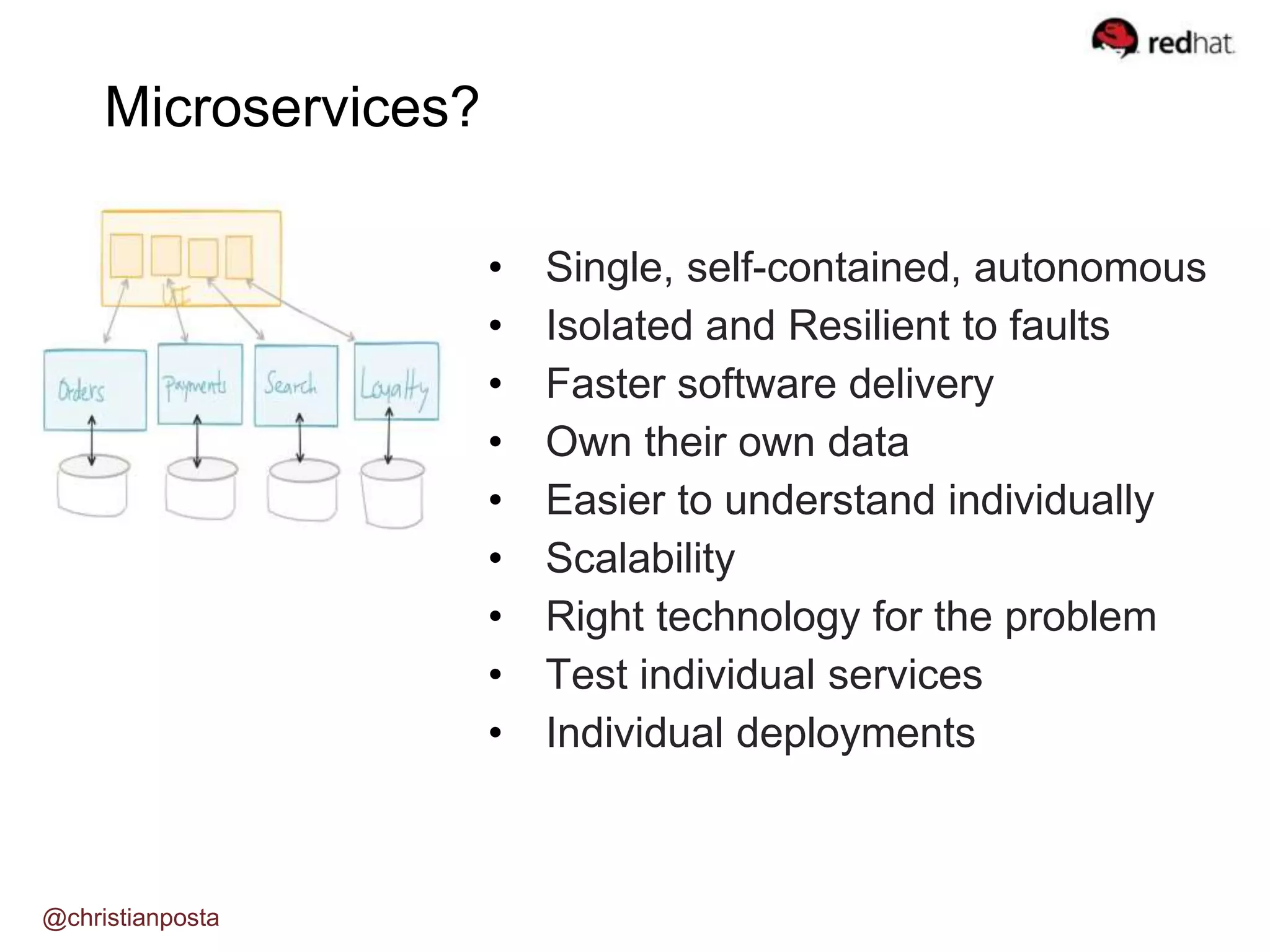
• Single, self-contained, autonomous
• Isolated and Resilient to faults
• Faster software delivery
• Own their own data
• Easier to understand individually
• Scalability
• Right technology for the problem
• Test individual services
• Individual deployments
Microservices?
@christianposta
• System complexity
• Operational complexity
• Testing is harder across services
• Security
• Hard to get boundaries right (transactions,
APIs, etc)
• Resource overhead
• Network overhead
• Lack of tooling
Drawbacks to microservices
@christianposta
Why would one implement a system
as microservices?
@christianposta
Pain we may feel…
@christianposta
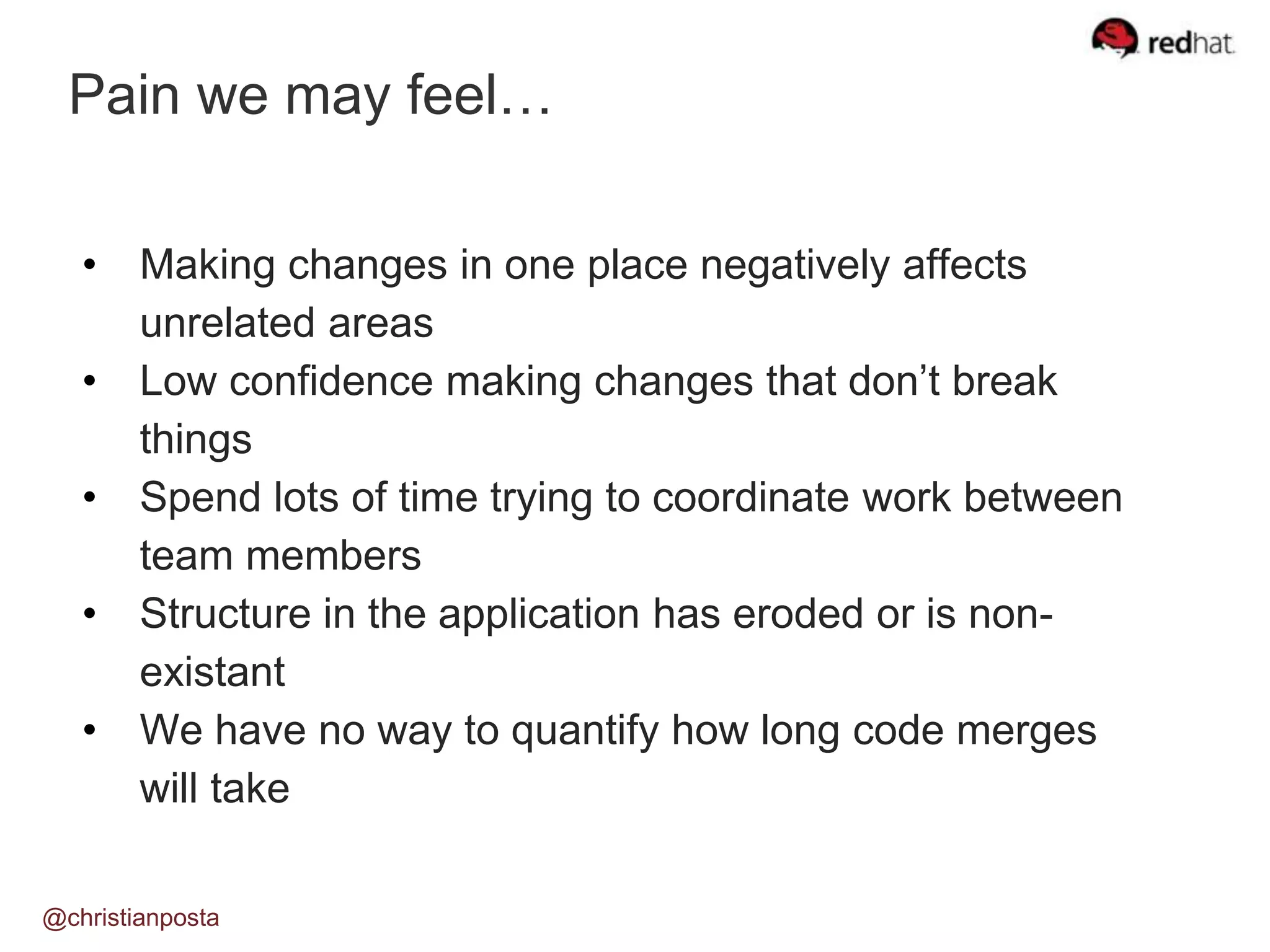
• Making changes in one place negatively affects
unrelated areas
• Low confidence making changes that don’t break
things
• Spend lots of time trying to coordinate work between
team members
• Structure in the application has eroded or is non-
existant
• We have no way to quantify how long code merges
will take
@christianposta
• Development time is slow simply because the project
is so big (IDE bogs down, running tests is slow, slow
bootstrap time, etc)
• Changes to one module force changes across other
modules
• Difficult to sunset outdated technology
• We’ve built our new applications around old
premises like batch processing
• Application steps on itself at runtime managing
resources, allocations, computations
Pain we may feel…
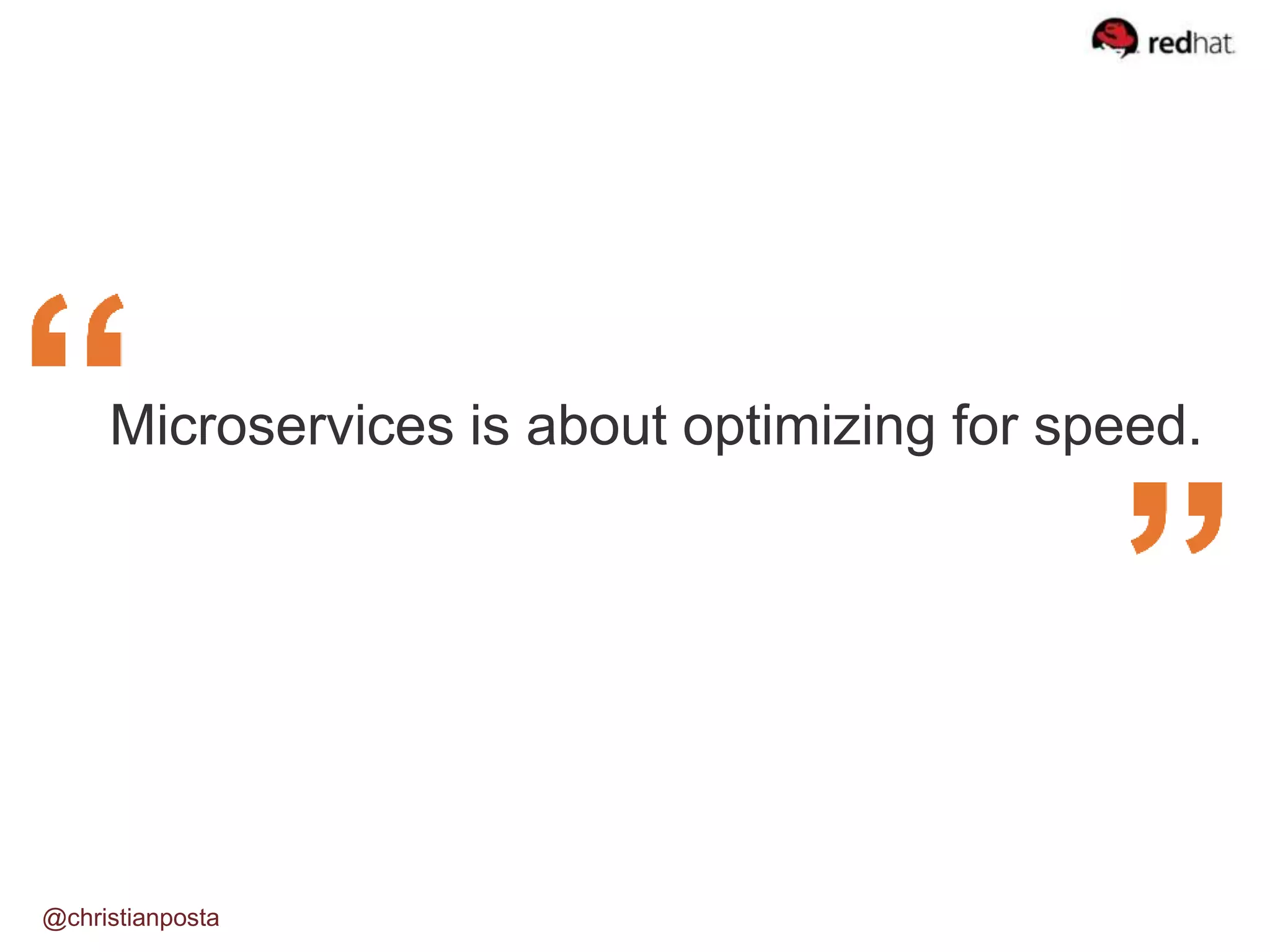
Microservices is about optimizing for speed.
@christianposta
If change is happening on the
outside faster than on the inside
the end is in sight.
S&P company life expectancy
@christianposta
Jack Welch, former CEO, GE
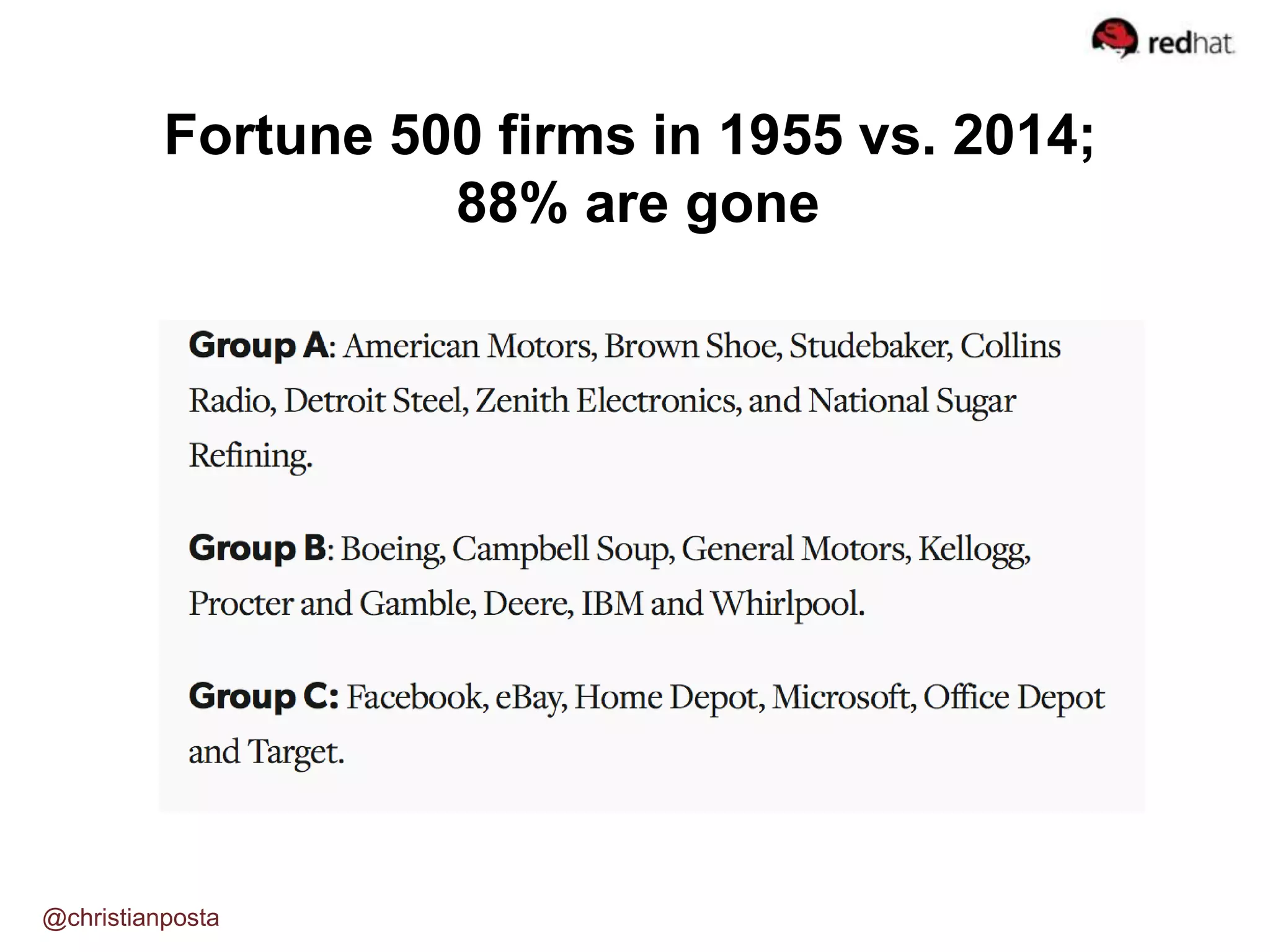
Fortune 500 firms in 1955 vs. 2014;
88% are gone
@christianposta
Competitive advantage is transient.
We need to continuously re-invent our
business models to compete and stay
relevant.
We need to continuously innovate.
@christianposta
Innovation is admitting we don’t
have all the answers
Mark Schwartz – Former CIO USCIS
@christianposta
We need to figure out the right
questions to ask…
Mark Schwartz – Former CIO USCIS
@christianposta
How do we do this?
@christianposta
• Identify goals
• Free teams to explore possible solution spaces
• Generate hypothesis
• Design cheap experiments to test hypothesis
• Work in small batches
• Learn from results
• Calibrate investment; rinse, repeat
“If I invest $5-$10M in your company and you fail, I have 30
other investments. It’s just a footnote in my investment history.”
https://medium.com/@mattklein123/optimizing-impact-why-i-will-not-start-an-envoy-platform-company-8904286658cb
https://barryoreilly.com/2017/04/06/optimize-to-be-wrong-not-right/
Create options through experiments
@christianposta
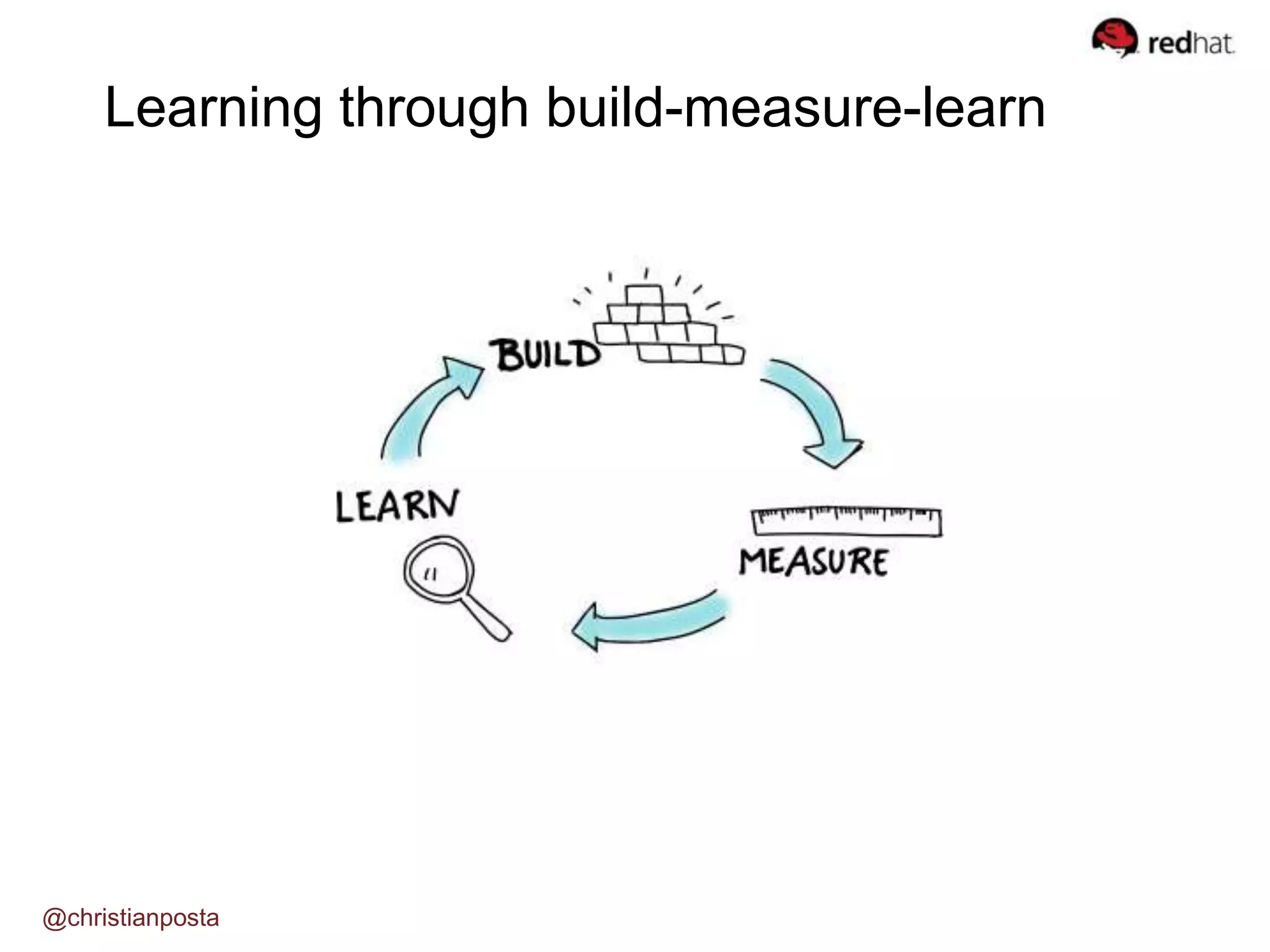
Learning through build-measure-learn
Microservices help us go faster.
@christianposta
So do we microservices all the way down?
@christianposta
@christianposta
http://blog.hypeinnovation.com/using-the-three-horizons-framework-for-innovation
IT Portfolio management strategies
@christianposta
Lean Enterprise: http://shop.oreilly.com/product/0636920030355.do
@christianposta
http://blog.hypeinnovation.com/using-the-three-horizons-framework-for-innovation
IT Portfolio management
MVPs, experiments, small apps
(co-locate if you have to write an app)
Product development, initial scale
(co-locate perfectly okay here!! ..
Microserices? possibly…)
Starting to feel the weight of maintenance,
need to shoot for efficiencies, integrate
new approaches to increase revenue
(microservices land)
Microservices != good design
AND
Co-location != bad design
@christianposta
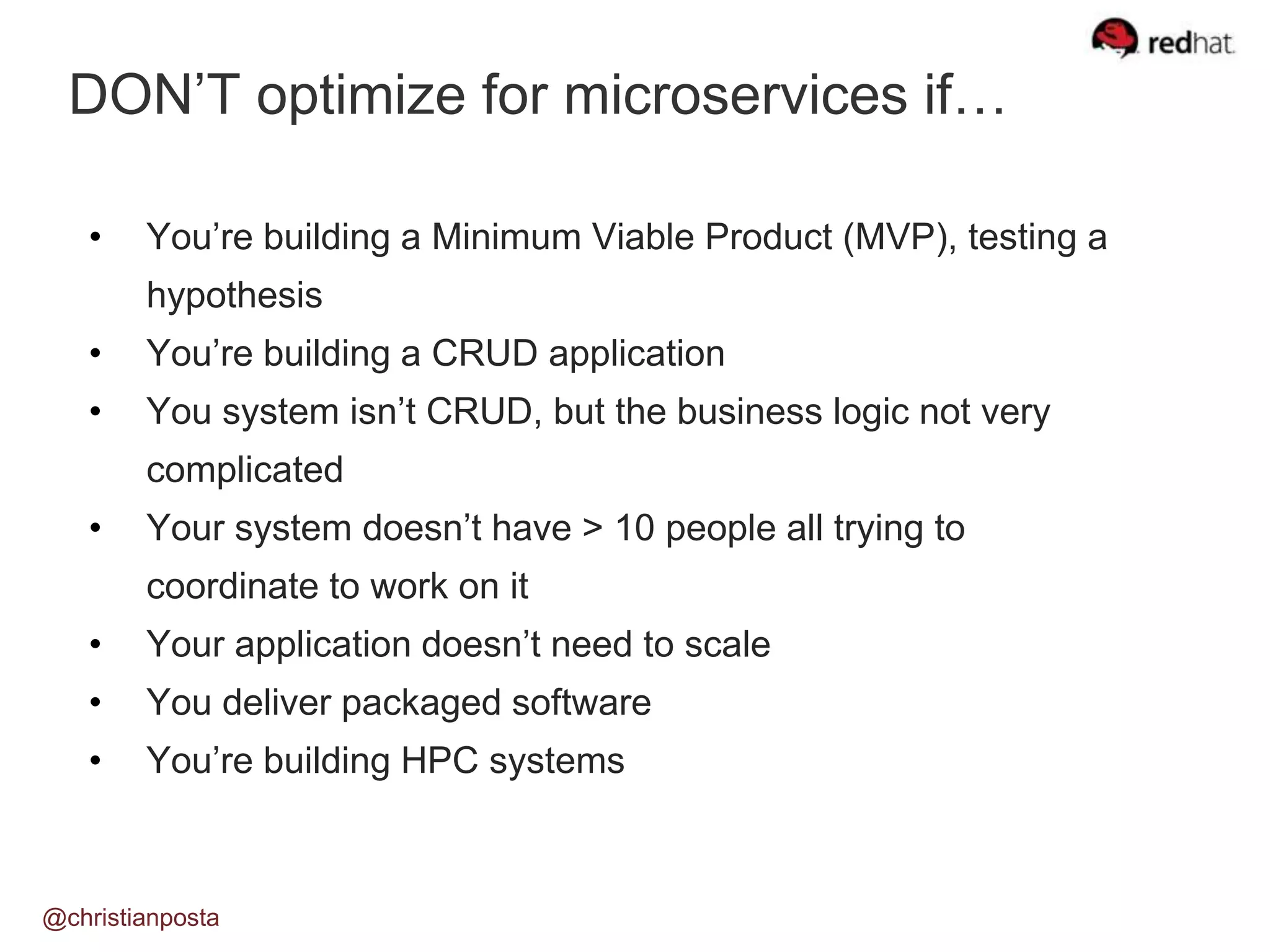
DON’T optimize for microservices if…
@christianposta
• You’re building a Minimum Viable Product (MVP), testing a
hypothesis
• You’re building a CRUD application
• You system isn’t CRUD, but the business logic not very
complicated
• Your system doesn’t have > 10 people all trying to
coordinate to work on it
• Your application doesn’t need to scale
• You deliver packaged software
• You’re building HPC systems
Making “cloud-native” economical
@christianposta
We can now assert with confidence that
high IT performance correlates with
strong business performance, helping
to boost productivity, profitability and
market share.
@christianposta
https://puppet.com/resources/whitepaper/2014-state-devops-report
High performing IT teams
@christianposta
• …are encouraged to experiment
• …learn from failure
• …work in small batches
• …focus on getting continuous feedback
• …are held to outcomes, not output
• …continuously prioritize and reprioritize based on
cost of delay (http://blackswanfarming.com/cost-of-
delay/)
High performing IT teams need these
IT capabilities and practices
@christianposta
• Continuous Integration (build from master)
• Continuous Delivery (automated pipelines)
• Safe, reliable delivery mechanisms
• Modern, scalable, resilient application architectures
• Self-service, on-demand infrastructure
• Automated testing
• Metrics, logs, traces, observability
• Feedback loops
• Security as part of the pipeline
@christianposta
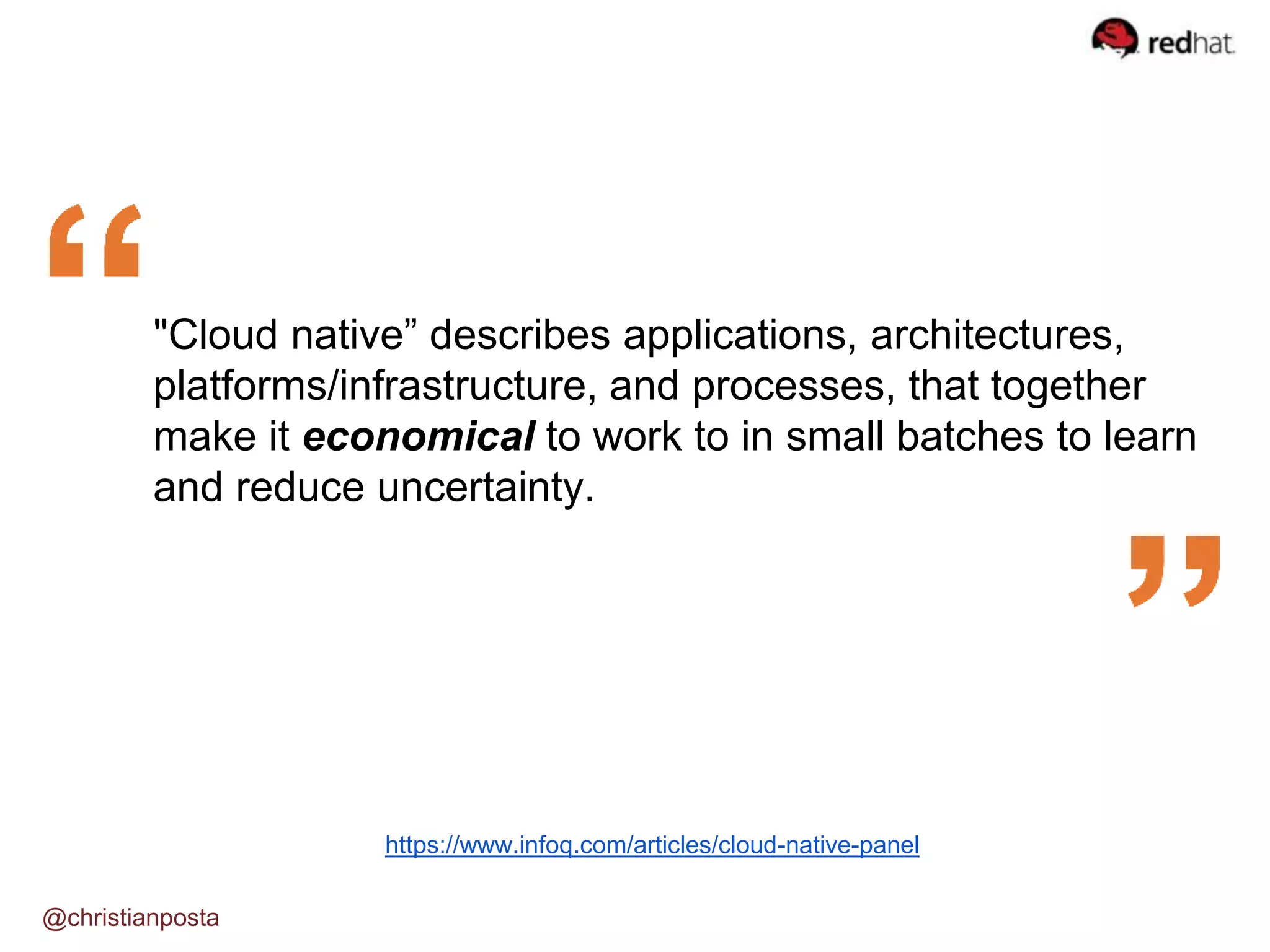
https://www.infoq.com/articles/cloud-native-panel
"Cloud native” describes applications, architectures,
platforms/infrastructure, and processes, that together
make it economical to work to in small batches to learn
and reduce uncertainty.
• Distributed configuration
• Service Discovery
• Loadbalancing
• Circuit Breakers
• Bulkheading
• Versioning/Routing
• Based on AWS
“Cloud-native” platform
What about non-java?
@christianposta
Kubernetes
@christianposta
Cluster management
• Distributed configuration
• Service Discovery
• Loadbalancing
• Versioning/Routing
• Deployments
• Scaling/Autoscaling
• Liveness/Health checking
• Self healing
• Logging, Metrics, Tracing
@christianposta
@christianposta
• Team self service application deployment
• Developer workflow
• Enterprise focused (LDAP, RBAC, Oauth, etc)
• Integrated Docker registry
• Jenkins Pipeline (CI/CD) out of the box
• Build/deployment triggers
• Software Defined Networking (SDN)
• Docker native format/packaging
• CLI/IDE/Web based tooling
OpenShift is a Kubernetes platform
@christianposta
@christianposta
@christianposta
@christianposta
@christianposta
• Simple configuration
• Curated dependencies and transitive
dependencies
• Built in metrics, monitoring
• Slim profile for deployment
• Strong communities (spring, vert.x,
microprofile.io)
OpenShift Application Runtimes
Use Kubernetes/OpenShift
• Distributed configuration
• Service Discovery
• Loadbalancing
• Versioning/Routing
• Deployments
• Scaling/Autoscaling
• Liveness/Health checking
• Self healing
• Logging, Metrics, Tracing
@christianposta
What if we’re already using
things like Spring Cloud and/or
Netflix OSS?!
@christianposta
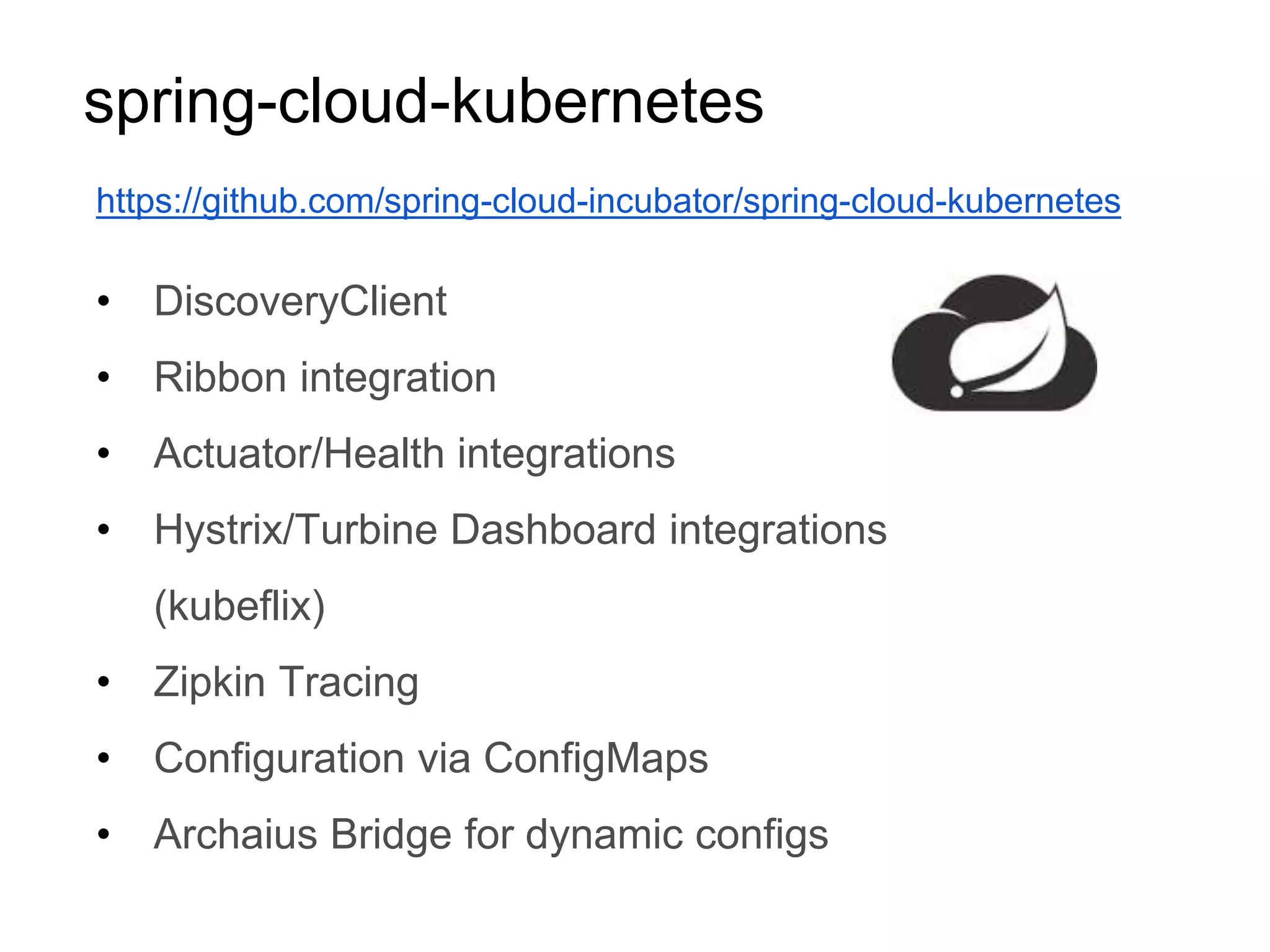
spring-cloud-kubernetes
• DiscoveryClient
• Ribbon integration
• Actuator/Health integrations
• Hystrix/Turbine Dashboard integrations
(kubeflix)
• Zipkin Tracing
• Configuration via ConfigMaps
• Archaius Bridge for dynamic configs
https://github.com/spring-cloud-incubator/spring-cloud-kubernetes
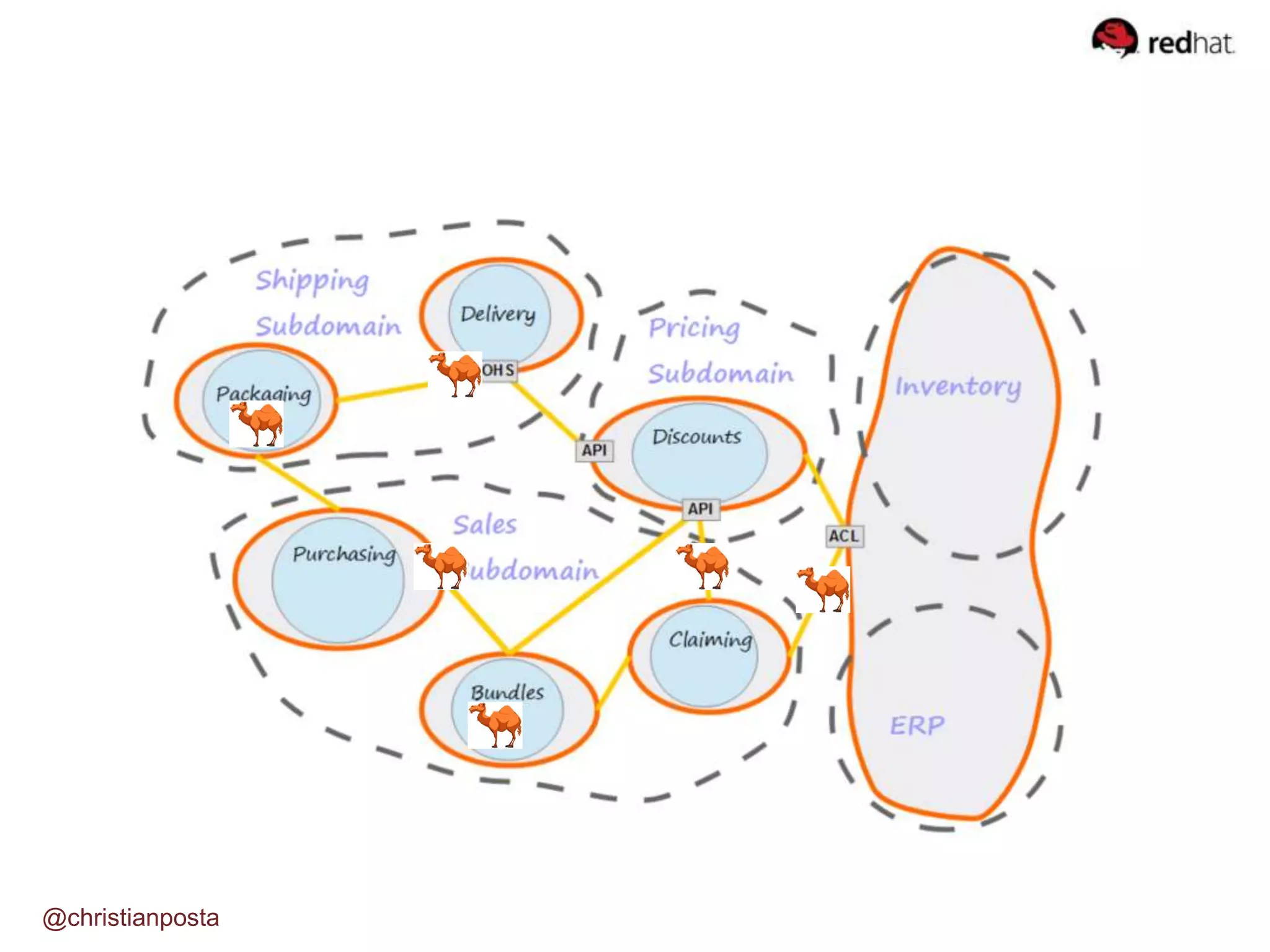
Microservices boundaries
@christianposta
@christianposta
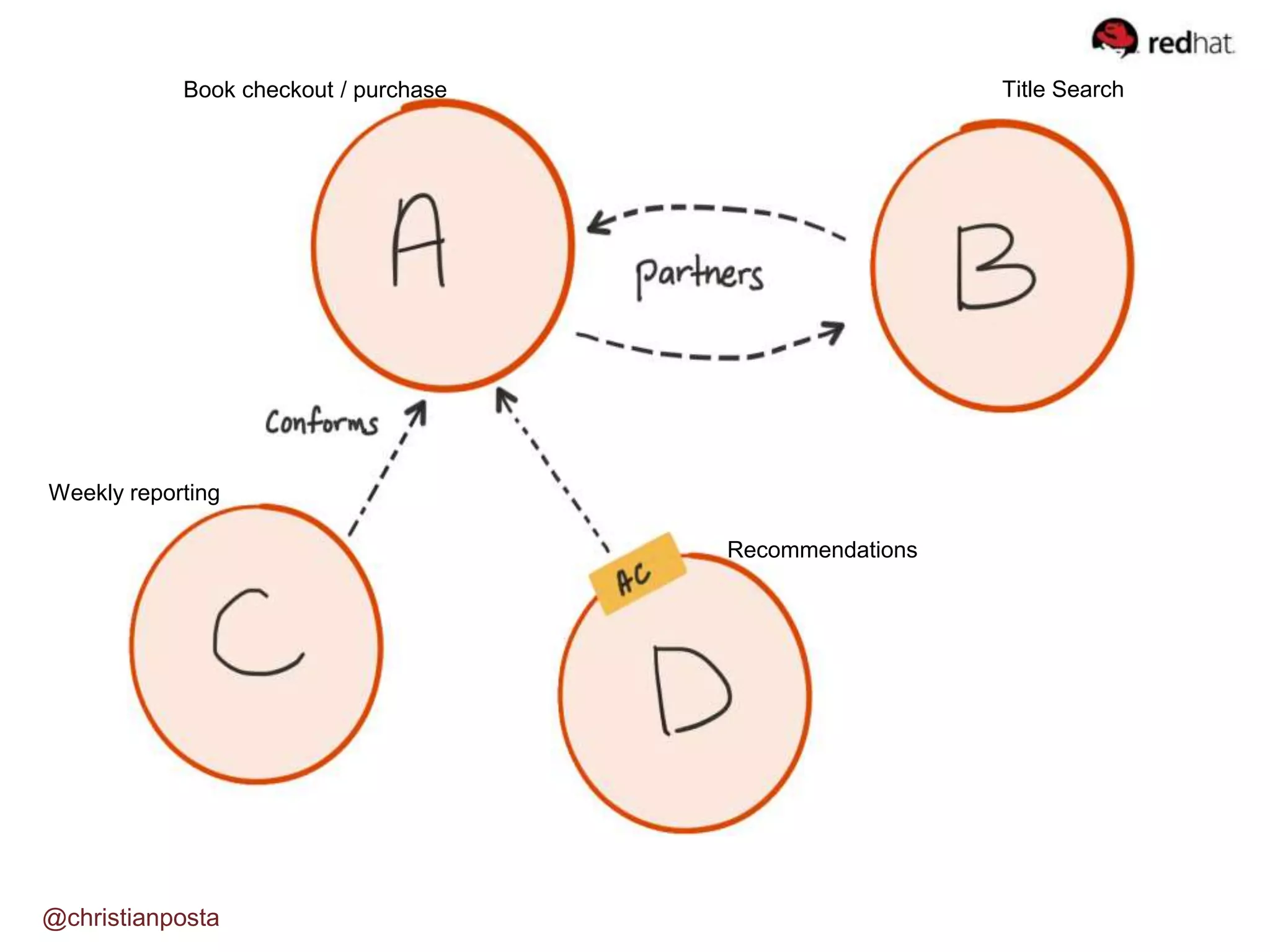
Book checkout / purchase Title Search
Recommendations
Weekly reporting
@christianposta
@christianposta
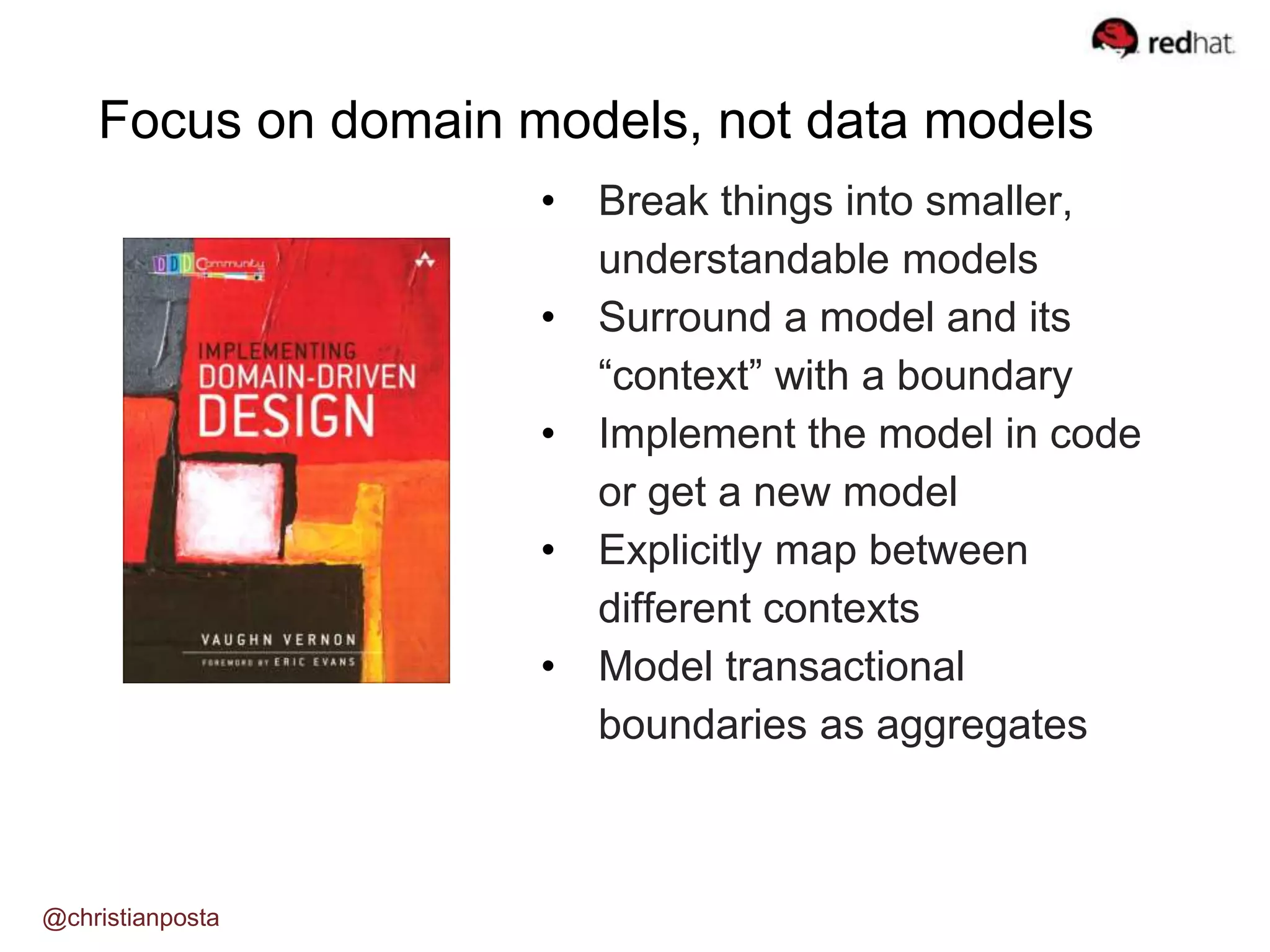
• Break things into smaller,
understandable models
• Surround a model and its
“context” with a boundary
• Implement the model in code
or get a new model
• Explicitly map between
different contexts
• Model transactional
boundaries as aggregates
Focus on domain models, not data models
@christianposta
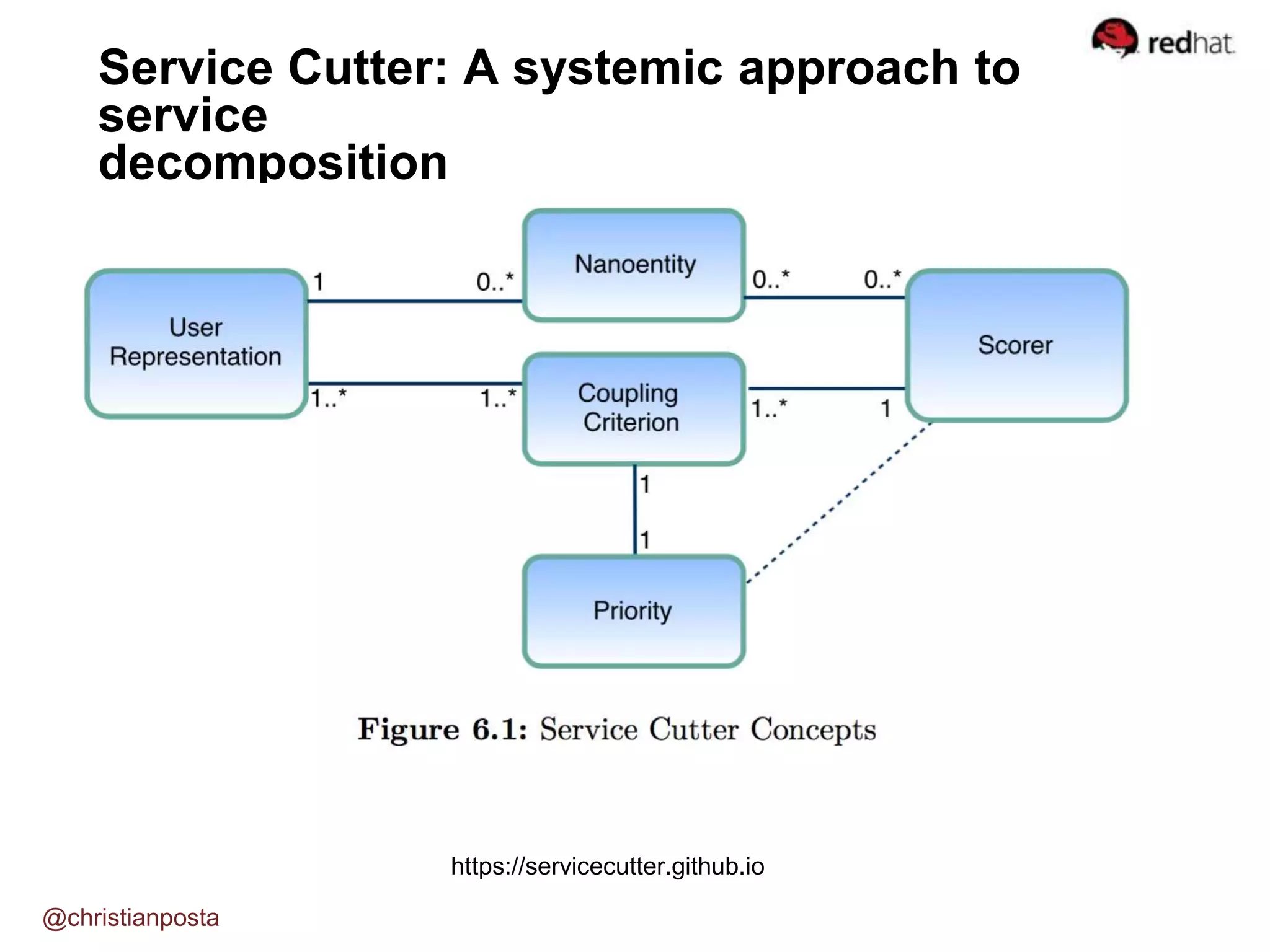
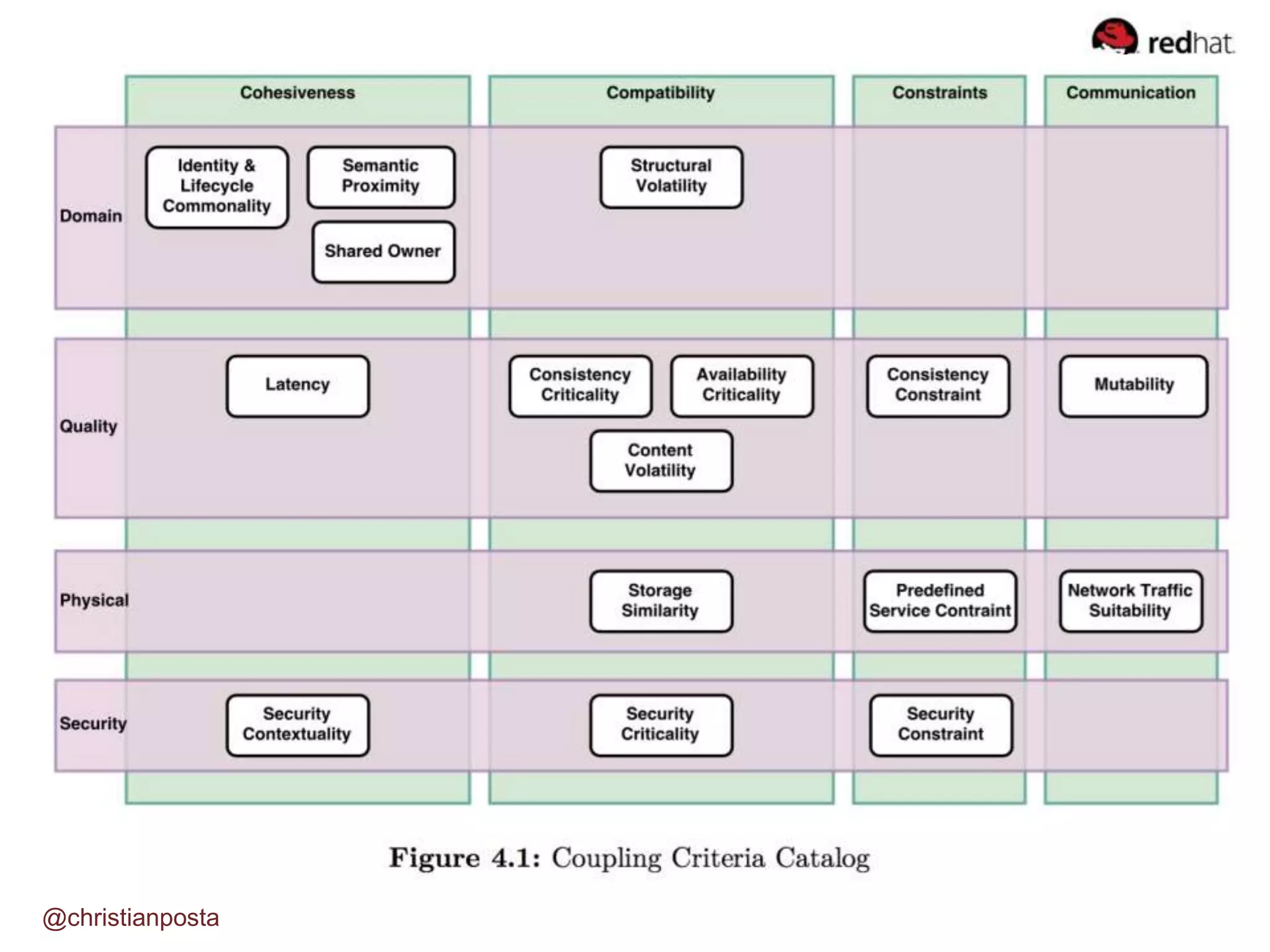
Service Cutter: A systemic approach to
service
decomposition
@christianposta
https://servicecutter.github.io
@christianposta
How do we share information?
• REST, RPC
• Streams/Events(ActiveMQ, JMS, AMQP, STOMP, Kafka,
etc)
• Legacy (SOAP, mainframe, file processing, proprietary)
• Routing, Aggregation, Splitting, Transactions,
Compensations, Filtering, etc.
@christianposta
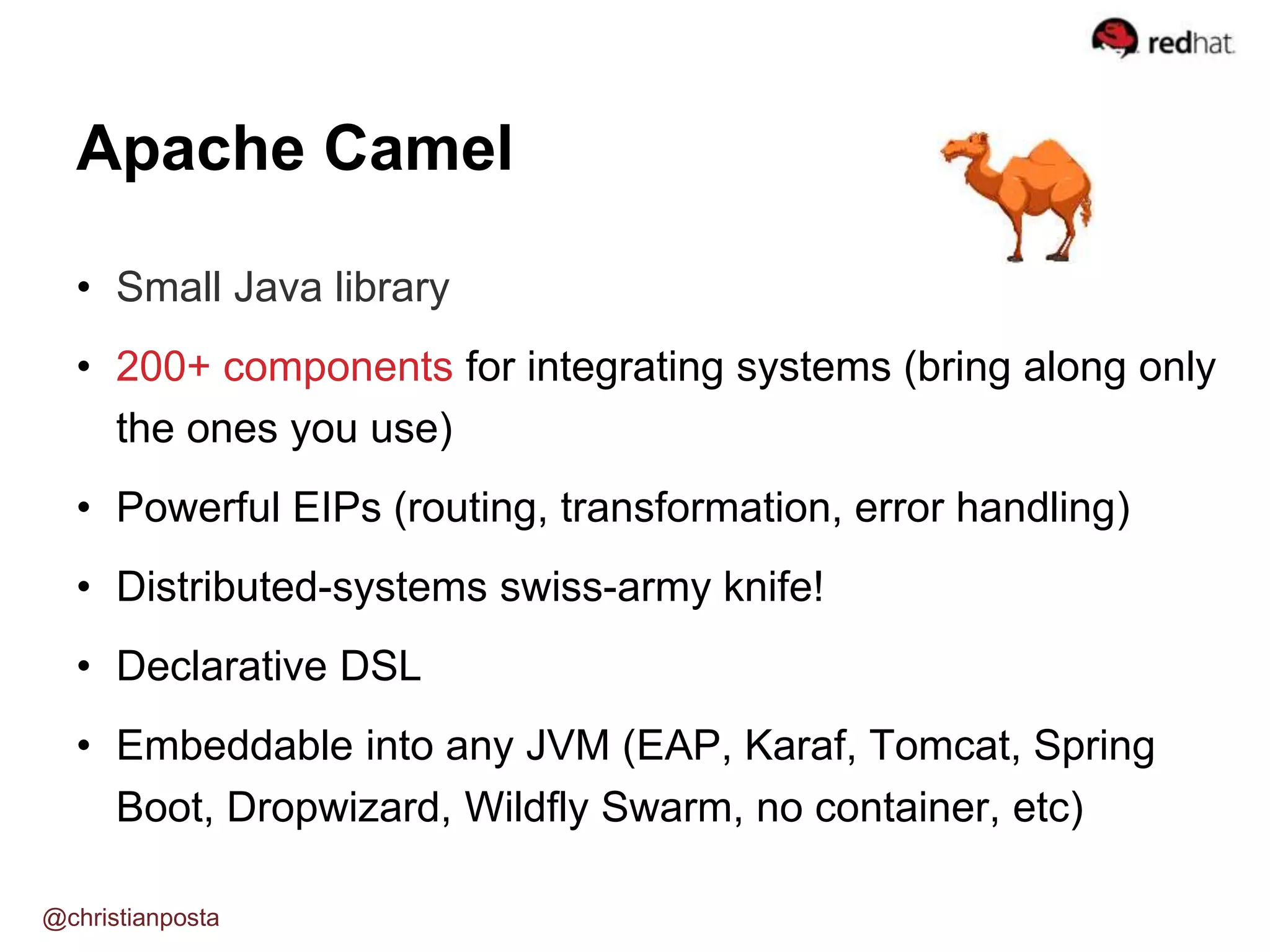
• Small Java library
• 200+ components for integrating systems (bring along only
the ones you use)
• Powerful EIPs (routing, transformation, error handling)
• Distributed-systems swiss-army knife!
• Declarative DSL
• Embeddable into any JVM (EAP, Karaf, Tomcat, Spring
Boot, Dropwizard, Wildfly Swarm, no container, etc)
Apache Camel
@christianposta
@christianposta
public class OrderProcessorRouteBuilder extends RouteBuilder {
@Override
public void configure() throws Exception {
rest().post(“/order/socks”)
.description(“New Order for pair of socks”)
.consumes(“application/json”)
.route()
.to(“activemq:topic:newOrder”)
.log(“received new order ${body.orderId}”)
.to(“ibatis:storeOrder?statementType=Insert”);
}
Camel REST DSL
@christianposta
Microservices resilience, routing,
control
@christianposta
Things you must solve for because…
distributed systems
• Service discovery
• Retries
• Timeouts
• Load balancing
• Rate limiting
• Thread bulk heading
• Circuit breaking
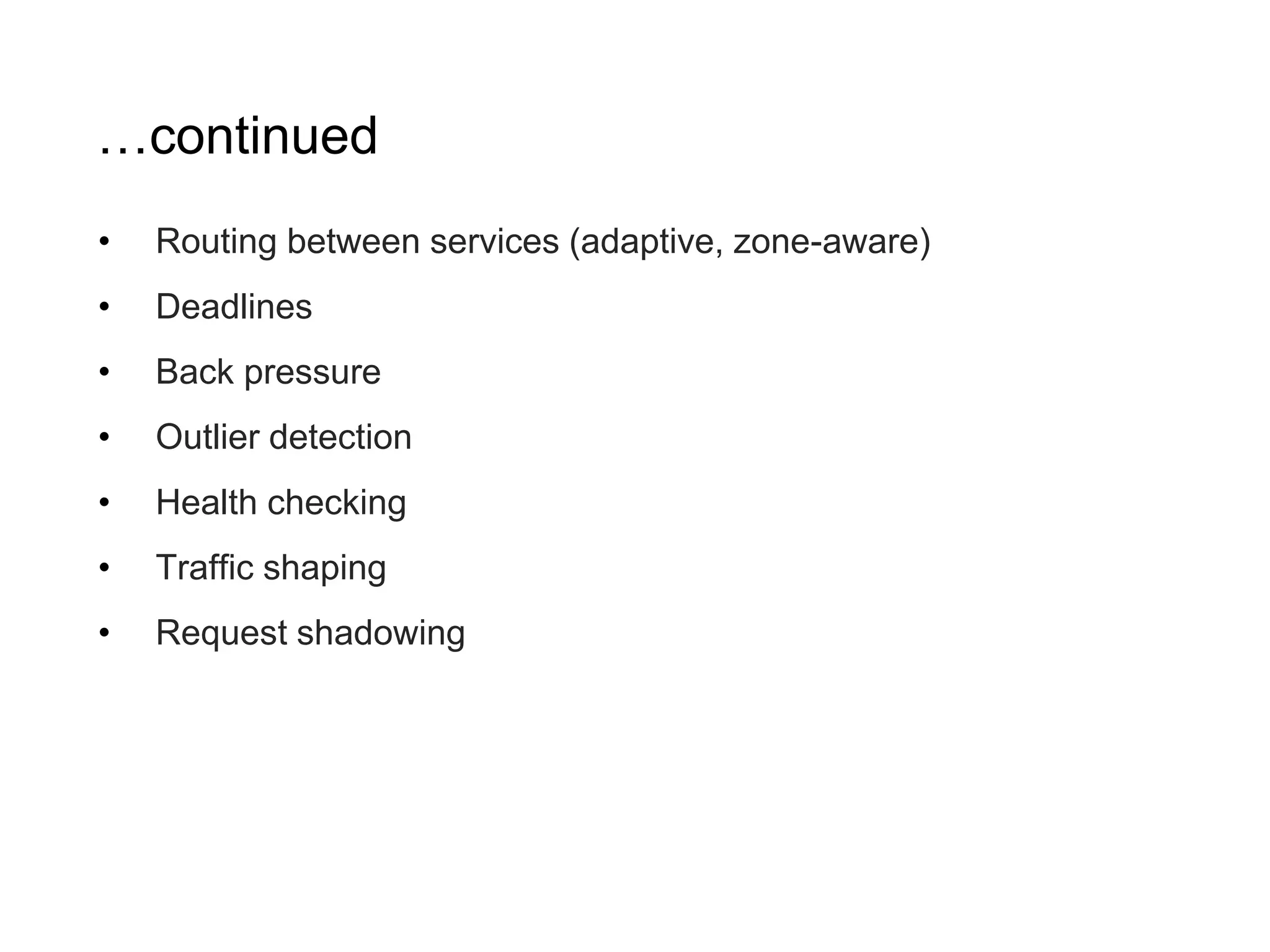
…continued
• Routing between services (adaptive, zone-aware)
• Deadlines
• Back pressure
• Outlier detection
• Health checking
• Traffic shaping
• Request shadowing
…continued
• Edge/DMZ routing
• Surgical / fine / per-request routing
• A/B rollout
• Internal releases / dark launches
• Fault injection
• Stats, metric, collection
• Logging
• Tracing
@christianposta
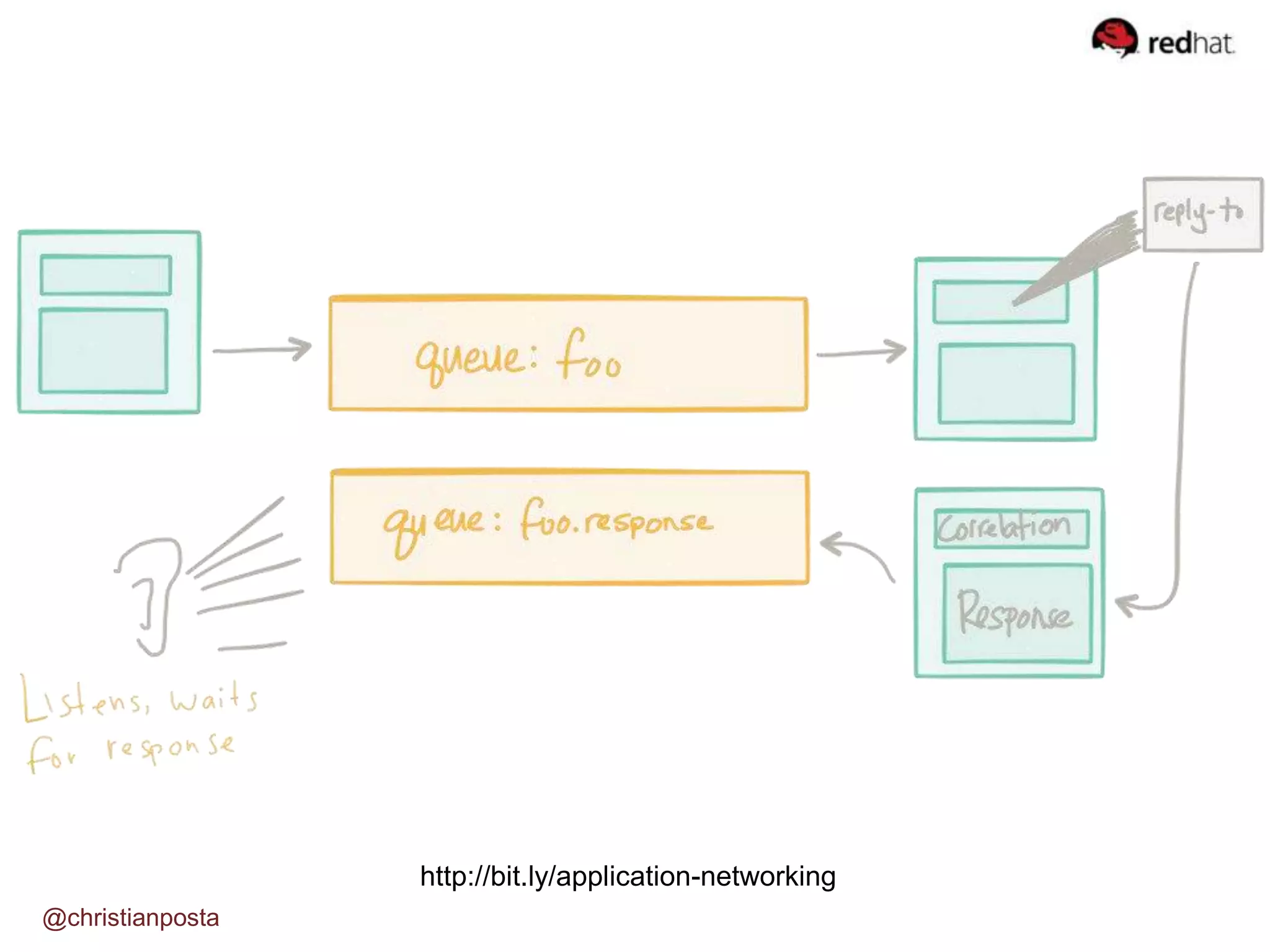
http://bit.ly/application-networking
@christianposta
http://bit.ly/application-networking
@christianposta
http://bit.ly/application-networking
• Netflix Hystrix (circuit breaking / bulk heading)
• Netflix Zuul (edge router)
• Netflix Ribbon (client-side service discovery / load balance)
• Netflix Eureka (service discovery registry)
• Brave / Zipkin (tracing)
• Netflix spectator / atlas (metrics)
“Microservices” patterns
@christianposta
@christianposta
http://bit.ly/application-networking
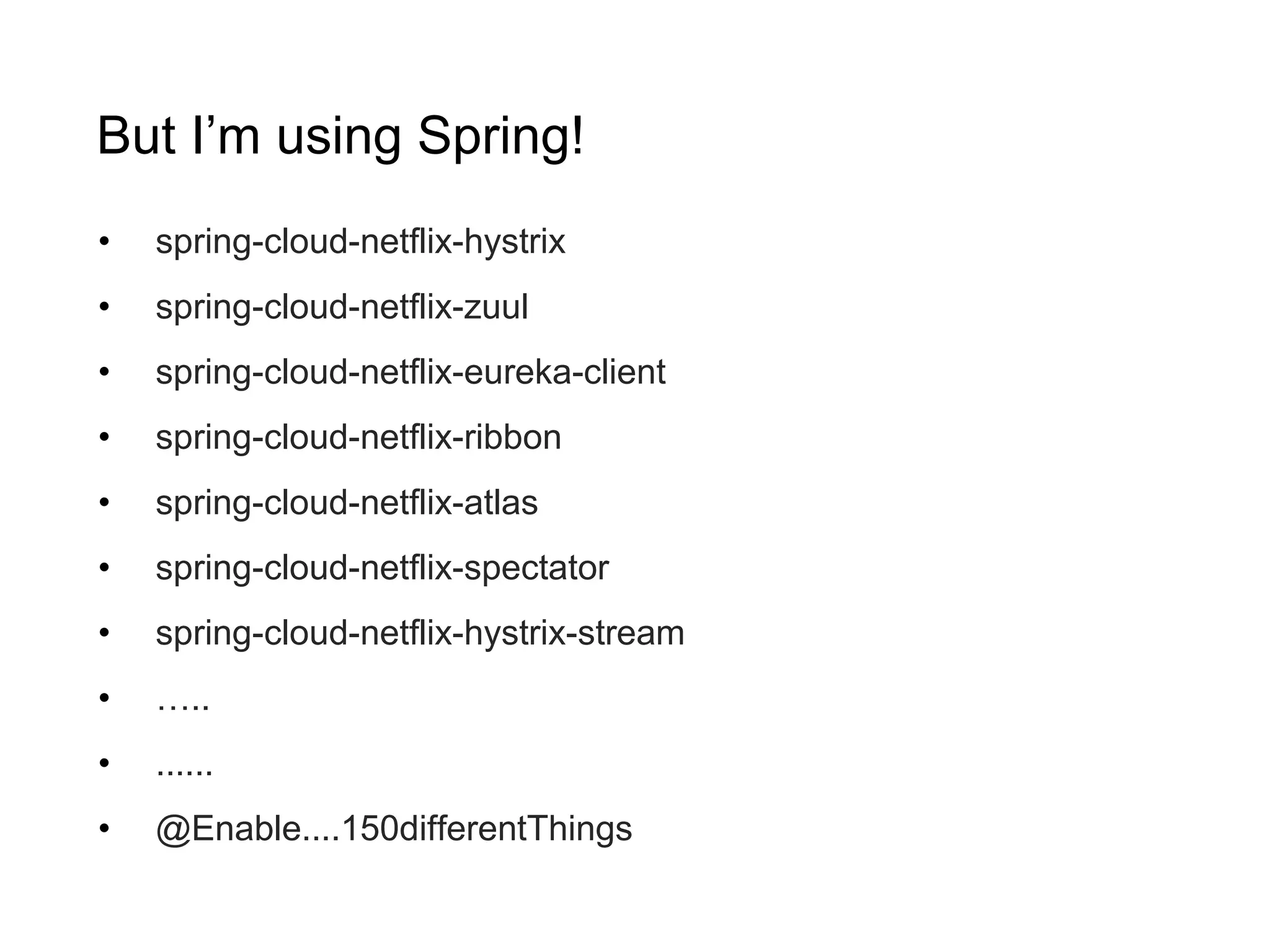
But I’m using Spring!
• spring-cloud-netflix-hystrix
• spring-cloud-netflix-zuul
• spring-cloud-netflix-eureka-client
• spring-cloud-netflix-ribbon
• spring-cloud-netflix-atlas
• spring-cloud-netflix-spectator
• spring-cloud-netflix-hystrix-stream
• …..
• ......
• @Enable....150differentThings
But I’m using Vert.x!
• vertx-circuit-breaker
• vertx-service-discovery
• vertx-dropwizard-metrics
• vertx-zipkin?
• …..
• ......
But I’m using NodeJS!
But I’m using Go!
But I’m using Python!
Get the point?
@christianposta
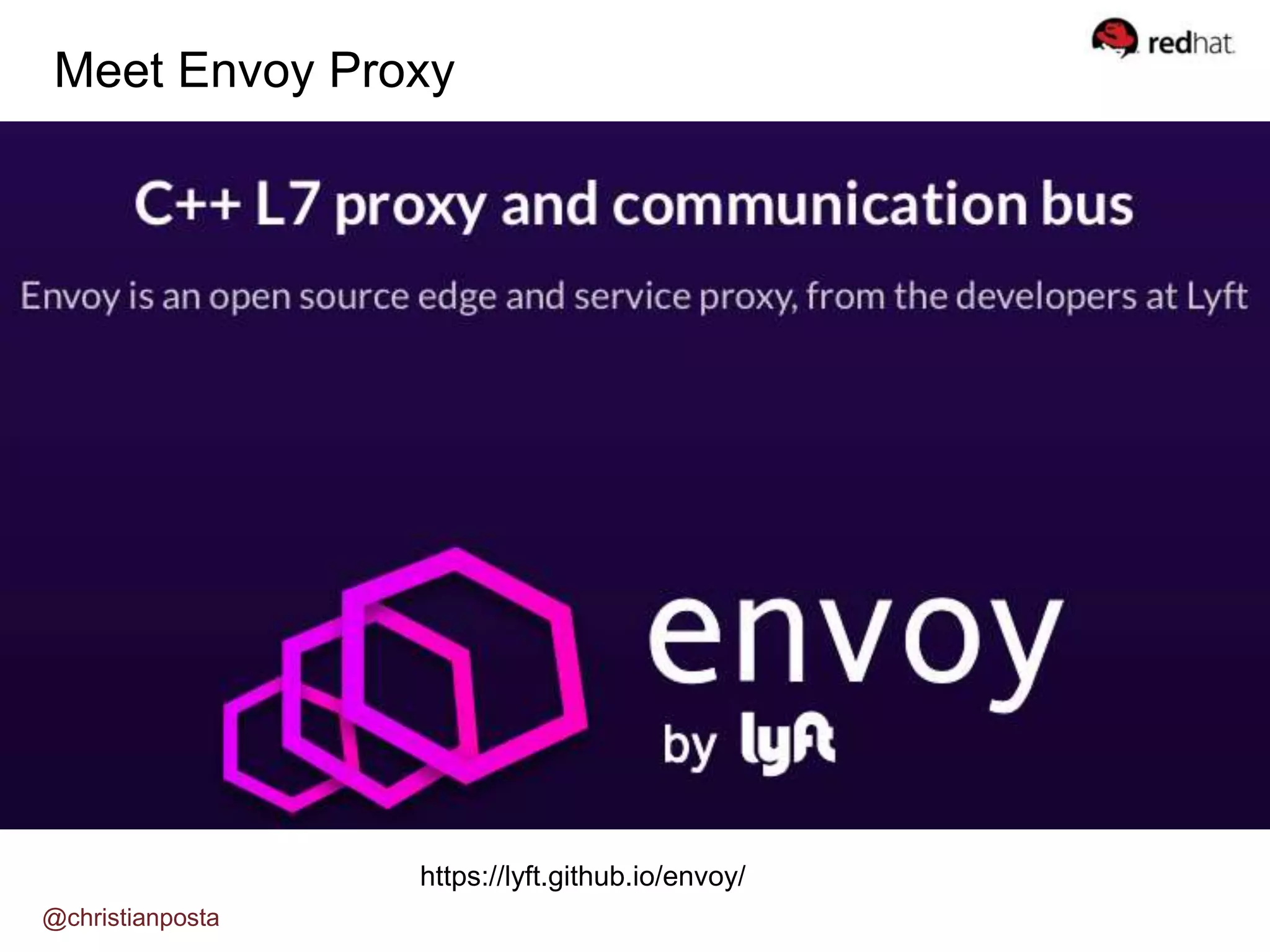
https://lyft.github.io/envoy/
Meet Envoy Proxy
Sidecar pattern
Meet Istio Service Mesh
https://istio.io
Quick Demo
https://istio.io/docs/samples/bookinfo.html
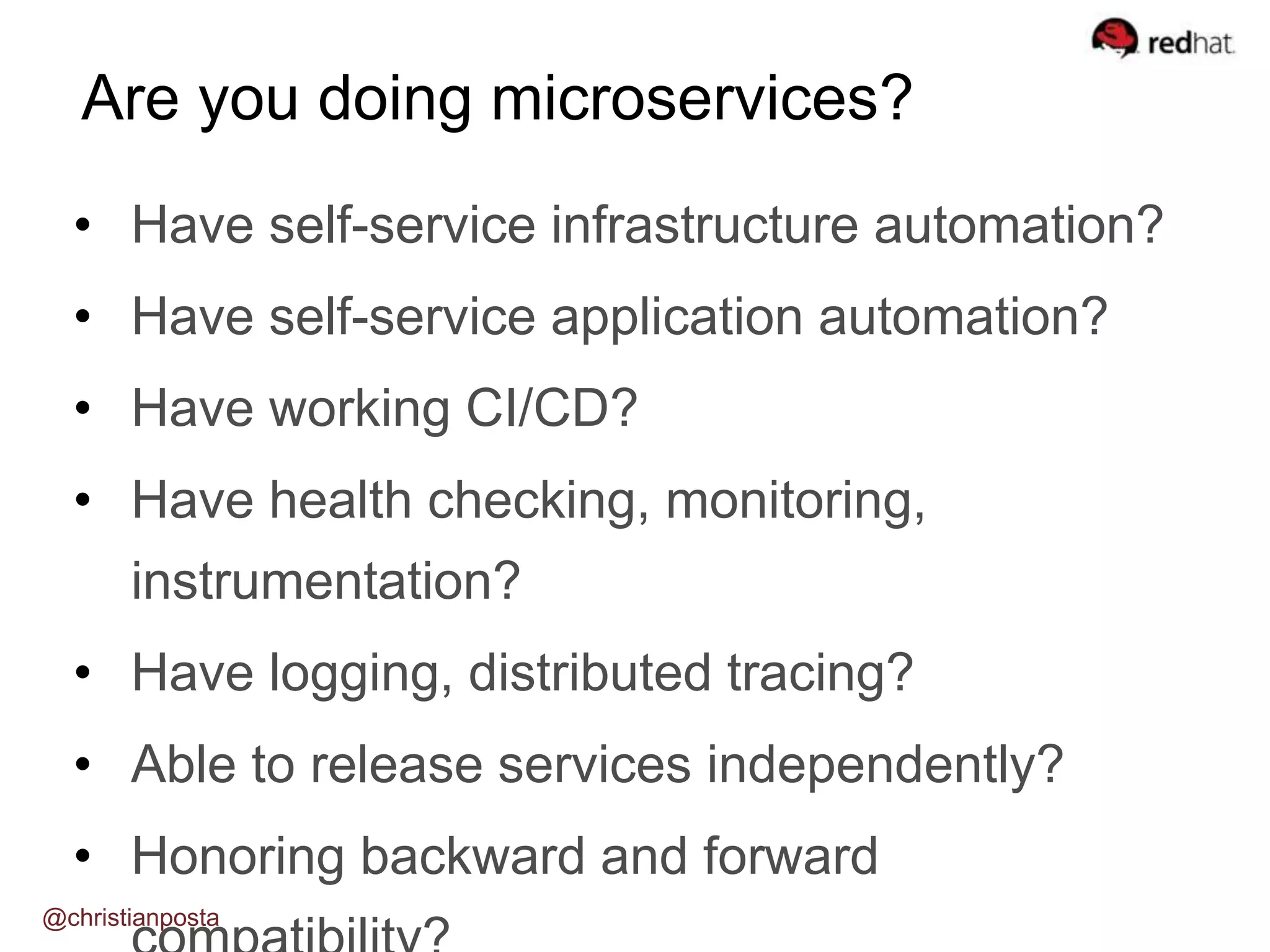
• Have self-service infrastructure automation?
• Have self-service application automation?
• Have working CI/CD?
• Have health checking, monitoring,
instrumentation?
• Have logging, distributed tracing?
• Able to release services independently?
• Honoring backward and forward
Are you doing microservices?
@christianposta
• Number of features accepted
• % of features completed
• User satisfaction
• Feature Cycle time
• defects discovered after deployment
• customer lifetime value (future profit as a result of relationship with the
customer) https://en.wikipedia.org/wiki/Customer_lifetime_value
• revenue per feature
• mean time to recovery
• % improvement in SLA
• number of changes
• number of user complaints, recommendations, suggestions
• % favorable rating in surveys
• % of users using which features
• % reduction in error rates
• avg number of tx / user
• MANY MORE!
Focus on going fast and learning
• The hardest part of microservices? Your data
https://developers.redhat.com/blog/2016/08/02/the-hardest-part-about-microservices-your-data/
• Microservices patterns:
circuit breaking with Envoy Proxy
https://developers.redhat.com/blog/2017/05/31/microservices-patterns-with-envoy-sidecar-proxy-
part-i-circuit-breaking/
• Monolith to microservices Part I
https://developers.redhat.com/blog/2017/09/26/low-risk-monolith-microservice-evolution-part/
• Monolith to microservices Part II
https://developers.redhat.com/blog/2017/10/23/low-risk-monolith-microservice-evolution-part-ii/
More material
@christianposta
• Download and explore OpenShift
• https://www.openshift.org/minishift/
• Checkout Spring Boot/WildFlySwarm/Vert.x on
OpenShift:
• https://launch.openshift.io
• Reach out to your Red Hat rep to discuss more and/or
get me/my team involved with your initiatives
What next?
Thanks!
BTW: Hand drawn diagrams made with Paper by FiftyThree.com @christianposta
Twitter: @christianposta
Blog: http://blog.christianposta.com
Email: christian@redhat.com
Slides: http://slideshare.net/ceposta
Follow up links:
• http://openshift.io
• http://launch.openshift.io
• http://blog.openshift.com
• http://developers.redhat.com/blog
• https://www.redhat.com/en/open-innovation-labs
• https://www.redhat.com/en/technologies/jboss-middleware/3scale
• https://www.redhat.com/en/technologies/jboss-middleware/fuse

Sidecars and a Microservices Mesh

  • 1.
  • 2.
    Christian Posta Chief Architect,cloud application development Twitter: @christianposta Blog: http://blog.christianposta.com Email: christian@redhat.com Slides: http://slideshare.net/ceposta • Author “Microservices for Java developers” • Committer/contributor lots of open-source projects • Worked with large Microservices, web-scale, unicorn company • Blogger, speaker about DevOps, integration, and microservices
  • 4.
    Rough path ofdiscussions today • Microservices: What, Why, When? • “Cloud-native” with a Platform • Microservices frameworks • Service decomposition and boundaries • Microservice resilience, routing, and control @christianposta
  • 5.
  • 6.
    “The microservice architecturalstyle is an approach to developing a single application as a suite of small services, each running in its own process and communicating with lightweight mechanisms, often an HTTP resource API. These services are built around business capabilities and independently deployable by fully automated deployment machinery.” A microservices definition
  • 7.
    • Single, self-contained,autonomous • Isolated and Resilient to faults • Faster software delivery • Own their own data • Easier to understand individually • Scalability • Right technology for the problem • Test individual services • Individual deployments Microservices? @christianposta
  • 8.
    • System complexity •Operational complexity • Testing is harder across services • Security • Hard to get boundaries right (transactions, APIs, etc) • Resource overhead • Network overhead • Lack of tooling Drawbacks to microservices @christianposta
  • 9.
    Why would oneimplement a system as microservices? @christianposta
  • 10.
    Pain we mayfeel… @christianposta • Making changes in one place negatively affects unrelated areas • Low confidence making changes that don’t break things • Spend lots of time trying to coordinate work between team members • Structure in the application has eroded or is non- existant • We have no way to quantify how long code merges will take
  • 11.
    @christianposta • Development timeis slow simply because the project is so big (IDE bogs down, running tests is slow, slow bootstrap time, etc) • Changes to one module force changes across other modules • Difficult to sunset outdated technology • We’ve built our new applications around old premises like batch processing • Application steps on itself at runtime managing resources, allocations, computations Pain we may feel…
  • 12.
    Microservices is aboutoptimizing for speed. @christianposta
  • 13.
    If change ishappening on the outside faster than on the inside the end is in sight. S&P company life expectancy @christianposta Jack Welch, former CEO, GE
  • 14.
    Fortune 500 firmsin 1955 vs. 2014; 88% are gone @christianposta
  • 15.
    Competitive advantage istransient. We need to continuously re-invent our business models to compete and stay relevant. We need to continuously innovate. @christianposta
  • 16.
    Innovation is admittingwe don’t have all the answers Mark Schwartz – Former CIO USCIS @christianposta
  • 17.
    We need tofigure out the right questions to ask… Mark Schwartz – Former CIO USCIS @christianposta
  • 18.
    How do wedo this? @christianposta • Identify goals • Free teams to explore possible solution spaces • Generate hypothesis • Design cheap experiments to test hypothesis • Work in small batches • Learn from results • Calibrate investment; rinse, repeat
  • 19.
    “If I invest$5-$10M in your company and you fail, I have 30 other investments. It’s just a footnote in my investment history.” https://medium.com/@mattklein123/optimizing-impact-why-i-will-not-start-an-envoy-platform-company-8904286658cb https://barryoreilly.com/2017/04/06/optimize-to-be-wrong-not-right/ Create options through experiments
  • 20.
  • 21.
    Microservices help usgo faster. @christianposta
  • 22.
    So do wemicroservices all the way down? @christianposta
  • 23.
  • 24.
  • 25.
    @christianposta http://blog.hypeinnovation.com/using-the-three-horizons-framework-for-innovation IT Portfolio management MVPs,experiments, small apps (co-locate if you have to write an app) Product development, initial scale (co-locate perfectly okay here!! .. Microserices? possibly…) Starting to feel the weight of maintenance, need to shoot for efficiencies, integrate new approaches to increase revenue (microservices land)
  • 26.
    Microservices != gooddesign AND Co-location != bad design @christianposta
  • 27.
    DON’T optimize formicroservices if… @christianposta • You’re building a Minimum Viable Product (MVP), testing a hypothesis • You’re building a CRUD application • You system isn’t CRUD, but the business logic not very complicated • Your system doesn’t have > 10 people all trying to coordinate to work on it • Your application doesn’t need to scale • You deliver packaged software • You’re building HPC systems
  • 28.
  • 29.
    We can nowassert with confidence that high IT performance correlates with strong business performance, helping to boost productivity, profitability and market share. @christianposta https://puppet.com/resources/whitepaper/2014-state-devops-report
  • 30.
    High performing ITteams @christianposta • …are encouraged to experiment • …learn from failure • …work in small batches • …focus on getting continuous feedback • …are held to outcomes, not output • …continuously prioritize and reprioritize based on cost of delay (http://blackswanfarming.com/cost-of- delay/)
  • 31.
    High performing ITteams need these IT capabilities and practices @christianposta • Continuous Integration (build from master) • Continuous Delivery (automated pipelines) • Safe, reliable delivery mechanisms • Modern, scalable, resilient application architectures • Self-service, on-demand infrastructure • Automated testing • Metrics, logs, traces, observability • Feedback loops • Security as part of the pipeline
  • 32.
    @christianposta https://www.infoq.com/articles/cloud-native-panel "Cloud native” describesapplications, architectures, platforms/infrastructure, and processes, that together make it economical to work to in small batches to learn and reduce uncertainty.
  • 33.
    • Distributed configuration •Service Discovery • Loadbalancing • Circuit Breakers • Bulkheading • Versioning/Routing • Based on AWS “Cloud-native” platform What about non-java? @christianposta
  • 34.
  • 35.
    Cluster management • Distributedconfiguration • Service Discovery • Loadbalancing • Versioning/Routing • Deployments • Scaling/Autoscaling • Liveness/Health checking • Self healing • Logging, Metrics, Tracing @christianposta
  • 36.
  • 37.
    • Team selfservice application deployment • Developer workflow • Enterprise focused (LDAP, RBAC, Oauth, etc) • Integrated Docker registry • Jenkins Pipeline (CI/CD) out of the box • Build/deployment triggers • Software Defined Networking (SDN) • Docker native format/packaging • CLI/IDE/Web based tooling OpenShift is a Kubernetes platform @christianposta
  • 39.
  • 40.
  • 41.
  • 42.
    @christianposta • Simple configuration •Curated dependencies and transitive dependencies • Built in metrics, monitoring • Slim profile for deployment • Strong communities (spring, vert.x, microprofile.io) OpenShift Application Runtimes
  • 43.
    Use Kubernetes/OpenShift • Distributedconfiguration • Service Discovery • Loadbalancing • Versioning/Routing • Deployments • Scaling/Autoscaling • Liveness/Health checking • Self healing • Logging, Metrics, Tracing @christianposta
  • 44.
    What if we’realready using things like Spring Cloud and/or Netflix OSS?! @christianposta
  • 45.
    spring-cloud-kubernetes • DiscoveryClient • Ribbonintegration • Actuator/Health integrations • Hystrix/Turbine Dashboard integrations (kubeflix) • Zipkin Tracing • Configuration via ConfigMaps • Archaius Bridge for dynamic configs https://github.com/spring-cloud-incubator/spring-cloud-kubernetes
  • 46.
  • 48.
  • 49.
    Book checkout /purchase Title Search Recommendations Weekly reporting @christianposta
  • 50.
  • 51.
    • Break thingsinto smaller, understandable models • Surround a model and its “context” with a boundary • Implement the model in code or get a new model • Explicitly map between different contexts • Model transactional boundaries as aggregates Focus on domain models, not data models @christianposta
  • 52.
    Service Cutter: Asystemic approach to service decomposition @christianposta https://servicecutter.github.io
  • 53.
  • 54.
    How do weshare information? • REST, RPC • Streams/Events(ActiveMQ, JMS, AMQP, STOMP, Kafka, etc) • Legacy (SOAP, mainframe, file processing, proprietary) • Routing, Aggregation, Splitting, Transactions, Compensations, Filtering, etc. @christianposta
  • 55.
    • Small Javalibrary • 200+ components for integrating systems (bring along only the ones you use) • Powerful EIPs (routing, transformation, error handling) • Distributed-systems swiss-army knife! • Declarative DSL • Embeddable into any JVM (EAP, Karaf, Tomcat, Spring Boot, Dropwizard, Wildfly Swarm, no container, etc) Apache Camel @christianposta
  • 56.
  • 57.
    public class OrderProcessorRouteBuilderextends RouteBuilder { @Override public void configure() throws Exception { rest().post(“/order/socks”) .description(“New Order for pair of socks”) .consumes(“application/json”) .route() .to(“activemq:topic:newOrder”) .log(“received new order ${body.orderId}”) .to(“ibatis:storeOrder?statementType=Insert”); } Camel REST DSL @christianposta
  • 58.
  • 59.
    Things you mustsolve for because… distributed systems • Service discovery • Retries • Timeouts • Load balancing • Rate limiting • Thread bulk heading • Circuit breaking
  • 60.
    …continued • Routing betweenservices (adaptive, zone-aware) • Deadlines • Back pressure • Outlier detection • Health checking • Traffic shaping • Request shadowing
  • 61.
    …continued • Edge/DMZ routing •Surgical / fine / per-request routing • A/B rollout • Internal releases / dark launches • Fault injection • Stats, metric, collection • Logging • Tracing
  • 62.
  • 63.
  • 64.
  • 65.
    • Netflix Hystrix(circuit breaking / bulk heading) • Netflix Zuul (edge router) • Netflix Ribbon (client-side service discovery / load balance) • Netflix Eureka (service discovery registry) • Brave / Zipkin (tracing) • Netflix spectator / atlas (metrics) “Microservices” patterns @christianposta
  • 66.
  • 67.
    But I’m usingSpring! • spring-cloud-netflix-hystrix • spring-cloud-netflix-zuul • spring-cloud-netflix-eureka-client • spring-cloud-netflix-ribbon • spring-cloud-netflix-atlas • spring-cloud-netflix-spectator • spring-cloud-netflix-hystrix-stream • ….. • ...... • @Enable....150differentThings
  • 68.
    But I’m usingVert.x! • vertx-circuit-breaker • vertx-service-discovery • vertx-dropwizard-metrics • vertx-zipkin? • ….. • ......
  • 69.
    But I’m usingNodeJS! But I’m using Go! But I’m using Python!
  • 70.
  • 71.
  • 72.
  • 74.
    Meet Istio ServiceMesh https://istio.io
  • 75.
  • 76.
    • Have self-serviceinfrastructure automation? • Have self-service application automation? • Have working CI/CD? • Have health checking, monitoring, instrumentation? • Have logging, distributed tracing? • Able to release services independently? • Honoring backward and forward Are you doing microservices? @christianposta
  • 77.
    • Number offeatures accepted • % of features completed • User satisfaction • Feature Cycle time • defects discovered after deployment • customer lifetime value (future profit as a result of relationship with the customer) https://en.wikipedia.org/wiki/Customer_lifetime_value • revenue per feature • mean time to recovery • % improvement in SLA • number of changes • number of user complaints, recommendations, suggestions • % favorable rating in surveys • % of users using which features • % reduction in error rates • avg number of tx / user • MANY MORE! Focus on going fast and learning
  • 78.
    • The hardestpart of microservices? Your data https://developers.redhat.com/blog/2016/08/02/the-hardest-part-about-microservices-your-data/ • Microservices patterns: circuit breaking with Envoy Proxy https://developers.redhat.com/blog/2017/05/31/microservices-patterns-with-envoy-sidecar-proxy- part-i-circuit-breaking/ • Monolith to microservices Part I https://developers.redhat.com/blog/2017/09/26/low-risk-monolith-microservice-evolution-part/ • Monolith to microservices Part II https://developers.redhat.com/blog/2017/10/23/low-risk-monolith-microservice-evolution-part-ii/ More material @christianposta
  • 79.
    • Download andexplore OpenShift • https://www.openshift.org/minishift/ • Checkout Spring Boot/WildFlySwarm/Vert.x on OpenShift: • https://launch.openshift.io • Reach out to your Red Hat rep to discuss more and/or get me/my team involved with your initiatives What next?
  • 81.
    Thanks! BTW: Hand drawndiagrams made with Paper by FiftyThree.com @christianposta Twitter: @christianposta Blog: http://blog.christianposta.com Email: christian@redhat.com Slides: http://slideshare.net/ceposta Follow up links: • http://openshift.io • http://launch.openshift.io • http://blog.openshift.com • http://developers.redhat.com/blog • https://www.redhat.com/en/open-innovation-labs • https://www.redhat.com/en/technologies/jboss-middleware/3scale • https://www.redhat.com/en/technologies/jboss-middleware/fuse