Introduction
Algorithmic Research
Problems
Types of Algorithmic
research problems
Algorithm:
It is a sequence steps to solve
a problem of interest.
It is procedure for solving
problem with special focus on
solving
problem
using
computer.
Search algorithms
Sorting algorithms
Shortest path algorithms
Minimum spanning tree algorithms
Branch and bound algorithms
Hungerian method for assignment
method
Simplex algorithm for linear
programming
Zero-one implicit enumeration
algorithm for 0-1 programming
Simulated annealing algorithm
Genetic algorithm
Tabu search algorithm
Greedy algorithm for Travelling
Salesman Problem
Introduction

Algorithmic Research
Problems
Types of Algorithmic
research problems
Financial
management
Marketing
management

Production
management

Research
problems in
different
functional areas
of management

Personnel
management

Other areas
Minimizing the mean tardiness in
single scheduling problem
Minimizing the weighted mean
tardiness
in
single
machine
scheduling problem
Minimizing the sum of the tardiness
and earliness in single machine
scheduling problem
Minimizing the makespan in parallel
machines scheduling problem
Minimizing the makespan in flowshop
scheduling problem
Maximizing the balancing efficiency of
an assembly line
Resource leveling and allocation in
project network
Aggregate planning problem
Master production planning problem
Dealer
location
problem

Travelling
Salesman problem

Problems in
Marketing
Management

Media
planning
problem

Salesman
assignment
problem
Determination of
rate of return

Capital budgeting

Exclusive
Selection of
mutually and
collectively
exhaustive
projects

Portfolio
management
Problems in Personnel
Management
Allocation
Employees
in-house
training
problem

Manpower
planning
problem

of fund to
personnel
activities
Assignmen
for
t problem
improved
labor
productivit
y
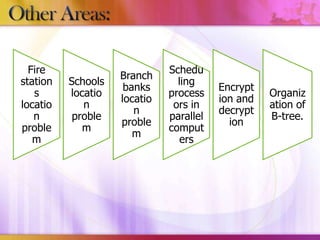
Fire
station
s
locatio
n
proble
m

Schools
locatio
n
proble
m

Branch
banks
locatio
n
proble
m

Schedu
ling
process
ors in
parallel
comput
ers

Encrypt
ion and
decrypt
ion

Organiz
ation of
B-tree.
Introduction
Algorithmic Research
Problems

Types of algorithmic
Research Problems
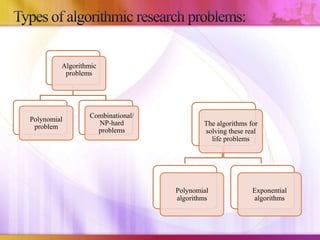
Algorithmic
problems

Polynomial
problem

Combinational/
NP-hard
problems

The algorithms for
solving these real
life problems

Polynomial
algorithms

Exponential
algorithms
If the complexity of an algorithm for a
problem is in polynomial form, then that
algorithm is known as polynomial algorithm.
It will take finite times to solve a problem
optimally.
The complexity of an algorithm means a
function representing the number of steps
required to solve a problem under the worst
case behavior.
An algorithm consists of a set of steps.
For some problems, the algorithm will be
executed for all its steps or for its subset of
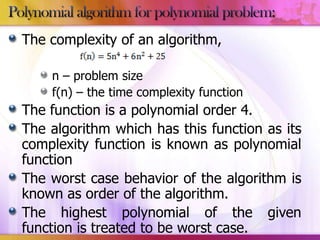
The complexity of an algorithm,
n – problem size
f(n) – the time complexity function

The function is a polynomial order 4.
The algorithm which has this function as its
complexity function is known as polynomial
function
The worst case behavior of the algorithm is
known as order of the algorithm.
The highest polynomial of the given
function is treated to be worst case.
The problems which will have polynomial time
complexity function are called polynomial problems.
These problems are solved in finite time
Examples of polynomial problem
Shortest path problem
Finding the roots of a quadratic equation
Minimizing mean flow time in single machine
scheduling – SPT rule(Shortest Path Time)
Minimizing the maximum tardiness in single
machine scheduling problem – EDD(Earliest due
date) rule is used
Minimizing the make span in 2 machines and n
jobs case flow shop scheduling problem –
Johnson’s algorithm is used for this problem.
Step 1: Set k=0
Step 2: From the initial distance matrix [D⁰]
and the initial precedence matrix[P⁰] from
the distance network
Step 3: Set k = k+1
Step 4: Obtain the values of the distance
matrix, [ ] for all the cells, where i is not
equal to j using the following formula:
Step 5: Obtain the values of the precedence
Step 6: if k=n go to step 7, otherwise, set
k=k+1 and go to step-4
Step 7:Trace the shortest path for a given
combination of source node and destination
node
7.1 : X-Source node, Y-Destination node
7.2 : Fix Y node as the last node in the partially
formed shortest path
7.3: find the value from the final precedence
matrix for the row corresponding to node X
and the column corresponding to Y. Let it be Q.
Prefix node Q in the partially formed shortest
path.
Critical analysis of execution of steps are
presented
The step-1 is executed only once.
The step-2 will be executed n² times to read
the distance matrix, [Dº]as well as the
precedence matrix[Pº]
Step-3 is repeated for one more time
In each of the step-4 and the step-5,
calculations for n² cells in the distance matrix,
as well as in the precedence matrix,
are
done for n times.
The step-6 is repeated for n times.
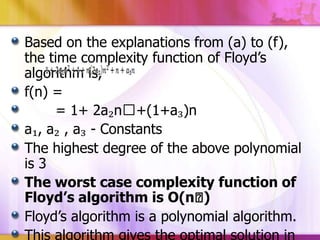
Based on the explanations from (a) to (f),
the time complexity function of Floyd’s
algorithm is,
f(n) =
= 1+ 2a₂nᶟ+(1+a₃)n
a₁, a₂ , a₃ - Constants
The highest degree of the above polynomial
is 3
The worst case complexity function of
Floyd’s algorithm is O(nᶟ
)
Floyd’s algorithm is a polynomial algorithm.
This algorithm gives the optimal solution in
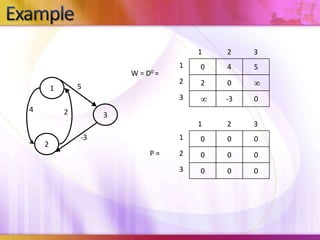
1
D0 =

5

2

0

4

2

0
-3

0

2

3

3
1

2

5

1

3
4

3

2

W=
1

2

-3

1
P=

0

0

0

2

0

0

0

3

0

0

0
1

4
2
1
D1 =

D0 =

5
2
-3

2

3
5

1

0

4

2

3

2

0

3

2

3

1

0

4

5

2

2

0

7

-3

-3

0

D1[2,3] = min( D0[2,3], D0[2,1]+D0[1,3] )
= min ( , 7)
=7

0

3
1

2

3

1
P=

1

0

0

0

2

0

0

1

3

0

0

0

D1[3,2] = min( D0[3,2], D0[3,1]+D0[1,2] )
= min (-3, )
= -3
1
1

4
2

D1 =

5
2
-3

0

4

5

2

2

0

7

-3

0

3
2

3

1

0

4

5

2

2

0

7

3

-1

-3
2

D2[1,3] = min( D1[1,3], D1[1,2]+D1[2,3] )
= min (5, 4+7)
=5

0

1

3

1
P=

3

1

3

1
D2 =

2

0

0

0

2

0

0

1

3

2

0

0

D2[3,1] = min( D1[3,1], D1[3,2]+D1[2,1] )
= min ( , -3+2)
= -1
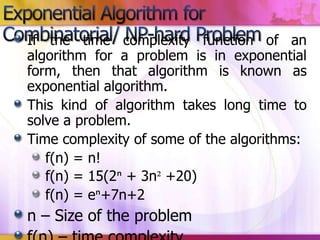
If the time complexity function of an
algorithm for a problem is in exponential
form, then that algorithm is known as
exponential algorithm.
This kind of algorithm takes long time to
solve a problem.
Time complexity of some of the algorithms:
f(n) = n!
f(n) = 15(2ⁿ + 3n² +20)
f(n) = eⁿ+7n+2

n – Size of the problem
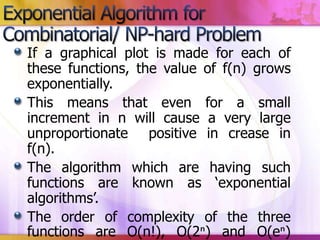
If a graphical plot is made for each of
these functions, the value of f(n) grows
exponentially.
This means that even for a small
increment in n will cause a very large
unproportionate positive in crease in
f(n).
The algorithm which are having such
functions are known as ‘exponential
algorithms’.
The order of complexity of the three
functions are O(n!), O(2ⁿ) and O(eⁿ)
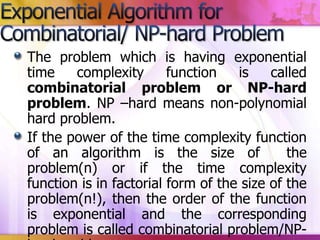
The problem which is having exponential
time
complexity
function
is
called
combinatorial problem or NP-hard
problem. NP –hard means non-polynomial
hard problem.
If the power of the time complexity function
of an algorithm is the size of
the
problem(n) or if the time complexity
function is in factorial form of the size of the
problem(n!), then the order of the function
is exponential and the corresponding
problem is called combinatorial problem/NP-
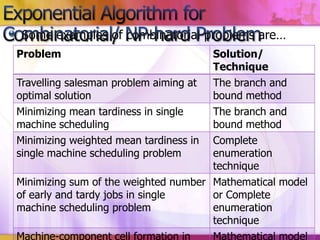
Some examples of combinatorial problems are…
Problem

Travelling salesman problem aiming at
optimal solution
Minimizing mean tardiness in single
machine scheduling
Minimizing weighted mean tardiness in
single machine scheduling problem

Solution/
Technique

The branch and
bound method
The branch and
bound method
Complete
enumeration
technique
Minimizing sum of the weighted number Mathematical model
of early and tardy jobs in single
or Complete
machine scheduling problem
enumeration
technique
Machine-component cell formation in
Mathematical model
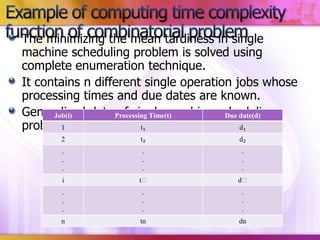
The minimizing the mean tardiness in single
machine scheduling problem is solved using
complete enumeration technique.
It contains n different single operation jobs whose
processing times and due dates are known.
Generalized data Processing Time(t)
of single machine scheduling
Job(i)
Due date(d)
problem
t₁
d₁
1
2

t₂

d₂

.
.
.

.
.
.

.
.
.

i

tᵢ

dᵢ

.
.
.

.
.
.

.
.
.

n

tn

dn
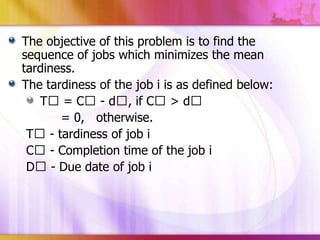
The objective of this problem is to find the
sequence of jobs which minimizes the mean
tardiness.
The tardiness of the job i is as defined below:
Tᶟ = Cᶟ - dᶟ, if Cᶟ > dᶟ
= 0, otherwise.
Tᶟ - tardiness of job i
Cᶟ - Completion time of the job i
Dᶟ - Due date of job i
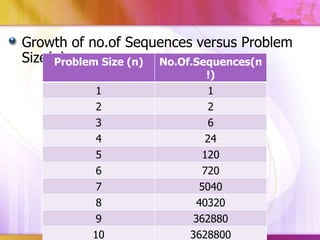
Growth of no.of Sequences versus Problem
Size(n)
Problem Size (n) No.Of.Sequences(n
!)

1
2

1
2

3

6

4
5
6
7
8
9
10

24
120
720
5040
40320
362880
3628800
Algorithmic research

Algorithmic research

  • 2.
  • 3.
    Algorithm: It is asequence steps to solve a problem of interest. It is procedure for solving problem with special focus on solving problem using computer.
  • 4.
    Search algorithms Sorting algorithms Shortestpath algorithms Minimum spanning tree algorithms Branch and bound algorithms Hungerian method for assignment method
  • 5.
    Simplex algorithm forlinear programming Zero-one implicit enumeration algorithm for 0-1 programming Simulated annealing algorithm Genetic algorithm Tabu search algorithm Greedy algorithm for Travelling Salesman Problem
  • 6.
  • 7.
  • 8.
    Minimizing the meantardiness in single scheduling problem Minimizing the weighted mean tardiness in single machine scheduling problem Minimizing the sum of the tardiness and earliness in single machine scheduling problem Minimizing the makespan in parallel machines scheduling problem
  • 9.
    Minimizing the makespanin flowshop scheduling problem Maximizing the balancing efficiency of an assembly line Resource leveling and allocation in project network Aggregate planning problem Master production planning problem
  • 10.
  • 11.
    Determination of rate ofreturn Capital budgeting Exclusive Selection of mutually and collectively exhaustive projects Portfolio management
  • 12.
    Problems in Personnel Management Allocation Employees in-house training problem Manpower planning problem offund to personnel activities Assignmen for t problem improved labor productivit y
  • 13.
  • 14.
  • 15.
    Algorithmic problems Polynomial problem Combinational/ NP-hard problems The algorithms for solvingthese real life problems Polynomial algorithms Exponential algorithms
  • 16.
    If the complexityof an algorithm for a problem is in polynomial form, then that algorithm is known as polynomial algorithm. It will take finite times to solve a problem optimally. The complexity of an algorithm means a function representing the number of steps required to solve a problem under the worst case behavior. An algorithm consists of a set of steps. For some problems, the algorithm will be executed for all its steps or for its subset of
  • 17.
    The complexity ofan algorithm, n – problem size f(n) – the time complexity function The function is a polynomial order 4. The algorithm which has this function as its complexity function is known as polynomial function The worst case behavior of the algorithm is known as order of the algorithm. The highest polynomial of the given function is treated to be worst case.
  • 18.
    The problems whichwill have polynomial time complexity function are called polynomial problems. These problems are solved in finite time Examples of polynomial problem Shortest path problem Finding the roots of a quadratic equation Minimizing mean flow time in single machine scheduling – SPT rule(Shortest Path Time) Minimizing the maximum tardiness in single machine scheduling problem – EDD(Earliest due date) rule is used Minimizing the make span in 2 machines and n jobs case flow shop scheduling problem – Johnson’s algorithm is used for this problem.
  • 19.
    Step 1: Setk=0 Step 2: From the initial distance matrix [D⁰] and the initial precedence matrix[P⁰] from the distance network Step 3: Set k = k+1 Step 4: Obtain the values of the distance matrix, [ ] for all the cells, where i is not equal to j using the following formula: Step 5: Obtain the values of the precedence
  • 20.
    Step 6: ifk=n go to step 7, otherwise, set k=k+1 and go to step-4 Step 7:Trace the shortest path for a given combination of source node and destination node 7.1 : X-Source node, Y-Destination node 7.2 : Fix Y node as the last node in the partially formed shortest path 7.3: find the value from the final precedence matrix for the row corresponding to node X and the column corresponding to Y. Let it be Q. Prefix node Q in the partially formed shortest path.
  • 21.
    Critical analysis ofexecution of steps are presented The step-1 is executed only once. The step-2 will be executed n² times to read the distance matrix, [Dº]as well as the precedence matrix[Pº] Step-3 is repeated for one more time In each of the step-4 and the step-5, calculations for n² cells in the distance matrix, as well as in the precedence matrix, are done for n times. The step-6 is repeated for n times.
  • 22.
    Based on theexplanations from (a) to (f), the time complexity function of Floyd’s algorithm is, f(n) = = 1+ 2a₂nᶟ+(1+a₃)n a₁, a₂ , a₃ - Constants The highest degree of the above polynomial is 3 The worst case complexity function of Floyd’s algorithm is O(nᶟ ) Floyd’s algorithm is a polynomial algorithm. This algorithm gives the optimal solution in
  • 23.
  • 24.
    1 4 2 1 D1 = D0 = 5 2 -3 2 3 5 1 0 4 2 3 2 0 3 2 3 1 0 4 5 2 2 0 7 -3 -3 0 D1[2,3]= min( D0[2,3], D0[2,1]+D0[1,3] ) = min ( , 7) =7 0 3 1 2 3 1 P= 1 0 0 0 2 0 0 1 3 0 0 0 D1[3,2] = min( D0[3,2], D0[3,1]+D0[1,2] ) = min (-3, ) = -3
  • 25.
    1 1 4 2 D1 = 5 2 -3 0 4 5 2 2 0 7 -3 0 3 2 3 1 0 4 5 2 2 0 7 3 -1 -3 2 D2[1,3] =min( D1[1,3], D1[1,2]+D1[2,3] ) = min (5, 4+7) =5 0 1 3 1 P= 3 1 3 1 D2 = 2 0 0 0 2 0 0 1 3 2 0 0 D2[3,1] = min( D1[3,1], D1[3,2]+D1[2,1] ) = min ( , -3+2) = -1
  • 26.
    If the timecomplexity function of an algorithm for a problem is in exponential form, then that algorithm is known as exponential algorithm. This kind of algorithm takes long time to solve a problem. Time complexity of some of the algorithms: f(n) = n! f(n) = 15(2ⁿ + 3n² +20) f(n) = eⁿ+7n+2 n – Size of the problem
  • 27.
    If a graphicalplot is made for each of these functions, the value of f(n) grows exponentially. This means that even for a small increment in n will cause a very large unproportionate positive in crease in f(n). The algorithm which are having such functions are known as ‘exponential algorithms’. The order of complexity of the three functions are O(n!), O(2ⁿ) and O(eⁿ)
  • 28.
    The problem whichis having exponential time complexity function is called combinatorial problem or NP-hard problem. NP –hard means non-polynomial hard problem. If the power of the time complexity function of an algorithm is the size of the problem(n) or if the time complexity function is in factorial form of the size of the problem(n!), then the order of the function is exponential and the corresponding problem is called combinatorial problem/NP-
  • 29.
    Some examples ofcombinatorial problems are… Problem Travelling salesman problem aiming at optimal solution Minimizing mean tardiness in single machine scheduling Minimizing weighted mean tardiness in single machine scheduling problem Solution/ Technique The branch and bound method The branch and bound method Complete enumeration technique Minimizing sum of the weighted number Mathematical model of early and tardy jobs in single or Complete machine scheduling problem enumeration technique Machine-component cell formation in Mathematical model
  • 30.
    The minimizing themean tardiness in single machine scheduling problem is solved using complete enumeration technique. It contains n different single operation jobs whose processing times and due dates are known. Generalized data Processing Time(t) of single machine scheduling Job(i) Due date(d) problem t₁ d₁ 1 2 t₂ d₂ . . . . . . . . . i tᵢ dᵢ . . . . . . . . . n tn dn
  • 31.
    The objective ofthis problem is to find the sequence of jobs which minimizes the mean tardiness. The tardiness of the job i is as defined below: Tᶟ = Cᶟ - dᶟ, if Cᶟ > dᶟ = 0, otherwise. Tᶟ - tardiness of job i Cᶟ - Completion time of the job i Dᶟ - Due date of job i
  • 32.
    Growth of no.ofSequences versus Problem Size(n) Problem Size (n) No.Of.Sequences(n !) 1 2 1 2 3 6 4 5 6 7 8 9 10 24 120 720 5040 40320 362880 3628800