A. Levitin “Introduction to the Design & Analysis of Algorithms,” 3rd ed., Ch. 3 ©2012 Pearson
Education, Inc. Upper Saddle River, NJ. All Rights Reserved. 1
Brute Force
A straightforward approach, usually based directly on the
problem’s statement and definitions of the concepts involved
Examples – based directly on definitions:
1. Computing an (a > 0, n a nonnegative integer)
2. Computing n!
3. Multiplying two matrices
4. Searching for a key of a given value in a list
A. Levitin “Introduction to the Design & Analysis of Algorithms,” 3rd ed., Ch. 3 ©2012 Pearson
Education, Inc. Upper Saddle River, NJ. All Rights Reserved. 2
Sorting by Brute Force
Use definition of sorted and obvious algorithm?
Selection Sort Scan the array to find its smallest element and
swap it with the first element. Then, starting with the second
element, scan the elements to the right of it to find the
smallest among them and swap it with the second elements.
Generally, on pass i (0  i  n-2), find the smallest element in
A[i..n-1] and swap it with A[i]:
A[0]  . . .  A[i-1] | A[i], . . . , A[min], . . ., A[n-1]
in their final positions
Example: 7 3 2 5
A. Levitin “Introduction to the Design & Analysis of Algorithms,” 3rd ed., Ch. 3 ©2012 Pearson
Education, Inc. Upper Saddle River, NJ. All Rights Reserved. 3
Analysis of Selection Sort
Time efficiency: 𝑪 𝒏 = 𝒊= 𝒋= 𝟏
Space efficiency: ?
Stability:
A. Levitin “Introduction to the Design & Analysis of Algorithms,” 3rd ed., Ch. 3 ©2012 Pearson
Education, Inc. Upper Saddle River, NJ. All Rights Reserved. 4
String Matching by Brute Force
 pattern: a string of m characters to search for
 text: a (longer) string of n characters to search in
 problem: find first substring in text that matches pattern
Brute-force: Scan text LR, compare chars, looking for pattern,
Step 1 Align pattern at beginning of text
Step 2 Moving from left to right, compare each character of
pattern to the corresponding character in text until
– all characters are found to match (successful search); or
– a mismatch is detected
Step 3 While pattern is not found and the text is not yet
exhausted, realign pattern one position to the right and
repeat Step 2
A. Levitin “Introduction to the Design & Analysis of Algorithms,” 3rd ed., Ch. 3 ©2012 Pearson
Education, Inc. Upper Saddle River, NJ. All Rights Reserved. 5
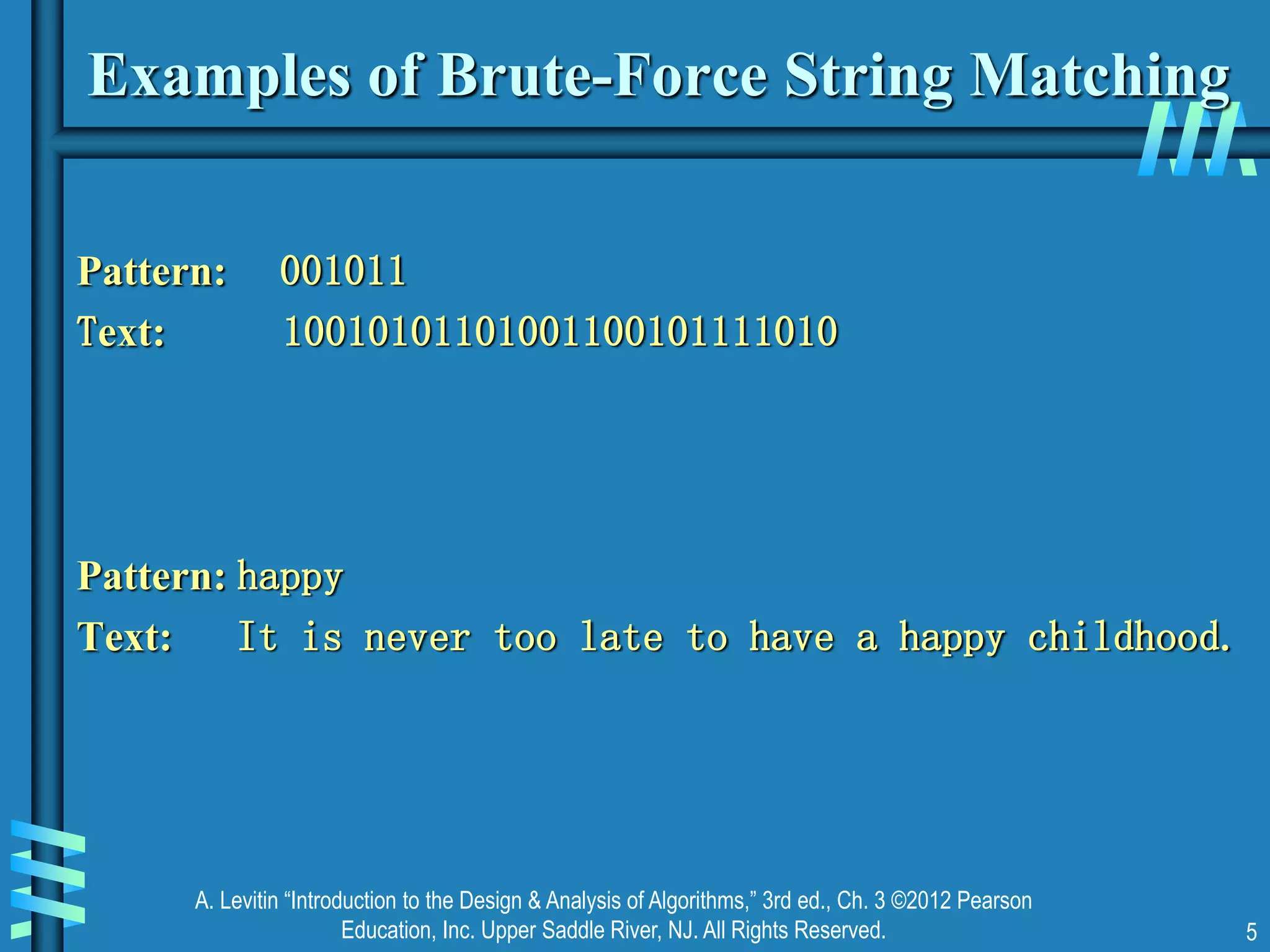
Examples of Brute-Force String Matching
Pattern: 001011
Text: 10010101101001100101111010
Pattern: happy
Text: It is never too late to have a happy childhood.
A. Levitin “Introduction to the Design & Analysis of Algorithms,” 3rd ed., Ch. 3 ©2012 Pearson
Education, Inc. Upper Saddle River, NJ. All Rights Reserved. 6
Pseudocode and Efficiency
Efficiency:
(Basic op and dataset assumptions?)
A. Levitin “Introduction to the Design & Analysis of Algorithms,” 3rd ed., Ch. 3 ©2012 Pearson
Education, Inc. Upper Saddle River, NJ. All Rights Reserved. 7
Brute-Force Polynomial Evaluation
Problem: Find the value of polynomial
p(x) = anxn + an-1xn-1 +… + a1x1 + a0
at a point x = x0
Brute-force algorithm
Efficiency: A(n)= ?. M(n)= 𝒊=
p  0.0
for i  n downto 0 do
power  1
for j  1 to i do //compute xi
power  power  x
p  p + a[i]  power
return p
A. Levitin “Introduction to the Design & Analysis of Algorithms,” 3rd ed., Ch. 3 ©2012 Pearson
Education, Inc. Upper Saddle River, NJ. All Rights Reserved. 8
Polynomial Evaluation: Improvement
Improve by evaluating from right to left (Horner’s Method):
𝒂𝒙𝟑 + 𝒃𝒙𝟐 + 𝒄𝒙 + 𝒅 = 𝒙(𝒙 𝒙 𝒂𝒙 + 𝒃 + 𝒄 + 𝒅
Better brute-force algorithm
Efficiency: A(n)= ?. M(n)= 𝒊=
p  a[0]
power  1
for i  1 to n do
power  power  x
p  p + a[i]  power
return p
A. Levitin “Introduction to the Design & Analysis of Algorithms,” 3rd ed., Ch. 3 ©2012 Pearson
Education, Inc. Upper Saddle River, NJ. All Rights Reserved. 9
Closest-Pair Problem
Find the two closest points in a set of n points (in the two-
dimensional Cartesian plane).
Brute-force algorithm
Compute the distance between every pair of distinct points
and return the indexes of the points for which the distance
is the smallest.
A. Levitin “Introduction to the Design & Analysis of Algorithms,” 3rd ed., Ch. 3 ©2012 Pearson
Education, Inc. Upper Saddle River, NJ. All Rights Reserved. 10
Closest-Pair Brute-Force Algorithm (cont.)
Efficiency:
Advantage:
How to make it faster? Constant factor, n lg n
A. Levitin “Introduction to the Design & Analysis of Algorithms,” 3rd ed., Ch. 3 ©2012 Pearson
Education, Inc. Upper Saddle River, NJ. All Rights Reserved. 11
Complex Hull
Convex Hull:
BF Algorithm:
Complexity: n^?
A. Levitin “Introduction to the Design & Analysis of Algorithms,” 3rd ed., Ch. 3 ©2012 Pearson
Education, Inc. Upper Saddle River, NJ. All Rights Reserved. 12
Complex Hull
Convex Hull:
BF Algorithm: For each segment, are all points on one side
Complexity: n^3
A. Levitin “Introduction to the Design & Analysis of Algorithms,” 3rd ed., Ch. 3 ©2012 Pearson
Education, Inc. Upper Saddle River, NJ. All Rights Reserved. 13
Complex Hull
Convex Hull:
BF Algorithm: For each segment, are all points on one side
Complexity: n^3
Improved algorithm: Average case: n^1
Worst case: n^2
A. Levitin “Introduction to the Design & Analysis of Algorithms,” 3rd ed., Ch. 3 ©2012 Pearson
Education, Inc. Upper Saddle River, NJ. All Rights Reserved. 14
Exhaustive Search
Many Brute Force Algorithms use Exhaustive Search
- Example: Brute force Closest Pair
Approach:
1. Enumerate and evaluate all solutions, and
2. Choose solution that meets some criteria (eg smallest)
Frequently the obvious solution
But, slow (Why?)
A. Levitin “Introduction to the Design & Analysis of Algorithms,” 3rd ed., Ch. 3 ©2012 Pearson
Education, Inc. Upper Saddle River, NJ. All Rights Reserved. 15
Exhaustive Search – More Detail
A brute force solution to a problem involving search for an
element with a special property, usually among
combinatorial objects such as permutations, combinations, or
subsets of a set.
Method:
• generate a list of all potential solutions to the problem in a
systematic manner (see algorithms in Sec. 5.4)
• evaluate potential solutions one by one, disqualifying
infeasible ones and, for an optimization problem, keeping
track of the best one found so far
• when search ends, announce the solution(s) found
A. Levitin “Introduction to the Design & Analysis of Algorithms,” 3rd ed., Ch. 3 ©2012 Pearson
Education, Inc. Upper Saddle River, NJ. All Rights Reserved. 16
Exhaustive Search – More Examples
Traveling Salesman Problem (TSP)
Knapsack Problem
Assignment Problem
Graph algorithms:
Depth First Search (DFS)
Breadth First Search (BFS)
Better algorithms may exist
A. Levitin “Introduction to the Design & Analysis of Algorithms,” 3rd ed., Ch. 3 ©2012 Pearson
Education, Inc. Upper Saddle River, NJ. All Rights Reserved. 17
Example 1: Traveling Salesman Problem
 Given n cities with known distances between each pair, find
the shortest tour that passes through all the cities exactly
once before returning to the starting city
 More formally: Find shortest Hamiltonian circuit in a
weighted connected graph
 Example:
a b
c d
8
2
7
5 3
4
A. Levitin “Introduction to the Design & Analysis of Algorithms,” 3rd ed., Ch. 3 ©2012 Pearson
Education, Inc. Upper Saddle River, NJ. All Rights Reserved. 18
TSP by Exhaustive Search
Tour Cost
a→b→c→d→a 2+3+7+5 = 17
a→b→d→c→a 2+4+7+8 = 21
a→c→b→d→a 8+3+4+5 = 20
a→c→d→b→a 8+7+4+2 = 21
a→d→b→c→a 5+4+3+8 = 20
a→d→c→b→a 5+7+3+2 = 17
Have we considered all tours?
Do we need to consider more?
Any way to consider fewer?
Efficiency: Number of tours = number of …
A. Levitin “Introduction to the Design & Analysis of Algorithms,” 3rd ed., Ch. 3 ©2012 Pearson
Education, Inc. Upper Saddle River, NJ. All Rights Reserved. 19
TSP by Exhaustive Search
Tour Cost
a→b→c→d→a 2+3+7+5 = 17
a→b→d→c→a 2+4+7+8 = 21
a→c→b→d→a 8+3+4+5 = 20
a→c→d→b→a 8+7+4+2 = 21
a→d→b→c→a 5+4+3+8 = 20
a→d→c→b→a 5+7+3+2 = 17
Have we considered all tours? Start elsewhere: b-c-d-a-b
Do we need to consider more? No
Any way to consider fewer? Yes: Reverse
Efficiency: # tours = O(# permutations of b,c,d) = O(n!)
A. Levitin “Introduction to the Design & Analysis of Algorithms,” 3rd ed., Ch. 3 ©2012 Pearson
Education, Inc. Upper Saddle River, NJ. All Rights Reserved. 20
Example 2: Knapsack Problem
Given n items:
• weights: w1 w2 … wn
• values: v1 v2 … vn
• a knapsack of capacity W
Find most valuable subset of the items that fit into the knapsack
Example: Knapsack capacity W=16
item weight value
1 2 $20
2 5 $30
3 10 $50
4 5 $10
A. Levitin “Introduction to the Design & Analysis of Algorithms,” 3rd ed., Ch. 3 ©2012 Pearson
Education, Inc. Upper Saddle River, NJ. All Rights Reserved. 21
Knapsack: Exhaustive Search
Subset Total weight Total value
{1} 2 $20
{2} 5 $30
{3} 10 $50
{4} 5 $10
{1,2} 7 $50
{1,3} 12 $70
{1,4} 7 $30
{2,3} 15 $80
{2,4} 10 $40
{3,4} 15 $60
{1,2,3} 17 not feasible
{1,2,4} 12 $60
{1,3,4} 17 not feasible
{2,3,4} 20 not feasible
{1,2,3,4} 22 not feasible
Efficiency: how
many subsets?
A. Levitin “Introduction to the Design & Analysis of Algorithms,” 3rd ed., Ch. 3 ©2012 Pearson
Education, Inc. Upper Saddle River, NJ. All Rights Reserved. 22
Example 3: The Assignment Problem
There are n people who need to be assigned to n jobs, one
person per job. The cost of assigning person i to job j is C[i,j].
Find an assignment that minimizes the total cost.
Job 0 Job 1 Job 2 Job 3
Person 0 9 2 7 8
Person 1 6 4 3 7
Person 2 5 8 1 8
Person 3 7 6 9 4
Algorithmic Plan:
Generate all legitimate assignments
Compute costs
Select cheapest
A. Levitin “Introduction to the Design & Analysis of Algorithms,” 3rd ed., Ch. 3 ©2012 Pearson
Education, Inc. Upper Saddle River, NJ. All Rights Reserved. 23
9 2 7 8
6 4 3 7
5 8 1 8
7 6 9 4
Assignment (col.#s) Total Cost
1, 2, 3, 4 9+4+1+4=18
1, 2, 4, 3 9+4+8+9=30
1, 3, 2, 4 9+3+8+4=24
1, 3, 4, 2 9+3+8+6=26
1, 4, 2, 3 9+7+8+9=33
1, 4, 3, 2 9+7+1+6=23
… …
(For this instance, the optimal assignment can be easily found by exploiting
the specific features of the numbers given. It is: )
Assignment Problem: Exhaustive Search
C =
A. Levitin “Introduction to the Design & Analysis of Algorithms,” 3rd ed., Ch. 3 ©2012 Pearson
Education, Inc. Upper Saddle River, NJ. All Rights Reserved. 24
9 2 7 8
6 4 3 7
5 8 1 8
7 6 9 4
Assignment (col.#s) Total Cost
1, 2, 3, 4 9+4+1+4=18
1, 2, 4, 3 9+4+8+9=30
1, 3, 2, 4 9+3+8+4=24
1, 3, 4, 2 9+3+8+6=26
1, 4, 2, 3 9+7+8+9=33
1, 4, 3, 2 9+7+1+6=23
… …
(For this instance, the optimal assignment can be easily found by exploiting
the specific features of the numbers given. It is: (2, 1, 3, 4)
Assignment Problem: Exhaustive Search
C =
A. Levitin “Introduction to the Design & Analysis of Algorithms,” 3rd ed., Ch. 3 ©2012 Pearson
Education, Inc. Upper Saddle River, NJ. All Rights Reserved. 25
Example 3: The Assignment Problem
There are n people who need to be assigned to n jobs, one
person per job. The cost of assigning person i to job j is C[i,j].
Find an assignment that minimizes the total cost.
Job 0 Job 1 Job 2 Job 3
Person 0 9 2 7 8
Person 1 6 4 3 7
Person 2 5 8 1 8
Person 3 7 6 9 4
Algorithmic Plan: Generate all legitimate assignments, compute
their costs, and select the cheapest one.
How many assignments are there?
Describe sol’n using cost matrix:
A. Levitin “Introduction to the Design & Analysis of Algorithms,” 3rd ed., Ch. 3 ©2012 Pearson
Education, Inc. Upper Saddle River, NJ. All Rights Reserved. 26
Example 3: The Assignment Problem
There are n people who need to be assigned to n jobs, one
person per job. The cost of assigning person i to job j is C[i,j].
Find an assignment that minimizes the total cost.
Job 0 Job 1 Job 2 Job 3
Person 0 9 2 7 8
Person 1 6 4 3 7
Person 2 5 8 1 8
Person 3 7 6 9 4
Algorithmic Plan: Generate all legitimate assignments, compute
their costs, and select the cheapest one.
How many assignments are there: permutations of 1..n = n!
Sol’n using cost matrix: select one from each row/col. Min sum.
A. Levitin “Introduction to the Design & Analysis of Algorithms,” 3rd ed., Ch. 3 ©2012 Pearson
Education, Inc. Upper Saddle River, NJ. All Rights Reserved. 27
Final Comments on Exhaustive Search
 Exhaustive-search algorithms run in a realistic amount of
time only on very small instances
 In some cases, there are much better alternatives!
• Euler circuits
• shortest paths
• minimum spanning tree
• assignment problem
 In many cases, exhaustive search or its variation is the only
known way to get exact solution
A. Levitin “Introduction to the Design & Analysis of Algorithms,” 3rd ed., Ch. 3 ©2012 Pearson
Education, Inc. Upper Saddle River, NJ. All Rights Reserved. 28
GRAPHS
Many problem solutions use a graph to represent the data:
- TSP
- Cities and roads
- Network nodes and connections among them
- People and friends
What is a graph? A graph is defined by two sets:
- Set of Vertices
- Set of Edges that connect the vertices
We look at two aspects of graphs:
- Standard graph algorithms (eg DFS and BFS in this chapter)
- Solve some problems with graphs
A. Levitin “Introduction to the Design & Analysis of Algorithms,” 3rd ed., Ch. 3 ©2012 Pearson
Education, Inc. Upper Saddle River, NJ. All Rights Reserved. 29
Graph Traversal Algorithms
Many problems require processing all graph vertices (and
edges) in systematic fashion
Graph traversal algorithms:
• Depth-first search (DFS): Visit children first
• Breadth-first search (BFS): Visit siblings first
A. Levitin “Introduction to the Design & Analysis of Algorithms,” 3rd ed., Ch. 3 ©2012 Pearson
Education, Inc. Upper Saddle River, NJ. All Rights Reserved. 30
GRAPHS – Definition Expanded
Graph consists of two sets:
- Set of vertices (aka nodes)
- Set of edges that connect vertices
- Edges may have weights
- Edges may have directions:
- Undirected graph: edges have no directions
- Directed graph: edges have direction
- AKA Digraph
A. Levitin “Introduction to the Design & Analysis of Algorithms,” 3rd ed., Ch. 3 ©2012 Pearson
Education, Inc. Upper Saddle River, NJ. All Rights Reserved. 31
GRAPH TERMS (Chap 1)
Degree of a node: Number of edges from it (in deg and out deg)
Path: Sequence of vertices that are connected by edges
Cycle: Path that starts and ends at same node
Connected graph:
- every pair of vertices has a path between them
Complete graph:
- every pair of vertices has an edge between them
Tree: connected acyclic graph
- Tree with n nodes has n-1 edges
- Root need not be specified
- Regular terms: Parent, child, ancestors, descendents, siblings, …
Forest: set of trees (ie not-necessarily-connected acyclic graph)
A. Levitin “Introduction to the Design & Analysis of Algorithms,” 3rd ed., Ch. 3 ©2012 Pearson
Education, Inc. Upper Saddle River, NJ. All Rights Reserved. 32
Graph Implementation
Adjacency matrix:
- Row and column for each vertex
- 1 for edge or 0 for no edge
- Undirected graph: What is true of the matrix?
Adjacency lists
- Each node has a list of adjacent nodes
Each has pros and cons. Performance:
- Check if two nodes are adjacent: …
- List all adjacent nodes: …
A. Levitin “Introduction to the Design & Analysis of Algorithms,” 3rd ed., Ch. 3 ©2012 Pearson
Education, Inc. Upper Saddle River, NJ. All Rights Reserved. 33
Depth-First Search (DFS)
 Visits graph’s vertices by always moving away from last
visited vertex to unvisited one
• Backtracks if no adjacent unvisited vertex is available.
 Implements backtracking using a stack
• a vertex is pushed when it’s reached for the first time
• a vertex is popped when it becomes a dead end, i.e., when
there are no adjacent unvisited vertices
 Marks edges in tree-like fashion (mark edges as tree edges
and back edges [goes back to already discovered ancestor
vertex].
• In a DFS of an undirected graph, each edge becomes either
a tree edge or a back edge (back to ancestor in tree)
A. Levitin “Introduction to the Design & Analysis of Algorithms,” 3rd ed., Ch. 3 ©2012 Pearson
Education, Inc. Upper Saddle River, NJ. All Rights Reserved. 34
Pseudocode of DFS
Stack?
A. Levitin “Introduction to the Design & Analysis of Algorithms,” 3rd ed., Ch. 3 ©2012 Pearson
Education, Inc. Upper Saddle River, NJ. All Rights Reserved. 35
Example: DFS traversal of undirected graph
a b
e f
c d
g h
DFS traversal stack:
a1,
DFS tree:
A. Levitin “Introduction to the Design & Analysis of Algorithms,” 3rd ed., Ch. 3 ©2012 Pearson
Education, Inc. Upper Saddle River, NJ. All Rights Reserved. 36
Example: DFS traversal of undirected graph
a b
e f
c d
g h
Nodes pushed: a b f e g c d h
Nodes popped: e f h d c g b a
Tree Edges: each v in dfs(v) defines a tree edge
Back Edge: encountered edge to previously visited ancestor
What nodes are on the stack?
Complexity:
A. Levitin “Introduction to the Design & Analysis of Algorithms,” 3rd ed., Ch. 3 ©2012 Pearson
Education, Inc. Upper Saddle River, NJ. All Rights Reserved. 37
Notes on DFS
 DFS can be implemented with graphs represented as:
• adjacency matrices: Θ(V2)
• adjacency lists: Θ(|V|+|E|)
 Yields two distinct ordering of vertices:
• order in which vertices are first encountered (pushed onto stack)
• order in which vertices become dead-ends (popped off stack)
• Orderings and edges used by various algorithms
– (eg scheduling / topological sort)
 Applications:
• checking connectivity, finding connected components
• checking acyclicity
• finding articulation points and biconnected components
• searching state-space of problems for solution (AI)
A. Levitin “Introduction to the Design & Analysis of Algorithms,” 3rd ed., Ch. 3 ©2012 Pearson
Education, Inc. Upper Saddle River, NJ. All Rights Reserved. 38
Breadth-first search (BFS)
 Visits graph vertices by moving across to all the neighbors
of last visited vertex
 BFS uses a queue (not a stack like DFS)
 Similar to level-by-level tree traversal
 Marks edges in tree-like fashion (mark tree edges and cross
edges [goes across to an already discovered sibling vertex]
• In a BFS of an undirected graph, each edge becomes
either a tree edge or a cross edge (to neither ancestor
nor descendant in tree-common ancestor or other tree)
A. Levitin “Introduction to the Design & Analysis of Algorithms,” 3rd ed., Ch. 3 ©2012 Pearson
Education, Inc. Upper Saddle River, NJ. All Rights Reserved. 39
Pseudocode of BFS
A. Levitin “Introduction to the Design & Analysis of Algorithms,” 3rd ed., Ch. 3 ©2012 Pearson
Education, Inc. Upper Saddle River, NJ. All Rights Reserved. 40
Example of BFS traversal of undirected graph
BFS traversal queue:
a b
e f
c d
g h
BFS tree:
A. Levitin “Introduction to the Design & Analysis of Algorithms,” 3rd ed., Ch. 3 ©2012 Pearson
Education, Inc. Upper Saddle River, NJ. All Rights Reserved. 41
Example of BFS traversal of undirected graph
BFS traversal queue: a, b e f, g, c h, d
Level: 1, 2 2 2, 3, 4 4, 5
Tree Edges: as dfs
Cross Edges: encountered edge to previously visited sibling
or sibling’s descendent (eg hypothetical edge eg)
What nodes are on the queue?
Performance:
a b
e f
c d
g h
A. Levitin “Introduction to the Design & Analysis of Algorithms,” 3rd ed., Ch. 3 ©2012 Pearson
Education, Inc. Upper Saddle River, NJ. All Rights Reserved. 42
Notes on BFS
 BFS has same efficiency as DFS and can be implemented
with graphs represented as:
• adjacency matrices: Θ(V2)
• adjacency lists: Θ(|V|+|E|)
 Yields single ordering of vertices (order added/deleted from
queue is the same)
 Applications: same as DFS, but can also find paths from a
vertex to all other vertices with the smallest number of
edges [How: mark depth from root]
A. Levitin “Introduction to the Design & Analysis of Algorithms,” 3rd ed., Ch. 3 ©2012 Pearson
Education, Inc. Upper Saddle River, NJ. All Rights Reserved. 43
Brute Force: Review
 Based on problem statement and definitions
 Typically slow, but may be only known algorithm
 Useful to consider first
• better algorithm frequently known
 Examples:
• Sorting and Searching
• Exhaustive Search:
– Pattern Match, TSP, Knapsack, Assignment,
• Graph (DFS, BFS)
A. Levitin “Introduction to the Design & Analysis of Algorithms,” 3rd ed., Ch. 3 ©2012 Pearson
Education, Inc. Upper Saddle River, NJ. All Rights Reserved. 44
Brute-Force Strengths and Weaknesses
 Strengths
• Wide applicability
• Simplicity
• Yields reasonable algorithms for some important problems
(e.g., matrix multiply, sorting, searching, string matching)
• Algorithm may be good enough for small problem
• Improvement may be too hard
• Provides yardstick for comparison
 Weaknesses
• Rarely yields efficient algorithms
• Some brute-force algorithms are unacceptably slow
• Not as constructive as some other design techniques

ch03-2018.02.02.pptx

  • 1.
    A. Levitin “Introductionto the Design & Analysis of Algorithms,” 3rd ed., Ch. 3 ©2012 Pearson Education, Inc. Upper Saddle River, NJ. All Rights Reserved. 1 Brute Force A straightforward approach, usually based directly on the problem’s statement and definitions of the concepts involved Examples – based directly on definitions: 1. Computing an (a > 0, n a nonnegative integer) 2. Computing n! 3. Multiplying two matrices 4. Searching for a key of a given value in a list
  • 2.
    A. Levitin “Introductionto the Design & Analysis of Algorithms,” 3rd ed., Ch. 3 ©2012 Pearson Education, Inc. Upper Saddle River, NJ. All Rights Reserved. 2 Sorting by Brute Force Use definition of sorted and obvious algorithm? Selection Sort Scan the array to find its smallest element and swap it with the first element. Then, starting with the second element, scan the elements to the right of it to find the smallest among them and swap it with the second elements. Generally, on pass i (0  i  n-2), find the smallest element in A[i..n-1] and swap it with A[i]: A[0]  . . .  A[i-1] | A[i], . . . , A[min], . . ., A[n-1] in their final positions Example: 7 3 2 5
  • 3.
    A. Levitin “Introductionto the Design & Analysis of Algorithms,” 3rd ed., Ch. 3 ©2012 Pearson Education, Inc. Upper Saddle River, NJ. All Rights Reserved. 3 Analysis of Selection Sort Time efficiency: 𝑪 𝒏 = 𝒊= 𝒋= 𝟏 Space efficiency: ? Stability:
  • 4.
    A. Levitin “Introductionto the Design & Analysis of Algorithms,” 3rd ed., Ch. 3 ©2012 Pearson Education, Inc. Upper Saddle River, NJ. All Rights Reserved. 4 String Matching by Brute Force  pattern: a string of m characters to search for  text: a (longer) string of n characters to search in  problem: find first substring in text that matches pattern Brute-force: Scan text LR, compare chars, looking for pattern, Step 1 Align pattern at beginning of text Step 2 Moving from left to right, compare each character of pattern to the corresponding character in text until – all characters are found to match (successful search); or – a mismatch is detected Step 3 While pattern is not found and the text is not yet exhausted, realign pattern one position to the right and repeat Step 2
  • 5.
    A. Levitin “Introductionto the Design & Analysis of Algorithms,” 3rd ed., Ch. 3 ©2012 Pearson Education, Inc. Upper Saddle River, NJ. All Rights Reserved. 5 Examples of Brute-Force String Matching Pattern: 001011 Text: 10010101101001100101111010 Pattern: happy Text: It is never too late to have a happy childhood.
  • 6.
    A. Levitin “Introductionto the Design & Analysis of Algorithms,” 3rd ed., Ch. 3 ©2012 Pearson Education, Inc. Upper Saddle River, NJ. All Rights Reserved. 6 Pseudocode and Efficiency Efficiency: (Basic op and dataset assumptions?)
  • 7.
    A. Levitin “Introductionto the Design & Analysis of Algorithms,” 3rd ed., Ch. 3 ©2012 Pearson Education, Inc. Upper Saddle River, NJ. All Rights Reserved. 7 Brute-Force Polynomial Evaluation Problem: Find the value of polynomial p(x) = anxn + an-1xn-1 +… + a1x1 + a0 at a point x = x0 Brute-force algorithm Efficiency: A(n)= ?. M(n)= 𝒊= p  0.0 for i  n downto 0 do power  1 for j  1 to i do //compute xi power  power  x p  p + a[i]  power return p
  • 8.
    A. Levitin “Introductionto the Design & Analysis of Algorithms,” 3rd ed., Ch. 3 ©2012 Pearson Education, Inc. Upper Saddle River, NJ. All Rights Reserved. 8 Polynomial Evaluation: Improvement Improve by evaluating from right to left (Horner’s Method): 𝒂𝒙𝟑 + 𝒃𝒙𝟐 + 𝒄𝒙 + 𝒅 = 𝒙(𝒙 𝒙 𝒂𝒙 + 𝒃 + 𝒄 + 𝒅 Better brute-force algorithm Efficiency: A(n)= ?. M(n)= 𝒊= p  a[0] power  1 for i  1 to n do power  power  x p  p + a[i]  power return p
  • 9.
    A. Levitin “Introductionto the Design & Analysis of Algorithms,” 3rd ed., Ch. 3 ©2012 Pearson Education, Inc. Upper Saddle River, NJ. All Rights Reserved. 9 Closest-Pair Problem Find the two closest points in a set of n points (in the two- dimensional Cartesian plane). Brute-force algorithm Compute the distance between every pair of distinct points and return the indexes of the points for which the distance is the smallest.
  • 10.
    A. Levitin “Introductionto the Design & Analysis of Algorithms,” 3rd ed., Ch. 3 ©2012 Pearson Education, Inc. Upper Saddle River, NJ. All Rights Reserved. 10 Closest-Pair Brute-Force Algorithm (cont.) Efficiency: Advantage: How to make it faster? Constant factor, n lg n
  • 11.
    A. Levitin “Introductionto the Design & Analysis of Algorithms,” 3rd ed., Ch. 3 ©2012 Pearson Education, Inc. Upper Saddle River, NJ. All Rights Reserved. 11 Complex Hull Convex Hull: BF Algorithm: Complexity: n^?
  • 12.
    A. Levitin “Introductionto the Design & Analysis of Algorithms,” 3rd ed., Ch. 3 ©2012 Pearson Education, Inc. Upper Saddle River, NJ. All Rights Reserved. 12 Complex Hull Convex Hull: BF Algorithm: For each segment, are all points on one side Complexity: n^3
  • 13.
    A. Levitin “Introductionto the Design & Analysis of Algorithms,” 3rd ed., Ch. 3 ©2012 Pearson Education, Inc. Upper Saddle River, NJ. All Rights Reserved. 13 Complex Hull Convex Hull: BF Algorithm: For each segment, are all points on one side Complexity: n^3 Improved algorithm: Average case: n^1 Worst case: n^2
  • 14.
    A. Levitin “Introductionto the Design & Analysis of Algorithms,” 3rd ed., Ch. 3 ©2012 Pearson Education, Inc. Upper Saddle River, NJ. All Rights Reserved. 14 Exhaustive Search Many Brute Force Algorithms use Exhaustive Search - Example: Brute force Closest Pair Approach: 1. Enumerate and evaluate all solutions, and 2. Choose solution that meets some criteria (eg smallest) Frequently the obvious solution But, slow (Why?)
  • 15.
    A. Levitin “Introductionto the Design & Analysis of Algorithms,” 3rd ed., Ch. 3 ©2012 Pearson Education, Inc. Upper Saddle River, NJ. All Rights Reserved. 15 Exhaustive Search – More Detail A brute force solution to a problem involving search for an element with a special property, usually among combinatorial objects such as permutations, combinations, or subsets of a set. Method: • generate a list of all potential solutions to the problem in a systematic manner (see algorithms in Sec. 5.4) • evaluate potential solutions one by one, disqualifying infeasible ones and, for an optimization problem, keeping track of the best one found so far • when search ends, announce the solution(s) found
  • 16.
    A. Levitin “Introductionto the Design & Analysis of Algorithms,” 3rd ed., Ch. 3 ©2012 Pearson Education, Inc. Upper Saddle River, NJ. All Rights Reserved. 16 Exhaustive Search – More Examples Traveling Salesman Problem (TSP) Knapsack Problem Assignment Problem Graph algorithms: Depth First Search (DFS) Breadth First Search (BFS) Better algorithms may exist
  • 17.
    A. Levitin “Introductionto the Design & Analysis of Algorithms,” 3rd ed., Ch. 3 ©2012 Pearson Education, Inc. Upper Saddle River, NJ. All Rights Reserved. 17 Example 1: Traveling Salesman Problem  Given n cities with known distances between each pair, find the shortest tour that passes through all the cities exactly once before returning to the starting city  More formally: Find shortest Hamiltonian circuit in a weighted connected graph  Example: a b c d 8 2 7 5 3 4
  • 18.
    A. Levitin “Introductionto the Design & Analysis of Algorithms,” 3rd ed., Ch. 3 ©2012 Pearson Education, Inc. Upper Saddle River, NJ. All Rights Reserved. 18 TSP by Exhaustive Search Tour Cost a→b→c→d→a 2+3+7+5 = 17 a→b→d→c→a 2+4+7+8 = 21 a→c→b→d→a 8+3+4+5 = 20 a→c→d→b→a 8+7+4+2 = 21 a→d→b→c→a 5+4+3+8 = 20 a→d→c→b→a 5+7+3+2 = 17 Have we considered all tours? Do we need to consider more? Any way to consider fewer? Efficiency: Number of tours = number of …
  • 19.
    A. Levitin “Introductionto the Design & Analysis of Algorithms,” 3rd ed., Ch. 3 ©2012 Pearson Education, Inc. Upper Saddle River, NJ. All Rights Reserved. 19 TSP by Exhaustive Search Tour Cost a→b→c→d→a 2+3+7+5 = 17 a→b→d→c→a 2+4+7+8 = 21 a→c→b→d→a 8+3+4+5 = 20 a→c→d→b→a 8+7+4+2 = 21 a→d→b→c→a 5+4+3+8 = 20 a→d→c→b→a 5+7+3+2 = 17 Have we considered all tours? Start elsewhere: b-c-d-a-b Do we need to consider more? No Any way to consider fewer? Yes: Reverse Efficiency: # tours = O(# permutations of b,c,d) = O(n!)
  • 20.
    A. Levitin “Introductionto the Design & Analysis of Algorithms,” 3rd ed., Ch. 3 ©2012 Pearson Education, Inc. Upper Saddle River, NJ. All Rights Reserved. 20 Example 2: Knapsack Problem Given n items: • weights: w1 w2 … wn • values: v1 v2 … vn • a knapsack of capacity W Find most valuable subset of the items that fit into the knapsack Example: Knapsack capacity W=16 item weight value 1 2 $20 2 5 $30 3 10 $50 4 5 $10
  • 21.
    A. Levitin “Introductionto the Design & Analysis of Algorithms,” 3rd ed., Ch. 3 ©2012 Pearson Education, Inc. Upper Saddle River, NJ. All Rights Reserved. 21 Knapsack: Exhaustive Search Subset Total weight Total value {1} 2 $20 {2} 5 $30 {3} 10 $50 {4} 5 $10 {1,2} 7 $50 {1,3} 12 $70 {1,4} 7 $30 {2,3} 15 $80 {2,4} 10 $40 {3,4} 15 $60 {1,2,3} 17 not feasible {1,2,4} 12 $60 {1,3,4} 17 not feasible {2,3,4} 20 not feasible {1,2,3,4} 22 not feasible Efficiency: how many subsets?
  • 22.
    A. Levitin “Introductionto the Design & Analysis of Algorithms,” 3rd ed., Ch. 3 ©2012 Pearson Education, Inc. Upper Saddle River, NJ. All Rights Reserved. 22 Example 3: The Assignment Problem There are n people who need to be assigned to n jobs, one person per job. The cost of assigning person i to job j is C[i,j]. Find an assignment that minimizes the total cost. Job 0 Job 1 Job 2 Job 3 Person 0 9 2 7 8 Person 1 6 4 3 7 Person 2 5 8 1 8 Person 3 7 6 9 4 Algorithmic Plan: Generate all legitimate assignments Compute costs Select cheapest
  • 23.
    A. Levitin “Introductionto the Design & Analysis of Algorithms,” 3rd ed., Ch. 3 ©2012 Pearson Education, Inc. Upper Saddle River, NJ. All Rights Reserved. 23 9 2 7 8 6 4 3 7 5 8 1 8 7 6 9 4 Assignment (col.#s) Total Cost 1, 2, 3, 4 9+4+1+4=18 1, 2, 4, 3 9+4+8+9=30 1, 3, 2, 4 9+3+8+4=24 1, 3, 4, 2 9+3+8+6=26 1, 4, 2, 3 9+7+8+9=33 1, 4, 3, 2 9+7+1+6=23 … … (For this instance, the optimal assignment can be easily found by exploiting the specific features of the numbers given. It is: ) Assignment Problem: Exhaustive Search C =
  • 24.
    A. Levitin “Introductionto the Design & Analysis of Algorithms,” 3rd ed., Ch. 3 ©2012 Pearson Education, Inc. Upper Saddle River, NJ. All Rights Reserved. 24 9 2 7 8 6 4 3 7 5 8 1 8 7 6 9 4 Assignment (col.#s) Total Cost 1, 2, 3, 4 9+4+1+4=18 1, 2, 4, 3 9+4+8+9=30 1, 3, 2, 4 9+3+8+4=24 1, 3, 4, 2 9+3+8+6=26 1, 4, 2, 3 9+7+8+9=33 1, 4, 3, 2 9+7+1+6=23 … … (For this instance, the optimal assignment can be easily found by exploiting the specific features of the numbers given. It is: (2, 1, 3, 4) Assignment Problem: Exhaustive Search C =
  • 25.
    A. Levitin “Introductionto the Design & Analysis of Algorithms,” 3rd ed., Ch. 3 ©2012 Pearson Education, Inc. Upper Saddle River, NJ. All Rights Reserved. 25 Example 3: The Assignment Problem There are n people who need to be assigned to n jobs, one person per job. The cost of assigning person i to job j is C[i,j]. Find an assignment that minimizes the total cost. Job 0 Job 1 Job 2 Job 3 Person 0 9 2 7 8 Person 1 6 4 3 7 Person 2 5 8 1 8 Person 3 7 6 9 4 Algorithmic Plan: Generate all legitimate assignments, compute their costs, and select the cheapest one. How many assignments are there? Describe sol’n using cost matrix:
  • 26.
    A. Levitin “Introductionto the Design & Analysis of Algorithms,” 3rd ed., Ch. 3 ©2012 Pearson Education, Inc. Upper Saddle River, NJ. All Rights Reserved. 26 Example 3: The Assignment Problem There are n people who need to be assigned to n jobs, one person per job. The cost of assigning person i to job j is C[i,j]. Find an assignment that minimizes the total cost. Job 0 Job 1 Job 2 Job 3 Person 0 9 2 7 8 Person 1 6 4 3 7 Person 2 5 8 1 8 Person 3 7 6 9 4 Algorithmic Plan: Generate all legitimate assignments, compute their costs, and select the cheapest one. How many assignments are there: permutations of 1..n = n! Sol’n using cost matrix: select one from each row/col. Min sum.
  • 27.
    A. Levitin “Introductionto the Design & Analysis of Algorithms,” 3rd ed., Ch. 3 ©2012 Pearson Education, Inc. Upper Saddle River, NJ. All Rights Reserved. 27 Final Comments on Exhaustive Search  Exhaustive-search algorithms run in a realistic amount of time only on very small instances  In some cases, there are much better alternatives! • Euler circuits • shortest paths • minimum spanning tree • assignment problem  In many cases, exhaustive search or its variation is the only known way to get exact solution
  • 28.
    A. Levitin “Introductionto the Design & Analysis of Algorithms,” 3rd ed., Ch. 3 ©2012 Pearson Education, Inc. Upper Saddle River, NJ. All Rights Reserved. 28 GRAPHS Many problem solutions use a graph to represent the data: - TSP - Cities and roads - Network nodes and connections among them - People and friends What is a graph? A graph is defined by two sets: - Set of Vertices - Set of Edges that connect the vertices We look at two aspects of graphs: - Standard graph algorithms (eg DFS and BFS in this chapter) - Solve some problems with graphs
  • 29.
    A. Levitin “Introductionto the Design & Analysis of Algorithms,” 3rd ed., Ch. 3 ©2012 Pearson Education, Inc. Upper Saddle River, NJ. All Rights Reserved. 29 Graph Traversal Algorithms Many problems require processing all graph vertices (and edges) in systematic fashion Graph traversal algorithms: • Depth-first search (DFS): Visit children first • Breadth-first search (BFS): Visit siblings first
  • 30.
    A. Levitin “Introductionto the Design & Analysis of Algorithms,” 3rd ed., Ch. 3 ©2012 Pearson Education, Inc. Upper Saddle River, NJ. All Rights Reserved. 30 GRAPHS – Definition Expanded Graph consists of two sets: - Set of vertices (aka nodes) - Set of edges that connect vertices - Edges may have weights - Edges may have directions: - Undirected graph: edges have no directions - Directed graph: edges have direction - AKA Digraph
  • 31.
    A. Levitin “Introductionto the Design & Analysis of Algorithms,” 3rd ed., Ch. 3 ©2012 Pearson Education, Inc. Upper Saddle River, NJ. All Rights Reserved. 31 GRAPH TERMS (Chap 1) Degree of a node: Number of edges from it (in deg and out deg) Path: Sequence of vertices that are connected by edges Cycle: Path that starts and ends at same node Connected graph: - every pair of vertices has a path between them Complete graph: - every pair of vertices has an edge between them Tree: connected acyclic graph - Tree with n nodes has n-1 edges - Root need not be specified - Regular terms: Parent, child, ancestors, descendents, siblings, … Forest: set of trees (ie not-necessarily-connected acyclic graph)
  • 32.
    A. Levitin “Introductionto the Design & Analysis of Algorithms,” 3rd ed., Ch. 3 ©2012 Pearson Education, Inc. Upper Saddle River, NJ. All Rights Reserved. 32 Graph Implementation Adjacency matrix: - Row and column for each vertex - 1 for edge or 0 for no edge - Undirected graph: What is true of the matrix? Adjacency lists - Each node has a list of adjacent nodes Each has pros and cons. Performance: - Check if two nodes are adjacent: … - List all adjacent nodes: …
  • 33.
    A. Levitin “Introductionto the Design & Analysis of Algorithms,” 3rd ed., Ch. 3 ©2012 Pearson Education, Inc. Upper Saddle River, NJ. All Rights Reserved. 33 Depth-First Search (DFS)  Visits graph’s vertices by always moving away from last visited vertex to unvisited one • Backtracks if no adjacent unvisited vertex is available.  Implements backtracking using a stack • a vertex is pushed when it’s reached for the first time • a vertex is popped when it becomes a dead end, i.e., when there are no adjacent unvisited vertices  Marks edges in tree-like fashion (mark edges as tree edges and back edges [goes back to already discovered ancestor vertex]. • In a DFS of an undirected graph, each edge becomes either a tree edge or a back edge (back to ancestor in tree)
  • 34.
    A. Levitin “Introductionto the Design & Analysis of Algorithms,” 3rd ed., Ch. 3 ©2012 Pearson Education, Inc. Upper Saddle River, NJ. All Rights Reserved. 34 Pseudocode of DFS Stack?
  • 35.
    A. Levitin “Introductionto the Design & Analysis of Algorithms,” 3rd ed., Ch. 3 ©2012 Pearson Education, Inc. Upper Saddle River, NJ. All Rights Reserved. 35 Example: DFS traversal of undirected graph a b e f c d g h DFS traversal stack: a1, DFS tree:
  • 36.
    A. Levitin “Introductionto the Design & Analysis of Algorithms,” 3rd ed., Ch. 3 ©2012 Pearson Education, Inc. Upper Saddle River, NJ. All Rights Reserved. 36 Example: DFS traversal of undirected graph a b e f c d g h Nodes pushed: a b f e g c d h Nodes popped: e f h d c g b a Tree Edges: each v in dfs(v) defines a tree edge Back Edge: encountered edge to previously visited ancestor What nodes are on the stack? Complexity:
  • 37.
    A. Levitin “Introductionto the Design & Analysis of Algorithms,” 3rd ed., Ch. 3 ©2012 Pearson Education, Inc. Upper Saddle River, NJ. All Rights Reserved. 37 Notes on DFS  DFS can be implemented with graphs represented as: • adjacency matrices: Θ(V2) • adjacency lists: Θ(|V|+|E|)  Yields two distinct ordering of vertices: • order in which vertices are first encountered (pushed onto stack) • order in which vertices become dead-ends (popped off stack) • Orderings and edges used by various algorithms – (eg scheduling / topological sort)  Applications: • checking connectivity, finding connected components • checking acyclicity • finding articulation points and biconnected components • searching state-space of problems for solution (AI)
  • 38.
    A. Levitin “Introductionto the Design & Analysis of Algorithms,” 3rd ed., Ch. 3 ©2012 Pearson Education, Inc. Upper Saddle River, NJ. All Rights Reserved. 38 Breadth-first search (BFS)  Visits graph vertices by moving across to all the neighbors of last visited vertex  BFS uses a queue (not a stack like DFS)  Similar to level-by-level tree traversal  Marks edges in tree-like fashion (mark tree edges and cross edges [goes across to an already discovered sibling vertex] • In a BFS of an undirected graph, each edge becomes either a tree edge or a cross edge (to neither ancestor nor descendant in tree-common ancestor or other tree)
  • 39.
    A. Levitin “Introductionto the Design & Analysis of Algorithms,” 3rd ed., Ch. 3 ©2012 Pearson Education, Inc. Upper Saddle River, NJ. All Rights Reserved. 39 Pseudocode of BFS
  • 40.
    A. Levitin “Introductionto the Design & Analysis of Algorithms,” 3rd ed., Ch. 3 ©2012 Pearson Education, Inc. Upper Saddle River, NJ. All Rights Reserved. 40 Example of BFS traversal of undirected graph BFS traversal queue: a b e f c d g h BFS tree:
  • 41.
    A. Levitin “Introductionto the Design & Analysis of Algorithms,” 3rd ed., Ch. 3 ©2012 Pearson Education, Inc. Upper Saddle River, NJ. All Rights Reserved. 41 Example of BFS traversal of undirected graph BFS traversal queue: a, b e f, g, c h, d Level: 1, 2 2 2, 3, 4 4, 5 Tree Edges: as dfs Cross Edges: encountered edge to previously visited sibling or sibling’s descendent (eg hypothetical edge eg) What nodes are on the queue? Performance: a b e f c d g h
  • 42.
    A. Levitin “Introductionto the Design & Analysis of Algorithms,” 3rd ed., Ch. 3 ©2012 Pearson Education, Inc. Upper Saddle River, NJ. All Rights Reserved. 42 Notes on BFS  BFS has same efficiency as DFS and can be implemented with graphs represented as: • adjacency matrices: Θ(V2) • adjacency lists: Θ(|V|+|E|)  Yields single ordering of vertices (order added/deleted from queue is the same)  Applications: same as DFS, but can also find paths from a vertex to all other vertices with the smallest number of edges [How: mark depth from root]
  • 43.
    A. Levitin “Introductionto the Design & Analysis of Algorithms,” 3rd ed., Ch. 3 ©2012 Pearson Education, Inc. Upper Saddle River, NJ. All Rights Reserved. 43 Brute Force: Review  Based on problem statement and definitions  Typically slow, but may be only known algorithm  Useful to consider first • better algorithm frequently known  Examples: • Sorting and Searching • Exhaustive Search: – Pattern Match, TSP, Knapsack, Assignment, • Graph (DFS, BFS)
  • 44.
    A. Levitin “Introductionto the Design & Analysis of Algorithms,” 3rd ed., Ch. 3 ©2012 Pearson Education, Inc. Upper Saddle River, NJ. All Rights Reserved. 44 Brute-Force Strengths and Weaknesses  Strengths • Wide applicability • Simplicity • Yields reasonable algorithms for some important problems (e.g., matrix multiply, sorting, searching, string matching) • Algorithm may be good enough for small problem • Improvement may be too hard • Provides yardstick for comparison  Weaknesses • Rarely yields efficient algorithms • Some brute-force algorithms are unacceptably slow • Not as constructive as some other design techniques