Algorithms
and Data
Structures
Marcin
Sydow
Algorithms and Data Structures
Complexity of Algorithms
Marcin Sydow
Algorithms
and Data
Structures
Marcin
Sydow
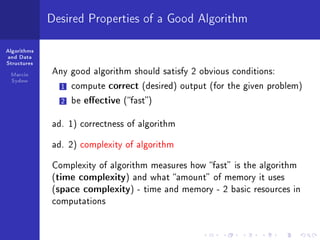
Desired Properties of a Good Algorithm
Any good algorithm should satisfy 2 obvious conditions:
1 compute correct (desired) output (for the given problem)
2 be eective (fast)
ad. 1) correctness of algorithm
ad. 2) complexity of algorithm
Complexity of algorithm measures how fast is the algorithm
(time complexity) and what amount of memory it uses
(space complexity) - time and memory - 2 basic resources in
computations
Algorithms
and Data
Structures
Marcin
Sydow
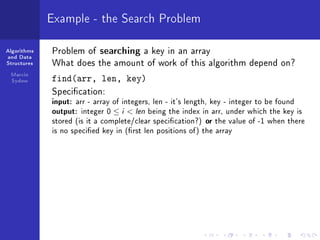
Example - the Search Problem
Problem of searching a key in an array
What does the amount of work of this algorithm depend on?
find(arr, len, key)
Specication:
input: arr - array of integers, len - it's length, key - integer to be found
output: integer 0 ≤ i  len being the index in arr, under which the key is
stored
Algorithms
and Data
Structures
Marcin
Sydow
Example - the Search Problem
Problem of searching a key in an array
What does the amount of work of this algorithm depend on?
find(arr, len, key)
Specication:
input: arr - array of integers, len - it's length, key - integer to be found
output: integer 0 ≤ i  len being the index in arr, under which the key is
stored (is it a complete/clear specication?)
Algorithms
and Data
Structures
Marcin
Sydow
Example - the Search Problem
Problem of searching a key in an array
What does the amount of work of this algorithm depend on?
find(arr, len, key)
Specication:
input: arr - array of integers, len - it's length, key - integer to be found
output: integer 0 ≤ i  len being the index in arr, under which the key is
stored (is it a complete/clear specication?) or the value of -1 when there
is no specied key in (rst len positions of) the array
Algorithms
and Data
Structures
Marcin
Sydow
Example - the Search Problem
Problem of searching a key in an array
What does the amount of work of this algorithm depend on?
find(arr, len, key)
Specication:
input: arr - array of integers, len - it's length, key - integer to be found
output: integer 0 ≤ i  len being the index in arr, under which the key is
stored (is it a complete/clear specication?) or the value of -1 when there
is no specied key in (rst len positions of) the array
code:
find(arr, len, key){
i = 0
while(i  len){
if(arr[i] == key)
return i
i++
}
return -1
}
What does the amount of work of this algorithm depend on?
Algorithms
and Data
Structures
Marcin
Sydow
The speed of algorithm
How to measure how fast (or slow) an algorithm is?
There are 2 issues to be considered when designing such a
measure:
1 independence on any programming language (and
hardware/software platform)
2 maximum independence on particular input data
It should be an internal property of the algorithm itself
Any idea?
Algorithms
and Data
Structures
Marcin
Sydow
The speed of algorithm
How to measure how fast (or slow) an algorithm is?
There are 2 issues to be considered when designing such a
measure:
1 independence on any programming language (and
hardware/software platform)
2 maximum independence on particular input data
It should be an internal property of the algorithm itself
Any idea? Count basic operations of the algorithm
Algorithms
and Data
Structures
Marcin
Sydow
Dominating Operations
Simplication: it is not necessary to count all the operations - it
is enough to count the representative ones
Before doing a complexity analysis 2 steps must be done:
1 determine the dominating operation set
2 observe what (in input) inuences the number of
dominating operations (data size)
Dominating operations are those which cover the amount of
work which is proportional to the whole amount of work of the
algorithm (they well represent the whole)
Algorithms
and Data
Structures
Marcin
Sydow
Example - determining operating operations
What can be the dominating operation set in the following
algorithm?
find(arr, len, key){
i = 0
while(i  len){
if(arr[i] == key)
return i
i++
}
return -1
}
assignment i = 0 ?
Algorithms
and Data
Structures
Marcin
Sydow
Example - determining operating operations
What can be the dominating operation set in the following
algorithm?
find(arr, len, key){
i = 0
while(i  len){
if(arr[i] == key)
return i
i++
}
return -1
}
assignment i = 0 ? no
comparison i  len ?
Algorithms
and Data
Structures
Marcin
Sydow
Example - determining operating operations
What can be the dominating operation set in the following
algorithm?
find(arr, len, key){
i = 0
while(i  len){
if(arr[i] == key)
return i
i++
}
return -1
}
assignment i = 0 ? no
comparison i  len ? yes
comparison arr[i] == key ?
Algorithms
and Data
Structures
Marcin
Sydow
Example - determining operating operations
What can be the dominating operation set in the following
algorithm?
find(arr, len, key){
i = 0
while(i  len){
if(arr[i] == key)
return i
i++
}
return -1
}
assignment i = 0 ? no
comparison i  len ? yes
comparison arr[i] == key ? yes
both the above?
Algorithms
and Data
Structures
Marcin
Sydow
Example - determining operating operations
What can be the dominating operation set in the following
algorithm?
find(arr, len, key){
i = 0
while(i  len){
if(arr[i] == key)
return i
i++
}
return -1
}
assignment i = 0 ? no
comparison i  len ? yes
comparison arr[i] == key ? yes
both the above? yes
return statement return i ?
Algorithms
and Data
Structures
Marcin
Sydow
Example - determining operating operations
What can be the dominating operation set in the following
algorithm?
find(arr, len, key){
i = 0
while(i  len){
if(arr[i] == key)
return i
i++
}
return -1
}
assignment i = 0 ? no
comparison i  len ? yes
comparison arr[i] == key ? yes
both the above? yes
return statement return i ? no
index increment i++ ?
Algorithms
and Data
Structures
Marcin
Sydow
Example - determining operating operations
What can be the dominating operation set in the following
algorithm?
find(arr, len, key){
i = 0
while(i  len){
if(arr[i] == key)
return i
i++
}
return -1
}
assignment i = 0 ? no
comparison i  len ? yes
comparison arr[i] == key ? yes
both the above? yes
return statement return i ? no
index increment i++ ? yes
Algorithms
and Data
Structures
Marcin
Sydow
Example, cont. - determining the data size
What is the data size in the following algorithm?
find(arr, len, key){
i = 0
while(i  len){
if(arr[i] == key)
return i
i++
}
return -1
}
Algorithms
and Data
Structures
Marcin
Sydow
Example, cont. - determining the data size
What is the data size in the following algorithm?
find(arr, len, key){
i = 0
while(i  len){
if(arr[i] == key)
return i
i++
}
return -1
}
Data size: length of array arr
Algorithms
and Data
Structures
Marcin
Sydow
Example, cont. - determining the data size
What is the data size in the following algorithm?
find(arr, len, key){
i = 0
while(i  len){
if(arr[i] == key)
return i
i++
}
return -1
}
Data size: length of array arr
Having determined the dominating operation and data size
we can determine time complexity of the algorithm
Algorithms
and Data
Structures
Marcin
Sydow
Time Complexity of Algorithm
Denition
Time Complexity of Algorithm is the number of dominating
operations executed by the algorithm as the function of data
size.
Time complexity measures the amount of work done by the
algorithm during solving the problem in the way which is
independent on the implementation and particular input data.
The lower time complexity the faster algorithm
Algorithms
and Data
Structures
Marcin
Sydow
Example - time complexity of algorithm
find(arr, len, key){
i = 0
while(i  len){
if(arr[i] == key)
return i
i++
}
return -1
}
Assume:
dominating operation: comparison arr[i] == key
data size: the length of array (denote by n)
Thus, the number of dominating operations executed by this
algorithm ranges:
from 1 (the key was found under the rst index)
to n (the key is absent or under the last index)
There is no single function which could express the dependence of the number of
executed dominating operations on the data size for this algorithm.
Algorithms
and Data
Structures
Marcin
Sydow
Pessimistic Time Complexity
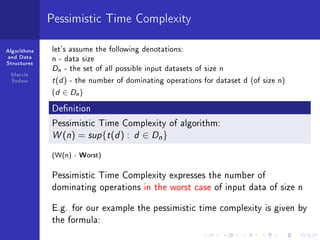
let's assume the following denotations:
n - data size
Dn - the set of all possible input datasets of size n
t(d) - the number of dominating operations for dataset d (of size n)
(d ∈ Dn)
Denition
Pessimistic Time Complexity of algorithm:
W(n) = sup{t(d) : d ∈ Dn}
(W(n) - Worst)
Pessimistic Time Complexity expresses the number of
dominating operations in the worst case of input data of size n
E.g. for our example the pessimistic time complexity is given by
the formula:
Algorithms
and Data
Structures
Marcin
Sydow
Pessimistic Time Complexity
let's assume the following denotations:
n - data size
Dn - the set of all possible input datasets of size n
t(d) - the number of dominating operations for dataset d (of size n)
(d ∈ Dn)
Denition
Pessimistic Time Complexity of algorithm:
W(n) = sup{t(d) : d ∈ Dn}
(W(n) - Worst)
Pessimistic Time Complexity expresses the number of
dominating operations in the worst case of input data of size n
E.g. for our example the pessimistic time complexity is given by
the formula:
W(n) = n
Algorithms
and Data
Structures
Marcin
Sydow
Average Time Complexity of Algorithm
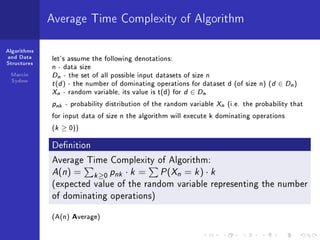
let's assume the following denotations:
n - data size
Dn - the set of all possible input datasets of size n
t(d) - the number of dominating operations for dataset d (of size n) (d ∈ Dn)
Xn - random variable, its value is t(d) for d ∈ Dn
pnk - probability distribution of the random variable Xn (i.e. the probability that
for input data of size n the algorithm will execute k dominating operations
(k ≥ 0))
Denition
Average Time Complexity of Algorithm:
A(n) = k≥0
pnk · k = P(Xn = k) · k
(expected value of the random variable representing the number
of dominating operations)
(A(n) Average)
Algorithms
and Data
Structures
Marcin
Sydow
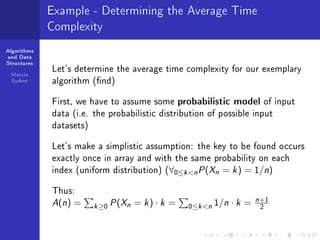
Example - Determining the Average Time
Complexity
Let's determine the average time complexity for our exemplary
algorithm (nd)
First, we have to assume some probabilistic model of input
data (i.e. the probabilistic distribution of possible input
datasets)
Let's make a simplistic assumption: the key to be found occurs
exactly once in array and with the same probability on each
index (uniform distribution) (∀0≤knP(Xn = k) = 1/n)
Thus:
A(n) = k≥0
P(Xn = k) · k = 0≤kn 1/n · k = n+1
2
Algorithms
and Data
Structures
Marcin
Sydow
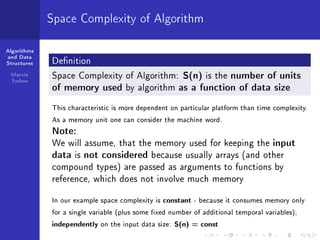
Space Complexity of Algorithm
Denition
Space Complexity of Algorithm: S(n) is the number of units
of memory used by algorithm as a function of data size
This characteristic is more dependent on particular platform than time complexity.
As a memory unit one can consider the machine word.
Note:
We will assume, that the memory used for keeping the input
data is not considered because usually arrays (and other
compound types) are passed as arguments to functions by
reference, which does not involve much memory
In our example space complexity is constant - because it consumes memory only
for a single variable (plus some xed number of additional temporal variables),
independently on the input data size: S(n) = const
Algorithms
and Data
Structures
Marcin
Sydow
Omitting Unimportant Details
The real time spent by an implementation of the algorithm
may dier between particular platforms by a constant
multiplicative factor. (e.g. CPU speed)
Thus, it would be very useful to have a notation allowing for
expressing the complexity functions with neglecting
unimportant details (as multiplicative or additive constant, for
example)
E.g. for the following function:
A(n) = 2.1 · n − 1
The most important information is that it is a linear function -
it's rank of complexity is linear
Does such a notation exist?
Algorithms
and Data
Structures
Marcin
Sydow
Asymptotic Notation - Big O
The notation is called asymptotic notation.
There are a couple of avours. The most common is big O:
Denition
The function g(n) is the upper bound of rank of order of the
function f(n):
f (n) = O(g(n)) ⇔ ∃c0∃n0∀n≥n0f (n) ≤ c · g(n)
The O() notation intuitively corresponds to the ≤ symbol (in
terms of ranks of orders of functions).
E.g. the fact that W(n) of our exemplary algorithm has an
upper bound of the linear rank can be noted as:
W(n) = n+1
2
= O(n)
The constant space complexity S(n) of that algorithm can be
expressed with the following special notation:
S(n) = O(1)
Algorithms
and Data
Structures
Marcin
Sydow
Asymptotic Notation - Big Theta
Another important avour of asymptotic notation is big Theta:
Denition
The function f(n) has the same rank of order as the function
g(n): f (n) = Θ(g(n)) ⇔ f (n) = O(g(n)) ∧ g(n) = O(f (n))
The Θ() notation intuitively corresponds to the = symbol (in
terms of ranks of orders of functions).
Notice, that Θ() is dened with the use of O(), similarly as = symbol can be
dened with the use of ≤ symbol.
E.g. the expression: f (n) = n2
+ n − 3 = Θ(n2
)
reads as the n2
+ n − 3 function is of square rank of order.
Algorithms
and Data
Structures
Marcin
Sydow
Other Flavours of Asymptotic Notation
We have 5 relation symbols for comparing numbers: = ≤ ≥  
In total, we also have 5 analogous symbols for comparing ranks
of functions:
1 Θ - =
2 O - ≤
3 Ω - ≥
4 o - 
5 ω - 
(in general, a capital letter denotes non-sharp inequality and lowercase denotes
a sharp one)
E.g.:
W(n)=o(n) (lowercase o)
means: the rank of function W(n) is lower than linear
Algorithms
and Data
Structures
Marcin
Sydow
Some Remarks on Using the Asymptotic Notation
Notice: in expressions like f(n)=O(g(n)) the = has a special
meaning - it does not represent the normal equality. The
expression has it's meaning only as a whole.
E.g. it does not make sense to use asymptotic notation as the
rst expression on the left-hand side of the = symbol.
E.g. expressions like O(f(n)) = n or O(f(n)) = O(g(n)) do
not make any sense
Besides the standard usage of the asymptotic notation on the
right-hand side of the = symbol, it can be also used in the
following way:
f(n) = g(n) + O(h(n))
Which means: f(n) - g(n) = O(h(n))
(the ranks of functions f and g dier at most by a rank of
function h)
Algorithms
and Data
Structures
Marcin
Sydow
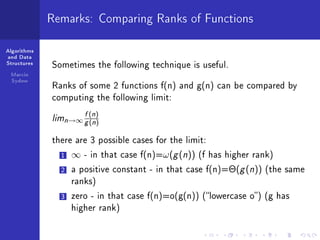
Remarks: Comparing Ranks of Functions
Sometimes the following technique is useful.
Ranks of some 2 functions f(n) and g(n) can be compared by
computing the following limit:
limn→∞
f(n)
g(n)
there are 3 possible cases for the limit:
1 ∞ - in that case f(n)=ω(g(n)) (f has higher rank)
2 a positive constant - in that case f(n)=Θ(g(n)) (the same
ranks)
3 zero - in that case f(n)=o(g(n)) (lowercase o) (g has
higher rank)
Algorithms
and Data
Structures
Marcin
Sydow
The Most Common Ranks of Functions
constant (e.g. S(n) = 3 = Θ(1))
logarithmic (e.g. W(n) = 2 + lg2n = Θ(log(n)))
linear (e.g. A(n) = 2n + 1 = Θ(n))
linear-logarithmic (e.g.
A(n) = 1.44 · nlog(n) = Θ(nlog(n)))
square (e.g. W(n) = n2
+ 4 = Θ(n2
))
cubic (e.g. A(n) = Θ(n3
))
sub-exponential (e.g. A(n) = Θ(nlog(n)))
exponential (e.g. A(n) = Θ(2
n))
factorial (e.g. W(n) = Θ(n!))
In simplication: in practise, an over-polynomial rank of time complexity is
considered as unacceptably high
In case of space complexity, even linear rank is considered as very high
Algorithms
and Data
Structures
Marcin
Sydow
Questions/Problems:
How to measure the speed of algorithm
What 2 things should be determined before starting
assessing the time complexity of an algorithm
What is a dominating operation
Denition of Time Complexity of Algorithm
Denition of Space Complexity of Algorithm
Denition of Pessimistic Time Complexity
Denition of Average Time Complexity
Be able to determine time complexity for simple algorithms
What is the purpose of the asymptotic notation
Denition and interpretation of the O() notation
Denitions (and interpretations) of the other types of
asymptotic notations
Ability to express rank of a given function with the
asymptotic notation
Algorithms
and Data
Structures
Marcin
Sydow
Thank you for your attention

Algorithem complexity in data sructure

  • 1.
    Algorithms and Data Structures Marcin Sydow Algorithms andData Structures Complexity of Algorithms Marcin Sydow
  • 2.
    Algorithms and Data Structures Marcin Sydow Desired Propertiesof a Good Algorithm Any good algorithm should satisfy 2 obvious conditions: 1 compute correct (desired) output (for the given problem) 2 be eective (fast) ad. 1) correctness of algorithm ad. 2) complexity of algorithm Complexity of algorithm measures how fast is the algorithm (time complexity) and what amount of memory it uses (space complexity) - time and memory - 2 basic resources in computations
  • 3.
    Algorithms and Data Structures Marcin Sydow Example -the Search Problem Problem of searching a key in an array What does the amount of work of this algorithm depend on? find(arr, len, key) Specication: input: arr - array of integers, len - it's length, key - integer to be found output: integer 0 ≤ i len being the index in arr, under which the key is stored
  • 4.
    Algorithms and Data Structures Marcin Sydow Example -the Search Problem Problem of searching a key in an array What does the amount of work of this algorithm depend on? find(arr, len, key) Specication: input: arr - array of integers, len - it's length, key - integer to be found output: integer 0 ≤ i len being the index in arr, under which the key is stored (is it a complete/clear specication?)
  • 5.
    Algorithms and Data Structures Marcin Sydow Example -the Search Problem Problem of searching a key in an array What does the amount of work of this algorithm depend on? find(arr, len, key) Specication: input: arr - array of integers, len - it's length, key - integer to be found output: integer 0 ≤ i len being the index in arr, under which the key is stored (is it a complete/clear specication?) or the value of -1 when there is no specied key in (rst len positions of) the array
  • 6.
    Algorithms and Data Structures Marcin Sydow Example -the Search Problem Problem of searching a key in an array What does the amount of work of this algorithm depend on? find(arr, len, key) Specication: input: arr - array of integers, len - it's length, key - integer to be found output: integer 0 ≤ i len being the index in arr, under which the key is stored (is it a complete/clear specication?) or the value of -1 when there is no specied key in (rst len positions of) the array code: find(arr, len, key){ i = 0 while(i len){ if(arr[i] == key) return i i++ } return -1 } What does the amount of work of this algorithm depend on?
  • 7.
    Algorithms and Data Structures Marcin Sydow The speedof algorithm How to measure how fast (or slow) an algorithm is? There are 2 issues to be considered when designing such a measure: 1 independence on any programming language (and hardware/software platform) 2 maximum independence on particular input data It should be an internal property of the algorithm itself Any idea?
  • 8.
    Algorithms and Data Structures Marcin Sydow The speedof algorithm How to measure how fast (or slow) an algorithm is? There are 2 issues to be considered when designing such a measure: 1 independence on any programming language (and hardware/software platform) 2 maximum independence on particular input data It should be an internal property of the algorithm itself Any idea? Count basic operations of the algorithm
  • 9.
    Algorithms and Data Structures Marcin Sydow Dominating Operations Simplication:it is not necessary to count all the operations - it is enough to count the representative ones Before doing a complexity analysis 2 steps must be done: 1 determine the dominating operation set 2 observe what (in input) inuences the number of dominating operations (data size) Dominating operations are those which cover the amount of work which is proportional to the whole amount of work of the algorithm (they well represent the whole)
  • 10.
    Algorithms and Data Structures Marcin Sydow Example -determining operating operations What can be the dominating operation set in the following algorithm? find(arr, len, key){ i = 0 while(i len){ if(arr[i] == key) return i i++ } return -1 } assignment i = 0 ?
  • 11.
    Algorithms and Data Structures Marcin Sydow Example -determining operating operations What can be the dominating operation set in the following algorithm? find(arr, len, key){ i = 0 while(i len){ if(arr[i] == key) return i i++ } return -1 } assignment i = 0 ? no comparison i len ?
  • 12.
    Algorithms and Data Structures Marcin Sydow Example -determining operating operations What can be the dominating operation set in the following algorithm? find(arr, len, key){ i = 0 while(i len){ if(arr[i] == key) return i i++ } return -1 } assignment i = 0 ? no comparison i len ? yes comparison arr[i] == key ?
  • 13.
    Algorithms and Data Structures Marcin Sydow Example -determining operating operations What can be the dominating operation set in the following algorithm? find(arr, len, key){ i = 0 while(i len){ if(arr[i] == key) return i i++ } return -1 } assignment i = 0 ? no comparison i len ? yes comparison arr[i] == key ? yes both the above?
  • 14.
    Algorithms and Data Structures Marcin Sydow Example -determining operating operations What can be the dominating operation set in the following algorithm? find(arr, len, key){ i = 0 while(i len){ if(arr[i] == key) return i i++ } return -1 } assignment i = 0 ? no comparison i len ? yes comparison arr[i] == key ? yes both the above? yes return statement return i ?
  • 15.
    Algorithms and Data Structures Marcin Sydow Example -determining operating operations What can be the dominating operation set in the following algorithm? find(arr, len, key){ i = 0 while(i len){ if(arr[i] == key) return i i++ } return -1 } assignment i = 0 ? no comparison i len ? yes comparison arr[i] == key ? yes both the above? yes return statement return i ? no index increment i++ ?
  • 16.
    Algorithms and Data Structures Marcin Sydow Example -determining operating operations What can be the dominating operation set in the following algorithm? find(arr, len, key){ i = 0 while(i len){ if(arr[i] == key) return i i++ } return -1 } assignment i = 0 ? no comparison i len ? yes comparison arr[i] == key ? yes both the above? yes return statement return i ? no index increment i++ ? yes
  • 17.
    Algorithms and Data Structures Marcin Sydow Example, cont.- determining the data size What is the data size in the following algorithm? find(arr, len, key){ i = 0 while(i len){ if(arr[i] == key) return i i++ } return -1 }
  • 18.
    Algorithms and Data Structures Marcin Sydow Example, cont.- determining the data size What is the data size in the following algorithm? find(arr, len, key){ i = 0 while(i len){ if(arr[i] == key) return i i++ } return -1 } Data size: length of array arr
  • 19.
    Algorithms and Data Structures Marcin Sydow Example, cont.- determining the data size What is the data size in the following algorithm? find(arr, len, key){ i = 0 while(i len){ if(arr[i] == key) return i i++ } return -1 } Data size: length of array arr Having determined the dominating operation and data size we can determine time complexity of the algorithm
  • 20.
    Algorithms and Data Structures Marcin Sydow Time Complexityof Algorithm Denition Time Complexity of Algorithm is the number of dominating operations executed by the algorithm as the function of data size. Time complexity measures the amount of work done by the algorithm during solving the problem in the way which is independent on the implementation and particular input data. The lower time complexity the faster algorithm
  • 21.
    Algorithms and Data Structures Marcin Sydow Example -time complexity of algorithm find(arr, len, key){ i = 0 while(i len){ if(arr[i] == key) return i i++ } return -1 } Assume: dominating operation: comparison arr[i] == key data size: the length of array (denote by n) Thus, the number of dominating operations executed by this algorithm ranges: from 1 (the key was found under the rst index) to n (the key is absent or under the last index) There is no single function which could express the dependence of the number of executed dominating operations on the data size for this algorithm.
  • 22.
    Algorithms and Data Structures Marcin Sydow Pessimistic TimeComplexity let's assume the following denotations: n - data size Dn - the set of all possible input datasets of size n t(d) - the number of dominating operations for dataset d (of size n) (d ∈ Dn) Denition Pessimistic Time Complexity of algorithm: W(n) = sup{t(d) : d ∈ Dn} (W(n) - Worst) Pessimistic Time Complexity expresses the number of dominating operations in the worst case of input data of size n E.g. for our example the pessimistic time complexity is given by the formula:
  • 23.
    Algorithms and Data Structures Marcin Sydow Pessimistic TimeComplexity let's assume the following denotations: n - data size Dn - the set of all possible input datasets of size n t(d) - the number of dominating operations for dataset d (of size n) (d ∈ Dn) Denition Pessimistic Time Complexity of algorithm: W(n) = sup{t(d) : d ∈ Dn} (W(n) - Worst) Pessimistic Time Complexity expresses the number of dominating operations in the worst case of input data of size n E.g. for our example the pessimistic time complexity is given by the formula: W(n) = n
  • 24.
    Algorithms and Data Structures Marcin Sydow Average TimeComplexity of Algorithm let's assume the following denotations: n - data size Dn - the set of all possible input datasets of size n t(d) - the number of dominating operations for dataset d (of size n) (d ∈ Dn) Xn - random variable, its value is t(d) for d ∈ Dn pnk - probability distribution of the random variable Xn (i.e. the probability that for input data of size n the algorithm will execute k dominating operations (k ≥ 0)) Denition Average Time Complexity of Algorithm: A(n) = k≥0 pnk · k = P(Xn = k) · k (expected value of the random variable representing the number of dominating operations) (A(n) Average)
  • 25.
    Algorithms and Data Structures Marcin Sydow Example -Determining the Average Time Complexity Let's determine the average time complexity for our exemplary algorithm (nd) First, we have to assume some probabilistic model of input data (i.e. the probabilistic distribution of possible input datasets) Let's make a simplistic assumption: the key to be found occurs exactly once in array and with the same probability on each index (uniform distribution) (∀0≤knP(Xn = k) = 1/n) Thus: A(n) = k≥0 P(Xn = k) · k = 0≤kn 1/n · k = n+1 2
  • 26.
    Algorithms and Data Structures Marcin Sydow Space Complexityof Algorithm Denition Space Complexity of Algorithm: S(n) is the number of units of memory used by algorithm as a function of data size This characteristic is more dependent on particular platform than time complexity. As a memory unit one can consider the machine word. Note: We will assume, that the memory used for keeping the input data is not considered because usually arrays (and other compound types) are passed as arguments to functions by reference, which does not involve much memory In our example space complexity is constant - because it consumes memory only for a single variable (plus some xed number of additional temporal variables), independently on the input data size: S(n) = const
  • 27.
    Algorithms and Data Structures Marcin Sydow Omitting UnimportantDetails The real time spent by an implementation of the algorithm may dier between particular platforms by a constant multiplicative factor. (e.g. CPU speed) Thus, it would be very useful to have a notation allowing for expressing the complexity functions with neglecting unimportant details (as multiplicative or additive constant, for example) E.g. for the following function: A(n) = 2.1 · n − 1 The most important information is that it is a linear function - it's rank of complexity is linear Does such a notation exist?
  • 28.
    Algorithms and Data Structures Marcin Sydow Asymptotic Notation- Big O The notation is called asymptotic notation. There are a couple of avours. The most common is big O: Denition The function g(n) is the upper bound of rank of order of the function f(n): f (n) = O(g(n)) ⇔ ∃c0∃n0∀n≥n0f (n) ≤ c · g(n) The O() notation intuitively corresponds to the ≤ symbol (in terms of ranks of orders of functions). E.g. the fact that W(n) of our exemplary algorithm has an upper bound of the linear rank can be noted as: W(n) = n+1 2 = O(n) The constant space complexity S(n) of that algorithm can be expressed with the following special notation: S(n) = O(1)
  • 29.
    Algorithms and Data Structures Marcin Sydow Asymptotic Notation- Big Theta Another important avour of asymptotic notation is big Theta: Denition The function f(n) has the same rank of order as the function g(n): f (n) = Θ(g(n)) ⇔ f (n) = O(g(n)) ∧ g(n) = O(f (n)) The Θ() notation intuitively corresponds to the = symbol (in terms of ranks of orders of functions). Notice, that Θ() is dened with the use of O(), similarly as = symbol can be dened with the use of ≤ symbol. E.g. the expression: f (n) = n2 + n − 3 = Θ(n2 ) reads as the n2 + n − 3 function is of square rank of order.
  • 30.
    Algorithms and Data Structures Marcin Sydow Other Flavoursof Asymptotic Notation We have 5 relation symbols for comparing numbers: = ≤ ≥ In total, we also have 5 analogous symbols for comparing ranks of functions: 1 Θ - = 2 O - ≤ 3 Ω - ≥ 4 o - 5 ω - (in general, a capital letter denotes non-sharp inequality and lowercase denotes a sharp one) E.g.: W(n)=o(n) (lowercase o) means: the rank of function W(n) is lower than linear
  • 31.
    Algorithms and Data Structures Marcin Sydow Some Remarkson Using the Asymptotic Notation Notice: in expressions like f(n)=O(g(n)) the = has a special meaning - it does not represent the normal equality. The expression has it's meaning only as a whole. E.g. it does not make sense to use asymptotic notation as the rst expression on the left-hand side of the = symbol. E.g. expressions like O(f(n)) = n or O(f(n)) = O(g(n)) do not make any sense Besides the standard usage of the asymptotic notation on the right-hand side of the = symbol, it can be also used in the following way: f(n) = g(n) + O(h(n)) Which means: f(n) - g(n) = O(h(n)) (the ranks of functions f and g dier at most by a rank of function h)
  • 32.
    Algorithms and Data Structures Marcin Sydow Remarks: ComparingRanks of Functions Sometimes the following technique is useful. Ranks of some 2 functions f(n) and g(n) can be compared by computing the following limit: limn→∞ f(n) g(n) there are 3 possible cases for the limit: 1 ∞ - in that case f(n)=ω(g(n)) (f has higher rank) 2 a positive constant - in that case f(n)=Θ(g(n)) (the same ranks) 3 zero - in that case f(n)=o(g(n)) (lowercase o) (g has higher rank)
  • 33.
    Algorithms and Data Structures Marcin Sydow The MostCommon Ranks of Functions constant (e.g. S(n) = 3 = Θ(1)) logarithmic (e.g. W(n) = 2 + lg2n = Θ(log(n))) linear (e.g. A(n) = 2n + 1 = Θ(n)) linear-logarithmic (e.g. A(n) = 1.44 · nlog(n) = Θ(nlog(n))) square (e.g. W(n) = n2 + 4 = Θ(n2 )) cubic (e.g. A(n) = Θ(n3 )) sub-exponential (e.g. A(n) = Θ(nlog(n))) exponential (e.g. A(n) = Θ(2 n)) factorial (e.g. W(n) = Θ(n!)) In simplication: in practise, an over-polynomial rank of time complexity is considered as unacceptably high In case of space complexity, even linear rank is considered as very high
  • 34.
    Algorithms and Data Structures Marcin Sydow Questions/Problems: How tomeasure the speed of algorithm What 2 things should be determined before starting assessing the time complexity of an algorithm What is a dominating operation Denition of Time Complexity of Algorithm Denition of Space Complexity of Algorithm Denition of Pessimistic Time Complexity Denition of Average Time Complexity Be able to determine time complexity for simple algorithms What is the purpose of the asymptotic notation Denition and interpretation of the O() notation Denitions (and interpretations) of the other types of asymptotic notations Ability to express rank of a given function with the asymptotic notation
  • 35.