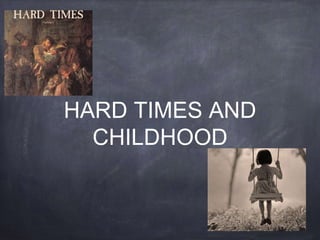
HARD TIMES AND
CHILDHOOD
Name:Dhvani Rajyaguru
Roll NO:04
Subject Name: Hard Times and Childhood
Paper name:Literature of the Victorians
Paper Code and No: 22395-104
Email id: dhvanirajyaguru22@gmail.com
DeP. Name: MKBU Dep, Bhavnagar.
Point to Ponder
Brief note on Charles Dickens
Introduction of Hard Times
Short Summary of Novel
Hard Times and Childhood
- Louisa’s childhood
- Tom’s childhood
- Sissy’ childhood
How the theme is connected to author
Critics Corner
CHARLES DICKENS:
- Charles John Huffam Dickens, born ON
February 7, 1812, in England and died on
June 9, 1870, Gad’s Hill, near Chatham,
Kent.
- He is English novelist, generally considered
the greatest of the Victorian era.
- His many volumes include such works as A
Christmas Carol, David Copperfield, Hard
times,Bleak House, A Tale of Two Cities,
Great Expectations, and Our Mutual Friend.
INTRODUCTION OF
HARD TIMES
published in serial form in the
periodical Household Words from
April to August 1854 and in book
form later the same year.
The novel is a bitter indictment of
industrialization, with its
dehumanizing effects on workers
and communities in mid-19th-century
England.
SHORT SUMMARY OF HARD
TIMES
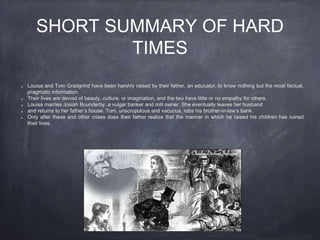
Louisa and Tom Gradgrind have been harshly raised by their father, an educator, to know nothing but the most factual,
pragmatic information.
Their lives are devoid of beauty, culture, or imagination, and the two have little or no empathy for others.
Louisa marries Josiah Bounderby, a vulgar banker and mill owner. She eventually leaves her husband
and returns to her father’s house. Tom, unscrupulous and vacuous, robs his brother-in-law’s bank.
Only after these and other crises does their father realize that the manner in which he raised his children has ruined
their lives.
HARD TIMES AND CHILDHOOD
Three person’s childhood is seen here: LOUISA,TOM AND SISSY.
Now novel starts with the voice of a headmaster,Thomas Gradgrind where he
says,”Now what I want is facts, teach these boys and girls nothing but the facts.
In Hard Times Charles Dickens mentions Gradgrind as, “A man of realities. A man of
facts and calculations. A man who proceeds upon the principle that two and two are
four, and nothing over, and who is not to be talked into allowing for anything over.
Thomas Gradgrind, sir—peremptorily Thomas—Thomas Gradgrind. With a rule and a
pair of scales, and the multiplication table always in his pocket, sir, ready to weigh and
measure any parcel of human nature, and tell you exactly what it comes to.”
The lessons and experiences of childhood shape these characters later in life.
Hard Times Ch 2:
Charles Dickens
LOUISA’S IMBALANCED CHILDHOOD
For Louisa the emphasis on reason and the rejection of imagination
and emotion in her childhood lead her to an unbalanced adulthood.
She doesn’t know what she feels.
Her over-reliance on reason and alienation from her own feelings
make her passive and indifferent, leading her into a loveless marriage
and to the edge of scandal with an extra-marital affair, which does not
come to pass.
When faced with emotions, she has no idea how to handle them.She
becomes unconscious.
Her life comes apart as a result, requiring her to reassess her
understanding of herself and her place in the world, and then she
rebuild accordingly.
TOM’S emotionless CHILDHOOD
For Tom the emphasis on reason in his childhood deprives him of
the pleasures of childhood, defined by fun and play, and leads
him to resent his family deeply.
His attempts to capture the youth he feels he missed lead to
irresponsibility, entitlement, excessive gambling, and other
disreputable activities.
He feels entitled to his sister's continued assistance and later
needs his father to help him avoid the consequence of stealing
from the bank.
In short, Tom's lack of a balanced childhood prevents him from
growing into a balanced, responsible adult.
Perfect,Imaginative though Reality based CHILDHOOD of
SISSY
Sissy Jupe experiences a more balanced childhood and grows up accordingly.
She is obviously tied to the circus, to entertainment, to the life of the imagination. But she is also
clearly one of the more realistic and matter-of-fact characters in the novel.
She spends her first seven years in the warm and whimsical environment of the circus, well loved
by her father and the other performers.
She reads fairy tales and plays with her dog. She spends the second half of her childhood
studying facts and reason in school.
Although she considers herself a failure as a student, her early experiences temper the strict
education she receives and give her emotional and imaginative grounding that make her a useful
resource when the Gradgrind family needs her.
She is kind, caring, and loving.
In the face of being abandoned by her father and then being forced to learn the Gradgrind
philosophy, she never stops being the only grounding, emotionally positive force in Coketown. In a
way, she is similar to another one of Dickens's favorite character types, the perfect young woman
who selflessly takes care of other people.
So Sissy is a messenger from the land of imagination, creativity, and selfless actions.
CHARLES DICKENS RECOLLECT CHILDHOOD
MEMORIES WITH HARD TIMES SOMEWHERE:
Somewhere we can see lost childhood of Charles Dickens in Hard
Times’ childhood theme..as Charles was the second born of eight
children. ... At the age of twelve Charles worked with working-class
men and boys in a factory that handled "blacking," or shoe polish.
He recorded his own lost childhood in the fragmentary autobiography
which he wrote for Forster:
“No words can express the secret agony of my soul..The deep
remembrance of the sense I had of being utterly neglected and hopeless;
of the shame I felt in my position.”
Dickens’ “Hard Times”: The Lost Childhood b
Warrington Winters(218-5)
CRITICS CORNER:
ACCORDING TO F.R.LEAVIS(1950):
“Of all Dicknes’ works it is the one that has all the strength of his genius, together
with a strength no other of them can show-that of a completely serious work of art”
ACCORDING TO EDGAR JOHNSON(1952):
“Hard Times is a morality drama.”
ACCORDING TO W. W. WATT(1958):
“The taut structure, the dramatic pace, the symbolic economy, and the single-minded
dedication to a serious purpose which make Hard Times both powerful criticism of the
Victorian industrial world and an intriguing example of Dickens’ mature art.”
‘HARD TIMES’: The Lost Childhood”
by Warrington Winter
CITATION
Britannica, The Editors of Encyclopaedia. "Hard Times". Encyclopedia
Britannica, 27 Mar. 2020, https://www.britannica.com/topic/Hard-Times-
novel-by-Dickens. Accessed 9 December 2021.
Collins, Philip. "Charles Dickens". Encyclopedia Britannica, 5 Jun. 2021,
https://www.britannica.com/biography/Charles-Dickens-British-novelist.
Accessed 9 December 2021.
Dickens, Charles. Hard Times. Gutenberg, 2013.
—. Hard Times. Ed. Maurice Greiffenhagen, and F. Walker Marcus Stone.
London: Gutenberg, 2013.
Winters, Warrington. “DICKENS’ ‘HARD TIMES’: The Lost Childhood.”
Dickens Studies Annual, vol. 2, Penn State University Press, 1972, pp.
217–369, http://www.jstor.org/stable/44372484.
THANK YOU..
HAVE A NICE DAY

104 CHILDHOOD THEME IN HARD TIMES

  • 1.
  • 2.
    Name:Dhvani Rajyaguru Roll NO:04 SubjectName: Hard Times and Childhood Paper name:Literature of the Victorians Paper Code and No: 22395-104 Email id: dhvanirajyaguru22@gmail.com DeP. Name: MKBU Dep, Bhavnagar.
  • 3.
    Point to Ponder Briefnote on Charles Dickens Introduction of Hard Times Short Summary of Novel Hard Times and Childhood - Louisa’s childhood - Tom’s childhood - Sissy’ childhood How the theme is connected to author Critics Corner
  • 4.
    CHARLES DICKENS: - CharlesJohn Huffam Dickens, born ON February 7, 1812, in England and died on June 9, 1870, Gad’s Hill, near Chatham, Kent. - He is English novelist, generally considered the greatest of the Victorian era. - His many volumes include such works as A Christmas Carol, David Copperfield, Hard times,Bleak House, A Tale of Two Cities, Great Expectations, and Our Mutual Friend.
  • 5.
    INTRODUCTION OF HARD TIMES publishedin serial form in the periodical Household Words from April to August 1854 and in book form later the same year. The novel is a bitter indictment of industrialization, with its dehumanizing effects on workers and communities in mid-19th-century England.
  • 6.
    SHORT SUMMARY OFHARD TIMES Louisa and Tom Gradgrind have been harshly raised by their father, an educator, to know nothing but the most factual, pragmatic information. Their lives are devoid of beauty, culture, or imagination, and the two have little or no empathy for others. Louisa marries Josiah Bounderby, a vulgar banker and mill owner. She eventually leaves her husband and returns to her father’s house. Tom, unscrupulous and vacuous, robs his brother-in-law’s bank. Only after these and other crises does their father realize that the manner in which he raised his children has ruined their lives.
  • 7.
    HARD TIMES ANDCHILDHOOD Three person’s childhood is seen here: LOUISA,TOM AND SISSY. Now novel starts with the voice of a headmaster,Thomas Gradgrind where he says,”Now what I want is facts, teach these boys and girls nothing but the facts. In Hard Times Charles Dickens mentions Gradgrind as, “A man of realities. A man of facts and calculations. A man who proceeds upon the principle that two and two are four, and nothing over, and who is not to be talked into allowing for anything over. Thomas Gradgrind, sir—peremptorily Thomas—Thomas Gradgrind. With a rule and a pair of scales, and the multiplication table always in his pocket, sir, ready to weigh and measure any parcel of human nature, and tell you exactly what it comes to.” The lessons and experiences of childhood shape these characters later in life. Hard Times Ch 2: Charles Dickens
  • 8.
    LOUISA’S IMBALANCED CHILDHOOD ForLouisa the emphasis on reason and the rejection of imagination and emotion in her childhood lead her to an unbalanced adulthood. She doesn’t know what she feels. Her over-reliance on reason and alienation from her own feelings make her passive and indifferent, leading her into a loveless marriage and to the edge of scandal with an extra-marital affair, which does not come to pass. When faced with emotions, she has no idea how to handle them.She becomes unconscious. Her life comes apart as a result, requiring her to reassess her understanding of herself and her place in the world, and then she rebuild accordingly.
  • 9.
    TOM’S emotionless CHILDHOOD ForTom the emphasis on reason in his childhood deprives him of the pleasures of childhood, defined by fun and play, and leads him to resent his family deeply. His attempts to capture the youth he feels he missed lead to irresponsibility, entitlement, excessive gambling, and other disreputable activities. He feels entitled to his sister's continued assistance and later needs his father to help him avoid the consequence of stealing from the bank. In short, Tom's lack of a balanced childhood prevents him from growing into a balanced, responsible adult.
  • 10.
    Perfect,Imaginative though Realitybased CHILDHOOD of SISSY Sissy Jupe experiences a more balanced childhood and grows up accordingly. She is obviously tied to the circus, to entertainment, to the life of the imagination. But she is also clearly one of the more realistic and matter-of-fact characters in the novel. She spends her first seven years in the warm and whimsical environment of the circus, well loved by her father and the other performers. She reads fairy tales and plays with her dog. She spends the second half of her childhood studying facts and reason in school. Although she considers herself a failure as a student, her early experiences temper the strict education she receives and give her emotional and imaginative grounding that make her a useful resource when the Gradgrind family needs her. She is kind, caring, and loving. In the face of being abandoned by her father and then being forced to learn the Gradgrind philosophy, she never stops being the only grounding, emotionally positive force in Coketown. In a way, she is similar to another one of Dickens's favorite character types, the perfect young woman who selflessly takes care of other people. So Sissy is a messenger from the land of imagination, creativity, and selfless actions.
  • 11.
    CHARLES DICKENS RECOLLECTCHILDHOOD MEMORIES WITH HARD TIMES SOMEWHERE: Somewhere we can see lost childhood of Charles Dickens in Hard Times’ childhood theme..as Charles was the second born of eight children. ... At the age of twelve Charles worked with working-class men and boys in a factory that handled "blacking," or shoe polish. He recorded his own lost childhood in the fragmentary autobiography which he wrote for Forster: “No words can express the secret agony of my soul..The deep remembrance of the sense I had of being utterly neglected and hopeless; of the shame I felt in my position.” Dickens’ “Hard Times”: The Lost Childhood b Warrington Winters(218-5)
  • 12.
    CRITICS CORNER: ACCORDING TOF.R.LEAVIS(1950): “Of all Dicknes’ works it is the one that has all the strength of his genius, together with a strength no other of them can show-that of a completely serious work of art” ACCORDING TO EDGAR JOHNSON(1952): “Hard Times is a morality drama.” ACCORDING TO W. W. WATT(1958): “The taut structure, the dramatic pace, the symbolic economy, and the single-minded dedication to a serious purpose which make Hard Times both powerful criticism of the Victorian industrial world and an intriguing example of Dickens’ mature art.” ‘HARD TIMES’: The Lost Childhood” by Warrington Winter
  • 13.
    CITATION Britannica, The Editorsof Encyclopaedia. "Hard Times". Encyclopedia Britannica, 27 Mar. 2020, https://www.britannica.com/topic/Hard-Times- novel-by-Dickens. Accessed 9 December 2021. Collins, Philip. "Charles Dickens". Encyclopedia Britannica, 5 Jun. 2021, https://www.britannica.com/biography/Charles-Dickens-British-novelist. Accessed 9 December 2021. Dickens, Charles. Hard Times. Gutenberg, 2013. —. Hard Times. Ed. Maurice Greiffenhagen, and F. Walker Marcus Stone. London: Gutenberg, 2013. Winters, Warrington. “DICKENS’ ‘HARD TIMES’: The Lost Childhood.” Dickens Studies Annual, vol. 2, Penn State University Press, 1972, pp. 217–369, http://www.jstor.org/stable/44372484.
  • 14.