INTRODUCTION OF NOVEL
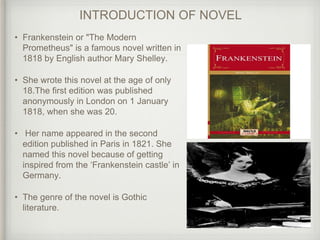
• Frankenstein or "The Modern
Prometheus" is a famous novel written in
1818 by English author Mary Shelley.
• She wrote this novel at the age of only
18.The first edition was published
anonymously in London on 1 January
1818, when she was 20.
• Her name appeared in the second
edition published in Paris in 1821. She
named this novel because of getting
inspired from the ‘Frankenstein castle’ in
Germany.
• The genre of the novel is Gothic
literature.
FRANKEINSTEIN MOVIE(1994)
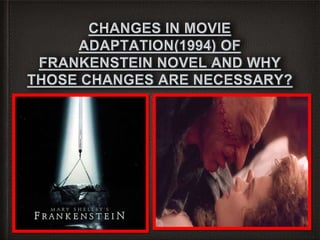
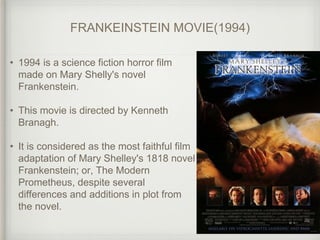
• 1994 is a science fiction horror film
made on Mary Shelly's novel
Frankenstein.
• This movie is directed by Kenneth
Branagh.
• It is considered as the most faithful film
adaptation of Mary Shelley's 1818 novel
Frankenstein; or, The Modern
Prometheus, despite several
differences and additions in plot from
the novel.
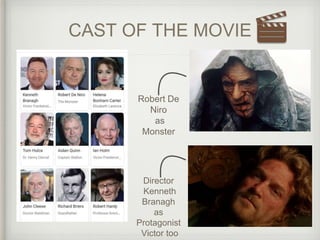
CAST OF THE MOVIE
Robert De
Niro
as
Monster
Director
Kenneth
Branagh
as
Protagonist
Victor too
NARRATIVE STYLE OF THE MOVIE
https://www.rogerebert.com/reviews/mary-shelleys-frankenstein-1994/
•This filmic construction – accelerated
montage – permeates the whole narrative,
along with the soundtrack and frontal planes
of the characters’ faces, especially the
monster’s, which define the tone of the film
in the generation of a violent drama.
NARRATIVE STYLE OF THE MOVIE
• Frankenstein films, brought to a fever pitch: The dark and stormy nights,
the lightning bolts, the charnel houses of spare body parts, the
laboratory where Victor Frankenstein stirs his steaming cauldron of
life.(VICTOR MAKES MONSTER)
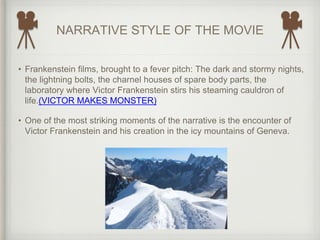
• One of the most striking moments of the narrative is the encounter of
Victor Frankenstein and his creation in the icy mountains of Geneva.
NARRATION OF CREATURE
• The family gradually becomes aware that some sort of
forest spirit is befriending him - and the old
grandfather, who is blind, actually invites the Creature
in to sit by the fire. “This shows beauty in not important
but the inner soul is!”
• And he is thoughtful: "Yes, I speak, and read, and
think, and know the ways of man," he says, with an
echo of Caliban. And he asks, "What of my soul? Do I
have one? What of these people of which I am
composed?" The whole issue of the Branagh film is
concentrated here: Has Frankenstein created a
monster, or a man?
ROLE OF ROBERT DE NIRO JUSTIFIES
CHARACTER
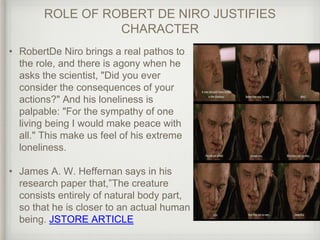
• RobertDe Niro brings a real pathos to
the role, and there is agony when he
asks the scientist, "Did you ever
consider the consequences of your
actions?" And his loneliness is
palpable: "For the sympathy of one
living being I would make peace with
all." This make us feel of his extreme
loneliness.
• James A. W. Heffernan says in his
research paper that,”The creature
consists entirely of natural body part,
so that he is closer to an actual human
being. JSTORE ARTICLE
MINOR CHANGES IN MOVIE
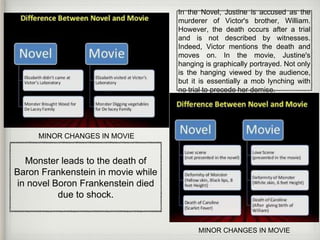
In the Novel, Justine is accused as the
murderer of Victor's brother, William.
However, the death occurs after a trial
and is not described by witnesses.
Indeed, Victor mentions the death and
moves on. In the movie, Justine's
hanging is graphically portrayed. Not only
is the hanging viewed by the audience,
but it is essentially a mob lynching with
no trial to precede her demise.
Monster leads to the death of
Baron Frankenstein in movie while
in novel Boron Frankenstein died
due to shock.
MAJOR CHANGES IN MOVIE
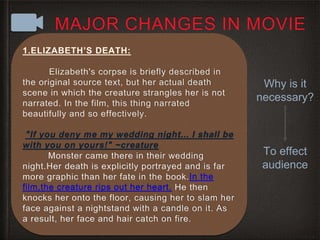
Elizabeth's corpse is briefly described in
the original source text, but her actual death
scene in which the creature strangles her is not
narrated. In the film, this thing narrated
beautifully and so effectively.
"If you deny me my wedding night... I shall be
with you on yours!" ~creature
Monster came there in their wedding
night.Her death is explicitly portrayed and is far
more graphic than her fate in the book.In the
film,the creature rips out her heart. He then
knocks her onto the floor, causing her to slam her
face against a nightstand with a candle on it. As
a result, her face and hair catch on fire.
Why is it
necessary?
To effect
audience
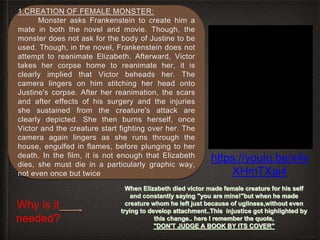
1.CREATION OF FEMALE MONSTER:
Monster asks Frankenstein to create him a
mate in both the novel and movie. Though, the
monster does not ask for the body of Justine to be
used. Though, in the novel, Frankenstein does not
attempt to reanimate Elizabeth. Afterward, Victor
takes her corpse home to reanimate her, it is
clearly implied that Victor beheads her. The
camera lingers on him stitching her head onto
Justine's corpse. After her reanimation, the scars
and after effects of his surgery and the injuries
she sustained from the creature's attack are
clearly depicted. She then burns herself, once
Victor and the creature start fighting over her. The
camera again lingers as she runs through the
house, engulfed in flames, before plunging to her
death. In the film, it is not enough that Elizabeth
dies, she must die in a particularly graphic way,
not even once but twice
Why is it
needed?
https://youtu.be/x4x
XHmTXaj4
END OF MONSTER:
In novel monster goes to northern
place to die but in movie when
Frankenstein dies. The monster then
sneaks on board, gives an eloquent
soliloquy about his sorrow and leaps
off the ship onto an ice floe — gone to
find himself some wood and burn
himself alive.The closing scene of
Frankenstein is symbolic. It can be said
that in Victor’s death, the creature has
no more reason to live, since his
creator is gone and that is all he has
ever known. It can also be seen from a
biblical standpoint.
CITATION
Ebert, Roger. “Mary Shelly's Frankeinstain .” RogerEbert.com, 4
Nov. 1994, https://www.rogerebert.com/reviews/mary-shelleys-
frankenstein-1994/.
James A. W. Heffernan. “Looking at the Monster: ‘Frankenstein’
and Film.” Critical Inquiry, vol. 24, no. 1, The University of
Chicago Press, 1997, pp. 133–58,
http://www.jstor.org/stable/1344161.
RIDEOUT, TD. “Mary Shelly's Frankeinstain(1994)-Kenneth
Branagh.” Themindreels.com, 27 Mar. 2015,
https://themindreels.com/2015/03/27/mary-shelleys-
frankenstein-1994-kenneth-branagh/.
“Captain Robert Walton : Who are you?
The Creature : He never gave me a
name.
[he continues to weep]
Captain Robert Walton : Why do you
weep?
The Creature : He was my father..
THANK YOU
HAVE A NICE DAY

103 frankenstein

  • 3.
    INTRODUCTION OF NOVEL •Frankenstein or "The Modern Prometheus" is a famous novel written in 1818 by English author Mary Shelley. • She wrote this novel at the age of only 18.The first edition was published anonymously in London on 1 January 1818, when she was 20. • Her name appeared in the second edition published in Paris in 1821. She named this novel because of getting inspired from the ‘Frankenstein castle’ in Germany. • The genre of the novel is Gothic literature.
  • 4.
    FRANKEINSTEIN MOVIE(1994) • 1994is a science fiction horror film made on Mary Shelly's novel Frankenstein. • This movie is directed by Kenneth Branagh. • It is considered as the most faithful film adaptation of Mary Shelley's 1818 novel Frankenstein; or, The Modern Prometheus, despite several differences and additions in plot from the novel.
  • 5.
    CAST OF THEMOVIE Robert De Niro as Monster Director Kenneth Branagh as Protagonist Victor too
  • 6.
    NARRATIVE STYLE OFTHE MOVIE https://www.rogerebert.com/reviews/mary-shelleys-frankenstein-1994/ •This filmic construction – accelerated montage – permeates the whole narrative, along with the soundtrack and frontal planes of the characters’ faces, especially the monster’s, which define the tone of the film in the generation of a violent drama.
  • 7.
    NARRATIVE STYLE OFTHE MOVIE • Frankenstein films, brought to a fever pitch: The dark and stormy nights, the lightning bolts, the charnel houses of spare body parts, the laboratory where Victor Frankenstein stirs his steaming cauldron of life.(VICTOR MAKES MONSTER) • One of the most striking moments of the narrative is the encounter of Victor Frankenstein and his creation in the icy mountains of Geneva.
  • 8.
    NARRATION OF CREATURE •The family gradually becomes aware that some sort of forest spirit is befriending him - and the old grandfather, who is blind, actually invites the Creature in to sit by the fire. “This shows beauty in not important but the inner soul is!” • And he is thoughtful: "Yes, I speak, and read, and think, and know the ways of man," he says, with an echo of Caliban. And he asks, "What of my soul? Do I have one? What of these people of which I am composed?" The whole issue of the Branagh film is concentrated here: Has Frankenstein created a monster, or a man?
  • 9.
    ROLE OF ROBERTDE NIRO JUSTIFIES CHARACTER • RobertDe Niro brings a real pathos to the role, and there is agony when he asks the scientist, "Did you ever consider the consequences of your actions?" And his loneliness is palpable: "For the sympathy of one living being I would make peace with all." This make us feel of his extreme loneliness. • James A. W. Heffernan says in his research paper that,”The creature consists entirely of natural body part, so that he is closer to an actual human being. JSTORE ARTICLE
  • 10.
    MINOR CHANGES INMOVIE MINOR CHANGES IN MOVIE In the Novel, Justine is accused as the murderer of Victor's brother, William. However, the death occurs after a trial and is not described by witnesses. Indeed, Victor mentions the death and moves on. In the movie, Justine's hanging is graphically portrayed. Not only is the hanging viewed by the audience, but it is essentially a mob lynching with no trial to precede her demise. Monster leads to the death of Baron Frankenstein in movie while in novel Boron Frankenstein died due to shock.
  • 11.
    MAJOR CHANGES INMOVIE Elizabeth's corpse is briefly described in the original source text, but her actual death scene in which the creature strangles her is not narrated. In the film, this thing narrated beautifully and so effectively. "If you deny me my wedding night... I shall be with you on yours!" ~creature Monster came there in their wedding night.Her death is explicitly portrayed and is far more graphic than her fate in the book.In the film,the creature rips out her heart. He then knocks her onto the floor, causing her to slam her face against a nightstand with a candle on it. As a result, her face and hair catch on fire. Why is it necessary? To effect audience
  • 12.
    1.CREATION OF FEMALEMONSTER: Monster asks Frankenstein to create him a mate in both the novel and movie. Though, the monster does not ask for the body of Justine to be used. Though, in the novel, Frankenstein does not attempt to reanimate Elizabeth. Afterward, Victor takes her corpse home to reanimate her, it is clearly implied that Victor beheads her. The camera lingers on him stitching her head onto Justine's corpse. After her reanimation, the scars and after effects of his surgery and the injuries she sustained from the creature's attack are clearly depicted. She then burns herself, once Victor and the creature start fighting over her. The camera again lingers as she runs through the house, engulfed in flames, before plunging to her death. In the film, it is not enough that Elizabeth dies, she must die in a particularly graphic way, not even once but twice Why is it needed? https://youtu.be/x4x XHmTXaj4
  • 13.
    END OF MONSTER: Innovel monster goes to northern place to die but in movie when Frankenstein dies. The monster then sneaks on board, gives an eloquent soliloquy about his sorrow and leaps off the ship onto an ice floe — gone to find himself some wood and burn himself alive.The closing scene of Frankenstein is symbolic. It can be said that in Victor’s death, the creature has no more reason to live, since his creator is gone and that is all he has ever known. It can also be seen from a biblical standpoint.
  • 14.
    CITATION Ebert, Roger. “MaryShelly's Frankeinstain .” RogerEbert.com, 4 Nov. 1994, https://www.rogerebert.com/reviews/mary-shelleys- frankenstein-1994/. James A. W. Heffernan. “Looking at the Monster: ‘Frankenstein’ and Film.” Critical Inquiry, vol. 24, no. 1, The University of Chicago Press, 1997, pp. 133–58, http://www.jstor.org/stable/1344161. RIDEOUT, TD. “Mary Shelly's Frankeinstain(1994)-Kenneth Branagh.” Themindreels.com, 27 Mar. 2015, https://themindreels.com/2015/03/27/mary-shelleys- frankenstein-1994-kenneth-branagh/.
  • 15.
    “Captain Robert Walton: Who are you? The Creature : He never gave me a name. [he continues to weep] Captain Robert Walton : Why do you weep? The Creature : He was my father.. THANK YOU HAVE A NICE DAY