



Monday,
February 17,
2014

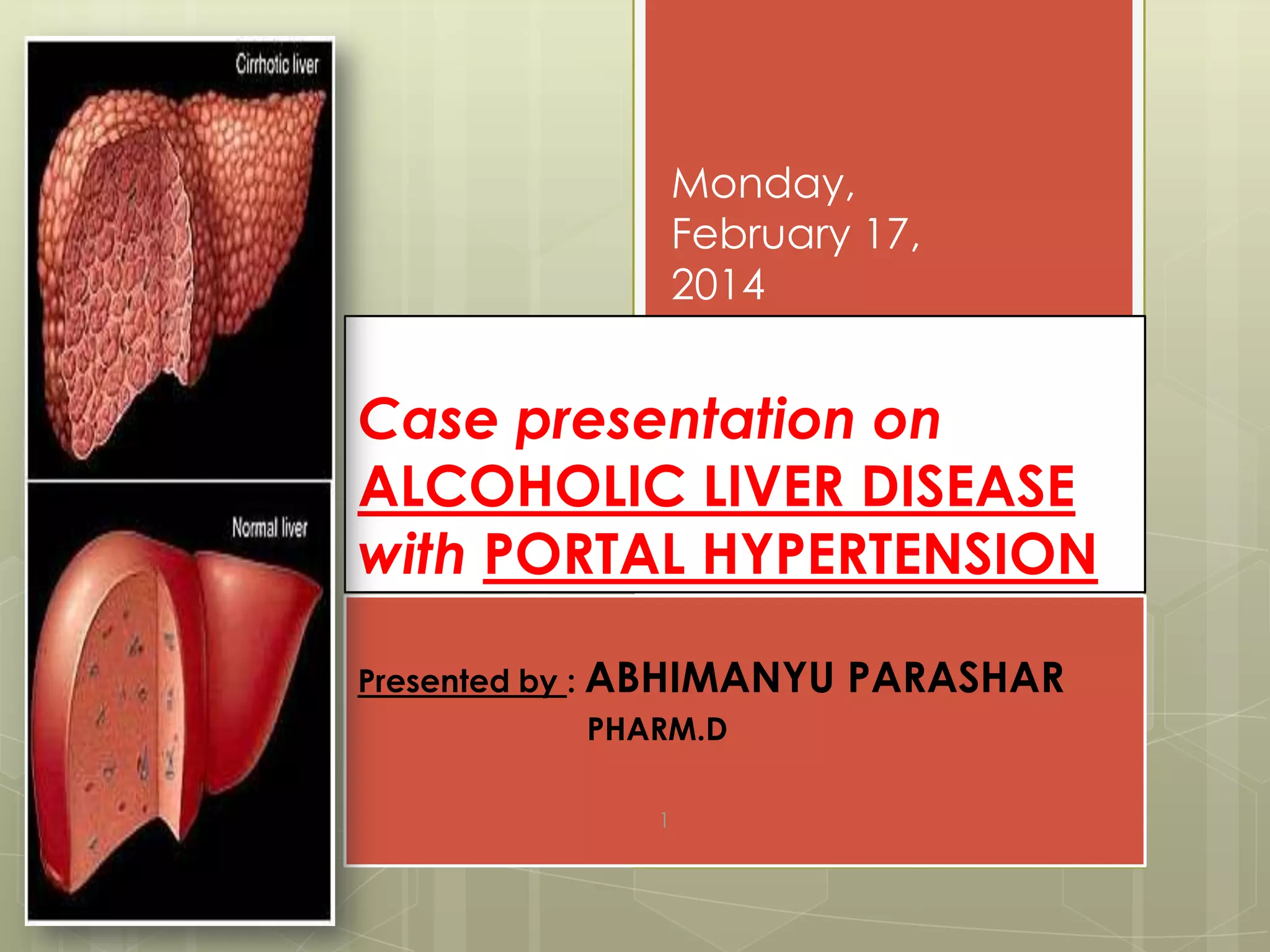
Case presentation on
ALCOHOLIC LIVER DISEASE
with PORTAL HYPERTENSION
Presented by : ABHIMANYU
PHARM.D
1

PARASHAR
2

 IP

no. : 220024

 UNIT

: medicine 1

 AGE

: 50 yrs

 SEX

: male

 WEIGHT

: 63 Kgs

Monday, February
17, 2014
3

Monday, February 17,
2014

Reasons for admission :
c/o :
 swelling of legs x 1 month (PEDAL EDEMA)
 Distention of abdomen x 1 month
(ASCITIS)
 constipation x 1 month
4

Monday, February 17,
2014

PMHx :
 Admitted

for similar complaints 5 months

back
 Was asymptomatic for 4 months
 k/c/o hypertension x 6 months was on
tab. Meto-ER (metprolol ) 50 mg
 Has been diagnosed with GERD and
GASTRITIS on 8/02/2012
5

Monday, February 17,
2014

SHx :
 Chronic

alcoholic x 15 yrs.
 Smoker x 15 yrs. Left 1 year back
 No Hx of hematuria , yellow discoloration ,
malena and fever
6

Allergies :
 NIL

KNOWN ALLERGIES

Monday, February 17,
2014
7

FHx :
 Not

significant

Monday, February 17,
2014
8

 DIET

: mixed

 APPETITE
 SLEEP

: good

: good

 BOWEL

and BLADDER : normal

Monday, February 17,
2014
9

Monday, February 17,
2014

PROVISIONAL DIAGNOSIS
 Liver

cirrhosis with decompensation with
portal hypertension and essential
hypertension
10

Monday, February 17,
2014

Decompensated cirrhosis ?
 In

patients with previously stable cirrhosis,
decompensation may occur due to
various causes, such as
 constipation
 infection (of any source)
 increased alcohol intake
 medications
 bleeding from esophageal varices
 dehydration.
11












Monday, February 17,
2014

Patients with decompensated cirrhosis
generally require admission to hospital, with
close monitoring of the fluid balance, mental
status,
emphasis on adequate nutrition and medical
treatment - often with
Diuretics
Antibiotics
laxatives
thiamine
occasionally steroids
Administration of saline is generally avoided.
12

DAY NOTES :

Monday, February 17,
2014
13

Monday, February 17,
2014

DAY 1(13/7/2012)
 BP

: 140 / 90 mmHg
 PULSE : 78 BPM
 O/E : CNS – conscious oriented
PALLOR – present
B/L pedal edema
no icterus
CVS : s1s2 heard
R/S : B/L NVBS present
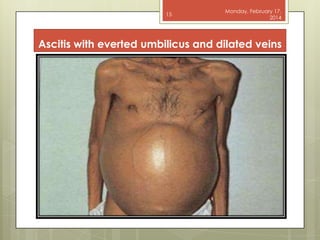
PA : distended , dilated veins
skin : shiny
umbilicus's : everted
14

 Scrotal

 ADV

Monday, February 17,
2014

swelling : present

: tapping 1000 ml (paracenteses)

Start tab FUROSEMIDE + SIPRANOLACTONE
U/C , S/E , ECG , no flaps
15

Monday, February 17,
2014

Ascitis with everted umbilicus and dilated veins
16

LAB REPORTS :

Monday, February 17,
2014
Monday, February 17,
2014

17

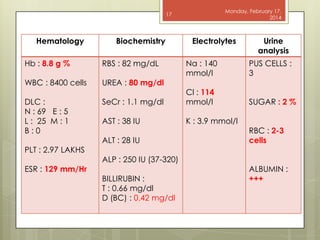
Hematology

Biochemistry

Hb : 8.8 g %

RBS : 82 mg/dL

WBC : 8400 cells

UREA : 80 mg/dl

DLC :
N : 69 E : 5
L : 25 M : 1
B:0
PLT : 2.97 LAKHS
ESR : 129 mm/Hr

Electrolytes

Urine
analysis

Na : 140
mmol/l

PUS CELLS :
3

SeCr : 1.1 mg/dl

Cl : 114
mmol/l

SUGAR : 2 %

AST : 38 IU

K : 3.9 mmol/l

ALT : 28 IU

ALP : 250 IU (37-320)
BILLIRUBIN :
T : 0.66 mg/dl
D (BC) : 0.42 mg/dl

RBC : 2-3
cells
ALBUMIN :
+++
18

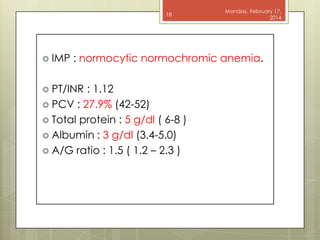
 IMP

Monday, February 17,
2014

: normocytic normochromic anemia.

 PT/INR

: 1.12
 PCV : 27.9% (42-52)
 Total protein : 5 g/dl ( 6-8 )
 Albumin : 3 g/dl (3.4-5.0)
 A/G ratio : 1.5 ( 1.2 – 2.3 )
19

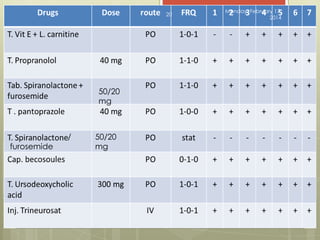
TREATMENT CHART :

Monday, February
17, 2014
20

50/20
mg

furosemide

/

50/20
mg

Monday, February 17,
2014
21

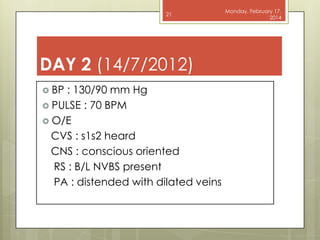
DAY 2 (14/7/2012)
 BP

: 130/90 mm Hg
 PULSE : 70 BPM
 O/E
CVS : s1s2 heard
CNS : conscious oriented
RS : B/L NVBS present
PA : distended with dilated veins

Monday, February 17,
2014
22

 ADV

: PT/INR , paracenteses ,

 collect

ascitic fluid

Monday, February 17,
2014
23

Monday, February
17, 2014

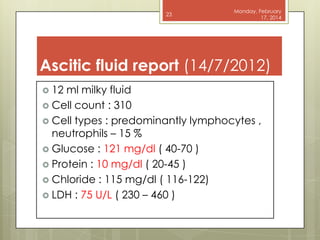
Ascitic fluid report (14/7/2012)
 12

ml milky fluid
 Cell count : 310
 Cell types : predominantly lymphocytes ,
neutrophils – 15 %
 Glucose : 121 mg/dl ( 40-70 )
 Protein : 10 mg/dl ( 20-45 )
 Chloride : 115 mg/dl ( 116-122)
 LDH : 75 U/L ( 230 – 460 )
24

Monday, February 17,
2014

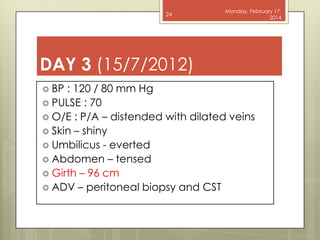
DAY 3 (15/7/2012)
 BP

: 120 / 80 mm Hg
 PULSE : 70
 O/E : P/A – distended with dilated veins
 Skin – shiny
 Umbilicus - everted
 Abdomen – tensed
 Girth – 96 cm
 ADV – peritoneal biopsy and CST
25

Monday, February 17,
2014

Ascitic fluid culture report
(15/7/2012)
 Gram

 AFB

stain : no cells , no bacteria

not seen
26

Monday, February 17,
2014

DAY 4 (16/7/2012)
 BP

: 130 / 100 mm Hg
 PULSE : 80 BPM
 O/E : c/o weakness in proximal muscles
 CVS - s1s2 heard
 CNS – Pt. conscious oriented
 RS – B/L NVBS present
 P/A – distended with dilated veins
 ADV - CST
27

Monday, February 17,
2014

DAY 5 (17/7/2012)
 BP

: 120 / 90 mm Hg
 PULSE : 82 BPM
 O/E : conscious oriented
 c/o decreased urine output and
constipation with generalized weakness
 P/A –distended , free fluid distended
 ADV - CST
28

Monday, February 17,
2014

DAY 6 (18/7/2012)
 BP

: 128 /80 mm Hg
 PULSE : 82 BPM
 O/E : conscious oriented
 c/o decreased urine output and
constipation with generalized weakness
 P/A –distended , free fluid distended
 ADV - CST
29

Monday, February 17,
2014

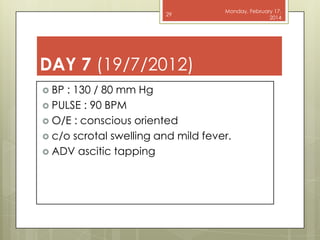
DAY 7 (19/7/2012)
 BP

: 130 / 80 mm Hg
 PULSE : 90 BPM
 O/E : conscious oriented
 c/o scrotal swelling and mild fever.
 ADV ascitic tapping
30

Monday, February 17,
2014

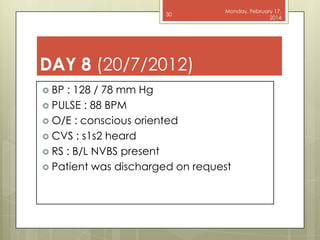
DAY 8 (20/7/2012)
 BP

: 128 / 78 mm Hg
 PULSE : 88 BPM
 O/E : conscious oriented
 CVS : s1s2 heard
 RS : B/L NVBS present
 Patient was discharged on request
31

Monday, February 17,
2014

PHARMACEUTICAL CARE
PLAN (SOAP)
32

Monday, February 17,
2014

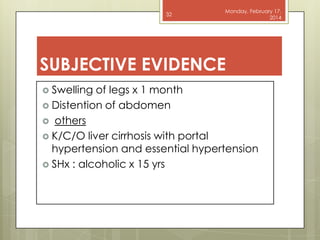
SUBJECTIVE EVIDENCE
 Swelling

of legs x 1 month
 Distention of abdomen
 others
 K/C/O liver cirrhosis with portal
hypertension and essential hypertension
 SHx : alcoholic x 15 yrs
33

Monday, February
17, 2014

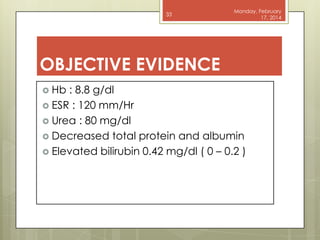
OBJECTIVE EVIDENCE
 Hb

: 8.8 g/dl
 ESR : 120 mm/Hr
 Urea : 80 mg/dl
 Decreased total protein and albumin
 Elevated bilirubin 0.42 mg/dl ( 0 – 0.2 )
34

Monday, February 17,
2014

FINAL DIAGNOSIS
 Based

on subjective and objective
evidence the patients was diagnosed as
ALCOHOLIC LIVER DISEASE with PORTAL
HYPERTENSION and ESSENTIAL
HYPERTENSION
35

Monday, February 17,
2014

cirrhosis
 Cirrhosis

is a consequence of chronic liver
disease characterized by replacement of
liver tissue by fibrosis , scar tissue and
regenerative nodules (lumps that occur
as a result of a process in which
damaged tissue is regenerated),leading
to loss of liver function
36

 In

Monday, February
17, 2014

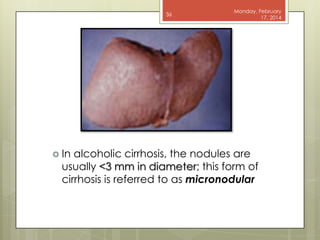
alcoholic cirrhosis, the nodules are
usually <3 mm in diameter; this form of
cirrhosis is referred to as micronodular
37

Monday, February 17,
2014

Risk Factor

Comment

Quantity

In men, 40–80 g/d of ethanol produces
fatty liver
160 g/d for 10–20 years causes hepatitis or
cirrhosis.
Only 15% of alcoholics develop alcoholic
liver disease

Gender

Women exhibit increased susceptibility to
alcoholic liver disease at amounts >20 g/d;
two drinks per day probably safe.
38

Monday, February 17,
2014

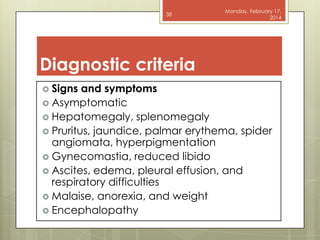
Diagnostic criteria
 Signs

and symptoms
 Asymptomatic
 Hepatomegaly, splenomegaly
 Pruritus, jaundice, palmar erythema, spider
angiomata, hyperpigmentation
 Gynecomastia, reduced libido
 Ascites, edema, pleural effusion, and
respiratory difficulties
 Malaise, anorexia, and weight
 Encephalopathy
39

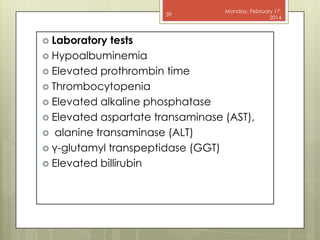
 Laboratory

Monday, February 17,
2014

tests
 Hypoalbuminemia
 Elevated prothrombin time
 Thrombocytopenia
 Elevated alkaline phosphatase
 Elevated aspartate transaminase (AST),
 alanine transaminase (ALT)
 γ-glutamyl transpeptidase (GGT)
 Elevated billirubin
40

Monday, February
17, 2014
Monday, February 17,
2014

41

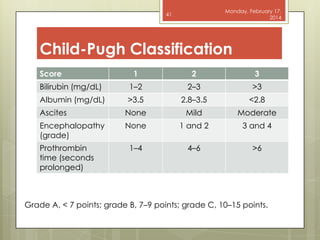
Child-Pugh Classification
Score

1

2

3

Bilirubin (mg/dL)

1–2

2–3

>3

Albumin (mg/dL)

>3.5

2.8–3.5

<2.8

Ascites

None

Mild

Moderate

Encephalopathy
(grade)

None

1 and 2

3 and 4

1–4

4–6

>6

Prothrombin
time (seconds
prolonged)

Grade A, < 7 points; grade B, 7–9 points; grade C, 10–15 points.
42

Monday, February 17,
2014

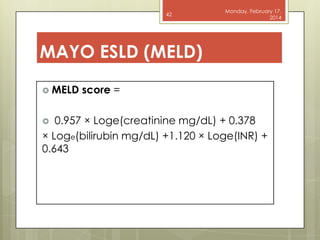
MAYO ESLD (MELD)
 MELD

score =

0.957 × Loge(creatinine mg/dL) + 0.378
× Loge(bilirubin mg/dL) +1.120 × Loge(INR) +
0.643

43

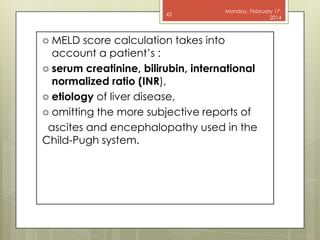
 MELD

Monday, February 17,
2014

score calculation takes into
account a patient’s :
 serum creatinine, bilirubin, international
normalized ratio (INR),
 etiology of liver disease,
 omitting the more subjective reports of
ascites and encephalopathy used in the
Child-Pugh system.
44

Monday, February 17,
2014

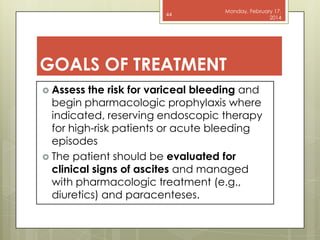
GOALS OF TREATMENT
 Assess

the risk for variceal bleeding and
begin pharmacologic prophylaxis where
indicated, reserving endoscopic therapy
for high-risk patients or acute bleeding
episodes
 The patient should be evaluated for
clinical signs of ascites and managed
with pharmacologic treatment (e.g.,
diuretics) and paracenteses.
45

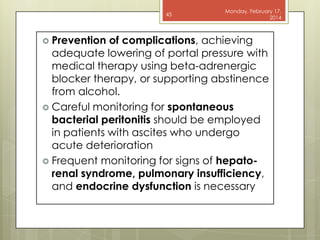
 Prevention

Monday, February 17,
2014

of complications, achieving
adequate lowering of portal pressure with
medical therapy using beta-adrenergic
blocker therapy, or supporting abstinence
from alcohol.
 Careful monitoring for spontaneous
bacterial peritonitis should be employed
in patients with ascites who undergo
acute deterioration
 Frequent monitoring for signs of hepatorenal syndrome, pulmonary insufficiency,
and endocrine dysfunction is necessary
46

 Hepatic

Monday, February 17,
2014

encephalopathy is a common
complication of cirrhosis and requires
clinical vigilance and treatment with
dietary restriction, elimination of central
nervous system depressants, and therapy
to lower ammonia levels
 prevent symptoms and maintain
reasonable QOL
 To provide adequate nutritional support
47

Monday, February 17,
2014

TREATMENT OPTIONS
 Patient

specific :
 for portal hypertension
Propranalol
nadolol
 for

Ascites:
aldosterone antagonists (spiranolactone)
loop diuretics
48

ADJUVENT THERAPY
 Ursodeoxycholic

acid
 Multivitamin supplements
 pantoprazole

Monday, February 17,
2014
49

Monday, February 17,
2014

GOALS ACHIEVED
 Paracenteses

was started on day 1(1000
ml fluid was removed ) and patient was
feeling relived from his abdominal
distention
 Patient was feeling better by day 8 and
was discharged on request.
50

Monday, February 17,
2014

PROBLEMS IDENTIFIED
 Untreated

indication : ANEMIA
 PT/INR was not repeated
 Patient was not started on antibiotics as a
prophylaxis for spontaneous bacterial
peritonitis
 Patient was not started on syrup lactulose
even though patient was on high risk to
develop encephalopathy
51

Monday, February 17,
2014

MONITORING PARAMETERS
 Liver

function test
 BLOOD SUGAR
 Blood Pressure
 Electrolytes (Na and K)
 body weight
 prothrombin time
 Complete hemogram
 USG Abdomen
52

Monday, February 17,
2014

PATIENT COUNSELLING
53

About the disease


Non curable disease.



Risk factor



Signs and symptoms

Monday, February 17,
2014
54

About medication


Name and purpose



Dose and frequency



Medication adherence



Possible adverse effects



Missed dose

Monday, February
17, 2014
55

Monday, February 17,
2014

About life style modification
Stop taking alcohol
Smoking cessation
Nutritious diet
Monday,
February 17,
2014

QUIT BEFORE ITS
LATE

THANK
YOU
56

ALD with portal htn

  • 1.
    Monday, February 17, 2014 Case presentationon ALCOHOLIC LIVER DISEASE with PORTAL HYPERTENSION Presented by : ABHIMANYU PHARM.D 1 PARASHAR
  • 2.
    2  IP no. :220024  UNIT : medicine 1  AGE : 50 yrs  SEX : male  WEIGHT : 63 Kgs Monday, February 17, 2014
  • 3.
    3 Monday, February 17, 2014 Reasonsfor admission : c/o :  swelling of legs x 1 month (PEDAL EDEMA)  Distention of abdomen x 1 month (ASCITIS)  constipation x 1 month
  • 4.
    4 Monday, February 17, 2014 PMHx:  Admitted for similar complaints 5 months back  Was asymptomatic for 4 months  k/c/o hypertension x 6 months was on tab. Meto-ER (metprolol ) 50 mg  Has been diagnosed with GERD and GASTRITIS on 8/02/2012
  • 5.
    5 Monday, February 17, 2014 SHx:  Chronic alcoholic x 15 yrs.  Smoker x 15 yrs. Left 1 year back  No Hx of hematuria , yellow discoloration , malena and fever
  • 6.
    6 Allergies :  NIL KNOWNALLERGIES Monday, February 17, 2014
  • 7.
  • 8.
    8  DIET : mixed APPETITE  SLEEP : good : good  BOWEL and BLADDER : normal Monday, February 17, 2014
  • 9.
    9 Monday, February 17, 2014 PROVISIONALDIAGNOSIS  Liver cirrhosis with decompensation with portal hypertension and essential hypertension
  • 10.
    10 Monday, February 17, 2014 Decompensatedcirrhosis ?  In patients with previously stable cirrhosis, decompensation may occur due to various causes, such as  constipation  infection (of any source)  increased alcohol intake  medications  bleeding from esophageal varices  dehydration.
  • 11.
    11         Monday, February 17, 2014 Patientswith decompensated cirrhosis generally require admission to hospital, with close monitoring of the fluid balance, mental status, emphasis on adequate nutrition and medical treatment - often with Diuretics Antibiotics laxatives thiamine occasionally steroids Administration of saline is generally avoided.
  • 12.
    12 DAY NOTES : Monday,February 17, 2014
  • 13.
    13 Monday, February 17, 2014 DAY1(13/7/2012)  BP : 140 / 90 mmHg  PULSE : 78 BPM  O/E : CNS – conscious oriented PALLOR – present B/L pedal edema no icterus CVS : s1s2 heard R/S : B/L NVBS present PA : distended , dilated veins skin : shiny umbilicus's : everted
  • 14.
    14  Scrotal  ADV Monday,February 17, 2014 swelling : present : tapping 1000 ml (paracenteses) Start tab FUROSEMIDE + SIPRANOLACTONE U/C , S/E , ECG , no flaps
  • 15.
    15 Monday, February 17, 2014 Ascitiswith everted umbilicus and dilated veins
  • 16.
    16 LAB REPORTS : Monday,February 17, 2014
  • 17.
    Monday, February 17, 2014 17 Hematology Biochemistry Hb: 8.8 g % RBS : 82 mg/dL WBC : 8400 cells UREA : 80 mg/dl DLC : N : 69 E : 5 L : 25 M : 1 B:0 PLT : 2.97 LAKHS ESR : 129 mm/Hr Electrolytes Urine analysis Na : 140 mmol/l PUS CELLS : 3 SeCr : 1.1 mg/dl Cl : 114 mmol/l SUGAR : 2 % AST : 38 IU K : 3.9 mmol/l ALT : 28 IU ALP : 250 IU (37-320) BILLIRUBIN : T : 0.66 mg/dl D (BC) : 0.42 mg/dl RBC : 2-3 cells ALBUMIN : +++
  • 18.
    18  IMP Monday, February17, 2014 : normocytic normochromic anemia.  PT/INR : 1.12  PCV : 27.9% (42-52)  Total protein : 5 g/dl ( 6-8 )  Albumin : 3 g/dl (3.4-5.0)  A/G ratio : 1.5 ( 1.2 – 2.3 )
  • 19.
  • 20.
  • 21.
    21 DAY 2 (14/7/2012) BP : 130/90 mm Hg  PULSE : 70 BPM  O/E CVS : s1s2 heard CNS : conscious oriented RS : B/L NVBS present PA : distended with dilated veins Monday, February 17, 2014
  • 22.
    22  ADV : PT/INR, paracenteses ,  collect ascitic fluid Monday, February 17, 2014
  • 23.
    23 Monday, February 17, 2014 Asciticfluid report (14/7/2012)  12 ml milky fluid  Cell count : 310  Cell types : predominantly lymphocytes , neutrophils – 15 %  Glucose : 121 mg/dl ( 40-70 )  Protein : 10 mg/dl ( 20-45 )  Chloride : 115 mg/dl ( 116-122)  LDH : 75 U/L ( 230 – 460 )
  • 24.
    24 Monday, February 17, 2014 DAY3 (15/7/2012)  BP : 120 / 80 mm Hg  PULSE : 70  O/E : P/A – distended with dilated veins  Skin – shiny  Umbilicus - everted  Abdomen – tensed  Girth – 96 cm  ADV – peritoneal biopsy and CST
  • 25.
    25 Monday, February 17, 2014 Asciticfluid culture report (15/7/2012)  Gram  AFB stain : no cells , no bacteria not seen
  • 26.
    26 Monday, February 17, 2014 DAY4 (16/7/2012)  BP : 130 / 100 mm Hg  PULSE : 80 BPM  O/E : c/o weakness in proximal muscles  CVS - s1s2 heard  CNS – Pt. conscious oriented  RS – B/L NVBS present  P/A – distended with dilated veins  ADV - CST
  • 27.
    27 Monday, February 17, 2014 DAY5 (17/7/2012)  BP : 120 / 90 mm Hg  PULSE : 82 BPM  O/E : conscious oriented  c/o decreased urine output and constipation with generalized weakness  P/A –distended , free fluid distended  ADV - CST
  • 28.
    28 Monday, February 17, 2014 DAY6 (18/7/2012)  BP : 128 /80 mm Hg  PULSE : 82 BPM  O/E : conscious oriented  c/o decreased urine output and constipation with generalized weakness  P/A –distended , free fluid distended  ADV - CST
  • 29.
    29 Monday, February 17, 2014 DAY7 (19/7/2012)  BP : 130 / 80 mm Hg  PULSE : 90 BPM  O/E : conscious oriented  c/o scrotal swelling and mild fever.  ADV ascitic tapping
  • 30.
    30 Monday, February 17, 2014 DAY8 (20/7/2012)  BP : 128 / 78 mm Hg  PULSE : 88 BPM  O/E : conscious oriented  CVS : s1s2 heard  RS : B/L NVBS present  Patient was discharged on request
  • 31.
  • 32.
    32 Monday, February 17, 2014 SUBJECTIVEEVIDENCE  Swelling of legs x 1 month  Distention of abdomen  others  K/C/O liver cirrhosis with portal hypertension and essential hypertension  SHx : alcoholic x 15 yrs
  • 33.
    33 Monday, February 17, 2014 OBJECTIVEEVIDENCE  Hb : 8.8 g/dl  ESR : 120 mm/Hr  Urea : 80 mg/dl  Decreased total protein and albumin  Elevated bilirubin 0.42 mg/dl ( 0 – 0.2 )
  • 34.
    34 Monday, February 17, 2014 FINALDIAGNOSIS  Based on subjective and objective evidence the patients was diagnosed as ALCOHOLIC LIVER DISEASE with PORTAL HYPERTENSION and ESSENTIAL HYPERTENSION
  • 35.
    35 Monday, February 17, 2014 cirrhosis Cirrhosis is a consequence of chronic liver disease characterized by replacement of liver tissue by fibrosis , scar tissue and regenerative nodules (lumps that occur as a result of a process in which damaged tissue is regenerated),leading to loss of liver function
  • 36.
    36  In Monday, February 17,2014 alcoholic cirrhosis, the nodules are usually <3 mm in diameter; this form of cirrhosis is referred to as micronodular
  • 37.
    37 Monday, February 17, 2014 RiskFactor Comment Quantity In men, 40–80 g/d of ethanol produces fatty liver 160 g/d for 10–20 years causes hepatitis or cirrhosis. Only 15% of alcoholics develop alcoholic liver disease Gender Women exhibit increased susceptibility to alcoholic liver disease at amounts >20 g/d; two drinks per day probably safe.
  • 38.
    38 Monday, February 17, 2014 Diagnosticcriteria  Signs and symptoms  Asymptomatic  Hepatomegaly, splenomegaly  Pruritus, jaundice, palmar erythema, spider angiomata, hyperpigmentation  Gynecomastia, reduced libido  Ascites, edema, pleural effusion, and respiratory difficulties  Malaise, anorexia, and weight  Encephalopathy
  • 39.
    39  Laboratory Monday, February17, 2014 tests  Hypoalbuminemia  Elevated prothrombin time  Thrombocytopenia  Elevated alkaline phosphatase  Elevated aspartate transaminase (AST),  alanine transaminase (ALT)  γ-glutamyl transpeptidase (GGT)  Elevated billirubin
  • 40.
  • 41.
    Monday, February 17, 2014 41 Child-PughClassification Score 1 2 3 Bilirubin (mg/dL) 1–2 2–3 >3 Albumin (mg/dL) >3.5 2.8–3.5 <2.8 Ascites None Mild Moderate Encephalopathy (grade) None 1 and 2 3 and 4 1–4 4–6 >6 Prothrombin time (seconds prolonged) Grade A, < 7 points; grade B, 7–9 points; grade C, 10–15 points.
  • 42.
    42 Monday, February 17, 2014 MAYOESLD (MELD)  MELD score = 0.957 × Loge(creatinine mg/dL) + 0.378 × Loge(bilirubin mg/dL) +1.120 × Loge(INR) + 0.643 
  • 43.
    43  MELD Monday, February17, 2014 score calculation takes into account a patient’s :  serum creatinine, bilirubin, international normalized ratio (INR),  etiology of liver disease,  omitting the more subjective reports of ascites and encephalopathy used in the Child-Pugh system.
  • 44.
    44 Monday, February 17, 2014 GOALSOF TREATMENT  Assess the risk for variceal bleeding and begin pharmacologic prophylaxis where indicated, reserving endoscopic therapy for high-risk patients or acute bleeding episodes  The patient should be evaluated for clinical signs of ascites and managed with pharmacologic treatment (e.g., diuretics) and paracenteses.
  • 45.
    45  Prevention Monday, February17, 2014 of complications, achieving adequate lowering of portal pressure with medical therapy using beta-adrenergic blocker therapy, or supporting abstinence from alcohol.  Careful monitoring for spontaneous bacterial peritonitis should be employed in patients with ascites who undergo acute deterioration  Frequent monitoring for signs of hepatorenal syndrome, pulmonary insufficiency, and endocrine dysfunction is necessary
  • 46.
    46  Hepatic Monday, February17, 2014 encephalopathy is a common complication of cirrhosis and requires clinical vigilance and treatment with dietary restriction, elimination of central nervous system depressants, and therapy to lower ammonia levels  prevent symptoms and maintain reasonable QOL  To provide adequate nutritional support
  • 47.
    47 Monday, February 17, 2014 TREATMENTOPTIONS  Patient specific :  for portal hypertension Propranalol nadolol  for Ascites: aldosterone antagonists (spiranolactone) loop diuretics
  • 48.
    48 ADJUVENT THERAPY  Ursodeoxycholic acid Multivitamin supplements  pantoprazole Monday, February 17, 2014
  • 49.
    49 Monday, February 17, 2014 GOALSACHIEVED  Paracenteses was started on day 1(1000 ml fluid was removed ) and patient was feeling relived from his abdominal distention  Patient was feeling better by day 8 and was discharged on request.
  • 50.
    50 Monday, February 17, 2014 PROBLEMSIDENTIFIED  Untreated indication : ANEMIA  PT/INR was not repeated  Patient was not started on antibiotics as a prophylaxis for spontaneous bacterial peritonitis  Patient was not started on syrup lactulose even though patient was on high risk to develop encephalopathy
  • 51.
    51 Monday, February 17, 2014 MONITORINGPARAMETERS  Liver function test  BLOOD SUGAR  Blood Pressure  Electrolytes (Na and K)  body weight  prothrombin time  Complete hemogram  USG Abdomen
  • 52.
  • 53.
    53 About the disease  Noncurable disease.  Risk factor  Signs and symptoms Monday, February 17, 2014
  • 54.
    54 About medication  Name andpurpose  Dose and frequency  Medication adherence  Possible adverse effects  Missed dose Monday, February 17, 2014
  • 55.
    55 Monday, February 17, 2014 Aboutlife style modification Stop taking alcohol Smoking cessation Nutritious diet
  • 56.