ALANKAR THEORY
PRESENTED BY : JANVI NAKUM
• Name : Nakum Janvi R
• Roll No : 11
• M. A. Sem : 2
• Paper No : 109
• Paper Name : Literary Theory & Criticism and Indian Aesthetics
• Presentation: 4
• Topic : Alankar Theory
• Enrollment No : 4069206420210020
• Email id : janvinakum360@gmail.com
• Submitted To – S.B.Gardi Department of English, MKBU
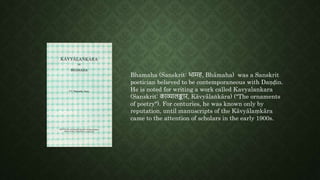
Bhamaha (Sanskrit: भामह, Bhāmaha) was a Sanskrit
poetician believed to be contemporaneous with Daṇḍin.
He is noted for writing a work called Kavyalankara
(Sanskrit: काव्यालङ्कार, Kāvyālaṅkāra) ("The ornaments
of poetry"). For centuries, he was known only by
reputation, until manuscripts of the Kāvyālaṃkāra
came to the attention of scholars in the early 1900s.
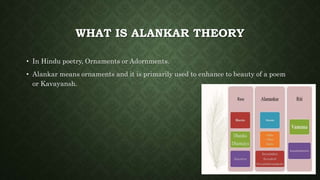
WHAT IS ALANKAR THEORY
• In Hindu poetry, Ornaments or Adornments.
• Alankar means ornaments and it is primarily used to enhance to beauty of a poem
or Kavayansh.
• The language of poetry is different from the Ordinary language. It is embellished
with appropriate use of figures of speech. Figures of speech make language elegant.
• Anandhavardhana says that when alankaras are used judiciously, they are the soul
of poetry. Abhinav Gupta also believed that alankars are soul of poetry and not mere
external.
• Mere thoughts and emotions make only philosophy. They become poetry only
philosophy. They become poetry only when they are embellished by the use of
alankaras.
• An important aspect of poetry is that it is charming and beautiful. Alankaras allow
poetry to express ideas in a different manner from the ordinary use of language.
ANANDHAVARDHANA SAYS
• When figures of speech are directly expressed, they are like ornaments worn over
body. But when they are indirectly express or suggested they make poetry even more
beautiful and become the soul of poetry.
• Anandhavardhana’s rules for the use of alankaras
• Alankara should be subordinated to Rasa. Realization of rasa is more important and
alnkaras should be helpful in achieving this.
• Another important rule is that its should be suied the Bhava and emotion dealt
with.
• It should be naturally and easily Introduced. It should not look like an artificial
imposition on the poem.
• The poet should not take an extra effort to introduce alankaras.
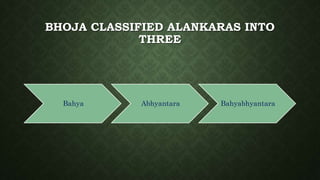
BHOJA CLASSIFIED ALANKARAS INTO
THREE
Bahya Abhyantara Bahyabhyantara
• Bahya alankaras
Bahya alankaras are concerned with sabda or word. They are external alankaras.
This alankaras are like ornaments or dress worn over the body.
• Abhyantara alankaras
• This concerned with artha or meaning and they are internal. This are like internal
decorations, like cleaning the teeth.
• Bahyabhyantara alankaras
• This concerned with both sabda and artha. This are like decorations on this skin –
applying Candana or Kumkum.
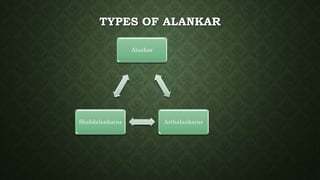
TYPES OF ALANKAR
Alankar
Arthalankaras
Shabdalankaras
• The supporters of the alankara school thought of poetry as having a body {kavyasarira)
which required to be ornamented. This Kavyasarira on one hand and the set of poetic
figure on the other, were two main separate real existence of poetry. The body consisted
of a group of words which was not devoid of an agreeable idea. S Hence, the body
constituted of two basis elements - (1) sound (sabda) and (2) sense (artha).
• According to Bhamaha, what constituted Kavya was the combination of these two
elements.6 But, this Kavyasarira of poetry never shines without proper ornaments in the
form of poetic figures and hence they are essential. Just as the face of a dansel though
beautiful, lacks lustre if unadorned, so is poetry.? The employment of alanakaras is the
characteristic feature of poetry the factor that converts the matter of fact, prosaic speech
into poetic speech, and the criterion for judging its worth. While ordlnctry speech is
straight and lacks ornamentation, poetry is marked by a striking turn of expression.
Apart from the treatment of figures, the alankara theory also devoted attention to the
incorporation of poetic qualities (gunadhana) and the exclusion of flaws poetry
(dosadana) as expedients that contribute to produce appeal. Hence the whole alankara
theory is primarily concerned with the formal embellishment of the external aspect of
Kavya.
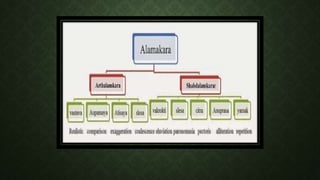
MOST COMMON (शब्दालंकार ) SHABDALANKARTHAT YOU MIGHT
FIND IN THE HINDI POETRY ARE:
• 1. अनुप्रास (Anupras) (Alliteration) – When a consonant word repeats serially more
than once.
• Example: घेर घेर घोर गगन।. Here, “घ ” is repeated three times.
• 2. यमक (Yamak) (Homonym) – when same word repeats more than once but each
time its meaning is different.
• Example: सजना है मुझे सजना क
े ललए। Here, “सजना” means to make up/lover.
• 3. श्लेष (Shlesh) (Pun) – when a word is used once but it gives more than one
meaning.
• Example: मधुबन की छाती को देखो, सूखी इसकी लकतनी कललयााँ। Here, “कललयााँ” means the
flower that is not fully blossomed/Young children. Poet wants to describe a scene
where a “मधुबन” (garden) is lacking, both in blossoming flowers and young children
MOST COMMON (अर्ाालंकार) ARTHALANKAR THAT YOU MIGHT
FIND IN THE HINDI POETRY ARE:
• 1. Simile (उपमा) (Upma) (Simile) – when a person or thing is compared in words with a similar
but famous/well known person or thing.
• Example: ताज महल सा घर। House like the Taj Mahal. Here, “घर” (house) is compared with a building
which is famous for its beauty.
• 2. Metaphor (रूपक) (Rupak)– when a word is used for something to which it is not literally
applicable in order to suggest a resemblance.
• Example: पायो जी मैंने राम-रतन धन पायो। Here, “राम” (Ram, Hindu god) is suggested metaphorically as
“रतन” (precious stones) and “धन” (money) .
• 3. अलतश्योक्ति (Atishyokti) (Hyperbole) – when a word is used of exaggerate something or someone,
to evoke a strong feelings or to create a strong impression.
• Example: लदल बादल बने, आाँखें बहेने लगी। Here, “लदल” (heart) is exaggerated to “बादल” (cloud). The
dramatic effect of this exaggeration would be, आाँखें (eyes) that can tear as rain because the heart
has turned into clouds (in pain).
• https://blogs.transparent.com/hindi/alankar-figure-of-speech/
• Ghosh, Manmohan, et al. “M.” Andhra University, ht
tps://www.andhrauniversity.edu.in/img/syllabus/Sanskrit-MA-Syllabus-2014.doc.
Accessed 14 April 2022.
Thank You
WORK CITED

alankar theory.pptx

  • 1.
  • 2.
    • Name :Nakum Janvi R • Roll No : 11 • M. A. Sem : 2 • Paper No : 109 • Paper Name : Literary Theory & Criticism and Indian Aesthetics • Presentation: 4 • Topic : Alankar Theory • Enrollment No : 4069206420210020 • Email id : janvinakum360@gmail.com • Submitted To – S.B.Gardi Department of English, MKBU
  • 3.
    Bhamaha (Sanskrit: भामह,Bhāmaha) was a Sanskrit poetician believed to be contemporaneous with Daṇḍin. He is noted for writing a work called Kavyalankara (Sanskrit: काव्यालङ्कार, Kāvyālaṅkāra) ("The ornaments of poetry"). For centuries, he was known only by reputation, until manuscripts of the Kāvyālaṃkāra came to the attention of scholars in the early 1900s.
  • 4.
    WHAT IS ALANKARTHEORY • In Hindu poetry, Ornaments or Adornments. • Alankar means ornaments and it is primarily used to enhance to beauty of a poem or Kavayansh.
  • 5.
    • The languageof poetry is different from the Ordinary language. It is embellished with appropriate use of figures of speech. Figures of speech make language elegant. • Anandhavardhana says that when alankaras are used judiciously, they are the soul of poetry. Abhinav Gupta also believed that alankars are soul of poetry and not mere external. • Mere thoughts and emotions make only philosophy. They become poetry only philosophy. They become poetry only when they are embellished by the use of alankaras. • An important aspect of poetry is that it is charming and beautiful. Alankaras allow poetry to express ideas in a different manner from the ordinary use of language.
  • 6.
    ANANDHAVARDHANA SAYS • Whenfigures of speech are directly expressed, they are like ornaments worn over body. But when they are indirectly express or suggested they make poetry even more beautiful and become the soul of poetry. • Anandhavardhana’s rules for the use of alankaras • Alankara should be subordinated to Rasa. Realization of rasa is more important and alnkaras should be helpful in achieving this. • Another important rule is that its should be suied the Bhava and emotion dealt with. • It should be naturally and easily Introduced. It should not look like an artificial imposition on the poem. • The poet should not take an extra effort to introduce alankaras.
  • 7.
    BHOJA CLASSIFIED ALANKARASINTO THREE Bahya Abhyantara Bahyabhyantara
  • 8.
    • Bahya alankaras Bahyaalankaras are concerned with sabda or word. They are external alankaras. This alankaras are like ornaments or dress worn over the body. • Abhyantara alankaras • This concerned with artha or meaning and they are internal. This are like internal decorations, like cleaning the teeth. • Bahyabhyantara alankaras • This concerned with both sabda and artha. This are like decorations on this skin – applying Candana or Kumkum.
  • 9.
  • 10.
    • The supportersof the alankara school thought of poetry as having a body {kavyasarira) which required to be ornamented. This Kavyasarira on one hand and the set of poetic figure on the other, were two main separate real existence of poetry. The body consisted of a group of words which was not devoid of an agreeable idea. S Hence, the body constituted of two basis elements - (1) sound (sabda) and (2) sense (artha). • According to Bhamaha, what constituted Kavya was the combination of these two elements.6 But, this Kavyasarira of poetry never shines without proper ornaments in the form of poetic figures and hence they are essential. Just as the face of a dansel though beautiful, lacks lustre if unadorned, so is poetry.? The employment of alanakaras is the characteristic feature of poetry the factor that converts the matter of fact, prosaic speech into poetic speech, and the criterion for judging its worth. While ordlnctry speech is straight and lacks ornamentation, poetry is marked by a striking turn of expression. Apart from the treatment of figures, the alankara theory also devoted attention to the incorporation of poetic qualities (gunadhana) and the exclusion of flaws poetry (dosadana) as expedients that contribute to produce appeal. Hence the whole alankara theory is primarily concerned with the formal embellishment of the external aspect of Kavya.
  • 12.
    MOST COMMON (शब्दालंकार) SHABDALANKARTHAT YOU MIGHT FIND IN THE HINDI POETRY ARE: • 1. अनुप्रास (Anupras) (Alliteration) – When a consonant word repeats serially more than once. • Example: घेर घेर घोर गगन।. Here, “घ ” is repeated three times. • 2. यमक (Yamak) (Homonym) – when same word repeats more than once but each time its meaning is different. • Example: सजना है मुझे सजना क े ललए। Here, “सजना” means to make up/lover. • 3. श्लेष (Shlesh) (Pun) – when a word is used once but it gives more than one meaning. • Example: मधुबन की छाती को देखो, सूखी इसकी लकतनी कललयााँ। Here, “कललयााँ” means the flower that is not fully blossomed/Young children. Poet wants to describe a scene where a “मधुबन” (garden) is lacking, both in blossoming flowers and young children
  • 13.
    MOST COMMON (अर्ाालंकार)ARTHALANKAR THAT YOU MIGHT FIND IN THE HINDI POETRY ARE: • 1. Simile (उपमा) (Upma) (Simile) – when a person or thing is compared in words with a similar but famous/well known person or thing. • Example: ताज महल सा घर। House like the Taj Mahal. Here, “घर” (house) is compared with a building which is famous for its beauty. • 2. Metaphor (रूपक) (Rupak)– when a word is used for something to which it is not literally applicable in order to suggest a resemblance. • Example: पायो जी मैंने राम-रतन धन पायो। Here, “राम” (Ram, Hindu god) is suggested metaphorically as “रतन” (precious stones) and “धन” (money) . • 3. अलतश्योक्ति (Atishyokti) (Hyperbole) – when a word is used of exaggerate something or someone, to evoke a strong feelings or to create a strong impression. • Example: लदल बादल बने, आाँखें बहेने लगी। Here, “लदल” (heart) is exaggerated to “बादल” (cloud). The dramatic effect of this exaggeration would be, आाँखें (eyes) that can tear as rain because the heart has turned into clouds (in pain).
  • 14.
    • https://blogs.transparent.com/hindi/alankar-figure-of-speech/ • Ghosh,Manmohan, et al. “M.” Andhra University, ht tps://www.andhrauniversity.edu.in/img/syllabus/Sanskrit-MA-Syllabus-2014.doc. Accessed 14 April 2022. Thank You WORK CITED