ICT Use in Rural India: Opportunities and ChallengesDepartment of rural managementBBAU,  Lucknow.Ajitesh Kumar Tiwari
Presentation OutlineICT and development potentialDemonstrated opportunities from pilotsLearning from successful cases  Challenges in scaling up, replicationKey role for creativity and innovation
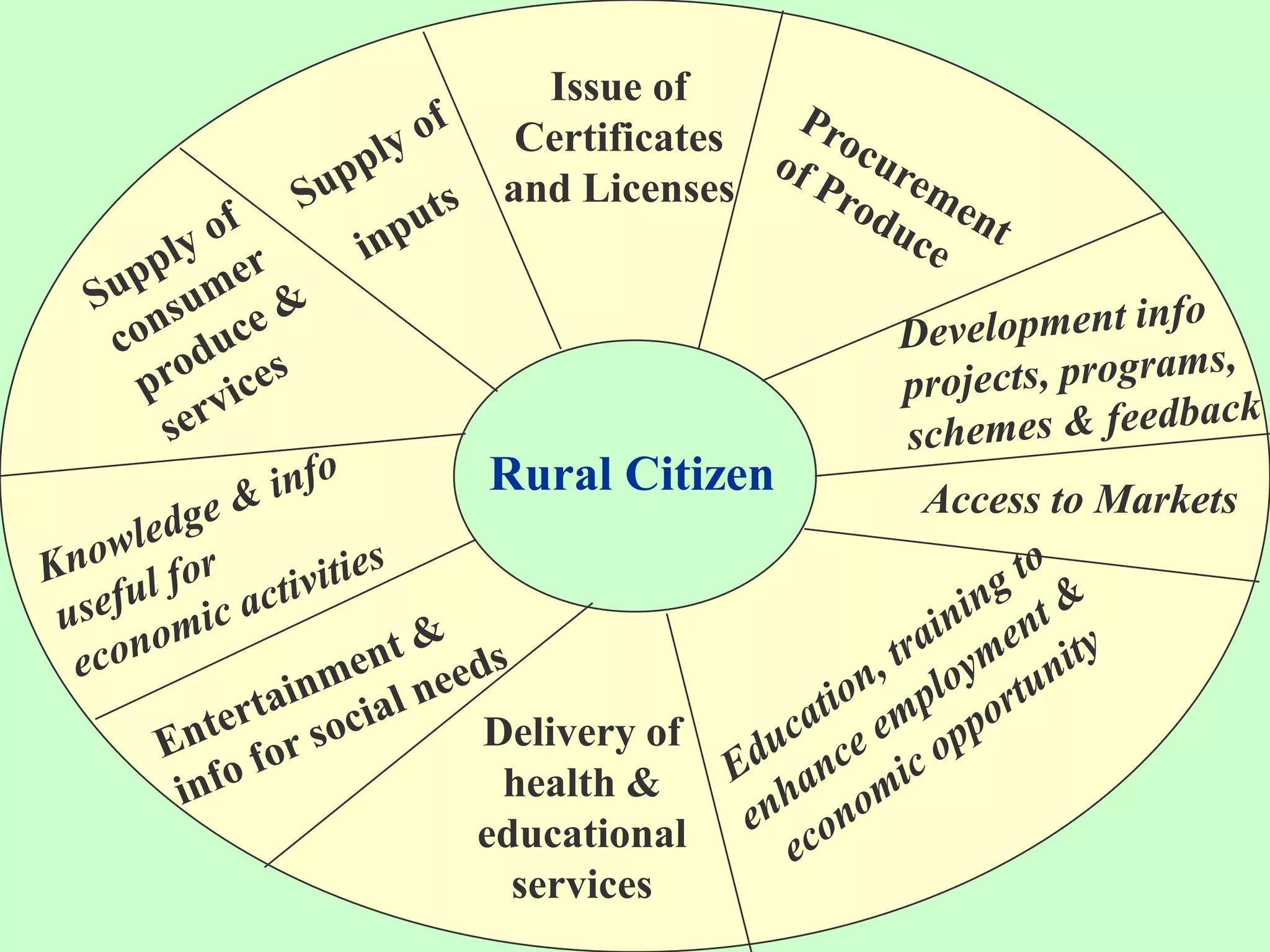
Issue of Certificates and LicensesSupply ofinputsProcurement of ProduceSupply of consumer produce & servicesDevelopment info projects, programs, schemes & feedbackRural CitizenAccess to MarketsKnowledge & info useful for economic activitiesEducation, training to enhance employment & economic opportunityEntertainment & info for social needsDelivery of health & educational services
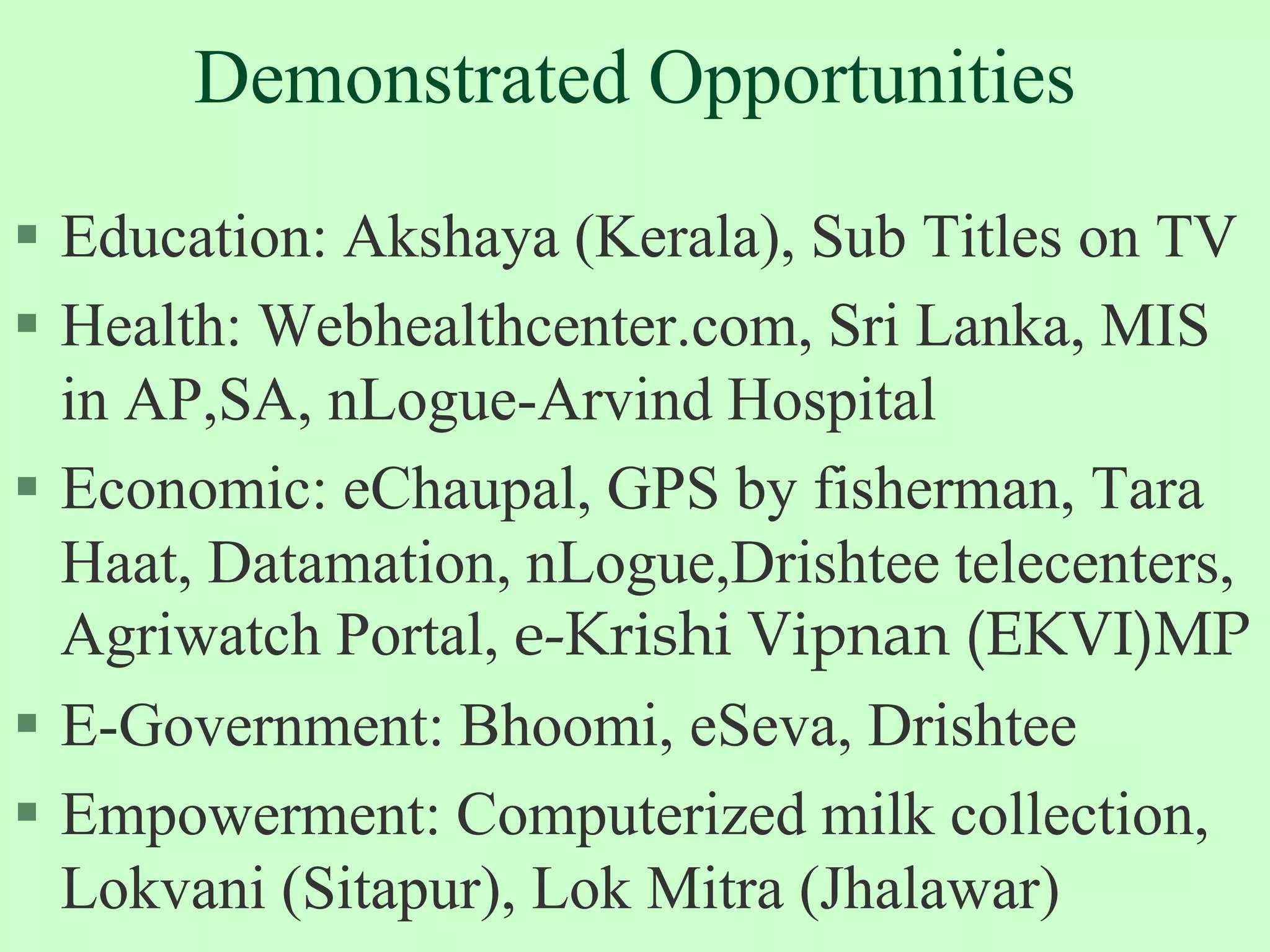
Demonstrated Opportunities  Education: Akshaya (Kerala), Sub Titles on TVHealth: Webhealthcenter.com, Sri Lanka, MIS in AP,SA, nLogue-Arvind HospitalEconomic: eChaupal, GPS by fisherman, Tara Haat, Datamation, nLogue,Drishtee telecenters, Agriwatch Portal, e-Krishi Vipnan (EKVI)MPE-Government: Bhoomi, eSeva, DrishteeEmpowerment: Computerized milk collection, Lokvani (Sitapur), Lok Mitra (Jhalawar)
Learning from PilotsPilot projects by NGOs, Government, cooperatives, private sector, and individual entrepreneurs. About 10,000 villages have telecenters or computers being used for processing transactions.
Large number of experiments but few have scaled up
Most pilots have narrow objectives; are not multi function; attract few users and are often not viable.
Community centers run by volunteers/ individuals have not been scaled up.
Rural population willing to pay for true value addition
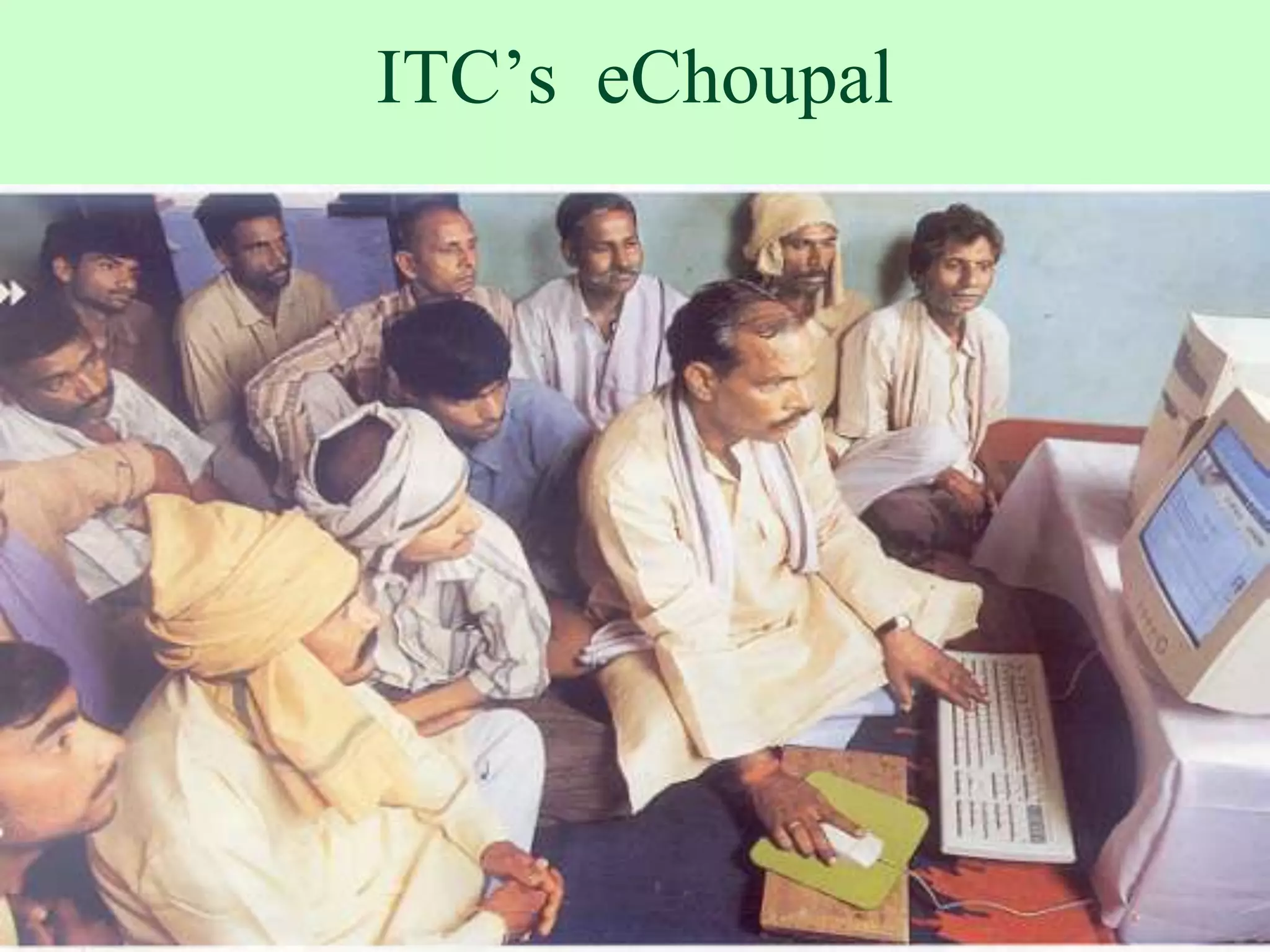
The services that are of value vary with regions and patterns of economic activity in the rural area.ITC’s  eChoupal , February 26-27, 2004
 eChoupal Infrastructure and ServicesInternet kiosk in the house of a trained farmer (Sanchalak) within walking distance of target farmersWarehousing hub managed by the erstwhile middleman,  within tractorable distance of target farmersCustomised knowledge on farm and risk managementBetter supply chain for ITC for farm inputs --lower transaction costs, better value through traceabilityRelevant real-time information results in higher incomeCommodity prices, local weather, news, customized knowledge despite heterogeneity, reduced transaction costsDirect marketing channel for farm produceScreened for quality, demand aggregation for competitive prices and efficient logistics
eChoupal Scale, Scope and Plans  3,500 eChoupals in 5 states of India covering 21,000 villages, servicing 2.0 million farmers, sourcing a range of agri commodities (oilseeds, grains, coffee, aquaculture)Marketing a variety of goods and services (agri-inputs, consumer goods, insurance, market research)2003-04 transactions US$ 100 millionPlan for 20,000 Choupals in 15 states covering 100,000 villages, servicing 25 million farmers by 2010 with projected transactions of US$ 2.5 billionHigher incomes through-better yields and pricesPower of scale to the small farmer
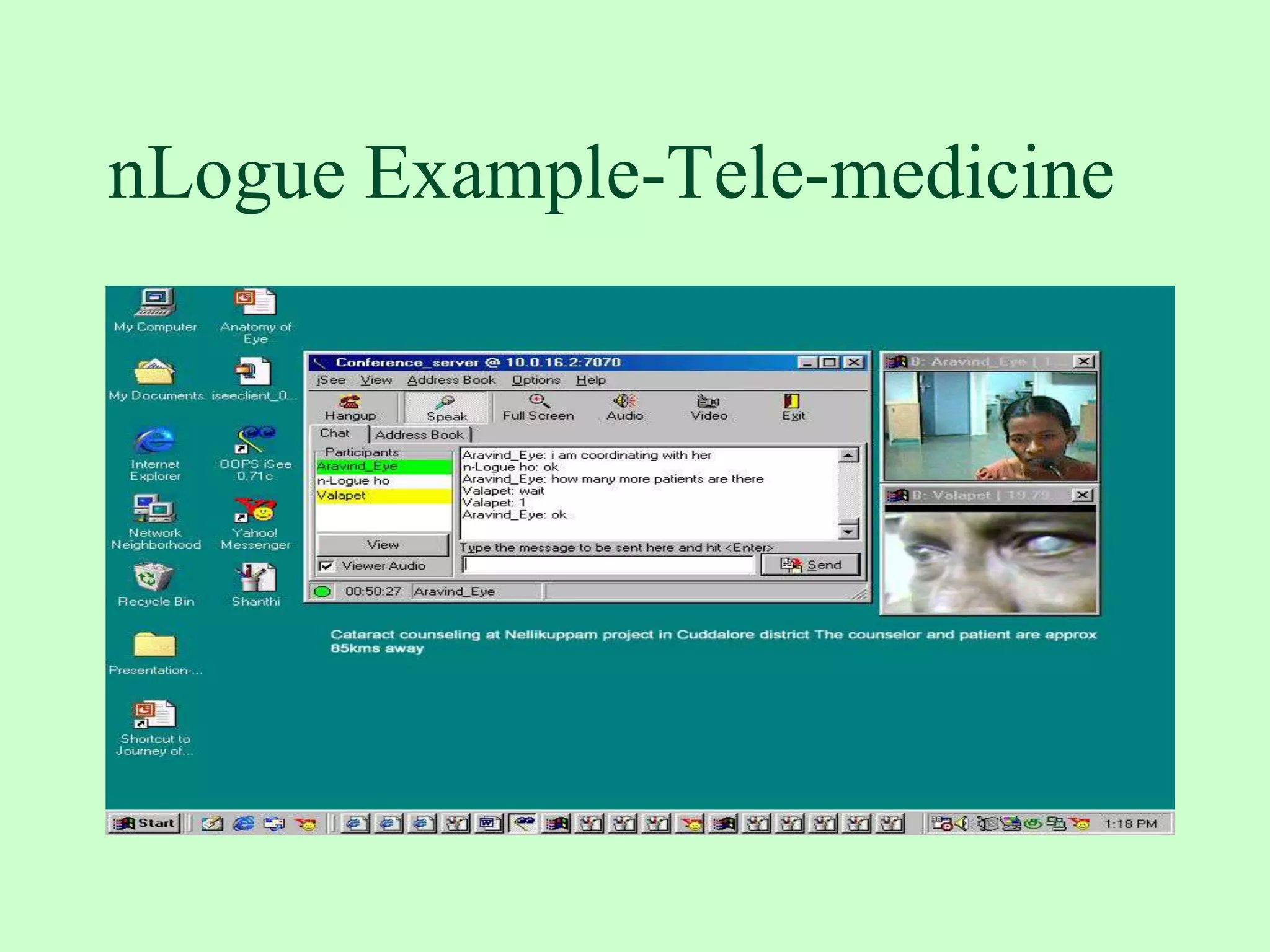
nLogue Example-Tele-medicine
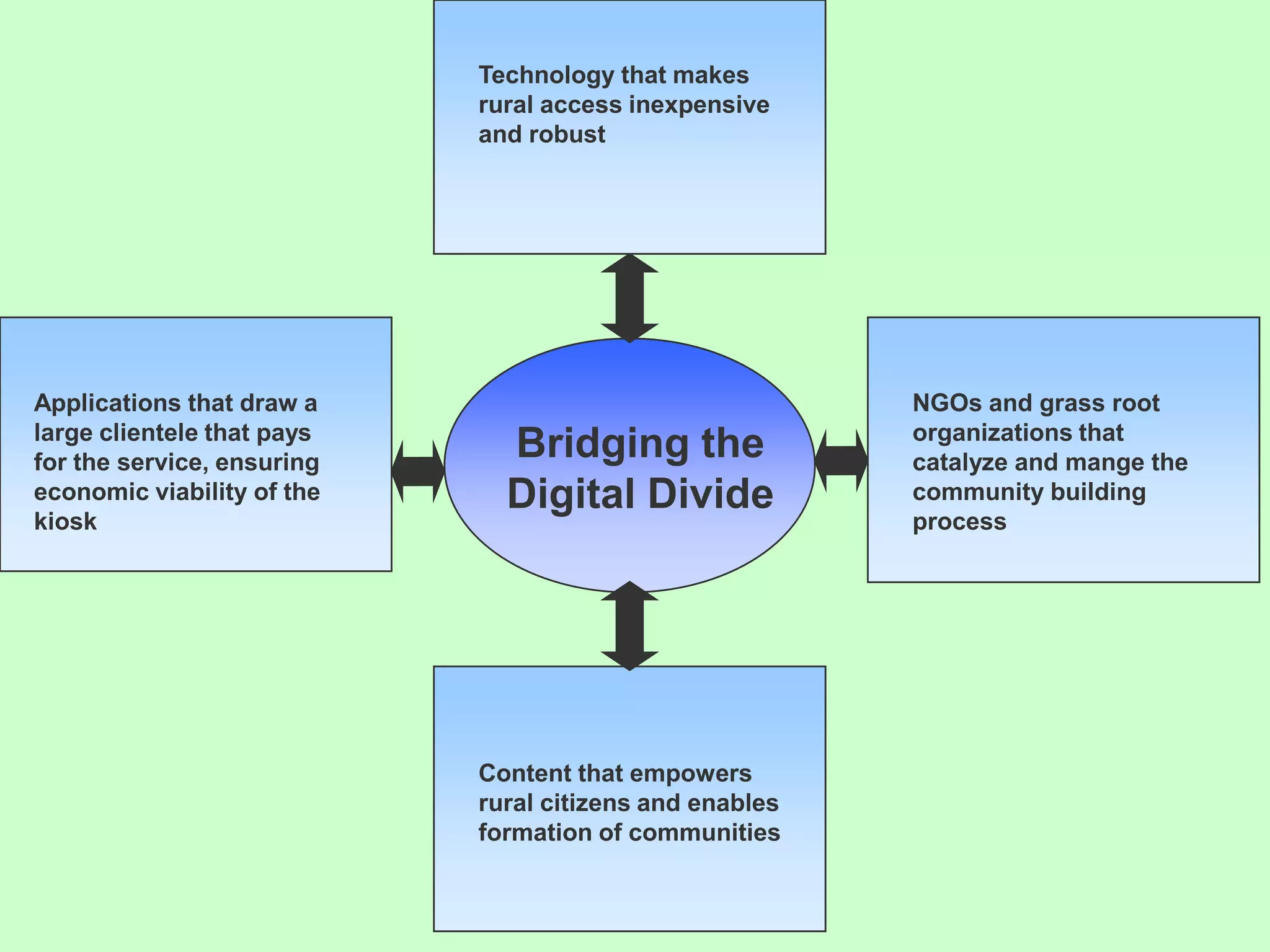
Technology that makes rural access inexpensive and robustNGOs and grass root organizations that catalyze and mange the community building processApplications that draw a large clientele that pays for the service, ensuring economic viability of the kioskBridging the Digital DivideContent that empowers rural citizens and enables formation of communities
Innovations and Creativity: Key to SuccessMaking a market despite many missing linksCreative use of technology in places or for a purpose not originally intended.Organizational design- coming together of partners with specific value proposition, incentives and rules to cooperate.Combining emerging and traditional technologies to overcome constraintsAdapting business models to local contextsRole of network orhestrators
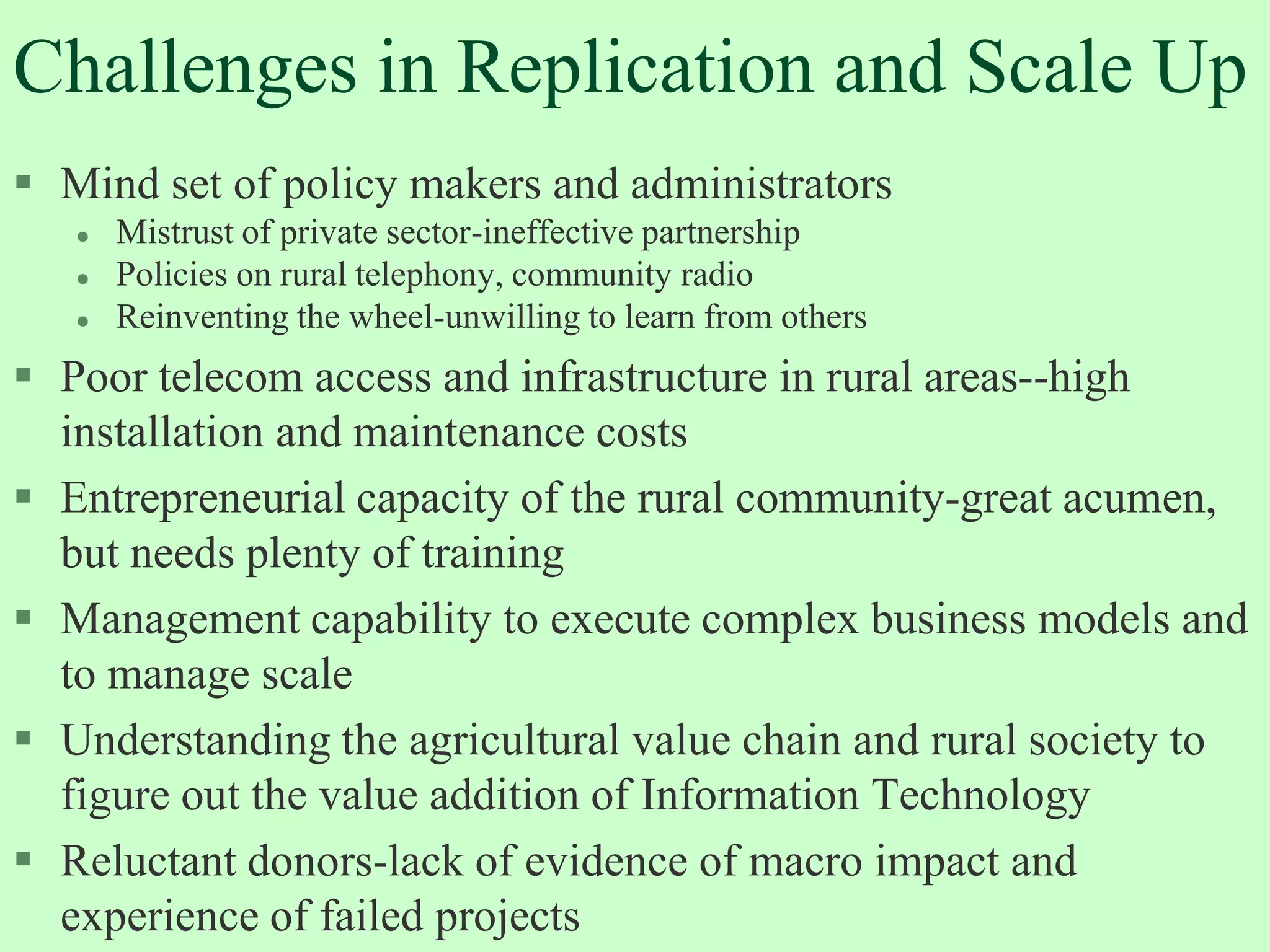
Challenges in Replication and Scale UpMind set of policy makers and administratorsMistrust of private sector-ineffective partnershipPolicies on rural telephony, community radioReinventing the wheel-unwilling to learn from othersPoor telecom access and infrastructure in rural areas--high installation and maintenance costsEntrepreneurial capacity of the rural community-great acumen, but needs plenty of training Management capability to execute complex business models and to manage scaleUnderstanding the agricultural value chain and rural society to figure out the value addition of Information TechnologyReluctant donors-lack of evidence of macro impact and experience of failed projects
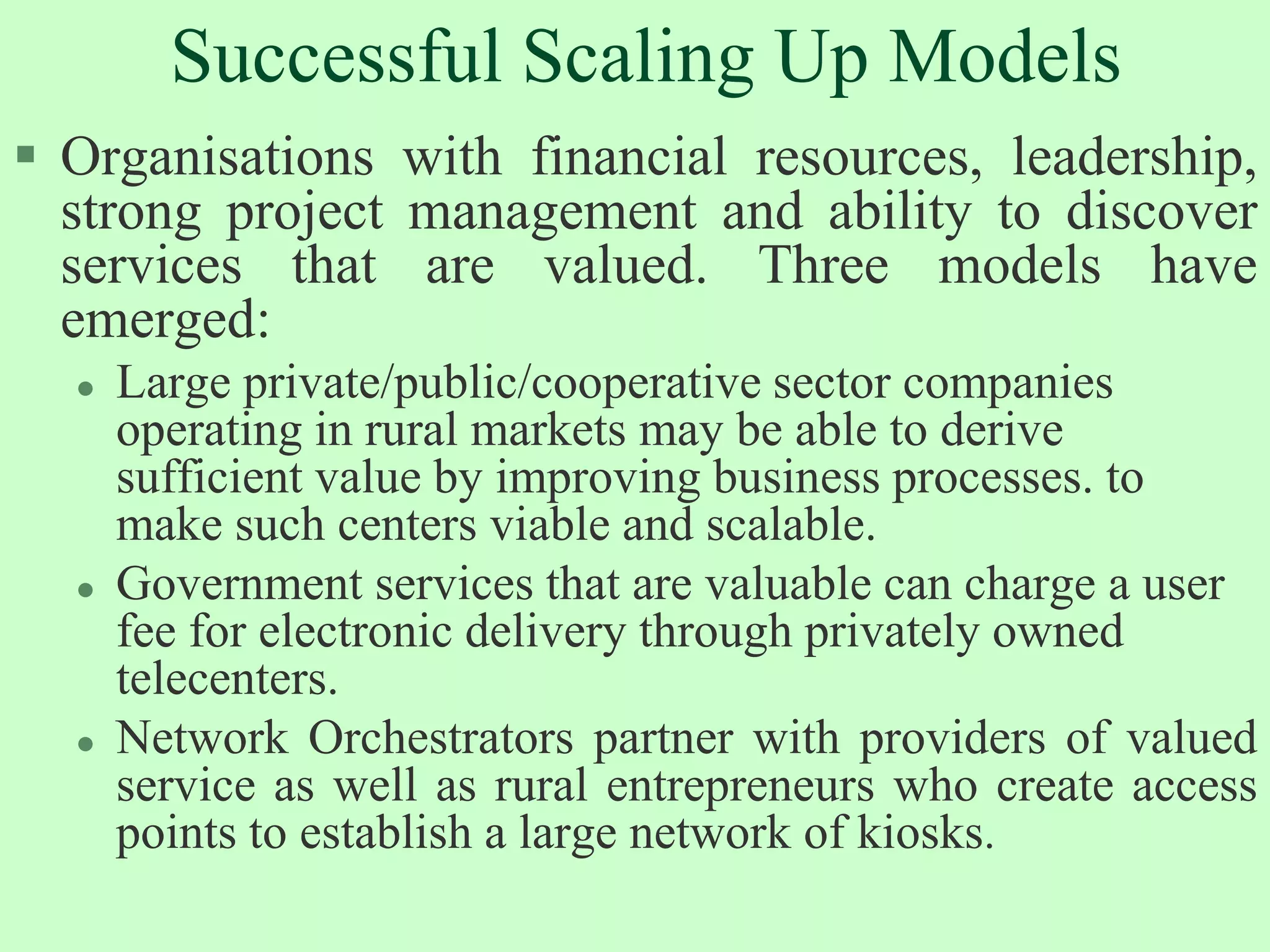
Successful Scaling Up ModelsOrganisations with financial resources, leadership, strong project management and ability to discover services that are valued. Three models have emerged:Large private/public/cooperative sector companies operating in rural markets may be able to derive sufficient value by improving business processes. to make such centers viable and scalable.Government services that are valuable can charge a user fee for electronic delivery through privately owned  telecenters.Network Orchestrators partner with providers of valued service as well as rural entrepreneurs who create access points to establish a large network of kiosks.

Ajitesh

  • 1.
    ICT Use inRural India: Opportunities and ChallengesDepartment of rural managementBBAU, Lucknow.Ajitesh Kumar Tiwari
  • 2.
    Presentation OutlineICT anddevelopment potentialDemonstrated opportunities from pilotsLearning from successful cases Challenges in scaling up, replicationKey role for creativity and innovation
  • 3.
    Issue of Certificatesand LicensesSupply ofinputsProcurement of ProduceSupply of consumer produce & servicesDevelopment info projects, programs, schemes & feedbackRural CitizenAccess to MarketsKnowledge & info useful for economic activitiesEducation, training to enhance employment & economic opportunityEntertainment & info for social needsDelivery of health & educational services
  • 4.
    Demonstrated Opportunities Education: Akshaya (Kerala), Sub Titles on TVHealth: Webhealthcenter.com, Sri Lanka, MIS in AP,SA, nLogue-Arvind HospitalEconomic: eChaupal, GPS by fisherman, Tara Haat, Datamation, nLogue,Drishtee telecenters, Agriwatch Portal, e-Krishi Vipnan (EKVI)MPE-Government: Bhoomi, eSeva, DrishteeEmpowerment: Computerized milk collection, Lokvani (Sitapur), Lok Mitra (Jhalawar)
  • 6.
    Learning from PilotsPilotprojects by NGOs, Government, cooperatives, private sector, and individual entrepreneurs. About 10,000 villages have telecenters or computers being used for processing transactions.
  • 7.
    Large number ofexperiments but few have scaled up
  • 8.
    Most pilots havenarrow objectives; are not multi function; attract few users and are often not viable.
  • 9.
    Community centers runby volunteers/ individuals have not been scaled up.
  • 10.
    Rural population willingto pay for true value addition
  • 11.
    The services thatare of value vary with regions and patterns of economic activity in the rural area.ITC’s eChoupal , February 26-27, 2004
  • 12.
    eChoupal Infrastructureand ServicesInternet kiosk in the house of a trained farmer (Sanchalak) within walking distance of target farmersWarehousing hub managed by the erstwhile middleman, within tractorable distance of target farmersCustomised knowledge on farm and risk managementBetter supply chain for ITC for farm inputs --lower transaction costs, better value through traceabilityRelevant real-time information results in higher incomeCommodity prices, local weather, news, customized knowledge despite heterogeneity, reduced transaction costsDirect marketing channel for farm produceScreened for quality, demand aggregation for competitive prices and efficient logistics
  • 13.
    eChoupal Scale, Scopeand Plans 3,500 eChoupals in 5 states of India covering 21,000 villages, servicing 2.0 million farmers, sourcing a range of agri commodities (oilseeds, grains, coffee, aquaculture)Marketing a variety of goods and services (agri-inputs, consumer goods, insurance, market research)2003-04 transactions US$ 100 millionPlan for 20,000 Choupals in 15 states covering 100,000 villages, servicing 25 million farmers by 2010 with projected transactions of US$ 2.5 billionHigher incomes through-better yields and pricesPower of scale to the small farmer
  • 14.
  • 15.
    Technology that makesrural access inexpensive and robustNGOs and grass root organizations that catalyze and mange the community building processApplications that draw a large clientele that pays for the service, ensuring economic viability of the kioskBridging the Digital DivideContent that empowers rural citizens and enables formation of communities
  • 16.
    Innovations and Creativity:Key to SuccessMaking a market despite many missing linksCreative use of technology in places or for a purpose not originally intended.Organizational design- coming together of partners with specific value proposition, incentives and rules to cooperate.Combining emerging and traditional technologies to overcome constraintsAdapting business models to local contextsRole of network orhestrators
  • 17.
    Challenges in Replicationand Scale UpMind set of policy makers and administratorsMistrust of private sector-ineffective partnershipPolicies on rural telephony, community radioReinventing the wheel-unwilling to learn from othersPoor telecom access and infrastructure in rural areas--high installation and maintenance costsEntrepreneurial capacity of the rural community-great acumen, but needs plenty of training Management capability to execute complex business models and to manage scaleUnderstanding the agricultural value chain and rural society to figure out the value addition of Information TechnologyReluctant donors-lack of evidence of macro impact and experience of failed projects
  • 18.
    Successful Scaling UpModelsOrganisations with financial resources, leadership, strong project management and ability to discover services that are valued. Three models have emerged:Large private/public/cooperative sector companies operating in rural markets may be able to derive sufficient value by improving business processes. to make such centers viable and scalable.Government services that are valuable can charge a user fee for electronic delivery through privately owned telecenters.Network Orchestrators partner with providers of valued service as well as rural entrepreneurs who create access points to establish a large network of kiosks.
  • 19.
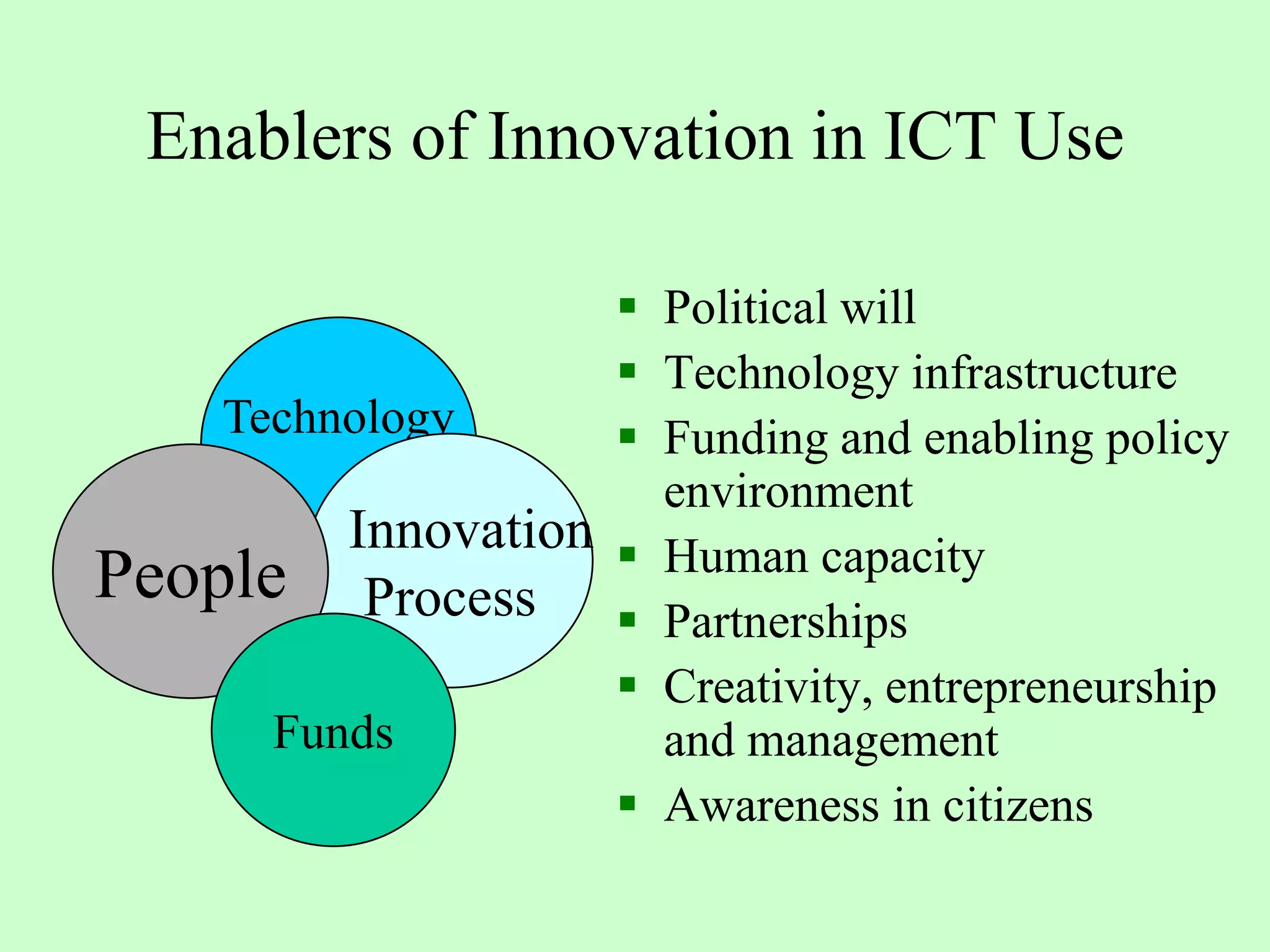
    Enablers of Innovationin ICT UsePolitical will Technology infrastructureFunding and enabling policy environmentHuman capacityPartnershipsCreativity, entrepreneurship and managementAwareness in citizensTechnology InnovationProcessPeopleFunds
  • 20.
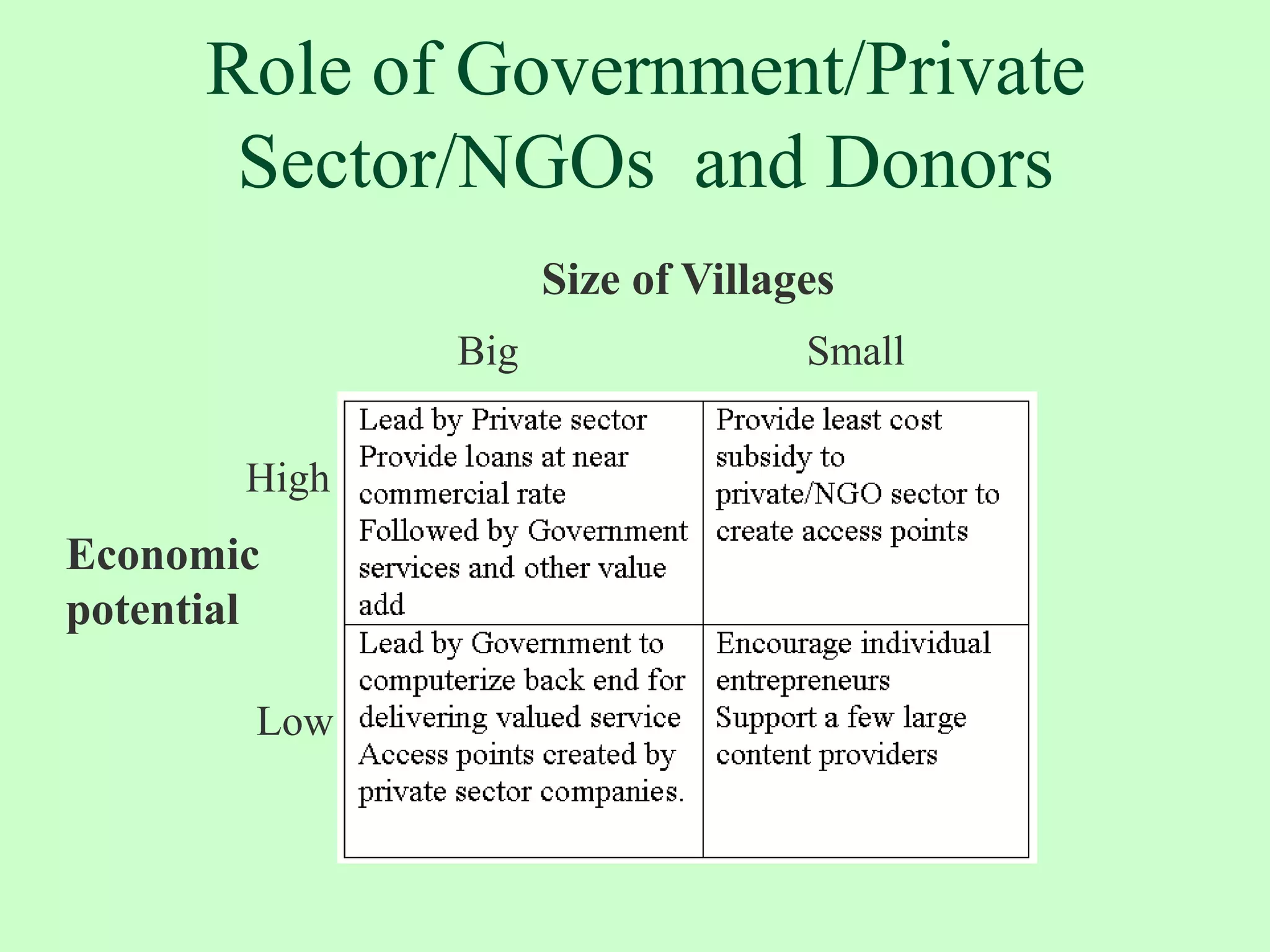
    Role of Government/PrivateSector/NGOs and DonorsSize of VillagesBigSmallHighEconomic potentialLow
  • 21.
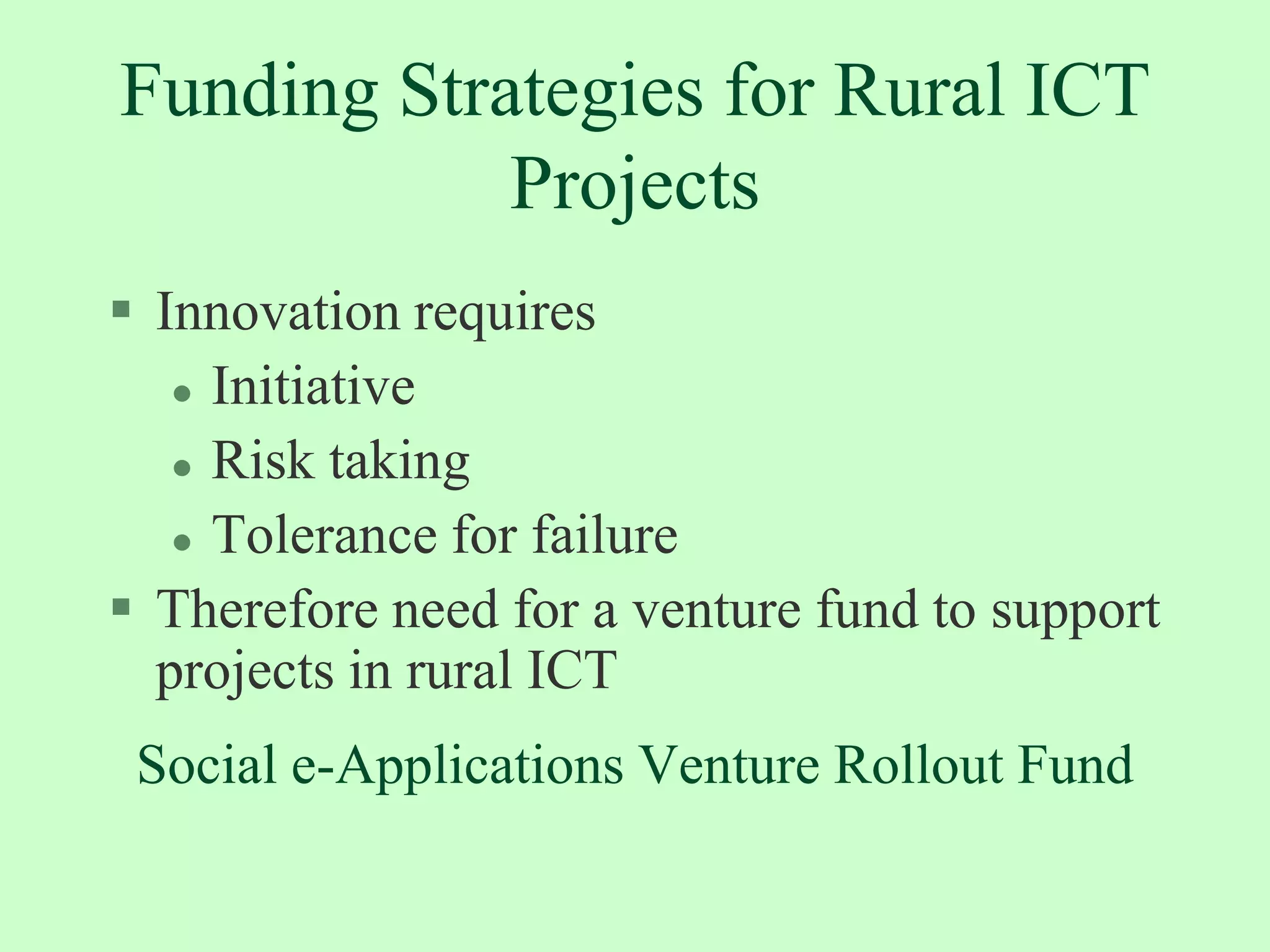
    Funding Strategies forRural ICT ProjectsInnovation requiresInitiativeRisk takingTolerance for failureTherefore need for a venture fund to support projects in rural ICTSocial e-Applications Venture Rollout Fund
  • 22.