28 April 2014
How ICTs can make
a difference to
Livelihoods
ICTS FOR DEVELOPMENT
PROGRAMMING
Page 3
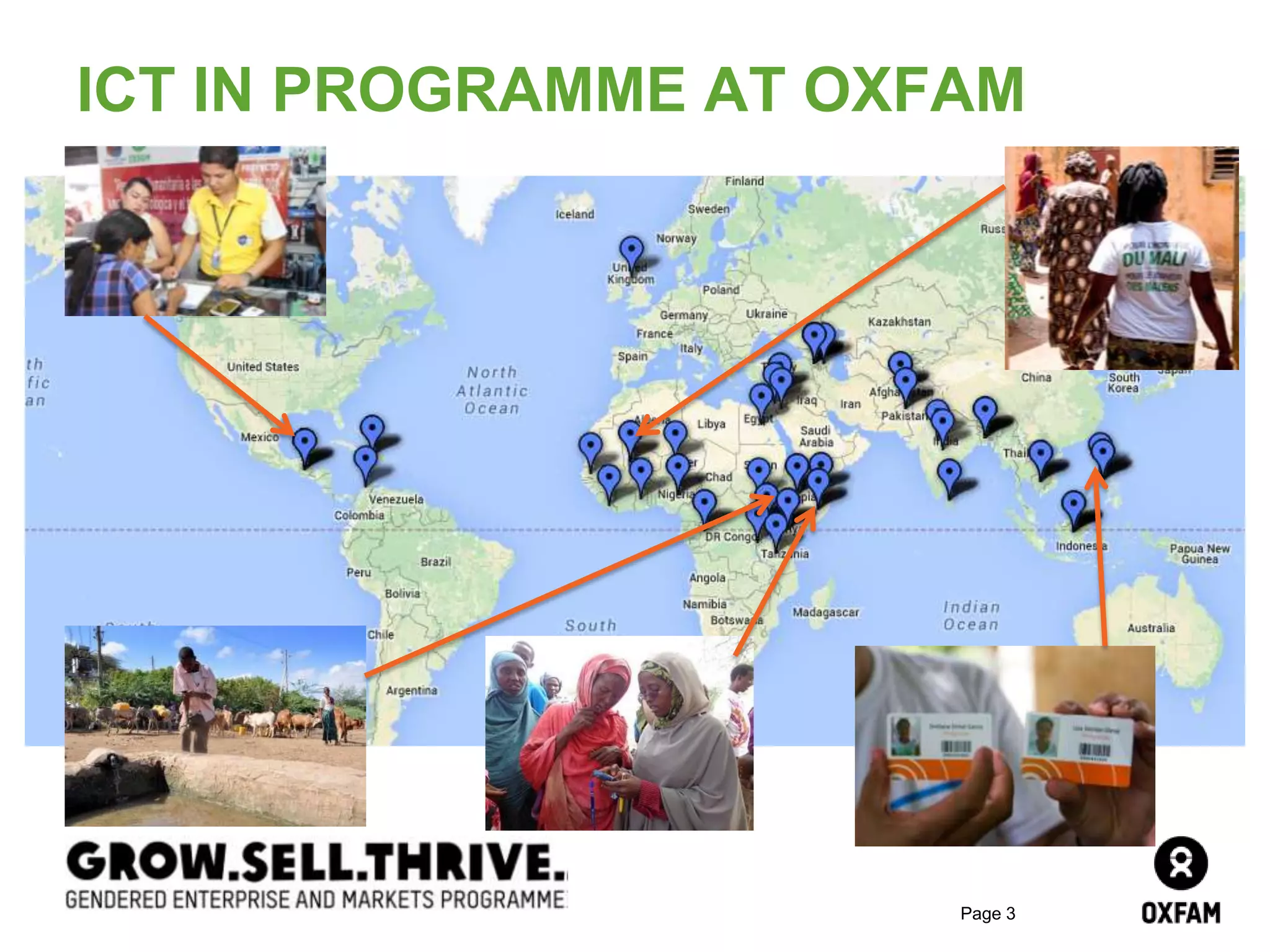
ICT IN PROGRAMME AT OXFAM
Page 4
KEY PRINCIPLES FOR SUCCESS
• Consider ICT as an enabler
• Embed ICTs in existing process
• Context appropriate solutions
• Build on existing solutions (where possible)
• Sustainability
• Women’s rights at the heart
• Listen to stakeholders
Page 5
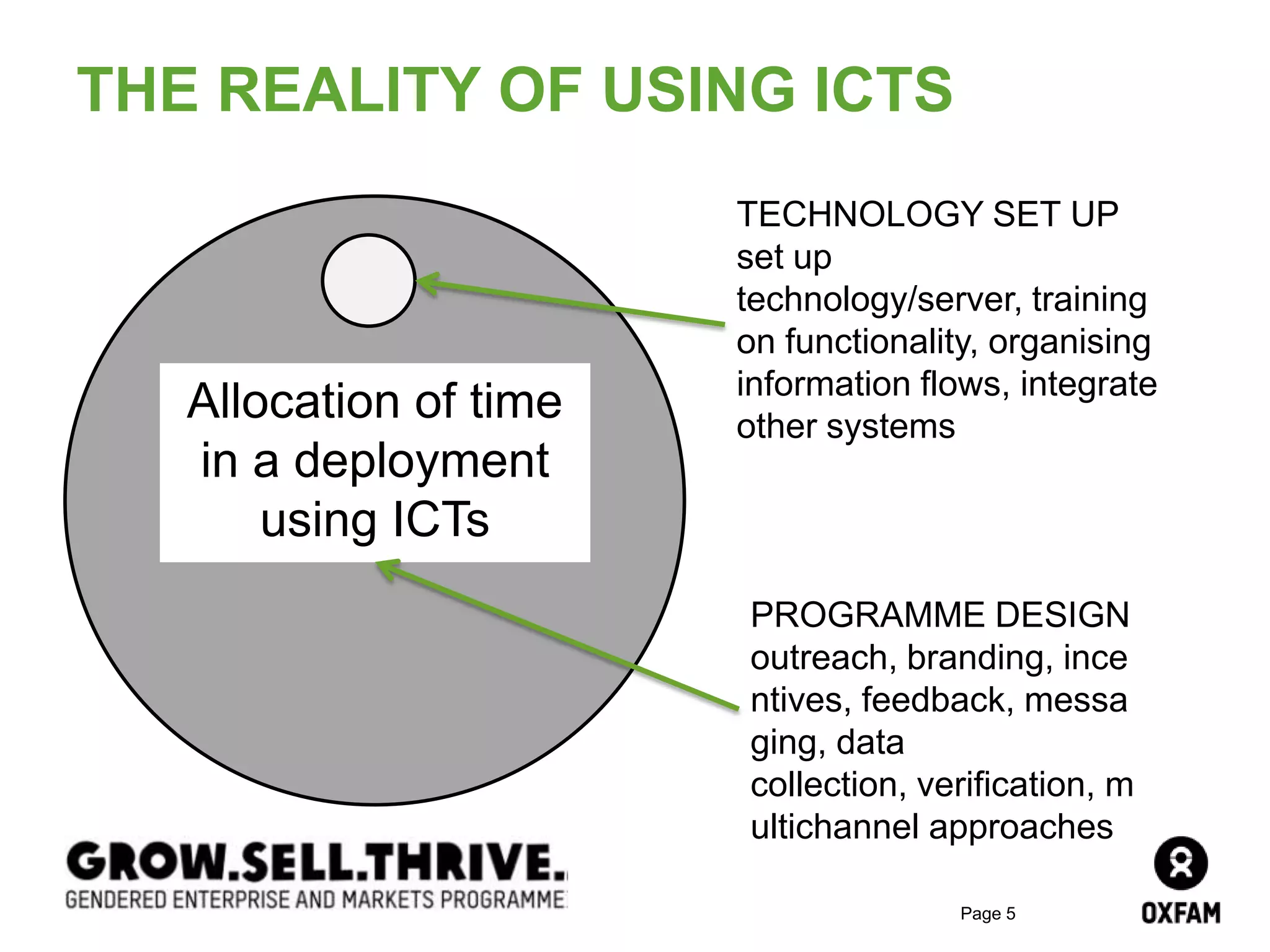
THE REALITY OF USING ICTS
En un despliegue usando lo
digital
Allocation of time
in a deployment
using ICTs
TECHNOLOGY SET UP
set up
technology/server, training
on functionality, organising
information flows, integrate
other systems
PROGRAMME DESIGN
outreach, branding, ince
ntives, feedback, messa
ging, data
collection, verification, m
ultichannel approaches
ICTS IN LIVELIHOODS PROGRAMMING
http://growsellthrive.org/our-work/ict
Page 7
INTEGRATING ICTS IN OXFAM’S
LIVELIHOODS PROGRAMMES – STEP 1
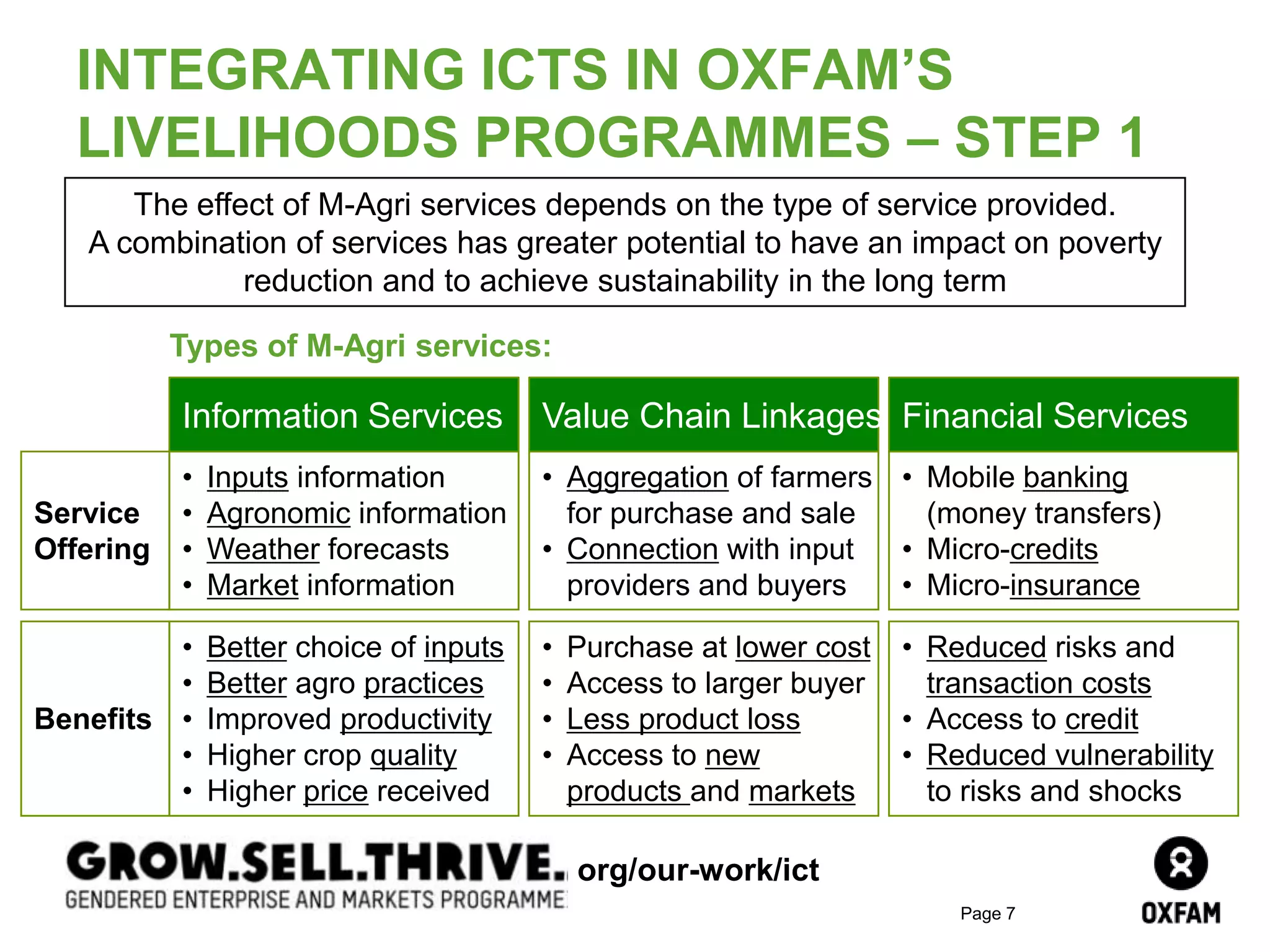
1. Understand the wide range of information and financial services
that can be provided through ICTs for small-holder farmers
Information Services Value Chain Linkages Financial Services
• Inputs information
• Agronomic information
• Weather forecasts
• Market information
• Aggregation of farmers
for purchase and sale
• Connection with input
providers and buyers
• Mobile banking
(money transfers)
• Micro-credits
• Micro-insurance
Service
Offering
• Better choice of inputs
• Better agro practices
• Improved productivity
• Higher crop quality
• Higher price received
• Purchase at lower cost
• Access to larger buyer
• Less product loss
• Access to new
products and markets
• Reduced risks and
transaction costs
• Access to credit
• Reduced vulnerability
to risks and shocks
Benefits
The effect of M-Agri services depends on the type of service provided.
A combination of services has greater potential to have an impact on poverty
reduction and to achieve sustainability in the long term
Types of M-Agri services:
org/our-work/ict
Page 8
INTEGRATING ICTS IN OXFAM’S
LIVELIHOODS PROGRAMMES – STEP 2
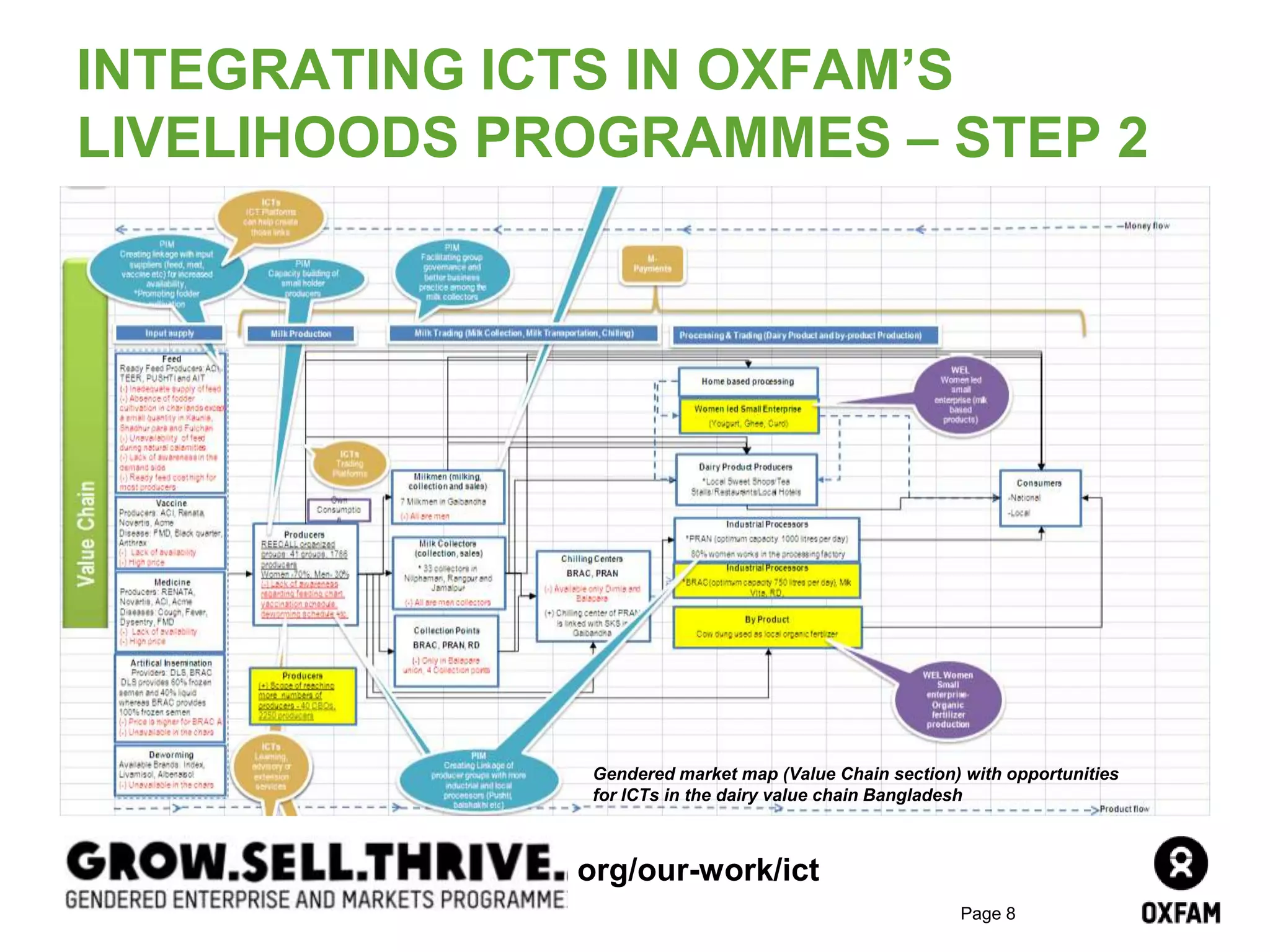
2. Identify concrete activities where ICTs could be used as a delivery
channel and contribute to reduce the operating costs, increase the
outreach and improve the efficiencies of the programme
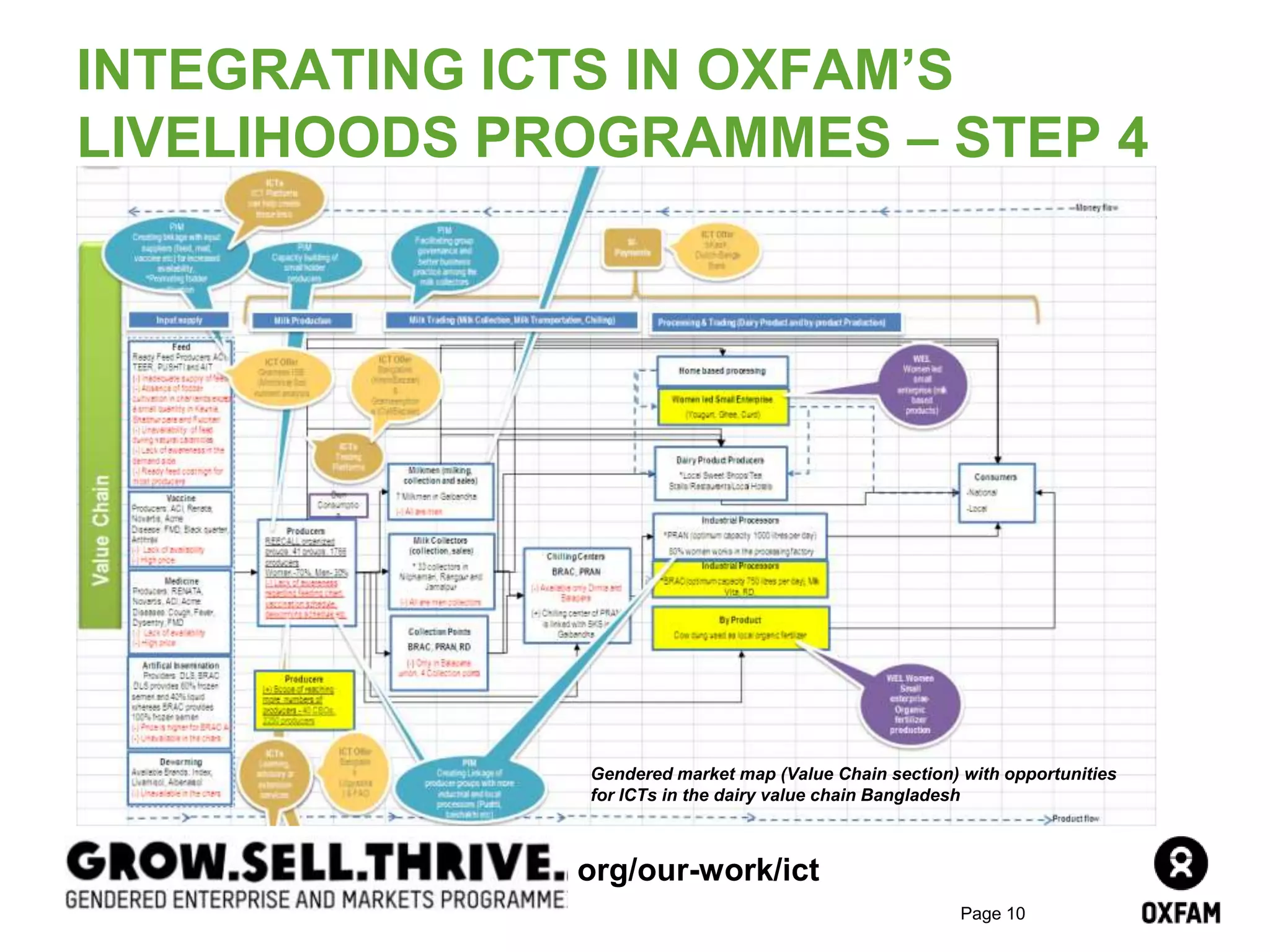
Gendered market map (Value Chain section) with opportunities
for ICTs in the dairy value chain Bangladesh
org/our-work/ict
Page 9
INTEGRATING ICTS IN OXFAM’S
LIVELIHOODS PROGRAMMES – STEP 3
3. Conduct a quick landscape analysis of the enabling environment,
M-Agri and Mobile Money service offering in the country
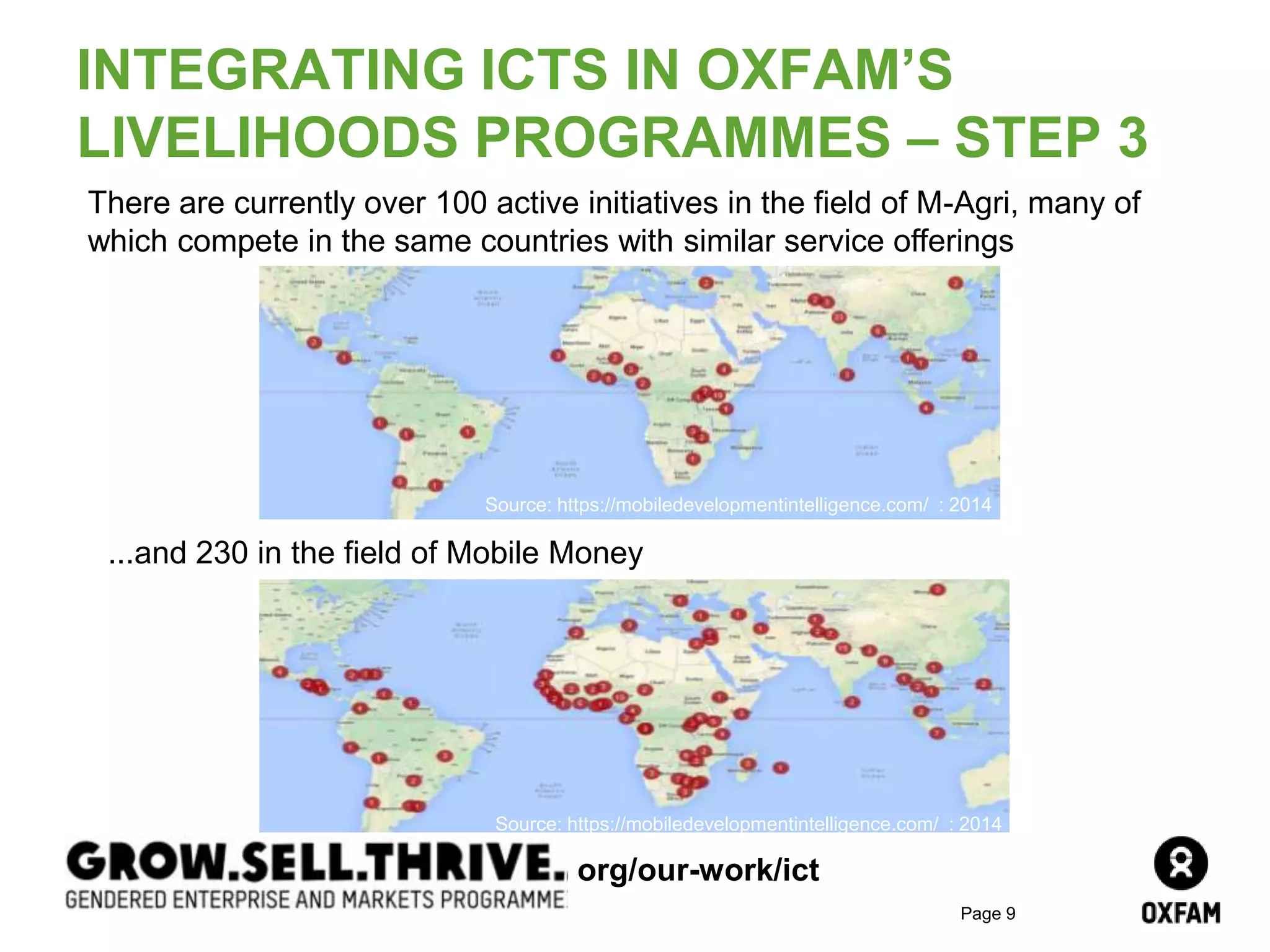
...and 230 in the field of Mobile Money
Source: https://mobiledevelopmentintelligence.com/ : 2014
org/our-work/ict
There are currently over 100 active initiatives in the field of M-Agri, many of
which compete in the same countries with similar service offerings
Source: https://mobiledevelopmentintelligence.com/ : 2014
Page 10
INTEGRATING ICTS IN OXFAM’S
LIVELIHOODS PROGRAMMES – STEP 4
4. Compare the opportunities for using ICTs in the programme (step
2) and the existing ICT service offering in the country (step 3) to
identify potential synergies between both
Gendered market map (Value Chain section) with opportunities
for ICTs in the dairy value chain Bangladesh
org/our-work/ict
Page 11
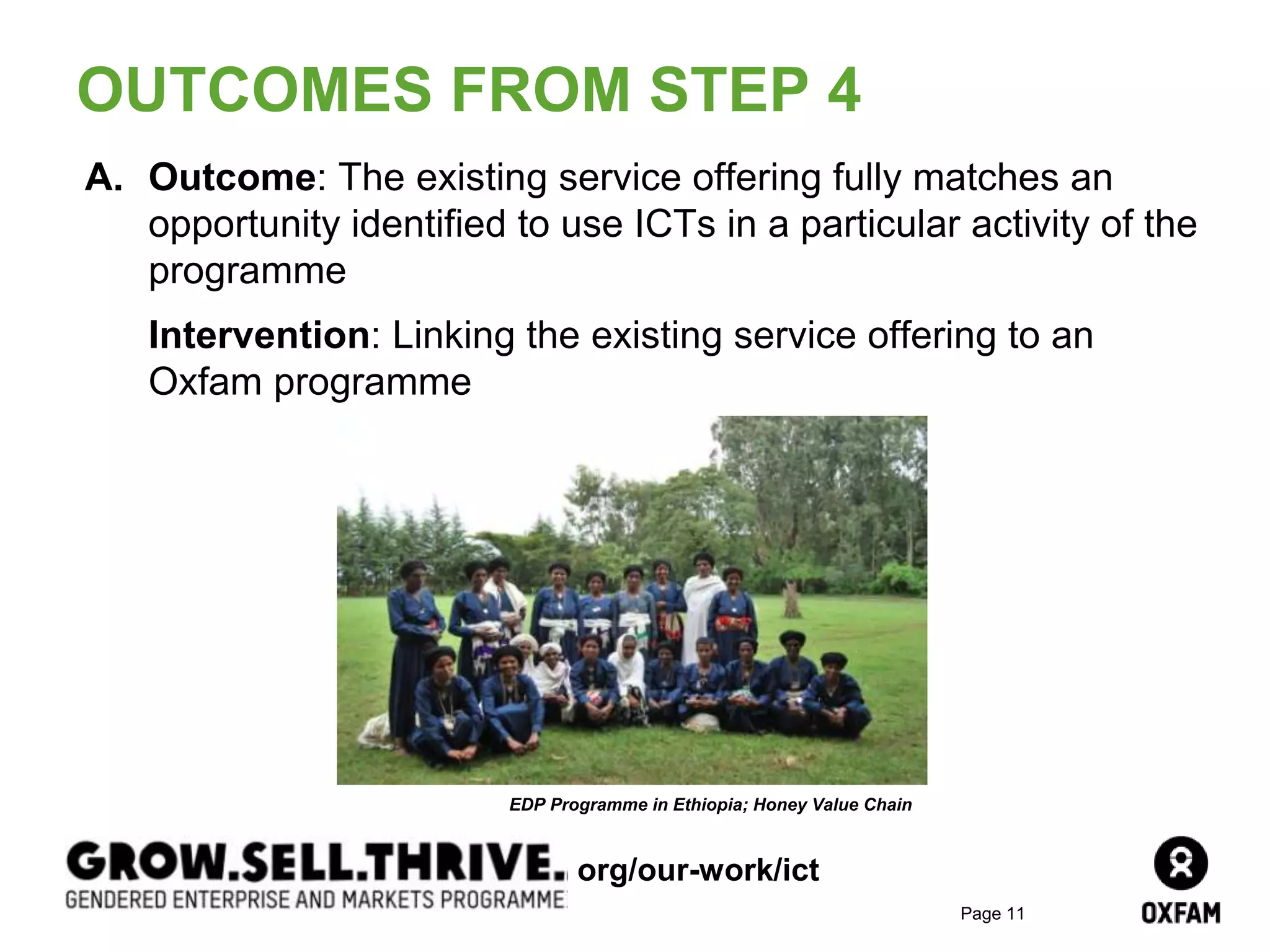
A. Outcome: The existing service offering fully matches an
opportunity identified to use ICTs in a particular activity of the
programme
Intervention: Linking the existing service offering to an
Oxfam programme
OUTCOMES FROM STEP 4
EDP Programme in Ethiopia; Honey Value Chain
org/our-work/ict
Page 12
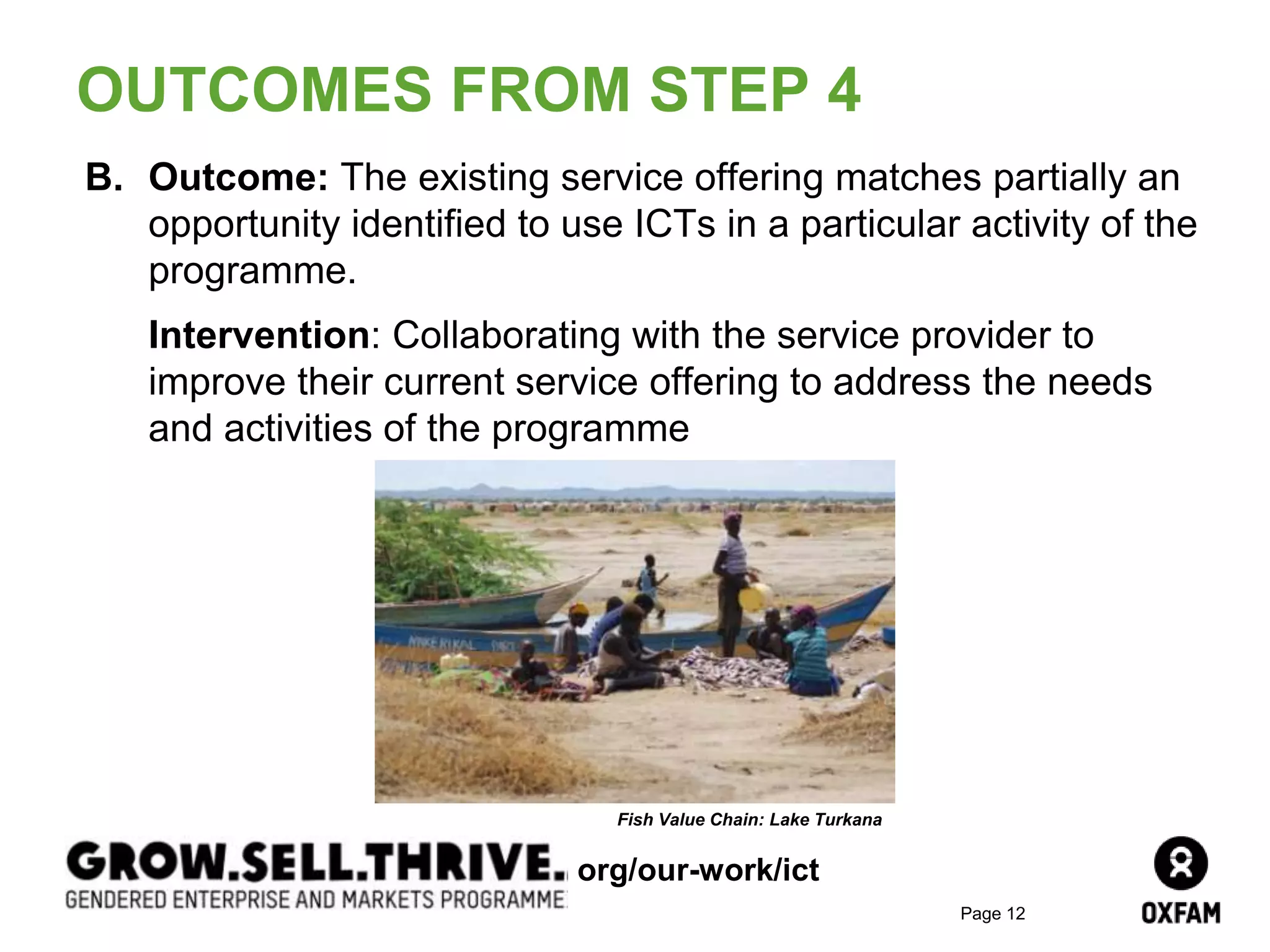
B. Outcome: The existing service offering matches partially an
opportunity identified to use ICTs in a particular activity of the
programme.
Intervention: Collaborating with the service provider to
improve their current service offering to address the needs
and activities of the programme
OUTCOMES FROM STEP 4
Fish Value Chain: Lake Turkana
org/our-work/ict
Page 13
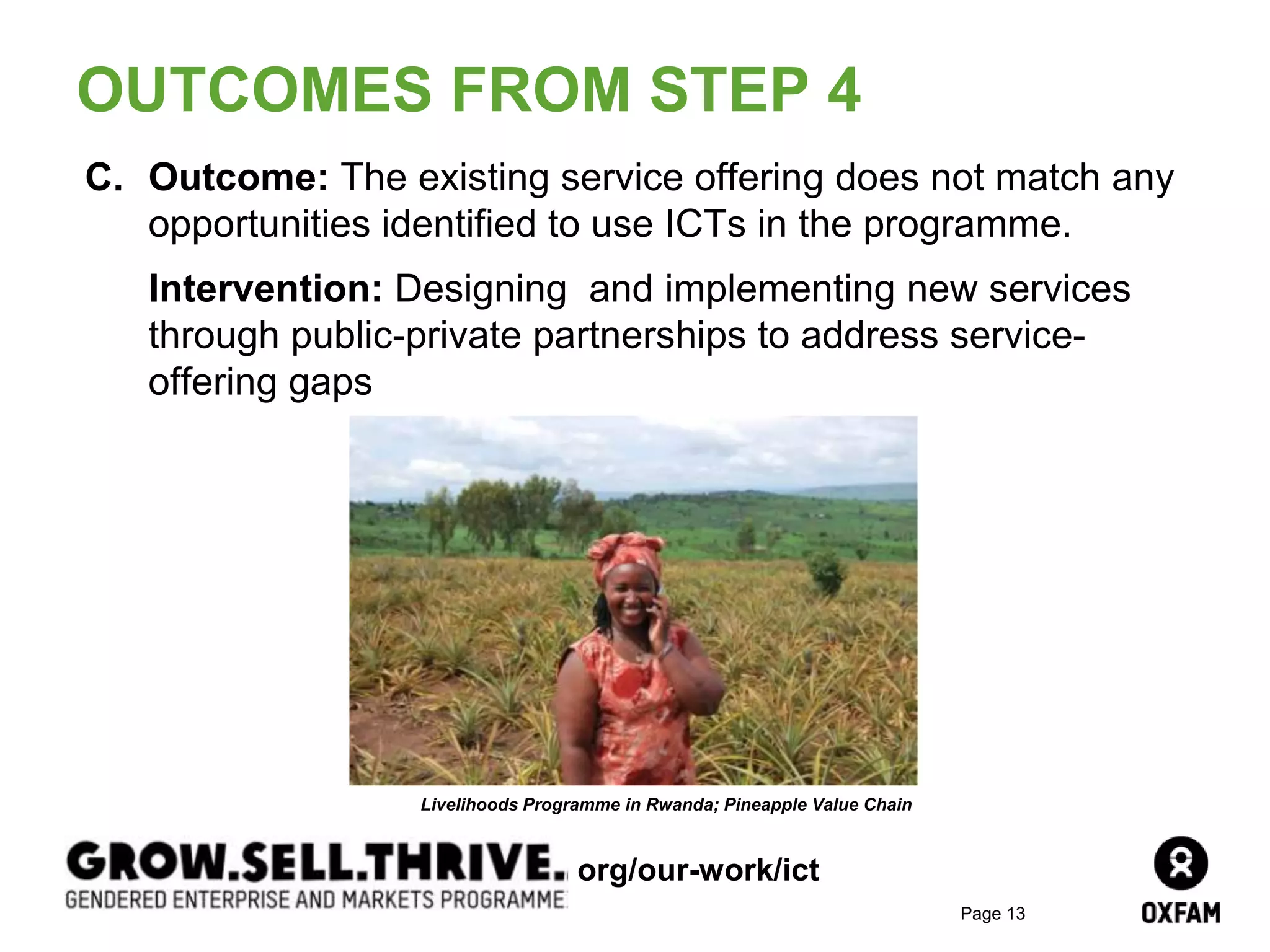
C. Outcome: The existing service offering does not match any
opportunities identified to use ICTs in the programme.
Intervention: Designing and implementing new services
through public-private partnerships to address service-
offering gaps
OUTCOMES FROM STEP 4
Livelihoods Programme in Rwanda; Pineapple Value Chain
org/our-work/ict
Page 14
GENDER APPROACH
Opportunities:
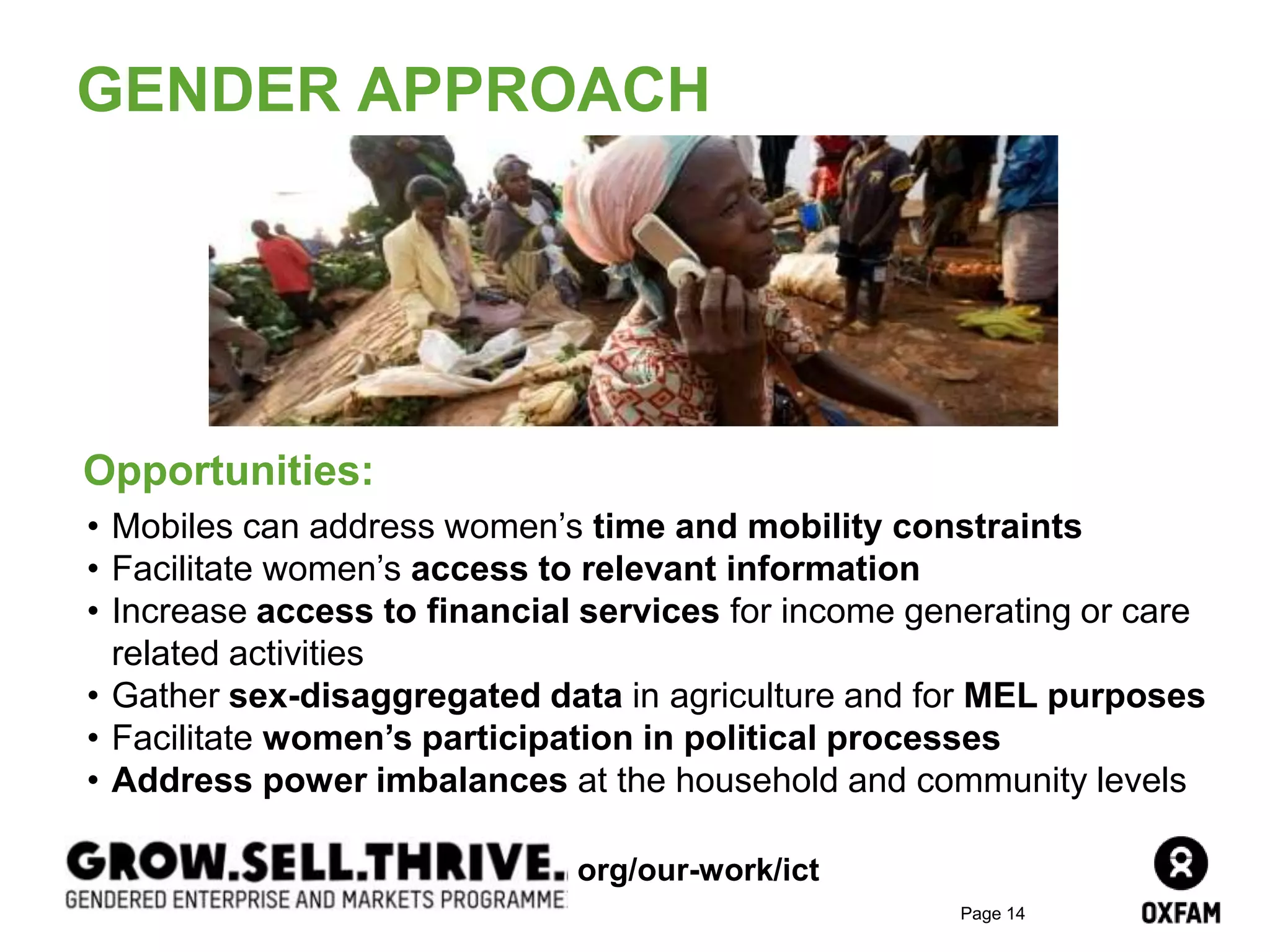
• Mobiles can address women’s time and mobility constraints
• Facilitate women’s access to relevant information
• Increase access to financial services for income generating or care
related activities
• Gather sex-disaggregated data in agriculture and for MEL purposes
• Facilitate women’s participation in political processes
• Address power imbalances at the household and community levels
org/our-work/ict
Page 15
GENDER APPROACH
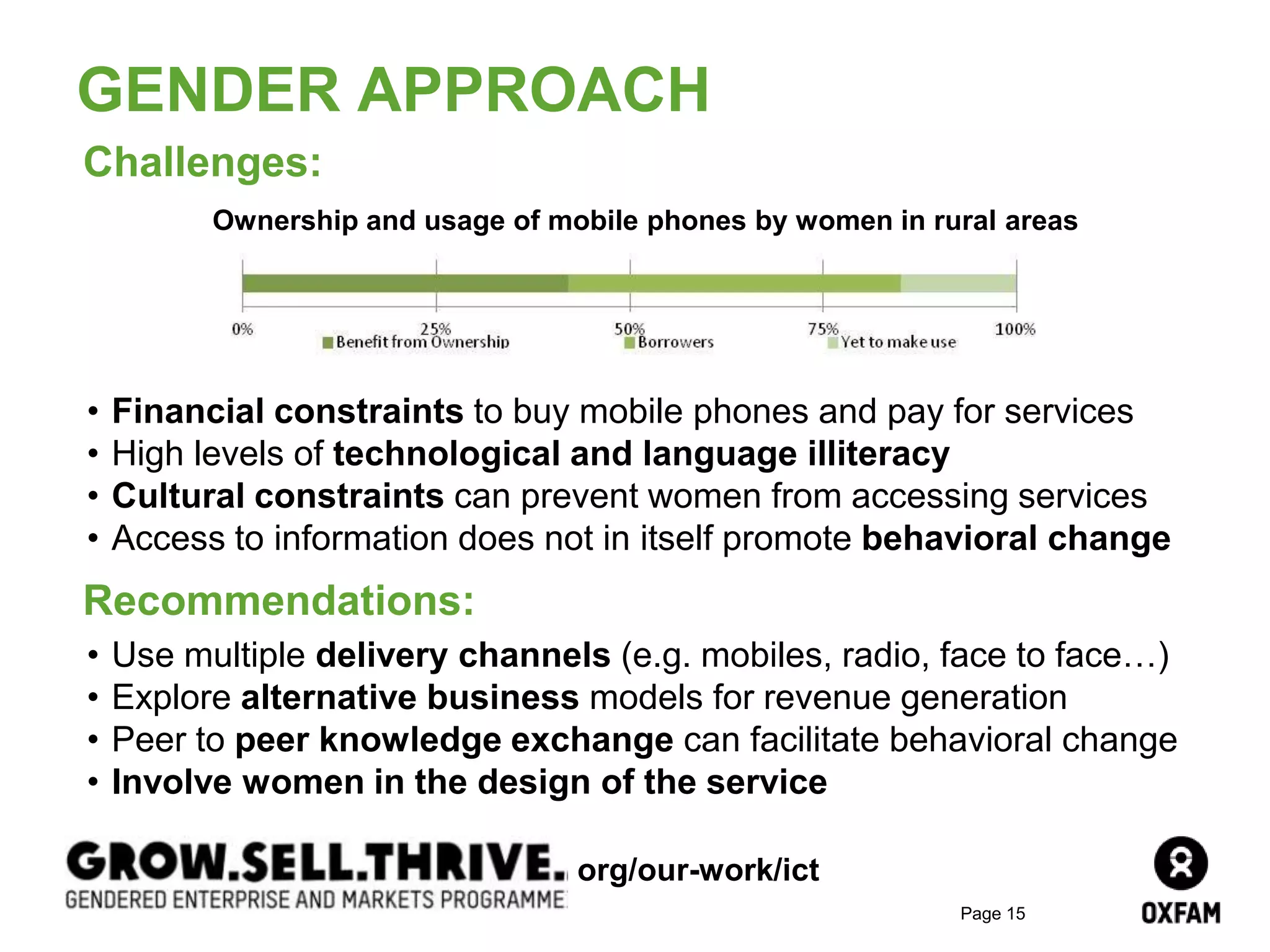
• Financial constraints to buy mobile phones and pay for services
• High levels of technological and language illiteracy
• Cultural constraints can prevent women from accessing services
• Access to information does not in itself promote behavioral change
Challenges:
Ownership and usage of mobile phones by women in rural areas
Recommendations:
• Use multiple delivery channels (e.g. mobiles, radio, face to face…)
• Explore alternative business models for revenue generation
• Peer to peer knowledge exchange can facilitate behavioral change
• Involve women in the design of the service
org/our-work/ict
Page 16
“The world needs a paradigm shift in agricultural development...from
conventional, monoculture-based and high external-input-dependent industrial
production towards mosaics of sustainable, regenerative production systems
that also considerably improve the productivity of small-scale farmers...a
farmer is not only a producer of agricultural goods, but also a manager
of an agro-ecological system that provides quite a number of public
goods and services (e.g. water, soil, landscape, energy, biodiversity and
recreation).”
UNCTAD: 2013, “Trade and environment review 2013”
RESEARCH AND INFLUENCING
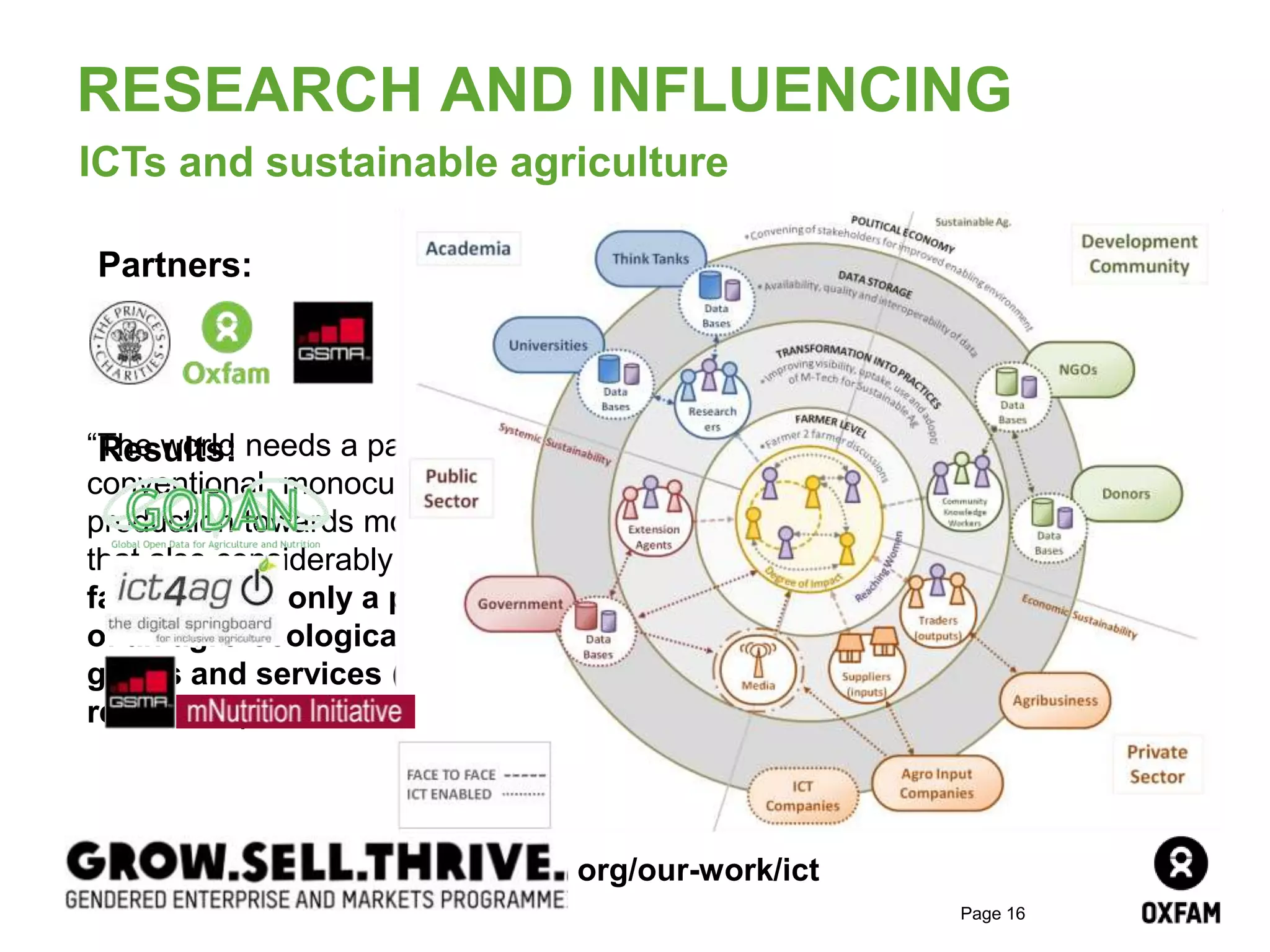
ICTs and sustainable agriculture
Partners:
Results:
org/our-work/ict
Page 17
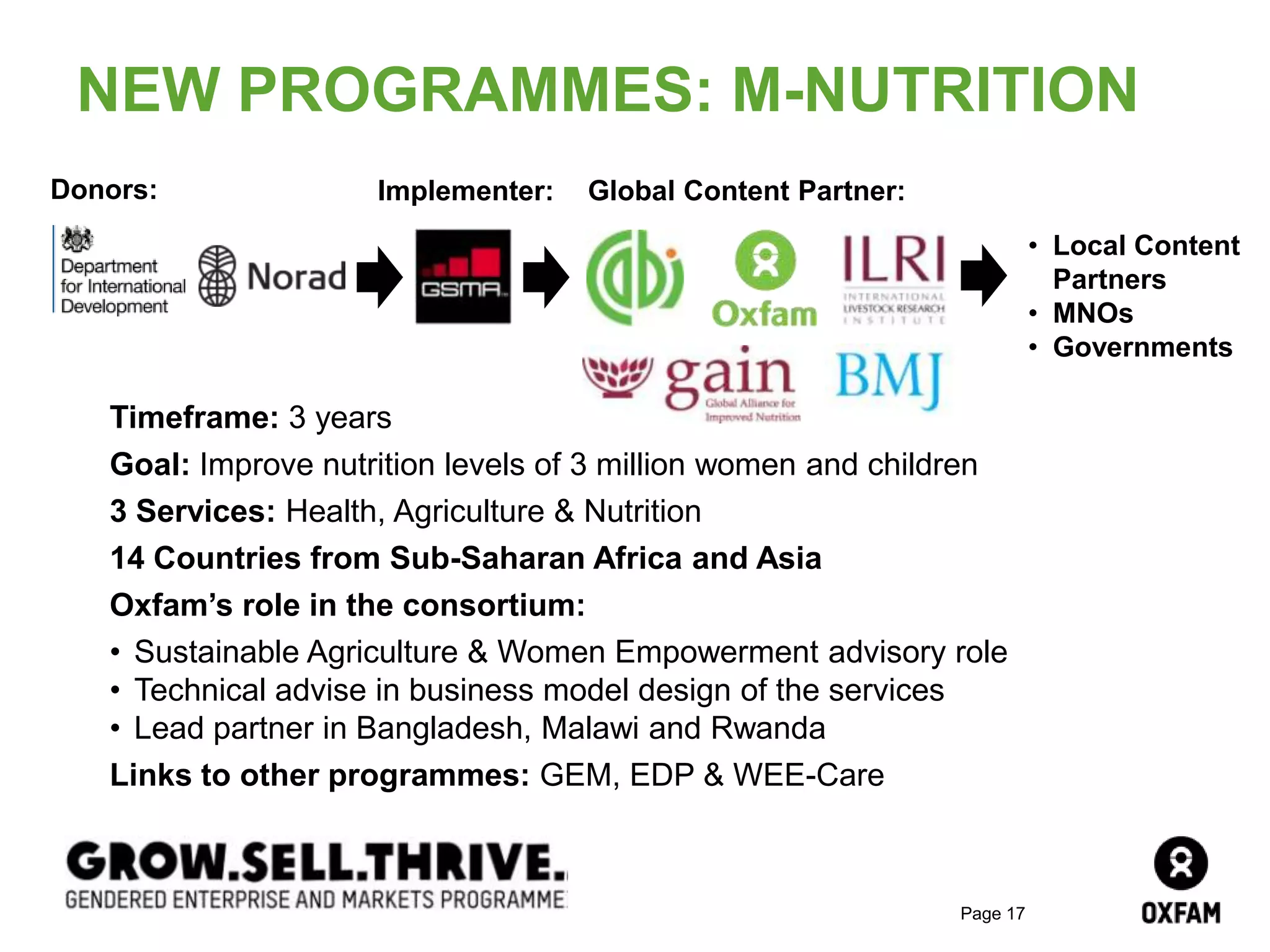
Implementer: Global Content Partner:
Timeframe: 3 years
Goal: Improve nutrition levels of 3 million women and children
3 Services: Health, Agriculture & Nutrition
14 Countries from Sub-Saharan Africa and Asia
Oxfam’s role in the consortium:
• Sustainable Agriculture & Women Empowerment advisory role
• Technical advise in business model design of the services
• Lead partner in Bangladesh, Malawi and Rwanda
Links to other programmes: GEM, EDP & WEE-Care
Donors:
NEW PROGRAMMES: M-NUTRITION
• Local Content
Partners
• MNOs
• Governments
MOBILE DATA COLLECTION
Page 19
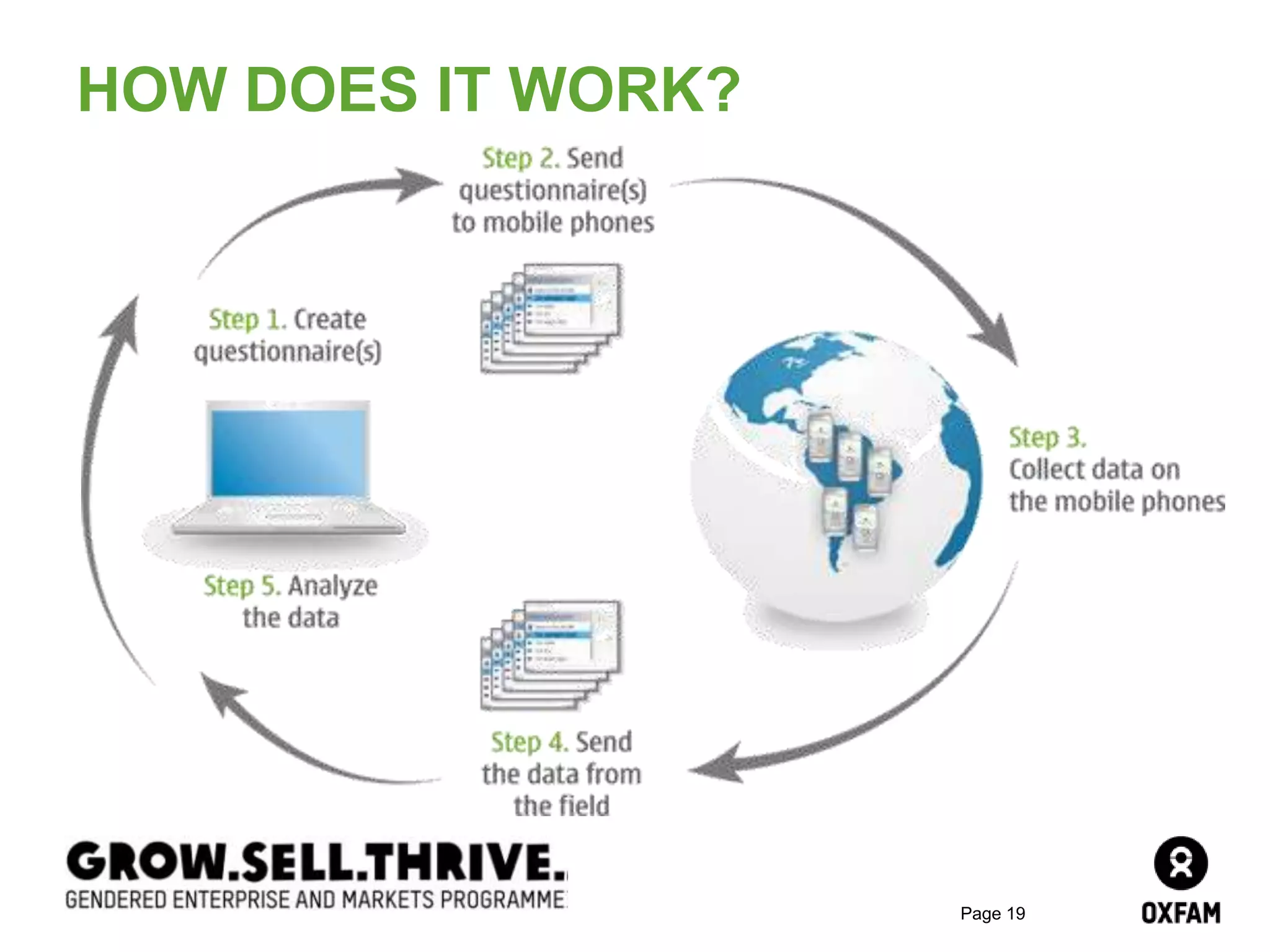
HOW DOES IT WORK?
Page 20
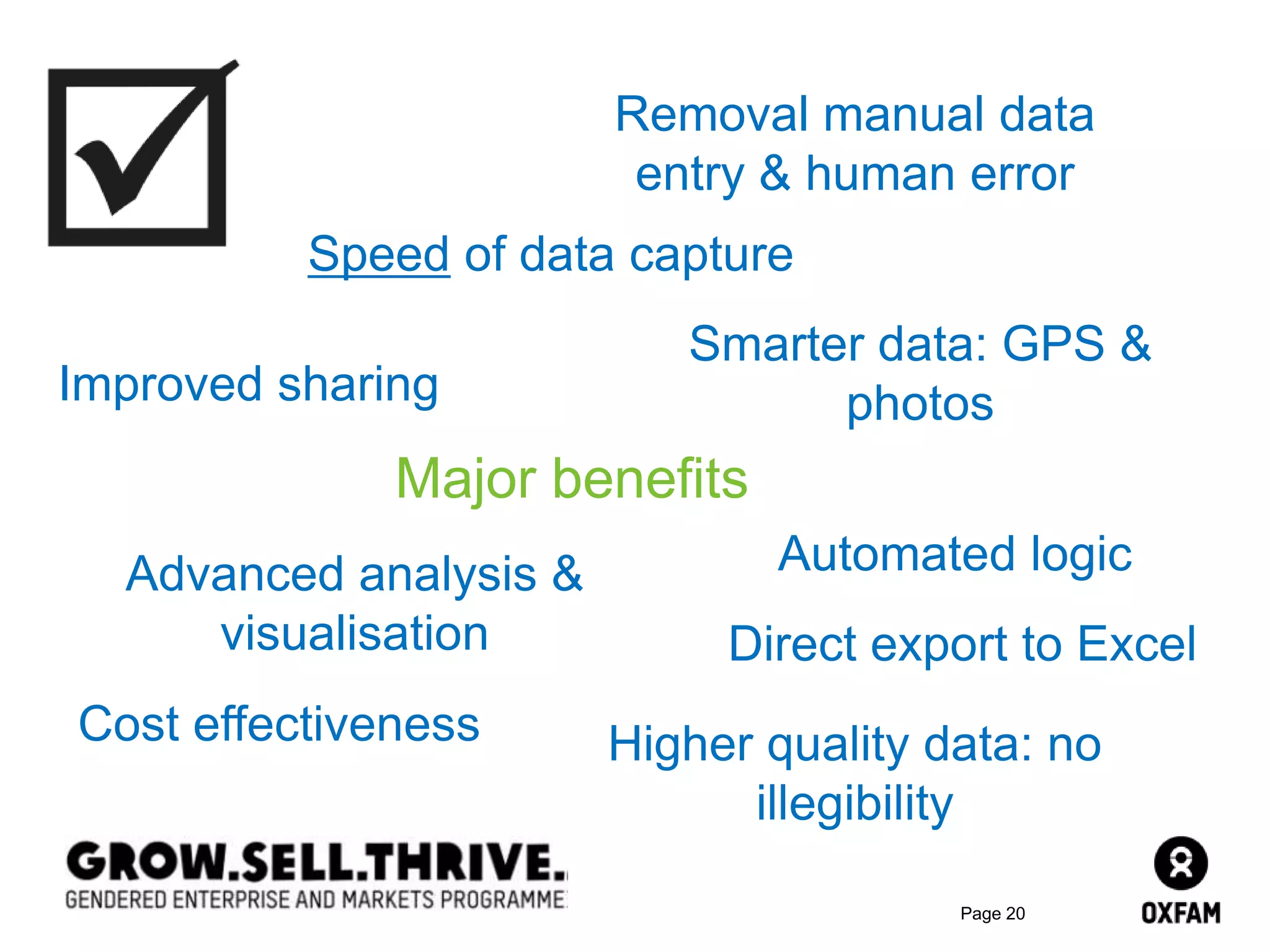
Major benefits
Speed of data capture
Cost effectiveness
Direct export to Excel
Advanced analysis &
visualisation
Smarter data: GPS &
photosImproved sharing
Removal manual data
entry & human error
Higher quality data: no
illegibility
Automated logic
Page 21
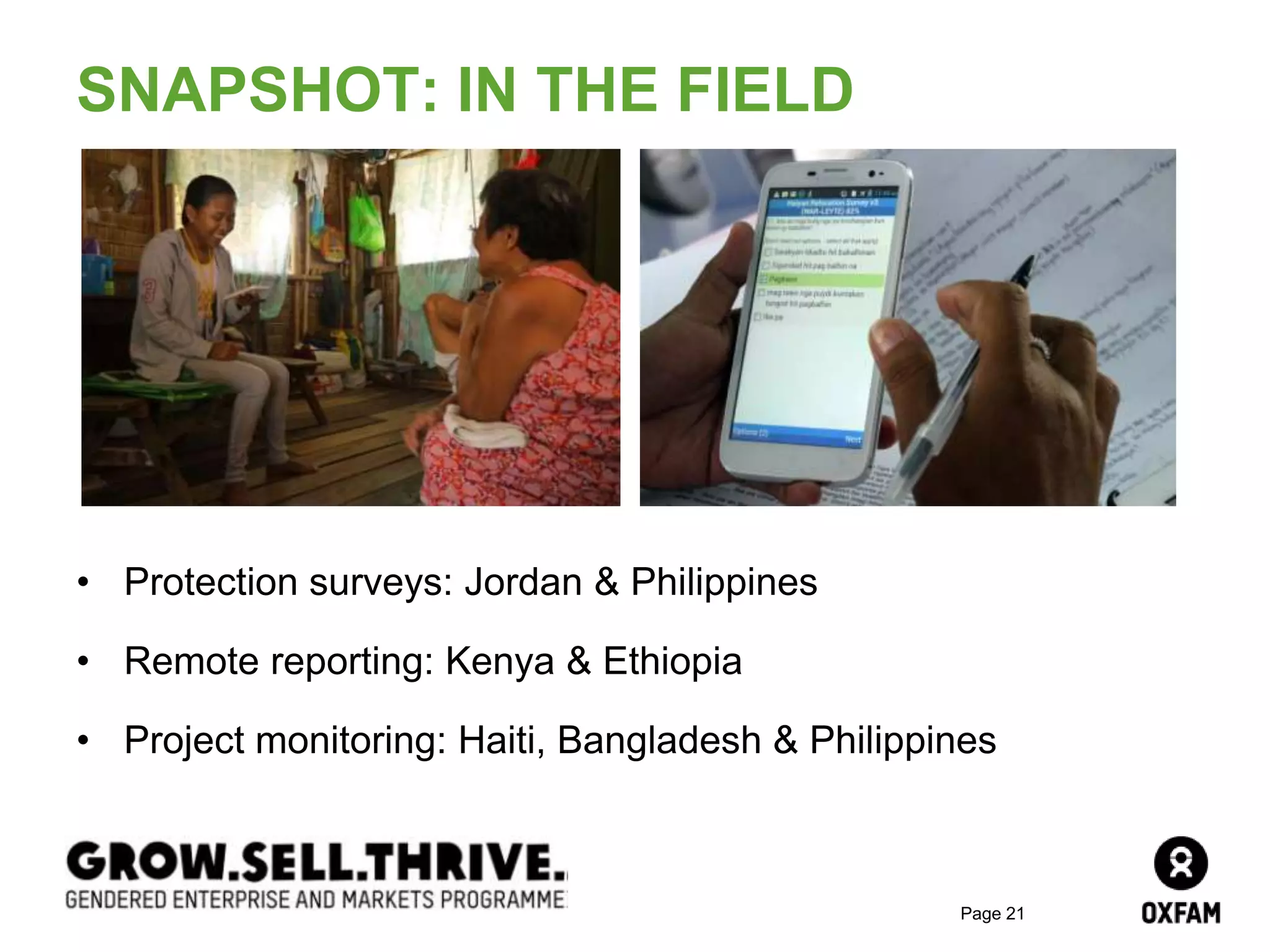
SNAPSHOT: IN THE FIELD
• Protection surveys: Jordan & Philippines
• Remote reporting: Kenya & Ethiopia
• Project monitoring: Haiti, Bangladesh & Philippines
Page 22
RESOURCES: MOBILE SURVEY TOOLKIT
Page 23
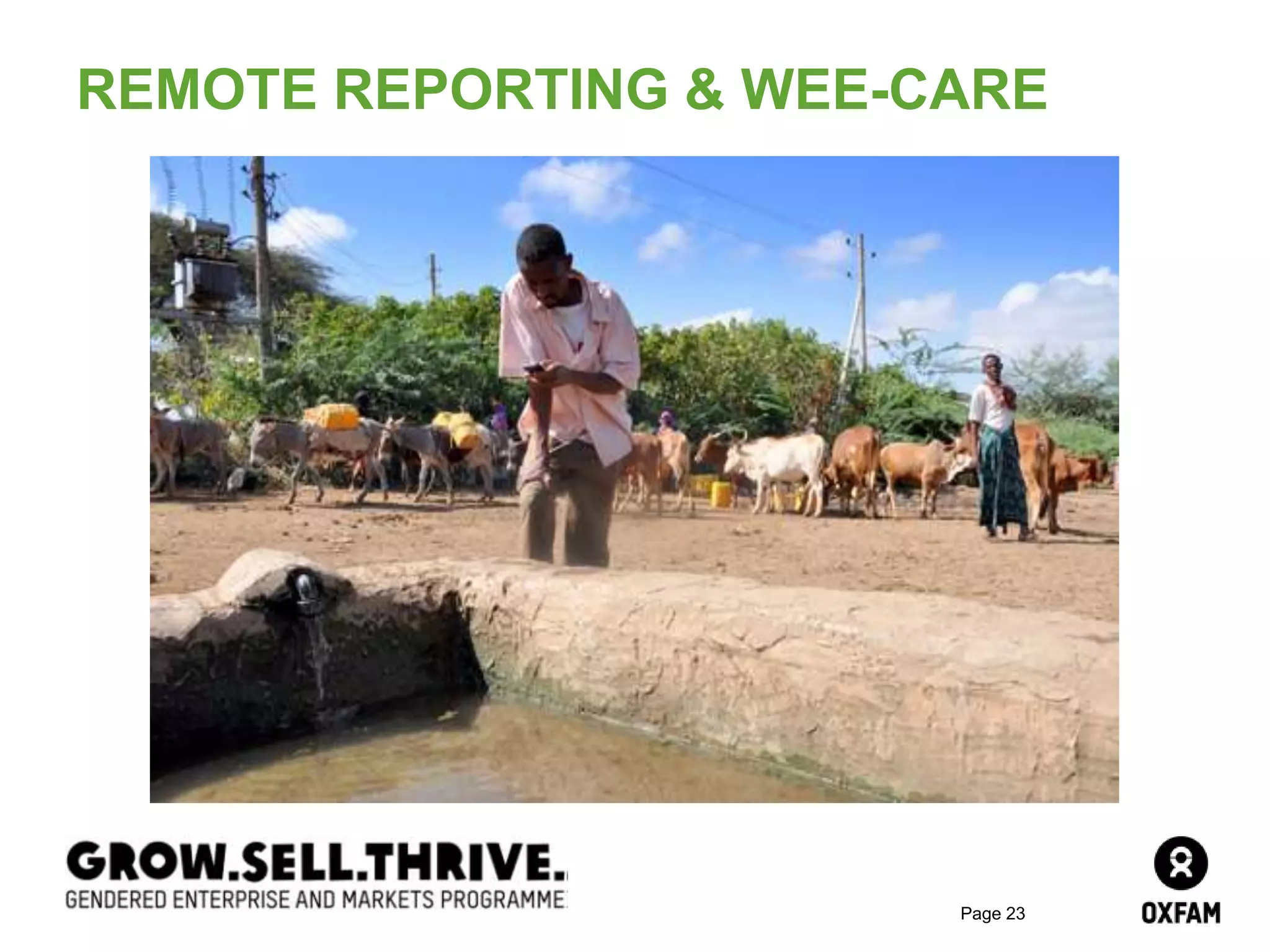
REMOTE REPORTING & WEE-CARE
THE FUTURE OF ICTS IN PROGRAMME
Page 25
FUTURE OF ICT IN PROGRAMME
• Work as One Oxfam – strategy and shared vision
• Network of staff
• Stories are our “bread and butter” for inspiration
• More robust and standard MEAL
• Improving communications
• Sustainable and replicable opportunities to reach scale
• Unique role in ethics and appropriateness
MOVING TO 2020
Page 27
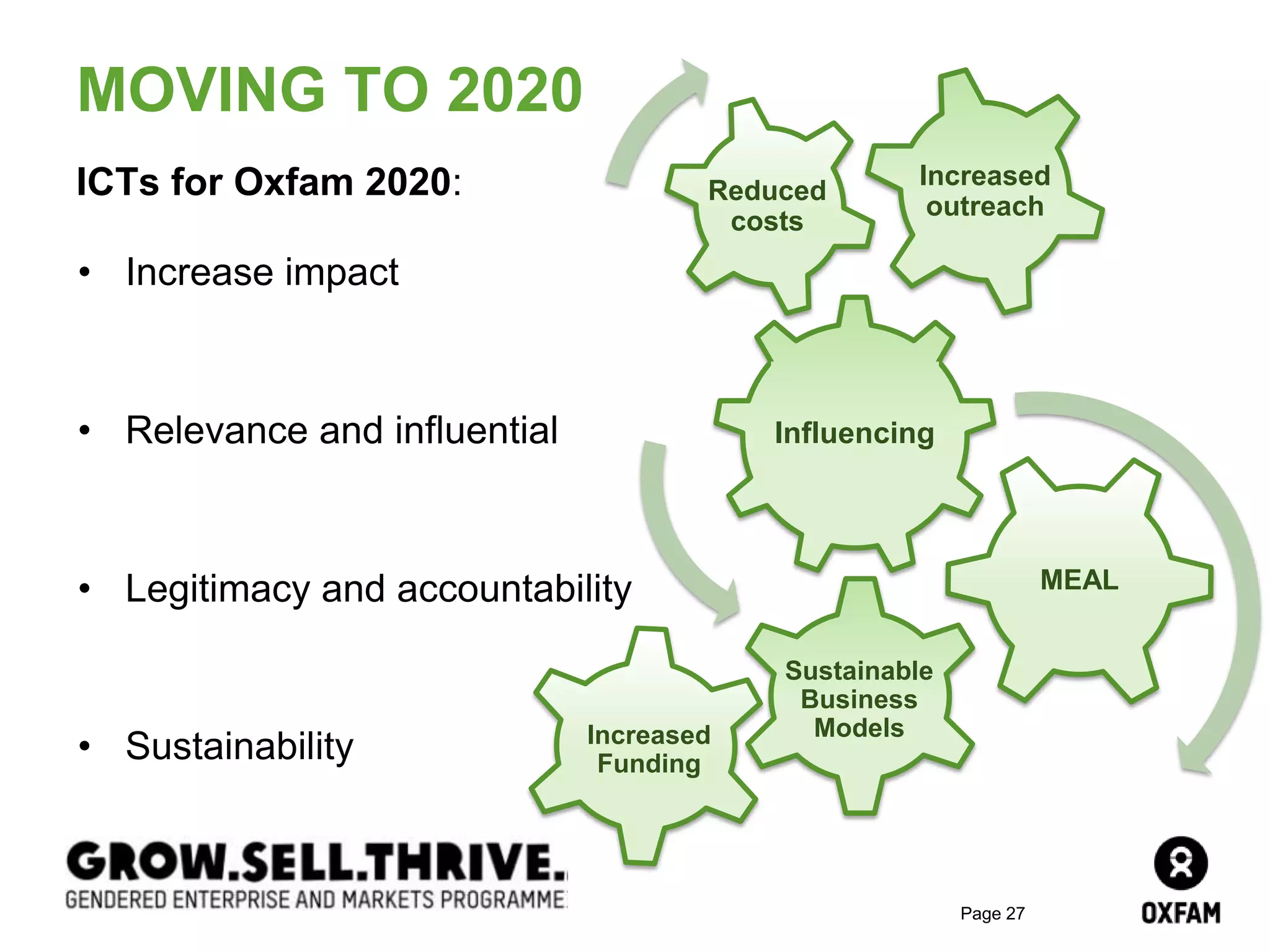
MOVING TO 2020
ICTs for Oxfam 2020: Reduced
costs
MEAL
Increased
outreach
Influencing
Sustainable
Business
ModelsIncreased
Funding
• Increase impact
• Relevance and influential
• Legitimacy and accountability
• Sustainability

How ICTs can make a difference to livelihoods

  • 1.
    28 April 2014 HowICTs can make a difference to Livelihoods
  • 2.
  • 3.
    Page 3 ICT INPROGRAMME AT OXFAM
  • 4.
    Page 4 KEY PRINCIPLESFOR SUCCESS • Consider ICT as an enabler • Embed ICTs in existing process • Context appropriate solutions • Build on existing solutions (where possible) • Sustainability • Women’s rights at the heart • Listen to stakeholders
  • 5.
    Page 5 THE REALITYOF USING ICTS En un despliegue usando lo digital Allocation of time in a deployment using ICTs TECHNOLOGY SET UP set up technology/server, training on functionality, organising information flows, integrate other systems PROGRAMME DESIGN outreach, branding, ince ntives, feedback, messa ging, data collection, verification, m ultichannel approaches
  • 6.
    ICTS IN LIVELIHOODSPROGRAMMING http://growsellthrive.org/our-work/ict
  • 7.
    Page 7 INTEGRATING ICTSIN OXFAM’S LIVELIHOODS PROGRAMMES – STEP 1 1. Understand the wide range of information and financial services that can be provided through ICTs for small-holder farmers Information Services Value Chain Linkages Financial Services • Inputs information • Agronomic information • Weather forecasts • Market information • Aggregation of farmers for purchase and sale • Connection with input providers and buyers • Mobile banking (money transfers) • Micro-credits • Micro-insurance Service Offering • Better choice of inputs • Better agro practices • Improved productivity • Higher crop quality • Higher price received • Purchase at lower cost • Access to larger buyer • Less product loss • Access to new products and markets • Reduced risks and transaction costs • Access to credit • Reduced vulnerability to risks and shocks Benefits The effect of M-Agri services depends on the type of service provided. A combination of services has greater potential to have an impact on poverty reduction and to achieve sustainability in the long term Types of M-Agri services: org/our-work/ict
  • 8.
    Page 8 INTEGRATING ICTSIN OXFAM’S LIVELIHOODS PROGRAMMES – STEP 2 2. Identify concrete activities where ICTs could be used as a delivery channel and contribute to reduce the operating costs, increase the outreach and improve the efficiencies of the programme Gendered market map (Value Chain section) with opportunities for ICTs in the dairy value chain Bangladesh org/our-work/ict
  • 9.
    Page 9 INTEGRATING ICTSIN OXFAM’S LIVELIHOODS PROGRAMMES – STEP 3 3. Conduct a quick landscape analysis of the enabling environment, M-Agri and Mobile Money service offering in the country ...and 230 in the field of Mobile Money Source: https://mobiledevelopmentintelligence.com/ : 2014 Source: https://mobiledevelopmentintelligence.com/ : 2014 org/our-work/ict There are currently over 100 active initiatives in the field of M-Agri, many of which compete in the same countries with similar service offerings Source: https://mobiledevelopmentintelligence.com/ : 2014
  • 10.
    Page 10 INTEGRATING ICTSIN OXFAM’S LIVELIHOODS PROGRAMMES – STEP 4 4. Compare the opportunities for using ICTs in the programme (step 2) and the existing ICT service offering in the country (step 3) to identify potential synergies between both Gendered market map (Value Chain section) with opportunities for ICTs in the dairy value chain Bangladesh org/our-work/ict
  • 11.
    Page 11 A. Outcome:The existing service offering fully matches an opportunity identified to use ICTs in a particular activity of the programme Intervention: Linking the existing service offering to an Oxfam programme OUTCOMES FROM STEP 4 EDP Programme in Ethiopia; Honey Value Chain org/our-work/ict
  • 12.
    Page 12 B. Outcome:The existing service offering matches partially an opportunity identified to use ICTs in a particular activity of the programme. Intervention: Collaborating with the service provider to improve their current service offering to address the needs and activities of the programme OUTCOMES FROM STEP 4 Fish Value Chain: Lake Turkana org/our-work/ict
  • 13.
    Page 13 C. Outcome:The existing service offering does not match any opportunities identified to use ICTs in the programme. Intervention: Designing and implementing new services through public-private partnerships to address service- offering gaps OUTCOMES FROM STEP 4 Livelihoods Programme in Rwanda; Pineapple Value Chain org/our-work/ict
  • 14.
    Page 14 GENDER APPROACH Opportunities: •Mobiles can address women’s time and mobility constraints • Facilitate women’s access to relevant information • Increase access to financial services for income generating or care related activities • Gather sex-disaggregated data in agriculture and for MEL purposes • Facilitate women’s participation in political processes • Address power imbalances at the household and community levels org/our-work/ict
  • 15.
    Page 15 GENDER APPROACH •Financial constraints to buy mobile phones and pay for services • High levels of technological and language illiteracy • Cultural constraints can prevent women from accessing services • Access to information does not in itself promote behavioral change Challenges: Ownership and usage of mobile phones by women in rural areas Recommendations: • Use multiple delivery channels (e.g. mobiles, radio, face to face…) • Explore alternative business models for revenue generation • Peer to peer knowledge exchange can facilitate behavioral change • Involve women in the design of the service org/our-work/ict
  • 16.
    Page 16 “The worldneeds a paradigm shift in agricultural development...from conventional, monoculture-based and high external-input-dependent industrial production towards mosaics of sustainable, regenerative production systems that also considerably improve the productivity of small-scale farmers...a farmer is not only a producer of agricultural goods, but also a manager of an agro-ecological system that provides quite a number of public goods and services (e.g. water, soil, landscape, energy, biodiversity and recreation).” UNCTAD: 2013, “Trade and environment review 2013” RESEARCH AND INFLUENCING ICTs and sustainable agriculture Partners: Results: org/our-work/ict
  • 17.
    Page 17 Implementer: GlobalContent Partner: Timeframe: 3 years Goal: Improve nutrition levels of 3 million women and children 3 Services: Health, Agriculture & Nutrition 14 Countries from Sub-Saharan Africa and Asia Oxfam’s role in the consortium: • Sustainable Agriculture & Women Empowerment advisory role • Technical advise in business model design of the services • Lead partner in Bangladesh, Malawi and Rwanda Links to other programmes: GEM, EDP & WEE-Care Donors: NEW PROGRAMMES: M-NUTRITION • Local Content Partners • MNOs • Governments
  • 18.
  • 19.
  • 20.
    Page 20 Major benefits Speedof data capture Cost effectiveness Direct export to Excel Advanced analysis & visualisation Smarter data: GPS & photosImproved sharing Removal manual data entry & human error Higher quality data: no illegibility Automated logic
  • 21.
    Page 21 SNAPSHOT: INTHE FIELD • Protection surveys: Jordan & Philippines • Remote reporting: Kenya & Ethiopia • Project monitoring: Haiti, Bangladesh & Philippines
  • 22.
  • 23.
  • 24.
    THE FUTURE OFICTS IN PROGRAMME
  • 25.
    Page 25 FUTURE OFICT IN PROGRAMME • Work as One Oxfam – strategy and shared vision • Network of staff • Stories are our “bread and butter” for inspiration • More robust and standard MEAL • Improving communications • Sustainable and replicable opportunities to reach scale • Unique role in ethics and appropriateness
  • 26.
  • 27.
    Page 27 MOVING TO2020 ICTs for Oxfam 2020: Reduced costs MEAL Increased outreach Influencing Sustainable Business ModelsIncreased Funding • Increase impact • Relevance and influential • Legitimacy and accountability • Sustainability