Power Quality Definitions
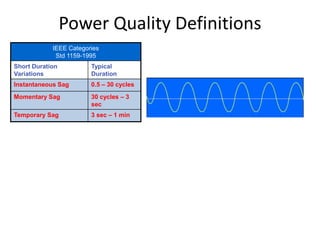
IEEE Categories
Std 1159-1995
Short Duration
Variations
Typical
Duration
Instantaneous Sag 0.5 – 30 cycles
Momentary Sag 30 cycles – 3
sec
Temporary Sag 3 sec – 1 min
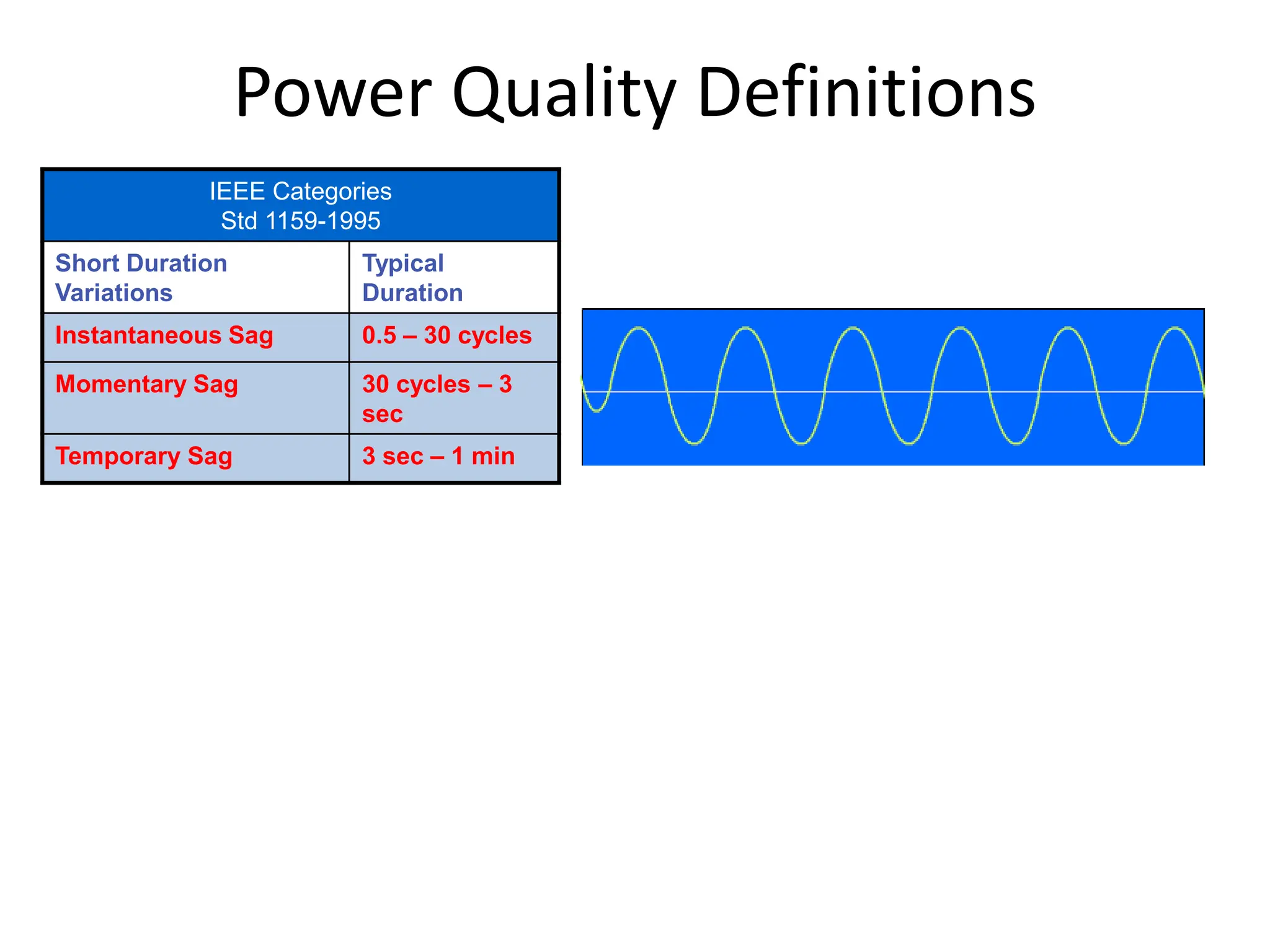
PQ Definitions
IEEE Categories
Std 1159-1995
Short Duration
Variations
Typical
Duration
Instantaneous Sag 0.5 – 30 cycles
Momentary Sag 30 cycles – 3
sec.
Temporary Sag 3 sec – 1 min.
Instantaneous Swell 0.5 – 30 cycles
Momentary Swell 30 cycles – 3
sec.
Temporary Swell 3 sec – 1 min.
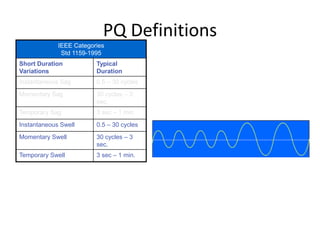
PQ Definitions
IEEE Categories
Std 1159-1995
Short Duration
Variations
Typical
Duration
Instantaneous Sag 0.5 – 30 cycles
Momentary Sag 30 cycles – 3
sec.
Temporary Sag 3 sec – 1 min.
Instantaneous Swell 0.5 – 30 cycles
Momentary Swell 30 cycles – 3
sec.
Temporary Swell 3 sec – 1 min.
Momentary
Interruptions
0.5 – 30 cycles
Temporary
Interruptions
30 cycles – 3
sec.
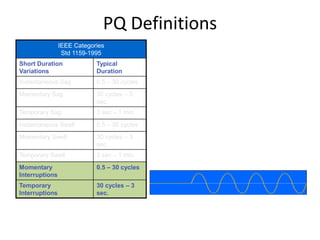
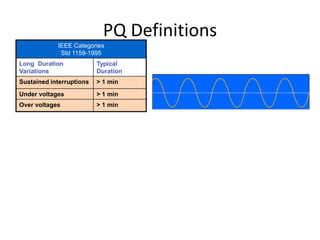
PQ Definitions
IEEE Categories
Std 1159-1995
Long Duration
Variations
Typical
Duration
Sustained interruptions > 1 min
Under voltages > 1 min
Over voltages > 1 min
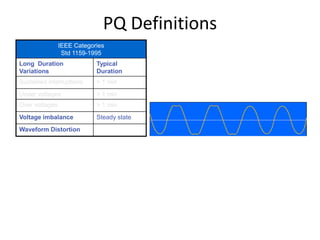
PQ Definitions
IEEE Categories
Std 1159-1995
Long Duration
Variations
Typical
Duration
Sustained interruptions > 1 min
Under voltages > 1 min
Over voltages > 1 min
Voltage imbalance Steady state
Waveform Distortion
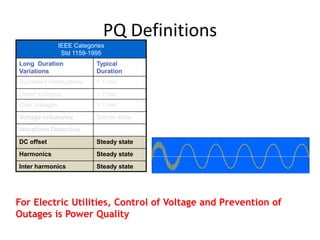
PQ Definitions
IEEE Categories
Std 1159-1995
Long Duration
Variations
Typical
Duration
Sustained interruptions > 1 min
Under voltages > 1 min
Over voltages > 1 min
Voltage imbalance Steady state
Waveform Distortion
DC offset Steady state
Harmonics Steady state
Inter harmonics Steady state
For Electric Utilities, Control of Voltage and Prevention of
Outages is Power Quality
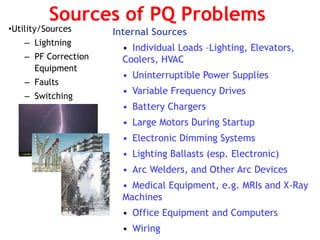
Sources of PQ Problems
•Utility/Sources
– Lightning
– PF Correction
Equipment
– Faults
– Switching
Internal Sources
• Individual Loads –Lighting, Elevators,
Coolers, HVAC
• Uninterruptible Power Supplies
• Variable Frequency Drives
• Battery Chargers
• Large Motors During Startup
• Electronic Dimming Systems
• Lighting Ballasts (esp. Electronic)
• Arc Welders, and Other Arc Devices
• Medical Equipment, e.g. MRIs and X-Ray
Machines
• Office Equipment and Computers
• Wiring
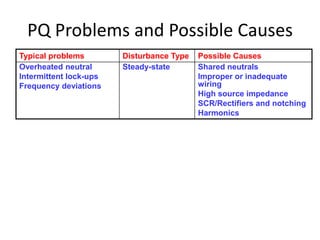
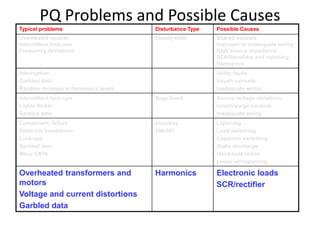
PQ Problems and Possible Causes
Typical problems Disturbance Type Possible Causes
Overheated neutral
Intermittent lock-ups
Frequency deviations
Steady-state Shared neutrals
Improper or inadequate
wiring
High source impedance
SCR/Rectifiers and notching
Harmonics
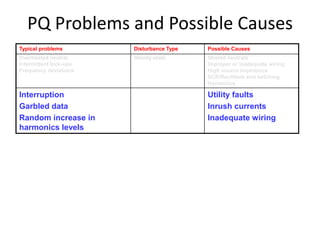
PQ Problems and Possible Causes
Typical problems Disturbance Type Possible Causes
Overheated neutral
Intermittent lock-ups
Frequency deviations
Steady-state Shared neutrals
Improper or inadequate wiring
High source impedance
SCR/Rectifiers and notching
Harmonics
Interruption
Garbled data
Random increase in
harmonics levels
Utility faults
Inrush currents
Inadequate wiring
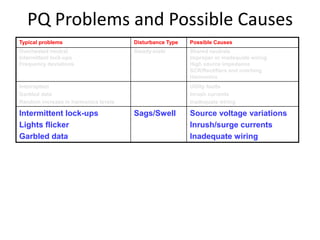
PQ Problems and Possible Causes
Typical problems Disturbance Type Possible Causes
Overheated neutral
Intermittent lock-ups
Frequency deviations
Steady-state Shared neutrals
Improper or inadequate wiring
High source impedance
SCR/Rectifiers and notching
Harmonics
Interruption
Garbled data
Random increase in harmonics levels
Utility faults
Inrush currents
Inadequate wiring
Intermittent lock-ups
Lights flicker
Garbled data
Sags/Swell Source voltage variations
Inrush/surge currents
Inadequate wiring
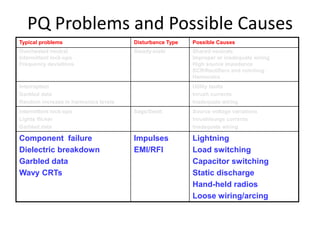
PQ Problems and Possible Causes
Typical problems Disturbance Type Possible Causes
Overheated neutral
Intermittent lock-ups
Frequency deviations
Steady-state Shared neutrals
Improper or inadequate wiring
High source impedance
SCR/Rectifiers and notching
Harmonics
Interruption
Garbled data
Random increase in harmonics levels
Utility faults
Inrush currents
Inadequate wiring
Intermittent lock-ups
Lights flicker
Garbled data
Sags/Swell Source voltage variations
Inrush/surge currents
Inadequate wiring
Component failure
Dielectric breakdown
Garbled data
Wavy CRTs
Impulses
EMI/RFI
Lightning
Load switching
Capacitor switching
Static discharge
Hand-held radios
Loose wiring/arcing
PQ Problems and Possible Causes
Typical problems Disturbance Type Possible Causes
Overheated neutral
Intermittent lock-ups
Frequency deviations
Steady-state Shared neutrals
Improper or inadequate wiring
High source impedance
SCR/Rectifiers and notching
Harmonics
Interruption
Garbled data
Random increase in harmonics levels
Utility faults
Inrush currents
Inadequate wiring
Intermittent lock-ups
Lights flicker
Garbled data
Sags/Swell Source voltage variations
Inrush/surge currents
Inadequate wiring
Component failure
Dielectric breakdown
Lock-ups
Garbled data
Wavy CRTs
Impulses
EMI/RFI
Lightning
Load switching
Capacitor switching
Static discharge
Hand-held radios
Loose wiring/arcing
Overheated transformers and
motors
Voltage and current distortions
Garbled data
Harmonics Electronic loads
SCR/rectifier
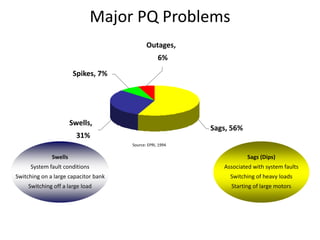
Major PQ Problems
Source: EPRI, 1994
Spikes, 7%
Sags, 56%
Outages,
6%
Swells,
31%
Sags (Dips)
Associated with system faults
Switching of heavy loads
Starting of large motors
Swells
System fault conditions
Switching on a large capacitor bank
Switching off a large load
Power Quality Mitigation
techniques
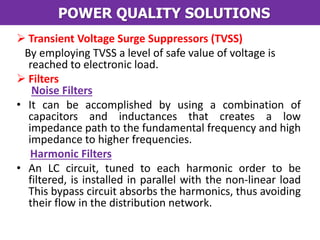
POWER QUALITY SOLUTIONS
 Transient Voltage Surge Suppressors (TVSS)
By employing TVSS a level of safe value of voltage is
reached to electronic load.
 Filters
Noise Filters
• It can be accomplished by using a combination of
capacitors and inductances that creates a low
impedance path to the fundamental frequency and high
impedance to higher frequencies.
Harmonic Filters
• An LC circuit, tuned to each harmonic order to be
filtered, is installed in parallel with the non-linear load
This bypass circuit absorbs the harmonics, thus avoiding
their flow in the distribution network.
 Isolation Transformers
• The main purpose of the isolation transformer is safety and
protection of electronic components and the person against
electrical shock.
 STATCOM
• STATCOM or Static Synchronous Compensator is a power electronic
converter using devices like IGBT, GTO etc. to control the reactive
power flow through a power network and thereby increasing the
stability of power network.
• STATCOM mean that it can either absorb or generate reactive
power in synchronization with the demand to stabilize the voltage
of the power network.
• Dynamic Voltage Restorer
DVR is method of injecting voltage in power distribution.
DVRs are connected in series with the transmission line.
Thyristor-Based Static Switch
• The static switch is a versatile device for switching a new
element into the circuit when voltage support is needed.
• To correct quickly for voltage spikes, sags, or interruptions,
the static switch can be used to switch in one of the following:
i) Capacitor,
ii) Filter,
iii) Alternate power line,
iv) Energy storage system.
• Static switch can be used in the alternate power line
application.
Uninterruptible Power Supply (UPS)
• UPS systems provide protection in the case of
a complete power interruption (blackout).
• A UPS provides a finite source of electrical
power to support selected critical loads during
a loss of normal power. This backup time
ranges from seconds to hours.
Voltage Regulators
• Voltage regulators maintain output voltage at nominal voltage
under all but the most severe input voltage variations.
Three basic types of Voltage regulators:
• Tap Changers: Designed to adjust for varying input voltages by
automatically transferring taps on a power transformer.
• Buck Boost: Utilize similar technology to the tap changers except
the transformer is not isolated.
• Constant Voltage Transformer (CVT): CVT is also known as ferro-
resonant transformers. The CVT is a completely static regulator
that maintains a nearly constant output voltage during large
variations in input voltage.
Unified Power Quality Conditioner (UPQC)
• The unified power quality conditioner (UPQC) is a custom
power device, which mitigates voltage and current-related
PQ issues in the power distribution systems. The UPQC
employs two voltage source inverters (VSIs) that is
connected to a DC energy storage capacitor.
• A UPQC, combines the operations of a Distribution Static
Compensator (DSTATCOM) and Dynamic Voltage Regulator
(DVR) together. This combination allows a simultaneous
compensation of the load currents and the supply voltages,
so that compensated current drawn from the network and
the compensated supply voltage delivered to the load are
sinusoidal and balanced.
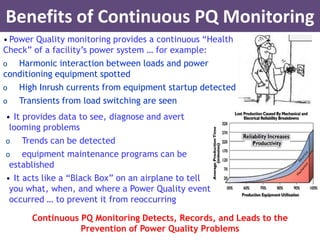
Benefits of Continuous PQ Monitoring
Continuous PQ Monitoring Detects, Records, and Leads to the
Prevention of Power Quality Problems
• Power Quality monitoring provides a continuous “Health
Check” of a facility’s power system … for example:
o Harmonic interaction between loads and power
conditioning equipment spotted
o High Inrush currents from equipment startup detected
o Transients from load switching are seen
• It provides data to see, diagnose and avert
looming problems
o Trends can be detected
o equipment maintenance programs can be
established
• It acts like a “Black Box” on an airplane to tell
you what, when, and where a Power Quality event
occurred … to prevent it from reoccurring
What is needed for PQ Monitoring?
•PQ Monitors must detect and record
the 7 types of PQ problems
– Transients
– Interruptions
– Sag/Under Voltage
– Swell/Over Voltage
– Waveform Distortion
– Voltage Fluctuations
– Frequency Variations
•These include Flicker and Compliance to
ITI(CBEMA), IEEE and ISO Standards
Plus they must …
• Be easy to use
• Be Suitable for continuously
monitoring indoors and outdoors
• Interface with standard PQ analysis
Software
• Be fast enough to capture high speed
events that produce equipment
problems
• Have enough storage to save the
waveforms you need
• Have PQ analysis tools that produce
usable, actionable recommendations
ITI: Information Technology Industry Council (Computer & Business Equipment Manufacturer’s Association)
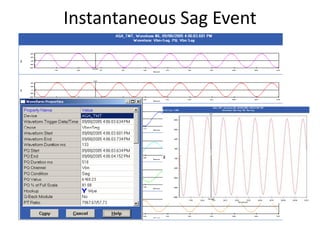
Instantaneous Sag Event
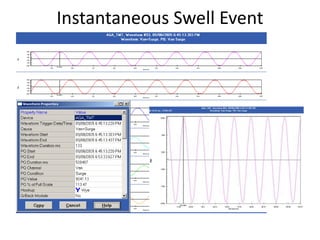
Instantaneous Swell Event
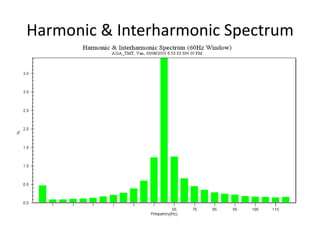
Harmonic & Interharmonic Spectrum
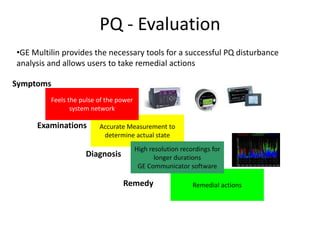
PQ - Evaluation
•GE Multilin provides the necessary tools for a successful PQ disturbance
analysis and allows users to take remedial actions
Accurate Measurement to
determine actual state
Examinations
Remedial actions
Remedy
Feels the pulse of the power
system network
Symptoms
High resolution recordings for
longer durations
GE Communicator software
Diagnosis
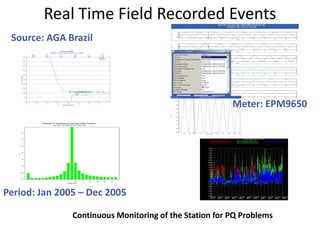
Real Time Field Recorded Events
Source: AGA Brazil
Meter: EPM9650
Period: Jan 2005 – Dec 2005
Continuous Monitoring of the Station for PQ Problems

Power Quality mitigation techniques2.pptx

  • 1.
    Power Quality Definitions IEEECategories Std 1159-1995 Short Duration Variations Typical Duration Instantaneous Sag 0.5 – 30 cycles Momentary Sag 30 cycles – 3 sec Temporary Sag 3 sec – 1 min
  • 2.
    PQ Definitions IEEE Categories Std1159-1995 Short Duration Variations Typical Duration Instantaneous Sag 0.5 – 30 cycles Momentary Sag 30 cycles – 3 sec. Temporary Sag 3 sec – 1 min. Instantaneous Swell 0.5 – 30 cycles Momentary Swell 30 cycles – 3 sec. Temporary Swell 3 sec – 1 min.
  • 3.
    PQ Definitions IEEE Categories Std1159-1995 Short Duration Variations Typical Duration Instantaneous Sag 0.5 – 30 cycles Momentary Sag 30 cycles – 3 sec. Temporary Sag 3 sec – 1 min. Instantaneous Swell 0.5 – 30 cycles Momentary Swell 30 cycles – 3 sec. Temporary Swell 3 sec – 1 min. Momentary Interruptions 0.5 – 30 cycles Temporary Interruptions 30 cycles – 3 sec.
  • 4.
    PQ Definitions IEEE Categories Std1159-1995 Long Duration Variations Typical Duration Sustained interruptions > 1 min Under voltages > 1 min Over voltages > 1 min
  • 5.
    PQ Definitions IEEE Categories Std1159-1995 Long Duration Variations Typical Duration Sustained interruptions > 1 min Under voltages > 1 min Over voltages > 1 min Voltage imbalance Steady state Waveform Distortion
  • 6.
    PQ Definitions IEEE Categories Std1159-1995 Long Duration Variations Typical Duration Sustained interruptions > 1 min Under voltages > 1 min Over voltages > 1 min Voltage imbalance Steady state Waveform Distortion DC offset Steady state Harmonics Steady state Inter harmonics Steady state For Electric Utilities, Control of Voltage and Prevention of Outages is Power Quality
  • 7.
    Sources of PQProblems •Utility/Sources – Lightning – PF Correction Equipment – Faults – Switching Internal Sources • Individual Loads –Lighting, Elevators, Coolers, HVAC • Uninterruptible Power Supplies • Variable Frequency Drives • Battery Chargers • Large Motors During Startup • Electronic Dimming Systems • Lighting Ballasts (esp. Electronic) • Arc Welders, and Other Arc Devices • Medical Equipment, e.g. MRIs and X-Ray Machines • Office Equipment and Computers • Wiring
  • 8.
    PQ Problems andPossible Causes Typical problems Disturbance Type Possible Causes Overheated neutral Intermittent lock-ups Frequency deviations Steady-state Shared neutrals Improper or inadequate wiring High source impedance SCR/Rectifiers and notching Harmonics
  • 9.
    PQ Problems andPossible Causes Typical problems Disturbance Type Possible Causes Overheated neutral Intermittent lock-ups Frequency deviations Steady-state Shared neutrals Improper or inadequate wiring High source impedance SCR/Rectifiers and notching Harmonics Interruption Garbled data Random increase in harmonics levels Utility faults Inrush currents Inadequate wiring
  • 10.
    PQ Problems andPossible Causes Typical problems Disturbance Type Possible Causes Overheated neutral Intermittent lock-ups Frequency deviations Steady-state Shared neutrals Improper or inadequate wiring High source impedance SCR/Rectifiers and notching Harmonics Interruption Garbled data Random increase in harmonics levels Utility faults Inrush currents Inadequate wiring Intermittent lock-ups Lights flicker Garbled data Sags/Swell Source voltage variations Inrush/surge currents Inadequate wiring
  • 11.
    PQ Problems andPossible Causes Typical problems Disturbance Type Possible Causes Overheated neutral Intermittent lock-ups Frequency deviations Steady-state Shared neutrals Improper or inadequate wiring High source impedance SCR/Rectifiers and notching Harmonics Interruption Garbled data Random increase in harmonics levels Utility faults Inrush currents Inadequate wiring Intermittent lock-ups Lights flicker Garbled data Sags/Swell Source voltage variations Inrush/surge currents Inadequate wiring Component failure Dielectric breakdown Garbled data Wavy CRTs Impulses EMI/RFI Lightning Load switching Capacitor switching Static discharge Hand-held radios Loose wiring/arcing
  • 12.
    PQ Problems andPossible Causes Typical problems Disturbance Type Possible Causes Overheated neutral Intermittent lock-ups Frequency deviations Steady-state Shared neutrals Improper or inadequate wiring High source impedance SCR/Rectifiers and notching Harmonics Interruption Garbled data Random increase in harmonics levels Utility faults Inrush currents Inadequate wiring Intermittent lock-ups Lights flicker Garbled data Sags/Swell Source voltage variations Inrush/surge currents Inadequate wiring Component failure Dielectric breakdown Lock-ups Garbled data Wavy CRTs Impulses EMI/RFI Lightning Load switching Capacitor switching Static discharge Hand-held radios Loose wiring/arcing Overheated transformers and motors Voltage and current distortions Garbled data Harmonics Electronic loads SCR/rectifier
  • 13.
    Major PQ Problems Source:EPRI, 1994 Spikes, 7% Sags, 56% Outages, 6% Swells, 31% Sags (Dips) Associated with system faults Switching of heavy loads Starting of large motors Swells System fault conditions Switching on a large capacitor bank Switching off a large load
  • 14.
  • 15.
    POWER QUALITY SOLUTIONS Transient Voltage Surge Suppressors (TVSS) By employing TVSS a level of safe value of voltage is reached to electronic load.  Filters Noise Filters • It can be accomplished by using a combination of capacitors and inductances that creates a low impedance path to the fundamental frequency and high impedance to higher frequencies. Harmonic Filters • An LC circuit, tuned to each harmonic order to be filtered, is installed in parallel with the non-linear load This bypass circuit absorbs the harmonics, thus avoiding their flow in the distribution network.
  • 16.
     Isolation Transformers •The main purpose of the isolation transformer is safety and protection of electronic components and the person against electrical shock.  STATCOM • STATCOM or Static Synchronous Compensator is a power electronic converter using devices like IGBT, GTO etc. to control the reactive power flow through a power network and thereby increasing the stability of power network. • STATCOM mean that it can either absorb or generate reactive power in synchronization with the demand to stabilize the voltage of the power network.
  • 17.
    • Dynamic VoltageRestorer DVR is method of injecting voltage in power distribution. DVRs are connected in series with the transmission line. Thyristor-Based Static Switch • The static switch is a versatile device for switching a new element into the circuit when voltage support is needed. • To correct quickly for voltage spikes, sags, or interruptions, the static switch can be used to switch in one of the following: i) Capacitor, ii) Filter, iii) Alternate power line, iv) Energy storage system. • Static switch can be used in the alternate power line application.
  • 18.
    Uninterruptible Power Supply(UPS) • UPS systems provide protection in the case of a complete power interruption (blackout). • A UPS provides a finite source of electrical power to support selected critical loads during a loss of normal power. This backup time ranges from seconds to hours.
  • 19.
    Voltage Regulators • Voltageregulators maintain output voltage at nominal voltage under all but the most severe input voltage variations. Three basic types of Voltage regulators: • Tap Changers: Designed to adjust for varying input voltages by automatically transferring taps on a power transformer. • Buck Boost: Utilize similar technology to the tap changers except the transformer is not isolated. • Constant Voltage Transformer (CVT): CVT is also known as ferro- resonant transformers. The CVT is a completely static regulator that maintains a nearly constant output voltage during large variations in input voltage.
  • 20.
    Unified Power QualityConditioner (UPQC) • The unified power quality conditioner (UPQC) is a custom power device, which mitigates voltage and current-related PQ issues in the power distribution systems. The UPQC employs two voltage source inverters (VSIs) that is connected to a DC energy storage capacitor. • A UPQC, combines the operations of a Distribution Static Compensator (DSTATCOM) and Dynamic Voltage Regulator (DVR) together. This combination allows a simultaneous compensation of the load currents and the supply voltages, so that compensated current drawn from the network and the compensated supply voltage delivered to the load are sinusoidal and balanced.
  • 21.
    Benefits of ContinuousPQ Monitoring Continuous PQ Monitoring Detects, Records, and Leads to the Prevention of Power Quality Problems • Power Quality monitoring provides a continuous “Health Check” of a facility’s power system … for example: o Harmonic interaction between loads and power conditioning equipment spotted o High Inrush currents from equipment startup detected o Transients from load switching are seen • It provides data to see, diagnose and avert looming problems o Trends can be detected o equipment maintenance programs can be established • It acts like a “Black Box” on an airplane to tell you what, when, and where a Power Quality event occurred … to prevent it from reoccurring
  • 22.
    What is neededfor PQ Monitoring? •PQ Monitors must detect and record the 7 types of PQ problems – Transients – Interruptions – Sag/Under Voltage – Swell/Over Voltage – Waveform Distortion – Voltage Fluctuations – Frequency Variations •These include Flicker and Compliance to ITI(CBEMA), IEEE and ISO Standards Plus they must … • Be easy to use • Be Suitable for continuously monitoring indoors and outdoors • Interface with standard PQ analysis Software • Be fast enough to capture high speed events that produce equipment problems • Have enough storage to save the waveforms you need • Have PQ analysis tools that produce usable, actionable recommendations ITI: Information Technology Industry Council (Computer & Business Equipment Manufacturer’s Association)
  • 23.
  • 24.
  • 25.
  • 26.
    PQ - Evaluation •GEMultilin provides the necessary tools for a successful PQ disturbance analysis and allows users to take remedial actions Accurate Measurement to determine actual state Examinations Remedial actions Remedy Feels the pulse of the power system network Symptoms High resolution recordings for longer durations GE Communicator software Diagnosis
  • 27.
    Real Time FieldRecorded Events Source: AGA Brazil Meter: EPM9650 Period: Jan 2005 – Dec 2005 Continuous Monitoring of the Station for PQ Problems