LAHSO RUNWAY INCURSIONS
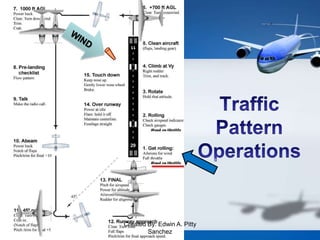
TRAFFIC PATTERN
WIND INDICATORS
ATIS
AIRPORT LIGHTING
Created By: Edwin A. Pitty
Sanchez
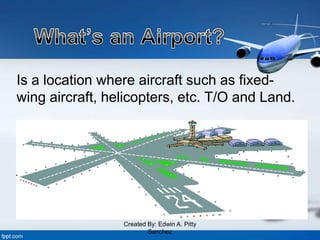
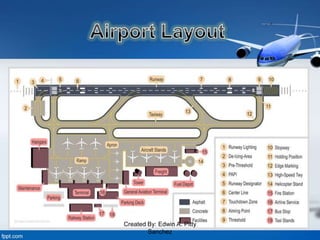
Is a location where aircraft such as fixed-
wing aircraft, helicopters, etc. T/O and Land.
Created By: Edwin A. Pitty
Sanchez
Created By: Edwin A. Pitty
Sanchez
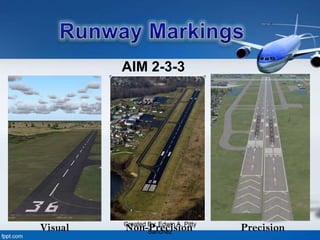
AIM 2-3-3
Visual Non-Precision PrecisionCreated By: Edwin A. Pitty
Sanchez
Created By: Edwin A. Pitty
Sanchez
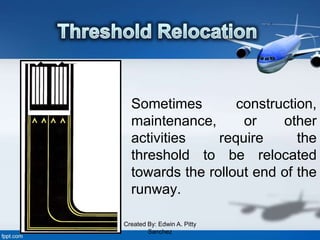
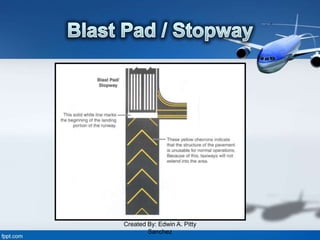
Sometimes construction,
maintenance, or other
activities require the
threshold to be relocated
towards the rollout end of the
runway.
Created By: Edwin A. Pitty
Sanchez
Created By: Edwin A. Pitty
Sanchez
Created By: Edwin A. Pitty
Sanchez
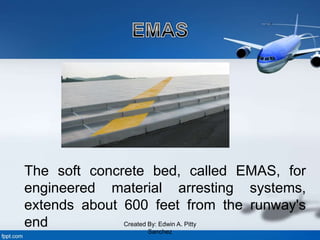
The soft concrete bed, called EMAS, for
engineered material arresting systems,
extends about 600 feet from the runway's
end Created By: Edwin A. Pitty
Sanchez
Created By: Edwin A. Pitty
Sanchez
Created By: Edwin A. Pitty
Sanchez
Created By: Edwin A. Pitty
Sanchez
Created By: Edwin A. Pitty
Sanchez
AIM 4-3-11
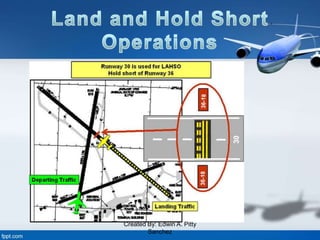
Land and Hold Short Clearances (LAHSO) are
issued by ATC at towered airports to increase
efficiency
• Hold short points can be:
– Intersecting runway.
– Intersecting taxiway.
– Other designated hold short point.
• Pilots must stop the aircraft prior to reaching the
designated hold short point.
– Failure to do so may compromise safety.
– The pilot has the option to decline a LAHSO clearance
when issued.
Created By: Edwin A. Pitty
Sanchez
Created By: Edwin A. Pitty
Sanchez
• Pilot has final authority to accept LAHSO
• Become familiar with LAHSO operations at destination prior
to departure
– Consult A/FD
• In the event of a rejected landing, maintain safe separation
and notify ATC immediately
• Readback all LAHSO clearances in full
– Do not make controller ask for a readback
• Maintain situational awareness
– Have airport diagram and ALD info available
• Brief other cockpit crewmembers
• Pilots should only be issued LAHSO clearances with ceilings
at least 1,000’ and visibility 3 SMCreated By: Edwin A. Pitty
Sanchez
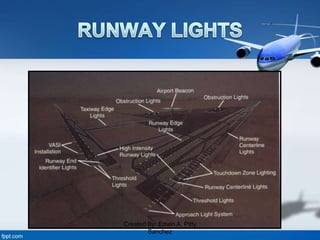
Airport lighting may include one or more of the following:
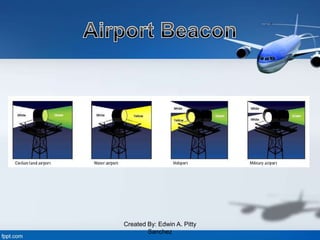
– Airport beacon
– Visual glideslope indicators
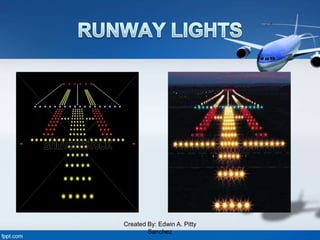
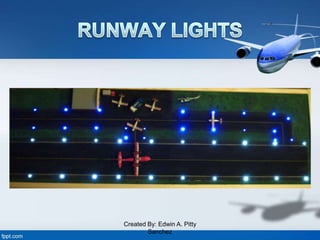
– Runway lighting
• Edge lighting
• Runway centerline lighting
• Touchdown zone lighting
• Taxiway lead-off lights
– Taxiway lighting
• Edge lighting
• Taxiway centerline lighting
– Approach lighting system
– Obstruction lighting Created By: Edwin A. Pitty
Sanchez
Created By: Edwin A. Pitty
Sanchez
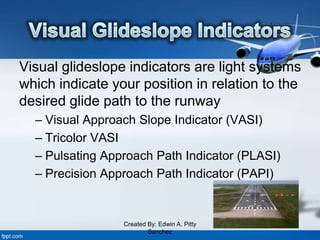
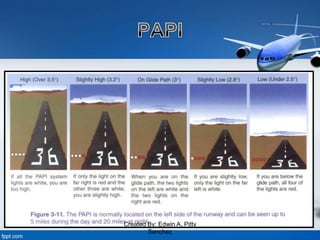
Visual glideslope indicators are light systems
which indicate your position in relation to the
desired glide path to the runway
– Visual Approach Slope Indicator (VASI)
– Tricolor VASI
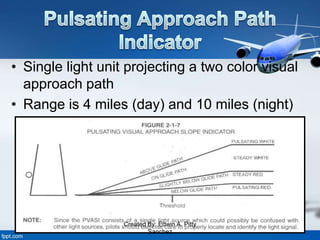
– Pulsating Approach Path Indicator (PLASI)
– Precision Approach Path Indicator (PAPI)
Created By: Edwin A. Pitty
Sanchez
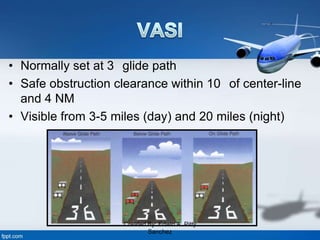
• Normally set at 3 glide path
• Safe obstruction clearance within 10 of center-line
and 4 NM
• Visible from 3-5 miles (day) and 20 miles (night)
Created By: Edwin A. Pitty
Sanchez
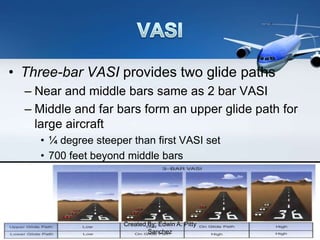
• Three-bar VASI provides two glide paths
– Near and middle bars same as 2 bar VASI
– Middle and far bars form an upper glide path for
large aircraft
• ¼ degree steeper than first VASI set
• 700 feet beyond middle bars
Created By: Edwin A. Pitty
Sanchez
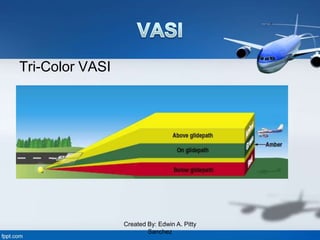
Tri-Color VASI
Created By: Edwin A. Pitty
Sanchez
Created By: Edwin A. Pitty
Sanchez
• Single light unit projecting a two color visual
approach path
• Range is 4 miles (day) and 10 miles (night)
Created By: Edwin A. Pitty
Sanchez
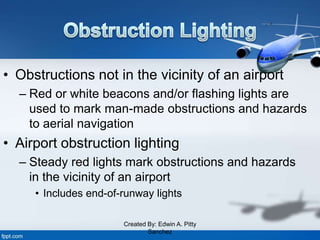
• Obstructions not in the vicinity of an airport
– Red or white beacons and/or flashing lights are
used to mark man-made obstructions and hazards
to aerial navigation
• Airport obstruction lighting
– Steady red lights mark obstructions and hazards
in the vicinity of an airport
• Includes end-of-runway lights
Created By: Edwin A. Pitty
Sanchez
Created By: Edwin A. Pitty
Sanchez
Created By: Edwin A. Pitty
Sanchez
Created By: Edwin A. Pitty
Sanchez
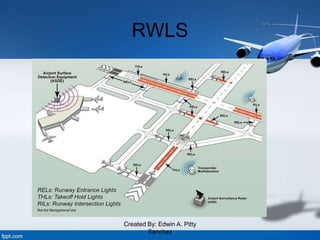
RWLS
Created By: Edwin A. Pitty
Sanchez
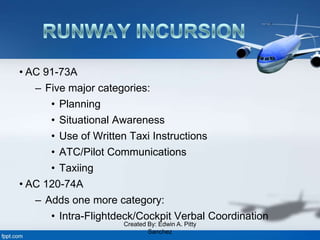
• AC 91-73A
– Five major categories:
• Planning
• Situational Awareness
• Use of Written Taxi Instructions
• ATC/Pilot Communications
• Taxiing
• AC 120-74A
– Adds one more category:
• Intra-Flightdeck/Cockpit Verbal Coordination
Created By: Edwin A. Pitty
Sanchez
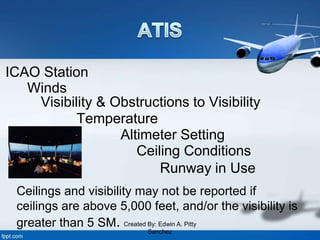
ICAO Station
Winds
Visibility & Obstructions to Visibility
Temperature
Altimeter Setting
Ceiling Conditions
Runway in Use
Ceilings and visibility may not be reported if
ceilings are above 5,000 feet, and/or the visibility is
greater than 5 SM. Created By: Edwin A. Pitty
Sanchez
Created By: Edwin A. Pitty
Sanchez
Created By: Edwin A. Pitty
Sanchez
Created By: Edwin A. Pitty
Sanchez

Airport Operations & Traffic Pattern Operations

  • 1.
    LAHSO RUNWAY INCURSIONS TRAFFICPATTERN WIND INDICATORS ATIS AIRPORT LIGHTING Created By: Edwin A. Pitty Sanchez
  • 2.
    Is a locationwhere aircraft such as fixed- wing aircraft, helicopters, etc. T/O and Land. Created By: Edwin A. Pitty Sanchez
  • 3.
    Created By: EdwinA. Pitty Sanchez
  • 4.
    AIM 2-3-3 Visual Non-PrecisionPrecisionCreated By: Edwin A. Pitty Sanchez
  • 5.
    Created By: EdwinA. Pitty Sanchez
  • 6.
    Sometimes construction, maintenance, orother activities require the threshold to be relocated towards the rollout end of the runway. Created By: Edwin A. Pitty Sanchez
  • 7.
    Created By: EdwinA. Pitty Sanchez
  • 8.
    Created By: EdwinA. Pitty Sanchez
  • 9.
    The soft concretebed, called EMAS, for engineered material arresting systems, extends about 600 feet from the runway's end Created By: Edwin A. Pitty Sanchez
  • 10.
    Created By: EdwinA. Pitty Sanchez
  • 11.
    Created By: EdwinA. Pitty Sanchez
  • 12.
    Created By: EdwinA. Pitty Sanchez
  • 13.
    Created By: EdwinA. Pitty Sanchez
  • 14.
    AIM 4-3-11 Land andHold Short Clearances (LAHSO) are issued by ATC at towered airports to increase efficiency • Hold short points can be: – Intersecting runway. – Intersecting taxiway. – Other designated hold short point. • Pilots must stop the aircraft prior to reaching the designated hold short point. – Failure to do so may compromise safety. – The pilot has the option to decline a LAHSO clearance when issued. Created By: Edwin A. Pitty Sanchez
  • 15.
    Created By: EdwinA. Pitty Sanchez
  • 16.
    • Pilot hasfinal authority to accept LAHSO • Become familiar with LAHSO operations at destination prior to departure – Consult A/FD • In the event of a rejected landing, maintain safe separation and notify ATC immediately • Readback all LAHSO clearances in full – Do not make controller ask for a readback • Maintain situational awareness – Have airport diagram and ALD info available • Brief other cockpit crewmembers • Pilots should only be issued LAHSO clearances with ceilings at least 1,000’ and visibility 3 SMCreated By: Edwin A. Pitty Sanchez
  • 17.
    Airport lighting mayinclude one or more of the following: – Airport beacon – Visual glideslope indicators – Runway lighting • Edge lighting • Runway centerline lighting • Touchdown zone lighting • Taxiway lead-off lights – Taxiway lighting • Edge lighting • Taxiway centerline lighting – Approach lighting system – Obstruction lighting Created By: Edwin A. Pitty Sanchez
  • 18.
    Created By: EdwinA. Pitty Sanchez
  • 19.
    Visual glideslope indicatorsare light systems which indicate your position in relation to the desired glide path to the runway – Visual Approach Slope Indicator (VASI) – Tricolor VASI – Pulsating Approach Path Indicator (PLASI) – Precision Approach Path Indicator (PAPI) Created By: Edwin A. Pitty Sanchez
  • 20.
    • Normally setat 3 glide path • Safe obstruction clearance within 10 of center-line and 4 NM • Visible from 3-5 miles (day) and 20 miles (night) Created By: Edwin A. Pitty Sanchez
  • 21.
    • Three-bar VASIprovides two glide paths – Near and middle bars same as 2 bar VASI – Middle and far bars form an upper glide path for large aircraft • ¼ degree steeper than first VASI set • 700 feet beyond middle bars Created By: Edwin A. Pitty Sanchez
  • 22.
    Tri-Color VASI Created By:Edwin A. Pitty Sanchez
  • 23.
    Created By: EdwinA. Pitty Sanchez
  • 24.
    • Single lightunit projecting a two color visual approach path • Range is 4 miles (day) and 10 miles (night) Created By: Edwin A. Pitty Sanchez
  • 25.
    • Obstructions notin the vicinity of an airport – Red or white beacons and/or flashing lights are used to mark man-made obstructions and hazards to aerial navigation • Airport obstruction lighting – Steady red lights mark obstructions and hazards in the vicinity of an airport • Includes end-of-runway lights Created By: Edwin A. Pitty Sanchez
  • 26.
    Created By: EdwinA. Pitty Sanchez
  • 27.
    Created By: EdwinA. Pitty Sanchez
  • 28.
    Created By: EdwinA. Pitty Sanchez
  • 29.
    RWLS Created By: EdwinA. Pitty Sanchez
  • 30.
    • AC 91-73A –Five major categories: • Planning • Situational Awareness • Use of Written Taxi Instructions • ATC/Pilot Communications • Taxiing • AC 120-74A – Adds one more category: • Intra-Flightdeck/Cockpit Verbal Coordination Created By: Edwin A. Pitty Sanchez
  • 31.
    ICAO Station Winds Visibility &Obstructions to Visibility Temperature Altimeter Setting Ceiling Conditions Runway in Use Ceilings and visibility may not be reported if ceilings are above 5,000 feet, and/or the visibility is greater than 5 SM. Created By: Edwin A. Pitty Sanchez
  • 32.
    Created By: EdwinA. Pitty Sanchez
  • 33.
    Created By: EdwinA. Pitty Sanchez
  • 34.
    Created By: EdwinA. Pitty Sanchez