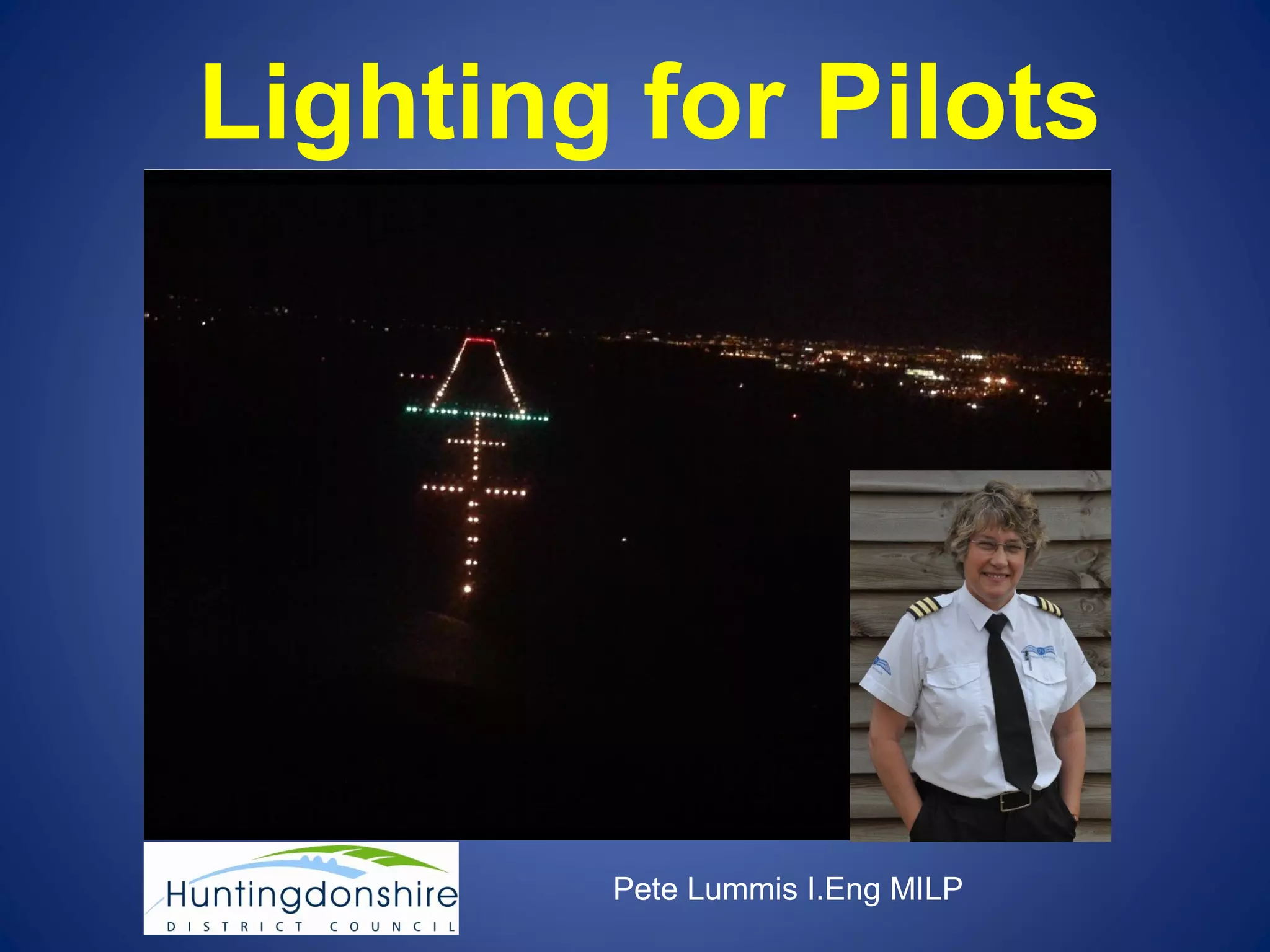


Lighting for Pilots 
Pete Lummis I.Eng MILP
A message from Trix Lummis
Seeing the runway from a distance
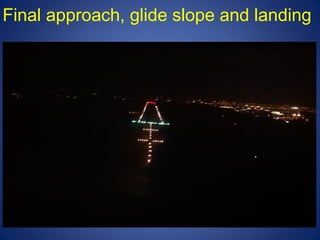
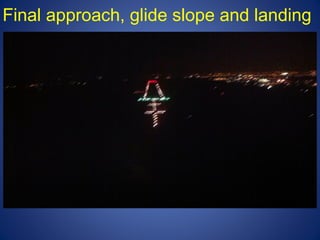
Final approach, glide slope and landing
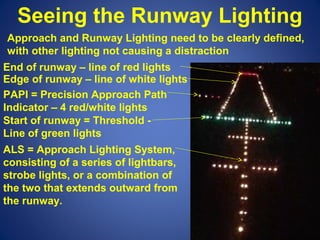
Seeing the Runway Lighting 
Approach and Runway Lighting need to be clearly defined, 
with other lighting not causing a distraction 
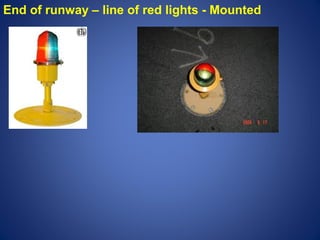
End of runway – line of red lights 
Edge of runway – line of white lights 
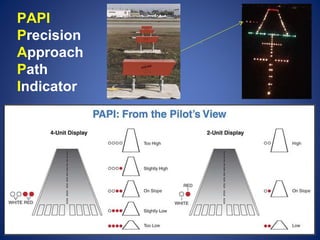
PAPI = Precision Approach Path 
Indicator – 4 red/white lights 
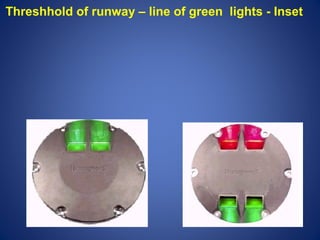
Start of runway = Threshold - 
Line of green lights 
ALS = Approach Lighting System, 
consisting of a series of lightbars, 
strobe lights, or a combination of 
the two that extends outward from 
the runway.
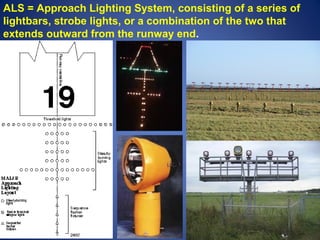
ALS = Approach Lighting System, consisting of a series of 
lightbars, strobe lights, or a combination of the two that 
extends outward from the runway end.
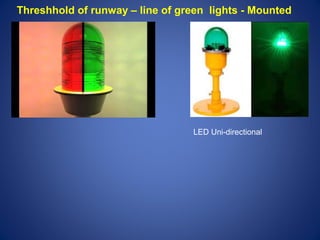
Threshhold of runway – line of green lights - Mounted 
LED Uni-directional
Threshhold of runway – line of green lights - Inset
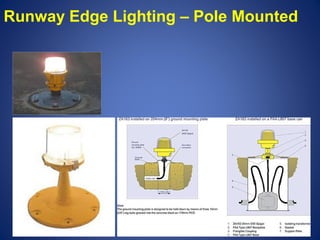
Runway Edge Lighting – Pole Mounted
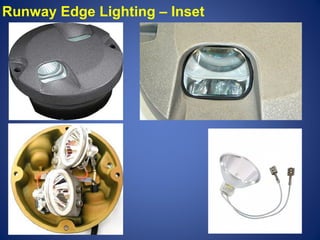
Runway Edge Lighting – Inset
End of runway – line of red lights - Mounted
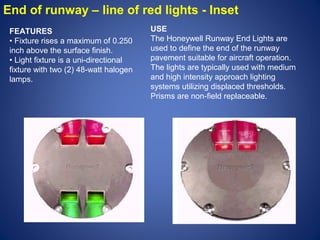
End of runway – line of red lights - Inset 
FEATURES 
• Fixture rises a maximum of 0.250 
inch above the surface finish. 
• Light fixture is a uni-directional 
fixture with two (2) 48-watt halogen 
lamps. 
USE 
The Honeywell Runway End Lights are 
used to define the end of the runway 
pavement suitable for aircraft operation. 
The lights are typically used with medium 
and high intensity approach lighting 
systems utilizing displaced thresholds. 
Prisms are non-field replaceable.
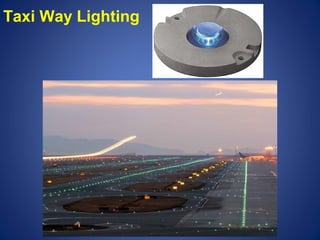
Taxi Way Lighting
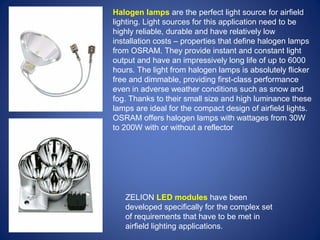
Halogen lamps are the perfect light source for airfield 
lighting. Light sources for this application need to be 
highly reliable, durable and have relatively low 
installation costs – properties that define halogen lamps 
from OSRAM. They provide instant and constant light 
output and have an impressively long life of up to 6000 
hours. The light from halogen lamps is absolutely flicker 
free and dimmable, providing first-class performance 
even in adverse weather conditions such as snow and 
fog. Thanks to their small size and high luminance these 
lamps are ideal for the compact design of airfield lights. 
OSRAM offers halogen lamps with wattages from 30W 
to 200W with or without a reflector 
ZELION LED modules have been 
developed specifically for the complex set 
of requirements that have to be met in 
airfield lighting applications.
PAPI 
Precision 
Approach 
Path 
Indicator
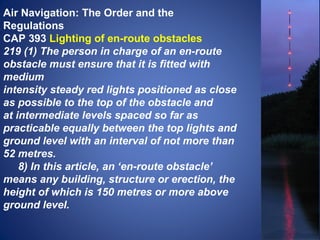
Air Navigation: The Order and the 
Regulations 
CAP 393 Lighting of en-route obstacles 
219 (1) The person in charge of an en-route 
obstacle must ensure that it is fitted with 
medium 
intensity steady red lights positioned as close 
as possible to the top of the obstacle and 
at intermediate levels spaced so far as 
practicable equally between the top lights and 
ground level with an interval of not more than 
52 metres. 
8) In this article, an ‘en-route obstacle’ 
means any building, structure or erection, the 
height of which is 150 metres or more above 
ground level.
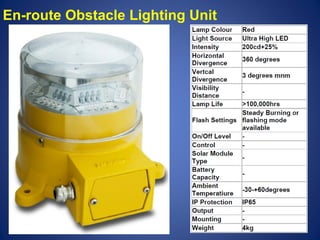
En-route Obstacle Lighting Unit
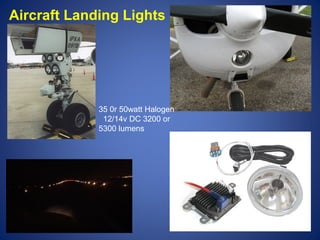
Aircraft Landing Lights 
35 0r 50watt Halogen 
12/14v DC 3200 or 
5300 lumens
CAP393 Air Navigation:The Order and Regulations 
Lights liable to endanger 
221 (1) A person must not exhibit in the United Kingdom any light 
which: 
(a) by reason of its glare is liable to endanger aircraft taking off 
from or landing at an 
aerodrome; or 
(b) by reason of its liability to be mistaken for an aeronautical 
ground light is liable to 
endanger aircraft. 
(2) If any light which appears to the CAA to be a light described in 
paragraph (1) is exhibited, 
the CAA may direct the person who is the occupier of the place 
where the light is 
exhibited or who has charge of the light, to take such steps within a 
reasonable time as 
are specified in the direction: 
(a) to extinguish or screen the light; and 
(b) to prevent in the future the exhibition of any other light which 
may similarly 
endanger aircraft.
A lighting designers responsibilities under BS 5489-1:2013 
7.8.2 Lighting in the vicinity of aerodromes 
7.8.2.1 General 
NOTE 1 The Civil Aviation Act 1982 [45], Section 105 
specifically defines an aerodrome as any area of land or 
water designed, equipped, set apart or commonly used for 
affording facilities for the landing and departure of aircraft 
and includes any area or space, whether on the ground, on 
the roof of a building or elsewhere, which is designed, 
equipped, and set apart for affording facilities for the landing 
and departure of aircraft capable of descending or climbing 
vertically.
A lighting designers responsibilities under BS 5489-1:2013 
NOTE 2 Attention is drawn to the Air Navigation Order 2000 [46], Article 110 in 
respect of lights that might affect aircraft. A light can endanger aircraft when: 
a)the intensity causes glare in the direction of an approaching aircraft; 
b) the colour (e.g. advertising signs) causes it to be mistaken for an 
aeronautical light; 
c) viewed from the air, lights make a pattern (e.g. a row of street lights) 
similar to an approach or runway lighting pattern; 
d) the overall amount of illumination near the approach to a runway 
detracts from the effectiveness of the visual aids provided by the 
aerodrome for use by 
aircraft, particularly in poor visibility conditions. 
Road lighting can present a hazard due to the effect of lighting upon the pilot’s 
visual picture or due to the creation of physical obstacles within the airspace 
manoeuvring area around the aerodrome. A road lighting scheme could 
prejudice the safe movement of aircraft on either or both grounds. Each issue 
should be addressed separately and appropriate measures taken to minimize 
any hazards identified.
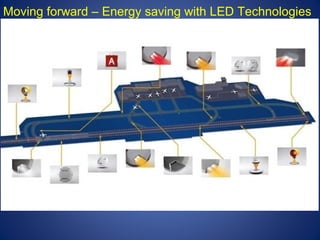
Moving forward – Energy saving with LED Technologies

PLS 2014: Lighting for Pilots

  • 1.
    Lighting for Pilots Pete Lummis I.Eng MILP
  • 2.
    A message fromTrix Lummis
  • 3.
    A message fromTrix Lummis
  • 4.
    Seeing the runwayfrom a distance
  • 5.
    Final approach, glideslope and landing
  • 6.
    Final approach, glideslope and landing
  • 7.
    Seeing the RunwayLighting Approach and Runway Lighting need to be clearly defined, with other lighting not causing a distraction End of runway – line of red lights Edge of runway – line of white lights PAPI = Precision Approach Path Indicator – 4 red/white lights Start of runway = Threshold - Line of green lights ALS = Approach Lighting System, consisting of a series of lightbars, strobe lights, or a combination of the two that extends outward from the runway.
  • 8.
    ALS = ApproachLighting System, consisting of a series of lightbars, strobe lights, or a combination of the two that extends outward from the runway end.
  • 9.
    Threshhold of runway– line of green lights - Mounted LED Uni-directional
  • 10.
    Threshhold of runway– line of green lights - Inset
  • 11.
    Runway Edge Lighting– Pole Mounted
  • 12.
  • 13.
    End of runway– line of red lights - Mounted
  • 14.
    End of runway– line of red lights - Inset FEATURES • Fixture rises a maximum of 0.250 inch above the surface finish. • Light fixture is a uni-directional fixture with two (2) 48-watt halogen lamps. USE The Honeywell Runway End Lights are used to define the end of the runway pavement suitable for aircraft operation. The lights are typically used with medium and high intensity approach lighting systems utilizing displaced thresholds. Prisms are non-field replaceable.
  • 15.
  • 16.
    Halogen lamps arethe perfect light source for airfield lighting. Light sources for this application need to be highly reliable, durable and have relatively low installation costs – properties that define halogen lamps from OSRAM. They provide instant and constant light output and have an impressively long life of up to 6000 hours. The light from halogen lamps is absolutely flicker free and dimmable, providing first-class performance even in adverse weather conditions such as snow and fog. Thanks to their small size and high luminance these lamps are ideal for the compact design of airfield lights. OSRAM offers halogen lamps with wattages from 30W to 200W with or without a reflector ZELION LED modules have been developed specifically for the complex set of requirements that have to be met in airfield lighting applications.
  • 17.
    PAPI Precision Approach Path Indicator
  • 18.
    Air Navigation: TheOrder and the Regulations CAP 393 Lighting of en-route obstacles 219 (1) The person in charge of an en-route obstacle must ensure that it is fitted with medium intensity steady red lights positioned as close as possible to the top of the obstacle and at intermediate levels spaced so far as practicable equally between the top lights and ground level with an interval of not more than 52 metres. 8) In this article, an ‘en-route obstacle’ means any building, structure or erection, the height of which is 150 metres or more above ground level.
  • 19.
  • 20.
    Aircraft Landing Lights 35 0r 50watt Halogen 12/14v DC 3200 or 5300 lumens
  • 21.
    CAP393 Air Navigation:TheOrder and Regulations Lights liable to endanger 221 (1) A person must not exhibit in the United Kingdom any light which: (a) by reason of its glare is liable to endanger aircraft taking off from or landing at an aerodrome; or (b) by reason of its liability to be mistaken for an aeronautical ground light is liable to endanger aircraft. (2) If any light which appears to the CAA to be a light described in paragraph (1) is exhibited, the CAA may direct the person who is the occupier of the place where the light is exhibited or who has charge of the light, to take such steps within a reasonable time as are specified in the direction: (a) to extinguish or screen the light; and (b) to prevent in the future the exhibition of any other light which may similarly endanger aircraft.
  • 22.
    A lighting designersresponsibilities under BS 5489-1:2013 7.8.2 Lighting in the vicinity of aerodromes 7.8.2.1 General NOTE 1 The Civil Aviation Act 1982 [45], Section 105 specifically defines an aerodrome as any area of land or water designed, equipped, set apart or commonly used for affording facilities for the landing and departure of aircraft and includes any area or space, whether on the ground, on the roof of a building or elsewhere, which is designed, equipped, and set apart for affording facilities for the landing and departure of aircraft capable of descending or climbing vertically.
  • 23.
    A lighting designersresponsibilities under BS 5489-1:2013 NOTE 2 Attention is drawn to the Air Navigation Order 2000 [46], Article 110 in respect of lights that might affect aircraft. A light can endanger aircraft when: a)the intensity causes glare in the direction of an approaching aircraft; b) the colour (e.g. advertising signs) causes it to be mistaken for an aeronautical light; c) viewed from the air, lights make a pattern (e.g. a row of street lights) similar to an approach or runway lighting pattern; d) the overall amount of illumination near the approach to a runway detracts from the effectiveness of the visual aids provided by the aerodrome for use by aircraft, particularly in poor visibility conditions. Road lighting can present a hazard due to the effect of lighting upon the pilot’s visual picture or due to the creation of physical obstacles within the airspace manoeuvring area around the aerodrome. A road lighting scheme could prejudice the safe movement of aircraft on either or both grounds. Each issue should be addressed separately and appropriate measures taken to minimize any hazards identified.
  • 24.
    Moving forward –Energy saving with LED Technologies
  • 25.
    Moving forward –Energy saving with LED Technologies