



SUMMER INTERNSHIP JUNE
2013 AT INDIA AVIATION
CONSULTING AND SUPPORT
,LLP
• A modern helicopter is one of the most versatile
transportation vehicles known to man.
• Typically, a heliport is smaller than an airport providing
comparable services. In a large metrocity ,a heliport can
serve passengers needing to quickly move within the city
or to outlying regions.
• The advantage in flying by helicopter to a destination is
that travel can be much faster than driving a car to that
destination point.
• Surface Heliport and Elevated heliport
• Site selection for constructing a heliport
• Selection of helicopters and selecting the critical one
• Minimum requirements for designing the
TLOF/FATO/SAFETY AREA
• Taxiway Requirements
• Visual Aids
• Visual Glide Slope Indicator
• Helicopter Approach Path Indicator
• Marking Aids
• Lighting Aids
• Safety Considerations at heliport
• Comparative study of Surface and elevated heliport
• Heliport built on the ground surfaces are known as
surface heliports. The basic element of surface heliport
are FATO , TLOF, Safety Area ,Helicopter Parking ,Clear
Approach Area ,Rescue & Fire Fighting …etc.
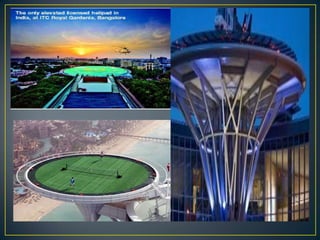
• Elevated Heliport
• Heliport built on a raised structure are known as elevated
heliports and the raised structure shall be atleast
30inches above ground.
• Long term planning – for future expansion
• Area requirements –depending on the number of
operations to be held.
• Obstruction clearance
• Wind direction and speed – air flowing around buildings
and stand alone trees .
• Electromagnetic Effects – large ventilators and motors.
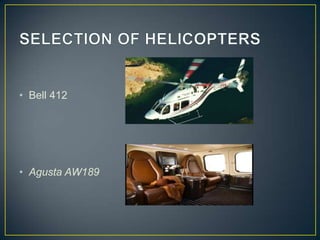
• Bell 412
• Agusta AW189
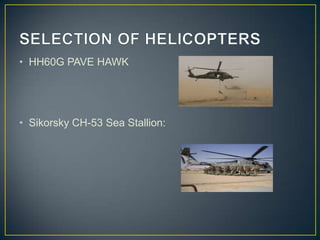
• HH60G PAVE HAWK
• Sikorsky CH-53 Sea Stallion:
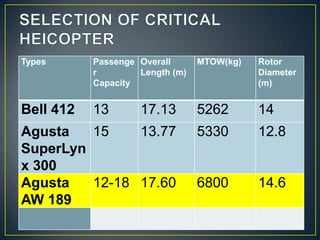
Types Passenge
r
Capacity
Overall
Length (m)
MTOW(kg) Rotor
Diameter
(m)
Bell 412 13 17.13 5262 14
Agusta
SuperLyn
x 300
15 13.77 5330 12.8
Agusta
AW 189
12-18 17.60 6800 14.6
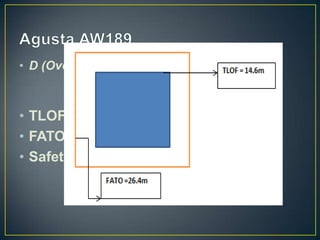
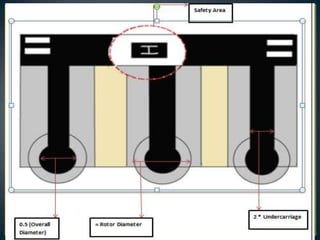
• D (Overall Length) = 17.6 m RD = 14.6 m
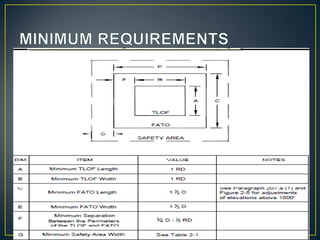
• TLOF = 1 RD
• FATO = 1.5 * D = 26.4 m
• Safety Area = 25% * 17.6 = 4.4m
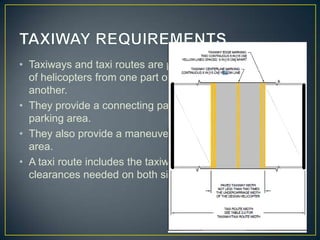
• Taxiways and taxi routes are provided for the movement
of helicopters from one part of a landing facility to
another.
• They provide a connecting path between the FATO and a
parking area.
• They also provide a maneuvering aisle within the parking
area.
• A taxi route includes the taxiway plus the appropriate
clearances needed on both sides.
• Taxiway width: 1.5 times the rotor diameter of the
designated critical helicopter.
• Taxiway meant for hovering (Taxiroute): i.e. meant for
helicopters without landing gear wheels. Are taken as 2
times that of the rotor diameter.
• Here in this project in case of the civil operations we have
our taxiway width as 22m i.e. 1.5 * 14.6 which comes as
21.9 m and taxiroute width as 2 * 14.6 = 29.2
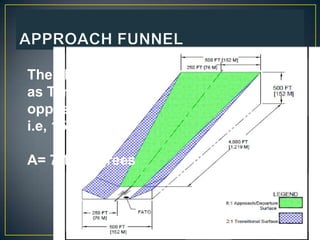
The slope is taken
as Tan A =
opposite/adjacent
i.e, 152 / 1219
A= 7.14 degrees
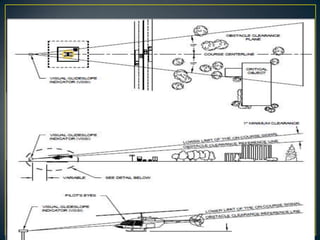
• A visual glideslope indicator (VGSI) provides pilots with
visual vertical course and descending cues. Install the
VGSI such that the lowest on-course visual signal
provides a minimum of 1 degree of clearance over any
object that lies within 10 degrees of the approach course
centerline.
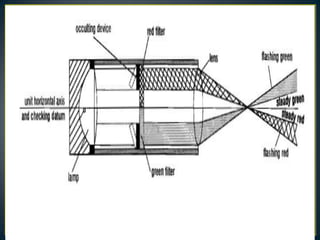
• HAPI is designed to give visual indications of the desired
approach slope and deviations from it .
• HAPI is a sngle unit device providing one normal
approach path and three discrete deviation indications.
• HAPI is a projector unit producing a light signal, the lower
half of which is red and the upper half of which is green .
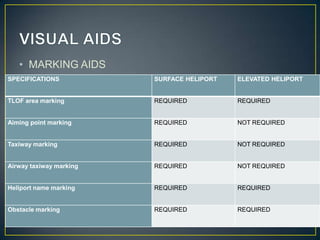
• MARKING AIDS
SPECIFICATIONS SURFACE HELIPORT ELEVATED HELIPORT
TLOF area marking REQUIRED REQUIRED
Aiming point marking REQUIRED NOT REQUIRED
Taxiway marking REQUIRED NOT REQUIRED
Airway taxiway marking REQUIRED NOT REQUIRED
Heliport name marking REQUIRED REQUIRED
Obstacle marking REQUIRED REQUIRED
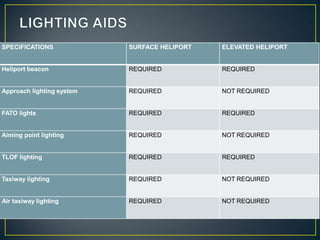
SPECIFICATIONS SURFACE HELIPORT ELEVATED HELIPORT
Heliport beacon REQUIRED REQUIRED
Approach lighting system REQUIRED NOT REQUIRED
FATO lights REQUIRED REQUIRED
Aiming point lighting REQUIRED NOT REQUIRED
TLOF lighting REQUIRED REQUIRED
Taxiway lighting REQUIRED NOT REQUIRED
Air taxiway lighting REQUIRED NOT REQUIRED
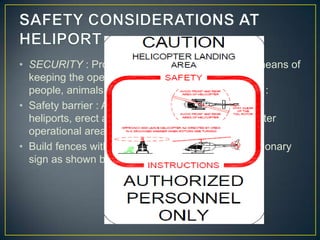
• SECURITY : Provide a heliport with appropriate means of
keeping the operational areas clear of
people, animals, and vehicles by following means :
• Safety barrier : At ground-level general aviation
heliports, erect a safety barrier around the helicopter
operational areas in the form of a fence or a wall.
• Build fences with locked gates and Display a cautionary
sign as shown below :
• RESCUE AND FIRE FIGHTING SERVICES : Heliports
are subject to state and local rescue and fire-fighting
regulations. Provide a fire hose cabinet or extinguisher at
each access gate/door and each fueling location.
However all these meet the ICAO stipulated guidelines
for helicopter operations.
• COMMUNICATIONS : Use a Common Traffic Advisory
radio in AERO MOBILE BAND(107 – 136Mhz) to provide
arriving helicopters with traffic advisory information.
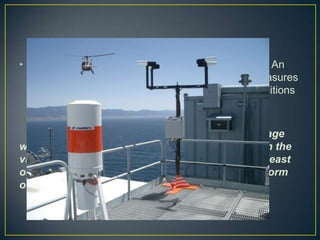
• AUTOMATED WEATHER OBSERVING SYSTEM : An
automated weather observing system (AWOS) measures
and automatically broadcasts current weather conditions
at the heliport site.
AWOS : A computer-generated voice message
which is broadcast via radio frequency to pilots in the
vicinity of an airport. The message is updated at least
once per minute, and this is the only mandatory form
of weather reporting for an AWOS.
Compartive study of surface heliport and elevated heliport

Compartive study of surface heliport and elevated heliport

  • 1.
    SUMMER INTERNSHIP JUNE 2013AT INDIA AVIATION CONSULTING AND SUPPORT ,LLP
  • 2.
    • A modernhelicopter is one of the most versatile transportation vehicles known to man. • Typically, a heliport is smaller than an airport providing comparable services. In a large metrocity ,a heliport can serve passengers needing to quickly move within the city or to outlying regions. • The advantage in flying by helicopter to a destination is that travel can be much faster than driving a car to that destination point.
  • 4.
    • Surface Heliportand Elevated heliport • Site selection for constructing a heliport • Selection of helicopters and selecting the critical one • Minimum requirements for designing the TLOF/FATO/SAFETY AREA • Taxiway Requirements
  • 5.
    • Visual Aids •Visual Glide Slope Indicator • Helicopter Approach Path Indicator • Marking Aids • Lighting Aids • Safety Considerations at heliport • Comparative study of Surface and elevated heliport
  • 6.
    • Heliport builton the ground surfaces are known as surface heliports. The basic element of surface heliport are FATO , TLOF, Safety Area ,Helicopter Parking ,Clear Approach Area ,Rescue & Fire Fighting …etc. • Elevated Heliport • Heliport built on a raised structure are known as elevated heliports and the raised structure shall be atleast 30inches above ground.
  • 7.
    • Long termplanning – for future expansion • Area requirements –depending on the number of operations to be held. • Obstruction clearance • Wind direction and speed – air flowing around buildings and stand alone trees . • Electromagnetic Effects – large ventilators and motors.
  • 8.
    • Bell 412 •Agusta AW189
  • 9.
    • HH60G PAVEHAWK • Sikorsky CH-53 Sea Stallion:
  • 10.
    Types Passenge r Capacity Overall Length (m) MTOW(kg)Rotor Diameter (m) Bell 412 13 17.13 5262 14 Agusta SuperLyn x 300 15 13.77 5330 12.8 Agusta AW 189 12-18 17.60 6800 14.6
  • 11.
    • D (OverallLength) = 17.6 m RD = 14.6 m • TLOF = 1 RD • FATO = 1.5 * D = 26.4 m • Safety Area = 25% * 17.6 = 4.4m
  • 13.
    • Taxiways andtaxi routes are provided for the movement of helicopters from one part of a landing facility to another. • They provide a connecting path between the FATO and a parking area. • They also provide a maneuvering aisle within the parking area. • A taxi route includes the taxiway plus the appropriate clearances needed on both sides.
  • 14.
    • Taxiway width:1.5 times the rotor diameter of the designated critical helicopter. • Taxiway meant for hovering (Taxiroute): i.e. meant for helicopters without landing gear wheels. Are taken as 2 times that of the rotor diameter. • Here in this project in case of the civil operations we have our taxiway width as 22m i.e. 1.5 * 14.6 which comes as 21.9 m and taxiroute width as 2 * 14.6 = 29.2
  • 15.
    The slope istaken as Tan A = opposite/adjacent i.e, 152 / 1219 A= 7.14 degrees
  • 17.
    • A visualglideslope indicator (VGSI) provides pilots with visual vertical course and descending cues. Install the VGSI such that the lowest on-course visual signal provides a minimum of 1 degree of clearance over any object that lies within 10 degrees of the approach course centerline.
  • 18.
    • HAPI isdesigned to give visual indications of the desired approach slope and deviations from it . • HAPI is a sngle unit device providing one normal approach path and three discrete deviation indications. • HAPI is a projector unit producing a light signal, the lower half of which is red and the upper half of which is green .
  • 19.
    • MARKING AIDS SPECIFICATIONSSURFACE HELIPORT ELEVATED HELIPORT TLOF area marking REQUIRED REQUIRED Aiming point marking REQUIRED NOT REQUIRED Taxiway marking REQUIRED NOT REQUIRED Airway taxiway marking REQUIRED NOT REQUIRED Heliport name marking REQUIRED REQUIRED Obstacle marking REQUIRED REQUIRED
  • 20.
    SPECIFICATIONS SURFACE HELIPORTELEVATED HELIPORT Heliport beacon REQUIRED REQUIRED Approach lighting system REQUIRED NOT REQUIRED FATO lights REQUIRED REQUIRED Aiming point lighting REQUIRED NOT REQUIRED TLOF lighting REQUIRED REQUIRED Taxiway lighting REQUIRED NOT REQUIRED Air taxiway lighting REQUIRED NOT REQUIRED
  • 21.
    • SECURITY :Provide a heliport with appropriate means of keeping the operational areas clear of people, animals, and vehicles by following means : • Safety barrier : At ground-level general aviation heliports, erect a safety barrier around the helicopter operational areas in the form of a fence or a wall. • Build fences with locked gates and Display a cautionary sign as shown below :
  • 22.
    • RESCUE ANDFIRE FIGHTING SERVICES : Heliports are subject to state and local rescue and fire-fighting regulations. Provide a fire hose cabinet or extinguisher at each access gate/door and each fueling location. However all these meet the ICAO stipulated guidelines for helicopter operations. • COMMUNICATIONS : Use a Common Traffic Advisory radio in AERO MOBILE BAND(107 – 136Mhz) to provide arriving helicopters with traffic advisory information.
  • 23.
    • AUTOMATED WEATHEROBSERVING SYSTEM : An automated weather observing system (AWOS) measures and automatically broadcasts current weather conditions at the heliport site. AWOS : A computer-generated voice message which is broadcast via radio frequency to pilots in the vicinity of an airport. The message is updated at least once per minute, and this is the only mandatory form of weather reporting for an AWOS.