Aeronautical Ground Lights
For Air Traffic Controller Training
Center
Mumbai Airport
Introduction
• Aeronautical Ground Lights (AGL) are visual
aids installed at aerodromes to assist pilots
and air traffic controllers in safe aircraft
movement during night and low visibility
operations.
Purpose of Aeronautical Ground
Lighting
• • Safe landing, take-off, and taxiing
• • Guidance during night and poor visibility
• • Runway and taxiway identification
• • Obstruction marking
• • Compliance with ICAO & DGCA standards
Regulatory Standards
• • ICAO Annex 14 – Aerodromes
• • DGCA CAR Section 4 – Aerodromes
• • FAA AC 150 (Reference)
• • CAT I, CAT II, CAT III requirements
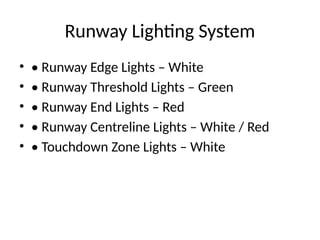
Runway Lighting System
• • Runway Edge Lights – White
• • Runway Threshold Lights – Green
• • Runway End Lights – Red
• • Runway Centreline Lights – White / Red
• • Touchdown Zone Lights – White
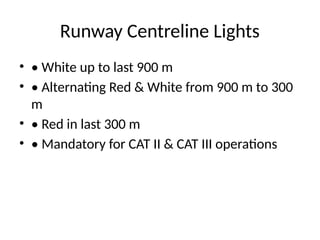
Runway Centreline Lights
• • White up to last 900 m
• • Alternating Red & White from 900 m to 300
m
• • Red in last 300 m
• • Mandatory for CAT II & CAT III operations
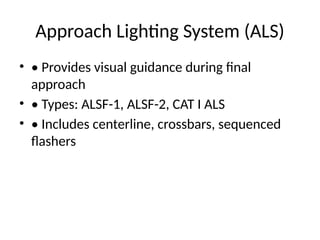
Approach Lighting System (ALS)
• • Provides visual guidance during final
approach
• • Types: ALSF-1, ALSF-2, CAT I ALS
• • Includes centerline, crossbars, sequenced
flashers
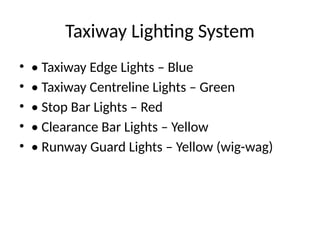
Taxiway Lighting System
• • Taxiway Edge Lights – Blue
• • Taxiway Centreline Lights – Green
• • Stop Bar Lights – Red
• • Clearance Bar Lights – Yellow
• • Runway Guard Lights – Yellow (wig-wag)
Stop Bar Lights
• • Red unidirectional lights
• • Installed at runway holding points
• • Used during LVP
• • Aircraft must not cross when illuminated
Apron Lighting
• • Provides illumination for aircraft parking
• • Floodlights mounted on masts
• • Ensures safe ground handling operations
Obstruction Lighting
• • Marks obstacles hazardous to aircraft
• • Red lights (low/medium intensity)
• • High-intensity white lights for tall structures
Lighting Control and Monitoring
• • Controlled from ATC Tower
• • Intensity control (Steps 1–5)
• • Standby power supply
• • Lighting monitoring and alarms
Low Visibility Procedures (LVP)
• • Mandatory use of stop bars
• • Centreline lighting required
• • Intensity adjusted as per RVR
• • Critical for CAT II / CAT III operations
Importance for Air Traffic
Controllers
• • Ensure correct lighting configuration
• • Prevent runway incursions
• • Maintain situational awareness
• • Support safe aircraft movement
Conclusion
• Aeronautical Ground Lighting is a critical
safety system at airports, enabling safe and
efficient aircraft operations under all visibility
conditions.

Aeronautical_Ground_Lights_ATC_Mumbai.pptx

  • 1.
    Aeronautical Ground Lights ForAir Traffic Controller Training Center Mumbai Airport
  • 2.
    Introduction • Aeronautical GroundLights (AGL) are visual aids installed at aerodromes to assist pilots and air traffic controllers in safe aircraft movement during night and low visibility operations.
  • 3.
    Purpose of AeronauticalGround Lighting • • Safe landing, take-off, and taxiing • • Guidance during night and poor visibility • • Runway and taxiway identification • • Obstruction marking • • Compliance with ICAO & DGCA standards
  • 4.
    Regulatory Standards • •ICAO Annex 14 – Aerodromes • • DGCA CAR Section 4 – Aerodromes • • FAA AC 150 (Reference) • • CAT I, CAT II, CAT III requirements
  • 5.
    Runway Lighting System •• Runway Edge Lights – White • • Runway Threshold Lights – Green • • Runway End Lights – Red • • Runway Centreline Lights – White / Red • • Touchdown Zone Lights – White
  • 6.
    Runway Centreline Lights •• White up to last 900 m • • Alternating Red & White from 900 m to 300 m • • Red in last 300 m • • Mandatory for CAT II & CAT III operations
  • 7.
    Approach Lighting System(ALS) • • Provides visual guidance during final approach • • Types: ALSF-1, ALSF-2, CAT I ALS • • Includes centerline, crossbars, sequenced flashers
  • 8.
    Taxiway Lighting System •• Taxiway Edge Lights – Blue • • Taxiway Centreline Lights – Green • • Stop Bar Lights – Red • • Clearance Bar Lights – Yellow • • Runway Guard Lights – Yellow (wig-wag)
  • 9.
    Stop Bar Lights •• Red unidirectional lights • • Installed at runway holding points • • Used during LVP • • Aircraft must not cross when illuminated
  • 10.
    Apron Lighting • •Provides illumination for aircraft parking • • Floodlights mounted on masts • • Ensures safe ground handling operations
  • 11.
    Obstruction Lighting • •Marks obstacles hazardous to aircraft • • Red lights (low/medium intensity) • • High-intensity white lights for tall structures
  • 12.
    Lighting Control andMonitoring • • Controlled from ATC Tower • • Intensity control (Steps 1–5) • • Standby power supply • • Lighting monitoring and alarms
  • 13.
    Low Visibility Procedures(LVP) • • Mandatory use of stop bars • • Centreline lighting required • • Intensity adjusted as per RVR • • Critical for CAT II / CAT III operations
  • 14.
    Importance for AirTraffic Controllers • • Ensure correct lighting configuration • • Prevent runway incursions • • Maintain situational awareness • • Support safe aircraft movement
  • 15.
    Conclusion • Aeronautical GroundLighting is a critical safety system at airports, enabling safe and efficient aircraft operations under all visibility conditions.