Airbus A3XX:
Developing the World’s Largest
Commercial Jet
                 Group 1

                 111 Rakshit Jhunjunwala

                 115 Ankitesh Mathur

                 211 Manu Shrivastava

                 301 Balagopal Padmakumar

                 402 Rishi Bajaj
Airline Industry – An Overview
 Highly competitive

 Capital and Labor intensive

 Seasonal industry – increased revenues in 2nd and 3rd
  quarters

 Sensitive – Fuel Prices, Price of airfares and customer
  demand
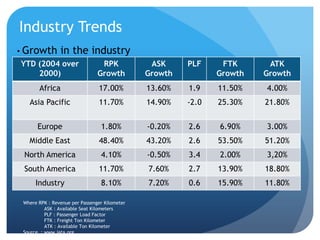
Industry Trends
• Growth        in the industry
YTD (2004 over                   RPK            ASK     PLF     FTK      ATK
    2000)                       Growth         Growth          Growth   Growth
       Africa                   17.00%         13.60%   1.9    11.50%   4.00%
   Asia Pacific                 11.70%         14.90%   -2.0   25.30%   21.80%


       Europe                    1.80%         -0.20%   2.6    6.90%    3.00%
   Middle East                  48.40%         43.20%   2.6    53.50%   51.20%
 North America                   4.10%         -0.50%   3.4    2.00%    3,20%
 South America                  11.70%         7.60%    2.7    13.90%   18.80%
      Industry                   8.10%         7.20%    0.6    15.90%   11.80%

 Where RPK : Revenue per Passenger Kilometer
          ASK : Available Seat Kilometers
          PLF : Passenger Load Factor
          FTK : Freight Ton Kilometer
          ATK : Available Ton Kilometer
 Source : www.iata.org
Dynamics of Airline Industry
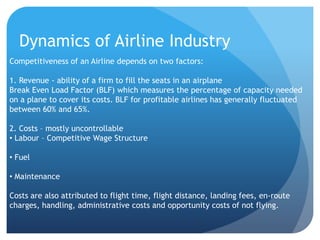
Competitiveness of an Airline depends on two factors:

1. Revenue - ability of a firm to fill the seats in an airplane
Break Even Load Factor (BLF) which measures the percentage of capacity needed
on a plane to cover its costs. BLF for profitable airlines has generally fluctuated
between 60% and 65%.

2. Costs – mostly uncontrollable
• Labour – Competitive Wage Structure

• Fuel

• Maintenance

Costs are also attributed to flight time, flight distance, landing fees, en-route
charges, handling, administrative costs and opportunity costs of not flying.
Dominant Business Models
  Currently 2 dominant business models in the airline industry
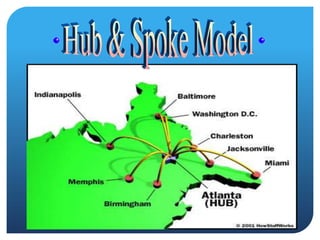
 Hub and Spoke Model –
 used by traditional / dominant airlines who concentrate their long haul
  and international flights at a hub while branching out short haul
  services to other cities.
 A long haul flight out of the hub typically waits for passengers from
  connecting flights to board. Since the volume of passengers is
  significantly higher, there is a need for Very Large Aircrafts.


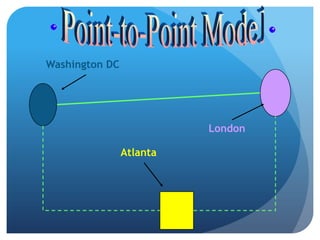
 Point to Point Model –
 used by regional or budget airlines who deploy their aircrafts on a
  specific route between 2 airports
 the airplane typically does not need to wait for connecting flights;
  which results in a faster turnaround time as compared to the 1st model
Washington DC


                          London

                Atlanta
The Boeing Company
 Founded in 1916.


 Forefront of Civil Aviation for almost a century

   From B17s and B29s during World War II,

    B52 during Cold War to Boeing787.


 Is into sales of:-
       Commercial Aircrafts
       Military Aircrafts
       Missiles
       Space System Controls
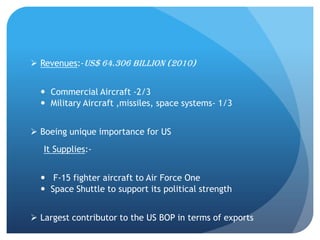
 Revenues:-US$ 64.306 billion (2010)


   Commercial Aircraft -2/3
   Military Aircraft ,missiles, space systems- 1/3


 Boeing unique importance for US
   It Supplies:-


   F-15 fighter aircraft to Air Force One
   Space Shuttle to support its political strength


 Largest contributor to the US BOP in terms of exports
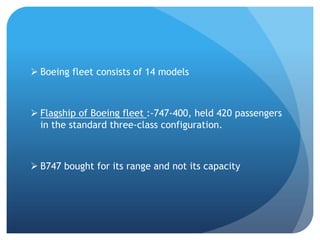
 Boeing fleet consists of 14 models


 Flagship of Boeing fleet :-747-400, held 420 passengers
  in the standard three-class configuration.


 B747 bought for its range and not its capacity
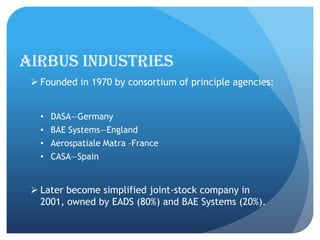
AIRBUS INDUSTRIES
  Founded in 1970 by consortium of principle agencies:


   •   DASA—Germany
   •   BAE Systems—England
   •   Aerospatiale Matra –France
   •   CASA—Spain


  Later become simplified joint-stock company in
   2001, owned by EADS (80%) and BAE Systems (20%).
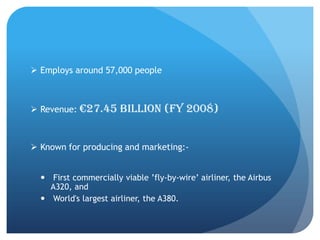
 Employs around 57,000 people


 Revenue: €27.45      billion (FY 2008)


 Known for producing and marketing:-


   First commercially viable ’fly-by-wire’ airliner, the Airbus
    A320, and
   World's largest airliner, the A380.
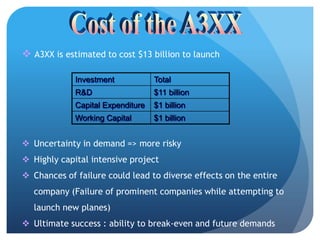
 A3XX is estimated to cost $13 billion to launch

             Investment            Total
             R&D                   $11 billion
             Capital Expenditure   $1 billion
             Working Capital       $1 billion


 Uncertainty in demand => more risky
 Highly capital intensive project
 Chances of failure could lead to diverse effects on the entire
   company (Failure of prominent companies while attempting to
   launch new planes)
 Ultimate success : ability to break-even and future demands
Why is Airbus interested in building
the A3XX?

 Enter new segment – VLA

 An optimistic outlook at receiving orders for VLA aircraft
  owing to its capture of more than half of the VLA
  market by terms of orders (in 1999)

 Market research – potential and increased demand

 Growing economies in Asia like China

 Increasing point to point route frequency is not a
  solution as it leads to congestion
Cont.


 Large range of travel without any stopovers - key point
  in purchase decision making

 Better operating economy – 12 % more to operate as
  compared to 747s but has 35% more space

 More customer satisfaction, comfort

 Higher number of premium flyers
Cont.
 4 engines per aircraft as compared to the usual 2
  engines increase the safety factor

 Would be the King of the air and any premium airline
  would feel the need to have it

 More sources of revenue due to increased space

 Commercial aviation sector leader
What are its objectives
 Ascertain the need

 Secure as many orders

 Build a new product that could match the requirements
  of the industry over the next 20 years

 Meet the standards and norms for building very large
  aircrafts according to the U.S Federal Aviation
  Administration (FAA)
Cont.
 Secure cheap source of financing with risk mitigation of
  the project

 Create a product that would be the highest level of
  luxury and thus would be imperative for any premium
  airline brand to purchase to drive up revenues from its
  high yield business class flyers

 Increase sales of its product and capture majority of the
  commercial airline industry to become a leading player
  (ahead of the current leader Boeing)
Economies of Large Projects
Benefits of large scale projects
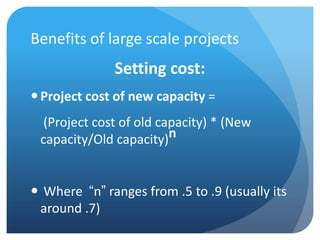
              Setting cost:
 Project cost of new capacity =
  (Project cost of old capacity) * (New
 capacity/Old capacity)n


 Where “n” ranges from .5 to .9 (usually its
 around .7)
Example
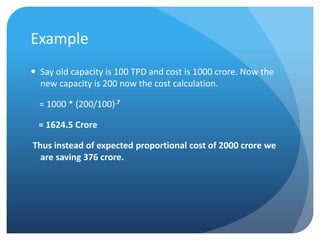
 Say old capacity is 100 TPD and cost is 1000 crore. Now the
  new capacity is 200 now the cost calculation.

  = 1000 * (200/100).7

  = 1624.5 Crore

Thus instead of expected proportional cost of 2000 crore we
  are saving 376 crore.
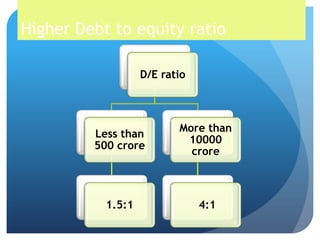
Higher Debt to equity ratio

                   D/E ratio


                          More than
         Less than
                           10000
         500 crore
                            crore


           1.5:1               4:1
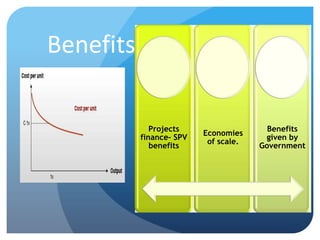
Benefits

              Projects                   Benefits
                          Economies
           finance– SPV                 given by
                           of scale.
              benefits                 Government
CONTD...
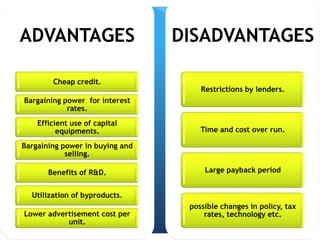
ADVANTAGES                       DISADVANTAGES

        Cheap credit.
                                     Restrictions by lenders.
Bargaining power for interest
            rates.
    Efficient use of capital
          equipments.                Time and cost over run.

Bargaining power in buying and
            selling.

       Benefits of R&D.               Large payback period


  Utilization of byproducts.
                                  possible changes in policy, tax
Lower advertisement cost per          rates, technology etc.
           unit.
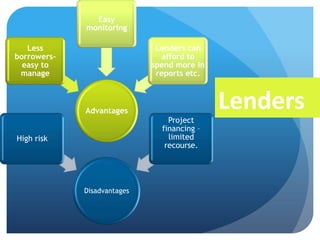
Easy
             monitoring

   Less                       Lenders can
borrowers-                      afford to
  easy to                    spend more in
 manage                       reports etc.


             Advantages
                                             Lenders
                                 Project
                               financing –
High risk                        limited
                                recourse.


             Disadvantages
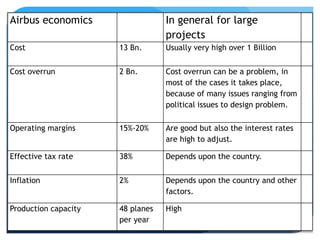
Airbus economics                  In general for large
                                  projects
Cost                  13 Bn.      Usually very high over 1 Billion

Cost overrun          2 Bn.       Cost overrun can be a problem, in
                                  most of the cases it takes place,
                                  because of many issues ranging from
                                  political issues to design problem.

Operating margins     15%-20%     Are good but also the interest rates
                                  are high to adjust.

Effective tax rate    38%         Depends upon the country.

Inflation             2%          Depends upon the country and other
                                  factors.

Production capacity   48 planes   High
                      per year
Limited Optionality
 On the decision making process, Airbus has limited
  optionality with respect to the fact that it does not
  have a product in the Very Large Aircraft (VLA) category
  that is therefore dominated by rival Boeing and its 747
  series of aircraft.

 If it fails to take the decision of going ahead, there is no
  other option for the aircraft operators but to purchase
  VLAs from Boeing.
Cont.
 In Finance, Optionality: The value of additional optional
  investment opportunities available only after having
  made an initial investment.

 The investment decision itself involves considerable
  optionality (to ramp up, abandon, change, etc.)

 It is important to recognize that there is limited optionality
  here.

 For example, the value resulting from an ability to stage
  investment is less in this case because one does not learn
  much about demand during the construction process—most of
  the demand will not materialize until several years hence.
Cont.
 A decision to wait before committing to industrial launch has
  limited benefit for the same reason, as the demand cannot be
  ascertained in a short period of time.

 It will be a trade off if they decide to hold on until sufficient
  demand rises at the risk of not being able to fulfill the orders
  in a timely manner.

 Finally, the highly specialized nature of the assets and
  development research implies that abandonment has little
  value.

 The investments put into the development and construction
  of the final product cannot fetch a sizeable percentage of the
  initial value.
Thank you

Airbus A3XX: Developing the World’s Largest Commercial Jet

  • 1.
    Airbus A3XX: Developing theWorld’s Largest Commercial Jet Group 1 111 Rakshit Jhunjunwala 115 Ankitesh Mathur 211 Manu Shrivastava 301 Balagopal Padmakumar 402 Rishi Bajaj
  • 2.
    Airline Industry –An Overview  Highly competitive  Capital and Labor intensive  Seasonal industry – increased revenues in 2nd and 3rd quarters  Sensitive – Fuel Prices, Price of airfares and customer demand
  • 3.
    Industry Trends • Growth in the industry YTD (2004 over RPK ASK PLF FTK ATK 2000) Growth Growth Growth Growth Africa 17.00% 13.60% 1.9 11.50% 4.00% Asia Pacific 11.70% 14.90% -2.0 25.30% 21.80% Europe 1.80% -0.20% 2.6 6.90% 3.00% Middle East 48.40% 43.20% 2.6 53.50% 51.20% North America 4.10% -0.50% 3.4 2.00% 3,20% South America 11.70% 7.60% 2.7 13.90% 18.80% Industry 8.10% 7.20% 0.6 15.90% 11.80% Where RPK : Revenue per Passenger Kilometer ASK : Available Seat Kilometers PLF : Passenger Load Factor FTK : Freight Ton Kilometer ATK : Available Ton Kilometer Source : www.iata.org
  • 4.
    Dynamics of AirlineIndustry Competitiveness of an Airline depends on two factors: 1. Revenue - ability of a firm to fill the seats in an airplane Break Even Load Factor (BLF) which measures the percentage of capacity needed on a plane to cover its costs. BLF for profitable airlines has generally fluctuated between 60% and 65%. 2. Costs – mostly uncontrollable • Labour – Competitive Wage Structure • Fuel • Maintenance Costs are also attributed to flight time, flight distance, landing fees, en-route charges, handling, administrative costs and opportunity costs of not flying.
  • 5.
    Dominant Business Models Currently 2 dominant business models in the airline industry  Hub and Spoke Model –  used by traditional / dominant airlines who concentrate their long haul and international flights at a hub while branching out short haul services to other cities.  A long haul flight out of the hub typically waits for passengers from connecting flights to board. Since the volume of passengers is significantly higher, there is a need for Very Large Aircrafts.  Point to Point Model –  used by regional or budget airlines who deploy their aircrafts on a specific route between 2 airports  the airplane typically does not need to wait for connecting flights; which results in a faster turnaround time as compared to the 1st model
  • 7.
    Washington DC London Atlanta
  • 8.
    The Boeing Company Founded in 1916.  Forefront of Civil Aviation for almost a century  From B17s and B29s during World War II, B52 during Cold War to Boeing787.  Is into sales of:-  Commercial Aircrafts  Military Aircrafts  Missiles  Space System Controls
  • 9.
     Revenues:-US$ 64.306billion (2010)  Commercial Aircraft -2/3  Military Aircraft ,missiles, space systems- 1/3  Boeing unique importance for US It Supplies:-  F-15 fighter aircraft to Air Force One  Space Shuttle to support its political strength  Largest contributor to the US BOP in terms of exports
  • 10.
     Boeing fleetconsists of 14 models  Flagship of Boeing fleet :-747-400, held 420 passengers in the standard three-class configuration.  B747 bought for its range and not its capacity
  • 11.
    AIRBUS INDUSTRIES Founded in 1970 by consortium of principle agencies: • DASA—Germany • BAE Systems—England • Aerospatiale Matra –France • CASA—Spain  Later become simplified joint-stock company in 2001, owned by EADS (80%) and BAE Systems (20%).
  • 12.
     Employs around57,000 people  Revenue: €27.45 billion (FY 2008)  Known for producing and marketing:-  First commercially viable ’fly-by-wire’ airliner, the Airbus A320, and  World's largest airliner, the A380.
  • 13.
     A3XX isestimated to cost $13 billion to launch Investment Total R&D $11 billion Capital Expenditure $1 billion Working Capital $1 billion  Uncertainty in demand => more risky  Highly capital intensive project  Chances of failure could lead to diverse effects on the entire company (Failure of prominent companies while attempting to launch new planes)  Ultimate success : ability to break-even and future demands
  • 14.
    Why is Airbusinterested in building the A3XX?  Enter new segment – VLA  An optimistic outlook at receiving orders for VLA aircraft owing to its capture of more than half of the VLA market by terms of orders (in 1999)  Market research – potential and increased demand  Growing economies in Asia like China  Increasing point to point route frequency is not a solution as it leads to congestion
  • 15.
    Cont.  Large rangeof travel without any stopovers - key point in purchase decision making  Better operating economy – 12 % more to operate as compared to 747s but has 35% more space  More customer satisfaction, comfort  Higher number of premium flyers
  • 16.
    Cont.  4 enginesper aircraft as compared to the usual 2 engines increase the safety factor  Would be the King of the air and any premium airline would feel the need to have it  More sources of revenue due to increased space  Commercial aviation sector leader
  • 17.
    What are itsobjectives  Ascertain the need  Secure as many orders  Build a new product that could match the requirements of the industry over the next 20 years  Meet the standards and norms for building very large aircrafts according to the U.S Federal Aviation Administration (FAA)
  • 18.
    Cont.  Secure cheapsource of financing with risk mitigation of the project  Create a product that would be the highest level of luxury and thus would be imperative for any premium airline brand to purchase to drive up revenues from its high yield business class flyers  Increase sales of its product and capture majority of the commercial airline industry to become a leading player (ahead of the current leader Boeing)
  • 19.
  • 21.
    Benefits of largescale projects Setting cost:  Project cost of new capacity = (Project cost of old capacity) * (New capacity/Old capacity)n  Where “n” ranges from .5 to .9 (usually its around .7)
  • 22.
    Example  Say oldcapacity is 100 TPD and cost is 1000 crore. Now the new capacity is 200 now the cost calculation. = 1000 * (200/100).7 = 1624.5 Crore Thus instead of expected proportional cost of 2000 crore we are saving 376 crore.
  • 23.
    Higher Debt toequity ratio D/E ratio More than Less than 10000 500 crore crore 1.5:1 4:1
  • 24.
    Benefits Projects Benefits Economies finance– SPV given by of scale. benefits Government
  • 25.
    CONTD... ADVANTAGES DISADVANTAGES Cheap credit. Restrictions by lenders. Bargaining power for interest rates. Efficient use of capital equipments. Time and cost over run. Bargaining power in buying and selling. Benefits of R&D. Large payback period Utilization of byproducts. possible changes in policy, tax Lower advertisement cost per rates, technology etc. unit.
  • 26.
    Easy monitoring Less Lenders can borrowers- afford to easy to spend more in manage reports etc. Advantages Lenders Project financing – High risk limited recourse. Disadvantages
  • 27.
    Airbus economics In general for large projects Cost 13 Bn. Usually very high over 1 Billion Cost overrun 2 Bn. Cost overrun can be a problem, in most of the cases it takes place, because of many issues ranging from political issues to design problem. Operating margins 15%-20% Are good but also the interest rates are high to adjust. Effective tax rate 38% Depends upon the country. Inflation 2% Depends upon the country and other factors. Production capacity 48 planes High per year
  • 28.
    Limited Optionality  Onthe decision making process, Airbus has limited optionality with respect to the fact that it does not have a product in the Very Large Aircraft (VLA) category that is therefore dominated by rival Boeing and its 747 series of aircraft.  If it fails to take the decision of going ahead, there is no other option for the aircraft operators but to purchase VLAs from Boeing.
  • 29.
    Cont.  In Finance,Optionality: The value of additional optional investment opportunities available only after having made an initial investment.  The investment decision itself involves considerable optionality (to ramp up, abandon, change, etc.)  It is important to recognize that there is limited optionality here.  For example, the value resulting from an ability to stage investment is less in this case because one does not learn much about demand during the construction process—most of the demand will not materialize until several years hence.
  • 30.
    Cont.  A decisionto wait before committing to industrial launch has limited benefit for the same reason, as the demand cannot be ascertained in a short period of time.  It will be a trade off if they decide to hold on until sufficient demand rises at the risk of not being able to fulfill the orders in a timely manner.  Finally, the highly specialized nature of the assets and development research implies that abandonment has little value.  The investments put into the development and construction of the final product cannot fetch a sizeable percentage of the initial value.
  • 31.