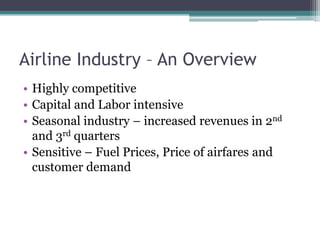
Airbus A3XX:Developing the World’s LargestCommercial JetPresented By:AkashJauhari – DCP056AlokMishra – DCP057Karan Verma – DCP072LokeshChaudhary – DCP075RaghavAgarwal – DCP087
Airline Industry – An OverviewHighly competitiveCapital and Labor intensiveSeasonal industry – increased revenues in 2nd and 3rd quartersSensitive – Fuel Prices, Price of airfares and customer demand
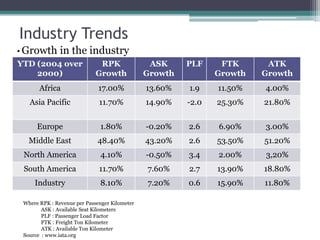
Industry TrendsGrowth in the industryWhere RPK : Revenue per Passenger KilometerASK : Available Seat Kilometers PLF : Passenger Load Factor FTK : Freight Ton Kilometer ATK : Available Ton KilometerSource  : www.iata.org
Dynamics of Airline IndustryCompetitiveness of an Airline depends on two factors:1. Revenue - ability of a firm to fill the seats in an airplaneBreak Even Load Factor (BLF) which measures the percentage of capacity needed on a plane to cover its costs. BLF for profitable airlines has generally fluctuated between 60% and 65%.2. Costs – mostly uncontrollable Labour – Competitive Wage Structure
 Fuel
 MaintenanceCosts are also attributed to flight time, flight distance, landing fees, en-route charges, handling, administrative costs and opportunity costs of not flying.
Dominant Business Models   Currently 2 dominant business models in the airline industryHub and Spoke Model – used by traditional / dominant airlines  who concentrate their long haul and international flights at a hub while branching out short haul services to other cities.
A long haul flight out of the hub typically waits for passengers from connecting flights to board. Since the volume of passengers is significantly higher, there is a need for Very Large Aircrafts.Point to Point Model – used by regional or budget airlineswho deploy their aircrafts on a specific route between 2 airports
the airplane typically does not need to wait for connecting flights; which results in a faster turnaround time as compared to the 1st modelThe Boeing CompanyFounded in 1916.
Forefront of Civil Aviation for almost a century From B17s and B29s during World War II,     B52 during Cold War to Boeing787.Is into sales of:-Commercial AircraftsMilitary AircraftsMissilesSpace System Controls
Revenues:-US$ 64.306 billion (2010)Commercial Aircraft -2/3 Military Aircraft ,missiles, space systems- 1/3Boeing unique importance for USIt Supplies:- F-15 fighter aircraft to Air Force OneSpace Shuttle to support its political strengthLargest contributor to the US BOP in terms of exportsBoeing fleet consists of 14 models
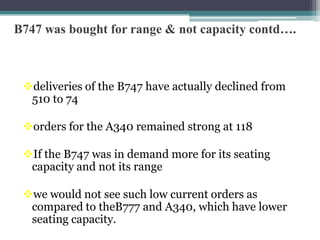
Flagship of Boeing fleet :-747-400, held 420 passengers in the standard three-class configuration.
B747 bought for its range and not its capacityAIRBUS INDUSTRIE Founded in 1970 by consortium of principle agencies:
DASA—Germany
BAE Systems—England
Aerospatiale Matra –France
CASA—Spain
Later become simplified joint-stock company in 2001, owned by EADS (80%) and BAE Systems (20%). Employs around 57,000 people
Revenue: €27.45 billion (FY 2008) 
Known for producing and marketing:-First commercially viable ’fly-by-wire’ airliner, the Airbus A320, andWorld's largest airliner, the A380.
A380 Vs B747  The A380 is much bigger than the B747
The A380 is a true double Decker while the B747 is not.
The A380 can accommodate 33% more passengers  than the B747
The A380 has more powerful engines than the B747
The B747 comes in a lot more variants than the A380 Strategies of Airbus & BoeingDeveloped countries are seeing a decrease in traffic but new markets are exploding.
Customers seem to want more comfort but are not willing to sacrifice speed and price for it.
Airbus tends to treat these changes by designing large aircraft and tinkering with them to adapt them to the market, while
Boeing invests in research and innovation hoping to recoup the costs through early replacement .Viability of A3XX
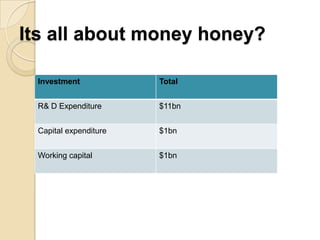
Its all about money honey?
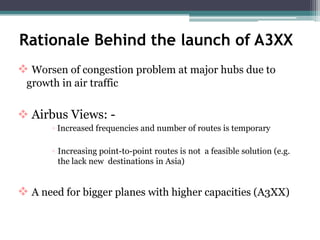
Rationale Behind the launch of A3XXWorsen of congestion problem at major hubs due to  growth in air traffic
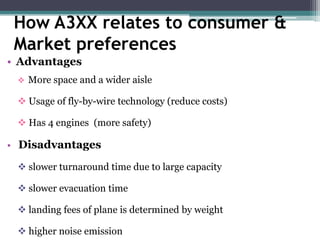
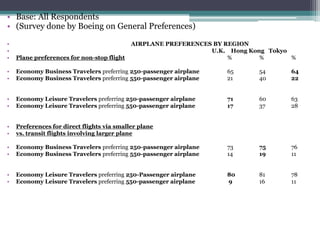
 Airbus Views: -Increased frequencies and number of routes is temporaryIncreasing point-to-point routes is not  a feasible solution (e.g.      the lack new  destinations in Asia)A need for bigger planes with higher capacities (A3XX)How A3XX relates to consumer & Market preferencesAdvantagesMore space and a wider aisle
 Usage of fly-by-wire technology (reduce costs)
 Has 4 engines  (more safety)Disadvantagesslower turnaround time due to large capacity

Airbus A3 xx

  • 1.
    Airbus A3XX:Developing theWorld’s LargestCommercial JetPresented By:AkashJauhari – DCP056AlokMishra – DCP057Karan Verma – DCP072LokeshChaudhary – DCP075RaghavAgarwal – DCP087
  • 2.
    Airline Industry –An OverviewHighly competitiveCapital and Labor intensiveSeasonal industry – increased revenues in 2nd and 3rd quartersSensitive – Fuel Prices, Price of airfares and customer demand
  • 3.
    Industry TrendsGrowth inthe industryWhere RPK : Revenue per Passenger KilometerASK : Available Seat Kilometers PLF : Passenger Load Factor FTK : Freight Ton Kilometer ATK : Available Ton KilometerSource : www.iata.org
  • 4.
    Dynamics of AirlineIndustryCompetitiveness of an Airline depends on two factors:1. Revenue - ability of a firm to fill the seats in an airplaneBreak Even Load Factor (BLF) which measures the percentage of capacity needed on a plane to cover its costs. BLF for profitable airlines has generally fluctuated between 60% and 65%.2. Costs – mostly uncontrollable Labour – Competitive Wage Structure
  • 5.
  • 6.
    MaintenanceCosts arealso attributed to flight time, flight distance, landing fees, en-route charges, handling, administrative costs and opportunity costs of not flying.
  • 7.
    Dominant Business Models Currently 2 dominant business models in the airline industryHub and Spoke Model – used by traditional / dominant airlines who concentrate their long haul and international flights at a hub while branching out short haul services to other cities.
  • 8.
    A long haulflight out of the hub typically waits for passengers from connecting flights to board. Since the volume of passengers is significantly higher, there is a need for Very Large Aircrafts.Point to Point Model – used by regional or budget airlineswho deploy their aircrafts on a specific route between 2 airports
  • 9.
    the airplane typicallydoes not need to wait for connecting flights; which results in a faster turnaround time as compared to the 1st modelThe Boeing CompanyFounded in 1916.
  • 10.
    Forefront of CivilAviation for almost a century From B17s and B29s during World War II, B52 during Cold War to Boeing787.Is into sales of:-Commercial AircraftsMilitary AircraftsMissilesSpace System Controls
  • 11.
    Revenues:-US$ 64.306 billion (2010)CommercialAircraft -2/3 Military Aircraft ,missiles, space systems- 1/3Boeing unique importance for USIt Supplies:- F-15 fighter aircraft to Air Force OneSpace Shuttle to support its political strengthLargest contributor to the US BOP in terms of exportsBoeing fleet consists of 14 models
  • 12.
    Flagship of Boeingfleet :-747-400, held 420 passengers in the standard three-class configuration.
  • 13.
    B747 bought forits range and not its capacityAIRBUS INDUSTRIE Founded in 1970 by consortium of principle agencies:
  • 14.
  • 15.
  • 16.
  • 17.
  • 18.
    Later become simplified joint-stockcompany in 2001, owned by EADS (80%) and BAE Systems (20%). Employs around 57,000 people
  • 19.
  • 20.
    Known for producingand marketing:-First commercially viable ’fly-by-wire’ airliner, the Airbus A320, andWorld's largest airliner, the A380.
  • 21.
    A380 Vs B747 The A380 is much bigger than the B747
  • 22.
    The A380 isa true double Decker while the B747 is not.
  • 23.
    The A380 canaccommodate 33% more passengers than the B747
  • 24.
    The A380 hasmore powerful engines than the B747
  • 25.
    The B747 comesin a lot more variants than the A380 Strategies of Airbus & BoeingDeveloped countries are seeing a decrease in traffic but new markets are exploding.
  • 26.
    Customers seem towant more comfort but are not willing to sacrifice speed and price for it.
  • 27.
    Airbus tends totreat these changes by designing large aircraft and tinkering with them to adapt them to the market, while
  • 28.
    Boeing invests inresearch and innovation hoping to recoup the costs through early replacement .Viability of A3XX
  • 29.
    Its all aboutmoney honey?
  • 30.
    Rationale Behind thelaunch of A3XXWorsen of congestion problem at major hubs due to growth in air traffic
  • 31.
    Airbus Views:-Increased frequencies and number of routes is temporaryIncreasing point-to-point routes is not a feasible solution (e.g. the lack new destinations in Asia)A need for bigger planes with higher capacities (A3XX)How A3XX relates to consumer & Market preferencesAdvantagesMore space and a wider aisle
  • 32.
    Usage offly-by-wire technology (reduce costs)
  • 33.
    Has 4engines (more safety)Disadvantagesslower turnaround time due to large capacity